

Global Aircraft Seating Market Size and Forecast – 2026 To 2033
The global aircraft seating market is expected to grow from USD 8.70 Bn in 2026 to USD 14.65 Bn by 2033, registering a compound annual growth rate (CAGR) of 6.2% from 2026 to 2033. The global aircraft seating market is driven by increasing demand for premium cabin experiences. On April 13, 2026, Delta announced it is introducing its next generation Delta One suite on new Airbus A350-1000 aircraft following a two-year intentional design process and a decade of data from customers and employees alike.
Key Takeaways of the Global Aircraft Seating Market
- The Commercial Aircraft segment is expected to account for 47.0% of the global aircraft seating market share in 2026. Growing aircraft cabin refurbishment and seat replacement is driving the growth of the segment. On February 18, 2026, Lufthansa announced a modernization program covering 38 Airbus A320 aircraft, with completion planned by 2029. The program installs new seats supplied by Italian manufacturer Geven, USB-A and USB-C ports, and smartphone holders.
- The Economy Class segment is estimated to capture 43.0% of the market share in 2026. Rising demand for lightweight and fuel-efficient seating is majorly driving the growth of the segment. On March 23, 2026, easyJet selected Mirus Aircraft Seating’s Kestrel economy seat for future Airbus A320neo and A321neo deliveries covering 237 aircraft orders.
- The Standard Seats segment is estimated to capture 38.0% of the market share in 2026. Growth of low-cost airlines is driving the growth of the segment. In January 2026, Southwest Airlines introduced assigned seating and additional seat categories for travel. Its new cabin offering includes Extra Legroom seats with up to five additional inches of legroom compared with standard and preferred seats.
- North America is expected to dominate the aircraft seating market in 2026 with a market share of 31.0%. Growing adoption of smart seats with power and connectivity features in North America is driving the growth of the regional market. On September 30, 2025, American Airlines revealed new regional aircraft interiors incorporating in-seat electricity and high-speed satellite Wi-Fi. The rollout covers Embraer E175, Embraer E170, Bombardier CRJ700, and Bombardier CRJ900 aircraft operated by regional carriers.
- Asia Pacific is expected to account for 26.0% share in 2026. Growing use of recyclable and sustainable seating materials in Asia Pacific is driving the growth of the regional market. In July 2026, the Korea AeroSpace Administration launched a five-year program to develop recyclable, flame-retardant thermoplastic composites for aircraft components.
Segmental Insights
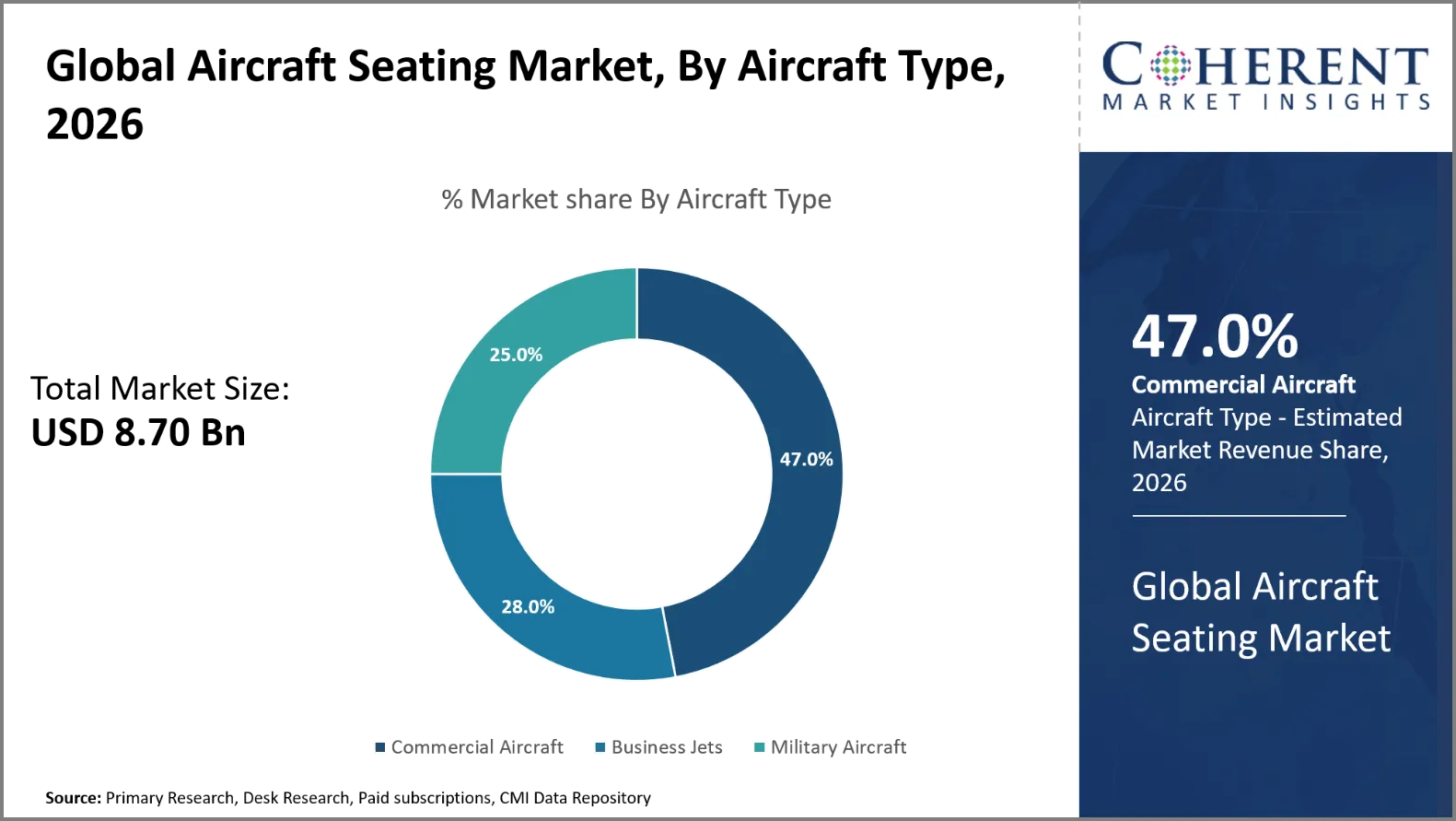
Why Does Commercial Aircraft Dominate the Global Aircraft Seating Market?
The commercial aircraft segment is expected to account for 47.0% of the global aircraft seating market share in 2026. Commercial aircraft dominates because airlines operate with fleets to serve domestic and international passenger routes. Rising air travel demand supports aircraft acquisition, fleet expansion, and cabin remodeling. Each commercial airplane requires several passenger seats, creating enormous demand for seating systems across economy, premium economy, business, and first-class cabins. Increasing aircraft deliveries also increase original equipment demand, while maintenance and refurbishment programs promote aftermarket sales. Airlines also invest in lightweight seats, which help them use less fuel, give passengers more room and cut operational costs.
On January 12, 2026, Airbus announced it has delivered 793 commercial aircraft to 91 customers globally in 2025 and registered 1,000 new gross orders in the Commercial Aircraft business. The backlog at the end of December 2025 increased to a new year-end record of 8,754 aircraft highlighting the strong market demand for Airbus’ product portfolio.
- Current Industry Events of 2026
- Market Size Estimation
- Regional Breakdown
- Competitive Landscape
- Customer Intelligence
- Segmental Analysis
- Pricing Analysis
- Key Market Drivers, Challenges & Future Trends
- Customized Insights Section
Why is Economy Class the Most Preferred Seating Class?
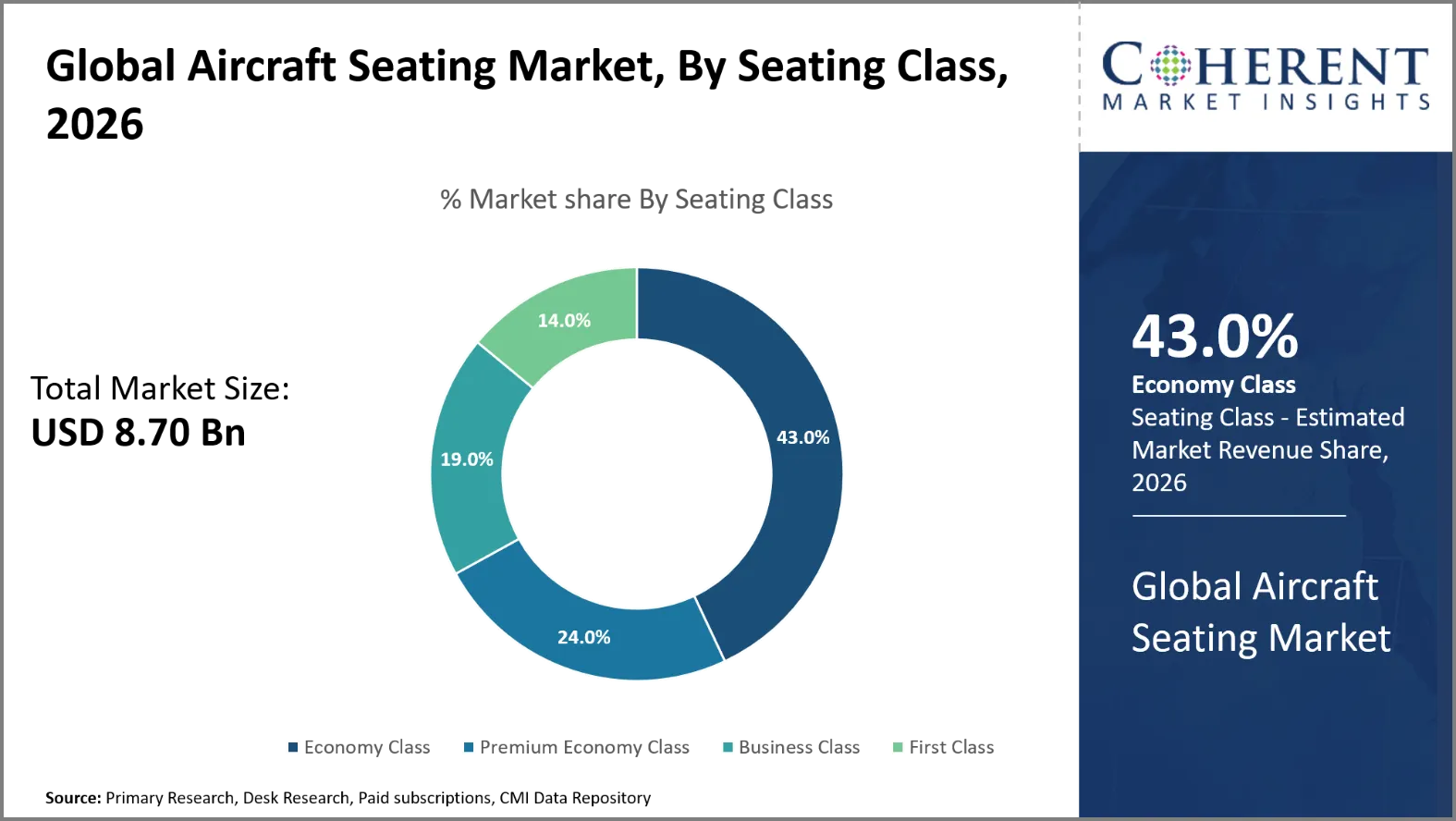
The economy class segment is expected to account for 43.0% of the global aircraft seating market share in 2026. Economy class remains the most popular seating class as it accommodates the majority of passengers on most commercial flights. Airlines favor economy seating to maximize passenger capacity and maintain inexpensive ticket costs. This sector is supported by growth in demand for affordable travel and expanding middle-income populations and increasing domestic air connections. Airlines can maximize income possibilities on busy routes by packing in the passengers. Lightweight, ergonomic economy seats made from durable materials and with simplified maintenance requirements are also produced by manufacturers.
On October 31, 2025, Air India’s legacy Airbus A320neo refurbishing program was completed, with 27 aircraft upgraded in the first phase. The airline reported that 104 A320-family aircraft now featured new or upgraded cabin interiors. The completed retrofit included 3,564 new Economy Class seats, alongside Premium Economy and Business Class seating.
Standard Seats Dominates the Global Aircraft Seating Market
The standard seats segment is expected to account for 38.0% of the global aircraft seating market share in 2026. The market is dominated by standard seats since it is the major seating option in most of the commercial aircraft cabins. Proven designs and their application to various aircraft configurations favor wide acceptance, together with the relatively low cost of production. Standard seats are liked by airlines as they provide a good mix between passenger comfort, cabin capacity, durability and maintenance efficiency. These seats can also be manufactured in series and ensure a steady supply for new aircraft deliveries and replacement programs. Because of their simple construction, they are often easy to service and easy to replace parts in.
On April 9, 2025, All Nippon Airways announced that its worldwide Premium Economy and Economy cabins will use new RECARO Aircraft Seating items. The seats are scheduled for gradual introduction on Boeing 787-9 aircraft beginning in fiscal 2026. The airline highlighted improved ergonomics, passenger comfort, functionality, and reclining capability.
Current Events and their Impact
Current Events | Description and its Impact |
U.K. - Civil Aviation Authority Safety Notice SN-2026/001 |
|
U.S. Federal Aviation Regulations, 14 CFR § 25.562 |
|
Aircraft Seating Market Dynamics
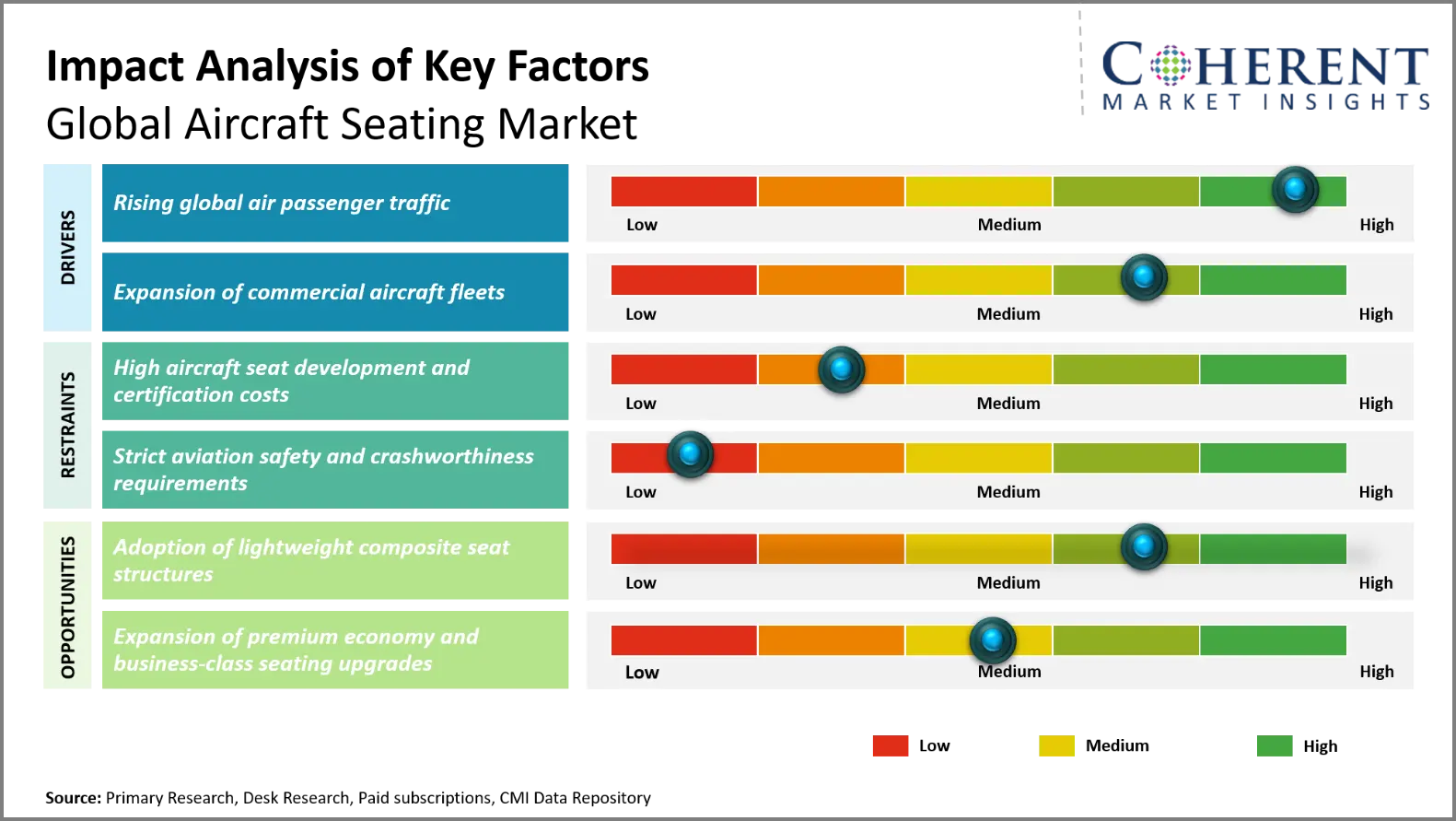
Market Drivers
Rising global air passenger traffic
The global aircraft seating market is driven by increasing global air passenger traffic, which fuels the demand for passenger capacity, cabin renovations, and increased sitting comfort. Increasing international tourism, corporate travel and domestic connection drive airlines to serve more passengers on short-haul and long-haul flights. Airlines also invest in ergonomic seating, durable upholstery and lightweight seat frames to improve the passenger experience and operational efficiency. Higher passenger volumes are supporting the recovery in travel demand for economy class seats and growth in premium travel is underpinning advanced business class and premium economy goods. These advancements offer opportunities for manufacturers supporting new aircraft programs and for replacement seats in existing commercial fleets.
On December 31, 2025, IndiGo stated it expects to serve more than 123 million users in 2025 compared with 113 million in 2024. The airline has grown its international network with 30 new international routes and 10 new international destinations over the year.
Expansion of commercial aircraft fleets
The global aircraft seating market is supported by the expansion of commercial aircraft fleets, with increased demand for factory-installed seats and cabin equipment. Airlines purchase new aircraft to open new routes, boost flight frequency and replace outdated, inefficient planes. Therefore, aircraft makers require seating systems that meet the necessary safety, weight, durability and passenger comfort standards. Fleet expansion also prompts providers to develop modular seating to ease installation and maintenance. Demand for high-density economy seats continues to be buoyed by growing low-cost carrier operations, while premium cabin installations are supported by long-haul fleet development.
On January 7, 2026, Alaska Airlines announced it is ordering 105 new 737-10 aircraft and five new 787 aircraft, exercising all previous 787 options held with Boeing. The airline also secured rights for an additional 35 737-10 aircraft. This order, representing the largest order in the airline’s history, secures critical delivery slots and extends the aircraft delivery stream through 2035.
Emerging Trends
- Lightweight Aircraft Seat Development: Advanced composites, light alloys and improved structural designs are being used by aircraft seat producers to reduce seat weight. Airlines can burn less fuel, decrease operating costs and hit emissions reduction targets with lighter seats that do not compromise structural integrity or passenger safety.
- Expansion of Premium Economy Seating: Airlines are increasing premium economy cabins to attract travelers who want more comfort without the expense of business class. Manufacturers are introducing bigger seats, improved recline mechanisms, enhanced privacy features and upgraded padding to promote diverse passenger experiences and increasing cabin income prospects.
- Integration of Smart Seating Technologies: Aircraft seats vendors are embedding passenger charging ports, customizable lighting controls, communication interfaces and electronic adjustment systems. These amenities add convenience and customization to meet current cabin standards. Manufacturers must measure the introduction of technology against weight, dependability, maintainability, and certification requirements.
- Growth of Sustainable Seating Materials: Manufacturers are researching recycled textiles, responsibly sourced materials, and durable upholstery and components that are easier to maintain. These changes help airlines achieve their environmental goals and cut material waste. Suppliers are looking at the impact of products throughout their life cycle, safety, comfort, durability and production costs.
Regional Insights
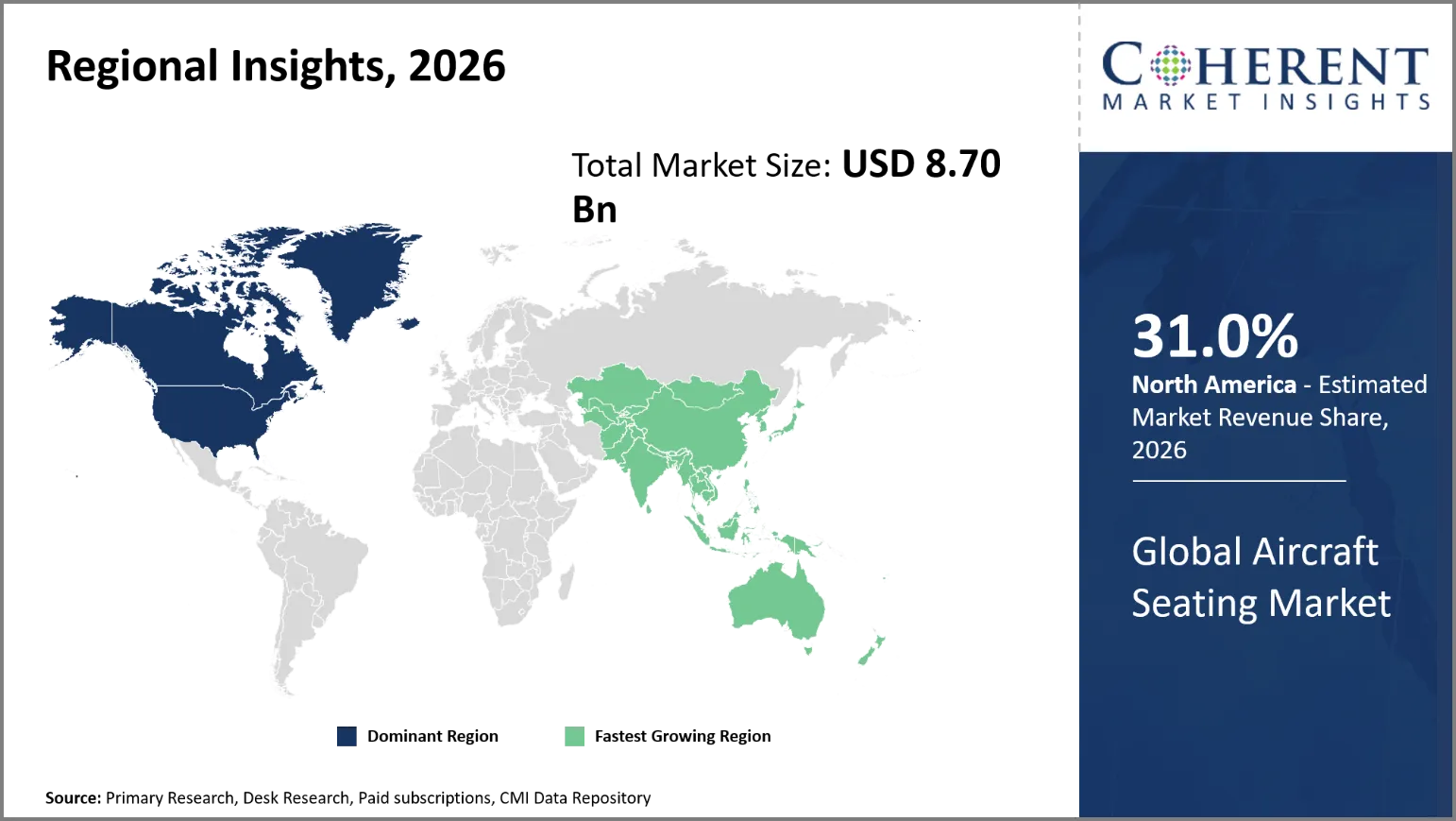
Why is North America a Strong Market for Aircraft Seating?
North America is expected to account for a market share of 31.0% in 2026. North America’s aircraft seating demand is strongly influenced by fleet replacement, aircraft cabin refurbishment, and airline investments in premium passenger experiences. Boeing’s 2025 Commercial Market Outlook identifies more than 8,000 aircraft in the region’s fleet at the end of 2024. It also cites large requirements for replacements as older aircraft are phased out. American Airlines said it will remodel the cabins of its Airbus A319 and A320 jets with new seats, updated finishes and power at every seat. The airline also planned additional premium seating capacity through these upgrades. These programs support demand for replacement seats, upgraded cabin layouts, and installation services.
Why Does Asia Pacific Aircraft Seating Market Exhibit High Growth?
Asia Pacific is expected to register the fastest growth with a CAGR of 6.6% over the forecast period. It is projected to account for 26.0% of the global aircraft seating market in 2026. Asia Pacific’s aircraft seating demand benefits from expanding intra-regional connectivity, low-cost carrier growth, and increasing demand for single-aisle aircraft. Airbus expects a requirement for 10,050 new passenger planes for Asia Pacific excluding China during the 2025-2044 period. The estimate comprises 81% single-aisle aircraft, which reflects the importance of regional and domestic routes. India’s growing aviation network and low-cost carriers in Southeast Asia offer potential for high-density economy seating and lightweight seat structures. Meanwhile, carriers that fly long-haul international routes need premium economy and business class offerings. Manufacturers able to deliver durable seats, quick maintenance support and variable cabin designs are ideally placed to meet these diverse operational needs.
Global Aircraft Seating Market Outlook for Key Countries
Why is U.S. Emerging as a Major Hub in the Aircraft Seating Market?
The U.S. aircraft seating industry is driven by airline fleet modernization, aircraft interior renovation and increased investments in premium passenger cabins. The U.S. Bureau of Transportation Statistics shows the aircraft seating capacity mix has evolved toward larger aircraft. 150-200 seat aircraft accounted for 43.10% of domestic flights in 2024. American Airlines is updating the interiors of its Airbus A319s and A320s with new seats, new finishes and power outlets at each seat. These programs show the desire for replacement seating and cabin renovations. Established airline partnerships and regional engineering capabilities assist suppliers such as Collins Aerospace and RECARO Aircraft Seating.
Is China the Next Growth Engine for the Aircraft Seating Market?
China’s aircraft seating industry is backed by domestic aircraft development, airline localization initiatives and the growth of the indigenous aerospace manufacturing sector. Domestic operators are adopting the C919 aircraft from the Commercial Aircraft Corporation of China, creating prospects for locally trained cabin equipment vendors. Airbus says China would need 9,570 new passenger aircraft between 2025 and 2044, indicating the scope of future aircraft purchase requirements. RECARO Aircraft Seating also maintains a production site in Qingdao, Shandong Province, expanding its local manufacturing footprint. These advances provide chances for supplier qualification, localized manufacturing and seat customization to meet Chinese airline standards.
Germany Aircraft Seating Market Analysis and Trends
Germany’s aviation seating business is supported by specialized seat engineering, certification testing and advanced production capabilities. RECARO Aircraft Seating is headquartered and has its main production site in Schwäbisch Hall where it produces the entire range of aircraft seating items. The company also has crash-testing and flammability-testing facilities to help product development and certification. In December 2025, RECARO announced intentions to expand test-seat production capacity at its German facilities by 60%. This investment addresses anticipated aircraft production growth and increasing demand for seating qualification. Germany’s engineering ecosystem therefore supports product development, safety validation, and export-oriented aircraft seating manufacturing.
France Aircraft Seating Market Analysis and Trends
France’s aircraft seating market benefits from Airbus commercial aircraft production, domestic aerospace engineering, and specialized passenger-seat manufacturing. Safran Seats operates production facilities in Issoudun, where it manufactures passenger and technical seating products. The portfolio includes economy, premium economy, business-class and first-class seats. One of the more noteworthy examples is the Air France Airbus A350 which features Safran Optima business class seats and Z300 economy seats. The configuration includes 34 business-class seats and 266 economy seats, demonstrating how one aircraft program generates demand across cabin classes. France’s strongest distinctive opportunity lies in integrated aircraft programs and customized seating development.
U.K. Aircraft Seating Market Analysis and Trends
The U.K. aircraft seating market benefits from premium-cabin engineering, specialized manufacturing, and international airline procurement programs. Thompson Aero Seating makes and installs top of the range airplane seats from its base in Portadown, Northern Ireland. UK (British and Northern Irish) seats manufacturing is export-led, with its goods used by airlines on six continents. In June 2026, the company revealed its 2025 revenue had grown by more than 30% to USD 298.6 million. It credited the result mostly to greater delivery numbers and demand for business class and first-class seating. This expansion demonstrates prospects in the reconfiguration of premium cabins, customizable seating platforms and long-haul airline deals.
Global Aircraft Seating Market - Aircraft Seat Delivery Backlog
Company | Backlog or Delivery Metric | Backlog Data | Reporting Period |
Airbus | Commercial aircraft order backlog | 9,222 aircraft | June 30, 2026 |
Boeing | Commercial aircraft order backlog | More than 6,200 aircraft, valued at approximately USD 597 billion | June 30, 2026 |
International Air Transport Association | Global aircraft order backlog | More than 17,000 aircraft | December 9, 2025 |
RECARO Aircraft Seating | Passenger seats produced | Nearly 120,000 seats | Full year 2025 |
How is Adoption of Lightweight Composite Seat Structures Creating New Growth Opportunities in the Aircraft Seating Market?
Growth prospects in the aircraft seating market are prominent, owing to the adoption of lightweight composite seat structures, which allow airlines to lower aircraft operating weight without sacrificing necessary structural performance. For example, Expliseat’s TiSeat platform employs titanium and composite materials to produce significant weight reductions over conventional passenger seats. It offers light weight designs for regional and short to medium-haul airplanes where the cumulative reduction in seat weight can enhance fuel efficiency over many flight cycles. Manufacturers may also utilize composite elements in seat backs, support structures and specific load-bearing elements as long as they meet certification standards. These advancements provide opportunity for providers that can demonstrate weight reductions, reduced maintenance requirements and compliance with aircraft refurbishment projects.
On September 1, 2025, Expliseat TiSeat 2X technology entered service with Air France, a major milestone for the company. This successful deployment positions Expliseat’s TiSeat 2X as the most advanced aircraft seat technology in the world, offering disruptive weight saving while taking passenger comfort to a new level.
Market Players, Key Development, and Competitive Landscape
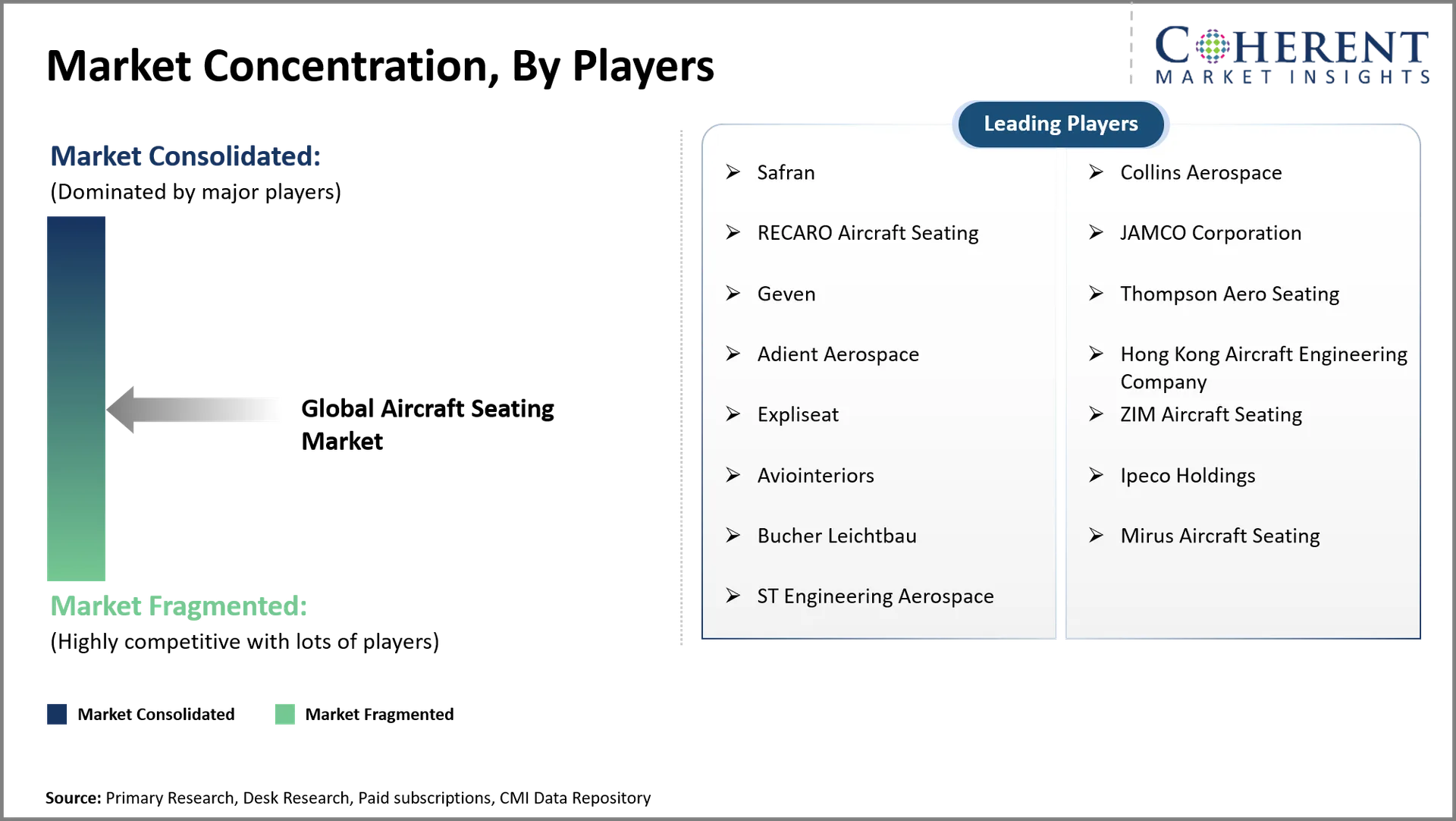
Key Developments
- On April 15, 2026, Collins Aerospace, an RTX business, announced that three international airlines have selected its Helix main cabin seat for upcoming narrowbody aircraft deliveries. With installations confirmed across Airbus A320 and Boeing 737 family variants, the initial orders will cover approximately 200 aircraft.
- On November 18, 2025, Emirates and Safran Seats signed a Memorandum of Understanding (MoU) to establish a manufacturing and seat assembly facility in Dubai, UAE. The joint industrial cooperation, the first of its kind, will initially concentrate on Business and Economy Class seats for cabin retrofit projects, with plans to expand to line fit in the future.
- On April 3, 2025, Safran Seats launched SeatLife, a comprehensive solution designed to support airlines at every stage of their seat’s lifecycle. From initial service to end-of-life management, SeatLife covers all aspects of training, maintenance, stock management, and sustainability.
Competitive Landscape
Leading players in the worldwide aircraft seating industry are Safran Seats, Collins Aerospace, and RECARO Aircraft Seating. These companies compete on the basis of product innovations, relationships with aircraft manufacturers, and cabin upgrade programs. Safran Seats supplies seats for economy, business and first class cabins and spare parts and repair services. Collins Aerospace specializes in modular seating systems, premium cabin solutions and integrated passenger amenities. RECARO Aircraft Seating focuses on lightweight designs, ergonomic comfort and development of production capacity. Thompson Aero Seating specializes in premium business and first-class goods, including lie-flat seat solutions. Expliseat competes with lightweight titanium and composite seat structures. These strategies demonstrate increasing competition around weight reduction, manufacturing reliability, certification capability, and customized airline cabin configurations.
Top Manufacturers and Notable Products in the Aircraft Seating Market
Manufacturer | Notable Product | Key features |
Safran Seats | Z400 | Economy seating, lightweight design approach, passenger comfort, configurable cabin options |
Collins Aerospace | Helix | Lightweight main-cabin seat, ergonomic design, durable construction, configurable features |
RECARO Aircraft Seating | CL3710 | Economy-class seating, ergonomic support, adjustable headrest, personal-device charging options |
Thompson Aero Seating | VantageXL | Business-class seating, lie-flat capability, privacy-focused design, efficient cabin integration |
Expliseat | TiSeat 2X | Titanium and composite structure, lightweight construction, reduced operating weight, ergonomic features |
Aircraft Seating Market Report Coverage | |||
Report Coverage | Details | ||
Base Year | 2025 | Market Size in 2026: | USD 8.70 Bn |
Historical Data For: | 2020 To 2024 | Forecast Period: | 2026 To 2033 |
Forecast Period 2026 To 2033 CAGR: | 6.2% | 2033 Value Projection: | USD 14.65 Bn |
Geographies covered: |
| ||
Segments covered: |
| ||
Companies covered: | Safran, Collins Aerospace, RECARO Aircraft Seating, JAMCO Corporation, Geven, Thompson Aero Seating, Adient Aerospace, Hong Kong Aircraft Engineering Company, Expliseat, ZIM Aircraft Seating, Aviointeriors, Ipeco Holdings, Bucher Leichtbau, Mirus Aircraft Seating, ST Engineering Aerospace | ||
Growth Drivers: |
| ||
Restraints & Challenges: |
| ||
Analyst Opinion (Expert Opinion)
- The future of the aircraft seating market will depend on manufacturers’ ability to combine lightweight construction, passenger comfort, and reliable delivery schedules. Airlines increasingly require seating platforms that support cabin differentiation without extensive redesign for every aircraft configuration. Composite structures, modular components, and simplified maintenance processes will become important competitive factors. The manufacturers who can best increase production consistency while keeping strict safety standards will be the ones who will win long term contracts with the airlines.
- The biggest potential will be in lightweight economy seating for high-utilization narrowbody aircraft and in premium business-class seating for long-haul services. India and China provide prospects for local manufacturing, supplier qualification and seating installations to support growing airline fleets. There are prospects for retrofit programs, premium cabin enhancements and replacement seating for existing fleets in the U.S. and Europe. Suppliers should focus on products that provide measurable weight savings, ease of maintenance and compatibility with certain aircraft platforms.
- To be ahead of the curve, manufacturers need to standardize seat constructions and provide variable upholstery, headrests, power options and passenger storage facilities. They must build early partnerships with aircraft manufacturers and airlines in cabin building efforts. Investing in automated production, proven digital engineering and accredited component supply chains can cut delivery delays. Companies should also set up regional repair capabilities and have accessible spare part inventories. Suppliers will be awarded with recurring contracts on the basis of proven lifecycle cost savings, on-time delivery pledges and efficient certification support.
Speak to the analyst
Want personalized insights?
Take the findings above to one of our principal consultants, or have the report rebuilt around the segments, geographies and competitors you actually track.
Market Segmentation
- Aircraft Type Insights (Revenue, USD Billion, 2021 - 2033)
- Commercial Aircraft
- Business Jets
- Military Aircraft
- Seating Class Insights (Revenue, USD Billion, 2021 - 2033)
- Economy Class
- Premium Economy Class
- Business Class
- First Class
- Seat Type Insights (Revenue, USD Billion, 2021 - 2033)
- Standard Seats
- Recliner Seats
- Lie-Flat Seats
- Suite Seats
- Pilot and Crew Seats
- Fit Type Insights (Revenue, USD Billion, 2021 - 2033)
- Line-Fit
- Retrofit
- End User Insights (Revenue, USD Billion, 2021 - 2033)
- Original Equipment Manufacturers
- Aftermarket
- MRO Service Providers
- Regional Insights (Revenue, USD Billion, 2021 - 2033)
- North America
- U.S.
- Canada
- Latin America
- Brazil
- Argentina
- Mexico
- Rest of Latin America
- Europe
- Germany
- U.K.
- Spain
- France
- Italy
- Russia
- Rest of Europe
- Asia Pacific
- China
- India
- Japan
- Australia
- South Korea
- ASEAN
- Rest of Asia Pacific
- Middle East
- GCC Countries
- Israel
- Rest of Middle East
- Africa
- South Africa
- North Africa
- Central Africa
- North America
- Key Players Insights
- Safran
- Collins Aerospace
- RECARO Aircraft Seating
- JAMCO Corporation
- Geven
- Thompson Aero Seating
- Adient Aerospace
- Hong Kong Aircraft Engineering Company
- Expliseat
- ZIM Aircraft Seating
- Aviointeriors
- Ipeco Holdings
- Bucher Leichtbau
- Mirus Aircraft Seating
- ST Engineering Aerospace
Sources
Primary Research Interviews
- Aircraft Seating Manufacturers
- Airline Operators & Fleet Managers
- Aircraft Interior Designers & OEMs
Magazines
- Aviation Week & Space Technology
- Aircraft Interiors International
- Airline Business Magazine
- Air Transport World (ATW)
Journals
- Journal of Aerospace Engineering
- International Journal of Aviation, Aeronautics, and Aerospace
- Journal of Air Transport Management
Associations
- International Air Transport Association (IATA)
- Aerospace Industries Association (AIA)
- Air Transport Association of America (ATA)
- European Aviation Safety Agency (EASA)
Public Domain Sources
- U.S. Federal Aviation Administration (FAA) Official Website
- ICAO Official Publications & Reports
- European Union Aviation Safety Agency (EASA) Public Reports
- NASA Technical Reports Server (NTRS)
Proprietary Elements
- CMI Data Analytics Tool
- Proprietary CMI Existing Repository of Information for the Last 10 Years
Get access to 250+ pages report
Every segment, forecast, competitor profile and data table behind the analysis above — available for instant download.
- ESOMAR Member
- ISO 9001:2015 Certified
- D-U-N-S Registered
- GDPR & CCPA Compliant
Frequently Asked Questions
The global aircraft seating market is expected to stand at USD 8.70 Bn in 2026 and is expected to reach USD 14.65 Bn by 2033.
The CAGR of the global aircraft seating market is projected to be 6.2% from 2026 to 2033.
Rising global air passenger traffic and Expansion of commercial aircraft fleets are the major factors driving the growth of the global aircraft seating market.
High aircraft seat development and certification costs and Strict aviation safety and crashworthiness requirements are the major factors hampering the growth of the global aircraft seating market.
In terms of aircraft type, commercial aircraft segment is estimated to dominate the market revenue share in 2026.
Line-fit aircraft seating refers to seats installed during aircraft production before delivery to the airline.
Retrofit aircraft seating involves replacing or upgrading existing seats in aircraft already operating within an airline fleet.