

Global ASIC Design Services Market Size and Forecast – 2026 To 2033
The global ASIC design services market is expected to grow from USD 10.00 Bn in 2026 to USD 21.00 Bn by 2033, registering a compound annual growth rate (CAGR) of 7.5% from 2026 to 2033. The global ASIC design services market is driven by rising demand for energy-efficient and high-performance semiconductor designs. On January 6, 2026, Ambiq Micro, Inc. announced the launch of Atomiq, the highly anticipated system-on-chip (SoC) integrating a Neural Processing Unit (NPU) designed to enable real-time, always-on artificial intelligence at the edge.
Key Takeaways of the Global ASIC Design Services Market
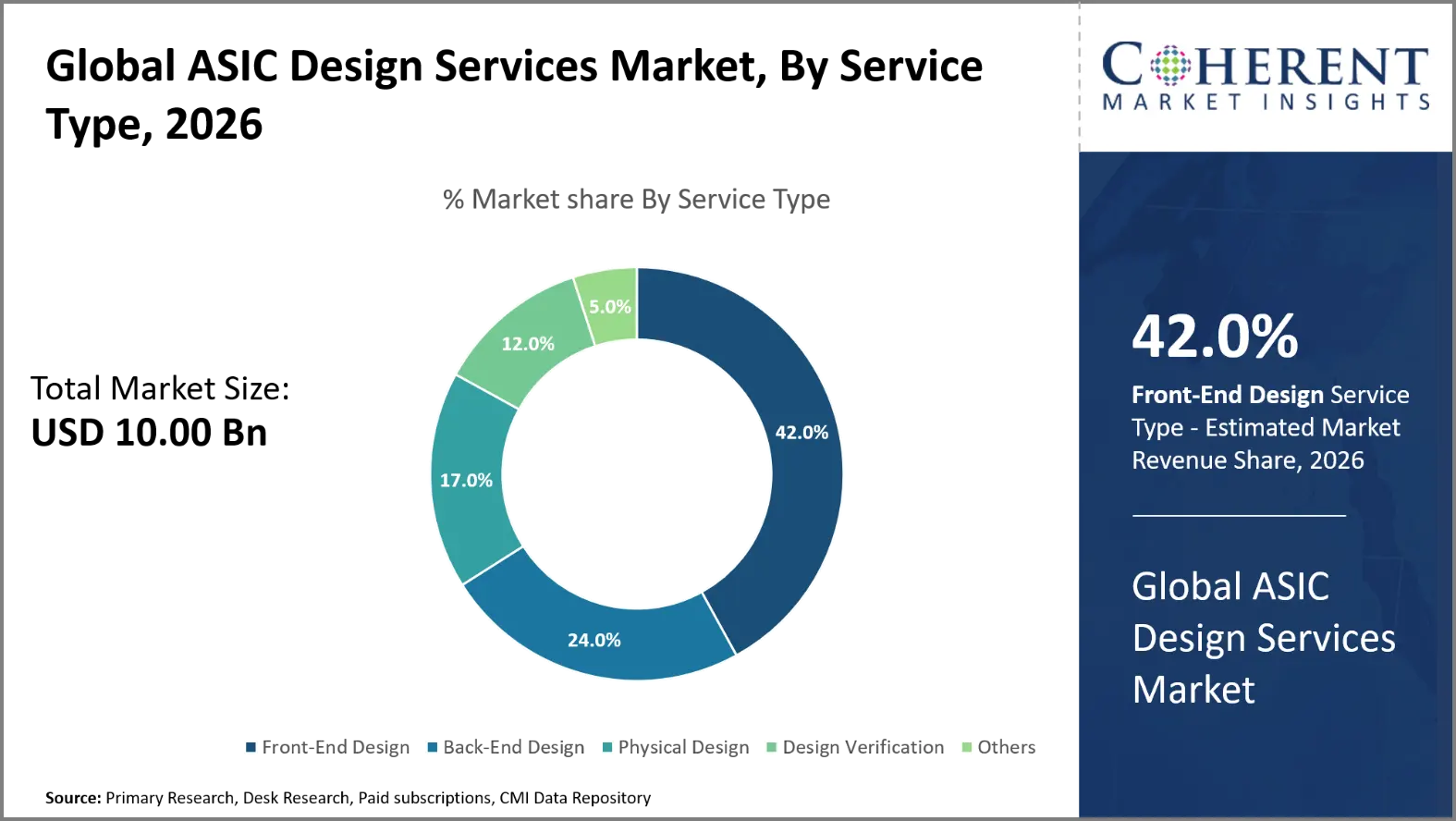
- The Front-End Design segment is expected to account for 42.0% of the global ASIC design services market share in 2026. Increasing complexity of automotive and industrial electronic systems is driving the growth of the segment. On March 27, 2025, EnSilica announced a design and supply contract exceeding US$ 18 million over seven years. The project covers an Arm-based mixed-signal sensor-interface ASIC for automotive and industrial applications.
- The Full-Custom Design segment is estimated to capture 39.0% of the market share in 2026. Expansion of advanced semiconductor nodes and chiplet-based architectures is majorly driving the growth of the segment. On April 22, 2026, Cadence announced expanded design infrastructure and artificial intelligence-assisted workflows for Taiwan Semiconductor Manufacturing Company's N3, N2, A16, and A14 process technologies.
- The Consumer Electronics segment is estimated to capture 34.0% of the market share in 2026. Growth in chiplet design and advanced packaging services is majorly driving the growth of the segment. On September 11, 2025, Tata Consultancy Services introduced chiplet-based system engineering services for semiconductor companies.
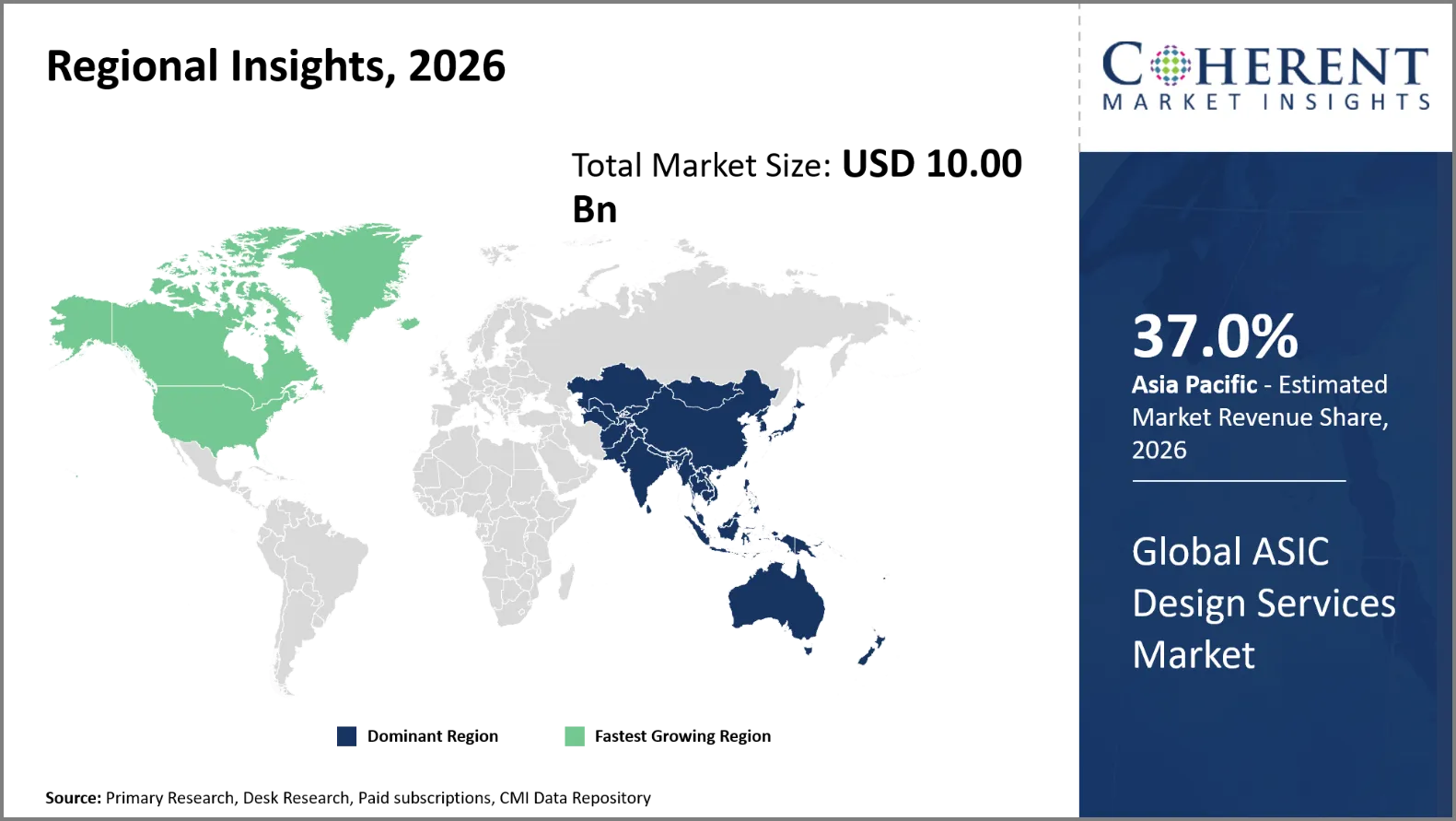
- Asia Pacific is expected to dominate the ASIC design services market in 2026 with a market share of 37.0%. Rising demand for low-power chips in Internet of Things devices in Asia Pacific is driving the growth of the regional market. On February 19, 2025, Renesas Electronics introduced 14 RA4L1 microcontroller devices featuring 80-megahertz Arm Cortex-M33 processor and integrated security capabilities. The devices consume 1.70 microamperes in standby mode while retaining all static random-access memory.
- North America is expected to account for 32.0% share in 2026 and is projected to record the fastest growth over the forecast period. Increasing adoption of application-specific integrated circuits in automotive electronics in North America is driving the growth of the regional market. On January 5, 2026, Texas Instruments introduced its TDA5 high-performance computing system-on-chip family for advanced driver assistance systems and software-defined vehicles. The processors deliver artificial intelligence performance ranging from 10 to 1,200 trillion operations per second.
Segmental Insights
Why Does Front-End Design Dominate the Global ASIC Design Services Market?
The front-end design segment is expected to account for 42.0% of the global ASIC design services market share in 2026. Front-end design is dominant, as it determines chip architecture, logic functionality and performance needs before physical implementation. This involves specification development, RTL coding, functional verification, logic synthesis and design-for-test planning. These activities determine power consumption, processing speed, chip functionality, and compatibility with the desired electronic system. The demand for application-specific processors and complicated System on Chip solutions is increasing the need for skilled engineers. Companies outsource front-end development to access experienced engineers, advanced electronic design automation tools, and reusable semiconductor intellectual property.
On September 22, 2026, Cadence introduced a new agent for Cadence ChipStack AI Super-Agent that automates front‑end digital design and verification; covering power, performance and area (PPA)-driven spec‑to‑RTL generation, RTL analysis, and refinement; all from natural language prompts.
- Current Industry Events of 2026
- Market Size Estimation
- Regional Breakdown
- Competitive Landscape
- Customer Intelligence
- Segmental Analysis
- Pricing Analysis
- Key Market Drivers, Challenges & Future Trends
- Customized Insights Section
Why is Full-Custom Design the Most Preferred Design Type?
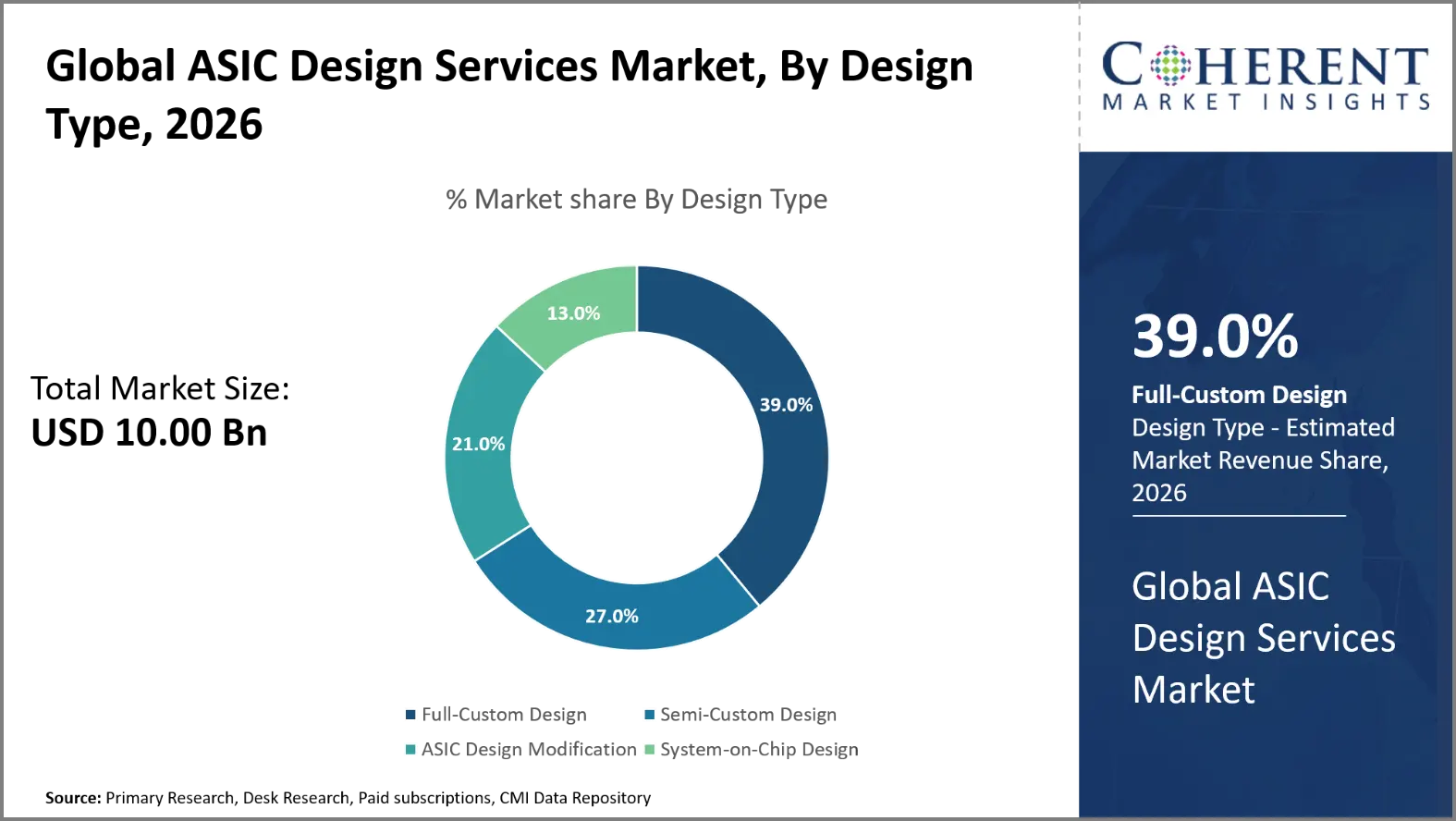
The full-custom design segment is expected to account for 39.0% of the global ASIC design services market share in 2026. When the application demands very tight control over the placement of transistors and circuit characteristics, as well as the use of silicon, then full-custom design is the primary choice. Engineers tailor the individual circuit elements for performance, power consumption and chip area. This helps memory circuits, analog parts, radio-frequency circuits and processor blocks when performance is crucial. Customized circuitry is used by consumer electronics makers to provide smaller devices, longer battery life, and differentiated product features. However, full-custom design demands large technical effort, longer development cycles and higher startup prices. Its suitability relies on the technological requirements, production quantities and the predicted product life.
On June 17, 2025, Marvell Technology announced custom static random-access memory designed for two-nanometer artificial intelligence infrastructure silicon. The design delivers up to six gigabits of high-speed memory while reducing total die area by up to 15%.
Consumer Electronics Dominates the Global ASIC Design Services Market
The Consumer Electronics segment is expected to account for 34.0% of the global ASIC design services market share in 2026. Consumer electronics is a major driver of demand for ASIC design services, with smartphones, televisions, wearables, gaming devices and smart home goods all requiring more specialized semiconductor capabilities. To boost processor efficiency, multimedia performance, connection, security and power consumption, manufacturers use bespoke chips. Application-specific integrated circuits are also used to combine several functionalities into smaller electronic components, which allow for slimmer gadgets and more battery life. New product introductions are forcing manufacturers to design distinctive hardware while managing component prices at scale.
On June 9, 2025, VeriSilicon stated that its artificial intelligence image signal processor technology has been deployed in mass-produced smartphones by a client. The specialized chip has both image processing and neural-network processing capabilities.
Current Events and their Impact
Current Events | Description and its Impact |
European Chips Act European Chips Act |
|
U.S. CHIPS and Science Act |
|
ASIC Design Services Market Dynamics
Market Drivers
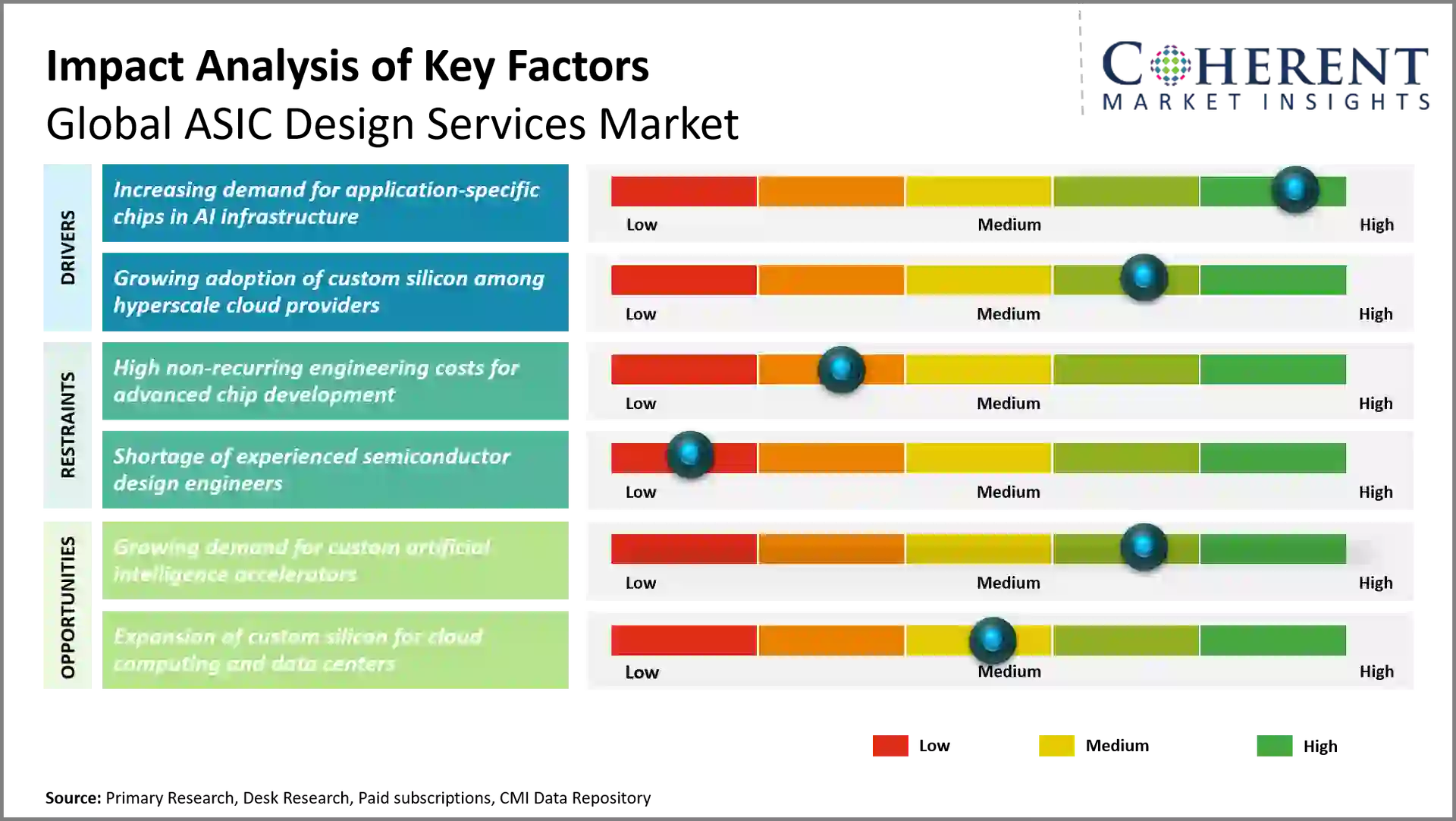
Increasing demand for application-specific chips in AI infrastructure
The rising deployment of artificial intelligence infrastructure is resulting in the demand for application specific integrated circuits suited for specialized computing workloads. Training and inference of artificial intelligence needs quick data transportation, parallel computation and high memory bandwidth. ASICs can provide workload specific performance with very little circuitry and energy usage. Technology businesses are building specialized accelerators for recommendation systems, generative AI, computer vision and huge language models. These criteria generate opportunity for ASIC design service providers specialized in architecture development, logic design, verification and physical implementation. Increasing electricity costs and data center power limitations are motivating customers to look for energy efficient silicon solutions.
On October 13, 2025, OpenAI and Broadcom announced a collaboration on 10 gigawatts of custom AI accelerators. The accelerators and systems will be designed by OpenAI and developed and deployed in conjunction with Broadcom.
Growing adoption of custom silicon among hyperscale cloud providers
Hyperscale cloud providers are designing more custom silicon to boost compute efficiency, cut infrastructure costs, and differentiate themselves in the cloud services market. Customized processors and accelerators may optimize workloads such as AI inference, machine learning, networking, storage and data processing. Tech giants such as Amazon, Google and Microsoft have poured resources into proprietary chip programs that serve their cloud ecosystems. To create these processors, manufacturers need competence in chip architecture, electronic design automation, verification and advanced packaging integration. ASIC design service providers can support such cloud enterprises who do not have enough internal engineering capabilities or demand additional development resources. Demand for proprietary processors is expanding, which is driving potential for joint chip development and long-term design service contracts.
On January 26, 2026, Microsoft introduced Maia 200, a breakthrough inference accelerator that drastically improves the economics of AI token creation. Maia 200 is an AI inference accelerator developed on TSMC’s 3nm process with native FP8/FP4 tensor cores, re-designed memory system with 216GB HBM3e at 7 TB/s and 272MB of on-chip SRAM.
Emerging Trends
- Artificial Intelligence-Specific Chip Architectures: ASIC design businesses are rapidly creating specialist designs for artificial intelligence training, inference, and edge computing. The designs are at the edge of computing throughput, memory access and energy efficiency. The growing demand for generative artificial intelligence acceleration is driving development of workload-specific chips.
- Advanced Packaging and Chiplet Integration: The growing complexity of semiconductors is driving ASIC designers to use chiplet architectures and advanced packaging technologies. These approaches incorporate specific functional blocks into integrated packages. Design vendors are demanding greater and greater expertise in die-to-die connectivity, thermal management, signal integrity and multi-die verification.
- Growing Adoption of High-Level Synthesis: High-level synthesis tools are becoming important since they can transform behavioral descriptions into hardware implementations. These tools can speed up design exploration and enhance the productivity of engineering. ASIC service providers are progressively integrating automated workflows with verification processes to deal with the difficult schedules of chip production.
- Increasing Focus on Design Security and Verification: Semiconductor companies are bolstering intellectual property protection, hardware security, and validation processes across ASIC development. Secure design approaches can discover vulnerabilities before the manufacturing starts. Increasing chip complexity and global supply-chain vulnerabilities are driving investment in formal verification and hardware security assessments.
Regional Insights
Why is Asia Pacific a Strong Market for ASIC Design Services?
Asia Pacific is expected to account for a market share of 37.0% in 2026. The semiconductor foundries, electronics manufacturers and specialized chip design businesses that are spread across Taiwan, South Korea, China, Japan and India add to the strength of the Asia Pacific’s semiconductor ecosystem. Taiwan Semiconductor Manufacturing Company has a sophisticated fab that allows fabless companies to create bespoke CPUs. Global Unichip and Alchip Technologies are specialists in application-specific integrated circuit development and advanced-node implementation. South Korea is a contributor through Samsung Electronics’ semiconductor design & production ecosystem. Japan backs demand in automotive electronics, industrial automation and imaging technologies. India’s rising semiconductor engineering workforce is strengthening regional design verification and physical implementation skills.
Why Does North America ASIC Design Services Market Exhibit High Growth?
North America is expected to register the fastest growth with a CAGR of 8.0% over the forecast period. North America is projected to account for 32.0% of the global ASIC design services market in 2026. North America benefits from hyperscale cloud companies commissioning proprietary processors for artificial intelligence infrastructure, networking, and cloud computing. Amazon develops Trainium and Inferentia accelerators, while Google develops Tensor Processing Units for machine learning workloads. Microsoft has introduced its Maia accelerator family for artificial intelligence infrastructure. These programmes create demand for architecture design, verification, physical implementation, and high-speed interconnect engineering. Broadcom and Marvell Technology also support customized silicon development for major technology customers. The region's distinctive growth factor is direct investment by cloud operators in silicon tailored to their computing platforms.
Global ASIC Design Services Market Outlook for Key Countries
Why is China Emerging as a Major Hub in the ASIC Design Services Market?
The domestic semiconductor replacement and the development of locally controlled chip technologies are supporting China’s ASIC design services sector. VeriSilicon provides bespoke silicon design, processor intellectual property and turnkey engineering services for consumer electronics, automotive electronics, industrial equipment and data processing applications. Its portfolio includes graphics processing, neural network processing, video processing, and image processing technologies. The company also reports more than 1,700 analog and mixed-signal intellectual property blocks. Domestic customers developing intelligent vehicles, surveillance systems, and artificial intelligence devices create demand for locally accessible design expertise. China's distinctive growth factor is the drive to strengthen domestic chip development and reduce dependence on overseas technology suppliers.
Is U.S. the Next Growth Engine for the ASIC Design Services Market?
The U.S. has a concentration of fabless semiconductor businesses, electronic design automation developers and system architects designing advanced chip specifications. Companies like Broadcom and Marvell Technology design specialized silicon solutions for networking, data processing and cloud infrastructure. Cadence Design Systems and Synopsys are providers of critical design automation software and semiconductor intellectual property which are utilized in different phases of chip design. The Semiconductor Industry Association lists high expenses of sophisticated chip design and a shortage of trained engineers among key competitive obstacles. Such conditions lead corporations to outsource specified engineering activities to specialist vendors. The country's distinctive growth factor is demand for sophisticated design expertise within a mature semiconductor innovation ecosystem.
Taiwan ASIC Design Services Market Analysis and Trends
Taiwan holds a distinctive position because ASIC design service companies operate closely with advanced foundries and packaging partners. Global Unichip provides system-on-chip integration, physical implementation, high-bandwidth memory interfaces, and advanced packaging design. Alchip Technologies supports complex artificial intelligence and high-performance computing processors, including advanced two-and-a-half-dimensional and three-dimensional integration. Taiwan Semiconductor Manufacturing Company maintains design partner programs that help customers implement chips using its manufacturing technologies. This collaboration helps align circuit design, packaging restrictions and fabrication needs. Taiwan’s unique growth factor is the close integration of ASIC engineering with foundry process development and improved semiconductor packaging.
South Korea ASIC Design Services Market Analysis and Trends
The South Korean ASIC design services industry is fueled by demand for specialized chips for memory systems, mobile devices, automotive electronics, and high-performance computers. ADTechnology provides platform-based ASIC services and has over 800 completed projects in mobile, automotive and high-performance computer applications. ASICLAND works with Arm and Taiwan Semiconductor Manufacturing Company to develop custom-designed semiconductors. These companies help system makers transform product needs into integrated circuits that can be manufactured. South Korea's existing know-how in memory semiconductors also presents potential for controllers and interfaces that support complicated memory architectures. The unique growth element is that it needs to build specialist logic chips coupled with the strong memory semiconductor ecosystem of the country.
India ASIC Design Services Market Analysis and Trends
India’s ASIC design services industry benefits from its existing semiconductor engineering talent, and increasing demand for outsourced design execution. HCLTech, Wipro, Tata Elxsi and L&T Technology Services have semiconductor engineering expertise across verification, embedded systems and physical design. Faraday Technology also has technical support facilities in India, linking local engineering resources with worldwide semiconductor development projects. The government’s Design Linked Incentive plan encourages qualifying domestic semiconductor design activities and creation of intellectual property. Engineering teams in Bengaluru, Hyderabad, Noida, and other technology centers serve international semiconductor customers. India's distinctive growth factor is its ability to supply specialized engineering talent for distributed global chip development programs.
Global ASIC Design Services Market - Custom Accelerators for AI Inference
Company | Product | Primary Application | Memory Capacity | Memory Bandwidth |
Microsoft | Maia 200 | Large language model inference | 216 GB HBM3e | 7 TB/s |
Qualcomm | AI200 | Generative and agentic AI inference | 768 GB LPDDR per card | 414 TB/s per 56-card rack, published rack figure |
Qualcomm | AI250 | Memory-intensive inference and long-context models | 768 GB per card | 133 TB/s effective per card |
Ironwood TPU | Large-scale inference and reasoning | 192 GB HBM per chip | 7.37 TB/s per chip |
How is Growing Demand for Custom Artificial Intelligence Accelerators Creating New Growth Opportunities in the ASIC Design Services Market?
The growing need for custom AI accelerators is opening opportunities for ASIC design service providers to offer workload-specific chips for generative AI, recommendation engines and inference processing. Hyperscale cloud providers like Amazon with its Trainium and Google with its Tensor Processing Units modify silicon for their computer architectures. Such projects involve domain expertise in memory hierarchy design, high bandwidth memory integration, chiplet connection, power optimization and advanced packaging. ASIC design businesses can win contracts for architecture investigation, register-transfer-level design, functional verification, physical implementation, and tape-out preparation. Smaller AI firms also create opportunities by outsourcing the creation of accelerators, rather than developing expensive internal semiconductor engineering teams.
On April 14, 2026, Broadcom Inc. and Meta announced a multi-year, multi-generation strategic partnership to support Meta’s rapidly scaling artificial intelligence compute infrastructure. Building on their existing partnership, Broadcom will deliver technology supporting Meta Training and Inference Accelerator (MTIA) chips, with plans to extend through 2029.
Market Players, Key Development, and Competitive Landscape
Key Developments
- On September 17, 2026, Tata Consultancy Services launched its Custom System-on-Chip (SoC) Design Services for automotive OEMs and semiconductor ecosystem companies. This advanced range of services will help auto manufacturers conceive, design, verify, implement, and validate custom SoC solutions for the next-generation of software-defined vehicles.
- On May 5, 2026, Global Unichip Corp. (GUC), the advanced ASIC leader, announced a strategic technical collaboration with Wiwynn, an innovative cloud IT infrastructure provider for data centers. This collaboration integrates GUC's flagship SoC design and 2.5D/3D advanced packaging with Wiwynn's expertise in rack-scale system integration, liquid cooling and optical interconnect. Together, the collaboration enables hyperscale customers to transition more efficiently from silicon definition to deployment-ready AI infrastructure.
- On January 19, 2026, MosChip Technologies announced the successful silicon bring-up of SAC’s custom SoC in 28nm technology node, completing an end-to-end turnkey ASIC program from Netlist to packaged silicon. Following tape out with its proven Netlist to GDSII flow and methodology, MosChip did substrate design for a 10-Layer FC-CBGA package and Assembly and validated engineering samples on ATE, confirming functionality against specification.
Competitive Landscape
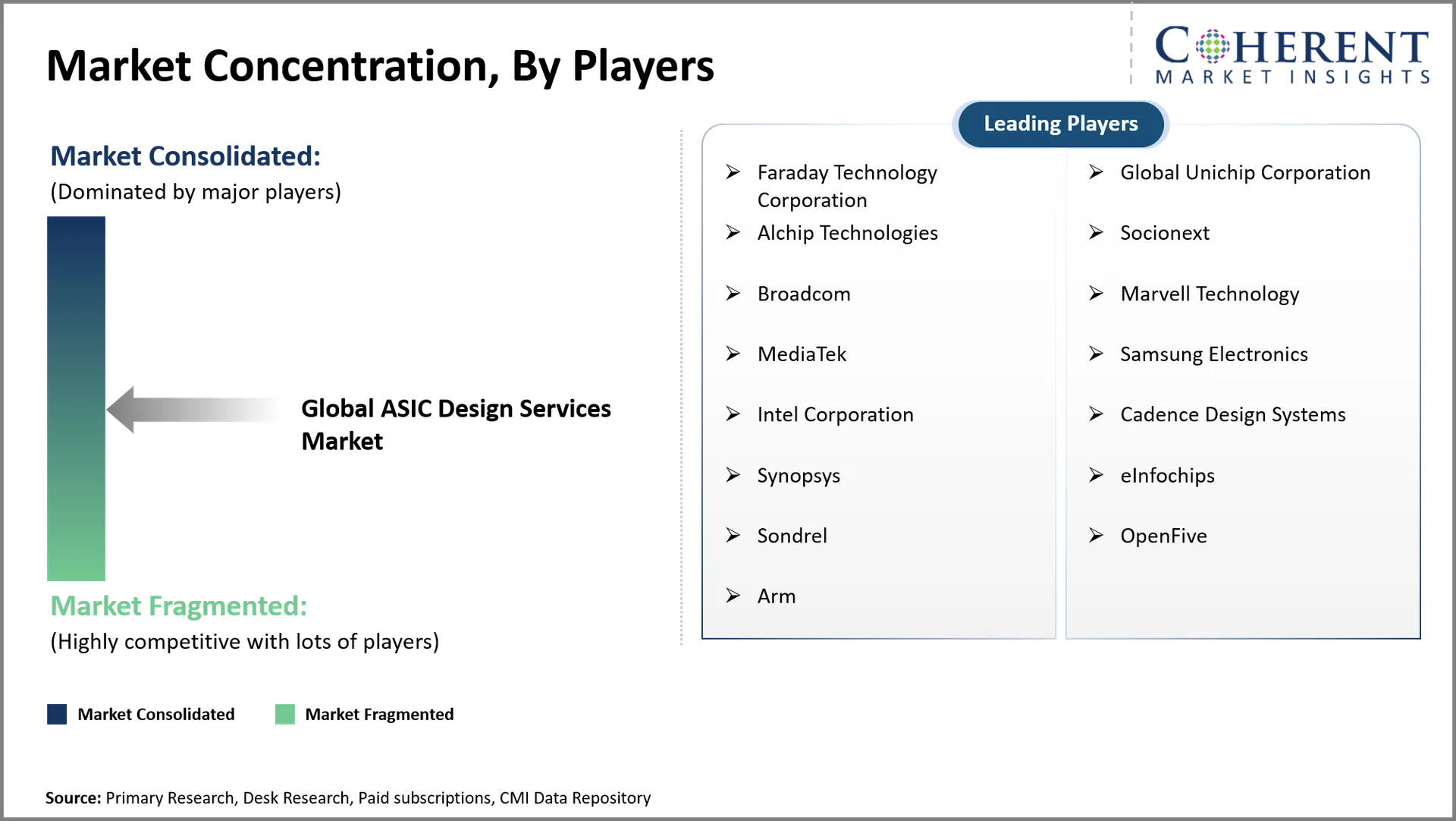
The global ASIC design services market features Broadcom, Marvell Technology, Global Unichip, Alchip Technologies, and VeriSilicon. Broadcom focuses on custom artificial intelligence accelerators and networking silicon for large cloud customers. Marvell Technology targets customized computing, optical connectivity, and data infrastructure solutions. Global Unichip provides system-on-chip integration, high-bandwidth memory interfaces, physical implementation and advanced packaging services. Alchip Technologies is focused on high-performance computing and artificial intelligence infrastructure, providing a full development service from chip design to production. VeriSilicon differentiates itself through silicon engineering services and reusable intellectual property for multimedia, artificial intelligence, automotive, and industrial applications.
Top Manufacturers and Notable Products in the ASIC Design Services Market
Manufacturer | Notable Product | Key features |
Broadcom | Custom AI accelerators | Application-specific integrated circuit design, advanced packaging, high-speed networking, and custom silicon for hyper scalers |
Ironwood Tensor Processing Unit | Custom inference acceleration, scalable pod architecture, high-bandwidth memory, and energy-efficient AI processing | |
Amazon Web Services | Trainium3 | Custom AI training and inference, 3-nanometer manufacturing, high-bandwidth memory, and improved performance per watt |
Microsoft | Maia 200 | Custom inference acceleration, 3-nanometer process, integrated high-bandwidth memory, and Azure AI workload optimization |
Meta | Meta Training and Inference Accelerator | Custom silicon for recommendation systems, AI training, inference workloads, and large-scale data-center deployment |
ASIC Design Services Market Report Coverage | |||
Report Coverage | Details | ||
Base Year | 2025 | Market Size in 2026: | USD 10.00 Bn |
Historical Data For: | 2020 To 2024 | Forecast Period: | 2026 To 2033 |
Forecast Period 2026 To 2033 CAGR: | 7.5% | 2033 Value Projection: | USD 21.00 Bn |
Geographies covered: |
| ||
Segments covered: |
| ||
Companies covered: | Faraday Technology Corporation, Global Unichip Corporation, Alchip Technologies, Socionext, Broadcom, Marvell Technology, MediaTek, Samsung Electronics, Intel Corporation, Cadence Design Systems, Synopsys, eInfochips, Sondrel, OpenFive, Arm | ||
Growth Drivers: |
| ||
Restraints & Challenges: |
| ||
Analyst Opinion (Expert Opinion)
- The future of ASIC design services will increasingly depend on workload-specific silicon rather than conventional chip customization alone. Artificial intelligence inference, cloud networking, and memory-intensive computing will require close coordination between processing architecture and data movement. Providers capable of integrating compute dies, high-bandwidth memory, and advanced packaging will gain stronger positions in complex projects. Global Unichip and Alchip Technologies demonstrate how specialized design houses can extend beyond front-end design into physical implementation and manufacturing coordination. The strongest long-term opportunities will involve chips designed around measurable customer requirements, including inference latency, power consumption, and operating cost.
- The most attractive opportunities will emerge in custom artificial intelligence accelerators for hyperscale cloud providers and networking processors supporting large data centers. The U.S. offers access to cloud operators developing proprietary silicon, while Taiwan offers close relationships between design houses, foundries, and advanced packaging partners. South Korea presents opportunities in memory-related logic and high-performance computing integration. India offers a compelling base for verification, physical design, and engineering execution. Providers should prioritize projects where customers need specialized functionality that general-purpose processors cannot deliver efficiently. They should also develop reusable design blocks for memory controllers, high-speed interfaces, security, and chiplet connectivity.
- ASIC design companies should build competitive advantages through verified intellectual property, predictable tape-out execution, and strong foundry collaboration. They should invest in high-bandwidth memory integration, advanced-node implementation, chiplet interoperability, and thermal-aware physical design. Early architecture modelling can identify performance bottlenecks before expensive fabrication commitments. Companies should also establish secure design environments and export-control compliance procedures for international projects. Smaller providers can differentiate themselves by specializing in particular workloads, such as automotive perception, industrial vision, or edge artificial intelligence. Long-term customer partnerships and measurable engineering outcomes will be more defensible advantages than competing primarily on hourly design costs.
Speak to the analyst
Want personalized insights?
Take the findings above to one of our principal consultants, or have the report rebuilt around the segments, geographies and competitors you actually track.
Market Segmentation
- Service Type Insights (Revenue, USD Billion, 2021 - 2033)
- Front-End Design
- Back-End Design
- Physical Design
- Design Verification
- Others
- Design Type Insights (Revenue, USD Billion, 2021 - 2033)
- Full-Custom Design
- Semi-Custom Design
- ASIC Design Modification
- System-on-Chip Design
- Application Insights (Revenue, USD Billion, 2021 - 2033)
- Consumer Electronics
- Telecommunications
- Automotive
- Industrial Electronics
- Healthcare Electronics
- Aerospace and Defense
- End User Insights (Revenue, USD Billion, 2021 - 2033)
- Semiconductor Companies
- Original Equipment Manufacturers
- Cloud Service Providers
- Automotive Manufacturers
- Industrial Technology Companies
- Fabless Semiconductor Companies
- Regional Insights (Revenue, USD Billion, 2021 - 2033)
- North America
- U.S.
- Canada
- Latin America
- Brazil
- Argentina
- Mexico
- Rest of Latin America
- Europe
- Germany
- U.K.
- Spain
- France
- Italy
- Russia
- Rest of Europe
- Asia Pacific
- China
- India
- Japan
- Australia
- South Korea
- ASEAN
- Rest of Asia Pacific
- Middle East
- GCC Countries
- Israel
- Rest of Middle East
- Africa
- South Africa
- North Africa
- Central Africa
- North America
- Key Players Insights
- Faraday Technology Corporation
- Global Unichip Corporation
- Alchip Technologies
- Socionext
- Broadcom
- Marvell Technology
- MediaTek
- Samsung Electronics
- Intel Corporation
- Cadence Design Systems
- Synopsys
- eInfochips
- Sondrel
- OpenFive
- Arm
Sources
Primary Research Interviews
- ASIC Design Engineers & Architects
- Semiconductor Foundry Representatives
- Electronics Manufacturing Service (EMS) Providers
- Fabless Semiconductor Companies
Magazines
- IEEE Spectrum Magazine
- EE Times (Electronic Engineering Times)
- Semiconductor Digest Magazine
- Chip Design Magazine
Journals
- IEEE Journal of Solid-State Circuits
- ACM Transactions on Design Automation of Electronic Systems
- Journal of Semiconductor Technology and Science
Associations
- Semiconductor Industry Association (SIA)
- Electronic Components Industry Association (ECIA)
- Global Semiconductor Alliance (GSA)
- IEEE Electron Devices Society
Public Domain Sources
- U.S. Semiconductor Industry Reports - U.S. Department of Commerce
- World Semiconductor Trade Statistics (WSTS)
- European Semiconductor Industry Association (ESIA) Public Reports
- International Trade Administration (ITA) - Semiconductor Sector Data
Proprietary Elements
- CMI Data Analytics Tool
- Proprietary CMI Existing Repository of Information for the Last 10 Years
Get access to 250+ pages report
Every segment, forecast, competitor profile and data table behind the analysis above — available for instant download.
- ESOMAR Member
- ISO 9001:2015 Certified
- D-U-N-S Registered
- GDPR & CCPA Compliant
Frequently Asked Questions
The global ASIC design services market is expected to stand at USD 10.00 Bn in 2026 and is expected to reach USD 21.00 Bn by 2033.
The CAGR of the global ASIC design services market is projected to be 7.5% from 2026 to 2033.
Increasing demand for application-specific chips in AI infrastructure and Growing adoption of custom silicon among hyperscale cloud providers are the major factors driving the growth of the global ASIC design services market.
High non-recurring engineering costs for advanced chip development and Shortage of experienced semiconductor design engineers are the major factors hampering the growth of the global ASIC design services market.
In terms of service type, front-end design segment is estimated to dominate the market revenue share in 2026.
ASIC design services cover the engineering activities required to develop application-specific integrated circuits for particular electronic applications.
Companies outsource ASIC design to access specialized engineering talent, advanced design tools, and additional development capacity without expanding internal teams.