

Global Automotive Coil Spring Market Size and Forecast – 2026 To 2033
The global automotive coil spring market is expected to grow from USD 2.75 Bn in 2026 to USD 3.80 Bn by 2033, registering a compound annual growth rate (CAGR) of 3.3% from 2026 to 2033. The global automotive coil spring market is driven by growing adoption of lightweight suspension components. On August 14, 2024, Carsolia Composites showcased its formed composite coil spring technology during Hannover Messe 2025. The company positions its composite spring as a lightweight alternative for automotive suspension systems.
Key Takeaways of the Global Automotive Coil Spring Market
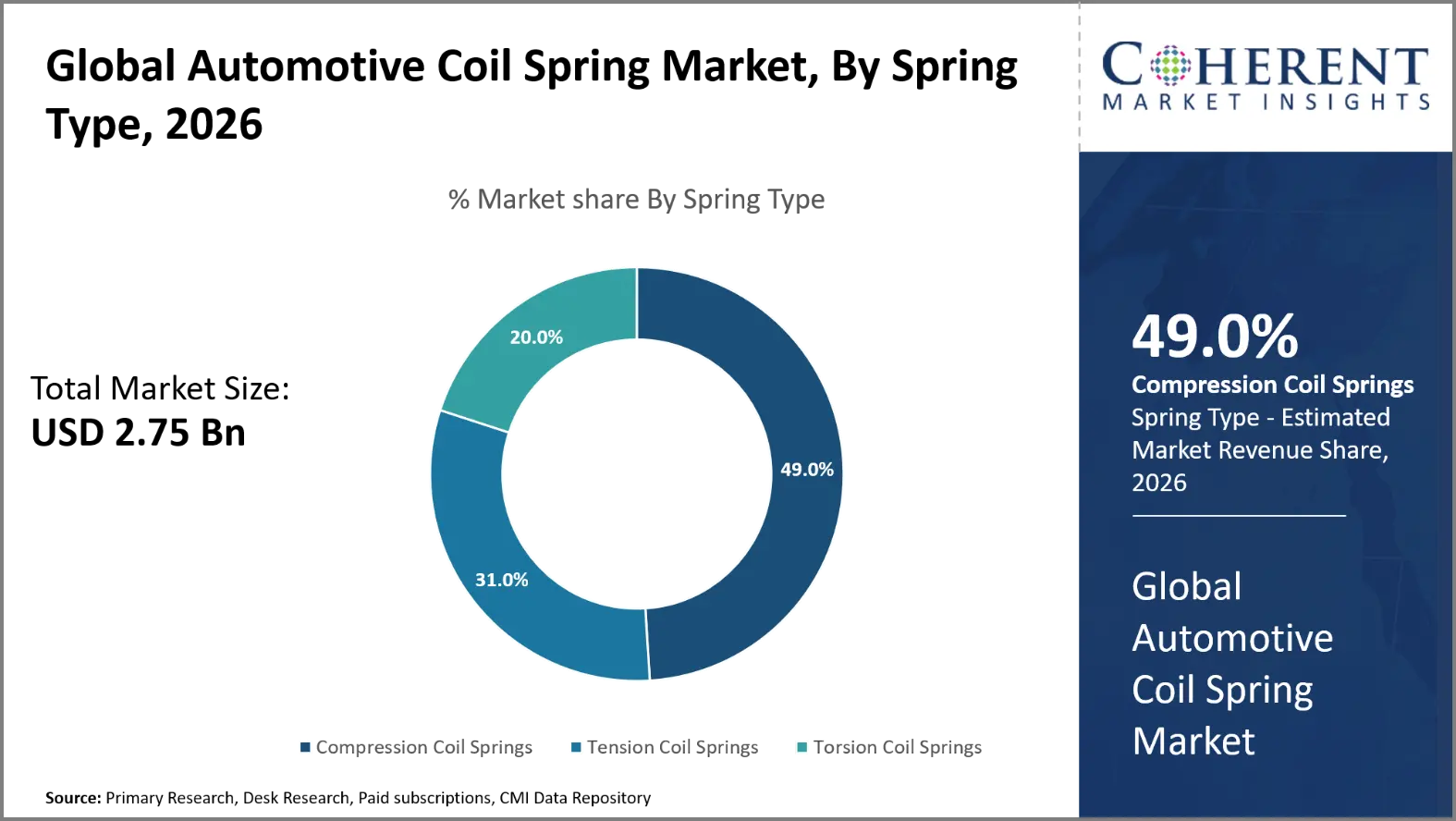
- The Compression Coil Springs segment is expected to account for 49.0% of the global automotive coil spring market share in 2026. Higher electric vehicle weight requirement is driving the growth of the segment. For example, the new Indian coil spring plant of Mitsubishi Steel is equipped with high-strength spring shot peening technology. The production line also includes enhanced coating capabilities.
- The High Tensile Steel segment is estimated to capture 42.0% of the market share in 2026. Expansion of automotive aftermarket replacement demand is majorly driving the growth of the segment. In September 2025, DRiV announced more than 500 additional Monroe coil spring stock-keeping units. The expansion targeted more than 92% coverage of Europe's light-vehicle market.
- The Passenger Cars segment is estimated to capture 56.0% of the market share in 2026. Increasing use of high strength spring steels is majorly driving the growth of the segment. In February 2026, Ansteel's automotive spring steel wire rods received recognition from Mubea Group. The companies had begun collaboration in 2025.
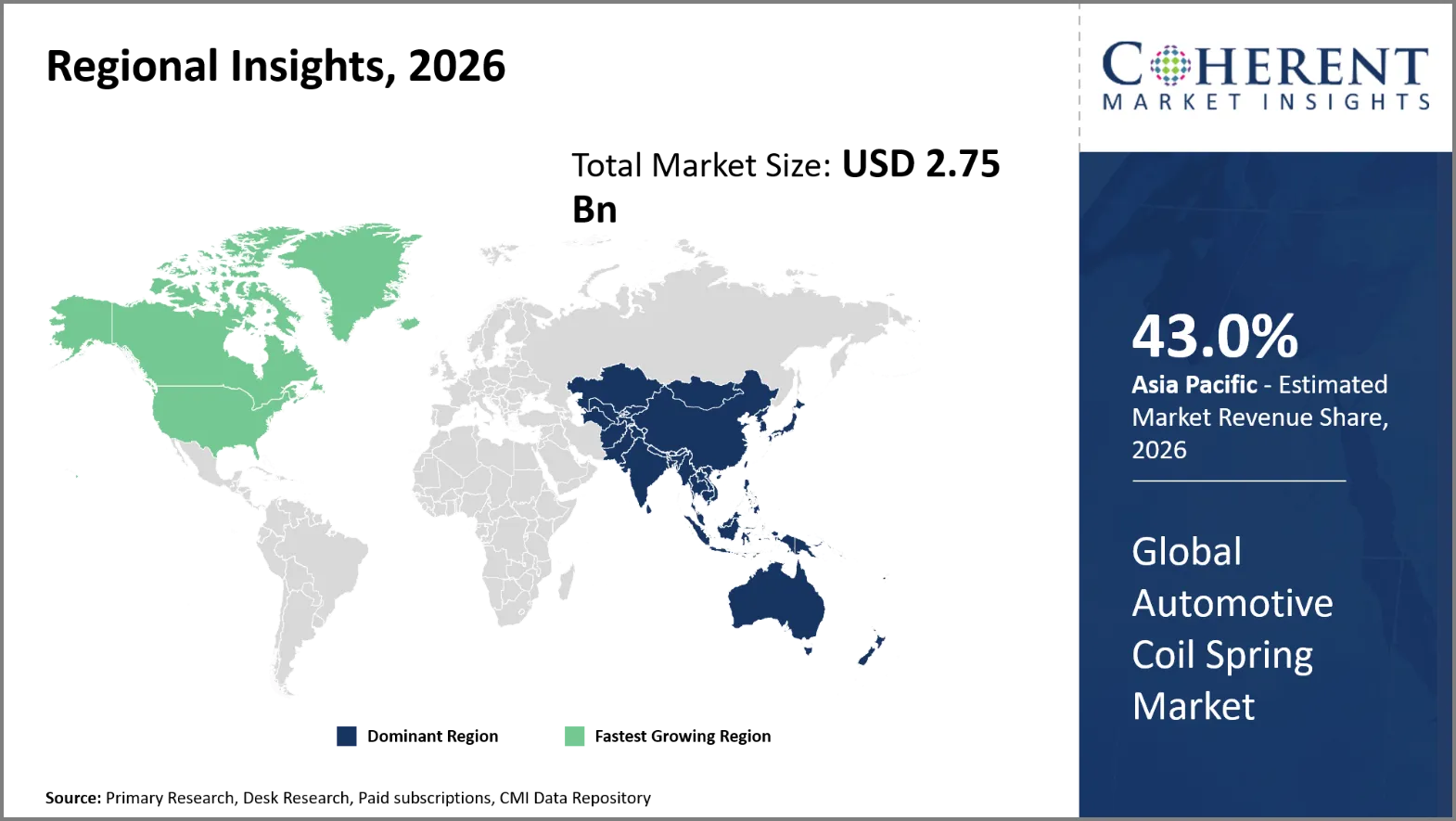
- Asia Pacific is expected to dominate the automotive coil spring market in 2026 with a market share of 43.0%. Rising vehicle production across Asia Pacific is driving the growth of the regional market. On July 30, 2026, Maruti Suzuki India Limited commenced commercial production at the fourth plant (Plant D) of its Hansalpur facility in Gujarat, India. The fourth plant, with annual capacity of 250,000 units, enhanced the facility’s total annual production capacity from 750,000 units to 1 million units.
- North America is expected to account for 23.0% share in 2026 and is projected to record the fastest growth over the forecast period. Growth of emerging automotive production units in North America is driving the growth of the regional market. On March 5, 2025, Hyundai Motor Group announced a significant investment of USD 21 billion in the U.S. from 2025 to 2028.
Segmental Insights
Why Does Compression Coil Springs Dominate the Global Automotive Coil Spring Market?
The compression coil springs segment is expected to account for 49.0% of the global automotive coil spring market share in 2026. Usually, compression coil springs are employed due to their efficiency in supporting the vehicle weight and absorbing suspension stresses. Its small-size fits into the current suspension architectures of passenger automobiles as well as commercial vehicles. Spring stiffness can be tuned by the manufacturers by wire diameter, coil geometry and active coil count. They have predictable behavior under repeated compression and rebound loading. Their proven manufacturing procedures also enable vehicle scale-up at cost-effective prices. On February 4, 2025, Mitsubishi Steel opened a new automotive coil spring factory in Bengaluru, India. The facility integrates hot forming, cold forming, and high-strength spring shot peening. Its coating line also supports corrosion protection for automotive coil springs. The company stated that the facility addresses increasing automobile demand in India.
- Current Industry Events of 2026
- Market Size Estimation
- Regional Breakdown
- Competitive Landscape
- Customer Intelligence
- Segmental Analysis
- Pricing Analysis
- Key Market Drivers, Challenges & Future Trends
- Customized Insights Section
Why is High Tensile Steel the Most Preferred Material?
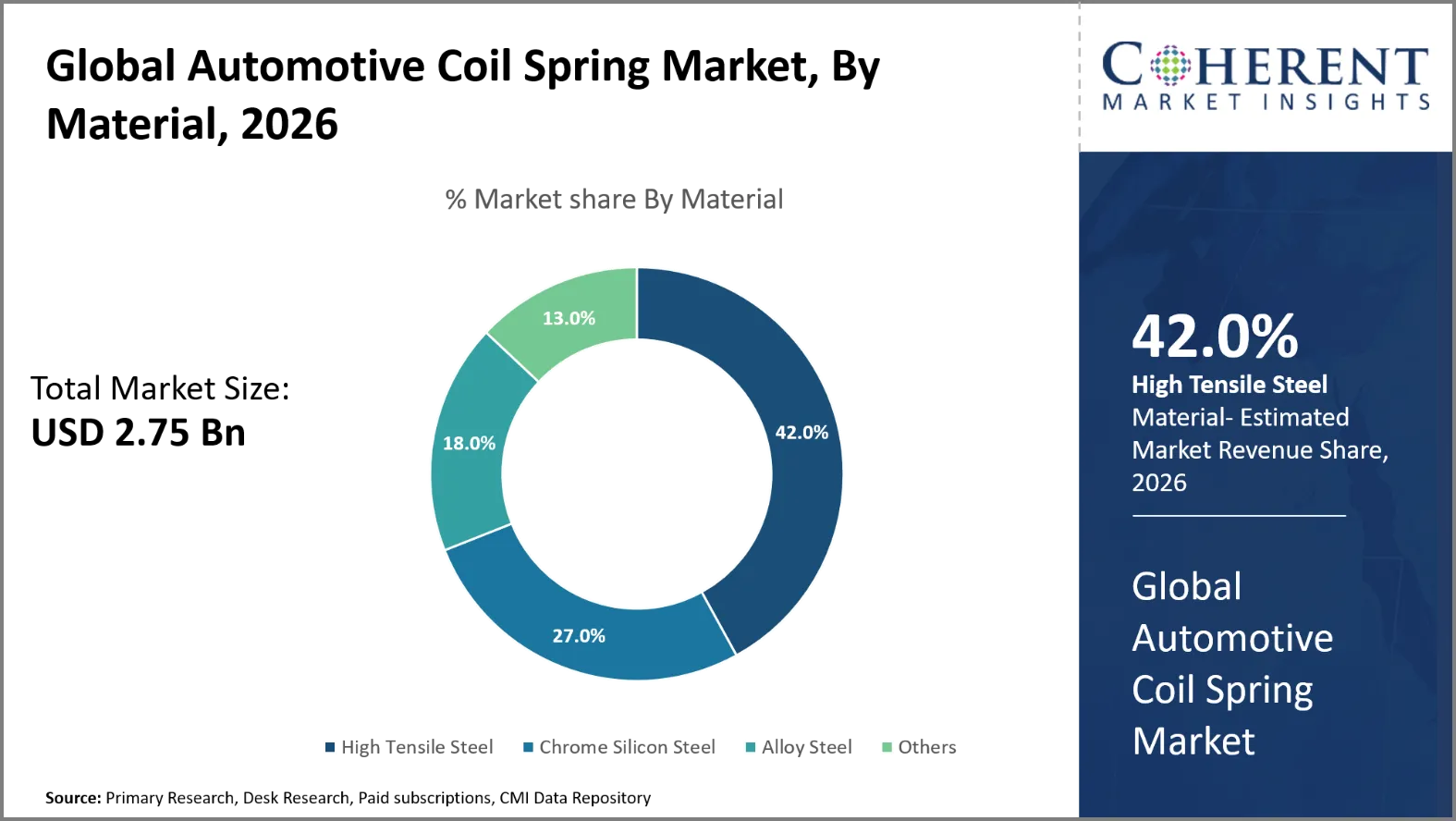
The high tensile steel segment is expected to account for 42.0% of the global automotive coil spring market share in 2026. High tensile steel gives good strength but is still comparatively low weight of material in vehicle suspension. Springs with high fatigue resistance can sustain multiple cycles of compression and rebound. The material allows for smaller spring sizes without sacrificing the needed load bearing capability. Manufacturers can achieve uniform spring properties by controlled heat treatment and forming techniques. It is also very durable, and has proven production procedures, making it a good fit for demanding vehicle suspension systems. On May 22, 2025, Tata Steel inaugurated its expanded Kalinganagar, India facility. The expansion increased crude steel capacity from 3 million to 8 million tons annually. The facility targets advanced high-strength steels for automotive applications. This expansion strengthens domestic availability of higher-strength steel grades for vehicle manufacturers.
Passenger Cars Dominates the Global Automotive Coil Spring Market
The passenger cars segment is expected to account for 56.0% of the global automotive coil spring market share in 2026. Passenger automobiles need suspension systems that provide a trade-off between ride comfort, handling, durability and vehicle weight. Coil springs offer uniform load bearing support for a wide range of passenger car platforms. They include a variety of spring rates to fit varied vehicle sizes, weights and suspension combinations. Large scale worldwide manufacture of passenger vehicles supports ongoing original equipment demand for these components. Replacement requirements also support ongoing demand in the automobile aftermarket. On May 11, 2026, Toyota Motor Corporation announced plans to develop a new Toyota Kirloskar Motor plant in the Bidkin industrial Area, Maharashtra, India. The new facility is expected to be operational in the first half of 2029 and is targeted at strengthening Toyota’s commercial base in the Indian market.
Current Events and their Impact
Current Events | Description and its Impact |
European Union - Regulation (EU) 2019/2144 |
|
U.S. - Federal Motor Vehicle Safety Standards |
|
Automotive Coil Spring Market Dynamics
Market Drivers
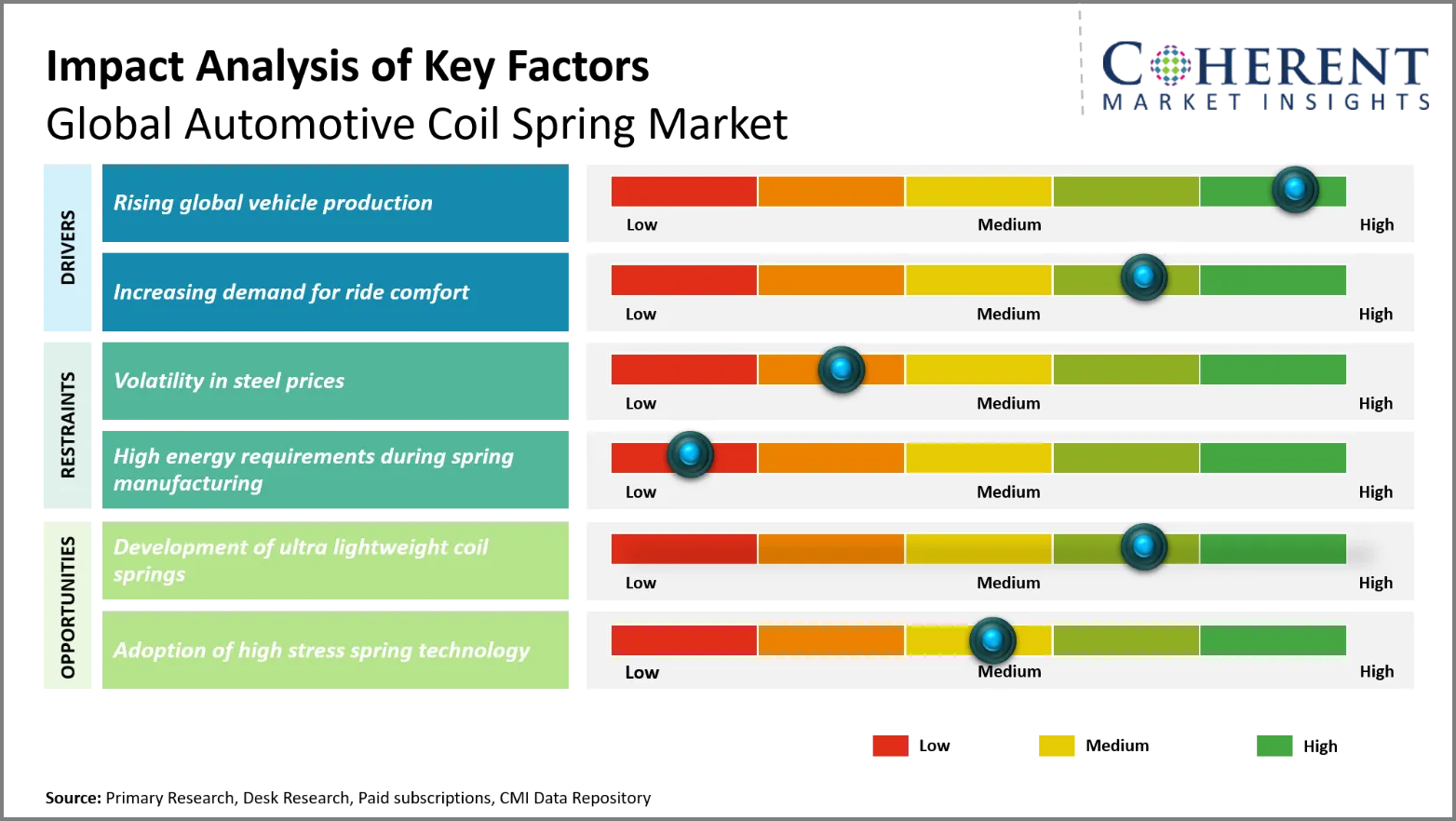
- Rising global vehicle production: Rising worldwide vehicle production drives the demand for suspension components in both passenger cars and commercial vehicles. OEM applications demand more coil springs with higher manufacturing volumes. The need for components is especially supported by growth of car production in Asia Pacific. The increase in vehicle production also supports the prospects for current spring producers and automotive suppliers. On May 30, 2025, Toyota announced production of the GR Corolla at its U.K. manufacturing facility from 2026. Preparations started from 2024 after demand for Toyota Gazoo Racing products was high. The expansion means Toyota Motor Manufacturing U.K. will build more passenger vehicles and the new model will sit on current manufacturing and supplier capabilities.
- Increasing demand for ride comfort: Consumers want a more comfortable ride, which is driving improvements in vehicle suspension systems. Coil springs are used to absorb the suspension loads from the road, whilst keeping the vehicle body control. The manufacturers are adjusting the springs, so that they can balance comfort, handling, durability and weight of the car. This tendency promotes demand for precisely manufactured coil springs in a range of modern vehicle platforms. On January 6, 2026, ZF debuted AI Road Sense at CES 2026, to enhance ride comfort with predictive chassis management. The technology uses sensors, cameras and LiDAR to detect the road conditions ahead. It then links up sMOTION and Continuous Damping Control systems to change the suspension in real-time. The premium version can scan road characteristics up to 25 meters ahead.
Emerging Trends
- Lightweight Coil Spring Development: Manufacturers are producing lighter coil springs by using high strength steel grades and improved shapes. These designs lower the weight of the suspension while bearing the needed loads. Lightweight springs are required to achieve vehicle efficiency standards, and to offset the weight of electric vehicle components.
- Electric Vehicle Suspension Optimization: The addition of battery packs to electric vehicles dramatically increases the bulk of the vehicle, producing new needs for suspension components. Spring producers are modifying stiffness, durability and fatigue performance to accommodate increased loads while retaining ride comfort and stable vehicle dynamics.
- Advanced Manufacturing Technologies: Automation of forming, precision heat treatment, and digital inspection are enhancing uniformity in the manufacturing of automotive coil springs. These technologies provide better control of dimensions, better fatigue performance and less variability in production. The integration of computerized quality monitoring is becoming increasingly common in spring manufacturing.
- Corrosion Resistant Spring Technologies: Automotive companies are enhancing surface protection and material treatments to lengthen coil spring service life. Improved corrosion resistance is crucial for cars working in humid, coastal and winter conditions. These innovations ensure that the spring stays strong and the suspension reliable.
Regional Insights
Why is Asia Pacific a Strong Market for Automotive Coil Spring?
Asia Pacific is expected to account for a market share of 43.0% in 2026. Most of the automobile production in China, Japan, India, South Korea, and Thailand is from Asia Pacific. OICA reported that Asia Oceania manufactured 59.20 million automobiles in 2025. China manufactured 34.53 million automobiles, hence increasing component demand in the region. India produced 6.49 million vehicles and Japan produced 8.41 million vehicles. The region is ramping up electric vehicle production. The battery electric and hybrid platforms need different suspension systems for different vehicle weights. Regional automotive suppliers are also expanding localized production capabilities. These developments support demand for coil springs with varied stiffness, fatigue resistance, and dimensional precision.
Why Does North America Automotive Coil Spring Market Exhibit High Growth?
North America is expected to register the fastest growth with a CAGR of 4.2% over the forecast period. It is projected to account for 23.0% of the global automotive coil spring market in 2026. The region benefits from substantial light truck, sport utility vehicle, and commercial vehicle production. OICA recorded 15.57 million vehicles produced across the region in 2025. The U.S. produced 10.24 million vehicles during the same period. Commercial vehicles accounted for more than 9.10 million units in the U.S. Heavy vehicle usage creates demanding suspension requirements. Pickup trucks frequently operate under high payload and towing conditions. These applications require coil springs with strong fatigue resistance and consistent load-bearing performance. Growing vehicle electrification also creates requirements for springs supporting heavier electric vehicle architectures.
Global Automotive Coil Spring Market Outlook for Key Countries
Why is China Emerging as a Major Hub in the Automotive Coil Spring Market?
China benefits from exceptionally large vehicle production and rapid expansion of new energy vehicle manufacturing. OICA recorded 34.53 million vehicles produced in 2025. New energy vehicle production reached 16.63 million units during the year. There are additional engineering demands with the suspension of battery electric and plug-in hybrid vehicles. Vehicle weight gain from the battery packs influences the spring rate to be selected. Chinese vehicle manufacturers also are expanding electric sport utility vehicle and passenger car platforms. Sourcing of domestic components further aids the domestic coil spring manufacturing. These improvements force producers to develop lightweight springs with stronger strength and better fatigue resistance.
Is U.S. the Next Growth Engine for the Automotive Coil Spring Market?
The U.S. produces a lot of pickup trucks, sport utility vehicles and commercial vehicles. OICA reported 10.24 million vehicles in production in 2025. More over 9.10 million units were commercial vehicles. Pickup trucks are often used for towing, hauling, and off-road use. These applications require the suspension to be very durable and able to carry heavy loads. Also, springs have to be carefully set for ride comfort and handling stability in sport utility vehicles. Electric pickup trucks have other needs because battery packs contribute to vehicle curb weight. Such car features require durable coil springs with optimum fatigue performance.
Germany Automotive Coil Spring Market Analysis and Trends
Germany profits from building premium cars and sophisticated suspension engineering. OICA registered production of 4.15 million passenger vehicles in 2025. German manufacturers offer premium passenger automobiles, sport utility vehicles, performance and electric vehicles. In premium applications, the suspension must be fine-tuned to enhance ride and handling responsiveness. Battery systems add weight to the vehicle; hence electric cars require higher spring requirements. Performance cars also need spring rates that are precisely tuned for dynamic handling characteristics. Dimensional correctness, fatigue strength, corrosion protection and production consistency are the main focuses of German automotive suppliers. These requirements are conducive to sophisticated coil spring development for luxury and performance-oriented car platforms.
Japan Automotive Coil Spring Market Analysis and Trends
Japan’s advantages include developed automotive production and a variety of vehicle technology. In 2025, OICA reported that 8.41 million automobiles were produced. Japanese manufacturers make passenger cars, hybrids, battery electric vehicles and commercial vehicles. The manufacture of hybrid vehicles is also increasing the demand for suspensions able to support the added weight of batteries and power trains. Compact vehicle platforms also require springs that can deliver the right performance within tight packaging constraints. In Japan, car makers stress consistent manufacture and reliability of parts. Therefore, coil spring providers emphasize accurately formed, regulated material characteristics, fatigue resistance and dimensional precision. These features back demand across Japan’s diversified automobile manufacturing base.
India Automotive Coil Spring Market Analysis and Trends
India benefits from growing passenger vehicle manufacturing and significant sport utility vehicle uptake. In 2025, 6.49 million automobiles were manufactured, according to the OICA. Domestic sales of 4.60 million passenger vehicles and 1.00 million trucks and busses were made in FY 2025-26. Sport utility vehicle impact on passenger vehicle demand is increasingly being felt by Indian manufacturers. These cars need suspension systems capable of dealing with heavier curb weights and other road surfaces. Rural and urban driving conditions also create durability requirements for suspension components. Manufacturers are developing vehicle platforms suited to local operating conditions. This underlines the necessity for durable coil springs with sufficient load capacity and fatigue resistance.
Global Automotive Coil Spring Market - Global Vehicle Production by Category (2025)
Vehicle Type | Global Vehicle Production |
Passenger Vehicles | 67.30 million |
Light Commercial Vehicles | 17.10 million |
Heavy Trucks | 9.40 million |
Buses and Coaches | 2.58 million |
Total Vehicles | 96.38 million |
Global Automotive Coil Spring Market - Coil Spring Replacement Frequency by Vehicle Age
Vehicle Age | Indicative Coil Spring Replacement Frequency | Typical Replacement Condition |
0-3 years | 2%-5% | Early failures, accident damage, severe corrosion |
4-6 years | 8%-15% | Fatigue, corrosion, heavy-duty usage |
7-9 years | 20%-30% | Sagging, fatigue, corrosion, repeated road impacts |
10-12 years | 35%-45% | Higher accumulated fatigue and corrosion |
13-15 years | 50%-65% | Age-related fatigue, sagging, and corrosion |
Over 15 years | 65%-80% | Advanced fatigue, corrosion, deformation, and breakage |
How is Development of Ultra Lightweight Coil Springs Creating New Growth Opportunities in the Automotive Coil Spring Market?
Development of ultra lightweight coil springs is creating opportunities by addressing the added mass of battery electric vehicles. Large battery packs add extra load to the suspension, which can be compensated by reduced spring weight. Manufacturers are employing high tensile spring steels along with improved wire diameters and coil shapes. NHK Spring has developed a lightweight, high-stress suspension spring that reduces weight without compromising the required spring performance. These technologies can be beneficial for EV platforms where more load capacity is required without a proportionate increase in the bulk of suspension components. In January 2026, NHK Spring published a new coil spring patent. The technology is targeted at higher load suspension springs, with better resistance to sagging. It is composed of silicon, manganese, chromium, copper, nickel and titanium. The advancement is in line with automotive requirements for smaller and lighter suspension components.
Market Players, Key Development, and Competitive Landscape
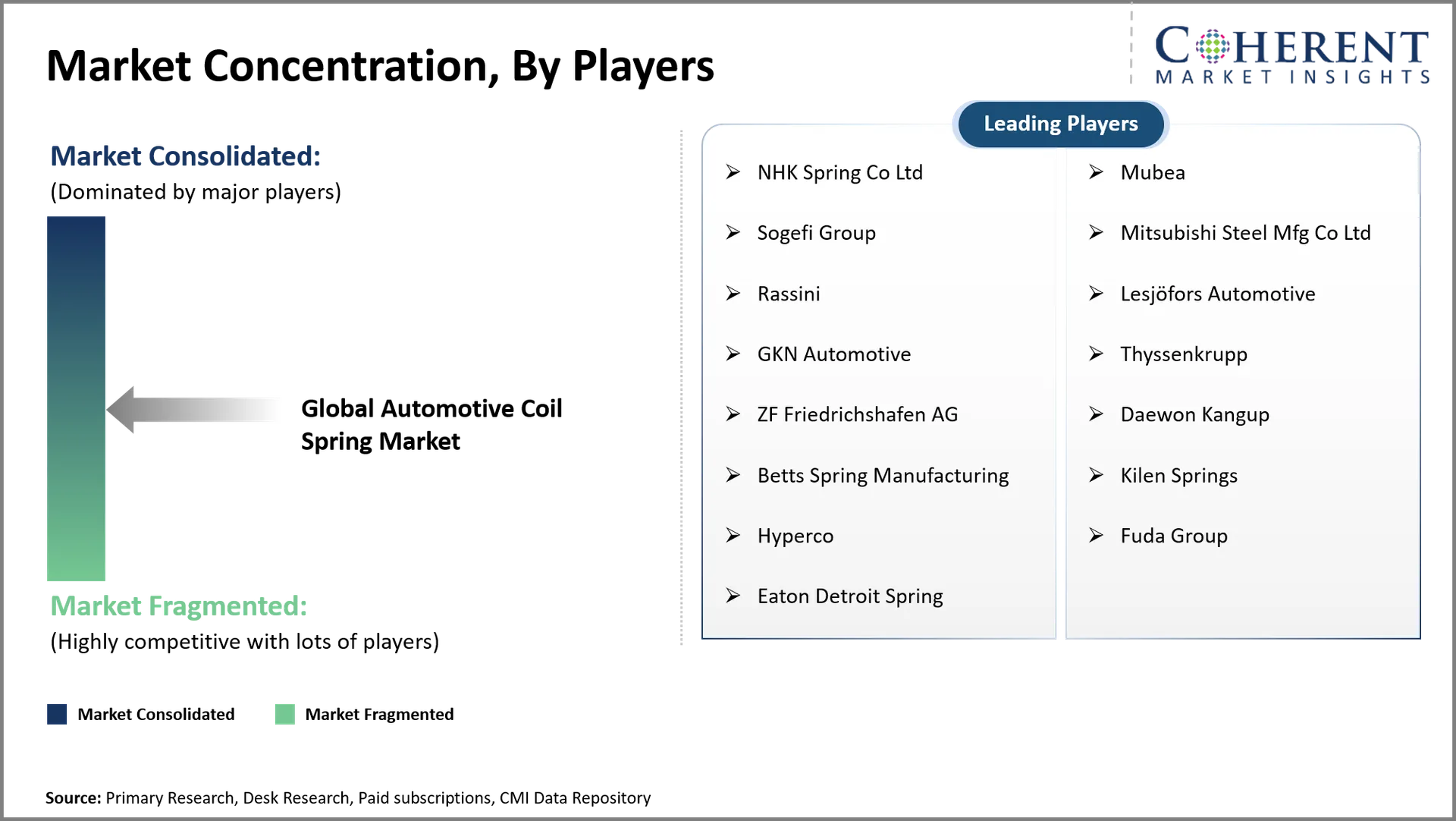
Key Developments
- On May 26, 2025, NHK Spring announced construction of a new automotive suspension spring facility in Aurangabad, India. The investment strengthens localized production capacity for automotive suspension springs.
- On February 11, 2025, Lesjöfors signed an agreement to acquire India-based International Industrial Springs (IIS). The acquisition strengthens the Beijer Component’s growth trajectory with the addition of new product capabilities, building on Lesjӧfors’ recognition of having the widest product portfolio in the industry.
Competitive Landscape
Leading players are focusing on lightweighting, high-stress materials, corrosion resistance, and electric vehicle suspension requirements. NHK Spring emphasizes high-stress coil springs, weight reduction, automated production, and global production technology support. Its coil springs use material development, heat treatment, and simulation technologies. Mubea is focused on light weight chassis innovations for electrified vehicles. Its Light and Robust coil spring system is designed for a weight savings of up to 15%. Sogefi develops cold and hot formed springs using high-stress micro-alloyed steels, heat treatments, and anticorrosion technologies. Sogefi also supplies suspension products across passenger cars, heavy-duty vehicles, and precision spring applications.
Market Report Scope
Automotive Coil Spring Market Report Coverage | |||
Report Coverage | Details | ||
Base Year | 2025 | Market Size in 2026: | USD 2.75 Bn |
Historical Data For: | 2020 To 2024 | Forecast Period: | 2026 To 2033 |
Forecast Period 2026 To 2033 CAGR: | 3.3% | 2033 Value Projection: | USD 3.80 Bn |
Geographies covered: |
| ||
Segments covered: |
| ||
Companies covered: | NHK Spring Co Ltd, Mubea, Sogefi Group, Mitsubishi Steel Mfg Co Ltd, Rassini, Lesjöfors Automotive, GKN Automotive, Thyssenkrupp, ZF Friedrichshafen AG, Daewon Kangup, Betts Spring Manufacturing, Kilen Springs, Hyperco, Fuda Group, Eaton Detroit Spring | ||
Growth Drivers: |
| ||
Restraints & Challenges: |
| ||
Analyst Opinion (Expert Opinion)
- The industry is moving toward lighter springs with higher fatigue strength and better corrosion durability. Electric vehicles will intensify demand for springs supporting higher vehicle masses without excessive suspension weight. Mubea already targets battery electric vehicles with computer-optimized lightweight coil spring systems. NHK Spring is also developing lighter and stronger springs through advanced materials and manufacturing methods.
- The largest opportunities should emerge in high-stress coil springs for electric passenger vehicles. China offers strong opportunities because manufacturers are rapidly developing electric passenger vehicle platforms. Japan is well suited to premium opportunities with compact packaging and tight spring characteristics. There is also room for sturdy springs for SUVs and harsh road conditions in India. Suppliers should design to the platform, not to a standard spring specification.
- Digital spring design and automated manufacture with lightweight materials are the go-to for players needing an edge. High-strength steels, optimum wire widths and enhanced surface treatments can help to minimize mass while preserving durability. This method is achieved using computer-optimized spring systems and high-performance residual stress processing at Mubea. NHK Spring also emphasizes productivity reforms and stronger global production support. Companies should therefore localize production near major vehicle manufacturing clusters while strengthening engineering collaboration with automakers.
Speak to the analyst
Want personalized insights?
Take the findings above to one of our principal consultants, or have the report rebuilt around the segments, geographies and competitors you actually track.
Market Segmentation
- Spring Type Insights (Revenue, USD Billion, 2021 - 2033)
- Compression Coil Springs
- Tension Coil Springs
- Torsion Coil Springs
- Material Insights (Revenue, USD Billion, 2021 - 2033)
- High Tensile Steel
- Chrome Silicon Steel
- Alloy Steel
- Others
- Vehicle Type Insights (Revenue, USD Billion, 2021 - 2033)
- Passenger Cars
- Commercial Vehicles
- Application Insights (Revenue, USD Billion, 2021 - 2033)
- Front Suspension
- Rear Suspension
- Regional Insights (Revenue, USD Billion, 2021 - 2033)
- North America
- U.S.
- Canada
- Latin America
- Brazil
- Argentina
- Mexico
- Rest of Latin America
- Europe
- Germany
- U.K.
- Spain
- France
- Italy
- Russia
- Rest of Europe
- Asia Pacific
- China
- India
- Japan
- Australia
- South Korea
- ASEAN
- Rest of Asia Pacific
- Middle East
- GCC Countries
- Israel
- Rest of Middle East
- Africa
- South Africa
- North Africa
- Central Africa
- North America
- Key Players Insights
- NHK Spring Co Ltd
- Mubea
- Sogefi Group
- Mitsubishi Steel Mfg Co Ltd
- Rassini
- Lesjöfors Automotive
- GKN Automotive
- Thyssenkrupp
- ZF Friedrichshafen AG
- Daewon Kangup
- Betts Spring Manufacturing
- Kilen Springs
- Hyperco
- Fuda Group
- Eaton Detroit Spring
Sources
Primary Research Interviews
- Automotive Coil Spring Manufacturers
- OEM (Original Equipment Manufacturer) Representatives
- Automotive Suspension System Suppliers
- Aftermarket Parts Distributors & Retailers
Magazines
- Automotive Engineering International
- SAE Automotive Engineering Magazine
- Motor Trend Industry Insights
- Automotive Body Repair News (ABRN)
Journals
- International Journal of Automotive Technology
- Journal of Mechanical Engineering and Sciences
- SAE International Journal of Passenger Cars - Mechanical Systems
Associations
- Automotive Parts Manufacturers' Association (APMA)
- European Automobile Manufacturers' Association (ACEA)
- Society of Automotive Engineers (SAE International)
- Specialty Equipment Market Association (SEMA)
Public Domain Sources
- U.S. Department of Transportation (DOT) Reports
- European Commission - Automotive Industry Reports
- International Organization of Motor Vehicle Manufacturers (OICA)
- World Bank - Automotive Sector Publications
Proprietary Elements
- CMI Data Analytics Tool
- Proprietary CMI Existing Repository of Information for the Last 10 Years
Get access to 250+ pages report
Every segment, forecast, competitor profile and data table behind the analysis above — available for instant download.
- ESOMAR Member
- ISO 9001:2015 Certified
- D-U-N-S Registered
- GDPR & CCPA Compliant
Missing comfort of reading report in your local language? Find your preferred language:
Frequently Asked Questions
The global automotive coil spring market is expected to stand at USD 2.75 Bn in 2026 and is expected to reach USD 3.80 Bn by 2033.
The CAGR of the global automotive coil spring market is projected to be 3.3% from 2026 to 2033.
Rising global vehicle production and Increasing demand for ride comfort are the major factors driving the growth of the global automotive coil spring market.
Volatility in steel prices and High energy requirements during spring manufacturing are the major factors hampering the growth of the global automotive coil spring market.
In terms of spring type, compression coil springs segment is estimated to dominate the market revenue share in 2026.
An automotive coil spring is a helical suspension component that supports vehicle weight and absorbs road impacts.
Electric vehicles encourage stronger lightweight springs because battery packs increase vehicle mass.