

Global Automotive Zonal Architecture Market Size and Forecast – 2026-2033
The global automotive zonal architecture market is expected to grow from USD 5.38 Bn in 2026 to USD 16.94 Bn by 2033, at a compound annual growth rate (CAGR) of 17.8% over 2026–2033. For years, carmakers added a new electronic control unit (ECU) almost every time they added a feature. A premium car now carries dozens of them, tied together by a heavy harness that is still mostly assembled by hand, and the automotive wiring harness has become one of the costliest parts of the car to build. Zonal architecture changes the layout. A few zone controllers look after power and signals in each area of the car and report to central computers over Ethernet. This is also the hardware base of the software defined vehicle, because features can then be changed through updates instead of new parts.
The savings are easy to measure. When Rivian moved its second-generation R1 to a zonal design in June 2024, it cut the number of ECUs from 17 to 7 and took 1.6 miles of wiring out of each vehicle. BMW Group says the zonal harness in its Neue Klasse uses 600 metres less wiring and weighs 30% less than the one it replaces. Harness makers are adapting as well. LEONI now designs smaller zonal sub-harnesses and is working with Valeo to bring zone controllers into series production
Key Takeaways of the Global Automotive Zonal Architecture Market
- The hardware segment is expected to account for 61.4% of the global automotive zonal architecture market share in 2026. Zone controllers, central compute units, in-vehicle networking components and smart power distribution units are physical parts that every zonal vehicle needs, so hardware takes the largest share of spending. In March 2026, NXP Semiconductors introduced the CoreRide Z248 zonal reference system, which combines 48 V power distribution, eFuses, power management and in-vehicle networking around its S32K566 zonal microcontroller.
- The passenger cars segment is expected to account for 78.5% of the market share in 2026. New zonal platforms are launching first in passenger electric and premium cars, where wiring weight, software features and over-the-air updates matter most. In January 2026, Qualcomm Technologies and Leapmotor introduced a central controller that brings cockpit, driver assistance, body control and the vehicle gateway together, with the Leapmotor D19 as the first mass-production car to use it.
- The hybrid domain-zonal architecture segment is expected to hold 54.2% of the architecture type segment in 2026. Most carmakers are adding zone controllers to existing platforms while keeping some domain controllers, rather than redesigning every model at once. In February 2026, Renesas Electronics presented system-on-chip technologies for multi-domain automotive ECUs at the ISSCC 2026 conference, aimed at running several vehicle domains safely on one chip.
- Asia Pacific is expected to dominate the automotive zonal architecture market in 2026, with a share of 39.2%. China builds more vehicles than any other country, and its carmakers move quickly from separate ECUs to central computers with zone controllers. In January 2026, Volkswagen Group began production of the China Electronic Architecture, its first locally developed zonal electronic architecture, created with XPENG.
- Europe is expected to account for 27.4% share in 2026 and to be the fastest-growing region. German premium brands and Volkswagen Group are moving whole model ranges onto new zonal electronics platforms between 2025 and 2027. In July 2026, BMW Group said its Debrecen plant had built the 50,000th BMW iX3, the first Neue Klasse model, nine months after series production began, and confirmed 40 new or updated models by the end of 2027.
Segmental Insights
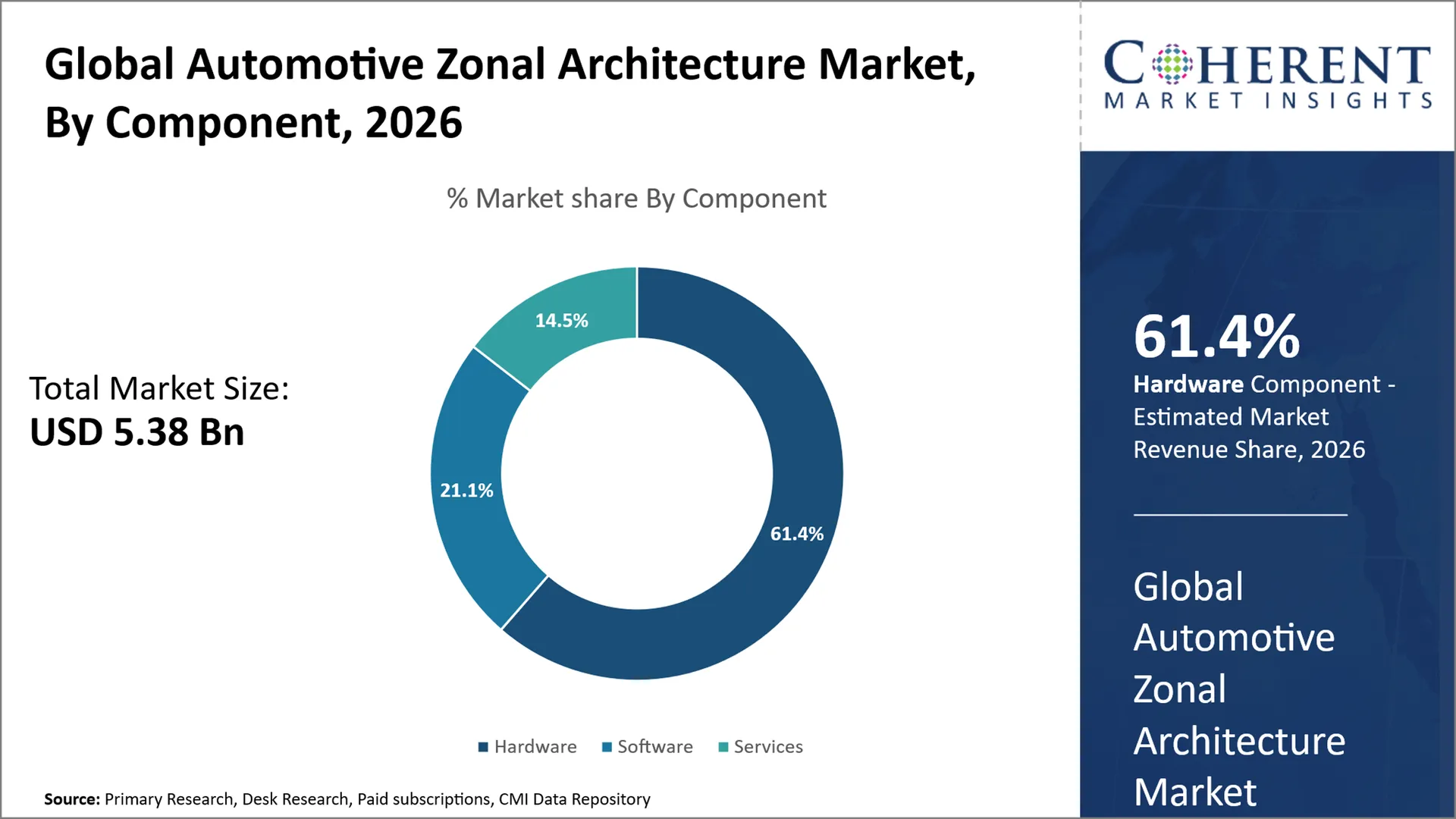
Why Does Hardware Dominate the Global Automotive Zonal Architecture Market?
In terms of component, hardware is expected to account for 61.4% of the global automotive zonal architecture market share in 2026. A zonal vehicle usually carries three to six zone controllers, plus one or more central computers, automotive Ethernet switches and transceivers, and semiconductor-based power distribution that replaces traditional fuse and relay boxes. Every one of these parts has to be bought again for each car that leaves the line. Software is different: it is written once and reused across models, so its share of spending is smaller for now.
Hardware is also becoming more capable and more expensive per unit. Zone controllers need safety-rated multicore microcontrollers, fast non-volatile memory for over-the-air updates, and power stages that can switch and protect dozens of loads.
In March 2025, NXP Semiconductors unveiled its S32K5 microcontroller family, which it described as the automotive industry’s first 16 nm FinFET microcontroller with embedded MRAM, designed for zonal and electrification controllers.
- Current Industry Events of 2026
- Market Size Estimation
- Regional Breakdown
- Competitive Landscape
- Customer Intelligence
- Segmental Analysis
- Pricing Analysis
- Key Market Drivers, Challenges & Future Trends
- Customized Insights Section
Why Do Hybrid Domain-Zonal Architectures Lead the Market?
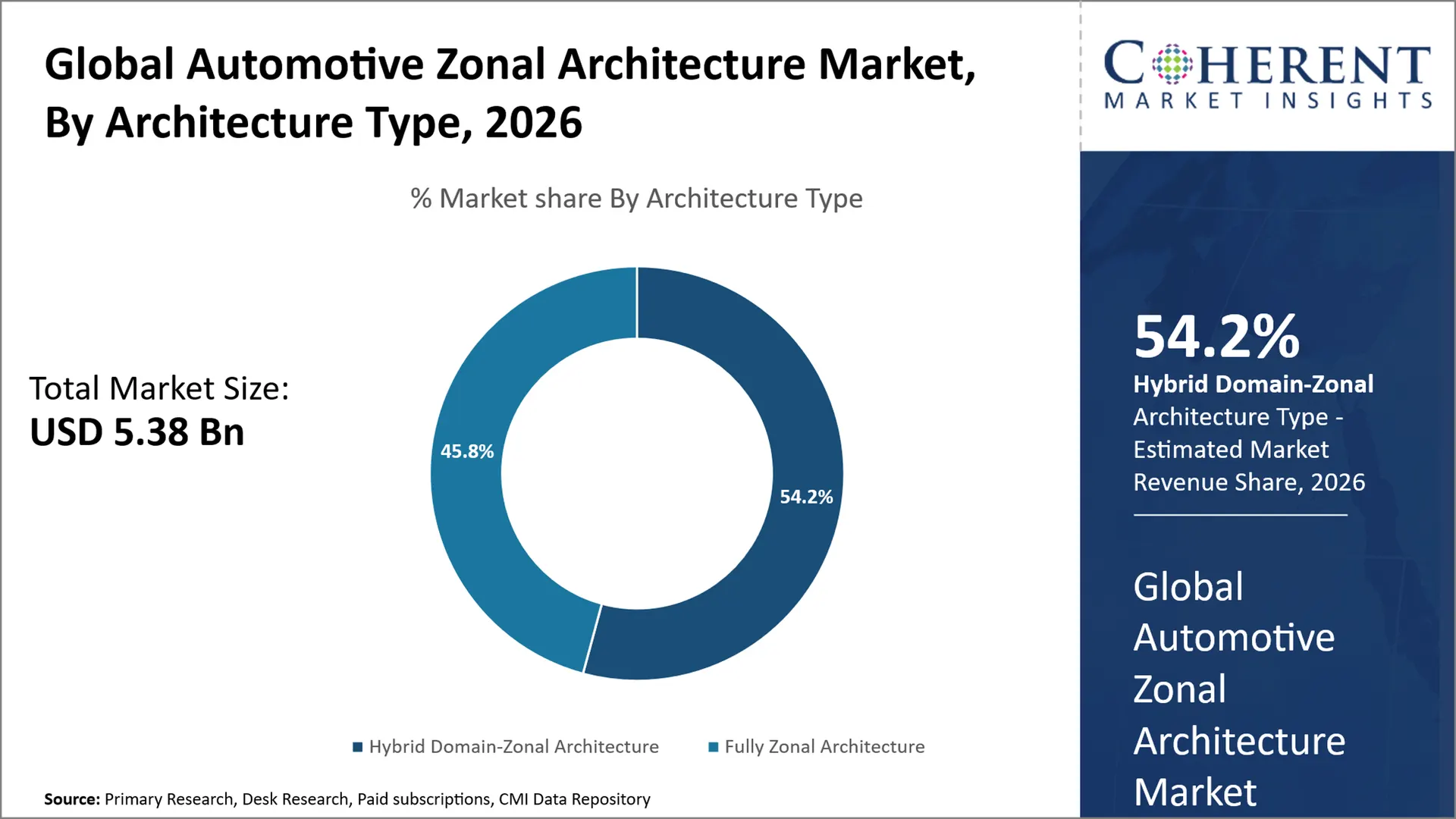
In terms of architecture type, hybrid domain-zonal architecture is expected to account for 54.2% of the global automotive zonal architecture market share in 2026. Established carmakers have large investments in existing software, validated suppliers and production lines. Few can move every model to a fully zonal design at once, so most start by adding zone controllers for body and power functions while keeping domain controllers for powertrain or driver assistance.
In March 2026, Renesas Electronics launched the 28 nm RH850/U2C microcontroller, an ASIL D device that keeps CAN-FD, LIN and other existing interfaces while adding the connectivity needed for zone and domain ECUs.
Why Do Passenger Cars Lead the Vehicle Type Segment?
In terms of vehicle type, passenger cars are expected to account for 78.5% of the global automotive zonal architecture market share in 2026. Carmakers compete in this segment on software features, screen experiences and driver assistance, all of which are easier to add and update on a zonal platform. Passenger car platforms are also replaced more often than commercial vehicle platforms, so new architectures reach them first.
Light commercial vehicles (LCV) are the fastest-growing vehicle type, at an estimated 19.4% CAGR. Van and delivery fleets value remote diagnostics and over-the-air updates, which reduce workshop visits and downtime.
In March 2025, Hyundai Motor Group launched its Pleos software brand, built on an electrical and electronic architecture that pairs a high-performance vehicle computer with zone-specific controllers.
Current Events and their Impact
Current Events | Description and its Impact |
U.S. Section 232 Tariffs on Automobile Parts (May 2025) |
|
Nexperia Chip Export Disruption (October–November 2025) |
|
Automotive Zonal Architecture Market Dynamics
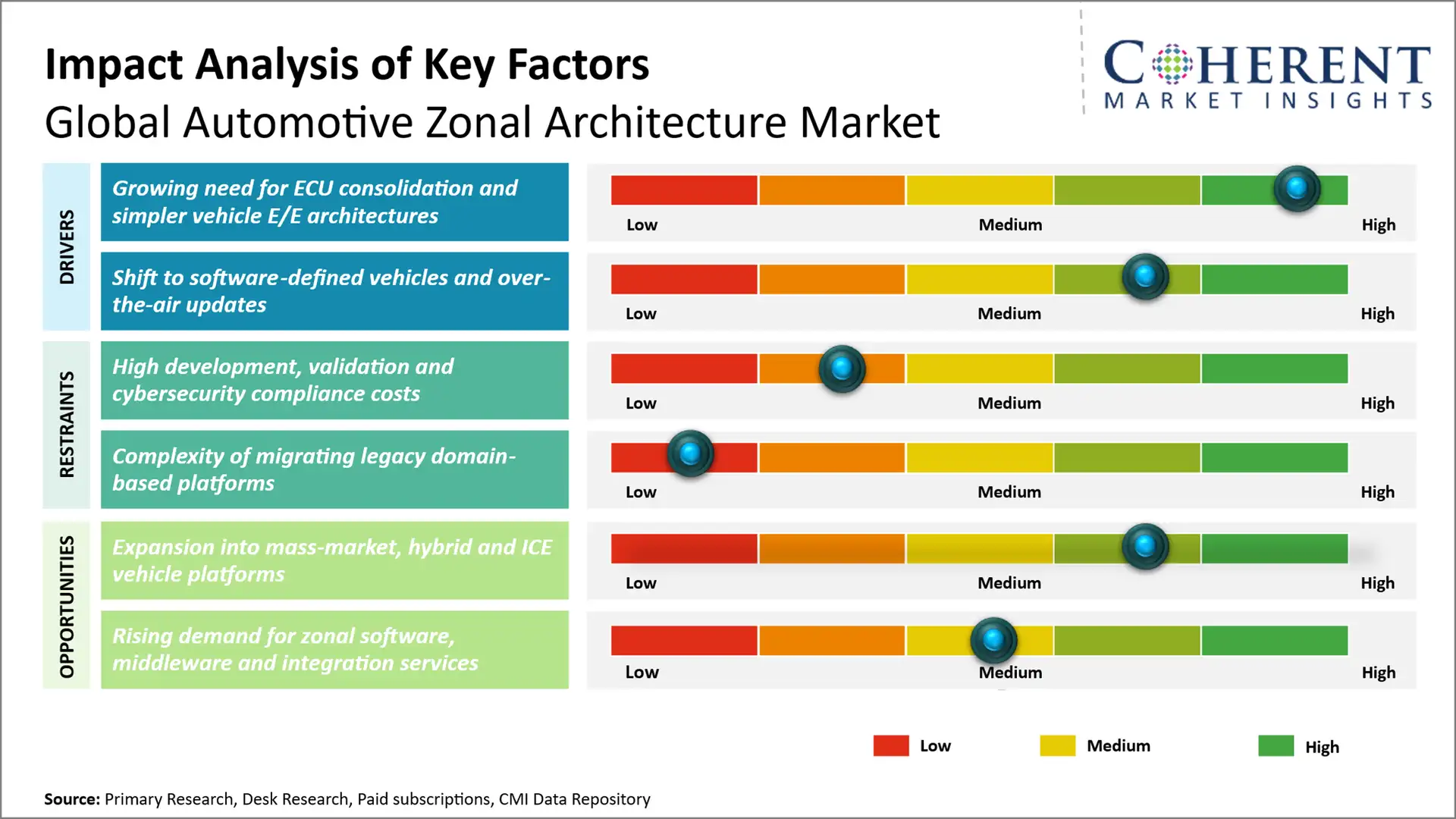
Market Drivers
- Growing need for ECU consolidation and simpler vehicle E/E architectures: For decades, carmakers added a new electronic control unit (ECU) each time they added a feature. A modern premium car can carry dozens of these units from different suppliers, each with its own software, wiring and connectors, and the harness tying them together is one of the heaviest and most expensive parts of the vehicle. That model no longer scales. Zonal architecture groups functions by location, so a handful of zone controllers can replace many small ECUs. Fewer units mean fewer part numbers, shorter cable runs and less validation work across a model range. Zone controllers can also replace traditional fuses and relays with electronic protection, which saves more space and weight. For carmakers under pressure on cost and EV range, this simplification pays back on every car they build.
- On April 18, 2024, Continental announced the series introduction of its zone control units for European and Asian carmakers. Each unit bundles the connections of one area of the vehicle, supplies power to peripheral ECUs with protection of up to 40 A, and is prepared for 48 V systems.
- Shift to software-defined vehicles and over-the-air updates: Carmakers now want to add features, fix faults and earn revenue after a car has been sold, all through software updates. That is hard when code is spread across dozens of ECUs from different suppliers, because each update has to be tested on every unit it touches. Zonal architecture moves most application software onto a few central computers and leaves zone controllers to handle power and input/output, so updates reach fewer devices and can be validated faster. To make this work at scale, large carmaker groups are choosing common zone controller chips and software platforms years before launch and sharing them across brands. Once a platform is set this way, demand for its hardware and software is locked in for the whole model cycle.
- In October 2026, Volkswagen Group and NXP announced a strategic partnership under which NXP’s S32K5 microcontrollers will serve as a common building block for zonal control across all Volkswagen Group brands and vehicle segments. The first vehicle using the architecture is planned for 2027.
Emerging Trends
- Ethernet is reaching the edge of the vehicle: Zonal designs depend on a fast, uniform network between zones and central computers, and that network is now extending to the sensors and actuators at the edge. Single-pair Ethernet at 10 Mbps (10BASE-T1S) can replace part of today’s CAN and LIN traffic inside each zone. In January 2026, Texas Instruments introduced the DP83TD555J-Q1, a 10BASE-T1S Ethernet PHY with Power over Data Line, so power and data can share a single cable pair to edge devices.
- Impact: One network type from the central computer to the edge simplifies software, gateways and diagnostics, and fewer wires are needed per device.
- Relevance to the market: This supports growth in in-vehicle networking hardware and favours suppliers that offer complete Ethernet chip sets for zone controllers and edge nodes.
- Ready-made zone controller platforms are shortening development: Chip and electronics suppliers are packaging silicon, power stages, networking and base software into modular zone controller kits. Carmakers that lack large in-house electronics teams can start from a tested design rather than a blank sheet. In January 2026, Flex introduced a zone controller development kit built with Infineon microcontrollers and Vector software.
- Impact: Development cycles for production zone controllers become shorter, and smaller carmakers can adopt zonal designs at lower engineering cost.
- Relevance to the market: This widens the customer base beyond the largest carmakers and supports growth in software and services, as kits come with pre-integrated software and engineering support.
Regional Insights
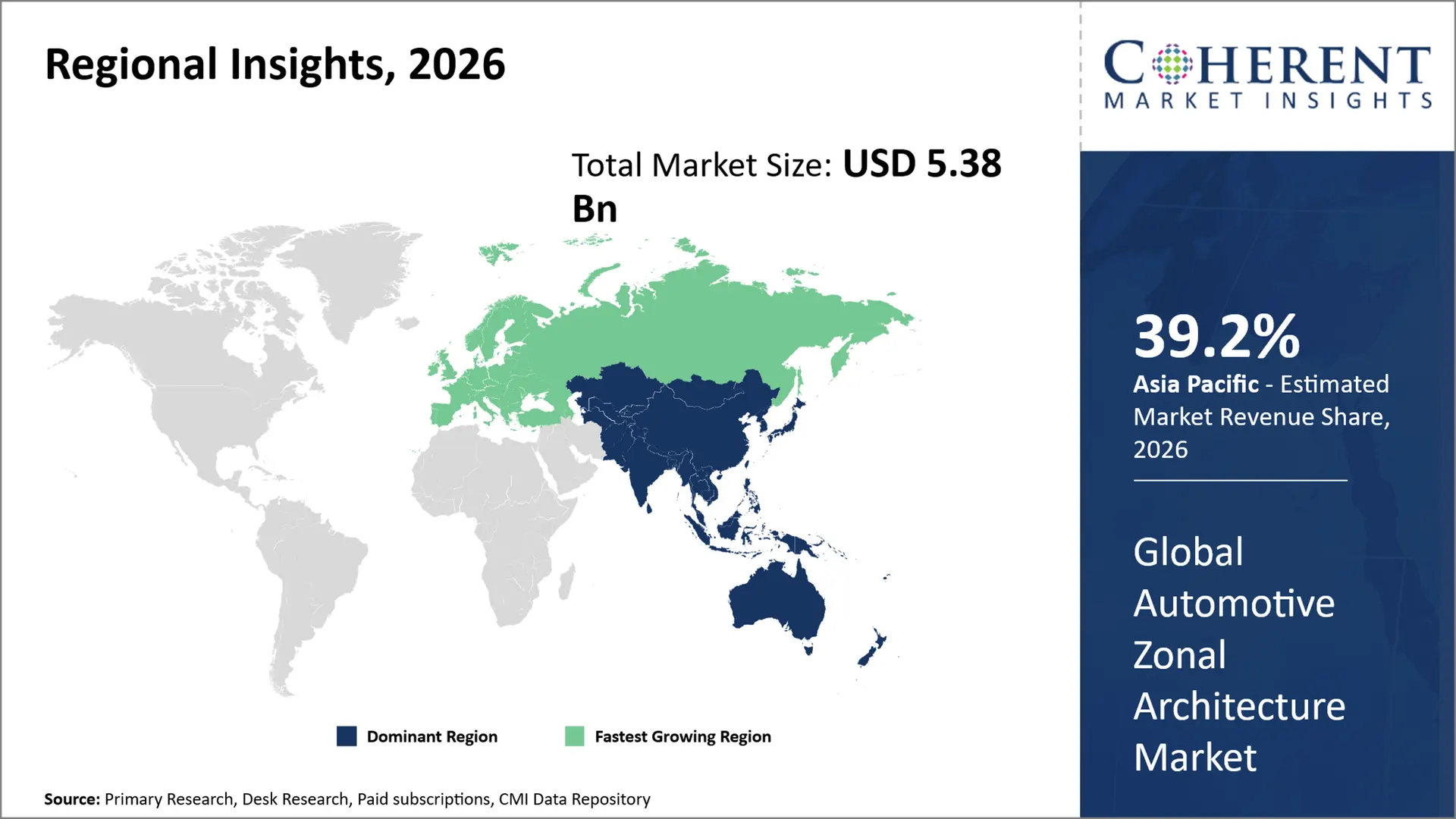
Why Does Asia Pacific Lead the Global Automotive Zonal Architecture Market?
Asia Pacific is expected to account for a market share of 39.2% in 2026. China is the largest vehicle producer and the largest electric vehicle market in the world, and its carmakers compete on software features and update speed. Many Chinese brands have moved quickly from separate ECUs to central computers with zone controllers, and global carmakers are developing zonal architectures locally for Chinese buyers. Japan and South Korea add scale through large carmaker groups that are now standardising their next-generation electronic platforms. Local electronics manufacturing is deep and cheap, and that keeps hardware prices down.
Why Is Europe the Fastest-Growing Region in the Automotive Zonal Architecture Market?
Europe is expected to account for 27.4% of the global market in 2026 and to register the fastest growth over the forecast period, at an estimated 20.4% CAGR. German premium brands and Volkswagen Group are moving whole model ranges onto new zonal platforms between 2025 and 2027. Europe is also home to many of the leading suppliers in this market, including Bosch, AUMOVIO, ZF, Valeo, Infineon, NXP and STMicroelectronics. UNECE regulations R155 and R156, which require cybersecurity and software update management for new vehicles, also push carmakers towards centralised, updatable architectures.
Global Automotive Zonal Architecture Market Outlook for Key Countries
Is China the Main Growth Engine in Asia Pacific?
China’s automotive zonal architecture market is projected to reach USD 1.16 Bn in 2026, the largest of any country. China sells more electric vehicles than any other country, and domestic brands launch new models and platforms faster than most global carmakers. Central computers combined with zone controllers are spreading from premium electric models to mid-priced cars. Local chip and electronics suppliers are also growing, which gives carmakers more domestic sourcing options and lowers hardware cost. Put simply, China is why Asia Pacific leads.
Is the U.S. Leading Zonal Architecture Adoption in North America?
The U.S. automotive zonal architecture market is projected to reach USD 1.12 Bn in 2026, the largest in North America. U.S. electric vehicle makers were among the first to adopt zonal wiring, and established carmakers are now following on their next-generation platforms. The country is also home to major suppliers of zone control electronics and chips, such as Lear, Visteon, Texas Instruments and Qualcomm. In April 2025, Lear won a 2025 Automotive News PACE Award for its Zone Control Module, which combines power distribution and body control functions.
Why Is Germany at the Center of Europe’s Zonal Architecture Rollout?
Germany’s automotive zonal architecture market is projected to reach USD 0.52 Bn in 2026, the largest in Europe. The country is home to BMW, Mercedes-Benz and Volkswagen Group, which are all launching new zonal electronics platforms, and to leading suppliers such as Bosch, AUMOVIO, ZF, Infineon and Vector. Few countries have this many carmakers and suppliers working on the same problem in one place.
Japan Automotive Zonal Architecture Market Analysis and Trends
Japan’s automotive zonal architecture market is projected to reach USD 0.36 Bn in 2026. Japanese carmakers have moved more slowly than Chinese and European brands but are now working together to share the cost of new electronic platforms. On August 31, 2026, Honda and Nissan agreed to jointly develop and standardise core ECUs, including high-performance computers and zone ECUs, for next-generation software-defined vehicles from fiscal year 2029. Japan is also home to Renesas Electronics, one of the leading suppliers of microcontrollers for zone controllers.
South Korea Automotive Zonal Architecture Market Analysis and Trends
South Korea’s automotive zonal architecture market is projected to reach USD 0.19 Bn in 2026. Hyundai Motor Group, the country’s largest carmaker, is building its own software and electronics stack for software-defined vehicles across its Hyundai, Kia and Genesis brands. South Korea is also home to two of the world’s largest memory chip makers, Samsung Electronics and SK hynix, whose products are used in central computers and zone controllers. Growth here is steady rather than fast, and it rests mostly on one large carmaker group.
Global Automotive Zonal Architecture Market – Key Controllers Chargers Used for Heavy-Duty Vehicle Charging
Zone Controller | Producer | Main Features and Uses |
Zone ECU | Links vehicle computers to actuators, sensors and smart ECUs in a vehicle-centralised, zone-oriented architecture | |
Zone Control Unit (ZCU) | Bundles the functions of one vehicle area, provides controlled power supply and connects to the high-performance computer over Ethernet | |
Zone Controllers | Handle high-speed data transfer and power distribution in each zone; developed in partnership with Leoni; support CAN, LIN and PSI5 interfaces | |
Zone Control Module | Combines power distribution and body control functions for zonal electrical architectures |
How Are Vehicle Control Computers Creating New Growth Opportunities in the Automotive Zonal Architecture Market?
As zone controllers take over local power and input/output, the vehicle’s decision-making moves to a small number of central computers. Early central computers focused on infotainment and driver assistance. The next step is to bring chassis, motion and body control together on a dedicated vehicle control computer. That leaves room for a new kind of product. Someone has to supply a safety-rated computer, write real-time software for it and connect it to every zone, and a supplier that sells the computer and the zone controllers as one package earns far more per car than one selling a single box. Because these functions are safety-critical, carmakers tend to stay with a proven supplier for the life of a platform, which makes early design wins valuable.
On January 6, 2026, AUMOVIO presented the latest version of its Vehicle Control High-Performance Computer at CES 2026. Running on NXP’s S32N79 processor, it brings chassis, motion and body functions together within one vehicle architecture.
Market Players, Key Development, and Competitive Intelligence
Key Developments
- In February 2026, Infineon Technologies announced that it supplies key components for the software-defined E/E architecture of BMW Group’s Neue Klasse. These include AURIX and TRAVEO microcontrollers, BRIGHTLANE Ethernet connectivity, OPTIREG power management ICs, and PROFET smart power switches and eFuses used for central computing, connectivity and power distribution.
- On April 1, 2026, Aptiv completed the separation of its Electrical Distribution Systems business into a new listed company, Versigent. Aptiv now concentrates on vehicle compute, software and connectors, while Versigent focuses on wiring and power distribution.
- In September 2025, Volkswagen Group announced at its Semiconductor Summit during IAA Mobility a joint sourcing model with Rivian and RV Tech covering more than 50 semiconductor categories, including microcontrollers.
Competitive Landscape
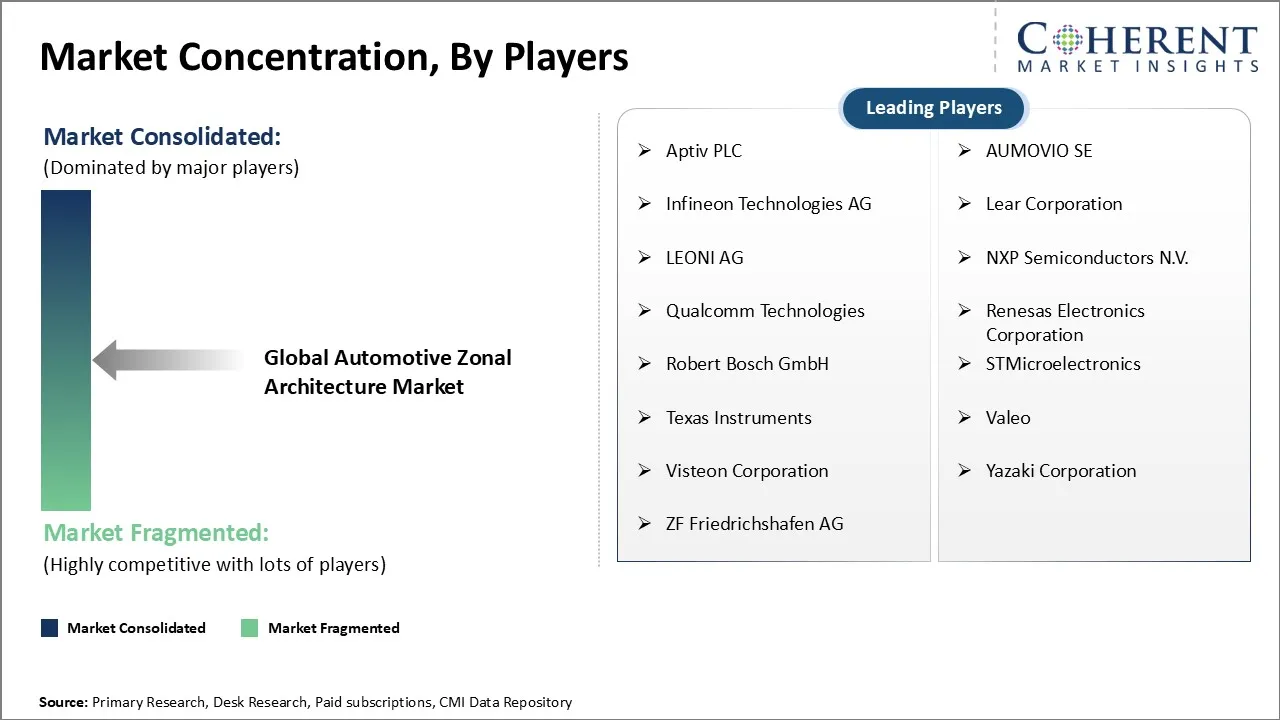
The market is shared between three groups that increasingly work together. Tier 1 suppliers such as Bosch, Aptiv, AUMOVIO, ZF, Valeo, Lear and Visteon build zone controllers and central computers. Wiring and power distribution specialists such as LEONI and Yazaki design the smaller zonal harnesses. Semiconductor companies such as NXP, Infineon, Renesas, STMicroelectronics, Texas Instruments and Qualcomm supply the microcontrollers, processors, networking and power chips inside them. Some carmakers, including BMW, Rivian and Volkswagen Group through RV Tech, also design their own zonal architectures and buy chips directly. Competition centres on scalable hardware families that fit several vehicle sizes, pre-integrated and safety-certified software, and the ability to support carmakers through the move from domain to zonal layouts. Long qualification cycles and functional safety and cybersecurity certification make it hard for new entrants to break in.
Top Companies and Notable Products in the Automotive Zonal Architecture Market
Company | Notable Product | Key Features |
NXP Semiconductors | S32K5 microcontroller family | 16 nm FinFET automotive microcontroller with embedded MRAM, designed for zonal and electrification controllers |
Renesas Electronics | RH850/U2C | 28 nm, 32-bit ASIL D microcontroller for vehicle control, body and zonal applications |
STMicroelectronics | Stellar P3E | Automotive microcontroller with a built-in neural processing unit and xMemory phase-change memory for X-in-1 and zonal controllers |
Infineon Technologies | FlexZoneX zone controller development kit | Modular kit of about 30 reusable building blocks for evaluating and designing zone control units, built with Flex |
Texas Instruments | DP83TD555J-Q1 | 10BASE-T1S automotive Ethernet PHY with Power over Data Line for edge nodes in zonal architectures |
Market Report Scope
Global Automotive Zonal Architecture Market Report Coverage | |||
Report Coverage | Details | ||
Base Year | 2025 | Market Size in 2026: | USD 5.38 Bn |
Historical Data For: | 2020 To 2024 | Forecast Period: | 2026 To 2033 |
Forecast Period 2026 To 2033 CAGR: | 17.8% | 2033 Value Projection: | USD 16.94 Bn |
Geographies covered: |
| ||
Segments covered: |
| ||
Companies covered: | Aptiv PLC, AUMOVIO SE, Infineon Technologies AG, Lear Corporation, LEONI AG, NXP Semiconductors N.V., Qualcomm Technologies, Renesas Electronics Corporation, Robert Bosch GmbH, STMicroelectronics, Texas Instruments, Valeo, Visteon Corporation, Yazaki Corporation, ZF Friedrichshafen AG | ||
Growth Drivers: |
| ||
Restraints & Challenges: |
| ||
Analyst Opinion (Expert Opinion)
- Hardware still takes most of the money, but value is starting to move towards software. Hardware is expected to make up 61.4% of spending in 2026, against 24.1% for software and 14.5% for services. That split suits a market where carmakers are still building their first zonal platforms, but it is unlikely to last. Once a carmaker fixes its zone controller hardware, most new features arrive as software, and the hypervisors, middleware, cybersecurity and update tools that run on the controllers become the main area of spending. That is why software is the fastest-growing component, at an estimated 21.0% CAGR. Carmakers want to buy a working zone, not a pile of parts, so suppliers offering hardware, base software and integration support together tend to win the bigger platform awards. Margins look harder to hold for companies selling single chips or boxes.
- Growth is likely to be strongest in Asia Pacific and Europe, with two main risks. Asia Pacific holds 39.2% of the market in 2026 because Chinese carmakers moved first and at high volume, while Europe, at 27.4%, is catching up fastest as German premium brands and Volkswagen Group move whole model ranges onto zonal platforms. The first risk is cost: zonal platforms need heavy upfront spending on development, functional safety and cybersecurity validation, and carmakers under margin pressure may delay or narrow their plans. The second risk is chip supply. The Nexperia export disruption in late 2025 showed how one low-cost component can halt production, and memory makers are giving priority to AI data centres; SK hynix said in October 2025 that its DRAM and NAND capacity for 2026 was virtually sold out. The suppliers least exposed are those with a second source for key chips and customers in more than one region.
Speak to the analyst
Want personalized insights?
Take the findings above to one of our principal consultants, or have the report rebuilt around the segments, geographies and competitors you actually track.
Market Segmentation
- Component Insights (Revenue, USD Billion, 2021 - 2033)
- Hardware
- Software
- Services
- Architecture Type Insights (Revenue, USD Billion, 2021 - 2033)
- Hybrid Domain-Zonal Architecture
- Fully Zonal Architecture
- Vehicle Type Insights (Revenue, USD Billion, 2021 - 2033)
- Passenger Cars
- Light Commercial Vehicles (LCV)
- Heavy Commercial Vehicles (HCV)
- Propulsion Insights (Revenue, USD Billion, 2021 - 2033)
- Battery Electric Vehicles (BEV)
- Hybrid Electric Vehicles and Plug-in Hybrid Electric Vehicles (HEV/PHEV)
- Internal Combustion Engine Vehicles (ICE Vehicles)
- Application Output Insights (Revenue, USD Billion, 2021 - 2033)
- Body and Comfort
- Advanced Driver Assistance Systems and Safety (ADAS and Safety)
- Infotainment and Connectivity
- Chassis and Motion Control
- Regional Insights (Revenue, USD Billion, 2021 - 2033)
- North America
- U.S.
- Canada
- Latin America
- Brazil
- Argentina
- Mexico
- Rest of Latin America
- Europe
- Germany
- U.K.
- Spain
- France
- Italy
- Russia
- Rest of Europe
- Asia Pacific
- China
- India
- Japan
- Australia
- South Korea
- ASEAN
- Rest of Asia Pacific
- Middle East
- GCC Countries
- Israel
- Rest of Middle East
- Africa
- South Africa
- North Africa
- Central Africa
- North America
- Key Players Insights
- Aptiv PLC
- AUMOVIO SE
- Infineon Technologies AG
- Lear Corporation
- LEONI AG
- NXP Semiconductors N.V.
- Qualcomm Technologies
- Renesas Electronics Corporation
- Robert Bosch GmbH
- STMicroelectronics
- Texas Instruments
- Valeo
- Visteon Corporation
- Yazaki Corporation
- ZF Friedrichshafen AG
Sources
Primary Research Interviews
- Automotive Tier 1 Suppliers and Electronics Manufacturers
- Semiconductor and Microcontroller Suppliers
- Wiring Harness and Power Distribution Manufacturers
- Vehicle Manufacturers (E/E Architecture and Software Teams)
- Automotive Software and Middleware Providers
Magazines
- Automotive News
- Automotive World
- EE Times
- Electronic Design
- SAE Automotive Engineering
Journals
- IEEE Transactions on Vehicular Technology
- IEEE Access
- SAE International Journal of Passenger Vehicle Systems
- Electronics (MDPI)
Associations
- SAE International
- AUTOSAR
- OPEN Alliance
- German Association of the Automotive Industry (VDA)
- China Association of Automobile Manufacturers (CAAM)
- Japan Automobile Manufacturers Association (JAMA)
Public Domain Sources
- United Nations Economic Commission for Europe (UNECE): UN Regulations No. 155 and No. 156
- ISO 26262: Road vehicles – Functional safety
- ISO/SAE 21434: Road vehicles – Cybersecurity engineering
- IEEE 802.3cg: 10 Mb/s single-pair Ethernet (10BASE-T1S)
- The White House: Proclamation on adjusting imports of automobiles and automobile parts, March 2025
- U.S. Securities and Exchange Commission (SEC): Company annual filings
- Company press releases
Proprietary Elements
- CMI Data Analytics Tool
- Proprietary CMI Existing Repository of information for last 10 year
Get access to 250+ pages report
Every segment, forecast, competitor profile and data table behind the analysis above — available for instant download.
- ESOMAR Member
- ISO 9001:2015 Certified
- D-U-N-S Registered
- GDPR & CCPA Compliant
Frequently Asked Questions
The global automotive zonal architecture market is estimated to be valued at USD 5.38 Bn in 2026 and is expected to reach USD 16.94 Bn by 2033.
The CAGR of the global automotive zonal architecture market is projected to be 17.8% from 2026 to 2033.
The growing need to consolidate ECUs and simplify vehicle electronics, and the shift to software-defined vehicles with over-the-air updates, are the major factors driving market growth.
High development, validation and cybersecurity compliance costs, and the difficulty of migrating legacy domain-based platforms, are the major factors hampering market growth.
In terms of component, hardware is estimated to dominate the market, with a revenue share of 61.4% in 2026.
Automotive zonal architecture is a way of organising a vehicle’s electrical and electronic systems by physical location rather than by function. Zone controllers in each area of the vehicle handle local power distribution, sensors and actuators, and connect to one or more central computers over an Ethernet backbone.
A domain controller manages one function area, such as powertrain or infotainment, wherever its parts sit in the vehicle. A zone controller manages all the functions in one physical area of the vehicle, whatever they do.