

Global Autonomous Industrial Machine Calibration Systems Market Size and Forecast – 2026 To 2033
The global autonomous industrial machine calibration systems market is expected to grow from USD 1.15 Bn in 2026 to USD 2.55 Bn by 2033, registering a compound annual growth rate (CAGR) of 12.0% from 2026 to 2033. The global Autonomous Industrial Machine Calibration Systems market is driven by rising deployment of automated quality inspection systems. On October 20, 2026, Siemens and Procter & Gamble (P&G) expanded the deployment of an AI-based quality inspection solution across P&G’s manufacturing operations worldwide. The system inspects products in real time during production, delivers comprehensive inspection coverage at full line speed and helps improve quality consistency.
Key Takeaways of the Global Autonomous Industrial Machine Calibration Systems Market
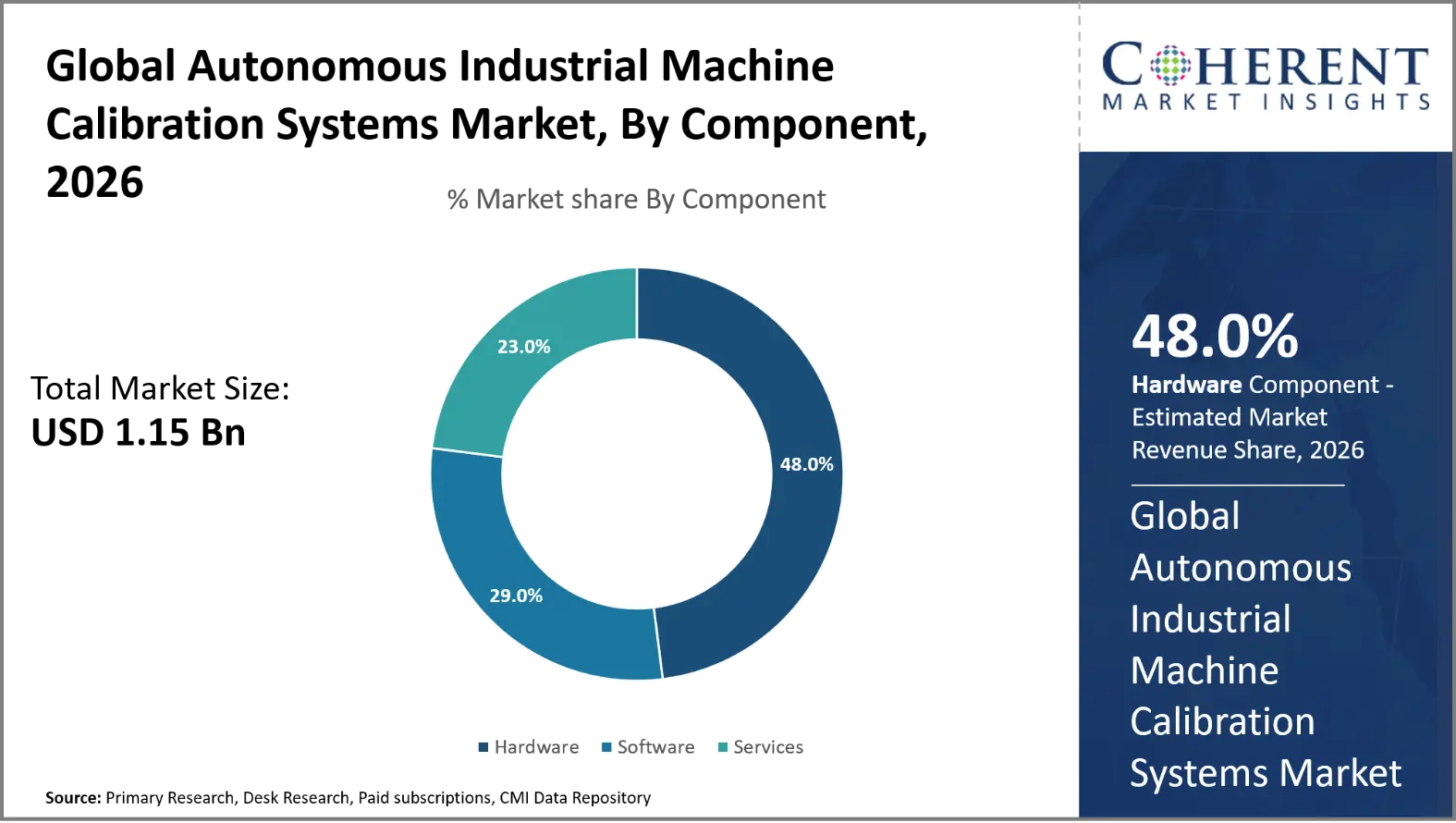
- The Hardware segment is expected to account for 48.0% of the global autonomous industrial machine calibration systems market share in 2026. Increasing use of digital twins in machine accuracy management is driving the growth of the segment. On July 1, 2026, Nidec Machine Tool Corporation launched Nidec NC Twin for its MVR Series double-column machining centers. The platform recreates actual machine movements and machining processes within a virtual environment.
- The Robot Calibration segment is estimated to capture 39.0% of the market share in 2026. Growing demand for predictive maintenance in manufacturing facilities is majorly driving the growth of the segment. On March 25, 2025, TDK Corporation introduced the edgeRX product line through its subsidiary, TDK SensEI. The platform combines edge sensors, artificial intelligence algorithms, and edge computing capabilities.
- The Semi-Automated Calibration segment is estimated to capture 52.0% of the market share in 2026. Expansion of smart factories requiring continuous machine performance monitoring is driving the growth of the segment. On March 11, 2025, Augury introduced Machine Health Ultra Low for continuous monitoring of machinery operating between 1 and 150 revolutions per minute.
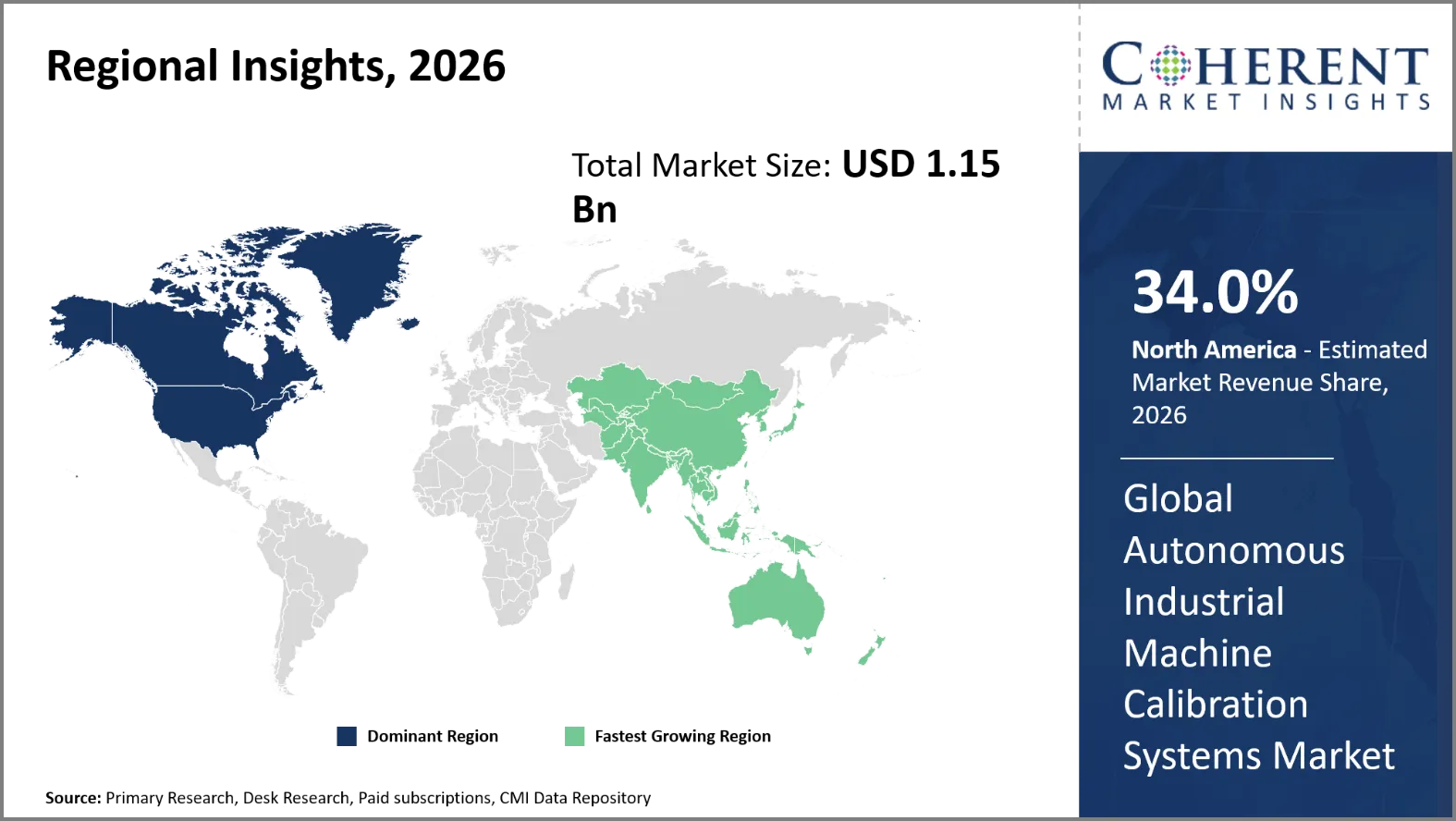
- North America is expected to dominate the autonomous industrial machine calibration systems market in 2026 with a market share of 34.0%. Growing demand for self-monitoring industrial machinery in North America is driving the growth of the regional market. On March 23, 2026, Hexagon Manufacturing Intelligence launched APOLLO, an artificial intelligence-powered condition monitoring platform in North Kingstown, Rhode Island. The platform monitors coordinate measuring machines and machine tools.
- Asia Pacific is expected to account for 29.0% share in 2026. Expansion of automated calibration in semiconductor manufacturing in Asia Pacific is driving the growth of the regional market. On January 16, 2026, HORIBA STEC announced the full-scale operation of its expanded Kyoto Fukuchiyama Technology Center in Japan. The facility holds ISO/IEC 17025 accreditation for gas mass-flow calibration.
Segmental Insights
Why Does Hardware Dominate the Global Autonomous Industrial Machine Calibration Systems Market?
The hardware segment is expected to account for 48.0% of the global autonomous industrial machine calibration systems market share in 2026. Hardware is the dominant component, as autonomous industrial calibration needs accurate measurement, sensing and positioning components. Precision machine alignment laser trackers, interferometers, calibration sensors and optical measurement equipment. Industrial producers value durable hardware and have a strong concern for dimensional perfection and decreased manufacturing variances. The hardware integration also enables for real-time monitoring and automatic error identification. And precision manufacturing is demanding better calibrating equipment because of more spending. These technologies enable manufacturers to deliver consistently high-quality products and reduce equipment downtime.
On April 2, 2025, API introduced their 6th generation Laser Tracker, the Integrated Laser Tracker (iLT). iLT is the result of the ultimate refining of the Laser Tracker technology, designed to be the most portable and user-friendly Laser Tracker ever conceived, and incorporating a number of advancements over the previous iteration.
- Current Industry Events of 2026
- Market Size Estimation
- Regional Breakdown
- Competitive Landscape
- Customer Intelligence
- Segmental Analysis
- Pricing Analysis
- Key Market Drivers, Challenges & Future Trends
- Customized Insights Section
Why is Robot Calibration the Most Preferred Calibration Type?
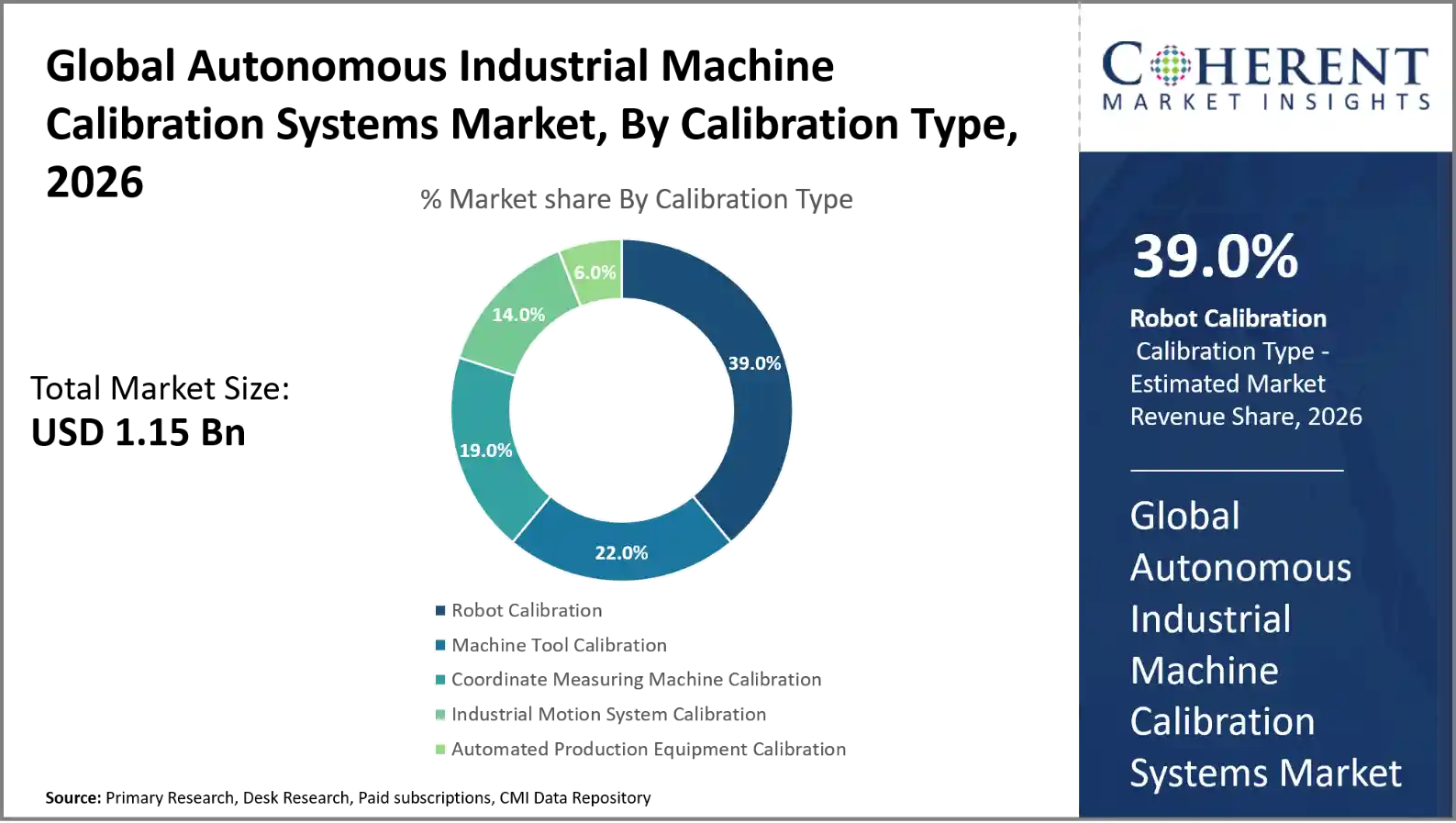
The robot calibration segment is expected to account for 39.0% of the global autonomous industrial machine calibration systems market share in 2026. Industrial robots must be calibrated so they can position themselves accurately and repeat their movements. Small geometrical mistakes might influence welding precision, assembly quality, material handling and machining operations. Automated calibration systems detect variances in position and compensate for imperfections in the robot axes. Manufacturers are progressively installing robotic systems that require consistent operational precision. Calibration also helps improve the robot performance following installation, maintenance and relocation of the equipment. Increased usage of industrial robotics drives the demand for better robot calibration solutions.
On January 12, 2026, Standard Bots selected Cognibotics’ CogniCal calibration technology for its next-generation collaborative robot platform. The integration targets its RO1 collaborative robot and a newer 30-kilogram payload model with two-meter reach.
Semi-Automated Calibration Dominates the Global Autonomous Industrial Machine Calibration Systems Market
The semi-automated calibration segment is expected to account for 52.0% of the global autonomous industrial machine calibration systems market share in 2026. Semi-automated calibration dominates because manufacturers seek accuracy without completely replacing existing manual procedures. These systems are a blend of automated measures with operator control and validation. Personnels benefit from human interaction to resolve tough calibration requirements and to confirm test results. Semi-automated systems also remove repetitive human work and reduce inconsistencies in the measurements. They work with existing industrial equipment, facilitating adoption in the manufacturing plants. Semi-automated calibration is attractive to manufacturers moving to complete autonomy because of the reduced implementation complexity.
On November 27, 2025, ENCY Software introduced Robot Calibration Helper, a mobile application for calibrating industrial robot tool-center points. The application guides the technician through a two-tool measurement process utilizing reference points. It computes automatically tool-center-point coordinates from observed records. Operators may view and re-calculate results prior to moving them into ENCY Robot projects.
Current Events and their Impact
Current Events | Description and its Impact |
United States International Traffic in Arms Regulations (ITAR) Modernization Updates |
|
European Union Artificial Intelligence Act (Regulation (EU) 2024/1689) |
|
Autonomous Industrial Machine Calibration Systems Market Dynamics
Market Drivers
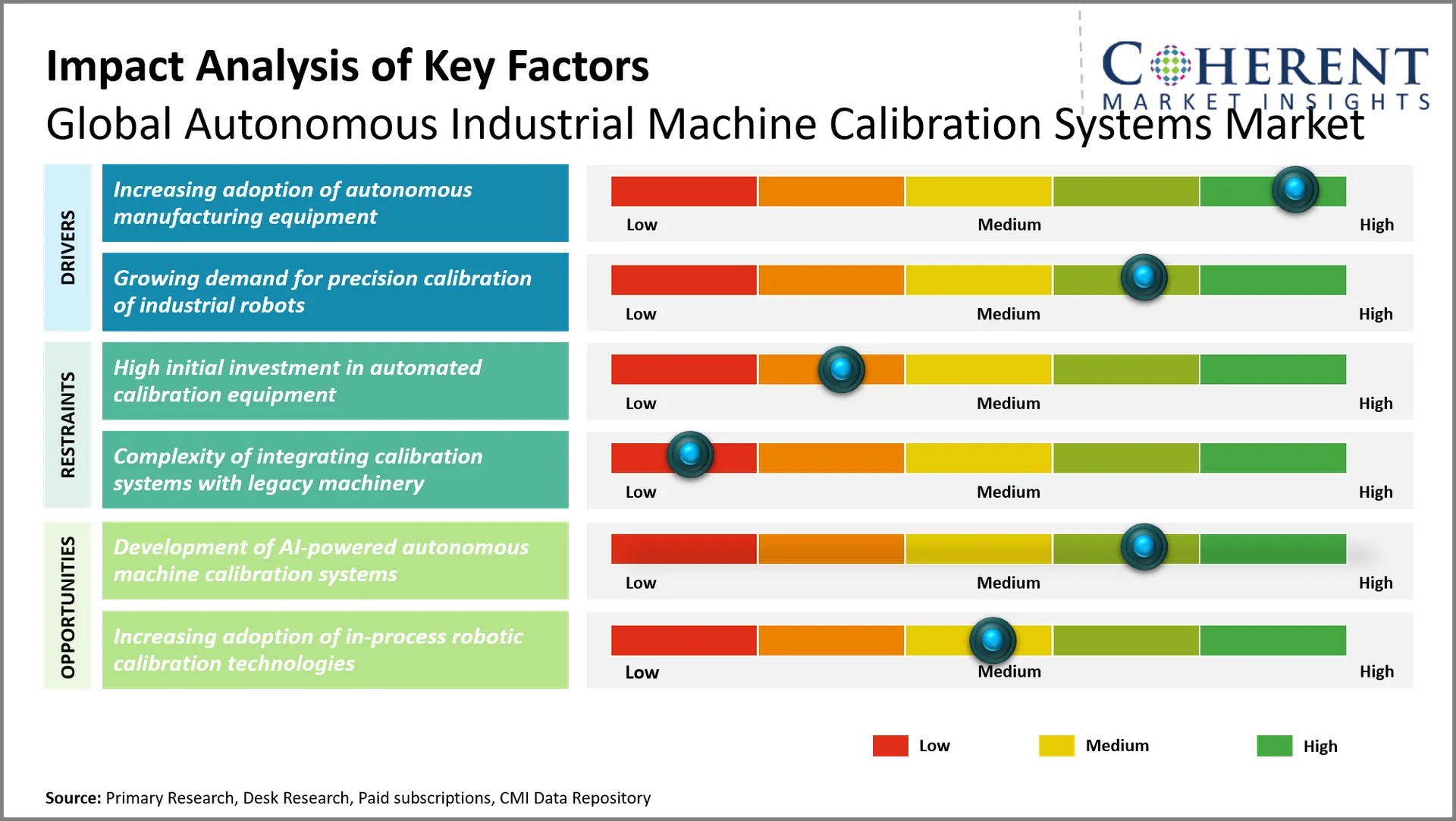
- Increasing adoption of autonomous manufacturing equipment: Manufacturers are spending in autonomous production equipment to increase operational efficiency and uniformity in manufacturing. Automated machining centers, robotic assembly lines and intelligent production systems need constant accuracy checking. Autonomous calibration systems detect deviations in the machine and keep the operation precise. These technologies reduce the need for manual inspection and reduce production disruptions. Furthermore, growing investments in smart manufacturing further boost the demand for automated calibration hardware and software. Industrial producers are placing greater emphasis on calibrating solutions that ensure constant equipment operation and continuous output.
- On April 14, 2026, AGIBOT, a leading robotics company focused on embodied intelligence, announced the successful deployment of its AGIBOT G2 robots in a live consumer electronic precision manufacturing environment operated by Longcheer Technology, a global leader in smart device ODM manufacturing.
- Growing demand for precision calibration of industrial robots: Industrial robots need precise calibration to ensure their positioning accuracy, repeatability, and coordinated movements. Small variations in the robot joints can impair welding, assembling, painting and material handling processes. Autonomous calibrating systems detect geometric faults and automatically correct positional errors. Increasing use of collaborative robots and high-speed robotic systems raises the demand for calibration. Manufacturers also need consistent robot performance after installation, maintenance and relocation. These operating needs drive the demand for improved robotic calibrating systems.
- On June 17, 2025, FANUC introduced their second-generation M-800/60-20B industrial robot for high-precision applications. The robot has a payload capacity of 60 kg and a route accuracy of ±0.1 mm. The Accuracy and Stiffness Enhancement option features iRCalibration Signature technology.
Restraining Factors
- High Initial Investment and Integration Costs: Autonomous calibration systems include significant initial investment in precision hardware acquisition, specialized software, sensors, and the integration infrastructure to support them. Small and medium sized manufacturers are usually financially constrained in replacing conventional calibration techniques. The integration to the existing machinery raises the cost of implementation.
- Complexity of Integrating Diverse Industrial Equipment: Industrial plants have machinery with varied designs, communication protocols and calibration needs. Engineering and comprehensive system validation will be needed to develop autonomous calibration solutions that are compatible. Difficulties of integration can cause delays in implementation, increased maintenance cost and limited acceptance in heterogeneous production environments.
Emerging Trends
- Integration of Artificial Intelligence and Machine Learning in Calibration Systems: Manufacturers are embracing artificial intelligence-based calibration software that identifies measurement deviations, forecasts errors, and automatically adjusts machine parameters during industrial processes.
- Impact: Intelligent calibration minimizes manual intervention, enhances measurement consistency and enables predictive maintenance. Producers can spot calibration drift sooner, helping to avoid production errors and unanticipated equipment downtime.
- Relevance to the market: Hexagon’s measurement technology and Siemens’ industrial automation platforms show prospects for combining intelligent measurement analytics with machine calibration operations.
- Development of Digital Twin-Based Calibration Technologies: Industrial producers are researching more deeply into digital twins that imitate machine behavior and simulate calibration modifications before making physical changes.
- Impact: Digital twin integration optimizes calibration planning, minimizes the need for physical testing, and assists engineers in assessing machine variances. Producers can maximize the performance of their equipment with minimal disruption to production.
- Relevance to the market: Examples of digital twin application relevant to virtual machine validation and calibration planning are Siemens’ Xcelerator range and Dassault Systèmes’ DELMIA platform.
Regional Insights
Why is North America a Strong Market for Autonomous Industrial Machine Calibration Systems?
North America is expected to account for a market share of 34.0% in 2026. North America advantages from aerospace manufacturing, superior machine tooling and increasing investments in automated quality inspection. Canadian industries are increasingly relying on onsite robot recalibration for specialized manufacturing equipment. Walker Advanced Manufacturing Innovation Center at Niagara College showed this requirement using waterjet robot recalibration. The calibration improved the positioning accuracy of the robot from 5 to 0.4 millimeters. Aerospace industries in the U.S. demand accurate robotic drilling, composite fabrication and airplane assembly. These demanding applications are addressed by portable laser trackers and automated measurement devices. Regional opportunities also arise from integrating calibration equipment into flexible manufacturing cells and specialized production facilities.
Why Does Asia Pacific Autonomous Industrial Machine Calibration Systems Market Exhibit High Growth?
Asia Pacific, registering the fastest growth with a CAGR of 13.6% over the forecast period, is projected to account for 29.0% of the global autonomous industrial machine calibration systems market in 2026. The region benefits from extensive electronics manufacturing, industrial robotics production, and expanding automated machinery deployment. In 2024, the region represented 74% of all global industrial robot installations. Strong demand comes from China, Japan and South Korea with their varied manufacturing niches. The auto component sector in India is also increasing the use of robotic automation. The precision calibration facilitates more complicated production processes, including electronic assemblies, equipment components and automated material handling. Regional suppliers are developing optical measurement equipment and machine accuracy verification technologies. Growing domestic robotics manufacturing further creates opportunities for calibration systems compatible with locally developed industrial robots.
Global Autonomous Industrial Machine Calibration Systems Market Outlook for Key Countries
Why is U.S. Emerging as a Major Hub in the Autonomous Industrial Machine Calibration Systems Market?
Aerospace modernization, semiconductor equipment manufacture and rising need for high-accuracy production gear support the U.S. market. Of the 34,200 industrial robots installed in 2024, 68% were in the U.S., or around 23,200. Robot integrators at the domestic level create chances for third-party calibration equipment and specialized measuring services. The Yaskawa Absolute Accuracy factory laser-calibration option indicates a need for improved robot positioning. The placement precision of the robot is about 0.2 mm, depending on the size and design of the robot and the technology used. Automated dimensional verification and machine error compensation are also attracting attention, fueled by applications in semiconductor production and aerospace tooling.
Is China the Next Growth Engine for the Autonomous Industrial Machine Calibration Systems Market?
China has the advantage of large-scale electronics manufacture, home robotics production and fast automation of general industries. In 2024, the country installed 295,000 industrial robots, 54% of the global installations. It has an installed base of more than two million industrial robots in operation. The metal and machinery production sector drove robot installations with 54,600 units, requiring precise positioning and machine alignment. Food processing installations were up 86% and rubber and plastics installations were up 34%. Such applications require dependable calibration in different production conditions. The growing number of domestic robot producers also create prospects for domestically created calibration hardware and software.
Germany Autonomous Industrial Machine Calibration Systems Market Analysis and Trends
Germany benefits from advanced automotive engineering, precision machinery manufacturing, and specialized industrial robotics research. Fraunhofer Institute for Manufacturing Technology and Advanced Materials develops CaliRob, a model-based industrial robot calibration application. The technology uses laser trackers to measure robot positions and calculate geometric corrections. Its real-time mathematical model transfers correction signals directly to robot axes. Germany recorded 26,982 industrial robot installations in 2024. Companies like KUKA are showcasing automated measuring applications, using robots to handle instruments in calibration operations. These skills meet the requirement for accurate calibration in the automobile production and precision engineering sectors.
Japan Autonomous Industrial Machine Calibration Systems Market Analysis and Trends
Japan benefits from its established machine tool industry, precision engineering capabilities, and domestic industrial robotics ecosystem. The Volumetric Accuracy Research Institute in Kyoto specializes in measuring and compensating machine tool accuracy. Its services generate spatial precision maps and correction parameters for machine tools. The company also supports correction table development for Siemens SINUMERIK controls. Japan installed 44,500 industrial robots in 2024, reflecting its substantial automation infrastructure. Demand for advanced calibration also benefits from manufacturers requiring precise machining of aerospace, automotive, and semiconductor components.
South Korea Analysis and Trends Autonomous Industrial Machine Calibration Systems Market
South Korea benefits from exceptionally high industrial robot density and sophisticated semiconductor and electronics manufacturing facilities. The country recorded 30,600 industrial robot installations in 2024. Its manufacturing robot density reached 1,220 robots per 10,000 manufacturing employees. This results in specific requirements for precise placement in small production lines and in automated inspection environments. Precision component assembly, display fabrication and semiconductor wafer handling require precise control of the equipment motions. The requirements are met by calibration methods which ensure robotic repeatability and coordinated positioning of the equipment. Investments in next-generation automotive manufacturing also create additional opportunities for automated machine verification.
Global Autonomous Industrial Machine Calibration Systems Market - Global Industrial Robot Installations (2024-2025)
Country | 2024 | 2025 |
China | 295000 | 354200 |
U.S. | 34200 | 38400 |
Japan | 44500 | 36200 |
South Korea | 30600 | 30000 |
Germany | 27000 | 24800 |
India | 9100 | 10500 |
Italy | 8800 | 7800 |
How is Development of AI-Powered Autonomous Machine Calibration Systems Creating New Growth Opportunities in the Autonomous Industrial Machine Calibration Systems Market?
The creation of AI-controlled autonomous machine calibration systems opens possibilities through smart mistake compensation and constant geometric accuracy improvement. Machine learning algorithms can evaluate laser tracker measurements, encoder feedback, vibration patterns and temperature fluctuations to diagnose complicated positioning issues. This allows the calibration program to provide machine-specific correction parameters without repeating manual measurements. Siemens, for example, has its SINUMERIK ONE digital native CNC platform that offers commissioning and simulation of machines based on digital twins. The AI integration with such platforms helps improve automated compensation operations for complex machine setups. This provides opportunity for vendors of adaptive calibration software, sophisticated measurement controllers and predictive accuracy monitoring solutions.
On April 22, 2026, Deepen AI announced its next-generation targetless multi-sensor calibration platform. The platform targets autonomous vehicles, advanced driver-assistance systems, and robotics sensor suites. It automatically calibrates multiple sensors within one integrated workflow.
Market Players, Key Development, and Competitive Landscape
Key Developments
- On April 30, 2026, Aeva and Nikon Metrology, LLC announced that Aeva’s Eve high-precision sensor technology is powering Nikon Corporation’s new APDIS MV5X Laser Radar system, which has begun commercial deployment as part of the companies’ multi-year production agreement to use Aeva’s technology in Nikon’s products for high-volume automated robotic inspection and metrology applications.
- On April 20, 2026, Nikon Corporation launched the APDIS MV5X, the latest addition to its APDIS Laser Radar product lineup. Building on the proven technologies of previous APDIS models, the APDIS MV5X delivers high-speed, high-precision non-contact measurement in a compact and lightweight form, enhancing the quality of the manufacturing process.
- On November 11, 2025, Creaform announced the next evolution in automated quality control for at-line inspection in mass production: the CUBE-R M Series. This innovative modular solution leverages the power of the MetraSCAN 3D-R scanner in an automated 3D measurement cell and offers three standard configurations to accommodate different part sizes.
Competitive Landscape
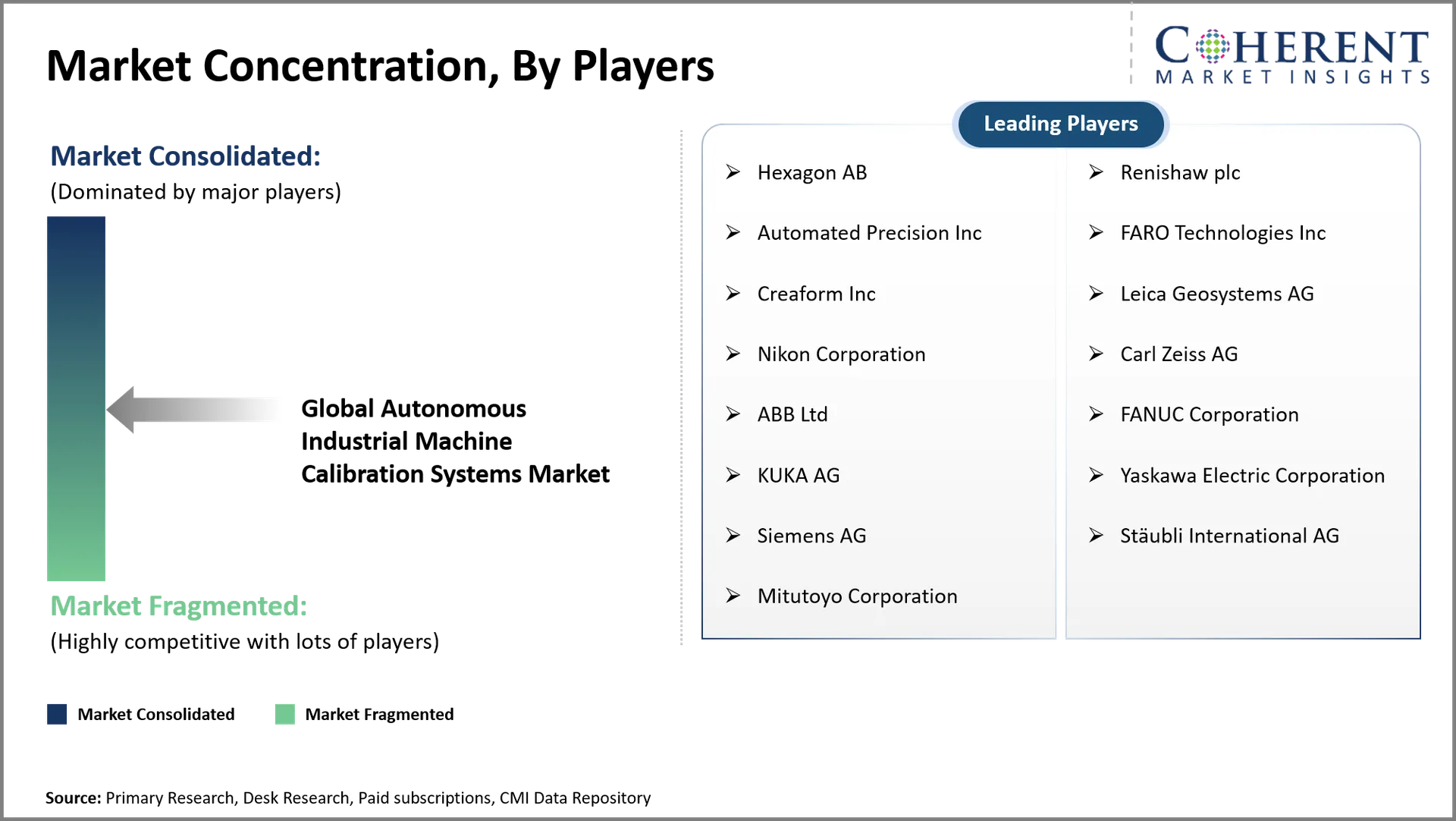
Key players in the global market includes Hexagon, FARO Technologies, Automated Precision Incorporated and large industrial robots manufacturers. Hexagon improves its position with integrated robot calibration, machine optimization and precision metrology solutions. Its RoboDyn software calculates robot kinematic parameters, tool centre point offsets, and positioning corrections. Its UNICAL platform automates volumetric machine tool calibration and generates controller-specific correction tables. FARO Technologies is dedicated to providing portable laser trackers, measurement arms, and BuildIT Metrology software. The system on a Cirrus Aircraft resulted in a 60% decrease in tooling costs due to enhanced robot positioning. Automated Precision Incorporated differentiates itself through RADIAN laser trackers, RoboCal software, and dynamic six-degree-of-freedom robot tracking. ABB Robotics focuses on lifelong robot positioning accuracy through its Absolute Accuracy technology and CalibWare software.
Top Manufacturers and Notable Products in the Autonomous Industrial Machine Calibration Systems Market
Manufacturer | Notable Product | Key features |
Hexagon AB | RoboDyn | Laser tracker integration, robot kinematic calibration, tool-centre-point correction, ISO 9283 performance testing |
Wiest AG | LaserLAB | Automated robot calibration, robot-cell measurement, controller integration, error correction, compatibility with multiple robot brands |
ISIOS GmbH | ISIOS Recalibration System | Laser-based measurement, inline recalibration, absolute accuracy maintenance, continuous production monitoring |
KEYENCE Corporation | WM-6000 Series | Six-degree-of-freedom laser tracking, robot calibration, automatic reporting, positional accuracy improvement |
Renishaw plc | RCS Calibration Series | Ballbar measurement, robot mastering, tool-frame verification, repeatability testing, automated recovery routines |
Market Report Scope
Global Autonomous Industrial Machine Calibration Systems Market Report Coverage | |||
Report Coverage | Details | ||
Base Year | 2025 | Market Size in 2026: | USD 1.15 Bn |
Historical Data For: | 2020 To 2024 | Forecast Period: | 2026 To 2033 |
Forecast Period 2026 To 2033 CAGR: | 12.0% | 2033 Value Projection: | USD 2.55 Bn |
Geographies covered: |
| ||
Segments covered: |
| ||
Companies covered: | Hexagon AB, Renishaw plc, Automated Precision Inc, FARO Technologies Inc, Creaform Inc, Leica Geosystems AG, Nikon Corporation, Carl Zeiss AG, ABB Ltd, FANUC Corporation, KUKA AG, Yaskawa Electric Corporation, Siemens AG, Stäubli International AG, Mitutoyo Corporation | ||
Growth Drivers: |
| ||
Restraints & Challenges: |
| ||
Analyst Opinion (Expert Opinion)
- The future industry will increasingly shift toward self-correcting calibration systems with minimal operator involvement. Artificial intelligence will enable calibration software to recognize geometric deviations and recommend machine-specific compensation parameters. Integration with industrial controllers will make automatic corrections more practical during production. Continuous monitoring will become particularly important for robots performing precision machining and automated inspection. Suppliers combining laser metrology, intelligent software, and real-time correction capabilities will gain stronger competitive positioning.
- Robot calibration software and automated volumetric machine calibration offer particularly attractive opportunities. Automotive body-in-white welding, aerospace drilling, semiconductor equipment positioning, and precision CNC machining require application-specific accuracy. China offers substantial opportunities through domestic robotics manufacturing and automated production facilities. Germany presents opportunities in precision machine tools and automotive engineering. Japan offers opportunities in advanced robotics and semiconductor equipment manufacturing. Hardware suppliers should prioritize six-degree-of-freedom laser trackers, interferometers, and automated measurement sensors.
- Manufacturers should develop calibration platforms compatible with ABB, FANUC, KUKA, and Yaskawa robotic controllers. Software developers should focus on automatic error compensation, thermal drift correction, and machine-specific calibration models. Hardware providers could increase measurement mobility and reduce the setup required for calibration. Companies should collaborate with industrial robot makers and CNC controller producers. Providing application-specific calibration kits, ongoing verification services and remote diagnostic capabilities can help retain customers. Modular solutions at low prices would help make it more accessible to small and medium manufacturers.
Speak to the analyst
Want personalized insights?
Take the findings above to one of our principal consultants, or have the report rebuilt around the segments, geographies and competitors you actually track.
Market Segmentation
- Component Insights (Revenue, USD Billion, 2021 - 2033)
- Hardware
- Software
- Services
- Calibration Type Insights (Revenue, USD Billion, 2021 - 2033)
- Robot Calibration
- Machine Tool Calibration
- Coordinate Measuring Machine Calibration
- Industrial Motion System Calibration
- Automated Production Equipment Calibration
- Automation Level Insights (Revenue, USD Billion, 2021 - 2033)
- Semi-Automated Calibration
- Fully Autonomous Calibration
- Continuous In-Process Calibration
- Technology Type Insights (Revenue, USD Billion, 2021 - 2033)
- Laser-Based Calibration
- Optical Measurement-Based Calibration
- Interferometry-Based Calibration
- Probe-Based Calibration
- Vision-Based Calibration
- Multilateration-Based Calibration
- Application Insights (Revenue, USD Billion, 2021 - 2033)
- Industrial Robotics
- CNC Machine Tools
- Automated Assembly Lines
- Semiconductor Manufacturing Equipment
- Automotive Manufacturing Equipment
- Aerospace Manufacturing Equipment
- End User Insights (Revenue, USD Billion, 2021 - 2033)
- Automotive
- Aerospace and Defense
- Electronics and Semiconductors
- Industrial Machinery
- Healthcare Equipment Manufacturing
- Metalworking and Heavy Manufacturing
- Regional Insights (Revenue, USD Billion, 2021 - 2033)
- North America
- U.S.
- Canada
- Latin America
- Brazil
- Argentina
- Mexico
- Rest of Latin America
- Europe
- Germany
- U.K.
- Spain
- France
- Italy
- Russia
- Rest of Europe
- Asia Pacific
- China
- India
- Japan
- Australia
- South Korea
- ASEAN
- Rest of Asia Pacific
- Middle East
- GCC Countries
- Israel
- Rest of Middle East
- Africa
- South Africa
- North Africa
- Central Africa
- North America
- Key Players Insights
- Hexagon AB
- Renishaw plc
- Automated Precision Inc
- FARO Technologies Inc
- Creaform Inc
- Leica Geosystems AG
- Nikon Corporation
- Carl Zeiss AG
- ABB Ltd
- FANUC Corporation
- KUKA AG
- Yaskawa Electric Corporation
- Siemens AG
- Stäubli International AG
- Mitutoyo Corporation
Sources
Primary Research Interviews
- Machine Calibration System Manufacturers & OEMs
- Industrial Automation & Robotics Solution Providers
- Precision Measurement & Metrology Specialists
- Quality Assurance & Process Control Engineers
Magazines
- Quality Magazine (Automation & Metrology)
- Manufacturing Engineering Magazine
- Control Engineering Magazine
- Metrology World Magazine
Journals
- International Journal of Advanced Manufacturing Technology
- Journal of Precision Engineering and Manufacturing
- IEEE Transactions on Industrial Electronics
Associations
- International Society of Automation (ISA)
- American Society for Quality (ASQ)
- National Institute of Standards and Technology (NIST)
- Measurement, Control & Automation Association (MCAA)
Public Domain Sources
- U.S. Bureau of Labor Statistics – Manufacturing Sector Data
- European Commission – Industry 4.0 & Automation Policy Reports
- World Economic Forum – Advanced Manufacturing Insights
- NIST – Calibration & Metrology Standards Documentation
Proprietary Elements
- CMI Data Analytics Tool
- Proprietary CMI Existing Repository of Information for Last 10 Years
Get access to 250+ pages report
Every segment, forecast, competitor profile and data table behind the analysis above — available for instant download.
- ESOMAR Member
- ISO 9001:2015 Certified
- D-U-N-S Registered
- GDPR & CCPA Compliant
Frequently Asked Questions
The global autonomous industrial machine calibration systems market is expected to stand at USD 1.15 Bn in 2026 and is expected to reach USD 2.55 Bn by 2033.
The CAGR of the global autonomous industrial machine calibration systems market is projected to be 12.0% from 2026 to 2033.
Increasing adoption of autonomous manufacturing equipment and Growing demand for precision calibration of industrial robots are the major factors driving the growth of the global autonomous industrial machine calibration systems market.
High initial investment in automated calibration equipment and Complexity of integrating calibration systems with legacy machinery are the major factors hampering the growth of the global autonomous industrial machine calibration systems market.
In terms of component, hardware segment is estimated to dominate the market revenue share in 2026.
Autonomous industrial machine calibration systems automatically measure, identify, and correct machinery deviations without extensive manual intervention.
Laser trackers measure three-dimensional positioning errors and support accurate geometric compensation of industrial machines and robots.