
Global Battery Recycling Chemicals Market Size and Forecast – 2026 To 2033
The Global Battery Recycling Chemicals Market is estimated to be valued at USD 112.6 Mn in 2026 and is projected to reach USD 221.4 Mn by 2033, exhibiting a CAGR of 10.14% during 2026–2033. The growth of the market is supported by the expansion of lithium-ion battery recycling infrastructure, increasing recovery of critical metals and stricter requirements for sustainable battery waste management. Ongoing demand for leaching agents, extractants, solvents and purification chemicals in recovery of lithium, nickel and cobalt is driven by the use of hydrometallurgical processes.
In October 2024, Mercedes-Benz opened a battery recycling plant in Kuppenheim, Germany, using a mechanical-hydrometallurgical process that is expected to recover more than 96%. The development underscores the increasing commercial importance of advanced chemical recycling technologies in developing circular battery supply chains.
Key Takeaways of the Global Battery Recycling Chemicals Market
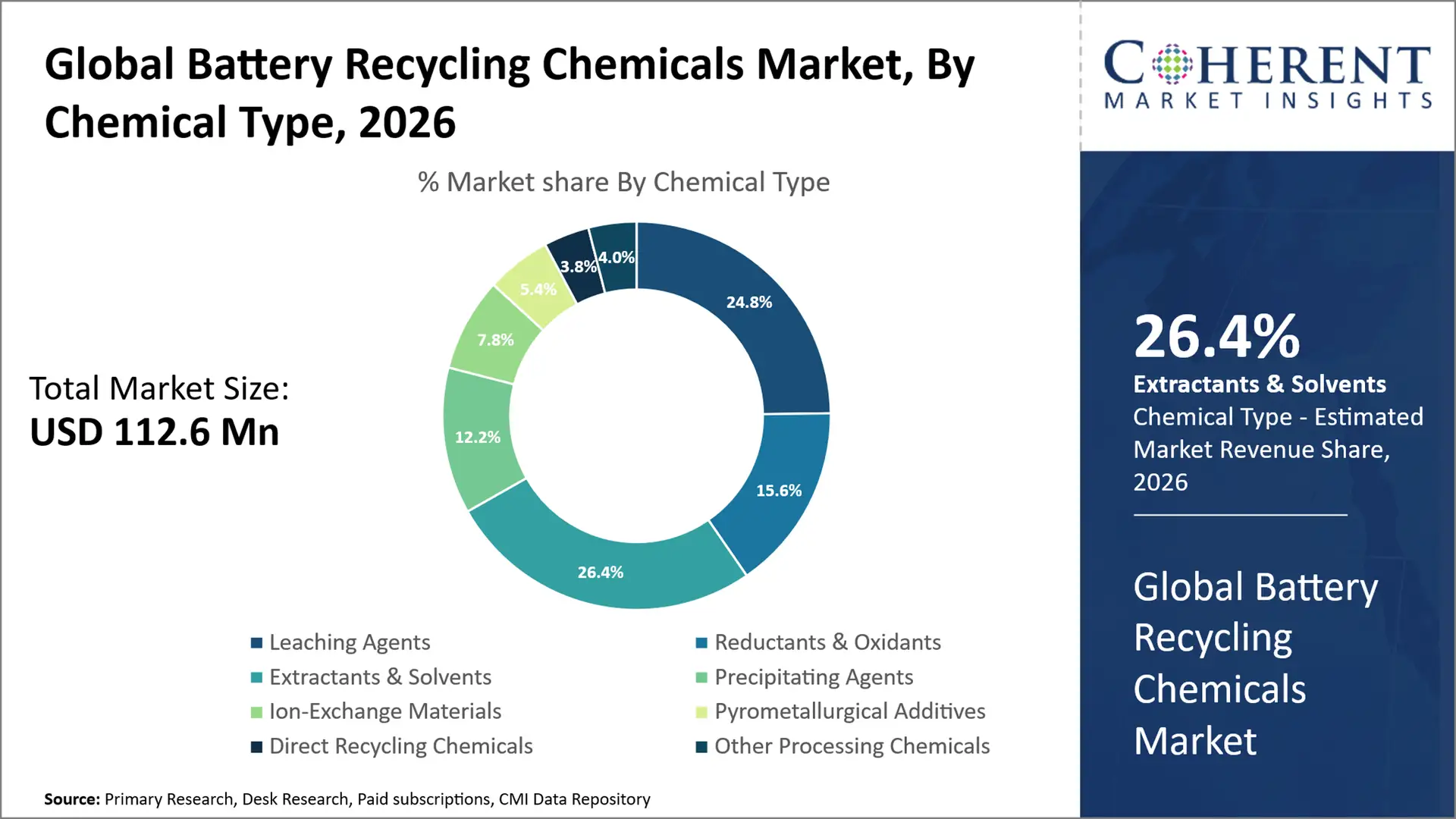
- Extractants & Solvents are estimated to expand at an 11.3% CAGR during 2026–2033 and represent 26.4% of the global battery recycling chemicals market in 2026. They are important for producing battery-grade compounds because they can extract lithium from complex leach solutions. In July 2025, Syensqo and cylib showed lithium hydroxide recovery with the selective extractant CYANEX 936P .
- Hydrometallurgical recycling is projected to grow at an estimated 10.6% CAGR during 2026–2033, accounting for 82.2% of the global battery recycling chemicals market in 2026. Its multi-stage leaching, separation and purification operations generate ongoing chemical requirements and enable high value metal recovery. In March 2026 Fortum signed an EU grant agreement to support its planned NEXT HYDROMET expansion in Finland.
- Lithium-Ion Batteries are projected to observe an estimated CAGR of 10.9% during 2026-2033 and hold 85.3% of global battery recycling chemicals market revenue in 2026. Mixed cathode streams require flexible treatment chemistry, supporting purchases across multiple reagent categories because of mixed NMC, LFP and other cathode streams. Maxvolt Energy founded ReEarth in April 2026 to develop recycling processes for LFP, NMC, NCA and LCO batteries.
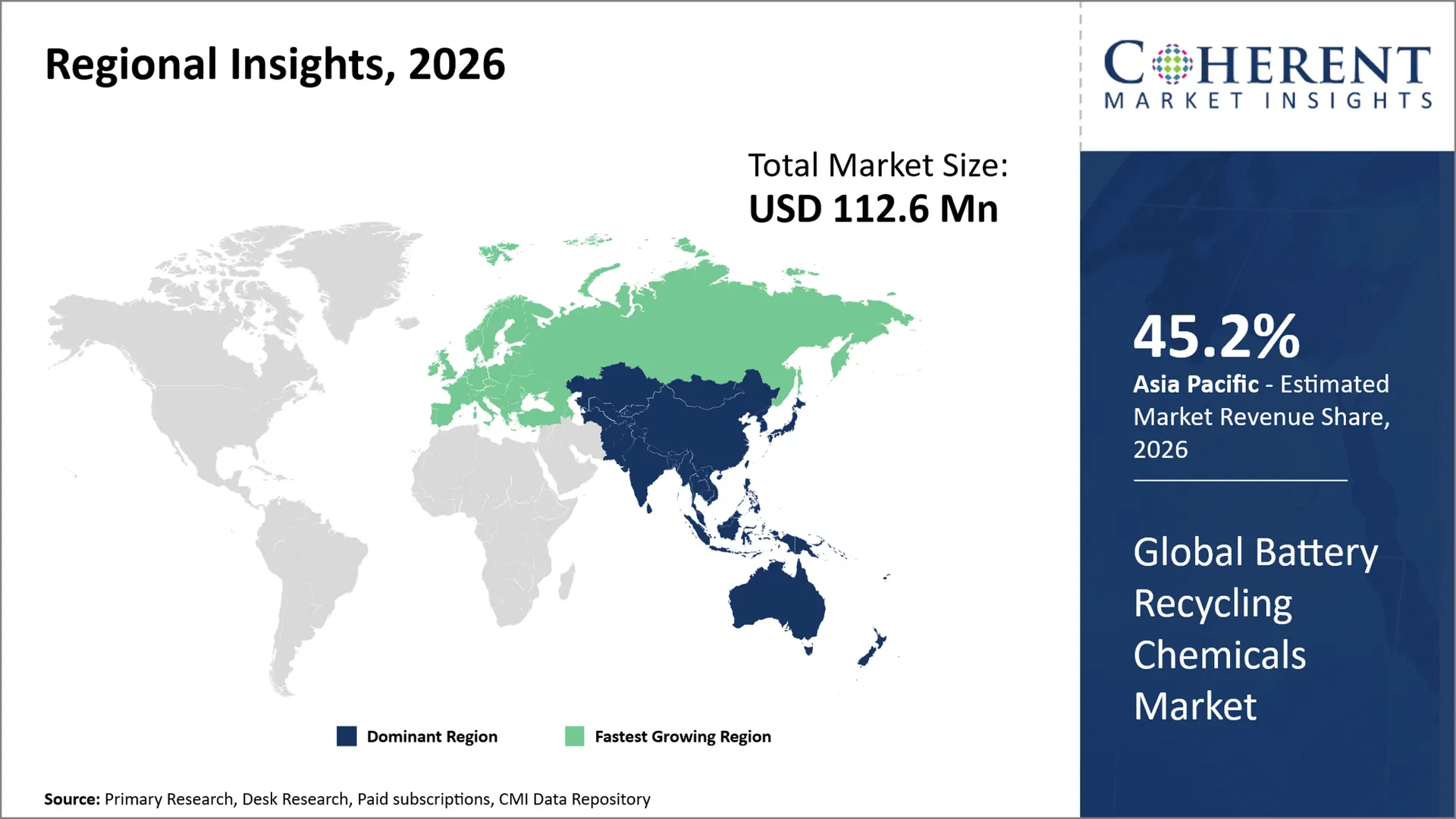
- Asia Pacific is expected to grow at an estimated 9.6% CAGR during 2026–2033 while retaining 45.2% of global battery recycling chemicals market revenue in 2026. Steady buying of reagents for metal recovery is underpinned by a big battery-making and recycling ecosystem. In September 2025, the Union Cabinet of India approved incentives for the extraction of critical minerals from battery scrap with specific focus on processing beyond black-mass production.
- Europe is projected to achieve an estimated 11.8% CAGR during 2026–2033, with 26.8% of the global battery recycling chemicals market in 2026, making it the fastest-growing region. The recovery targets make measurable extraction performance commercially important, pushing recyclers to optimize the way they process chemicals. The European Commission introduced harmonized rules for the calculation of recycling efficiency and recovery of lithium, nickel, cobalt and copper in July 2025.
Segmental Insights
Why Do Extractants & Solvents Dominate the Global Battery Recycling Chemicals Market?
Extractants & Solvents are expected to account for 26.4% of the global battery recycling chemicals market by chemical type in 2026. Their leadership is also a sign of the need to closely manage the dissolved metals that are closely related after black mass leaching. Poor selectivity can increase the cost of downstream refining. Recyclers select solvent systems on the basis of extraction performance, phase separation, solvent durability and compatibility with existing equipment. This creates opportunities for chemical formulators to provide tailor-made extraction media instead of standard bulk reagents. In January 2026, Iondrive announced the ordering of the dry-processing container for its Australian pilot plant to prepare lithium-ion black mass for subsequent extraction using its IONSolv deep eutectic solvent platform. Commissioning of the wet-processing system was still pending the project shows commercial interest in specialized solvent systems, but pilot development should not be confused with full scale adoption. Suppliers will still see customer qualification and solvent performance across variable feedstocks as critical to securing contracts.
- Current Industry Events of 2026
- Market Size Estimation
- Regional Breakdown
- Competitive Landscape
- Customer Intelligence
- Segmental Analysis
- Pricing Analysis
- Key Market Drivers, Challenges & Future Trends
- Customized Insights Section
Why Does Hydrometallurgical Recycling Represent the Largest Recycling Process Segment in the Global Battery Recycling Chemicals Market?
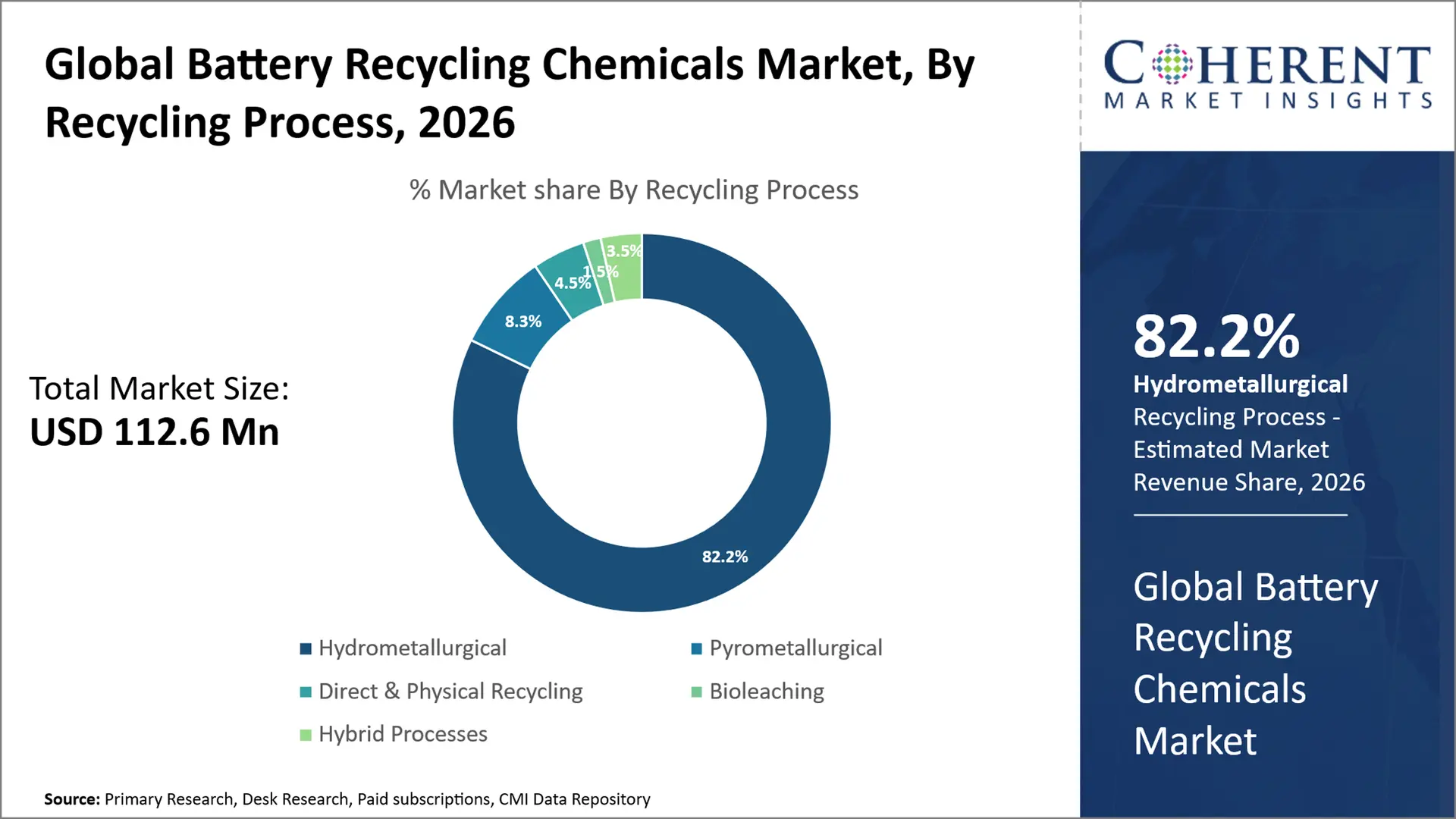
Hydrometallurgical recycling is expected to hold 82.2% of the global battery recycling chemicals market by recycling process in 2026. Its advantage extends beyond metal dissolution: operators can configure sequential purification steps around target metal products and varying feedstock grades. That operational flexibility is useful to metal refineries seeking salable intermediates without dependence on a single high temperature treatment route. When plants incorporate impurity control, solution management and chemical dosing into a single flowsheet, equipment vendors and reagent suppliers are rewarded. In November 2026, Veolia announced the opening of a hydrometallurgical battery-material recovery site in France that can process nearly 7,000 tons of black mass a year. The site targets cobalt, nickel, and copper recovery for industrial markets. Such investments indicate that localized refining infrastructure can widen the addressable customer base for chemical suppliers, while putting greater emphasis on predictable plant operation and treatment costs.
Why Do Lithium-Ion Batteries Dominate the Battery Chemistry Segment of the Global Battery Recycling Chemicals Market?
Lithium-Ion Batteries, covering NMC, LFP, LCO, NCA, and LMO chemistries, are expected to account for 85.3% of the global battery recycling chemicals market by battery chemistry in 2026. Their lead reflects the direct relationship between high-volume cell manufacturing and streams of electrode scrap, rejected cells, and retired packs. Recovering material from factory scrap can be commercially attractive because its origin and composition are easier to document than mixed consumer waste. This improves processing schedules, procurement planning, and qualification of recovered materials by battery makers. In April 2025, LG Energy Solution announced a recycling joint venture with Derichebourg in France, combining battery-production scrap with collected end-of-life EV batteries. The proposed facility would produce black mass for subsequent recovery of lithium, nickel, and cobalt. Such partnerships encourage traceable recycling supply chains and more structured purchasing opportunities for downstream chemical processors.
Current Events and their Impact
Current Event | Description and Its Impact |
China – New EV Battery Recycling Management Rules, January 2026 |
|
European Union – Digital Waste Shipment Requirements, May 2026 |
|
Australia – Mandatory Battery Product Stewardship Regulation, February 2026 |
|
Global Battery Recycling Chemicals Market Dynamics
Key Market Drivers
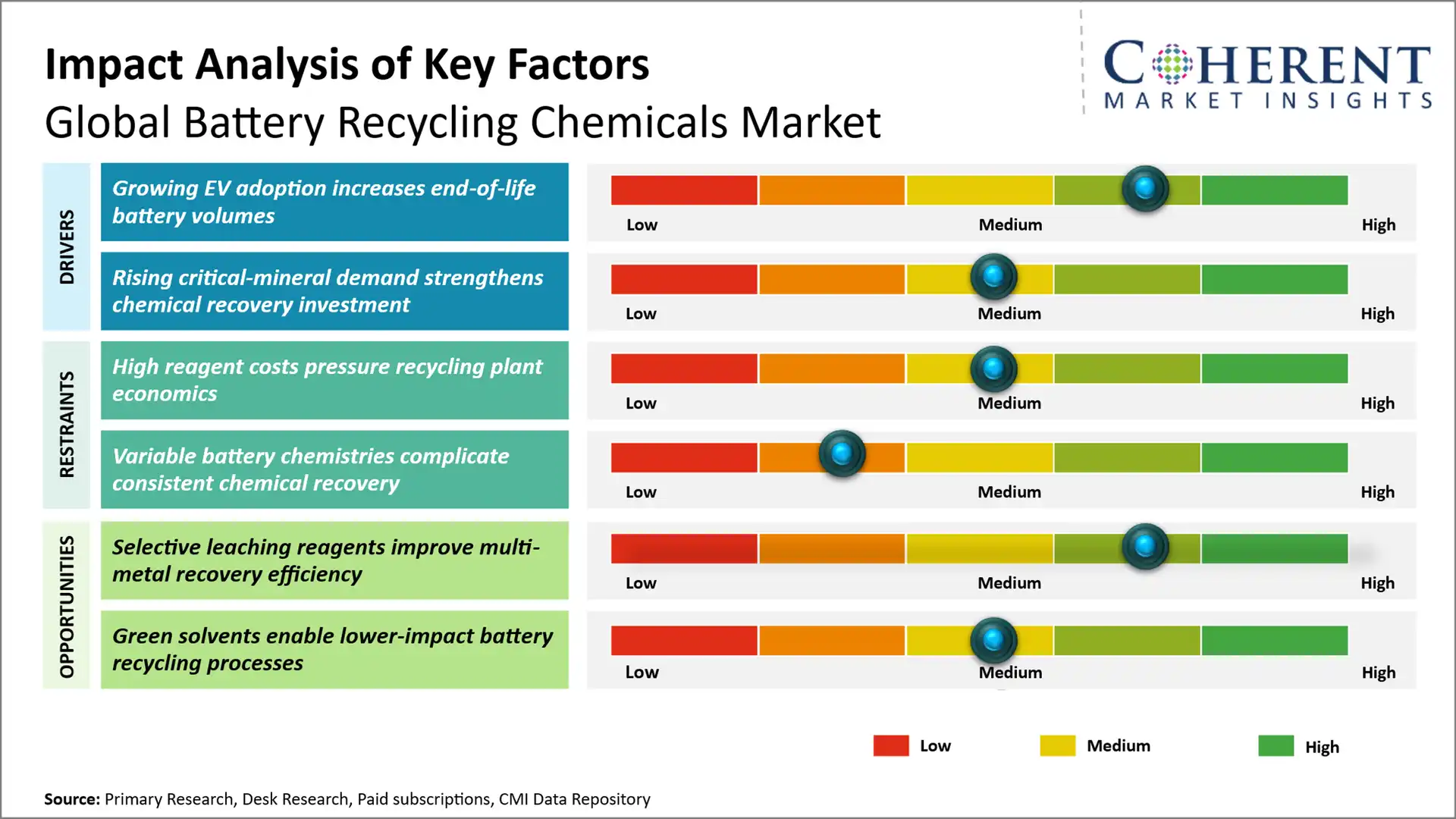
- Growing EV adoption increases end-of-life battery volumes: The expanding global electric vehicle fleet is creating a larger pipeline of damaged, replaced, and end-of-life lithium-ion batteries. Batteries entering chemical recycling require leaching, metal separation, and purification, increasing opportunities for reagent manufacturers and recycling facilities. Formal collection agreements also improve feedstock visibility and chemical procurement planning. In June 2026, Redwood Materials expanded its relationship with General Motors to cover manufacturing scrap recovery, end-of-life EV battery recycling, and second-life energy storage applications. This strengthens organized battery recovery infrastructure and future chemical processing opportunities.
- Rising critical-mineral demand strengthens chemical recovery investment: Efforts to secure domestic supplies of lithium, nickel, cobalt, and manganese are encouraging investment in battery material recovery infrastructure. Converting black mass into battery-grade products requires controlled dissolution, selective separation, and impurity removal, creating opportunities for specialty chemical suppliers and metal refiners. In December 2024, American Battery Technology Company received a US$144 million contracted grant award from the U.S. Department of Energy to support construction of a second commercial-scale lithium-ion battery recycling facility. The proposed expansion illustrates how mineral-security investments can translate into future chemical procurement opportunities.
Emerging Market Trends
- Shift Toward Reagent Regeneration and Closed-Loop Chemical Consumption: Battery recyclers are exploring ways to recover and reuse acids, alkalis, and separation chemicals instead of continually adding new reagents. With operating costs for wastewater treatment and chemical disposal becoming a major consideration, chemical regeneration systems are receiving greater consideration in plant design decisions.
- Impact: Demand for high purity reusable formulations may change. Operating margins may improve due to reduced fresh chemical consumption. Traditional reagent vendors may be motivated to provide products suitable for regeneration.
- Market Relevance: During the forecast period, chemical suppliers offering recovery-compatible formulations and regeneration services could develop differentiated commercial models with established recycling facilities.
- Growing Interest in Bioleaching and Low-Temperature Metal Recovery: Bioleaching is gaining more interest as a potential alternative method to recover metals from specific battery waste streams. Microorganisms can initiate or promote leaching reactions under relatively mild operating conditions, but the problems related to industrial scalability and the speed of recovery are major issues.
- Impact: Successful commercialization of the technology could reduce dependence on some conventional leaching chemicals and open opportunities for specialized inputs to biological processing.
- Market Relevance: The approach is expected to be gradually developed through pilot scale applications before large scale industrial applications. There may be benefits to processes tailored to difficult or low value battery feedstocks for technology developers and specialty reagent suppliers.
Key Restraining Factors
- Unfavorable Recovery Economics for Lower-Value Battery Chemistries: Lithium iron phosphate batteries contain no recoverable nickel or cobalt, minimizing the metal value available to offset the costs of chemical processing. When lithium prices soften, traditional recovery routes that require large amounts of reagents, energy and waste water treatment may not be justified for recyclers. This increases the importance of selective lithium recovery and puts pressure on the price of chemical suppliers.
- Chemical Handling and Wastewater Treatment Costs: Recycling of batteries may require the use of corrosive acids, alkaline reagents, dissolved heavy metals, and possibly hazardous fluorine-containing residues. Treatment systems must control emissions, manage wastewater, and protect employees from chemical exposure. Such requirements, in particular, increase operating costs and capital expenditures especially for smaller recycling operations. Environmental permitting can also be complex and may cause delays in the purchase of reagents and the start-up of new processing projects.
Regional Insights
Why Does Asia Pacific Dominate the Global Battery Recycling Chemicals Market?
Asia Pacific is expected to constitute 45.2% of the global battery recycling chemicals market by 2026, due to its dense battery-cell production, established recycling infrastructure and vast cathode-material supply chains. The area has integrated industrial networks between battery manufacturers, black mass processors and chemical refiners. It lowers the cost of processing material and increases the availability of recycled metal intermediates. Domestic processing capabilities are also expanding to areas outside of traditional manufacturing centers. In April 2026, Australia’s Clean Energy Finance Corporation led a Series A financing round of US$ 8.05 million for Renewable Metals to advance its alkali-based battery recycling technology. This shows increasing regional interest in commercially scalable recovery processes and dedicated chemical treatment systems.
Why Is Europe Emerging as the Fastest-Growing Region in the Global Battery Recycling Chemicals Market?
Europe is projected to hold a 26.8% share of the global battery recycling chemicals market by 2026 and witness the highest growth by 2033. The growth stems from attempts to keep battery waste in the regional refining networks and reduce dependence on imported processed metals. European recyclers are developing treatment routes, taking into account the different battery compositions, which are compliant with strict environmental requirements. In June 2026, Fraunhofer ISE said it will take part in the EU-funded M-BAT project, which will develop chemical recovery processes and run pilot activities in Spain, Poland, and the United Kingdom. The initiative supports the development of selective recovery technologies for battery-related materials, creating opportunities for specialized manufacturers of reagents, separation technology developers, and industrial processing partners.
Global Battery Recycling Chemicals Market Outlook for Key Countries
Why Does China Lead the Global Battery Recycling Chemicals Market?
China is central to the global battery recycling chemicals market because its battery manufacturing clusters generate substantial production scrap that can enter recovery circuits before packs reach end of life. Established networks for precursor synthesis and cathode manufacturing also provide nearby buyers for reclaimed lithium salts, connecting recycling chemistry directly with battery-material production. Refiners can coordinate black mass intake, metal recovery, and downstream conversion within established industrial ecosystems. In March 2026, CATL reported recycling 210,000 tonnes of spent batteries during 2025 and regenerating 24,000 tonnes of lithium salts. This scale illustrates how integrated material flows can sustain procurement of leaching agents, separation chemicals, and purification reagents across commercial operations.
Why Is the U.S. a Key Market for the Global Battery Recycling Chemicals Market?
The U.S. is a key country market because battery manufacturers and recyclers need domestic sources of battery-grade compounds rather than relying on exported processing intermediates. The central commercial challenge is qualifying recycled lithium carbonate to specifications accepted by cathode producers and industrial buyers. Reliable customers for recovered compounds also help chemical processors justify investments in reagent circuits and final-product purification. In September 2025, Ascend Elements reported producing lithium carbonate with greater than 99% purity from black mass at commercial scale at its Covington, Georgia, facility. The milestone demonstrates a shift from battery collection and shredding toward domestic chemical refining. Suppliers able to deliver consistent chemical purity and reliable processing performance stand to benefit.
Why Is Germany a Strategic Country in the Global Battery Recycling Chemicals Market?
Germany has a high concentration of chemical engineering, automotive development, and industrial parks that can accommodate regulated processing operations. These capabilities support specialized formulations that address feedstock impurities, plant throughput, and industrial safety requirements in the battery recycling chemicals market. Germany’s opportunity is more than just battery collection; it is about turning laboratory recovery methods into working production lines with qualified output materials. In March 2026, Tozero opened an industrial demonstration plant at Chemical Park Gendorf in Bavaria to recover lithium carbonate, graphite and nickel-cobalt materials using its proprietary acid-free hydrometallurgical process. The development demonstrates how industrial chemical infrastructure can be utilized to support process validation and generate future procurement opportunities for treatment chemicals and supporting equipment.
Why Is South Korea Important in the Global Battery Recycling Chemicals Market?
South Korea's role in the global battery recycling chemicals market is closely linked to its cathode-material, cell-manufacturing, and metallurgical industries, which need reliable secondary sources of nickel and cobalt. A key constraint for smaller recyclers is the cost of validating recovery technology and qualifying recovered materials. Shared demonstration infrastructure can reduce that barrier while allowing reagent developers to test processing chemistry before commercial deployment. In November 2025, South Korea's Ministry of Climate, Energy and Environment opened the Korea Battery Circulation Cluster in Pohang, with research and demonstration equipment for black mass production and valuable-metal extraction. This facility could increase the number of domestic technology developers progressing toward recurring industrial chemical purchasing.
Why Does Japan Support Growth in the Global Battery Recycling Chemicals Market?
Japan is important because its automakers and advanced materials manufacturers prioritize traceable, high-purity recycled inputs that can return to battery supply chains. Chemical recovery providers therefore face pressure to improve lithium yield and product quality without excessive reagent consumption or carbon emissions. Competition centers on improving process economics while meeting demanding material specifications. JX Advanced Metals said in April 2025 it has developed a process to recover more than 90% of lithium from used automotive lithium-ion batteries, and will conduct demonstration operations at its Tsuruga site. These refinements could favor suppliers of process-specific additives, purification materials, and technical services rather than undifferentiated bulk chemicals.
Chemical Recovery and Processing Technology Adoption Landscape in the Global Battery Recycling Chemicals Market
Processing Technology | Chemical Requirements and Applications | Adoption Landscape | Commercial Significance |
Reductive Acid Leaching | Sulfuric acid and reducing agents are used to leach lithium, nickel, cobalt and manganese from appropriate black mass feedstocks. | Commercially established | Generates a continuous demand for leaching agents and reductants. |
Selective Solvent Extraction | Organic extractants, diluents and stripping reagents are used to separate dissolved battery metals into purified streams. | Commercially established | Supports higher value recovery products and custom extractant formulations. |
Controlled Chemical Precipitation | Dissolved metals are converted to recoverable compounds by sodium hydroxide, sodium carbonate and other precipitating agents. | Commercially established | It is used in making metal hydroxides and other refining intermediates. |
Ion-Exchange Purification | Functionalized resins selectively capture residual dissolved metals and remove impurities from process solutions. | Established in specialist applications | Opportunities are provided for high-selectivity purification materials and resin replacement services. |
Electrochemical Recovery and Reagent Regeneration | Electrochemical cells can be used to separate metals, recover acids or recycle reagents, depending on the conditions of the process. | Developing and application-specific | Could reduce chemical losses and drive demand for integrated electrochemical processing solutions. |
Microbial Bioleaching | Biological systems generate or support metal-solubilizing reactions through microorganisms and associated chemical conditions. | Research and pilot-stage development | Provides opportunities for specialized bioleaching inputs and alternative recovery processes. |
How Are Electrolyte-Safe Recovery Processes Creating New Growth Opportunities in the Global Battery Recycling Chemicals Market?
Spent batteries represent an underdeveloped opportunity for specialized processing chemicals, especially as recyclers handle more types of lithium-ion battery formats. Residual electrolyte can make dismantling difficult, increase equipment corrosion and contaminate metal recovery downstream.
Chemical suppliers could provide integrated treatment solutions, including controlled neutralization, fluorine management and, where technically feasible, solvent separation. Potential customers include electronics recyclers, industrial battery recyclers, battery dismantling facilities, and operators dealing with mixed-format cells.
The commercial opportunity is to reduce the cost of handling hazardous waste, improve the safety of processing and limit contamination of recovered metals. Application specific formulations, technical services and validated treatment performance could be used by suppliers to differentiate themselves.
The catch is that it requires expertise in electrolyte chemistry, toxic substances, corrosion resistant equipment and effluent management. It would also involve partnerships with licensed recyclers.
The biggest winners will likely be specialty chemical companies and technology providers, especially those that can integrate the treatment chemistry with existing recycling processes with minimal process disruption.
Market Players, Key Developments, and Competitive Intelligence
Key Developments
- In September 2026, Electra Battery Materials announced preliminary engineering results for a proposed nickel refining facility with a potential second phase for processing recycled battery black mass. The project could create additional demand for hydrometallurgical processing chemicals, although recycling expansion remains subject to further engineering and investment decisions.
- In July 2026, Altilium announced that it had secured a UK patent covering its EcoCathode battery recycling process. The protected hydrometallurgical technology recovers, purifies, and regenerates cathode materials from spent batteries. Patent protection strengthens its position in specialized chemical recovery technology and potential licensing opportunities.
- In April 2026, BASF announced a collaboration with TSR Group covering electric vehicle battery dismantling, discharging, black mass production, and associated recycling services. The arrangement expands BASF's recycling network and could improve the consistency of feedstock supplied to downstream chemical recovery operations.
Competitive Landscape
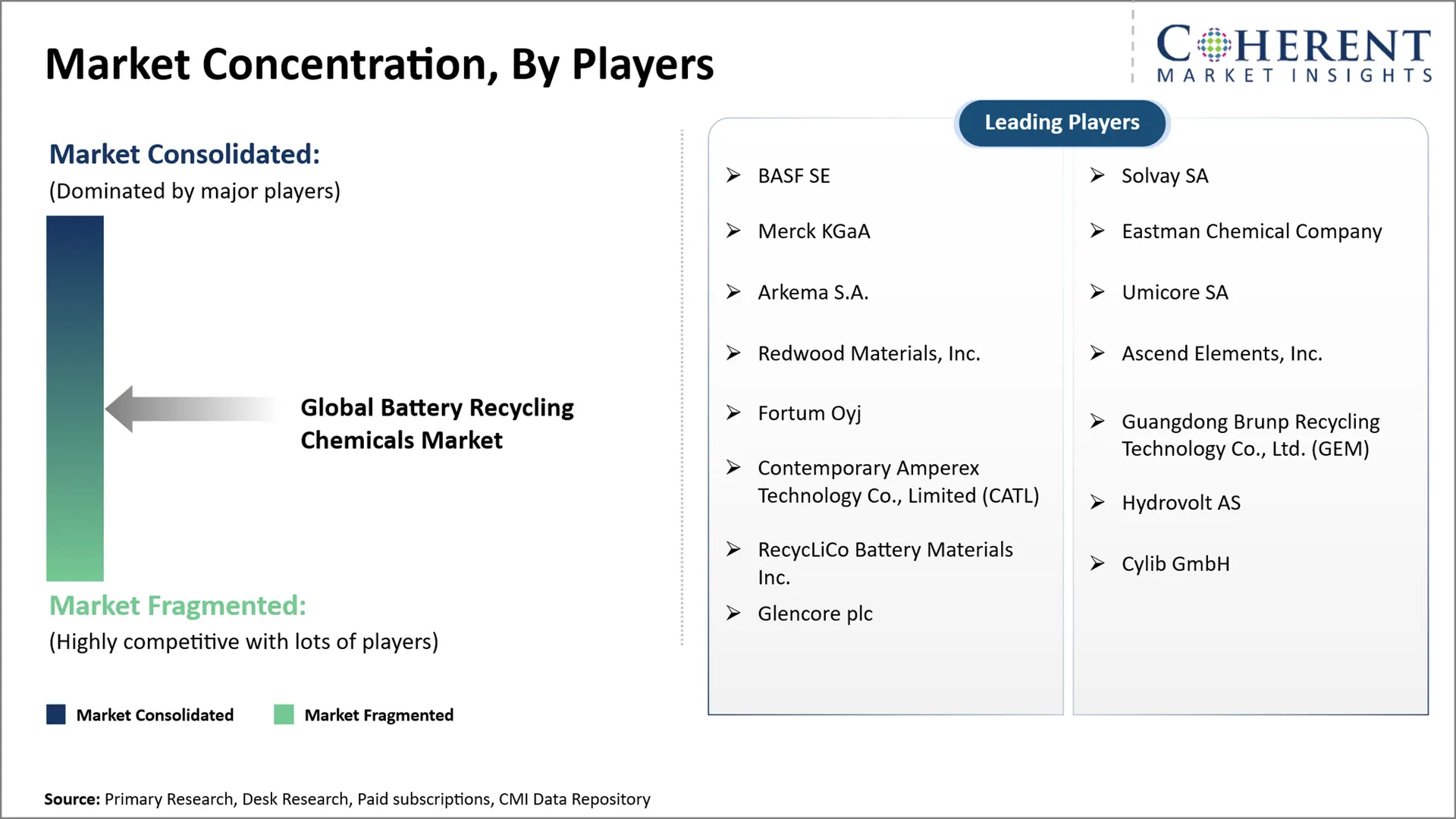
The global battery recycling chemicals market is highly fragmented with a diverse set of players including industrial chemical suppliers, extractant specialists, chemical formulators and regional distributors. Competition centers on metal recovery efficiency, selectivity of reagents, chemical purity, operational safety, pricing and reliability of supply. Established producers have an advantage due to their scale of manufacturing, technical expertise and established relationships with industrial customers, but smaller suppliers can compete with specialized formulations.
Key focus areas include
- Recovery Performance: Impurities control and high metal selectivity.
- Chemical Purity: Uniformity of reagent quality within processing batches.
- Cost Efficiency: Lower cost of treatment and reagent consumption.
- Supply Reliability: Uninterrupted chemicals enable continuous recycling operations.
- Process Compatibility: Formulations that are usable with existing recovery equipment.
- Regulatory Compliance: Safe chemical handling and wastewater management.
- Customer Access: Technical support and regional chemical distribution.
Market Report Scope
Global Battery Recycling Chemicals Market Report Scope
Global Battery Recycling Chemicals Market | |||
Report Coverage | Details | ||
Base Year | 2025 | Market Size in 2026: | USD 112.6 Mn |
Historical Data For: | 2020 to 2024 | Forecast Period: | 2026 to 2033 |
Forecast Period 2026 To 2033 CAGR: | 10.14% | 2033 Value Projection: | USD 221.4 Mn |
Geographies covered: |
| ||
Segments covered: |
| ||
Companies covered: | BASF SE, Solvay SA, Merck KGaA, Eastman Chemical Company, Arkema S.A., Umicore SA, Redwood Materials, Inc., Ascend Elements, Inc., Fortum Oyj, Guangdong Brunp Recycling Technology Co., Ltd. (GEM), Contemporary Amperex Technology Co., Limited (CATL), Hydrovolt AS, RecycLiCo Battery Materials Inc., Cylib GmbH, Glencore plc | ||
Growth Drivers: |
| ||
Restraints & Challenges: |
| ||
Analyst Opinion (Expert Opinion)
- Future Market Direction: The global battery recycling chemicals market is likely to move toward performance-linked supply agreements, where suppliers share responsibility for reagent efficiency, process stability, and recovery-related operating costs. Longer-term contracts may be available for suppliers who can support plant-specific trials and demonstrate consistent economic benefit. Such arrangements might slowly shift competitive advantage from chemical selling prices to measurable process results.
- Transformative Trend or Disruption: Carbon-accounted chemical procurement may change the way suppliers are selected as battery manufacturers look at the environmental footprint of recycled materials. Recycling facilities may increasingly take into account the emissions of manufacturing, transportation and waste treatment of the reagents. This may put suppliers without reliable environmental data at a disadvantage, while creating opportunities for chemical producers with a history of low-emission manufacturing and transparent supply chains.
- Strategic Priorities, Risks and Recommendations: Chemical makers should emphasize flexible manufacturing capacity, safe corrosion-resistant handling systems and applications with steady commercial feedstock availability. Long-term pricing agreements must take into account raw material volatility, chemical consumption and treatment costs. Suppliers should avoid excessive investment in narrowly defined recovery processes before securing customer qualification, regulatory clearance, and dependable sourcing arrangements.
Speak to the analyst
Want personalized insights?
Take the findings above to one of our principal consultants, or have the report rebuilt around the segments, geographies and competitors you actually track.
Market Segmentation
- Chemical Type Insights (Revenue, USD Mn, 2021 - 2033)
- Leaching Agents
- Reductants & Oxidants
- Extractants & Solvents
- Precipitating Agents
- Ion-Exchange Materials
- Pyrometallurgical Additives
- Direct Recycling Chemicals
- Other Processing Chemicals
- Recycling Process Insights (Revenue, USD Mn, 2021 - 2033)
- Hydrometallurgical
- Pyrometallurgical
- Direct & Physical Recycling
- Bioleaching
- Hybrid Processes
- Battery Chemistry Insights (Revenue, USD Mn, 2021 - 2033)
- Lithium-Ion Batteries (NMC, LFP, LCO, NCA, LMO)
- Lead-Acid Batteries
- Nickel-Based Batteries (NiMH, NiCd)
- Alkaline & Other Batteries
- End-use Industry Insights (Revenue, USD Mn, 2021 - 2033)
- Battery Recycling Facilities
- Metal Refineries & Smelters
- Chemical Processing Plants
- Automotive OEMs
- Electronics Recyclers
- Industrial Battery Recyclers
- Regional Insights (Revenue, USD Mn, 2021 - 2033)
- North America
- U.S.
- Canada
- Latin America
- Brazil
- Argentina
- Mexico
- Rest of Latin America
- Europe
- Germany
- U.K.
- Spain
- France
- Italy
- Russia
- Rest of Europe
- Asia Pacific
- China
- India
- Japan
- Australia
- South Korea
- ASEAN
- Rest of Asia Pacific
- Middle East
- GCC Countries
- Israel
- Rest of Middle East
- Africa
- South Africa
- North Africa
- Central Africa
- North America
- Key Players Insights
- BASF SE
- Solvay SA
- Merck KGaA
- Eastman Chemical Company
- Arkema S.A.
- Umicore SA
- Redwood Materials, Inc.
- Ascend Elements, Inc.
- Fortum Oyj
- Guangdong Brunp Recycling Technology Co., Ltd. (GEM)
- Contemporary Amperex Technology Co., Limited (CATL)
- Hydrovolt AS
- RecycLiCo Battery Materials Inc.
- Cylib GmbH
- Glencore plc
Sources
Primary Research Interviews
- Battery recycling companies, chemical manufacturers, and metal recovery specialists
- Hydrometallurgical processors, solvent extraction developers, and chemical formulators
- Lithium-ion battery manufacturers, automotive OEMs, and recycling facility operators
- Metal refiners, black mass processors, and critical mineral recovery companies
- Chemical distributors, environmental consultants, and regulatory experts
Stakeholders
- Leaching agent, extractant, solvent, and precipitating agent manufacturers
- Battery recycling and black mass processing companies
- Chemical processing plants, metal refineries, and smelters
- Automotive OEMs, battery manufacturers, and electronics recyclers
- Chemical equipment suppliers, testing laboratories, and recycling technology developers
End-use Sectors
- Battery Recycling Facilities: Chemical extraction, separation, and metal recovery
- Metal Refineries & Smelters: Metal purification and secondary raw material production
- Chemical Processing Plants: Reagent preparation and recovered metal processing
- Automotive OEMs: Battery scrap recycling and closed-loop material recovery
- Electronics Recyclers: Spent battery treatment and valuable metal extraction
- Industrial Battery Recyclers: Lead-acid, nickel-based, and lithium-ion battery recovery
Chemical Applications
- Hydrometallurgical leaching and metal dissolution
- Solvent extraction, precipitation, and ion-exchange purification
- Pyrometallurgical additives and slag treatment
- Direct recycling, cathode regeneration, and chemical relithiation
- Bioleaching, wastewater treatment, and reagent regeneration
Regulatory and Industry Bodies
- European Commission and European Chemicals Agency (ECHA)
- U.S. Environmental Protection Agency (EPA)
- U.S. Department of Energy (DOE)
- Ministry of Environment, Forest and Climate Change (MoEFCC), India
- Central Pollution Control Board (CPCB), India
- Ministry of Industry and Information Technology (MIIT), China
- Ministry of Economy, Trade and Industry (METI), Japan
- Basel Convention Secretariat
- International Organization for Standardization (ISO)
Databases
- International Energy Agency (IEA) – Global EV Outlook and Critical Minerals Data
- U.S. Geological Survey (USGS) – Mineral Commodity Summaries
- Eurostat – Waste Management and Battery Statistics
- UN Comtrade and ITC Trade Map
- U.S. EPA – RCRAInfo Database
- India CPCB – Battery Waste EPR Portal
- China National Bureau of Statistics
- World Bank Open Data
Magazines and Journals
- Journal of Power Sources
- Resources, Conservation and Recycling
- Hydrometallurgy
- Separation and Purification Technology
- Journal of Hazardous Materials
- Waste Management
- ACS Sustainable Chemistry & Engineering
- Batteries International
- Recycling Today
- Chemical Engineering
Associations
- European Battery Recycling Association (EBRA)
- European Association of Automotive and Industrial Battery Manufacturers (EUROBAT)
- EUCOBAT – European Battery Collection and Recycling Network
- RECHARGE – European Advanced Rechargeable Batteries Association
- Recycled Materials Association (ReMA)
- Battery Council International (BCI)
- Global Battery Alliance (GBA)
- Material Recycling Association of India (MRAI)
- International Council on Mining and Metals (ICMM)
Public Domain Sources
- Chemical product catalogues, technical datasheets, and safety data sheets
- Leaching efficiency, solvent selectivity, extraction yield, and reagent consumption studies
- Battery recycling technology patents, process flowsheets, and pilot plant assessments
- Lithium, nickel, cobalt, and manganese recovery research
- Battery manufacturing, recycling capacity, and black mass generation statistics
- Company annual reports, investments, partnerships, and facility expansions
- Chemical pricing, recovered metal values, import-export statistics, and supplier disclosures
- Life cycle assessments, wastewater treatment studies, and chemical recovery research
Key Standards and Regulations
- EU Regulation (EU) 2023/1542 – Batteries and Waste Batteries
- EU REACH Regulation (EC) No. 1907/2006 – Chemical Registration and Safety
- EU CLP Regulation (EC) No. 1272/2008 – Chemical Classification and Labelling
- U.S. Resource Conservation and Recovery Act (RCRA) – Hazardous Waste Management
- U.S. 40 CFR Part 273 – Universal Waste Regulations
- India Battery Waste Management Rules, 2022, and Amendments
- China – Interim Measures for Recycling and Comprehensive Utilization of Waste NEV Power Batteries, effective April 2026
- Basel Convention – Transboundary Movement of Hazardous Wastes
- ISO 14001 – Environmental Management Systems
- ISO 45001 – Occupational Health and Safety Management Systems
- ISO/IEC 17025 – Testing and Calibration Laboratory Competence
- ISO 14040 and ISO 14044 – Life Cycle Assessment
Proprietary Elements
- CMI Data Analytics Tool
- Proprietary research repository, supported by primary interviews, battery recycling chemical consumption analysis, reagent pricing and ASP benchmarking, hydrometallurgical process assessment, metal recovery efficiency evaluation, recycling facility capacity analysis, battery chemistry-wise market sizing, country-level recycling infrastructure assessment, import-export analysis, distribution-channel evaluation, regulatory assessment, and competitive intelligence.
Get access to 250+ pages report
Every segment, forecast, competitor profile and data table behind the analysis above — available for instant download.
- ESOMAR Member
- ISO 9001:2015 Certified
- D-U-N-S Registered
- GDPR & CCPA Compliant
Frequently Asked Questions
The CAGR of global battery recycling chemicals market is projected to be 10.14% from 2026 to 2033.
The global battery recycling chemicals market is estimated to be valued at USD 112.6 Mn in 2026 and is projected to reach USD 221.4 Mn by 2033.
The critical challenges for battery recycling operators are maintaining consistent chemical purity, handling raw material price volatility and ensuring reliable reagent supply.
Chemical pricing affects processing costs, metal recovery economics and operating margins. Recycling plants focus on chemical re-use and efficiency of the reagents.
Companies should consider the fit between processing technology and customer needs, the reliability of the supply chain, the compatibility of regulations on chemical handling, and partnerships with established recycling operators.
The report considers strategic alliances, distribution channels, competitive positioning, key manufacturers, product capabilities, recovery technologies and market entry decisions.
The growing adoption of electric vehicles is increasing end-of-life battery volumes, while the rising need for critical minerals is encouraging investment in chemical recovery processes. These are the major factors driving the growth of the global battery recycling chemicals market.