

Global Battery Separator Market Size and Forecast – 2026 To 2033
The Global Battery Separator Market is estimated to be valued at USD 8.21 Bn in 2026 and is expected to reach USD 17.59 Bn by 2033, growing at a compound annual growth rate (CAGR) of 11.50% from 2026 to 2033. Market expansion is supported by accelerating lithium-ion battery deployment across electric vehicles, energy storage systems, consumer electronics, and other high-performance applications, where separator quality directly influences ion transport, thermal stability, and cell safety.
In May 2026, the International Energy Agency reported that global EV battery deployment reached 1.2 TWh in 2025, increasing by almost 30% year on year, with electric vehicles accounting for more than 70% of total battery deployment. This continued expansion in battery production and installation directly increases requirements for high-quality microporous and coated separator materials across major cell chemistries.
Key Takeaways of the Global Battery Separator Market
- Wet Process Separators are estimated to expand at an 11.8% CAGR during 2026–2033 and account for 62.8% of the global battery separator market in 2026, supported by their suitability for thin uniform high-porosity membranes used in high-energy lithium-ion cells. In April 2024, Asahi Kasei announced a USD 1.14Bn Ontario plant with 700 million m² annual Hipore wet-process separator capacity.
- Polyethylene PE Separators are projected to grow at an 11.2% CAGR during 2026–2033 and hold 38.6% of the market in 2026, reflecting PE’s balance of porosity chemical resistance shutdown behavior and compatibility with high-volume wet-process manufacturing. In September 2024, Braskem was selected to negotiate a US$50 million U.S. DOE award to expand UHMWPE production specifically for lithium-ion battery separators.
- Uncoated Separators are expected to post a 9.9% CAGR from 2026–2033 while retaining 42.8% of the market in 2026, as cost-sensitive cell designs continue using base separators where additional ceramic or polymer layers are not essential. In November 2024, ENTEK received U.S. DOE financing for its Indiana separator facility and confirmed that it manufactures both ceramic-coated and uncoated separators.
- Asia Pacific is estimated to register an 11.4% CAGR during 2026–2033 and command 52.8% of the global battery separator market in 2026, underpinned by dense lithium-ion cell manufacturing clusters vertically integrated material supply chains and large EV and energy-storage production bases. In December 2024, Housheng reported all 16 Shanxi separator lines operational establishing 2 Bn m² of annual capacity.
- Europe is projected to record a 13.3% CAGR during 2026–2033 and represent 19.6% of the global battery separator market in 2026, positioning it as the fastest-growing region as local battery-cell investment strengthens demand for nearby separator supply and shorter logistics chains. In June 2025, Eurofound reported that SEMCORP’s Debrecen Hungary separator-film plant was preparing to begin test production.
Segmental Insights
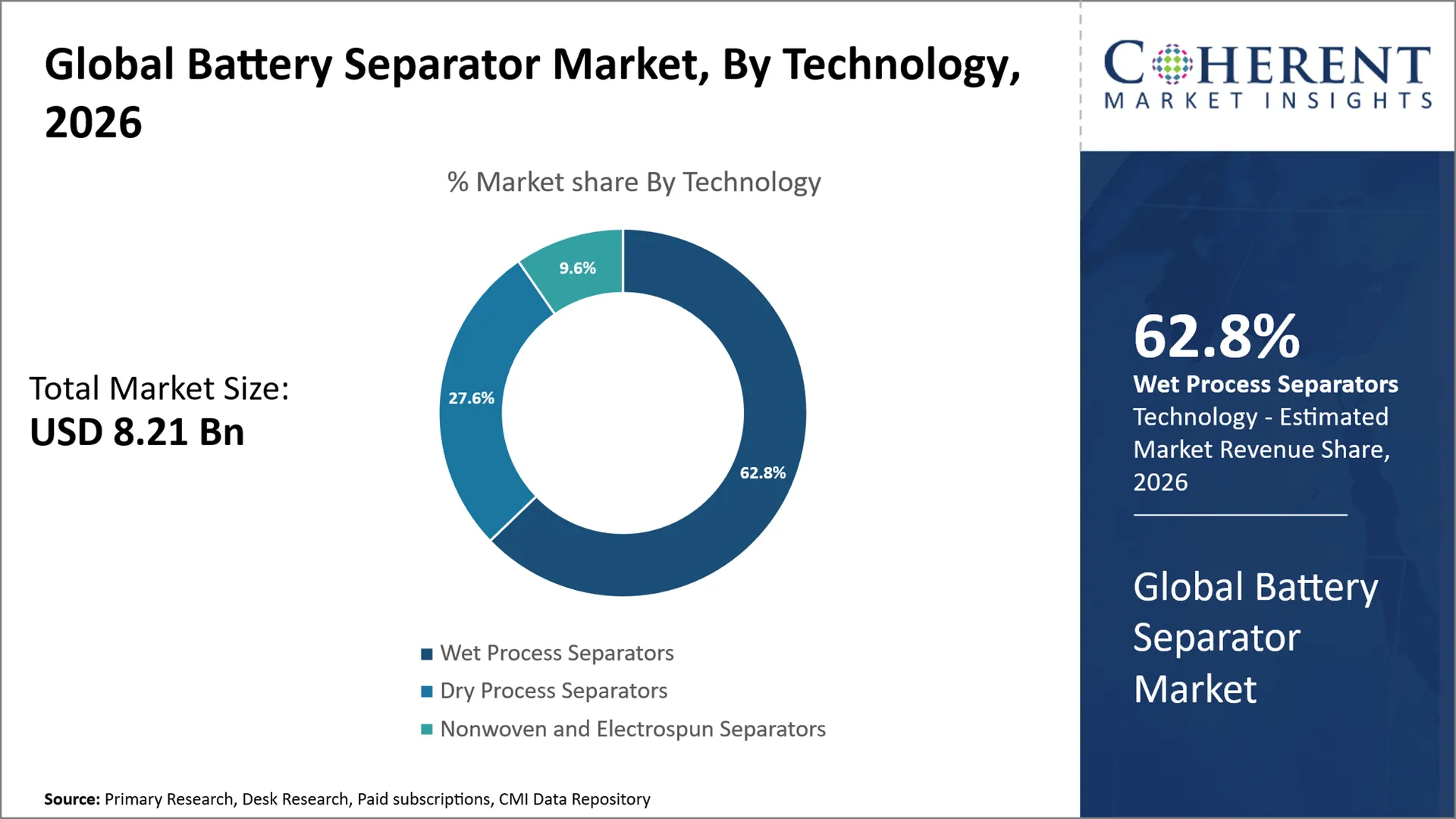
Why Do Wet Process Separators Dominate the Global Battery Separator Market?
Wet Process Separators are expected to retain leadership with 62.8% share in the global battery separator market because solvent-assisted pore formation gives manufacturers tighter control over pore uniformity while supporting thinner films with high puncture strength a combination aligned with high-energy EV and consumer-cell designs. On the supply side, the process is more capital- and solvent-management-intensive, but large integrated lines can offset this through scale, continuous stretching, extraction, and high-throughput finishing. Battery producers also value wet-process base film because it can be supplied uncoated or used as the substrate for ceramic and adhesive coatings, widening customer qualification options. In May 2024, Hengli Petrochemical’s disclosed annual report stated that its Nantong project was designed for 1.2 billion square meters of wet lithium-battery separators versus 600 million square meters of dry separators with production lines entering operation progressively. This capacity mix illustrates continued manufacturing priority toward wet-process platforms.
- Current Industry Events of 2026
- Market Size Estimation
- Regional Breakdown
- Competitive Landscape
- Customer Intelligence
- Segmental Analysis
- Pricing Analysis
- Key Market Drivers, Challenges & Future Trends
- Customized Insights Section
Why Does Polyethylene PE Represent the Largest Material Type in the Global Battery Separator Market?
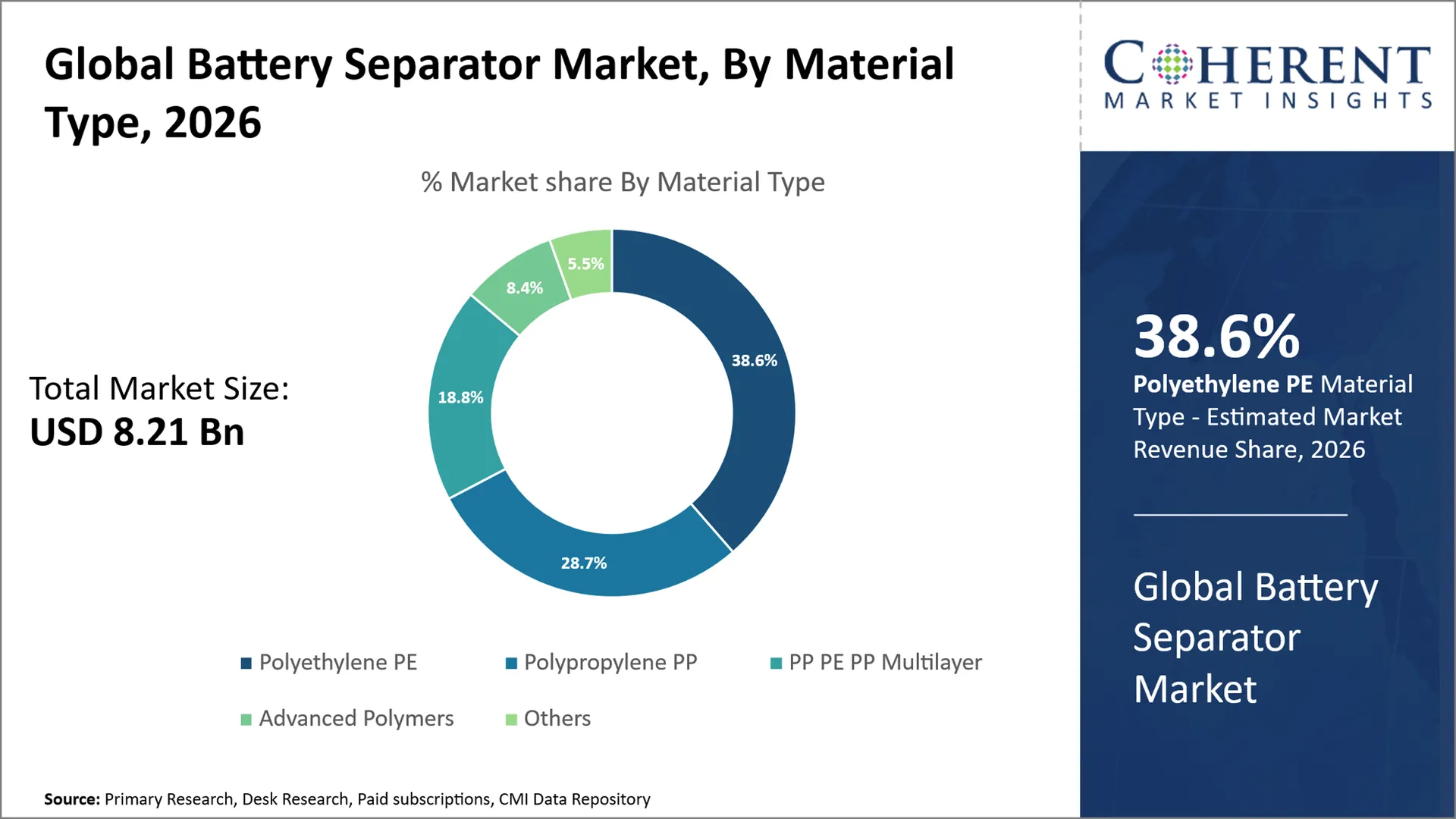
Polyethylene PE is expected to remain the largest material type with 38.6% share in global battery separator market because its shutdown response, chemical stability, and ability to form very thin microporous structures match the safety and energy-density requirements of mainstream lithium-ion cells. PE is especially compatible with wet-process manufacturing, where molecular-weight selection and controlled phase separation can be tuned for porosity, tensile strength, and electrolyte transport. Its mature resin-processing base also supports repeatable film quality at commercial scale. In January 2025, KAIST researchers reported an electron-irradiated montmorillonite HDPE composite separator that improved puncture strength and thermal behavior while retaining strong lithium-ion cell cycling performance. The work demonstrates that PE can be functionally upgraded through fillers and crosslinking rather than displaced by an entirely different membrane platform, strengthening its relevance for next-generation separator engineering.
Why Do Uncoated Separators Dominate the Coating Type Category of the Global Battery Separator Market?
Uncoated Separators are expected to lead the coating-type category with 42.8% share in the global battery separator market because many lithium-ion cell designs can meet required electrical isolation porosity and mechanical targets using qualified microporous polymer film without an additional ceramic or polymer layer. Eliminating coating-slurry preparation, application, drying, binder management, and secondary inspection reduces conversion complexity and helps preserve a thinner separator profile, making uncoated products commercially attractive where extreme-temperature performance is not the primary specification. In May 2024, Deakin University researchers evaluated alumina coatings by applying doctor-blade spin-coating and electrospinning processes to commercial porous polypropylene separators followed by calendaring. The study illustrates the additional manufacturing stages introduced when a conventional separator is coated reinforcing the cost process-simplicity and production-throughput advantages that allow uncoated separators to remain relevant in suitably engineered battery systems.
Current Events and their Impact
Current Event | Description and Its Impact |
U.S. Treasury and IRS Final Clean Vehicle Regulations – May 2024 |
|
EU Battery Due-Diligence Deadline Amendment – July 2025 |
|
India Grid-Scale ACC Manufacturing Tender – July 2026 |
|
Global Battery Separator Market Dynamics
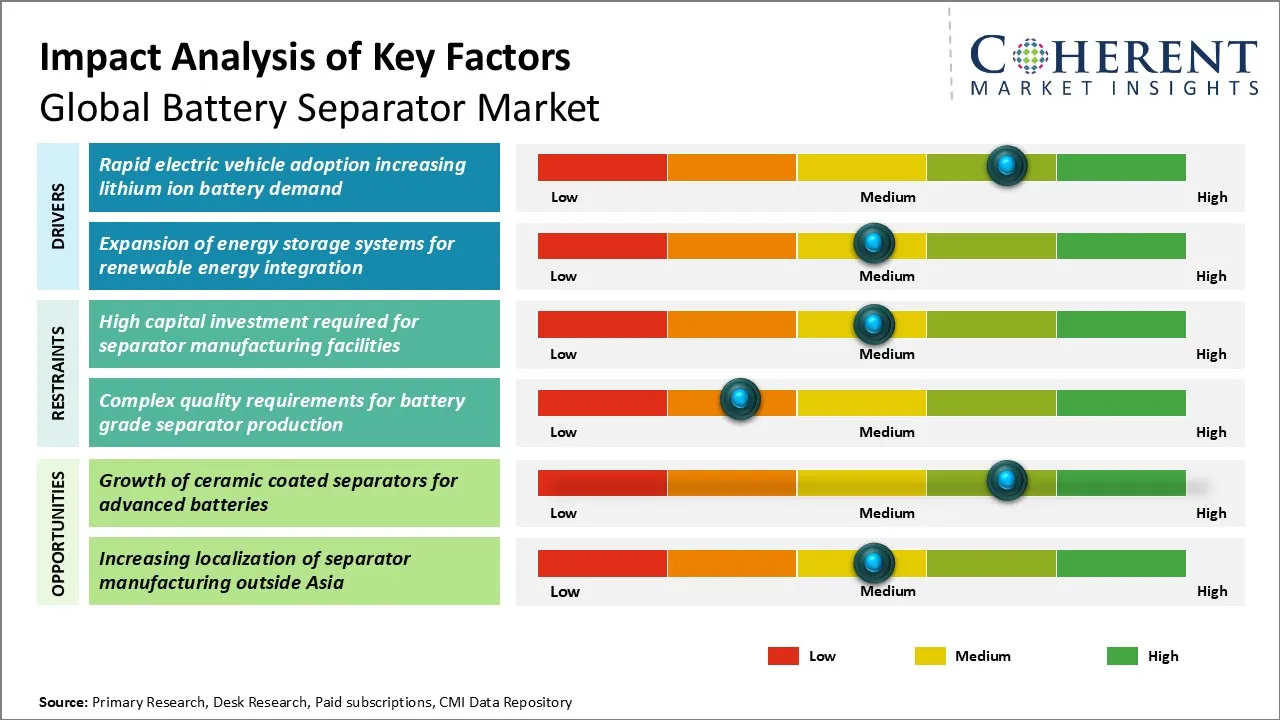
Key Market Drivers
- Rapid electric vehicle adoption increasing lithium ion battery demand: Electric-vehicle production increases separator consumption almost mechanically because every additional lithium-ion cell requires a precisely engineered microporous barrier between the cathode and anode. This benefits wet-process film producers, coating specialists, and converters able to meet automotive requirements for puncture resistance, thickness consistency, thermal stability, and high-speed cell assembly. In July 2025, Panasonic Energy began mass production at its Kansas automotive lithium-ion battery factory, with planned annual capacity of about 32 GWh, illustrating how new cell plants create sustained demand for qualified separator supply close to battery manufacturing hubs.
- Expansion of energy storage systems for renewable energy integration: Utility-scale energy storage creates a second large-volume demand base for battery separators beyond passenger vehicles because renewable-heavy grids require batteries capable of repeated cycling, safe thermal behavior, and long service life. Separator suppliers serving LFP and related stationary chemistries benefit from programs that prioritize reliability, cost control, and stable high-volume sourcing. In August 2026, the U.S. Energy Information Administration reported that utility-scale battery storage capacity had reached nearly 52 GW by June 2026, with further additions planned, reinforcing the procurement pipeline for separator materials used in stationary cells.
Emerging Market Trends
- Functional Separators Becoming Engineered Safety Interfaces: Separator development is moving from a largely passive insulation function toward application-specific safety engineering. Cell manufacturers increasingly expect membranes to contribute to thermal shutdown, electrolyte wettability, electrode adhesion, dimensional stability, and resistance to internal short-circuit pathways. This changes supplier economics because value can migrate from commodity base film toward coating chemistry, multilayer architecture, and co-designed cell interfaces. Producers with formulation expertise and flexible coating capability should gain pricing resilience, while suppliers focused only on undifferentiated film may face stronger substitution and margin pressure over the forecast period.
- Manufacturing Precision Becoming a Primary Value Lever: Manufacturing competitiveness is increasingly being determined by defect control rather than nominal separator capacity alone. As films become thinner and cell formats larger, small variations in pore structure, gauge, slitting quality, or contamination can have greater consequences for yield and battery safety. This is pushing producers toward tighter process control, inline inspection, cleaner handling, and more disciplined conversion operations. The commercial result is a widening gap between plants that can consistently meet customer process windows and facilities that compete mainly on price without equivalent manufacturing precision.
Regional Insights
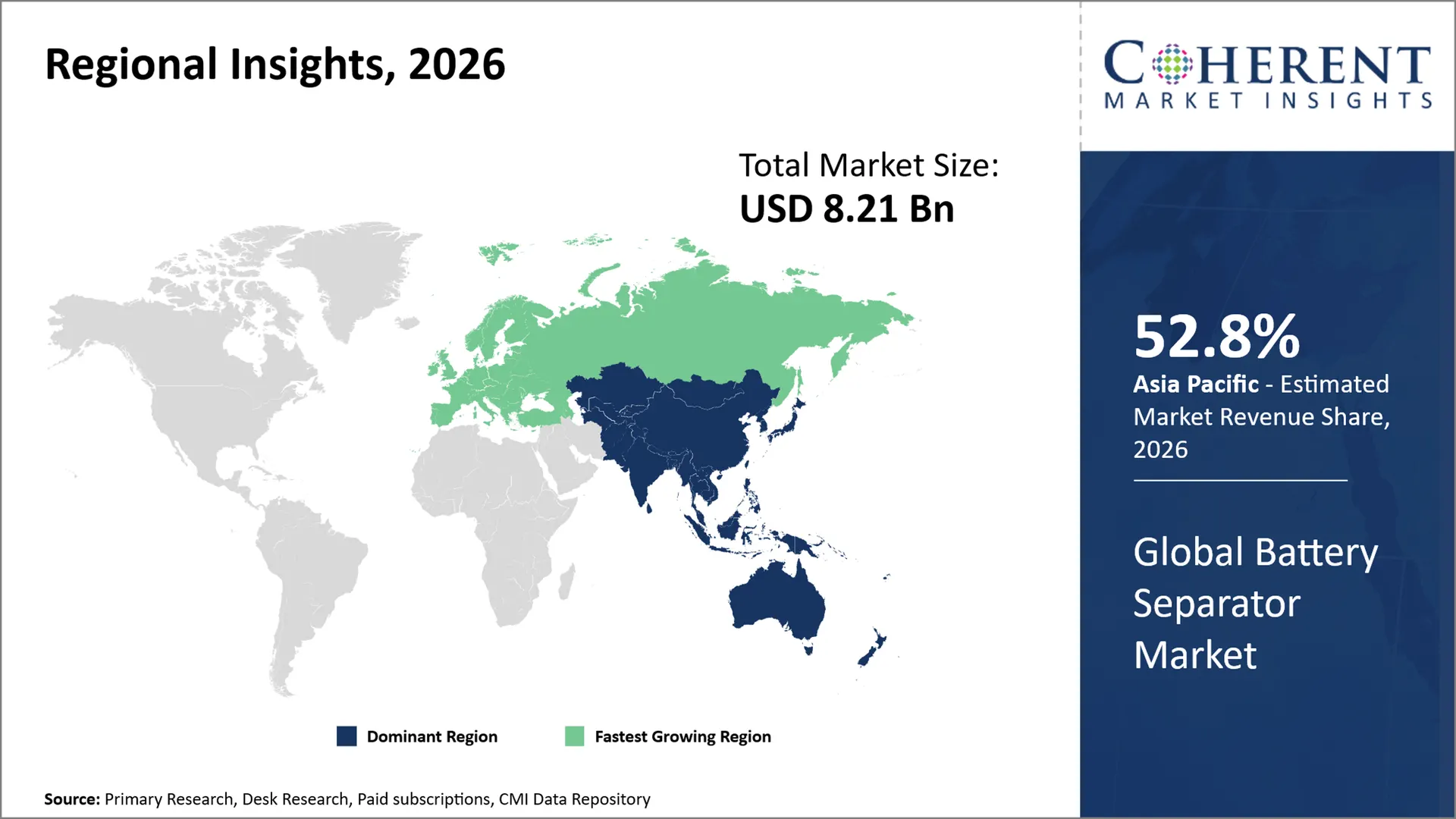
Why Does Asia Pacific Dominate the Global Battery Separator Market?
Asia Pacific is expected to account for 52.8% of the global battery separator market in 2026 because the region combines large-scale lithium-ion cell production with established separator-film, coating-material, polymer-resin, and precision-equipment supply chains. China provides volume manufacturing and export capacity, while Japan and South Korea contribute advanced membrane engineering, coating know-how, and automotive qualification expertise. This concentration shortens customer qualification, logistics, and technical-support cycles for separator suppliers and gives regional producers greater flexibility to serve EV, energy-storage, and electronics customers. Southeast Asia is also becoming an additional manufacturing node rather than only an end market. In June 2025, Malaysia’s MIDA announced the launch of INV New Material Technology’s Penang separator plant, designed to produce 1.3 billion square metres annually of wet-process and coated lithium-ion separators, reinforcing regional production depth beyond Northeast Asia.
Why Is Europe Emerging as the Fastest-Growing Region in the Global Battery Separator Market?
Europe is expected to represent 19.6% of the global battery separator market in 2026 and emerge as the fastest-growing region as battery-cell localization creates new demand for qualified separator supply near automotive production. European buyers increasingly evaluate separators not only on porosity and shutdown performance but also on traceability, carbon footprint, process consistency, and compatibility with high-safety cell designs. New cell factories therefore create openings for wet-process, ceramic-coated, and other premium separator formats that can satisfy demanding OEM validation requirements. Financing support is also lowering investment barriers across the battery value chain. In December 2024, the European Commission and European Investment Bank announced a package combining 1.13 billion in grants, a USD 226.37 million InvestEU guarantee, and planned EIB financing for battery-value-chain projects, strengthening the investment environment for regional component localization.
Global Battery Separator Market Outlook for Key Countries
Why Is the U.S. a Key Market for the Global Battery Separator Market?
The U.S. battery separator market is becoming strategically important because domestic cell manufacturing is moving closer to vehicle assembly and large energy-storage demand centers, increasing the commercial value of locally qualified separator supply. U.S. customers require consistent high-volume film quality, chemistry flexibility, and reliable logistics because separator changes can trigger lengthy cell requalification. This favors suppliers able to support automotive programs with technical service, coating options, and resilient North American sourcing. The expanding hybrid, plug-in hybrid, and battery-electric production base also broadens separator demand beyond a single vehicle architecture. In November 2025, Toyota started production at its US$13.9 billion North Carolina battery facility, its first battery plant outside Japan, with 14 planned production lines serving hybrid, plug-in hybrid, and battery-electric vehicles. Such multi-platform capacity enlarges the addressable market for automotive-grade separator materials.
Why Does China Support Growth in the Global Battery Separator Market?
China supports the global battery separator market through exceptional manufacturing scale across cells, separators, coatings, battery materials, and production equipment. Large domestic EV and stationary-storage industries create continuous demand for high-throughput separator output, while intense supplier competition encourages thinner-film development, coating productivity, yield improvement, and manufacturing cost reduction. China’s export-oriented battery industry also allows separator suppliers to qualify materials across numerous chemistries, cell formats, and customer platforms at high volumes, creating rapid feedback between cell design and separator-process optimization. In September 2026, China’s Ministry of Industry and Information Technology reported that domestic separator production reached approximately 33 billion square metres during the first half of 2026, increasing by more than 50% year on year. This production scale illustrates China’s central influence over global separator availability, capacity utilization, and manufacturing economics.
Why Is Japan Important in the Global Battery Separator Market?
Japan remains important in the global battery separator market because its suppliers compete strongly on membrane precision, safety engineering, dry-process expertise, and long-standing qualification relationships with automotive battery manufacturers. Japanese demand is shaped by hybrid vehicles, premium lithium-ion applications, and energy-storage systems, where repeated cycling and thermal reliability increase the value of consistent pore structure and shutdown performance. Rather than relying solely on commodity volume, domestic producers increasingly emphasize technically differentiated base films and coated products for demanding applications. In June 2026, UBE MAXELL announced a new lithium-ion battery separator base-film facility at its Sakai Works, following another facility already under construction. The investment is expected to increase the company’s separator base-film production capacity by approximately 50%, demonstrating continued Japanese commitment to specialized separator manufacturing for automotive and non-automotive battery applications.
Why Is Germany a Strategic Country in the Global Battery Separator Market?
Germany is a strategic country for the battery separator market because its automotive manufacturing base is increasingly being connected with domestic battery-cell production, creating a nearby customer pool for tightly specified separator materials. German cell programs place strong emphasis on manufacturing reproducibility, safety validation, energy density, and scalable quality systems, which favors suppliers capable of delivering uniform thin films and advanced coated separators under rigorous qualification procedures. Local cell production can also reduce logistics complexity and encourage earlier collaboration between separator engineers and battery developers. In December 2025, Volkswagen Group’s PowerCo commissioned its Salzgitter gigafactory and produced its first Unified Cells. The site is being ramped toward 20 GWh in its initial stage, with expansion potential to 40 GWh, creating a substantial domestic demand anchor for qualified battery-component suppliers, including separator manufacturers.
Why Is South Korea an Important Growth Market for the Global Battery Separator Market?
South Korea is an important growth market for battery separators because the country combines major cell producers, advanced materials companies, equipment suppliers, and application-focused battery R&D within a compact industrial network. This structure supports rapid validation of thinner separators, functional coatings, and safety-oriented designs for EV, ESS, and next-generation batteries. Korean procurement also places high value on consistency and defect control because separator performance directly affects cell yield and thermal safety. Policy is increasingly reinforcing this ecosystem through coordinated regional infrastructure. In September 2026, South Korea’s Ministry of Trade, Industry and Energy launched its battery triangle belt, linking Chungcheong cell manufacturing, Yeongnam core-material production, and Honam raw-material manufacturing. The program also supports evaluation infrastructure for all-solid-state, sodium-ion, and recycled-material batteries, strengthening the country’s wider platform for separator innovation and commercialization.
Innovation Production & Manufacturing Landscape in the Global Battery Separator Market
Separator Technology | Adoption Level | Commercial Role | Strategic Implication |
Wet-Process Microporous Separators | High commercial adoption | Enables thin and highly uniform microporous films suited to high-energy lithium-ion cells | Producers require strong solvent management stretching control defect inspection and high manufacturing yields to remain cost competitive |
Dry-Process Microporous Separators | Established commercial adoption | Provides mechanically robust separator structures without solvent-intensive wet processing | Offers process-economics advantages in selected cylindrical LFP and cost-sensitive battery architectures |
Ceramic-Coated Separators | Expanding adoption | Improves dimensional stability heat resistance and resistance to separator shrinkage | Creates higher-value opportunities around coating formulation adhesion quality and consistent coating thickness |
Polymer and Aramid Functional Coatings | Targeted premium adoption | Enhances electrolyte affinity adhesion thermal tolerance and interface stability | Supports differentiation in demanding high-voltage long-life and safety-focused battery programs |
PP PE PP Multilayer Shutdown Structures | Established adoption | Combines mechanical integrity with engineered thermal-shutdown behavior | Remains important where cell manufacturers require a balance between safety response manufacturability and cost |
Nonwoven and Electrospun Nanofiber Separators | Early commercial and specialist adoption | Provides high porosity electrolyte uptake and flexibility for thermally demanding designs | Commercial expansion depends on scalable web production fiber uniformity mechanical strength and qualification economics |
How Are High-Temperature Nonwoven and Electrospun Separator Platforms Creating New Growth Opportunities in the Global Battery Separator Market?
High-temperature nonwoven and electrospun separator platforms create an underdeveloped opportunity where conventional polyolefin film cannot fully address demanding thermal, mechanical, or electrolyte-management requirements. Their strongest potential lies in high-voltage cells, fast-charging systems, industrial batteries, and emerging semi-solid architectures, where porosity, heat resistance, and electrolyte uptake can justify a more specialized separator design. Suppliers can capture this opportunity by combining engineered fiber structures with ceramic or polymer surface treatments and by tailoring thickness, pore distribution, and mechanical strength to individual cell platforms. Commercial participation will require scalable roll-to-roll production, consistent fiber morphology, low contamination levels, reliable slitting, and extensive customer validation. Specialist membrane developers may gain an early advantage because they can iterate materials rapidly, while established separator producers can use existing customer relationships, coating know-how, and quality systems to accelerate qualification. The opportunity is therefore less about replacing mainstream film immediately and more about securing premium applications where safety, durability, and cell-design flexibility command greater value.
Market Players, Key Development, and Competitive Intelligence
Key Developments
- In August 2026, SK Innovation proposed a merger with SK IE Technology to improve financial stability operational efficiency and separator-business competitiveness including development for energy storage applications. This is important for the global battery separator market because it signals consolidation around financing capability cost discipline and application-specific separator R&D.
- In November 2025, Sumitomo Chemical announced restructuring of its PERVIO lithium-ion battery separator business by consolidating manufacturing at its South Korean subsidiary while retaining next-generation materials R&D in Japan. This is important for the global battery separator market because it combines production-footprint optimization with continued investment in differentiated heat-resistant technology.
- In January 2024, 24M introduced Impervio a separator technology designed to suppress dendrite propagation and enable early detection of internal shorts across lithium-ion lithium-metal and SemiSolid cells. This is important for the global battery separator market because it expands separator value beyond physical isolation toward active cell-safety functionality.
Competitive Landscape
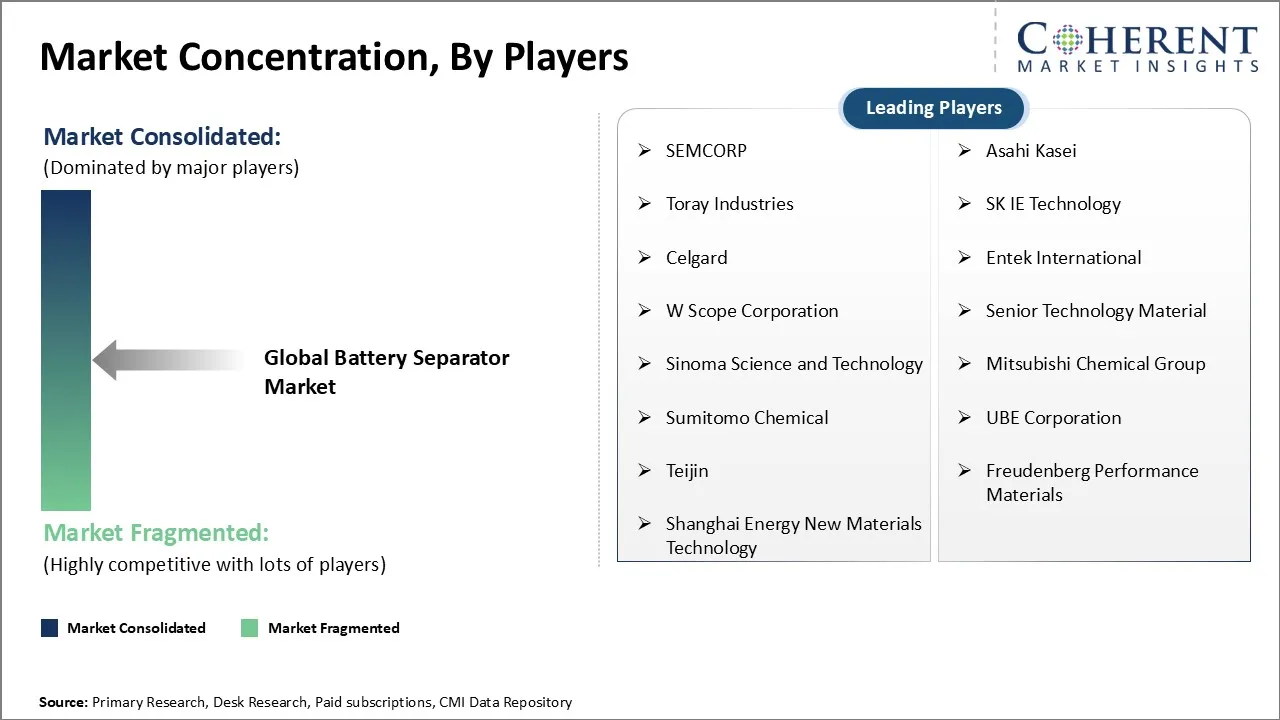
The global battery separator market is moderately consolidated, with large-scale membrane manufacturers, diversified materials groups, and specialist separator producers competing across base film, coating, and conversion. Entry is constrained by capital-intensive film lines, low-defect manufacturing, lengthy cell qualification cycles, and strict supply-continuity expectations. Regional suppliers can win localized programs, but durable competitiveness depends on safety performance, thickness control, yield, cost, compliance documentation, and direct engineering support for battery-cell customers.
Key focus areas include
- Cell-maker qualification: Long validation cycles make technical acceptance and production consistency important barriers for new separator suppliers.
- Film quality and defect control: Pore uniformity thickness tolerance contamination control and slit-edge quality increasingly determine customer acceptance.
- Coating capability: Ceramic polymer and heat-resistant functional coatings enable suppliers to move beyond commodity base-film pricing.
- Manufacturing yield: Higher usable output per production line directly improves cost competitiveness especially as separator thickness decreases.
- Supply reliability: Customers increasingly value stable raw-material sourcing production redundancy and dependable delivery alongside technical performance.
- Compliance readiness: Traceability documentation material declarations and customer-specific quality systems are becoming more important in procurement decisions.
- Application customization: Suppliers able to tailor separators for EV ESS high-voltage fast-charging and long-life cells can defend stronger customer relationships.
Market Report Scope
Global Battery Separator Market Report Coverage | |||
Report Coverage | Details | ||
Base Year | 2025 | Market Size in 2026: | USD 8.21 Bn |
Historical Data For: | 2020 To 2024 | Forecast Period: | 2026 To 2033 |
Forecast Period 2026 To 2033 CAGR: | 11.50% | 2033 Value Projection: | USD 17.59 Bn |
Geographies covered: |
| ||
Segments covered: |
| ||
Companies covered: | SEMCORP, Asahi Kasei, Toray Industries, SK IE Technology, Celgard, Entek International, W Scope Corporation, Senior Technology Material, Sinoma Science and Technology, Mitsubishi Chemical Group, Sumitomo Chemical, UBE Corporation, Teijin, Freudenberg Performance Materials, Shanghai Energy New Materials Technology | ||
Growth Drivers: |
| ||
Restraints & Challenges: |
| ||
Analyst Opinion (Expert Opinion)
- Competitive leadership is likely to move away from selling standardized separator film toward supplying qualified separator platforms combining base-film engineering functional coatings conversion tolerances technical data and cell-design support. Suppliers that shorten customer qualification cycles and adapt products around individual battery architectures should gain stronger commercial defensibility than companies competing primarily through installed production capacity.
- Semi-solid and solid-state battery architectures could ultimately redefine the role of conventional microporous separators rather than simply create another incremental product category. This could place pressure on assets designed only for traditional polyolefin film while increasing the strategic value of membrane chemistry interface engineering composite structures and flexible manufacturing systems capable of supporting hybrid separator-electrolyte concepts.
- Market participants should prioritize defect-control systems, thermal-stability, engineering, chemistry-specific coatings, flexible production lines, and direct co-qualification with cell manufacturers. Resin sourcing and regional conversion redundancy should also receive greater attention. Suppliers should avoid indiscriminate capacity additions where customer qualification is uncertain because excess commodity film capacity can intensify price pressure without creating durable differentiation or assured utilization.
Speak to the analyst
Want personalized insights?
Take the findings above to one of our principal consultants, or have the report rebuilt around the segments, geographies and competitors you actually track.
Market Segmentation
- Technology Insights (Revenue, USD Bn, 2021 - 2033)
- Wet Process Separators
- Dry Process Separators
- Nonwoven and Electrospun Separators
- Material Type Insights (Revenue, USD Bn, 2021 - 2033)
- Polyethylene PE
- Polypropylene PP
- PP PE PP Multilayer
- Advanced Polymers
- Others
- Coating Type Insights (Revenue, USD Bn, 2021 - 2033)
- Uncoated Separators
- Ceramic Coated Separators
- Polymer Coated Separators
- Composite Coated Separators
- Thickness Insights (Revenue, USD Bn, 2021 - 2033)
- 9 to 16 Micron
- Below 9 Micron
- Above 16 Micron
- Application Insights (Revenue, USD Bn, 2021 - 2033)
- Electric Vehicles
- Energy Storage Systems
- Consumer Electronics
- Industrial Applications
- Distribution Channel Insights (Revenue, USD Bn, 2021 - 2033)
- Direct Sales
- Indirect Sales
- Regional Insights (Revenue, USD Bn, 2021 - 2033)
- North America
- U.S.
- Canada
- Latin America
- Brazil
- Argentina
- Mexico
- Rest of Latin America
- Europe
- Germany
- U.K.
- Spain
- France
- Italy
- Russia
- Rest of Europe
- Asia Pacific
- China
- India
- Japan
- Australia
- South Korea
- ASEAN
- Rest of Asia Pacific
- Middle East
- GCC Countries
- Israel
- Rest of Middle East
- Africa
- South Africa
- North Africa
- Central Africa
- North America
Sources
Primary Research Interviews
- Battery separator manufacturers wet and dry process producers coating specialists and lithium-ion battery material suppliers
- Battery cell manufacturers EV battery producers ESS companies procurement managers R&D teams and quality-control professionals
- Polymer resin suppliers coating-material providers separator equipment manufacturers and battery technology specialists
Stakeholders
- Battery separator manufacturers and converters
- Polyethylene polypropylene ceramic coating polymer coating and specialty material suppliers
- Lithium-ion battery manufacturers EV OEMs energy storage companies and consumer electronics battery producers
- Equipment suppliers distributors importers exporters and contract manufacturers
End-use Sectors
- Electric vehicles
- Energy storage systems
- Consumer electronics
- Industrial batteries and equipment
Regulatory and Industry Bodies
- International Energy Agency IEA
- U.S. Department of Energy DOE
- European Commission
- International Electrotechnical Commission IEC
- International Organization for Standardization ISO
- China Ministry of Industry and Information Technology MIIT
- National battery safety environmental and transport authorities
Databases
- Company annual reports and investor presentations
- Battery and separator manufacturing capacity databases
- Lithium-ion battery trade datasets
- EV and energy storage deployment databases
- Polymer resin and battery-material pricing databases
- Product specifications patents and technology databases
Magazines and Journals
- Journal of Power Sources
- Energy Storage Materials
- Batteries & Supercaps
- ACS Applied Materials & Interfaces
- Battery Power
- Advanced Energy Materials
Associations
- Global Battery Alliance GBA
- European Battery Alliance EBA
- Battery Council International BCI
- Korea Battery Industry Association KBIA
- China Industrial Association of Power Sources
- Regional battery and electric mobility associations
Public Domain Sources
- EV production and battery deployment statistics
- Battery manufacturing capacity data
- Separator technology and material developments
- Lithium-ion battery trade flows
- Energy storage installations
- Battery safety and recycling policy updates
- Raw material and polymer market information
Key Standards and Regulations
- Lithium-ion battery safety and performance standards
- UN 38.3 battery transport requirements
- IEC battery safety standards
- EU Battery Regulation requirements
- Battery material traceability and due-diligence requirements
- Environmental chemical and workplace safety regulations
- EV battery localization and sourcing requirements
Proprietary Elements
- CMI Data Analytics Tool
- proprietary CMI repository containing 10+ years of battery materials lithium-ion batteries EVs energy storage battery separator technology manufacturing capacity trade flows pricing and competitive intelligence.
Get access to 250+ pages report
Every segment, forecast, competitor profile and data table behind the analysis above — available for instant download.
- ESOMAR Member
- ISO 9001:2015 Certified
- D-U-N-S Registered
- GDPR & CCPA Compliant
Frequently Asked Questions
The CAGR of global battery separator market is projected to be 11.50% from 2026 to 2033.
The global battery separator market is estimated to be valued at USD 8.21 Bn in 2026 and is expected to reach USD 17.59 Bn by 2033
The global battery separator market is primarily driven by the rapid adoption of electric vehicles, which is increasing demand for lithium-ion batteries, along with the expansion of energy storage systems used to support renewable energy integration.
High capital investment required for separator manufacturing facilities and Complex quality requirements for battery grade separator production are the major factors hampering the growth of global battery separator market.
In terms of technology, wet process separators are estimated to dominate the market revenue share in 2026.
SEMCORP, Asahi Kasei, Toray Industries, SK IE Technology, Celgard, Entek International, W Scope Corporation, Senior Technology Material, Sinoma Science and Technology, Mitsubishi Chemical Group, Sumitomo Chemical, UBE Corporation, Teijin, Freudenberg Performance Materials, Shanghai Energy New Materials Technology are the major players.
Asia Pacific is expected to lead the global battery separator market in 2026.