

Global Behavioral Biometrics Market Size and Forecast – 2026 To 2033
The global behavioral biometrics market is expected to grow from USD 3.85 Bn in 2026 to USD 16.20 Bn by 2033, registering a compound annual growth rate (CAGR) of 7.3% from 2026 to 2033. The global behavioral biometrics market is driven by expansion of mobile banking and digital payment transactions. On April 29, 2026, ICICI Bank announced the implementation of biometric authentication for UPI transactions through iMobile, the Bank’s mobile banking application. The feature enhances user experience by allowing them to authorize transactions through facial recognition or fingerprint authentication.
Key Takeaways of the Global Behavioral Biometrics Market
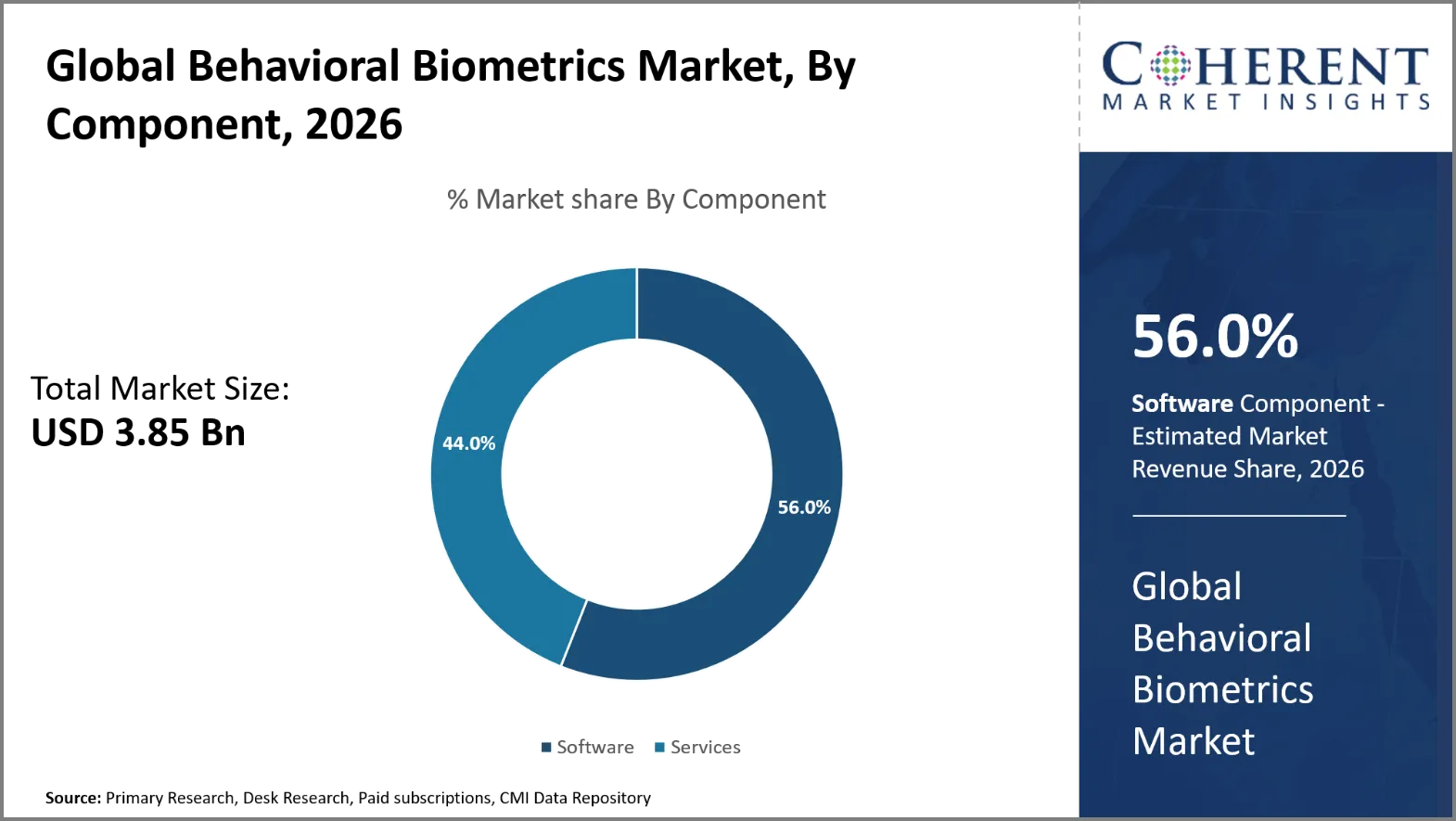
- The Software segment is expected to account for 56.0% of the global behavioral biometrics market share in 2026. Rising adoption of fraud detection systems in financial services is driving the growth of the segment. On July 22, 2025, Experian announced a strategic investment in Resistant AI, to strengthen fraud and financial crime prevention for financial institutions.
- The Keystroke Dynamics segment is estimated to capture 33.0% of the market share in 2026. Increasing demand for frictionless customer authentication is majorly driving the growth of the segment. In January 2026, Visa and payment service provider PSP Platon expanded Visa Payment Passkey capabilities in Ukraine.
- The Continuous Authentication segment is estimated to capture 36.0% of the market share in 2026. Growing use of behavioral signals in digital identity authentication is driving the growth of the segment. On March 11, 2026, BioCatch introduced DeviceIQ to help financial institutions assess device trustworthiness during digital banking sessions. The product combines persistent device identification with behavioral, application, and transaction intelligence.
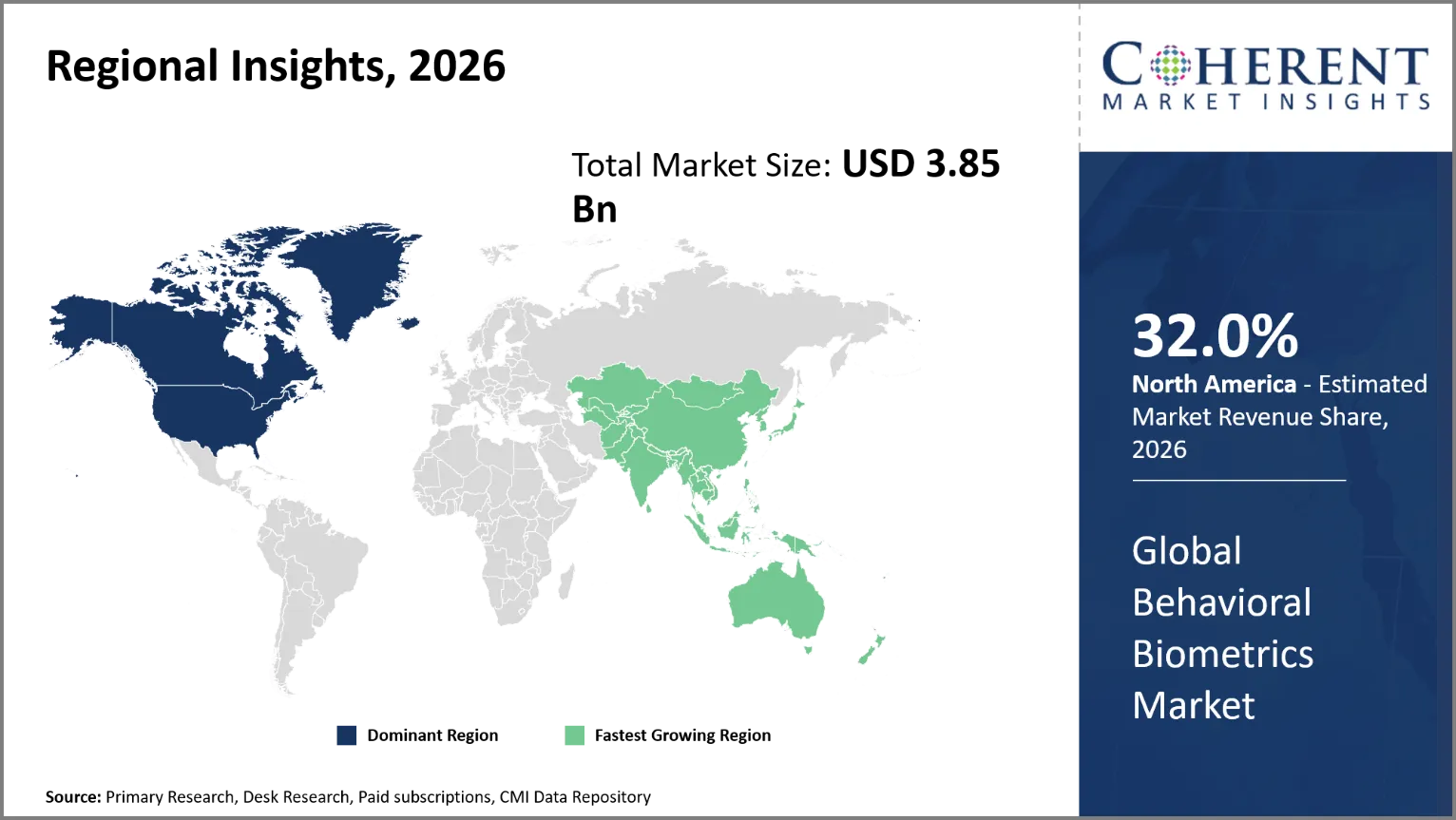
- North America is expected to dominate the behavioral biometrics market in 2026 with a market share of 32.0%. Increasing use of behavioral analytics for account takeover prevention in North America is driving the growth of the regional market. On November 19, 2025, BioCatch launched Connect 2.0, upgrading its fraud detection platform with behavioral, device, network, application, and transaction signals.
- Asia Pacific is expected to account for 24.0% share in 2026. Growing demand for adaptive authentication in enterprise applications in Asia Pacific is driving the growth of the regional market. On February 13, 2026, DT Asia Group and Authsignal announced a strategic partnership to expand password less authentication and adaptive multifactor authentication across Asia Pacific.
Segmental Insights
Why Does Software Dominate the Global Behavioral Biometrics Market?
The software segment is expected to account for 56.0% of the global behavioral biometrics market share in 2026. Software is the leading component as it provides scalable authentication across banking applications, digital platforms, enterprise systems and mobile devices. Software solutions can evaluate typing patterns, mouse motions, touchscreen interactions, and navigation behavior without requiring specialist biometric hardware. Organizations can embed these features into their existing applications and identity management systems with minimal changes to the infrastructure. Software also allows for constant monitoring, automatic risk grading, and adaptive authentication in digital transactions. This enables financial institutions, retailers and technology companies to mitigate risks of account takeovers, while providing a frictionless customer experience.
On July 28, 2025, Darwinium introduced Beagle and Copilot, two new agentic AI capabilities that simulate adversarial assaults, uncover hidden vulnerabilities and dynamically enhance fraud defenses. The company plans to roll them out on July 28, 2025. With fraudsters using AI agents to avoid detection and influence digital systems, Darwinium gives defenders their own autonomous AI capabilities, directly embedded into its behavioral intelligence platform.
- Current Industry Events of 2026
- Market Size Estimation
- Regional Breakdown
- Competitive Landscape
- Customer Intelligence
- Segmental Analysis
- Pricing Analysis
- Key Market Drivers, Challenges & Future Trends
- Customized Insights Section
Why is Keystroke Dynamics the Most Crucial Behavioral Modality?
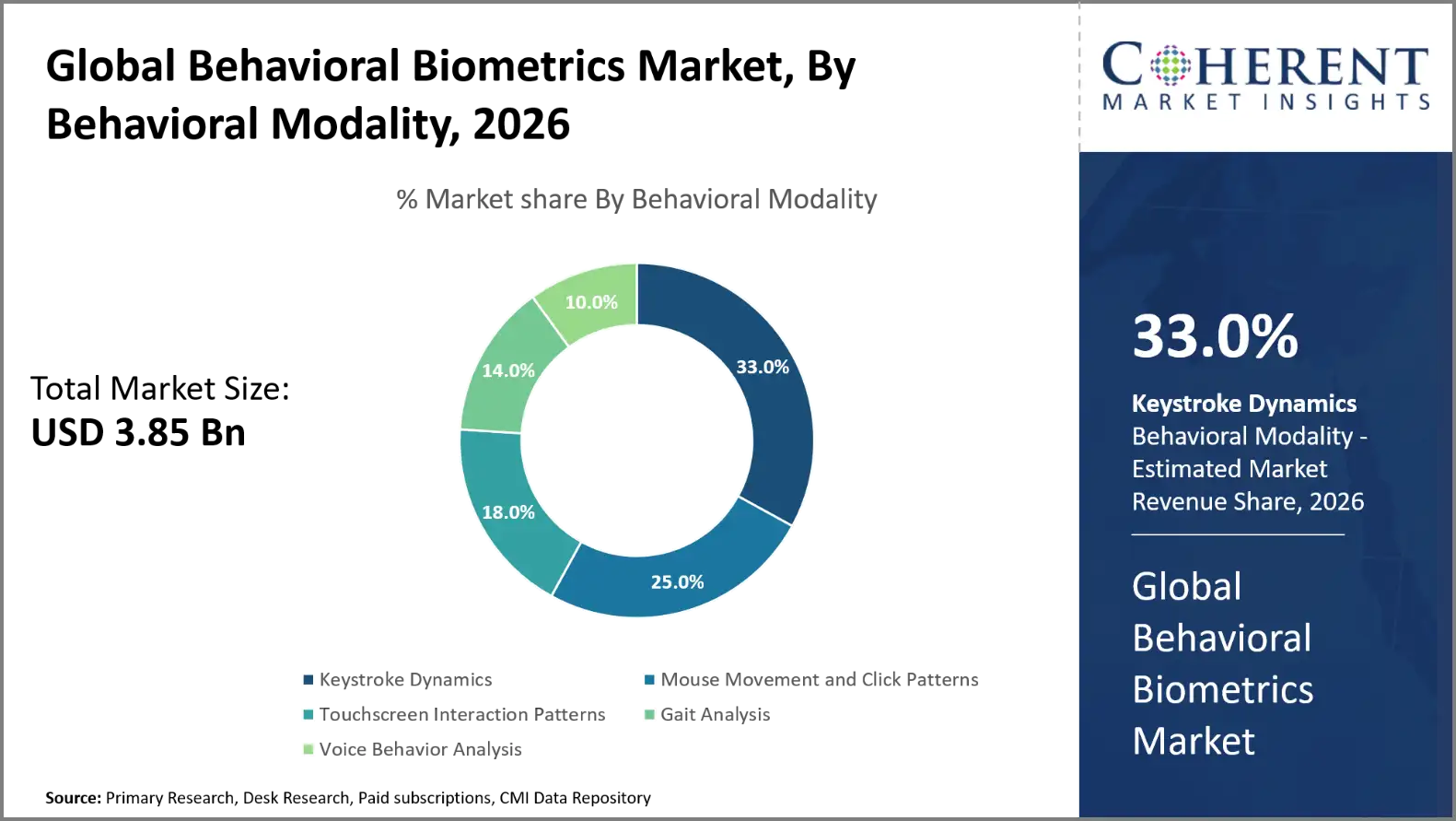
The keystroke dynamics segment is expected to account for 33.0% of the global behavioral biometrics market share in 2026. Keystroke dynamics is a significant behavioral modality that distinguishes users by their unique typing rhythms, the duration of key presses, and the intervals between keystrokes. These patterns offer cues that can be used to augment existing behavior-based password and multifactor authentication techniques. Financial institutions and digital service providers may evaluate typing patterns to identify suspicious login attempts and potential account misuse. Keystroke dynamics can also work on regular keyboards and do not need special biometric sensors. Its suitability for web applications, enterprise systems, and remote access platforms strengthens its practical value.
On August 24, 2026, TypingDNA published version 2.5.0 of its authentication application programming interface documentation. The documentation describes artificial intelligence software that compares users’ typing patterns against previously enrolled behavioral profiles.
Continuous Authentication Dominates the Global Behavioral Biometrics Market
The continuous authentication segment is expected to account for 36.0% of the global behavioral biometrics market share in 2026. Continuous authentication is gaining prominence in the Global Behavioral Biometrics Market because it evaluates user behavior throughout digital sessions rather than relying exclusively on login verification. Systems continuously analyze interaction patterns, including typing cadence, pointer movements, touchscreen gestures, and navigation behavior. This approach helps enterprises to detect suspicious activity after legitimate credentials have already given access to the system. Financial services, enterprise apps and digital commerce platforms have improved security from session hijacking and fraudulent account usage.
On June 9, 2025, Facephi unveiled an upgrade to their behavioral biometrics technology to combat sophisticated fraud in digital interactions. Its program takes into account over 3,000 contextual cues such as typing rhythms, changes in screen focus and odd response times.
Current Events and their Impact
Current Events | Description and its Impact |
India's Digital Personal Data Protection Act No. 22 of 2023 |
|
European Union General Data Protection Regulation (European Union) 2016/679 |
|
Behavioral Biometrics Market Dynamics
Market Drivers
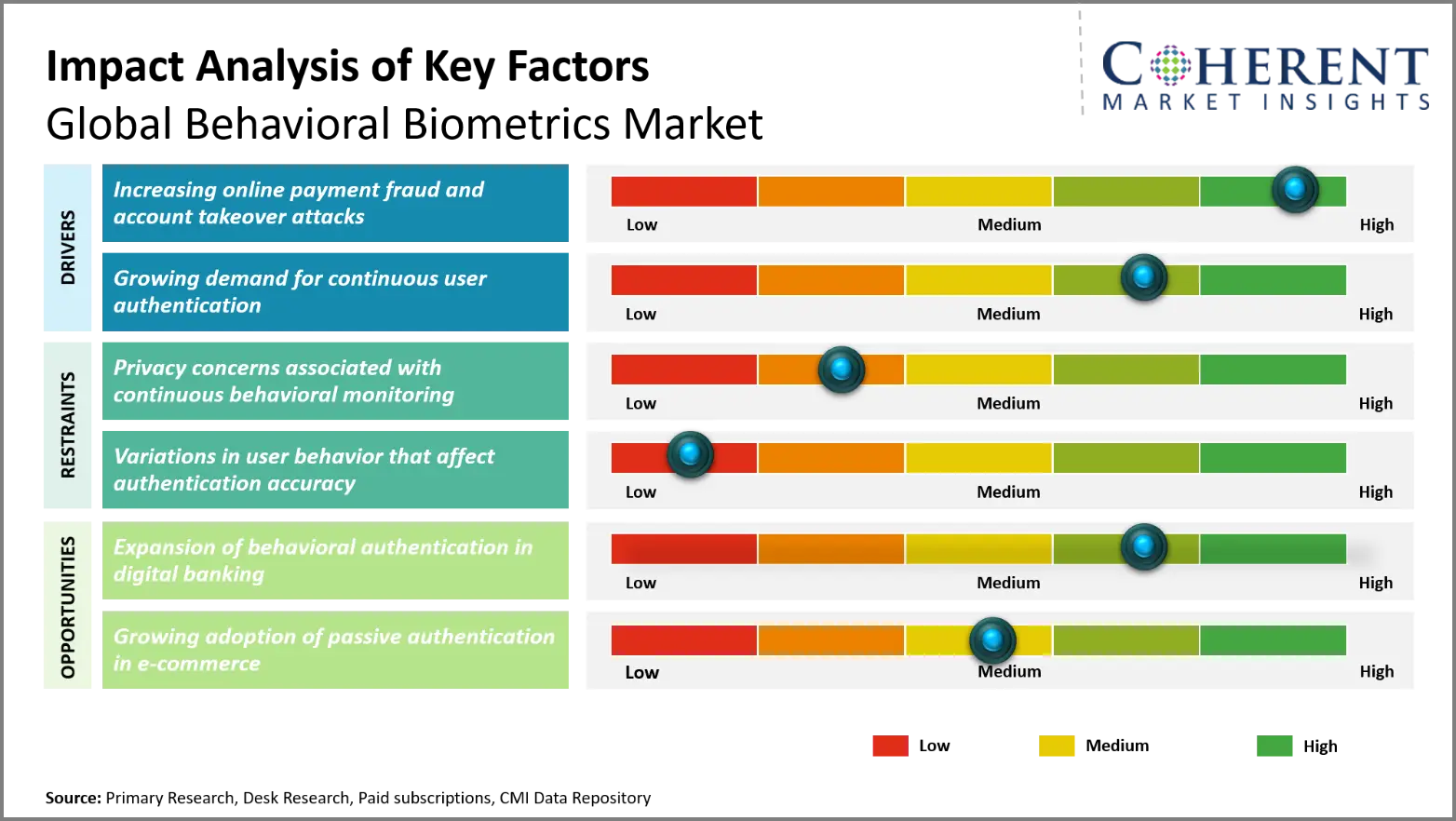
Increasing online payment fraud and account takeover attacks
The demand for behavioral biometrics in digital financial services is being fueled by increases in online payment fraud and account takeover assaults. More and more, cybercriminals are relying on stolen credentials, phishing and hacked devices to access legitimate customer accounts. Behavioral biometrics improves fraud detection by monitoring typing rhythms, mouse motions, touchscreen interactions, and navigation habits. These signals assist spot malicious behavior even if attackers have proper login credentials. Banks, payment processors and digital commerce platforms leverage behavioral analysis to improve transaction monitoring and multi-factor authentication. Rising volumes of digital payments and advanced fraud strategies are driving enterprises to embrace adaptive, behavior-based security solutions.
On October 27, 2025, Mastercard announced the debut of Mastercard Threat Intelligence, the first threat intelligence product applied to payments at scale. The solution uses Mastercard’s fraud insights and global network visibility along with curated cyber threat intelligence from the Recorded Future platform to help payment fraud and merchant compliance teams respond to cyber-enabled fraud.
Growing demand for continuous user authentication
Increasing demand for continuous user authentication is driving the adoption of behavioral biometrics in banking, business security, and digital commerce. Traditional authentication techniques typically authenticate the identity at the time of login, which leaves the active sessions vulnerable to unwanted access. Behavioral biometrics continuously monitors interaction patterns to detect anomalies from user profiles. Organizations can also trigger extra verification when systems identify atypical typing behavior, pointer movements or touchscreen gestures. This improves protection against session hijacking and minimizes repeated password requests. The trend toward remote employment, mobile banking and cloud applications continues to drive the need for unobtrusive authentication systems that provide security without inconvenience.
On February 10, 2026, Imprivata announced new, comprehensive capabilities to enable the next generation of rapid, frictionless and password less access for frontline staff, knowledge workers and all other enterprise users. Imprivata Enterprise Access Management (EAM) delivers context-aware password less authentication, identity verification, and AI-powered risk alerting and behavioral analytics.
Emerging Trends
- Artificial Intelligence-Powered Behavioral Analysis: AI models are being employed more and more to monitor typing rhythms, pointer movements, and touchscreen interactions to detect subtle behavioral irregularities. Those characteristics enable authentication solutions to enhance fraud detection, adapt to evolving user behaviors, and discriminate between legitimate consumers and possible impersonators.
- Password less Authentication Integration: Behavioral biometrics is increasingly supporting password less authentication methods such as passkeys and device-based identity verification. The connection helps enterprises to enhance account security, reduce reliance on traditional passwords, and increase login comfort, while enabling easier authentication across digital channels.
- Real-Time Fraud Detection Across Digital Payments: Financial institutions are adding behavioral analysis to payment monitoring systems to identify unusual activity in transactions. Real-time evaluations assist detect odd patterns of interaction, enable risk-based verification and limit possible losses from account takeover assaults and illicit payments.
- Privacy-Preserving Behavioral Authentication: Increased privacy expectations lead to less sensitive data collecting and better behavioral information protection by developers. Techniques such as on-device processing, data minimization, and pseudonymization can help limit exposure while enabling authentication systems to detect suspicious behavior across digital services.
Regional Insights
Why is North America a Strong Market for Behavioral Biometrics?
North America is expected to account for a market share of 32.0% in 2026. North America features advanced digital banking, wide scale electronic commerce and more investment in identity fraud prevention. Behavioral analytics is used by financial organizations to detect account takeover attempts, unusual login sessions and payment abnormalities. Mastercard’s Decision Intelligence solutions assess payment risk by analyzing transaction context for issuers. Leading technology vendors also leverage behavioral cues in their identity verification and fraud prevention solutions. The region has a vibrant cybersecurity ecosystem that encourages collaboration between banks, payment networks and authentication companies. The move to mobile banking, remote account access, and digital wallets opens the door for continuous authentication. Privacy compliance and reducing false fraud alerts remain important purchasing considerations.
Why Does Asia Pacific Behavioral Biometrics Market Exhibit High Growth?
Asia Pacific is expected to register the fastest growth with a CAGR of 7.9% over the forecast period. The region is projected to account for 24.0% of the global behavioral biometrics market in 2026. Asia Pacific benefits from high mobile payment usage, super-app ecosystems, and rapid digital onboarding across financial services. The region’s need for frictionless authentication across payments and daily services is exemplified by Chinese Alipay and WeChat Pay. The Unified Payments Interface in India also provides possibilities to evaluate behavioral risks across rapid payment journeys. Japan and South Korea provide their advanced mobile infrastructure and financial services with a focus on technology. China's national standard of biometric authentication on mobile smart terminals provides technical reference for the application of biometric security. Regional providers can differentiate through mobile-first behavioral models, multilingual interfaces, and authentication adapted to diverse devices.
Global Behavioral Biometrics Market Outlook for Key Countries
Why is U.S. Emerging as a Major Hub in the Behavioral Biometrics Market?
The U.S. market is positive for sophisticated financial fraud prevention, massive online retail platforms and strong demand for identity protection. Mastercard’s behavioral solutions leverage typing cadence, mouse motions, swipe patterns and device orientation to detect suspicious activities. Mastercard’s Decision Intelligence Pro takes into account the transaction environment and merchant connections in real-time. According to the Federal Trade Commission, customers lost nearly USD 3.5 billion in 2025 to frauds involving impersonation. These concerns are forcing banks, payment processors and merchants to add behavioral analysis to transaction scoring and device intelligence
Is China the Next Growth Engine for the Behavioral Biometrics Market?
China’s large mobile commerce market, integrated digital payment ecosystems and domestic technology development favor China’s behavioral biometrics market. Alipay and WeChat Pay create favorable environments for identity verification to function across payments and related services. The technological framework of the biometric authentication on the mobile smart terminal is formulated in the national standard of China for the biometric authentication on the mobile smart terminal. Other parts of the country’s technological economy include large platform firms and cybersecurity suppliers working on identity protection capabilities. Behavioral authentication can help identify odd patterns of engagement while accessing accounts and initiating transactions. Domestic compliance, permission management and secure processing are essential implementation objectives due to local data governance laws.
Germany Behavioral Biometrics Market Analysis and Trends
Germany’s market has the advantage of a well-developed banking infrastructure, high standards on data protection and a requirement for secure digital financial services. The Federal Financial Supervisory Authority describes how banks verify the identity of consumers who log into online accounts and issue payment requests. Behavioral biometrics can improve smartphone apps, transaction authentication and existing fraud detection systems. German banks and payment providers must find the right balance between increased identity assurance and transparent personal data processing. The European Union’s General Data Protection Regulation also applies to the processing of identifiable behavioral information. Vendors have substantial opportunity for privacy-conscious deployment, explainable risk judgments and dependable interaction with banking security infrastructure.
U.K. Behavioral Biometrics Market Analysis and Trends
The U.K. market benefits from mature digital banking, established payment technology companies, and strong attention to authorized and unauthorized payment fraud. The government explains that Strong Customer Authentication generally requires two independent elements from knowledge, possession, and inherence categories. Behavioral biometrics can provide an additional layer of control through the tracking of typing patterns, pointer movements and session activity. The National Cyber Security Center gives advice on how to establish biometric authentication, how to ensure enrollment quality and how to set up secure fallback procedures. Behavioral cues enable financial organizations to spot suspect sessions without inconveniencing customers.
Japan Behavioral Biometrics Market Analysis and Trends
Japan’s market benefits from the use of innovative financial technology, broad mobile service usage and renewed emphasis on phishing-resistant authentication. In April 2026, the Financial Services Agency announced cross-industry public awareness activities supporting multifactor authentication that is resistant to phishing. This development supports the rationale for layered identity verification across banking and securities services. Post-login, behavioral biometrics can augment strong authentication by identifying anomalies in user activities. Japan’s financial institutions also need to tackle cybersecurity dangers from third parties and fake remote account applications. These specific operational requirements can be addressed by vendors that provide low friction monitoring, easy to implement mobile integration and well-defined escalation procedures.
Global Behavioral Biometrics Market - Cloud-Based Behavioral Biometrics and Software Integration by Region (2025):
Region | Estimated cloud-based deployment share | Estimated software integration share |
North America | 68% | 76% |
Europe | 62% | 71% |
Asia Pacific | 64% | 69% |
Latin America | 55% | 61% |
Middle East and Africa | 49% | 56% |
How is Expansion of Behavioral Authentication in Digital Banking Creating New Growth Opportunities in the Behavioral Biometrics Market?
The growth of behavioral authentication in digital banking presents growth prospects for banks by allowing them to identify fraudulent activity after the initial login verification. For example, BioCatch looks at typing patterns, mouse movements and navigation activity to spot probable account takeover attempts during online banking sessions. Mastercard uses behavioral intelligence for fraud protection solutions, helping to detect suspect payment activity. These features can help digital banks to spot odd additions of beneficiaries, suspicious changes in sessions and anomalous interactions with transactions. Instant payments and remote account opening are growing, and with them the need for authentication that doesn't require reentering passwords or adding hardware. Behavioral biometrics suppliers have new opportunity to integrate directly with banking apps, fraud management platforms and payment authentication systems.
On April 1, 2026, Axis Bank, one of the largest private sector banks in India, announced the availability of Registered Mobile Number updating journey with Aadhaar Face Authentication on its Mobile Banking app. With this introduction, Axis Bank becomes the first among India’s leading banks to implement UIDAI’s Aadhaar Face Authentication service as a Do‑It‑Yourself (DIY) digital journey for updating registered mobile numbers.
Market Players, Key Development, and Competitive Landscape
Key Developments
- On March 31, 2026, ThreatMark joined EBA CLEARING’s Fraud Pattern and Anomaly Detection (FPAD) Solution Provider Program, enabling banks and payment service providers across EU member states to combine ThreatMark’s behavioral intelligence with network-level fraud signals from EBA CLEARING’s pan-European SEPA infrastructures, RT1 and STEP2.
- On May 13, 2025, BioCatch announced a new partnership with identity and fraud prevention platform provider Alloy. The deal fully integrates BioCatch’s end-to-end account opening (AO) solution into the Alloy platform, offering the more than 700 financial institutions and fintech companies that work with Alloy the opportunity to leverage BioCatch’s behavioral and device intelligence.
- On March 18, 2025, Outseer announced the launch of its platform-native Behavioral Biometrics capability. The addition of platformed Behavioral Biometrics introduces another layer of defense that continuously analyzes user interactions to detect anomalies in real time.
Competitive Landscape
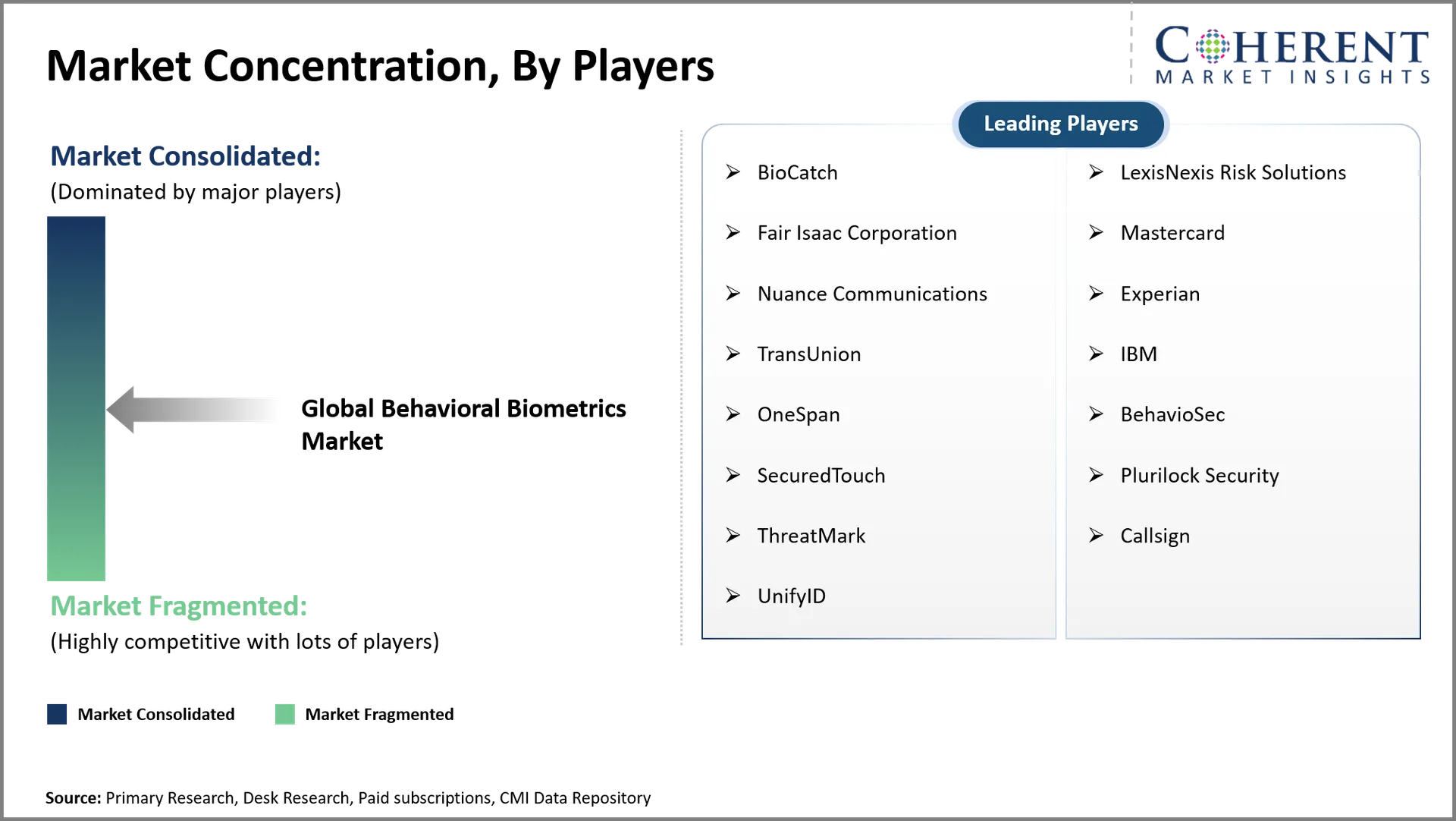
BioCatch, Mastercard, ThreatMark, TypingDNA, and SecureAuth are some of the leading players in the global behavioral biometrics industry, catering to various authentication and fraud protection needs. BioCatch provides continuous behavioral intelligence, account takeover prevention, scam detection and money mule detection across banking applications. Mastercard blends behavioral and device analytics with risk-based authentication to help businesses evaluate suspicious activity across customer sessions. Competitors can differentiate through specialist keystroke analysis, flexible application programming interfaces, privacy-conscious deployment, and integration with existing fraud management systems.
Top Market Players and Notable Products/Offerings in the Behavioral Biometrics Market
Market Players | Notable Product/Offerings | Key features |
BioCatch | BioCatch Connect | Continuous behavioral analysis, keystroke and gesture monitoring, account takeover detection, scam detection, and real-time risk assessment |
LexisNexis Risk Solutions | BehavioSec | Continuous authentication, typing and mouse analysis, device intelligence, bot detection, and integration through a single application programming interface |
Mastercard | Behavioral Biometrics and Behavior Solutions | Login-to-logout behavioral monitoring, device intelligence, risk-based authentication, bot detection, and suspicious session identification |
Outseer | Outseer Fraud Manager Behavioral Biometrics | Keystroke and mouse data collection, machine learning-based risk scoring, social engineering detection, and integrated transaction fraud prevention |
Experian | Behavioural Biometrics and Device Intelligence through CrossCore | Continuous session monitoring, device and behavioral signal analysis, machine learning-based risk assessment, and open application programming interfaces |
Market Report Scope
Report Coverage | Details | ||
Base Year | 2025 | Market Size in 2026: | USD 3.85 Bn |
Historical Data For: | 2020 To 2024 | Forecast Period: | 2026 To 2033 |
Forecast Period 2026 To 2033 CAGR: | 7.3% | 2033 Value Projection: | USD 16.20 Bn |
Geographies covered: |
| ||
Segments covered: |
| ||
Companies covered: | BioCatch, LexisNexis Risk Solutions, Fair Isaac Corporation, Mastercard, Nuance Communications, Experian, TransUnion, IBM, OneSpan, BehavioSec, SecuredTouch, Plurilock Security, ThreatMark, Callsign, UnifyID | ||
Growth Drivers: |
| ||
Restraints & Challenges: |
| ||
Analyst Opinion (Expert Opinion)
- The future of the behavioral biometrics industry will center on continuous authentication, real-time scam detection, and protection against artificial intelligence-enabled impersonation. Authentication providers will increasingly combine keystroke dynamics, touchscreen behavior, device handling, and transaction context. The strongest product opportunities lie in software platforms that monitor active sessions without requiring dedicated hardware. Providers also need to build detection capabilities around remote access tools, altered customer sessions and questionable account opening behavior. They are designed to plug security holes that traditional password verification can’t be trusted to find.
- The largest prospects for application will be in digital banking, rapid payments, online lending and digital account onboarding. The financial institutions need to be able to differentiate real consumers from fraudsters using stolen credentials or tricking actual customers to authorize transfers. Vendors can go after banks and payment processors in the U.S. that are looking for integrated fraud intelligence. India has prospects surrounding mobile-first banking and Unified Payments Interface transactions. Germany and the UK. provide options for privacy-preserving authentication integrated with the existing banking security standards. Deployment models must adapt to local restrictions and transaction workflows.
- Market players can benefit from better fraud detection accuracy, fewer false positives, and integrating behavioral intelligence into current fraud management technologies. Vendors should establish application programming interfaces to enable rapid deployment across mobile banking, online applications and payment systems. They should also offer visible data retention controls, configurable response procedures, and explainable risk rankings. Partnerships with payment networks, basic banking providers and digital identity vendors help expand distribution. Those companies who can provide measurable operational value, yet not losing customer convenience will cement their competitive position.
Speak to the analyst
Want personalized insights?
Take the findings above to one of our principal consultants, or have the report rebuilt around the segments, geographies and competitors you actually track.
Market Segmentation
- Component Insights (Revenue, USD Billion, 2021 - 2033)
- Software
- Services
- Behavioral Modality Insights (Revenue, USD Billion, 2021 - 2033)
- Keystroke Dynamics
- Mouse Movement and Click Patterns
- Touchscreen Interaction Patterns
- Gait Analysis
- Voice Behavior Analysis
- Application Insights (Revenue, USD Billion, 2021 - 2033)
- Continuous Authentication
- Fraud Detection
- Identity Verification
- Account Takeover Prevention
- Risk-Based Authentication
- End User Insights (Revenue, USD Billion, 2021 - 2033)
- BFSI
- Retail and E-commerce
- Healthcare
- IT and Telecommunications
- Government and Public Sector
- Others
- Regional Insights (Revenue, USD Billion, 2021 - 2033)
- North America
- U.S.
- Canada
- Latin America
- Brazil
- Argentina
- Mexico
- Rest of Latin America
- Europe
- Germany
- U.K.
- Spain
- France
- Italy
- Russia
- Rest of Europe
- Asia Pacific
- China
- India
- Japan
- Australia
- South Korea
- ASEAN
- Rest of Asia Pacific
- Middle East
- GCC Countries
- Israel
- Rest of Middle East
- Africa
- South Africa
- North Africa
- Central Africa
- North America
- Key Players Insights
- BioCatch
- LexisNexis Risk Solutions
- Fair Isaac Corporation
- Mastercard
- Nuance Communications
- Experian
- TransUnion
- IBM
- OneSpan
- BehavioSec
- SecuredTouch
- Plurilock Security
- ThreatMark
- Callsign
- UnifyID
Sources
Primary Research Interviews
- Chief Information Security Officers (CISOs)
- Behavioral Biometrics Solution Providers & Vendors
- Banking, Financial Services & Insurance (BFSI) IT Security Executives
- Identity & Access Management (IAM) Specialists
Magazines
- Cybersecurity Magazine
- SC Magazine (Security & Compliance)
- Biometric Technology Today
- MIT Technology Review
Journals
- Journal of Information Security and Applications (Elsevier)
- IEEE Transactions on Information Forensics and Security
- Journal of Cybersecurity (Oxford Academic)
Associations
- FIDO Alliance (Fast Identity Online)
- International Biometrics + Identity Association (IBIA)
- Cybersecurity and Infrastructure Security Agency (CISA)
Public Domain Sources
- National Institute of Standards and Technology (NIST) – Biometrics Resources
- U.S. Department of Homeland Security (DHS) Publications
- European Union Agency for Cybersecurity (ENISA) Reports
- World Economic Forum (WEF) – Digital Identity & Cybersecurity Reports
Proprietary Elements
- CMI Data Analytics Tool
- Proprietary CMI Existing Repository of Information for Last 10 Years
Get access to 250+ pages report
Every segment, forecast, competitor profile and data table behind the analysis above — available for instant download.
- ESOMAR Member
- ISO 9001:2015 Certified
- D-U-N-S Registered
- GDPR & CCPA Compliant
Frequently Asked Questions
The global behavioral biometrics market is expected to stand at USD 3.85 Bn in 2026 and is expected to reach USD 16.20 Bn by 2033.
The CAGR of the global behavioral biometrics market is projected to be 7.3% from 2026 to 2033.
Increasing online payment fraud and account takeover attacks and Growing demand for continuous user authentication are the major factors driving the growth of the global behavioral biometrics market.
Privacy concerns associated with continuous behavioral monitoring and Variations in user behavior that affect authentication accuracy are the major factors hampering the growth of the global behavioral biometrics market.
In terms of component, software segment is estimated to dominate the market revenue share in 2026.
Behavioral biometrics evaluates typing rhythms, mouse movements, touchscreen gestures, and navigation patterns to determine whether user behavior matches an established profile.
Behavioral biometrics identifies suspicious deviations from established interaction patterns, helping security systems detect unauthorized sessions despite valid login credentials.