
Flat 45% off this market research report
Nov 26 – 29 · Direct purchase only · Not applicable to customized reports

Global Bidirectional Onboard EV Charger Market Size and Forecast – 2026-2033
The global bidirectional onboard EV charger market is expected to grow from USD 1.05 Bn in 2026 to USD 3.30 Bn by 2033, registering a compound annual growth rate (CAGR) of 17.8% from 2026 to 2033. The global bidirectional onboard EV charger market is driven by rising adoption of bidirectional power electronics in electric vehicle platforms. On January 3, 2025, Sungrow E-Power introduced a brand-new integrated on-board charger solution. This solution replaces the traditional PFC+DC/DC two-stage topology design with an innovative single-stage topology architecture.
Key Takeaways of the Global Bidirectional Onboard EV Charger Market
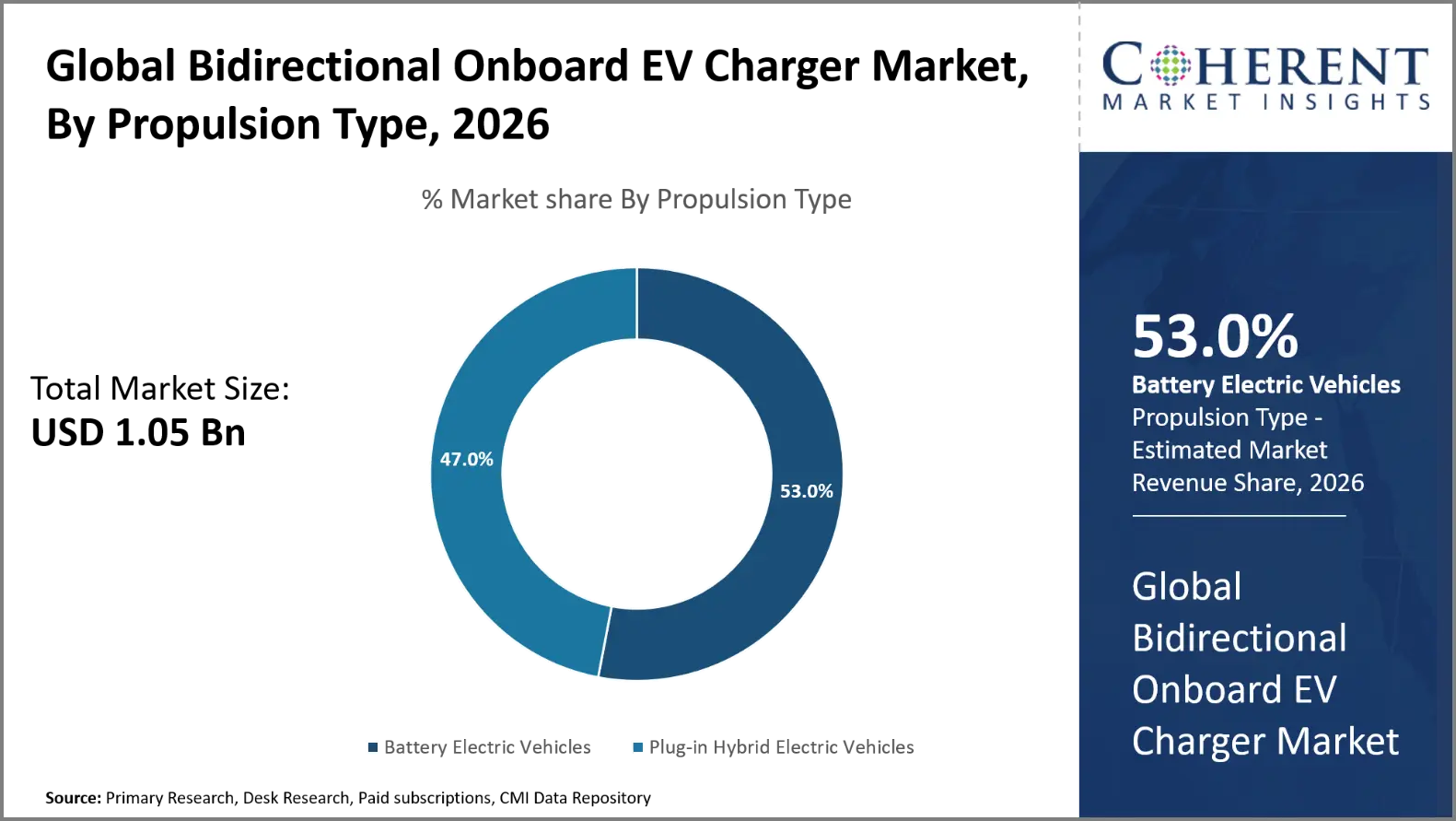
- The Battery Electric Vehicles segment is expected to account for 53.0% of the global bidirectional onboard EV charger market share in 2026. Increasing integration of silicon carbide semiconductors in onboard chargers is driving the growth of the segment. On March 13, 2025, Navitas Semiconductor Corporation introduced its 650V bidirectional GaNFast integrated circuits and high-speed isolated gate drivers.
- The Passenger Vehicles segment is estimated to capture 61.0% of the market share in 2026. Expansion of renewable energy integration and distributed energy storage is majorly driving the growth of the segment. On September 26, 2026, Hoymiles Power Electronics Inc. introduced a 22-kW bidirectional direct-current V2X charger. The product integrates with its HiOne all-in-one battery energy storage system.
- The Below 11 kW segment is estimated to capture 49.0% of the market share in 2026. Growing demand for integrated charging and power management systems is majorly driving the growth of the segment. On April 28, 2026, onsemi and Geely Auto Group expanded their strategic collaboration for next-generation electric vehicle development. The partnership strengthens integration of onsemi EliteSiC technologies across Geely's vehicle platforms.
- Asia Pacific is expected to dominate the bidirectional onboard EV charger market in 2026 with a market share of 38.0%. Increasing integration of onboard chargers with battery management systems in Asia Pacific is driving the growth of the regional market. On June 18, 2025, Tata Elxsi and Infineon Technologies AG signed a memorandum of understanding. The partnership focuses on developing application-ready electric vehicle subsystems for India's automotive industry.
- North America is expected to account for 33.0% share in 2026 and is projected to record the fastest growth over the forecast period. Increasing electrification of commercial vehicle fleets in North America is driving the growth of the regional market. On March 20, 2025, Tradelink Transport expanded its electric port-drayage operations. The California-based carrier deployed 15 Volvo VNR Electric trucks at the Ports of Los Angeles and Long Beach.
Segmental Insights
Why Does Battery Electric Vehicles Dominate the Global Bidirectional Onboard EV Charger Market?
The battery electric vehicles segment is expected to account for 53.0% of the global bidirectional onboard EV charger market share in 2026. Battery Electric Vehicles dominate because their large traction batteries support bidirectional energy storage and electricity exchange. These vehicles can offer stored electricity to houses, buildings and appropriate power infrastructures. Vehicle-to-Grid technology allows battery owners to help keep the grid stable during periods of high electricity demand. Vehicle-to-Home provides backup electricity during power outages and better management of home energy. Battery electric vehicles also contain power electronics and sophisticated battery management systems. Car manufactures are also developing bidirectional charging features to differentiate their electric vehicle platforms, which has pushed the use of renewables even further.
On September 3, 2025, American Honda Motor Co., Inc. announced that it will showcase present and future home and vehicle energy management solutions at RE+ 25, North America’s largest renewable energy exhibition, in Las Vegas. The display will feature the Acura RSX Prototype, an all-new electric vehicle (EV) built on Honda's new global EV platform and fresh from its debut at Monterey Car Week, paired with a bi-directional home charging station concept, previewing future vehicle-to-home (V2H) and vehicle-to-grid (V2G) energy capabilities.
- Current Industry Events of 2026
- Market Size Estimation
- Regional Breakdown
- Competitive Landscape
- Customer Intelligence
- Segmental Analysis
- Pricing Analysis
- Key Market Drivers, Challenges & Future Trends
- Customized Insights Section
Why is Passenger Vehicles the Most Crucial Vehicle Type?
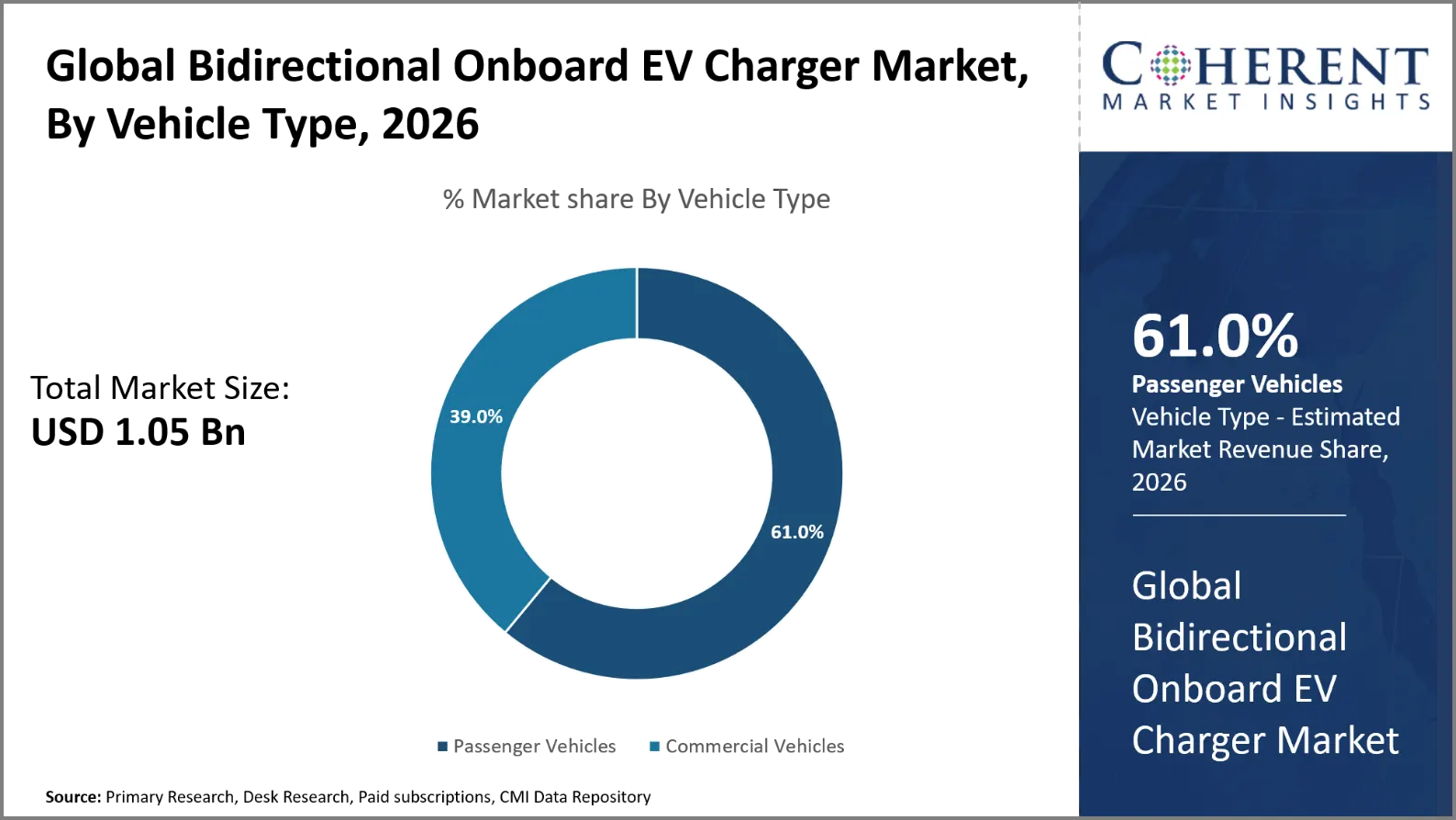
The passenger vehicles segment is expected to account for 61.0% of the global bidirectional onboard EV charger market share in 2026. Passenger vehicles are an important vehicle type given their enormous customer addressable base. Their predictable parking behavior offers prospects for home bidirectional charging applications. Since most passenger cars sit idle for long stretches, the electricity they retain can be used to satisfy a household’s needs. Vehicle-to-Home technology can lessen dependence on traditional electricity suppliers during peak demand. Private sector car owners could also earn revenues by participating in vehicle-to-grid. Increasingly, automotive manufacturers embed sophisticated onboard charging systems in passenger electric vehicle platforms. Home charging infrastructure also facilitates the introduction of bidirectional charging capabilities.
On September 10, 2025, BMW Group and E.ON launched Germany's first Vehicle-to-Grid solution for private customers. The initial offering uses the new BMW iX3 with bidirectional charging capabilities. Participating owners can feed electricity from their vehicle batteries into the electricity grid. The companies introduced an energy tariff rewarding customers for making stored electricity available.
Below 11 kW Dominates the Global Bidirectional Onboard EV Charger Market
The Below 11 kW segment is expected to account for 49.0% of the global bidirectional onboard EV charger market share in 2026. The below 11 kW segment dominates because it aligns with residential charging requirements. Most household charging installations operate within relatively moderate power capacities. Lower-power bidirectional chargers also reduce electrical infrastructure requirements for residential installations. They can be used in single phase and three phase power systems and so can be used more widely. These chargers support Vehicle-to-Home applications such as household backup power and solar energy optimization. Lower charging power can help minimize thermal management complexity and component cost. Overnight vehicle parking provides sufficient charging time for many passenger vehicle owners. Automakers can integrate compact below 11 kW onboard charging systems into mass-market electric vehicles.
On October 28, 2025, Opel introduced Vehicle-to-Load functionality for the new Astra Electric and other electric models. The Astra Electric and Mokka Electric feature a 7.4 kW single-phase bidirectional onboard charger as standard. An optional three-phase 11 kW charging unit is also available for selected models.
Current Events and their Impact
Current Events | Description and its Impact |
European Union - Delegated Regulation (EU) 2025/656 |
|
European Union - Alternative Fuels Infrastructure Regulation (EU) 2023/1804 |
|
Bidirectional Onboard EV Charger Market Dynamics
Market Drivers
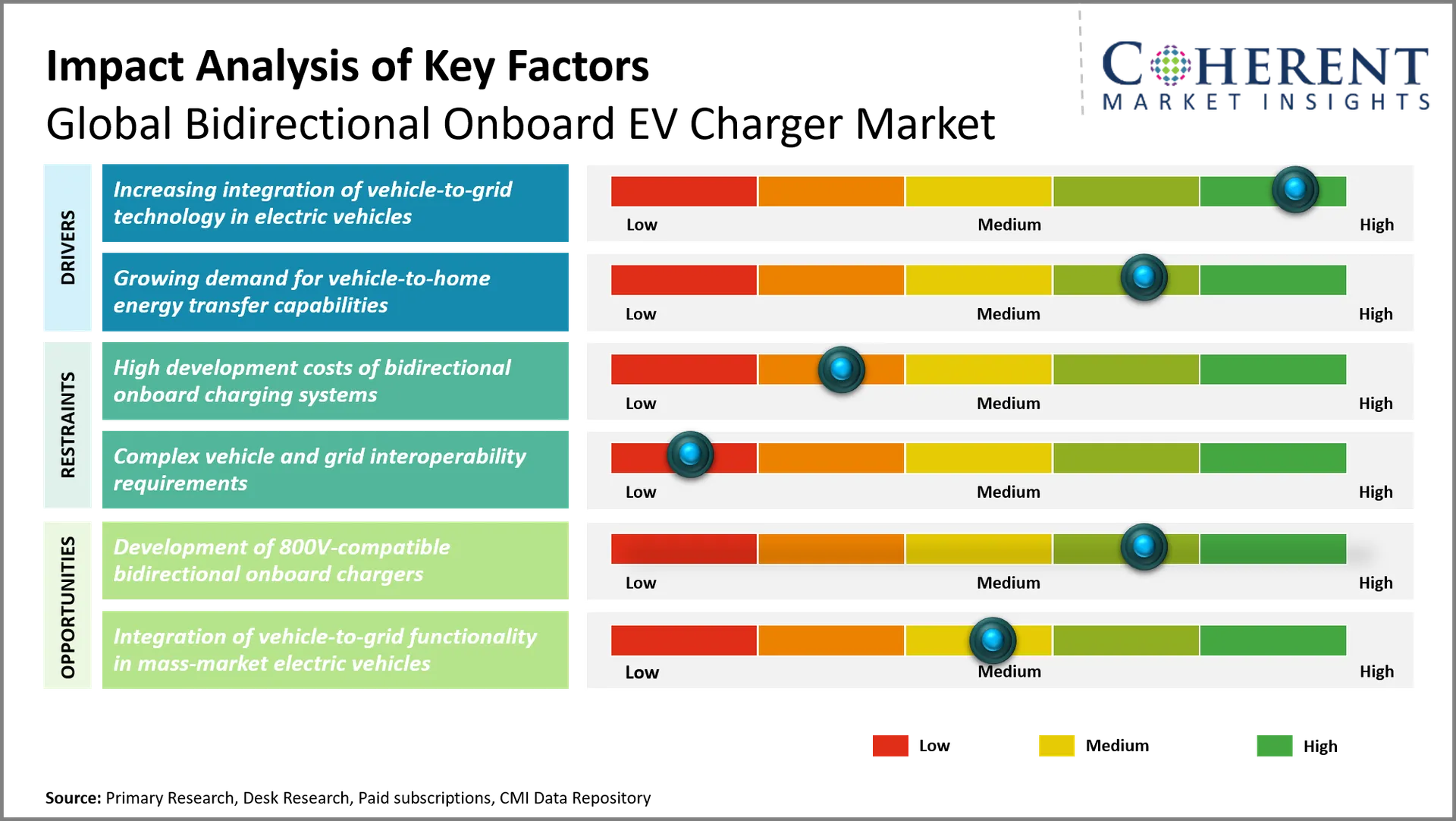
- Increasing integration of vehicle-to-grid technology in electric vehicles: One of the factors that are boosting the need for bidirectional onboard EV chargers is the increasing integration of Vehicle-to-Grid technology. V2G technology allows electric vehicles to sell the electricity stored in their batteries back to the compatible power grids. This capability transforms electric vehicles into flexible distributed energy resources. Automotive manufacturers are developing compatible charging architectures supporting controlled electricity export. For example, Nissan has developed advanced V2G capabilities through its LEAF electric vehicle platform. Renault has also experimented with bidirectional charging on its Renault 5 E-Tech electric platform. These systems include grid balancing, renewable integration and peak demand management. Electricity utilities can aggregate connected vehicles to provide demand-response services. Bidirectional onboard chargers require efficient power conversion and reliable grid-synchronization capabilities. Growing V2G deployment therefore encourages automotive manufacturers to integrate advanced bidirectional charging electronics.
- On September 23, 2025, Origin collaborated with vehicle manufacturer BYD and StarCharge, a global leader in EV charging infrastructure, to announce the trial of Australia’s first EV subscription bundled with a bi-directional charger and access to free home EV charging. Bi-directional charging allows EV drivers to charge the car from the grid or from their solar system, and then also send electricity back to the grid.
- Growing demand for vehicle-to-home energy transfer capabilities: Growing demand for Vehicle-to-Home capabilities is creating opportunities for bidirectional onboard EV chargers. V2H is a technology that allows EVs to send stored energy from their batteries into home electrical systems. Vehicle batteries can be used as backup energy sources for homeowners when electricity is interrupted. The system also enables household energy optimization and solar power usage. For example, Nissan’s LEAF supports domestic energy applications with suitable bidirectional charging equipment. Mitsubishi Motors has also been promoting the car-based domestic power supply as part of its electric vehicle ecosystem. The growing number of home solar systems boosts demand for integrated energy management solutions. House owners can charge the vehicle batteries with the surplus renewable electricity for later usage in the home. Bidirectional onboard chargers must support efficient power conversion, electrical protection, and communication with home energy systems. These capabilities position V2H applications as an important demand driver for residential electric vehicle charging technologies.
- On March 4, 2025, Kia America and Wallbox announced Quasar 2 pre-orders for eligible Kia EV9 owners. The bidirectional charger enables EV batteries to supply electricity to residential properties. The package includes Wallbox’s Power Recovery Unit for home energy transfer. This announcement advanced V2H availability beyond experimental demonstrations.
Emerging Trends
- Integration of Silicon Carbide and Gallium Nitride Power Electronics: Automotive manufacturers are using Silicon Carbide and Gallium Nitride semiconductors in bidirectional onboard chargers. These materials increase switching efficiency, conversion losses, and enable small power electronic architectures.
- Impact: More efficient switching means less heat, which means less cooling needed. Smaller parts allow for more flexible packaging, supporting lightweight onboard chargers with better power density and energy conversion performance.
- Relevance to the market: On November 11, 2026, Visteon, SHINRY, and Infineon announced a partnership on a single-stage onboard charger employing Gallium Nitride bidirectional switches. This shows increasing commercial interest in advanced bi-directional charging topologies based on semiconductor technology.
- Development of Integrated Bidirectional Charging and Energy Management Systems: Automakers are combining bidirectional charging with battery management, home energy systems and smart charging software. This technique enables coordinated electricity exchange between electric vehicles, residential structures and power grids.
- Impact: Integrated architectures make it easier to manage energy and increase coordination between car batteries and external electrical systems. They also allow for automatic charging schedules, export of electricity and optimal use of renewable energy.
- Relevance to the market: On November 24, 2026, Volkswagen Group launched its mass-market Vehicle-to-Grid charging solution in Germany. This invention is an indication of the increasing prospects for onboard charging systems that support grid interactive electric vehicle platforms.
Regional Insights

Why is Asia Pacific a Strong Market for Bidirectional Onboard EV Charger?
Asia Pacific is expected to account for a market share of 38.0% in 2026. There is a concentration of electric vehicle manufacturing in the Asia Pacific region, and utilities are increasing their participation in bi-directional charging demonstrations. Hyundai Motor Group’s Jeju pilot is pushing alternating-current V2G technology in South Korea. The Korea Electric Power Corporation is also thinking about adjustments to the grid code for these applications. Australia is improving market preparedness with updated AS/NZS 4777.2 requirements and national interoperability consultations. In May 2026, the Australian Renewable Energy Agency extended its Amber Electric's V2G project. The expansion targets 1,000 participating V2G households. These developments create opportunities for onboard charger suppliers developing grid-compatible power conversion systems.
Why Does North America Bidirectional Onboard EV Charger Market Exhibit High Growth?
North America is expected to register the fastest growth with a CAGR of 18.3% over the forecast period. It is projected to account for 33.0% of the global bidirectional onboard EV charger market in 2026 and benefits from utility-led demonstrations, commercial fleet electrification, and residential backup-power requirements. Canada is researching bidirectional charging applications on fleets of electric school busses. British Columbia Hydro launched Canada’s first real-world V2G field test on an electric school bus in September 2025. Natural Resources Canada is also supporting Alectra Utilities’ V2X project in Ontario. The concept is focused on bidirectional charging of light duty cars and school busses. Such programs drive the demand for fleet-compatible onboard charging solutions. Manufacturers can target school busses, business vehicles and distributed energy management systems.
Global Bidirectional Onboard EV Charger Market Outlook for Key Countries
Why is China Emerging as a Major Hub in the Bidirectional Onboard EV Charger Market?
China has mass production of electric vehicles and government-supported vehicle-grid integration schemes. In 2025, the National Development and Reform Commission selected nine pilot cities and 30 projects. Shenzhen saw its first actual electricity-export settlement in January 2026. One vehicle owner participating in the program was compensated for electricity discharged during peak demand. The demonstration was overseen by Shenzhen Power Supply Bureau of China Southern Power Grid. These advances are prompting manufacturers to design bidirectional chargers that can be used with household charging interfaces. Grid aggregation, electricity settlement and peak-load management are all key business potential.
Is U.S. the Next Growth Engine for the Bidirectional Onboard EV Charger Market?
In the U.S. market, household energy resilience regulations and utility agreements for two-way electricity exchange are helpful. General Motors is also working on V2G technology that uses alternating current to make residential energy installations easier. Its November 2026 update cited partnerships with Southern California Edison and WeaveGrid. The companies are testing vehicle-to-grid electricity exports with participating California customers. The California Energy Commission also supports eligible residential V2H installations through financial incentives. These initiatives encourage onboard charger manufacturers to develop integrated power conversion architectures. Demand is particularly promising for passenger electric vehicles supporting home backup and grid participation.
Germany Bidirectional Onboard EV Charger Market Analysis and Trends
Germany benefits from advanced automotive engineering, renewable electricity generation, and emerging commercial V2G electricity tariffs. Volkswagen Group subsidiary Elli is introducing an integrated bidirectional charging solution. Its offering combines the Elli BiDi Charger, electricity tariffs, digital applications, and installation services. The system supports compatible Volkswagen, CUPRA, Škoda, and Volkswagen Commercial Vehicles models. Volkswagen Group also identifies approximately one million European MEB vehicles as technically prepared for bidirectional charging. These developments encourage demand for high-efficiency DC bidirectional onboard charging architectures. Germany's commercial rollout provides an important reference for European automotive suppliers.
Japan Bidirectional Onboard EV Charger Market Analysis and Trends
Japan has existing CHAdeMO technology and considerable demand for electricity resiliency during natural calamities. Its automotive industry has a large expertise designing automobiles compatible with bidirectional electrical transfer. CHAdeMO set the early technical basis for vehicle-to-grid and vehicle-to-home applications. Japan’s energy policy puts emphasis on distributed electrical resources and emergency power readiness. These constraints present opportunity for tiny bidirectional chargers for domestic backup applications. Japanese providers have existing competence in power electronics and experience in charging interfaces. However, manufacturers will have to progressively focus on interoperability with growing international communication standards.
France Bidirectional Onboard EV Charger Market Analysis and Trends
France is well served by its nuclear-powered electricity infrastructure, its household electrification and growing partnerships between car manufacturers and electricity suppliers. On October 8, 2026, Renault Group and Électricité de France announced a strategic agreement on charging. The partnership covers bidirectional charging and Vehicle to Grid electricity services. It provides an integrated mix of electric vehicles, residential charging and smart energy management. The implementation is supported by Renault Group's relationship with Électricité de France subsidiaries IZI by EDF and DREEV. The companies are looking to lower the cost of charging at home and offer grid flexibility. These developments create opportunities for onboard chargers supporting coordinated residential and electricity-market operations.
Global Bidirectional Onboard EV Charger Market - Comparative Battery Degradation
Metric | Conventional Charging | Bidirectional Charging |
Capacity fade after approximately 26,000 miles | Approximately 4% | Approximately 8% |
Power fade after approximately 26,000 miles | Approximately 1.5% | Approximately 7% |
Annual capacity degradation, EPRI accelerated test | 1.5% | 3.3% |
Capacity fade after 10 years, EPRI projection | 15% | 33% |
Battery life, average driving scenario | 9.9 years | 8.5 years |
Battery life, high driving scenario | 9.5 years | 8.3 years |
Battery life, very high driving scenario | 8.7 years | 8.0 years |
Cyclic degradation contribution | 10-15% | 20-25% |
Calendar degradation contribution | 85-90% | Lower relative contribution |
How is Development of 800V-Compatible Bidirectional Onboard Chargers Creating New Growth Opportunities in the Bidirectional Onboard EV Charger Market?
The introduction of 800V-capable bidirectional on-board chargers opens up new prospects by making it compatible with next generation electric car platforms and innovative energy-transfer applications. Higher-voltage topologies allow manufacturers to enhance power conversion efficiency, reduce electrical losses due to current and improve the packaging of the onboard charging system. On November 2, 2023, BorgWarner secured a deal to supply an 800V bidirectional onboard charger for a major North American automaker. Its silicon carbide-based system is rated for single-phase 19.2 kW and three-phase 22 kW, and also has vehicle-to-load capability. Production is slated to start in January 2027. Valeo also has a fourth-generation bidirectional onboard charger architecture that supports 400V and 800V batteries. Its scalable architecture can manage outputs up to 22 kW. These improvements offer potential for suppliers of high-voltage semiconductors, sophisticated converter topologies and integrated bi-directional power electronics.
Market Players, Key Development, and Competitive Landscape
Key Developments
- On June 2, 2026, Valeo, a global leader in automotive technologies, announced that it is building on its dominant position in electrification technologies to expand its footprint in the electric car ecosystem with a range of innovative smart charging solutions. The whole offer will be presented on June 2 and 3 at Drive to Zero at Paris Expo Porte de Versailles, Paris, France.
- On February 2, 2026, Enphase Energy, Inc. a global energy technology company, provided an update on the continued development of its IQ Bidirectional EV Charging Platform, highlighting successful demonstrations, expanding global engagement, and ongoing validation across vehicles, homes, and grid environments in the United States and Europe.
- On September 2, 2025, FORVIA HELLA and Tau Motors announced that they are developing improved charging technologies within the framework of a strategic development agreement. The focus is on the creation of a virtually isolated onboard charger for electric vehicles, which is to be brought to serial production in the next two to three years.
Competitive Landscape
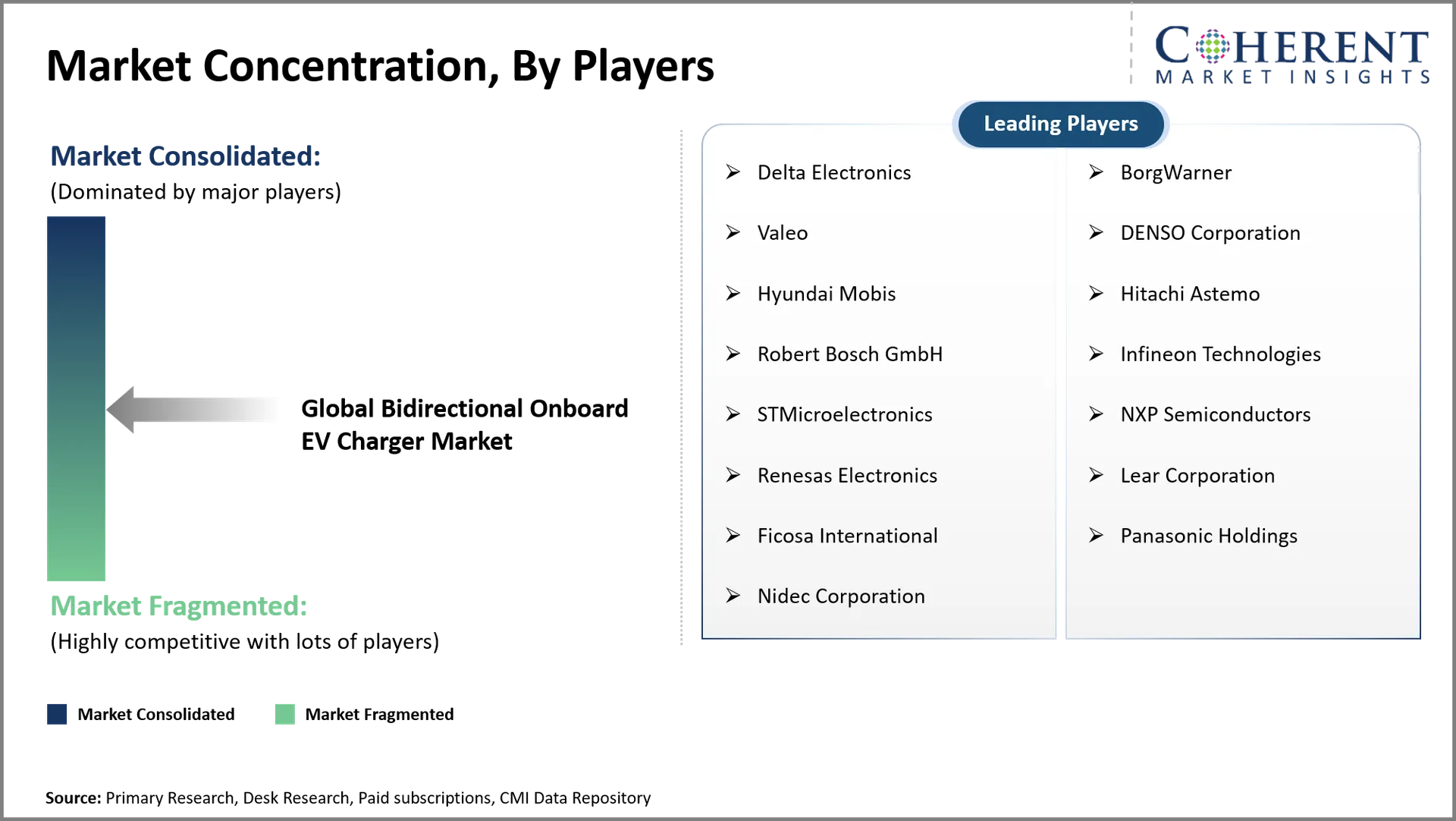
The global bidirectional onboard EV charger market features competition across automotive power electronics, semiconductor integration, and vehicle energy management. BorgWarner Inc. is betting on 800V charging topologies, Silicon Carbide technologies The bidirectional on-board charger of 22 kW has vehicle-to-load capability and supports various grid configurations. Valeo SE has developed a fourth-generation scalable bidirectional onboard charger that can accommodate 400V and 800V batteries. It has a platform designed for single-phase and three-phase electrical networks with power up to 22 kW. Hyundai Mobis Co., Ltd. focuses on integrated electrification systems and advanced power conversion technologies. Toyota Industries Corporation develops bidirectional onboard charging technology for vehicle-to-grid applications. Delta-Q Technologies targets compact charging systems using Gallium Nitride and Silicon Carbide semiconductors. Infineon Technologies AG and STMicroelectronics strengthen the supply chain through automotive-grade power semiconductors. Competition increasingly centers on high-voltage compatibility, reverse power conversion, thermal management, and OEM platform integration.
Top Manufacturers and Notable Products in the Bidirectional Onboard EV Charger Market
Manufacturer | Notable Product | Bidirectional Capability | Key features |
BorgWarner Inc. | 800V Bidirectional Onboard Charger | V2L | Silicon Carbide switches, high power density, regional grid compatibility, integrated hardware and software |
Valeo SE | Fourth-Generation High-Voltage Onboard Charger | V2X | Scalable platform, single-phase and three-phase compatibility, up to 96% efficiency, ISO 15118 communication |
Delta Electronics, Inc. | Bidirectional On-Board Charger | V2G, V2H, V2V, V2L | Grid-to-vehicle and vehicle-to-external-load power flow, bidirectional energy conversion |
Stercom Power Solutions GmbH | OBC V2X 550/950 | V2G, V2H, V2B, V2L, V2V | Universal Grid Compatibility, parallel operation, integrated charging control, ISO 26262 compliance |
BRUSA HyPower AG | DC Wallbox Charger, Bidirectional 30 kW | V2X | Built on OBC7 power electronics, over 96.5% peak efficiency, home energy integration, intelligent load management |
Market Report Scope
Global Bidirectional Onboard EV Charger Market Report Coverage | |||
Report Coverage | Details | ||
Base Year | 2025 | Market Size in 2026: | USD 1.05 Bn |
Historical Data For: | 2020 To 2024 | Forecast Period: | 2026 To 2033 |
Forecast Period 2026 To 2033 CAGR: | 17.80% | 2033 Value Projection: | USD 3.30 Bn |
Geographies covered: |
| ||
Segments covered: |
| ||
Companies covered: | Delta Electronics, BorgWarner, Valeo, DENSO Corporation, Hyundai Mobis, Hitachi Astemo, Robert Bosch GmbH, Infineon Technologies, STMicroelectronics, NXP Semiconductors, Renesas Electronics, Lear Corporation, Ficosa International, Panasonic Holdings, Nidec Corporation | ||
Growth Drivers: |
| ||
Restraints & Challenges: |
| ||
Analyst Opinion (Expert Opinion)
- The future of this industry will center on bidirectional power conversion becoming an integrated vehicle function. Automakers will increasingly prioritize onboard chargers supporting both electricity consumption and controlled electricity export. The shift to 800V car layouts will drive demand for Silicon Carbide based converter designs. AC bi-directional charging will find more use when home installations want lower equipment complexity. Toyota Industries’ hardware verification in July 2026 is a step toward standardized AC-based V2G commercialization. Suppliers should prepare for stronger competition around interoperability and vehicle-level integration.
- The maximum opportunity will emerge in below 11 kW and 11-22 kW bidirectional onboard charger categories. Passenger vehicles offer attractive opportunities because residential parking supports scheduled electricity export and household backup. Germany, France, and the Netherlands offer promising commercial conditions for V2G deployment. China offers prospects for government-supported charging demonstrations and domestic electric vehicle production. The U.S. has limited options for home V2H systems and premium 800V EVs. Suppliers should focus on AC bidirectional topologies for home applications and greater power platforms for premium automobiles.
- Companies seeking competitive advantage should design modular on-board chargers that can accommodate both 400V and 800V battery topologies. They should include Silicon Carbide switches, superior heat management and communication systems according to ISO 15118-20. BorgWarner’s 800V platform and Valeo’s scalable 22 kW architecture point to important engineering directions. Toyota Industries’ AC-based V2G verification is another commercialization path. Suppliers should secure long-term automotive OEM contracts before production-platform specifications become fixed. They should also establish validation partnerships with utilities and charging equipment manufacturers. Local engineering teams must address regional grid codes and charging interfaces.
Speak to the analyst
Want personalized insights?
Take the findings above to one of our principal consultants, or have the report rebuilt around the segments, geographies and competitors you actually track.
Market Segmentation
- Propulsion Type Insights (Revenue, USD Billion, 2021 - 2033)
- Battery Electric Vehicles
- Plug-in Hybrid Electric Vehicles
- Vehicle Type Insights (Revenue, USD Billion, 2021 - 2033)
- Passenger Vehicles
- Commercial Vehicles
- Power Output Insights (Revenue, USD Billion, 2021 - 2033)
- Below 11 kW
- 11 kW to 22 kW
- Above 22 kW
- Charging Architecture Insights (Revenue, USD Billion, 2021 - 2033)
- Single-Phase Bidirectional Chargers
- Three-Phase Bidirectional Chargers
- Application Insights (Revenue, USD Billion, 2021 - 2033)
- Vehicle-to-Grid
- Vehicle-to-Home
- Vehicle-to-Load
- Vehicle-to-Building
- Regional Insights (Revenue, USD Billion, 2021 - 2033)
- North America
- U.S.
- Canada
- Latin America
- Brazil
- Argentina
- Mexico
- Rest of Latin America
- Europe
- Germany
- U.K.
- Spain
- France
- Italy
- Russia
- Rest of Europe
- Asia Pacific
- China
- India
- Japan
- Australia
- South Korea
- ASEAN
- Rest of Asia Pacific
- Middle East
- GCC Countries
- Israel
- Rest of Middle East
- Africa
- South Africa
- North Africa
- Central Africa
- North America
- Key Players Insights
- Delta Electronics
- BorgWarner
- Valeo
- DENSO Corporation
- Hyundai Mobis
- Hitachi Astemo
- Robert Bosch GmbH
- Infineon Technologies
- STMicroelectronics
- NXP Semiconductors
- Renesas Electronics
- Lear Corporation
- Ficosa International
- Panasonic Holdings
- Nidec Corporation
Sources
Primary Research Interviews
- EV Charging Infrastructure Manufacturers
- Electric Vehicle OEMs & Automakers
- Grid & Energy Management Solution Providers
- Fleet Operators & EV Charging Network Operators
Magazines
- EV Technology Magazine
- Charged Electric Vehicles Magazine
- Power Electronics Technology Magazine
- Electrification Magazine (IEEE)
Journals
- IEEE Transactions on Power Electronics
- Journal of Power Sources (Elsevier)
- International Journal of Electrical Power & Energy Systems
Associations
- CharIN e.V. (Charging Interface Initiative)
- Electric Drive Transportation Association (EDTA)
- International Council on Clean Transportation (ICCT)
- European Automobile Manufacturers' Association (ACEA)
Public Domain Sources
- U.S. Department of Energy (DOE) – Alternative Fuels Data Center
- International Energy Agency (IEA) – Global EV Outlook Reports
- European Commission – Clean Energy for All Europeans Package
- U.S. Environmental Protection Agency (EPA) – EV Infrastructure Reports
Proprietary Elements
- CMI Data Analytics Tool
- Proprietary CMI Existing Repository of Information for the Last 10 Years
Get access to 250+ pages report
Every segment, forecast, competitor profile and data table behind the analysis above — available for instant download.
- ESOMAR Member
- ISO 9001:2015 Certified
- D-U-N-S Registered
- GDPR & CCPA Compliant
Frequently Asked Questions
The global Bidirectional Onboard EV Charger market is expected to stand at USD 1.05 Bn in 2026 and is expected to reach USD 3.30 Bn by 2033.
The CAGR of the global Bidirectional Onboard EV Charger market is projected to be 17.8% from 2026 to 2033.
Increasing integration of vehicle-to-grid technology in electric vehicles and Growing demand for vehicle-to-home energy transfer capabilities are the major factors driving the growth of the global Bidirectional Onboard EV Charger market.
High development costs of bidirectional onboard charging systems and Complex vehicle and grid interoperability requirements are the major factors hampering the growth of the global Bidirectional Onboard EV Charger market.
In terms of propulsion type, battery electric vehicles segment is estimated to dominate the market revenue share in 2026.
A bidirectional onboard EV charger converts electricity between vehicle batteries and external electrical systems.
It converts alternating current into direct current during charging and reverses power flow during electricity export.