

Global Bone Conduction Devices Market Size and Forecast – 2026 To 2033
The global bone conduction devices market is expected to grow from USD 1,080.0 Mn in 2026 to USD 1,941.6 Mn by 2033, registering a compound annual growth rate (CAGR) of 8.7% from 2026 to 2033. The market for global bone conduction devices is poised for significant expansion, fueled by the rising prevalence of hearing loss and the growing need for hearing rehabilitation technologies.
According to the World Health Organization (WHO), nearly 2.5 billion people are projected to have some degree of hearing loss by 2050, with more than 700 million requiring hearing rehabilitation. This highlights the substantial and expanding addressable patient population for bone conduction devices and other hearing rehabilitation technologies, supporting sustained market growth as demand for effective hearing solutions increases.
Key Takeaways of the Global Bone Conduction Devices Market
- Bone-anchored hearing aids (BAHA) is projected to hold 63.4% of the global bone conduction devices market share in 2026 making it dominant product type segment across North America, where established regulatory pathways support implant-based hearing technologies. The U.S. Food and Drug Administration (FDA) classifies active implantable bone conduction hearing systems as Class II medical devices under 21 CFR 874.3340, with specific clinical and non-clinical performance controls.
- Active transcutaneous is projected to hold 42.8% of the global bone conduction devices market share in 2026, making it dominant technology segment with North America benefiting from a defined regulatory framework for active implantable bone conduction systems. The U.S.FDA's Class II classification and special controls require evidence covering clinical performance, mechanical integrity, reliability, biocompatibility, and sterility, supporting a structured pathway for adoption of active implantable technologies.
- Conductive hearing loss is projected to hold 44.7% of the global bone conduction devices market share in 2026, making it dominant application segment across Europe, where national healthcare authorities have established specific eligibility pathways for bone conduction interventions. The NHS England commissioning policy defines specific eligibility criteria for bone-conduction hearing implants in patients with conductive or mixed hearing loss, supporting their use within established clinical pathways.
- North America market maintains dominance with an expected share of 36.8% in 2026, bolstered by established public reimbursement mechanisms. For instance, Ontario’s Assistive Devices Program covers 75% of eligible BAHA replacement costs, up to USD 2,174 (CAD 3,000) for a replacement sound processor and USD 2,827 (CAD 3,900) when supplied with an abutment.
- Asia Pacific is expected to exhibit the fastest growth in the global bone conduction devices market, registering an estimated CAGR of 10.6% during 2026–2033, driven by strengthening medical-device standards and regulatory infrastructure. For instance, China’s GB/T 9706.266-2025 standard, effective from July 1, 2026, establishes specific basic safety and essential-performance requirements for hearing aids and hearing-aid systems, supporting more standardized device development and evaluation in the Chinese market.
Segmental Insights
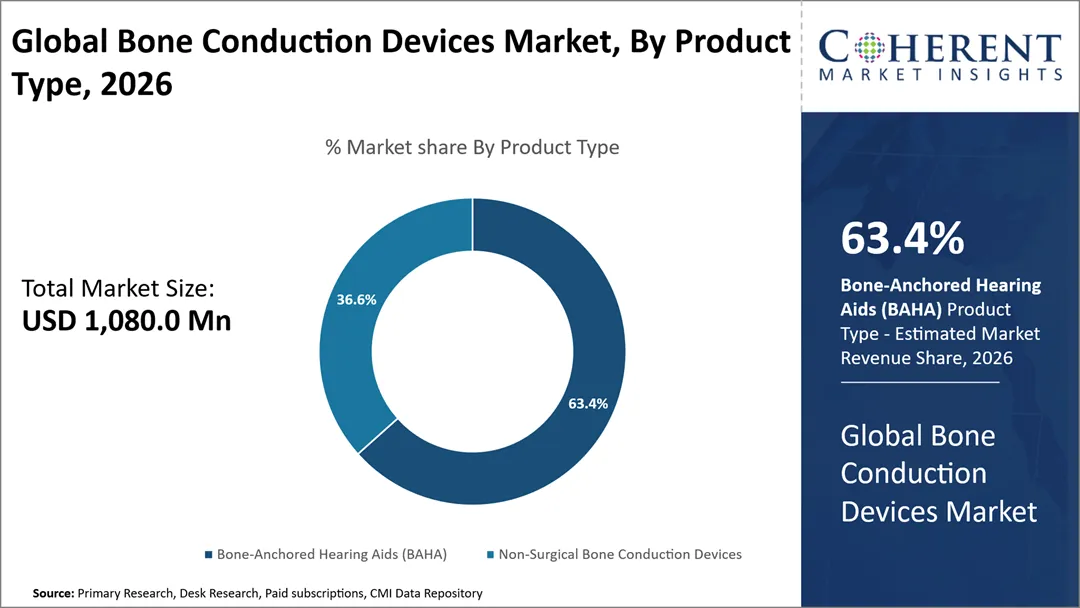
Why Do Bone-Anchored Hearing Aids (BAHA) Dominate the Global Bone Conduction Devices Market?
Bone-anchored hearing aids (BAHA) is projected to hold the market share of 63.4% in 2026, owing to their traditional application in treating conductive and mixed hearing loss and unilateral hearing impairment. Enhanced features such as direct bone-conduction process, enhanced sound amplification and wireless connection enhanced its usability by patients and acceptance by clinician. For instance, Cochlear Ltd. Baha 6 Max. features a fitting range of 55 dB, Smart Sound iQ processing and is compatible with direct streaming on smart phones such as compatible Apple or Android device, demonstrating continued product evolution in BAHA devices.
- Current Industry Events of 2026
- Market Size Estimation
- Regional Breakdown
- Competitive Landscape
- Customer Intelligence
- Segmental Analysis
- Pricing Analysis
- Key Market Drivers, Challenges & Future Trends
- Customized Insights Section
Why Does Active Transcutaneous Represent the Largest Technology Segment in the Bone Conduction Devices Market?
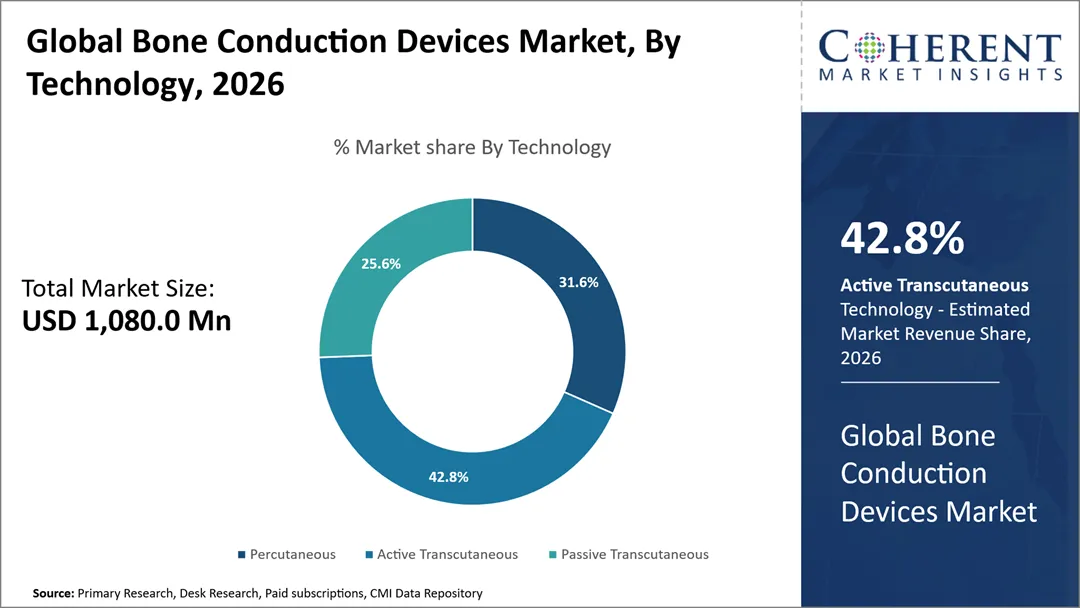
Active transcutaneous is projected to hold a market share of 42.8% in 2026, because the skin is kept intact and there are less skin-related issues and better cosmetic acceptance than percutaneous systems. The technology includes direct stimulation of the bone via implanted transducer which helps to maintain regular sound transmission and to use device continuously for a long time. For instance, the BONEBRIDGE BCI 602 from MED-EL Medical Electronics, is an active transcutaneous implant that is fully subdermal and is the smallest transducer available. The smaller size offers less anatomical constraints and less demands during surgery.
Conductive Hearing Loss Segment Dominates the Global Bone Conduction Devices Market
The conductive hearing loss segment is projected to hold a market share of 44.7% in 2026, because the bone conduction devices are able to circumvent the non-functioning structures of the external and middle ear and stimulate the cochlea directly. The application is especially relevant in case of chronic otitis media, atresia of the meatus, microtia, or different diseases of the ossicular chain. For instance, the Ponto system, offered by Oticon Medical, addresses conductive and mixed hearing loss and transmits sound externally to the ear canal and middle ear.
Current Events and their Impact
Current Events | Description and its Impact |
Australia Updates Minimum Specifications for Subsidised Bone Conduction Devices (September 2025) |
|
MHRA Strengthens Post-Market Surveillance for Hearing Implants (June 2025) |
|
NHS Scotland Bone Conduction Procurement Framework (March 2024) |
|
Bone Conduction Devices Market Dynamics
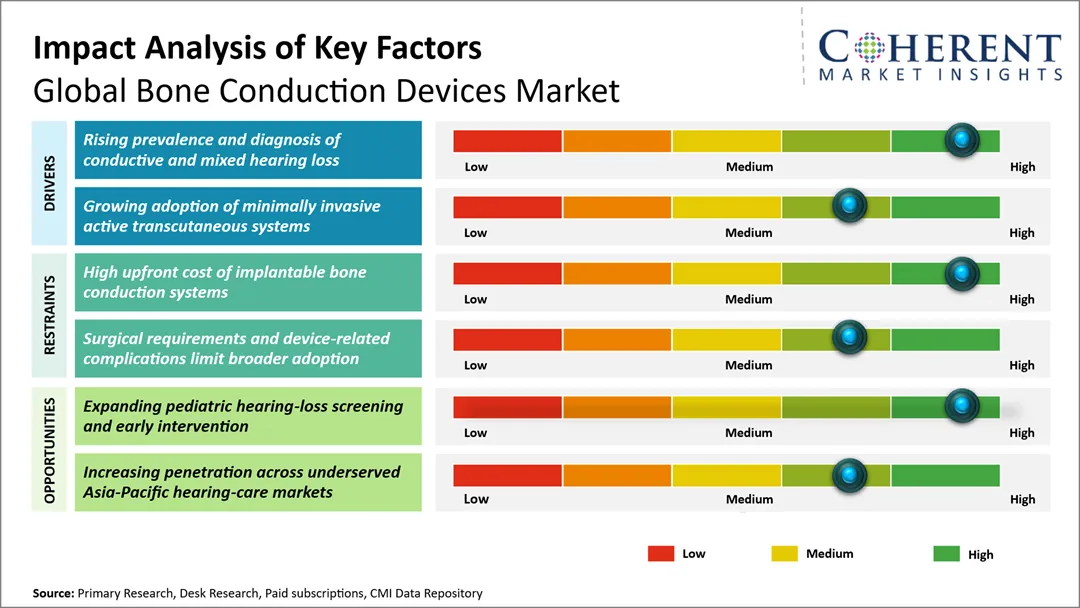
Market Drivers
- Rising prevalence and diagnosis of conductive and mixed hearing loss: The increasing identification of conductive and mixed hearing loss, particularly through early-life screening, is expanding the pool of patients who may require specialized hearing rehabilitation. Improved screening and diagnostic follow-up are enabling earlier classification of hearing-loss type and severity, supporting timely intervention and treatment planning. For instance, the U.S. National Institute on Deafness and Other Communication Disorders (NIDCD) estimates that approximately 37.5 million adults report some trouble hearing, while 28.8 million adults could potentially benefit from hearing aids, indicating a substantial pool of patients requiring hearing rehabilitation.
- Growing adoption of minimally invasive active transcutaneous systems: The shift toward active transcutaneous systems is being supported by their reduced skin-related complications and improved patient acceptance compared with percutaneous approaches. This is encouraging clinicians to consider transcutaneous options for patients requiring long-term bone conduction hearing rehabilitation. For instance, the American Academy of Otolaryngology–Head and Neck Surgery (AAO-HNS) recognizes both percutaneous and transcutaneous bone conduction devices as appropriate treatment options for conductive and mixed hearing loss, supporting the integration of transcutaneous systems into clinical practice.
- Growing geriatric population with age-related hearing impairment: The expanding geriatric population is increasing the number of individuals requiring hearing rehabilitation, particularly those with complex or mixed hearing-loss profiles. As age-related hearing impairment becomes more prevalent, demand for alternative hearing technologies such as bone conduction devices is expected to increase. For instance, the U.S. National Institute on Deafness and Other Communication Disorders (NIDCD) reports that disabling hearing loss affects approximately 22% of adults aged 65–74 and 55% of adults aged 75 and older, demonstrating the substantial hearing-care needs among older adults.
Emerging Trends
- Shift toward active transcutaneous and minimally invasive systems: Manufacturers are increasingly moving toward active transcutaneous technologies that reduce skin-penetrating components while improving sound transmission. This trend is supporting greater patient acceptance and expanding the addressable population for implantable bone conduction solutions.
- Integration of wireless connectivity and digital sound processing: Bone conduction devices are increasingly incorporating Bluetooth, smartphone connectivity, advanced signal processing, and adaptive noise-management capabilities. These features are improving speech intelligibility and enabling more personalized hearing experiences.
- Growing focus on rechargeable and long-battery-life devices: Rechargeable power systems and improved energy efficiency are emerging as important design priorities, reducing dependence on disposable batteries and simplifying daily device management. Longer operating times are particularly valuable for pediatric and active adult users.
Regional Insights
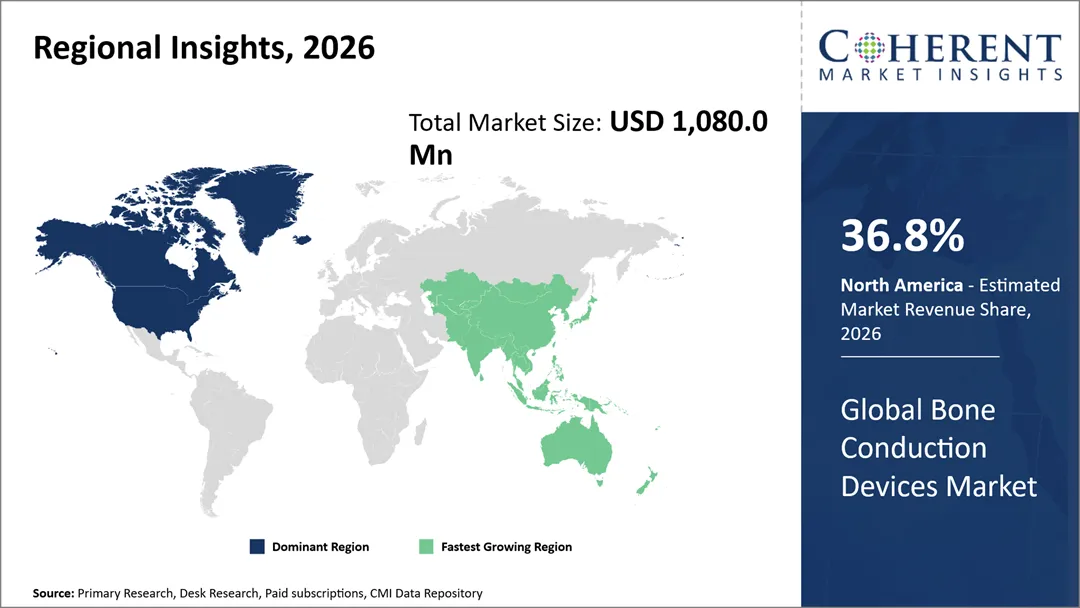
Why is North America a Strong Market for Bone Conduction Devices?
North America leads the global bone conduction devices market, accounting for an estimated 36.8% share in 2026, due to the well-developed healthcare infrastructure, high adoption rate of hearing rehabilitation, and high potential clinical strengths among doctors and medical professionals. The government policies based on increasing accessibility for the specially-abled persons and favorable reimbursements are further fueling the adoption of high-tech hearing devices among the populace.
For instance, the U.S. Department of Veterans Affairs through its VA healthcare system furnishes eligible beneficiaries with hearing aids and supporting hearing healthcare services available within the VA system that promotes fitting of new hearing rehabilitation technologies for eligible veterans. Furthermore, the constant investment in audiology services, specialized centers with advanced treatment capabilities and robust investment for R&D in latest technologies further amplify the regional demand.
Why Does Asia Pacific Bone Conduction Devices Market Exhibit High Growth?
Asia Pacific is expected to exhibit the fastest growth in the global bone conduction devices market, registering an estimated CAGR of 10.6% during 2026–2033. The region is projected to account for 25.2% of the global market in 2026, driven by growing healthcare infrastructure, rising awareness toward hearing loss and better access to specialized audiological care services. In countries like China, India and South Korea, governments are actively driving the trend towards digitalization and the use of hearing care programs, backed by supportive government policies, growing capabilities for local manufacturing and technology access is intensifying its pace of market expansion.
For instance, in August 2025, China's National Health Commission announced national guidelines to improve ear and hearing services, aiming to achieve above 90% coverage of newborn hearing screening by 2030 and to expand standardized hearing assessment and rehabilitation services in cities. Furthermore, increasing urbanization and a higher prevalence of noise induced hearing disability has enhanced its customer segment.
Global Bone Conduction Devices Market Outlook for Key Countries
Why is the U.S. Leading Innovation and Adoption in the Bone Conduction Devices Market?
The U.S is at the forefront of innovation and adoption attributed to concentration of highly efficient active transcutaneous technologies, excellent network of audiological and ENT care expertise, fast integration with wireless and digital sound-processing applications. The presence of existing clinical understanding on implant and post-implantation management support also provides with an advantage. Furthermore, acceptance of complex hearing solution applications further contributes to quick market launch of innovative bone conduction platforms.
Is Japan a Favorable Market for Bone Conduction Devices Market?
Japan presents an attractive opportunity for bone conduction devices due to the existence of an extensive ENT and audiology infrastructure, coupled with an increasing trend toward clinical adoption of implantable hearing devices. Key bone conduction devices are covered by national health insurance, providing access to treatment for many patients suffering from the stipulated conductive and mixed hearing losses. In addition, the country is also developing their own developed hearings by cartilage-conduction, hence it provides opportunities for product development and utilization.
Is China Emerging as a Key Growth Hub for the Bone Conduction Devices Market?
China is developing into an important market, due to the rise of hearing-health infrastructure and the awareness of hearing rehabilitation, together with more access to high-quality audiological technologies. Domestic device standards, as well as manufacturing technologies, are becoming stronger to facilitate the market of bone conduction devices. Furthermore, extended programs of neonatal hearing screening and rehabilitation, make the target audience larger, and an earlier intervention is possible.
Why Does Germany Top the European Bone Conduction Devices Market?
In the European Bone Conduction Devices Market, Germany is one of the dominant countries, a reflection of its well-developed ENT and audiology network, significant concentration of dedicated hearing implant facilities and a good base of clinical experience in difficult rehabilitation scenarios. The country's well-established medical device infrastructure also encourages the uptake of cutting-edge implantable and transcutaneous devices. While the extensive access to specialist audiological diagnostic support and long-term post-implantation care eases the entire device journey from screening to consistent use.
Is Bone Conduction Devices Market Developing in India?
India represents a growing market for bone conduction devices owing to a developing ENT and audiology ecosystem, rising prevalence and diagnosis of hearing impairment and better access to a variety of dedicated hearing rehabilitation. National Programme for Prevention and Control of Deafness is enhancing a number of early screening and rehabilitation services and ENT/Audiology resource at the district level. This market has good potential for rapid penetration with increasing awareness levels surrounding implantable and non-surgical bone conduction systems especially concerning to pediatric and underprivileged patients
How are the expanding pediatric hearing-loss screening and early intervention creating new growth opportunities in the bone conduction devices market?
The widespread adoption and increasing utilization of newborn hearing screening and early-intervention programs are offering earlier opportunities to detect potential candidates for more intensive hearing rehabilitation. While funded screening pathways are supporting this early diagnosis to early audiological intervention the awareness and utilization of pediatric hearing devices continue to increase. For instance, in November 2025, the Newborn Hearing Screening National Framework, was released by the Australian Government, that dictates the screening standards to be implemented nationally. For babies eligible for cochlear implants, it requires that an intervention occurs by 12 months of age.
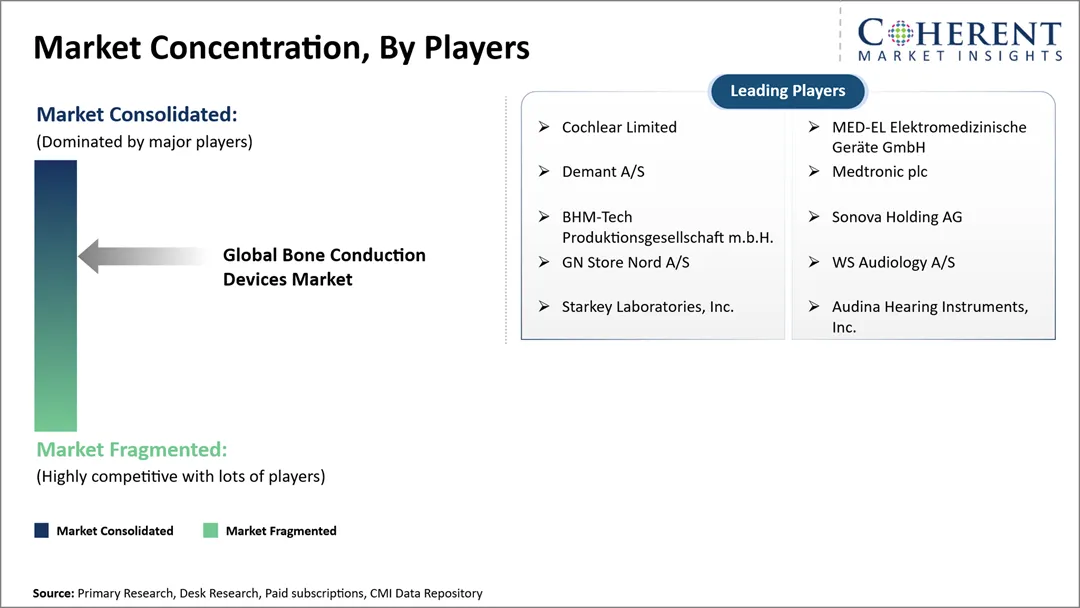
Market Players, Key Development, and Competitive Landscape
Key Developments
- In July 2026, Cochlear Limited introduced the Osia 3 Sound Processor following U.S. FDA clearance, advancing its active bone conduction hearing system. The processor is fully rechargeable, provides up to 30 hours of battery life, and offers enhanced sound processing and connectivity through Apple, Android, Bluetooth LE Audio, and Auracast.
- In July 2026, Mojawa launched Purra Flow, an AI-powered bone conduction headphone featuring real-time heart-rate monitoring, AI voice coaching, open-ear audio, and standalone music playback. The product extends bone conduction technology into AI-enabled fitness and wearable applications, supporting broader innovation beyond traditional audio use cases.
- In August 2025, Audeara Limited entered a project agreement with the Ear Science Institute Australia to develop and evaluate bone conduction hearing solutions for high-need communities in Australia. The project includes product evaluation, stakeholder engagement, product supply, and pilot implementation in classroom settings.
Competitive Landscape
The global bone conduction devices market is moderately competitive, with competition centered on technology innovation, sound-processing performance, patient comfort, regulatory compliance, and clinical accessibility. Market participants are increasingly focusing on active transcutaneous systems, compact and discreet device designs, wireless connectivity, pediatric applications, and expansion of clinical indications. Key focus areas include:
- Advancement of active transcutaneous bone conduction technologies
- Development of lightweight, discreet, and patient-friendly device designs
- Integration of Bluetooth, wireless streaming, and advanced digital sound processing
- Expansion of pediatric bone conduction solutions and early hearing intervention
- Strengthening of clinical evidence, regulatory approvals, and access to specialized hearing-care services
Market Report Scope
Bone Conduction Devices Market Report Coverage | |||
Report Coverage | Details | ||
Base Year | 2025 | Market Size in 2026: | USD 1,080.0 Mn |
Historical Data For: | 2020 To 2024 | Forecast Period: | 2026 To 2033 |
Forecast Period 2026 To 2033 CAGR: | 8.7% | 2033 Value Projection: | USD 1,941.6 Mn |
Geographies covered: |
| ||
Segments covered: |
| ||
Companies covered: | Cochlear Limited, MED-EL Elektromedizinische Geräte GmbH, Demant A/S, Medtronic plc, BHM-Tech Produktionsgesellschaft m.b.H., Sonova Holding AG, GN Store Nord A/S, WS Audiology A/S, Starkey Laboratories, Inc., Audina Hearing Instruments, Inc. | ||
Growth Drivers: |
| ||
Restraints & Challenges: |
| ||
Analyst Opinion (Expert Opinion)
- In the coming years, global bone conduction devices market is expected to move toward more discreet, rechargeable, and digitally connected hearing solutions, with active transcutaneous systems gaining importance. Over the longer term, greater integration of wireless connectivity, personalized sound processing, and pediatric-friendly designs is likely to shift competition from basic sound transmission toward overall user experience and clinical outcomes.
- The maximum opportunities are foreseen within active transcutaneous for conductive hearing loss in China. China offers a large addressable patient population, expanding audiology infrastructure, and increasing availability of advanced hearing-care services. Players that establish localized clinical networks and education programs around active transcutaneous solutions can capture growth as diagnosis and treatment access improve.
- In order to gain a competitive advantage market players should prioritize active transcutaneous platforms with compact designs, rechargeable power, wireless connectivity, and adaptable sound processing, while simultaneously strengthening pediatric and ENT referral networks. A combination of localized clinical education, faster regulatory execution, and broader access through audiology centers can create differentiation beyond device specifications alone.
Speak to the analyst
Want personalized insights?
Take the findings above to one of our principal consultants, or have the report rebuilt around the segments, geographies and competitors you actually track.
Market Segmentation
- Product Type Insights (Revenue, USD Mn, 2021 - 2033)
- Bone-Anchored Hearing Aids (BAHA)
- Non-Surgical Bone Conduction Devices
- Technology Insights (Revenue, USD Mn, 2021 - 2033)
- Percutaneous
- Active Transcutaneous
- Passive Transcutaneous
- Application Insights (Revenue, USD Mn, 2021 - 2033)
- Conductive Hearing Loss
- Mixed Hearing Loss
- Single-Sided Deafness
- Unilateral Hearing Loss
- Others
- Patient Age Insights (Revenue, USD Mn, 2021 - 2033)
- Pediatric
- Adult
- End User Insights (Revenue, USD Mn, 2021 - 2033)
- Hospitals and ENT Clinics
- Audiology and Hearing Care Centers
- Ambulatory Surgical Centers
- Specialty Clinics
- Home Care Settings
- Others
- Regional Insights (Revenue, USD Mn, 2021 - 2033)
- North America
- U.S.
- Canada
- Latin America
- Brazil
- Argentina
- Mexico
- Rest of Latin America
- Europe
- Germany
- U.K.
- Spain
- France
- Italy
- Russia
- Rest of Europe
- Asia Pacific
- China
- India
- Japan
- Australia
- South Korea
- ASEAN
- Rest of Asia Pacific
- Middle East
- GCC Countries
- Israel
- Rest of Middle East
- Africa
- South Africa
- North Africa
- Central Africa
- North America
- Key Players Insights
- Cochlear Limited
- MED-EL Elektromedizinische Geräte GmbH
- Demant A/S
- Medtronic plc
- BHM-Tech Produktionsgesellschaft m.b.H.
- Sonova Holding AG
- GN Store Nord A/S
- WS Audiology A/S
- Starkey Laboratories, Inc.
- Audina Hearing Instruments, Inc.
Sources
Primary Research Interviews
- ENT surgeons and otologists involved in bone conduction device implantation and hearing-loss management
- Audiologists and hearing-care specialists evaluating bone conduction technologies and patient outcomes
- Pediatric audiologists and otolaryngologists involved in pediatric hearing-loss screening and rehabilitation
- Hearing implant specialists and cochlear implant program coordinators assessing implantable hearing technologies
- Medical-device procurement and hospital administrators involved in the acquisition and adoption of bone conduction systems
Stakeholders
- Bone conduction device manufacturers and hearing-technology companies
- Hospitals, ENT departments, and specialized hearing-implant centers
- Audiology and hearing-care centers
- Pediatric hearing and early-intervention centers
- Ambulatory surgical centers and specialty clinics
- Medical-device distributors and hearing-device dealers
- Patients, caregivers, and hearing rehabilitation organizations
- End-use Sectors
- Healthcare & Clinical
- Consumer Electronics
- Sports & Fitness
- Military & Defense
- Occupational & Industrial
- Regulatory & Health Bodies
- U.S. Food and Drug Administration (FDA) – Bone conduction hearing-device classifications, 510(k) clearances, safety requirements, and regulatory information.
- Health Canada – Medical-device licensing, clinical evidence, safety, and effectiveness requirements.
- Medicines and Healthcare products Regulatory Agency (MHRA), UK – Medical-device regulation, safety monitoring, and post-market requirements
- European Commission – Medical-device regulatory framework and conformity requirements under the EU Medical Device Regulation
- Pharmaceuticals and Medical Devices Agency (PMDA), Japan – Medical-device review, approval, and regulatory information
- National Medical Products Administration (NMPA), China – Medical-device registration, classification, and regulatory requirements
Databases
- U.S. FDA 510(k) Database – Bone conduction hearing-device classifications, regulatory decisions, and premarket submissions.
- ClinicalTrials.gov – Clinical trials and studies evaluating bone conduction hearing technologies
- WHO International Clinical Trials Registry Platform (ICTRP) – International clinical-trial information
- EU EUDAMED – European medical-device registration and regulatory information
- FDA MAUDE Database – Medical-device adverse-event and safety information
- WHO Global Health Observatory (GHO) – Global hearing-loss and population health statistics
Associations
- American Academy of Otolaryngology–Head and Neck Surgery (AAO-HNS)
- American Academy of Audiology (AAA)
- British Society of Audiology (BSA)
- British Association of Audiovestibular Physicians (BAAP)
- European Academy of Otology and Neurotology (EAONO)
- American Cochlear Implant Alliance (ACI Alliance)
- International Society of Audiology (ISA)
Public Domain Sources
- World Health Organization (WHO) – Global hearing-loss prevalence, hearing rehabilitation, and assistive-technology data
- National Institute on Deafness and Other Communication Disorders (NIDCD) – U.S. hearing-loss prevalence, diagnosis, and hearing-care statistics
- Centers for Disease Control and Prevention (CDC) – U.S. newborn hearing-screening and early-intervention data
- National Center for Health Statistics (NCHS) – U.S. hearing-health and population statistics
- National Health Service (NHS) – UK hearing-care pathways and bone conduction hearing-implant information
Proprietary Elements
- CMI Data Analytics Tool, Proprietary CMI Existing Repository of information for last 10 years.
Get access to 250+ pages report
Every segment, forecast, competitor profile and data table behind the analysis above — available for instant download.
- ESOMAR Member
- ISO 9001:2015 Certified
- D-U-N-S Registered
- GDPR & CCPA Compliant
Missing comfort of reading report in your local language? Find your preferred language:
Frequently Asked Questions
The global bone conduction devices market is estimated to be valued at USD 1,080.0 Mn in 2026 and is expected to reach USD 1,941.6 Mn by 2033.
Bone-anchored hearing aids (BAHA) dominates due to their established clinical use, broader applicability across conductive and mixed hearing loss, and growing adoption of implant-based hearing rehabilitation.
Bone conduction devices are hearing solutions that transmit sound vibrations through the skull directly to the inner ear, bypassing the outer and middle ear.
The CAGR of global bone conduction devices market is projected to be 8.7% from 2026 to 2033.
Rising prevalence and diagnosis of conductive and mixed hearing loss, and growing adoption of minimally invasive active transcutaneous systems are the major factors driving the growth of the global bone conduction devices market.
High upfront cost of implantable bone conduction systems, and surgical requirements and device-related complications limit broader adoption are the major factors hampering the growth of the global bone conduction devices market.
In terms of technology, active transcutaneous is estimated to dominate the market revenue share in 2026.