

Global Brick Machines Market Size and Forecast – 2026 To 2033
The Global Brick Machines Market is estimated to be valued at USD 2.36 Bn in 2026 and is expected to reach USD 3.28 Bn by 2033, growing at a compound annual growth rate (CAGR) of 4.8% from 2026 to 2033. Market expansion is supported by increasing investments in residential construction, infrastructure development, and modernization of brick-production facilities worldwide. Demand is shifting toward automated and efficient brick manufacturing solutions as producers seek higher output consistency, reduced labor dependency, improved energy utilization, and better production control.
Advancements in servo-based systems, hydraulic precision, automated material handling, and digital monitoring are enabling manufacturers to improve productivity while maintaining product quality across large-scale operations. In July 2025, UNIK Machinery commissioned a fully automatic concrete block production line in Russia’s Far East, integrating servo vibration technology, intelligent controls, automated batching, curing, and palletizing systems to support smarter and more efficient construction-material manufacturing.
Key Takeaways of the Global Brick Machines Market
- Concrete Brick Machines, with an estimated 2026–2033 CAGR of 4.7%, are projected to account for 35.6% of the global brick machines market in 2026, supported by their suitability for high-volume production of blocks, pavers, and masonry products requiring consistent strength, durability, and dimensional accuracy. In July 2024, Masa reported that Asian Concreto became Nepal’s largest concrete block and paver manufacturer using Masa plant technology, highlighting the scalability of advanced concrete-product manufacturing systems.
- Fully Automatic Brick Machines, recording an estimated 2026–2033 CAGR of 5.6%, are expected to capture 42.8% of the global brick machines market in 2026 as manufacturers increasingly prioritize automated feeding, material handling, packaging integration, and precise production control to improve efficiency and reduce operational dependency. In October 2025, Mehramat Concretes commissioned a fully automated HESS production line centered on the RH 2000-4 VA concrete block machine in Assam, India, demonstrating industrial adoption of advanced automated manufacturing systems.
- Stationary Brick Machines, with a forecast CAGR of 4.9% during 2026–2033, are expected to maintain a leading position with 61.5% of the global brick machines market share in 2026 because permanent production facilities enable optimized material flow, continuous operation, higher utilization rates, and integration with curing and storage infrastructure. In October 2025, Hydraform highlighted its M10 Blockyard System through its commercial program, reflecting continued industry interest in dedicated high-output block production facilities.
- Asia Pacific, achieving an estimated 2026–2033 CAGR of 4.8%, is anticipated to contribute 57.8% of the global brick machines market in 2026, driven by large-scale housing development, infrastructure expansion, domestic machinery manufacturing, and extensive use of masonry-based construction materials. In August 2026, India’s Ministry of Housing and Urban Affairs reported continued progress under PMAY-Urban, with more than 1 crore houses completed and delivered, supporting sustained demand for construction-material production capacity.
- Europe, with a projected CAGR of 5.6% from 2026 to 2033, is expected to account for 18.7% of the global brick machines market in 2026 and emerge as the fastest-growing region due to increasing focus on sustainable construction, production modernization, quality compliance, and digitalized manufacturing processes. In November 2024, the European Union adopted the revised Construction Products Regulation framework, strengthening requirements around environmental information and digital product documentation for construction products.
Segmental Insights
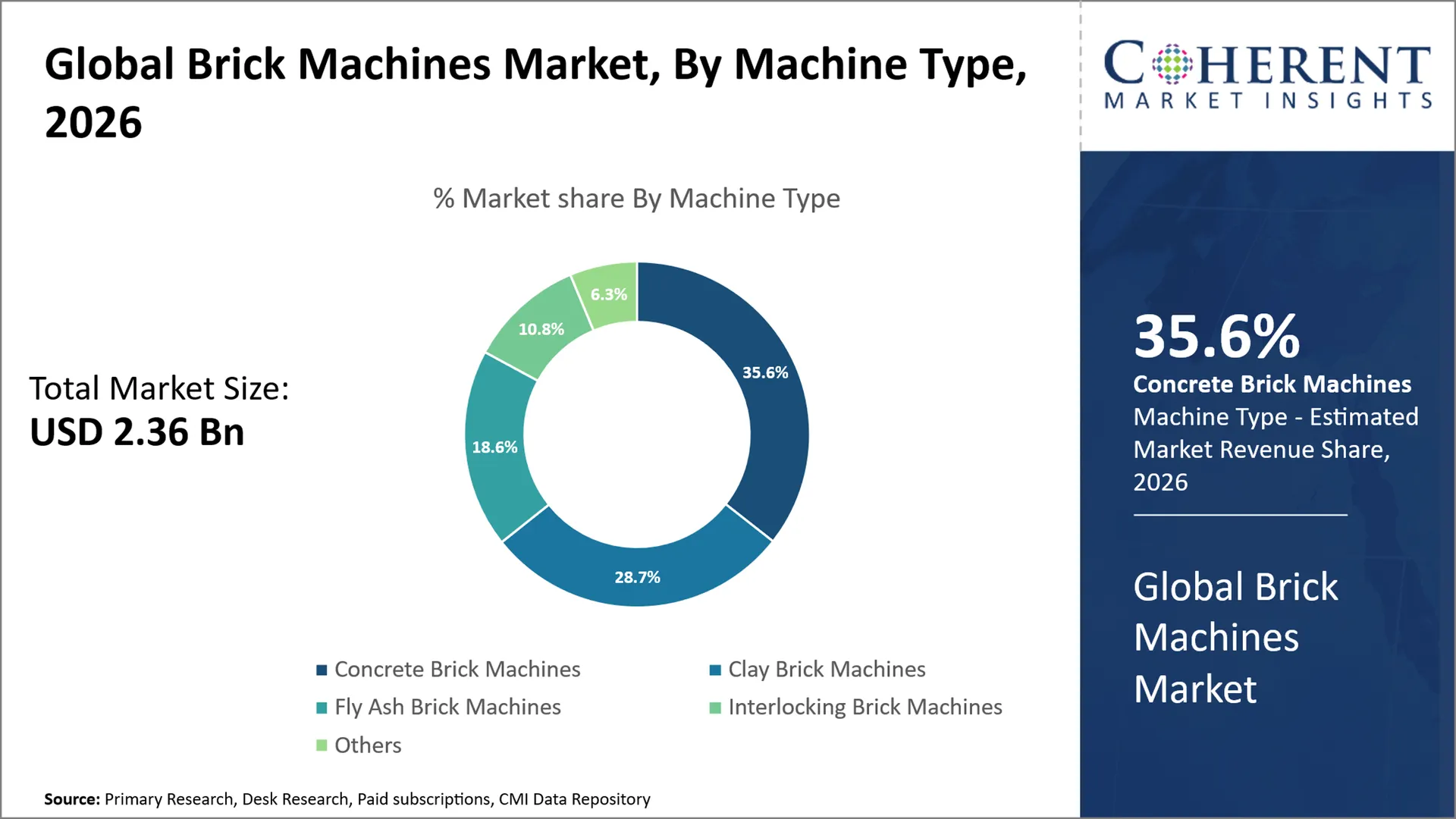
Why Do Concrete Brick Machines Dominate the Machine Type Segment in the Global Brick Machines Market?
Concrete Brick Machines are expected to account for 35.6% of the global brick machines market in 2026, supported by their ability to produce standardized masonry units with consistent strength, dimensional accuracy, and compatibility with large-volume construction requirements. Unlike specialized brick formats, concrete-based products can serve residential buildings, commercial structures, infrastructure projects, and landscaping applications through hollow blocks, solid blocks, and paving products. Manufacturers benefit from broad raw-material flexibility, including cement, aggregates, and industrial by-products, while equipment suppliers gain opportunities through mould customization, automation upgrades, and after-sales services. The segment’s commercial strength comes from its ability to balance production scale with product versatility. In March 2025, Columbia Machine announced the installation of a new automated concrete products manufacturing system at a customer facility in North America, strengthening demand for scalable concrete-product production solutions.
- Current Industry Events of 2026
- Market Size Estimation
- Regional Breakdown
- Competitive Landscape
- Customer Intelligence
- Segmental Analysis
- Pricing Analysis
- Key Market Drivers, Challenges & Future Trends
- Customized Insights Section
Why Do Fully Automatic Brick Machines Represent the Largest Operation Mode Segment in the Global Brick Machines Market?
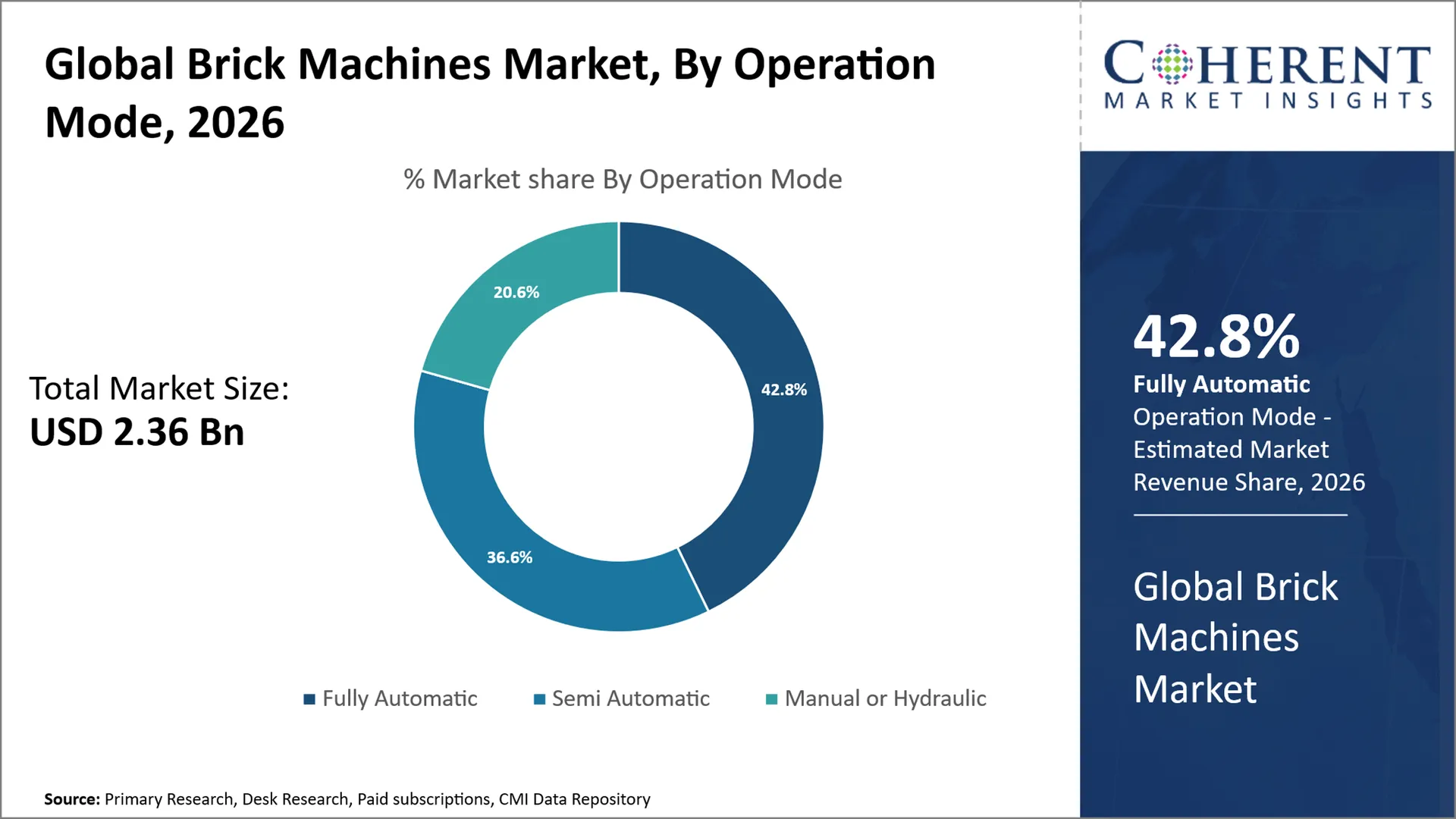
Fully Automatic Brick Machines are expected to account for 42.8% of the global brick machines market in 2026, leading the operation mode category because manufacturers increasingly require higher production consistency, reduced manual dependency, and improved operational control. These systems integrate automated feeding, mould changing, vibration management, pallet transfer, and stacking processes, enabling producers to maintain stable output across continuous production cycles. The segment is particularly important for large concrete-product manufacturers supplying standardized blocks, pavers, and masonry products were production efficiency and quality consistency influence profitability. Equipment suppliers with automation expertise, digital monitoring capabilities, and integrated plant solutions are positioned to capture higher-value projects. In April 2025, REKERS GmbH highlighted its automated concrete-product manufacturing solutions, including intelligent control systems and automated production technologies designed to improve efficiency and flexibility in modern block-production facilities.
Why Do Stationary Brick Machines Dominate the Machine Configuration Segment of the Global Brick Machines Market?
Stationary Brick Machines are expected to hold 61.5% of the global brick machines market in 2026, maintaining leadership in machine configuration because permanent production plants allow manufacturers to integrate raw-material preparation, curing systems, storage areas, and automated handling infrastructure into a single optimized workflow. These systems are preferred by established brick and concrete-product producers that require predictable capacity utilization, lower production interruptions, and long-term operational reliability. Unlike mobile solutions designed for temporary production requirements, stationary equipment supports expansion through additional moulds, handling systems, and process upgrades. This creates recurring opportunities for equipment suppliers through installation, modernization, and service contracts. In January 2025, SR SCHINDLER announced a new concrete block and paver plant and value-adding line for Alomaier Trading and Contracting Company, demonstrating continued investment in permanent concrete-product production infrastructure.
Current Events and their Impact
Current Event | Description and Its Impact |
July 2026 – EU amends AI treatment under the Machinery Regulation |
|
February 2026 – UK publishes Construction Products Reform White Paper and General Safety Requirement proposal |
|
Global Brick Machines Market Dynamics
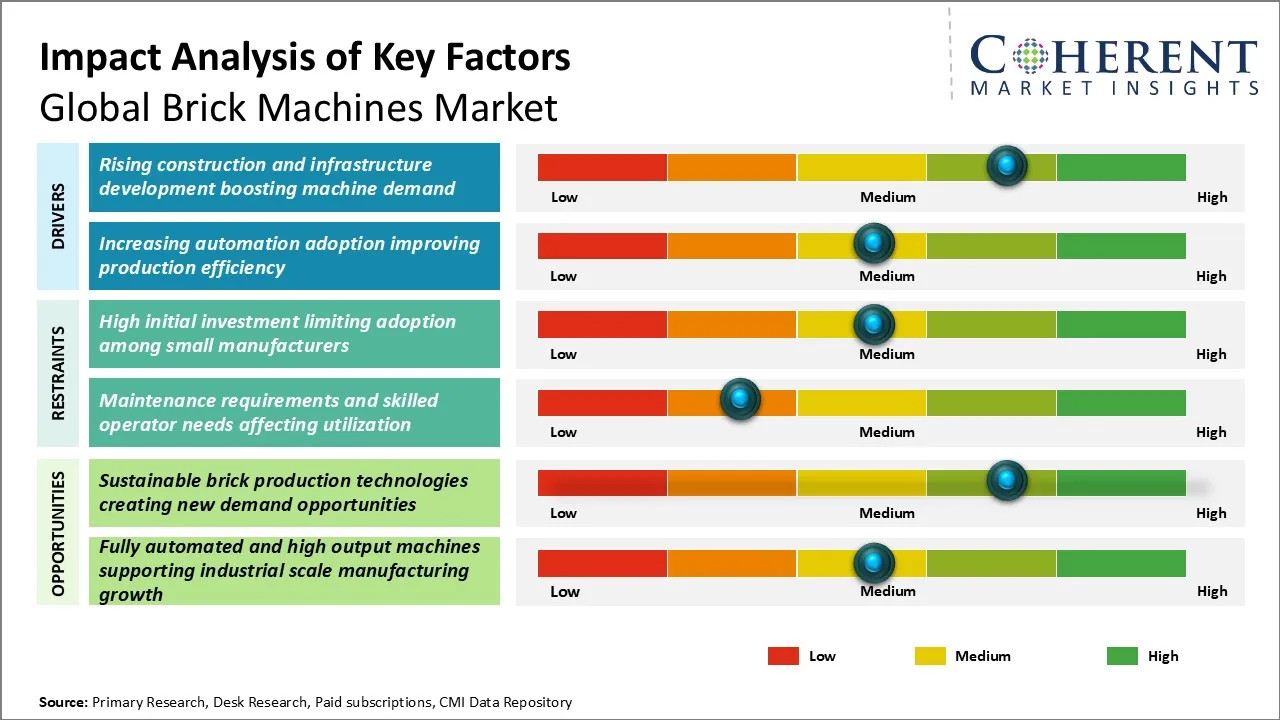
Key Market Drivers
- Rising construction and infrastructure development boosting machine demand: Rising housing reconstruction, urban infrastructure, and public works programs expand demand for concrete blocks, pavers, kerbstones, and other masonry units, raising utilization rates at existing plants and encouraging producers to add forming capacity. Brick-machine OEMs, mould suppliers, batching-system providers, and local distributors benefit as project pipelines improve equipment payback visibility. In June 2026, the World Bank approved additional financing for Türkiye’s Earthquake Recovery and Reconstruction Project that will support construction of 3,000 additional rural homes, reinforcing a tangible downstream requirement for locally produced building materials and scalable block-making capacity.
- Increasing automation adoption improving production efficiency: Automation is moving from a labor-substitution feature toward a production-control investment. Integrated mould change, synchronized feeding, pallet handling, and packaging let block producers shorten changeovers, stabilize dimensional tolerances, reduce avoidable material loss, and run a broader SKU mix without proportional staffing increases. This benefits OEMs with integrated-line capabilities and producers serving paver, kerbstone, and engineered masonry customers. In February 2025, Qunfeng completed installation of an automated concrete-products line for a Sichuan customer, combining servo palletizing, automatic baling, rapid mould change, and controlled material feeding to improve production efficiency and product consistency.
Emerging Market Trends
- Localized Service Ecosystems Are Becoming Part of the Equipment Proposition: Localized service ecosystems are becoming part of the product proposition rather than an after-sale add-on. Brick producers increasingly evaluate whether an OEM can provide regional commissioning, operator training, critical spare parts, mould support, and rapid maintenance response before approving capital expenditure. This is likely to favor manufacturers that build durable dealer and service networks, while export-only suppliers may face longer sales cycles and heavier price pressure. Over the forecast period, local technical coverage should increasingly influence supplier shortlists, especially where downtime can interrupt continuous block and paver production.
- Lifecycle Economics Are Overtaking Initial Machine Price in Procurement Decisions: Lifecycle economics are gaining more weight than the initial machine price in procurement decisions. Buyers are comparing energy use, hydraulic efficiency, wear-part frequency, mould life, maintenance access, changeover losses, and expected uptime because these factors determine conversion cost across years of production. The shift should reward equipment platforms designed for predictable maintenance and component standardization, while low-priced machines with uncertain operating costs may lose appeal. Purchasing teams are therefore likely to demand clearer operating-cost assumptions and serviceability evidence before committing to new brick-production capacity.
Regional Insights
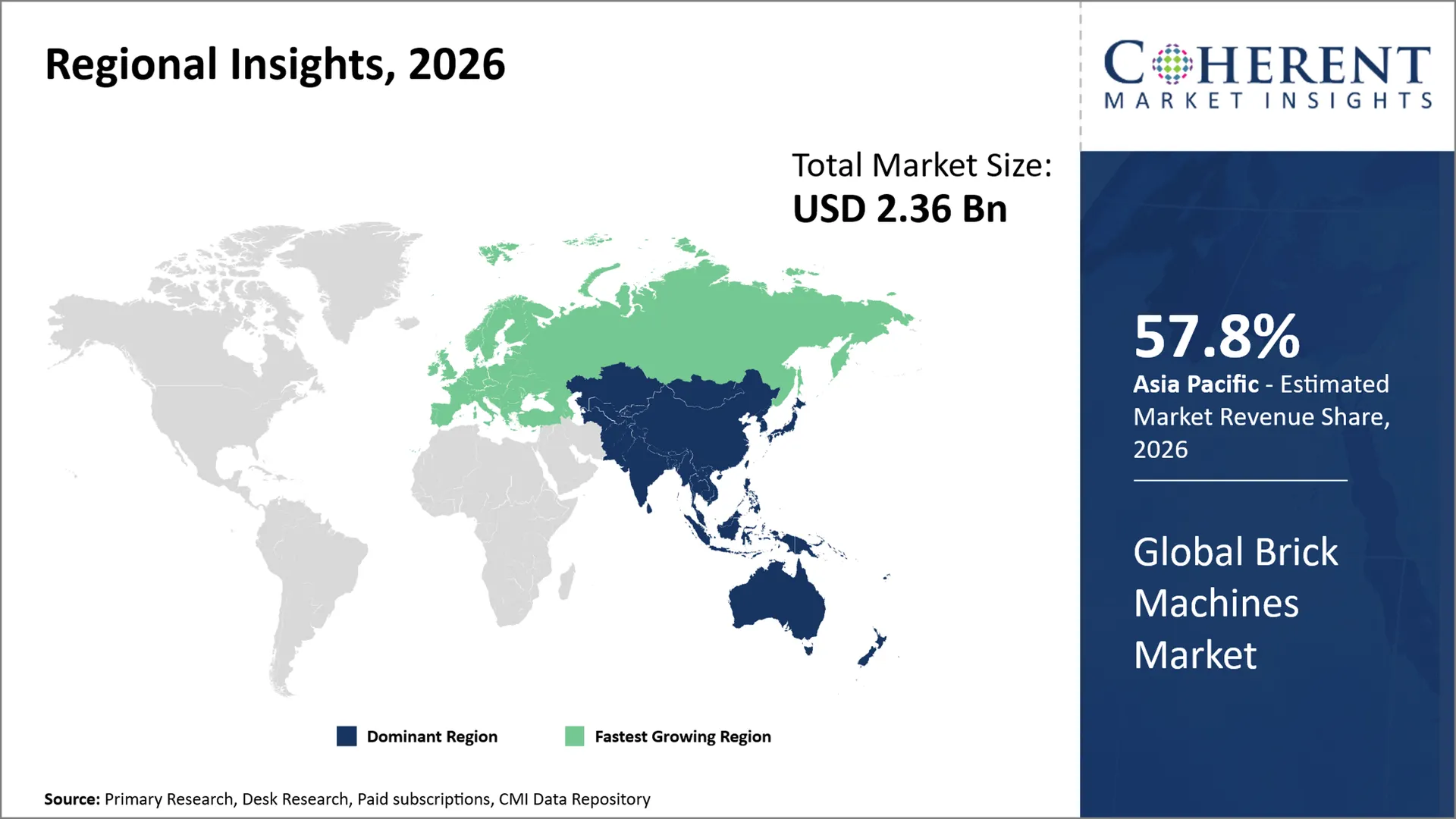
Why Does Asia Pacific Dominate the Global Brick Machines Market?
Asia Pacific is expected to account for 57.8% of the global brick machines market in 2026, supported by large-scale residential construction, urban expansion, infrastructure development, and the presence of one of the world’s largest brick and concrete-product manufacturing ecosystems. The region benefits from high-volume demand for hollow blocks, pavers, and masonry products across China, India, Southeast Asia, and other emerging economies. Local equipment manufacturing clusters, availability of raw materials, and cost-sensitive construction practices encourage adoption of both semi-automatic and fully automatic brick machines. Government-backed housing programs and industrial development projects continue to expand the addressable customer base for equipment suppliers. In December 2025, India’s Ministry of Housing and Urban Affairs highlighted continued progress under urban housing initiatives, supporting sustained construction activity requiring locally produced building materials.
Why Is Europe Emerging as the Fastest-Growing Region in the Global Brick Machines Market?
Europe is emerging as the fastest-growing region in the global brick machines market, with an expected 18.7% share in 2026, as manufacturers increasingly modernize production facilities to meet stricter efficiency, sustainability, and quality requirements. The region’s brick and concrete-product producers are investing in advanced machinery capable of reducing energy consumption, improving production consistency, and supporting digitally monitored manufacturing processes. Environmental regulations, circular construction practices, and demand for higher-performance building materials are encouraging equipment upgrades rather than only capacity expansion. European machine suppliers also benefit from strong engineering capabilities and export-oriented production models. In March 2025, the European Commission published updates supporting implementation of the Construction Products Regulation framework, reinforcing greater emphasis on product performance information and compliance across construction supply chains.
Global Brick Machines Market Outlook for Key Countries
The U.S. represents an important market for brick machines due to demand from residential construction, commercial development, infrastructure modernization, and replacement of aging production equipment. Unlike highly cost-driven markets, U.S. buyers generally prioritize automation, operational reliability, labor reduction, product consistency, and lifecycle economics when investing in manufacturing equipment. The country’s established concrete-product industry creates opportunities for suppliers offering automated block-making systems, advanced handling solutions, and customized production lines. Demand is also supported by contractors and developers seeking locally produced masonry products to reduce logistics complexity. In April 2025, the U.S. Department of Transportation announced continued infrastructure funding allocations under federal programs, supporting long-term construction activity that contributes to demand for concrete masonry products.
Why Is India Important in the Global Brick Machines Market?
India is a significant market for brick machines because of its large construction workforce, extensive housing requirements, infrastructure development programs, and transition toward more organized brick and block manufacturing. The market is gradually shifting from labor-intensive traditional brick production toward mechanized solutions that improve output consistency, reduce dependence on manual processes, and support environmentally improved construction practices. Demand is particularly relevant among manufacturers producing concrete blocks, pavers, and alternative masonry products for urban housing and infrastructure projects. Domestic equipment suppliers and international OEMs are targeting India due to expanding regional manufacturing clusters and increasing acceptance of automated production systems. In January 2025, the Government of India announced continued infrastructure investment priorities through the Union Budget framework, supporting construction-related demand across housing and public development projects.
Why Does China Support Growth in the Global Brick Machines Market?
China plays a central role in the global brick machines market because of its extensive construction-material manufacturing base, mature machinery supply chain, and strong position as an equipment producer and exporter. The country benefits from established clusters producing concrete blocks, pavers, construction equipment components, hydraulic systems, and automation technologies. Chinese brick-machine manufacturers increasingly compete through integrated production lines, digital controls, energy-efficient systems, and export-oriented solutions rather than only low-cost machinery. Domestic demand remains supported by urban redevelopment, infrastructure projects, and industrial construction activity. In June 2025, China’s Ministry of Housing and Urban-Rural Development continued promoting urban renewal initiatives, supporting modernization of construction-related supply chains and material-production capabilities.
Why Is Germany a Strategic Country in the Global Brick Machines Market?
Germany is strategically important in the global brick machines market because of its advanced mechanical engineering ecosystem, precision manufacturing capabilities, and strong emphasis on automation, efficiency, and sustainable production technologies. German equipment suppliers are recognized for developing high-performance systems that integrate robotics, process control, energy optimization, and reliable long-term operation. The country’s construction-material manufacturers increasingly focus on improving productivity while complying with stricter environmental and quality requirements, creating opportunities for advanced brick-production equipment. Germany also serves as an important technology exporter, influencing machinery standards in international markets. In September 2024, Germany’s Federal Ministry for Economic Affairs and Climate Action continued supporting industrial transformation programs focused on energy efficiency and digitalization, strengthening the investment environment for advanced manufacturing sectors.
Why Is the UAE an Important Growth Market for the Global Brick Machines Market?
The UAE represents an important growth market for brick machines due to continuous investment in residential communities, commercial developments, industrial zones, and infrastructure projects. The country’s construction sector relies heavily on locally manufactured concrete blocks, paving products, and other masonry materials, creating demand for reliable production equipment. The market favors automated and high-capacity machines because contractors and developers require consistent supply, faster project execution, and predictable product quality. The UAE also acts as a regional construction hub, supporting equipment distribution opportunities across neighboring Gulf markets. In February 2025, the UAE Ministry of Energy and Infrastructure highlighted ongoing national infrastructure development priorities, reinforcing construction activity and associated demand for building-material production capacity.
Innovation, Production & Manufacturing Landscape in the Global Brick Machines Market
Technology | Role in Brick-Machine Production | Adoption Level | Commercial Implication |
Servo-Controlled Vibration Compaction | Independently manages vibration frequency and amplitude during mould filling and compaction to improve material distribution and forming consistency. | High in premium and high-capacity systems | Supports sharper surface finish, denser products, shorter forming cycles, and differentiation in higher-specification pavers and blocks. |
Proportional Hydraulic Pressure Control | Regulates pressing force more precisely across different product recipes and mould configurations. | High | Helps protect tooling, maintain repeatable density, and accommodate different block geometries without relying on extensive mechanical adjustment. |
Moisture-Compensated Batching and Dosing | Adjusts aggregate, cement, water, and additive dosing according to mix-condition changes before material reaches the forming machine. | Medium–High | Reduces batch-to-batch variation and improves the stability of downstream compaction, particularly where raw-material moisture fluctuates. |
Dual-Layer and Face-Mix Feeding Systems | Enables a structural base mix and separate decorative or wear-resistant surface layer within the same product. | Medium | Allows producers to move beyond commodity blocks into colored pavers, architectural products, and other higher-value concrete units. |
Controlled Curing Chambers | Manages humidity, temperature, and air circulation after forming to create more predictable curing conditions. | Medium–High | Reduces dependence on ambient weather conditions and helps producers achieve more reliable strength development and production scheduling. |
Variable-Frequency and Energy-Efficient Drive Systems | Matches motor and pump output more closely with individual production stages instead of operating continuously at maximum load. | Medium–High | Lowers unnecessary energy consumption and can improve machine operating economics without requiring changes to the finished masonry product. |
How Are Equipment Financing and Pay-per-Output Models Creating New Growth Opportunities in the Global Brick Machines Market?
Equipment financing and pay-per-output structures could unlock an underdeveloped customer base of small and mid-sized brick producers that need mechanization but cannot absorb a large upfront machine purchase. The opportunity is strategically important because these buyers often serve local housing, municipal paving, and contractor networks where demand can be durable but cash flow is uneven. OEMs, dealers, leasing partners, and equipment financiers can capture this segment through staged ownership, lease-to-own, capacity-linked payments, or bundled machine-and-maintenance contracts. Success requires standardized equipment packages, reliable residual-value assumptions, credit screening, parts availability, and enforceable service terms. Suppliers also need clear repossession, refurbishment, and redeployment processes to control asset risk. The model is likely to favor established manufacturers and well-capitalized regional distributors that can carry financing exposure, manage used-equipment channels, and support machines throughout the contract period. It can widen adoption without relying on discount-led selling without eroding list prices across the broader customer base.
Market Players, Key Development, and Competitive Landscape
Key Developments
- In July 2026, TEMA presented its latest concrete block and cabro paving block machines at BUILDEXPO AFRICA in Nairobi, Kenya. The exhibition-based market push expands TEMA’s commercial visibility in East Africa and gives regional concrete-product manufacturers direct access to equipment demonstrations, configuration discussions, and capacity-upgrade options.
- In March 2026, QGM announced that its self-developed ZN1500YD brick production system had been selected for Fujian Province’s 2025 “first set” major technical equipment recognition. The designation strengthens commercial credibility for domestically developed high-end brick machinery and can support customer confidence in advanced equipment procurement.
- In September 2024, Besser Company announced the acquisition of Slab Innovation, bringing specialized robotics and automated product-handling capabilities into its concrete-products equipment portfolio. The move broadens Besser’s ability to supply more integrated production systems and gives masonry producers a single-source route for forming and downstream handling solutions.
Competitive Landscape
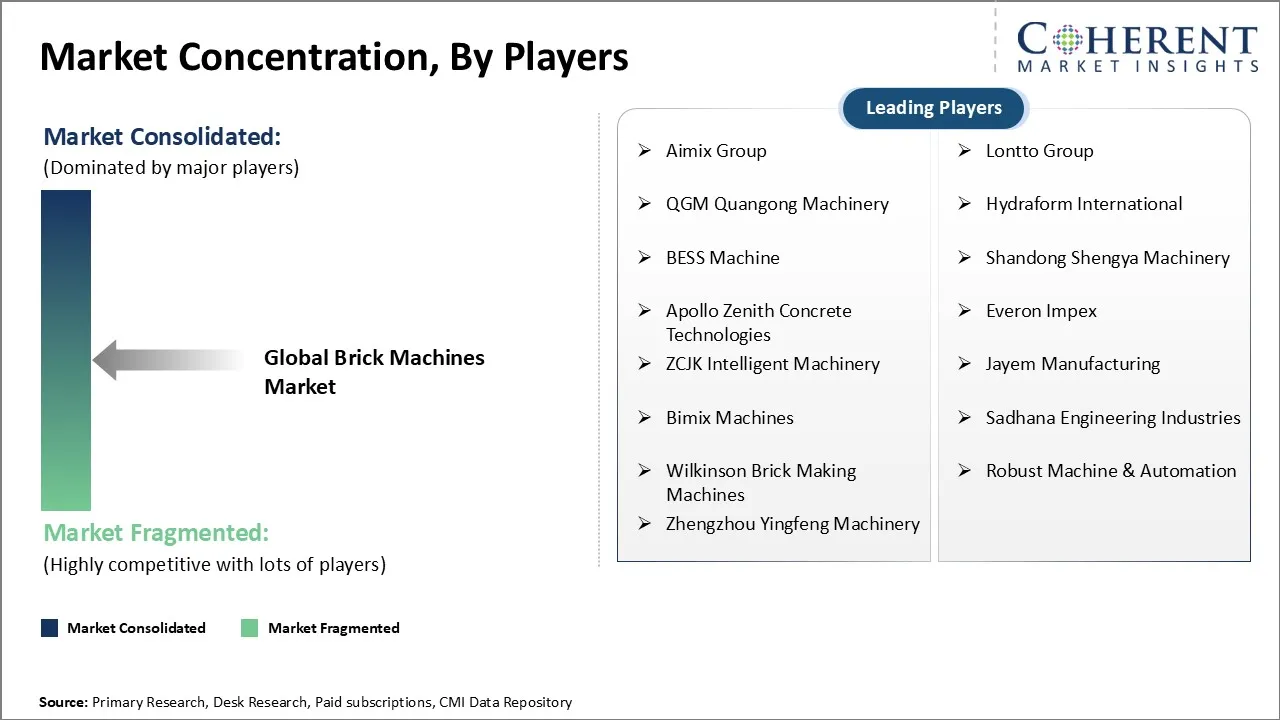
The global brick machines market is fragmented, combining specialized international OEMs, regional machinery builders, low-cost fabricators, and application-focused integrators. Competition is shaped less by scale alone than by the ability to deliver repeatable product quality, engineer complete plant layouts, adapt equipment to customer specifications, meet safety requirements, control lead times, and establish technical credibility through successful installations across varied operating conditions.
Key focus areas include:
- Finished-product performance: Producers compare density consistency, dimensional accuracy, edges, surface quality, and reject behavior rather than machine throughput alone.
- Mould and tooling capability: Precision tooling, mould availability, wear resistance, and the ability to support specialized product geometries influence recurring customer value.
- Application engineering: Suppliers capable of configuring plant layout, material preparation, forming conditions, curing requirements, and downstream flow can differentiate beyond standalone machine sales.
- Machine durability: Frame rigidity, hydraulic-component quality, vibration-system durability, and protection against abrasive operating conditions affect long-term supplier reputation.
- Safety and certification readiness: Electrical architecture, guarding, emergency systems, documentation, and conformity requirements are increasingly important for export-oriented equipment providers.
- Component sourcing resilience: Access to hydraulics, drives, bearings, controls, fabricated structures, and replacement components affects delivery reliability and warranty exposure.
- Reference-installation credibility: Demonstrated performance in comparable products and operating environments increasingly reduces customer technology risk during capital-equipment selection.
Market Report Scope
Brick Machines Market Report Coverage | |||
Report Coverage | Details | ||
Base Year | 2025 | Market Size in 2026: | USD 2.36 Bn |
Historical Data For: | 2020 To 2024 | Forecast Period: | 2026 To 2033 |
Forecast Period 2026 To 2033 CAGR: | 4.8% | 2033 Value Projection: | USD 3.28 Bn |
Geographies covered: |
| ||
Segments covered: |
| ||
Companies covered: | Aimix Group, Lontto Group, QGM Quangong Machinery, Hydraform International, BESS Machine, Shandong Shengya Machinery, Apollo Zenith Concrete Technologies, Everon Impex, ZCJK Intelligent Machinery, Jayem Manufacturing, Bimix Machines, Sadhana Engineering Industries, Wilkinson Brick Making Machines, Robust Machine & Automation, Zhengzhou Yingfeng Machinery | ||
Growth Drivers: |
| ||
Restraints & Challenges: |
| ||
Analyst Opinion (Expert Opinion)
- The global brick machines market leadership is likely to depend on production-performance accountability rather than machine specifications alone. Buyers will increasingly expect suppliers to engineer the complete operating outcome product finish, dimensional stability, commissioning discipline, operator readiness, and ramp-up reliability before accepting a line. That favors OEMs able to convert technical claims into measurable acceptance criteria and could weaken suppliers that compete mainly through catalogue capacity ratings.
- A potentially disruptive shift is the spread of project-adjacent and distributed block-production cells. Locating smaller production systems closer to construction corridors can reduce dependence on long-distance movement of heavy masonry units and allow output to follow project phases. If this model gains traction, centralized producers may face selective pressure, while suppliers of compact, relocatable, rapidly commissioned equipment could gain a new route to market.
- Manufacturers should prioritize standardized machine platforms with controlled customization, resilient component sourcing, and disciplined project selection. Engineering resources should concentrate on applications where customers value reliability and product quality enough to protect margins. Suppliers should avoid excessive one-off customization that complicates parts inventories and service obligations, while strengthening qualification of critical hydraulic, electrical, mould, and structural-component vendors to reduce delivery and warranty risk.
Speak to the analyst
Want personalized insights?
Take the findings above to one of our principal consultants, or have the report rebuilt around the segments, geographies and competitors you actually track.
Market Segmentation
- Machine Type Insights (Revenue, USD Bn, 2021 - 2033)
- Concrete Brick Machines
- Clay Brick Machines
- Fly Ash Brick Machines
- Interlocking Brick Machines
- Others
- Operation Mode Insights (Revenue, USD Bn, 2021 - 2033)
- Fully Automatic
- Semi Automatic
- Manual or Hydraulic
- Machine Type Configuration Insights (Revenue, USD Bn, 2021 - 2033)
- Stationary Brick Machines
- Mobile Brick Machines
- Application Insights (Revenue, USD Bn, 2021 - 2033)
- Residential Construction
- Commercial Construction
- Infrastructure Projects
- Industrial Construction
- End User Insights (Revenue, USD Bn, 2021 - 2033)
- Brick Manufacturers
- Construction Companies
- Infrastructure Developers
- Others
- Distribution Channel Insights (Revenue, USD Bn, 2021 - 2033)
- Direct OEM Sales
- Equipment Dealers and Distributors
- Regional Insights (Revenue, USD Bn, 2021 - 2033)
- North America
- U.S.
- Canada
- Latin America
- Brazil
- Argentina
- Mexico
- Rest of Latin America
- Europe
- Germany
- U.K.
- Spain
- France
- Italy
- Russia
- Rest of Europe
- Asia Pacific
- China
- India
- Japan
- Australia
- South Korea
- ASEAN
- Rest of Asia Pacific
- Middle East
- GCC Countries
- Israel
- Rest of Middle East
- Africa
- South Africa
- North Africa
- Central Africa
- North America
- Key Players Insights
- Aimix Group
- Lontto Group
- QGM Quangong Machinery
- Hydraform International
- BESS Machine
- Shandong Shengya Machinery
- Apollo Zenith Concrete Technologies
- Everon Impex
- ZCJK Intelligent Machinery
- Jayem Manufacturing
- Bimix Machines
- Sadhana Engineering Industries
- Wilkinson Brick Making Machines
- Robust Machine & Automation
- Zhengzhou Yingfeng Machinery
Sources
Primary Research Interviews
- Brick machine manufacturers, concrete block machine OEMs, automation solution providers, plant operators, distributors, contractors, and construction-material producers
- Production managers, machinery procurement professionals, engineering consultants, equipment dealers, construction developers, and infrastructure project stakeholders
Stakeholders
- Brick machine manufacturers, concrete-product machinery suppliers, automation technology providers, hydraulic and control-system suppliers, and equipment integrators
- Construction-material manufacturers, brick producers, paver manufacturers, contractors, infrastructure developers, distributors, and machinery dealers
- Government infrastructure agencies, construction associations, and industrial equipment service providers
End-use Sectors
- Residential construction and housing development
- Commercial and industrial construction projects
- Infrastructure development, roads, and urban development projects
- Landscaping, paving, and concrete-product manufacturing applications
Regulatory and Industry Bodies
- Construction standards organizations and building material regulatory authorities
- Industrial machinery safety and equipment compliance bodies
- Infrastructure development ministries and government construction agencies
- Sustainability and energy-efficiency regulatory organizations
Databases
- Company annual reports, investor presentations, and corporate filings
- Construction equipment databases and industrial machinery directories
- Import-export trade databases for machinery and construction equipment
- Infrastructure project databases and construction activity trackers
- Product catalogs, technical specifications, and competitive intelligence databases
Magazines and Journals
- Construction equipment and machinery publications
- Building materials and concrete technology journals
- Industrial automation and manufacturing technology publications
- Infrastructure development and engineering publications
- Construction industry research journals
Associations
- American Concrete Institute (ACI)
- European Concrete Platform
- National Ready Mixed Concrete Association (NRMCA)
- Construction equipment and machinery associations
- Regional building materials and construction industry associations
Public Domain Sources
- Infrastructure investment and construction development trends
- Housing development programs and urbanization initiatives
- Automation adoption and smart manufacturing developments
- Construction-material production capacity expansion
- Sustainability initiatives in concrete and masonry production
Key Standards and Regulations
- Construction product quality and performance standards
- Industrial machinery safety and operational compliance requirements
- Energy-efficiency requirements for manufacturing equipment
- Environmental regulations related to construction-material production
- International machinery trade and import regulations
Proprietary Elements
- CMI Data Analytics Tool, Proprietary CMI repository containing 10+ years of construction equipment, building materials, industrial automation, and infrastructure market intelligence.
Get access to 250+ pages report
Every segment, forecast, competitor profile and data table behind the analysis above — available for instant download.
- ESOMAR Member
- ISO 9001:2015 Certified
- D-U-N-S Registered
- GDPR & CCPA Compliant
Missing comfort of reading report in your local language? Find your preferred language:
Frequently Asked Questions
The CAGR of global brick machines market is projected to be 4.8% from 2026 to 2033.
The global brick machines market is estimated to be valued at USD 2.36 billion in 2026 and is expected to reach USD 3.28 billion by 2033.
The global brick machines market is being shaped by advancements in automation, intelligent control systems, hydraulic precision, automated material handling, energy-efficient machinery, and digital monitoring solutions. These technologies help manufacturers improve production consistency, reduce operational dependency on manual labor, optimize resource utilization, and enhance overall plant efficiency.
Companies should evaluate factors such as production capacity requirements, product type compatibility, automation level, machine durability, maintenance support, spare-parts availability, energy efficiency, installation requirements, and after-sales service capabilities. Selecting the right equipment depends on operational goals, investment priorities, and long-term production requirements.
Automation is transforming the brick machines market by enabling higher production reliability, improved product uniformity, reduced material wastage, and better control over manufacturing processes. Automated systems allow producers to integrate feeding, moulding, handling, and monitoring functions, helping manufacturers improve productivity while addressing labor availability challenges.
Brick machines are widely used for manufacturing construction materials required in residential buildings, commercial structures, infrastructure projects, industrial facilities, landscaping applications, and urban development activities. These machines support the production of various masonry products used by contractors, developers, and construction-material manufacturers worldwide.
The growth of the global brick machines market is primarily driven by increasing construction and infrastructure development activities, which are creating demand for efficient brick-production solutions. Additionally, the rising adoption of automated brick machines is improving production efficiency, reducing manual dependency, enhancing product consistency, and supporting higher-volume manufacturing operations.