

Global Chromic Acid Market Size and Forecast – 2026 To 2033
The Global Chromic Acid Market is estimated to be valued at USD 1,057.1 Mn in 2026 and is expected to reach USD 1,467.7 Mn by 2033, growing at a compound annual growth rate (CAGR) of 4.80% from 2026 to 2033. Growth is supported by sustained chromic acid consumption in electroplating, metal finishing, surface treatment, and chemical processing, where chromium trioxide is used to deliver corrosion resistance, surface hardness, wear protection, and controlled oxidation performance.
Demand remains particularly resilient in applications where alternative chemistries require lengthy technical qualification or cannot fully reproduce established coating characteristics. In July 2025, the UK government authorized C&E Plating Limited to continue industrial use of chromium trioxide for functional chrome plating with decorative characteristics on metallic objects, confirming continued commercial reliance on chromium-trioxide-based finishing processes despite stricter regulatory controls.
Key Takeaways of the Global Chromic Acid Market
- Industrial Grade is expected to hold 62.8% of the global chromic acid market in 2026, while expanding at an estimated CAGR of 4.6% during 2026–2033. Its leadership reflects broad use in metal finishing, anodizing, corrosion protection, and industrial processing. In May 2026, U.S. Commerce issued preliminary affirmative antidumping determinations on chromium trioxide imports from India and Türkiye.
- Solid Chromium Trioxide is projected to capture 54.7% of the global chromic acid market in 2026, with an estimated CAGR of 4.7% through 2033. Its concentrated solid form supports easier storage, transport, dosing, and on-site solution preparation. In January 2026, the U.S. International Trade Commission noted that chromium trioxide is primarily sold in solid form.
- Metal Finishing and Electroplating is expected to account for 61.8% of the global chromic acid market in 2026, growing at an estimated CAGR of 4.9% during 2026–2033. Demand remains supported by applications requiring hardness, corrosion resistance, and durable surface performance. In May 2025, the European Commission authorized Righi S.p.A. to use chromium trioxide for functional electroplating.
- Asia Pacific is expected to command 42.6% of the global chromic acid market in 2026, supported by an estimated CAGR of 5.0% through 2033. Regional leadership reflects integrated chromium-chemical production and strong automotive, electroplating, and industrial demand. In July 2025, Vishnu Chemicals reported three chromium-chemical manufacturing units with about 80,000 MTPA capacity.
- Europe is expected to represent 25.7% of the global chromic acid market in 2026, while registering the fastest estimated CAGR of 5.5% during 2026–2033. Growth is concentrated in regulated, high-value surface-treatment applications. In February 2025, the UK government authorized chromium trioxide uses for critical engineering-component surface treatment.
Segmental Insights
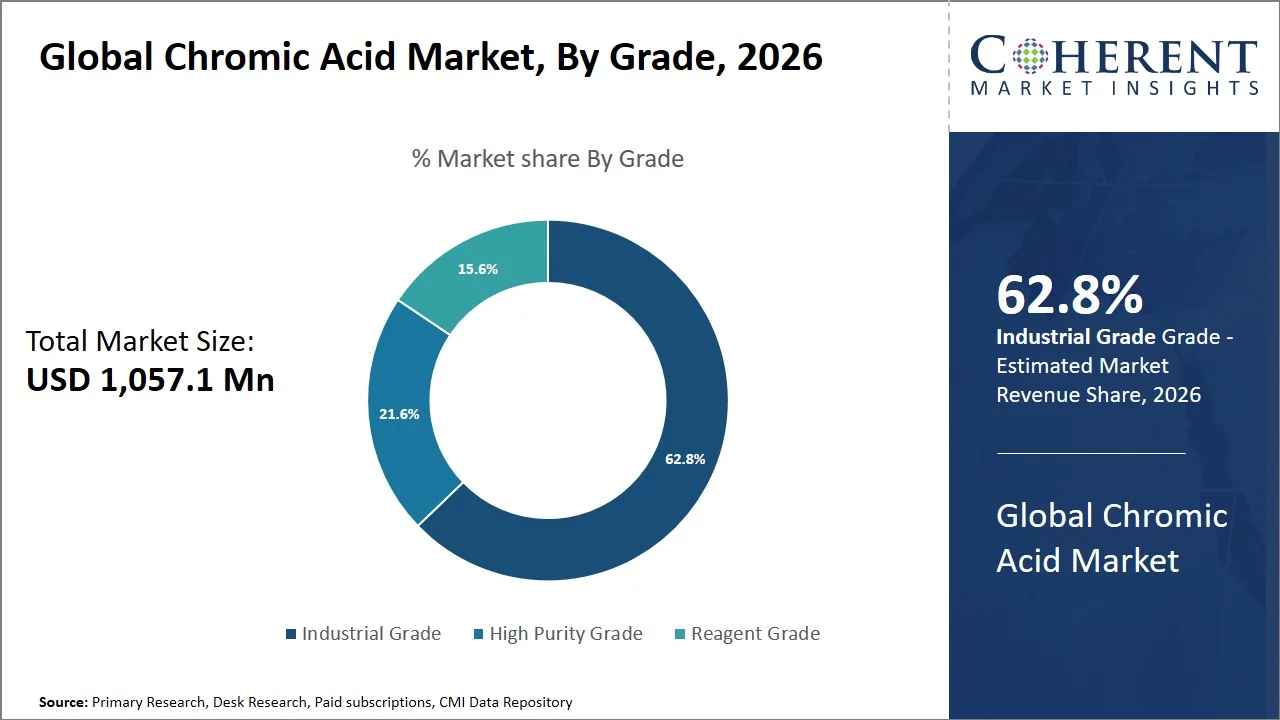
Why Does Industrial Grade Dominate the Global Chromic Acid Market?
Industrial Grade is expected to account for 62.8% of the global chromic acid market in 2026, leading the grade category because most commercial consumption occurs in production-scale processes rather than laboratory or ultra-high-purity applications. Industrial buyers typically prioritize dependable assay, batch consistency, bulk availability, and cost-efficient replenishment for chromium plating and other process-chemical uses. This favors suppliers capable of handling recurring industrial volumes and maintaining controlled specifications without the additional purification cost associated with higher grades. The segment also benefits from established procurement routines in heavy engineering and component manufacturing, where chromic acid is consumed as a process input rather than a specialty analytical reagent. In April 2025, Grenevia reported that its FAMUR segment used or acquired 8,098 kg of chromium trioxide during 2024 for chromium plating, illustrating continuing production-scale consumption within an industrial manufacturing environment.
- Current Industry Events of 2026
- Market Size Estimation
- Regional Breakdown
- Competitive Landscape
- Customer Intelligence
- Segmental Analysis
- Pricing Analysis
- Key Market Drivers, Challenges & Future Trends
- Customized Insights Section
Why Does Solid Chromium Trioxide Represent the Largest Form in the Global Chromic Acid Market?
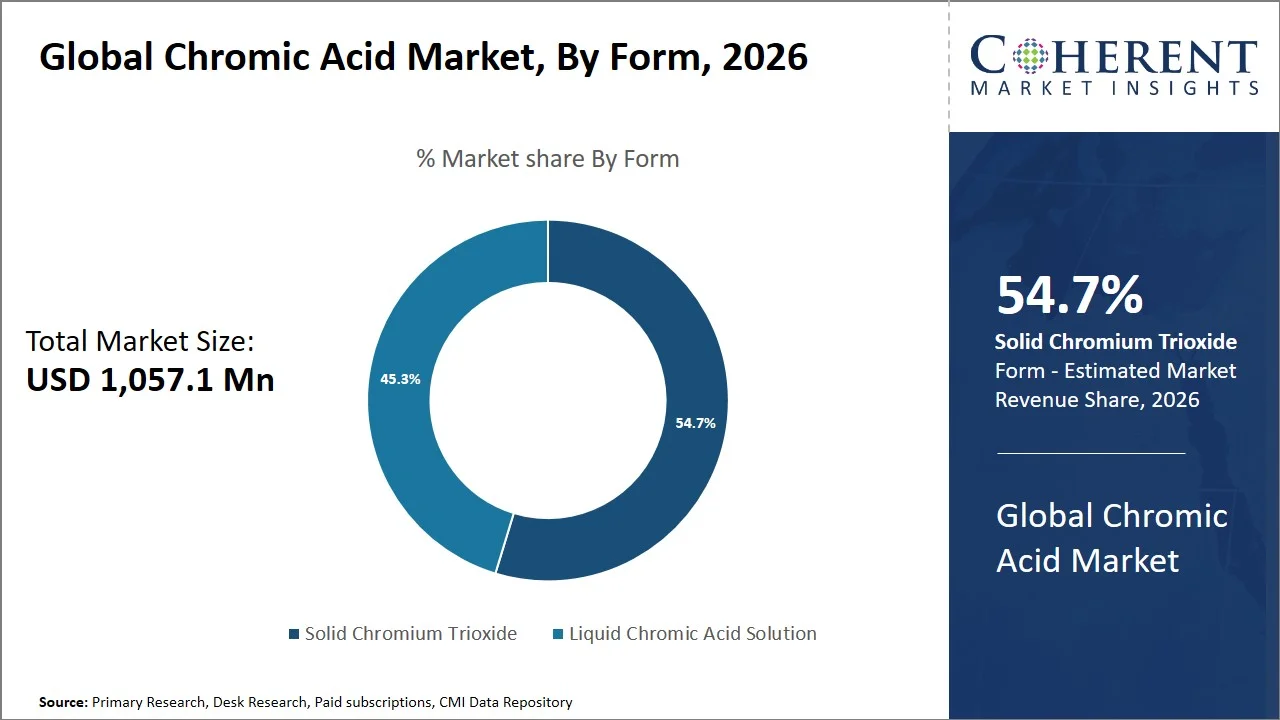
Solid Chromium Trioxide is expected to represent 54.7% of the global chromic acid market in 2026, making it the leading form because it delivers concentrated active material without transporting the water contained in pre-diluted solutions. Flakes and crystals can be shipped in sealed drums, stored until required, and converted into application-specific bath concentrations at the customer site. This structure suits established metal-finishing plants that already operate controlled mixing, ventilation, and chemical-handling systems. Suppliers also benefit from standardized packaging and the ability to serve dispersed industrial customers without dedicated bulk-liquid logistics. The commercial trade-off is stricter dust and exposure management, making product integrity and packaging quality important purchasing criteria. In July 2025, Qualikems Lifesciences manufactured chromium trioxide flakes under batch QF2507032 and certified the material at 98.56% assay, demonstrating current standardized production of the solid form.
Why Do Metal Finishing and Electroplating Dominate the Application Segment of the Global Chromic Acid Market?
Metal Finishing and Electroplating is expected to hold 61.8% of the global chromic acid market in 2026, leading the application category because chromic-acid chemistry is embedded in installed plating lines, OEM specifications, repair processes, and qualified surface-finishing workflows. Existing tanks, rectifiers, ventilation systems, wastewater controls, and operator know-how create meaningful switching costs, particularly where coating appearance or functional performance must remain consistent across approved parts. Automotive components, tooling, hydraulic parts, and other engineered products therefore sustain application-specific consumption even as substitution programs advance. For suppliers, value increasingly comes from bath-control support, qualification assistance, and transition management rather than chemical supply alone. In January 2025, Automotive Industry Action Group (AIAG) announced a NASF/AIAG industry program focused on transitioning automotive electroplating from hexavalent to trivalent chromium, noting technical barriers and the need to protect quality and uninterrupted supply across OEM, plater, and chemical-supplier networks.
Current Events and their Impact
Current Event | Description and Business Impact |
UK Health and Safety Executive – July 2026 – Chromium Trioxide Authorisation Review |
|
California Air Resources Board – January 2026 – New Chrome Plating Compliance Requirements |
|
California OEHHA – February 2026 – Hexavalent Chromium Health Assessment Update |
|
Global Chromic Acid Market Dynamics
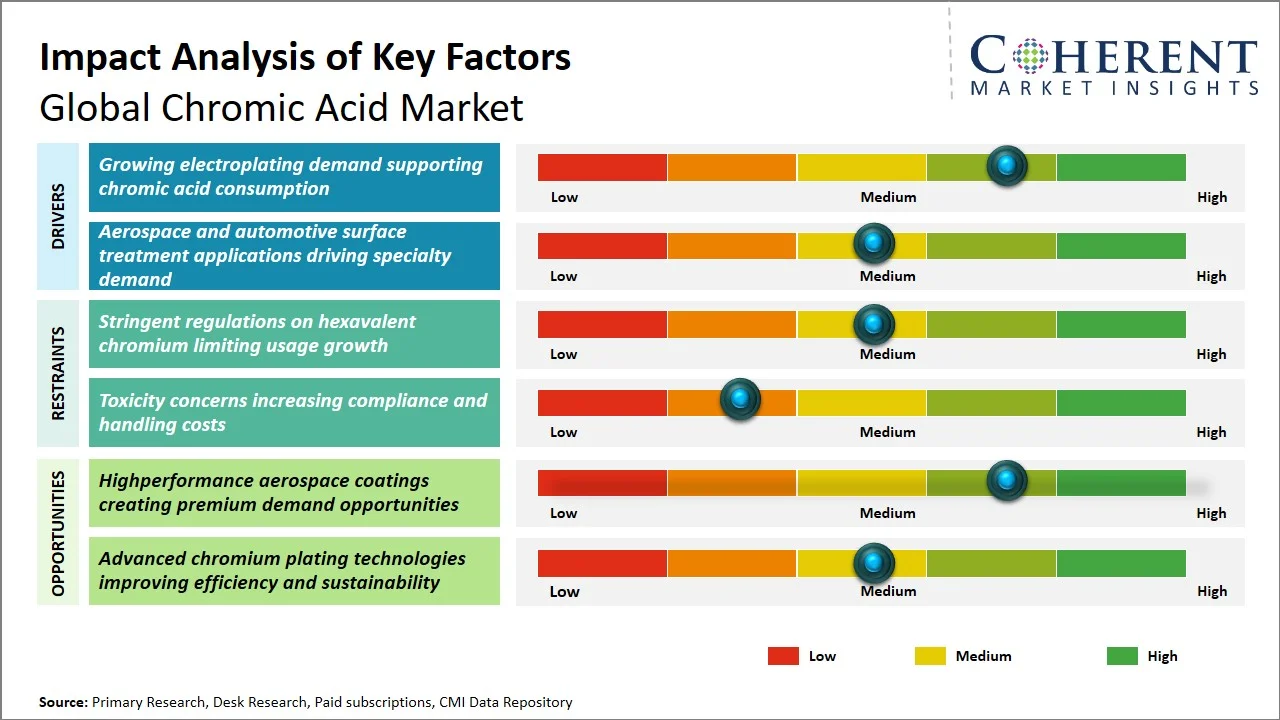
Key Market Drivers
Growing Electroplating Demand Supporting Chromic Acid Consumption
Growing electroplating demand continues to support chromic acid consumption because functional chromium coatings remain valued where hardness, wear resistance, corrosion protection, and surface restoration are difficult to reproduce consistently with lower-risk chemistries. This sustains procurement by metal finishers and supports utilization at chromium-chemical producers, while compliance requirements favor suppliers able to provide stable purity and technical documentation. In March 2026, Sisecam reported that its chromium-chemicals sales volume increased 15% year-on-year in 2025, alongside a portfolio that includes chromic acid for metal plating.
Aerospace and Automotive Surface Treatment Applications Driving Specialty Demand
Aerospace and automotive surface-treatment requirements support specialty chromic acid demand because qualification cycles are long and coating performance is tied to safety, durability, and component life. Buyers therefore prioritize approved processes, traceable material quality, and continuity of supply over lowest-cost sourcing, sustaining higher-value demand even as substitution progresses globally. In April 2026, Aerostar reported continued management of chromium trioxide within aerospace special processes while advancing tartaric-sulfuric and thin-film sulfuric anodizing alternatives, illustrating both persistent technical dependence and growing qualification investment.
Emerging Market Trends
Compliance-Qualified Procurement Is Replacing Pure Price-Based Sourcing
Chromic acid procurement is shifting from simple chemical purchasing toward compliance-qualified sourcing. Buyers increasingly evaluate supplier traceability, impurity control, packaging integrity, exposure documentation, and continuity plans alongside price. This changes competitive positioning because vendors that can support audits, authorization documentation, safer handling, and application-specific operating guidance become more valuable to regulated end users. The trend also encourages longer supplier relationships and reduces willingness to switch purely for marginal price savings, particularly where production interruptions or failed qualification can outweigh chemical-cost differences.
Application-Specific Substitution Is Creating a Dual-Track Market
Substitution is becoming application-specific rather than market-wide. Decorative and lower-criticality processes are moving faster toward trivalent chromium or alternative anodizing systems, while technically demanding functional uses require longer testing and customer approval cycles. This creates a dual-track market in which chromic acid suppliers must protect compliant legacy demand while surface-treatment providers invest in replacement chemistries. Procurement teams increasingly manage parallel specifications, and capital spending is moving toward flexible lines, improved bath control, segregated process equipment, and qualification capability rather than simple capacity expansion.
Regional Insights
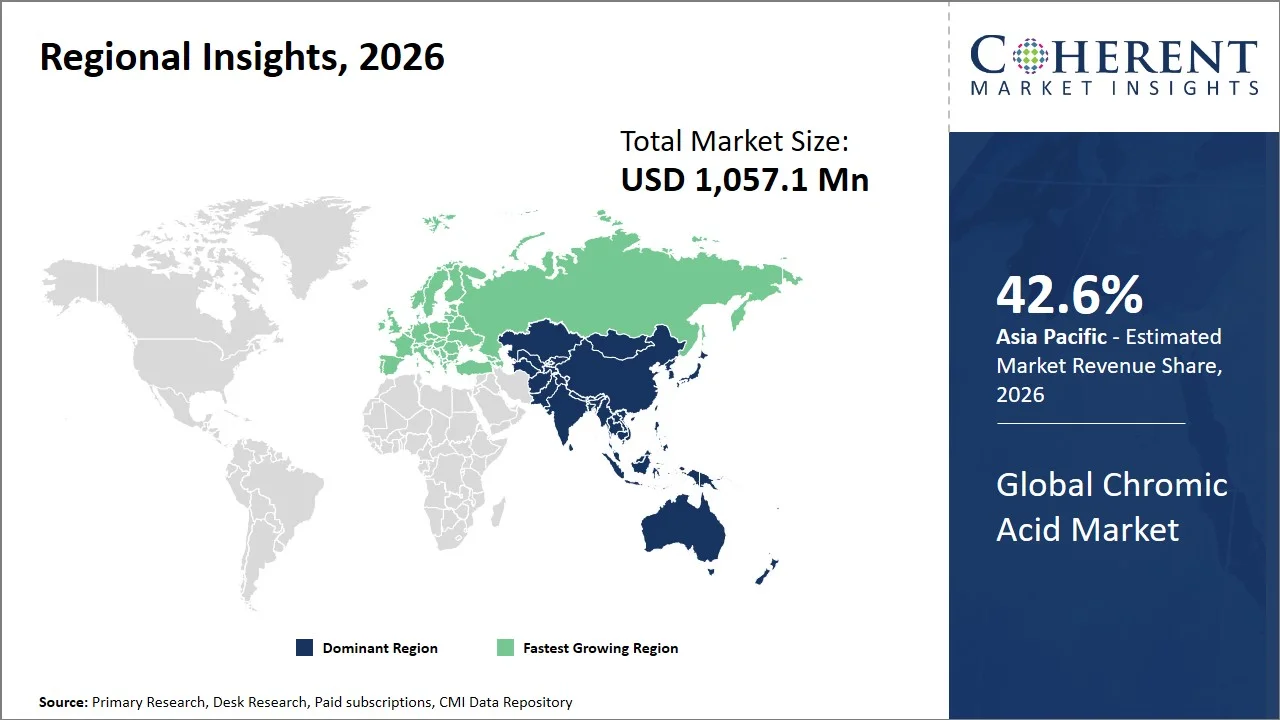
Why Does Asia Pacific Dominate the Global Chromic Acid Market?
Asia Pacific is expected to account for 42.6% of the global chromic acid market in 2026, supported by an established chromium-chemical manufacturing base and concentrated demand from electroplating, automotive components, industrial machinery, and metal surface treatment. China, India, and Japan provide a broad downstream customer base, while regional production reduces dependence on long-distance hazardous-material supply and improves continuity for process-intensive users. The region also benefits from mature chemical-processing infrastructure and recycling capabilities that support more secure chromium availability. In October 2025, Nippon Chemical Industrial’s Integrated Report stated that the company, Japan’s only chromium manufacturer, collects chromium-bearing plating effluent from plating and surface-treatment facilities and returns it to the chromium trioxide manufacturing process for reuse. This closed-loop model strengthens domestic supply resilience and demonstrates the depth of Asia Pacific’s integrated chromic acid production ecosystem.
Why Is Europe Emerging as the Fastest-Growing Region in the Global Chromic Acid Market?
Europe is expected to hold 25.7% of the global chromic acid market in 2026 and emerge as the fastest-growing region as demand shifts toward highly controlled, specification-critical uses rather than unrestricted volume consumption. Aerospace, precision engineering, hard chrome plating, functional coatings, and selected surface-treatment operations continue to require chromium trioxide where technically equivalent substitutes remain difficult to qualify. At the same time, REACH compliance is accelerating investment in closed-process handling, exposure reduction, substitution trials, and supplier documentation, increasing the value of compliant specialty supply. In February 2025, ECHA opened consultations covering six uses of chromium trioxide and one use of chromic acid for hard chrome plating, functional chrome plating, and surface treatment. This regulatory activity shows that Europe’s market is being reshaped around authorized industrial uses, technical necessity, and compliance-intensive purchasing rather than broad commodity expansion.
Global Chromic Acid Market Outlook for Key Countries
Why Is the U.S. a Key Market for the Global Chromic Acid Market?
The U.S. remains a key chromic acid market because it combines a large aerospace and defense supply chain with established metal finishing, industrial machinery, transportation equipment, and specialty coating operations. Chromic acid is still relevant where chromium plating, anodizing, etching, and conversion-coating processes deliver wear resistance, corrosion protection, or tightly specified surface properties. However, demand is increasingly influenced by environmental controls, worker-exposure requirements, and wastewater treatment costs, which favor sophisticated users capable of maintaining compliant operations. In March 2026, the U.S. Environmental Protection Agency updated its Metal Finishing Effluent Guidelines page and confirmed ongoing rulemaking for PFAS discharges from chrome-finishing facilities, specifically identifying chromium plating, chromium anodizing, chromic acid etching, and chromate conversion coating. This reinforces the U.S. market’s dual character: technically persistent demand paired with rising compliance intensity.
Why Is India Important in the Global Chromic Acid Market?
India is important to the global chromic acid market because its demand is tied to heavy electrical equipment, engineering components, industrial machinery, automotive parts, defense-related manufacturing, and electroplating activity. The country also has an established chromium-chemicals ecosystem and access to chromite resources, supporting domestic processing capability and export participation. Demand is strongest for industrial and electroplating grades used where durable, corrosion-resistant surfaces are required. Public-sector procurement provides a direct signal that conventional chromic-acid processes remain relevant in demanding industrial applications. In August 2025, Bharat Heavy Electricals Limited’s Haridwar unit issued an open tender for chromic acid, electroplating grade, in granular form. The procurement is significant because BHEL serves heavy engineering and power-equipment applications, demonstrating that chromic acid continues to have practical demand within India’s high-specification industrial manufacturing base even as environmental controls become more stringent.
Why Does China Support Growth in the Global Chromic Acid Market?
China supports growth in the global chromic acid market through the scale of its machinery, automotive, electronics, metal products, hydraulic equipment, and industrial surface-treatment sectors. Large domestic manufacturing clusters create recurring requirements for engineered chromium coatings where hardness, wear resistance, dimensional restoration, and corrosion performance remain important. China also has established chromium-chemical production capacity, allowing downstream users to source chromium trioxide closer to major industrial centers. The market is simultaneously moving toward cleaner process control and tighter technical standards, which can shift demand toward higher-quality material and better-managed plating operations. In August 2025, China’s national standards platform recorded a revision project for the standard on electrodeposited chromium coatings for engineering purposes, led by the national surface-coating technical committee. The revision confirms continued institutional attention to engineering chrome plating and its role in China’s manufacturing economy.
Why Is Germany a Strategic Country in the Global Chromic Acid Market?
Germany is a strategic country in the global chromic acid market because its advanced automotive, machinery, precision engineering, aerospace, and industrial equipment sectors require surface treatments with demanding wear, corrosion, and dimensional-performance specifications. The country’s market is not defined by unrestricted chromium (VI) consumption; instead, value is concentrated in technically justified applications, tightly controlled processes, and transition pathways toward safer alternatives. This creates opportunities for compliant chromic-acid supply while encouraging investment in process optimization and substitution technologies. In May 2026, Germany’s Central Association for Surface Technology reported that the Hanover Administrative Court had ruled that chromium trioxide used in the specific electroplating case qualified as an intermediate under REACH, following a similar 2025 judgment in Baden-Württemberg. The development is commercially important because regulatory interpretation can materially affect authorization obligations, operating continuity, and investment decisions for German surface-treatment companies.
Why Is Brazil an Important Growth Market for the Global Chromic Acid Market?
Brazil is an important growth in global chromic acid market because demand is supported by industrial wood preservation, metal finishing, maintenance, automotive components, and other surface-treatment applications, while domestic availability remains heavily dependent on imports. This import dependence makes trade policy, landed cost, and supply continuity especially important to Brazilian buyers. The country’s large forestry and wood-products base also creates a distinct end-use channel compared with markets led primarily by aerospace or electroplating. In May 2026, Brazil’s Ministry of Development, Industry, Commerce and Services supported a temporary reduction of the chromium trioxide import tariff from 9% to 0% for an 8,000-ton quota over 12 months. Government analysis reported 2025 imports of about 7,838.7 tons and noted the absence of current national or Mercosur production for the specific chromic-acid supply concerned, highlighting Brazil’s structural reliance on external suppliers.
Regulatory, Process-Control & Substitution Landscape
Category | Current Status / Adoption Level | Key Application or Impact | Business Implication |
Hexavalent Chromium Regulatory Control | Highly regulated and becoming more restrictive | Governs production, formulation, electroplating, anodizing, worker exposure, emissions, and waste handling | Compliance capability increasingly determines customer eligibility, operating continuity, and supplier competitiveness |
Trivalent Chromium Substitution | Growing adoption in technically suitable processes | Used as an alternative in selected decorative and surface-finishing applications | Reduces addressable chromic acid demand in lower-criticality uses but creates a slower transition in performance-sensitive applications |
Alternative Anodizing Chemistries | Commercially established but application-dependent | Supports replacement of chromic-acid anodizing in qualified metal-treatment processes | Requires testing, requalification, revised operating parameters, and customer approval before conversion |
Closed-Loop Bath Management | Increasingly important | Extends bath life, reduces drag-out, improves material utilization, and lowers chromium-bearing waste | Creates opportunities for process-service providers and improves economics for compliant continued use |
Emission and Exposure Control Systems | Essential for regulated operations | Includes enclosed process areas, ventilation, scrubbers, mist control, monitoring, and safer material handling | Raises plant investment requirements but can extend the viable operating life of existing chromic-acid lines |
Process Qualification and Traceability | Critical in specification-sensitive manufacturing | Links chemical purity, bath chemistry, coating performance, operating records, and customer approvals | Favors established suppliers and qualified finishers because switching chemicals or processes carries operational and approval risk |
How Can Closed-Loop Chromic Acid Management Create a Higher-Value Growth Opportunity?
A high-value opportunity is emerging around closed-loop bath management, recovery, purification, and compliance services rather than incremental commodity supply. Industrial users face pressure to reduce worker exposure, wastewater loading, drag-out losses, and hazardous waste while preserving the performance of qualified chromic acid processes. Suppliers that combine high-purity material with bath analytics, regeneration support, containment design, waste minimization, and documented operating protocols can move closer to customers' process economics. Target customers include specialist surface-treatment contractors, precision component manufacturers, and facilities operating tightly controlled chromium lines. Capturing this opportunity requires application chemistry expertise, service infrastructure, recovery know-how, and strong regulatory documentation. Entry barriers are meaningful because customers are reluctant to alter validated processes without evidence of consistent coating performance. Strategically, this model can improve customer retention, create recurring service revenue, and reduce exposure to pure chemical-price competition.
Market Players, Key Development, and Competitive Intelligence
Key Developments
- In April 2026, American Chrome & Chemicals, through CoreX Holding's 2025 reporting, highlighted expansion of its international distributor network, increased chromic acid positioning in selected markets, and operational upgrades including improvements to chromic-acid handling infrastructure. This supports the global chromic acid market by strengthening supply reliability, geographic reach, and customer-service capability for industrial chromium chemicals.
- In March 2026, Porvair Plc reported continued development of products using a non-hexavalent replacement treatment at its Segensworth operation while working with customers to replace chromium-trioxide-based coatings on an application-by-application basis. This development affects the global chromic acid market by demonstrating how aerospace and defense supply chains are investing in qualified substitution while retaining conventional processes where replacement approval remains incomplete.
Competitive Landscape
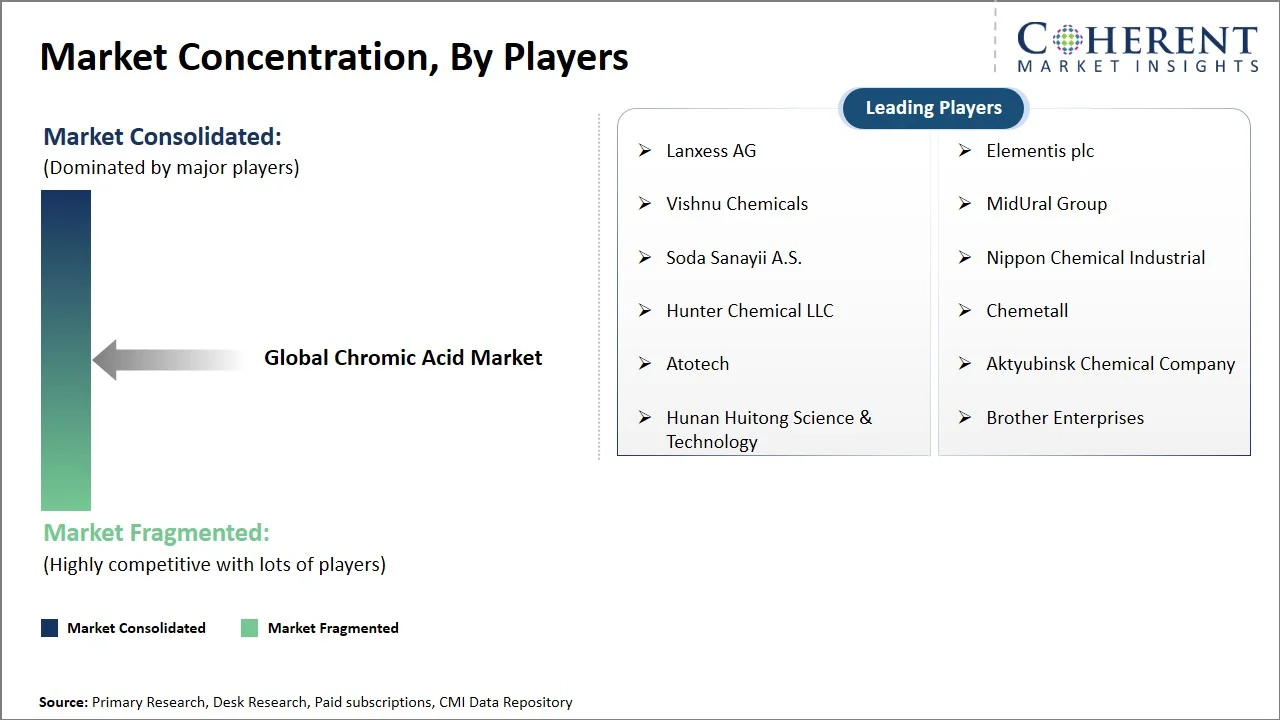
The global chromic acid market is moderately concentrated at the upstream production level but more fragmented across distribution, formulation, and surface-treatment channels. Competition centers less on product novelty than on purity consistency, secure chromium feedstock access, regulatory readiness, logistics discipline, and customer qualification. Large integrated producers benefit from scale and export reach, while regional suppliers compete through responsiveness, application support, and localized hazardous-material handling.
Key focus areas Include
- Consistent chromium trioxide purity and impurity control for specification-sensitive finishing processes
- Secure access to chromite and sodium dichromate intermediates to protect production continuity
- Reliable hazardous-material logistics and packaging capability across domestic and export markets
- Regulatory documentation and customer compliance supp ort for controlled Cr(VI) applications
- Technical support for bath preparation, process stability, and troubleshooting
- Ability to serve both conventional chromic acid and alternative chromium chemistry requirements
- Long-term relationships with metal finishers and qualified industrial customers
- Waste minimization, process efficiency, and environmental-performance positioning as differentiation criteria
Market Report Scope
Chromic Acid Market Report Coverage
| Report Coverage | Details | ||
|---|---|---|---|
| Base Year: | 2025 | Market Size in 2026: | USD 1,057.1 Mn |
| Historical Data for: | 2020 To 2024 | Forecast Period: | 2026 To 2033 |
| Forecast Period 2026 to 2033 CAGR: | 4.80% | 2033 Value Projection: | USD 1,467.7 Mn |
| Geographies covered: |
| ||
| Segments covered: |
| ||
| Companies covered: | Lanxess AG, Elementis plc, Vishnu Chemicals, MidUral Group, Soda Sanayii A.S., Nippon Chemical Industrial, Hunter Chemical LLC, Chemetall, Atotech, Aktyubinsk Chemical Company, Hunan Huitong Science & Technology, Brother Enterprises | ||
| Growth Drivers: |
| ||
| Restraints & Challenges: |
| ||
Analyst Opinion (Expert Opinion)
- The global chromic acid market is likely to evolve from a predominantly volume-oriented specialty chemical business into a more segmented market defined by technical necessity and compliance capability. Leadership will increasingly depend on controlling upstream supply while supporting downstream customers with formulation expertise, documentation, waste management, and process continuity. Suppliers that treat regulatory capability as part of the commercial offering rather than simply a manufacturing obligation should be better positioned to protect durable customer relationships.
- The most important structural transition is the gradual separation of replaceable and difficult-to-replace chromic acid applications. Processes where appearance is the principal performance requirement face stronger substitution pressure, whereas uses requiring exceptional hardness, corrosion resistance, adhesion, dimensional restoration, or previously qualified performance will transition more slowly. This changes the competitive landscape because alternative-chemistry specialists gain access to new applications while conventional chromic acid suppliers increasingly compete within narrower but technically defensible end-use niches.
- Market participants should prioritize closed-process handling, bath efficiency, wastewater control, alternative-chemistry capabilities, and customer qualification support rather than pursuing capacity growth without application visibility. Supply-chain concentration, hazardous-material logistics, regulatory uncertainty, and qualification costs remain important risks. Producers should therefore maintain diversified feedstock and geographic sourcing while developing technical-service capabilities that help customers determine where chromic acid should be retained, optimized, recovered, or substituted. The strongest strategic position will be the ability to support both compliant continuity and controlled transition.
Speak to the analyst
Want personalized insights?
Take the findings above to one of our principal consultants, or have the report rebuilt around the segments, geographies and competitors you actually track.
Market Segmentation
- Grade Insights (Revenue, USD Mn, 2021 - 2033)
- Industrial Grade
- High Purity Grade
- Reagent Grade
- Form Insights (Revenue, USD Mn, 2021 - 2033)
- Solid Chromium Trioxide
- Liquid Chromic Acid Solution
- Application Insights (Revenue, USD Mn, 2021 - 2033)
- Metal Finishing and Electroplating
- Surface Treatment and Anodizing
- Pigments and Dyes
- Chemical Synthesis
- Wood Preservation
- Others
- End use Industry Insights (Revenue, USD Mn, 2021 - 2033)
- Automotive
- Aerospace and Defense
- Industrial Machinery
- Electronics
- Construction and Infrastructure
- Chemicals and Others
- Distribution Channel Insights (Revenue, USD Mn, 2021 - 2033)
- Direct Sales
- Indirect Sales
- Regional Insights (Revenue, USD Mn, 2021 - 2033)
- North America
- U.S.
- Canada
- Latin America
- Brazil
- Argentina
- Mexico
- Rest of Latin America
- Europe
- Germany
- U.K.
- Spain
- France
- Italy
- Russia
- Rest of Europe
- Asia Pacific
- China
- India
- Japan
- Australia
- South Korea
- ASEAN
- Rest of Asia Pacific
- Middle East
- GCC Countries
- Israel
- Rest of Middle East
- Africa
- South Africa
- North Africa
- Central Africa
- North America
Sources
Primary Research Interviews
- Chromic acid manufacturers, chromium chemical producers, electroplating companies, metal finishers, distributors, and industrial chemical suppliers
- Surface-treatment specialists, plating engineers, procurement managers, chemical technologists, and industry experts
Stakeholders
- Chromic acid and chromium trioxide manufacturers
- Chromite, sodium dichromate, packaging, and chemical-input suppliers
- Electroplaters, metal finishers, aerospace suppliers, automotive component manufacturers, and chemical distributors
End-use Sectors
- Automotive and transportation
- Aerospace and defense
- Industrial machinery and engineering
- Electronics and metal processing
- Chemical manufacturing and wood treatment
Regulatory and Industry Bodies
- U.S. Environmental Protection Agency
- European Chemicals Agency
- European Commission
- UK Health and Safety Executive
- California Air Resources Board
- National occupational safety and environmental authorities
Databases
- UN Comtrade and ITC Trade Map
- Government customs and import-export databases
- Company annual reports, investor presentations, and product portfolios
- Chemical, electroplating, metals, and industrial manufacturing databases
Magazines and Journals
- Products Finishing
- Metal Finishing
- Surface and Coatings Technology
- Journal of Applied Electrochemistry
- Transactions of the IMF
Associations
- National Association for Surface Finishing
- Surface Engineering Association
- European Committee for Surface Treatment
- International Chromium Development Association
- National electroplating and surface-finishing associations
Public Domain Sources
- Chromium trioxide regulatory authorizations
- Electroplating and surface-treatment industry publications
- Company capacity, product, and manufacturing announcements
- Environmental, worker-safety, and chromium (VI) compliance publications
Key Standards and Regulations
- REACH authorization requirements for chromium trioxide
- Hexavalent chromium occupational exposure limits
- Chrome-plating air-emission requirements
- Industrial wastewater and chromium-discharge regulations
- Hazardous chemical handling, labeling, storage, and transport standards
Proprietary Elements
- CMI Data Analytics Tool
- Proprietary CMI Existing Repository of information for the last 10 years
Get access to 250+ pages report
Every segment, forecast, competitor profile and data table behind the analysis above — available for instant download.
- ESOMAR Member
- ISO 9001:2015 Certified
- D-U-N-S Registered
- GDPR & CCPA Compliant
Missing comfort of reading report in your local language? Find your preferred language:
Frequently Asked Questions
The CAGR of global chromic acid market is projected to be 4.80% from 2026 to 2033.
The global chromic acid market is estimated to be valued at USD 1,057.1 Mn in 2026 and is expected to reach USD 1,467.7 Mn by 2033.
Chromic acid is primarily used in electroplating, metal finishing, surface treatment, anodizing, chemical synthesis, pigments, and wood preservation.
Major consuming industries include automotive, aerospace and defense, industrial machinery, electronics, construction, metal processing, and specialty chemicals.
Regulations governing hexavalent chromium are increasing requirements for worker protection, emissions control, wastewater treatment, safe handling, and regulatory compliance across chromic acid applications.
The report helps companies evaluate demand patterns, competitive positioning, regional opportunities, regulatory developments, supply-chain dynamics, customer requirements, and strategic market-entry or expansion opportunities.
Growing electroplating demand supporting chromic acid consumption and Aerospace and automotive surface treatment applications driving specialty demand are the major factors driving the growth of global chromic acid market.