

Global Clinical Imaging Analytics Market Size and Forecast – 2026 To 2033
The global clinical imaging analytics market is expected to grow from USD 5.62 Bn in 2026 to USD 13.64 Bn by 2033, registering a compound annual growth rate (CAGR) of 13.5% from 2026 to 2033. The market for global clinical imaging analytics is poised for significant expansion, fueled by the rising diagnostic imaging volumes and the resulting need for faster, data-driven image interpretation and quantitative assessment.
NHS England recorded 49.9 million imaging tests in England during November 2024–October 2025, including 0.69 million CT and 0.39 million MRI examinations in October 2025 alone, increasing the need for analytics solutions that can efficiently process high-volume imaging workflows. This highlights the growing workload faced by imaging departments and the need for AI-enabled analytics to accelerate image interpretation, automate quantitative assessment, and support timely clinical decision-making.
Key Takeaways of the Global Clinical Imaging Analytics Market
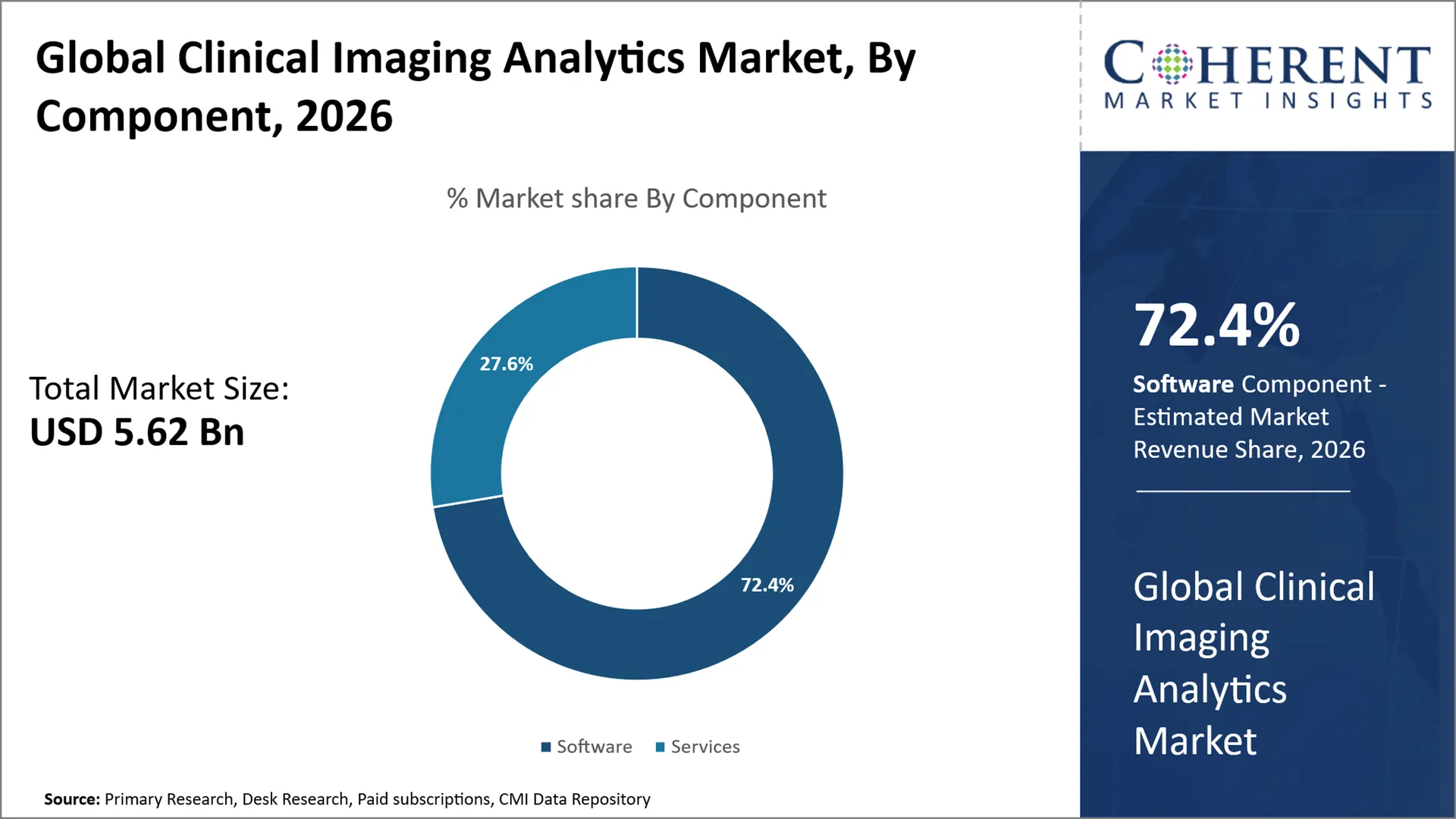
- Software is projected to hold 72.4% of the global clinical imaging analytics market share in 2026, making it dominant component segment across North America due to strengthening regulatory frameworks for AI/ML-enabled medical-device software. For instance, Health Canada published its Pre-market Guidance for Machine Learning-Enabled Medical Devices in April 2026, covering data management, clinical validation, transparency, and post-market monitoring. Such regulatory clarity supports the development and commercialization of imaging analytics software in the region.
- Computed Tomography (CT) is projected to hold 30.1% of the global clinical imaging analytics market share in 2026, making it dominant imaging modality segment across Asia Pacific due to the strong adoption driven by regulatory support for AI-based CT analysis. For instance, China's NMPA approved CT Angiography Image-aided Detection Software for intracranial aneurysms in February 2025, which uses deep-learning vessel segmentation and multi-scale aneurysm detection to analyze CT angiography images. The approval demonstrates the regulatory acceptance of AI-enabled quantitative CT analysis in clinical diagnosis.
- Diagnostic and detection analytics are projected to hold 36.9% of the global clinical imaging analytics market share in 2026, making it dominant analytics type segment with Europe supporting adoption through evolving AI-specific medical-device regulation. On October 6, 2026, the U.K. MHRA opened Phase 3 of its AI Airlock regulatory sandbox allowing AI-enabled medical devices to be tested within a controlled regulatory environment; the programme specifically addresses lifecycle oversight and post-market surveillance, including applications involving radiology image findings. This regulatory framework can facilitate the clinical deployment of AI-based diagnostic and detection analytics.
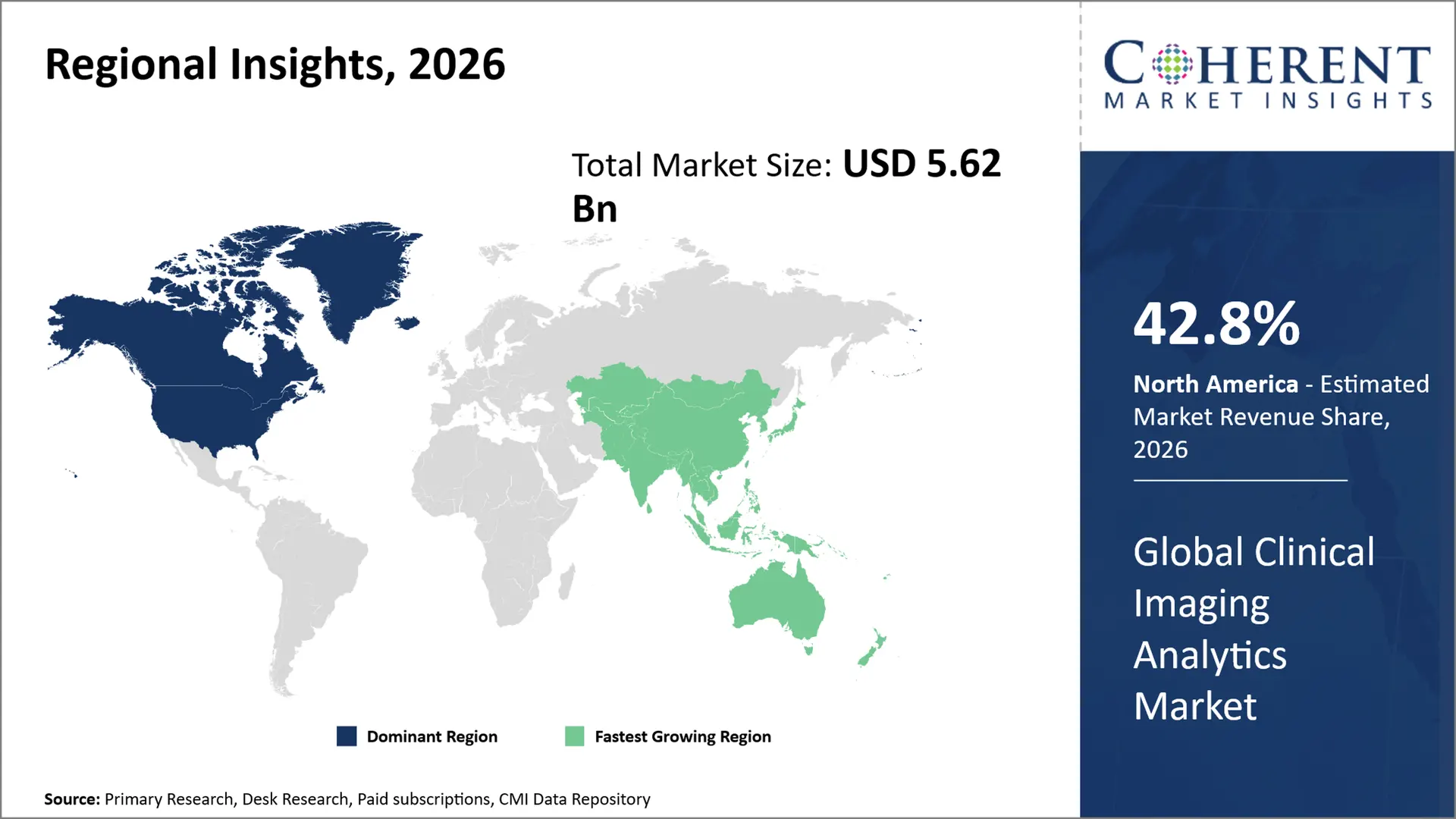
- North America market maintains dominance with an expected share of 42.8% in 2026, bolstered by established regulatory pathways for AI-enabled imaging software and strong clinical integration. In June 2026, the U.S. FDA classified radiological machine-learning-based quantitative imaging software with a predetermined change-control plan as a Class II medical device, establishing specific special controls while reducing regulatory barriers for iterative AI imaging technologies.
- Asia Pacific is expected to exhibit the fastest growth in the global clinical imaging analytics market, registering an estimated CAGR of 19.6% during 2026–2033, driven by expanding government-backed AI validation and deployment frameworks. For instance, in February 2026, India’s Ministry of Health and Family Welfare launched the SAHI and BODH initiatives, with BODH providing a structured platform to test and benchmark AI solutions before large-scale healthcare deployment.
Segmental Insights
Why Does Software Dominate the Global Clinical Imaging Analytics Market?
Software is projected to hold the market share of 72.4% in 2026, as it is used for automated image interpretation, quantitative analysis, clinical decision support, and hospital IT interface. Software powered by AI/ML can make the processing of large volumes of imaging data faster and improve the consistency of image-based evaluations. While, the cloud-based platform enables portable deployment and remote access across health care networks. For instance, in September 2026, the U.S. Food and Drug Administration approved the GE Health Care EchoPAC Software Only / EchoPAC Plug-in v211 as a type of automated radiological image-processing software, with the updated software supporting AI-enabled analysis of echocardiographic images.
- Current Industry Events of 2026
- Market Size Estimation
- Regional Breakdown
- Competitive Landscape
- Customer Intelligence
- Segmental Analysis
- Pricing Analysis
- Key Market Drivers, Challenges & Future Trends
- Customized Insights Section
Why Does Computed Tomography (CT) Represent the Largest Imaging Modality Segment in the Clinical Imaging Analytics Market?
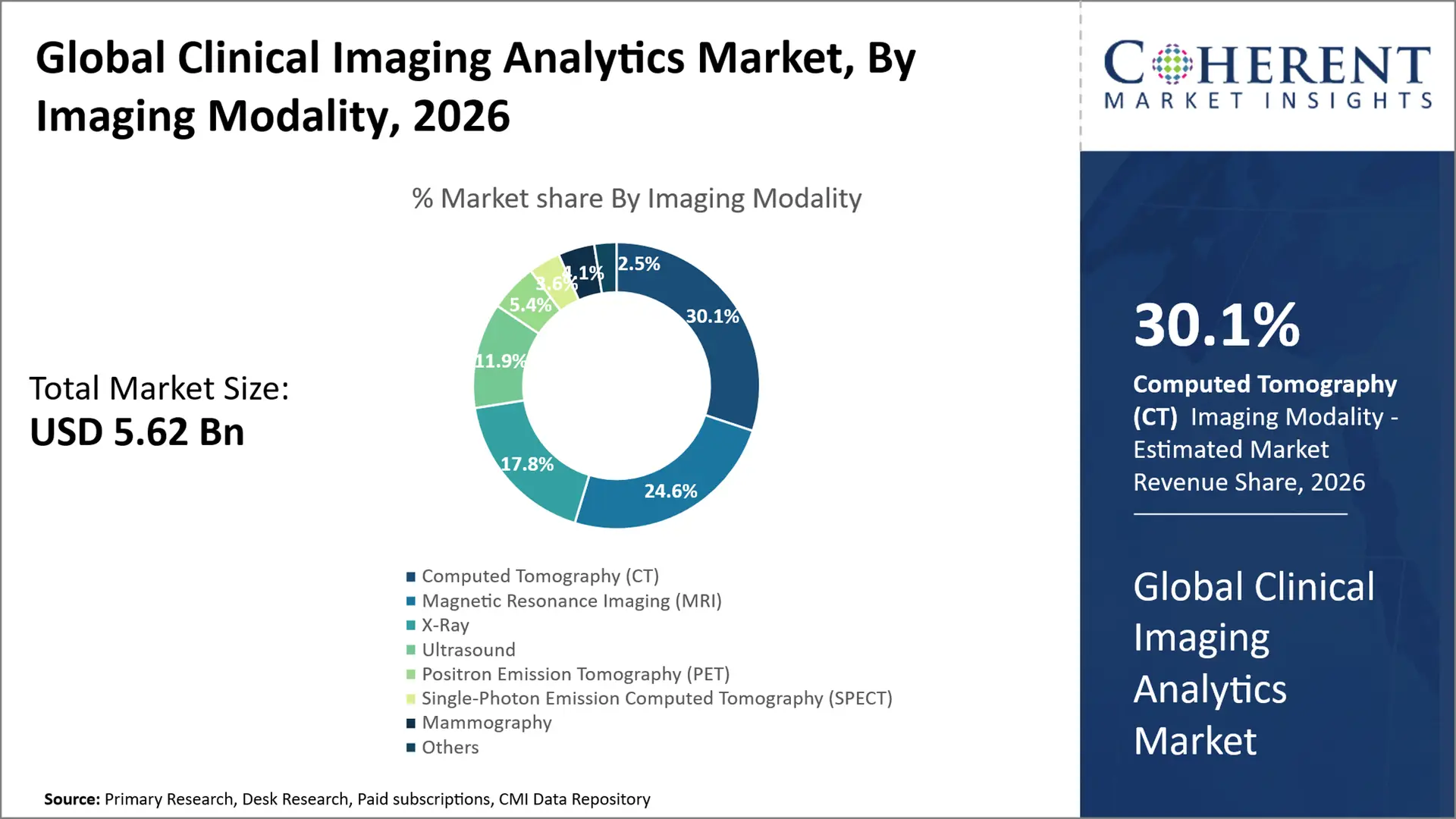
Computed Tomography (CT) is projected to hold a market share of 30.1% in 2026, as it is widely adopted in cancer, cardiology, neurology, trauma and emergency applications, thereby yielding large volumes of analyzable imaging data. Additionally, the fast acquisition time and quantitative results from the modality enable AI for segmentation, lesion detection, volumetrics and treatment monitoring. For instance, in August 2026, the U.S. Food and Drug Administration approved Dentsply Sirona’s DS Core CBCT Anatomy, an automated radiological image-processing software for cone-beam CT images, under Class II product code QIH.
Diagnostic and Detection Analytics Segment Dominates the Global Clinical Imaging Analytics Market
The diagnostic and detection analytics segment are projected to hold a market share of 36.9% in 2026, as it directly helps in the detection and localization of abnormality such as tumors, lesions, fractures and vascular conditions. AI detection tools have the potential to quickly screen large imaging volumes, identify suspicious abnormalities and support radiologists for case prioritization. For instance, in November 2023, Brainomix 360 Triage was approved by the U.S. Food and Drug Administration for use with brain radiological image-processing AI software for suspected intracranial bleeding on non-contrast CT images and to support triage of patients.
Current Events and their Impact
Current Events | Description and its Impact |
U.S. FDA Seeks Regulatory Input on Generative AI-Enabled Medical Devices (August 2026) |
|
U.K. Government Expands AI Deployment Across the NHS for Faster Diagnosis (June 2026) |
|
European Commission Launches Large-Scale AI and GenAI Medical Imaging Pilots (February 2026) |
|
Clinical Imaging Analytics Market Dynamics
Market Drivers
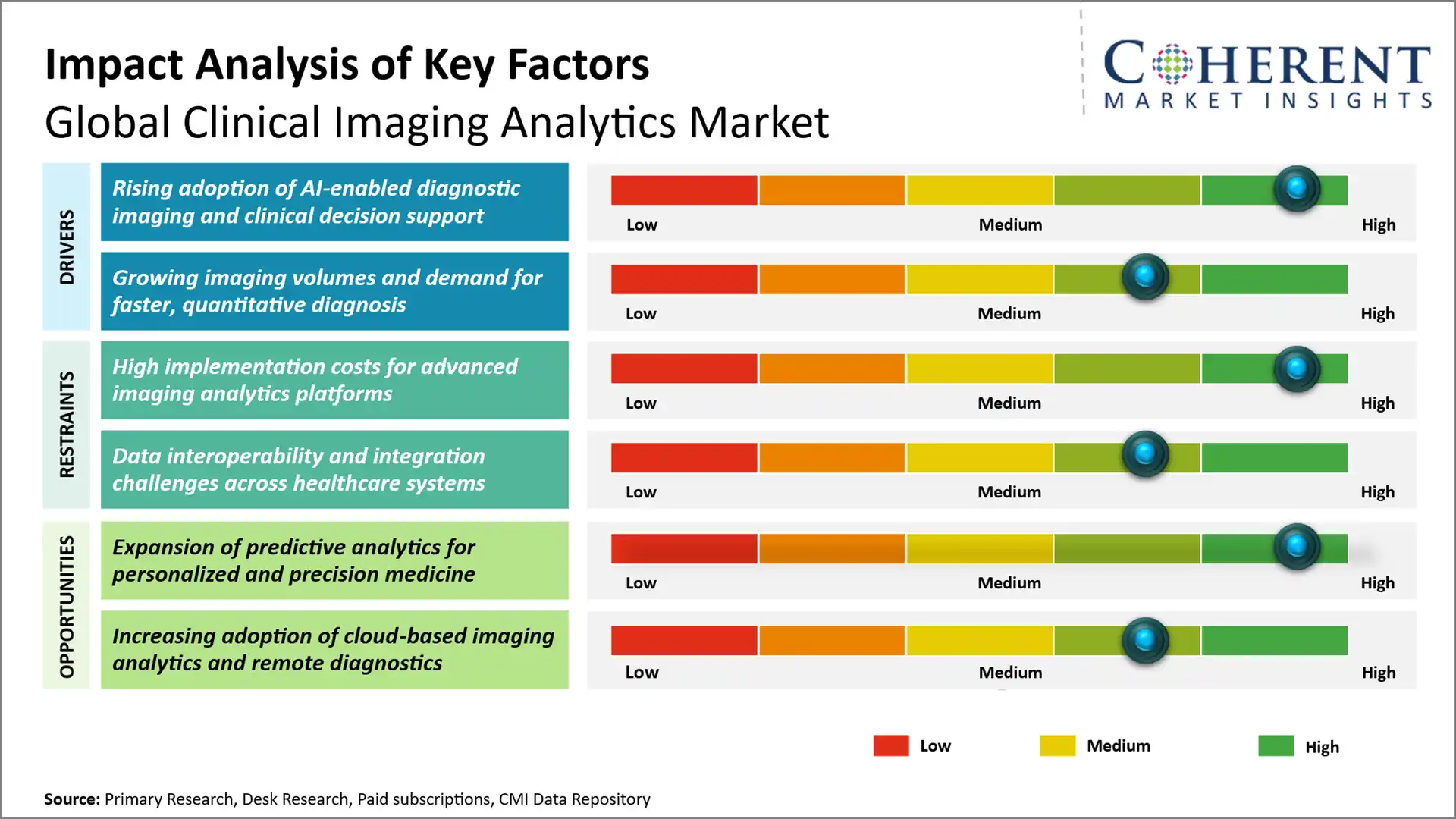
- Rising adoption of AI-enabled diagnostic imaging and clinical decision support: The adoption of AI-enabled diagnostic imaging is accelerating as healthcare systems increasingly integrate AI for automated lesion detection, image interpretation, and diagnostic support. For instance, in March 2026, the U.S. FDA approved Lunit INSIGHT DBT (V1.2), an AI-based radiological computer-assisted detection/diagnosis software for lesions suspicious for cancer in digital breast tomosynthesis, demonstrating the continued expansion of AI-based clinical decision support into routine diagnostic imaging workflows.
- Growing imaging volumes and demand for faster, quantitative diagnosis: The growing volume of diagnostic imaging is increasing the need for analytics tools that can process scans rapidly and generate reproducible quantitative findings. For instance, NHS England recorded 8.71 million CT scans and 5.03 million MRI scans across England during 2025, demonstrating the substantial imaging workload requiring efficient interpretation and quantitative assessment.
- Increasing use of imaging-derived biomarkers for quantitative clinical assessment: Clinical imaging analytics is expanding from image interpretation toward extracting measurable biomarkers that support disease characterization, treatment monitoring, and risk assessment. For instance, the European Commission’s EUCAIM initiative is developing a federated repository of more than 100,000 anonymized cancer cases and at least 50 AI algorithms and clinical prediction models by December 2026, supporting AI-based analysis of cancer imaging data across Europe.
Emerging Trends
- Generative AI for clinical imaging interpretation: Generative AI is emerging as a new layer in clinical imaging analytics, supporting radiology report generation, image summarization, and multimodal clinical reasoning. Its integration with imaging workflows is expected to improve reporting efficiency and decision support.
- Multimodal imaging analytics: Imaging analytics is increasingly moving beyond isolated image interpretation toward combining imaging data with clinical, genomic, and longitudinal patient data. This trend is strengthening predictive analytics for disease characterization, prognosis, and treatment-response assessment.
- Cloud-Based and enterprise imaging analytics: Healthcare providers are increasingly adopting cloud-based platforms that centralize imaging data and analytics across hospitals and diagnostic networks. These platforms enable scalable AI deployment, remote access, interoperability, and standardized imaging workflows.
Regional Insights
Why is North America a Strong Market for Clinical Imaging Analytics?
North America leads the global clinical imaging analytics market, accounting for an estimated 42.8% share in 2026, owing to the presence of well-developed healthcare infrastructure, high digital-health maturity, and greater adoption of AI-enabled clinical technologies in the region. The growing digital health policies coupled with the increasing healthcare IT investments by the government in the digital health infrastructure, health-data exchange, interoperable systems, and AI-enabled healthcare systems are further expected to accelerate the use of the clinical imaging analytics in clinical practice. In January 2024, the U.S. Office of the National Coordinator for Health Information Technology (ONC) issued the HTI-1 Final Rule, which set new interoperability standards and algorithm transparency criteria for certified health information technology.
Why Does Asia Pacific Clinical Imaging Analytics Market Exhibit High Growth?
Asia Pacific is expected to exhibit the fastest growth in the global clinical imaging analytics market, registering an estimated CAGR of 19.6% during 2026–2033. The region is projected to account for 23.4% of the global market in 2026, due to the rising healthcare facilities, growth in the rate of diagnostic imaging, and rise in the deployment of digital health. The government of the countries such as China, Japan, and India are actively developing an environment to promote the adoption of healthcare information technology, artificial intelligence-driven diagnostics, digital health infrastructure, and big data of medical imaging system.
For instance, China’s National Health Commission and four other government bodies issued the “Implementation Opinions on Promoting and Regulating AI + Healthcare” on October 20, 2025, which specifically calls for AI-assisted medical imaging diagnosis, imaging report generation, image-quality assessment, and treatment recommendations. Furthermore, elevated healthcare access and the rising network of private healthcare institutions provide an opportunity for the deployment of clinical imaging analytics.
Global Clinical Imaging Analytics Market Outlook for Key Countries
Why is the U.S. Leading Innovation and Adoption in the Clinical Imaging Analytics Market?
The U.S. is anticipated to be at the forefront of innovation and adoption in the clinical imaging analytics market, due to country’s high density of AI-enabled imaging solutions and well-developed clinical implementation channels. The market in the U.S. is particularly strong in AI-based image interpretation, automated detection, quantitative analysis and radiology workflow tools. In addition, the market is strengthened by the availability of imaging-AI-specific developers and a well-established analytics integration into hospital RIS/PACS and workflows.
Is China a Favorable Market for Clinical Imaging Analytics Market?
China is an attractive market for clinical imaging analytics, with a high focus on AI-enabled radiology and quantitative image-analysis solutions. The National Medical Products Administration has created official guidance for AI medical devices-including categories and technical-review pathways for imaging devices. Furthermore, its 2026 agenda is focused on AI-enabled regulatory and clinical-data infrastructure.
Is Japan Emerging as a Key Growth Hub for the Clinical Imaging Analytics Market?
Japan, seems to be poised to emerge as a prominent growth hub for the clinical imaging analytics market owing to the comprehensive imaging infrastructure and the rapidly expanding deployment of AI-enabled diagnostic systems. The country offers a promising scope for imaging-based analytics for CT, MRI, ultrasound, and AI-based radiology analytics owing to automated detection techniques and quantitative image analysis. Furthermore, the AI-designated medical-device category of Pharma and Medical Devices Agency is likely to accelerate the commercialization of imaging-centric AI solutions.
Why Does Germany Top the European Clinical Imaging Analytics Market?
Germany leads the European clinical imaging analytics market, driven by need of digitization in healthcare, strong presence of medical-imaging infrastructure, and existing use of AI in diagnostic radiology in the country. AI in health-care has been explicitly endorsed in the current German digital health strategy for 2026, with the German Federal Ministry of Health already explicitly offering funding for diagnostic radiology as a use case for clinical application of AI and 'actively working on AI-ready healthcare infrastructure and secure testing environments for clinical AI'.
Is Clinical Imaging Analytics Market Developing in UK?
The UK clinical imaging analytics market is witnessing a positive growth, due to the rising adoption of AI-assisted radiology, the evolution of digital imaging infrastructure and the need for faster diagnostic workflows. The market is anticipated to offer significant opportunities in X-ray, CT, MRI and AI based detection and triage space within NHS diagnostic services, as well as at the croosits of data and clinically validated AI.
How is the expansion of predictive analytics for personalized and precision medicine creating new growth opportunities in the clinical imaging analytics market?
The clinical imaging analytics market holds substantial promise for predictive analytics related to precision medicine, as artificial intelligence can be used to combine imaging features with clinical and a range of patient-level data to enable individualized diagnosis, risk stratification and prediction of treatment response. This transition may also be relevant to oncology, where imaging-based biomarkers may inform disease profiling and treatment-response assessment. For instance, in June 2026, the PRIMED-AI program of the National Institutes of Health (NIH), launched funding opportunities for the development and validation of artificial intelligence instruments that integrate clinical imaging with multimodal health data to support decision making and precision medicine.
Market Players, Key Development, and Competitive Landscape
Key Developments
- In September 2026, Cognita Imaging, Inc., a wholly owned subsidiary of Mosaic Clinical Technologies, Inc. received a USD 1.29 million research contract from the U.S. Food and Drug Administration (FDA) to develop and validate an LLM-based framework for evaluating AI-generated radiology reports. The 18-month project will assess approximately 1 million patient exams, with radiologists reviewing clinically significant discrepancies, highlighting the growing use of advanced analytics and AI for clinical imaging evaluation.
- In September 2026, Sectra signed a partner agreement with S&S Partners to introduce its Sectra One Cloud enterprise imaging platform in Brazil. The cloud-based platform provides hospitals with a unified environment for managing medical imaging, reflecting the growing adoption of scalable, cloud-based imaging infrastructure in emerging healthcare markets.
- In May 2026, Medidata unveiled enhanced AI-powered imaging capabilities within its Medidata Data Experience, introducing automated imaging workflows for clinical trials. The solution delivers more than 97% anatomy-verification accuracy and 32% faster PHI redaction, while intelligent quality-control checks help identify imaging issues rapidly.
Competitive Landscape
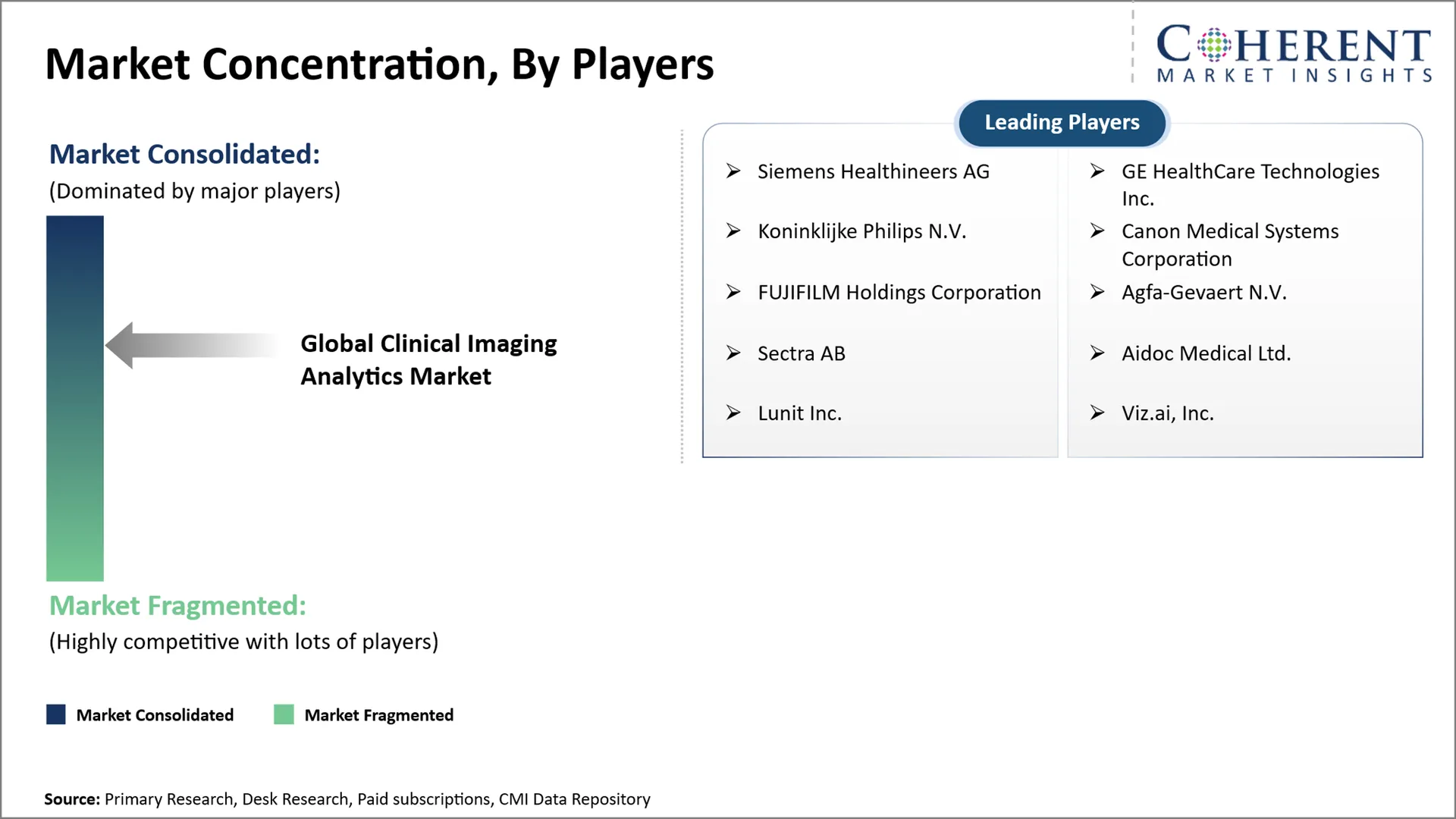
The global clinical imaging analytics market is moderately competitive, with competition centered on AI-enabled image interpretation, quantitative analysis, clinical decision support, and integration with enterprise imaging infrastructure. Market participants are increasingly strengthening capabilities that connect medical image processing, clinical workflows, data management, and predictive insights. Key focus areas include:
- AI-powered image analysis and automated detection of abnormalities across imaging modalities
- Quantitative imaging analytics for lesion measurement, disease assessment, and treatment monitoring
- Predictive and prognostic analytics supporting clinical decision-making and personalized care
- Cloud-based imaging analytics and enterprise imaging platforms for scalable data access and workflow integration
- Interoperability across PACS, RIS, EHR, and other clinical information systems
- Generative AI and advanced analytics for radiology reporting, image interpretation, and clinical workflow optimization
Market Report Scope
Clinical Imaging Analytics Market Report Coverage | |||
Report Coverage | Details | ||
Base Year | 2025 | Market Size in 2026: | USD 5.62 Bn |
Historical Data For: | 2020 To 2024 | Forecast Period: | 2026 To 2033 |
Forecast Period 2026 To 2033 CAGR: | 13.5% | 2033 Value Projection: | USD 13.64 Bn |
Geographies covered: |
| ||
Segments covered: |
| ||
Companies covered: | Siemens Healthineers AG, GE HealthCare Technologies Inc., Koninklijke Philips N.V., Canon Medical Systems Corporation, FUJIFILM Holdings Corporation, Agfa-Gevaert N.V., Sectra AB, Aidoc Medical Ltd., Lunit Inc., Viz.ai, Inc. | ||
Growth Drivers: |
| ||
Restraints & Challenges: |
| ||
Analyst Opinion (Expert Opinion)
- In the coming years, global clinical imaging analytics market is expected to move from standalone image-analysis tools toward integrated, AI-driven clinical intelligence platforms that combine image interpretation, quantitative assessment, predictive analytics, and workflow automation. Greater emphasis will be placed on real-time analytics, multimodal imaging, cloud deployment, and integration with patient-level clinical data to support more personalized diagnosis and treatment decisions.
- The maximum opportunities are foreseen within AI-powered diagnostic and predictive analytics for oncology in the U.S. Oncology offers substantial scope for automated lesion detection, tumor quantification, treatment-response assessment, and longitudinal imaging analysis, while the U.S. provides a strong environment for adoption of advanced clinical imaging technologies.
- In order to gain a competitive advantage market players should focus on developing modality-agnostic platforms that integrate seamlessly with PACS, RIS, and EHR systems while combining diagnostic, quantitative, and predictive capabilities. Building clinically reliable algorithms, simplifying deployment through cloud-based architectures, and demonstrating measurable improvements in workflow efficiency and diagnostic consistency will be critical for differentiation.
Speak to the analyst
Want personalized insights?
Take the findings above to one of our principal consultants, or have the report rebuilt around the segments, geographies and competitors you actually track.
Market Segmentation
- Component Insights (Revenue, USD Bn, 2021 - 2033)
- Software
- Services
- Imaging Modality Insights (Revenue, USD Bn, 2021 - 2033)
- Computed Tomography (CT)
- Magnetic Resonance Imaging (MRI)
- X-Ray
- Ultrasound
- Positron Emission Tomography (PET)
- Single-Photon Emission Computed Tomography (SPECT)
- Mammography
- Others
- Analytics Type Insights (Revenue, USD Bn, 2021 - 2033)
- Diagnostic and Detection Analytics
- Descriptive and Quantitative Analytics
- Predictive and Prognostic Analytics
- Image Enhancement and Visualization
- Others
- Application Insights (Revenue, USD Bn, 2021 - 2033)
- Oncology
- Cardiology
- Neurology
- Orthopedics
- Pulmonology
- Gastroenterology
- Obstetrics and Gynecology
- Others
- End User Insights (Revenue, USD Bn, 2021 - 2033)
- Hospitals
- Diagnostic Imaging Centers
- Specialty Clinics
- Research and Academic Institutions
- Pharmaceutical and Biotechnology Companies
- Others
- Regional Insights (Revenue, USD Bn, 2021 - 2033)
- North America
- U.S.
- Canada
- Latin America
- Brazil
- Argentina
- Mexico
- Rest of Latin America
- Europe
- Germany
- U.K.
- Spain
- France
- Italy
- Russia
- Rest of Europe
- Asia Pacific
- China
- India
- Japan
- Australia
- South Korea
- ASEAN
- Rest of Asia Pacific
- Middle East
- GCC Countries
- Israel
- Rest of Middle East
- Africa
- South Africa
- North Africa
- Central Africa
- North America
- Key Players Insights
- Siemens Healthineers AG
- GE HealthCare Technologies Inc.
- Koninklijke Philips N.V.
- Canon Medical Systems Corporation
- FUJIFILM Holdings Corporation
- Agfa-Gevaert N.V.
- Sectra AB
- Aidoc Medical Ltd.
- Lunit Inc.
- Viz.ai, Inc.
Sources
Primary Research Interviews
- Radiologists and Imaging Department Heads overseeing diagnostic imaging, AI-assisted interpretation, quantitative imaging, and clinical workflow optimization.
- Medical Imaging AI and Data Science Specialists developing machine learning, computer vision, predictive analytics, and image-analysis applications for clinical imaging.
- Imaging Informatics and PACS/RIS Professionals responsible for enterprise imaging, DICOM interoperability, image management, workflow integration, and clinical data connectivity.
- Clinical AI and Digital Health Leaders evaluating AI-enabled imaging tools, clinical decision support, algorithm performance, and implementation across healthcare systems.
- Medical Imaging Technology and Application Specialists involved in CT, MRI, X-ray, ultrasound, PET/SPECT, and other imaging modalities and associated analytics applications.
- Healthcare IT and Data Integration Professionals responsible for integrating imaging analytics with EHRs, PACS, RIS, cloud platforms, and hospital information systems.
- Clinical Research and Imaging Core Professionals using imaging analytics for oncology, cardiology, neurology, clinical trials, and quantitative disease assessment.
Stakeholders
- Hospitals and Healthcare Providers adopting clinical imaging analytics for diagnostic interpretation, workflow optimization, and clinical decision support.
- Diagnostic Imaging Centers implementing AI-enabled image analysis, quantitative imaging, and automated reporting solutions.
- Pharmaceutical and Biotechnology Companies using imaging analytics for clinical trials, imaging biomarkers, treatment-response assessment, and drug development.
- Medical Imaging and AI Technology Companies developing imaging software, AI algorithms, analytics platforms, and clinical decision-support solutions.
- PACS, RIS, and Enterprise Imaging Providers integrating analytics, AI, image management, and clinical workflow capabilities.
- Cloud and Healthcare IT Providers supporting cloud-based imaging, data storage, analytics processing, interoperability, and remote access.
- Academic and Research Institutions using advanced imaging analytics for medical research, AI development, validation, and precision medicine.
- End-use Sectors
- Hospitals and Healthcare Providers
- Diagnostic Imaging Centers
- Pharmaceutical and Biotechnology Companies
- Academic and Research Institutions
- Clinical Research Organizations (CROs)
- Specialty and Ambulatory Care Centers
- Regulatory & Health Bodies
- U.S. Food and Drug Administration (FDA), U.S. – AI-enabled medical devices, radiology software, medical imaging, clinical validation, and regulatory requirements.
- European Medicines Agency (EMA), Europe – medical imaging applications relevant to pharmaceutical development, clinical research, and imaging biomarkers.
- European Commission, European Union – AI governance, digital health, medical-device regulation, and healthcare data frameworks.
- Medicines and Healthcare products Regulatory Agency (MHRA), U.K. – AI-enabled medical devices, software as a medical device, and medical imaging technologies.
- Pharmaceuticals and Medical Devices Agency (PMDA), Japan – regulatory review of medical devices, diagnostic imaging technologies, and AI-enabled medical-device software.
- National Medical Products Administration (NMPA), China – medical-device registration and regulatory oversight of AI-enabled imaging and diagnostic technologies.
Databases
- FDA AI-Enabled Medical Device List – authorized AI-enabled medical devices, including radiology and medical imaging applications.
- FDA 510(k), De Novo, and PMA Databases – regulatory clearances and approvals for imaging devices, software, and AI-enabled medical technologies.
- ClinicalTrials.gov – clinical trials involving medical imaging, imaging biomarkers, AI-based diagnostics, and image-analysis technologies.
- National Center for Biotechnology Information (NCBI) – biomedical literature, imaging research, clinical datasets, and computational biology resources.
- EU Clinical Trials Information System (CTIS) – clinical-trial information relevant to imaging-based clinical research and pharmaceutical development.
Associations
- American College of Radiology (ACR) – radiology practice, imaging AI, clinical imaging standards, and AI performance monitoring.
- Radiological Society of North America (RSNA) – radiology research, medical imaging, AI, imaging informatics, and clinical applications.
- Society for Imaging Informatics in Medicine (SIIM) – imaging informatics, enterprise imaging, AI, interoperability, and clinical imaging technology.
- European Society of Radiology (ESR) – radiology practice, imaging research, AI adoption, and European imaging standards.
- International Society for Magnetic Resonance in Medicine (ISMRM) – MRI research, imaging technology, quantitative imaging, and advanced analytics.
- European Association of Nuclear Medicine (EANM) – PET/SPECT imaging, molecular imaging, nuclear medicine, and quantitative image analysis.
- American Society of Clinical Oncology (ASCO) – oncology imaging, treatment-response assessment, and clinical applications of imaging analytics.
Public Domain Sources
- U.S. Food and Drug Administration (FDA) – AI-enabled medical devices, medical imaging regulation, device clearances, and AI/ML guidance.
- National Institutes of Health (NIH) – biomedical imaging research, AI/ML development, clinical imaging datasets, and translational research.
- National Cancer Institute (NCI) – oncology imaging, imaging biomarkers, cancer research, and quantitative imaging.
- National Institute of Standards and Technology (NIST) – AI standards, measurement, evaluation, interoperability, and trustworthy AI resources.
- Centers for Medicare & Medicaid Services (CMS) – healthcare utilization, reimbursement, and imaging-related healthcare data.
Proprietary Elements
- CMI Data Analytics Tool, Proprietary CMI Existing Repository of information for last 10 years.
Get access to 250+ pages report
Every segment, forecast, competitor profile and data table behind the analysis above — available for instant download.
- ESOMAR Member
- ISO 9001:2015 Certified
- D-U-N-S Registered
- GDPR & CCPA Compliant
Frequently Asked Questions
The global clinical imaging analytics market is estimated to be valued at USD 5.62 Bn in 2026 and is expected to reach USD 13.64 Bn by 2033.
Software dominates due to the growing adoption of AI-powered image analysis, quantitative analytics, and clinical decision-support solutions.
Clinical imaging analytics uses AI, machine learning, and data analytics to extract actionable insights from medical imaging data for diagnosis, treatment planning, and clinical decision-making.
The CAGR of global clinical imaging analytics market is projected to be 13.5% from 2026 to 2033.
Rising adoption of AI-enabled diagnostic imaging and clinical decision support, and growing imaging volumes and demand for faster, quantitative diagnosis are the major factors driving the growth of the global clinical imaging analytics market.
High implementation costs for advanced imaging analytics platforms, and data interoperability and integration challenges across healthcare systems are the major factors hampering the growth of the global clinical imaging analytics market.
In terms of imaging modality, Computed Tomography (CT) is estimated to dominate the market revenue share in 2026.