

Global Currency Exchange Software Market Size and Forecast – 2026 To 2033
The global currency exchange software market is expected to grow from USD 2.44 Bn in 2026 to USD 5.39 Bn by 2033, at a compound annual growth rate (CAGR) of 12.1% over 2026–2033. Currency exchange software is the group of applications that quote, execute, record and settle conversions between currencies. A typical platform combines live rate feeds, a pricing engine, order and position management, hedging and risk tools, and connections to banks, liquidity providers and accounting systems. The need is easy to measure. The Bank for International Settlements reported on September 30, 2025 that trading in over-the-counter FX markets reached USD 9.6 Tn per day in April 2025 on preliminary data, up 28% from 2022. The software forms a growing part of the wider Treasury Management Market and shares its payment rails with the Real Time Payments Market.
Three forces support this growth. First, FX trading is expanding. The Bank for International Settlements reported that OTC FX turnover averaged USD 9.5 Tn per day in April 2025, up 27% from April 2022, as market participants hedged currency risk during heightened volatility. Second, trade keeps generating currency needs. The World Trade Organization reported that world merchandise trade volume rose 4.6% in 2025. Third, hedging is broadening beyond currencies. OTC interest rate derivatives turnover rose 59% to USD 7.9 Tn per day, which signals more demand for treasury systems that manage rate and currency risk together.
Key Takeaways of the Global Currency Exchange Software Market:
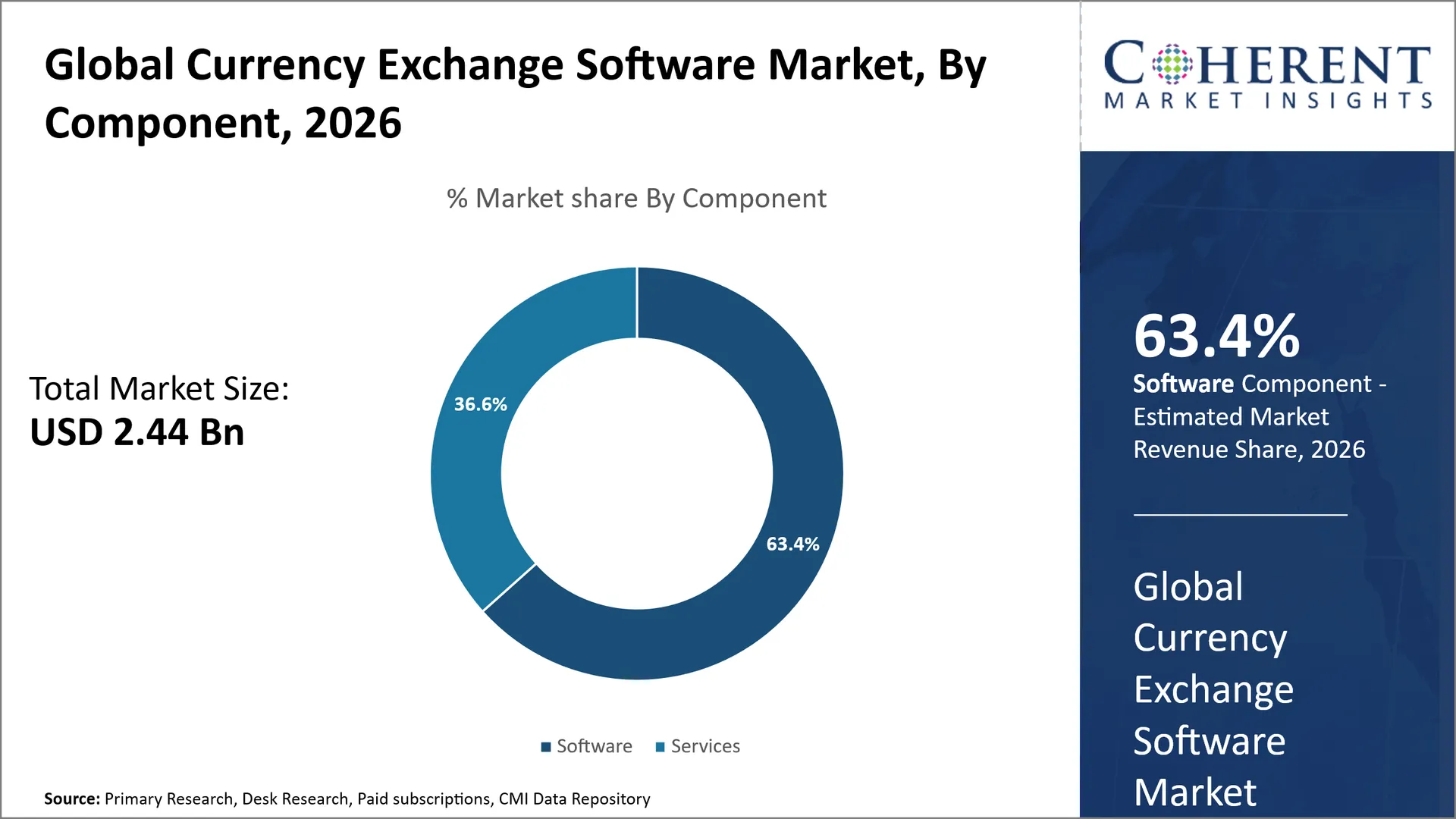
- The software component is expected to account for 63.4% of the global currency exchange software market share in 2026. The pricing engine, workflow, risk limits and reporting all sit in software, so each new regulatory or operational duty is added as another software module. On January 13, 2026, LSEG announced the launch of Trade Surveillance, which helps spot FX participants on its FX Dealing, Advanced Dealing and Matching platforms identify and investigate potential market abuse and financial crime.
- On-premises deployment is expected to hold 54.7% of the deployment segment in 2026. Banks and large dealing desks keep latency-sensitive pricing and core-banking links inside systems they control, which favors installed deployments. On April 21, 2026, ION Treasury announced that it had introduced Verification of Payee capabilities across its treasury solutions, with its ITS system the first in the portfolio to go live in production under the new EU regulation.
- Large enterprises are expected to account for 67.3% of the enterprise size segment in 2026. Large groups run many subsidiaries and currencies, so they need exposure capture, hedge execution and hedge accounting in one controlled workflow. On April 28, 2026, Kyriba announced Advanced FX, which automates exposure validation, hedge application and workflow controls for organizations managing daily hedging programs, and reported that customers have seen up to USD 3.1 Mn in reduced FX volatility impact.
- The Banking, Financial Services and Insurance (BFSI) segment is expected to account for 44.7% of the end user segment in 2026. Banks and financial institutions quote, trade and settle currencies as part of their core business, which makes them the largest buyers. On May 21, 2026, the Central Bank of Congo launched the BMatch module of Bloomberg FXGO to modernize the country’s interbank FX market, as reported by the Congolese press agency ACP.
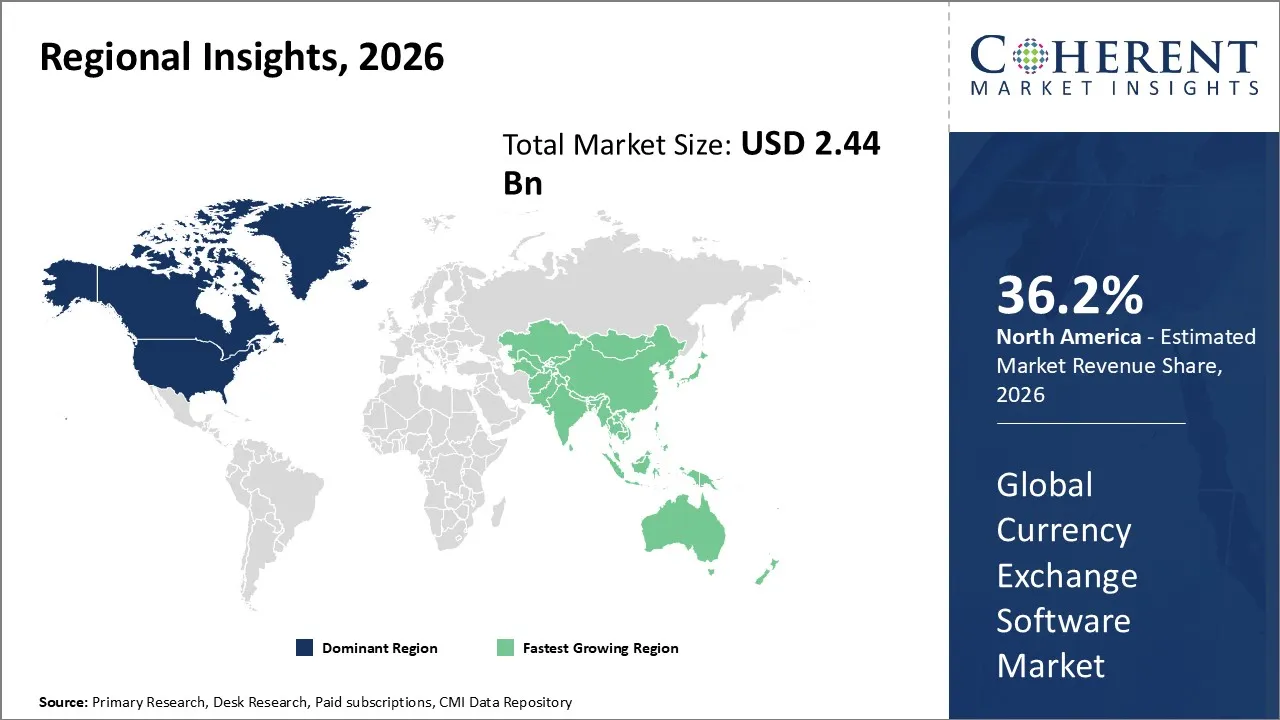
- North America is expected to dominate the currency exchange software market in 2026, with a share of 36.2%. The region is home to a deep base of banks, asset managers and corporate treasuries that price and hedge in US dollars. On December 8, 2025, Corpay announced that it had completed Mastercard’s USD 300 Mn minority investment in its cross-border business, which valued that business at approximately USD 13.0 Bn, and that the two companies signed a commercial partnership to bring Corpay cross-border services to Mastercard’s financial institution customers.
- Asia Pacific is expected to account for a 24.5% share in 2026 and to be the fastest-growing region over 2026–2033. Trade flows are shifting toward Asia, and regional banks are moving FX workflows onto electronic infrastructure. On April 13, 2026, LSEG announced that KEB Hana Bank, a major FX trading institution in South Korea, had joined SwapAgent and executed its inaugural cross-currency swap through the service.
Segmental Insights
Why Do Software Solutions Dominate the Global Currency Exchange Software Market?
In terms of component, software is expected to account for 63.4% of the global currency exchange software market share in 2026. Software carries the logic that makes a currency conversion possible. A rate engine ingests live market prices, a pricing engine applies spreads, client tiers and risk limits to produce a firm quote, and an order and position manager records the resulting deal and passes it to risk, accounting and settlement systems. Application programming interfaces (APIs) then let banks, brokers and corporates connect these functions to their own channels and to liquidity providers. Because the same code is licensed or subscribed to by many institutions, software captures the largest portion of spending.
A complete software stack usually has five layers, each of which is bought, upgraded and integrated separately:
- Market data and rate management: collects bank, venue and benchmark rates into one clean price stream.
- Pricing and quoting: applies spreads by client tier, currency pair and size, and checks each quote against risk limits.
- Execution and connectivity: routes orders to banks and market makers by API or standards such as FIX and ISO 20022.
- Position, risk and hedge management: tracks exposure in real time, runs limits and valuations, and books hedge accounting entries.
- Reporting and compliance: produces audit trails, regulatory reports and surveillance alerts.
On September 14, 2026, Bloomberg announced the launch of its FX Options RFQ API on FXGO, bringing end-to-end programmatic request-for-quote trading to the buy-side FX options market for the first time. The release covers vanilla and exotic FX options strategies across deliverable and non-deliverable currency markets through a single API, and Bloomberg reported more than 58% year-on-year growth in FX options volumes on FXGO since August 2025.
- Current Industry Events of 2026
- Market Size Estimation
- Regional Breakdown
- Competitive Landscape
- Customer Intelligence
- Segmental Analysis
- Pricing Analysis
- Key Market Drivers, Challenges & Future Trends
- Customized Insights Section
Why Does On-Premises Deployment Lead the Deployment Segment?
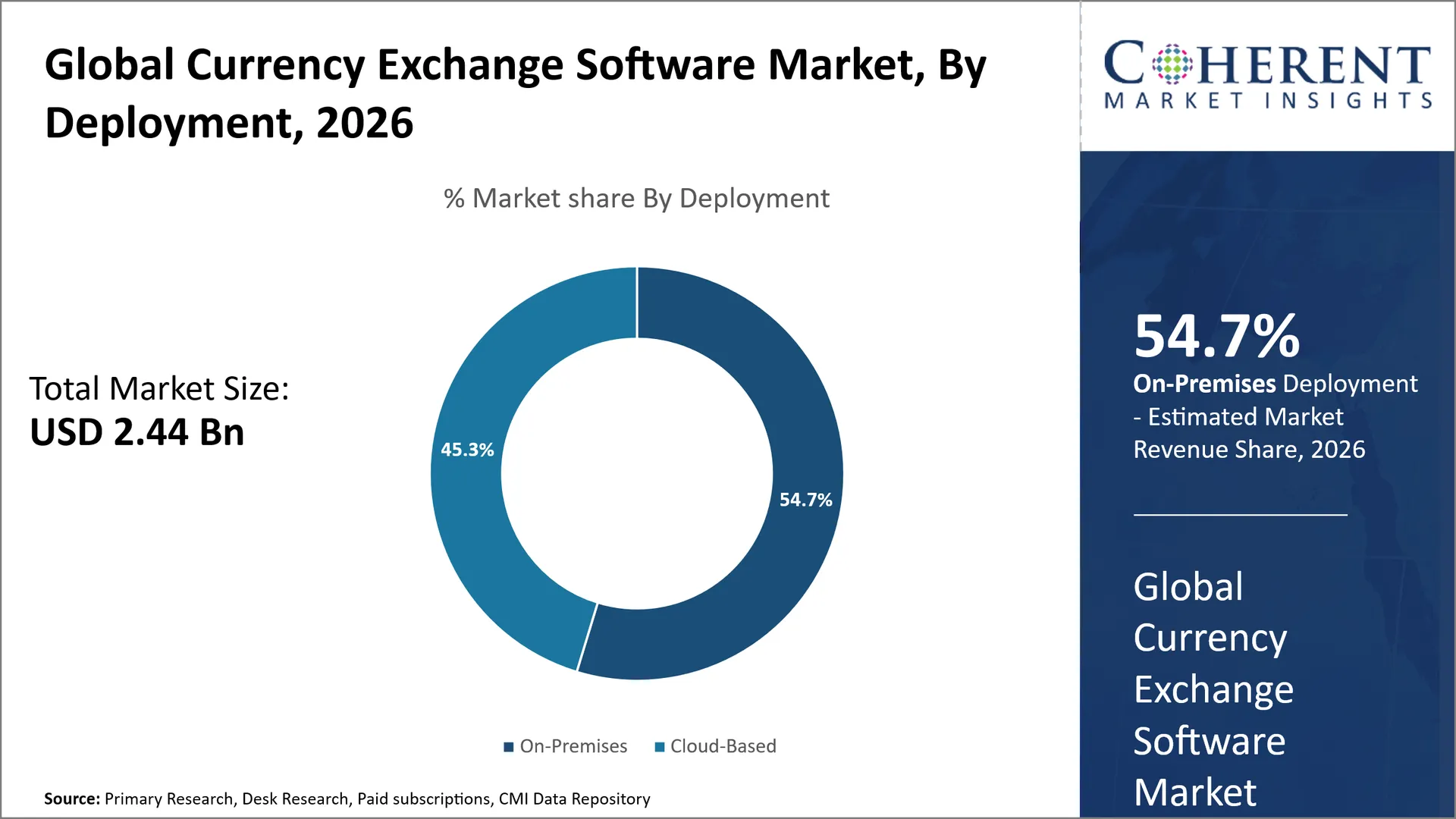
In terms of deployment, on-premises systems are expected to account for 54.7% of the global currency exchange software market share in 2026. A dealing desk or treasury that prices and trades currencies depends on fast, predictable response times and on direct links to its core banking, risk and settlement systems. Running the platform inside its own data centers gives the institution control over upgrade timing, data location and security policy, which matters in a business where a pricing error can create a loss within seconds. Existing installations are also deeply wired into other systems, so institutions tend to extend what they run rather than replace it.
Four practical reasons keep on-premises systems in front:
- Latency and throughput: quoting engines that refresh prices many times a second run next to the institution’s own data feeds and order flow.
- Control of data location: customer, position and pricing data stays in the institution’s own data centers, which simplifies data-residency and audit duties.
- Integration depth: years of links to core banking, ledger, limit and settlement systems are costly to rebuild on a new platform.
- Change control: upgrades follow the institution’s own risk and release calendars, not a vendor.
Why Do Large Enterprises Lead the Enterprise Size Segment?
In terms of enterprise size, large enterprises are expected to account for 67.3% of the global currency exchange software market share in 2026. A multinational group collects invoices, payroll and intercompany loans in many currencies across many legal entities. It needs software that captures each exposure, nets positions across subsidiaries, applies a board-approved hedging policy, executes the hedge with relationship banks and books hedge accounting entries. Each of these steps involves volumes and controls that justify an enterprise-grade platform with audit trails, approval workflows and integration with the group’s enterprise resource planning (ERP) system.
Current Events and their Impact
Current Events | Description and its Impact |
Swift ISO 20022 cutover for cross-border payments: coexistence period ended November 22, 2025 |
|
G20 cross-border payments roadmap: progress report published November 16, 2026 |
|
Currency Exchange Software Market Dynamics
Market Drivers
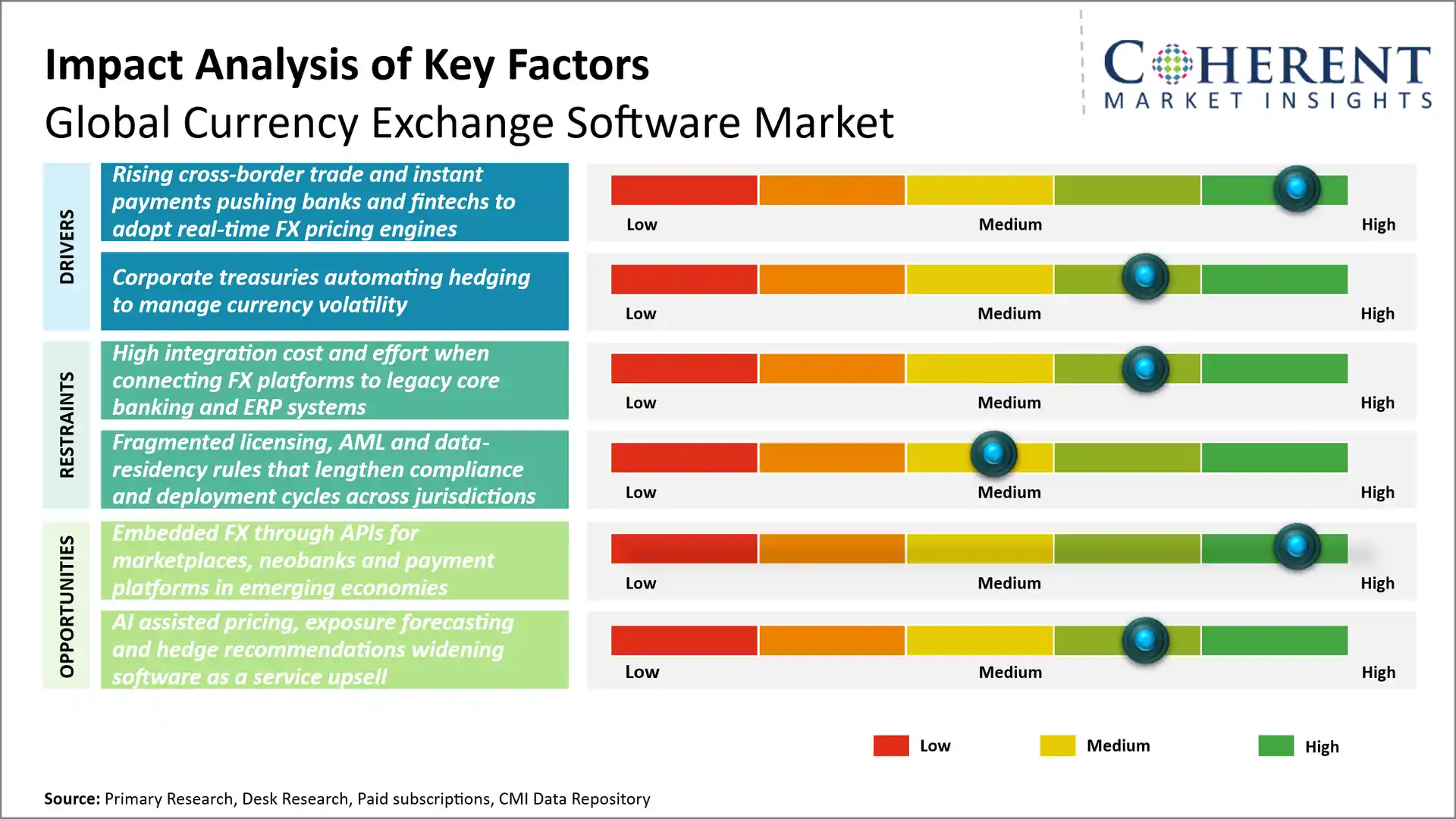
- Rising cross-border trade and instant payments pushing banks and fintechs to adopt real-time FX pricing engines: When a payment arrives in seconds, the exchange rate has to be fixed in the same moment. A rate sheet refreshed once a day no longer works for an institution that must send or receive money at any hour. Banks and fintechs therefore need a pricing engine that streams live market rates, applies spreads and risk limits, and returns a firm quote at the time of payment. Trade growth adds to the volume that must be converted. On October 8, 2026, the World Trade Organization reported that world merchandise trade volume is expected to grow by 3.9% in 2026 and 4.1% in 2027, and that the current US dollar value of world merchandise trade rose 15% year-on-year in the first half of 2026.
- Corporate treasuries automating hedging to manage currency volatility: Currency swings change the cost of imports, the value of foreign sales and the profit of overseas subsidiaries. Treasuries that once placed hedges by e-mail and spreadsheet now use software to capture exposures from their accounting systems, check them against policy, place the hedge and book the accounting entries. The size of the hedging need is visible in the market itself. The Bank for International Settlements reported that FX swaps were the most-traded instrument, averaging USD 4 Tn per day in April 2025, and noted that swaps and forwards are instruments commonly used in hedging currency risk.
Emerging Trends
- Treasury and FX platforms are moving to cloud-native architecture: Established vendors are rebuilding long-running systems so that upgrades arrive continuously and implementation is faster. On September 28, 2026, ProCredit group announced that it had selected Teciem’s Kondor Up, a new version of the Kondor treasury platform that combines treasury and risk management functions with a cloud-native operating model, for its international banking network.
- Impact: Smaller banks can adopt treasury and FX functions without building a large internal technology team.
- Relevance to the market: This favors vendors that can keep a proven product while modernizing its delivery.
- Electronic and API-based execution is reaching FX swaps and longer-dated trades: In an FX market update, LSEG FX reported that in 2025, 10% of swap activity on its FX Matching platform was conducted via API, and announced that from May 1, 2026 the brokerage payable on FX swaps with tenors of one month or longer would be reduced to USD 0 per Mn traded.
- Impact: Automated systems can place and manage hedging trades without a person on the phone, which lowers cost per trade.
- Relevance to the market: This raises demand for software that connects directly to trading venues through APIs.
Regional Insights
Why Does North America Lead the Global Currency Exchange Software Market?
North America is expected to account for a market share of 36.2% in 2026. The region’s leadership rests on the central role of the US dollar. The Bank for International Settlements reported that the dollar appeared on one side of 89% of FX trades in April 2025, so banks, asset managers and corporate treasuries in the region price and hedge more currency flow than their size alone would suggest. The United States is also the second-largest FX trading location in the world, behind only the United Kingdom, which keeps demand for dealing, risk and treasury software high. The BIS Quarterly Review for December 2025 added that record turnover in April 2025 partly reflected trading around the US tariff news and hedging of US dollar exposures.
Why Is Asia Pacific the Fastest-Growing Region in the Currency Exchange Software Market?
Asia Pacific is expected to account for a 24.5% share in 2026 and to register the fastest growth over the forecast period. The World Trade Organization’s March 2026 Global Trade Outlook reported that Asia contributed 71% of the growth in world merchandise trade volume in 2025 and projected that Asia would see the fastest merchandise import growth in 2026. More goods crossing borders means more invoices in foreign currency and more demand for pricing, hedging and payment software. Singapore and Hong Kong SAR rank third and fourth among global FX trading locations, and the Bank for International Settlements reported that the four leading locations together account for 75% of FX trading. Regional banks and brokers therefore already operate large currency books that are being moved onto modern platforms.
Global Currency Exchange Software Market Outlook for Key Countries
Is the U.S. the Largest Market for Currency Exchange Software?
The U.S. currency exchange software market is projected to reach USD 0.78 Bn in 2026, the largest of the five countries covered here. The country is the world’s second-largest FX trading centre, with daily turnover of USD 2.33 Tn. On April 8, 2026, the Federal Reserve Board invited public comment on a proposal that would allow U.S. banks and credit unions to use intermediaries to transfer funds through the FedNow Service. The Board noted that the change could “support private-sector cross-border payment solutions”, which would raise demand for conversion and pricing software on the U.S. leg of cross-border payments.
Is the U.K. the Leading European Market?
The U.K. currency exchange software market is projected to reach USD 0.22 Bn in 2026, the second-largest of the five countries and the leading market in Europe. The country is the world’s largest FX hub: the UK alone accounted for 38% of total FX turnover, and it retained its position as the leading hub in 2025, with the United States in second place. Dealers, trading venues and software vendors operate side by side in London, where Teciem is headquartered. On October 13, 2026, the Bank of England held its RTGS CHAPS Industry Forum and noted that its work on extended settlement hours is driven by innovation, cross-border payment enhancement, and liquidity and risk management. Longer settlement hours give UK dealing and treasury systems a wider window for cross-border settlement.
Is Singapore the Main Engine of Growth in Asia Pacific?
Singapore’s currency exchange software market is projected to reach USD 0.19 Bn in 2026, the third-largest of the five countries and the largest among the Asia Pacific hubs covered. It is the world’s third-largest FX centre, with turnover of USD 1.49 Tn per day, and its share rose to 11.8% of global turnover, up from 9.5% in 2022. Global banks run regional sales desks in the city, which concentrates demand for multi-currency pricing and execution software. On November 13, 2026, the Bank of England, the Monetary Authority of Singapore and the Bank of Thailand published the findings of Project Meridian FX APAC, which tested payment-versus-payment FX settlement and multilateral net FX settlement across three central banks’ test environments. The work points toward FX platforms that connect to synchronised settlement.
Is Hong Kong SAR the Offshore Yuan Hub for Currency Exchange Software?
Hong Kong SAR’s currency exchange software market is projected to reach USD 0.11 Bn in 2026, the fourth-largest of the five countries. It is the world’s fourth-largest FX centre, and its share held steady at 7.0%, compared with 7.1% in 2022. Demand is supported by the yuan, whose share of global FX trading increased to 8.5% from 7% in 2022. The 2026 Policy Address reported that offshore RMB lending in Hong Kong reached a record RMB 935 Bn in 2025. On July 7, 2026, the Hong Kong Monetary Authority, the People’s Bank of China and the Securities and Futures Commission announced new measures to support Hong Kong’s fixed income and currency market and offshore RMB business. The measures include supporting the development of a Hong Kong electronic trading platform for fixed income and currency products.
Is Japan a Mature but Important Market for Currency Exchange Software?
Japan’s currency exchange software market is projected to reach USD 0.06 Bn in 2026, the fifth-largest of the five countries. It is the world’s fifth-largest FX centre, with turnover of USD 0.44 Tn per day. Its share has declined to 3.5% of global turnover from 4.4% in 2022, so growth is steadier than in Singapore or Hong Kong. Large banks and trading houses keep Japan an important buyer of treasury and FX systems. On March 3, 2026, Bank of Japan Governor Kazuo Ueda reported at FIN/SUM 2026 that efforts are under way to develop a mechanism in which payment transactions among multiple financial institutions arising from cross-border payments can be completed synchronously.
Global Currency Exchange Software Market – Published Specifications by Component
Component | What It Does | Published Figure or Capability | Source |
Liquidity connectivity | Connects a client to banks and market makers for quotes and execution | Trade FX spot, forwards, swaps, NDFs and options in over 500 currency pairs; connect with over 200 banks and alternative market makers | LSEG FXall |
Pricing and execution engine | Aggregates prices, applies spreads and routes orders | Fully automated trading with connectivity to over 100 liquidity providers | ION Group |
Multi-bank trading with API access | Lets buy-side users request quotes and trade through a screen or program | Spot, forwards, swaps, options and deposits; programmatic FX options request-for-quote through one API | Bloomberg FXGO |
Exposure and hedge management | Captures exposures, executes hedges and books hedge accounting | Pre-trade, trade and post-trade capabilities including exposure analysis, trade management, valuations and accounting | Kyriba |
Embedded FX interface | Lets banks and fintechs offer currency exchange inside their own products | Multi-currency wallets holding more than 30 currencies; payments to over 180 countries and territories | Visa Cross-Border Solutions (Currencycloud) |
Integrated treasury and trading platform | Covers trading, risk and processing in one system | More than 60,000 daily users in over 60 countries | Murex |
Messaging standard | Carries structured payment data between banks | ISO 20022 is the standard for cross-border payment instructions from November 22, 2025 | Swift |
How Are Embedded FX and AI-Assisted Treasury Creating New Growth Opportunities in the Currency Exchange Software Market?
Two openings stand out. The first is embedded FX through APIs. Marketplaces, neobanks and payment platforms in emerging economies need to take payment in one currency and pay out in another without building a treasury desk. Software providers that offer FX as a set of building blocks can sell to many such platforms at once. On March 31, 2026, Convera announced a partnership with Ripple to support stablecoin-enabled cross-border payments, which shows how providers are adding new settlement routes to their FX offerings.
The second is AI-assisted pricing, exposure forecasting and hedge recommendations, which let software vendors add higher-value modules on top of a base subscription. On June 3, 2026, Kyriba announced that it was hosting KyribaLive Exchange London, bringing its AI-orchestrated treasury platform to European and UK finance leaders for the first time since its Las Vegas announcements.
Market Players, Key Development, and Competitive Landscape
Key Developments
- On October 13, 2026, Convera announced four senior leadership appointments: Mike Cahill as EVP and Chief Operating Officer, Jon Southall as SVP and Chief Technology Officer, Tui Allen as SVP and Chief Product Officer, and Chris Steinig as Chief Information Officer. The appointments support its roadmap for an integrated global money movement platform that combines cross-border payments, FX risk management and multi-currency capabilities.
- On September 23, 2026, Murex and Google Cloud announced a strategic partnership under which the MX.3 platform achieved certification on Google Cloud, broadening client choice for cloud deployments.
- On May 6, 2026, LSEG announced the 25th anniversary of FXall and described FXall’s integration into LSEG Workspace as the next step in delivering a more connected trading experience.
- On February 17, 2026, Kantox announced the appointment of Mathieu Lacour as its new Chief Executive Officer.
- On February 2, 2026, Teciem launched as an independent company after the Apax Funds completed the purchase of Finastra’s Treasury and Capital Markets division, with a portfolio that includes Kondor, Summit, Opics and Sophis.
- On November 5, 2025, Corpay announced that it had completed its USD 2.4 Bn acquisition of Alpha Group International plc, a provider of B2B cross-border FX solutions and global bank accounts to corporations and investment funds in the UK and Europe.
Competitive Landscape
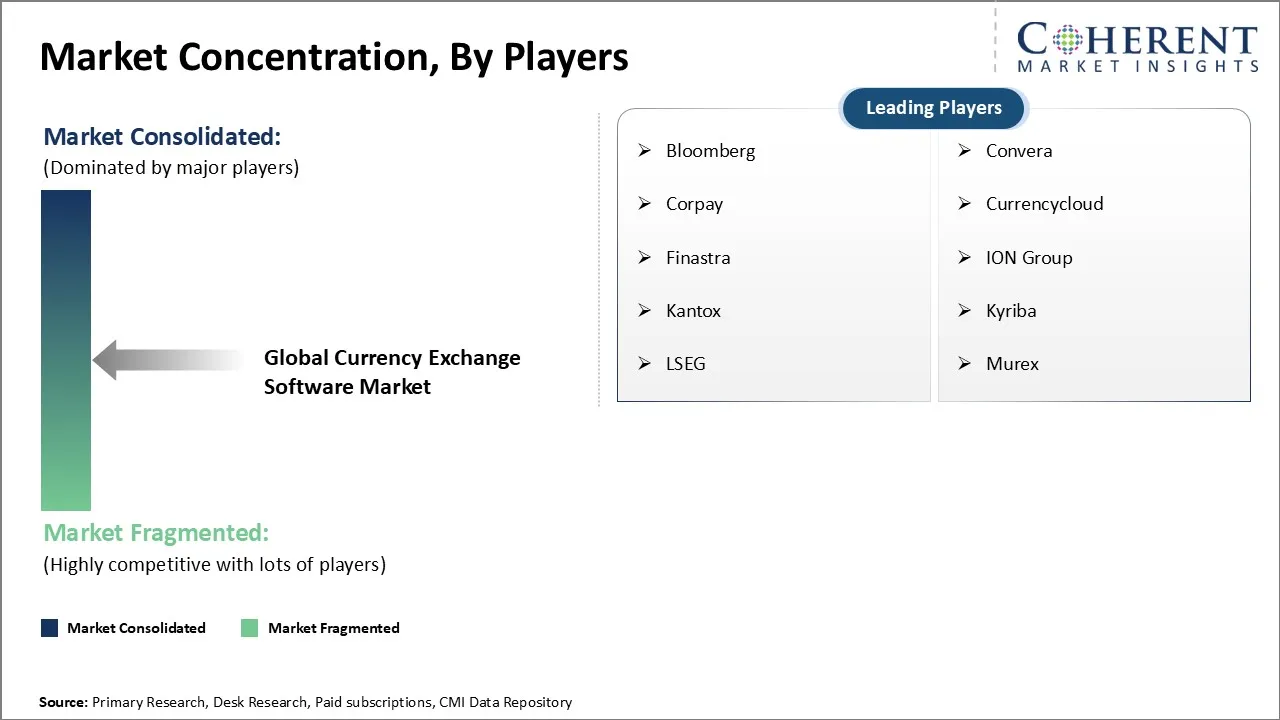
The market is shared between three groups that increasingly work together. Trading and dealing platform operators such as Bloomberg and LSEG provide the venues and workflows through which currencies are quoted and executed. Cross-border payment and embedded FX providers such as Convera, Corpay and Currencycloud sell conversion and payment services to businesses, banks and fintechs through APIs and online platforms. Treasury and FX risk software vendors such as ION Group, Kantox, Kyriba, Murex and Teciem supply the systems that measure exposure, run hedging programs and record trades for banks and corporates. Competition centers on pricing speed, breadth of liquidity connections, integration with banks and ERP systems, depth of hedge accounting, and compliance coverage across jurisdictions. Long implementation cycles and deep integration with customers’ core systems make it hard for new entrants to displace established vendors.
Top Companies and Notable Products in the Currency Exchange Software Market
Company | Notable Product | Key Features |
Bloomberg | FXGO | Multi-bank FX trading solution for streaming or request-for-quote trading in spot, outrights, swaps, non-deliverable forwards, deposits and options, with an FX Options RFQ API for programmatic execution |
Convera | Convera FX and cross-border payments platform | B2B payments with forward contracts, FX options and FX swaps, plus multi-currency balances and an API for embedded payments |
Corpay | Corpay Cross-Border | B2B cross-border payments and FX solutions for corporations and investment funds, extended by Alpha Group’s global bank accounts |
Currencycloud (Visa) | Currencycloud platform | API-based embedded FX platform with real-time notifications, multi-currency wallets and virtual account management for banks and fintechs |
ION Group | Wallstreet FX and Wallstreet Suite | Real-time FX front, middle and back-office processing, and an enterprise treasury management suite with a payment hub |
Market Report Scope
Currency Exchange Software Market | |||
Report Coverage | Details | ||
Base Year | 2025 | Market Size in 2026: | USD 2.44 Bn |
Historical Data For: | 2020 To 2024 | Forecast Period: | 2026 To 2033 |
Forecast Period 2026 To 2033 CAGR: | 12.1% | 2033 Value Projection: | USD 5.39 Bn |
Geographies covered: |
| ||
Segments covered: |
| ||
Companies covered: | Bloomberg, Convera, Corpay, Currencycloud, Finastra, ION Group, Kantox, Kyriba, LSEG, Murex | ||
Growth Drivers: |
| ||
Restraints & Challenges: |
| ||
Analyst Opinion (Expert Opinion)
- Software leads, but integration and compliance decide the wins. Software holds 63.4% of component spending in 2026, on-premises deployment holds 54.7% of the deployment segment, large enterprises hold 67.3% of the enterprise size segment and the BFSI segment holds 44.7% of the end user segment. Buyers in these segments choose platforms that connect cleanly to their core banking, ERP and payment systems, so the contest is mostly won in multi-year sourcing decisions. Vendors that combine real-time pricing, hedge automation and compliance reporting in one validated package are best placed for those awards.
- Growth is strongest where trade and payments are speeding up, and two risks remain. North America holds 36.2% of the market in 2026, while Asia Pacific grows fastest as trade and regional FX trading expand. The first risk is the high cost and effort of connecting FX platforms to legacy core banking and ERP systems. The second is fragmented licensing, anti-money laundering and data-residency rules, which lengthen deployment cycles across jurisdictions. Vendors with proven integration toolkits and local compliance coverage are the least exposed to both.
Speak to the analyst
Want personalized insights?
Take the findings above to one of our principal consultants, or have the report rebuilt around the segments, geographies and competitors you actually track.
Market Segmentation
- Component Insights (Revenue, USD Billion, 2021 - 2033)
- Software
- Services
- Deployment Insights (Revenue, USD Billion, 2021 - 2033)
- On-Premises
- Cloud-Based
- Enterprise Size Insights (Revenue, USD Billion, 2021 - 2033)
- Large Enterprises
- Small and Medium-sized Enterprises (SMEs)
- End User Insights (Revenue, USD Billion, 2021 - 2033)
- Banking, Financial Services and Insurance (BFSI)
- Travel and Tourism
- Retail
- Hospitality
- Others
- Regional Insights (Revenue, USD Billion, 2020 - 2033)
- North America
- U.S.
- Canada
- Latin America
- Brazil
- Argentina
- Mexico
- Rest of Latin America
- Europe
- Germany
- U.K.
- Spain
- France
- Italy
- Russia
- Rest of Europe
- Asia Pacific
- China
- India
- Japan
- Australia
- South Korea
- ASEAN
- Rest of Asia Pacific
- Middle East
- GCC Countries
- Israel
- Rest of Middle East
- Africa
- South Africa
- North Africa
- Central Africa
- North America
- Key Players Insights
- Bloomberg
- Convera
- Corpay
- Currencycloud
- Finastra
- ION Group
- Kantox
- Kyriba
- LSEG
- Murex
Sources
- Primary Research Interviews
- Bank and Broker FX Dealing and Treasury Technology Heads
- Corporate Treasurers and Treasury Technology Managers
- FX Software, Pricing Engine and API Vendors
- Payment Institution and Fintech Product Leaders
- Exchange Bureau and Travel Money Operators
- Magazines
- Finextra
- Treasury Today
- Risk.net
- FX Markets
- The Paypers
- Journals
- Journal of International Money and Finance
- Journal of Banking & Finance
- Journal of Financial Markets
- Journal of International Financial Markets, Institutions and Money
- Associations
- Global Foreign Exchange Committee (GFXC)
- Association for Financial Professionals (AFP)
- Association of Corporate Treasurers (ACT)
- European Association of Corporate Treasurers (EACT)
- FIX Trading Community
- Public Domain Sources
- Bank for International Settlements: Triennial Central Bank Survey 2025, media release of September 30, 2025, and BIS Quarterly Review, December 2025
- World Trade Organization: Global Trade Outlook and Statistics, March 2026 and October 2026
- Financial Stability Board: G20 Roadmap for Enhancing Cross-border Payments, consolidated progress report, November 16, 2026
- Swift: press release on the completion of the ISO 20022 switch for cross-border payments, November 25, 2025
- European Union: Regulation (EU) 2024/886 (Instant Payments Regulation) and European Central Bank implementation deadlines
- Global Foreign Exchange Committee: FX Global Code
- Company annual reports, regulatory filings and investor materials (LSEG, Corpay)
- Company press releases and newsrooms
- Proprietary Elements
- CMI Data Analytics Tool
- Proprietary CMI Existing Repository of information for last 10 years
Get access to 250+ pages report
Every segment, forecast, competitor profile and data table behind the analysis above — available for instant download.
- ESOMAR Member
- ISO 9001:2015 Certified
- D-U-N-S Registered
- GDPR & CCPA Compliant
Frequently Asked Questions
The global currency exchange software market is valued at USD 2.44 Bn in 2026 and is expected to reach USD 5.39 Bn by 2033.
The CAGR of the global currency exchange software market is projected to be 12.1% from 2026 to 2033.
Rising cross-border trade and instant payments that push banks and fintechs to adopt real-time FX pricing engines, and corporate treasuries automating hedging to manage currency volatility, are the major factors driving market growth.
The high integration cost and effort of connecting FX platforms to legacy core banking and ERP systems, and fragmented licensing, anti-money laundering and data-residency rules that lengthen compliance and deployment cycles across jurisdictions, are the major factors hampering market growth.
In terms of component, software is expected to dominate the market, with a revenue share of 63.4% in 2026.
It is software that quotes, executes, records and settles conversions between currencies. Banks, brokers, payment providers, corporate treasuries and exchange bureaus use it to price currencies, trade, hedge exposure and reconcile payments.
A typical deployment combines application and database servers, network links to market data feeds and liquidity providers, and secure storage for credentials and keys. Cloud deployments run the same functions on cloud infrastructure. Where the software runs at a counter, such as an exchange bureau, it also connects to point-of-sale terminals, ID scanners and cash-handling equipment.