

Global Customer Success Platform Market Size and Forecast – 2026 To 2033
The global customer success platform market is expected to grow from USD 3.40 Bn in 2026 to USD 14.00 Bn by 2033, registering a compound annual growth rate (CAGR) of 12% from 2026 to 2033. The global customer success platform market is driven by increasing need for proactive churn prediction. On October 14, 2025, Movate announced a strategic partnership with Reef.ai to accelerate Net Revenue Retention (NRR) growth. The partnership combines Movate’s outcome-driven sales services with Reef.ai’s explainable, back tested AI models to help enterprises achieve sustainable NRR growth and evolve churn prevention into a proactive revenue intelligence system.
Key Takeaways of the Global Customer Success Platform Market
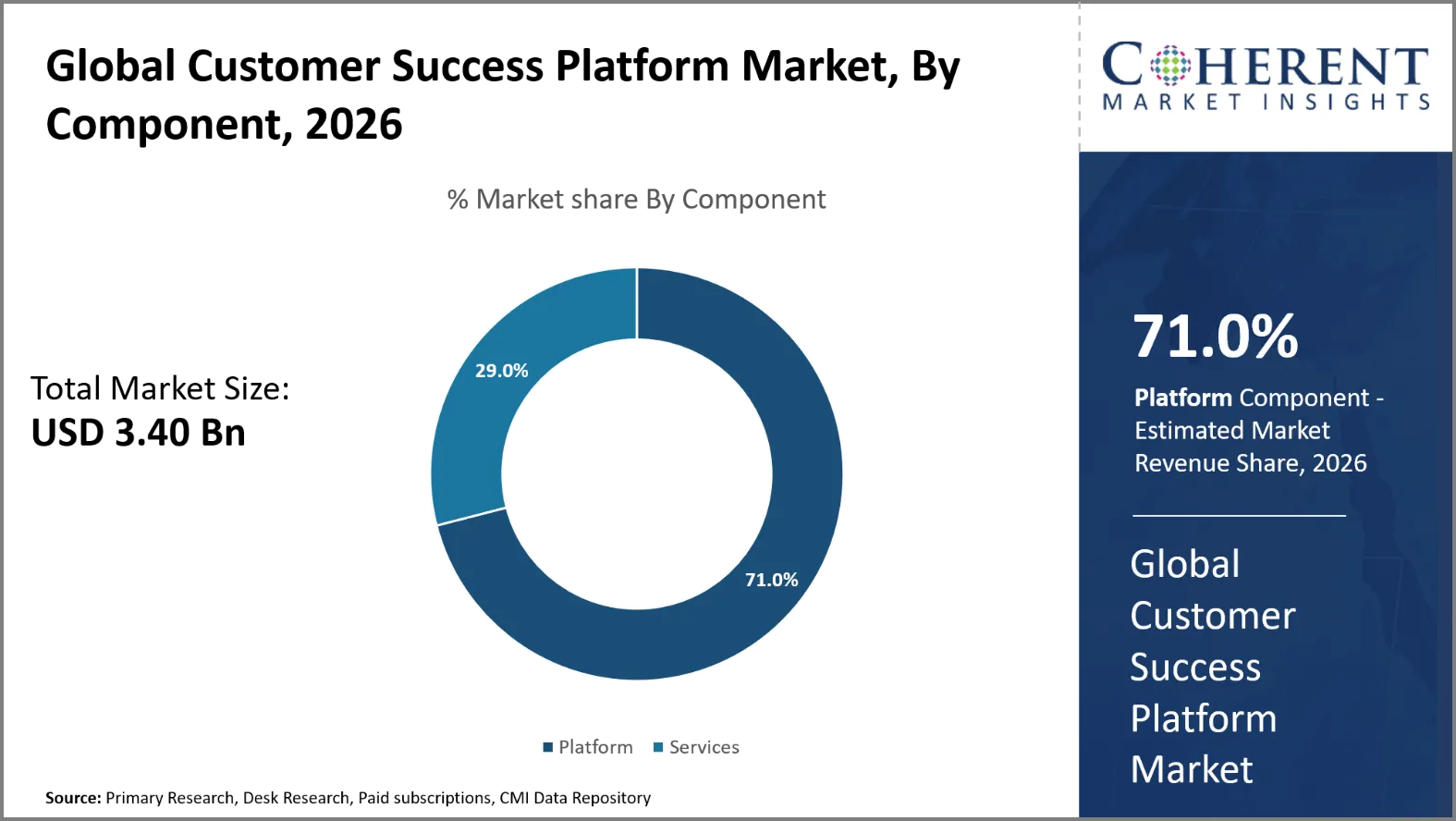
- The Platform segment is expected to account for 71.0% of the global customer success platform market share in 2026. Growing demand for customer health monitoring is driving the growth of the segment. In June 2026, ClientSuccess introduced SuccessScore profiles. SuccessScore allows different health-scoring profiles for different customer types.
- The Cloud segment is estimated to capture 66.0% of the market share in 2026. Rising adoption of AI-enabled customer engagement is majorly driving the growth of the segment. In April 2025, Google Cloud introduced its next-generation Customer Engagement Suite capabilities. The platform added advanced generative and agentic conversational capabilities.
- The Customer Experience Management segment is estimated to capture 41.0% of the market share in 2026. Increasing focus on customer lifetime value is driving the growth of the segment. On September 17, 2026, Insider One launched Agent, an autonomous agents support customer engagement through proactive decisions and personalized interactions.
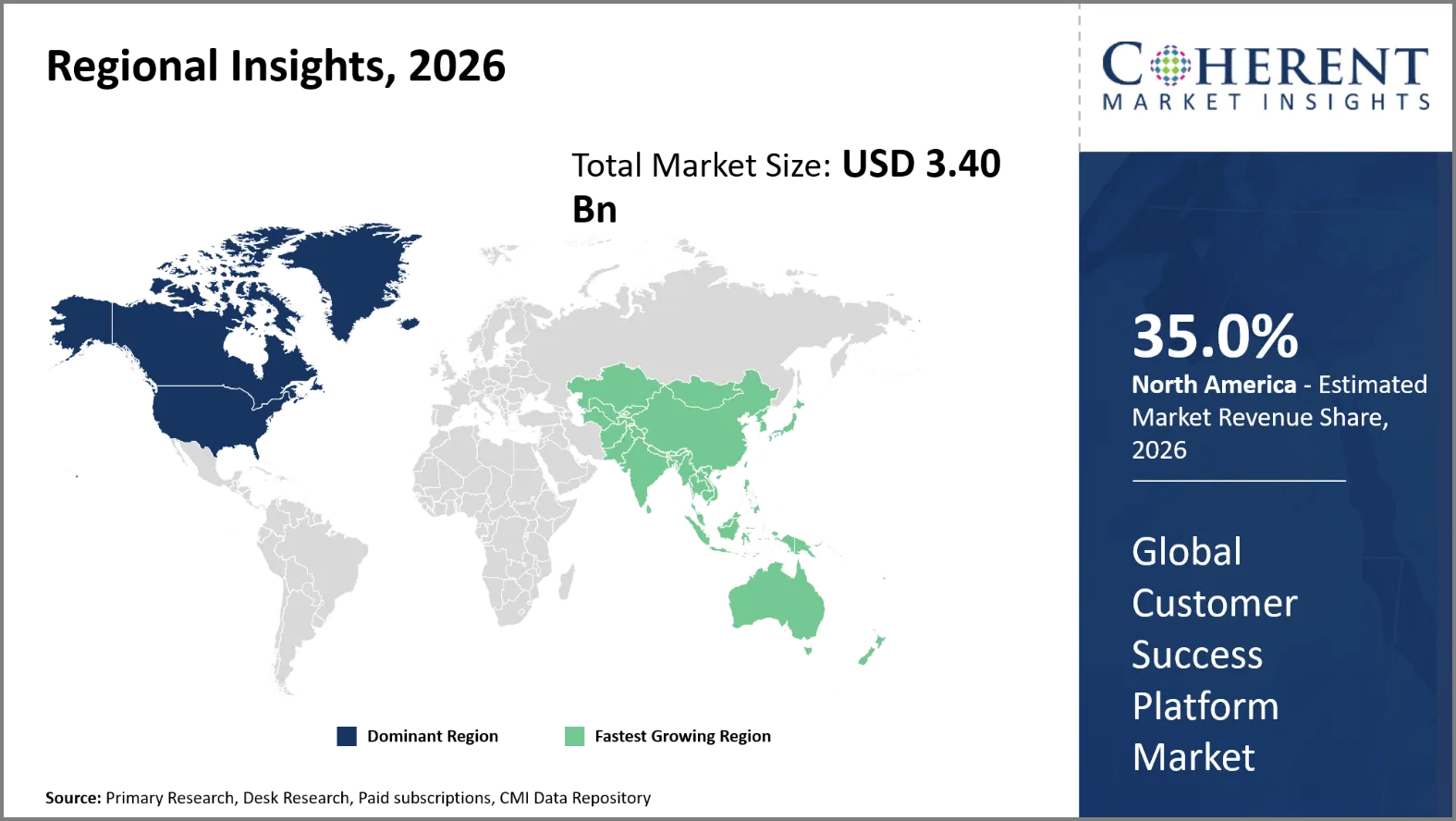
- North America is expected to dominate the customer success platform market in 2026 with a market share of 35.0%. Growing integration with customer relationship management systems in North America is driving the growth of the regional market. In June 2026, ClientSuccess upgraded its integration architecture. The company introduced a new Workato-powered integration platform for CRM connections.
- Asia Pacific is expected to account for 24.0% share in 2026. Rising demand for automated onboarding and renewal workflows in Asia Pacific is driving the growth of the regional market. On September 7, 2026, Zoho introduced expanded cross-team CRM workflows in Asia Pacific. Its CRM for Everyone connects sales, onboarding, consulting, legal, and finance activities.
Segmental Insights
Why Does Platform Dominate the Global Customer Success Platform Market?
The platform segment is expected to account for 71.0% of the global customer success platform market share in 2026. Businesses want a unified platform to run customer connections and customer success activities. These platforms provide integrated environments to track customer health, engagement, analytics, automation and workflow management. They help customer success teams surface adoption challenges, churn risks and expansion opportunities sooner. Integration with customer relationship management, billing, support and product analytics platforms can improve operational visibility.
On May 28, 2025, Gainsight, the retention engine powering the world’s most customer-centric companies, announced the launch of Atlas. Atlas is a new generation of AI agents purpose-built to help companies guide their customers from onboarding to outcomes, with intelligence, personalization, and scale.
- Current Industry Events of 2026
- Market Size Estimation
- Regional Breakdown
- Competitive Landscape
- Customer Intelligence
- Segmental Analysis
- Pricing Analysis
- Key Market Drivers, Challenges & Future Trends
- Customized Insights Section
Why is Cloud the Most Preferred Deployment Type?
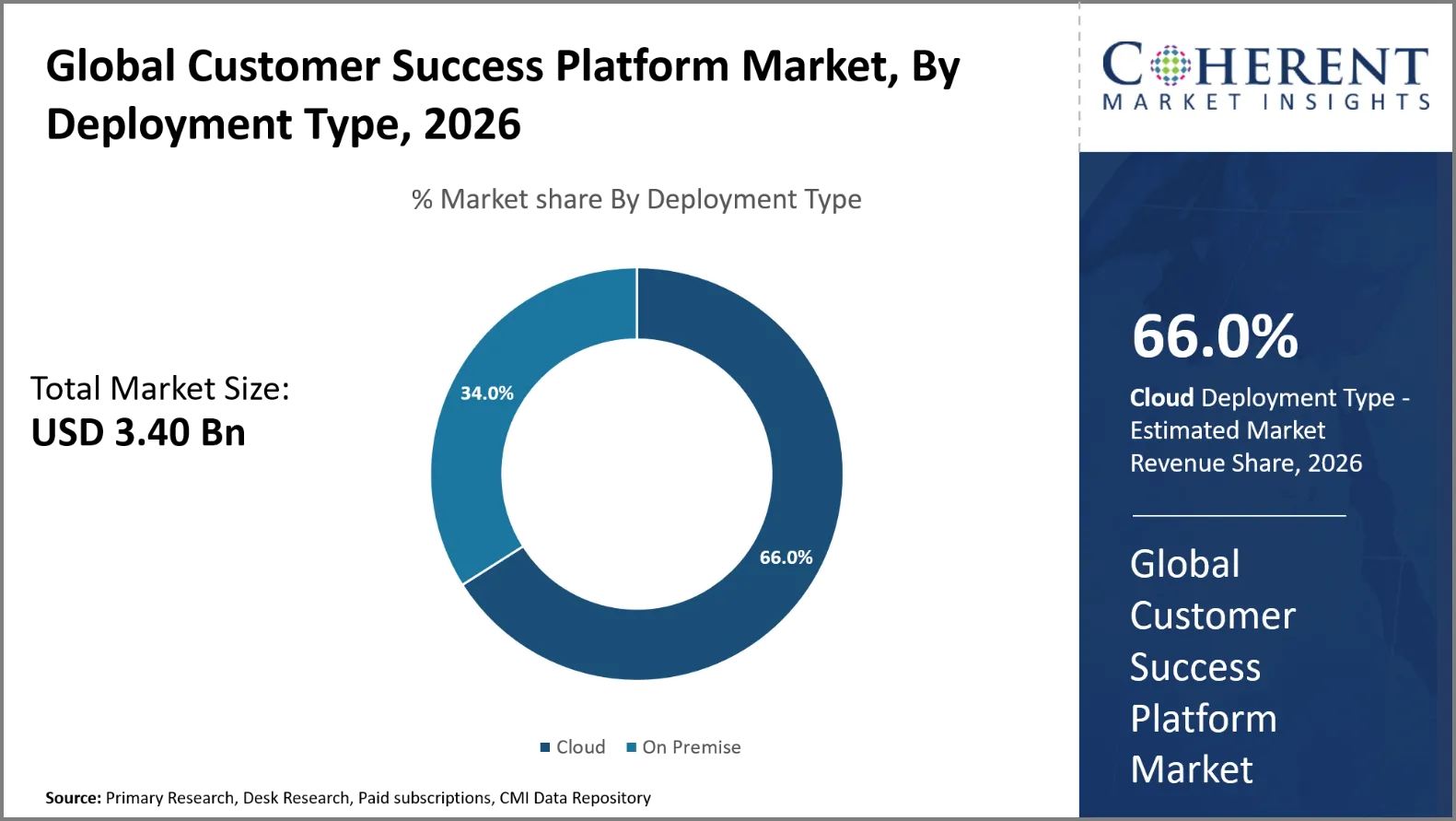
The cloud segment is expected to account for 66.0% of the global customer success platform market share in 2026. Cloud reduces infrastructure needs and makes it easier to deploy the customer success platform. Cloud systems can be used by enterprises across disparate teams and do not require any particular equipment. Cloud deployment enables speedier software updates, so security and features may be added quickly. Subscription based pricing allows for more flexibility in the handling of technology costs. Cloud platforms support other cloud-based corporate applications as well. For instance, Planhat expanded its cloud customer platform with broader artificial intelligence capabilities during 2025. The company developed configurable artificial intelligence workflows for customer experience operations. Its approach combines customer data, automation, analytics, and artificial intelligence within one cloud environment.
Customer Experience Management Dominates the Global Customer Success Platform Market
The customer experience management segment is expected to account for 41.0% of the global customer success platform market share in 2026. Customer experience management is king as firms increasingly focus on end-to-end customer journey visibility. Businesses need a synchronized view across onboarding, product usage, support calls, engagement and renewal activity. Customer experience management technologies collect these discussions and surface friction points across customer journeys. This allows organizations to tailor engagement based on consumer behavior, demands and account attributes.
On March 26, 2025, Zendesk announced the debut of Zendesk Resolution Platform at its annual Relate conference, designed to redefine the customer experience. This platform comes with a set of advanced technologies that connect the Zendesk AI Agents, actions and integrations, governance and control, and measurement and insights.
Current Events and their Impact
Current Events | Description and its Impact |
European Union Artificial Intelligence Act Regulation (EU) 2024/1689 |
|
European Union General Data Protection Regulation (EU) 2016/679 |
|
Customer Success Platform Market Dynamics
Market Drivers
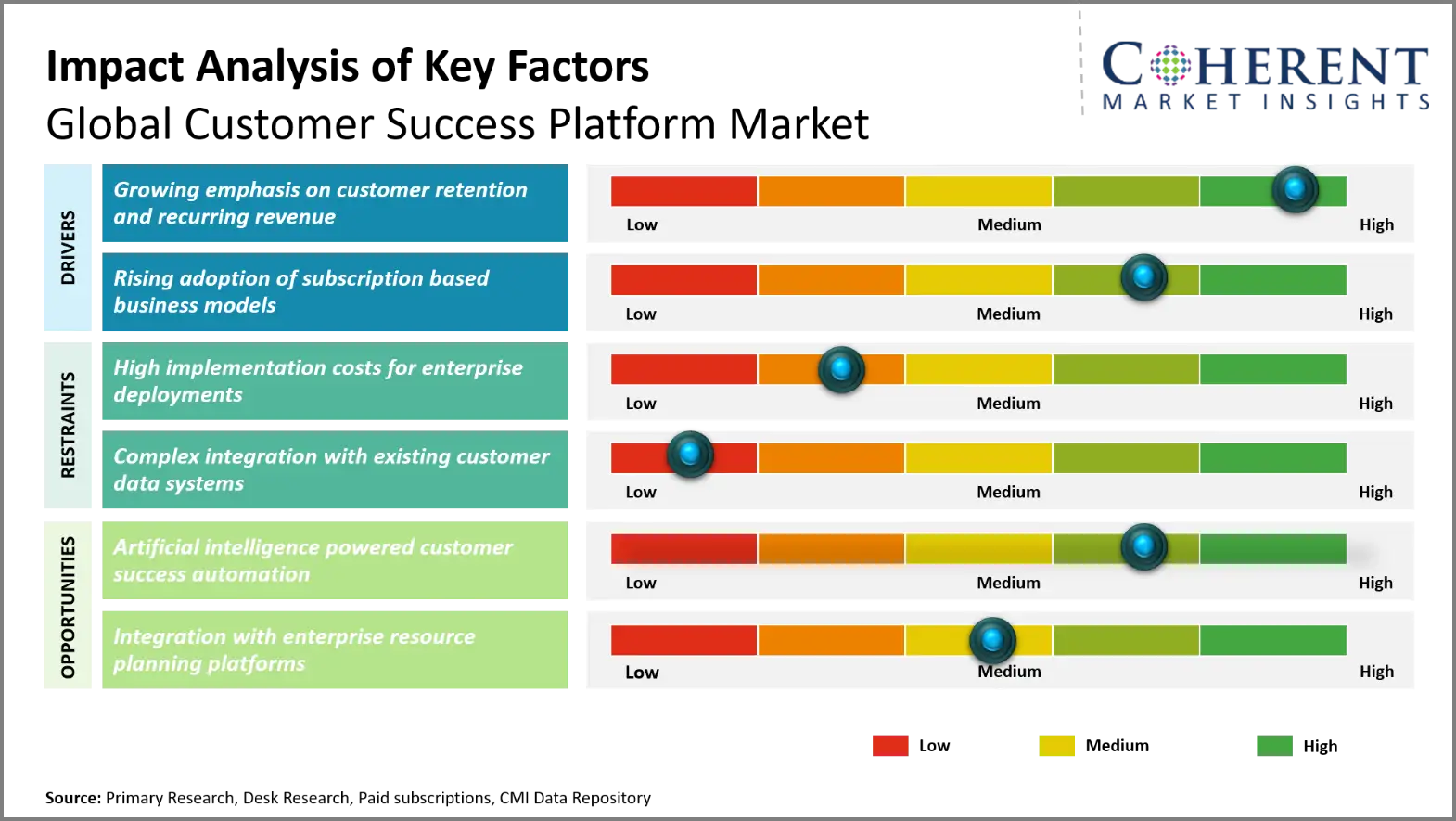
Growing emphasis on customer retention and recurring revenue
There is a move toward customer retention and recurrent streams of revenue as recurring customers offer more dependable revenue sources and long-term relationships. Customer success platforms let businesses monitor consumer contact, satisfaction, product adoption, and account health. These tools allow businesses to identify declining engagement and solve consumer issues sooner. Cross-selling, up-selling and contract renewals through retention-oriented strategies can fuel expansion chances. As companies focus more strongly on customer lifetime value, demand for customer success platforms continues increasing.
On May 6, 2025, ChurnZero launched Services Suite, a new professional services offering to help ChurnZero customers execute and scale their retention and revenue strategies faster. Staffed by in-house advisors from ChurnZero’s award-winning customer experience team, Services Suite offers substantial, hands-on assistance with customer success strategy, operations, and execution.
Rising adoption of subscription-based business models
Growing acceptance of subscription-based business models is driving the demand for customer success platforms across a range of industries. In the case of subscription businesses, the revenue will come from renewals, not single purchases, therefore it’s important to keep customers engaged. Customer success solutions enable firms to track usage trends, onboarding progress, satisfaction levels and renewal indicators. Automation processes will help communicate at the right moment, in the right way, during the lifetime of the subscription. These capabilities enable companies to manage recurring client interactions and uncover chances for retention and account expansion.
On February 18, 2026, Snap shared that its direct revenue category surpassed a USD 1 billion annualized revenue run rate. The milestone is supported by Snap’s global subscription community of over 25 million members.
Emerging Trends
- Artificial Intelligence Driven Customer Success: Customer success platforms are increasingly turning to artificial intelligence for predictive churn detection, client health score, automated suggestions and tailored interaction. These features enable teams to recognize emerging client threats, prioritize accounts and automate repetitive processes across complicated customer portfolios.
- Predictive Customer Health Analytics: Platforms increasingly combine product usage, support interactions, engagement patterns and account information to build dynamic customer health profiles. Predictive analytics might help customer success teams recognize diminishing engagement sooner and take particular action before renewal problems become severe.
- Automated Customer Journey Management: Growing automation of onboarding, product uptake, engagement, renewal and growth processes. Automated workflows that activate interactions and activities based on customer behavior, lifecycle stages, use patterns and pre-determined business scenarios are becoming a fast-growing trend in customer success systems.
- Integration With Revenue Operations: Customer success platforms are more and more integrated with customer relationship management, sales, marketing, billing, support and product analytics systems. These interfaces enable wider customer visibility and assist firms align retention, growth, renewal and revenue generating initiatives across departments.
Regional Insights
Why is North America a Strong Market for Customer Success Platform?
North America is expected to account for a market share of 35.0% in 2026. North America has a robust customer success practice in the subscription software and technology businesses. Gainsight found that 89% of North American firms planned to focus on gross revenue retention in 2024. More than half of surveyed firms worldwide have included artificial intelligence into their customer success procedures. Gainsight said use of digital customer success is up 15% year over year. More than 400 firms and customer success professionals have been part of its research through 2025. Artificial intelligence, automation and scalable interaction were among top priorities for customer success teams, according to Gainsight. These developments support demand for platforms that unify retention analytics, health scoring, digital engagement, and expansion workflows.
Why Does Asia Pacific Customer Success Platform Market Exhibit High Growth?
Asia Pacific is expected to register the fastest growth with a CAGR of 12.6% over the forecast period. Asia Pacific is projected to account for 24.0% of the global customer success platform market in 2026. Asia Pacific is growing with rapid use of artificial intelligence, digital payments and enterprise digitalization. A good example in the region is Singapore, where 95.1% of small and medium firms will use at least one digital space in 2024. The usage of artificial intelligence among small and medium-sized firms in Singapore rose from 4.2% to 14.5%. Non-small and medium firms boosted their adoption from 44% to 62.5%. Artificial intelligence was most commonly applied to information technology, customer service, and finance functions. Singapore also supported more than 7,200 businesses adopting integrated artificial intelligence and cloud solutions.
Global Customer Success Platform Market Outlook for Key Countries
Why is U.S. Emerging as a Major Hub in the Customer Success Platform Market?
Subscription software firms are increasingly looking at retention and growth revenue, making the U.S. a key customer success technology base. Approximately 40% of software-as-a-service revenue is derived from renewals and expansion as reported by Gainsight. HubSpot had 288,706 clients as of December 2025, a 16% increase year-over-year. HubSpot also said it saw more use of artificial intelligence across its customer platform. Gainsight’s 2025 customer success research found three trends: artificial intelligence usage, digital engagement and revenue accountability. This requires automated health scoring, renewal forecasting, client involvement, and expansion management.
Is Japan the Next Growth Engine for the Customer Success Platform Market?
Japan offers a unique development opportunity with the movement of digital transformation of organizations to customer and market results. A recent study by the Information-technology Promotion Agency, Digital Transformation Trends 2025, compared firms in Japan, the U.S. and Germany. More than 80% of organizations in the U.S. and Germany said they had achieved digital transformation results in the poll, compared to less than 60% of Japanese enterprises. Japanese enterprises placed more attention on cost reduction and shorter service delivery intervals. The Information-technology Promotion Agency has flagged the insufficient measurement of digital transformation outcomes as a key Japanese concern. Customer success solutions can help bridge this gap by tracking customer happiness and measuring outcomes.
U.K. Customer Success Platform Market Analysis and Trends
The U.K. customer success platform market benefits from strong small and medium enterprise digital adoption and expanding cloud infrastructure. A 2025 technology adoption analysis by the U.K. Government concluded that businesses want reliable and individualized help when they adopt digital technology. The Small and Medium Enterprise Digital Adoption Taskforce recognized cloud computing and customer relationship management software as critical productivity tools. The U.K. 2026 According to the Business Data Survey, 31% of organizations used public cloud providers in 2025 and 2026. And a further 22% used third-party software or web solutions for data infrastructure. These characteristics are fueling customer success software adoption in digitally active enterprises.
Germany Customer Success Platform Market Analysis and Trends
Germany offers growth opportunities because enterprise cloud adoption is increasingly embedded across large and mid-sized businesses. The Federal Statistical Office reported that 54% of German enterprises with at least 10 employees purchased cloud services in 2025. Among the companies surveyed, 23% of their use of cloud services was for customer relationship management applications. Information and communication companies had adopted cloud at an 88% rate. These patterns build infrastructure preparedness for customer success platforms, especially for large companies looking for integrated customer data, analytics, and engagement workflows.
Canada Customer Success Platform Market Analysis and Trends
The expansion of Canada’s customer success platforms is intimately tied to software subscription activities and the deployment of artificial intelligence. Statistics Canada stated that software publishers produced CAD 27.9 billion in operating income in 2024. Sales of software publishers generated 57.3% of revenue online, indicating a heavy reliance on online subscription and licensing arrangements. Artificial intelligence adoption also rose with 12.2% of Canadian enterprises employing artificial intelligence during 2025. Among the firms that used them, 40.1% created new workflows, and 25.7% bought cloud services or storage. These developments support demand for customer health analytics, workflow automation, and artificial intelligence enabled customer engagement.
Global Customer Success Platform Market - Customer Retention Rate By Industry (2025):
Industry | Customer Retention Rate |
B2B SaaS and Software | 90% |
Insurance | 83% |
Information Technology Services | 81% |
Financial Services | 78% |
Telecommunications | 78% |
Healthcare | 77% |
Banking | 75% |
Retail | 63% |
Hospitality and Travel | 55% |
Ecommerce | 30-40% |
How is Artificial Intelligence Powered Customer Success Automation New Growth Opportunities in the Customer Success Platform Market?
Artificial intelligence powered customer success automation is creating new growth opportunities by shifting platforms from passive dashboards toward autonomous customer engagement and renewal workflows. Gainsight found that 52% of customer success teams included artificial intelligence into their workflows, and automation enabled teams to save more than 10 hours per week by automating processes like data entry and churn detection. In 2025, Gainsight released Atlas which included agents for adoption, risk spotting, community moderating, and renewal management. Its Staircase AI Agent looks for hidden hazards and sentiment in emails, meetings, Slack interactions, product usage and support tickets. The company also rolled out a Renewal AI Agent to provide individualized engagement for long-tail accounts. These developments expand addressable demand for automated risk detection, renewal execution, personalized outreach, and digital customer success at scale.
On June 25, 2026, Salesforce announced it is launching Agentforce Help Agent, an autonomous service agent with guided setup that’s deployable in minutes across all channels. Built on the Agentforce 360 Platform, the Help Agent is designed helping enterprises to resolve their customer issues from start to finish, on day one.
Market Players, Key Development, and Competitive Landscape
Key Developments
- On October 9, 2025, ChurnZero, the platform and partner for customer growth, announced a suite of autonomous AI Agents that empower customer teams to scale their impact exponentially without adding headcount. Unveiled at ChurnZero’s ZERO-IN 2025 conference in Chicago, U.S., ChurnZero AI Agents act as digital teammates that can engage every customer, automate the tasks that slow people down, and execute around the clock on every risk or opportunity.
- On July 15, 2025, Vitally announced the launch of Vitally AI, the purpose-built AI for delivering scaled Customer Success. Vitally AI takes the guesswork out of customer success with a purpose-built solution. It’s a personal AI Copilot that creates clarity from complexity and serves up the insights as and when needed.
- On January 14, 2025, ClientSuccess announced the acquisition of Product Signals, a cutting-edge platform for product feedback and feature request management. This acquisition represents a key step in its evolution from a legacy CSP to a next-gen platform, offering a fully integrated suite of solutions that unites post-sales.
Competitive Landscape
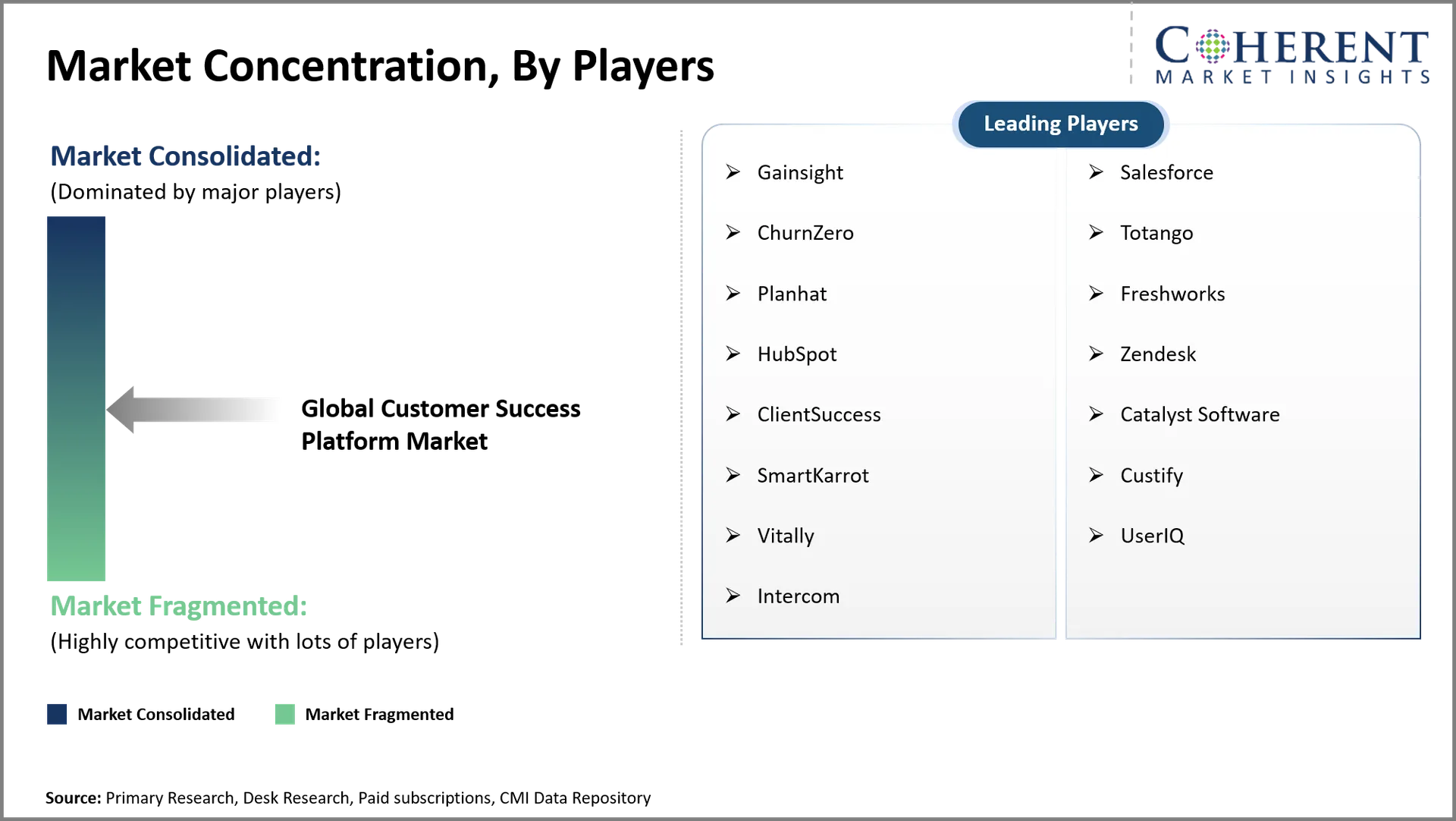
Leading players are steering customer success systems toward artificial intelligence, agentic automation, and revenue-driven processes. Gainsight is expanding its Atlas platform to include adoption, risk identification, renewals and client interaction. Its Staircase AI Agent monitors emails, meetings, Slack chats, product usage and support tickets. Gainsight also announced a Renewal AI Agent for long-tail consumer segments. Salesforce is bringing its customer success capabilities together with Agentforce, Data Cloud and its larger customer platform. Agentforce 3 added agent observability, open-standard interoperability, and more than 100 industry actions. Totango is focusing on customer-led growth, value realization, artificial intelligence, and post-sale revenue intelligence. Its strategy also emphasizes pricing aligned with revenue under management.
Market Report Scope
Report Coverage | Details | ||
Base Year | 2025 | Market Size in 2026: | USD 3.40 Bn |
Historical Data For: | 2020 To 2024 | Forecast Period: | 2026 To 2033 |
Forecast Period 2026 To 2033 CAGR: | 12% | 2033 Value Projection: | USD 14.00 Bn |
Geographies covered: |
| ||
Segments covered: |
| ||
Companies covered: | Gainsight, Salesforce, ChurnZero, Totango, Planhat, Freshworks, HubSpot, Zendesk, ClientSuccess, Catalyst Software, SmartKarrot, Custify, Vitally, UserIQ, Intercom | ||
Growth Drivers: |
| ||
Restraints & Challenges: |
| ||
Analyst Opinion (Expert Opinion)
- The future of customer success platforms will center on agentic systems that execute defined workflows, rather than simply displaying customer health information. Platforms will increasingly connect product usage, support interactions, engagement signals, and renewal processes within unified operating environments. The strongest product evolution will involve human-supervised agents handling repetitive customer journeys. Human teams can then concentrate on complex negotiations, strategic adoption, and executive relationships. This shift will make automation depth a major product differentiation factor.
- The largest opportunity should emerge in platform-based solutions serving recurring-revenue businesses. Application opportunities will be strongest in renewal management, churn prevention, onboarding, product adoption, and expansion identification. Long-tail customer segments offer particularly significant automation potential because individual human engagement becomes difficult at scale. Country-level opportunities should remain substantial in the U.S., Canada, U.K., Germany, Japan, and India. They tap into established software ecosystems and increasing need for customer retention and digital engagement.
- Market players looking for an edge should design specialized AI agents around measurable client workflows rather than providing generic chatbot functionality. Product architecture should be able to incorporate customer data from customer relationship management, product analytics, support, billing, and communication systems. vendors should also have clear permission controls, audit logs, security rules and human escalation paths. Another potential competitive path is deeper artificial intelligence capabilities for customer success workflows, as demonstrated by Gainsight’s acquisition of UpdateAI.
Speak to the analyst
Want personalized insights?
Take the findings above to one of our principal consultants, or have the report rebuilt around the segments, geographies and competitors you actually track.
Market Segmentation
- Component Insights (Revenue, USD Billion, 2021 - 2033)
- Platform
- Services
- Deployment Type Insights (Revenue, USD Billion, 2021 - 2033)
- Cloud
- On Premise
- Application Insights (Revenue, USD Billion, 2021 - 2033)
- Customer Experience Management
- Sales and Marketing Management
- Risk and Compliance Management
- Others
- End User Insights (Revenue, USD Billion, 2021 - 2033)
- IT and Telecommunications
- BFSI
- Healthcare
- Retail
- Government
- Others
- Regional Insights (Revenue, USD Billion, 2021 - 2033)
- North America
- U.S.
- Canada
- Latin America
- Brazil
- Argentina
- Mexico
- Rest of Latin America
- Europe
- Germany
- U.K.
- Spain
- France
- Italy
- Russia
- Rest of Europe
- Asia Pacific
- China
- India
- Japan
- Australia
- South Korea
- ASEAN
- Rest of Asia Pacific
- Middle East
- GCC Countries
- Israel
- Rest of Middle East
- Africa
- South Africa
- North Africa
- Central Africa
- North America
- Key Players Insights
- Gainsight
- Salesforce
- ChurnZero
- Totango
- Planhat
- Freshworks
- HubSpot
- Zendesk
- ClientSuccess
- Catalyst Software
- SmartKarrot
- Custify
- Vitally
- UserIQ
- Intercom
Sources
Primary Research Interviews
- Customer Success Managers & Directors
- Software-as-a-Service (SaaS) Product Executives
- Chief Technology Officers (CTOs) & IT Decision Makers
- Enterprise Sales & Account Management Professionals
Magazines
- CRM Magazine
- SaaS Mag
- Customer Think Magazine
- Harvard Business Review (Technology Edition)
Journals
- Journal of Customer Relationship Management
- Journal of Business & Industrial Marketing
- International Journal of Information Management
Associations
- Customer Success Association (CSA)
- Software & Information Industry Association (SIIA)
- Technology Services Industry Association (TSIA)
- Cloud Software Association
Public Domain Sources
- U.S. Securities and Exchange Commission (SEC) Filings
- World Economic Forum (WEF) Reports
- National Institute of Standards and Technology (NIST)
- European Commission Digital Economy Reports
Proprietary Elements
- CMI Data Analytics Tool
- Proprietary CMI Existing Repository of Information for the Last 10 Years
Get access to 250+ pages report
Every segment, forecast, competitor profile and data table behind the analysis above — available for instant download.
- ESOMAR Member
- ISO 9001:2015 Certified
- D-U-N-S Registered
- GDPR & CCPA Compliant
Frequently Asked Questions
The global customer success platform market is expected to stand at USD 3.40 Bn in 2026 and is expected to reach USD 14.00 Bn by 2033.
The CAGR of the global customer success platform market is projected to be 12% from 2026 to 2033.
Growing emphasis on customer retention and recurring revenue and Rising adoption of subscription based business models are the major factors driving the growth of the global customer success platform market.
High implementation costs for enterprise deployments and Complex integration with existing customer data systems are the major factors hampering the growth of the global customer success platform market.
In terms of component, platform segment is estimated to dominate the market revenue share in 2026.
A customer success platform centralizes customer data, health monitoring, engagement workflows, analytics, and retention activities.
Companies use these platforms to improve customer adoption, retention, renewals, expansion, and relationship management.