

Dishwasher Rinse Surfactants Market Size and Share Analysis – 2026 To 2033
The global Dishwasher Rinse Surfactants Market is expected to grow at a CAGR of 6.5% from USD 140 Mn in 2026 to USD 217.6 Mn by 2033. The rising adoption of automatic dishwashers in residential and commercial sectors, increasing demand for low-foaming nonionic surfactants, growing focus on water-spot prevention and streak-free drying, and advancements in biodegradable and environmentally sustainable surfactant formulations are the key factors driving the growth of the market. Specialty nonionic surfactants, like alcohol alkoxylates, are used in automatic dishwashing rinse-aid formulations to improve wetting, water sheeting and drying performance, according to Stepan Company.
Key Takeaways of the Global Dishwasher Rinse Surfactants Market
- The Anionic Surfactants segment is anticipated to command an estimated 45.2% of the global dishwasher rinse surfactant market share in 2026. Increasing demand for laundry detergents, dishwashing products and industrial cleaning formulations is supporting the segment expansion. BASF’s Care Chemicals manufacturing data shows that the company has about 550,000 metric tons per year nameplate capacity for anionic surfactants across its global manufacturing network, indicating the industrial scale of these ingredients.
- The Household Detergents segment is estimated to account for a share of about 43.5% of the global dishwasher rinse surfactant market in 2026. The surfactant consumption is supported by increasing frequency of household cleaning and laundry consumption and demand for concentrated detergent formulations. U.S. retail sales of fabric care products were USD 18.5 billion and surface care products were USS 8.2 billion in 2025, the American Cleaning Institute reported Sept. 29, 2026. The numbers underscore the strong demand for household cleaning products based on surfactants.
- Asia Pacific is expected to lead the global dishwasher rinse surfactant market by 2026 with a market share of 38.5%. The regional demand is being supported by the expansion of manufacturing activities, the growing demand for personal care formulations and the increasing consumption of household detergents across China, India and Southeast Asia. BASF said on Nov. 19, 2025, it plans to boost production capacity for alkyl polyglucoside (APG) surfactants at its Bangpakong facility in Thailand to enhance supply in the region and address increasing demand for sustainable surfactants for home care, personal care and industrial applications.
- The North America dishwasher rinse surfactant market is projected to see significant growth in the global dishwasher rinse surfactant market over the forecast period, driven by the growing adoption of bio-based surfactants, sustainable cleaning formulations, and regional investments in manufacturing. The U.S. cleaning products industry generated USD 88.5 billion in direct economic output and supported nearly 125,000 jobs across its wider supply chain, according to a September 2026 report from the American Cleaning Institute.
Segmental Insights
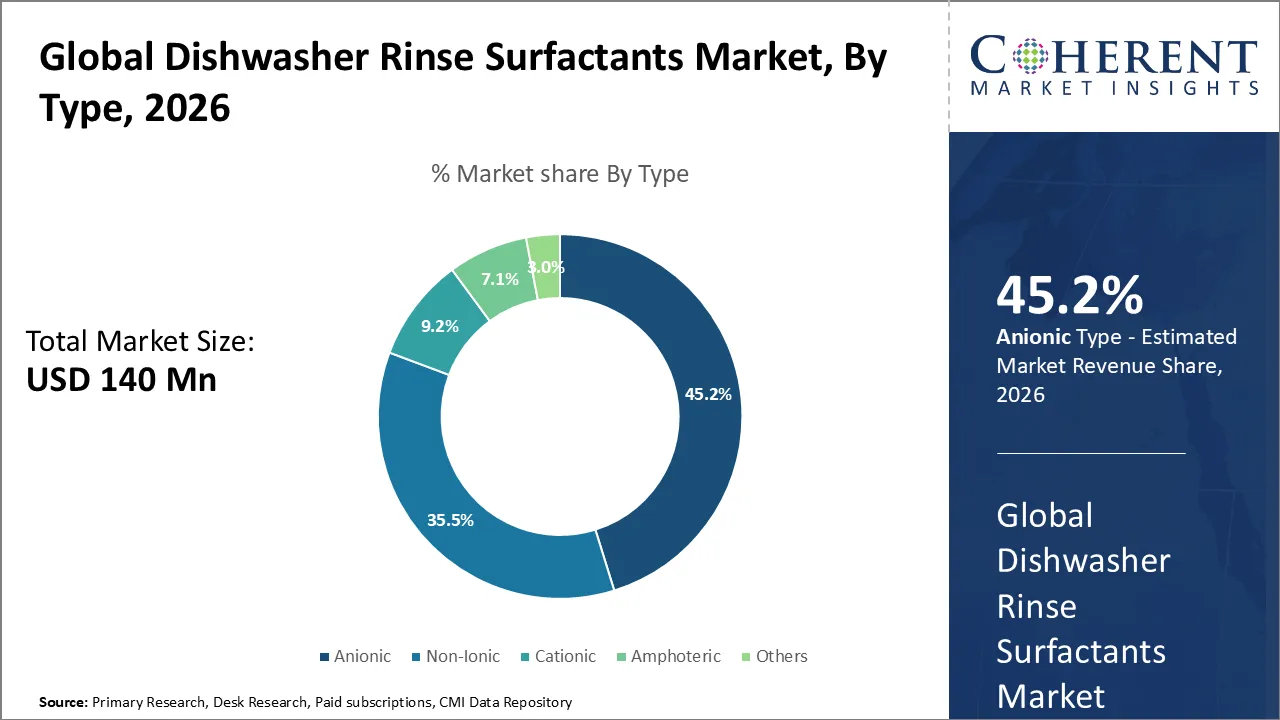
Why Do Anionic Surfactants Dominate the Global Dishwasher Rinse Surfactants Market?
The Anionic Surfactants segment is expected to account for approximately 45.2% of the global dishwasher rinse surfactant market share in 2026. The segment is growing on the back of increasing demand for low foaming cleaning formulations, enhanced drying performance and effective prevention of water spots. Fatty alcohol alkoxylates and ethoxylates are extensively favored in automatic dishwasher rinse aids because of their better foam-control, water-sheeting and wetting properties. These ingredients improve the drainage of water from glassware, dishes and utensils while reducing the formation of residue. Increasing demand for energy-efficient dishwashing, biodegradable ingredients and high-performance rinse-aid formulations is further aiding their adoption.
In its 2025 Industrial and Institutional Product Guide, BASF identified a number of specialty surfactants suitable for rinse-aid and commercial warewashing applications. The company recommends its Dehypon LT 104 L, a low foaming nonionic surfactant based on C12-C18 fatty alcohol ethoxylates for automatic dishwasher rinse aids and foodservice and institutional kitchen hygiene.
- Current Industry Events of 2026
- Market Size Estimation
- Regional Breakdown
- Competitive Landscape
- Customer Intelligence
- Segmental Analysis
- Pricing Analysis
- Key Market Drivers, Challenges & Future Trends
- Customized Insights Section
Why Do Household Dishwasher Rinse Aids Represent an Important End-Use Segment?
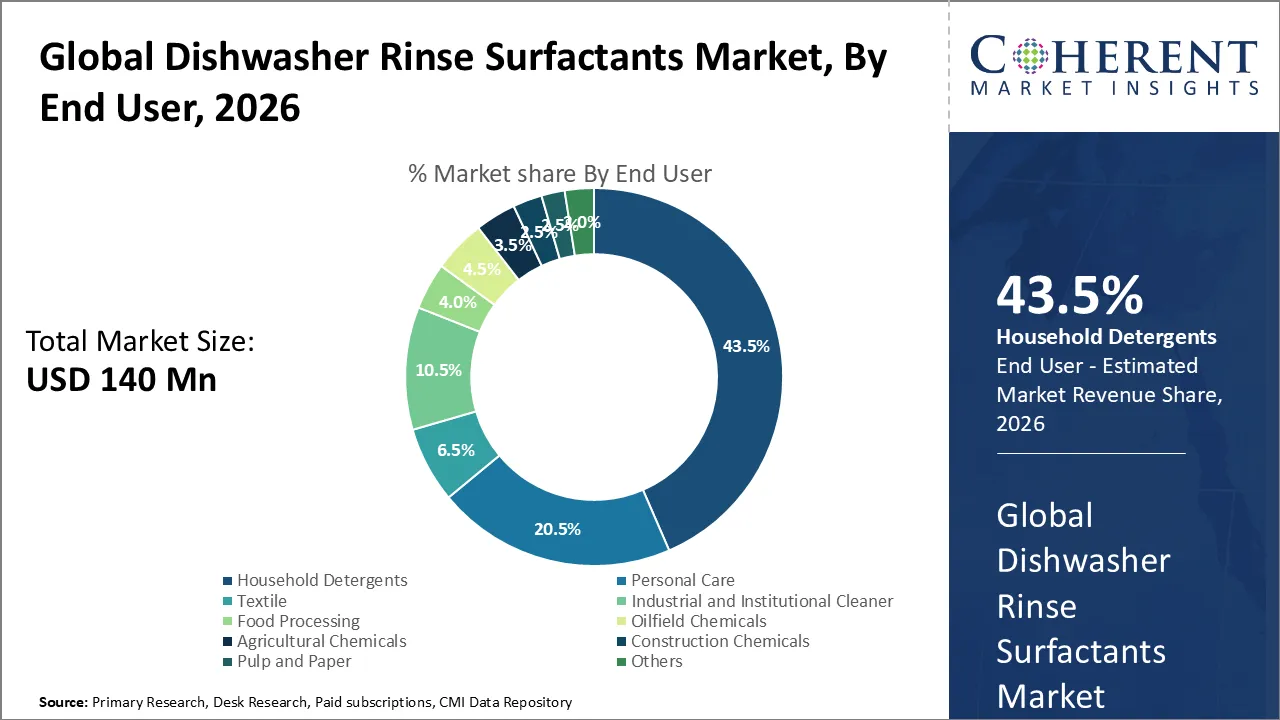
The household dishwasher rinse aids segment will hold a major application in the global dishwasher rinse surfactants market with a share of 43.5% in 2026. The segment is growing owing to the rising adoption of automatic dishwashers, demand for spotless glassware, and increasing consumer preference for convenient cleaning products. Household rinse aids employ specialty surfactants that reduce the surface tension of water and enhance its ability to dry quickly and reduce water spots and streaks. There is also an increasing demand for low-foaming surfactant formulations, due to the increased use of multi-purpose dishwasher detergents and specific rinse-aid products.
Stepan's current household rinse-aid portfolio includes MAKON NF-180, a defoaming nonionic surfactant designed to improve wetting and reduce spotting. Its detergent-drying rinse-aid formulation specifies 2.5% MAKON NF-180 by weight in a multifunctional automatic dishwashing powder. This demonstrates the use of specialty nonionic surfactants in household dishwasher formulations.
Dishwasher Rinse Surfactants Market Dynamics
Market Drivers
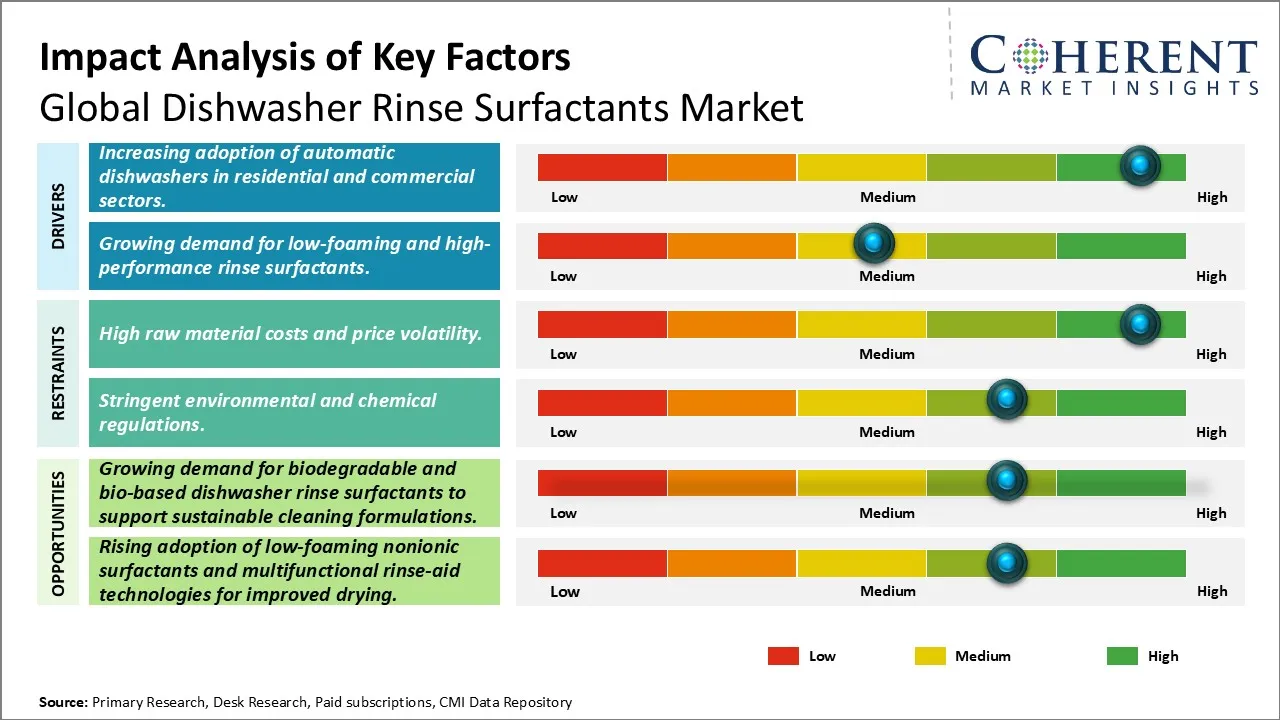
- Increasing penetration of automatic dishwashers in residential households: The demand for dishwasher rinse surfactants is increasing globally due to the increasing penetration of automatic dishwashers. The rising disposable income, changing lifestyle of consumers and increasing preference for convenient kitchen cleaning solutions are prompting households to replace manual dishwashing with automated appliances. In dishwashing, rinse surfactants are key ingredients for better water drainage, prevention of water spots, reduction of streaking and improved drying performance. Growing penetration of dishwashers in emerging markets is expanding the potential consumer base for rinse-aid formulations, particularly those containing low-foaming nonionic surfactants.
- On March 26, 2026 BSH Home Appliances Group announced a 2.1% increase in sales in the dishwashing product category for 2025. The company also reported total revenues of EUR 15.0 billion, highlighting the tremendous scale of the global home appliance business and continuing commercial interest in dishwashing equipment.
- Increasing demand for biodegradable and sustainable surfactant formulations: The demand for biodegradable dishwasher rinse surfactants is fueled by rising consumer awareness of the environment, the choice of eco-friendly cleaning products and strict sustainability requirements for ingredients. To enhance the sustainability of their formulations, manufacturers are increasingly using plant-derived nonionic surfactants, alkyl polyglucosides and other environmentally friendly ingredients. These surfactants have good wetting properties, compatibility with cleaning ingredients and can be utilized to reduce the need for traditional petrochemical feedstocks. Furthermore, rising investment in sustainable surfactant production is driving innovation in a range of household and institutional cleaning applications.
- On October 27, 2026, BASF announced expanded alkyl polyglucoside (APG) production capacity in Cincinnati, Ohio. These nonionic surfactants are made from 100 percent natural and renewable feedstocks and are readily biodegradable according to OECD 301 testing, BASF said. The expansion boosts regional supply for home care, industrial cleaning and other surfactant applications.
Dishwasher Rinse Surfactants Market Trends
- The increasing use of bio-based and biodegradable surfactants is leading manufacturers to develop eco-friendly formulations of dishwasher rinse aids. BASF announced on October 27, 2026 that it will expand alkyl polyglucosides (APG) production capacity at its site in Cincinnati, Ohio. The company states that the nonionic surfactants are made from 100% natural and renewable feedstocks and are readily biodegradable according to OECD 301 testing. This expansion will help make sustainable ingredients more widely available for home care and industrial cleaning formulations.
- Innovation in automatic dishwasher rinse aids is driven by increasing preference for low-foaming nonionic surfactants, especially formulations engineered to improve wetting, water sheeting and drying performance. According to Stepan’s Warewash Rinse Aid Formulation Guide, industrial rinse-aid formulations can contain 10-30% low-foam alkoxylates and 10-20% nonionic ethoxylates by weight. The recommended formulation ranges emphasize the technical importance of specialty surfactants in commercial warewashing.
- Growing demand for energy-efficient and water-saving dishwashing technologies is driving development of rinse surfactants that can provide better drying performance and reduce the need for heated drying cycles. ENERGY STAR-certified standard-size dishwashers meet the U.S. Environmental Protection Agency’s 2025 guidance for dishwashers, which calls for them to use about 20% less energy and 30% less water than standard models. These efficiency gains are reinforcing the need for good rinse-aid formulations to aid in water drainage and spot-free drying.
Current Events and Their Impact on the Dishwasher Rinse Surfactants Market
Current Event | Description and its Impact |
European Union Implements Packaging and Packaging Waste Regulation (August 2026) |
|
U.S. EPA Expands Safer Chemical Ingredients List (July 2025) |
|
Regional Insights
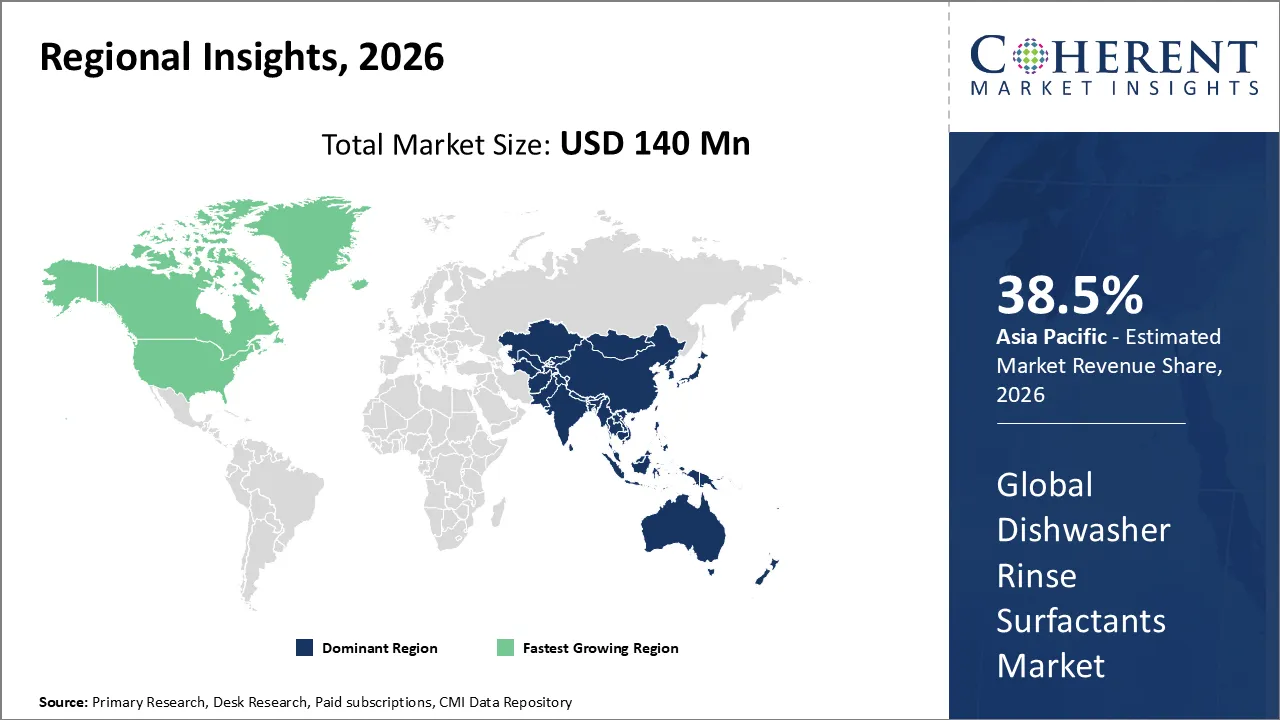
Why Does Asia Pacific Dominate the Global Dishwasher Rinse Surfactants Market?
Asia Pacific is expected to hold the largest market share of global dishwasher rinse surfactants market in 2026, accounting for 38.5%. Growing urban populations, higher disposable incomes, rising adoption of automatic dishwashers and demand for convenient household cleaning products are driving the regional market. China, India, Japan and South Korea are major markets due to their growing appliance industry and demand for advanced cleaning formulations. Low-foaming nonionic surfactants are increasingly used in dishwasher rinse aids, also supporting regional consumption. The region is seeing an increase in the production of specialty surfactants as manufacturers seek to bolster their supply chains and meet demand for sustainable cleaning ingredients.
On February 10, 2025, BSH Home Appliances announced the launch of its new range of Bosch and Siemens dishwashers in India. The company claimed to have a 53% share in India’s dishwasher market and recorded steady double-digit growth in its dishwasher business in 2023-2024. The expansion underscores the rising popularity of dishwashers in emerging Asian economies, and the opportunity for higher consumption of rinse-aid surfactants.
Why Is North America a Strong Growth Market for Dishwasher Rinse Surfactants?
North America is likely to witness a significant growth in the global dishwasher rinse surfactants market during the forecast period. High dishwasher penetration in households, established commercial warewashing infrastructure and increasing demand for environmentally sustainable cleaning ingredients are driving regional market growth. The household and institutional cleaning industries of the United States and Canada are well developed and have motivated manufacturers to develop advanced rinse-aid formulations with improved wetting, rapid drying, and low-foaming characteristics. Also, growing emphasis on biodegradable surfactants, and energy efficient dishwashing is creating opportunities for specialty chemical manufacturers. Regional investments in surfactant production capacity are expected to enhance supply-chain availability and support product innovation.
On October 27, 2026 BASF announced the start-up of expanded alkyl polyglucosides (APG) production capacity at Cincinnati, Ohio. The company says its APG surfactants are made from 100% natural and renewable feedstocks and are readily biodegradable under OECD 301 testing. BASF also announced North American sales of USD 18.1 billion in 2025 and a workforce of more than 13,300 employees in the region. This expansion will also enhance the regional production capabilities of nonionic surfactants used in household, industrial and institutional cleaning formulations.
Global Dishwasher Rinse Surfactants Market Outlook for Key Countries
Why Is the U.S. Emerging as a Major Hub in the Dishwasher Rinse Surfactants Market?
The U.S. dishwasher rinse surfactants market is propelled by established household dishwasher usage, extensive commercial warewashing operations and increasing demand for high-performance cleaning formulations. Consumers are looking for rinse aid products that help water to sheet off, prevent spotting on glasses and enhance drying. Manufacturers are looking at low-foaming nonionic surfactants which work well in various water hardness levels and energy-saving wash cycles. The growing focus on biodegradable ingredients is also promoting domestic investments in specialty surfactant production.
As of 2025, the U.S. Environmental Protection Agency says ENERGY STAR-certified standard-size dishwashers use about 20% less energy and 30% less water than standard models. BASF also brought on line expanded alkyl polyglucoside production capacity at Cincinnati, Ohio, in October 2026 to boost domestic supplies of renewable, biodegradable nonionic surfactants for cleaning applications. Such developments create opportunities for advanced rinse aid formulations.
Is China an Important Growth Market for Dishwasher Rinse Surfactants?
In China, dishwasher rinse surfactants are being driven by market trends such as increasing use of automatic kitchen appliances, demand for convenience in cleaning household items and a strong infrastructure for specialty chemicals manufacturing. Domestic manufacturers are formulating detergents and rinse aids for dishwashers that have better grease removal, less foaming and better drying performance. Specialty nonionic surfactants are finding opportunities in demand for premium kitchen appliances and environmentally sustainable household cleaning ingredients. China's existing chemical supply chains also support the production of surfactant intermediates and finished formulations.
According to the 2025 annual results of Midea Group released in 2026, the retail industry of dishwashers in China was worth about RMB 12.73 billion in 2025. The average selling price for a dishwasher was around RMB 5,728.
Germany Dishwasher Rinse Surfactants Market Analysis and Trends
The German dishwasher rinse surfactant market is driven on the basis of high penetration of dishwashers in households, demand for premium cleaning products and rising focus toward biodegradable chemical formulations. In Germany, automatic dishwashers are widely used by consumers and thus there is a recurrent demand for rinse aids, which improve drying performance, reduce water spots and avoid the formation of residues. Manufacturers are concentrating on low-foaming nonionic surfactants which perform consistently in a variety of water hardness conditions. Germany’s existing infrastructure for specialty chemical manufacturing and changing EU detergent rules are also fueling innovation in environmentally sound rinse-aid components.
As of December 9, 2025, data from the German Federal Statistical Office (Destatis) show that the proportion of German households with a dishwasher increased from 71.9% in 2018 to about 78.0% in 2023. Over the same period, the number of household dishwashers increased from 29.8 million to 32.7 million. The figures show the large installed dishwasher base in Germany and the recurring demand potential for specialty rinse surfactants.
U.K. Dishwasher Rinse Surfactants Market Analysis and Trends
The U.K. market for dishwasher rinse surfactants is driven by the ownership of household dishwashers, demand for convenient kitchen cleaning and a growing preference for concentrated and environmentally sustainable cleaning products. Consumers want rinse-aid formulations that deliver spot-free glassware and consistent drying performance especially in hard water regions. Innovation in specialty surfactant formulations is also being driven by the use of multifunctional dishwasher tablets and all-in-one cleaning systems. Manufacturers are looking into biodegradable nonionic surfactants and low-dose rinse-aid ingredients to improve cleaning performance and support product sustainability.
According to research by the University of Oxford and University College London using the 2025 Energy Demand Observatory and Laboratory survey. Some 65% of the 3,806 households surveyed said they had a dishwasher. This suggests a large installed base of appliances that support demand for dishwasher detergents and rinse aids. That number is from survey respondents and not a definitive nationwide ownership rate.
Japan Dishwasher Rinse Surfactants Market Analysis and Trends
Japan dishwasher rinse surfactants market is also driven by the growing preference for compact and built-in dishwashers, changing household lifestyles, and the need for effective kitchen cleaning solutions. Smaller urban households and limited kitchen space are driving the development of compact dishwashing systems. Effective wetting, controlled foaming and consistent drying performance require special detergent and rinse-aid formulations for these appliances. The rising awareness of environmental issues is also driving interest in biodegradable surfactants and resource-efficient cleaning products.
According to statistics from the Japan Electrical Manufacturers' Association (JEMA) reported by the Japan Home Appliance Repair Business Association on January 29, 2026, domestic shipments of dishwashers in 2025 amounted to about 575,000 units, up 3.8% year on year. The growth suggests continued demand for automatic dishwashing equipment and validates opportunities for specialty rinse-aid surfactant suppliers.
How Is the Growing Demand for High-Performance, Low-Foaming Surfactants Creating New Growth Opportunities in the Dishwasher Rinse Surfactants Market?
The global Dishwasher Rinse Surfactants Market is witnessing growth opportunities owing to the rising demand for high-performance and low-foaming surfactants. Manufacturers are also developing more sophisticated rinse-aid formulas that improve water sheeting, speed drying and minimize water spots on glassware, dishes and utensils.” Demand for specialty nonionic surfactants such as alcohol alkoxylates and low-foam ethoxylates is driven by the increasing use of automatic dishwashers in residential and commercial environments. These ingredients help to maintain effective rinsing performance under different water hardness conditions and washing temperatures.
For instance, Stepan Company reports 10-30% low-foam alkoxylates and 10-20% nonionic ethoxylates as typical ingredient ranges in industrial rinse-aid formulations. BASF also provides specialty nonionic surfactants for automatic dishwasher rinse-aid and institutional cleaning applications, such as Dehypon products. These developments present opportunities for surfactant manufacturers to introduce specialized low-foaming ingredients, custom surfactant blends and sustainable formulations to improve rinse-aid performance and to meet evolving environmental and regulatory demands.
Market Players, Key Development, and Competitive Intelligence
Key Developments
- In November 2025, Stepan Company announced an exclusive distribution agreement with AmphiStar for upcycled, bio-based surfactants in Europe, the Middle East and Africa. The partnership is focused on household cleaning and industrial and institutional (I&I) cleaning applications.
- In October 2025, Nouryon unveiled new sustainable cleaning ingredients at SEPAWA Congress 2025, such as Ethylan X4 and Ethylan X6, low-foaming nonionic surfactants, AG 6206 natural surfactant, and the Dissolvine MAX chelating-agent range for cleaning and dishwashing applications.
Competitive Landscape
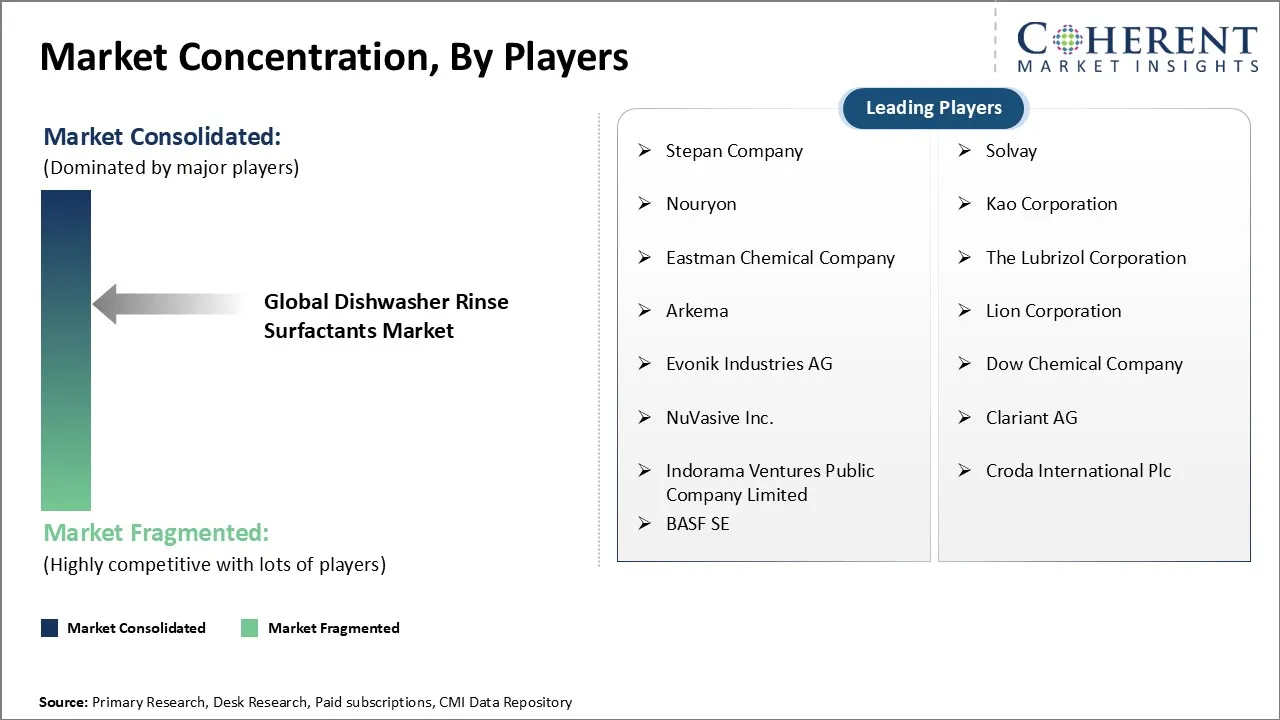
The global market for dishwasher rinse surfactants is characterized by competition amongst specialty chemical manufacturers for market share, by focusing on low foaming performance, fast drying, prevention of water spots and biodegradability of formulations. BASF SE Dehypon nonionic surfactants for dishwasher rinse aid and Clariant AG Genapol Pure Power for superior drying and shine performance. Nouryon has added low foaming surfactants Ethylan X4 and X6 to its portfolio. Stepan Company has commercial warewashing applications for specialty alcohol alkoxylates. Evonik Industries AG’s REWOFERM portfolio focuses on biodegradable biosurfactants.
Top Manufacturers and Notable Products/Solutions in the Dishwasher Rinse Surfactants Market
Company/Manufacturer | Notable Product/Brand | Key Features |
BASF SE | Dehypon® Shine | Low-foaming nonionic surfactant, improved drying performance, reduced water spotting, water sheeting, automatic dishwasher rinse-aid applications |
Clariant AG | Genapol™ Pure Power | Multifunctional rinse surfactant, enhanced drying and shine, improved plastic drying, reduced grease buildup, automatic dishwashing applications |
Stepan Company | MAKON® NF-180 | Low-foaming nonionic surfactant, excellent wetting properties, defoaming performance, reduced water spotting, household and institutional rinse-aid applications |
Nouryon | Ethylan® X4 | Low-foaming nonionic surfactant, efficient wetting, emulsification, degreasing, industrial and institutional cleaning applications |
Market Report Scope
Dishwasher Rinse Surfactants Market Report Coverage
Report Coverage | Details | ||
Base Year: | 2025 | Market Size in 2026: | USD 140 Mn |
Historical Data for: | 2020 to 2024 | Forecast Period: | 2026 to 2033 |
CAGR: | 6.5% | 2033 Value Projection: | USD 217.6 Mn |
Geographies covered: |
| ||
Segments covered: |
| ||
Companies covered: | Stepan Company, Solvay, Nouryon, Kao Corporation, Eastman Chemical Company, The Lubrizol Corporation, Arkema, Lion Corporation, Evonik Industries AG, Dow Chemical Company, Clariant AG, Indorama Ventures Public Company Limited, Croda International Plc, BASF SE. | ||
Growth Drivers: |
| ||
Restraints & Challenges: |
| ||
Analyst Opinion (Expert Opinion)
- In the future the global dishwasher rinse surfactants market will be more focused on high-performance, low-foaming and multifunctional surfactants, which can improve the drying efficiency, reduce water spotting and keep the dishwasher clean. Manufacturers will likely focus on nonionic surfactants which provide better water sheeting and grease removal performance and allow for shorter, energy-efficient wash cycles. Genapol Pure Power from Clariant is a multifunctional rinse surfactant that is said to improve drying, shine and dishwasher filter cleanliness. Oct. 7, 2026 In-house testing showed that the product reduced the weight of the dishwasher filter caused by the accumulation of fatty residues by up to 70% compared to a well-established benchmark surfactant. This evolution reflects the growing significance of multifunctional performance in the development of surfactants.
- Bio-based surfactants, concentrated rinse-aid formulations and water-efficient automatic dishwashing applications are expected to offer the highest growth opportunities. North America and Europe are fertile grounds for sustainable ingredient innovation and Asia Pacific is ready for growth with increasing appliance penetration and local surfactant production. The U.S. EPA’s 2025 ENERGY STAR guidance states that certified standard-size dishwashers are about 20% more energy efficient and 30% more water efficient than standard models. BASF also announced the construction of additional alkyl polyglucoside production capacity in Cincinnati, Ohio, on October 27, 2026, bolstering North American supply of nonionic surfactants derived from 100% natural and renewable feedstocks. These developments indicate opportunities for surfactants that are compatible with resource-efficient dishwashing and for environmentally sustainable formulations.
- Market players need to differentiate on the basis of verified rinse performance, biodegradability, formulation compatibility and cost-effective product development rather than traditional cleaning properties. Manufacturers should show measurable improvements in drying time, prevention of spotting, control of foam and performance in varying water hardness conditions. Additionally, regulatory compliance will impact purchasing decisions and supplier qualification. On March 2, 2026, the European Union published Regulation (EU) 2026/405 that contains new requirements for biodegradability of detergents and surfactants, product labeling and digital product passports. Most provisions will enter into effect on September 23, 2029. Suppliers offering transparent ingredient documentation, validated environmental performance, and customized formulation support are expected to strengthen their competitive positioning.
Speak to the analyst
Want personalized insights?
Take the findings above to one of our principal consultants, or have the report rebuilt around the segments, geographies and competitors you actually track.
Market Segmentation
- By Type (Revenue, USD Mn, 2021-2033)
- Anionic
- Non-Ionic
- Cationic
- Amphoteric
- Others
- By End User (Revenue, USD Mn, 2021-2033)
- Household Detergents
- Personal Care
- Textile
- Industrial and Institutional Cleaner
- Food Processing
- Oilfield Chemicals
- Agricultural Chemicals
- Construction Chemicals
- Pulp and Paper
- Others
- By Region (Revenue, USD Mn, 2021-2033)
- North America
- U.S.
- Canada
- Latin America
- Brazil
- Mexico
- Argentina
- Rest of Latin America
- Europe
- Germany
- U.K.
- France
- Italy
- Spain
- Russia
- Rest of Europe
- Asia Pacific
- China
- India
- Japan
- Australia
- South Korea
- ASEAN
- Rest of Asia Pacific
- Middle East
- GCC
- Israel
- Rest of Middle East
- Africa
- South Africa
- Central Africa
- North Africa
- North America
- Key Players
- Stepan Company
- Solvay
- Nouryon
- Kao Corporation
- Eastman Chemical Company
- The Lubrizol Corporation
- Arkema
- Lion Corporation
- Evonik Industries AG
- Dow Chemical Company
- Clariant AG
- Indorama Ventures Public Company Limited
- Croda International Plc
- BASF SE.
Sources
Primary Research Interviews
- Surfactant manufacturers and specialty chemical producers
- R&D heads from household and industrial cleaning chemical companies
- Formulation chemists specializing in dishwasher detergents and rinse aids
- Nonionic and low-foaming surfactant technology developers
- Raw material suppliers and chemical distributors
- Procurement managers from household cleaning product manufacturers
- Commercial and institutional warewashing solution providers
- Sustainability and regulatory compliance experts in detergent chemicals
- Key opinion leaders (KOLs) in surfactant chemistry and cleaning technologies
Databases
- World Bank
- Organisation for Economic Co-operation and Development (OECD)
- United Nations Comtrade Database (UN Comtrade)
- Eurostat
- U.S. International Trade Commission (USITC) DataWeb
- U.S. Environmental Protection Agency (EPA) – CompTox Chemicals Dashboard
- European Chemicals Agency (ECHA) – Chemicals Database
- United Nations Industrial Development Organization (UNIDO) Statistics
Magazines
- Chemical & Engineering News (C&EN)
- Chemical Processing
- Chemical Week
- Household and Personal Care Today
- HAPPI (Household and Personal Products Industry)
- International Chemical Industry
- European Cleaning Journal
Journals
- Journal of Surfactants and Detergents
- Tenside Surfactants Detergents
- Journal of Molecular Liquids
- Colloids and Surfaces A: Physicochemical and Engineering Aspects
- Journal of Cleaner Production
- ACS Sustainable Chemistry & Engineering
- Industrial & Engineering Chemistry Research
- Green Chemistry
Newspapers
- The Wall Street Journal
- Financial Times
- Reuters
- The Economic Times
- Nikkei Asia
- Handelsblatt
- The Guardian
Associations
- American Cleaning Institute (ACI)
- International Association for Soaps, Detergents and Maintenance Products (A.I.S.E.)
- European Committee of Organic Surfactants and Their Intermediates (CESIO)
- Household & Commercial Products Association (HCPA)
- Society of Chemical Industry (SCI)
- Royal Society of Chemistry (RSC)
- European Chemical Industry Council (Cefic)
- Chemical Industries Association (CIA)
- International Association for Soaps, Detergents and Maintenance Products – Charter for Sustainable Cleaning
Public Domain Sources
- Company Annual Reports and Investor Presentations
- Surfactant Manufacturer Product Catalogs and Technical Data Sheets
- Government Chemical Manufacturing and Trade Statistics
- U.S. EPA Safer Choice and Safer Chemical Ingredients List
- European Chemicals Agency (ECHA) REACH Registration Data
- European Union Detergents and Surfactants Regulations
- OECD Biodegradability Testing Guidelines
- U.S. ENERGY STAR Dishwasher Efficiency Publications
- Publicly Available Dishwasher Rinse-Aid Formulation Guides
- Patent Databases such as WIPO, USPTO, and Google Patents
- Regulatory and Standards Publications Related to Surfactant Safety, Biodegradability, and Environmental Compliance
Proprietary Elements
- CMI Data Analytics Tool
- Proprietary CMI Existing Repository of Information for the Last 10 Years
Get access to 250+ pages report
Every segment, forecast, competitor profile and data table behind the analysis above — available for instant download.
- ESOMAR Member
- ISO 9001:2015 Certified
- D-U-N-S Registered
- GDPR & CCPA Compliant
Frequently Asked Questions
The global Dishwasher Rinse Surfactants Market is estimated to reach USD 217.6 Mn by 2033, compared with USD 140 Mn in 2026.
Major players operating in the global Dishwasher Rinse Surfactants Market include Stepan Company, Solvay, Nouryon, Kao Corporation, Eastman Chemical Company, The Lubrizol Corporation, Arkema, Lion Corporation, Evonik Industries AG, Dow Chemical Company, Clariant AG, Indorama Ventures Public Company Limited, Croda International Plc, and BASF SE.
High raw material costs, fluctuating petrochemical feedstock prices, stringent environmental regulations, and challenges in maintaining low-foaming performance and formulation compatibility are the key factors hampering market growth.
Increasing adoption of automatic dishwashers, rising demand for low-foaming nonionic surfactants, growing preference for biodegradable cleaning ingredients, and increasing emphasis on water-efficient and spot-free drying solutions are driving market growth.
The global Dishwasher Rinse Surfactants Market is anticipated to grow at an estimated CAGR of 6.5% between 2026 and 2033.
Among regions, Asia Pacific is estimated to account for the largest market share of 38.5% in 2026, supported by expanding dishwasher adoption, rising household cleaning product consumption, and increasing specialty surfactant manufacturing activities.
Dishwasher rinse surfactants are specialty surface-active chemical ingredients used in automatic dishwasher rinse aids to reduce water surface tension, improve water sheeting, prevent water spots and streaks, and enhance drying performance on dishes, glassware, and utensils.