

Global Engine MRO Market Size & Forecast, 2026 To 2033
The Global Engine MRO Market is valued at USD 50.52 Bn in 2026 and is projected to reach USD 71.04 Bn by 2033, growing at a CAGR of 4.99% from 2026 to 2033. Engine MRO covers the maintenance, repair and overhaul of aviation gas-turbine and piston engines, including performance restoration and quick-turn shop visits, on-wing maintenance, module and component repair, and test-cell runs. Spending follows the installed engine base, so the market links closely to the Aircraft Engine Market and to routine airport-based work covered in the Aircraft Line Maintenance Market.
Demand for engine work is set to keep climbing. Airbus announced on October 14, 2026 that global aircraft services demand will double to more than USD 420 Bn by 2045, with off-wing maintenance alone forecast at USD 217 Bn, driven by more shop visits as the fleet ages and grows. Regulation is also shaping where work is done. The FAA published a final rule on December 18, 2024 that requires certificated repair stations outside the United States to run drug and alcohol testing programs, with compliance due by December 20, 2027, a change that touches approximately 977 repair stations in about 65 countries.
Key Takeaways of the Global Engine MRO Market:
- The Global Engine MRO Market is valued at USD 50.52 Bn in 2026 and is projected to reach USD 71.04 Bn by 2033, a CAGR of 4.99%. Growth comes from a larger and older engine base, heavier daily aircraft use and the spread of licensed repair capability for new-generation engines.
- Turbofan engines lead the engine type segment with a 71.64% share in 2026. Large fleets of narrow-body and wide-body jets keep this engine family at the center of shop-visit demand, because each engine logs long daily cycles that wear fan blades, compressors and hot-section parts on a predictable schedule. On January 8, 2026, Rolls-Royce and Turkish Technic broke ground on a new aero engine maintenance facility that will handle Trent XWB-97, Trent XWB-84 and Trent 7000 engines, with capacity of 200 shop visits per year and operations targeted by the end of 2027.
- Engine Overhaul is the largest service type segment, holding a 46.82% share in 2026. A full overhaul strips the engine to modules, restores or replaces life-limited parts and ends with a test-cell run, so each visit carries a high labor and parts content. On March 11, 2026, Delta TechOps announced full overhaul capability for CFM LEAP-1A engines in addition to LEAP-1B, becoming the first North American airline MRO licensed to support both.
- OEM-Affiliated MRO providers account for a 57.82% share of the provider type segment in 2026. Access to proprietary repair data, original parts, warranty terms and licensed shop networks gives these providers the first call on most new-generation engine work.
- Commercial Aviation is the leading application segment, with a 68.4% share in 2026. Airline fleets log the most flight hours, and carriers book shop capacity through multi-year agreements, which keeps shop schedules full.
- Among the faster-growing segments, Independent MRO providers are expanding at a CAGR of 5.28% and Turboprop engines at a CAGR of 5.16% through 2033.
- North America dominates the Global Engine MRO Market with a 38.9% share in 2026, led by the United States and Canada. The region is supported by large airline fleets, the main OEM aftermarket organizations and a deep base of independent shops.
- Asia Pacific is the fastest-growing region, expanding at a CAGR of 5.74% through 2033, ahead of the global pace of 4.99%. New engine shops, joint ventures with global engine makers and fleet additions at regional carriers are lifting local capacity in China, India, Japan and Singapore.
Segmental Insights
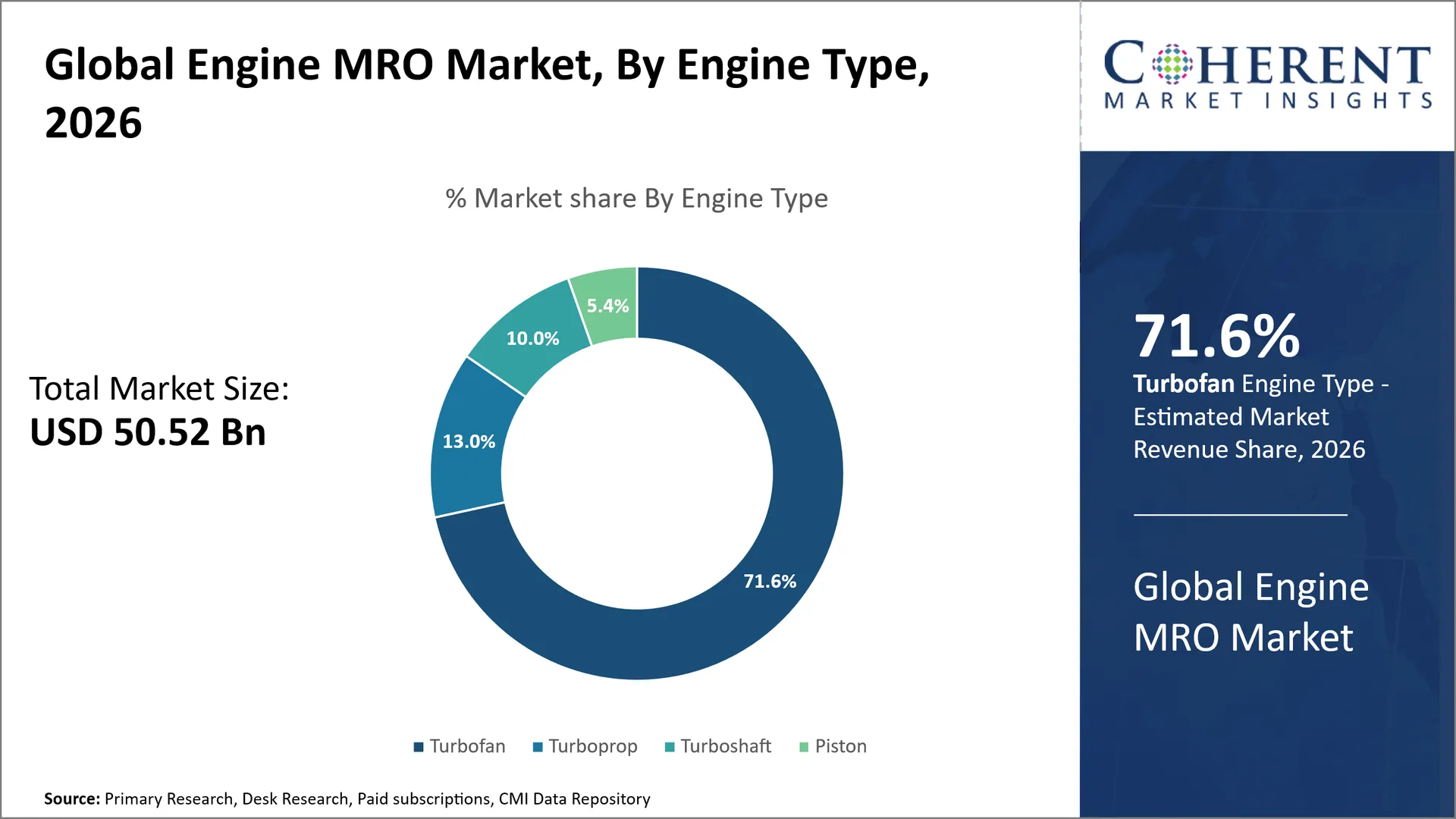
Why does the turbofan segment lead the Global Engine MRO Market by engine type?
In terms of engine type, turbofan engines are expected to account for 71.6% of the global market in 2026. A turbofan pulls air through a large fan and a multi-stage compressor, burns fuel in the combustor and drives the fan and compressor with the turbine. The combustor and turbine sections run hottest, so blades, seals and discs wear on a predictable schedule. That wear produces regular shop visits, from quick-turn repairs to full performance restoration. The engines also fly long daily cycles on narrow-body and wide-body jets, so the number of visits per year stays high.
Suppliers are building long-term programs around single engine families. On January 14, 2026, Lufthansa Technik and SunExpress signed a five-year agreement covering CFM56-7B and LEAP-1B engines, with work ranging from quick turns to complete overhauls and performance restoration shop visits. Safran Aircraft Engines lists the LEAP-1A at a maximum take-off thrust of 35,000 lbf with a 78 in fan, which shows the scale of the hardware shops must handle.
- Current Industry Events of 2026
- Market Size Estimation
- Regional Breakdown
- Competitive Landscape
- Customer Intelligence
- Segmental Analysis
- Pricing Analysis
- Key Market Drivers, Challenges & Future Trends
- Customized Insights Section
Why Does Engine Overhaul Lead the Global Engine MRO Market by Service Type?
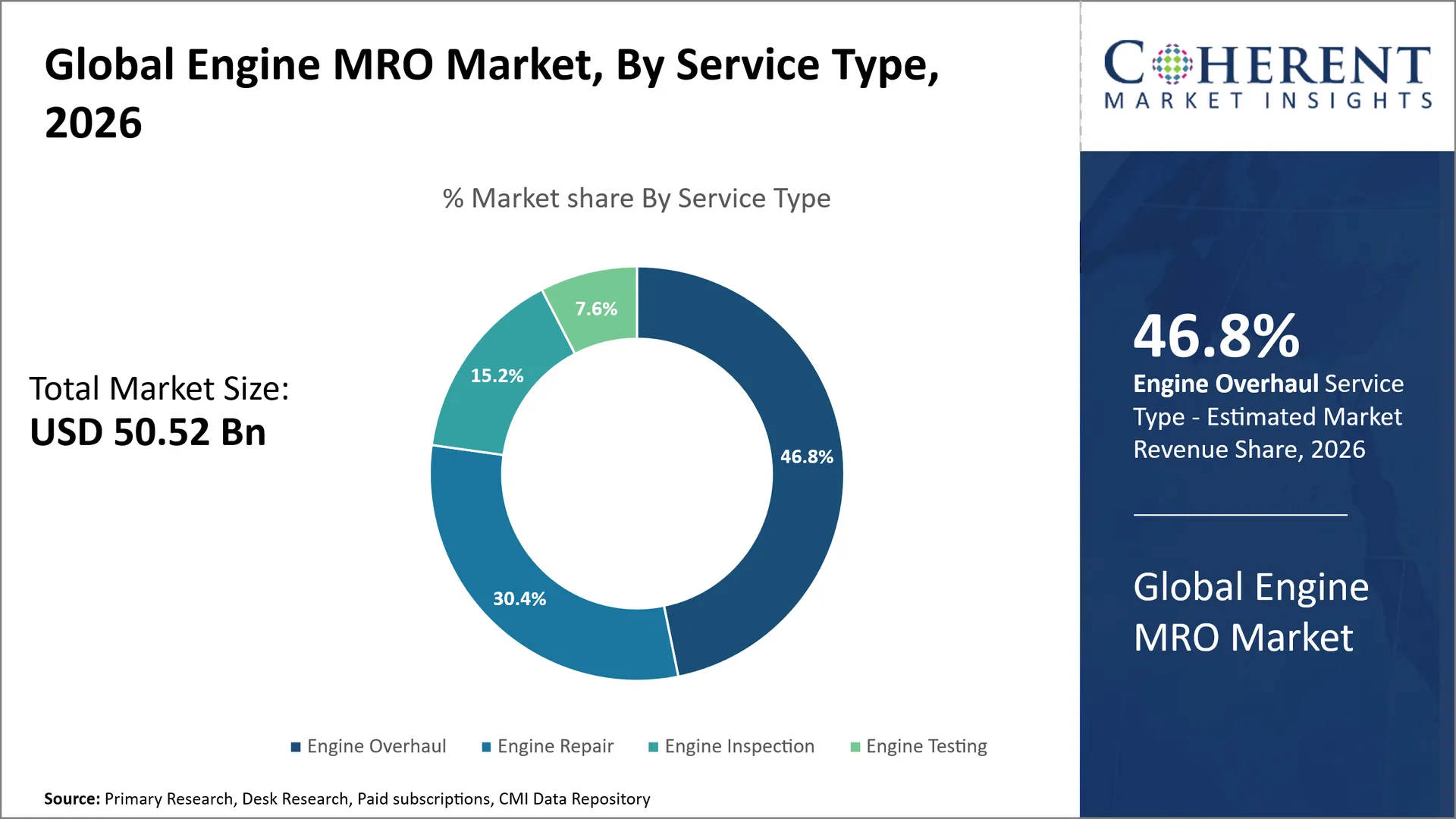
In terms of service type, engine overhaul is expected to account for 46.8% of the global market in 2026. An overhaul strips the engine to modules, inspects and repairs each part, replaces life-limited components and ends with a test-cell run to confirm thrust, temperature and vibration limits. Each visit therefore carries a high labor and parts content, and it restores the engine for a full interval of operation. Operators and lessors also use overhaul to protect engine value.
Providers are widening the scope of work they can take on. On March 5, 2026, StandardAero announced a General Terms Agreement with lessor AviLease for LEAP-1A, LEAP-1B and CFM56-7B MRO services, using San Antonio for LEAP work and Winnipeg and DFW International Airport for CFM56-7B work. Delta TechOps lists full restoration of all modules, gas-path performance restoration and engine test-cell runs among its LEAP-1B services.
Why are OEM-affiliated providers ahead in the provider type segment?
In terms of service provider, OEM-affiliated providers are expected to account for 57.8% of the global market in 2026. Engine makers control repair procedures, proprietary parts, warranty terms and the data gathered from engines across the world. Extending that control through their own shops and licensed partners lets them bundle maintenance with engine sales and plan parts and labor from fleet-wide data. Airlines and lessors accept this link because it protects engine value and keeps repairs consistent.
The model is visible in new capacity. Safran opened a LEAP engine shop in Querétaro, Mexico, backed by an investment of USD 0.14 Bn. By 2030 the site can handle up to 350 LEAP shop visits per year, supported by a test cell planned for 350 engine tests per year.
How does commercial aviation shape demand for engine MRO?
In terms of application, commercial aviation is expected to account for 68.4% of the global market in 2026 Airlines fly their engines for many hours each day, so shop visits arrive on a steady cycle that suppliers can plan around. Carriers also lock in capacity years ahead through multi-year agreements. On July 20, 2026, Lufthansa Technik announced that Cebu Pacific extended its engine MRO cooperation, a sign that low-cost and full-service carriers alike prefer long-term partnerships for engine care. Scheduled flying also gives shops early notice of removals. Engine health monitoring data from airline fleets lets providers line up parts and slots before an engine arrives, which cuts turnaround and keeps commercial carriers loyal to proven shop networks.
Which segments are expanding fastest through 2033?
Independent MRO providers are growing at a CAGR of 5.28%, helped by lessors and airlines that want alternatives to OEM-controlled capacity and by new licensing arrangements that open LEAP and CFM56 work to qualified third-party shops. Turboprop engines are growing at a CAGR of 5.16%, driven by regional airline and utility aircraft fleets whose engines follow fixed hour-based overhaul intervals. Both segments are growing faster than the overall market, which stands at a CAGR of 4.99%.
Current Events and their Impact
Current Event | Description | Impact |
Air India and SIAEC MRO agreement (July 3, 2026) | Air India announced an agreement with SIA Engineering Company for collaboration on MRO. | Broadens the partner base for Indian carriers and adds capacity in a region where fleets are growing. Providers with licensed engine capability stand to gain from this kind of tie-up. |
Lycoming TBO extension (July 20, 2026) | Lycoming announced Service Instruction 1009BF, raising recommended time between overhaul to 2,600 hours for many factory-new and factory-rebuilt piston engines. | Piston engine owners gain more flying hours between overhauls, which shifts the work mix toward inspection and component service while keeping engine overhaul relevant at the new interval. |
Engine MRO Market Dynamics
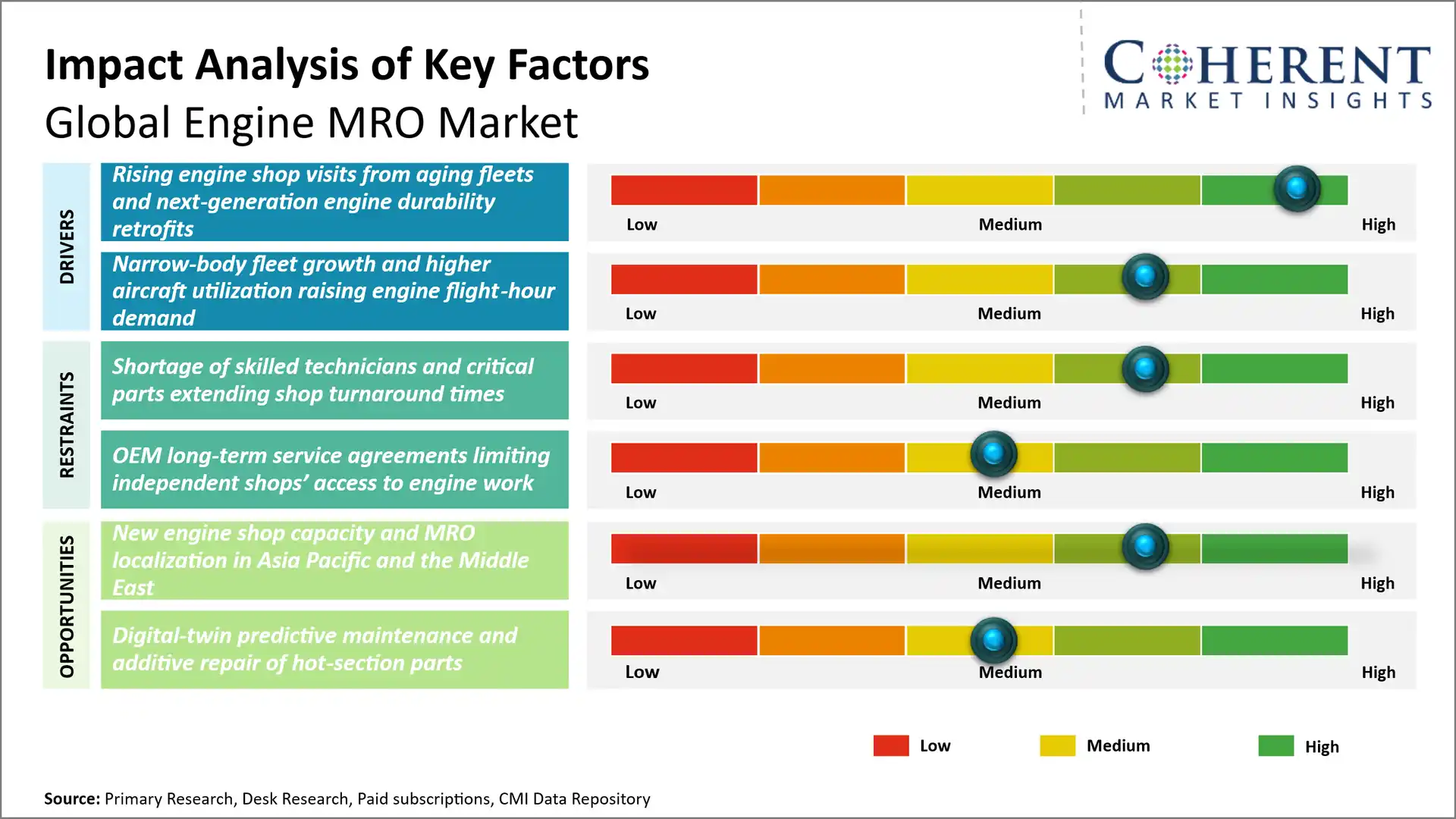
Market Drivers
Rising engine shop visits from aging fleets and next-generation engine durability retrofits
Every engine carries life-limited parts and hot-section components that wear with each takeoff cycle. As fleets age, more engines reach the point where blades, seals, combustors and discs need repair or replacement, and each of those events becomes a shop visit. Older engine families do not simply fade out. Airlines and lessors keep them flying and keep paying for performance restoration, which is the heaviest and most valuable type of visit. On April 22, 2026, Delta TechOps announced an expansion in India to support IndiGo's CFM56-5B engines, a clear case of mature-engine demand creating new capacity.
Newer engines add a second source of work. Next-generation engines run hotter and harder to deliver better fuel burn, and in-service experience leads manufacturers to issue durability improvements that operators install during shop visits. Pratt & Whitney's inspection campaign on its geared turbofan fleet, reported by Reuters in April 2025, shows how a fleet-wide check can pull large numbers of engines into shops within a short window. In the same way, licensing of LEAP repair know-how is spreading.
On April 22, 2026, Woodward and AFI KLM E&M announced an elite-level licensing agreement for LEAP engine MRO services, widening the set of providers able to take on durability-related workscopes.
Narrow-body fleet growth and higher aircraft utilization raising engine flight-hour demand
Maintenance demand tracks flight hours, and narrow-body jets generate the most of them. On July 8, 2026, Airbus released its Global Market Forecast, which calls for about 42,060 new aircraft over the next 20 years, of which roughly 81% are single-aisle, and passenger traffic growth of about 3.9% per year through 2045. Every one of those aircraft carries two engines that will accumulate cycles and hours, and the engine base expands in step with deliveries.
Utilization compounds the effect. When airlines fly aircraft more hours per day, engines reach their removal intervals sooner, and rate-per-flight-hour style contracts convert those hours directly into maintenance revenue for shops. Quick-turn visits, which restore an engine in a short window to keep aircraft earning, become more common as schedules tighten.
On July 16, 2026, StandardAero announced the induction of the first SunExpress CFM LEAP-1B engine under a new agreement, an example of a carrier with a growing 737 MAX fleet placing engines directly into a long-term program.
Emerging Trends
Additive and digital repair techniques: Repair shops are moving away from slow, tooling-heavy repair steps and turning to additive deposition and digital inspection instead. On April 8, 2025, Pratt & Whitney announced an additive repair solution for structural case features on its GTF engines. It uses Directed Energy Deposition, a 3D printing method that builds material back onto a worn part, and cuts process time by more than 60%.
- Impact: Shorter repair cycles return engines to service sooner and lower tooling needs, which lifts throughput in busy shops.
- Relevance to the market: Gives providers that adopt approved additive repairs a turnaround advantage on parts that would otherwise wait for scarce new material.
OEM-licensed networks and joint ventures: Engine makers are opening their repair know-how to selected partners through licensed networks and joint ventures. On July 20, 2026, AFI KLM E&M and AerCap announced plans to establish a LEAP engine joint venture, tying an established shop to a major lessor.
- Impact: More shops are approved to work on LEAP engines, and repair capacity sits closer to the large engine owners who need it.
- Relevance to the market: Airlines and lessors get more options on where and how fast their engines are repaired, and partner shops gain a steady, long-term flow of work.
Regional Insights
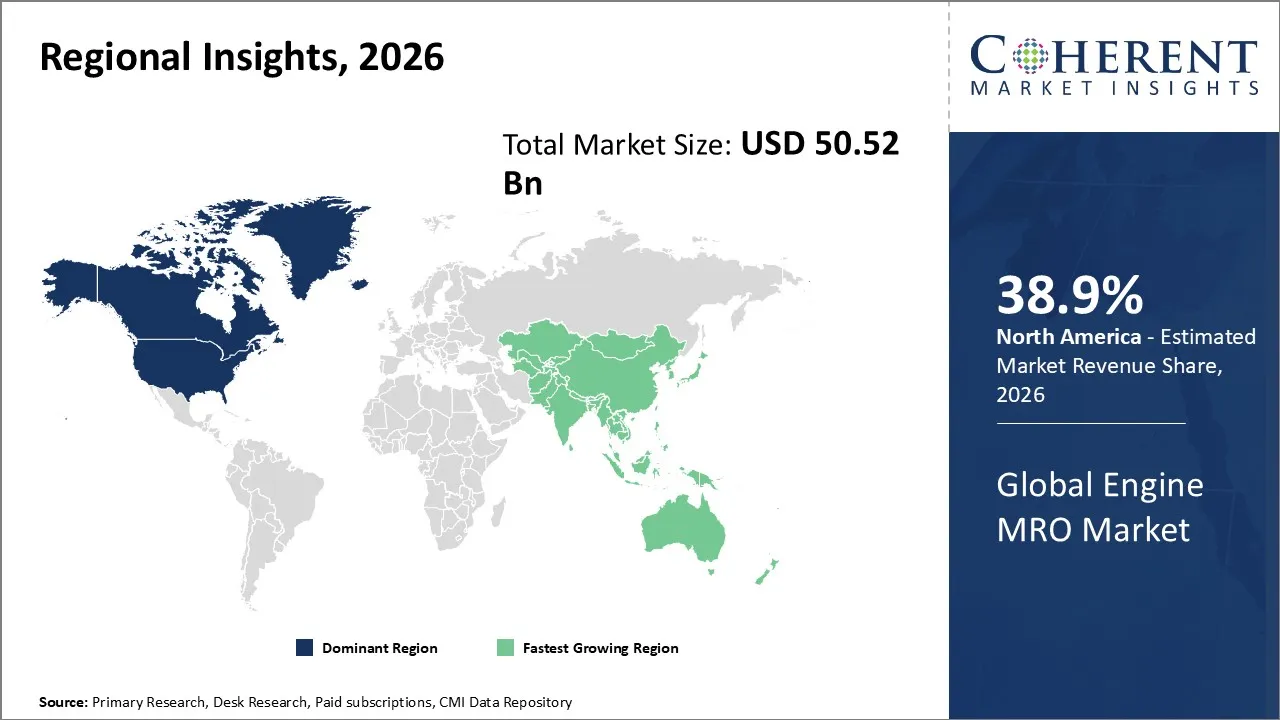
North America: the leading region in the Global Engine MRO Market
North America is expected to account for a market share of 38.9% in 2026, with the United States and Canada driving demand. The region leads because it combines large airline fleets, the main OEM aftermarket organizations and a deep base of independent shops. Airline-owned operations such as Delta TechOps and independent providers such as StandardAero sit alongside OEM facilities, which gives operators many options for every major engine family. Canada adds turboprop, regional jet and helicopter engine depth to the region’s narrow-body overhaul base. Large airline fleets also mean steady removals, and the presence of the leading engine makers' aftermarket organizations keeps repair data, parts and engineering support close to the shops.
Asia Pacific: the fastest-growing region
Asia Pacific is expanding at a CAGR of 5.74% through 2033, the fastest pace of any region and above the global CAGR of 4.99%. Fleet additions at regional carriers, new shop openings and joint ventures with global engine makers are raising local capacity, and operators are moving engine work closer to home instead of shipping engines to other continents.
Global Engine MRO Market Outlook for Key Countries
Is the U.S. Leading Engine MRO Demand in North America?
The U.S. Engine MRO market is projected to reach USD 15.61 Bn in 2026, making it the largest of any country. The U.S. holds that lead because it has the world’s biggest airline fleets and is home to the aftermarket organizations of the main engine makers, along with airline-owned and independent shops. On October 20, 2026, GE Aerospace reported record internal shop visit output for the third quarter, with LEAP internal shop visit revenue up more than 40%.
Is China Building Its Engine MRO Base Through Joint Ventures?
China's Engine MRO market is projected to reach USD 4.47 Bn in 2026, the largest in Asia Pacific. Its fleet is growing fast, and carriers want engine work done at home instead of shipping engines abroad. Global engine makers are responding by partnering with local shops. On December 10, 2025, Rolls-Royce announced the official opening of BAESL, its engine MRO joint venture in Beijing.
Why Does Canada Rank Among the Top Engine MRO Markets in North America?
Canada's Engine MRO market is projected to reach USD 2.43 Bn in 2026. The country is a hub for turboprop, regional jet and helicopter engine work as well as narrow-body overhaul. On May 20, 2026, Aviation International News reported that Pratt & Whitney Canada approved StandardAero’s Winnipeg site as a PW100 designated overhaul facility, which adds turboprop overhaul to a site already serving CF34 and CFM56 engines.
How Strong Is Japan’s In-House Engine MRO Capability?
Japan's Engine MRO market is projected to reach USD 2.18 Bn in 2026. Airline-owned shops and large industrial groups give the country strong domestic capability. A March 25, 2025 review by Japan’s Ministry of Economy, Trade and Industry counted four domestic engine maintenance companies. It also noted that the two leading airline shops outsource about half of their engine models overseas, which points to room for added domestic capacity.
Is India Becoming a Growth Hub for Engine MRO?
India's Engine MRO market is projected to reach USD 1.70 Bn in 2026 and is among the faster-growing national markets as carriers add narrow-body aircraft. Each new aircraft brings engines that will need licensed maintenance within the decade. On December 9, 2025, CFM announced the opening of a new MRO shop in India to strengthen LEAP support, moving engine work closer to Indian operators.
Published Engine Specifications
Engine | Used On | Published Figure | Published By |
LEAP-1A | Airbus A320neo family | Maximum take-off thrust of 35,000 lbf; 78 in fan diameter | Safran Aircraft Engines |
LEAP-1B | Boeing 737 MAX family | Maximum take-off thrust of 28,000 lbf; 69 in fan diameter; bypass ratio 8.6:1 | CFM International |
PT6A-140 series | Caravan-class turboprops | Time between overhaul of 4,000 hours; hot section inspection every 2,000 hours | Pratt & Whitney Canada |
Arriel 2D | Airbus H125 and H130 helicopters | Maximum continuous power of 856 shp; take-off power of 952 shp; time between overhaul of 5,000 hours | Safran Helicopter Engines |
Lycoming O-360 to IO-540 series | General aviation piston aircraft | Time between overhaul of up to 2,600 hours on eligible factory-new and factory-rebuilt engines; 12-year calendar interval retained | Lycoming Engines |
How Are Integrated Service Bundles and Defense Programs Creating New Growth Opportunities in the Global Engine MRO Market?
Operators increasingly want one provider to cover the whole engine life instead of buying each service separately. A bundled agreement can combine shop visits, component repair, spare engines on lease and health monitoring data, which gives the provider steady work and gives the operator predictable cost and fewer engines out of service. On October 27, 2026, StandardAero announced a new agreement with Air Corsica that extends its existing relationship with the airline. The agreement lets Air Corsica use LEAP-1A services from StandardAero’s San Antonio facility, including performance restoration shop visits, quick-turn shop visits, component repairs and short-term engine leases. It also covers engine health monitoring data analysis. Providers that can offer this full package, backed by licensed capability, are able to win longer contracts and defend them against competitors who bid on single visits.
Defense and government programs add a second source of demand that does not follow airline schedules. New military fleets arrive with long-term support needs, and the engine families involved often have a dedicated overhaul base. On July 23, 2026, StandardAero announced that GE Aerospace had chosen it to build, maintain and overhaul CT7-2E1 engines for the UK’s new medium helicopter fleet. The announcement follows GE Aerospace’s disclosure that Leonardo selected the CT7-2E1 to power 23 AW149 helicopters, in an agreement covering 46 engines plus spares, spare parts and long-term support. A new fleet with a multi-year support plan gives shops a stable base of overhaul work for many years.
Market Players, Key Development, and Competitive Landscape
Key Developments
- On October 12, 2026, GE Aerospace announced an investment at its Prestwick, UK, MRO site as part of a wider partnership package that includes funding from the Ayrshire Growth Deal and Scottish Enterprise. The project adds a 55,000 sq. ft. building and improves site layout and operational flow to increase capacity for GE’s commercial engine MRO network, with full operations targeted for the first quarter of 2028.
- On September 3, 2026, StandardAero opened a 70,000 sq. ft. expansion of its Winnipeg MRO facility, growing the footprint by 40%. The site provides full MRO support for GE Aerospace CF34-3/8 and CFM International CFM56 engines. The build moved from groundbreaking in November 2025 to opening in under a year.
- On July 21, 2026, StandardAero announced a LEAP LeaseTeam agreement with global lessor Avolon. The agreement gives the lessor a defined route to licensed LEAP shop capacity and gives the provider a steady program of work.
- On July 8, 2026, MTU Aero Engines announced that MTU Maintenance Fort Worth held its grand opening and inducted its first LEAP-1B engine, adding North American capacity for the 737 MAX engine.
- On June 6, 2026, SIA Engineering Company announced a joint venture with Safran Aircraft Engines for a CFM LEAP engine MRO facility in Singapore covering LEAP-1A and LEAP-1B engines. Safran Aircraft Engines holds 51% and SIAEC 49%. The existing quick-turn operations at Changi North move into the venture, following a letter of intent signed on November 25, 2025.
- On April 21, 2026, Pratt & Whitney announced investments of more than USD 0.10 Bn across three U.S. MRO sites. These include a new 500,000 sq. ft. facility in Irving, Texas, for used serviceable material and engines. They also include a West Palm Beach, Florida, expansion of roughly 50,000 sq. ft. that raises GTF MRO capacity by about 40%, and a Springdale, Arkansas, expansion for GTF additive repairs.
- On April 7, 2026, the Canadian Commercial Corporation announced a five-year contract with the U.S. Department of Defense under which StandardAero will repair and modify 501K engine components at its Winnipeg facility.
Competitive Landscape
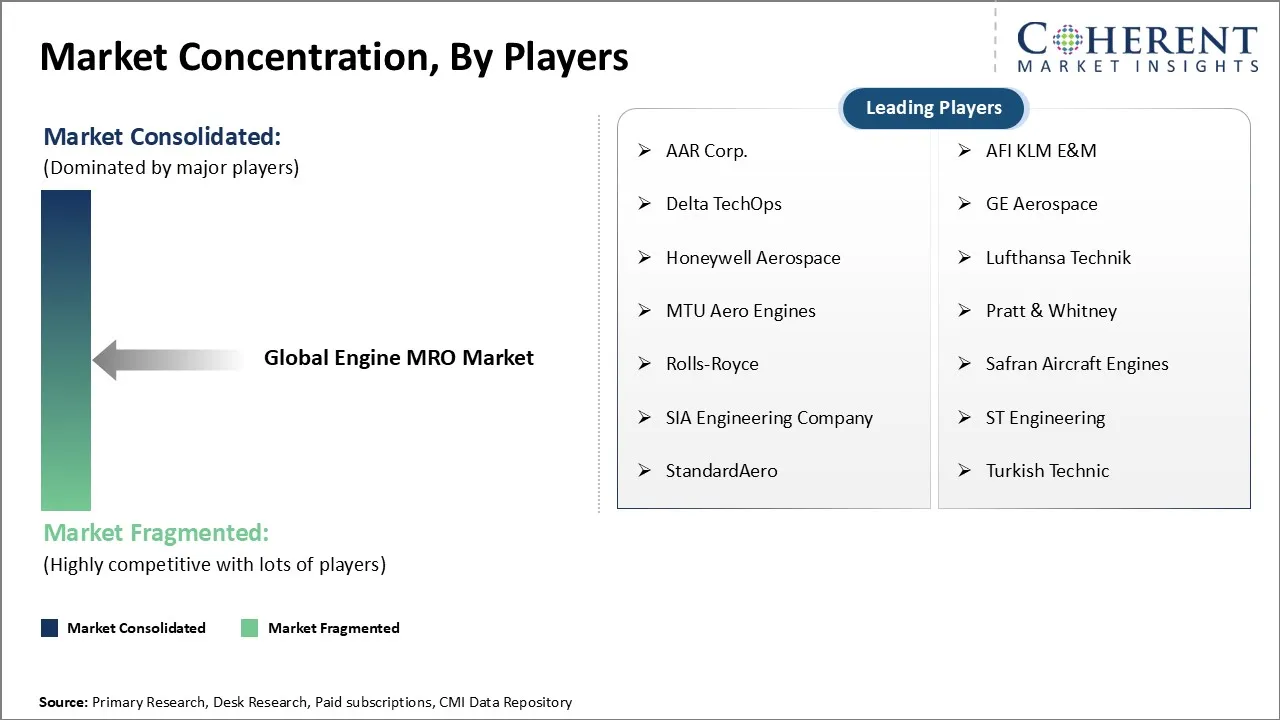
The Global Engine MRO Market is led by engine manufacturers and their licensed networks, alongside airline-owned shops and independent specialists. Manufacturers such as GE Aerospace, Safran Aircraft Engines, Pratt & Whitney and Rolls-Royce hold the repair data and parts, and they extend capacity through partners, joint ventures and licensing. Airline-backed operators such as Delta TechOps, Lufthansa Technik and Air France Industries KLM Engineering & Maintenance compete on turnaround and breadth of engine coverage, while StandardAero, MTU Aero Engines, SIA Engineering Company, ST Engineering and Turkish Technic add regional capacity. Competition centers on licensed capability for new-generation engines, test-cell capacity and long-term service agreements.
Top Companies and Notable Products
Company | Notable Product or Service | Key Features |
AAR Corp. | Engine component repair and aviation MRO services | Component repair and overhaul alongside airframe and landing gear support |
Air France Industries KLM Engineering & Maintenance | Engine MRO services | Multi-engine-family overhaul capability; LEAP licensing and joint venture activity |
Delta TechOps | LEAP-1A and LEAP-1B engine MRO | Full overhaul, gas-path performance restoration, quick turns, test-cell runs and on-wing support |
GE Aerospace | Commercial engine MRO network | Internal shops and partner network covering CF34, CFM and other commercial engine families |
Honeywell Aerospace | Business and regional jet engine aftermarket support | Engine aftermarket support for business and regional aircraft engines |
Lufthansa Technik | Engine services | Overhaul and quick-turn work at Hamburg, with capacity extension through its joint venture in Poland |
MTU Aero Engines | MTU Maintenance engine services | LEAP-1A and LEAP-1B maintenance in Zhuhai and Fort Worth, plus on-site service teams |
Pratt & Whitney | GTF MRO network and EngineWise services | Multi-site GTF shop network with additive repair capability |
Rolls-Royce | Trent engine MRO network | Trent XWB and Trent 7000 support through owned and partner facilities |
Safran Aircraft Engines | CFM Services for LEAP and CFM56 | Shops in France, Mexico and a planned Singapore joint venture |
SIA Engineering Company | Aircraft Engine Services at Changi North | LEAP quick-turn maintenance, moving into the new Singapore joint venture |
Market Report Scope
Global Engine MRO Market | |||
Report Coverage | Details | ||
Base Year | 2025 | Market Size in 2026: | USD 50.52 Bn |
Historical Data For: | 2020 To 2024 | Forecast Period: | 2026 To 2033 |
Forecast Period 2026 To 2033 CAGR: | 4.99% | 2033 Value Projection: | USD 71.04 Bn |
Geographies covered: |
| ||
Segments covered: |
| ||
Companies covered: | AAR Corp., AFI KLM E&M, Delta TechOps, GE Aerospace, Honeywell Aerospace, Lufthansa Technik, MTU Aero Engines, Pratt & Whitney, Rolls-Royce, Safran Aircraft Engines, SIA Engineering Company, ST Engineering, StandardAero, Turkish Technic | ||
Growth Drivers: |
| ||
Restraints & Challenges: |
| ||
Analyst Opinion (Expert Opinion)
- Engine MRO demand is anchored in the engine base that airlines and lessors already operate, which makes the outlook steady rather than speculative. Turbofan is expected to make up 71.6% of the market in 2026, against 13.0% for turboprop, 10.0% for turboshaft and 5.4% for piston engines. Aging engines and fleet-wide durability work keep shop visits flowing, while narrow-body growth and heavier daily utilization add flight hours, so both drivers support spending from USD 50.52 Bn in 2026 to USD 71.04 Bn in 2033.
- Capacity, not demand, is the main constraint to watch. A shortage of skilled technicians, test cells and spare parts can stretch turnaround times, and OEM control over repair data and long-term service agreements can limit access to engine work for independent shops. Providers that secure licenses, invest in additive and digital repair, and sign lessor and long-term programs are best placed to turn demand into revenue.
- The balance of activity is also shifting. North America is expected to keep the largest share at 38.9% in 2026, but Asia Pacific is growing faster at a CAGR of 5.74%, so licensed shops and joint ventures placed in the region now will shape which providers hold the work later in the decade.
- Licensing is the quiet battleground. As OEM-affiliated providers are expected to hold the largest service provider share at 57.8% in 2026, independent shops growing at a CAGR of 5.28% depend on license agreements to reach new-generation engines, so partnerships between engine makers, lessors and independents will decide how work is divided.
Speak to the analyst
Want personalized insights?
Take the findings above to one of our principal consultants, or have the report rebuilt around the segments, geographies and competitors you actually track.
Market Segmentation
- Engine Type Insights (Revenue, USD Billion, 2021 - 2033)
- Turbofan
- Turboprop
- Turboshaft
- Piston
- Service Type Insights (Revenue, USD Billion, 2021 - 2033)
- Engine Overhaul
- Engine Repair
- Engine Inspection
- Engine Testing
- Service Provider Insights (Revenue, USD Billion, 2021 - 2033)
- OEM-Affiliated
- Independent MRO
- Airline In-House
- Application Insights (Revenue, USD Billion, 2021 - 2033)
- Commercial Aviation
- Military Aviation
- Business and General Aviation
- Regional Insights (Revenue, USD Billion, 2021 - 2033)
- North America
- U.S.
- Canada
- Latin America
- Brazil
- Argentina
- Mexico
- Rest of Latin America
- Europe
- Germany
- U.K.
- Spain
- France
- Italy
- Russia
- Rest of Europe
- Asia Pacific
- China
- India
- Japan
- Australia
- South Korea
- ASEAN
- Rest of Asia Pacific
- Middle East
- GCC Countries
- Israel
- Rest of Middle East
- Africa
- South Africa
- North Africa
- Central Africa
- North America
- Key Players Insights
- AAR Corp.
- AFI KLM E&M
- Delta TechOps
- GE Aerospace
- Honeywell Aerospace
- Lufthansa Technik
- MTU Aero Engines
- Pratt & Whitney
- Rolls-Royce
- Safran Aircraft Engines
- SIA Engineering Company
- ST Engineering
- StandardAero
- Turkish Technic
Sources
Primary Research Interviews
- Engine MRO shop and powerplant engineering leads
- Airline and lessor technical and asset management teams
- OEM aftermarket and services executives
Magazines
- Aviation Week & Space Technology
- Aviation International News (AIN)
- AviationPros
- Business Air News
- AVweb
Journals
- Federal Register (U.S. Office of the Federal Register)
Associations
- Aircraft Owners and Pilots Association (AOPA)
- Aeronautical Repair Station Association (ARSA)
Public Domain Sources
- Airbus: Global Market Forecast (July 8, 2026) and Global Services Forecast (October 14, 2026)
- Federal Aviation Administration: Drug and Alcohol Testing of Certificated Repair Station Employees Located Outside of the United States (Federal Register, December 18, 2024)
- GE Aerospace: Prestwick MRO investment (October 12, 2026) and third quarter 2026 results (October 20, 2026)
- StandardAero: Winnipeg expansion (September 3, 2026), AviLease General Terms Agreement (March 5, 2026) and Avolon LEAP LeaseTeam agreement (July 21, 2026); first SunExpress LEAP-1B induction (July 16, 2026)
- StandardAero: Air Corsica LEAP-1A agreement (October 27, 2026) and CT7-2E1 engines for the UK medium helicopter fleet (July 23, 2026)
- MTU Aero Engines: MTU Maintenance Fort Worth grand opening (July 8, 2026)
- SIA Engineering Company: SGX announcement on the CFM LEAP MRO joint venture (June 6, 2026)
- Pratt & Whitney (RTX): U.S. MRO investments (April 21, 2026) and additive GTF repair solution (April 8, 2025)
- Rolls-Royce: Turkish Technic facility groundbreaking (January 8, 2026) and BAESL opening (December 10, 2025)
- Lufthansa Technik: SunExpress five-year agreement (January 15, 2026) and Cebu Pacific engine MRO extension (July 20, 2026)
- Delta TechOps: LEAP-1A and LEAP-1B capability (March 11, 2026) and IndiGo CFM56-5B support in India (April 22, 2026)
- AFI KLM E&M: AerCap LEAP joint venture (July 20, 2026) and Woodward licensing agreement (April 22, 2026)
- Safran: Querétaro maintenance shop, LEAP-1A product data, Arriel 2D product data, Turkish Airlines and CFM MoU (October 16, 2026)
- CFM International: LEAP engine family data and India MRO shop (December 9, 2025)
- Air India: agreement with SIA Engineering Company (July 3, 2026)
- Lycoming Engines: Service Instruction 1009BF (July 2026)
- Pratt & Whitney Canada: PT6A-140 TBO and HSI release (December 4, 2017)
- Canadian Commercial Corporation: StandardAero U.S. Navy contract (April 7, 2026)
- Japan Ministry of Economy, Trade and Industry: Civil Aircraft Engine MRO Study Group summary (March 25, 2025)
Proprietary Elementsw4
- CMI Data Analytics Tool
- Proprietary CMI Existing Repository of information for last 10 years
Get access to 250+ pages report
Every segment, forecast, competitor profile and data table behind the analysis above — available for instant download.
- ESOMAR Member
- ISO 9001:2015 Certified
- D-U-N-S Registered
- GDPR & CCPA Compliant
Frequently Asked Questions
The global Engine MRO market is valued at USD 50.52 Bn in 2026 and is expected to reach USD 71.04 Bn by 2033.
The CAGR of the global Engine MRO market is projected to be 4.99% from 2026 to 2033.
Rising engine shop visits from aging fleets and next-generation engine durability retrofits, and narrow-body fleet growth and higher aircraft utilization raising engine flight-hour demand, are the major factors driving market growth.
The shortage of skilled technicians, test cells and spare parts extending shop turnaround times, and OEM control over repair data and long-term service agreements limiting independent shops' access to engine work, are the major factors hampering market growth.
In terms of engine type, turbofan is expected to dominate the market, with a revenue share of 71.6% in 2026.
In terms of service type, engine overhaul is expected to dominate the market, with a revenue share of 46.8% in 2026.
In terms of service provider, OEM-affiliated providers are expected to dominate the market, with a revenue share of 57.8% in 2026.