

Fire Trucks Market Size and Share Analysis – 2026 To 2033
The Fire Trucks Market size is anticipated to grow at a CAGR of 8.1%, with USD 11.68 Bn in 2026, and is expected to reach USD 20.13 Bn by 2033. The primary drivers are largely defined by increasing investments in fire safety infrastructure, rising demand for advanced firefighting and emergency response vehicles, replacement of aging fire truck fleets, and growing fire protection requirements across urban and industrial facilities. The National Fire Protection Association (NFPA) reports that about 58% of aerial fire-fighting apparatus in the U.S. are over 15 years old, which means there's a need for modernization and replacement of the fleet. This creates growth opportunities for manufacturers of advanced fire trucks and specialized fire-fighting vehicles.
Key Takeaways
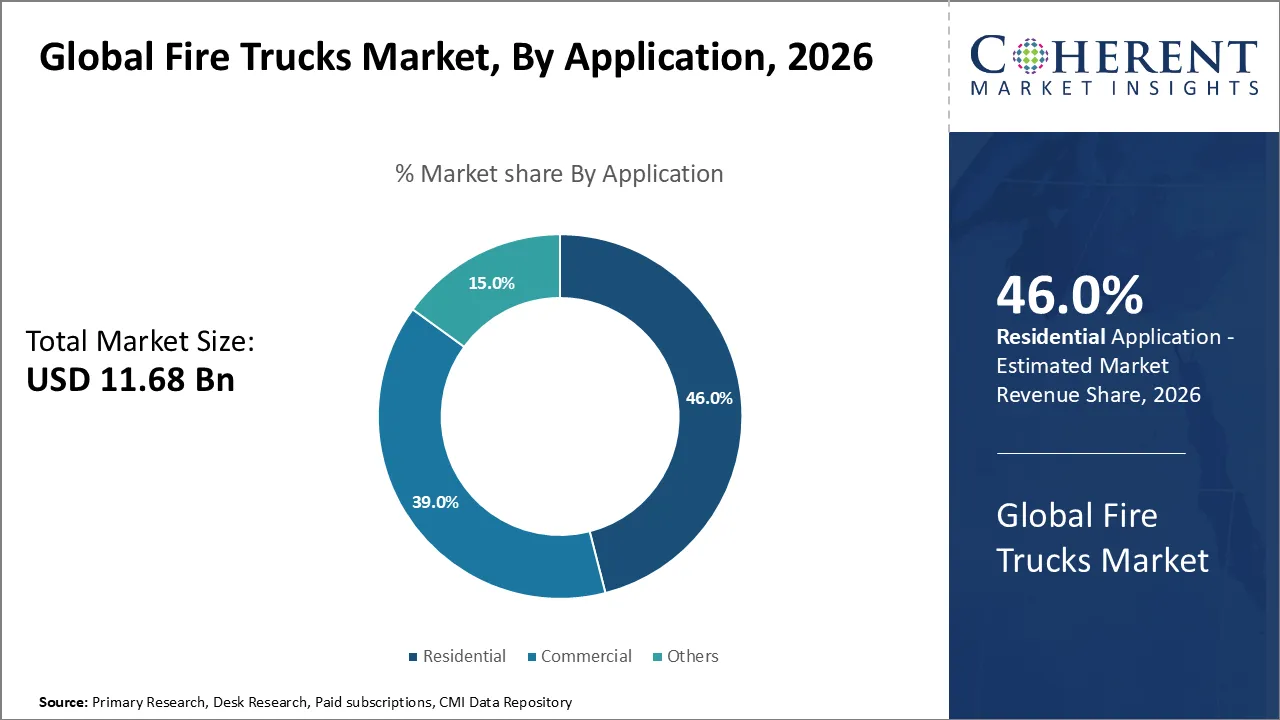
- The residential segment is anticipated to hold a share of 46.0% in the Fire Trucks Market by 2026. The segment’s growth is propelled by increasing residential construction, rising urban populations, increasing demand for quick fire response, and investments in municipal firefighting fleets. The U.S. Fire Administration (USFA) reported that there were approximately 343,000 residential building fires in the U.S. in 2024, resulting in 2,975 deaths and an estimated USD 11.56 Bn in property damage, emphasizing the continued importance of residential fire protection and emergency response capabilities.
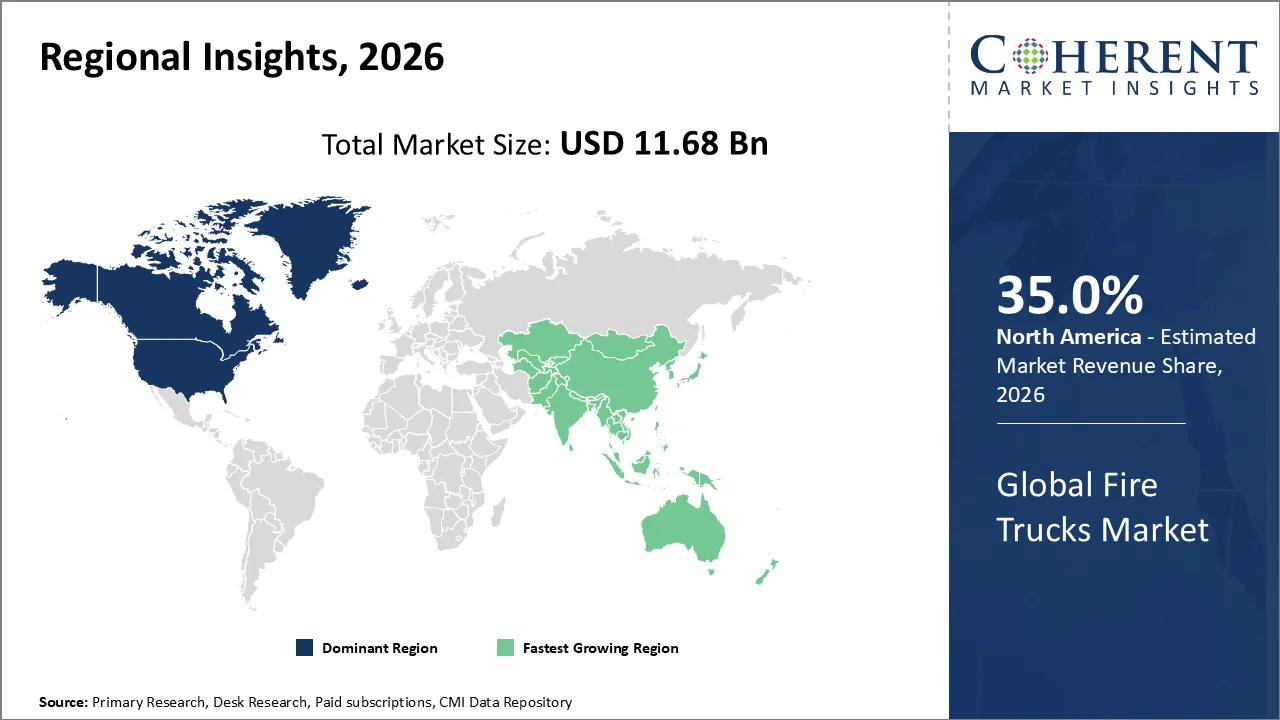
- North America is anticipated to lead the regional market with a share of around 35.0% in 2026. The growth of the region is driven by established municipal fire departments, replacement demand for aging firefighting fleets, advanced emergency response infrastructure and investments in specialized fire apparatus. According to the National Fire Protection Association (NFPA), in 2024, there were an estimated 1.39 million fires in the U.S., resulting in 3,920 civilian deaths and USD 19.1 Bn in direct property damage.
Market Drivers
Rising Replacement Demand for Aging Fire Truck Fleets is Accelerating Market Growth
The global Fire Trucks Market is experiencing an increase in demand due to aging firefighting vehicle fleets, rising maintenance costs and increasing emphasis on operational reliability. The modernization of the fleet is a top priority for city fire departments and emergency response agencies to improve response efficiency, firefighter safety and vehicle availability during critical emergencies.
According to the Victorian Auditor-General’s Office in its report published on October 14, 2026, 57.1% of the combined Fire Rescue Victoria (FRV) and Country Fire Authority (CFA) fire truck fleets were at least 15 years old and 35.2% were aged 20 years or older. The report also identified critical fire truck replacement and upgrade requirements of approximately AUD 1.5 billion over the period 2024-25 to 2033-34.
Increasing Government Funding for Firefighting Equipment is Supporting Market Expansion
Government investment in emergency response infrastructure is driving the Fire Trucks Market. Fire departments can improve firefighting readiness, replace outdated equipment and improve operational capabilities. Programs such as these are critical to local and volunteer fire departments to obtain specialized fire-fighting vehicles and to increase emergency response services.
In May 2026, the U.S. Federal Emergency Management Agency (FEMA) announced a program funding of approximately USD 291.6 million through its FY2025 Assistance to Firefighters Grants (AFG) Program, with an estimated number of 1,800 awards. The program covers eligible fire suppression equipment, operational safety enhancements and emergency response abilities.
Current Events and Their Impact on the Fire Trucks Market
Current Event | Description and its Impact |
U.S. EPA Proposes Revisions to Heavy-Duty Engine Emission Regulations (July 2026) |
|
California Introduces Greater Flexibility in Zero-Emission Fleet Regulations (September 2025–2026) |
|
- Current Industry Events of 2026
- Market Size Estimation
- Regional Breakdown
- Competitive Landscape
- Customer Intelligence
- Segmental Analysis
- Pricing Analysis
- Key Market Drivers, Challenges & Future Trends
- Customized Insights Section
Segmental Insights
Why is the Residential Segment Acquiring the Largest Share?
On the basis of application, the residential segment is projected to account for the largest Fire Trucks Market share of 46.0% in 2026. The segment’s growth is attributed to increasing urban residential density, expanding housing infrastructure, rising requirements for rapid emergency response, and growing municipal investments in fire engines, aerial ladder trucks, and rescue vehicles to strengthen residential fire protection capabilities.
According to the U.S. Fire Administration (USFA), cooking was the leading cause of residential building fires in 2024, accounting for 46.7 percent of those fires. Other major causes were unintentional or careless activities (10.0%) and heating equipment (7.9%). Such numbers speak to the variety of fire hazards in residential environments and the ongoing need for properly equipped municipal firefighting fleets.
Fire Trucks Market Trends
- The firefighting vehicle industry is undergoing a transformation as more electric and hybrid fire trucks are being introduced, motivated by municipal sustainability initiatives, lower operating emissions, and advances in electric drivetrain technology. Dallas Love Field Airport has received delivery of a Rosenbauer all-electric PANTHER 6x6 fire apparatus that can reach a speed of 50 mph in less than 25 seconds and extend the range of the water cannon by 40 percent, from 190 feet to 250 feet.
- The growing demand for specialized airport rescue and firefighting (ARFF) vehicles is driving the investments in large-capacity water tanks, advanced foam suppression systems and rapid-response equipment. In July 2026, Brussels Airport took delivery of four new firefighting vehicles from Rosenbauer. Each of the vehicles has a capacity of 12,500 liters of water, 1,500 liters of firefighting foam and 225 kilograms of dry powder, and can discharge water at a rate of up to 5,200 liters per minute.
- The increases in the integration of advanced driver assistance systems, thermal imaging and remotely operated firefighting equipment are enhancing operational efficiency and firefighter safety. In March 2026, the Dutch Ministry of Defense ordered 26 Rosenbauer PANTHER 6x6 firefighting vehicles, including seven with high-reach extendable turrets with a reach of around 16 meters, in a sign of increasing demand for advanced firefighting technologies.
Regional Insights
North America Dominates Owing to Established Firefighting Infrastructure and Strong Demand for Advanced Fire Apparatus
North America is expected to dominate the Fire Trucks Market, holding approximately 35.0% in 2026. The growth of this region is due to a well-established municipal firefighting infrastructure, increasing replacement of conventional fire engines, soaring demand for aerial ladder trucks and rising investments in advanced fire suppression and emergency response technologies.
In July 2026, Oshkosh Corporation reported continued strong demand for fire trucks and announced ongoing modernization of its fire truck manufacturing operations to expand production capacity. The company highlighted investments in improved material flows and manufacturing processes to support long-term growth in firefighting vehicle deliveries.
Asia Pacific Fire Trucks Market Trends
Asia Pacific is expected to emerge as the fastest-growing region in the Fire Trucks Market during 2026–2033. Regional growth is driven by rapid urbanization, expanding industrial and commercial infrastructure, increasing government investments in fire protection services, and growing procurement of specialized firefighting vehicles across China, India, Japan, and Southeast Asia.
In March 2026 Japan’s Fire and Disaster Management Agency issued a government procurement notice for 19 fire pump vehicles with rescue equipment, each under five tons. The procurement is part of ongoing public investment in specialized firefighting equipment and emergency response capabilities across the region.
In April 2026, Japan’s Fire and Disaster Management Agency issued a further procurement notice for six large-capacity water tank fire trucks, which reflects the demand for specialized high-capacity fire-fighting equipment.
Strong Municipal Fire Apparatus Procurement and Fleet Modernization are Accelerating the Fire Trucks Market in the United States
The U.S. Fire Trucks Market is expected to witness steady growth owing to increased municipal spending on firefighting vehicles, replacement of aging fire apparatus and growing demand for advanced aerial ladder trucks and high-capacity fire engines. Specialized firefighting vehicles are in high demand as local governments focus on fleet reliability, firefighter safety and emergency response capabilities.
In April 2026, the City of Fort Wayne, Indiana, agreed to purchase a Pierce Enforcer 100-foot Ascendant Tower Ladder Truck for its fire department for USD 2.5 million. The vehicle is expected to enhance the city’s capability to fight fires and perform rescues from the air, and is another example of the city’s ongoing investment in modern fire apparatus.
China Fire Trucks Market Trends
China is expected to register significant growth in the Fire Trucks Market during the forecast period. The growth in the country is driven by the development of urban infrastructure, increasing demands for industrial fire safety, modernization of emergency rescue services, and increasing government investment in specialized fire fighting and disaster response vehicles.
In June 2026, Zoomlion Heavy Industry Science & Technology Co., Ltd. introduced three advanced firefighting products at the Hannover International Fire and Safety Exhibition in Germany, including an airport foam rapid-response fire truck, an aerial platform fire truck, and a high-rise firefighting robot.
Who are the Major Companies in Fire Trucks Industry
Some of the major key players in Fire Trucks Market are W.S. Darley & Co., Oshkosh Corporation, Ziegler Firefighting, Magirus GmbH (CNH Industrial Group), Rosenbauer International AG, Gimaex GmbH, Morita Holdings Corporation, E-one, HME Incorporated, and Smeal Fire Apparatus.
Key News
- In March 2026, Pierce Manufacturing, a subsidiary of Oshkosh Corporation, launched Phase I of its new High Flow production line at its Appleton, Wisconsin, manufacturing facility. The initiative is part of the ongoing USD 150 million investment in manufacturing modernization across facilities in Wisconsin, Florida and Tennessee.
- In June 2026, E-ONE and Wheeled Coach announced an order from the Chicago Fire Department for 120 emergency response vehicles valued at more than USD 100 million. The order includes 42 E-ONE pumpers, 38 E-ONE aerial ladder trucks, and 40 Wheeled Coach ambulances.
Market Report Scope
Fire Trucks Market Report Coverage
Report Coverage | Details | ||
Base Year: | 2025 | Market Size in 2026: | USD 11.68 Bn |
Historical Data for: | 2020 to 2024 | Forecast Period: | 2026 to 2033 |
CAGR: | 8.1% | 2033 Value Projection: | USD 20.13 Bn |
Geographies covered: |
| ||
Segments covered: |
| ||
Companies covered: | W.S. Darley & Co., Oshkosh Corporation, Ziegler Firefighting, Magirus GmbH (CNH Industrial Group), Rosenbauer International AG, Gimaex GmbH, Morita Holdings Corporation, E-one, HME Incorporated, and Smeal Fire Apparatus. | ||
Growth Drivers: |
| ||
Restraints & Challenges: |
| ||
Analyst Opinion
- The Fire Trucks Market is experiencing sustained demand from municipal fleet modernization and replacement programs, particularly across North America. The Contra Costa County Fire Protection District in California has approved the purchase of five Type 1 fire engines in April 2026 for up to USD 6.66 million, said the Contra Costa County Fire Protection District. This points to continued public sector investment in modern firefighting tools and emergency response infrastructure.
- Fire trucks are becoming more expensive and take longer to manufacture, leading to changing buying patterns and competition in the industry. The price of a typical fire engine rose from USD 500,000-$600,000 in November 2019 to USD 1 million or more in November 2025 and delivery times for some vehicles were as long as about 2-4 years. This has led to manufacturers increasing their production capacity and fire departments are looking at long term procurement.
- The rising use of specialized rescue equipment and customized fire trucks is creating opportunities for advanced fire truck manufacturers. May 2026 - The Minneapolis Fire Department orders three Pierce Enforcer pumpers from Pierce Manufacturing, a subsidiary of Oshkosh Corporation. The order represents a shift from commercial chassis vehicles to purpose-built firefighting apparatus. The development highlights increasing emphasis on firefighter safety, vehicle maneuverability, and operational efficiency in urban firefighting applications.
Speak to the analyst
Want personalized insights?
Take the findings above to one of our principal consultants, or have the report rebuilt around the segments, geographies and competitors you actually track.
Market Segmentation
- By Application (Revenue, USD Bn, 2021-2033)
- Residential
- Commercial
- Others
- By Region (Revenue, USD Bn, 2021-2033)
- North America
- U.S.
- Canada
- Latin America
- Brazil
- Mexico
- Argentina
- Rest of Latin America
- Europe
- Germany
- U.K.
- France
- Italy
- Spain
- Russia
- Rest of Europe
- Asia Pacific
- China
- India
- Japan
- Australia
- South Korea
- ASEAN
- Rest of Asia Pacific
- Middle East
- GCC
- Israel
- Rest of Middle East
- Africa
- South Africa
- Central Africa
- North Africa
- North America
Sources
Primary Research Interviews
- Fire truck manufacturers and OEM representatives
- Fire apparatus design and engineering specialists
- Fire department chiefs and emergency response managers
- Municipal fire truck procurement and fleet management officers
- Firefighting equipment suppliers and distributors
- Airport rescue and firefighting (ARFF) specialists
- Key opinion leaders (KOLs) in fire safety and emergency vehicle technologies
Databases
- U.S. Fire Administration (USFA)
- National Fire Protection Association (NFPA)
- World Bank
- United Nations Comtrade Database
- U.S. Census Bureau
Magazines
- Fire Apparatus & Emergency Equipment Magazine
- Fire Engineering Magazine
- Firehouse Magazine
- FireRescue1
- Fire Fighting in Canada
Journals
- Fire Safety Journal
- Fire Technology
- Safety Science
- Accident Analysis & Prevention
- International Journal of Disaster Risk Reduction
- Fire (MDPI)
Newspapers
- The New York Times
- The Guardian
- The Wall Street Journal
- Financial Times
- The Economic Times
- Reuters
Associations
- Fire Apparatus Manufacturers' Association (FAMA)
- National Fire Protection Association (NFPA)
- International Association of Fire Chiefs (IAFC)
- International Association of Fire and Rescue Services (CTIF)
- Fire and Emergency Manufacturers and Services Association (FEMSA)
- Fire Protection Association (FPA)
Public Domain Sources
- Company Annual Reports and Investor Presentations
- Government Fire Safety and Emergency Response Publications
- Municipal Fire Department Procurement and Fleet Replacement Records
- Publicly Available Fire Truck Tender and Contract Award Documents
- Fire Truck Manufacturer Product Catalogs and Technical Specifications
- Regulatory and Standards Publications Related to Fire Apparatus and Emergency Vehicles
Proprietary Elements
- CMI Data Analytics Tool
- Proprietary CMI Existing Repository of Information for the Last 10 Years
Get access to 250+ pages report
Every segment, forecast, competitor profile and data table behind the analysis above — available for instant download.
- ESOMAR Member
- ISO 9001:2015 Certified
- D-U-N-S Registered
- GDPR & CCPA Compliant
Missing comfort of reading report in your local language? Find your preferred language:
Transform your Strategy with Exclusive Trending Reports
Frequently Asked Questions
The Fire Trucks Market is expected to reach USD 20.13 Bn in 2033, from USD 11.68 Bn in 2026.
Major players operating in the global Fire Trucks Market include W.S. Darley & Co., Oshkosh Corporation, Ziegler Firefighting, Magirus GmbH, Rosenbauer International AG, Gimaex GmbH, Morita Holdings Corporation, E-ONE, HME Incorporated, and Smeal Fire Apparatus.
High initial investment and procurement costs, increasing maintenance and operational expenses, extended manufacturing lead times, and limited municipal firefighting budgets are the key factors hampering market growth.
Increasing demand for advanced firefighting and emergency response vehicles, rising replacement of aging fire truck fleets, growing government investments in fire safety infrastructure, and expanding residential and commercial construction activities are boosting demand for fire trucks.
The Fire Trucks Market is anticipated to grow at a CAGR of approximately 8.1% between 2026 and 2033.
Among regions, North America is expected to account for the largest share of approximately 35.0% in 2026, owing to established firefighting infrastructure, strong municipal procurement activities, and increasing demand for advanced firefighting apparatus.
Fire trucks are specialized emergency response vehicles equipped with firefighting and rescue equipment, including water pumps, hoses, ladders, water tanks, and fire suppression systems. These vehicles are designed to support fire extinguishing, rescue operations, and emergency response activities.