

India Vehicle Scrapping Market Size and Forecast – 2026-2033
India Vehicle Scrapping Market is estimated to be valued at USD 12.80 Bn in 2026 and is expected to reach USD 31.73 Bn by 2033, exhibiting a compound annual growth rate (CAGR) of 13.9% from 2026 to 2033.
Key Takeaways of the India Vehicle Scrapping Market
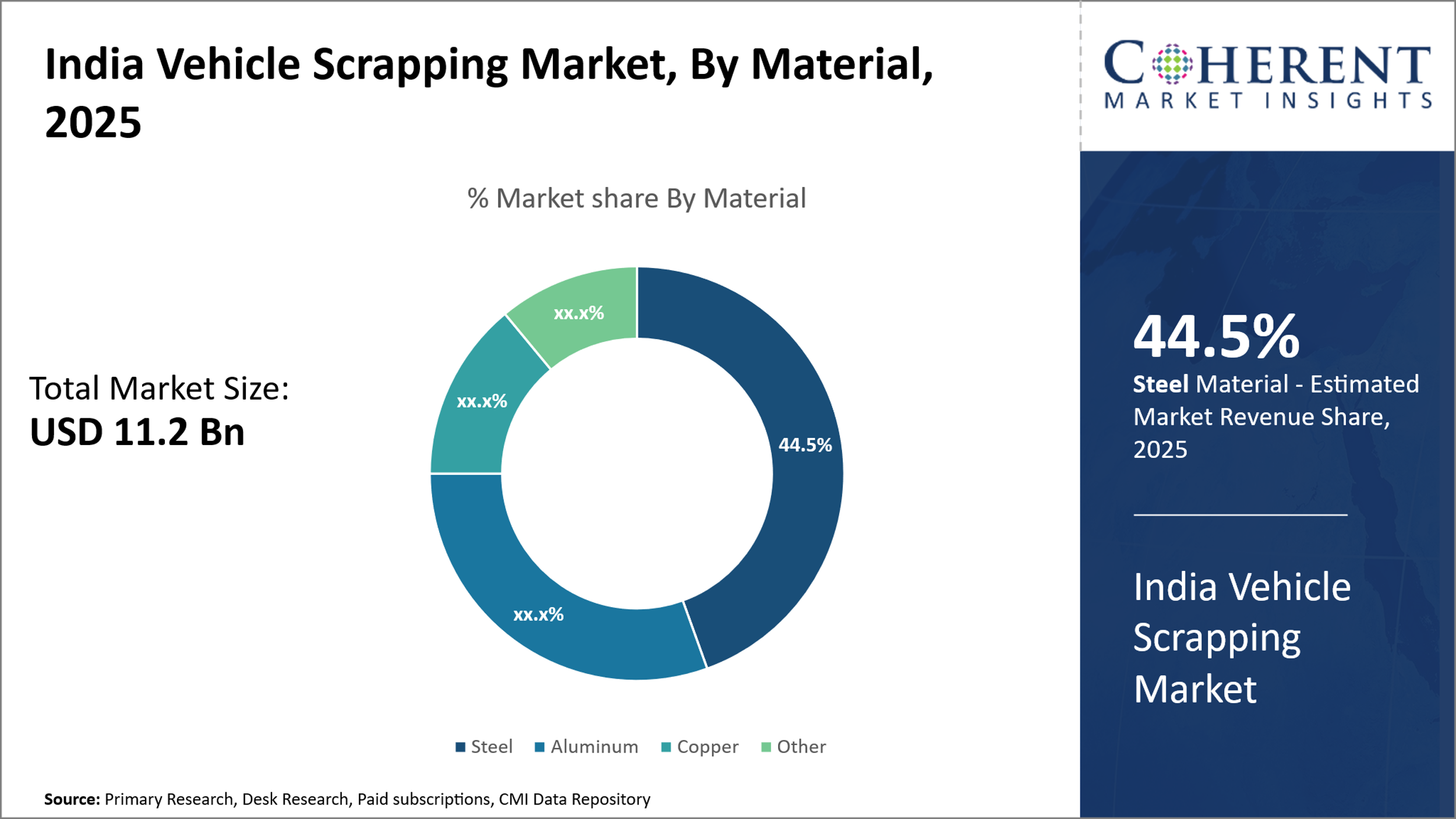
- The steel segment leads the market holding an estimated share of 45.5 % in 2026.
- The passenger vehicles segment is projected to dominate with a share of 42.3 % in 2026.
- The reusable parts segment is estimated to lead the market with a share of 55.3 % in 2026.
Market Overview
With the Government of India pushing to scrap unfit vehicles older than 20 years under the Voluntary Vehicle Fleet Modernisation Programme (launched in 2021), the vehicle scrapping market in India is poised to grow manifold. The total installed capacity in India for vehicle scraping is ~1.5–1.7 million vehicles per year. As more fleet owners such as bus and truck operators opt for vehicle replacement over continued use of old vehicles, it will drive a surge in demand for vehicle scrapping services in the coming years.
Current Events and Its Impact
Current Events | Description and its impact |
Implementation and Expansion of India's Vehicle Scrappage Policy |
|
Technological Advancements in Vehicle Recycling |
|
Segmental Insights
- Current Industry Events of 2026
- Market Size Estimation
- Regional Breakdown
- Competitive Landscape
- Customer Intelligence
- Segmental Analysis
- Pricing Analysis
- Key Market Drivers, Challenges & Future Trends
- Customized Insights Section
India Vehicle Scrapping Market Insights, by Material – Availability of Scrap Steel Drives the Steel Segment Growth
By Material, Steel segment is expected to account for the highest share 45.5% market share in 2026 owing to its abundant availability from scrap vehicles. Steel has been the dominant material used in automotive manufacturing due to its high strength-to-weight ratio and affordability. On an average, a decommissioned vehicle contains about 60-70% of recyclable steel which can be extracted and processed. This huge source of scrap steel directly feeds into the recycling ecosystem. Steel scrap yards find it convenient to collect, sort, and process bulk quantities of ferrous scrap.
CERO (MSTC-Mahindra JV) operates multiple scrapping units where ferrous scrap recovery is a core activity. Their facilities in Greater Noida and Pune systematically extract high-quality steel scrap from decommissioned vehicles. This steel is then supplied to domestic steel mills, contributing directly to India’s circular economy in the metals sector.
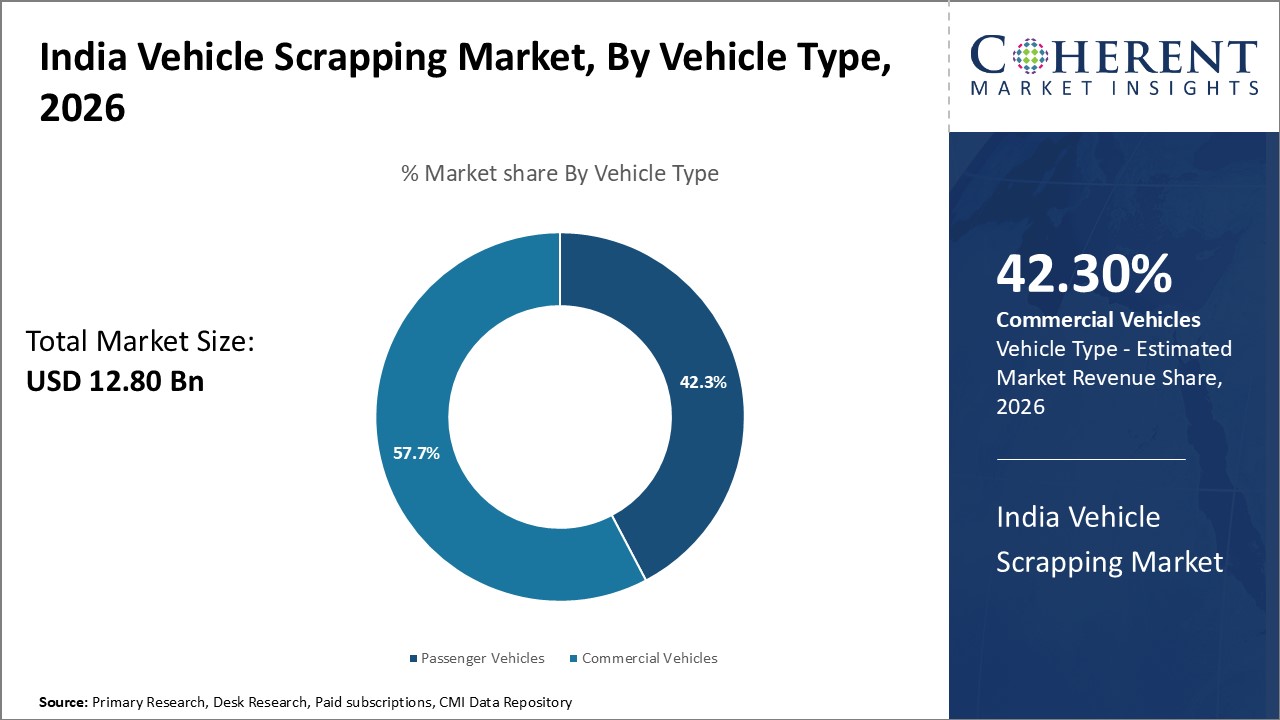
India Vehicle Scrapping Market Insights, by Vehicle Type - Passenger Vehicle Segment Leads Due to Urbanization and Rise of Personal Mobility
By Vehicle Type, Passenger Vehicles segment is projected to hold the highest share of 42.3% market share in 2026. As personal mobility rises alongside economic growth and urbanization, the passenger vehicle parc has been rising consistently over the past decades. This exponential increase in the number of vehicles on road eventually leads to a proportionate rise in obsolete passenger cars after completing their lifecycle. Scrapping such end-of-life vehicles provides a good source of components and steel for the recycling industry.
Maruti Suzuki Toyotsu India Pvt Ltd (MSTI) focuses significantly on scrapping obsolete passenger vehicles. Their dedicated ELV facility in Noida targets the rising volume of scrappable cars driven by stricter emission norms (BS-VI transition) and voluntary vehicle scrappage.
India Vehicle Scrapping Market Insights, by Application – Component Reuse Boosts the Reusable Parts Application
By Application, Reusable Parts are expected to contribute the highest share of 55.3% market share in 2026 owing to the practice of refurbishing viable components. Though an older vehicle reaches the end of its life components such as engines, transmission, and alternators are still left with functionality. Scrapping facilities efficiently segregate such reusable parts through inspection and testing. These salvaged parts are then reconditioned or re-manufactured to desired quality standards. The refurbished components are competitively priced, increasing their demand from mechanic workshops and retail components buyers.
Abhishek Auto Industries, operating out of Delhi NCR, is a scrapper that specializes in recovering and refurbishing reusable parts like engines, gearboxes, and alternators.
Scrappage Policies and Air Pollution Action Plans in Indian Cities/States
Timeline | State | Aim | Measures Taken |
August 2018 | Delhi | Scrap 10-year-old diesel vehicles and 15-year-old petrol vehicles | Up to 25% rebate on road tax with vehicle scrapping certificate |
December 2018 | Kolkata, West Bengal | Air pollution control | Phasing out/scrapping of >15 years old commercial vehicles based on the Eastern Bench of NGT - Only 4-Stroke LPG 3-wheelers allowed |
February 2019 | Kohima, Nagaland | Air quality monitoring | Phasing out 15-year-old commercial diesel vehicles |
September 2019 | Mumbai, Maharashtra | Action Plan for Control of Air Pollution | BS–II and BS–III bus scrapping policy developed Restrict age of taxies to 20 years and 16 years for autorickshaws |
2021 | Madhya Pradesh | Vehicle Scrappage Policy | Incentives on new vehicle purchase Waiver of pending dues / liabilities |
July 2022 | Assam | Vehicle Scrappage Policy of Assam, 2022 | Incentivize voluntary scrappage of old and unfit vehicles Support to RVSF |
December 2022 | Odisha | Improve air quality, regularize informal facilities, and promote circular economy | Vehicles >15-year-old banned in low emission zones Incentives to customers Land incentives, capital investment subsidy, and SGST reimbursement to RVSFs |
India’s National Vehicle Scrappage Policy (VVMP), including Key Updates and Incentives Implemented up to mid-2025
Notification | Date Issued | Purpose / Description |
G.S.R. 653(E) – Motor Vehicles (Registration & Functions of Vehicle Scrapping Facility) Rules, 2021 | September 23, 2021 | Defines registration criteria, operational guidelines, and requirements for RVSFs. |
G.S.R. 714(E) – Registration Fee Waiver Notification | October 4, 2021 (effective April 1, 2022) | Waives new vehicle registration fee for vehicles registered against a Certificate of Deposit from an RVSF. |
G.S.R. 720(E) – Road Tax Concession Notification | October 5, 2021 (effective April 1, 2022) | Grants road tax rebate: 25% for non-transport vehicles, 15% for transport vehicles, for up to 8–15 years. |
G.S.R. 652(E) – Automated Testing Stations (ATS) Rules | September 23, 2021 | Mandates fitness tests through ATS for HCVs (from Apr 2022) and all CV/PVs (from Jun 2024). |
MoRTH PIB Releases – VVMP Overview | 2021–2024 | Government’s official announcements summarizing VVMP, RVSF targets (84+ approved by January 2025). |
Budget 2025 Draft Amendment | Circa January 2025 | Proposal to increase road tax rebate to 50% for scrapping BS‑II or older vehicles. |
Major Registered Vehicle Scrapping Facilities (RVSFs) in India (Operational & Upcoming)
Player / JV | Facility Name / Location | Address / Site | Annual Capacity |
Maruti Suzuki & Toyota Tsusho (MSTI) | Noida RVSF, Uttar Pradesh (MSTI’s first facility) | Sector Ecotech-1 Ext., Greater Noida, Gautam Budh Nagar, UP | 24,000 ELVs/year |
Maruti Suzuki & Toyota Tsusho (MSTI) | Gujarat RVSF (proposed) – likely Ahmedabad/Gujarat region | (Exact site TBA – planned by 2025) | Planned (~24,000/year) |
Tata Motors & Ganganagar Vaahan Udyog | Re.Wi.Re – Jaipur, Rajasthan (Tata’s 1st RVSF) | Jaipur (near Ganganagar Vaahan Udyog yard) | 15,000 vehicles/year |
Tata Motors & Empreo Premium Pvt. Ltd. | Re.Wi.Re – Bhubaneswar, Odisha (Odisha’s 1st RVSF) | Pitapalli, Khordha District (near Bhubaneswar), Odisha | 10,000 vehicles/year |
Tata Motors & Shree Ambica Auto | Re.Wi.Re – Surat, Gujarat (Tata’s 3rd RVSF) | Surat (Pandesara area), Gujarat | 15,000 vehicles/year |
Tata Motors & Dada Trading Co. | Re.Wi.Re – Chandigarh, Chandigarh (UT) (Tata’s 4th RVSF) | Indl. Area, Chandigarh (Punjab border) | 12,000 vehicles/year |
Tata Motors & Johar Motors | Re.Wi.Re – Delhi NCR, (near Delhi, Haryana) (5th RVSF) | Delhi NCR region (Haryana border) | 18,000 vehicles/year |
Tata Motors & Tata International (TIVA) | Re.Wi.Re – Pune, Maharashtra (6th RVSF) | Pune (Chakan MIDC area), Maharashtra | 21,000 vehicles/year |
Tata Motors & Axom Platinum Scrappers | Re.Wi.Re – Guwahati, Assam (7th RVSF) | North Guwahati, Kamrup District, Assam | 15,000 vehicles/year |
Market Players, Key Development, and Competitive Intelligence
Key Developments
- In May 2025, Tata Motors inaugurated its eighth Registered Vehicle Scrapping Facility (RVSF) in India, establishing its first center in West Bengal and third in the eastern region. Located in Kolkata, the facility operates under the brand name ‘Re.Wi.Re – Recycle with Respect’, reflecting the company’s commitment to responsible vehicle recycling.
- On January 24, 2025, the Ministry of Road Transport and Highways (MoRTH) proposed increasing the one-time tax rebate to up to 50% for those purchasing a new vehicle after scrapping older ones that comply with BS-II or earlier emission standards. Currently, buyers receive a 25% rebate on motor vehicle tax when replacing old personal vehicles, and 15% in the case of commercial vehicles. The draft notification suggests this enhanced 50% rebate would apply to both personal and commercial vehicles that are either BS-I compliant or manufactured before the introduction of Bharat Stage (BS) emission norms.
- In January 2023, CERO, a joint venture between Mahindra Accelo and MSTC Ltd., announced plans to expand its recycling facilities to 100 cities by 2025, aiming to enhance sustainable vehicle recycling practices across India.
- In April 2023, Tata Motors inaugurated a registered vehicle scrapping facility in Bhubaneswar, Odisha. This state-of-the-art center is designed to dismantle 10,000 end-of-life vehicles annually using environmentally friendly processes.
- In November 2021, Maruti Suzuki Toyotsu India (MSTI) opened a registered vehicle scrapping facility in Noida, Uttar Pradesh. This facility employs eco-friendly processes to dismantle end-of-life vehicles, contributing to the formalization of the scrapping industry.
- In August 2021, the Indian government launched the Vehicle Scrapping Policy to tackle the environmental and safety issues caused by old and damaged vehicles. The policy applies to private vehicles over 20 years old and commercial vehicles over 15 years old, or those severely damaged and no longer fit to be driven. A key part of the policy is mandatory fitness testing. Once a vehicle reaches the age limit, it must undergo tests—including a Pollution Under Control (PUC) check—at certified centers. If it passes, the owner will need to pay a 'green cess' of 10–15% on the road tax. If it fails, the vehicle cannot be re-registered, and the owner must either repair it to meet standards or send it for scrapping.
Top Strategies Followed by India Vehicle Scrapping Market Players
- Established Players: Leading companies heavily invest in research and development to introduce technologically advanced and innovative products.
- CERO (joint venture of Mahindra Intertrade & MSTC) has invested in automated dismantling lines, advanced depollution equipment, and digital systems for issuing Certificate of Deposit (CoD).
- Mid-Level Players: Mid-sized players aim to deliver high-quality yet affordable products and services targeting the price-sensitive segments.
- Aman Motors (Uttar Pradesh) focuses on structured scrapping services and collaborates with local dealers to provide reasonable scrapping solutions bundled with old-to-new car exchange schemes for price-conscious customers.
- Small-Scale Players: Small players focus on specific market niches neglected by bigger players.
- Shree Auto Recyclers (Gujarat) is a small scrapper focused on agricultural and industrial vehicle dismantling in rural belts of Saurashtra.
Market Report Scope
India Vehicle Scrapping Market Report Coverage
| Report Coverage | Details | ||
|---|---|---|---|
| Base Year: | 2025 | Market Size in 2026: | USD 12.80 Bn |
| Historical Data for: | 2020 To 2024 | Forecast Period: | 2026 To 2033 |
| Forecast Period 2026 to 2033 CAGR: | 13.9% | 2033 Value Projection: | USD 31.73 Bn |
| Segments covered: |
| ||
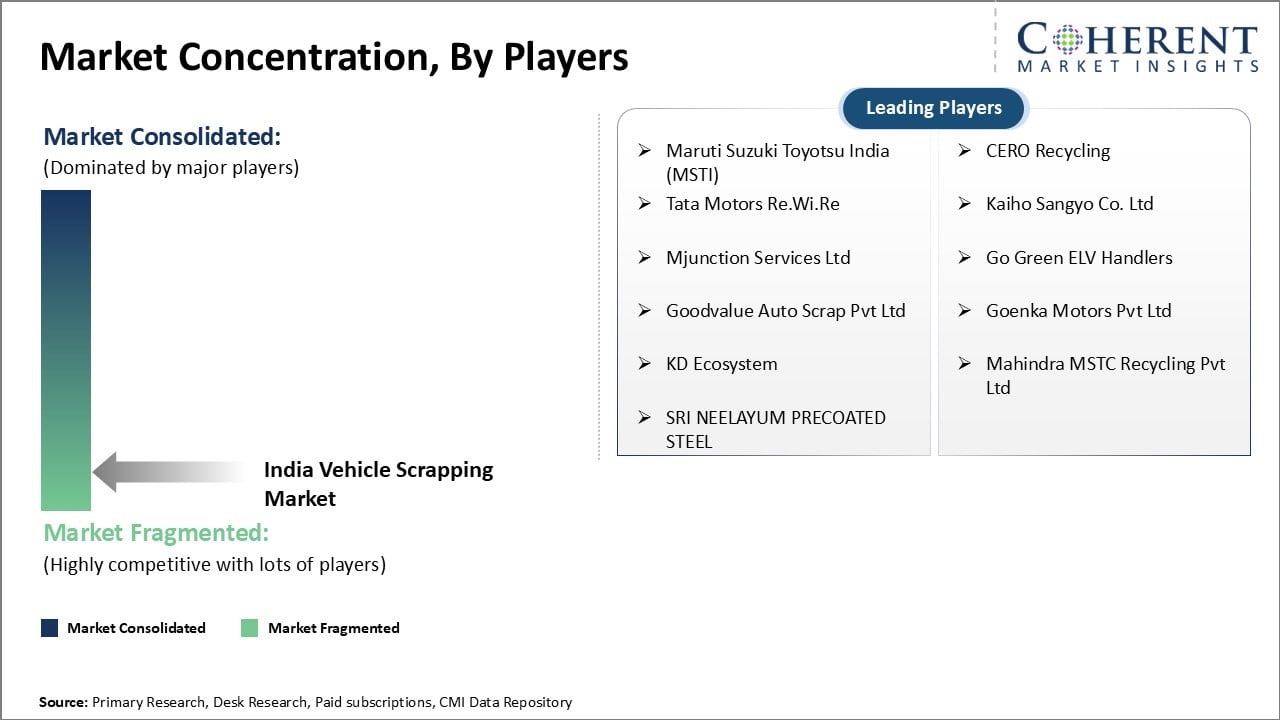
| Companies covered: | Maruti Suzuki Toyotsu India (MSTI), CERO Recycling, Tata Motors Re.Wi.Re, Kaiho Sangyo Co. Ltd, Mjunction Services Ltd, Go Green ELV Handlers, Goodvalue Auto Scrap Pvt Ltd, Goenka Motors Pvt Ltd, KD Ecosystem, Mahindra MSTC Recycling Pvt Ltd, and SRI NEELAYUM PRECOATED STEEL | ||
| Growth Drivers: |
| ||
| Restraints & Challenges: |
| ||
Market Dynamics
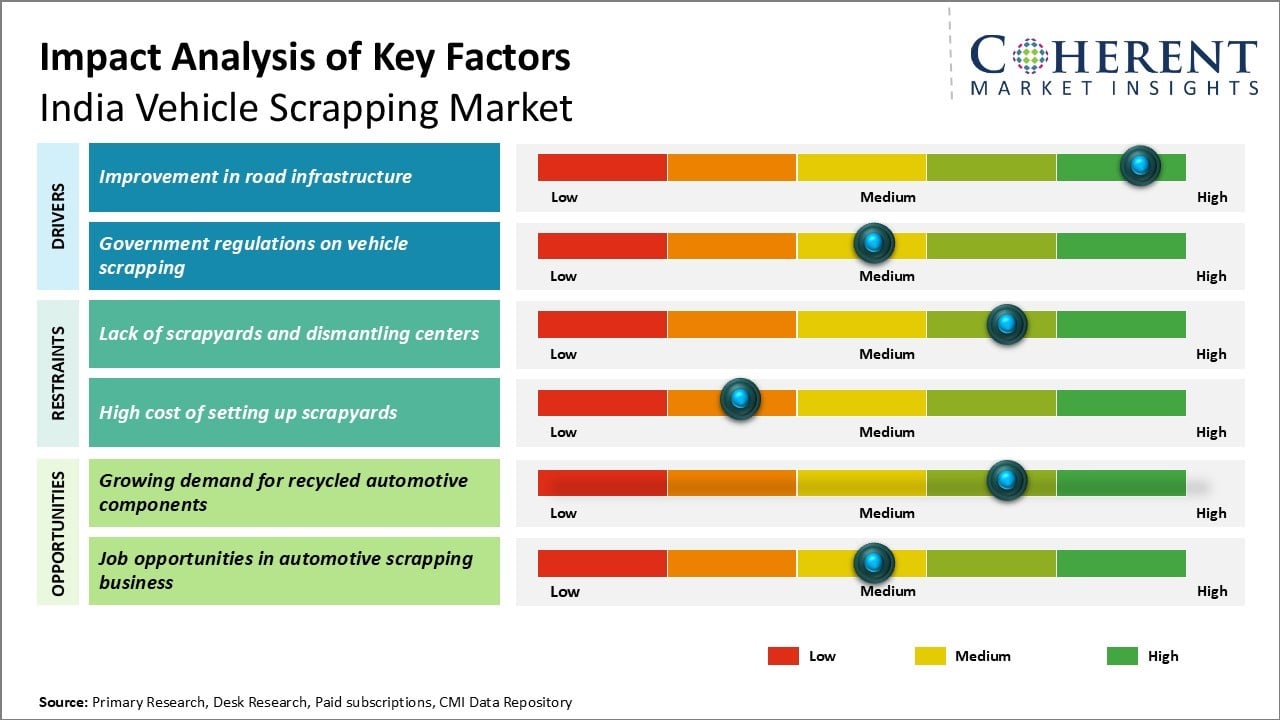
India Vehicle Scrapping Market Driver - Improvement in Road Infrastructure
As India aims to become a five trillion economy by 2025, extensive efforts are being put by the government to boost infrastructure development across the country. Emphasis is being given to build modern highways, expressways and roads which can support the growing vehicular traffic. In the last few years, around 30 km of roads were being constructed daily in India. The government had set a target of building over 34,800 km of National Highways by 2022 intending to connect different parts of the country. A well maintained and developed road infrastructure is enabling the higher utilization of vehicles. With wider and smoother roads coming up, vehicle owners are able to cover longer distances during daily commutes with less repairs and maintenance. This increased usage is shortening the lifespan of existing older vehicles.
India Vehicle Scrapping Market Opportunity - Growing Demand for Recycled Automotive Components
One of the key opportunities for players in India vehicle scrapping market is the growing demand for recycled automotive components. As thousands of old vehicles get decommissioned and dismantled at authorized centers every year, there will be a sizable supply of reusable parts such as engines, transmission components, steel sheets, aluminum parts, and electric vehicle batteries. Many of these components can be remanufactured and remarketed at lower costs compared to new parts. The automotive aftermarket which sees demand for replacement parts is increasingly embracing recycled components. Both independent garages and automotive workshops will source such parts for repairing older vehicles.
Analyst Opinion (Expert Opinion)
- Players benefit from ~10–15% lower effective CapEx due to input tax credit on plant, equipment, and services. This makes investments in scrapping infrastructure more attractive, especially for large organized players. States like Odisha, Assam, and Gujarat offer SGST reimbursement for 5–7 years. OEMs and JVs smartly structure SPVs to claim these benefits, directly boosting margins and enabling faster market expansion.
- GST compliance on scrap sales turns what was often informal revenue into legitimate turnover. This enhances creditworthiness as banks recognize the turnover, improving players’ access to credit. Corporate finance arms of large players leverage accelerated depreciation on capital equipment. This reduces taxable income during initial years (typically 3–5 years), improving project IRRs and encouraging upfront investments.
- OEMs like Tata and Maruti bundle scrappage benefits (via Certificate of Deposit - CoD) with new vehicle discounts (5–6%) and road tax/registration fee waivers. This integrated approach accelerates ELV (end-of-life vehicle) flow into scrapping yards while driving new vehicle sales. Early certification (e.g., CERO) enables players to issue CoDs quickly, supporting incentive-bundled new vehicle sales and locking in ELV supply. MoRTH and state-level support have been instrumental in this fast-track certification.
- Larger players exhibit full preparedness to tap GST input credits across plant, IT, and service spends, realizing ~15–18% CapEx savings. This provides them with a decisive edge over unorganized or smaller scrappers.
Speak to the analyst
Want personalized insights?
Take the findings above to one of our principal consultants, or have the report rebuilt around the segments, geographies and competitors you actually track.
Market Segmentation
- Material Insights (Revenue, USD Bn, 2021 - 2033)
- Steel
- Aluminum
- Copper
- Others
- Vehicle Type Insights (Revenue, USD Bn, 2021 - 2033)
- Passenger Vehicles
- Commercial Vehicles
- Application Insights (Revenue, USD Bn, 2021 - 2033)
- New Products
- Reusable Parts
- Key Players Insights
- Maruti Suzuki Toyotsu India (MSTI)
- CERO Recycling
- Tata Motors Re.Wi.Re
- Kaiho Sangyo Co. Ltd
- Mjunction Services Ltd
- Go Green ELV Handlers
- Goodvalue Auto Scrap Pvt Ltd
- Goenka Motors Pvt Ltd
- KD Ecosystem
- Mahindra MSTC Recycling Pvt Ltd
- SRI NEELAYUM PRECOATED STEEL
Sources
Primary Research Interviews
Stakeholders
- Construction Companies and Contractors (e.g., Project Managers, Site Supervisors)
- Formwork Manufacturers and Suppliers
- Architects and Structural Engineers involved in large-scale infrastructure projects
- Real Estate Developers and Building Construction Companies
- Equipment Leasing Firms specializing in formwork solutions
- Sustainability Experts and Green Building Consultants (if focusing on eco-friendly formwork systems)
Databases
- Global Infrastructure Data Exchange (GIDE)
- Asia Construction Statistics Bureau (ACSB)
- U.S. Census
- Eurostat
- OECD
- Construction Global
Magazines
- Construction Today
- Concrete Construction Magazine
- Building Design + Construction (BD+C)
- Formwork Construction Magazine
- Modern Infrastructure Digest
Journals
- Journal of Construction Engineering and Management
- Construction and Building Materials Journal
- Automation in Construction Journal
- Journal of Building Engineering
- International Journal of Sustainable Construction
Newspapers
- The Construction Index
- Construction Week Online
- The Guardian (UK)
- The Economic Times (India)
- Infrastructure Daily
Associations
- International Concrete Repair Institute (ICRI)
- The Concrete Society (UK)
- National Association of Home Builders (NAHB)
- The Formwork Association (UK)
- American Concrete Institute (ACI)
- Asia-Pacific Construction Alliance (APCA)
Public Domain Sources
- U.S. Census Bureau
- EUROSTAT
- United Nations Economic Commission for Europe (UNECE)
- World Bank
- ResearchGate
Proprietary Elements
- CMI Data Analytics Tool, Proprietary CMI Existing Repository of information for last 8 years
Get access to 250+ pages report
Every segment, forecast, competitor profile and data table behind the analysis above — available for instant download.
- ESOMAR Member
- ISO 9001:2015 Certified
- D-U-N-S Registered
- GDPR & CCPA Compliant
Missing comfort of reading report in your local language? Find your preferred language:
Transform your Strategy with Exclusive Trending Reports
Frequently Asked Questions
India vehicle scrapping market is estimated to be valued at USD 12.80 Bn in 2026 and is expected to reach USD 31.73 Bn by 2033.
The CAGR of India vehicle scrapping market is projected to be 13.9% from 2026 to 2033.
Improvement in road infrastructure and government regulations on vehicle scrapping are the major factors driving the growth of India vehicle scrapping market.
Lack of scrapyards and dismantling centers and high cost of setting up scrapyards are the major factors hampering the growth of India vehicle scrapping market.
In terms of Material, Steel segment is estimated to dominate the market revenue share in 2026.
Maruti Suzuki Toyotsu India (MSTI), CERO Recycling, Tata Motors Re.Wi.Re, Kaiho Sangyo Co. Ltd, Mjunction Services Ltd, Go Green ELV Handlers, Goodvalue Auto Scrap Pvt Ltd, Goenka Motors Pvt Ltd, KD Ecosystem, Mahindra MSTC Recycling Pvt Ltd, and SRI NEELAYUM PRECOATED STEEL are the major players.