

Luxury Van Market Size and Forecast — 2026 - 2033
The Global Luxury Van Market size is estimated to be valued at USD 12.8 billion in 2026 and is expected to reach USD 23.6 billion by 2033, exhibiting a compound annual growth rate (CAGR) of 8.7% from 2026 to 2033.
Overview
The Luxury Van Market offers a range of high-end vehicles designed for comfort, performance, and premium features. Products typically include luxury passenger vans, camper vans, and customized transport vans equipped with advanced infotainment systems, leather interiors, and enhanced safety technologies. Passenger vans focus on spacious seating, executive travel, and long-distance comfort, while camper vans integrate living amenities such as kitchens, sleeping areas, and climate control for recreational purposes. Customized vans cater to corporate, VIP, and leisure segments, offering bespoke interiors and technological enhancements. Overall, luxury van products combine style, convenience, and advanced automotive technology to meet the evolving demands of affluent consumers and specialized transport services.
Key Takeaways
The Passenger Van segment holds a dominant market share due to its versatility and widespread use across tourism, corporate, and private applications.
Among propulsion types, Internal Combustion Engine (ICE) vehicles currently lead the market, while Electric Vehicles (EVs) are the fastest-growing segment, driven by changing regulations and shifting consumer preferences.
Europe accounts for the largest regional market share, supported by mature automotive ecosystems and stringent emission regulations that promote EV adoption.
Asia Pacific exhibits the fastest growth, fueled by rapid urbanization, expanding corporate fleets, and increasing demand in key markets such as China and India, offering significant business opportunities.
Luxury Van Market Segmentation Analysis
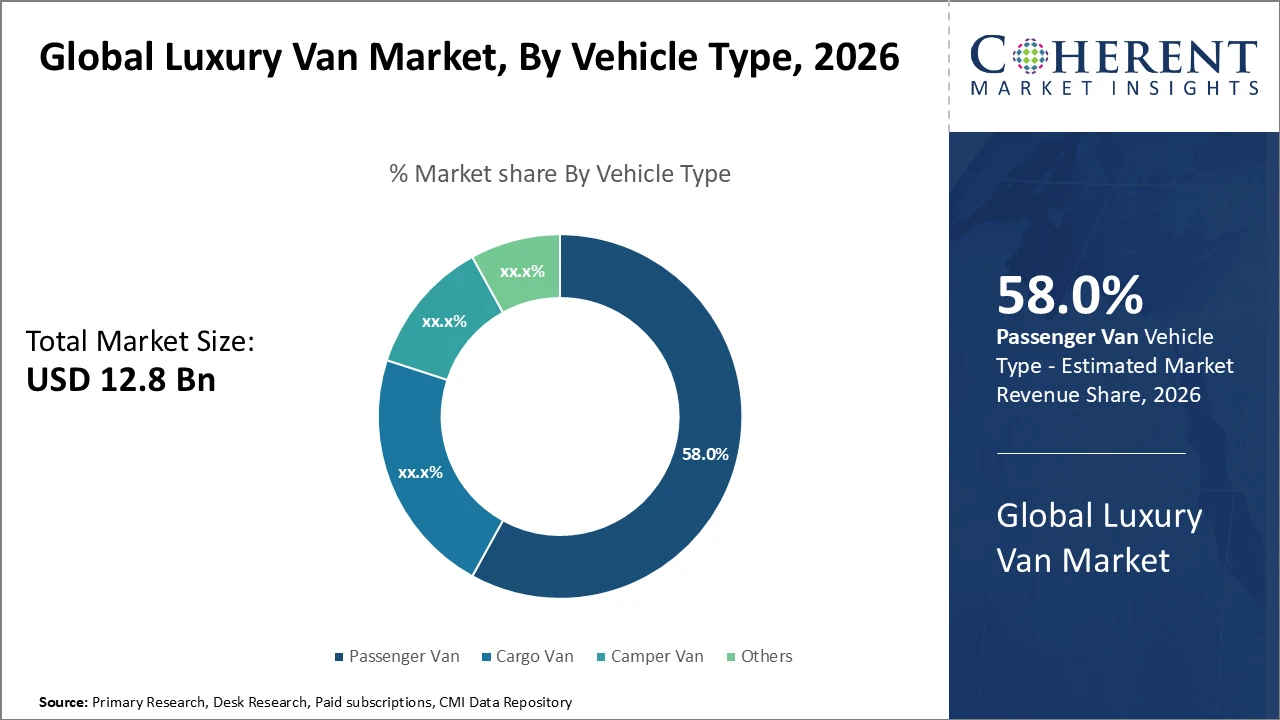
Luxury Van Market Insights, By Vehicle Type
Passenger Vans dominate the luxury van market due to their versatile use across corporate transport, tourism, and private luxury travel. They are favored for spacious interiors and advanced comfort features, accounting for over 58% of the market share. Cargo Vans, while smaller in share, are gaining popularity for premium goods transportation in urban areas. Camper Vans are the fastest-growing subsegment, driven by rising demand for luxury recreational travel and outdoor experiences. The Others category includes highly customized vans for niche purposes such as mobile offices and VIP transport. Overall, the segments cater to comfort, utility, lifestyle, and bespoke mobility needs.
Luxury Van Market Insights, By Propulsion Type
The Internal Combustion Engine (ICE) segment dominates the luxury van market due to its established manufacturing infrastructure and widespread consumer preference, contributing a major portion of market revenue. Electric Vehicles (EVs) represent the fastest-growing segment, driven by stricter environmental regulations and increasing demand for sustainable mobility, with double-digit growth observed in 2025 and 2026. Hybrid vehicles are gaining moderate adoption, offering a balance between fuel efficiency and performance. The Others category includes alternative propulsion technologies, such as hydrogen fuel cells, which remain niche but hold future potential. Overall, ICE ensures reliability, EVs focus on sustainability, and hybrids bridge efficiency and performance.
Luxury Van Market Insights, By Application
Corporate Transport dominates the luxury van market as companies increasingly use these vehicles for employee and client transportation, enhancing comfort and brand image. This segment benefits from large-scale fleet procurement and consistent demand across sectors such as IT, finance, and manufacturing. Tourism and Rental services are the fastest-growing application, fueled by rising luxury travel demand and customizable vehicle options. Private Use remains a stable segment, catering to high-net-worth individuals seeking bespoke travel experiences. The Others category includes emergency services and government dignitary vehicles requiring specialized configurations. Overall, Corporate Transport drives volume, Tourism & Rental grows rapidly, Private Use is steady, and Others meet specialized operational needs.
Luxury Van Market Trends
The luxury van segment is shifting towards sustainable and connected vehicles, driven by the rise of electric vans and AI-enabled safety systems.
In 2025, global electric luxury van sales increased by 12.5%, reflecting growing consumer preference for eco-friendly and technologically advanced vehicles.
Adoption of digital sales platforms has accelerated purchase cycles and improved personalization, enhancing the overall consumer buying experience.
Modular interior designs are increasingly in demand, allowing customization for corporate transport, tourism, camper, and private use applications.
Overall, sustainability, connectivity, digital engagement, and flexible interiors are key trends shaping luxury van product development and market growth.
Luxury Van Market Insights, By Geography
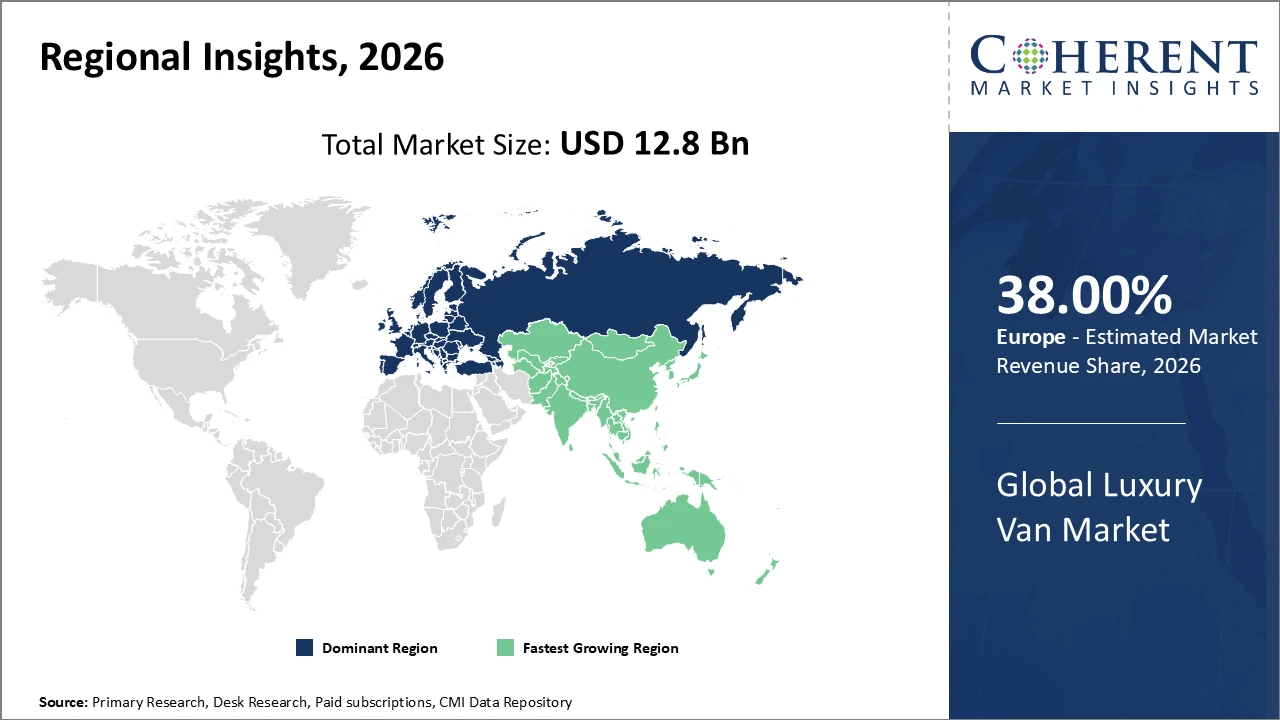
North America Luxury Van Market Analysis and Trends
North America holds a significant share in the luxury van market, driven by mature automotive infrastructure, high disposable incomes, and strong corporate fleet demand. The region sees widespread adoption of passenger vans for corporate transport, tourism, and private luxury travel, supported by established dealer networks and advanced service ecosystems. Electric and hybrid luxury vans are gaining traction as environmental regulations tighten and consumer preference shifts toward sustainable mobility. Technological innovations, including AI-enabled safety systems, connected vehicle features, and modular interiors, are shaping product development. Overall, North America remains a key market, combining strong demand, innovation, and regulatory support for luxury van growth.
Asia Pacific Luxury Van Market Analysis and Trends
Asia Pacific is experiencing the fastest growth in the luxury van market, with a CAGR exceeding 12%, fueled by rapid urbanization, rising disposable incomes, and expanding corporate ecosystems. Key markets such as China and India benefit from significant investments in electric vehicle infrastructure and premium passenger transportation services. The increasing adoption of corporate fleets, tourism, and luxury travel solutions further drives demand. Local manufacturers are collaborating with international players to offer customized luxury van models that align with regional preferences and regulatory requirements. These strategic partnerships and market developments are accelerating business expansion and solidifying Asia Pacific’s position as a high-growth region in the global luxury van market.
Luxury Van Market Outlook for Key Countries
USA Luxury Van Market Analysis and Trends
The U.S. luxury van market is driven by strong consumer spending on premium vehicles and rising demand from corporate transportation for reliable, spacious vans. In 2025, luxury van registrations grew by 16%, supported by increasing interest in electric variants. Major manufacturers, including Ford and General Motors, have leveraged advanced technologies, connected features, and strategic fleet partnerships to expand market presence. Additionally, government incentives promoting electric vehicles are encouraging investment in EV luxury vans, accelerating innovation in propulsion systems, safety technologies, and interior customization. These factors collectively foster market growth, positioning the U.S. as a leading region in the global luxury van industry.
Germany Luxury Van Market Analysis and Trends
Germany continues to be a key market for luxury vans, supported by its advanced automotive manufacturing industry and strict environmental regulations that drive the adoption of electric and hybrid models. In 2026, over 25% of luxury vans produced were electric or hybrid, highlighting the country’s focus on sustainable mobility. Leading manufacturers like Mercedes-Benz and Volkswagen have increased R&D investments to enhance safety, performance, and digital integration in luxury van platforms. Germany’s well-developed road infrastructure, high disposable incomes, and strong corporate and private demand further reinforce its position as a major contributor to market size and industry share in the luxury van sector.
Analyst Opinion
Advanced manufacturing capabilities are a key supply-side driver, with leading production hubs in Europe and North America increasing luxury van output by over 15% in 2025, helping stabilize prices despite rising raw material costs. Germany’s automotive plants, for example, reported a 17% production increase, reflecting expanding capacity.
On the demand side, luxury van imports in Asia Pacific grew by 22% in 2024, driven by expanding corporate fleets and luxury travel demand in countries like China and India, supporting higher consumer adoption rates for premium mobility solutions through 2026.
The integration of electric drivetrains is a significant micro-indicator; in 2026, battery electric luxury vans contributed approximately 12.5% of total global market revenue, highlighting the shift toward sustainable transportation.
Nano-level dynamics show increased adoption of smart safety and infotainment systems, with AI-based driver assistance features raising unit pricing by around 8% in 2025, boosting overall market revenue.
- Current Industry Events of 2026
- Market Size Estimation
- Regional Breakdown
- Competitive Landscape
- Customer Intelligence
- Segmental Analysis
- Pricing Analysis
- Key Market Drivers, Challenges & Future Trends
- Customized Insights Section
Market Scope
| Report Coverage | Details | ||
|---|---|---|---|
| Base Year: | 2025 | Market Size in 2026: | USD 12.8 billion |
| Historical Data for: | 2020 To 2024 | Forecast Period: | 2026 To 2033 |
| Forecast Period 2026 to 2033 CAGR: | 8.7% | 2033 Value Projection: | USD 23.6 billion |
| Geographies covered: |
| ||
| Segments covered: |
| ||
| Companies covered: | Ford Motor Company, Toyota Motor Corporation, BMW Group, Stellantis N.V., Tata Motors, Rivian Automotive, FCA US LLC, General Motors, MAN SE, Hino Motors | ||
| Growth Drivers: |
| ||
Luxury Van Market Growth Factors
Rising corporate demand for premium transportation solutions is a key driver of the luxury van market, with increased investment in employee shuttles and client transport boosting revenue. In 2025, Asia Pacific corporate fleets expanded luxury van acquisitions by 18%, reflecting strong regional demand. Technological enhancements, including advanced infotainment and AI-enabled safety systems, have further increased consumer preference, evidenced by a 20% year-over-year rise in feature-equipped models sold in 2024. Government incentives for electric vehicles in Europe and North America supported a 12% growth in the electric luxury van segment in 2025. Urbanization and improved road infrastructure in emerging economies continue to encourage broader adoption, sustaining market expansion.
Luxury Van Market Development
In January 2026, Avis India launched a luxury van rental service for group travel. The service accommodates up to 25 passengers and is designed for corporate trips, airport transfers, long-distance travel, and family journeys.
Key Players
Leading Companies of the Market
Ford Motor Company
Toyota Motor Corporation
BMW Group
Stellantis N.V.
Tata Motors
Rivian Automotive
FCA US LLC
General Motors
MAN SE
Hino Motors
Notably, Mercedes-Benz expanded its market share in 2025 by launching the EQV electric luxury van series, targeting a premium segment niche and contributing to a 10% revenue increase in its van segment. Ford pursued strategic partnerships focused on integrating EV technologies, accelerating its entry into the luxury van electric vehicle subsegment and achieving a 14% rise in unit sales in North America in 2026. Meanwhile, Volkswagen optimized its supply chain by establishing regional manufacturing hubs, reducing lead times and lowering production costs, which strengthened its competitive positioning across Europe. These strategic initiatives highlight the emphasis on electrification, efficiency, and market expansion in the luxury van industry.
Luxury Van Market Future Outlook
The future of the luxury van market is poised for significant growth, driven by rising demand for premium transportation, corporate fleet expansions, and increasing adoption of electric and hybrid models. Technological advancements such as AI-enabled safety systems, connected infotainment features, and modular interiors will continue to shape consumer preferences. Sustainability trends, supported by government incentives and stricter emission regulations, will accelerate the transition to electric luxury vans. Emerging markets in Asia Pacific and Latin America offer high-growth opportunities, while established regions focus on innovation and fleet modernization. Overall, the market is expected to expand steadily, combining luxury, performance, and eco-friendly mobility solutions.
Luxury Van Market Historical Analysis
The historical growth of the luxury van market reflects increasing consumer preference for premium, spacious, and technologically advanced vehicles. Between 2018 and 2025, passenger vans dominated due to their versatility across corporate transport, tourism, and private use, while cargo and camper vans gradually gained traction. ICE-powered vans led the market historically, though electric and hybrid models began emerging in response to environmental regulations. North America and Europe drove early adoption due to mature automotive industries, high disposable incomes, and corporate fleet demand, while Asia Pacific began showing rapid growth with rising urbanization and luxury travel trends. Technological innovations and fleet expansion underpinned steady market development during this period.
Sources
Primary Research Interviews:
Corporate fleet managers and logistics companies
Luxury travel and tourism operators
Automotive manufacturers and luxury van OEMs
Dealerships and automotive distributors
Magazines:
Automotive News – Luxury Vehicle Market & Innovations
Motor Trend – Premium Van Reviews & Features
Car and Driver – Luxury Van Insights and Technology
AutoWeek – Automotive Trends and Market Developments
Journals:
Journal of Automotive Engineering – Vehicle Technology and Design
International Journal of Automotive Technology – Luxury Vehicle Research
SAE International Journals – Automotive Engineering and EV Integration
Transportation Research Part C – Emerging Automotive Technologies
Newspapers:
The Wall Street Journal – Automotive Industry & Luxury Vehicles
Financial Times – Vehicle Market and Corporate Fleets
Reuters – Automotive Technology and Market Trends
Bloomberg – Luxury Vehicle and EV Market Developments
Nikkei Asia – Automotive Manufacturing and Luxury Segment
Associations:
European Automobile Manufacturers Association (ACEA)
Society of Automotive Engineers (SAE)
International Organization of Motor Vehicle Manufacturers (OICA)
North American Automotive Dealers Association (NAADA)
Get access to 250+ pages report
Every segment, forecast, competitor profile and data table behind the analysis above — available for instant download.
- ESOMAR Member
- ISO 9001:2015 Certified
- D-U-N-S Registered
- GDPR & CCPA Compliant
Missing comfort of reading report in your local language? Find your preferred language:
Transform your Strategy with Exclusive Trending Reports
Frequently Asked Questions
Dominant players include Hino Motors, Ford, MAN SE, Toyota, and BMW, which collectively command a substantial market share through product innovation and strategic expansion.
The market size is projected to reach USD 23.6 billion by 2033, expanding at a CAGR of 8.7% from 2026 onwards as demand intensifies globally.
Corporate transportation and tourism sectors present the largest growth opportunity, with luxury vans increasingly preferred for premium shuttle and travel services.
Market growth is expected to be driven by electrification, digitization of sales channels, and increasing customization options aligned with customer preferences.
The landscape is highly competitive with a focus on technology adoption and geographic expansion; challenges include high production costs and evolving emission regulations.
Key strategies include partnerships for technology integration, direct-to-consumer sales models, and product diversification through bespoke options.