

Global Floor Glue Market Size and Forecast – 2026 To 2033
The Global Floor Glue Market is estimated to be valued at USD 10.82 Bn in 2026 and is expected to reach USD 15.43 Bn by 2033, growing at a compound annual growth rate (CAGR) of 5.2% from 2026 to 2033. This steady expansion reflects sustained demand for durable, application-efficient adhesive systems across residential, commercial, institutional, and industrial flooring projects.
New construction creates first-time installation demand, while refurbishment and replacement activity supports recurring consumption of adhesives for tile, resilient flooring, wood, carpet, and laminate applications. In August 2026, the Australian Bureau of Statistics reported that building work completed during the June 2026 quarter increased 1.3% to USD 32.97 billion, indicating continued construction activity that supports downstream demand for flooring installation materials, including floor adhesives.
Key Takeaways of the Global Floor Glue Market
- Acrylic Adhesives are expected to grow at an estimated 5.6% CAGR during 2026–2033 and hold 34.8% of the global floor glue market in 2026. Their broad compatibility with textile and resilient flooring, workable open times, and availability in low-emission water-dispersion systems support specification across residential and commercial interiors. In October 2024, Mapei used its acrylic Ultrabond Eco Tack TX+ for carpet-tile installation at The Junction in Leeds.
- Water-based Adhesives are projected to expand at an estimated 6.0% CAGR during 2026–2033 and account for 47.8% of the global floor glue market in 2026. Contractors increasingly value lower odor, easier cleanup, and emissions compliance without sacrificing wet tack or dimensional control, strengthening their position in occupied buildings and refurbishment work. In January 2026, the USPTO issued Sika Technology AG a patent for a water-based dispersion floor adhesive with high dimensional stability.
- Tile and Stone Flooring is expected to advance at an estimated 5.5% CAGR during 2026–2033 and represent 36.8% of the global floor glue market in 2026. The segment benefits from heavy-duty bonding requirements, larger-format tiles, moisture-exposed areas, and widespread use in kitchens, bathrooms, hospitality, and public interiors. In September 2025, LATICRETE introduced MULTIMAX 1, a ready-to-use adhesive mortar engineered for demanding floor and wall installations across tile and stone sizes.
- Asia Pacific is projected to post an estimated 5.5% CAGR during 2026–2033 and command 41.6% of the global floor glue market in 2026. Its lead reflects the scale of urban housing delivery, commercial construction, renovation activity, and high use of tiled and resilient surfaces across major Asian economies. In August 2026, India’s housing ministry reported that more than one crore PMAY-U homes had been completed and delivered nationwide.
- North America is expected to record an estimated 6.3% CAGR during 2026–2033 and account for 24.8% of the global floor glue market in 2026, making it the fastest-growing region. Replacement-led flooring demand, stricter indoor-air specifications, and a sizeable pipeline of residential and non-residential fit-outs favor higher-performance adhesive systems. In August 2026, the U.S. Census Bureau reported July building permits at a 1.443 million annualized rate, 5.0% above June.
Segmental Insights
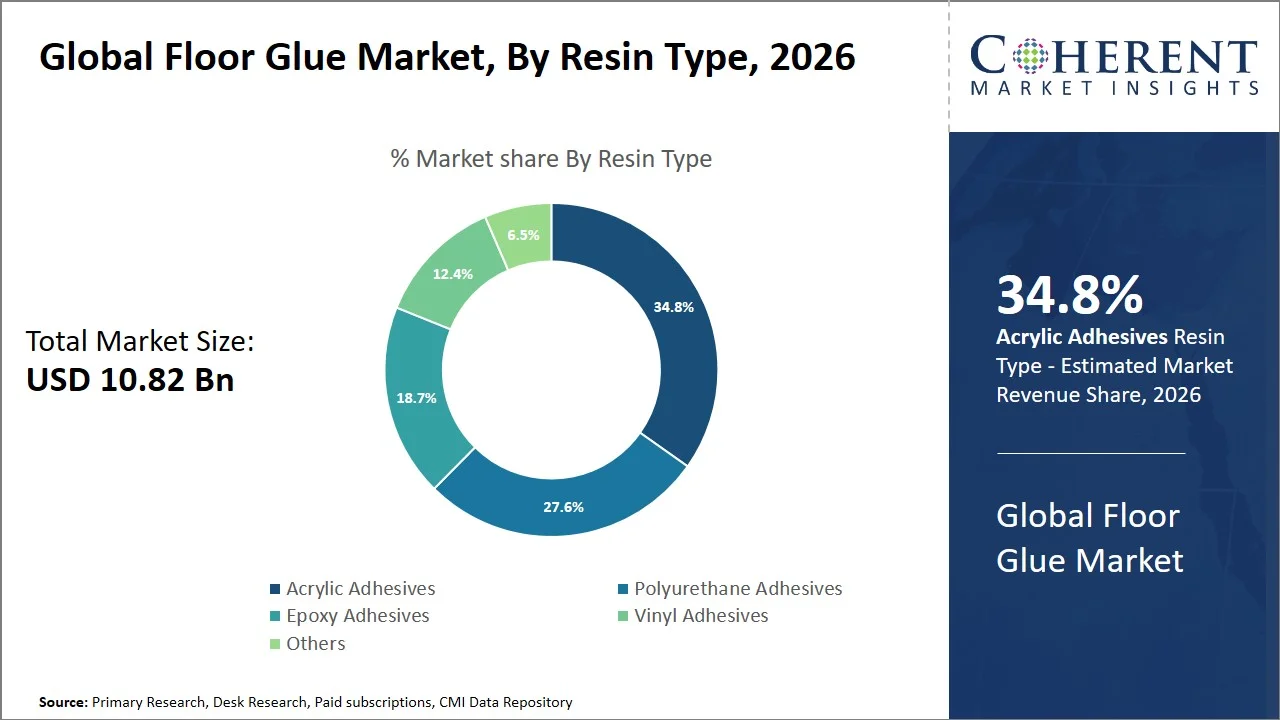
Why Do Acrylic Adhesives Dominate the Global Floor Glue Market?
Acrylic Adhesives are expected to account for 34.8% of the global floor glue market in 2026, leading the resin-type category because they balance dependable tack, formulation flexibility, and practical installation economics. Their chemistry works particularly well in pressure-sensitive and emulsion systems used for carpet tile, vinyl, and other resilient floorcoverings, where installers value controlled open time and easy application. From a supply perspective, acrylic polymers can be tailored for adhesion, removability, plasticizer resistance, and low-emission performance, allowing manufacturers to serve both permanent and releasable flooring systems. This versatility supports broad distributor inventories and reduces dependence on highly specialized chemistries. In June 2024, F. Ball highlighted Styccobond F41, a solvent-free acrylic polymer emulsion tackifier certified to EMICODE EC1 Plus, designed to hold carpet tiles while allowing individual tiles to be removed and replaced. For suppliers, this illustrates how acrylic platforms can address both installation reliability and lifecycle maintenance requirements.
- Current Industry Events of 2026
- Market Size Estimation
- Regional Breakdown
- Competitive Landscape
- Customer Intelligence
- Segmental Analysis
- Pricing Analysis
- Key Market Drivers, Challenges & Future Trends
- Customized Insights Section
Why Do Water based Adhesives Represent the Largest Technology Segment in the Global Floor Glue Market?
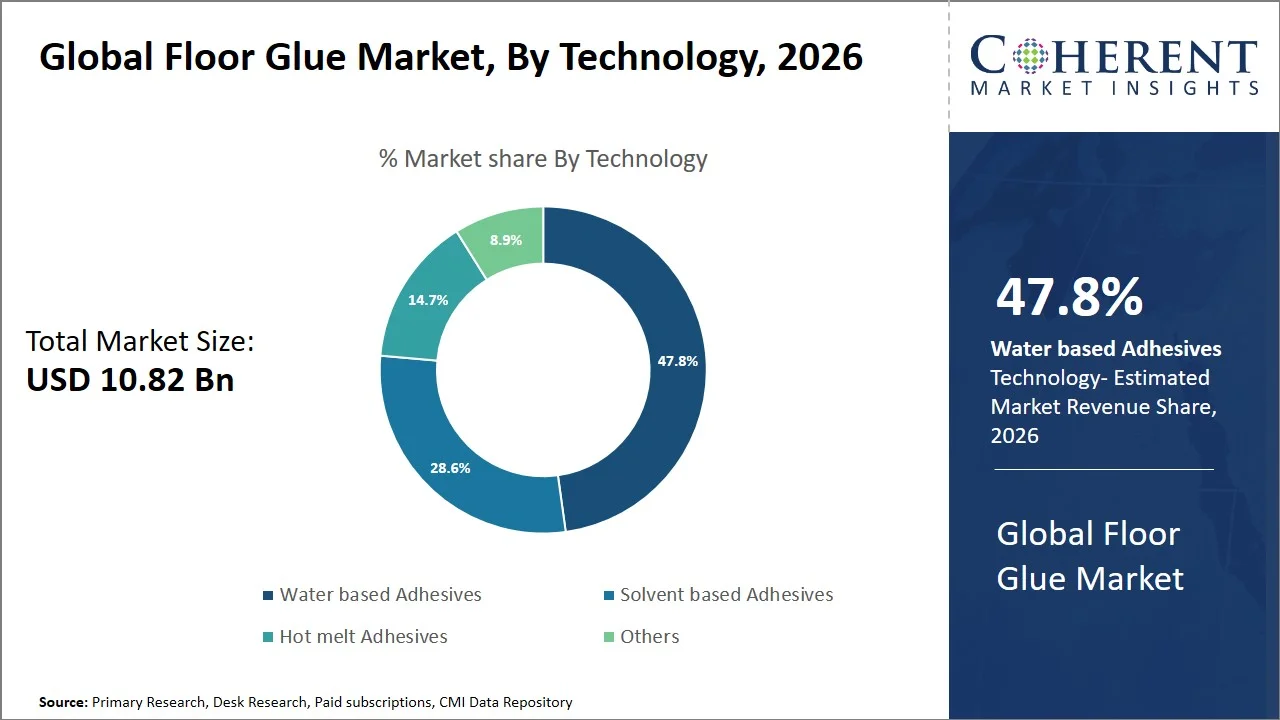
Water based Adhesives are expected to represent 47.8% of the global floor glue market in 2026, making them the largest technology segment as contractors increasingly need installation products suitable for occupied interiors and diverse resilient flooring systems. Their commercial advantage comes from combining lower solvent exposure and easier cleanup with formulation options that can deliver aggressive tack, extended working time, and resistance to demanding site conditions. Water-based systems are especially relevant in healthcare, education, offices, hospitality, and retail, were odor management and installation continuity influence product selection. Manufacturers benefit because waterborne polymer platforms can be engineered for multiple flooring formats without relying on traditional solvent-heavy formulations. In August 2024, TEC updated the specification for Flexera 2K PSA Hybrid Adhesive, documenting a low-odor water-based system for sheet flooring, LVT, rubber, linoleum, and sports flooring, with applications extending to healthcare and institutional environments.
Why Does Tile and Stone Flooring Dominate the Flooring Type Segment of the Global Floor Glue Market?
Tile and Stone Flooring is expected to hold 36.8% of the global floor glue market in 2026, leading the flooring-type category because rigid surface installations impose demanding requirements for bond strength, water resistance, open time, and dimensional stability. Ceramic, porcelain, vitrified tile, and natural stone are widely installed across bathrooms, kitchens, commercial interiors, hospitality spaces, public buildings, and exterior areas, creating recurring demand for polymer-modified cementitious adhesives. On the supply side, dry-mix technology gives manufacturers scalable production, easier transport, and formulation flexibility for different tile sizes and exposure conditions. Larger formats and lower-porosity surfaces also raise the technical value of polymer modification. In March 2025, WACKER presented VINNAPAS 8118 E, VINNAPAS 8620 E, and VINNAPAS 7220 E dispersible polymer powders for tile adhesives using CEM II cement, demonstrating how binder innovation can preserve tensile adhesion while supporting lower-emission cement formulations.
Current Events and their Impact
Current Event | Description and Its Impact |
January 2026 – Main Provisions of the EU Construction Products Regulation 2024 Begin Applying |
|
July 2026 – South Coast AQMD Reopens Rule 1168 Adhesive and Sealant Rulemaking |
|
July 2026 – Revised EU CLP Requirements Enter a New Application Phase |
|
Global Floor Glue Market Dynamics
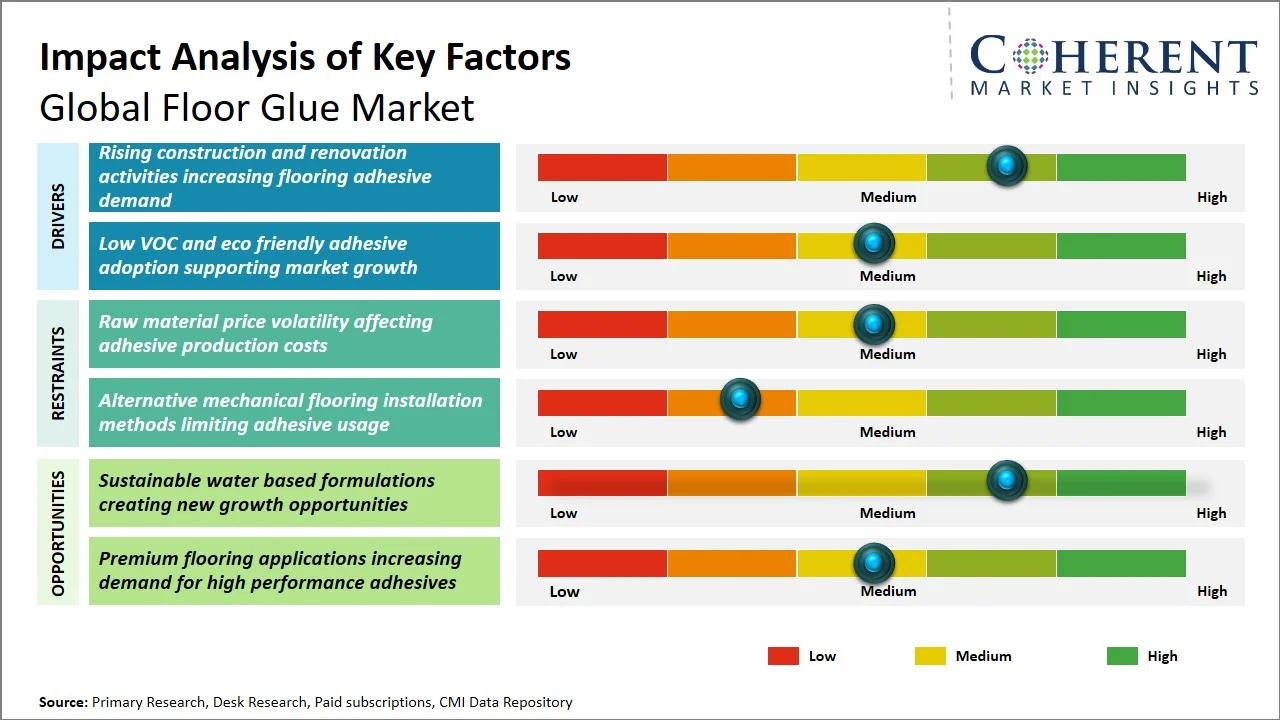
Key Market Drivers
- Rising Construction and Renovation Activities Increasing Flooring Adhesive Demand: Construction and renovation activity expands the installed flooring base and creates recurring demand for adhesives used in tile, resilient, wood, carpet, and laminate systems. New housing supports first-time installation volumes, while refurbishment generates replacement demand that often requires substrate preparation and higher-performance bonding. Adhesive manufacturers, flooring contractors, distributors, and construction-chemical suppliers benefit from this project pipeline. In March 2025, Canada’s federal government announced more than CAD 369.5 million for housing-enabling infrastructure expected to support over 110,230 housing units, creating downstream opportunities for interior finishing and flooring installation products.
- Low VOC and Eco-Friendly Adhesive Adoption Supporting Market Growth: Low-VOC and environmentally preferable floor glues are moving from a specification advantage toward a procurement requirement in offices, schools, healthcare facilities, and certified green buildings. This shifts formulation investment toward water-based, solvent-free, bio-based, and low-emission systems while rewarding suppliers that can document indoor-air performance. Architects, contractors, flooring brands, and compliant adhesive producers benefit as specification control becomes more important. In April 2025, the U.S. Green Building Council launched LEED v5; its low-emitting materials framework includes interior adhesives and floor-setting materials within VOC-emissions evaluation criteria.
Emerging Market Trends
- Multifunctional Adhesives Are Reducing Installation-System Complexity: Flooring adhesive design is shifting toward multifunctional systems that combine bonding with moisture management, pH tolerance, sound reduction, or substrate conditioning. The commercial value is contractor productivity: fewer separate layers, fewer site visits, and lower risk of compatibility failures between primers, barriers, and adhesives. Formulators with strong polymer engineering and application-testing capabilities are positioned to gain, while single-function products face pressure in specification-led projects. Over the forecast period, multifunctionality is likely to become a core premiumization route rather than a niche performance feature.
- Installer Productivity Is Becoming a Core Product-Design Criterion: Adhesive selection is increasingly being shaped by installation speed and labor efficiency rather than bond strength alone. Roller-applied, sprayable, fast-flash, extended-working-time, and transitional pressure-sensitive systems allow contractors to adapt application methods to project schedules and flooring formats. This favors suppliers that design chemistry around installer ergonomics, open-time control, and predictable traffic readiness. Conventional products requiring rigid application sequences may lose share in fast-turn commercial refurbishment. The direction of travel is toward adhesives engineered as workflow tools, with application convenience influencing purchasing alongside durability.
Regional Insights
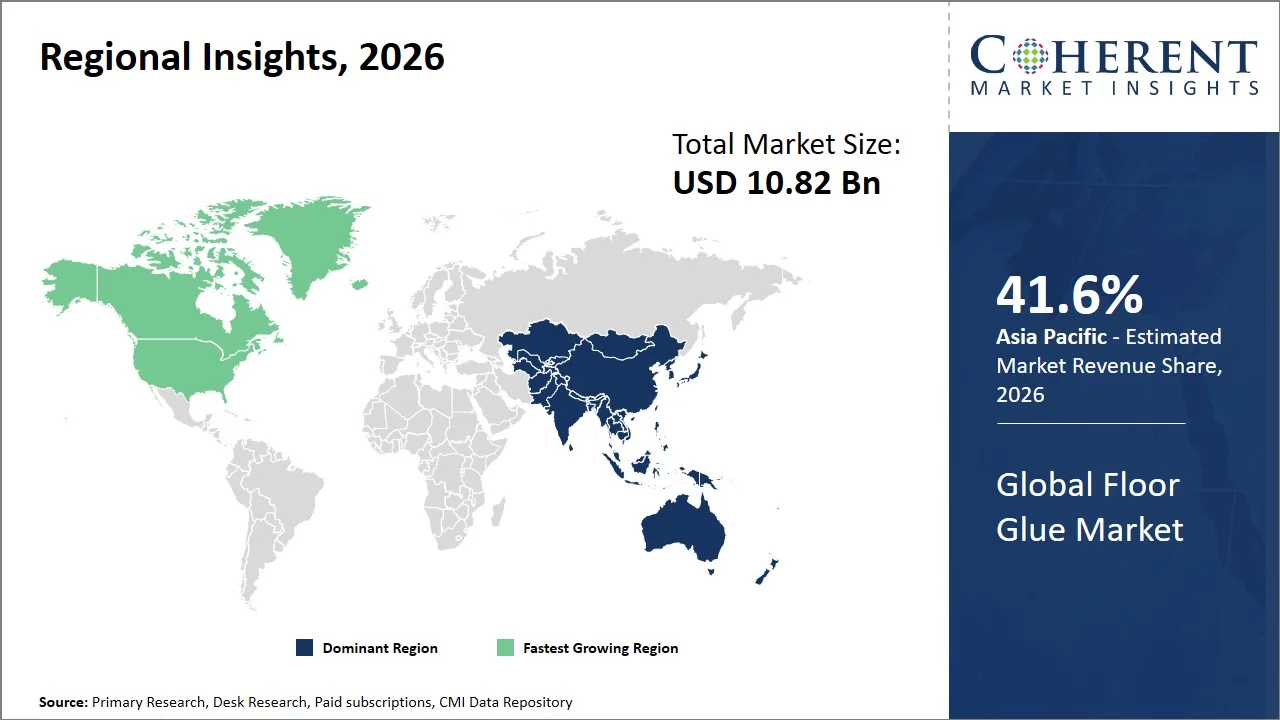
Why Does Asia Pacific Dominate the Global Floor Glue Market?
Asia Pacific is expected to command 41.6% of the global floor glue market in 2026, supported by the region’s exceptionally large base of new construction, urban refurbishment, ceramic-tile installation, resilient flooring, and commercial fit-outs. China and India contribute substantial project volumes, while Southeast Asian markets add demand from hospitality, retail, manufacturing facilities, and urban infrastructure. The region also benefits from local production of polymers, construction chemicals, flooring materials, and tile-setting systems, improving product availability and price competitiveness. Suppliers increasingly compete through low-VOC formulations, faster-curing systems, moisture resistance, and technical support for contractors rather than basic bonding performance alone. In September 2025, Henkel opened a USD 69.68 million, 33,000-square-meter Adhesive Technologies Inspiration Center in Shanghai with more than 500 scientists and technical experts, strengthening localized adhesive innovation and application support across Asia Pacific.
Why Is North America Emerging as the Fastest-Growing Region in the Global Floor Glue Market?
North America is expected to account for 24.8% of the global floor glue market in 2026 and emerge as the fastest-growing region as flooring replacement, renovation, and specification-led commercial projects increase demand for higher-performance installation systems. Growth is increasingly linked to resilient flooring, LVT, carpet tile, engineered wood, healthcare interiors, education facilities, and multi-family housing, where installers require adhesives with moisture tolerance, rapid working times, low emissions, and compatibility across multiple substrates. The region’s mature contractor network and strong use of product certifications also encourage premiumization rather than simple volume expansion. Manufacturers are responding with multifunctional formulations designed to reduce installation risk and labor complexity. In July 2025, ARDEX Americas introduced HENRY TRUEblue Flooring Solutions, led by the HENRY 2575 modified silane-based floor and wall adhesive for broad substrate compatibility and demanding applications.
Global Floor Glue Market Outlook for Key Countries
Why Is the U.S. a Key Market for the Global Floor Glue Market?
The U.S. is expected to represent an estimated 18.1% of the global floor glue market in 2026, reflecting its large installed base of residential, commercial, institutional, and healthcare flooring that requires continuous replacement and refurbishment. Demand is particularly attractive in resilient flooring, carpet tile, engineered wood, education facilities, offices, and multi-family buildings, where moisture conditions, indoor-air requirements, and shorter project schedules influence adhesive selection. U.S. buyers also place greater emphasis on documented emissions performance and manufacturer-backed installation systems, supporting water-based and low-VOC products with stronger technical credentials. This regulatory and specification environment creates a higher-value market for compliant formulations. In December 2025, the U.S. EPA’s Indoor AirPlus construction specifications required qualifying carpet and carpet adhesives to meet low-emission criteria and recommended low- or no-VOC products for hard-surface flooring, reinforcing lower-emission floor bonding specifications.
Why Is India Important in the Global Floor Glue Market?
India is expected to hold an estimated 8.3% share of the global floor glue market in 2026 as rapid urban development, apartment construction, organized retail, hospitality, offices, hospitals, and premium residential interiors expand the addressable flooring base. Tile and stone remain especially important, while vinyl, engineered wood, and other modern finishes are gaining visibility in higher-value projects, increasing the need for specialized adhesives rather than conventional cement-rich installation practices. Domestic suppliers are also investing in contractor education, specification services, and integrated construction-chemical portfolios, helping formalize product selection and application quality. The market therefore combines high project volume with a gradual shift toward branded installation systems. In October 2025, Pidilite Industries officially showcased its comprehensive construction and interior solutions at ACETECH Bengaluru 2025, highlighting growing supplier emphasis on integrated solutions for professional construction and interior application
Why Does China Support Growth in the Global Floor Glue Market?
China is expected to account for an estimated 19.4% of the global floor glue market in 2026, underpinned by the sheer scale of its built environment, flooring manufacturing ecosystem, construction-chemical supply base, and renovation requirements. Even with slower new-property development, a vast stock of residential towers, offices, malls, factories, public facilities, and commercial buildings sustains recurring demand for tile adhesives, resilient-flooring glue, wood-floor bonding systems, and refurbishment products. China also offers local access to acrylic dispersions, polyurethane chemistry, packaging, and flooring materials, supporting cost-efficient domestic production and rapid product customization. Renovation is becoming increasingly important as new-build activity normalizes. In January 2026, China’s National Bureau of Statistics reported 6.60 billion square meters of buildings under construction during 2025, including 4.60 billion square meters of residential space, illustrating the enormous installation and finishing base available to flooring-system suppliers.
Why Is Germany a Strategic Country in the Global Floor Glue Market?
Germany is expected to capture an estimated 5.8% share of the global floor glue market in 2026, supported by a technically demanding construction sector, stringent building-product expectations, and strong use of engineered wood, resilient flooring, carpet, and tile in residential and commercial interiors. Buyers place considerable weight on emissions performance, substrate preparation, durability, installer safety, and system compatibility, which favors advanced water-based, silane-modified, and other low-emission adhesive technologies. Renovation of existing buildings is particularly important because Germany has a large mature building stock where flooring replacement often requires products suited to old screeds, moisture variation, and mixed substrates. A recovery in project approvals would strengthen downstream installation demand. In February 2026, Destatis reported that 238,500 dwellings were approved during 2025, up 10.8% year on year, marking the first annual increase in German housing permits since 2021.
Why Is Brazil an Important Growth Market for the Global Floor Glue Market?
Brazil is expected to account for an estimated 3.4% of the global floor glue market in 2026, making it a strategically important Latin American demand center because of its extensive ceramic-tile industry, large residential market, and active renovation and housing segments. Tile installation remains a major adhesive-use case, while commercial buildings, shopping centers, hospitality projects, and urban housing support demand for higher-performance mortars, polymer-modified adhesives, and flooring preparation systems. Domestic ceramic production also creates a broad installer and distributor ecosystem, helping specialized bonding products reach regional markets beyond the largest cities. Product opportunities are strongest where contractors shift from traditional site-mixed methods toward standardized systems with improved adhesion and moisture performance. In August 2025, ANFACER reported that Brazil produced 400.1 million square meters of ceramic coverings during the first half of 2025, confirming the scale of the country’s downstream tile-installation opportunity.
Floor Glue Innovation, Formulation & Installation Landscape
Technology / Formulation Approach | Adoption Status | Market Relevance | Commercial Implication |
Modified Silane / Silane-Terminated Polymer Adhesives | Growing | Combines elasticity, strong bonding, low emissions, and compatibility with wood and other demanding flooring systems. | Supports premium positioning where installers require performance without traditional solvent-heavy chemistry. |
High-Moisture-Resistance Acrylic Pressure-Sensitive Adhesives | High and expanding | Designed for LVT, LVP, carpet tile, VCT, and resilient flooring installed over challenging concrete slabs. | Reduces delays associated with substrate moisture and strengthens supplier value in fast-track commercial projects. |
Transitional Pressure-Sensitive Adhesive Systems | Growing | Begins with installer-friendly pressure-sensitive behavior before developing a firmer permanent bond. | Helps address lateral movement and rolling-load requirements while retaining practical installation windows. |
Integrated Bonding and Moisture-Control Systems | Emerging to growing | Incorporates moisture mitigation into the adhesive layer, reducing dependence on separate membranes or primers. | Creates premium system-selling opportunities by reducing labor steps and project scheduling complexity. |
Bio-Based and Renewable-Content Binder Technologies | Emerging | Replaces part of fossil-derived feedstock while targeting low-emission and green-building specifications. | Provides differentiation in sustainability-led procurement but requires performance validation and dependable raw-material sourcing. |
Roller, Spray and Fast-Application Adhesive Technologies | Growing | Moves application away from conventional trowel-only installation and improves coverage, ergonomics, and speed. | Can reduce labor intensity and create stronger adoption among contractors handling large commercial flooring areas. |
How Are Releasable and De bondable Flooring Adhesive Systems Creating New Growth Opportunities in the Global Floor Glue Market?
A high-potential opportunity lies in releasable and selectively de bondable adhesive systems designed for commercial refurbishment, leased spaces, retail resets, offices, hospitality interiors, and modular flooring. These projects increasingly need strong in-service bonding without making future removal costly, destructive, or waste-intensive. Suppliers can capture this opportunity through pressure-sensitive and reversible chemistries that permit tile or plank replacement, minimize substrate damage, and reduce residue during changeovers. Commercialization should focus on compatibility with LVT, carpet tile, rubber, and other frequently replaced surfaces, supported by clear removal protocols and installer training. Product differentiation can extend into circularity claims, take-back programs, and system warranties tied to both installation and removal performance. Participation requires formulation expertise, long-duration aging tests, substrate-specific validation, and partnerships with flooring manufacturers and facility managers. The opportunity should favor specialist and established adhesive producers able to prove predictable bond retention while controlling end-of-life removal behavior. It also creates room for premium pricing where removal costs are contractually visible.
Market Players, Key Development, and Competitive Landscape
Key Developments
- In April 2026, Bostik’s XL Brands introduced InnoStix PSA, a bio-based pressure-sensitive adhesive for carpet tile and multiple vinyl flooring formats. The launch broadens competition around renewable-content, low-emission flooring adhesives while giving contractors a releasable-and-rebondable option suited to commercial replacement cycles and sustainability-oriented specifications.
- In May 2025, Bona introduced Bona QUANTUM FLOW, a pourable one-component silane-based wood-floor adhesive combining strong initial grab, moisture protection, and low-emission positioning. The development addresses installer productivity and application ergonomics, illustrating how premium wood-floor adhesives are evolving toward easier handling without separating bonding and moisture-control functions.
- In January 2024, Instarmac partnered with Forbo Eurocol to launch an UltraFloor flooring-adhesive range in the U.K., including products for carpet, vinyl, LVT, linoleum, and rubber coverings. The move expanded UltraFloor from subfloor preparation into a fuller installation system, strengthening cross-selling potential with flooring contractors and distributors.
Competitive Landscape
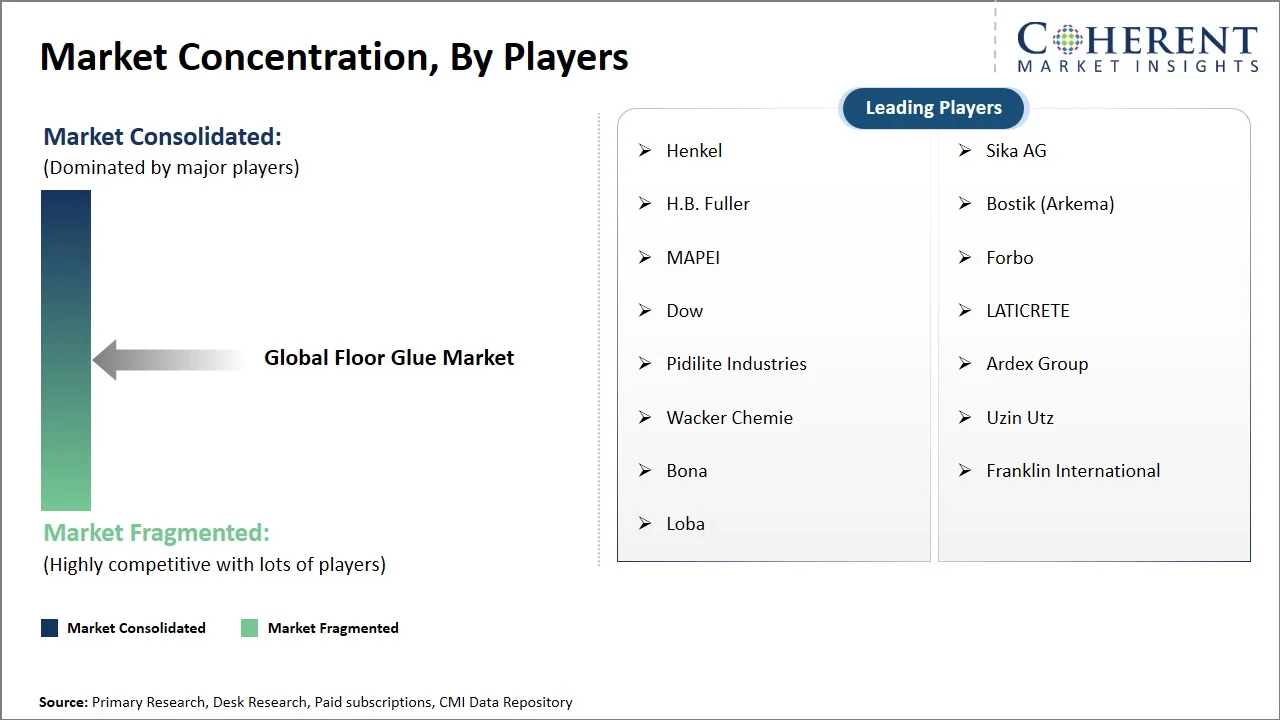
The global floor glue market is moderately fragmented, combining multinational construction-chemical suppliers with regional flooring-adhesive specialists and local formulators. Competition centers on application reliability, installer productivity, substrate compatibility, compliance documentation, price-to-performance, and supply continuity. Regional firms remain relevant where contractor relationships and local distribution matter, while technically differentiated suppliers gain leverage in demanding commercial, resilient-flooring, and wood-floor installations.
Key focus areas include
- Application reliability: Consistent tack, shear strength, open time, and curing behavior remain fundamental to installer acceptance and repeat specification.
- Substrate tolerance: Suppliers able to handle moisture, alkalinity, existing flooring, radiant-heated substrates, and mixed subfloor conditions can address more complex renovation projects.
- Installer economics: Coverage rate, application method, cleanup requirements, working time, and return-to-service speed increasingly influence total installed cost.
- Specification readiness: Emission certificates, technical documentation, environmental declarations, test reports, and warranty clarity strengthen access to professionally specified projects.
- Supply reliability: Consistent polymer, additive, and packaging availability is important because contractors have limited tolerance for formulation changes during active projects.
- Channel execution: Specialist flooring distributors, contractor networks, technical representatives, and training programs remain important for converting product performance into repeat purchasing.
- Portfolio rationalization: Suppliers that cover multiple flooring types with fewer well-validated products can improve distributor inventory turns and reduce contractor SKU complexity.
Market Report Scope
Floor Glue Market Report Coverage
| Report Coverage | Details | ||
|---|---|---|---|
| Base Year: | 2025 | Market Size in 2026: | USD 10.82 Bn |
| Historical Data for: | 2020 To 2024 | Forecast Period: | 2026 To 2033 |
| Forecast Period 2026 to 2033 CAGR: | 5.2% | 2033 Value Projection: | USD 15.43 Bn |
| Geographies covered: |
| ||
| Segments covered: |
| ||
| Companies covered: | Henkel, Sika AG, H.B. Fuller, Bostik (Arkema), MAPEI, Forbo, Dow, LATICRETE, Pidilite Industries, Ardex Group, Wacker Chemie, Uzin Utz, Bona, Franklin International, Loba | ||
| Growth Drivers: |
| ||
| Restraints & Challenges: |
| ||
Analyst Opinion (Expert Opinion)
- The global floor glue market leadership is likely to depend increasingly on SKU productivity rather than portfolio size. Suppliers that can create broadly compatible adhesive platforms covering several flooring formats and substrate conditions should improve manufacturing efficiency, simplify distributor inventories, and reduce contractor decision complexity. This could pressure businesses that maintain large portfolios of narrowly differentiated formulations without a clear performance or economic advantage.
- Factory-applied bonding layers, dry adhesive films, and pre-applied installation technologies could gradually displace part of the traditional wet-applied floor-glue requirement. Their significance lies in shifting bonding value upstream from the jobsite toward flooring manufacturing. Adhesive companies with expertise in films, coatings, removable bonding, and OEM integration could benefit, while suppliers dependent primarily on contractor-applied pail products may face structural pressure in selected applications.
- Manufacturers should prioritize robust formulations that tolerate variable moisture, alkalinity, temperature, and substrate conditions while protecting margins through raw-material flexibility and disciplined SKU management. Investment should concentrate on applications where installation failure carries high replacement costs. Dual sourcing, regional manufacturing, contractor validation, and flooring-manufacturer compatibility programs can create defensible advantages; overinvestment in technically sophisticated niche chemistries without channel pull should be avoided.
Speak to the analyst
Want personalized insights?
Take the findings above to one of our principal consultants, or have the report rebuilt around the segments, geographies and competitors you actually track.
Market Segmentation
- Resin Type Insights (Revenue, USD Bn, 2021 - 2033)
- Acrylic Adhesives
- Polyurethane Adhesives
- Epoxy Adhesives
- Vinyl Adhesives
- Others
- Technology Insights (Revenue, USD Bn, 2021 - 2033)
- Water based Adhesives
- Solvent based Adhesives
- Hot melt Adhesives
- Others
- Flooring Type Insights (Revenue, USD Bn, 2021 - 2033)
- Tile and Stone Flooring
- Resilient Flooring (Vinyl or PVC)
- Wood Flooring
- Carpet Flooring
- Laminate Flooring
- End User Insights (Revenue, USD Bn, 2021 - 2033)
- Commercial
- Residential
- Industrial
- Institutional
- Distribution Channel Insights (Revenue, USD Bn, 2021 - 2033)
- Direct Sales
- Indirect Sales
- Regional Insights (Revenue, USD Bn, 2021 - 2033)
- North America
- U.S.
- Canada
- Latin America
- Brazil
- Argentina
- Mexico
- Rest of Latin America
- Europe
- Germany
- U.K.
- Spain
- France
- Italy
- Russia
- Rest of Europe
- Asia Pacific
- China
- India
- Japan
- Australia
- South Korea
- ASEAN
- Rest of Asia Pacific
- Middle East
- GCC Countries
- Israel
- Rest of Middle East
- Africa
- South Africa
- North Africa
- Central Africa
- North America
- Key Players Insights
- Henkel
- Sika AG
- B. Fuller
- Bostik (Arkema)
- MAPEI
- Forbo
- Dow
- LATICRETE
- Pidilite Industries
- Ardex Group
- Wacker Chemie
- Uzin Utz
- Bona
- Franklin International
- Loba
Sources
Primary Research Interviews
- Floor adhesive manufacturers, construction chemical companies, flooring system suppliers, distributors, contractors, applicators, and flooring installers
- R&D specialists, formulation chemists, procurement managers, technical sales professionals, architects, project contractors, and industry consultants
Stakeholders
- Acrylic, polyurethane, epoxy, vinyl, hot-melt, and specialty flooring adhesive manufacturers
- Polymer, resin, additive, filler, solvent, dispersant, and packaging suppliers
- Flooring manufacturers, construction chemical distributors, contractors, applicators, architects, developers, and facility-management companies
End-use Sectors
- Residential housing, renovation, and remodeling
- Commercial offices, retail, hospitality, and mixed-use developments
- Industrial facilities, warehouses, factories, and manufacturing plants
- Institutional buildings including healthcare, education, and public infrastructure
- Tile and stone, resilient flooring, wood, carpet, and laminate flooring applications
Regulatory and Industry Bodies
- U.S. Environmental Protection Agency (EPA)
- European Chemicals Agency (ECHA)
- European Commission
- U.S. Green Building Council (USGBC)
- South Coast Air Quality Management District (SCAQMD)
- National construction, building-material, chemical-safety, and environmental authorities
Databases
- Company annual reports, product catalogues, sustainability reports, and technical data sheets
- Construction, housing, renovation, and commercial real-estate databases
- Flooring production, consumption, installation, and construction-chemical databases
- Trade databases covering adhesives, polymers, resins, and flooring materials
- Patent, product specification, pricing, supplier, capacity, and competitive intelligence databases
Magazines and Journals
- International Journal of Adhesion and Adhesives
- Journal of Adhesion Science and Technology
- Construction and Building Materials
- Progress in Organic Coatings
- Flooring, construction chemicals, architecture, interior materials, and building-product publications
Associations
- The Adhesive and Sealant Council (ASC)
- FEICA – Association of the European Adhesive & Sealant Industry
- U.S. Green Building Council (USGBC)
- Tile Council of North America (TCNA)
- National flooring, construction chemical, building-material, and contractor associations
Public Domain Sources
- Residential and commercial construction activity
- Renovation, refurbishment, and flooring replacement trends
- Tile, resilient flooring, wood flooring, carpet, and laminate installation activity
- Low-VOC, water-based, solvent-free, and sustainable adhesive adoption
- Flooring adhesive product launches, manufacturing investments, and distribution expansion
- Raw-material pricing, polymer availability, construction regulations, and environmental compliance developments
Key Standards and Regulations
- VOC emission requirements applicable to flooring adhesives and sealants
- EU REACH and CLP requirements for chemical substances and mixtures
- EU Construction Products Regulation requirements
- LEED and other green-building material requirements
- SCAQMD Rule 1168 requirements for adhesives and sealants
- ISO, ASTM, EN, and ANSI standards applicable to flooring installation, adhesive performance, emissions, and material testing
- Occupational safety, labeling, waste-management, transportation, and environmental regulations
Proprietary Elements
- CMI Data Analytics Tool, proprietary CMI repository containing 10+ years of flooring adhesives, construction chemicals, flooring materials, residential and commercial construction, renovation activity, raw-material pricing, competitive intelligence, regulatory developments, and regional market data.
Get access to 250+ pages report
Every segment, forecast, competitor profile and data table behind the analysis above — available for instant download.
- ESOMAR Member
- ISO 9001:2015 Certified
- D-U-N-S Registered
- GDPR & CCPA Compliant
Missing comfort of reading report in your local language? Find your preferred language:
Frequently Asked Questions
The global floor glue market is estimated to be valued at USD 10.82 billion in 2026 and is expected to reach USD 15.43 billion by 2033.
The CAGR of global floor glue market is projected to be 5.2% from 2026 to 2033.
The report covers market dynamics, technology trends, regional analysis, competitive landscape, company developments, end-use demand, regulatory environment, and growth opportunities.
Yes. The report includes analysis of leading floor glue manufacturers, their product positioning, strategic initiatives, geographic presence, and competitive strengths.
The report covers residential, commercial, industrial, institutional, renovation, and new-construction flooring applications across major flooring installation environments.
Yes. The report provides regional analysis along with country-level insights covering demand conditions, construction activity, flooring adoption, regulatory factors, and competitive developments.
Growth of the global floor glue market is mainly supported by higher flooring installation volumes in new construction and renovation projects, along with a shift toward low-VOC, water-based, and environmentally compliant adhesives. Demand is also strengthening as contractors require adhesives with better moisture resistance, substrate compatibility, faster installation, and reliable bonding for tile, resilient, wood, and other modern flooring systems.