

Global Gasoline Particulate Filter Market Size and Forecast – 2026 To 2033
The global gasoline particulate filter market is expected to grow from USD 2.10 Bn in 2026 to USD 5.10 Bn by 2033, at a compound annual growth rate (CAGR) of 13.4% over 2026–2033. A gasoline particulate filter is a honeycomb filter fitted in the exhaust of a gasoline direct injection (GDI) engine. Exhaust is forced through porous channel walls that hold back soot particles, and the trapped soot is burned off by the engine's own hot exhaust. Corning reports that its latest filters trap more than 95% of particulates when new. Many filters now carry a catalyst coating, so one part handles both particles and gases.
Regulation is the main reason the market exists. The European Parliament summary of Euro 7 confirms that the rules apply to new types of cars and vans from 29 November 2026 and to all new ones from 29 November 2027. Suppliers are also seeing the effect in orders: on 30 April 2026, Umicore reported that its automotive catalyst unit outperformed the global light-duty vehicle market, mostly on strong demand in Europe, China and India.
The filter is one part of the wider exhaust line. Related markets include the automotive exhaust systems market, valued at USD 50.80 Bn in 2026, and the precious metal catalysts market, valued at USD 7.8 Bn in 2026, since coated filters use platinum-group metals.
Key Takeaways of the Global Gasoline Particulate Filter Market:
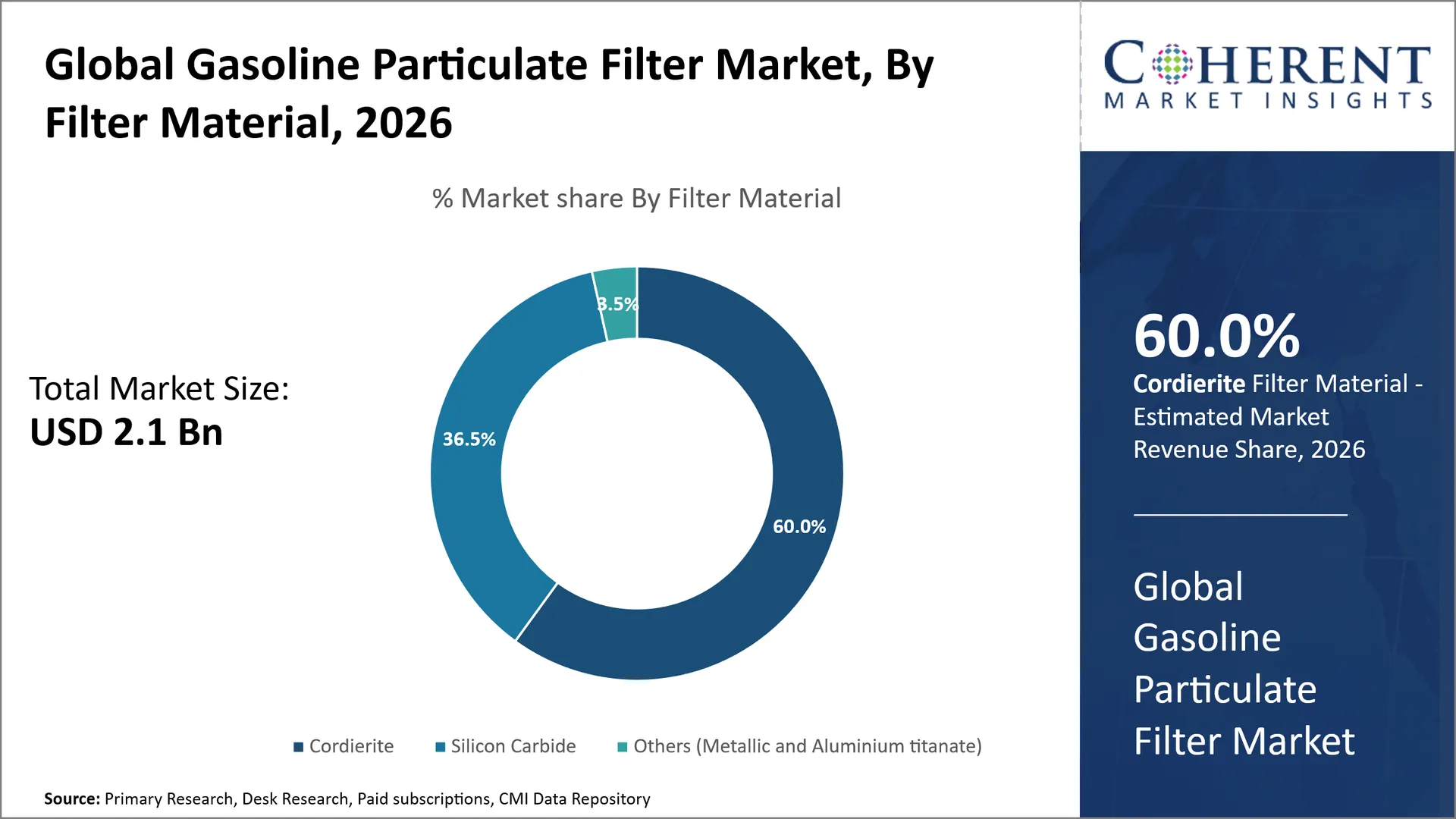
- Filter material: The cordierite segment is expected to account for 60.0% of the global gasoline particulate filter market share in 2026. Carmakers prefer it for its low cost per filter, its ability to survive rapid temperature swings and its proven supply base.
- Vehicle type: The passenger cars segment is expected to hold 72.5% of the market share in 2026. Passenger cars are the largest users of direct injection engines, so particle number limits apply to them first and to the greatest volume.
- Sales channel: The original equipment manufacturer (OEM) segment is expected to account for 88.0% of the market share in 2026, because a filter has to be matched to the engine and certified with the whole vehicle at the factory.
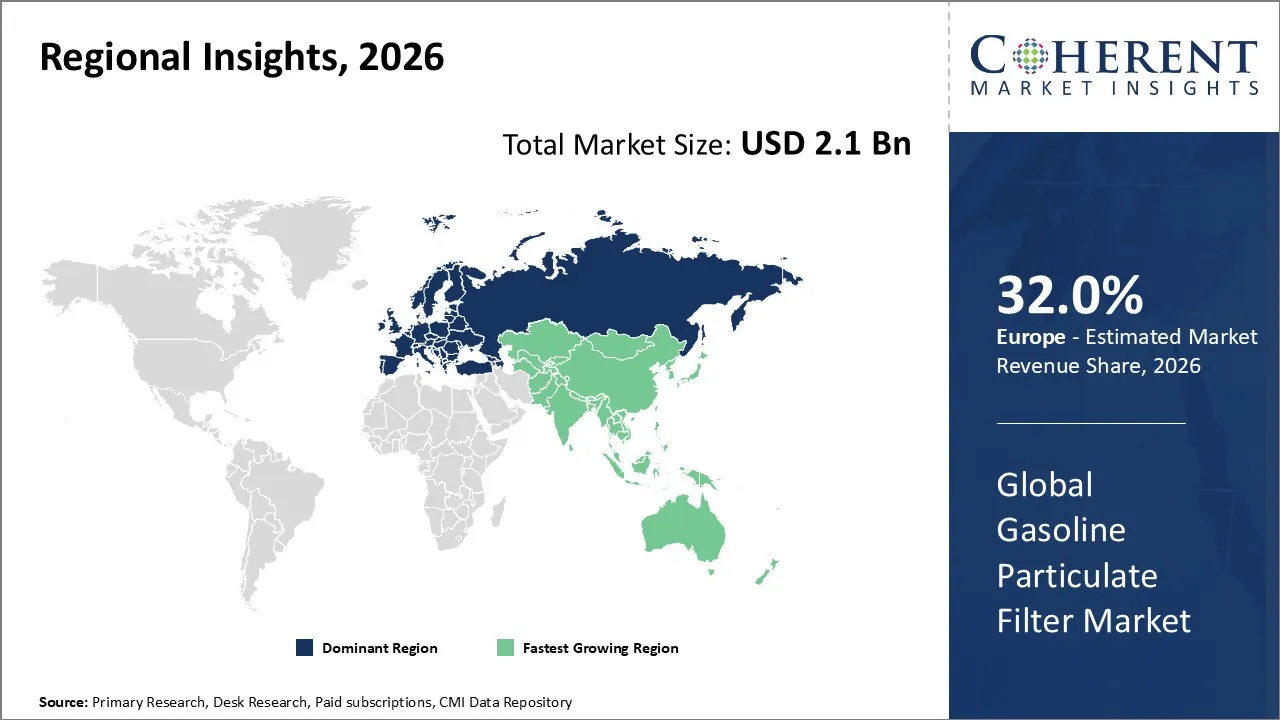
- Dominating region: Europe is expected to lead the global market with a share of 32.0% in 2026, supported by the Euro 6d rules in force and the Euro 7 rules to be implemented from 29 November 2026.
- Fastest-growing region: Asia Pacific is expected to account for 31.0% of the market in 2026 and to grow fastest at a CAGR of 15.6% over 2026–2033, as China, Japan and India tighten particle number limits.
Segmental Insights
Why Does Cordierite Dominate the Filter Material Segment?
In terms of filter material, cordierite is expected to account for 60.0% of the global gasoline particulate filter market share in 2026. Cordierite is a ceramic with very low thermal expansion, which lets a filter withstand the sudden jumps from cold start to full-load exhaust temperature without cracking. It can be extruded into thin-walled honeycombs at high volume and is cheaper per filter than most alternatives. Corning describes its gasoline filters as made exclusively from ceramic cordierite, with a wall microstructure engineered specifically for gasoline exhaust, and notes that the porosity can be higher than in a diesel filter so that very fine particles are caught at low back pressure.
The hardware specification shows why carmakers standardize on it. Corning lists its DuraTrap GC filter at 200 cells per square inch with 8 mil walls and medium porosity, and its high-porosity DuraTrap GC HP at 300 cells per square inch with 8 mil walls. Volume is proven: on 25 June 2018, Corning announced that its Kaiserslautern, Germany plant had produced the one millionth DuraTrap GC filter, following an expansion that began in 2016. The company now reports that it has sold 50 million gasoline particulate filters worldwide, with production in Kaiserslautern, Shanghai and Hefei.
- Current Industry Events of 2026
- Market Size Estimation
- Regional Breakdown
- Competitive Landscape
- Customer Intelligence
- Segmental Analysis
- Pricing Analysis
- Key Market Drivers, Challenges & Future Trends
- Customized Insights Section
Why Do Passenger Cars Lead the Vehicle Type Segment?
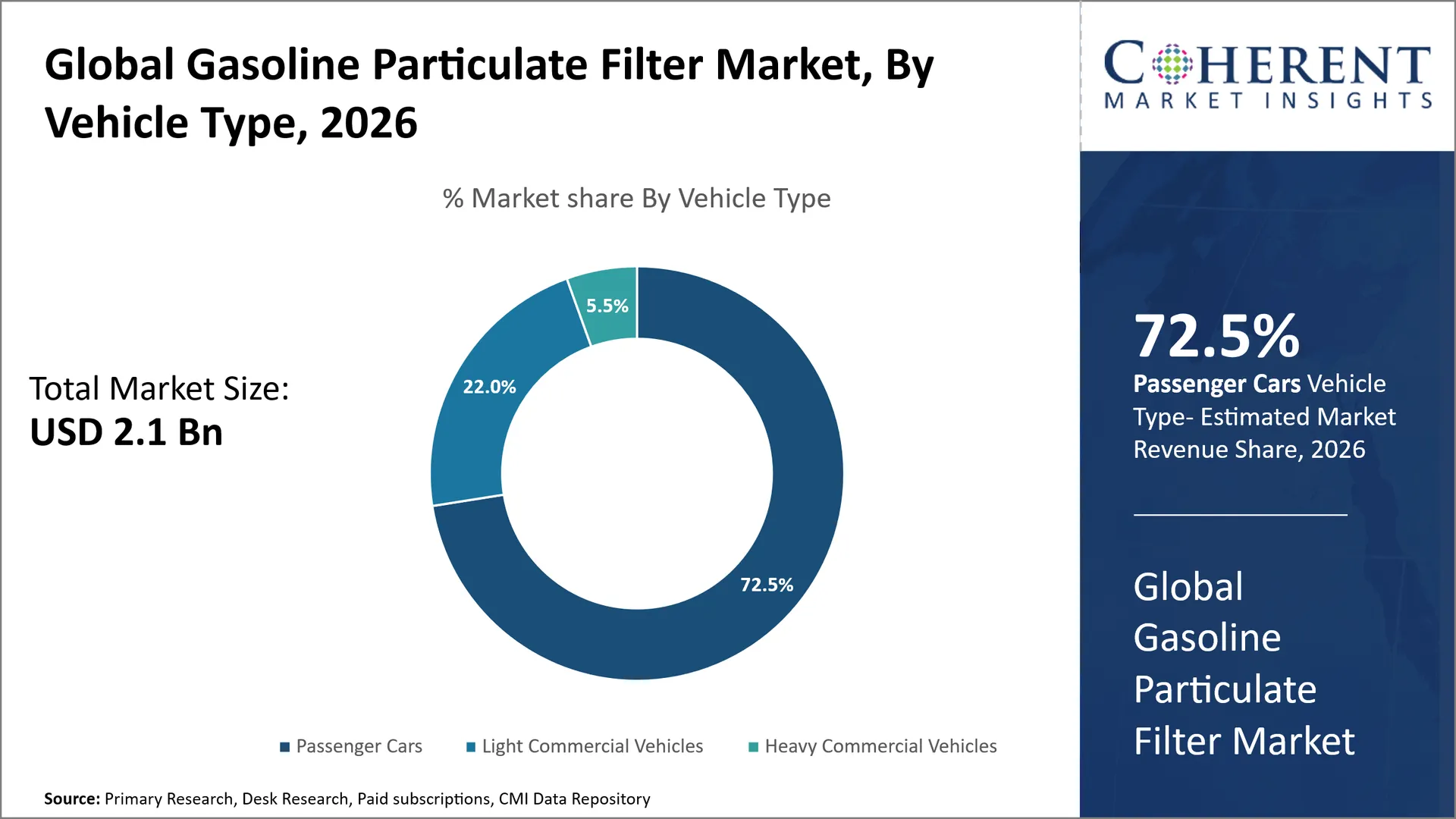
In terms of vehicle type, passenger cars are expected to account for 72.5% of the global gasoline particulate filter market share in 2026. Passenger cars are the main users of direct injection, a technique that raises power and cuts fuel use but releases ultrafine soot. Particle number rules were written mainly around cars, and every car sold with a GDI engine in a regulated market needs one filter. Corning reports that GDI vehicles reached about a quarter of worldwide passenger vehicle sales, which gives a sense of the size of the fitted base.
Suppliers see this volume in their results. On 24 April 2026, FORVIA reported that Clean Mobility organic sales grew 2.2%, supported by good momentum in combustion-engine programs. Because most of these programs now include a filter, passenger car platforms are where new filter designs are launched first.
Why Does the OEM Segment Lead the Sales Channel Segment?
In terms of sales channel, the original equipment manufacturer (OEM) segment is expected to account for 88.0% of the global gasoline particulate filter market share in 2026. A filter must be matched to the engine, calibrated with its control software, tested for durability and approved with the whole vehicle, so carmakers buy it as part of the exhaust system under multi-year supply contracts. This is also why suppliers build close ties with a few large vehicle makers: Cataler, for example, lists Toyota, Daihatsu, Hino, Subaru, Isuzu, Suzuki, General Motors and Volkswagen among its major automotive catalyst customers.
System suppliers add engineering depth to this channel. Tata AutoComp Katcon lists gasoline particulate filter design among its exhaust engineering capabilities and reports that it has supplied more than 30 million exhaust systems worldwide for gasoline, diesel and hybrid applications.
Current Events and their Impact
Current Events | Description and its Impact |
U.S. EPA Proposes Two-Year Delay of Tier 4 Standards (14 May 2026) |
|
India Releases Draft BS-VII Standards (12 October 2026) |
|
Global Gasoline Particulate Filter Market Dynamics
Market Drivers
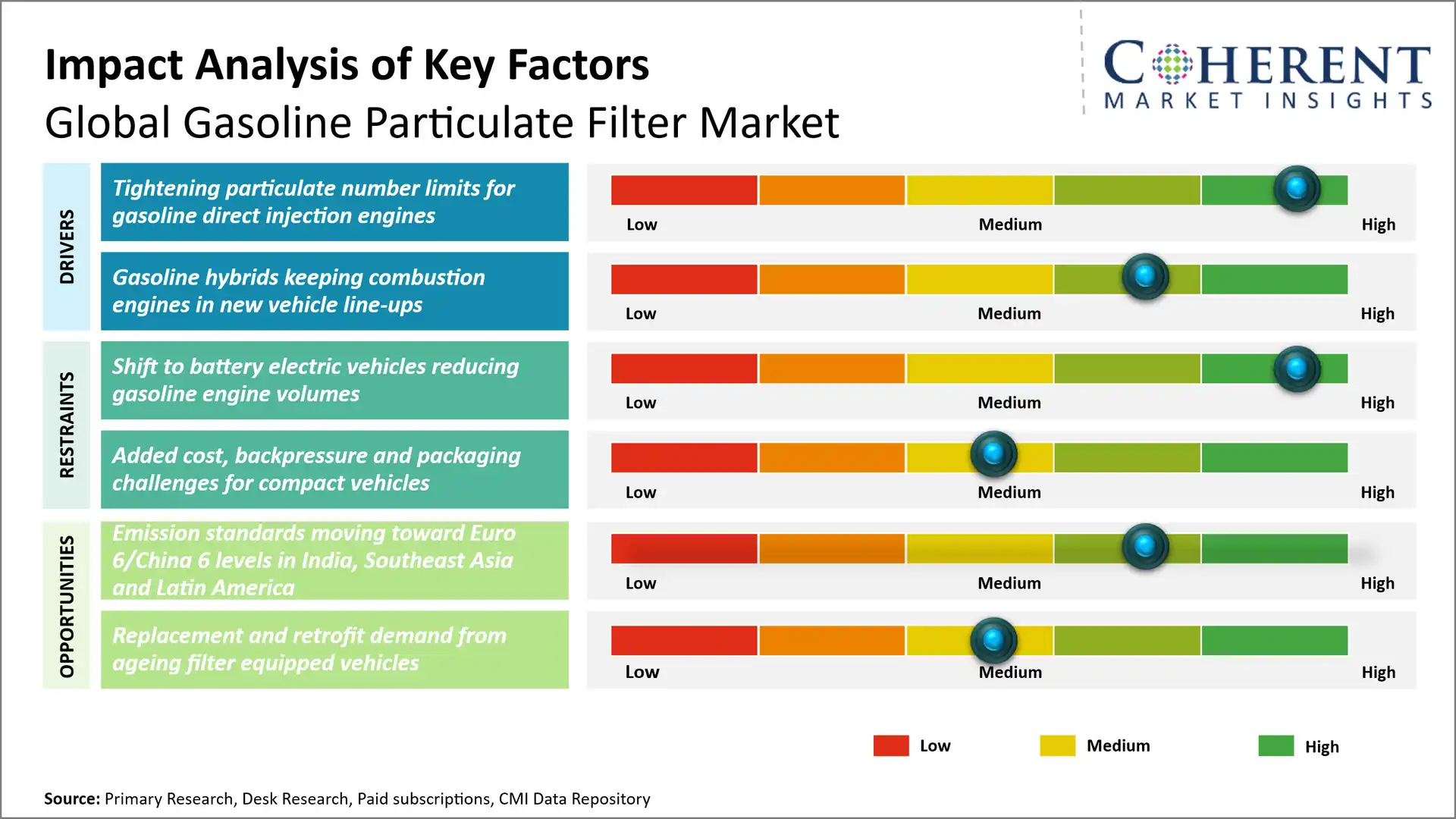
- Tightening particulate number limits for gasoline direct injection engines: Direct injection sprays fuel straight into the cylinder, which improves efficiency but leaves less time for the fuel to mix and burn, so the engine releases far more solid particles than older port injection designs. Regulators now count these particles, not just weigh them. The Euro 6 limit is 6.0 × 10^11 particles per kilometer, and Euro 7 keeps that number but counts particles down to 10 nm instead of 23 nm, which pulls in the smallest and most harmful particles. Engine calibration alone cannot meet this, so a filter becomes a fixed part of the exhaust line on every GDI model. Corning reports that particulate emissions from modern gasoline vehicles actually rose with the spread of direct injection, which is why Europe and China moved first and why other regions are now following.
- Gasoline hybrids keeping combustion engines in new vehicle line-ups: Hybrid cars still burn gasoline and must meet the same particle limits as conventional cars, so each one needs a filter. Hybrids also create demand for new designs, because the engine switches on and off and often runs cold, which makes soot burn-off harder. In its 27 January 2026 release, ACEA reported that hybrid-electric cars reached 3,733,325 registrations and a 34.5% share of the EU market in 2025, overtaking petrol as the top choice, with plug-in hybrids adding a further 1,015,887 units. Every one of these vehicles carries a gasoline engine that falls under particle number rules.
Emerging Trends
- Catalyst coatings are moving onto the filter itself: A coated filter, often called a four-way catalyst, combines particle filtration with the work of a three-way catalyst, which saves space, weight and cost. Umicore's publication list includes a 2024 SAE World Congress paper on improved coated gasoline particulate filters for China 7 and U.S. Tier 4 legislation, and a 2026 SAE India paper introducing a new secondary emission treatment catalyst family for gasoline aftertreatment.
- Impact: One component replaces two, reducing back pressure and the number of parts per vehicle.
- Relevance to the market: Suppliers with coating know-how and long filter supply agreements are better placed to win new platforms.
- Compact, close-coupled exhaust packages are being built for hybrids: Because hybrid engines run intermittently, exhaust makers place catalysts and filters nearer the engine so that they heat up quickly. Tenneco's Clean Air business lists gasoline and diesel particulate filters, close-coupled converters and active heating units among its aftertreatment products for Euro 6d, Euro 7, China 6 and Bharat 6 rules.
- Impact: Faster warm-up, quicker soot burn-off and less cold-start particle release.
- Relevance to the market: System suppliers can sell filter, catalyst and piping as one module, which raises the value per vehicle.
Regional Insights
Why Does Europe Lead the Global Gasoline Particulate Filter Market?
Europe is expected to account for a market share of 32.0% in 2026. Filters have been fitted on European gasoline cars since the Euro 6c stage, so the region has the largest installed base and the most mature supply chain, with ceramic plants, catalyst coaters and exhaust makers close to the carmakers. On 25 July 2025, the European Commission adopted Implementing Regulation (EU) 2025/1706, which sets the test procedures for Euro 7 exhaust type approval and refers to particle number measurement from 10 nm (PN10). That smaller size forces coated, higher-efficiency filters, which raises the value of each unit sold. With Euro 7 applying to new car and van types from 29 November 2026, European demand is set to stay the largest.
Why Is Asia Pacific the Fastest-Growing Region in the Gasoline Particulate Filter Market?
Asia Pacific is expected to account for 31.0% of the global market in 2026 and to register the fastest growth over the forecast period, at a CAGR of 15.6%. China requires filters through China 6b and sold 34.44 million vehicles in 2025, the world's largest vehicle market. Japan's particle number limit for gasoline direct injection cars reached continued-production vehicles on 1 October 2026, which extends filters to models already on sale, and India's draft BS-VII roadmap would add a new large market from 2029. Together these steps widen the base of filter-equipped vehicles faster than anywhere else.
Gasoline Particulate Filter Market Outlook for Key Countries
Is the U.S. the Largest Market for Gasoline Particulate Filters?
The U.S. gasoline particulate filter market is projected to reach USD 0.44 Bn in 2026, the largest of any country and about 88% of the North American total. Demand is shaped by federal rules: on 18 April 2024, the Environmental Protection Agency published its final rule in the Federal Register, which sets a particulate matter standard of 0.5 mg/mile across three test cycles, including a cold test at −7°C. That limit is far tighter than the current rules and is expected to push particulate filters onto a much wider range of gasoline models once it applies.
Is China the Largest Market in Asia Pacific?
China's market is projected to reach USD 0.39 Bn in 2026, the largest in the region. China 6b has applied nationwide since 1 July 2023, and vehicles that do not meet it cannot be produced, imported or sold, which made the particulate filter a standard part on most gasoline direct injection cars. The scale is large: the China Association of Automobile Manufacturers reported on 14 January 2026 that vehicle sales reached 34.44 million units in 2025, up 9.4%, and conventional and hybrid cars still make up roughly half of those sales.
Why Is Germany a Key Market in Europe?
Germany's market is projected to reach USD 0.19 Bn in 2026, the largest in Europe. Germany is home to the region's largest group of car makers and to Eberspächer, an exhaust supplier headquartered in Esslingen. ACEA data for 2025 show that hybrid-electric registrations in Germany rose 8.0%, which keeps gasoline engines, and therefore filters, in the German new-car mix as Euro 7 approaches.
Japan Gasoline Particulate Filter Market Analysis and Trends
Japan's market is projected to reach USD 0.10 Bn in 2026. On 7 October 2022, the Ministry of Land, Infrastructure, Transport and Tourism announced a particle number standard for gasoline direct injection vehicles up to 3.5 tonnes, in line with the global light-duty test procedure. New gasoline models have been covered since 1 October 2024. Japan is also the home base of two of the world's largest ceramic filter and catalyst makers, Cataler and NGK Insulators.
India Gasoline Particulate Filter Market Analysis and Trends
India's market is projected to reach USD 0.05 Bn in 2026, the smallest of the five but among the fastest growing. India moved from BS4 to BS6 in April 2020 and added on-board diagnostic requirements in April 2025. Most gasoline cars do not yet need a filter under BS6, so growth depends on the BS-VII timeline. Local suppliers are already preparing: Tata AutoComp Katcon, a joint venture between Tata AutoComp and Katcon Global, supplies exhaust and aftertreatment systems to Indian carmakers.
Global Gasoline Particulate Filter Market – Key Filter Configurations
Configuration | How It Works | Main Strengths | Typical Use |
Uncatalyzed ceramic wall-flow filter | A bare cordierite honeycomb with alternately plugged channels traps soot on and in the walls; a three-way catalyst sits upstream | Low cost, simple design | Vehicles with enough packaging room |
Catalyzed filter (four-way catalyst) | A catalyst coating on the filter walls treats particles, hydrocarbons, carbon monoxide and nitrogen oxides together | Saves space and weight, one part replaces two | Compact cars and hybrids |
High-porosity ceramic filter | Higher wall porosity at 300 cells per square inch with 8 mil walls | Lower back pressure | Turbocharged engines |
Metal fiber filter | A three-dimensional mat of metal fibers 17 to 30 microns thick in a metal housing, with porosity up to 98% and heat resistance up to 1,000°C | Sound absorption, low weight, low regeneration temperature | Direct injection passenger cars needing a compact filter |
How Are Ageing Fleets and New Standards Creating Opportunities?
Two openings stand apart from factory fit. The first is replacement of filters in vehicles that are now several years old, which will build as the first filter-equipped fleets in Europe and China age and as workshops meet clogged or damaged units. The second is entry of new markets, where each new standard creates demand for every GDI model at once. Suppliers with local plants, coating technology and OEM approvals will capture most of this volume.
Market Players, Key Development, and Competitive Landscape
Key Developments
- On November 2, 2026, FORVIA reported third-quarter sales in which group organic sales rose 0.4%, an outperformance of 510 basis points, driven by strong activity in Clean Mobility.
- On September 3, 2026, Tenneco opened its Global Innovation Center in Kunshan, China, which brings Clean Air, Powertrain and Ignition engineering together and reports more than 400 patents filed, including technology for hybrid vehicles.
- On February 20, 2026, Umicore announced its full year results for 2025 and reported that its catalysis business is expected to keep benefiting from its position in light-duty gasoline catalysts, even though global combustion engine production has peaked.
- On November 20, 2025, Johnson Matthey announced half year results in which the Clean Air margin reached 12.4%, up 200 basis points, while light-duty gasoline sales fell 15% at constant exchange rates.
Competitive Landscape
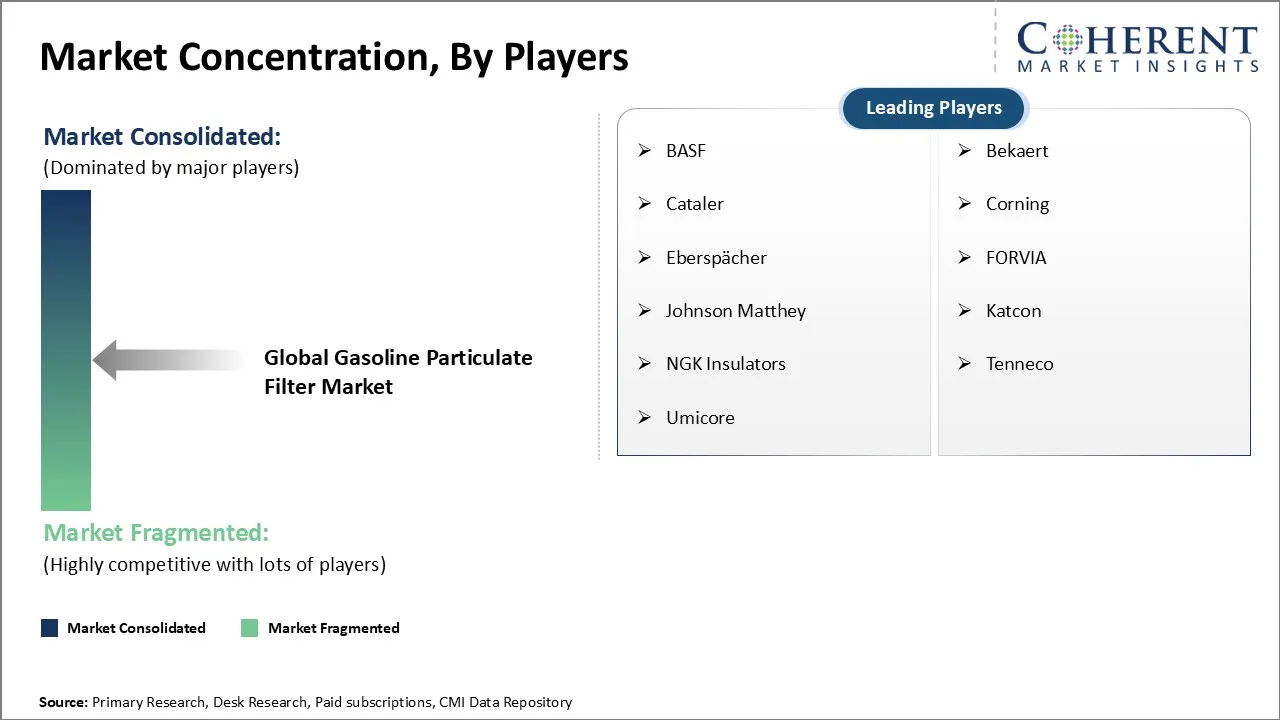
The market has three layers that depend on one another. Substrate makers such as Corning and NGK Insulators produce the ceramic filter body, and Bekaert supplies metal fiber filter media. Catalyst specialists such as Umicore, Johnson Matthey, BASF and Cataler apply the coating that turns a filter into a four-way catalyst. System suppliers such as Tenneco, FORVIA, Eberspächer and Katcon build the complete exhaust module for the carmaker. Scale matters: Umicore Automotive Catalysts operates 16 plants in 13 countries, BASF's Environmental Catalyst and Metal Solutions business runs 21 production sites in 16 countries, and Johnson Matthey reports that it has made 1.41 billion catalysts in the last 50 years.
Top Companies and Notable Products in the Gasoline Particulate Filter Market
Company | Notable Product | Key Features |
Corning Incorporated | DuraTrap GC and GC HP | Cordierite wall-flow filters at 200 and 300 cells per square inch with 8 mil walls, filtration efficiency above 95% when new |
Umicore | Catalyzed gasoline particulate filter (cGPF) | Coated filter for gasoline engines, motorcycles and small engines, offered with three-way catalysts |
Johnson Matthey | Three Way Filter (TWF) | Gasoline particulate filter with a catalyst coating for Euro 7, EPA and China 6/7 rules |
Bekaert | Bekaert Gasoline Particulate Filter (Bekipor metal fiber) | Metal fiber media with porosity up to 98% and heat resistance up to 1,000°C; sound absorbing and low weight |
Tenneco Inc. | Gasoline particulate filter systems | Close-coupled and active heating aftertreatment for Euro 7, China 6 and Bharat 6 |
Market Report Scope
Gasoline Particulate Filter Market | |||
Report Coverage | Details | ||
Base Year | 2025 | Market Size in 2026: | USD 2.1 Bn |
Historical Data For: | 2020 To 2024 | Forecast Period: | 2026 To 2033 |
Forecast Period 2026 To 2033 CAGR: | 13.4% | 2033 Value Projection: | USD 5.1 Bn |
Geographies covered: |
| ||
Segments covered: |
| ||
Companies covered: | BASF, Bekaert, Cataler, Corning, Eberspächer, FORVIA, Johnson Matthey, Katcon, NGK Insulators, Tenneco, Umicore | ||
Growth Drivers: |
| ||
Restraints & Challenges: |
| ||
Analyst Opinion (Expert Opinion)
- Cordierite sets the standard, and coatings set the pace. Cordierite is expected to hold 60.0% of the market in 2026 because carmakers know its cost, durability and supply. Competition is moving from the filter body to the coating on it, where catalyst specialists hold the know-how, so growth in value per filter will outpace growth in unit volume.
- Passenger cars and OEM contracts carry the market. Passenger cars account for 72.5% and the OEM channel for 88.0% of the 2026 market. Suppliers that win a platform keep it for the life of the model, which makes early design wins in Euro 7, China and India programs more valuable than price competition.
- Europe leads in value, Asia Pacific in growth. Europe holds 32.0% of the market in 2026, while Asia Pacific, at 31.0%, is expected to grow at 15.6% a year as Japan and India add rules to those already in force in China. The main risks are a faster-than-expected switch to battery electric cars, which cuts gasoline engine volumes, and the proposed delay of U.S. Tier 4 limits to model year 2029.
Speak to the analyst
Want personalized insights?
Take the findings above to one of our principal consultants, or have the report rebuilt around the segments, geographies and competitors you actually track.
Market Segmentation
- Filter Material Insights (Revenue, USD Billion, 2021 - 2033)
- Cordierite
- Silicon Carbide
- Others (Metallic and Aluminium titanate)
- Vehicle Type Insights (Revenue, USD Billion, 2021 - 2033)
- Passenger Cars
- Light Commercial Vehicles
- Heavy Commercial Vehicles
- Sales Channel Insights (Revenue, USD Billion, 2021 - 2033)
- Original Equipment Manufacturer (OEM)
- Aftermarket
- Regional Insights (Revenue, USD Billion, 2021 - 2033)
- North America
- U.S.
- Canada
- Latin America
- Brazil
- Argentina
- Mexico
- Rest of Latin America
- Europe
- Germany
- U.K.
- Spain
- France
- Italy
- Russia
- Rest of Europe
- Asia Pacific
- China
- India
- Japan
- Australia
- South Korea
- ASEAN
- Rest of Asia Pacific
- Middle East
- GCC Countries
- Israel
- Rest of Middle East
- Africa
- South Africa
- North Africa
- Central Africa
- North America
- Key Players Insights
- BASF
- Bekaert
- Cataler
- Corning
- Eberspächer
- FORVIA
- Johnson Matthey
- Katcon
- NGK Insulators
- Tenneco
- Umicore
Sources
- Primary Research Interviews
▪ Automotive OEM Powertrain and Emission Compliance Teams
▪ Exhaust Aftertreatment System Suppliers
▪ Ceramic Substrate and Filter Media Manufacturers
▪ Catalyst Coating and Precious Metal Specialists
▪ Tier-1 Automotive Component Distributors and Aftermarket Suppliers - Magazines
▪ Automotive News Europe
▪ Automotive World
▪ SAE Automotive Engineering Magazine
▪ Autocar Professional - Journals
▪ SAE International Journal of Engines
▪ Emission Control Science and Technology
▪ Catalysis Today
▪ Atmospheric Environment - Associations
▪ European Automobile Manufacturers’ Association (ACEA)
▪ China Association of Automobile Manufacturers (CAAM)
▪ Society of Indian Automobile Manufacturers (SIAM)
▪ Japan Automobile Manufacturers Association (JAMA)
▪ Manufacturers of Emission Controls Association (MECA)
▪ International Council on Clean Transportation (ICCT) - Public Domain Sources
▪ European Parliament: Euro 7 summary
▪ European Commission: Commission Implementing Regulation (EU) 2025/1706, July 2025
▪ U.S. Environmental Protection Agency (EPA): Multi-Pollutant Emissions Standards for Model Years 2027 and Later, Federal Register, April 2024
▪ U.S. EPA: proposal to delay Tier 4 standards, May 2026
▪ Japan Ministry of Land, Infrastructure, Transport and Tourism (MLIT): particle number standard for gasoline direct injection vehicles, October 2022
▪ China Ministry of Ecology and Environment: China 6 emission standard for light-duty vehicles
▪ India Ministry of Road Transport and Highways: draft BS-VII emission norms
▪ ACEA: new car registrations 2025 and vehicles on European roads 2026
▪ U.S. Securities and Exchange Commission (SEC): company annual filings
▪ Company press releases - Proprietary Elements
▪ CMI Data Analytics Tool
▪ Proprietary CMI Existing Repository of information for last 10 years
Get access to 250+ pages report
Every segment, forecast, competitor profile and data table behind the analysis above — available for instant download.
- ESOMAR Member
- ISO 9001:2015 Certified
- D-U-N-S Registered
- GDPR & CCPA Compliant
Frequently Asked Questions
The global gasoline particulate filter market is valued at USD 2.10 Bn in 2026 and is expected to reach USD 5.10 Bn by 2033.
The CAGR of the global gasoline particulate filter market is projected to be 13.4% from 2026 to 2033.
Tightening particulate number limits for gasoline direct injection engines, and gasoline hybrids keeping combustion engines in new vehicle line-ups, are the major factors driving market growth.
The shift to battery electric vehicles reducing gasoline engine volumes, and the added cost, back pressure and packaging challenges for compact vehicles, are the major factors hampering market growth.
In terms of filter material, cordierite is expected to dominate the market, with a revenue share of 60.0% in 2026.
A gasoline particulate filter (GPF) is a honeycomb filter placed in the exhaust of a gasoline direct injection (GDI) engine. Exhaust gas is forced through porous channel walls that hold back ultrafine soot, and the trapped soot is burned off by the engine’s own hot exhaust, so the filter cleans itself without extra fuel.
An uncatalyzed filter only traps particles and is paired with a separate three-way catalyst. A catalyzed filter, often called a four-way catalyst, carries a catalyst coating on its walls, so one component removes particles and also converts hydrocarbons, carbon monoxide and nitrogen oxides.