

Global Glass Mosaics Market Size and Forecast – 2026 To 2033
The Global Glass Mosaics Market is estimated to be valued at USD 4.82 Bn in 2026 and is expected to reach USD 7.15 Bn by 2033, growing at a compound annual growth rate (CAGR) of 5.80% from 2026 to 2033. This growth reflects increasing adoption across residential, hospitality, wellness, and commercial construction projects, where glass mosaics are increasingly specified for decorative walls, swimming pools, spas, and premium interior surfaces due to their durability, moisture resistance, and design flexibility.
The market expansion is further supported by the shift toward customized architectural finishes, renovation activities, and demand for visually differentiated spaces. In May 2025, Ezarri expanded its international project portfolio by highlighting its recycled glass mosaic solutions for swimming pools, wellness areas, and interior applications across global markets, reinforcing the growing preference for sustainable and design-oriented mosaic surfaces.
Key Takeaways of the Global Glass Mosaics Market
- Traditional Glass Mosaic Tiles are expected to record an estimated 5.2% CAGR during 2026–2033 while holding 42.6% of the global glass mosaics market in 2026, supported by their familiar square-tessera format, broad design compatibility, and suitability across interior, exterior, wet-area, and decorative installations. In March 2025, Bisazza announced a Milan Design Week showcase centered on a glass-mosaic installation by eBoy, reinforcing continued designer use of classic glass mosaic formats.
- Swimming Pools and Spas are projected to expand at an estimated 6.3% CAGR during 2026–2033 while accounting for 28.6% of the global glass mosaics market in 2026, reflecting glass mosaic’s water resistance, visual depth, curved-surface adaptability, and strong fit with premium aquatic environments. In November 2025, Hisbalit unveiled its Marine collection at Piscina Barcelona, offering recycled-glass mosaics specifically positioned for pools, spas, and contract projects.
- Wall Applications are anticipated to grow at an estimated 5.9% CAGR during 2026–2033 while representing 52.8% of the global glass mosaics market in 2026, as vertical surfaces let mosaics deliver color, texture, light interaction, and moisture resistance without the abrasion demands associated with floors. In March 2026, ONIX showcased new glass mosaic collections at Coverings 2026 for architecture and interior design, including surface-focused designs that broaden specification possibilities across decorative interiors.
- Asia Pacific is expected to post an estimated 6.0% CAGR during 2026–2033 while capturing 36.8% of the global glass mosaics market in 2026, supported by intensive hotel development, urban construction, and design-led investment across major Asian cities and resort destinations. In April 2026, Hilton announced more than fifteen luxury and lifestyle openings planned across Asia Pacific during the year, expanding the specification base for premium interior, spa, and pool finishes.
- Europe is forecast to achieve an estimated 6.6% CAGR during 2026–2033 while accounting for 27.8% of the global glass mosaics market in 2026, making it the fastest-growing region as renovation activity, premium hospitality upgrades, and sustainable-material preferences widen mosaic specification opportunities. In June 2026, the European Commission highlighted Green Deal projects supporting accelerated building renovation and the revised EPBD framework, strengthening long-term refurbishment activity across the region.
Segmental Insights
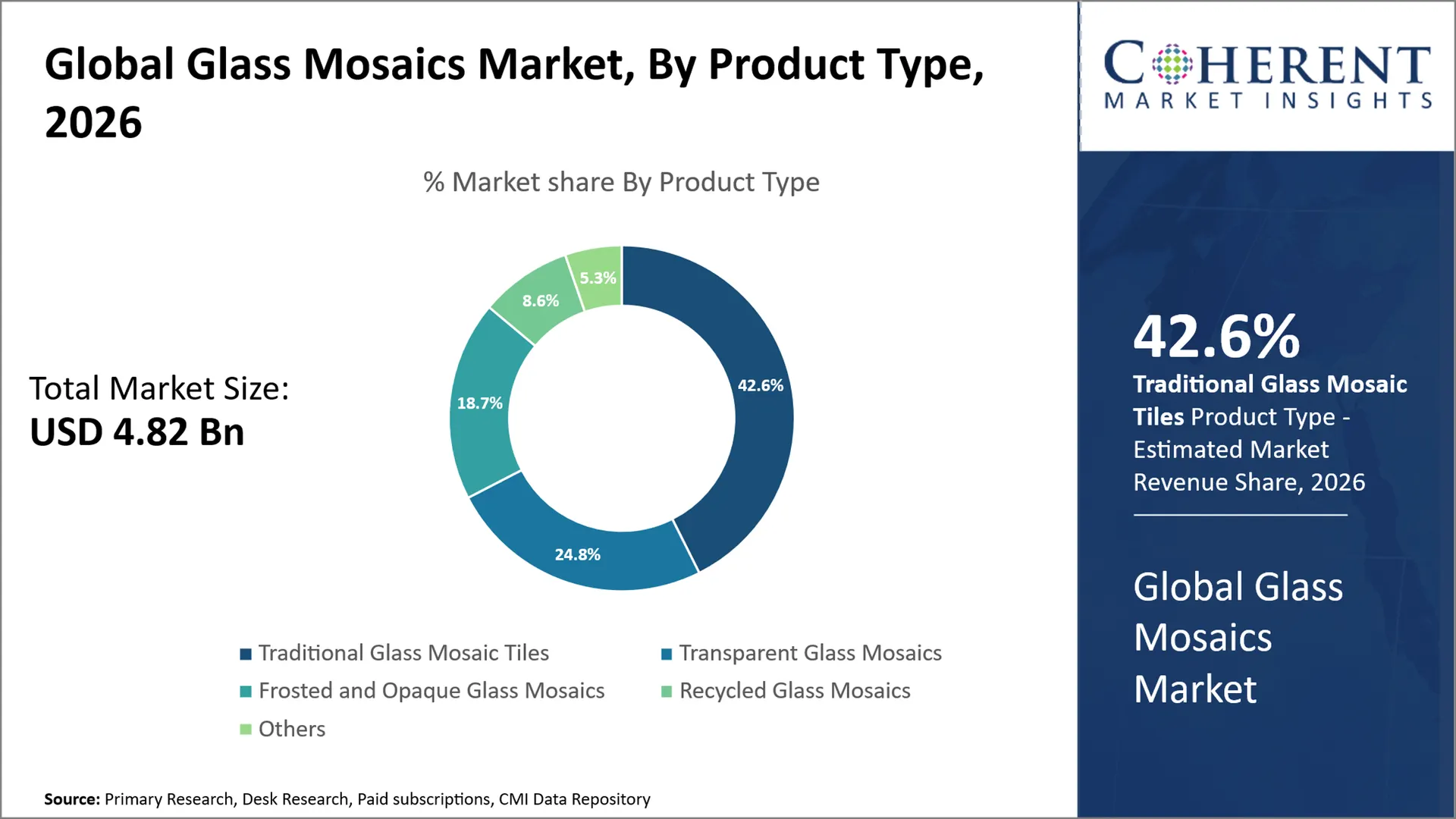
Why Do Traditional Glass Mosaic Tiles Dominate the Product Type Segment of the Global Glass Mosaics Market?
Traditional Glass Mosaic Tiles are expected to hold 42.6% of the global glass mosaics market in 2026, leading the product-type category because their familiar small-format geometry supports broad specification across bathrooms, kitchens, pools, spas, backsplashes, and decorative interiors. Their strength also comes from mature production economics: standardized chip sizes, established mounting methods, broad color libraries, and dealer familiarity make them easier to stock, sample, replace, and install than more specialized mosaic formats. For manufacturers and distributors, this creates dependable volume turnover and lowers the commercial risk of carrying wide assortments. Contractors also benefit from proven installation practices and easier matching across phased projects. In November 2024, Lunada Bay Tile introduced JAW Redux and two new Agate glass-tile patterns, expanding its handcrafted glass offering with new formats and multiple color options, illustrating continued product investment around established glass mosaic systems.
- Current Industry Events of 2026
- Market Size Estimation
- Regional Breakdown
- Competitive Landscape
- Customer Intelligence
- Segmental Analysis
- Pricing Analysis
- Key Market Drivers, Challenges & Future Trends
- Customized Insights Section
Why Do Swimming Pools and Spas Represent the Largest Application Segment in the Global Glass Mosaics Market?
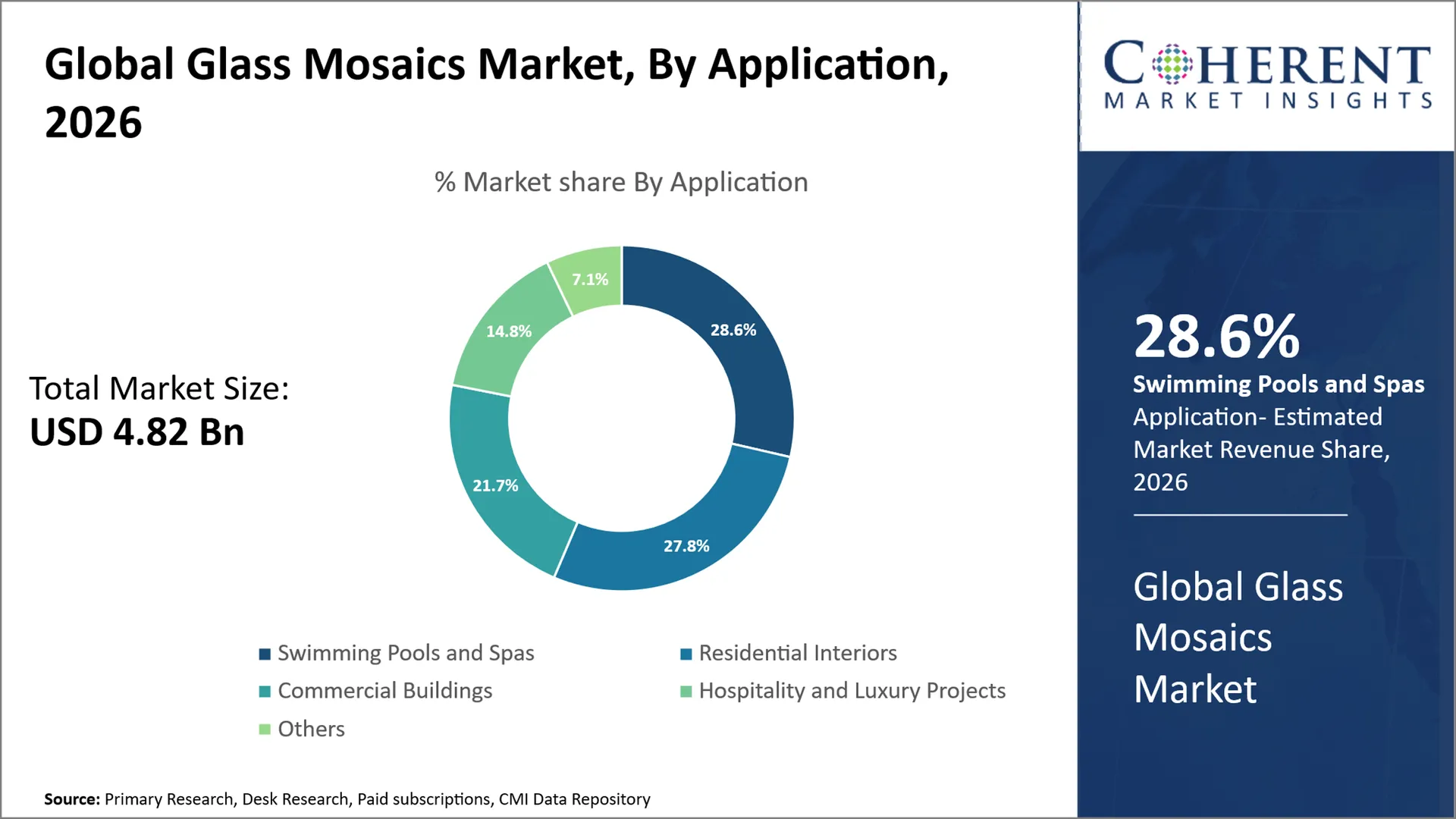
Swimming Pools and Spas are expected to represent 28.6% of the global glass mosaics market in 2026, making them the largest application segment because submerged and wet-area environments place unusually high value on low water absorption, chemical resistance, visual depth, and adaptability to curved surfaces. Small mosaic chips can follow pool shells, steps, benches, waterlines, and spa contours more effectively than many large-format coverings, while blue, green, iridescent, and customized mixes help designers influence perceived water color. This creates repeat demand from pool contractors, resort developers, wellness facilities, and specialist distributors. Suppliers that can offer coordinated sheet mounting, custom blends, edge solutions, and installation guidance gain a stronger commercial position. In March 2025, Foshan Gentle Building Materials documented a Malaysian residential swimming-pool project using 25 x 25 mm crystal glass mosaics and customized mural elements, demonstrating direct end-use adoption in a complete pool installation.
Why Do Wall Applications Dominate the Installation Area Segment of the Global Glass Mosaics Market?
Wall Applications are expected to account for 52.8% of the global glass mosaics market in 2026, making walls the leading installation area because vertical surfaces allow glass mosaics to deliver high visual impact without the wear, load, and slip-performance constraints associated with floors. Feature walls, shower enclosures, reception areas, backsplashes, columns, and branded interiors can use small tesserae to create gradients, murals, logos, and complex geometry while maintaining easy cleaning and moisture resistance. Wall installation also gives architects greater freedom to specify reflective, transparent, metallic, or textured finishes at eye level, supporting premiumization. For suppliers, custom design conversion and accurate sheet assembly can generate higher-value project orders. In June 2026, COCO Tiles and Mosaics completed a large custom glass mosaic feature wall for Liverpool Catholic Club in New South Wales, developed with Modena Ceramics and Altis Architecture for a commercial interior setting.
Current Events and their Impact
Current Event | Description and Its Impact |
January 2026 – EU Construction Products Regulation 2024/3110 becomes broadly applicable |
|
January 2026 – UK Construction Products Amendment Regulations take effect |
|
Global Glass Mosaics Market Dynamics
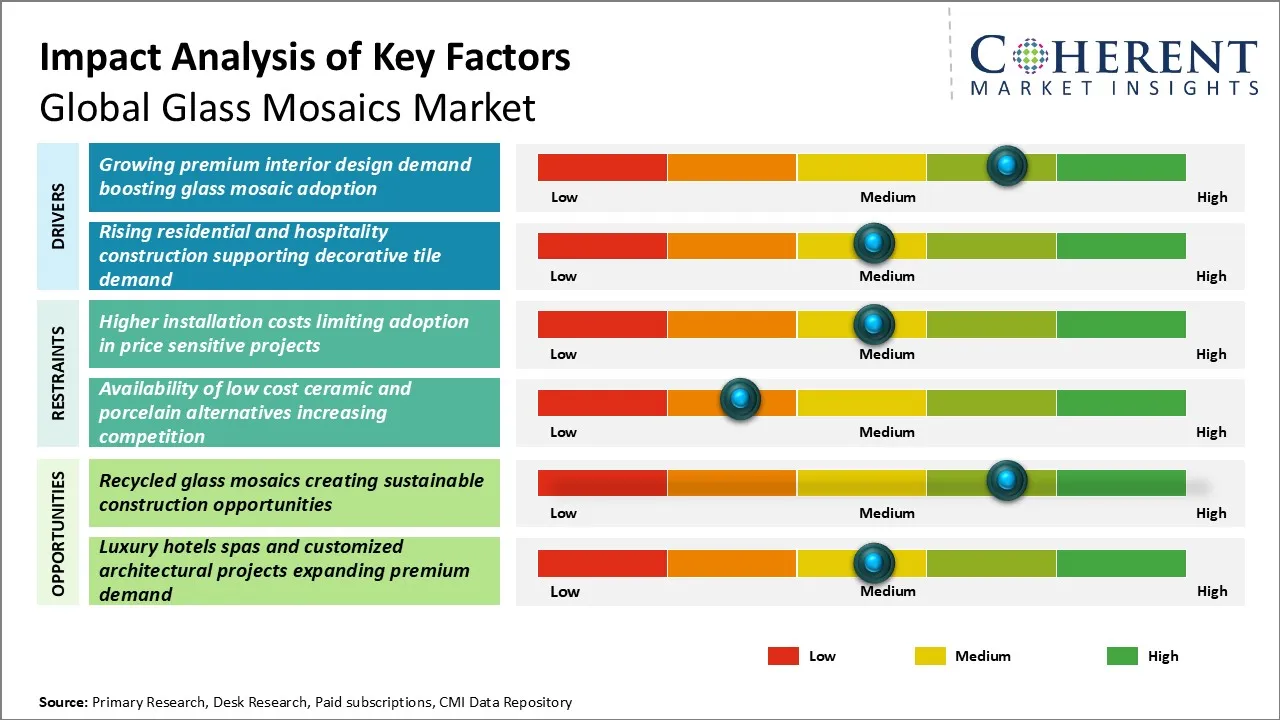
Key Market Drivers
- Growing premium interior design demand boosting glass mosaic adoption: Premium interior projects increasingly treat glass mosaics as specified design materials rather than interchangeable decorative tiles. Architects and designers value controlled color, reflective depth, small-format geometry, and the ability to create bespoke patterns across feature walls, bathrooms, bars, and reception spaces. These shifts purchasing toward higher-margin customized collections, benefiting specialist manufacturers, design-led distributors, fabricators, and project installers. In April 2025, New Ravenna introduced its Two Step collection, combining natural stone with Italian Serenity glass in customizable mosaic patterns for interior and exterior design applications.
- Rising residential and hospitality construction supporting decorative tile demand: Residential and hospitality construction expands the number of bathrooms, wet areas, leisure facilities, lobbies, kitchens, and decorative surfaces where glass mosaics can be specified at project stage. Large developments also favor repeatable colorways, standardized sheet formats, and reliable delivery, creating volume opportunities for manufacturers, importers, distributors, and installation contractors. In January 2026, IHG Hotels & Resorts reported more than 50 hotels open and 80 in development in India, with an ambition to exceed 400 open and pipeline properties within five years, indicating a widening hospitality specification base.
Emerging Market Trends
- Application-Coded Portfolios Are Replacing Color-Only Merchandising: Glass mosaic portfolios are moving from purely aesthetic classification toward application-coded product systems. Buyers increasingly expect clear guidance on wet-area suitability, slip behavior, chemical resistance, edge treatment, mounting method, grout compatibility, and maintenance requirements before approving a finish. This changes product development because manufacturers must design collections around performance envelopes rather than color alone. Technical distributors and specification-oriented brands should benefit, while suppliers that rely on visual merchandising without robust application documentation may face slower approvals and greater installer resistance over the forecast period.
- Format Innovation Is Redefining the Mosaic Sheet: Design preferences are broadening beyond conventional small square tesserae toward elongated rectangles, hexagons, mixed-scale modules, textured surfaces, and larger mosaic pieces that reduce visual repetition. The change is commercially important because format innovation lets suppliers refresh established glass chemistry without rebuilding the entire value proposition around new raw materials. Manufacturers with flexible cutting, finishing, and mounting lines can respond faster to architectural trends, while distributors may need more complex sample management and inventory planning. Over time, format variety should become a stronger basis for portfolio segmentation and premium pricing.
Regional Insights
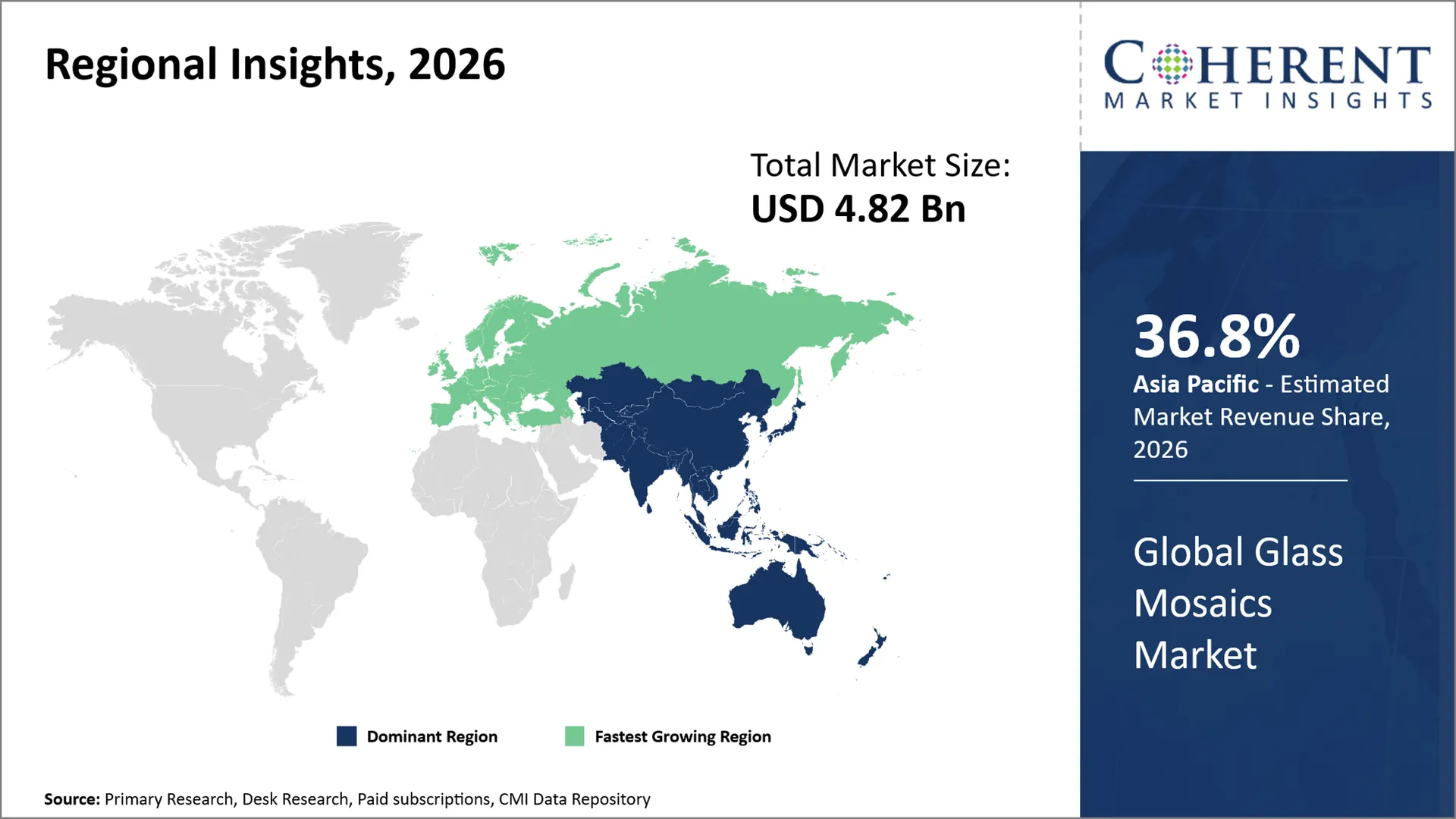
Why Does Asia Pacific Dominate the Global Glass Mosaics Market?
Asia Pacific is expected to account for 36.8% of the global glass mosaics market in 2026, supported by large-scale urban development, premium hospitality investment, resort construction, and expanding residential interiors across China, India, Southeast Asia, Japan, and Australia. The region also benefits from a broad manufacturing and processing base for decorative glass products, supporting competitive supply, product variety, and faster project servicing. Glass mosaics are particularly suited to swimming pools, spas, bathrooms, feature walls, and luxury commercial interiors, all gaining relevance in destination-led real estate and upscale hospitality. Design preferences are also moving toward customized surfaces and visually distinctive finishes. In July 2025, Hyatt announced a pipeline of close to 90 luxury and lifestyle properties expected to open across Asia Pacific over five years, reinforcing future specification opportunities for premium interior and wet-area surfaces.
Why Is Europe Emerging as the Fastest-Growing Region in the Global Glass Mosaics Market?
Europe is expected to hold 27.8% of the global glass mosaics market in 2026 and emerge as the fastest-growing region as renovation, premium interior design, and sustainability-led material selection reshape demand. The region has a mature architectural specification culture, where mosaics are used in bathrooms, pools, spas, hospitality interiors, restoration projects, and decorative wall applications. Growth is increasingly linked to refurbishment rather than only new construction, favoring glass mosaics because they can refresh high-visibility surfaces without requiring large-format structural changes. European buyers also emphasize material traceability, durability, recycled content, and design differentiation, supporting higher-value product categories. In May 2026, Renovate Europe and nine partners published a study examining National Building Renovation Plans across several European countries, illustrating the growing policy and investment focus on upgrading existing building stock.
Global Glass Mosaics Market Outlook for Key Countries
Why Is Italy a Key Market for the Global Glass Mosaics Market?
Italy is a key country in the global glass mosaics market because it combines long-established mosaic craftsmanship with premium design, architectural specification, and export-oriented production. Italian suppliers are particularly influential in high-end residential interiors, luxury hospitality, wellness areas, swimming pools, artistic installations, and bespoke contract projects where color depth, surface finish, and customization determine purchasing decisions. The country’s design ecosystem also connects mosaic producers closely with architects, interior designers, furniture brands, and international project developers, helping manufacturers compete on aesthetics and technical performance rather than price alone. This supports continued demand for smalto, transparent glass, metallic effects, gradients, and recycled-glass solutions. Supporting this specialization, in January 2025, TREND Group marked 25 years in mosaics, glass, and engineered surfaces and highlighted its manufacturing foundation in Italy’s traditional mosaic-producing area of Pordenone.
Why Is India Important in the Global Glass Mosaics Market?
India is becoming increasingly important in the global glass mosaics market as urban housing, branded hospitality, wellness destinations, premium bathrooms, and swimming pool construction expand across metropolitan and leisure markets. Demand is moving beyond basic wall finishes toward decorative surfaces that provide moisture resistance, color flexibility, and customized visual effects, particularly in upscale apartments, hotels, resorts, spas, and clubhouses. India also offers a cost-competitive manufacturing and artisan base for mosaic processing, supporting domestic supply as well as export-oriented production. Rising investment in organized hospitality is especially relevant because hotels and resorts frequently specify mosaics across pools, bathrooms, spas, and feature walls. Reflecting this expanding project base, in April 2025, Indian Hotels Company reported 74 hotel signings and 26 openings during FY2025, taking its portfolio to 380 hotels and widening future opportunities for decorative surface suppliers.
Why Is the U.S. a Key Market for the Global Glass Mosaics Market?
The U.S. is a key market for glass mosaics because demand is supported by high-value residential construction, home renovation, swimming pools, spas, hotels, restaurants, and design-intensive commercial interiors. Glass mosaics compete effectively where homeowners and specifiers value stain resistance, cleanability, water suitability, and differentiated finishes for bathrooms, backsplashes, shower areas, pools, and accent walls. The country also has a developed specialty tile distribution network and a large community of architects, designers, installers, and remodeling contractors, improving access to premium and customized mosaic products. Renovation is particularly important because mosaics can selectively upgrade small, high-visibility areas without requiring complete surface replacement. Demonstrating the scale of the addressable construction base, in September 2026, the U.S. Census Bureau reported residential construction spending at a seasonally adjusted annual rate of USD 859.0 billion for July 2026.
Why Is Germany a Strategic Country in the Global Glass Mosaics Market?
Germany is a strategic market for glass mosaics because purchasing decisions are strongly influenced by material quality, installation reliability, technical compliance, and lifecycle performance. Demand is concentrated in premium residential refurbishment, bathrooms, wellness facilities, swimming pools, hotels, public buildings, and architect-led commercial interiors where durable decorative surfaces can justify higher specification values. Germany is also an important European distribution and specification market for premium imported mosaics, including Italian and other European products, while sustainability requirements increasingly favor long-lasting and maintainable materials. Renovation and residential approvals therefore remain meaningful indicators of future surface demand. Supporting the forward project pipeline, in February 2026, Germany’s Federal Statistical Office reported that 238,500 dwellings were approved in 2025, 10.8% more than in 2024, with approvals for newly constructed residential buildings also increasing.
Why Does China Support Growth in the Global Glass Mosaics Market?
China supports growth in the global glass mosaics market through its combination of manufacturing scale, glass-processing capability, domestic construction demand, and export-oriented supply chains. The country can serve both price-sensitive volume categories and increasingly design-led products for residential interiors, hotels, resorts, pools, commercial spaces, and public redevelopment projects. Its industrial base supports access to glass inputs, automated cutting and finishing, color processing, mesh mounting, and high-volume packaging, enabling suppliers to compete across multiple international price points. At the same time, domestic demand is shifting toward renovation and quality improvement in established urban areas, creating opportunities beyond greenfield construction. Reinforcing this transition, in May 2026, China’s State Council issued its 2026–2030 urban renewal plan, calling for construction or renovation of quality homes, upgraded urban infrastructure, greener cities, and improved living spaces.
Innovation, Production & Installation Technology Landscape
Technology | Adoption Position | Market-Specific Application | Commercial Impact |
Waterjet and CNC Precision Cutting | Established to expanding | Produces intricate inlays, curved tesserae, irregular shapes, borders, logos, and repeatable customized geometries. | Reduces dependence on manual cutting, improves tolerance control, and enables commercially scalable bespoke mosaic programs with higher specification value. |
Digital Enamel and Inkjet Glass Decoration | Selective but expanding | Applies repeatable patterns, gradients, visual textures, and decorative effects directly to glass surfaces. | Enables faster collection refreshes and broader design libraries while allowing manufacturers to differentiate finishes without relying entirely on new glass compositions. |
Machine-Vision Color Sorting and Batch Quality Control | Expanding among scaled producers | Detects shade, dimensional, edge, and surface inconsistencies before tesserae are mounted or packed. | Improves large-project color consistency, reduces rejection and replacement risk, and strengthens supplier credibility with architects and installation contractors. |
Automated Sheet Mounting and Robotic Assembly | Established in volume-oriented facilities | Positions tesserae onto mesh, paper, film, or dot-mounted systems with controlled spacing and alignment. | Raises throughput, lowers assembly variability, and provides more predictable joint geometry, improving both manufacturing economics and installation efficiency. |
Anti-Slip Micro-Texturing and Surface Engineering | Application-specific | Modifies exposed surfaces to improve traction for selected wet-area and floor-oriented mosaic applications. | Broadens specification potential where safety and surface performance matter while increasing the importance of application testing and technical documentation. |
Digital Layout-to-Production and Pixel Mapping | Specialized but growing | Converts artwork, CAD files, branding, or digital imagery into numbered mosaic sheets and installation-ready modules. | Shortens the path from concept to fabrication and allows murals, graphics, and complex customized installations to be produced with greater repeatability. |
How Are Prefabricated Architectural Mosaic Panels Creating New Growth Opportunities in the Global Glass Mosaics Market?
Prefabricated mosaic panels for façades, transit spaces, civic interiors, branded environments, and large decorative installations represent an underdeveloped opportunity beyond conventional sheet-based retail applications. The opportunity is becoming more attractive because architects increasingly need distinctive surfaces that can be translated from digital artwork into repeatable, installation-ready modules with controlled joints and predictable site labor. Suppliers can capture this space by combining design engineering, penalization, precision cutting, mounting systems, substrate guidance, logistics planning, and installer coordination. The most relevant buyers include architects, public-space designers, hospitality developers, transport authorities, commercial landlords, and specialist contractors. Participation requires stronger project management, fire and weather-performance documentation where applicable, large-area color consistency, and fabrication capacity capable of handling non-standard geometries. Vertically integrated manufacturers and specialist mosaic fabricators are best positioned because they can control design conversion, production tolerances, packaging, installation sequencing, and replacement matching across complex projects. This supports premium contract pricing and longer project relationships.
Market Players, Key Development, and Competitive Intelligence
Key Developments
- In September 2026, Ezarri announced that it would present GEA, a new glass mosaic collection built around tactile, mineral-inspired surfaces, at Cersaie 2026. The development strengthens Ezarri's premium specification offer for pools and bespoke architectural settings, where differentiated texture and coordinated design language can support higher-value project selection.
- In March 2026, Fireclay Tile expanded its Glass Tile offering with 18 new colors and four new sizes across gloss and matte finishes. The update broadens specification choice across mosaic and larger glass formats, helping designers coordinate interiors, pools, and outdoor wet areas while giving distributors a wider design-led assortment.
- In April 2025, SICIS previewed new mosaics, surfaces, and furnishings at Salone del Mobile 2025 in Milan. The presentation linked glass mosaic more closely with complete luxury interior schemes, strengthening architect and designer engagement and supporting cross-category specification rather than treating mosaic as an isolated decorative finish.
Competitive Landscape
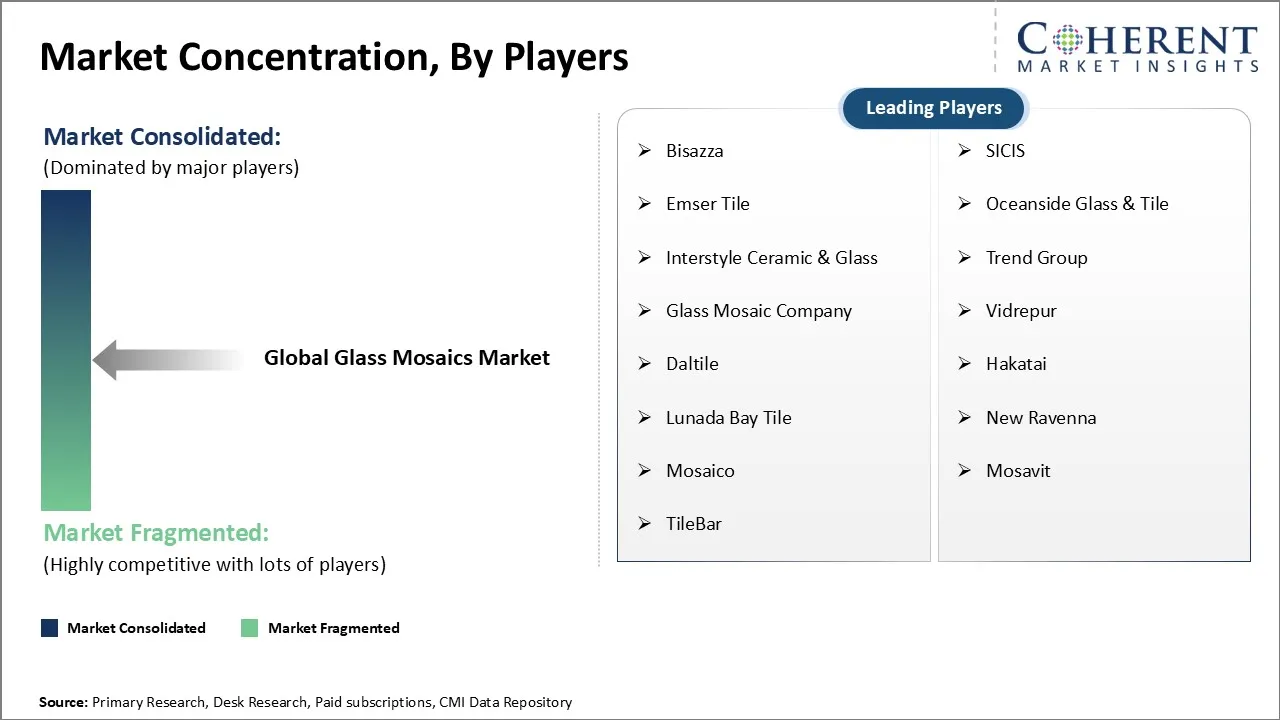
The global glass mosaics market remains fragmented, with luxury design houses, pool-focused specialists, regional volume manufacturers, custom fabricators, and broad tile distributors serving different specification tiers. Competition is determined less by scale alone than by color consistency, format breadth, fabrication accuracy, mounting reliability, lead-time control, installer support, and access to architects and dealers. Regional specialists retain influence where local design preferences and project servicing outweigh global brand reach.
Key focus areas include
- Specification Consistency: Reliable batch-to-batch color, tessera dimensions, surface finish, and mounting geometry reduce approval risk on multi-phase projects.
- Custom Fabrication Speed: Suppliers able to convert architectural drawings into manufacturable layouts quickly can shorten sampling and quotation cycles.
- Project Logistics Capability: Secure packaging, replacement matching, phased deliveries, and batch reservation are increasingly important for contract installations.
- Architect and Designer Access: Sample libraries, specification support, visualization tools, and direct engagement with design practices influence early-stage material selection.
- Installation Assurance: Clear substrate, adhesive, grout, joint, movement, and wet-area guidance helps limit failures, callbacks, and contractor resistance.
- Portfolio Architecture: Competitors with disciplined combinations of formats, finishes, applications, and price tiers can avoid excessive SKU complexity while retaining design breadth.
- Customer-Service Economics: Fast quotations, sample turnaround, technical responses, claims resolution, and replacement availability strengthen installer and distributor relationships beyond initial product pricing.
Market Report Scope
Global Glass Mosaics Market Report Coverage | |||
Report Coverage | Details | ||
Base Year | 2025 | Market Size in 2026: | USD 4.82 Bn |
Historical Data For: | 2020 To 2024 | Forecast Period: | 2026 To 2033 |
Forecast Period 2026 To 2033 CAGR: | 5.80% | 2033 Value Projection: | USD 7.15 Bn |
Geographies covered: |
| ||
Segments covered: |
| ||
Companies covered: | Bisazza, SICIS, Emser Tile, Oceanside Glass & Tile, Interstyle Ceramic & Glass, Trend Group, Glass Mosaic Company, Vidrepur, Daltile, Hakatai, Lunada Bay Tile, New Ravenna, Mosaico, Mosavit, TileBar | ||
Growth Drivers: |
| ||
Restraints & Challenges: |
| ||
Analyst Opinion (Expert Opinion)
- The Global Glass Mosaics Market is likely to shift from catalogue-based selling toward specification-driven solutions. Manufacturers that support architects and contractors through digital design libraries, faster sampling, customized patterns, batch consistency, and installation guidance can create stronger differentiation. As premium residential, hospitality, and wellness projects demand unique surfaces, execution capability and project support may become more valuable than product variety alone.
- Digital design integration and automated production planning could reshape customized mosaic economics by reducing the time required to convert concepts into manufacturable designs. Suppliers with digital visualization, automated layout tools, flexible fabrication, and structured colour libraries may expand customized solutions beyond luxury projects, while traditional manual design and quotation processes could face competitive pressure.
- Manufacturers should focus on shade consistency, technical support, application-specific solutions, and supply reliability for glass inputs, pigments, and mounting materials. Growth opportunities are stronger in premium renovation, hospitality, wellness, and decorative architectural projects. However, excessive investment in short-lived designs and fragmented product variants may increase inventory complexity, making balanced portfolios combining core ranges with selective customization more commercially sustainable.
Speak to the analyst
Want personalized insights?
Take the findings above to one of our principal consultants, or have the report rebuilt around the segments, geographies and competitors you actually track.
Market Segmentation
- Product Type Insights (Revenue, USD Bn, 2021 - 2033)
- Traditional Glass Mosaic Tiles
- Transparent Glass Mosaics
- Frosted and Opaque Glass Mosaics
- Recycled Glass Mosaics
- Others
- Application Insights (Revenue, USD Bn, 2021 - 2033)
- Swimming Pools and Spas
- Residential Interiors
- Commercial Buildings
- Hospitality and Luxury Projects
- Others
- Installation Area Insights (Revenue, USD Bn, 2021 - 2033)
- Wall Applications
- Floor Applications
- Ceiling and Decorative Surfaces
- Exterior Applications
- End User Insights (Revenue, USD Bn, 2021 - 2033)
- Residential Construction
- Commercial Construction
- Hospitality
- Institutional Projects
- Others
- Distribution Channel Insights (Revenue, USD Bn, 2021 - 2033)
- Direct Sales
- Specialty Tile Stores
- Online Retail
- Home Improvement Stores
- Regional Insights (Revenue, USD Bn, 2021 - 2033)
- North America
- U.S.
- Canada
- Latin America
- Brazil
- Argentina
- Mexico
- Rest of Latin America
- Europe
- Germany
- U.K.
- Spain
- France
- Italy
- Russia
- Rest of Europe
- Asia Pacific
- China
- India
- Japan
- Australia
- South Korea
- ASEAN
- Rest of Asia Pacific
- Middle East
- GCC Countries
- Israel
- Rest of Middle East
- Africa
- South Africa
- North Africa
- Central Africa
- North America
Sources
Primary Research Interviews
- Glass mosaic manufacturers, tile producers, mosaic artists, architects, interior designers, contractors, distributors, and project developers
- Procurement managers, specification consultants, installers, pool builders, hospitality developers, and construction professionals
Stakeholders
- Glass mosaic manufacturers, decorative tile brands, specialty surface suppliers, and private-label producers
- Raw material suppliers, glass processors, pigment suppliers, mounting system providers, distributors, retailers, and online marketplaces
- Architects, designers, builders, renovation companies, hospitality operators, and residential consumers
End-use Sectors
- Residential interiors and renovation projects
- Swimming pools, spas, and wellness facilities
- Hospitality, luxury real estate, and commercial interiors
- Decorative architectural surfaces and specialty applications
Regulatory and Industry Bodies
- Construction product regulatory authorities
- Building material certification organizations
- Tile and ceramic industry associations
- Sustainability and environmental compliance organizations
- Architectural and construction industry bodies
Databases
- Company annual reports, investor presentations, and corporate filings
- Construction industry databases and building activity platforms
- Import-export trade databases and glass product statistics
- Retail, distributor, and e-commerce product databases
- Product portfolio and competitive intelligence databases
Magazines and Journals
- Tile and surface industry publications
- Architecture and interior design magazines
- Construction material journals
- Building technology and sustainability publications
- Design and hospitality industry publications
Associations
- Tile Council of North America (TCNA)
- European Tile Association (EUF)
- Glass industry associations
- Construction material and architectural organizations
- Regional tile and surface industry associations
Public Domain Sources
- Residential and commercial construction developments
- Hospitality and luxury interior design trends
- Architectural surface innovation and material developments
- Sustainable building material adoption trends
- Renovation and remodeling industry developments
Key Standards and Regulations
- Construction product performance requirements
- Tile installation and safety standards
- Building material certification requirements
- Environmental and recycled-content compliance standards
- International trade and import regulations for glass-based products
Proprietary Elements
- CMI Data Analytics Tool
- proprietary CMI repository containing 10+ years of construction materials, decorative surfaces, building products, and consumer lifestyle market intelligence.
Get access to 250+ pages report
Every segment, forecast, competitor profile and data table behind the analysis above — available for instant download.
- ESOMAR Member
- ISO 9001:2015 Certified
- D-U-N-S Registered
- GDPR & CCPA Compliant
Missing comfort of reading report in your local language? Find your preferred language:
Frequently Asked Questions
The CAGR of global glass mosaics market is projected to be 5.80% from 2026 to 2033.
The global glass mosaics market is estimated to be valued at USD 4.82 Bn in 2026 and is expected to reach USD 7.15 Bn by 2033.
Glass mosaics are widely used in swimming pools, spas, bathrooms, kitchens, residential interiors, hospitality projects, commercial buildings, wellness centers, and decorative architectural surfaces due to their aesthetic flexibility, durability, and moisture resistance.
The key trends shaping the global glass mosaics market include increasing demand for customized mosaic designs, growing preference for sustainable and recycled glass materials, adoption of digital design tools, and rising use of premium decorative surfaces in luxury residential and hospitality projects.
Manufacturers are enhancing glass mosaic offerings through advanced surface finishes, wider color collections, customized patterns, improved mounting systems, recycled material integration, and application-specific solutions designed for architectural, residential, and commercial projects.
Buyers should evaluate factors such as design flexibility, product durability, installation requirements, maintenance needs, supplier reliability, customization capabilities, technical support, and suitability for specific applications such as wet areas, interiors, and high-traffic environments.
The growth of the global glass mosaics market is primarily supported by increasing demand for premium interior designs and rising investments in residential and hospitality construction projects. The growing preference for aesthetically appealing, durable, and customized decorative surfaces is encouraging the adoption of glass mosaics across various architectural applications.