

Global Golf Simulator Market Size and Forecast – 2026 To 2033
The Global Golf Simulator Market is estimated to be valued at USD 189.2 Mn in 2026 and is expected to reach USD 397.8 Mn by 2033, exhibiting a compound annual growth rate (CAGR) of 11.2% from 2026 to 2033. Market growth is being supported by greater acceptance of year-round indoor golf, wider use of launch monitors for performance analysis, and the expansion of simulator-based entertainment, coaching, and home practice.
Improvements in ball-tracking accuracy, realistic course simulation, cloud-based analytics, and software interoperability are also increasing the value of simulator ecosystems for both commercial operators and residential users. More accessible portable systems are helping broaden adoption beyond premium fixed installations. In March 2025, Rapsodo announced official integration of its MLM2PRO Mobile Launch Monitor and Golf Simulator with GSPro, giving users access to advanced virtual-course simulation and online gameplay, illustrating how hardware-software integration is strengthening the overall simulator value proposition
Key Takeaways of the Global Golf Simulator Market
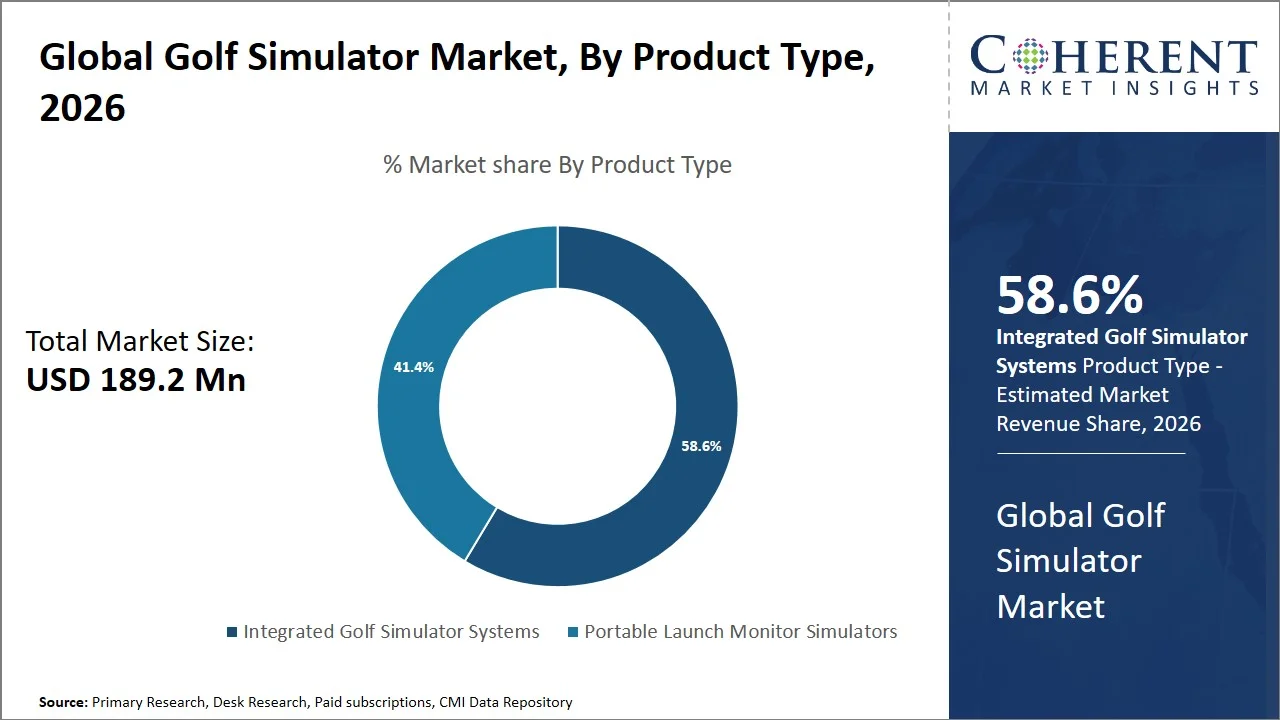
- Integrated golf simulator systems are expected to lead the global golf simulator market with a 58.6 % share in 2026, reflecting buyer preference for turnkey environments that combine launch tracking, projection, impact screens, software, and calibrated installation in one experience. In December 2025, Full Swing introduced Skill Strike, an AI-enabled competitive game built exclusively for its simulator platform, expanding the utility of installed systems beyond conventional practice.
- Camera-based systems are expected to account for 44.8 % of the market share in 2026 as indoor users prioritize precise ball and club measurement within compact spaces where optical tracking can operate without long radar flight paths. In January 2024, Foresight Sports announced the Falcon, a simulation-focused overhead launch monitor using photometric tracking in a smaller form factor designed for commercial and residential simulator environments.
- Hardware is expected to hold 56.7 % of the global golf simulator market in 2026 because launch monitors, cameras, projectors, displays, impact screens, computers, and installation equipment represent the largest upfront portion of simulator spending. In November 2024, Garmin launched the Approach R50 with a built-in touchscreen and three high-speed cameras, demonstrating how increasingly capable physical devices are consolidating simulation and analytics functions.
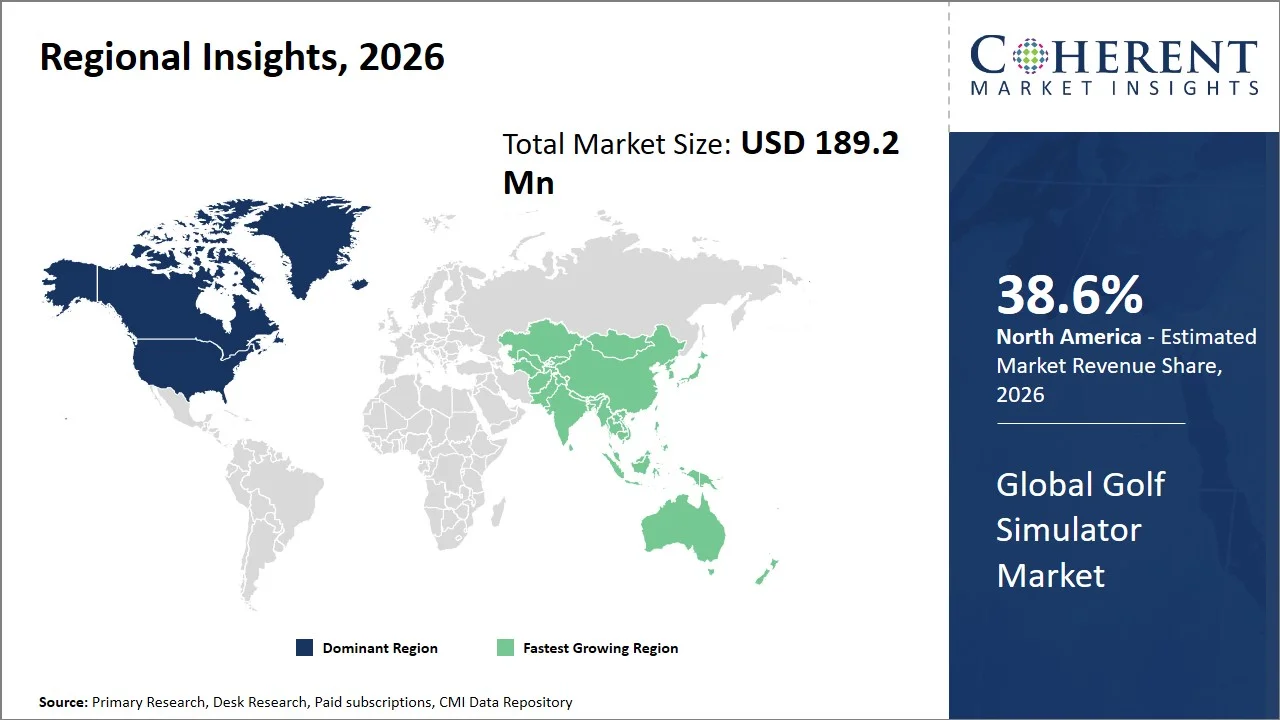
- North America is expected to represent 38.6 % of the market in 2026, supported by established golf participation, premium training expenditure, commercial indoor venues, and rapid acceptance of technology-led golf entertainment. In January 2025, the PGA TOUR-backed TGL began competition at Florida’s purpose-built SoFi Center, bringing simulator-led golf into a prime-time team format and broadening mainstream visibility for technology-mediated play.
- Asia Pacific is expected to hold 27.9 % of the global golf simulator market in 2026 and remain the fastest-growing region, supported by dense urban markets, established screen-golf culture, expanding indoor leisure concepts, and strong acceptance of digital training formats. In January 2026, GOLFZON Japan reported that simulator-round usage across its equipped facilities peaked during winter, demonstrating weather-independent demand for indoor golf experiences.
Segmental Insights
Why Do Integrated Golf Simulator Systems Dominate the Global Golf Simulator Market?
Integrated golf simulator systems are expected to hold 58.6% of the global golf simulator market in 2026 because they reduce procurement complexity for buyers that would otherwise need to source, configure, and support multiple components separately. Single-system configurations simplify compatibility, commissioning, warranty responsibility, and operator training, which is particularly valuable for multi-bay commercial venues and premium residential installations. Suppliers also benefit from bundling launch monitoring, swing capture, software, and supporting equipment into higher-value packages that installers can deploy more consistently. This structure improves project predictability and lowers integration risk for customers. In April 2026, Uneekor introduced AI Studio, a complete indoor simulator package combining its overhead launch monitors, Swing Optix high-speed cameras, AI Trainer, and software access, illustrating the commercial shift toward pre-integrated simulator environments.
- Current Industry Events of 2026
- Market Size Estimation
- Regional Breakdown
- Competitive Landscape
- Customer Intelligence
- Segmental Analysis
- Pricing Analysis
- Key Market Drivers, Challenges & Future Trends
- Customized Insights Section
Why Do Camera Based Systems Represent the Largest Technology Segment in the Global Golf Simulator Market?
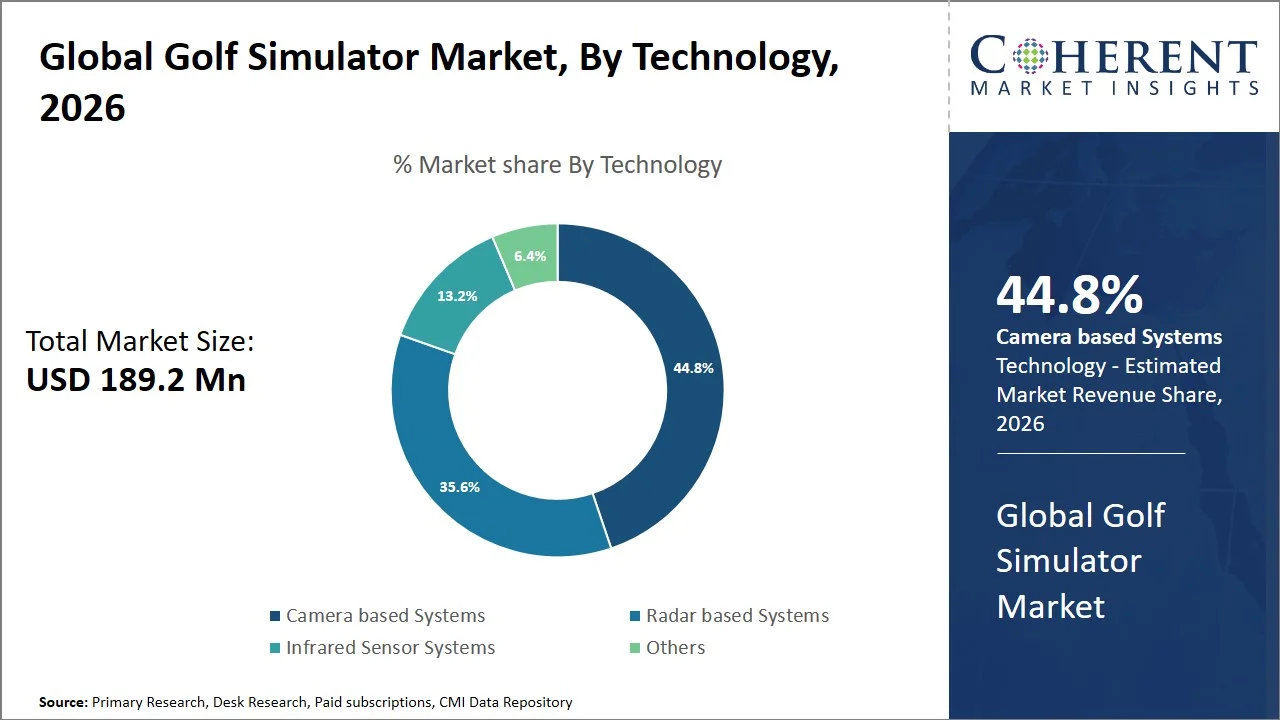
Camera based systems are expected to represent 44.8% of the global golf simulator market in 2026 because visual capture at and around impact provides detailed evidence for both shot measurement and instructional review. High-speed imaging can directly observe ball movement, spin behavior, club delivery, and impact characteristics, giving coaches and serious golfers information that is easy to validate alongside recorded swing footage. For indoor academies and fixed simulator bays, this supports repeatable sessions and detailed post-shot analysis without relying only on modeled flight outputs. Manufacturers benefit by differentiating through frame rates, image processing, hitting-zone coverage, and computer-vision algorithms. In July 2025, ProTee updated its VX software platform to improve Club AI accuracy and spin readings for fast driver shots, reinforcing continued investment in camera-led measurement performance.
Why Does Hardware Dominate the Component Category of the Global Golf Simulator Market?
Hardware is expected to account for 56.7% of the global golf simulator market in 2026 because every new simulator bay requires a physical measurement and display stack before software or services can create value. Launch monitors, projectors, impact screens, enclosures, hitting surfaces, PCs, mounts, and control equipment scale directly with the number and specification of installations, particularly across commercial facilities where each bay must operate reliably under frequent use. Hardware suppliers and integrators therefore capture spending from new builds, replacements, upgrades, and facility expansion. Buyers also place substantial weight on durability, serviceability, calibration stability, and component compatibility because downtime directly affects usable playing hours. In October 2025, SKYTRAK opened pre-orders for its ST MAX launch monitor, combining dual Doppler radar and high-speed camera technology for indoor simulation and performance measurement.
Current Events and their Impact
Current Event | Description and Its Impact |
UK Consumer Connectable Product Security Regime – April 2024 |
|
EU General Product Safety Regulation – December 2024 |
|
EU Radio Equipment Cybersecurity Requirements – August 2025 |
|
Global Golf Simulator Market Dynamics
Key Market Drivers
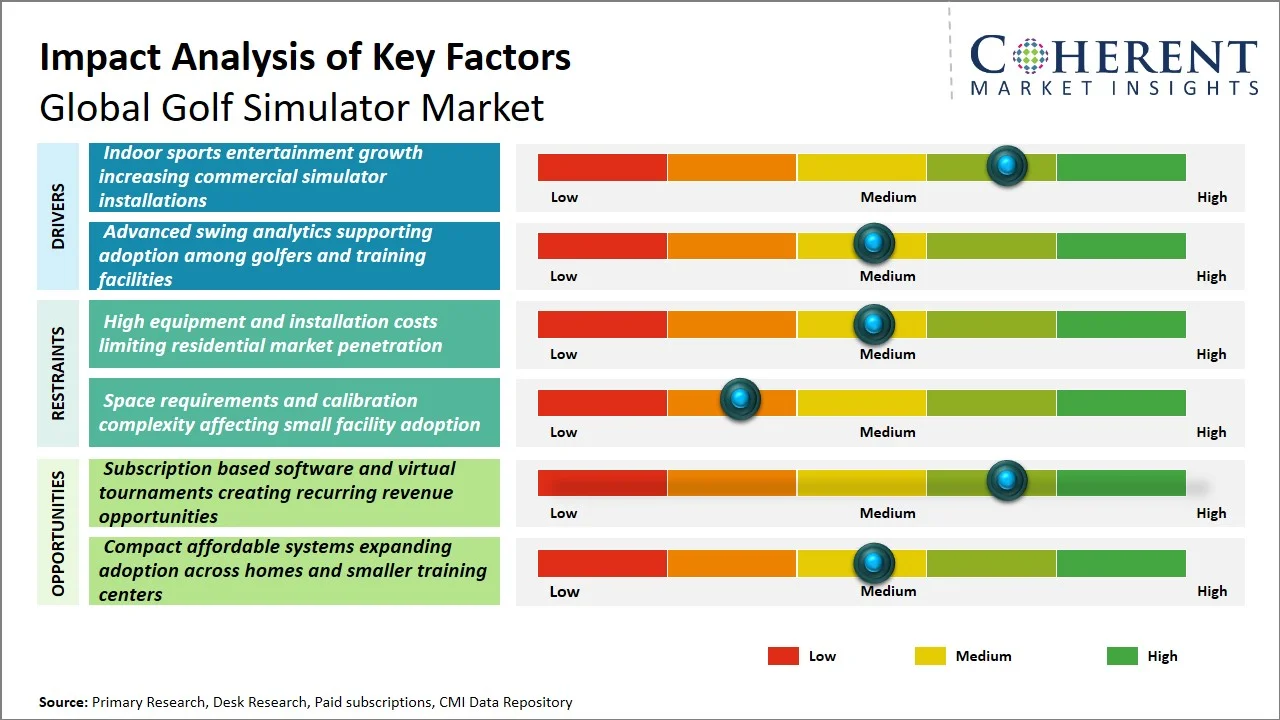
- Indoor sports entertainment growth increasing commercial simulator installations: Indoor sports entertainment growth increasing commercial simulator installations is expanding the addressable customer base for golf simulator vendors beyond traditional clubs and teaching academies. Indoor venues can monetize simulator bays through hourly play, leagues, lessons, corporate events, food and beverage, and memberships, improving equipment utilization across daytime and evening periods. This encourages operators to invest in multi-bay layouts, durable tracking hardware, centralized booking tools, and commercial software licenses. Simulator manufacturers, installers, venue-management software providers, and franchise operators benefit as new entertainment formats convert golf into a weather-independent urban activity. In January 2025, Five Iron Golf announced a 12-location franchise agreement across Florida, with planned sites spanning major metropolitan markets and combining golf technology with social and hospitality uses. The expansion illustrates how venue-led concepts can translate entertainment demand directly into simulator installations.
- Advanced swing analytics supporting adoption among golfers and training facilities: Advanced swing analytics supporting adoption among golfers and training facilities is strengthening the value proposition of simulator-based practice by turning ball flight, club delivery, and body movement into measurable feedback. Objective data helps coaches diagnose swing patterns more consistently, allows players to track improvement between sessions, and supports higher-value lesson, fitting, and practice packages. Training centers therefore have a stronger commercial reason to invest in integrated measurement environments rather than basic hitting bays. Launch-monitor manufacturers, analytics software developers, coaches, club fitters, and academy operators benefit as data quality becomes central to customer retention and instructional credibility. In June 2025, GOLFTEC reported that its OPTIMOTION Swing Capture Bays at the PGA Championship analyzed more than 12,000 swings and delivered personalized video breakdowns to participants. The deployment demonstrated how advanced motion analysis can make technology-led instruction accessible to a broad golfer audience.
Emerging Market Trends
- Lifecycle Software Value is Becoming a Procurement Criterion: Software ecosystems are becoming more important in golf simulator purchasing decisions as course libraries, analytics, practice modes, cloud profiles, and updates create recurring engagement and revenue. Buyers increasingly assess software quality, compatibility, subscription costs, and long-term support alongside hardware performance. Vendors offering flexible, regularly updated platforms are likely to strengthen customer retention, while closed ecosystems may face greater scrutiny over lifetime ownership costs.
- Upgradeable Simulator Architectures are Reducing Replacement Friction: Upgradeable simulator architectures are gaining importance as buyers seek to extend system life without replacing complete installations. Modular launch monitors, cameras, projectors, computers, and software allow individual components to be refreshed as technology evolves. This supports lower lifecycle costs, creates recurring service opportunities for integrators, and favors suppliers offering backward compatibility, standardized connectivity, and clear upgrade pathways.
Regional Insights
Why Does North America Dominate the Global Golf Simulator Market?
North America is expected to account for 38.6% of the global golf simulator market in 2026, supported by a mature golf ecosystem, high spending on coaching and equipment, and broad access to specialist installers, software platforms, and launch-monitor technologies. The region also benefits from seasonal weather in parts of the U.S. and Canada, which makes indoor practice commercially relevant for clubs, academies, and serious golfers seeking year-round continuity. Strong collegiate, junior-development, and professional coaching networks further encourage data-led training environments where simulator systems can be integrated into structured player development. This creates demand beyond entertainment-oriented venues and supports premium equipment adoption. Institutional use is reinforcing this position. In May 2026, the U.S. National Development Program named Trackman its official launch monitor and simulator, giving athletes and coaches year-round access to connected performance and practice tools.
Why is Asia Pacific Emerging as the Fastest-Growing Region in the Global Golf Simulator Market?
Asia Pacific is expected to represent 27.9% of the global golf simulator market in 2026 and emerge as the fastest-growing region as indoor golf solves practical access constraints across densely populated metropolitan markets. South Korea already demonstrates strong familiarity with screen-golf formats, while China is expanding urban simulator participation and India is developing a premium residential and hospitality customer base. The region also has a deep consumer-electronics and projection ecosystem, supporting availability of displays, computing hardware, sensors, and installation expertise. Commercial operators can place simulator venues in malls, mixed-use developments, clubs, and leisure destinations without requiring the land footprint of a conventional golf course. Investment activity is becoming more visible in newer markets. In May 2025, BenQ stated that it was installing about 20 golf-simulator projector units per quarter in India, indicating equipment deployment beyond Asia Pacific’s established screen-golf markets.
Global Golf Simulator Market Outlook for Key Countries
Why is the U.S. a Key Market for the Global Golf Simulator Market?
The U.S. is a key country in the global golf simulator market because simulator golf has developed into a distinct off-course business model rather than remaining primarily a home-practice product. Operators increasingly combine hourly bay rentals with memberships, leagues, food and beverage, lessons, fittings, and corporate events, allowing a single installation to serve several revenue streams. This operating model broadens the buyer base for launch monitors, enclosures, projectors, booking systems, and commercial simulation software. The country also has an extensive golfer population and a large network of teaching professionals, equipment retailers, and golf-oriented leisure businesses that can incorporate simulator technology into existing customer relationships. Evidence of this commercial footprint is substantial. In November 2025, the National Golf Foundation reported at least 1,500 simulator businesses across the U.S., noting that the number had nearly tripled since 2022.
Why Does China Support Growth in the Global Golf Simulator Market?
China supports growth in the global golf simulator market because indoor systems reduce two important barriers to golf participation: access to large outdoor courses and the time required for a conventional round. Simulator venues can be located close to residential and business districts, making shorter practice sessions and social play more practical for urban consumers. The country also has domestic suppliers developing simulator hardware, software, digital course content, and integrated venue concepts, which supports localization and a wider range of price points. For operators, the model creates opportunities to combine coaching, entertainment, memberships, and technology-enabled competition in relatively compact spaces. The size of the indoor user base gives suppliers a meaningful installed-market foundation. In March 2026, China Daily, citing China Golf Association data, reported approximately 1.33 million indoor golf participants and more than 2,000 indoor golf facilities nationwide.
Why is India Important in the Global Golf Simulator Market?
India is becoming increasingly relevant to the global golf simulator market as premium golf experiences move closer to affluent consumers in major metropolitan areas. Simulator installations can serve residential developments, private clubs, luxury resorts, corporate recreation facilities, and specialist academies where customers value convenience and year-round access more than a full outdoor-course experience. The format is particularly suitable for golfers who face long travel times to courses or want shorter practice sessions integrated into urban lifestyles. For suppliers, India offers an opportunity to build demand through turnkey installation, local technical support, training packages, and partnerships with hospitality and real-estate operators rather than relying only on standalone equipment sales. Premium leisure properties are beginning to adopt the format. In November 2025, India Golf Weekly reported that Karma Lakelands in Gurugram had launched a high-tech Golf Simulator Lounge offering year-round virtual-course practice.
Why is Germany a Strategic Country in the Global Golf Simulator Market?
Germany is a strategic country in the global golf simulator market because indoor simulation can extend golf participation through winter while fitting naturally into the country’s organized club and tournament structure. Golf clubs, training centers, and indoor facilities can use simulator bays to retain members, provide coaching, run competitions, and generate activity when outdoor course conditions are less reliable. German buyers also place importance on measurement consistency, equipment durability, technical support, and well-integrated installations, favoring suppliers that can combine reliable hardware with professional service. The country’s established golf association infrastructure can further normalize simulator play as a structured competitive format rather than an occasional entertainment activity. This transition is already visible in organized indoor competition. In February 2026, the German Golf Association reported that its fifth DGV Indoor Trophy had exceeded 5,700 tournament participations and 10,500 rounds, demonstrating established engagement with simulator-based competition.
Why is South Korea an Important Growth Market for the Global Golf Simulator Market?
South Korea is an important growth market for the global golf simulator market because screen golf is deeply embedded in everyday golf participation and operates as a convenient urban alternative to outdoor play. High population density, digital payment familiarity, smartphone-based booking, and strong consumer acceptance of technology-led leisure support frequent simulator use and sophisticated venue operating models. Competition therefore extends beyond measurement accuracy to app functionality, loyalty programs, reservation convenience, store cleanliness, customer support, and social-play features. This creates opportunities for software providers, hardware suppliers, operators, and service companies that can improve the complete customer journey rather than only the hitting experience. Consumer expectations are becoming increasingly measurable. In February 2025, Korea’s government-run KTV reported Korea Consumer Agency findings showing strong satisfaction with payment convenience and that roughly four in ten surveyed screen-golf users used operator-specific mobile applications.
Technology Adoption Landscape in the Global Golf Simulator Market
Technology | Adoption Level | Key Application Area | Business Impact |
High-Speed Photometric Camera Tracking | High | Indoor ball and club measurement | Provides detailed visual measurement of launch conditions and club delivery, supporting high-accuracy indoor practice, fitting, and simulation. |
3D Doppler Radar Tracking | High | Ball-flight and club-motion measurement | Enables direct trajectory and movement tracking, supporting training, portable launch monitors, and simulator environments requiring extensive performance data. |
Infrared Optical Sensor Arrays | Medium | Fixed simulator bays and impact-zone detection | Provides dependable club and ball detection in controlled environments while supporting relatively compact and repeatable installations. |
Hybrid Radar-Camera Sensor Fusion | Medium | Premium launch monitoring and simulation | Combines complementary measurement methods to improve data confidence, reduce individual sensor limitations, and strengthen performance consistency across different shots. |
Markerless 3D Swing Motion Capture | Medium | Coaching and biomechanical swing assessment | Adds body-position and movement analysis to shot data, enabling more personalized instruction without requiring wearable markers or physical sensors. |
Physics-Based Ball-Flight and Virtual-Course Rendering Engines | High | Course simulation and practice environments | Converts measured shot characteristics into realistic virtual outcomes, improving simulation credibility, course-play engagement, and software differentiation. |
How are Data-Enabled Club Fitting and Retail Experience Models Creating New Growth Opportunities in the Global Golf Simulator Market?
Data-enabled club fitting and equipment retail can create a high-potential growth avenue for the global golf simulator market by positioning simulator bays as revenue-generating sales infrastructure rather than standalone practice installations. Golf retailers, pro shops, club-fitting studios, sporting-goods chains, and equipment brands can use simulator data to compare shafts, heads, balls, and gapping outcomes while keeping the customer inside a controlled purchase journey. Suppliers can capture this opportunity with compact fitting configurations, accurate club and ball measurement, easy session comparison, customer-reporting tools, and integrations that transfer fitting results into retail or CRM workflows. Leasing, service contracts, and standardized bay packages can lower the initial barrier for smaller outlets. Successful participation requires reliable calibration, fast setup, technician training, local support, and software designed for repeatable fitting processes rather than entertainment alone. The opportunity is likely to favor measurement specialists and integrated solution providers that can connect credible performance data with retailer workflow, service uptime, and clear return-on-investment logic.
Market Players, Key Development, and Competitive Landscape
Key Developments
- In March 2026, TruGolf released an updated version of its E6 simulation platform featuring a redesigned interface, improved display scaling, course-preview functionality, gameplay fixes, and commercial-oriented usability enhancements. This is important for the global golf simulator market because continued software improvement increases the operating value of installed simulator hardware and makes user experience, interface design, content management, and platform support more significant components of competitive differentiation.
- In September 2025, Uneekor announced a QED Trade-In Program that provides existing users with a transition path toward its newer EYE XR rear-mounted launch monitor as QED approaches end-of-life. This is important for the global golf simulator market because structured trade-in and upgrade programs can accelerate hardware replacement cycles, retain installed-base customers, concentrate engineering support on newer platforms, and reduce the financial friction associated with adopting updated simulator measurement technology.
- In August 2025, FlightScope introduced the Mevo Gen2 personal launch monitor and golf simulator, combining 3D Doppler radar with synchronized image processing and providing compatibility with external simulation software. The development is important for the global golf simulator market because it strengthens competition in portable performance-measurement systems while giving residential and smaller training users another pathway into simulator-based practice without requiring a permanently installed overhead system.
Competitive Landscape
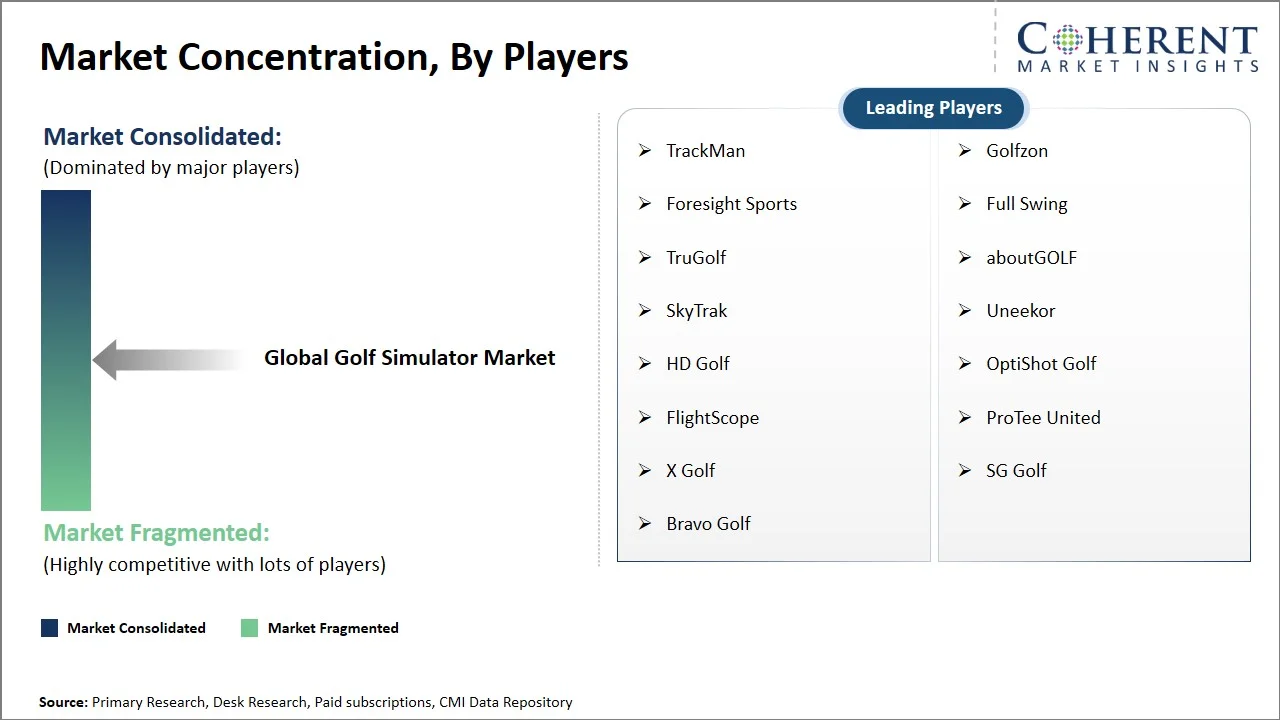
The global golf simulator market is fragmented, although premium launch-monitor and integrated-system categories contain pockets of concentration around established technology platforms. Competition spans launch-monitor manufacturers, full-system suppliers, simulation-software developers, installation specialists, component providers, and indoor-golf solution integrators. Market positioning depends increasingly on measurement repeatability, simulation quality, system interoperability, lifetime ownership economics, installation capability, technical support, and distribution reach. Regional specialists remain important because site design, calibration, maintenance, and customer training often require local execution rather than hardware shipment alone.
Key focus areas include
- Measurement Accuracy and Repeatability: Maintaining consistent ball and club data across different room conditions and player profiles is critical to premium positioning.
- Hardware-Software Interoperability: Compatibility with external simulation, coaching, fitting, and operating platforms can materially widen the addressable customer base.
- Total Cost of Ownership: Hardware pricing, software subscriptions, replacement parts, upgrades, and maintenance increasingly influence purchasing decisions together.
- Installation Simplicity: Products requiring less calibration, cabling, floor space, and specialist configuration can improve installer productivity and customer adoption.
- Simulation Realism and Content Depth: Course rendering, shot physics, putting behavior, practice environments, and gameplay quality remain important differentiators.
- Commercial Reliability: Multi-bay operators prioritize uptime, rapid user turnover, administrative controls, and equipment capable of supporting prolonged daily use.
- Distribution and Installer Coverage: Strong dealer, integrator, and service networks improve customer access while reducing deployment and maintenance risk.
- After-Sales Support and Upgrade Paths: Responsive technical assistance, spare-part availability, firmware continuity, and structured upgrade options strengthen customer retention.
Market Report Scope
Golf Simulator Market Report Coverage
| Report Coverage | Details | ||
|---|---|---|---|
| Base Year: | 2025 | Market Size in 2026: | USD 189.2 Mn |
| Historical Data for: | 2020 To 2024 | Forecast Period: | 2026 To 2033 |
| Forecast Period 2026 to 2033 CAGR: | 11.2% | 2033 Value Projection: | USD 397.8 Mn |
| Geographies covered: |
| ||
| Segments covered: |
| ||
| Companies covered: | TrackMan, Golfzon, Foresight Sports, Full Swing, TruGolf, aboutGOLF, SkyTrak, Uneekor, HD Golf, OptiShot Golf, FlightScope, ProTee United, X Golf, SG Golf, and Bravo Golf | ||
| Growth Drivers: |
| ||
| Restraints & Challenges: |
| ||
Analyst Opinion (Expert Opinion)
- The global golf simulator market leadership is likely to depend increasingly on control of the complete customer deployment journey rather than superiority in a single launch-monitor specification. Buyers will expect suppliers or channel partners to solve room planning, hardware configuration, software compatibility, installation, calibration, training, maintenance, and upgrades as one coordinated proposition. This should increase the strategic importance of integrators and service networks and encourage manufacturers to develop more solution-oriented commercial structures.
- The largest structural risk for premium hardware vendors is the gradual commoditization of acceptable tracking performance. As imaging components, radar modules, computing capacity, and measurement algorithms become more accessible, a wider range of devices may deliver performance that recreational customers consider sufficient. Premium pricing will therefore become harder to defend through raw measurement capability alone, shifting differentiation toward calibration reliability, specialized data, workflow integration, software experience, service quality, and ownership simplicity.
- Market participants should prioritize robust calibration under real installation conditions, remote diagnostics, simplified commissioning, replacement-part availability, channel training, and disciplined product architectures that support multiple buyer budgets. Entry-level hardware price pressure should be managed through operating efficiency rather than excessive feature proliferation. Companies should also avoid overinvesting in proprietary functions that create development costs without improving retention or customer willingness to pay, while strengthening localized technical support and supply resilience for critical sensing and computing components.
Speak to the analyst
Want personalized insights?
Take the findings above to one of our principal consultants, or have the report rebuilt around the segments, geographies and competitors you actually track.
Market Segmentation
- Product Type Insights (Revenue, USD Mn, 2021 - 2033)
- Integrated Golf Simulator Systems
- Portable Launch Monitor Simulators
- Technology Insights (Revenue, USD Mn, 2021 - 2033)
- Camera based Systems
- Radar based Systems
- Infrared Sensor Systems
- Others
- Component Insights (Revenue, USD Mn, 2021 - 2033)
- Hardware
- Services
- Software
- End User Insights (Revenue, USD Mn, 2021 - 2033)
- Commercial
- Residential
- Regional Insights (Revenue, USD Mn, 2021 - 2033)
- North America
- U.S.
- Canada
- Latin America
- Brazil
- Argentina
- Mexico
- Rest of Latin America
- Europe
- Germany
- U.K.
- Spain
- France
- Italy
- Russia
- Rest of Europe
- Asia Pacific
- China
- India
- Japan
- Australia
- South Korea
- ASEAN
- Rest of Asia Pacific
- Middle East
- GCC Countries
- Israel
- Rest of Middle East
- Africa
- South Africa
- North Africa
- Central Africa
- North America
- Key Players Insights
- TrackMan
- Golfzon
- Foresight Sports
- Full Swing
- TruGolf
- aboutGOLF
- SkyTrak
- Uneekor
- HD Golf
- OptiShot Golf
- FlightScope
- ProTee United
- X Golf
- SG Golf
- Bravo Golf
Sources
Primary Research Interviews
- Golf simulator, launch monitor, tracking technology, and simulation software manufacturers
- Camera, radar, infrared sensor, projector, screen, enclosure, and computing-hardware suppliers
- Indoor golf centers, clubs, academies, entertainment venues, hotels, resorts, and residential users
- Distributors, installers, system integrators, calibration specialists, coaches, club fitters, and industry executives
Stakeholders
- Integrated simulator and portable launch monitor manufacturers
- Sensor, projector, display, screen, turf, and accessory suppliers
- Installers, integrators, AV solution providers, and maintenance companies
- Golf clubs, academies, indoor venues, retailers, hospitality operators, and residential customers
End-use Sectors
- Indoor golf and screen-golf entertainment centers
- Golf clubs, driving ranges, academies, and coaching facilities
- Club-fitting studios and golf equipment retailers
- Hotels, resorts, corporate recreation, and leisure facilities
- Residential golf rooms and home simulator installations
Regulatory and Government Bodies
- U.S. FCC, CPSC, FTC, Census Bureau, and USITC
- European Commission, ENISA, Eurostat, and national market-surveillance authorities
- UK OPSS, Ofcom, CMA, and ONS
- China SAMR, MIIT, China Customs, and NBS
- India BIS, MeitY, DoT, DGFT, and MOSPI
- Korea KATS, Ministry of Science and ICT, Korea Customs, and Statistics Korea
- ISO, IEC, IEEE, and accredited testing laboratories
Databases
- UN Comtrade, ITC Trade Map, WTO, Eurostat, USITC DataWeb, World Bank, and OECD
- National Golf Foundation, USGA, The R&A, and national golf associations
- National statistical and customs databases
- Golf participation, indoor facility, leisure expenditure, and sports databases
- WIPO PATENTSCOPE, Espacenet, company filings, product catalogues, and pricing records
Magazines and Journals
- Golf Digest, Golf Magazine, Golf Business News, Golf Inc., and PGA Magazine
- Sports Engineering, Journal of Sports Sciences, Sports Biomechanics, and Sensors
- IEEE Sensors Journal, Journal of Sports Analytics, Applied Sciences, and Virtual Reality
Associations
- United States Golf Association
- The R&A
- PGA of America
- National Golf Foundation
- European Golf Association
- German Golf Association
- Korea Golf Association
- China Golf Association
- Indian Golf Union
- Japan Golf Association
Public Domain Sources
- Product catalogues, specifications, installation manuals, and software documentation
- Ball speed, spin, launch angle, club path, carry distance, and swing-analysis data
- Camera, radar, infrared, projector, screen, room-size, and connectivity specifications
- Golf participation, indoor facility, recreation, and leisure statistics
- Import-export data, annual reports, product launches, patents, partnerships, and facility openings
Key Standards and Regulations
- USGA and The R&A Rules of Golf and Equipment Rules
- FCC Part 15
- EU Radio Equipment Directive
- EU General Product Safety Regulation
- EU RoHS and REACH
- UK connected-product security requirements
- IEC 62368-1, IEC 62471, and IEC 61000 series
- ISO/IEC 17025
- Applicable CE, UKCA, FCC, ISED, KC, PSE, and BIS requirements
- GDPR and applicable data-protection requirements
Proprietary Elements
- CMI Data Analytics Tool. Proprietary CMI Existing Repository of information for the last 10 years
Get access to 250+ pages report
Every segment, forecast, competitor profile and data table behind the analysis above — available for instant download.
- ESOMAR Member
- ISO 9001:2015 Certified
- D-U-N-S Registered
- GDPR & CCPA Compliant
Missing comfort of reading report in your local language? Find your preferred language:
Transform your Strategy with Exclusive Trending Reports
Frequently Asked Questions
The CAGR of the global golf simulator market is projected to be 11.2% from 2026 to 2033.
The global golf simulator market is estimated to be valued at USD 189.2 million in 2026 and is expected to reach USD 397.8 million by 2033.
Camera-based systems are widely used due to their precise ball and club tracking capabilities and suitability for indoor simulator environments.
Commercial facilities and residential users are the key end users, with applications spanning golf clubs, training academies, entertainment venues, and home practice setups.
Asia Pacific is expected to emerge as the fastest-growing region, supported by strong screen-golf culture, urban indoor entertainment demand, and expanding simulator adoption across Asia Pacific markets.
Indoor sports entertainment growth increasing commercial simulator installations and advanced swing analytics supporting adoption among golfers and training facilities are the major factors driving the growth of the global golf simulator market.
High equipment and installation costs limiting residential market penetration and space requirements and calibration complexity affecting small facility adoption are the major factors hampering the growth of the global golf simulator market.