

Global HFO Foam Stabilizers Market Size and Forecast – 2026 To 2033
The global HFO foam stabilizers market is expected to grow from USD 83.0 Mn in 2026 to USD 152.00 Mn by 2033, registering a compound annual growth rate (CAGR) of 9.0% from 2026 to 2033. The market is driven by stricter rules on high-GWP blowing agents, which are pushing foam makers of polyurethane foam insulation to switch to HFOs. On October 24, 2023, the US Environmental Protection Agency (EPA) published its final Technology Transitions rule. The rule limited the global warming potential (GWP) of foam blowing agents to 150 for new products, so many foam makers had to move to HFO-based systems and find stabilizers that work with them.
Key Takeaways of the Global HFO Foam Stabilizers Market
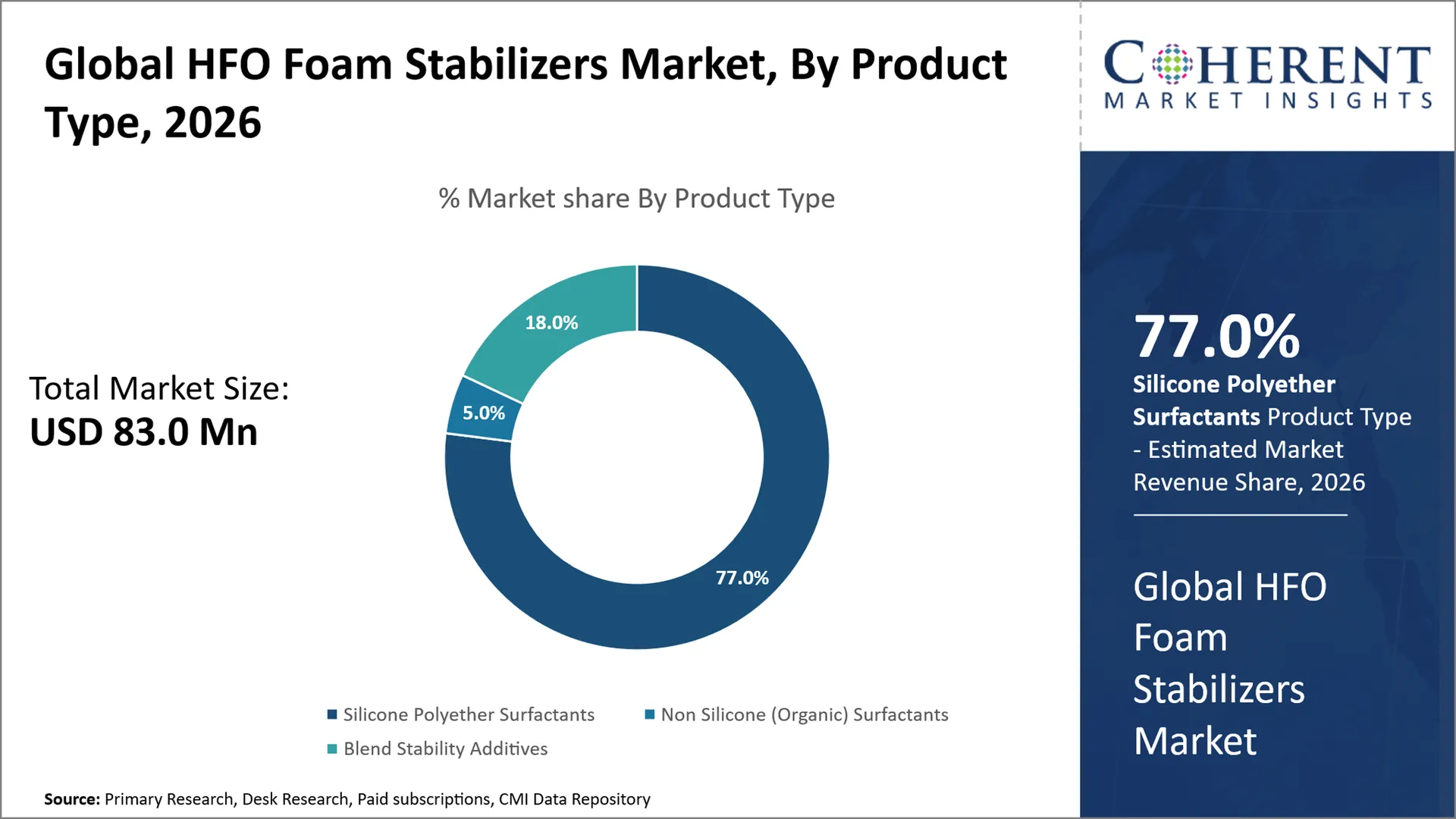
- The silicone polyether surfactants segment is expected to account for 77.0% of the global HFO foam stabilizers market share in 2026. Rising need for stabilizers that can handle acid formed in HFO blends is driving the growth of the segment. On September 12, 2025, Momentive Performance Materials announced that it would showcase high-purity silicones for rigid polyurethane foam at UTECH Middle East 2025. The products aimed to improve insulation and surface quality in boards, panels and appliances.
- The spray polyurethane foam segment is estimated to capture 34.0% of the market share in 2026. Strong demand for high-performance insulation in building retrofits is driving the growth of the segment. On October 30, 2025, Honeywell completed the spin-off of Solstice Advanced Materials as an independent company. The new company makes Solstice blowing agents, which are used in spray foam insulation.
- The HCFO-1233zd(E) segment is expected to account for 46.0% of the global HFO foam stabilizers market share in 2026. Wide use of this blowing agent in spray foam, appliances and panels is driving the growth of the segment. It is also the hardest HFO to stabilize, so foam makers using it need stronger stabilizer packages. On September 23, 2026, Arkema launched Foranext Continuum, a new additive for rigid polyurethane foam made with Forane 1233zd. The additive was designed to keep foam formulations consistent over time.
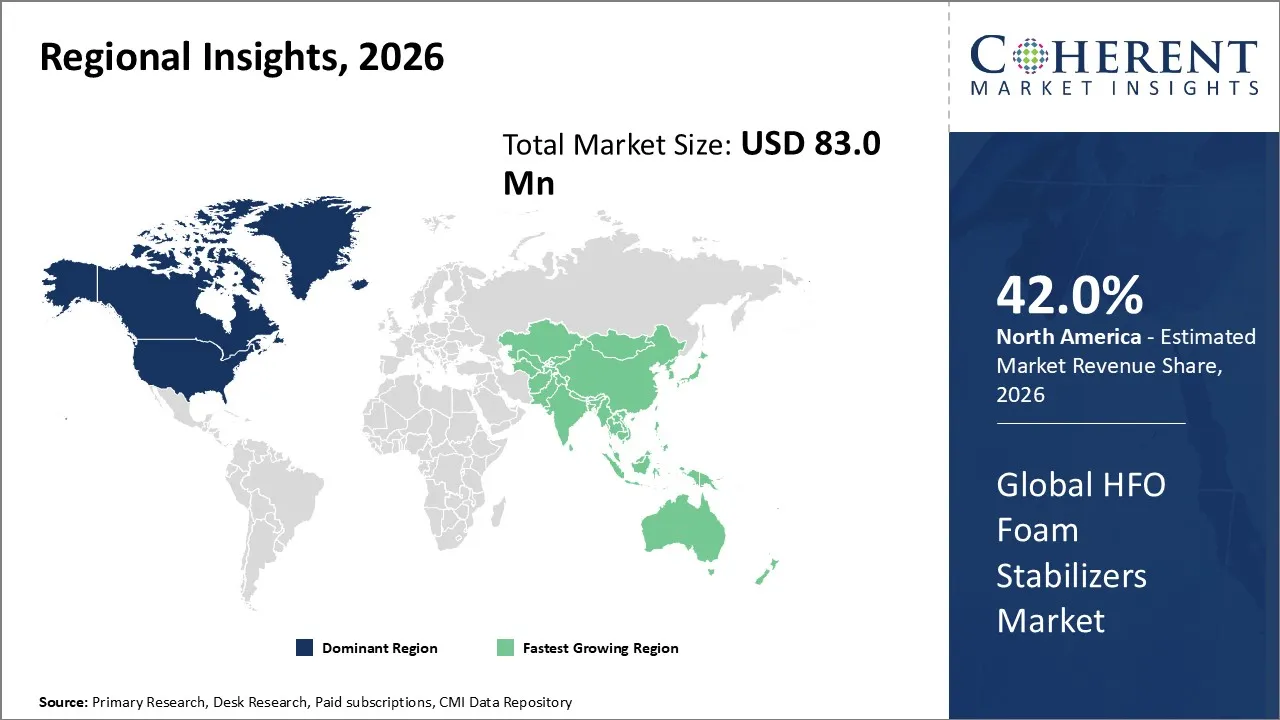
- North America is expected to dominate the HFO foam stabilizers market in 2026 with a market share of 42.0%. Tight US limits on high-GWP blowing agents in foam are driving the growth of the regional market. On May 26, 2026, the US EPA published a rule that eased several refrigeration deadlines under its Technology Transitions program, while the foam blowing restrictions stayed in place.
- Asia Pacific is expected to account for 28.0% share in 2026 and is the fastest-growing region. China’s move away from the ozone-depleting blowing agent HCFC-141b is driving the growth of the regional market. On November 15, 2025, China’s Ministry of Ecology and Environment issued a ban on HCFC-141b in polyurethane foam. The ban took effect on January 1, 2026 for polyol blends, and on July 1, 2026 for spray foam.
Segmental Insights
Why Do Silicone Polyether Surfactants Dominate the Global HFO Foam Stabilizers Market?
In terms of product type, silicone polyether surfactants are expected to account for 77.0% of the global HFO foam stabilizers market share in 2026. They are the main cell stabilizer in rigid polyurethane foam. A small dose controls bubble size, closed-cell content and insulation value.
HFO systems need a tougher type of surfactant. Standard grades can break down when acid forms in the blend during storage. So, suppliers make hydrolysis-resistant grades. Evonik’s TEGOSTAB B 8409, for example, is a non-hydrolysable grade that works with pentanes, HFCs and HFOs. Grades like this let foam makers use one product across different blowing agents.
On January 22, 2025, Concentrol introduced STB PU-2272, a silicone surfactant for rigid foams made with HFCs, HFOs or pure hydrocarbons. The company said the product dissolves easily in common rigid foam polyols and helps deliver low thermal conductivity.
- Current Industry Events of 2026
- Market Size Estimation
- Regional Breakdown
- Competitive Landscape
- Customer Intelligence
- Segmental Analysis
- Pricing Analysis
- Key Market Drivers, Challenges & Future Trends
- Customized Insights Section
Why Is Spray Polyurethane Foam the Leading Application?
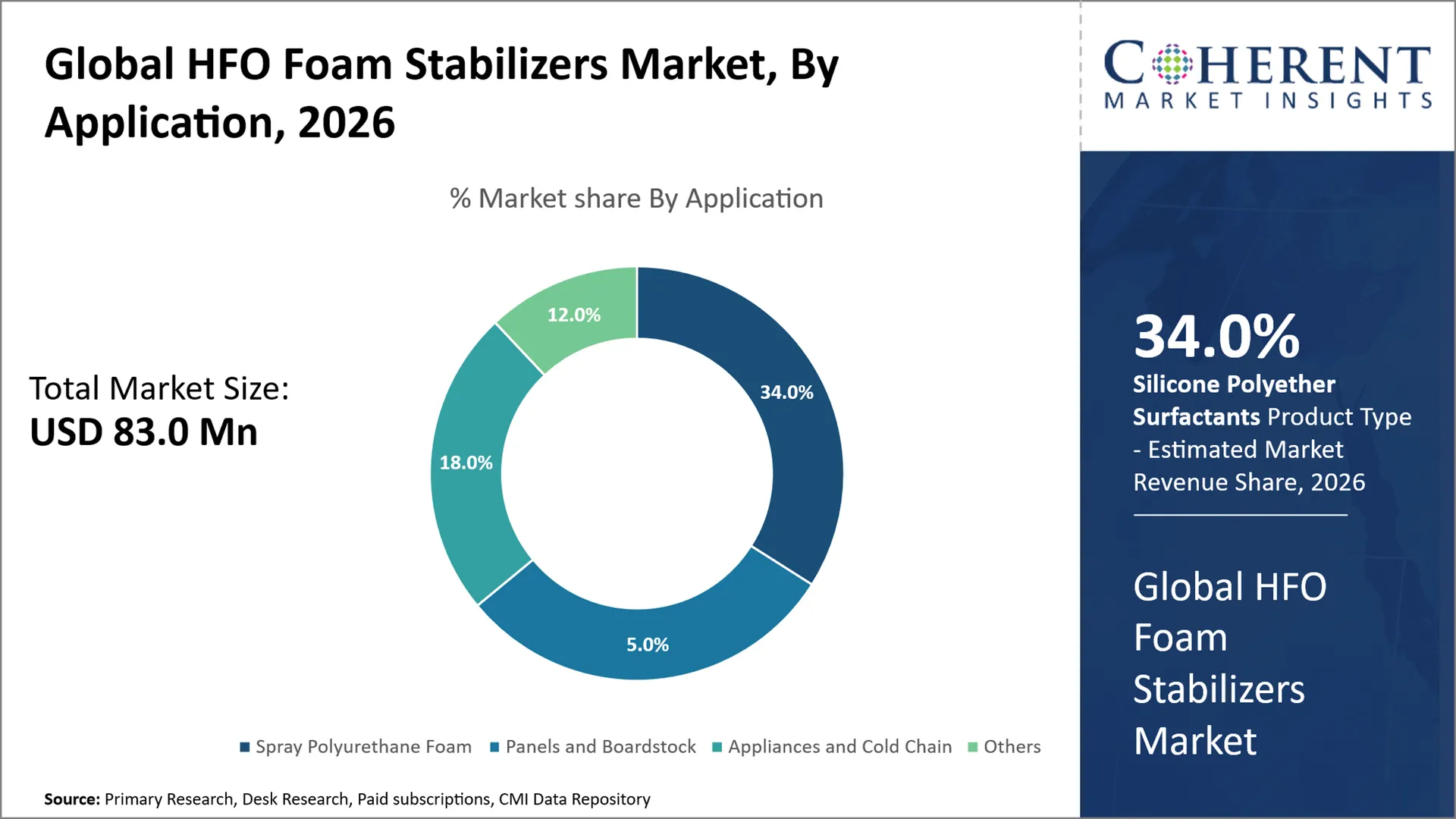
In terms of application, spray polyurethane foam is expected to account for 34.0% of the global HFO foam stabilizers market share in 2026. Closed-cell spray foam carries a high HFO load. It is widely used for wall and roof insulation.
Spray foam kits are often stored for months before use, so the stabilizer must hold up for a long time. Substitutes are also limited. Hydrocarbons are too flammable to spray on site. In its submission to ECHA, DuPont stated that no alternatives to HFO-1234ze(E) and HCFO-1233zd(E) existed for low-pressure spray foam.
On July 2, 2025, China’s Ministry of Ecology and Environment released a draft ban on HCFC-141b as a polyurethane blowing agent for public comment. This gave foam makers, including spray foam producers, early notice to plan their switch to alternatives such as HFOs
Why Does HCFO-1233zd(E) Lead Among Blowing Agent Types?
In terms of blowing agent type, HCFO-1233zd(E) is expected to account for 46.0% of the global HFO foam stabilizers market share in 2026. It is widely used in spray foam, appliances and panels. It also gives very good insulation.
It is the hardest HFO to stabilize. It reacts with amine catalysts more easily than other HFOs, and the acid formed damages the surfactant. So, foam makers using it need stronger stabilizer packages, often with acid-blocked catalysts. This high stabilizer need, along with its wide use, gives it the largest share.
On August 28, 2025, Arkema announced the start-up of its new 15-kiloton Forane 1233zd production unit in Calvert City, Kentucky. The company invested around US$60 million to convert an old HFC line into this HFO unit, to meet growing demand in building insulation and thermal management.
Current Events and their Impact
Current Events | Description and its Impact |
US EPA Technology Transitions Rule, 88 FR 73098 |
|
China HCFC-141b Ban in Polyurethane Foam, MEE Announcement 2025 |
|
HFO Foam Stabilizers Market Dynamics
Market Drivers
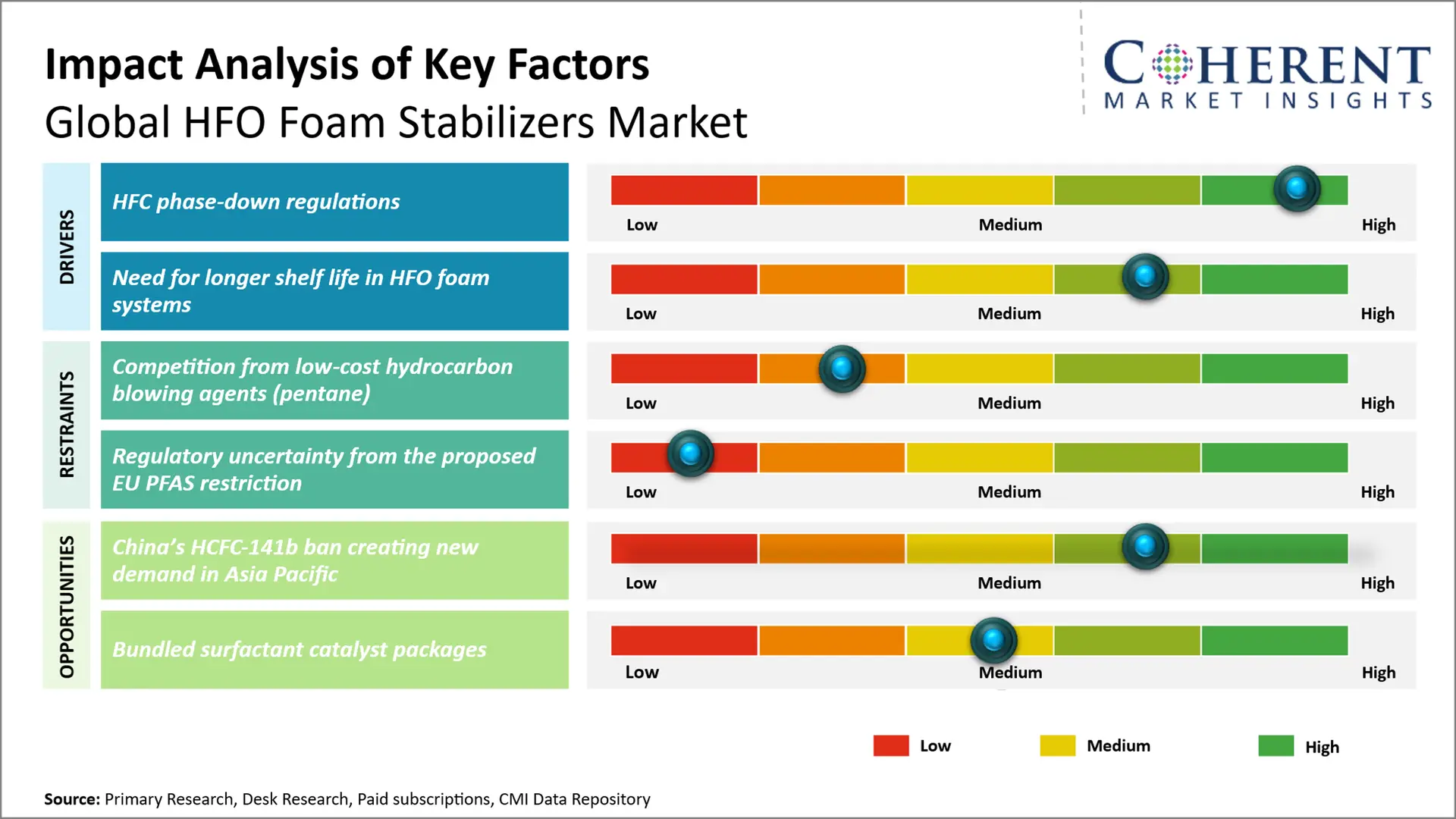
- HFC phase-down rules are pushing foam makers to HFOs: Governments are limiting high-GWP HFCs in foam. HFC-245fa, which was widely used in closed-cell spray foam, has a GWP of about 1,030. HFOs bring this down to around 1. So, foam makers are reformulating their products with HFO blowing agents. But they cannot reuse their old surfactant packages, because HFOs behave differently in solubility and storage. Each switch needs a new stabilizer, and this creates direct demand for HFO-grade stabilizers. HFO foams also insulate well: Oak Ridge National Laboratory measured 18.3 mW/m·K in boardstock blown with HCFO-1233zd(E). This makes them a strong choice under tighter energy codes.
- On October 19, 2026, Huntsman Building Solutions presented Heatlok HFO Pro, a closed-cell spray foam for new construction and retrofit projects. The foam uses Honeywell’s Solstice HFO liquid blowing agent, which has a GWP of 1.
- Shelf-life problems are making stabilizers a critical ingredient: HFO blends are harder to keep stable than older systems. During storage, HCFO-1233zd reacts with the amine catalyst and releases hydrofluoric acid. This acid breaks down the silicone surfactant. After a few weeks, the foam can show coarse cells or even collapse. Foam makers now need stabilizer packages that hold up for months. This turns the stabilizer from a low-cost ingredient into a specified, higher-value product. On September 23, 2026, Arkema launched Foranext Continuum, a new additive for rigid polyurethane foam made with Forane 1233zd. The additive was designed to keep foam formulations consistent over time, for use in insulation, roofing and appliances.
Emerging Trends
- Bundled surfactant and catalyst packages: Suppliers increasingly sell stabilizers and catalysts as one matched set for HFO systems. Momentive’s rigid foam guide, for example, pairs HFO-compatible silicones with catalysts promoted for good shelf life with HFO-1233zd.
- Impact: Foam makers get a tested system instead of building their own. This cuts trial time and lowers the risk of foam failure.
- Relevance to the market: Value is moving toward suppliers that can offer a full package backed by ageing data. Suppliers that sell only surfactants may lose ground.
- PFAS scrutiny of HFOs: The EU’s proposed PFAS restriction covers HFOs that contain a CF3 group. Many European foam makers are keeping hydrocarbon backup formulations ready.
- Impact: Uncertainty slows HFO adoption in Europe. Some buyers delay switching until the rules are clear.
- Relevance to the market: Stabilizer suppliers with grades that work in both HFO and pentane systems are better protected. They can serve customers whichever way the EU decision goes
Regional Insights
Why Is North America a Strong Market for HFO Foam Stabilizers?
North America is expected to account for a market share of 42.0% in 2026. The region has the world’s largest spray foam industry and a strong market for insulated panels and boardstock. The US limit of 150 GWP for foam blowing agents moved most closed-cell spray foam to HFOs. Several major HFO producers also make their products here. Honeywell produces HFO-1234ze at its Baton Rouge plant, and Arkema has started a new 15-kiloton Forane 1233zd unit in Calvert City, Kentucky. Stabilizer suppliers such as Dow and Momentive are also based in the US. Having blowing agent makers, stabilizer suppliers and foam producers in one region speeds up joint formulation work.
Why Does the Asia Pacific HFO Foam Stabilizers Market Show High Growth?
Asia Pacific is expected to register the fastest growth, with a CAGR of about 12.5% over the forecast period. The region is projected to account for 28.0% of the global market in 2026. Growth comes mainly from China’s exit from HCFC-141b, which forces foam makers in spray foam, panels and cold storage to find new blowing agents. The region also has a growing base of HFO and silicone production. Chemours partnered with Zhejiang Juhua Group in China to produce more HFO-1336mzz(Z). Shin-Etsu Chemical in Japan supplies silicone surfactants to Asian appliance and building foam makers. Rising demand for cold chain and building insulation adds further support.
Global HFO Foam Stabilizer Market Outlook for Key Countries
Why Is the U.S. Emerging as a Major Hub in the HFO Foam Stabilizers Market?
The U.S. leads because of strict rules on high-GWP blowing agents and a large spray foam market. Under the EPA’s Technology Transitions rule, new foam products had to meet a GWP limit of 150 from 2025. Spray foam makers moved their closed-cell products to HFOs. Huntsman Building Solutions, for example, uses Honeywell’s Solstice HFO liquid blowing agent in its Heatlok HFO Pro spray foam. Chemours supplies Opteon 1100 for spray foam insulation. Stabilizer suppliers like Dow (VORASURF) and Momentive (Niax) also serve this market. This mix of blowing agent supply, additive supply and end use keeps the US at the center of HFO stabilizer demand.
Is China the Next Growth Engine for the HFO Foam Stabilizers Market?
China is set for strong growth after its HCFC-141b ban. The ban took effect in polyol blends and polyurethane products from January 1, 2026, and in spray foam from July 1, 2026. China also set its 2026 production quota for HCFC-141b at zero. The country’s refrigerator makers still rely mainly on cyclopentane, so HFO growth will come from construction, spray foam and cold storage. Local silicone producers such as Jiangsu Maysta Chemical, and Elkem with its operations in China, can benefit from this shift. Chemours’ HFO-1336mzz(Z) supply agreement with Zhejiang Juhua Group also adds local HFO capacity.
Germany HFO Foam Stabilizers Market Analysis and Trends
Germany is home to two of the largest silicone surfactant makers, Evonik and Wacker Chemie. Evonik’s TEGOSTAB range includes hydrolysis-resistant grades for rigid foam made with pentane, HFCs and HFOs. Even so, HFO use in Germany stays limited. According to PU Europe, pentane makes up more than 90% of blowing agent use among its members. The EU F-gas Regulation also bans F-gases in foams from 2033, unless needed for safety. So German suppliers focus on universal grades that work in both HFO and pentane systems, and they sell these grades widely outside Europe.
India HFO Foam Stabilizers Market Analysis and Trends
India phased HCFC-141b out of its foam sector from January 1, 2020. Many foam makers moved to cyclopentane, supported by the Multilateral Fund under the Montreal Protocol. HFOs are used mainly where flammability is a concern, such as spray foam and some panels. Cost is the main barrier: the Multilateral Fund noted that HFO prices in developing countries ranged from about US$15 to US$25 per kg. Even so, growing demand for cold chain and building insulation is creating room for premium HFO foams. This opens a steady, if smaller, market for HFO-grade stabilizers.
Japan HFO Foam Stabilizers Market Analysis and Trends
Japan follows the faster HFC phase-down schedule for developed countries under the Kigali Amendment. This pushes Japanese foam makers toward low-GWP options. Shin-Etsu Chemical, based in Tokyo, is a major silicone producer and supplies surfactants to appliance and building foam makers across Asia. Japan’s large appliance industry needs high-efficiency insulation in compact spaces, which suits HFO-blown foam. Japanese suppliers also benefit from strong demand in nearby Asian markets. This makes Japan both a user and an exporter of HFO-compatible stabilizers.
Global HFO Foam Stabilizers Market - Key HFO Blowing Agents Used in Foam
Blowing Agent | Brand | Producer | Main Foam Uses |
HCFO-1233zd(E) | Solstice Liquid Blowing Agent | Solstice Advanced Materials (formerly Honeywell) | Spray foam, appliances, panels |
HCFO-1233zd(E) | Forane FBA 1233zd | Arkema | Insulation, roofing, appliances |
HFO-1336mzz(Z) | Opteon 1100 | Chemours | Spray foam, appliances |
HFO-1336mzz(E) | Opteon 1150 | Chemours | Spray foam (blending component) |
HFO-1234ze(E) | Solstice Gas Blowing Agent | Solstice Advanced Materials (formerly Honeywell) | Foam insulation, co-blowing |
How Is Cost-Competitive Silicone Supply Creating New Growth Opportunities in the HFO Foam Stabilizers Market?
New silicone suppliers are entering the polyurethane foam market with lower-cost stabilizer ranges. This matters most in price-sensitive markets, where foam makers are moving away from HCFC-141b. Vertically integrated silicone producers can control raw material costs and offer custom formulations to systems houses. This gives foam makers in emerging markets more choice beyond the big global suppliers. It also increases price competition, which could make HFO-compatible stabilizers more affordable and support wider HFO adoption.
On December 5, 2025, BRB International launched its Sipostab silicone stabiliser range for the polyurethane foam industry. The range covers rigid foam, flexible foam, one-component foam and other uses. The company said its integrated silicone value chain helps it offer more cost-competitive surfactants to foam system houses.
Market Players, Key Development, and Competitive Intelligence
Key Developments
- On September 23, 2026, Arkema launched Foranext Continuum, a low-viscosity additive for rigid polyurethane foam made with Forane FBA 1233zd. The additive was designed to keep foam formulations consistent over time. It was made for insulation, roofing, appliance and other rigid foam uses.
- On October 30, 2025, Honeywell completed the spin-off of Solstice Advanced Materials as an independent listed company. Solstice took over Honeywell’s HFO blowing agent and refrigerant business, including the Solstice brand used in spray foam and appliance insulation.
- On September 12, 2025, Momentive Performance Materials announced that it would showcase high-purity silicones for rigid polyurethane foam at UTECH Middle East 2025. The products aimed to improve thermal insulation and surface quality in boards, metal panels and appliances.
Competitive Landscape
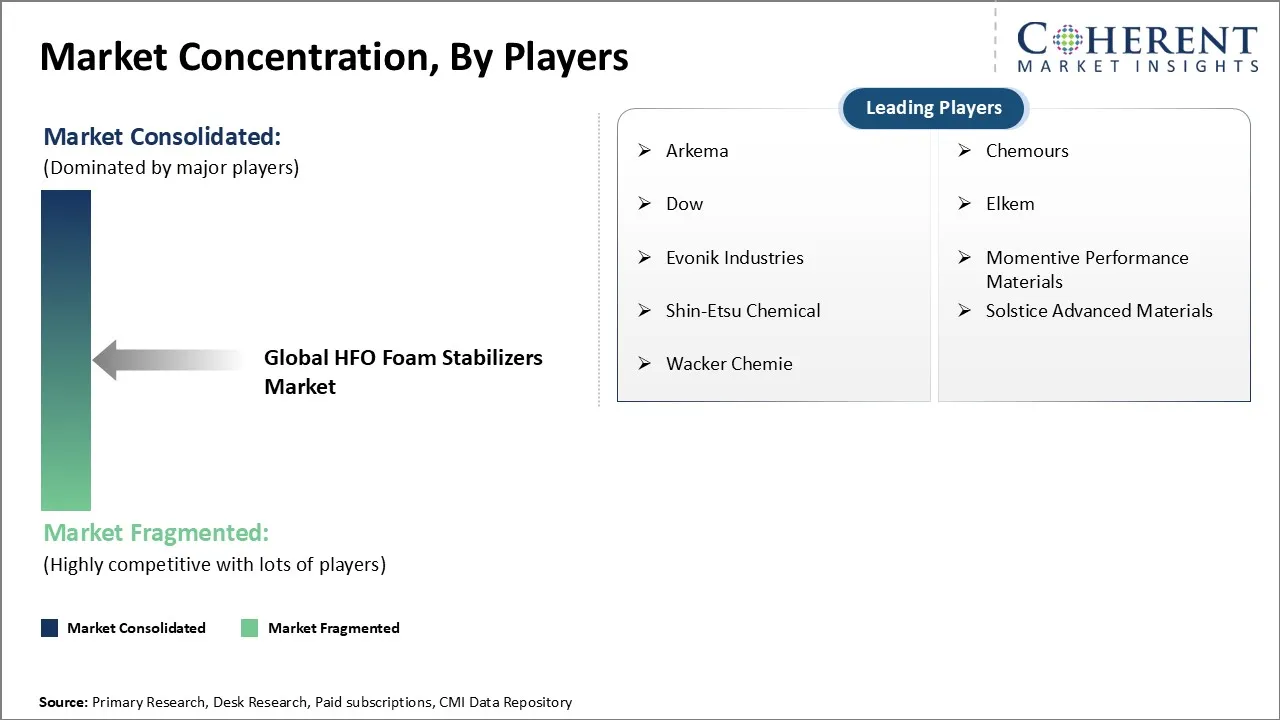
Evonik leads the market with its wide TEGOSTAB surfactant range, including hydrolysis-resistant grades for HFO, HFC and pentane systems. Momentive competes with its Niax silicones and sells them with catalysts built for good shelf life in HFO-1233zd blends. Dow offers VORASURF silicone surfactants that work alongside its own polyols and systems. Wacker Chemie and Shin-Etsu Chemical bring deep silicone expertise, with Shin-Etsu strong in Asian appliance and building foam. Elkem and newer players such as BRB International compete on cost. HFO producers such as Arkema, Chemours and Solstice Advanced Materials also shape the market, and Arkema has now moved into stability additives of its own. Competition centers on shelf-life performance, compatibility across blowing agents, technical support and price.
Top Manufacturers and Notable Products in the HFO Foam Stabilizers Market
Manufacturer | Notable Product | Key Features |
Evonik | TEGOSTAB B 8409 | Non-hydrolysable silicone surfactant for rigid foam; works with pentanes, HFCs and HFOs; forms a clear solution with common rigid foam polyols |
Momentive Performance Materials | Niax L-6620 | HFO-compatible silicone surfactant for rigid foam; offered with catalysts promoted for good shelf life with HFO-1233zd |
Dow | VORASURF silicone surfactants | Silicone surfactants for rigid polyurethane foam; range extended with a focus on spray and construction foam |
Arkema | Foranext Continuum | Low-viscosity additive for rigid foam made with Forane 1233zd; helps keep formulations consistent over time |
BRB International | Sipostab silicone stabilisers | Silicone surfactant range for rigid foam, flexible foam and one-component foam; cost-competitive supply from an integrated silicone value chain |
Market Report Scope
Global HFO Foam Stabilizers Market Report Coverage | |||
Report Coverage | Details | ||
Base Year | 2025 | Market Size in 2026: | USD 83.0 Mn |
Historical Data For: | 2020 To 2024 | Forecast Period: | 2026 To 2033 |
Forecast Period 2026 To 2033 CAGR: | 9.00% | 2033 Value Projection: | USD 152.0 Mn |
Geographies covered: |
| ||
Segments covered: |
| ||
Companies covered: | Arkema, Chemours, Dow, Elkem, Evonik Industries, Momentive Performance Materials, Shin-Etsu Chemical, Solstice Advanced Materials, Wacker Chemie | ||
Growth Drivers: |
| ||
Restraints & Challenges: |
| ||
Analyst Opinion (Expert Opinion)
- The stabilizer has become the bottleneck. In the early days of HFOs, the main concern was the price and supply of the blowing agent. Supply has since grown. The harder problem is now inside the blend: keeping an HFO mixture stable for months. HFO producers filed patents on amine–acid adducts, encapsulated catalysts and other ways to protect the surfactant. Additive makers also began promoting catalysts for their shelf life in HFO blends. As a result, value will move to suppliers that offer a tested package of surfactant, catalyst and stabilizer, backed by ageing data. Suppliers that sell only surfactants risk becoming second sources.
- Growth is expected to remain niche-led, while Europe faces a binary regulatory risk. Hydrocarbon blowing agents continue to dominate wherever their use is feasible. Pentane accounts for more than 90% of blowing agent consumption among PU Europe’s members, and HFOs remain considerably more expensive than cyclopentane in developing countries. As a result, demand for HFO foam stabilizers is likely to be concentrated in applications where hydrocarbons are less suitable, such as spray foam, thin insulation panels and cold chain. North American spray foam and Chinese construction foam therefore represent the most attractive opportunities for suppliers. In Europe, the outcome of the proposed PFAS restriction remains the principal risk. An exemption for foam applications would help sustain demand, whereas a restriction without such an exemption could lead to a significant decline. Stabilizer grades compatible with both HFO and pentane systems offer suppliers the most resilient position.
Speak to the analyst
Want personalized insights?
Take the findings above to one of our principal consultants, or have the report rebuilt around the segments, geographies and competitors you actually track.
Market Segmentation
- Product Type Insights (Revenue, USD Million, 2021-2033)
- Silicone Polyether Surfactants
- Non Silicone (Organic) Surfactants
- Blend Stability Additives
- Application Insights (Revenue, USD Million, 2021-2033)
- Spray Polyurethane Foam
- Panels and Boardstock
- Appliances and Cold Chain
- Blowing Agent Type Insights (Revenue, USD Million, 2021-2033)
- HCFO-1233zd
- HFO-1336mzz
- HFO-1234ze
- HFO-1336mzz
- HFO pentane co-blends
- Regional Insights (Revenue, USD Million, 2021-2033)
- North America
- U.S.
- Canada
- Latin America
- Brazil
- Argentina
- Mexico
- Rest of Latin America
- Europe
- Germany
- U.K.
- Spain
- France
- Italy
- Russia
- Rest of Europe
- Asia Pacific
- China
- India
- Japan
- Australia
- South Korea
- ASEAN
- Rest of Asia Pacific
- Middle East
- GCC Countries
- Israel
- Rest of Middle East
- Africa
- South Africa
- North Africa
- Central Africa
- North America
- Key Players Insights
- Arkema
- Chemours
- Dow
- Elkem
- Evonik Industries
- Momentive Performance Materials
- Shin-Etsu Chemical
- Solstice Advanced Materials
- Wacker Chemie
Sources
Primary Research Interviews
- Silicone Surfactant and Polyurethane Additive Manufacturers
- HFO Blowing Agent Producers
- Polyurethane Systems Houses and Formulators
- Spray Foam, Panel and Appliance Manufacturers
Magazines
- Urethanes Technology International
- Spray Foam Magazine
- Chemical & Engineering News (C&EN)
- Cooling Post
Journals
- Journal of Cellular Plastics
- Journal of Applied Polymer Science
- Atmospheric Chemistry and Physics
Associations
- PU Europe
- Center for the Polyurethanes Industry (CPI), American Chemistry Council
- Spray Polyurethane Foam Alliance (SPFA)
- European FluoroCarbons Technical Committee (EFCTC)
Public Domain Sources
- UNEP Ozone Secretariat: Technology and Economic Assessment Panel (TEAP) and Foams Technical Options Committee reports
- Multilateral Fund for the Implementation of the Montreal Protocol: project documents
- U.S. Environmental Protection Agency (EPA): AIM Act Technology Transitions rule
- European Commission: F-gas Regulation (EU) 2024/573
- European Chemicals Agency (ECHA): PFAS restriction proposal
- China Ministry of Ecology and Environment (MEE): HCFC-141b announcements
- USPTO (U.S. Patent and Trademark Office): HFO foam stabilization patent filings
- U.S. Securities and Exchange Commission (SEC): company annual filings
- Oak Ridge National Laboratory (ORNL): HFO foam insulation studies
Proprietary Elements
- CMI Data Analytics Tool
- Proprietary CMI Existing Repository of information for last 10 years
Get access to 250+ pages report
Every segment, forecast, competitor profile and data table behind the analysis above — available for instant download.
- ESOMAR Member
- ISO 9001:2015 Certified
- D-U-N-S Registered
- GDPR & CCPA Compliant
Frequently Asked Questions
The global HFO foam stabilizers market is estimated to be valued at USD 83.0 Mn in 2026 and is expected to reach USD 152.0 Mn by 2033.
The CAGR of the global HFO foam stabilizers market is projected to be 9.0% from 2026 to 2033.
HFC phase-down regulations and the need for longer shelf life in HFO foam systems are the major factors driving the growth of the global HFO foam stabilizers market.
Competition from low-cost hydrocarbon blowing agents such as pentane, and regulatory uncertainty from the proposed EU PFAS restriction, are the major factors hampering the growth of the global HFO foam stabilizers market.
In terms of product type, silicone polyether surfactants are estimated to dominate the market, with a revenue share of 77.0% in 2026.
In terms of application, spray polyurethane foam is estimated to lead the market, with a revenue share of 34.0% in 2026.
In terms of blowing agent type, HCFO-1233zd(E) is estimated to lead the market, with a revenue share of 46.0% in 2026.