

Global High-Temperature Steam Heat Pump Market Size and Forecast – 2026 To 2033
The Global High-Temperature Steam Heat Pump Market is expected to grow at a compound annual growth rate (CAGR) of 16.7% from 2026 to 2033 and is expected to reach USD 4.83 Bn by 2033. The market was valued at USD 1.64 Bn in 2026. Market growth is driven by industrial efforts to replace fossil fuel based steam generation with energy efficient electrified heating systems. The adoption of waste heat recovery technologies is also creating opportunities in a range of steam-intensive industries like food processing, chemicals and textiles.
In March 2026, the Apparel Impact Institute announced the Steam Heat Pump Pilot Project to facilitate feasibility assessments and planned pilot installations at textile manufacturing facilities in India, China, and Vietnam. The project includes capital grants to test the technical and commercial viability of steam-generating heat pumps, to enable future deployment in industrial manufacturing.
Key Takeaways of the Global High-Temperature Steam Heat Pump Market
- Closed-Cycle Vapor Compression Heat Pumps are expected to record an estimated CAGR of 16.2% during 2026–2033 and hold 57.2% of the global high-temperature steam heat pump market in 2026. Their controllable refrigerant cycles suit factories with variable steam loads and limited thermal storage. In March 2026, AtmosZero reported approximately 70% effective turndown from its cascaded centrifugal steam heat pump, strengthening operational flexibility.
- 120–150°C steam systems are projected to expand at an estimated CAGR of 15.8% during 2026–2033 and command 51.8% of the global high-temperature steam heat pump market in 2026. This temperature range supports evaporation, cooking and product drying without the engineering complexity of higher-pressure steam. In February 2025, the European Heat Pump Association reported the inauguration of GEA's system supplying 138°C steam to a Belgian sugar factory.
- 1–5 MW Heating Capacity systems are forecast to achieve an estimated CAGR of 17.3% during 2026–2033 and capture 45.8% of the global high-temperature steam heat pump market in 2026. Mid-sized units can serve individual production lines while containing initial capital exposure. In November 2025, Skyven Technologies commissioned its Arcturus demonstration facility in Texas, delivering 1 MW of industrial steam through waste heat recovery.
- Europe is anticipated to advance at an estimated CAGR of 15.1% during 2026–2033 while retaining the largest market share at 39.1% of global high-temperature steam heat pump market in 2026. Its established chemical and paper industries, industrial electrification programs and project funding support steam system upgrades. In April 2026, BASF reported the arrival of a key evaporator for its approximately 50 MW industrial steam heat pump under construction in Ludwigshafen, Germany.
- The Asia Pacific region is expected to see the highest regional growth rate of 20.2% during the forecast period of 2026 to 2033. This region will hold a revenue share of 34.8% in the global high-temperature steam heat pump market in 2026. The region’s manufacturing heat needs and Japan’s engineering expertise make it easier to localize the equipment. In October 2026, Mayekawa announced a trial with Honda, where 140°C steam was used to dry the paint line at Honda’s Saitama, Japan, automotive plant.
Segmental Insights
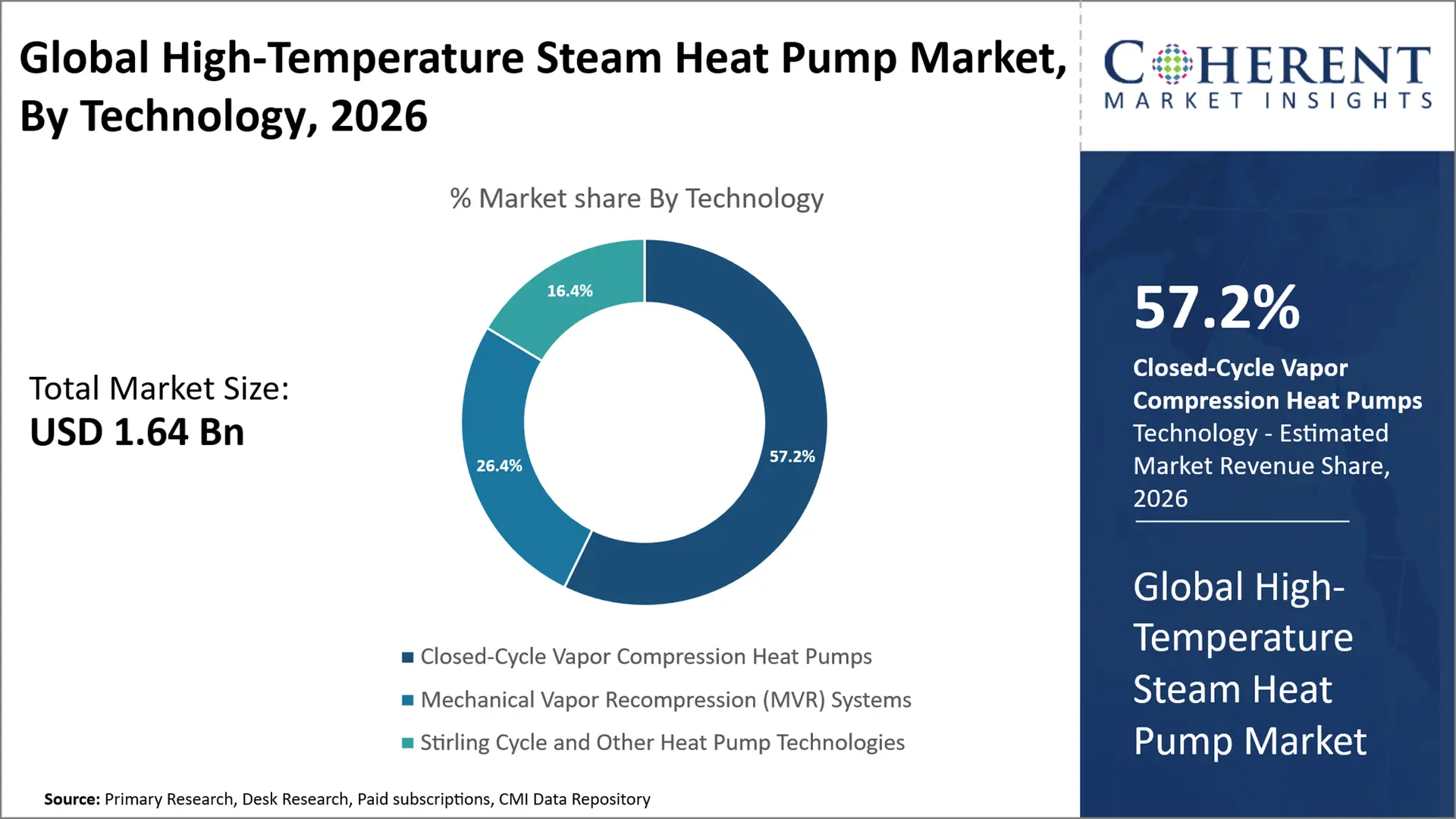
Why Do Closed-Cycle Vapor Compression Heat Pumps Dominate the Global High-Temperature Steam Heat Pump Market?
Closed-Cycle Vapor Compression Heat Pumps are expected to account for 57.2% of the global high-temperature steam heat pump market in 2026. The main advantage is that the circulating refrigerant is separated from the process steam, allowing engineers freedom to select working fluids and compressor configurations without introducing refrigerant into the steam system. This setup is particularly applicable where equipment approval is governed by chemical compatibility, steam purity and controlled pressure delivery. Standardization of compressor components also enables system manufacturers to have greater design flexibility to refrigerant requirements and site conditions. In March 2026, Suzhou Weishans Climate Technologies introduced an ultra-high-temperature scroll compressor series designed for refrigerant condensing temperatures of 100–160°C. The development improves the selection of components for designers of closed-cycle systems for industrial steam applications.
- Current Industry Events of 2026
- Market Size Estimation
- Regional Breakdown
- Competitive Landscape
- Customer Intelligence
- Segmental Analysis
- Pricing Analysis
- Key Market Drivers, Challenges & Future Trends
- Customized Insights Section
Why Does the 120–150°C Segment Represent the Largest Steam Temperature Category in the Global High-Temperature Steam Heat Pump Market?
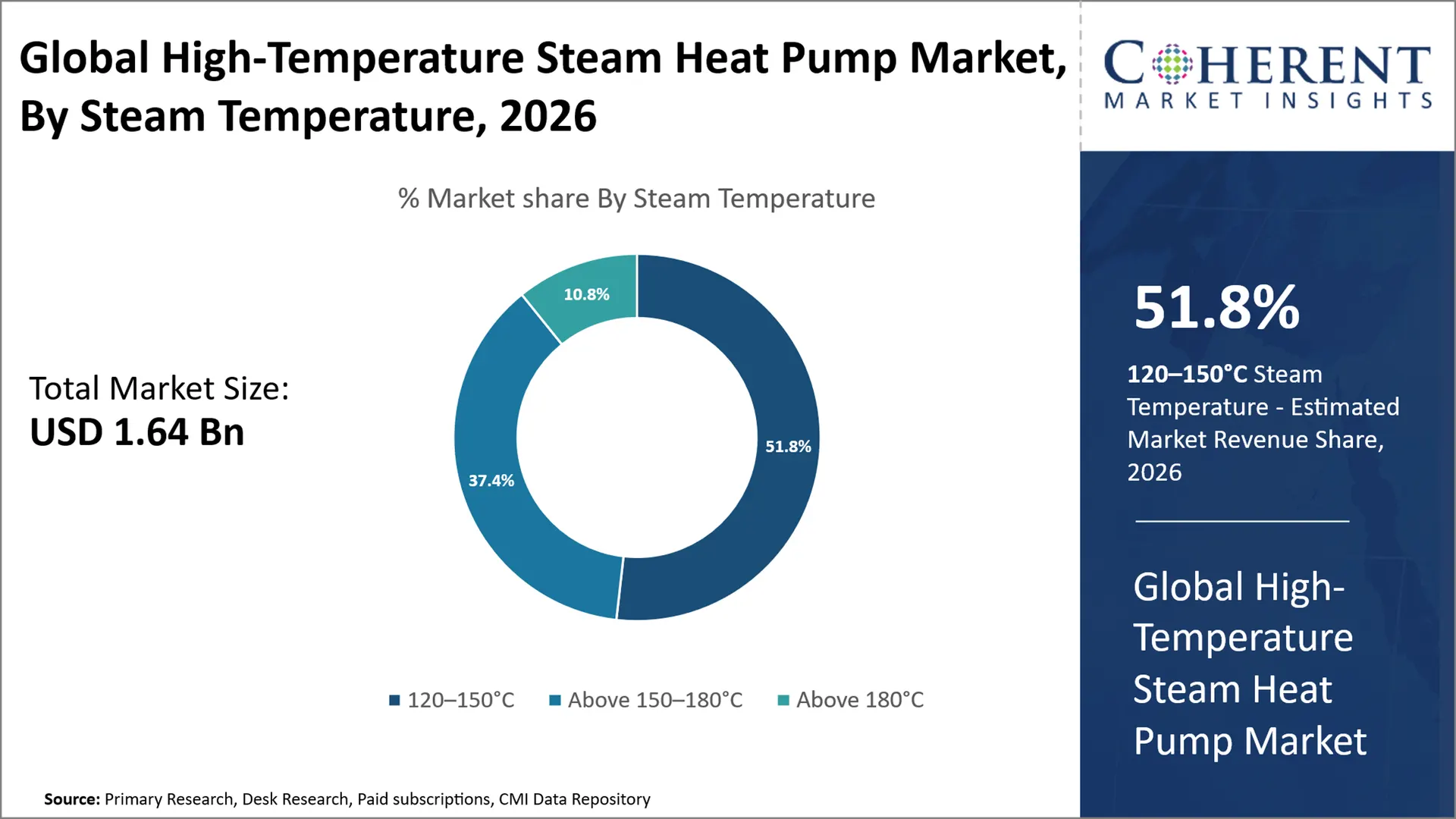
The 120–150°C steam temperature segment is expected to hold 51.8% of the global high-temperature steam heat pump market in 2026. This temperature range allows manufacturers to add electrified steam to suitable lower-pressure utility branches, while continuing to use conventional boilers for higher-pressure needs. In addition to improving the economics of the overall process, recovery of heat from moisture-rich exhaust streams can also support steam production and water recovery. This means that industrial buyers can concentrate on specific heating processes without having to modify their entire steam distribution infrastructure. In December 2025, JOA Air Solutions installed a two-stage heat pump at Philip Morris International’s Bologna plant. The heat pump converts recovered dryer heat into steam at 139°C. The installation demonstrated how better industrial energy use can be achieved by using temperature matched steam generation to supplement existing drying operations.
Why Does the 1–5 MW Segment Dominate the Heating Capacity Category of the Global High-Temperature Steam Heat Pump Market?
The 1–5 MW heating capacity segment is expected to represent 45.8% of the global high-temperature steam heat pump market in 2026. The range of capacities allows industrial plants to adapt the output of their equipment to the needs of the existing steam network, electrical infrastructure and thermal resources. In addition, mid-size compressor packages allow phasing of the commissioning and maintenance planning with backup steam equipment to reduce operational disruption. Manufacturers benefit from the development of modular systems that are adaptable to different plant layouts without extensive equipment redesign. In September 2024 HEATEN successfully completed functional and endurance testing of its HeatBooster HBL4, a modular platform for industrial heat pumps with steam service configurations. The milestone improves the technical foundation for medium-capacity industrial steam applications and facilitates equipment qualification.
Current Events and their Impact
Current Event | Description and Its Impact |
The European Commission published the IF26 industrial heat auction terms in September 2026. |
|
April 2026: Launched second heat pump investment accelerator competition (UK) |
|
The amended EU F-Gas Regulation will come into effect in March 2024. |
|
Global High-Temperature Steam Heat Pump Market Dynamics
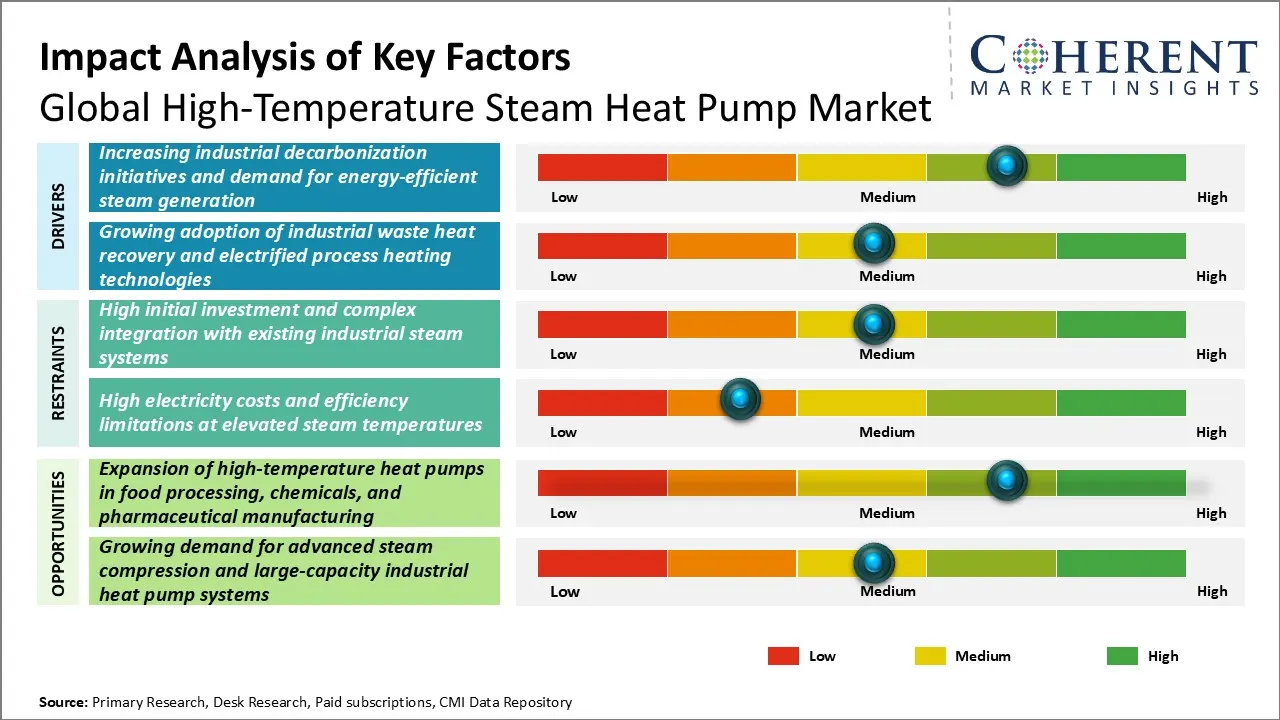
Key Market Drivers
- Increasing industrial decarbonization initiatives and demand for energy-efficient steam generation: Industrial manufacturers are prioritizing steam generation are compelling industrial manufacturers to focus on steam generation technologies that reduce fossil fuel dependence without compromising production continuity. An alternative to conventional boilers, high-temperature steam heat pumps convert electricity and recovered thermal energy into usable process steam. This improves energy efficiency in steam-intensive processes and assists in achieving industrial decarbonization targets. This supports industrial decarbonization targets while improving energy utilization in steam-intensive operations. In February 2026, delfort announced the commissioning of a large steam-generating heat pump alongside an electrode boiler at its Tervakoski paper mill in Finland, enabling specialty paper production without fossil energy. The development demonstrates the commercial feasibility of electrified industrial steam systems.
- Growing adoption of industrial waste heat recovery and electrified process heating technologies: Industrial sites are looking increasingly at the potential to convert previously unused thermal energy into valuable steam for their manufacturing operations. Upgrading recovered heat from production equipment, cooling circuits and industrial wastewater with high-temperature steam heat pumps can reduce the additional energy required for steam generation. This is opening up commercial opportunities for industrial engineering providers, compressor manufacturers and heat recovery specialists. In December 2025, Calefa Oy launched its AmbiSteam solution, which combines SteamLevel heat pump technology and waste heat recovery to produce industrial process steam at pressures above 5 bar. The introduction expands the set of possibilities for integrating electrified steam production into the existing thermal infrastructure
Emerging Market Trends
- Increasing Emphasis on Process-Specific Steam Quality and Delivery Performance: Industrial buyers are increasingly prioritizing steam pressure stability, dryness, feedwater quality, and process compatibility alongside equipment efficiency. Manufacturers are consequently developing application-specific steam heat pump configurations to meet different industrial operating requirements.
- Impact: This change drives more need for accurate process controls, tailored system engineering and steam quality validation. Suppliers who can offer specialized technical support and reliable delivery of steam will be more competitive.
- Market Relevance: High-quality specialty chemicals, pharmaceuticals, and food processing all depend on consistent steam conditions. These requirements underpin the need for high temperature steam heat pumps that have a proven track record and application specific designs.
- Transition Toward Performance-Linked Industrial Steam Supply Contracts: Industrial steam procurement is gradually shifting toward performance-linked contracts that connect supplier compensation with delivered thermal output, efficiency, and system availability. Equipment manufacturers and energy service providers are exploring service-based models that include operation, maintenance, and performance commitments.
- Impact: These arrangements can reduce customers' upfront investment requirements while creating recurring revenue opportunities for equipment suppliers. They also increase supplier responsibility for system reliability and operating efficiency.
- Market Relevance: Performance-linked contracts can help industrial manufacturers to adopt high-temperature steam heat pumps in their efforts to electrify steam generation, while reducing the technical and financial risks associated with equipment ownership.
Market Restraints
- High Initial Capital Investment and Grid Connection Costs: Industrial steam heat pumps require large investments in electrical infrastructure, compressors, heat exchangers and steam integration. Costly grid upgrades can undermine project economics, especially for facilities with lower electrical capacities.
- Electricity-to-Natural Gas Price Differentials: The commercial viability of steam heat pumps depends on the achievable efficiency, the temperatures of the heat source, the prices of fuels and electricity. Lower energy consumption can lead to longer payback periods because of unfavorable electricity pricing.
- Technical Complexity at Higher Steam Temperatures: Challenges in compressor performance, refrigerant stability, pressure management and equipment durability are encountered in reliable operation at high temperatures. These requirements can slow the adoption of demanding industrial processes and increase engineering costs.
Regional Insights
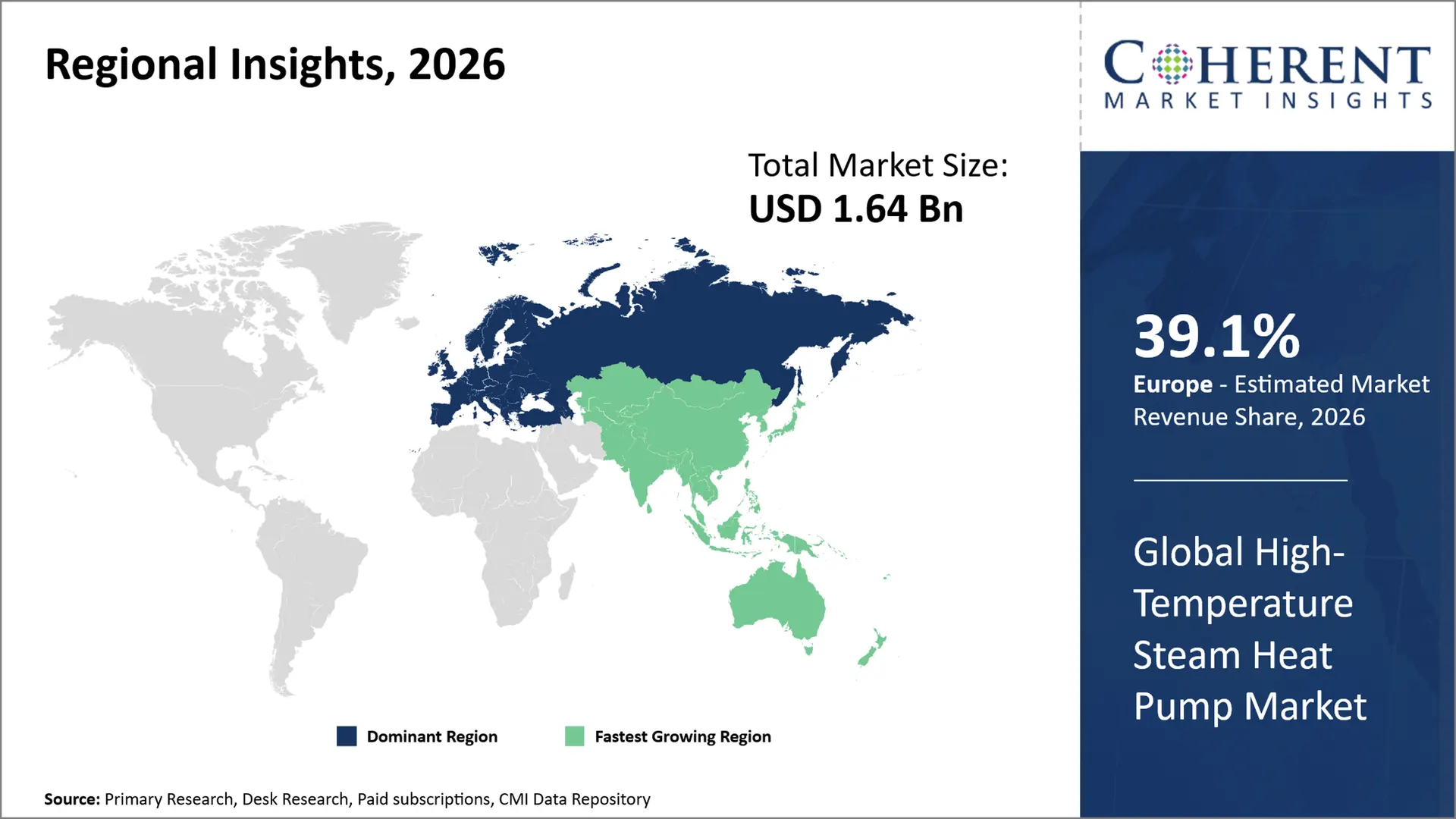
Why Does Europe Dominate the Global High-Temperature Steam Heat Pump Market?
Europe is estimated to account for 39.1% share of the global high-temperature steam heat pump market in 2026. The region has already existing industrial heating infrastructure, thermal engineering specialized companies and manufacturers investments in alternative steam boilers. Pharmaceutical, chemical and food-processing plants provide possibilities for the integration of high-temperature heat pumps into existing production systems. European industrial research partnerships also help manufacturers validate steam quality and operating reliability prior to commercial deployment. In September 2025, Takeda launched the AHEAD high-temperature heat pump system at its pharmaceutical manufacturing site in Vienna, Austria. Developed in cooperation with the AIT Austrian Institute of Technology, the installation shows how highly developed steam heat pumps can be used in pharmaceutical production and thus makes a contribution to the fossil-free generation of industrial process steam.
Why Is Asia Pacific Emerging as the Fastest-Growing Region in the Global High-Temperature Steam Heat Pump Market?
Asia Pacific is expected to account for 34.8% of the global market by 2026 and be the fastest-growing region through 2033. The region has significant opportunities for electrification of industrial steam in sugar refining, chemical processing and other energy-intensive manufacturing activities. The commercial environment for heat recovery solutions is improving with the development of local equipment supply chains and government-backed industrial energy projects. In October 2025, the Australian Government committed USD 2.89 million to Sugar Australia to replace gas-fired evaporators at its Yarraville refinery in Victoria with an electric mechanical vapor recompression system. The project shows how industrial players can reduce their dependence on conventional steam by using recovered vapor and electrification that is adapted to the processes.
Global High-Temperature Steam Heat Pump Market Outlook for Key Countries
Why Is the U.S. a Key Market for the Global High-Temperature Steam Heat Pump Market?
The U.S. remains an important global market for high-temperature steam heat pump because manufacturers operate extensive steam distribution systems across food processing, chemicals, pharmaceuticals, and industrial services. Instead, it is increasingly being linked to site-specific assessments of electricity capacity, boiler replacement and production downtime, rather than standardized heating purchases. California is an early proving ground for industrial applications where local air quality requirements help make the case for electric steam generation. In November 2024, the California Energy Commission filed notice of a demonstration of a steam-generating heat pump at an industrial laundry in Patterson. The proposed project involves converting gas-fired drying operations to steam provided from an electric heat pump. A successful demonstration could provide operating references for similar U.S. facilities.
Why Is China Important in the Global High-Temperature Steam Heat Pump Market?
China’s industrial manufacturing clusters also matter to the global high-temperature steam heat pump market because they can cater to large process heating needs and have domestic capabilities in electrical equipment, compressors and heat exchangers. Thermal energy recovery can be applied in textile finishing, food processing and chemical production and can reduce the demand for purchased fuel. While the high-temperature steam equipment still needs to be qualified for each application, domestic suppliers also have the advantage of being close to customers and having established networks to manufacture components. In May 2026, China’s national standardization authorities promulgated the GB/T 47619-2026 on steam generation packages based on vapor compression heat pump cycle. The standard, set for release in December 2026, offers a more rigorous technical reference for industrial buyers and equipment manufacturers assessing steam-generating heat pump systems.
Why Does Japan Support Growth in the Global High-Temperature Steam Heat Pump Market?
Japan's expertise in industrial refrigeration, precision compressors and tightly controlled factory utilities are all contributing to the growth of the global high temperature steam heat pump market. For food manufacturers, chemical processors and pharmaceutical producers who often require continuous steam pressure and reliable performance, operational validation is an important aspect of procurement. This enables domestic equipment suppliers to compete on the basis of compact system design, reliability of components and integration with existing plant equipment, rather than on the basis of installed capacity alone. In November 2025, Fuji Electric revised its official product information for a compact steam-generating heat pump. The heat pump produces saturated steam with a temperature of up to 150°C by using recovered heat from warm wastewater. This product shows how Japanese manufacturers are employing purpose-built equipment to meet specific industrial steam duties.
Why Is Germany a Strategic Country in the Global High-Temperature Steam Heat Pump Market?
Germany's engineering ecosystem of equipment testing facilities, specialist compressor manufacturers, and large process-industry customers ensure it remains a strategic market for high-temperature steam heat pump. Opportunities for steam heat pumps to meet stringent temperature requirements exist with the integration of complex site utility networks with chemical and specialty manufacturing operations. German buyers want pressure stability, measured efficiency and long duration operation before significant plant modifications. In October 2026 Fraunhofer ISE published a report about testing of providing process steam up to 160 °C temperature by a new high temperature heat pump test facility. Its work gives manufacturers and engineering contractors the operational evidence they need to improve component selection, control strategies and plant integration for industrial steam systems.
Why Is France an Important Growth Market for the Global High-Temperature Steam Heat Pump Market?
France presents opportunities for high-temperature steam heat pump market in food processing, chemicals, and paper production, where substantial process heating requirements coexist with recoverable industrial waste heat. Commercial adoption depends on the ability to document operating efficiency and qualify projects for suitable energy-saving incentives. Local engineering firms and energy service providers can help manufacturers assess heat sources and integrate new equipment without disrupting production. In May 2026, France amended its standardized energy-savings certificate provisions for industrial waste-heat heat pumps, including electrically driven vapor-compression systems with thermal output up to 5 MW under specified conditions. The framework strengthens the incentive environment for eligible industrial heat recovery investments, although qualification must be assessed for each steam application.
Steam Heat Pump Technology Deployment and Integration Landscape
Evaluation Parameter | Industrial Assessment Criteria | Impact on Market Adoption | Commercial Significance |
Waste Heat Availability | Temperature, flow rate, operating consistency and recoverable heat volume of industrial processes | Plants that have stable and readily available streams of waste heat are in a better position to install steam heat pumps. | Makes projects more feasible and energy savings more predictable |
Demand for Steam and Operating Hours | Annual steam consumption, continuous or batch operations, and changes in steam demand | Facilities with steady steam demands can achieve a higher utilization of equipment | Accelerates capital payback and lowers operating costs to a known level |
Steam Pressure and Quality Requirements | Required steam pressure, dryness, temperature, and compatibility with existing steam distribution networks | Determines whether heat pump-generated steam can serve existing industrial processes directly | Creates opportunities for customized steam supply and system integration services |
Electricity and Fuel Cost Economics | Industrial electricity tariffs, natural gas prices, demand charges, and available energy incentives | Electrified steam generation is becoming more financially attractive as electricity-to-fuel cost ratios improve | impacts payback periods, long term operating costs, investment decisions |
Electrical Infrastructure Preparedness | Available grid capacity Transformer ratings Electrical connection requirements Site power limitations | Projects that require fewer additional upgrades can be hosted in facilities with the appropriate electrical infrastructure. | Reduces installation cost, connection delays and the risks of project execution |
Installation and Operational Continuity | Available space for installation Steam network connections Scheduled shutdown windows and backup steam arrangements | Industrial buyers are more attracted to projects with manageable integration needs and minimal production disruption | Supports planning of retrofit projects, vendor selection, efficiency in commissioning and reliability in operation |
How Are Advanced High-Temperature Compression Systems Creating New Growth Opportunities in the Global High-Temperature Steam Heat Pump Market?
There is relatively little to operate on with steam above 180°C because of the increased complexity of pressure management, compressor stress and maintenance requirements associated with larger temperature lifts. Some pulp mills and makers of pharmaceutical intermediates and specialty chemicals may need steam at higher temperatures for specialized drying operations, separations and reactions.
Rather than attempting a large-scale boiler replacement, suppliers can address these applications with staged compression, qualified high temperature working fluids and integrated steam conditioning. The first commercial entry point should be processing duties that require custom engineering due to predictable operating profiles and stable heat sources.
The equipment developers will have to do materials qualification, pressure system certification, long-duration reliability testing and advanced sealing technologies to be able to support continuous industrial operation.
Commercial partnerships can be offered by established maintenance providers and process engineering contractors to help improve market access and reduce commissioning risk. This opportunity is likely to benefit established thermal equipment manufacturers and specialist engineering firms that can offer application-specific solutions with credible performance commitments.
Market Players, Key Development, and Competitive Landscape
Key Developments
- In June 2026, Enerin reported that Roche engineers had inspected its first HoegTemp V12 high-temperature heat pump in Norway ahead of a planned Swiss installation. The completed inspection marked an equipment qualification milestone, demonstrating the importance of customer verification before deploying specialized steam-generation technology in pharmaceutical manufacturing infrastructure.
- In November 2025, Everllence announced a project to supply a 35 MW steam heat pump for Vicinity Energy's Kendall Station in Cambridge, Massachusetts. Scheduled for operation in 2028, the project demonstrates the potential to introduce electrified steam generation into established district energy infrastructure without replacing distribution networks.
- In August 2026, Clayton Industries announced a collaboration with Solid Energy to develop steam heat pumps capable of supplying steam at up to 4 bars. Combining high-temperature heat pump technology with established steam-generation expertise could broaden equipment options for industrial facilities evaluating alternatives to fossil-fuel-fired steam systems.
Competitive Landscape
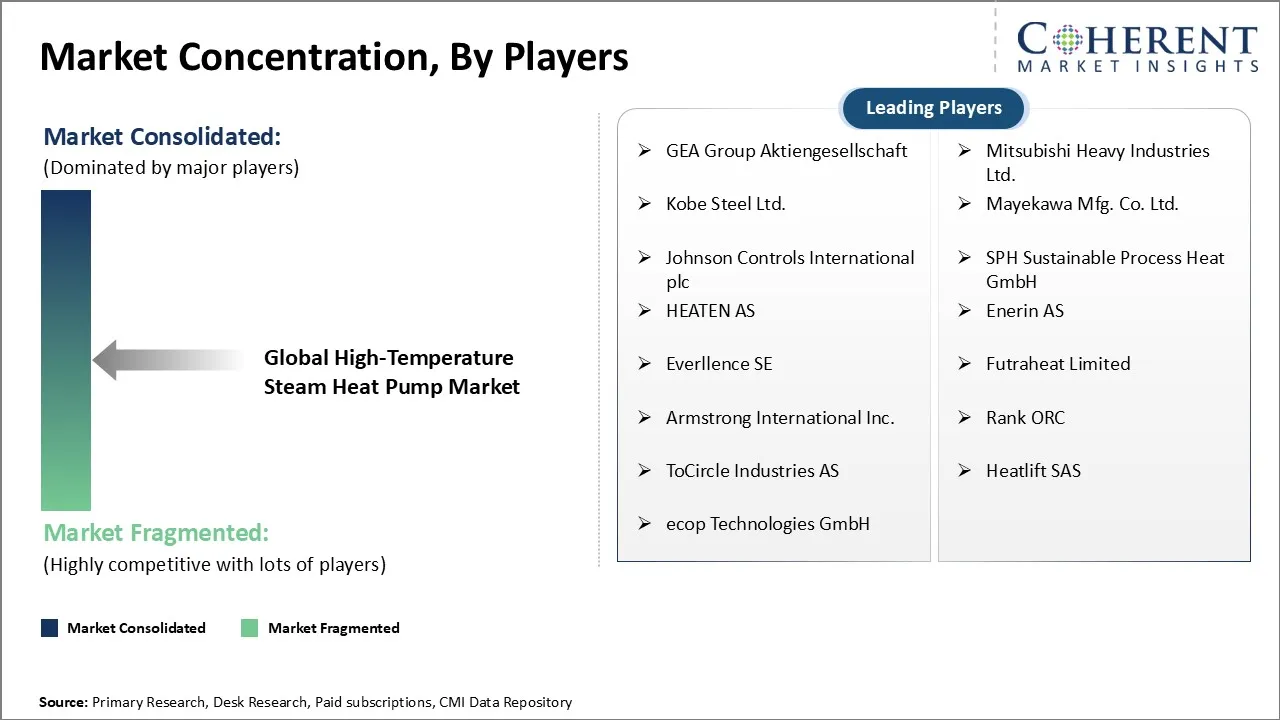
The global high-temperature steam heat pump market is moderately fragmented and project-oriented competitive landscape comprising of established industrial equipment manufacturers, specialized heat pump developers, compressor suppliers, and engineering contractors. The competition covers long term reliability, cost of installation, steam delivery specifications and operating performance. Specialist manufacturers contribute with proprietary compression technologies and application-specific expertise for their competition, and regional engineering companies offer customized system integration.
Key focus areas include
- Product Performance: Demonstrated steam output, pressure stability, and performance under actual operating conditions influence purchasing decisions.
- Technology Differentiation: Proprietary compressor architectures, thermal-cycle designs, and heat exchanger configurations support competitive positioning.
- Total Cost of Ownership: Equipment pricing, electricity consumption, maintenance requirements, and expected service life influence investment decisions.
- Manufacturing and Supply Reliability: Access to specialized compressors, pressure-rated components, and reliable fabrication partners supports project delivery.
- Certifications and Compliance: Pressure-equipment regulations, refrigerant safety requirements, and applicable industrial standards influence supplier qualification.
- System Customization: Site-specific engineering, steam network compatibility, and installation planning help address complex industrial requirements.
- After-Sales Service: Maintenance capabilities, spare-parts availability, and technical response times influence long-term customer relationships.
- Regional Market Access: Local engineering partnerships and established industrial procurement channels strengthen participation in international projects.
Market Report Scope
High-Temperature Steam Heat Pump Market Report Coverage | |||
Report Coverage | Details | ||
Base Year | 2025 | Market Size in 2026: | USD 1.64 Bn |
Historical Data For: | 2020 To 2024 | Forecast Period: | 2026 To 2033 |
Forecast Period 2026 To 2033 CAGR: | 16.7% | 2033 Value Projection: | USD 4.83 Bn |
Geographies covered: |
| ||
Segments covered: |
| ||
Companies covered: | GEA Group Aktiengesellschaft, Mitsubishi Heavy Industries Ltd., Kobe Steel Ltd., Mayekawa Mfg. Co. Ltd., Johnson Controls International plc, SPH Sustainable Process Heat GmbH, HEATEN AS, Enerin AS, Everllence SE, Futraheat Limited, Armstrong International Inc., Rank ORC, ToCircle Industries AS, Heatlift SAS, ecop Technologies GmbH | ||
Growth Drivers: |
| ||
Restraints & Challenges: |
| ||
Analyst Opinion (Expert Opinion)
- The global high-temperature steam heat pump market is expected to see a move toward suppliers who can support industrial steam systems over their entire life cycle rather than competing mainly on equipment specs. Buyers will be more selective on technology reliability and supplier accountability, which should favor manufacturers with established service networks, reliable component supply and documented industrial references.
- Commercial role of industrial heat pumps could be changed by grid-interactive steam generation Systems that can coordinate the procurement of electricity with thermal storage and steam production could eventually act as flexible energy assets, rather than fixed heating equipment. Suppliers that develop sophisticated energy management capabilities could benefit, whereas manufacturers that offer unflexible operating systems may face pressure in electricity-sensitive applications.
- Manufacturers should concentrate on proven compressor designs, dependable industrial controls, refrigerant safety and application-specific engineering. More attention should be paid to customers with predictable thermal needs and developed maintenance capabilities. Companies should create regional service partnerships, manage risks of critical component sourcing, and avoid over-investment in temperature capabilities that have not been sufficiently validated in operation.
Speak to the analyst
Want personalized insights?
Take the findings above to one of our principal consultants, or have the report rebuilt around the segments, geographies and competitors you actually track.
Market Segmentation
- Technology Insights (Revenue, USD Bn, 2021 - 2033)
- Closed-Cycle Vapor Compression Heat Pumps
- Mechanical Vapor Recompression (MVR) Systems
- Stirling Cycle and Other Heat Pump Technologies
- Steam Temperature Insights (Revenue, USD Bn, 2021 - 2033)
- 120–150°C
- Above 150–180°C
- Above 180°C
- Heating Capacity Insights (Revenue, USD Bn, 2021 - 2033)
- Below 1 MW
- 1–5 MW
- Above 5 MW
- Heat Source Insights (Revenue, USD Bn, 2021 - 2033)
- Industrial Process Waste Heat
- Wastewater and Water Sources
- Ambient and Other Heat Sources
- End User Insights (Revenue, USD Bn, 2021 - 2033)
- Food and Beverage
- Chemicals and Petrochemicals
- Pulp and Paper
- Pharmaceuticals
- Textiles
- District Steam and Utilities
- Other Industries
- Installation Type Insights (Revenue, USD Bn, 2021 - 2033)
- New Installations
- Retrofit Installations
- Regional Insights (Revenue, USD Bn, 2021 - 2033)
- North America
- U.S.
- Canada
- Latin America
- Brazil
- Argentina
- Mexico
- Rest of Latin America
- Europe
- Germany
- U.K.
- Spain
- France
- Italy
- Russia
- Rest of Europe
- Asia Pacific
- China
- India
- Japan
- Australia
- South Korea
- ASEAN
- Rest of Asia Pacific
- Middle East
- GCC Countries
- Israel
- Rest of Middle East
- Africa
- South Africa
- North Africa
- Central Africa
- North America
- Key Players Insights
- GEA Group Aktiengesellschaft
- Mitsubishi Heavy Industries Ltd.
- Kobe Steel Ltd.
- Mayekawa Mfg. Co. Ltd.
- Johnson Controls International plc
- SPH Sustainable Process Heat GmbH
- HEATEN AS
- Enerin AS
- Everllence SE
- Futraheat Limited
- Armstrong International Inc.
- Rank ORC
- ToCircle Industries AS
- Heatlift SAS
- ecop Technologies GmbH
Sources
Primary Research Interviews
- Steam heat pump manufacturers, compressor suppliers, and thermal system integrators
- Industrial energy managers, process engineers, EPC contractors, and heat recovery consultants
Stakeholders
- Heat pump OEMs, refrigerant suppliers, heat exchanger manufacturers, and engineering service providers
- Industrial steam users, energy service companies, and utility operators
End-use Sectors
- Food and beverage, chemicals and petrochemicals, pulp and paper
- Pharmaceuticals, textiles, district steam and utilities
Regulatory and Industry Bodies
- International Energy Agency (IEA)
- U.S. Department of Energy (DOE)
- European Commission and U.S. Environmental Protection Agency (EPA)
Databases
- IEA industrial energy and heat pump databases
- U.S. EIA Manufacturing Energy Consumption Survey (MECS)
- Eurostat, UN Comtrade, and national industrial energy statistics
Magazines and Journals
- Applied Thermal Engineering
- International Journal of Refrigeration
- Energy
- Chemical Engineering and Process Heating
Associations
- European Heat Pump Association (EHPA)
- IEA Heat Pumping Technologies TCP
- International Institute of Refrigeration (IIR)
- ASHRAE
Public Domain Sources
- Industrial steam consumption, waste heat recovery, and process electrification data
- Manufacturer product specifications, installation capacities, and project announcements
- Government industrial energy efficiency programs and investment data
Key Standards and Regulations
- Regulation (EU) 2024/573 – Fluorinated Greenhouse Gases
- Directive 2014/68/EU – Pressure Equipment Directive
- EN 378 and ISO 5149 – Refrigerating Systems and Heat Pump Safety
- ASHRAE Standards 15 and 34 – Refrigeration Safety and Refrigerant Classification
Proprietary Elements
- CMI Data Analytics Tool and proprietary research repository, supplemented by primary interviews, equipment pricing analysis, installed capacity assessment, steam temperature benchmarking, project pipeline tracking, and competitive intelligence.
Get access to 250+ pages report
Every segment, forecast, competitor profile and data table behind the analysis above — available for instant download.
- ESOMAR Member
- ISO 9001:2015 Certified
- D-U-N-S Registered
- GDPR & CCPA Compliant
Frequently Asked Questions
The CAGR of global high-temperature steam heat pump market is projected to be 16.7% from 2026 to 2033.
The global high-temperature steam heat pump market is estimated to be valued at USD 1.64 billion in 2026 and is expected to reach USD 4.83 billion by 2033.
Market sizing is assessed through equipment sales, manufacturer revenues, industrial project installations, system pricing, and primary industry research, with adjustments to avoid double counting.
Industrial buyers should evaluate steam temperature, pressure requirements, energy efficiency, waste heat availability, equipment reliability, installation compatibility, and long-term maintenance costs.
High-temperature steam heat pumps upgrade recovered thermal energy to produce steam, whereas conventional electric boilers convert electricity directly into heat. Their operating economics depend on site conditions.
Important competitive intelligence includes manufacturer product portfolios, steam generation capabilities, equipment performance, commercial installations, pricing strategies, service networks, and technology partnerships.
Increasing industrial decarbonization efforts and the need for energy-efficient steam generation are key factors driving the global high-temperature steam heat pump market. Growing adoption of industrial waste heat recovery and electrified process heating technologies further supports market growth.