

Global HVLS fan Market Size and Forecast – 2026 To 2033
The global HVLS fan market is expected to grow from USD 2.00 Bn in 2026 to USD 2.75 Bn by 2033, registering a compound annual growth rate (CAGR) of 3.0% from 2026 to 2033. The global HVLS fan market is driven by increasing construction of large manufacturing facilities. On February 6, 2026, Mahindra Group announced plans to establish its largest integrated manufacturing facility for automobiles and tractors in Nagpur, Maharashtra, India, marking a significant milestone in the Group’s long-term growth strategy.
Key Takeaways of the Global HVLS Fan Market
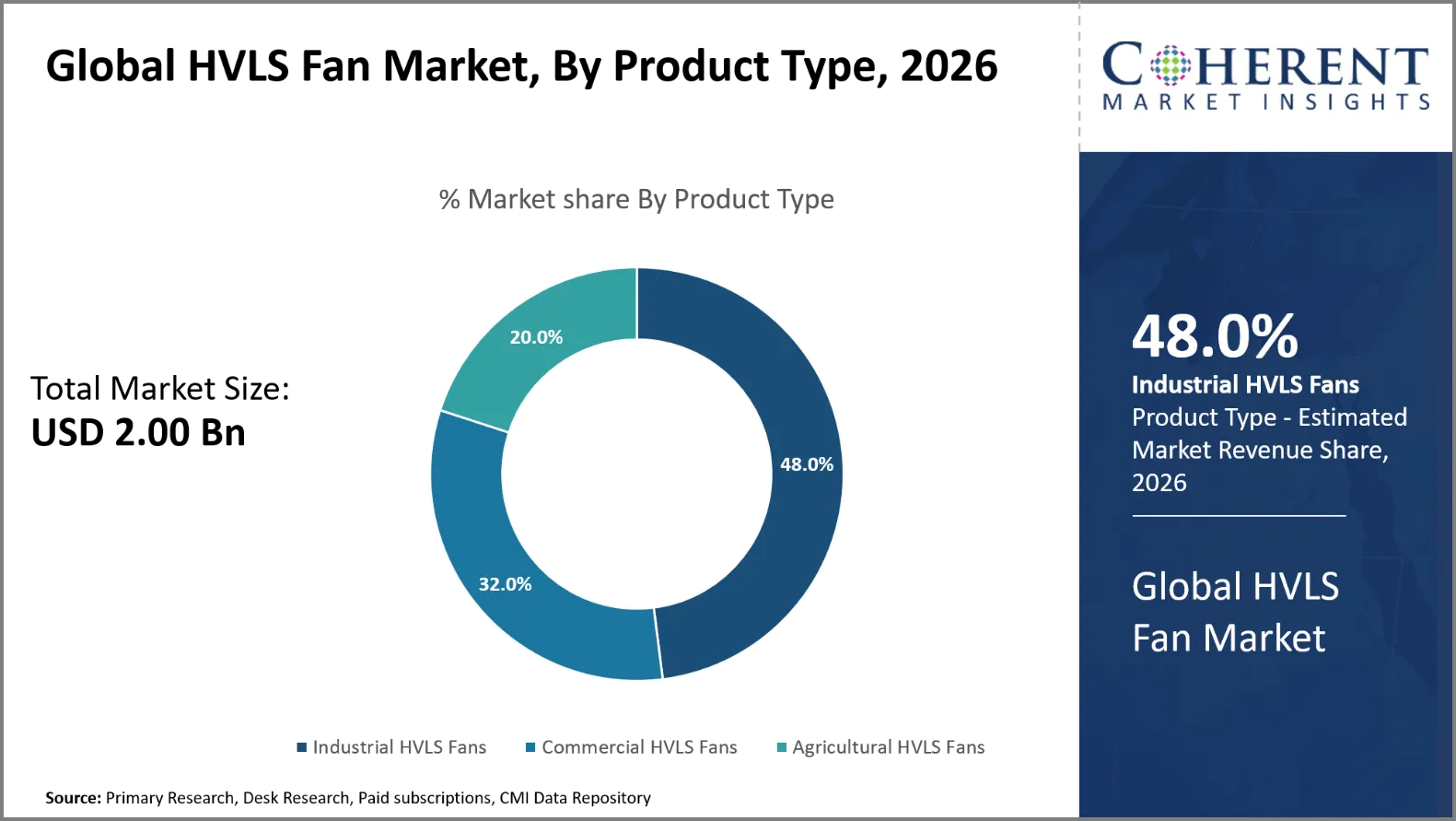
- The Industrial HVLS Fans segment is expected to account for 48.0% of the global HVLS fan market share in 2026. Rising demand for improved workplace thermal comfort is driving the growth of the segment. On May 8, 2025, Amazon India highlighted its workplace safety and employee health programs at its operational sites. Its initiatives include climate-controlled facilities, dedicated rest centers, and improved workplace safety arrangements.
- The AC Motor HVLS Fans segment is estimated to capture 51.0% of the market share in 2026. Increasing electricity costs encouraging efficient ventilation alternatives is majorly driving the growth of the segment. On January 9, 2025, Danfoss upgraded its factory ventilation system at Loves Park, Illinois, using an energy-efficient EC+ configuration. The installation combines a Novenco ZerAx axial fan, permanent magnet motor, and Danfoss VLT HVAC Drive FC 102.
- The Ceiling-Mounted HVLS Fans segment is estimated to capture 46.0% of the market share in 2026. Growing use of HVLS fans alongside conventional HVAC systems is driving the growth of the segment. On February 12, 2026, Baumann Consulting recorded HVAC commissioning activities for Amazon’s 1.17 million square foot Fontana distribution warehouse. The facility incorporates 61 rooftop units, heat pumps, and HVLS fans.
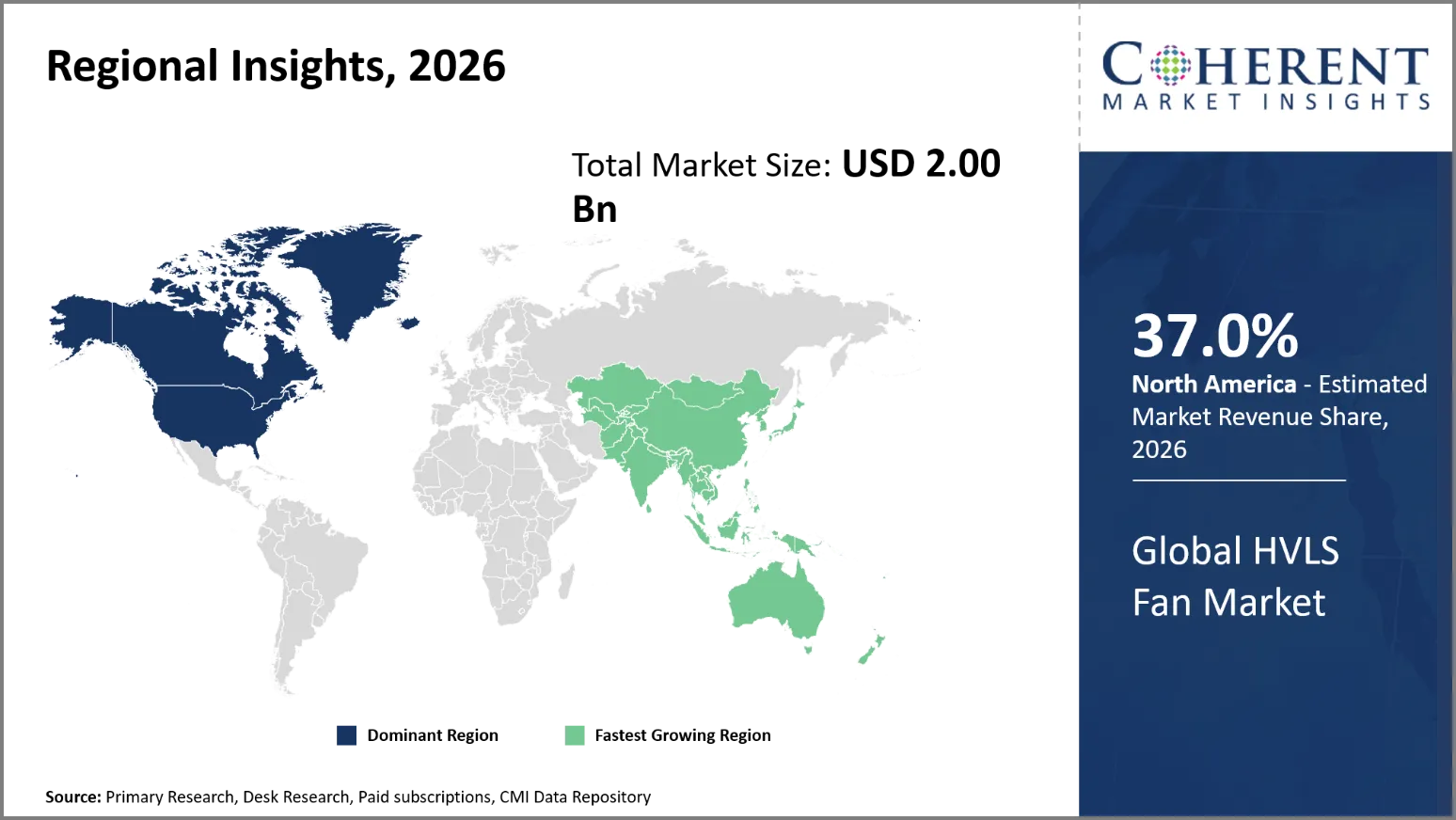
- North America is expected to dominate the HVLS fan market in 2026 with a market share of 37.0%. Growing adoption of HVLS fans in agricultural buildings in North America is driving the growth of the regional market. On February 6, 2026, VES-Artex expanded its cow-comfort and ventilation portfolio by introducing a dedicated HVLS fan. The product targets dairy barns, livestock facilities, equipment storage buildings, and commercial spaces.
- Asia Pacific is expected to account for 31.0% share in 2026. Expansion of commercial spaces, sports facilities, and distribution centers in Asia Pacific is driving the growth of the regional market. On February 19, 2025, Haines Beef Farm installed an eight 20-foot Altra-Air Sailfin HVLS fans, to increase air movement and the comfort of the animals. The farm faced respiratory issues with yearlings, moisture build up, and temperature variations within the barn.
Segmental Insights
Why Does Industrial HVLS Fans Dominate the Global HVLS Fan Market?
The industrial HVLS fans segment is expected to account for 48.0% of the global HVLS fan market share in 2026. The most common product type is an industrial HVLS fan. Warehouses and factories demand constant air movement across large floor areas. The heat builds up in these buildings, and the temperatures are uneven and there is not enough natural ventilation. Industrial HVLS fans create thermal comfort through good air movement and temperature destratification. The wide blade diameters make the device less dependent on several typical ventilation systems. Condensation is also minimized in manufacturing facilities, which makes working conditions better. There’s a growing emphasis on energy efficient ventilation in distribution centers across high ceiling storage environments.
On April 7, 2026, Lincoln Electric Automation installed Z-Tech and Z-Tech3 industrial HVLS fans at its Bettendorf, Iowa manufacturing facility. The assembly room was more than 25,000 square feet and had ceilings around 35-feet high.
- Current Industry Events of 2026
- Market Size Estimation
- Regional Breakdown
- Competitive Landscape
- Customer Intelligence
- Segmental Analysis
- Pricing Analysis
- Key Market Drivers, Challenges & Future Trends
- Customized Insights Section
Why is AC Motor HVLS Fans the Most Preferred Motor Type?
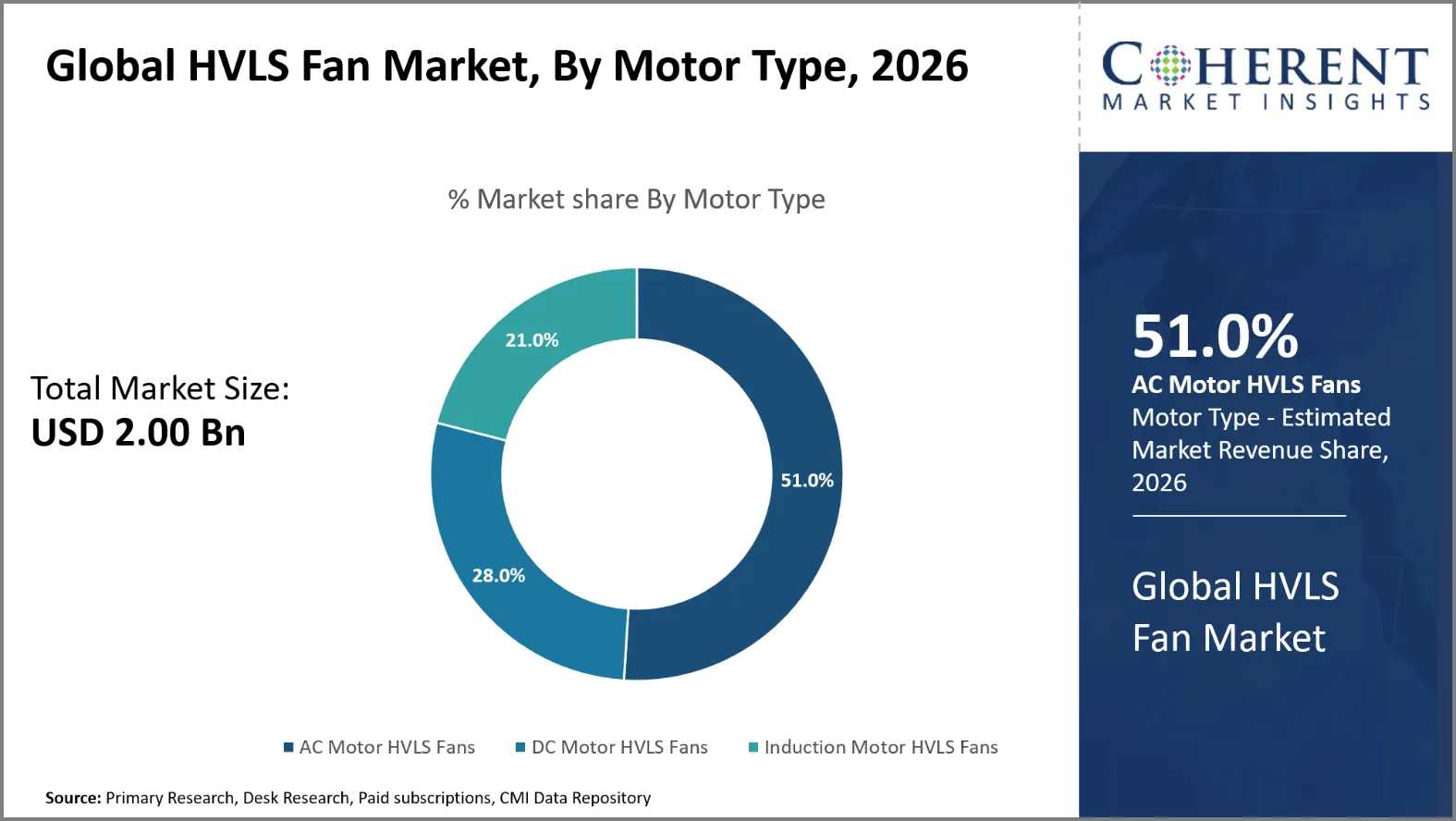
The AC motor HVLS fans segment is expected to account for 51.0% of the global HVLS fan market share in 2026. AC motor HVLS fans remain the top choice as they provide consistent performance in challenging industrial applications. AC induction motors offer steady performance for longer operation. They have the electrical infrastructure proven to make it easy to install in warehouses and manufacturing facilities. In industrial models, gearboxes are often coupled with AC motors to provide controlled, high-volume airflow. These setups are suitable for applications that require reliable ventilation for large interior spaces. There are also AC motors which cuts down on maintenance and replacement. They can run continuously in an industrial setting, which is why plant operators like them.
On December 31, 2025, Greenheck announced the redesign of its DS-3 three-bladed and DS-6 six-bladed High Volume Low Speed (HVLS) overhead fans, designed to provide major performance benefits, best-in-class reliability, advanced configurability and ease of installation for a variety of applications.
Ceiling-Mounted HVLS Fans Dominates the Global HVLS Fan Market
The ceiling-mounted HVLS fans segment is expected to account for 46.0% of the global HVLS fan market share in 2026. Ceiling-mounted HVLS fans are the most popular since they cover a large area with a large volume of air without taking up valuable floor space. Their raised position allows free circulation for people, forklifts and material handling equipment. Big overhead blades move air in huge industrial and commercial spaces. They assist eliminate stagnant air pockets and temperature stratification in their operation. Reverse operation also circulates warm air that has built up during cold spells. Ceiling mounted solutions are good for warehouses, industries, shopping centers, gyms and distribution facilities. Efficient ventilation and better usage of space are driving uptake by facilities looking for functional benefits.
On April 7, 2026, Compass Electrical Solutions installed two HVLS fans within the Mary Institute and Saint Louis Country Day School natatorium. The addition helped increase the movement of air through the school’s swimming complex. The goal was to provide improved comfort for athletes, employees and spectators.
Current Events and their Impact
Current Events | Description and its Impact |
European Union - Ecodesign Regulation (EU) 2024/1834 |
|
U.S. Department of Energy Ceiling Fan Energy Conservation Standards, 10 CFR 430.32(s)(1), under the Energy Policy and Conservation Act |
|
HVLS Fan Market Dynamics
Market Drivers
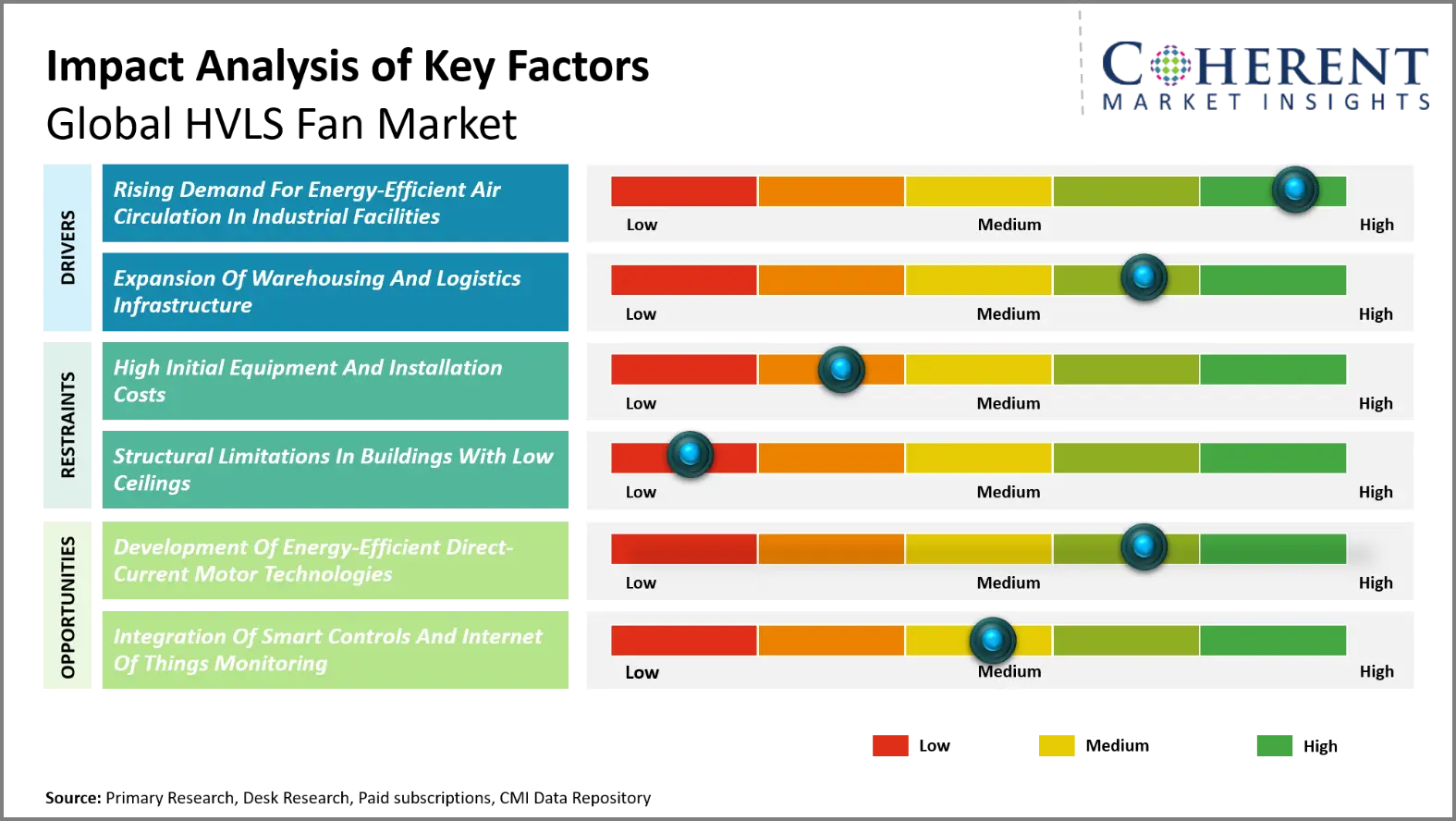
- Rising Demand for Energy-Efficient Air Circulation in Industrial Facilities: Industrial facilities are increasingly focusing on energy-efficient air circulation to reduce operational expenses and improve working conditions. Densely inhabited workstations along with machinery and industrial processes contribute to heat build-up in manufacturing plants. HVLS fans move enormous quantities of air at relatively low rotational speeds. This helps to improve the apparent cooling effect and allows for destratification of temperature inside large spaces. These features can decrease reliance on energy-intensive traditional ventilation and cooling systems. Facility operators are encouraged to look at efficient air movement systems as electricity costs rise. Manufacturers are also adding modern motor systems and smart controls to maximize electricity use. HVLS fan installations are in demand due to a growing focus on industrial energy management.
- On June 30, 2025, Modine released the DSU destratification fan for manufacturing centers, warehouses and other industrial buildings. The product includes a high efficiency electronically commutated motor with continuously variable speed control. It provides up to 6,500 cubic feet per minute of axial airflow.
- Expansion of Warehousing and Logistics Infrastructure: The rising warehouse and logistics infrastructure is raising the need for HVLS fans in industrial sites across the globe. The development of e-commerce is driving investment in distribution centers, fulfillment warehouses and automated storage facilities. They usually have high ceilings and large floor areas that require constant air circulation. HVLS fans can move air across a broad area, while still leaving the floor space uncluttered. Their functioning assists in fighting temperature stratification and stagnant air in tightly loaded warehouses. Logistics operators are increasingly concerned about employee comfort and proper working environments. Also, the growing investments in cold-chain infrastructure offer prospects for niche air circulation applications. Continued building and refurbishment of warehouses is projected to aid installations of industrial HVLS fans.
- On November 21, 2025, Rhenus Logistics launched a major distribution center for IKEA in Farrukhnagar, Gurugram, India. The facility is spread over 180,000 square feet. The site provides storage and fulfillment for more than 7,000 IKEA items. It has a storage capacity of 12,000 cubic meters and advanced material handling technologies.
Emerging Trends
- Integration of Smart Controls and Internet of Things-Based Monitoring: HVLS fan manufacturers are combining smart controls, variable-speed drives and Internet of Things connectivity. These systems allow for automated modifications of airflow based on temperature, occupancy and operating schedules.
- Impact: Intelligent controls increase energy management and reduce needless fan operation. Automation also helps building managers maintain consistent indoor comfort while tracking equipment performance and maintenance needs.
- Relevance to the market: This trend provides prospects for makers of connected industrial ventilation systems. Big Ass Fans’ i6 fan platform highlights the importance of integrated controls and automation in advanced airflow management.
- Development of Direct-Drive and Energy-Efficient Motor Technologies: Manufacturers are rapidly producing direct drive HVLS fans employing permanent magnet and electronically commutating motor technologies. These arrangements decrease mechanical complexity and increase operational efficiency.
- Impact: With direct drive systems, the typical maintenance requirements connected to gearboxes are removed. Improved motor efficiency can minimize electrical use, reduce maintenance, and improve long-term operating economics in industrial facilities.
- Relevance to the market: This development promotes competition in motor efficiency and maintenance costs. MacroAir’s direct-drive fan technologies are an example of the increasing business interest in streamlined industrial fan setups.
Regional Insights
Why is North America a Strong Market for HVLS Fan?
North America is expected to account for a market share of 37.0% in 2026. North America enjoys massive automobile production, large scale commercial infrastructure and industrial warehousing. HVLS fans are being increasingly integrated into the heating, ventilation and air-conditioning systems of U.S. distribution facilities. There are other chances inside the manufacturing industry in Canada, especially within the plants that make cars and work with metals. Camcor Manufacturing of Ontario installed nine MacroAir HVLS fans and improved perceived employee comfort by up to 8 degrees Fahrenheit. The project also qualified for an energy rebate of CAD 24,000. Four 20-Foot Fans Installed at Corvex Manufacturing to Improve Airflow at Production Facility. These installations demonstrate demand for integrated ventilation, employee comfort, and industrial energy management.
Why Does Asia Pacific HVLS Fan Market Exhibit High Growth?
Asia Pacific is expected to register the fastest growth with a CAGR of 3.4% over the forecast period. It is projected to account for 31.0% of the global HVLS fan market in 2026. The region is benefitting from growth in manufacturing, industrial automation and specialized warehousing development. In 2025, China’s equipment manufacturing and high-technology manufacturing industries expanded by 9.2% and 9.4%. Australia's distribution system also caters for commercial HVLS installations. CEVA Logistics has teamed up with Dexion Logistics to build warehouses with over 100,000 pallet placements. The project includes HVLS technologies that were meant to optimize airflow in distribution facilities. Also, in food processing and in industrial manufacturing Australian manufacturers use huge diameter fans. These advancements offer unique opportunities in industrial clusters, logistical networks and in temperature sensitive production environments.
Global HVLS Fan Market Outlook for Key Countries
Why is U.S. Emerging as a Major Hub in the HVLS Fan Market?
The U.S. market is benefitting from huge distribution centers, automotive production and industrial building upgrading. Air flow around loading docks and temperature sensitive storage spaces is becoming a bigger concern for food distributors in Texas. In 2016, Hunter Fan launched its commercial and industrial HVLS series of products, using direct-drive motor technology. The development incorporated Mitsubishi Electric Automation’s unique variable-frequency drive architecture. BlueScope Buildings has installed four 5.5-metre Powerfoil X2.0 fans at its North Carolina manufacturing facility. These projects show need for sophisticated motor controls, industrial worker comfort and ventilation improvements throughout manufacturing and distribution businesses.
Is China the Next Growth Engine for the HVLS Fan Market?
The large-scale industrial manufacturing, machinery production and factory growth give China’s HVLS fan market advantages. manufacture output climbed by 6.4% and automotive manufacture by 11.5% in 2025. Industrial robot output was also up 28%, a sign of more factories automating. These advances promote need for unimpeded airflow throughout automated production lines and machinery dense facilities. Ventilation is crucial for electronics manufacturing clusters in Guangdong, Jiangsu, and Zhejiang, where production is carried out in huge buildings. There are also prospects for ceiling-mounted industrial ventilation in automotive and electric vehicle manufacturing plants. The ability to manufacture domestically enables competitive sourcing of industrial fan components and motor systems.
Germany HVLS Fan Market Analysis and Trends
Germany’s HVLS fan market is supported by automotive engineering, industrial machinery manufacture, and specialist manufacturing facilities. The country manufactured 4.15 million passenger automobiles in 2025, which raised ventilation needs at automotive manufacturing plants. For example, the assembly halls and the production of components of Volkswagen, BMW and Mercedes-Benz manufacturing plants can be used. Germany’s engineering-heavy sectors also demand efficient airflow around welding stations, machinery and material-handling processes. As industrial energy efficiency gains importance, producers are looking to destratification and better ventilation. Industrial modernization and automated production layouts offer more prospects for improved HVLS installations.
Japan HVLS Fan Market Analysis and Trends
HVLS fans are finding markets in Japan in automobile manufacture, electronics manufacturing and highly automated industrial facilities. Toyota, Honda and Nissan car assembly plants require enough ventilation for their vast manufacturing buildings. Electronics firms also have specific facilities where heat created by equipment needs to be managed effectively. The industrial production index of Japan stood at 100.9 (2020=100) in the yearly average of 2025. Efficient circulation of above air is permitted by the developed machines and robotics businesses in the country. Also industrial operators are more and more demanding a comfortable workplace, not hindering the automated material-handling systems.
India HVLS Fan Market Analysis and Trends
The HVLS fan market is being driven by growing production clusters, expansion of industrial corridors, and construction of specialized warehouses in India. As of December 2025, the Government of India had identified 4,523 industrial parks around the country. These parks provide chances in manufacturing, logistical and processing facilities. Austar Technologies recently installed four 24-foot HVLS fans in a 48,000 square foot manufacturing facility in Ahmedabad. The idea was to mitigate floor condensation that occurred during monsoons and poor ventilation across storage aisles. Other applications include fabrication workshops, textile processing facilities, dairy barns and transit terminals. Domestic manufacturing capabilities also support product availability and customized installation requirements
Global HVLS Fan Market - Replacement Cycles for Industrial Fan Motors and Controllers
Component Or Maintenance Activity | Indicative Interval or Service Life | Operating Basis | Manufacturer Reference |
Industrial electric motor service life | 30000-40000 operating hours | General industrial motor reference | U.S. Department of Energy |
Continuous-duty motor overhaul | Every 5-6 years | Continuous operation under normal service conditions | Natural Resources Canada |
Induction motor bearing grease life | Approximately 30000 hours | Continuous operation at rated torque and 30°C ambient temperature | Oriental Motor |
Brushless motor bearing grease life | Approximately 40000 hours | Continuous operation under specified reference conditions | Oriental Motor |
Motor replacement warranty | 5 years | Hunter Industrial covered products purchased from October 1, 2025 | Hunter Industrial warranty documentation |
How is Development Of Energy-Efficient Direct-Current Motor Technologies Creating New Growth Opportunities in the HVLS Fan Market?
HVLS fans benefit from the evolution of energy-efficient direct-current motor technologies that provide better speed control and lower mechanical losses. Brushless direct-current motors have no brushes, so there’s less friction-related wear and less routine repair. Permanent magnet arrangements also provide substantial torque at relatively low rotational speeds, enabling big diameter fan operation. These features are advantageous for warehouses that need longer operating hours and adjustable airflow. For example, business interest in eliminating conventional gearbox configurations is demonstrated by MacroAir’s direct-drive HVLS solutions. Advanced electronic controllers offer more accurate speed adjustments based on occupancy and temperature conditions.
Nidec’s Blade Runner range of brushless permanent-magnet motors in 1 HP and 2 HP variants supports the commercial opportunities. ABB’s LFH platform offers integrated controls and IP65 protection for 6.5- to 23-foot fans. These advancements enable producers to aim at applications where less maintenance, quieter operation and accurate airflow control are required.
Market Players, Key Development, and Competitive Landscape
Key Developments
- On June 11, 2026, Vindus announced the launch of two new additions to their HVLS fan product range: the E680 Series HVLS Fans and the E730 Series HVLS Fans. Designed to suit a range of space sizes and fitting needs, these new series offer functional air movement for commercial, industrial, logistics, retail, hospitality and public facility contexts.
- On June 10, 2026, Softwave Fans Pvt. Ltd. announced the launch of Blu Ocean Kool, a new industrial HVLS fan line spanning 8-ft to 24-ft diameters and built on a liquid-cooled permanent-magnet direct-drive motor platform. Engineered to keep its motor cool during the longest, hottest industrial shifts, Blu Ocean Kool delivers dependable airflow for the lifetime of the facility it serves.
- On November 28, 2024, SUNON Electric Co., Ltd. won the 2025 Taiwan Excellence Award for their Powerful HVLS Fan Series 10. The judges gave great praises to the Powerful HVLS Fan Series 10 industrial energy-saving ceiling fan for its outstanding design and performance. The product adopts the high efficiency BLDC direct drive motor, and the motor efficiency is more than 90%, which can save a lot of energy.
Competitive Landscape
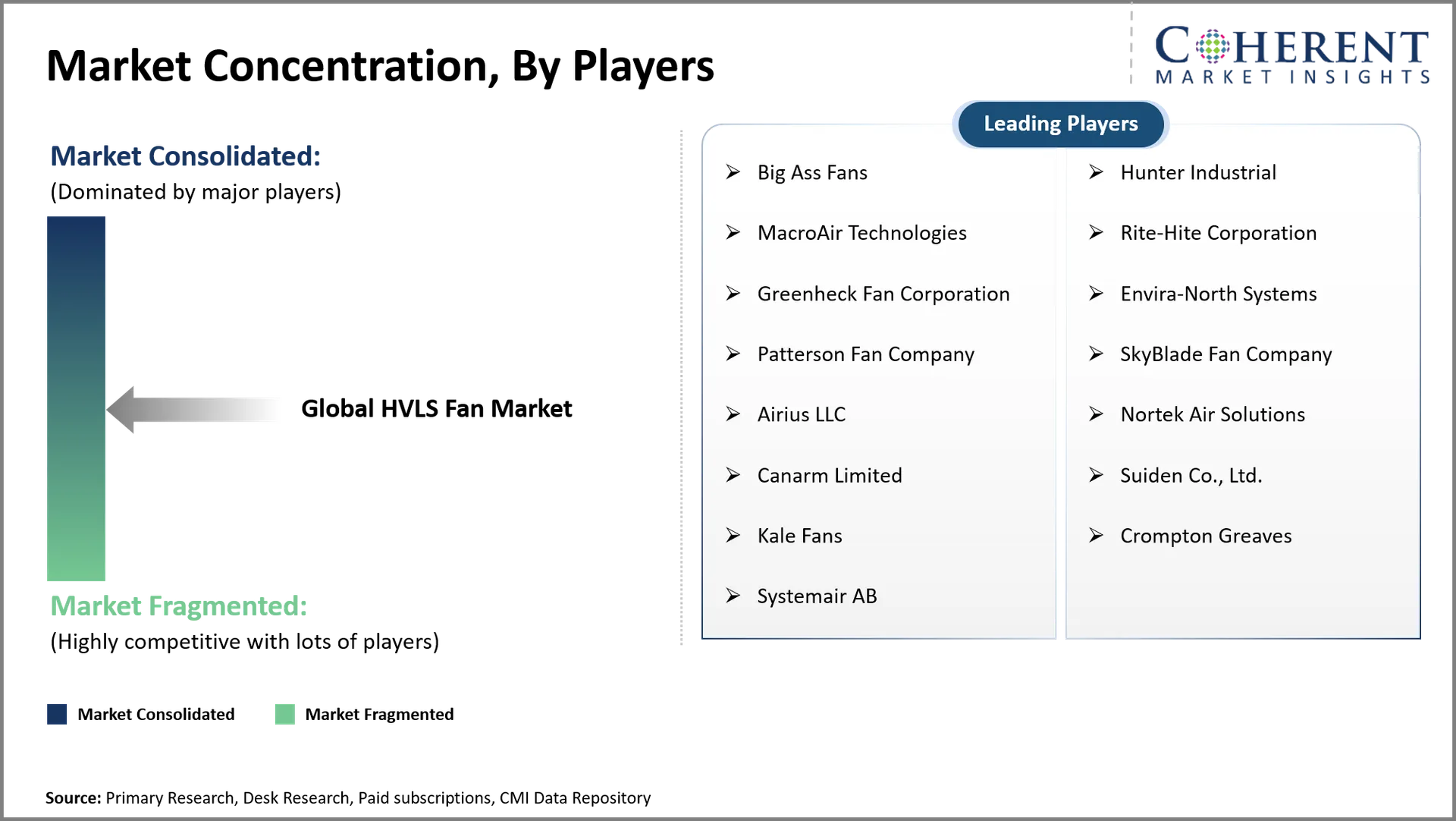
The global HVLS fan market is characterized by the presence of manufacturers in the industrial airflow, motor engineering, and commercial ventilation. Big Ass Fans stands apart with enormous diameter fans, direct drive technology and smart controls. Its Powerfoil X4 variant is aimed at harsh industrial conditions while its i6 platform is geared toward commercial applications. MacroAir specializes in energy efficient, direct drive design industrial airflow systems. Greenheck uses their line of commercial ventilation products to serve industrial and institutional customers. Hunter Industrial focuses on direct drive motors and variable speed controls for the warehouse and manufacturing industries. Ziehl-Abegg intensifies competitiveness using modern motor technology and electronically controlled fan technology. Manufacturers increasingly compete through installation expertise, customized blade configurations, maintenance support, and integrated building controls.
Top Manufacturers and Notable Products in the HVLS Fan Market
Manufacturer | Notable Product | Key features |
Big Ass Fans | Powerfoil X4 | NitroSeal maintenance-free gearbox, patented aerodynamic airfoils, IP56 protection, variable-speed controls, BAFCon smart controls |
MacroAir Technologies | AirVolution | Integrated gearmotor, forward and reverse operation, variable speed, digital wall control, fire-alarm integration |
Greenheck Fan Corporation | DS-3 and DS-6 | Direct-drive motor, extruded aluminum airfoils, integrated variable-frequency drive options, advanced safety systems, airflow up to 281,700 CFM for DS-6 |
Hunter Industrial | Titan | Direct-drive motor, five structural-grade aluminum blades, adjustable down rod, building management integration, limited lifetime warranty |
Rite-Hite Engineered Solutions Group | Revolution | Propell-Aire aluminum blades, Vortex Tips, adjustable speed control, three-way motor-to-hub safety connection, wireless controls |
Market Report Scope
Global HVLS Fan Market Report Coverage | |||
Report Coverage | Details | ||
Base Year | 2025 | Market Size in 2026: | USD 2.00 Bn |
Historical Data For: | 2020 To 2024 | Forecast Period: | 2026 To 2033 |
Forecast Period 2026 To 2033 CAGR: | 3.00% | 2033 Value Projection: | USD 2.75 Bn |
Geographies covered: |
| ||
Segments covered: |
| ||
Companies covered: | Big Ass Fans, Hunter Industrial, MacroAir Technologies, Rite-Hite Corporation, Greenheck Fan Corporation, Envira-North Systems, Patterson Fan Company, SkyBlade Fan Company, Airius LLC, Nortek Air Solutions, Canarm Limited, Suiden Co., Ltd., Kale Fans, Crompton Greaves, Systemair AB | ||
Growth Drivers: |
| ||
Restraints & Challenges: |
| ||
Analyst Opinion (Expert Opinion)
- The future of the HVLS fan industry will increasingly depend on direct-drive motors, intelligent controls, and application-specific airflow engineering. Manufacturers will move beyond conventional ceiling fans toward integrated industrial air-management solutions. Brushless direct-current motors and permanent magnet technologies will attract greater attention because they reduce mechanical complexity. Facility operators can connect fan speeds to building ventilation systems using connected controls. Opportunities exist for manufacturers creating corrosion resistant blades and dust shielded motor enclosures throughout challenging industrial environments. Product differentiation will increasingly depend on operating efficiency, installation flexibility, and long-term maintenance requirements.
- The maximum growth opportunities will emerge in industrial warehouses, automotive manufacturing plants, logistics centers, and large agricultural facilities. Direct-drive HVLS fans with brushless motors will offer attractive opportunities for facilities requiring continuous operation. The U.S. and China will remain major markets because of their large industrial base. India presents huge prospects with new manufacturing clusters, logistics parks and commercial complexes. Germany and Japan have niche potential in car assembly, precision manufacturing and automated production plants. Manufacturers should focus on unique diameters, blade designs for specialized applications and environment resistance combinations.
- Competitive positioning should be strengthened through regional manufacturing, technological alliances, and the development of products for specialized applications. Direct-drive units can be fitted with sophisticated variable-frequency drives to satisfy a variety of industrial airflow requirements. Also, manufacturers should offer installation audits, airflow simulations and preventative maintenance services. Regional accessibility can be enhanced through distribution relationships in China and Southeast Asia. The product portfolios should include unique configurations for food processing, automotive factories, textile facilities and cold-storage warehouses. Companies investing in independently verified airflow performance and simplified installation systems can strengthen customer confidence. These strategies can improve differentiation and support long-term industrial customer relationships.
Speak to the analyst
Want personalized insights?
Take the findings above to one of our principal consultants, or have the report rebuilt around the segments, geographies and competitors you actually track.
Market Segmentation
- Product Type Insights (Revenue, USD Billion, 2021 - 2033)
- Industrial HVLS Fans
- Commercial HVLS Fans
- Agricultural HVLS Fans
- Motor Type Insights (Revenue, USD Billion, 2021 - 2033)
- AC Motor HVLS Fans
- DC Motor HVLS Fans
- Induction Motor HVLS Fans
- Installation Type Insights (Revenue, USD Billion, 2021 - 2033)
- Ceiling-Mounted HVLS Fans
- Wall-Mounted HVLS Fans
- Pole-Mounted HVLS Fans
- Application Insights (Revenue, USD Billion, 2021 - 2033)
- Warehousing and Logistics
- Manufacturing Facilities
- Agricultural Buildings
- Commercial Buildings
- Sports and Entertainment Facilities
- Retail and Hospitality
- Others
- End User Insights (Revenue, USD Billion, 2021 - 2033)
- Industrial
- Commercial
- Agricultural
- Institutional
- Residential
- Regional Insights (Revenue, USD Billion, 2021 - 2033)
- North America
- U.S.
- Canada
- Latin America
- Brazil
- Argentina
- Mexico
- Rest of Latin America
- Europe
- Germany
- U.K.
- Spain
- France
- Italy
- Russia
- Rest of Europe
- Asia Pacific
- China
- India
- Japan
- Australia
- South Korea
- ASEAN
- Rest of Asia Pacific
- Middle East
- GCC Countries
- Israel
- Rest of Middle East
- Africa
- South Africa
- North Africa
- Central Africa
- North America
- Key Players Insights
- Big Ass Fans
- Hunter Industrial
- MacroAir Technologies
- Rite-Hite Corporation
- Greenheck Fan Corporation
- Envira-North Systems
- Patterson Fan Company
- SkyBlade Fan Company
- Airius LLC
- Nortek Air Solutions
- Canarm Limited
- Suiden Co., Ltd.
- Kale Fans
- Crompton Greaves
- Systemair AB
Sources
Primary Research Interviews
- HVLS Fan Manufacturers & OEMs
- Industrial Facility Managers & End-Users
- HVAC System Distributors & Dealers
- Warehouse & Logistics Sector Procurement Heads
Magazines
- HVACR Business Magazine
- Engineered Systems Magazine
- Facility Management Journal
- Industrial Distribution Magazine
Journals
- Journal of Building Engineering
- Energy and Buildings Journal
- Applied Thermal Engineering Journal
Associations
- Air Movement and Control Association International (AMCA)
- American Society of Heating, Refrigerating and Air-Conditioning Engineers (ASHRAE)
- Industrial Fabrics Association International (IFAI)
- National Electrical Manufacturers Association (NEMA)
Public Domain Sources
- U.S. Department of Energy (DOE) - Energy Efficiency Reports
- U.S. Environmental Protection Agency (EPA) - Indoor Air Quality Data
- International Energy Agency (IEA) - Building Energy Reports
- Eurostat - Industrial Energy Consumption Statistics
Proprietary Elements
- CMI Data Analytics Tool
- Proprietary CMI Existing Repository of Information for the Last 10 Years
Get access to 250+ pages report
Every segment, forecast, competitor profile and data table behind the analysis above — available for instant download.
- ESOMAR Member
- ISO 9001:2015 Certified
- D-U-N-S Registered
- GDPR & CCPA Compliant
Frequently Asked Questions
The global HVLS fan market is expected to stand at USD 2.00 Bn in 2026 and is expected to reach USD 2.75 Bn by 2033.
The CAGR of the global HVLS fan market is projected to be 3.0% from 2026 to 2033.
Rising Demand For Energy-Efficient Air Circulation In Industrial Facilities and Expansion Of Warehousing And Logistics Infrastructure are the major factors driving the growth of the global HVLS fan market.
High Initial Equipment And Installation Costs and Structural Limitations In Buildings With Low Ceilings are the major factors hampering the growth of the global HVLS fan market.
In terms of product type, industrial HVLS fans segment is estimated to dominate the market revenue share in 2026.
HVLS fans are large-diameter ceiling fans designed to circulate substantial air volumes at relatively low rotational speeds.
HVLS fans improve indoor air circulation, reduce temperature stratification, and enhance thermal comfort across large facilities.