

Global Hybrid Ceramic Bearings Market Size and Forecast – 2026 To 2033
The global hybrid ceramic bearings market is expected to grow from USD 560 Mn in 2026 to USD 800 Mn by 2033, registering a compound annual growth rate (CAGR) of 5.8% from 2026 to 2033. The global hybrid ceramic bearings market is driven by increasing use in industrial automation. On May 8, 2026, NSK Ltd. announced that it has signed a Memorandum of Understanding with Delta Electronics, Inc., a globally recognized leader in power, control, and automation, to advance collaboration in robotics. In conjunction with this agreement, NSK has positioned its robotics-related business as a key pillar of its medium- to long-term growth strategy.
Key Takeaways of the Global Hybrid Ceramic Bearings Market
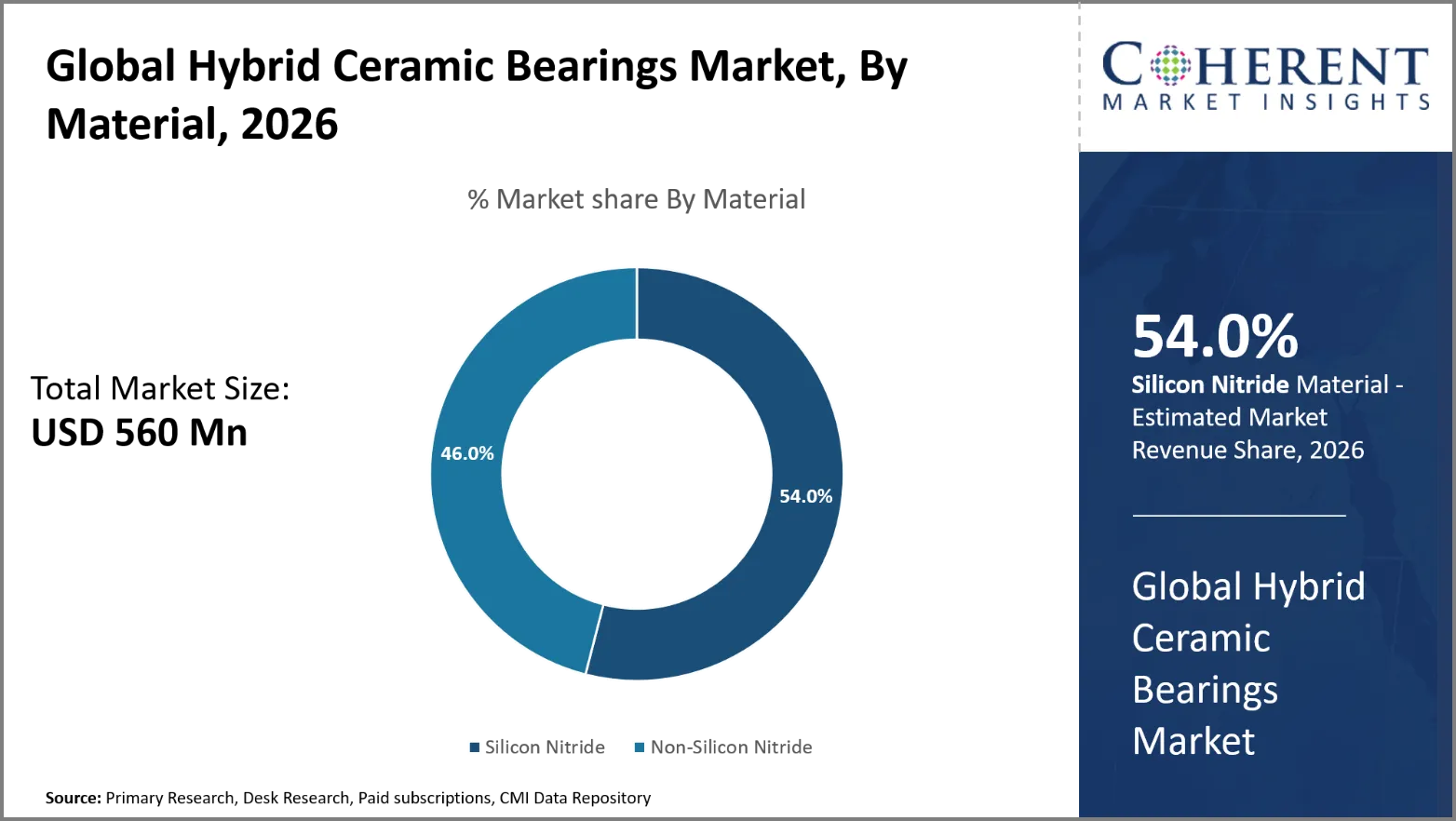
- The Silicon Nitride segment is expected to account for 54.0% of the global hybrid ceramic bearings market share in 2026. Growing adoption in machine tools is driving the growth of the segment. On September 10, 2025, Schaeffler introduced the three-row DKLFA-HC screw drive bearing at EMO 2025. The bearing uses ceramic rolling elements for short-stroke and oscillating applications.
- The Deep Groove Ball Bearings segment is estimated to capture 48.0% of the market share in 2026. Higher demand for electrically insulated bearings is majorly driving the growth of the segment. In January 2025, Schaeffler introduced improved J20G current-insulated bearings. The optimized Insutect A coating provides stronger protection against damaging electrical currents.
- The Transportation segment is estimated to capture 46.0% of the market share in 2026. Rising focus on lower friction and energy efficiency is majorly driving the growth of the segment. In March 2025, SK Ltd. developed a compact deep groove ball bearing for electric vehicle drive units. The design reduces outer diameter by approximately 10% and weight by 51%.
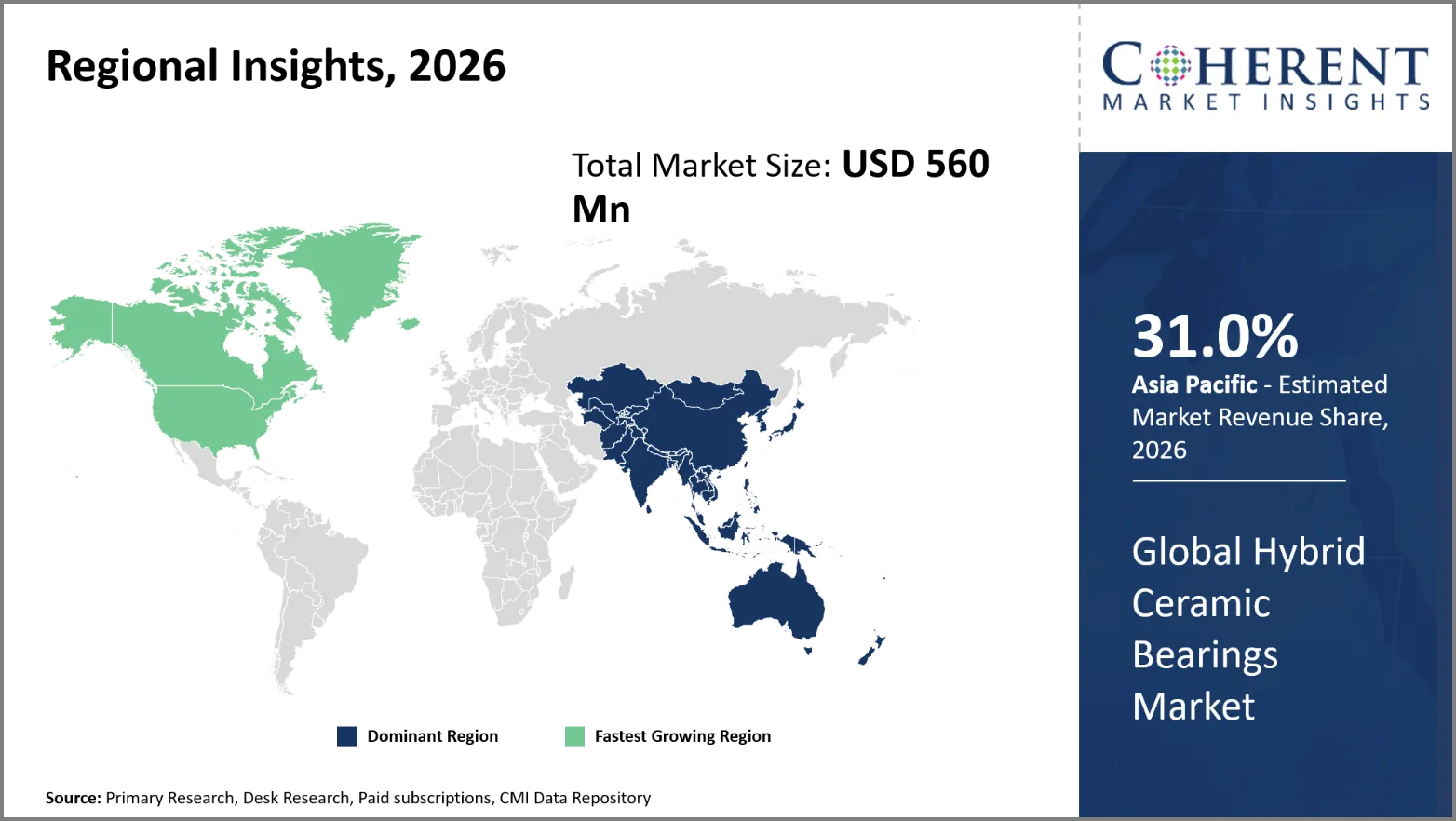
- Asia Pacific is expected to dominate the hybrid ceramic bearings market in 2026 with a market share of 31.0%. Increasing industrial robotics deployment in Asia Pacific is driving the growth of the regional market. On July 2, 2025, ABB expanded its Chinese robotics portfolio with three new robot families. The Lite+, PoWa, and IRB 1200 models target electronics, food, beverage, and metalworking manufacturers.
- North America is expected to account for 25.0% share in 2026 and is projected to record the fastest growth over the forecast period. Rising aerospace manufacturing activity in North America is driving the growth of the regional market. On March 12, 2025, GE Aerospace announced nearly USD 1 billion for U.S. manufacturing and supply-chain investments.
Segmental Insights
Why Does Silicon Nitride Dominate the Global Hybrid Ceramic Bearings Market?
The silicon nitride segment is expected to account for 54.0% of the global hybrid ceramic bearings market share in 2026. High wear and corrosion resistance, low density and exceptional hardness are characteristic of silicon nitride. The lower density means that lesser centrifugal forces can be used in high-speed bearing operation. The material also provides excellent electrical insulation for electric motors and other rotating machinery. Its thermal stability ensures reliable operation in extreme temperatures and speeds. Silicon nitride for aerospace, automotive, machine tools and industrial applications. These qualities make Schaeffler, for example, showed high-performance electric motors for electric and hybrid drives at bauma 2025. The motors have peak efficiency of more than 97 percent at speeds from 3,000 to 8,000 revolutions per minute. Schaeffler incorporated ceramic balls to reduce bearing friction and prevent damaging electrical currents. This demonstrates increasing use of ceramic rolling elements in high-speed electric machinery.
- Current Industry Events of 2026
- Market Size Estimation
- Regional Breakdown
- Competitive Landscape
- Customer Intelligence
- Segmental Analysis
- Pricing Analysis
- Key Market Drivers, Challenges & Future Trends
- Customized Insights Section
Why is Deep Groove Ball Bearings the Most Preferred Bearing Type?
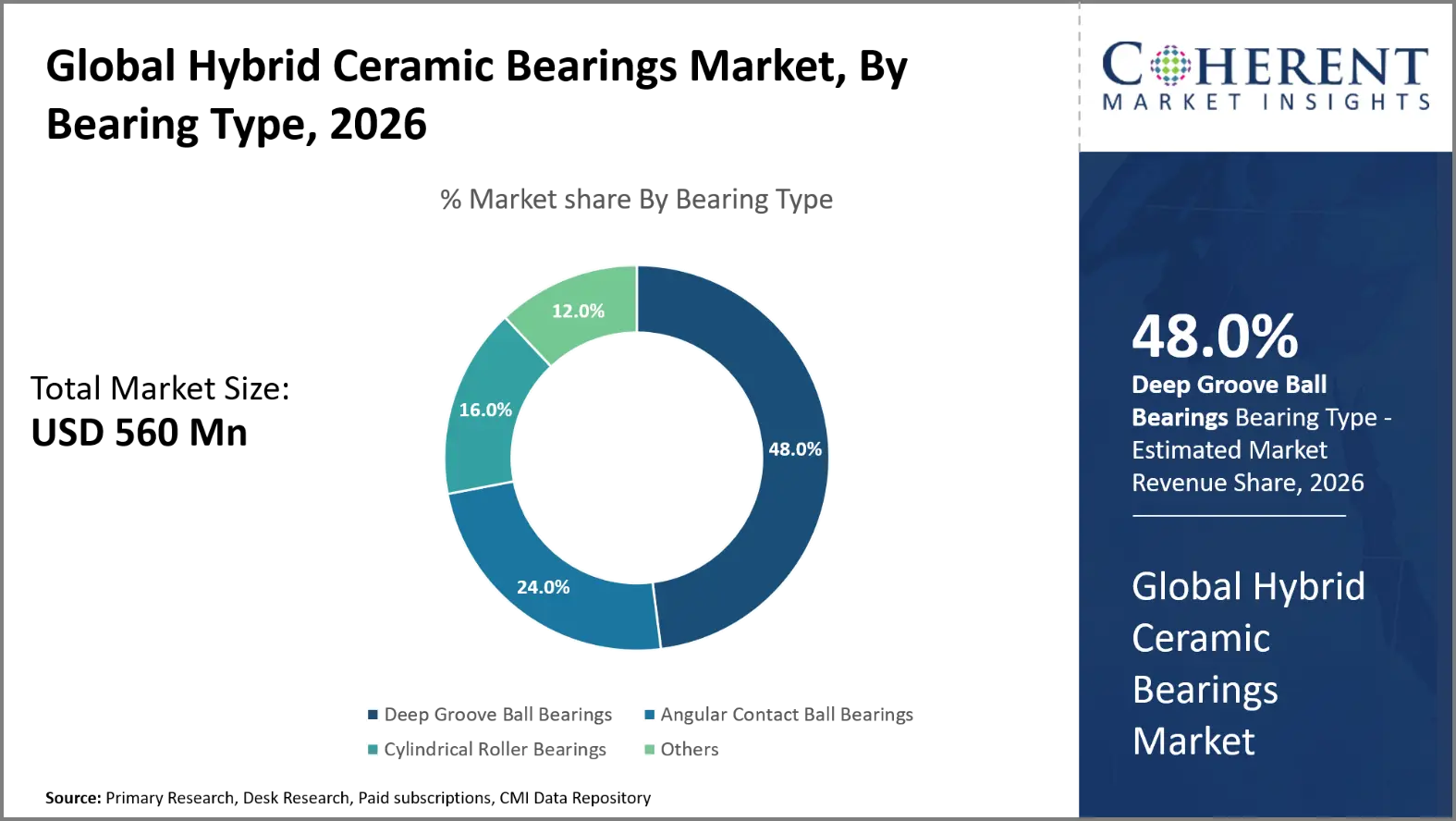
The deep groove ball bearings segment is expected to account for 48.0% of the global hybrid ceramic bearings market share in 2026. Compact equipment designs are supported by radial and light axial loads with deep groove ball bearings. Simple construction means it will operate reliably over a wide range of speeds. The low friction properties can help minimize energy consumption and operating temperatures during continuous use. It’s this versatility that makes them applicable to electric motors, industrial machinery, automobile systems and appliances. Their easy installation and the availability of standard dimensions make them attractive for use in many different sectors. On March 26, 2025, NSK extended its range of NSKHPS deep groove ball bearings for general-purpose industrial applications. The range includes many sizes and is centered on versatility, excellent accuracy and high-speed performance. NSK states that these bearings provide 15% longer bearing life than conventional designs. Applications include electric motors, fans, blowers, pumps, compressors, and semiconductor equipment.
Transportation Dominates the Global Hybrid Ceramic Bearings Market
The transportation segment is expected to account for 46.0% of the global hybrid ceramic bearings market share in 2026. Rising vehicle electrification is creating demand for bearings that can handle high speeds and electrical currents. Hybrid ceramic bearings reduce friction, and hence improve the efficiency of electric drivetrains and traction motors. The ceramic rolling elements also provide electrical insulation and limit the possibility of current-induced damage. Automotive manufacturers are increasingly looking for robust bearing solutions for compact, high-speed engine systems. These performance gains promote broader use in electric, hybrid and sophisticated transportation systems. NSK’s 2025 product development also continued to address the greater speeds and efficiency needs in electric vehicle drive units. The company’s EV bearing innovations focus on compact design, decreased friction and prevention of electrical degradation. NSK lists ceramic-ball-bearings as one of the methods to safeguard eAxles against electrical degradation. These standards are directly supporting the further use of hybrid ceramic bearings in electrified powertrains.
Current Events and their Impact
Current Events | Description and its Impact |
European Union - Regulation (EU) 2024/1781, Ecodesign for Sustainable Products Regulation |
|
European Union - Regulation (EU) 2023/1230 on Machinery |
|
Hybrid Ceramic Bearings Market Dynamics
 Market Drivers
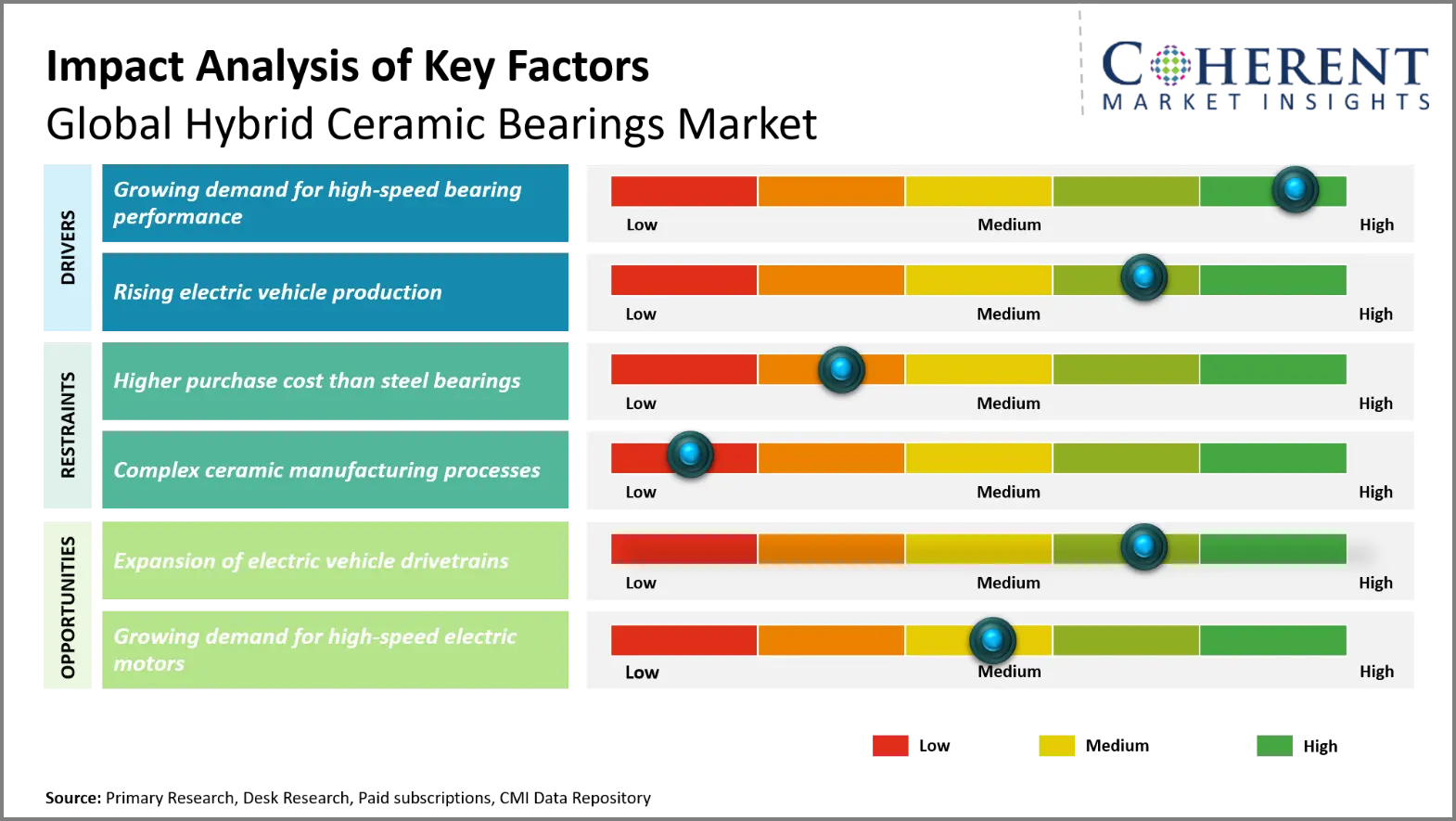
- Growing demand for high-speed bearing performance: The need for bearings that can perform under extreme rotational conditions in high-speed industrial equipment is increasing. Hybrid ceramic bearing show less friction and less centrifugal forces in operation at high speed. Their rolling elements, made from silicon nitride, also provide high wear resistance and thermal stability. These properties make them suitable for use in machine tools, turbines, compressors and high-speed electric motors. As equipment speeds increase, manufacturers are thus forced to employ improved bearing technologies. On October 4, 2024, NSK developed ROBUSTRIDE for high-speed machine-tool spindle applications The design allows an increase in rotating speed of about 20% with grease lubrication. It also minimizes the heat generated by running-in during operation. These advancements allow faster machining while minimizing bearing temperatures and energy losses
- Rising electric vehicle production: Increasing electric vehicle manufacturing is fueling demand for bearings that are used in high-speed electric motors and drivetrains. Hybrid ceramic bearings provide electric insulation and thus help to prevent the bearing damage caused by electricity. Their low friction properties can also contribute to greater drivetrain efficiency and less energy loss. The demand for smaller bearings with higher rotational speeds in electric vehicles is increasing, forcing electric vehicle makers to develop new solutions. This trend is driving stronger potential for the development of hybrid ceramic bearings in transportation applications. On June 30, 2025, BYD launched its one millionth Dolphin Mini. The BYD DOLPHIN MINI has taken only 27 months from its launch to the 1 million production milestone, becoming the world’s fastest pure electric +A00-level car to reach the 1 million milestone.
Emerging Trends
- Increasing Adoption in Electric Mobility: Electric vehicle manufacturers are employing hybrid ceramic bearings for high-speed traction motors and electric drivetrains. Electrical insulation limits damage from current and with less friction, they aid with efficient operation, longer component life and less maintenance.
- Growing Demand for High-Speed Industrial Equipment: Machine tools, turbines, compressors and industrial motors need bearings that can be depended on to run at high speeds. Hybrid ceramic bearings are suitable for demanding rotational applications due to decreased centrifugal forces, better thermal stability and good wear resistance.
- Expansion of Advanced Manufacturing: Manufacturers are developing superior silicon nitride materials and precise manufacturing procedures for ceramic rolling elements. These innovations are improving dimensional precision, surface quality and durability, and are enabling hybrid ceramic bearings to enter even more demanding industrial applications.
- Rising Focus on Bearing Energy Efficiency: Equipment makers are increasingly emphasizing components that reduce mechanical losses and operating temperatures. Hybrid ceramic bearings have reduced rolling friction than standard steel bearings, aiding energy-efficient machinery, electric motors and other continuous-duty equipment.
Regional Insights
Why is Asia Pacific a Strong Market for Hybrid Ceramic Bearings?
Asia Pacific is expected to account for a market share of 31.0% in 2026. The region benefits from semiconductor equipment, electric motors, and precision manufacturing expansion. Japan and South Korea are strengthening hybrid bearing applications in vacuum and clean manufacturing equipment. NSK specifically lists hybrid bearings for semiconductor manufacturing and organic light-emitting diode equipment. China is also becoming important for localized silicon nitride production. SKF formed a joint venture with Sinoma Nitride for ceramic rolling elements.
Why Does North America Hybrid Ceramic Bearings Market Exhibit High Growth?
North America is expected to register the fastest growth with a CAGR of 7.0% over the forecast period. It is projected to account for 25.0% of the global hybrid ceramic bearings market in 2026. The region benefits strongly from aerospace engineering and advanced electric machinery applications. Timken develops ceramic hybrid bearings for aircraft engines, generators, starters, and rotorcraft gear drives. The region also has established expertise in ceramic bearing development. SKF records early U.S. government-supported testing of silicon nitride bearing technology. Electric motor applications further benefit from electrical insulation against current-related bearing damage.
Global Hybrid Ceramic Bearings Market Outlook for Key Countries
Why is China Emerging as a Major Hub in the Hybrid Ceramic Bearings Market?
China is expanding hybrid ceramic bearing capabilities through localized silicon nitride production. SKF and Sinoma Nitride established a joint venture focused on ceramic rolling elements. SKF holds a 30% share in the venture. The cooperation specifically targets electric vehicles and precision machine tools. China therefore combines domestic ceramic-material development with expanding high-speed machinery requirements. This integration strengthens local supply capabilities for advanced bearing applications.
Is U.S. the Next Growth Engine for the Hybrid Ceramic Bearings Market?
The U.S. benefits from aerospace applications requiring lightweight components and high-speed performance. Timken supplies ceramic hybrid bearing technologies for aircraft engines, generators, starters, and rotorcraft gear drives. Earlier U.S. government-funded testing demonstrated long-term silicon nitride bearing operation above 500 degrees Celsius. These aerospace engineering programs created specialized expertise in ceramic rolling elements. The resulting capabilities continue supporting demanding aviation and high-performance machinery applications.
Germany Hybrid Ceramic Bearings Market Analysis and Trends
Germany benefits from machine-tool manufacturing and advanced industrial automation requirements. Schaeffler has used hybrid bearings in machine tools and aerospace engineering for decades. In 2025, Schaeffler introduced the three-row DKLFA-HC screw-drive bearing with ceramic rolling elements. The product targets short-stroke and oscillating applications in mold-making and medical technology. This development expands hybrid bearing usage beyond conventional high-speed spindle applications.
Japan Hybrid Ceramic Bearings Market Analysis and Trends
Japan benefits from precision machine tools, power-generation equipment, and specialized environmental machinery. NSK is developing hybrid bearings with ceramic balls for machine tools and power-generation applications. The bearings offer electrical isolation, maintain reduced friction, decrease centrifugal forces and give longer service life. Japanese manufacturers also provide bearings designed for vacuum and corrosive environments. These precision-engineering requirements support continued adoption across demanding industrial equipment applications.
South Korea Hybrid Ceramic Bearings Market Analysis and Trends
South Korea benefits from semiconductor manufacturing equipment requiring controlled, clean, and vacuum operating environments. NSK identifies hybrid bearings for vacuum and corrosive environments within semiconductor and organic light-emitting diode manufacturing equipment. These tough circumstances are supported by the use of ceramic balls and special self-lubricating cages. NSK states it also has the benefits of electrical isolation and lower friction with hybrid bearings. The requirements of specialist equipment carve out a specific path of progress for the use of sophisticated bearings. Increasing investments in waste-to-energy projects, biomass power generation, and integrated steel manufacturing further increase the demand for improved electrostatic precipitation technology.
Global Hybrid Ceramic Bearings Market - Hybrid Bearings for Humanoid and Industrial Robots
Company | Robot Application | Hybrid Bearing Relevance | Key Data |
Schaeffler | Industrial robots and handling systems | Ceramic rolling elements support precision and reliability | DKLFA-HC hybrid bearing launched for oscillating applications |
SKF | Industrial robotics and automation | Silicon nitride provides low friction and electrical insulation | Hybrid bearings support high-speed and automation applications |
Ceramic Speed | Industrial production equipment | Silicon nitride balls provide high hardness and reduced lubrication needs | Ceramic balls are twice as hard as steel |
NSK | Robotic and automated equipment | Hybrid bearing technology supports high-speed precision motion | Ceramic rolling elements provide electrical insulation |
Barden | Precision robotic mechanisms | Silicon nitride balls support high speed and low vibration | Ceramic balls are 60% lighter than steel |
How is Expansion of Electric Vehicle Drivetrains Creating New Growth Opportunities in the Hybrid Ceramic Bearings Market?
Expansion of electric vehicle drivetrains is creating opportunities because traction motors increasingly operate at higher rotational speeds than conventional powertrains. Hybrid ceramic bearings are electrically insulated so that harmful currents are not allowed to flow through the motor bearings. SKF, for instance, particularly cites hybrid bearings for electric vehicles such electric motors and generators. The ceramic rolling parts help decrease the friction and centrifugal forces at a high-speed rotation. This combination allows for compact electric motors demanding faster rotational speeds, more efficiency and more durability. The increasing use of high-speed permanent-magnet traction motors thus creates extra demand for hybrid bearing solutions.
On December 23, 2025, Tata Motors marked a significant milestone in India’s electric mobility journey with more than 250,000 TATA.ev vehicles on road. This milestone arrives at a time when electric mobility is decisively moving from the edges to the mainstream of India’s automotive market, an evolution of which Tata Motors has been at the center of shaping.
Market Players, Key Development, and Competitive Landscape
Key Developments
- On June 12, 2026, JTEKT Corporation developed grease-lubricated ceramic ball bearings optimized for eAxles in high-performance electric vehicles. This newly developed product incorporates rolling elements (ceramic balls) to prevent electrolytic corrosion, enable high-speed rotation, and extend grease life.
- On February 28, 2025, CeramicSpeed Industry announced its dedicated hybrid-bearing development for electric vehicles. The company identified high rotational speeds, electrical currents, durability, and efficiency losses as key engineering challenges.
Competitive Landscape
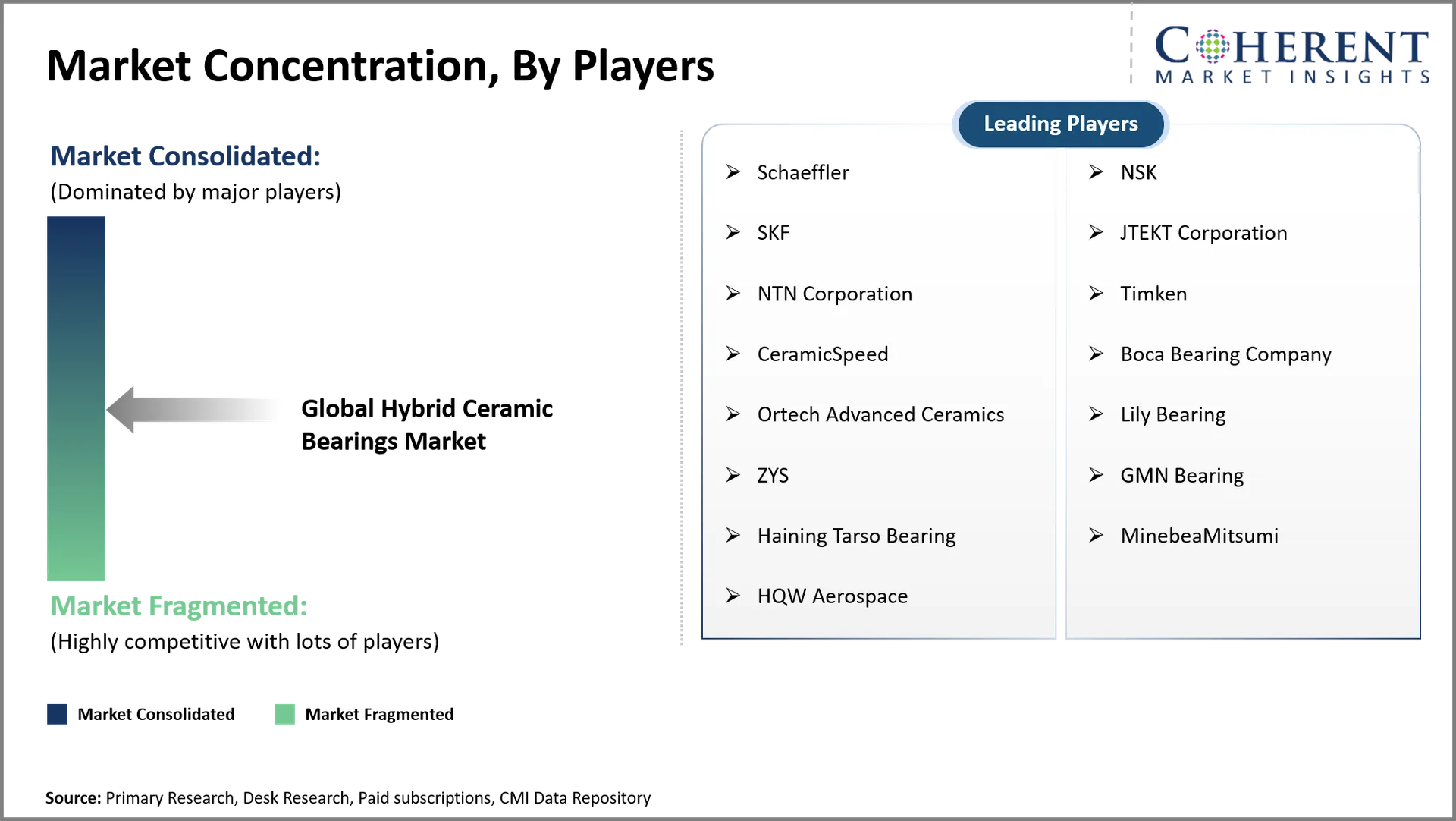
Schaeffler, NSK, SKF and Timken are the main players with a focus on electrification and high-speed machinery. Schaeffler has extended ceramic rolling-element bearings into screw-drive applications with its DKLFA-HC line. NSK is focused on electric vehicle drivetrains, including ceramic-ball eAxle bearings for electrical erosion and high-speed operation. SKF focuses on hybrid designs for traction motor bearings, using silicon nitride rolling elements for electrical insulation and reduced friction. Schaeffler also targets electric motors, traction motors, wind generators, machine tools, and vacuum pumps with hybrid bearing solutions.
Hybrid Ceramic Bearings Market Report Coverage | |||
Report Coverage | Details | ||
Base Year | 2025 | Market Size in 2026: | USD 560 Mn |
Historical Data For: | 2020 To 2024 | Forecast Period: | 2026 To 2033 |
Forecast Period 2026 To 2033 CAGR: | 5.8% | 2033 Value Projection: | USD 800 Mn |
Geographies covered: |
| ||
Segments covered: |
| ||
Companies covered: | Schaeffler, NSK, SKF, JTEKT Corporation, NTN Corporation, Timken, CeramicSpeed, Boca Bearing Company, Ortech Advanced Ceramics, Lily Bearing, ZYS, GMN Bearing, Haining Tarso Bearing, MinebeaMitsumi, HQW Aerospace | ||
Growth Drivers: |
| ||
Restraints & Challenges: |
| ||
Analyst Opinion (Expert Opinion)
- The industry is likely to move toward application-specific hybrid bearings rather than broadly standardized solutions. Electric motors will require higher rotational speeds, lower friction, and stronger protection against electrical erosion. NSK's recent electric vehicle bearing development specifically targets compact drive units requiring higher speeds and reduced friction. This direction should increase demand for silicon nitride rolling elements in demanding drivetrain and industrial applications.
- The strongest opportunities should emerge around electric vehicle eAxles, high-speed traction motors, and precision machine tools. China, Japan, Germany, and South Korea offer particularly attractive opportunities because their industries support these applications directly. NSK determines electric erosion and high-speed requirements for ceramic-ball eAxle bearings Moreover, there are potential in Germany for precision hybrid bearings in modern machine tool and industrial automation applications.
- Players should differentiate on ceramic material quality, electrical insulation, high speed capability and application specific engineering. The product development should be aimed at compact bearing designs that can accommodate higher motor speeds and tighter packaging requirements. Also, companies should partner with electric motor and drivetrain manufacturers early in the development of equipment. The benefit is shown in Schaeffler’s application-oriented product expansion, including ceramic bearings for a number of equipment and electrification applications.
Speak to the analyst
Want personalized insights?
Take the findings above to one of our principal consultants, or have the report rebuilt around the segments, geographies and competitors you actually track.
Market Segmentation
- Material Insights (Revenue, USD Million, 2021 - 2033)
- Silicon Nitride
- Non-Silicon Nitride
- Bearing Type Insights (Revenue, USD Million, 2021 - 2033)
- Deep Groove Ball Bearings
- Angular Contact Ball Bearings
- Cylindrical Roller Bearings
- Others
- Application Insights (Revenue, USD Million, 2021 - 2033)
- Transportation
- Machinery
- Energy
- Others
- Regional Insights (Revenue, USD Million, 2021 - 2033)
- North America
- U.S.
- Canada
- Latin America
- Brazil
- Argentina
- Mexico
- Rest of Latin America
- Europe
- Germany
- U.K.
- Spain
- France
- Italy
- Russia
- Rest of Europe
- Asia Pacific
- China
- India
- Japan
- Australia
- South Korea
- ASEAN
- Rest of Asia Pacific
- Middle East
- GCC Countries
- Israel
- Rest of Middle East
- Africa
- South Africa
- North Africa
- Central Africa
- North America
- Key Players Insights
- Schaeffler
- NSK
- SKF
- JTEKT Corporation
- NTN Corporation
- Timken
- CeramicSpeed
- Boca Bearing Company
- Ortech Advanced Ceramics
- Lily Bearing
- ZYS
- GMN Bearing
- Haining Tarso Bearing
- MinebeaMitsumi
- HQW Aerospace
Sources
Primary Research Interviews
- Bearing Manufacturers & OEMs
- Industrial Machinery & Equipment Suppliers
- Aerospace & Defense Component Distributors
- Automotive & EV Drivetrain System Integrators
Magazines
- Bearing & Power Transmission Magazine
- Machine Design Magazine
- Advanced Materials & Processes Magazine
- Lubrication & Maintenance Technology Magazine
Journals
- Journal of Tribology (ASME)
- International Journal of Advanced Manufacturing Technology
- Journal of the European Ceramic Society
Associations
- American Bearing Manufacturers Association (ABMA)
- European Bearing Manufacturers Association (EFBMA)
- American Ceramic Society (ACerS)
- International Federation of Industrial Energy Consumers (IFIEC)
Public Domain Sources
- U.S. International Trade Commission (USITC) Reports
- European Commission Industrial Reports
- United Nations Industrial Development Organization (UNIDO) Data
- World Trade Organization (WTO) Trade Statistics
Proprietary Elements
- CMI Data Analytics Tool
- Proprietary CMI Existing Repository of Information for Last 10 Years
Get access to 250+ pages report
Every segment, forecast, competitor profile and data table behind the analysis above — available for instant download.
- ESOMAR Member
- ISO 9001:2015 Certified
- D-U-N-S Registered
- GDPR & CCPA Compliant
Missing comfort of reading report in your local language? Find your preferred language:
Frequently Asked Questions
The global hybrid ceramic bearings market is expected to stand at USD 560 Mn in 2026 and is expected to reach USD 800 Mn by 2033.
The CAGR of the global hybrid ceramic bearings market is projected to be 5.8% from 2026 to 2033.
Growing demand for high-speed bearing performance and rising electric vehicle production are the major factors driving the growth of the global hybrid ceramic bearings market.
Higher purchase cost than steel bearings and complex ceramic manufacturing processes are the major factors hampering the growth of the global hybrid ceramic bearings market.
In terms of material, silicon nitride segment is estimated to dominate the market revenue share in 2026.
Hybrid ceramic bearings combine ceramic rolling elements, usually silicon nitride, with steel rings and other components.
Silicon nitride rolling elements have favorable tribological properties that can reduce rolling resistance under suitable operating conditions.