

Global In-Space Data Storage Market Size and Forecast – 2026 To 2033
The global in-space data storage market is expected to grow from USD 710.0 Mn in 2026 to USD 1,160.0 Mn by 2033, registering a compound annual growth rate (CAGR) of 12.3% from 2026 to 2033. The global in-space data storage market is driven by rising deployment of Earth observation satellite constellations. On January 24, 2025, GHGSat successfully launched two new satellites, Pierre (C-12) and Valmay (C-13), aboard SpaceX’s Transporter-14 rideshare mission, reaching a total of 14 satellites launched.
Key Takeaways of the Global In-Space Data Storage Market
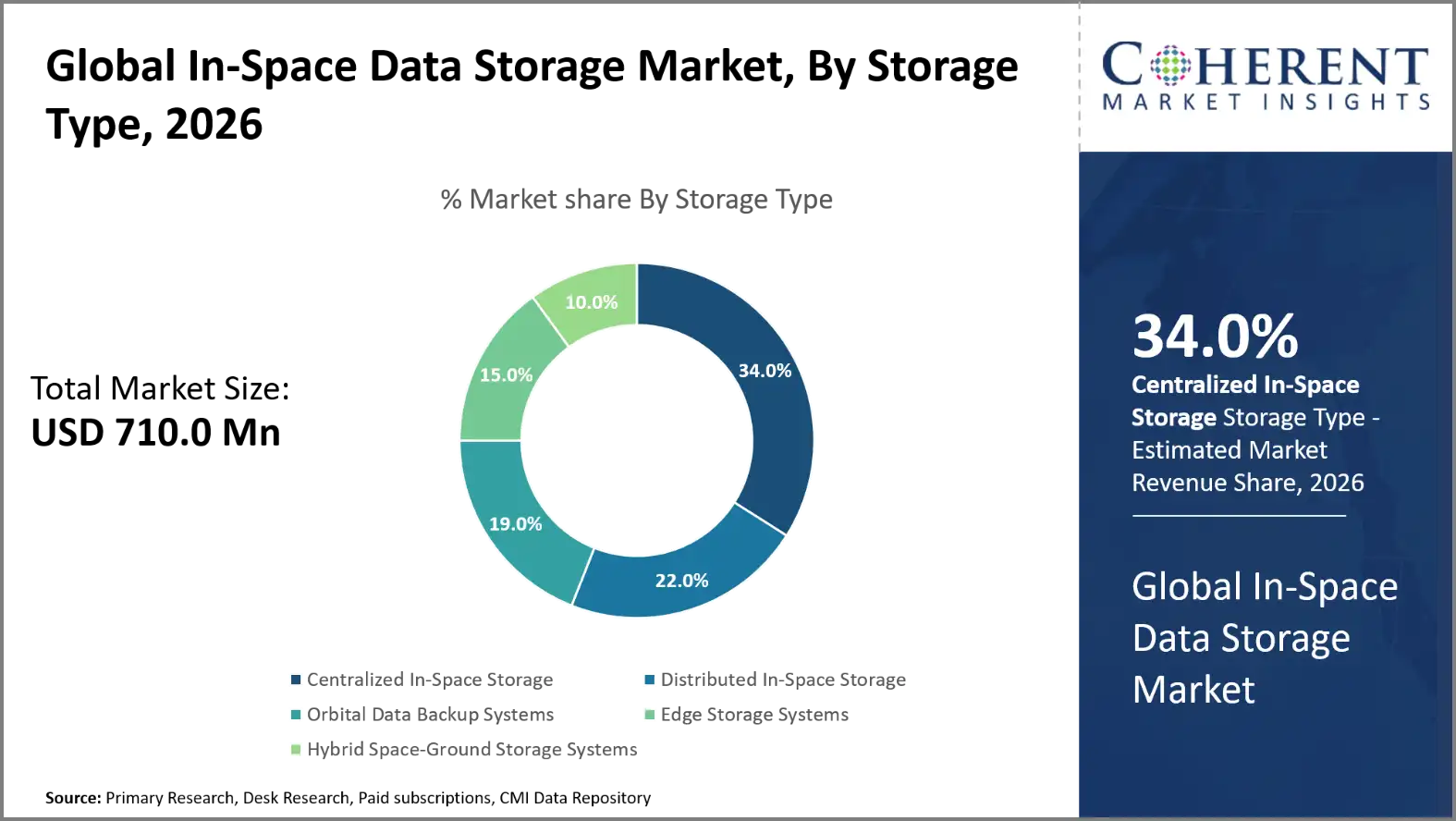
- The Centralized In-Space Storage segment is expected to account for 34.0% of the global in-space data storage market share in 2026. Increasing demand for space-based disaster recovery solutions is driving the growth of the segment. On March 20, 2025, ICEYE and Juvare announced a strategic partnership to improve disaster response using satellite intelligence.
- The Solid-State Storage segment is estimated to capture 36.0% of the market share in 2026. Growing requirements for autonomous satellite data management is majorly driving the growth of the segment. On May 7, 2026, NASA reported the successful deployment of its Prithvi geospatial artificial intelligence model aboard two orbital platforms.
- The Low Earth Orbit segment is estimated to capture 42.0% of the market share in 2026. Expansion of inter-satellite communication infrastructure is driving the growth of the segment. On March 3, 2025, Spire Global announced that it has established a two-way optical communication link between two satellites in orbit. The spacecraft demonstrated laser-based data transmission across distances of up to 5,000 kilometers.
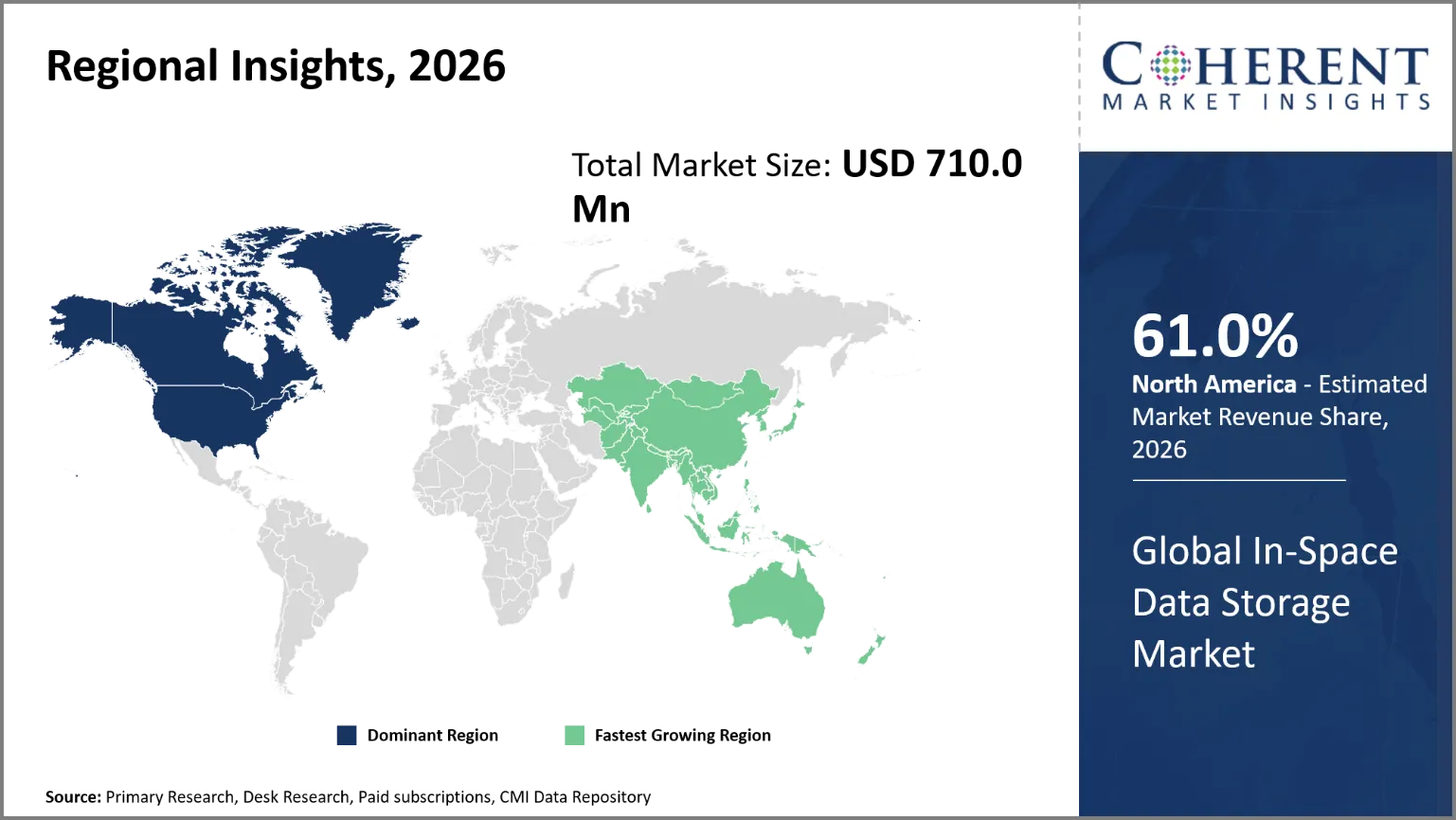
- North America is expected to dominate the in-space data storage market in 2026 with a market share of 61.0%. Growing integration of distributed storage across satellite constellations in North America is driving the growth of the regional market. On October 27, 2025, Sidus Space finalized a commercial pathfinder mission agreement with Lonestar Data Holdings. The agreement covers integration of Lonestar’s high-capacity digital storage payload aboard LizzieSat-5.
- Asia Pacific is expected to account for 20.0% share in 2026. Development of radiation-resistant high-capacity storage systems in Asia Pacific is driving the growth of the regional market. On October 22, 2025, Novachips introduced its NN765R customized M.2 solid-state drive for satellite applications. The drive incorporates protective coatings against low-energy protons, enhanced error-correction technology, and firmware recovery mechanisms.
Segmental Insights
Why Does Centralized In-Space Storage Dominate the Global In-Space Data Storage Market?
The centralized in-space storage segment is expected to account for 34.0% of the global in-space data storage market share in 2026. Centralized in-space storage is winning as it accumulates massive datasets in specialized orbital infrastructure. This architecture provides a simplified way of managing data between satellites, spacecraft and space-based computing platforms. Operators can minimize duplicate storage hardware on particular spacecraft. Additionally, central facilities help organize data access, processing and delivery. These features increase resource efficiency in developing satellite constellations. Demand for earth observation and scientific research and defense data also drives adoption.
On November 4, 2025, Google announced Project Suncatcher, a research program to explore satellite constellations fueled by the sun to do artificial intelligence processing. The suggested architecture connects satellites with Google’s Tensor Processing Units.
- Current Industry Events of 2026
- Market Size Estimation
- Regional Breakdown
- Competitive Landscape
- Customer Intelligence
- Segmental Analysis
- Pricing Analysis
- Key Market Drivers, Challenges & Future Trends
- Customized Insights Section
Why is Solid-State Storage the Most Preferred Technology Type?
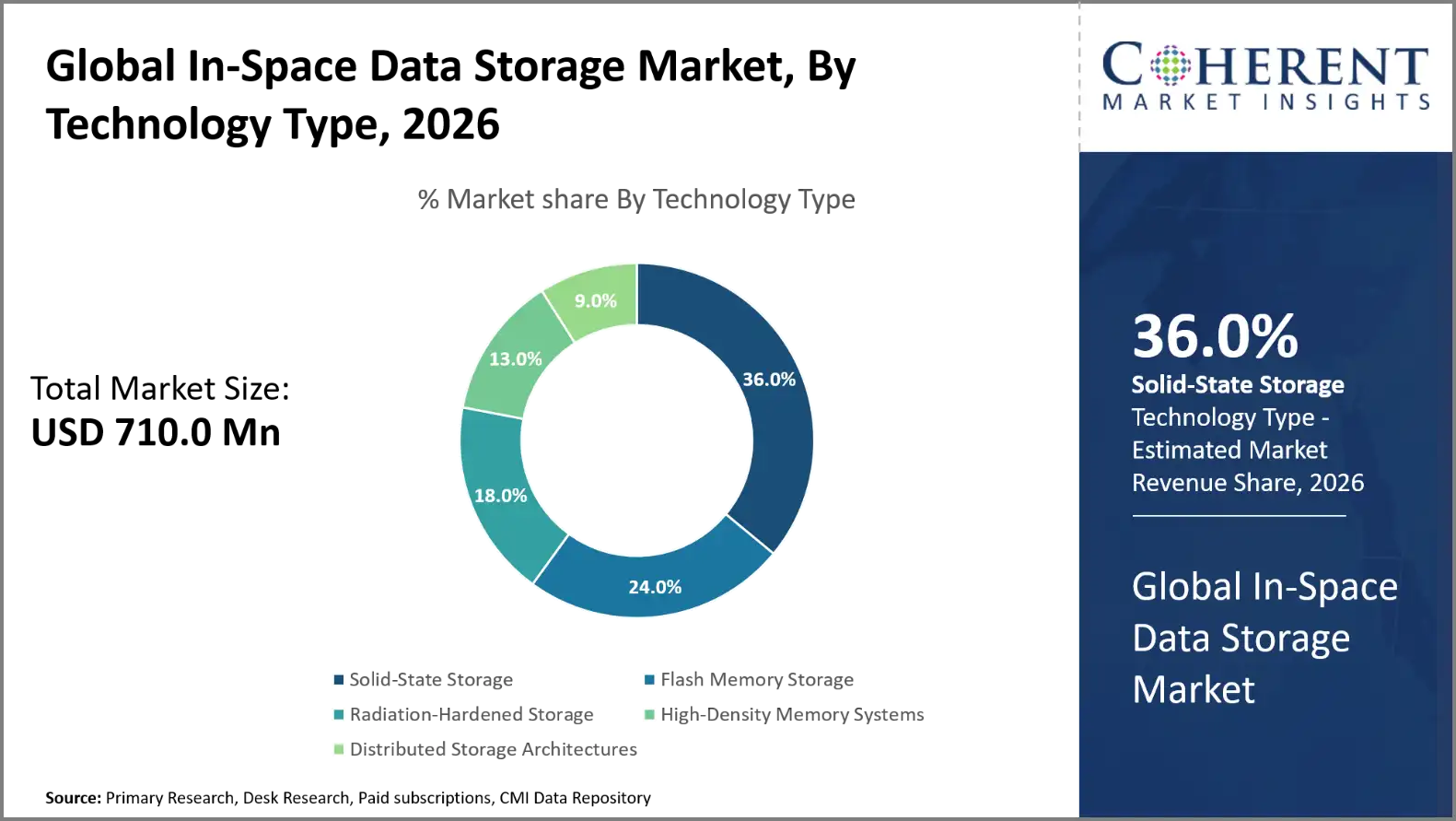
The solid-state storage segment is expected to account for 36.0% of the global in-space data storage market share in 2026. High data access rates and small hardware designs are making solid state storage the way forward. It has no moving mechanical parts, which improves dependability of functioning in the spaceship environment. It uses less power, which is good for satellites that have only limited electrical capacity. Solid-state devices also provide speedier data retrieval for onboard analytics and artificial intelligence applications. They can withstand mechanical vibrations to enable challenging launch and orbit circumstances. These advantages make solid-state technology suitable for high-performance space data storage systems.
On January 30, 2025, Infineon Technologies AG announced that its radiation-hardened 512 Mbit QSPI NOR Flash memory for space and extreme environment applications has now received the QML-V and QML-P qualification of the Defense Logistics Agency Land and Maritime (DLAM). The QML certification is the highest reliability standard for microcircuits awarded by the U.S. government and indicates that the device will perform reliably under the most challenging conditions.
Low Earth Orbit Dominates the Global In-Space Data Storage Market
The low earth orbit segment is expected to account for 42.0% of the global in-space data storage market share in 2026. Low Earth Orbit dominates because it offers shorter communication distances and lower transmission latency than higher orbital regimes. It is close to Earth which signifies good communication with ground stations and other satellites. This orbit also facilitates frequent data exchanges with Earth observation and remote sensing spacecraft. Growing satellite constellations increase demand for onboard data storage and orbital processing facilities. Commercial access is better, launch costs are lower and small satellite deployments are growing. The European Space Agency is also making progress on distributed in-space processing capabilities. These advancements make the case for future orbital storage facilities in Low Earth Orbit.
On January 12, 2026, Eutelsat awarded Airbus Defense and Space a contract to build additional 340 OneWeb spacecraft. The deal boosted Eutelsat's total ordered replacement and expansion satellites to 440. The new spaceship will include new digital channelizers to increase onboard processing.
Current Events and their Impact
Current Events | Description and its Impact |
European Union Space Act Proposal, 2025 COM (2025) 335 final, Procedure 2025/0335(COD) |
|
U.S. Federal Communications Commission Orbital Debris Regulations, 2024 |
|
In-Space Data Storage Market Dynamics
Market Drivers
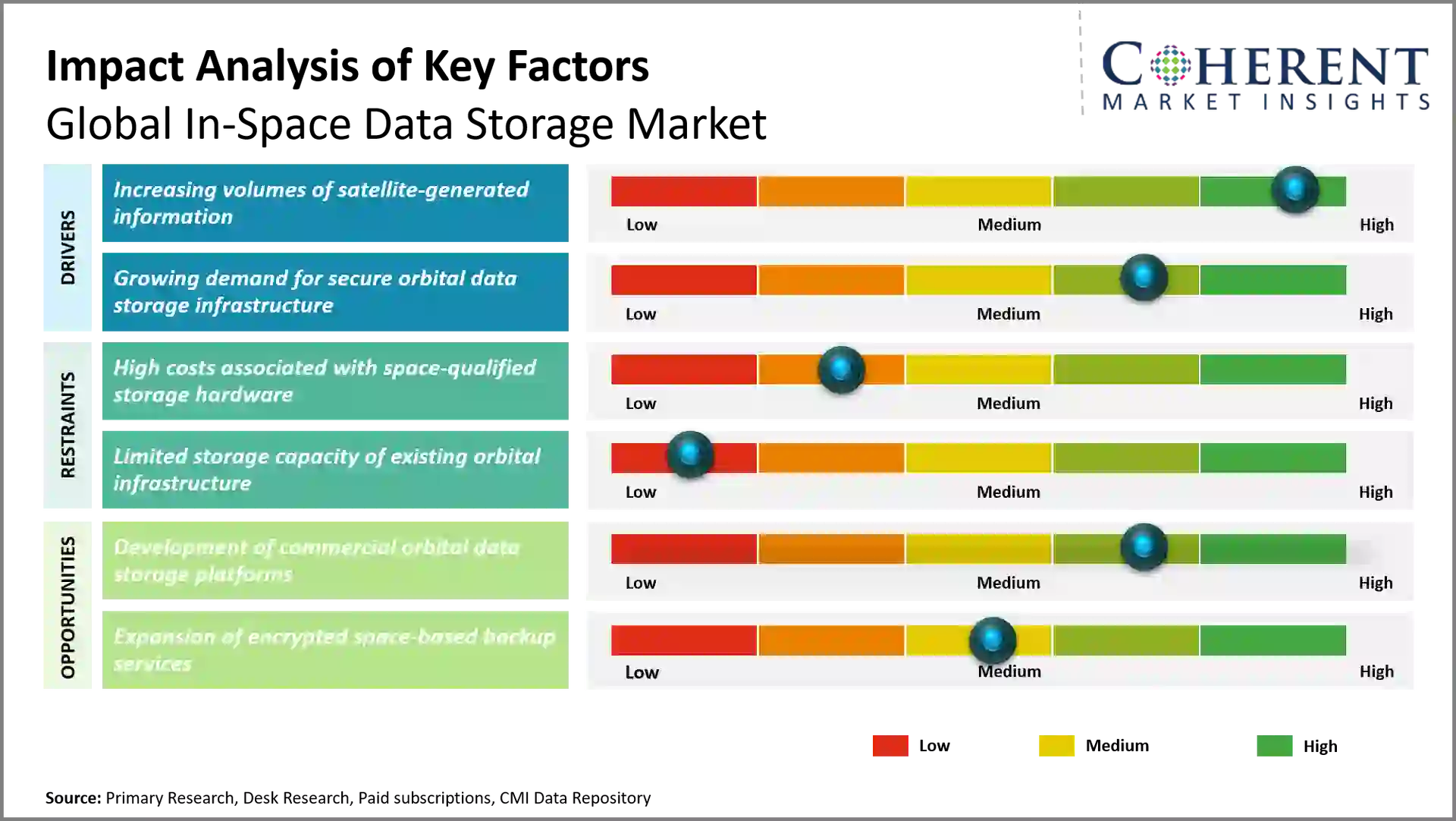
Increasing volumes of satellite-generated information
The increasing deployment of Earth observation satellites, communication constellations and scientific spacecraft is creating unprecedented volumes of data. High-resolution imaging systems provide constant comprehensive information on weather patterns, land usage, ocean conditions and infrastructure. Advanced satellite sensors also provide large datasets for technologies such as hyperspectral imaging and synthetic aperture radar. Handling big files onboard demands higher storage capability and faster data retrieval capability. Large data sets transmitted to ground facilities are limited by capacity in traditional downlink infrastructure. Thus, dedicated orbital storage systems are gaining important for storing and managing the information generated by satellites. This trend creates opportunities for high-capacity solid-state storage and distributed orbital data management technologies.
On January 3, 2026, the third satellite part of the COSMO-SkyMed Second Generation (CSG) constellation, owned by the Italian Space Agency and the Italian Ministry of Defense, built by Thales Alenia Space, a joint venture between Thales (67%) and Leonardo (33%) was successfully launched from Vandenberg Space Force Base in California (USA), aboard a SpaceX Falcon 9 rocket.
Growing demand for secure orbital data storage infrastructure
There is increasing demand for secure orbital storage infrastructure because of rising worries about satellite cybersecurity and sensitive space-generated data. Defense agencies, intelligence organizations, and commercial satellite operators must reliably preserve mission-critical datasets. Heightened geopolitical tensions can reveal vulnerabilities in satellite communications networks and in terrestrial data centers. Orbital storage platforms can process encrypted data and regulated information access in space-based infrastructure. Protection against illegal access is further enhanced with advanced encryption, hardware-based security and safe communication protocols. Government investment in space security is spurring the development of resilient satellite systems and secure data management capabilities. These needs are creating opportunities for specialized storage providers for defense, intelligence and commercial space applications.
On March 25, 2025, Viasat announced NATO certification of its DARC-SSD 600 encrypted solid-state drive. The drive was certified for storage of secret information up to NATO SECRET level. It’s hardware-based encryption prevents illegal access and compromising of important information.
Emerging Trends
- Integration of Artificial Intelligence with Orbital Data Storage: Satellite operators are gradually embedding artificial intelligence into their onboard storage systems. This allows for smart filtering, prioritizing, compression, and early analysis of data before sending information to ground stations.
- Impact: Smarter storage means less wasteful data transmission and less congestion on satellite communications. It helps in better usage of bandwidth and faster recovery of information.
- Relevance to the market: The European Space Agency’s Φ-sat missions are examples of the use of onboard artificial intelligence to filter Earth observation imagery. Such improvements open fresh prospects for storage platforms that can intelligently pick and process data.
- Development of Distributed Orbital Data Storage Networks: Space businesses are exploring interconnected orbital infrastructure allowing several satellites to communicate, store and retrieve data. This also allows for dispersed storage and lowers reliance on individual spacecraft.
- Impact: Distributed architectures enhance data access and operational redundancy. They also provide for resilient information management in case of communication outages or hardware problems on particular satellites.
- Relevance to the market: Northrop Grumman’s SpaceLogistics service technologies are an example of growing orbital infrastructure capabilities. These advances pave the way for linked storage systems that can support satellite servicing, data interchange and long-duration missions.
Regional Insights
Why is North America a Strong Market for In-Space Data Storage?
North America is expected to account for a market share of 61.0% in 2026. North America benefits from commercial satellite manufacture, optical communication advancement, and investment in orbital computing infrastructure. Kepler Communications is helping Canada enhance its position by building an orbiting cloud infrastructure. In March 2026, Kepler commissioned distributed orbital computing across its optical relay constellation. Its infrastructure uses 40 NVIDIA Jetson Orin modules across 10 satellites. These features enable distributed processing, secure hosting of payloads and Artificial Intelligence applications. The U.S. Space Force also awarded contracts supporting resilient orbital networking infrastructure.
Why Does Asia Pacific In-Space Data Storage Market Exhibit High Growth?
Asia Pacific is expected to register the fastest growth with a CAGR of 13.7% over the forecast period. The region is projected to account for 20.0% of the global in-space data storage market in 2026. National space projects, semiconductor research, and satellite computing spending in Asia Pacific are driving orbital storage capacities. South Korea is developing through the K-Moonshot Space Data Center program of its Korea AeroSpace Administration. The program aims to develop key technologies for data processing and storage in orbit. In August 2026, the administration brought together 17 businesses from the semiconductor, battery, cooling and satellite production industry. SK hynix, LG Electronics, Hanwha Systems and Rebellions participated in the event. The initiative focuses on radiation-hardened semiconductors, space-qualified solar cells and thermal management technologies. These developments strengthen regional capabilities for dedicated orbital storage infrastructure.
Global In-Space Data Storage Market Outlook for Key Countries
Why is U.S. Emerging as a Major Hub in the In-Space Data Storage Market?
Commercial orbital infrastructure development and expanding national security requirements benefit the U.S. market. Axiom Space unveiled its Orbital Data Center program in April 2025. Its initial architecture will comprise dedicated orbital nodes for safe data storage, processing and artificial intelligence applications. The company targets satellite operators, commercial customers and government agencies. In April 2026, the Government Accountability Office released its evaluation of space-based data centers. Radiation protection, heat management and orbital congestion were among the primary engineering issues highlighted in the research. The Federal Communications Commission has picked up three applications for big orbital data center constellations.
Is China the Next Growth Engine for the In-Space Data Storage Market?
China is building its own ecosystem for orbital storage by integrating satellite sensing, on-board computers and artificial intelligence research. GalaxySpace is forging ahead with space-based cloud capabilities through its synthetic aperture radar satellite program. In August 2026 China launched seven satellites, including Zhongke Sat-14 and Zhongke Sat-15. Both satellites are equipped with dedicated cloud payloads in space, integrating data reception, computing, and analysis. These technologies allow for rapid dissemination of information for flood monitoring and earthquake response. China is also working on its own processing chips and inter-satellite communications. And these investments increase its independent orbital information management capability.
Japan In-Space Data Storage Market Analysis and Trends
The basis of market development in Japan are defense intelligence needs, improved satellite communications and optical Earth observation technologies. In November 2025, SKY Perfect JSAT signed a deal with Japan’s Ministry of Defense. The deal relates to the continued transmission of optical Earth observation imagery from Low Earth Orbit satellites. This creates a necessity for a reliable processing of satellite data, secure managing of information and an effective archival infrastructure. Japan’s Aerospace Exploration Agency also has efforts to promote the development of advanced satellite communication technology within Japan. Increasing defense applications drive the need for secure storage and reliable access to space-based information.
France In-Space Data Storage Market Analysis and Trends
France has a mature satellite engineering ecosystem and European research projects on autonomous orbital computing. ORCHIDE is a European Union funded project aiming to provide safe on-board data processing capabilities powered by artificial intelligence. Its collaboration has partners in France, Poland and Romania. The project exploits light-weight computing architectures to process Earth observation information directly on-board satellites. This reduces the reliance on constant terrestrial data links. France also has the European Space Agency’s technology development ecosystem and strong aerospace research capabilities. Such improvements create need for small storage hardware, secure computing platforms and radiation resistant processing technology.
India In-Space Data Storage Market Analysis and Trends
India is building its own orbital storage capacities through government-funded research into onboard computing and advanced satellite technology. Preliminary feasibility studies for space-based edge computing infrastructure were confirmed by the Department of Space in December 2025. The study found key development needs in radiation-hardened graphics processing units, central processing units and orbital power systems. The Indian Space Research Organization is investigating onboard processing technologies for use in satellite applications. These skills could be used to support catastrophe management, strategic monitoring and communications services. Additional prospects are there in India’s burgeoning private space sector and domestic semiconductor goals, which necessitate specialized orbital storage components and secure information management systems.
Global In-Space Data Storage Market - In-Orbit Servicing and Hardware Replacement
Company / Organization | Servicing Platform | Servicing Type | Target Orbit | Hardware Or Component Serviced | Announcement Date |
Northrop Grumman SpaceLogistics | Mission Robotic Vehicle (MRV) | Robotic inspection, repair and upgrade | GEO | Propulsion modules and satellite components | July 21, 2026 |
Astroscale UK | In-Orbit Refurbishment and Upgrading Service (IRUS) | Hardware refurbishment and replacement | GEO / satellite-dependent | Batteries, solar panels and onboard computers | January 13, 2026 |
Astroscale UK | ELSA-M | End-of-life servicing and removal | LEO | Retired OneWeb satellites | March 16, 2026 |
Astroscale Japan | ISSA-J1 | Multi-orbit satellite inspection | Multiple orbits | Retired Japanese satellites | April 6, 2026 |
Momentus | Vigoride 7 / NASA R5-S10 | Inspection and rendezvous demonstration | LEO | Satellite platforms and hosted payloads | February 9, 2026 |
How is Development of Commercial Orbital Data Storage Platforms Creating New Growth Opportunities in the In-Space Data Storage Market?
The proliferation of commercial orbital data storage platforms presents potential for specialist infrastructure providers to serve satellite operators, defense agencies and cloud computing corporations. Lonestar Data Holdings proved out this commercial approach with its Independence payload on Intuitive Machines’ IM-2 lunar trip in March 2025. The payload housed data storage and processing devices intended to test the secure retention of information beyond Earth. Starcloud is taking another commercial strategy with its Starcloud-1 satellite, launched in November 2025. It has space-based AI computing capabilities with its inbuilt NVIDIA H100 graphics processing unit. These improvements offer potential for radiation-tolerant memory manufacturers, secure storage software developers, and orbital infrastructure operators. They also open the door to prospective commercial services in satellite data archiving, catastrophe recovery and distributed computing.
On February 26, 2026, Rocket Lab Corporation announced the introduction of advanced silicon solar arrays designed to power gigawatt-scale space-based data centers spanning kilometers in orbit. Designed for constellation scale production, the arrays feature radiation hardened solar cell modules that are flexible and lightweight. This is crucial to supporting a variety of stowage and deployment methods tailored to any mission requirements.
Market Players, Key Development, and Competitive Landscape
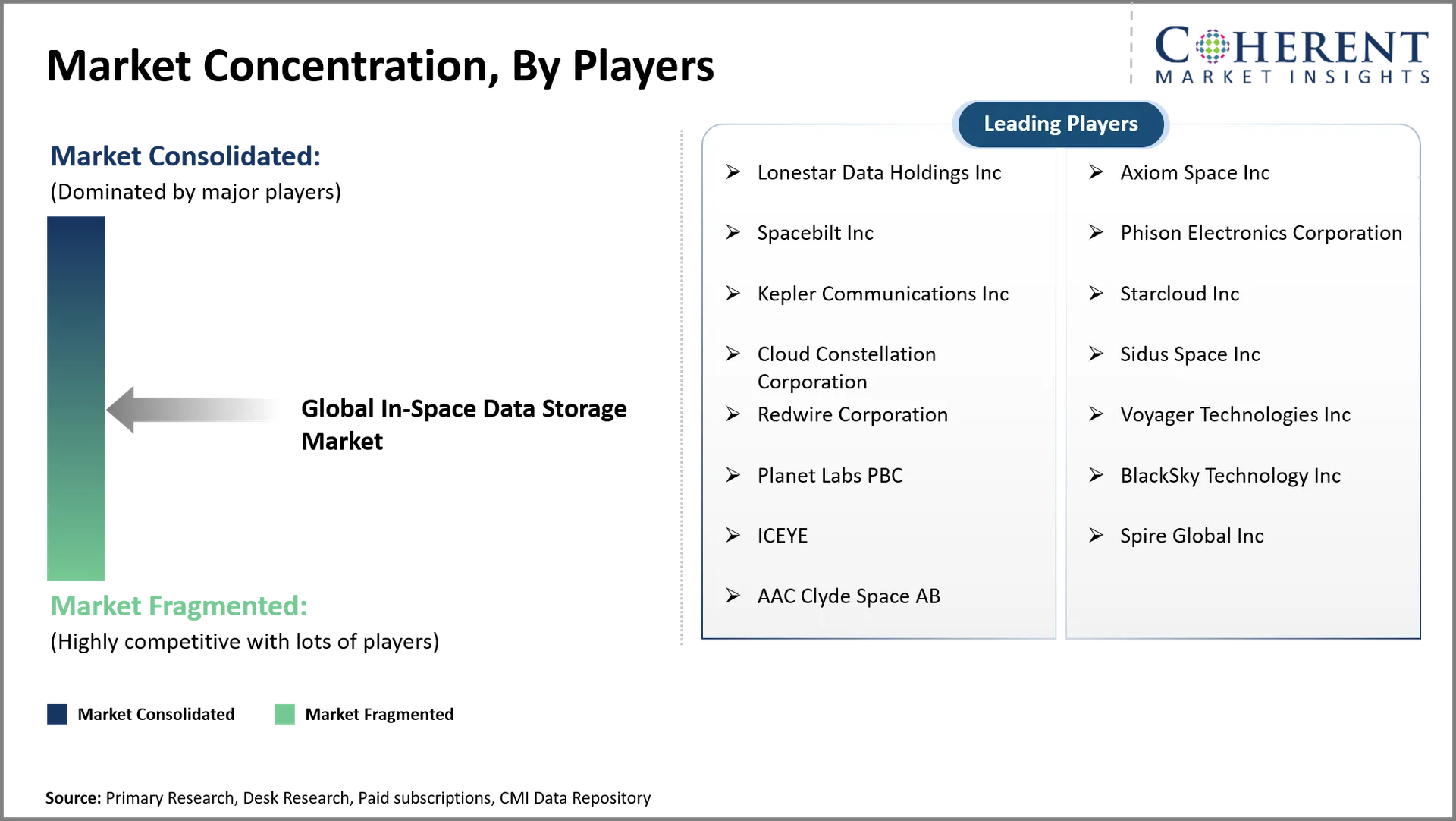
Key Developments
- On June 3, 2026, Muon Space unveiled Condor-Ultra, its newest spacecraft platform developed for high-power, networked constellations of hundreds to thousands of satellites. Optimized for stackable mass-deployment from SpaceX’s Starship, Condor-Ultra anchors communications, sensing and data-center class compute missions with the most demanding power, aperture and data requirements at unprecedented scale and unit economics.
- On April 13, 2026, Atomic-6 launched ODC.space, introducing a commercial marketplace for orbital data center capacity. The platform allows artificial intelligence developers, software providers, and government agencies to purchase dedicated or shared orbital computing capacity.
- On July 22, 2025, Micron Technology, Inc. announced that it is launching the industry’s highest-density, radiation-tolerant single-level cell (SLC) NAND product. With a die capacity of 256 gigabits (Gb), this product is the first in a portfolio that will include space-qualified NAND, NOR and DRAM solutions.
Competitive Landscape
The competitive landscape comprises specialized space computing companies, satellite infrastructure providers, and secure data storage developers. Lonestar Data Holdings is expanding commercial storage through its StarVault platform, announced in April 2026. Its strategy is based on sovereign data protection, cryptographic security and orbital backup services. Ramon.Space announced an increased relationship with Ingrasys, a Foxconn company, in March 2026. The partnership is focused on scalable orbital data center hardware and production-ready computing infrastructure. In April 2026, Sophia Space inked a commercial arrangement with Kepler Communications. Their collaboration focuses on distributed computing, fault-tolerant software, and interconnected orbital infrastructure.
Top Manufacturers and Notable Products in the In-Space Data Storage Market
Manufacturer | Notable Product | Key features |
Lonestar Data Holdings | StarVault | Secure orbital data storage, sovereign data management, cryptographic key escrow, disaster recovery, data redundancy, orbital data protection |
Axiom Space | Axiom Orbital Data Center (ODC) | Scalable cloud-enabled storage, onboard data processing, artificial intelligence workloads, optical inter-satellite connectivity, encrypted infrastructure, modular orbital nodes |
Kepler Communications | Kepler Network and Kepler Compute | Optical inter-satellite links, distributed onboard computing, terabytes of satellite storage, secure data routing, hosted payloads, low-latency data transfer |
Starcloud | Starcloud-2 | Persistent storage, GPU computing, continuous orbital access, proprietary power and thermal systems, high-volume satellite data processing, sovereign cloud computing |
Aethero | NxA-ECM and Space Data Center architecture | RAID-capable storage, radiation-resilient computing, Kubernetes clustering, distributed processing, modular computing nodes, onboard data management |
In-Space Data Storage Market | |||
Report Coverage | Details | ||
Base Year | 2025 | Market Size in 2026: | USD 710.0 Mn |
Historical Data For: | 2020 To 2024 | Forecast Period: | 2026 To 2033 |
Forecast Period 2026 To 2033 CAGR: | 12.3% | 2033 Value Projection: | USD 1,160.0 Mn |
Geographies covered: |
| ||
Segments covered: |
| ||
Companies covered: | Lonestar Data Holdings Inc, Axiom Space Inc, Spacebilt Inc, Phison Electronics Corporation, Kepler Communications Inc, Starcloud Inc, Cloud Constellation Corporation, Sidus Space Inc, Redwire Corporation, Voyager Technologies Inc, Planet Labs PBC, BlackSky Technology Inc, ICEYE, Spire Global Inc, AAC Clyde Space AB | ||
Growth Drivers: |
| ||
Restraints & Challenges: |
| ||
Analyst Opinion (Expert Opinion)
- The future of in-space data storage will depend on specialized orbital infrastructure rather than immediate replacement of terrestrial data centers. Demand will progressively favor radiation tolerant solid-state storage, autonomous data management and distributed computer architectures. Modular storage payloads developed by companies will be compatible with different satellite platforms. It will be an increasingly significant way of delivering massive data collections between nodes in orbit between satellites.
- The strongest potential will be in centralized orbital storage, distributed satellite storage networks and secure backup applications. Reliable information storage will be required for earth observation, defense intelligence, disaster monitoring and lunar infrastructure. The U.S. provides opportunities using commercial orbital infrastructure and defense purchases. Integrated satellite computer constellations have possibilities in China. Japan and France have unique prospects in the fields of optical communications and advanced spacecraft engineering. India can attract investment through indigenous satellite manufacturing and private sector orbital computing.
- Market participants should focus on radiation protected memory, error correcting technology and encryption capabilities. Hardware developers should look for agreements with satellite makers and optical communications suppliers. Storage businesses need to show that data can be retrieved reliably amid radiation exposure and heat variations. Commercial suppliers should offer subscription-based storage services with strong security guaranties. Enable compatibility amongst spacecraft platforms to increase customer adoption. Companies securing early government and satellite operator contracts can establish stronger commercial positions.
Speak to the analyst
Want personalized insights?
Take the findings above to one of our principal consultants, or have the report rebuilt around the segments, geographies and competitors you actually track.
Market Segmentation
- Storage Type Insights (Revenue, USD Million, 2021 - 2033)
- Centralized In-Space Storage
- Distributed In-Space Storage
- Orbital Data Backup Systems
- Edge Storage Systems
- Hybrid Space-Ground Storage Systems
- Technology Type Insights (Revenue, USD Million, 2021 - 2033)
- Solid-State Storage
- Flash Memory Storage
- Radiation-Hardened Storage
- High-Density Memory Systems
- Distributed Storage Architectures
- Orbit Insights (Revenue, USD Million, 2021 - 2033)
- Low Earth Orbit
- Medium Earth Orbit
- Geostationary Earth Orbit
- Lunar Orbit
- Deep-Space Platforms
- Application Insights (Revenue, USD Million, 2021 - 2033)
- Satellite Data Storage
- Earth Observation Data Storage
- Scientific Research Data Storage
- Defense and Intelligence Data Storage
- Disaster Recovery and Backup
- Space Mission Data Management
- Sovereign Data Storage
- End User Insights (Revenue, USD Million, 2021 - 2033)
- Government and Defense Organizations
- Commercial Satellite Operators
- Space Agencies
- Research Institutions
- Telecommunication Companies
- Earth Observation Companies
- Cloud Service Providers
- Regional Insights (Revenue, USD Million, 2021 - 2033)
- North America
- U.S.
- Canada
- Latin America
- Brazil
- Argentina
- Mexico
- Rest of Latin America
- Europe
- Germany
- U.K.
- Spain
- France
- Italy
- Russia
- Rest of Europe
- Asia Pacific
- China
- India
- Japan
- Australia
- South Korea
- ASEAN
- Rest of Asia Pacific
- Middle East
- GCC Countries
- Israel
- Rest of Middle East
- Africa
- South Africa
- North Africa
- Central Africa
- North America
- Key Players Insights
- Lonestar Data Holdings Inc
- Axiom Space Inc
- Spacebilt Inc
- Phison Electronics Corporation
- Kepler Communications Inc
- Starcloud Inc
- Cloud Constellation Corporation
- Sidus Space Inc
- Redwire Corporation
- Voyager Technologies Inc
- Planet Labs PBC
- BlackSky Technology Inc
- ICEYE
- Spire Global Inc
- AAC Clyde Space AB
Sources
Primary Research Interviews
- Satellite Manufacturers & Operators
- Space Data Infrastructure Providers
- Defense & Government Space Agency Representatives
- In-Space Computing & Storage Technology Developers
Magazines
- Aviation Week & Space Technology
- Space News Magazine
- IEEE Spectrum (Space Technology Edition)
- Satellite Today
Journals
- Journal of Spacecraft and Rockets (AIAA)
- Acta Astronautica (Elsevier)
- IEEE Transactions on Aerospace and Electronic Systems
Associations
- Satellite Industry Association (SIA)
- American Institute of Aeronautics and Astronautics (AIAA)
- Space Foundation
- Commercial Spaceflight Federation (CSF)
Public Domain Sources
- NASA Official Website (nasa.gov)
- European Space Agency (esa.int)
- Federal Aviation Administration (FAA) – Office of Commercial Space Transportation
- U.S. Department of Defense – Space Policy Reports
Proprietary Elements
- CMI Data Analytics Tool
- Proprietary CMI Existing Repository of Information for the Last 10 Years
Get access to 250+ pages report
Every segment, forecast, competitor profile and data table behind the analysis above — available for instant download.
- ESOMAR Member
- ISO 9001:2015 Certified
- D-U-N-S Registered
- GDPR & CCPA Compliant
Frequently Asked Questions
The global in-space data storage market is expected to stand at USD 710.0 Mn in 2026 and is expected to reach USD 1,160.0 Mn by 2033.
The CAGR of the global in-space data storage market is projected to be 12.3% from 2026 to 2033.
Increasing volumes of satellite-generated information and Growing demand for secure orbital data storage infrastructure are the major factors driving the growth of the global in-space data storage market.
High costs associated with space-qualified storage hardware and Limited storage capacity of existing orbital infrastructure are the major factors hampering the growth of the global in-space data storage market.
In terms of storage type, centralized in-space storage segment is estimated to dominate the market revenue share in 2026.
The market covers technologies and services that store, manage, and retrieve digital information within spacecraft and orbital infrastructure.
Artificial intelligence enables automated data classification, compression, prioritization, and retrieval within resource-constrained spacecraft environments.