
India Battery-Grade Lithium & Nickel Processing Market Size and Forecast – 2026 To 2033
The India battery-grade lithium & nickel processing market is expected to grow from USD 26.1 Mn in 2026 to USD 648.2 Mn by 2033, registering a compound annual growth rate (CAGR) of 59.3% from 2026 to 2033. This rapid market expansion shows the increasing domestic demand for high-purity battery-grade materials, driven by the rising adoption of electric vehicles and energy storage solutions in India’s burgeoning clean energy landscape.
On August 7, 2026, India's Ministry of Heavy Industries reported 67,657 EV chargers have been deployed in the country, including 1,139 charges at battery-swapping stations. INR 2,000 crore was also given for public charging infrastructure under the PM E-DRIVE plan. Multiple charging stations can increase EV adoption, leading to future lithium-ion battery needs and demand for battery grade lithium.
Key Takeaways of the Global India Battery-Grade Lithium & Nickel Processing Market
- The battery grade lithium segment is expected to account for 55.0% of the India battery-grade lithium & nickel processing market share in 2026. Battery-Grade Lithium is emerging as a major segment due to India's increasing investment in grid-scale battery energy storage systems to support renewable energy integration and grid stability. The growing deployment of large-scale BESS projects is therefore creating an additional source of lithium demand beyond electric vehicles, encouraging investment in domestic lithium processing and refining capacity. The Union Cabinet has given its approval for Rs 14,500 crore Viability Gap Funding (VGF) program for development of 92 GWh of grid scale energy storage capacity from FY 2026-27 to FY 2030-31 including 30 GWh earmarked for Battery Energy Storage Systems. The move is expected to spur the deployment of lithium-ion batteries, boosting demand for battery-grade lithium carbonate and lithium hydroxide and generating prospects for domestic lithium refiners.
- Lithium carbonate segment is anticipated to account for 42.0% market share by 2026. Battery makers choose lithium carbonate over other lithium compounds such as lithium hydroxide for its performance, availability and affordability. A 2026 study in Advanced Science demonstrated that lithium carbonate is 30–50% cheaper than battery-grade lithium hydroxide on a molar lithium basis, making it economically advantageous for LFP cathode manufacture.
- Hydrometallurgical processing sector is expected to hold 62.0% market share in 2026. Hydrometallurgical Processing is becoming more relevant as it enables selective recovery of lithium, nickel and other important minerals from battery trash and mineral intermediates. It is relevant to India’s emerging critical mineral recycling industry due to its capacity to treat complicated battery materials and extract several valuable metals. In March 2026, the Government of India’s Technology Development Board (TDB) offered financial support to MiniMines Cleantech Solutions Pvt. Ltd. to commercialize its own lithium-ion battery recycling and refining technology. The initiative attempts to recover lithium carbonate of battery grade quality and other important metals from wasted lithium ion batteries.
Segmental Insights
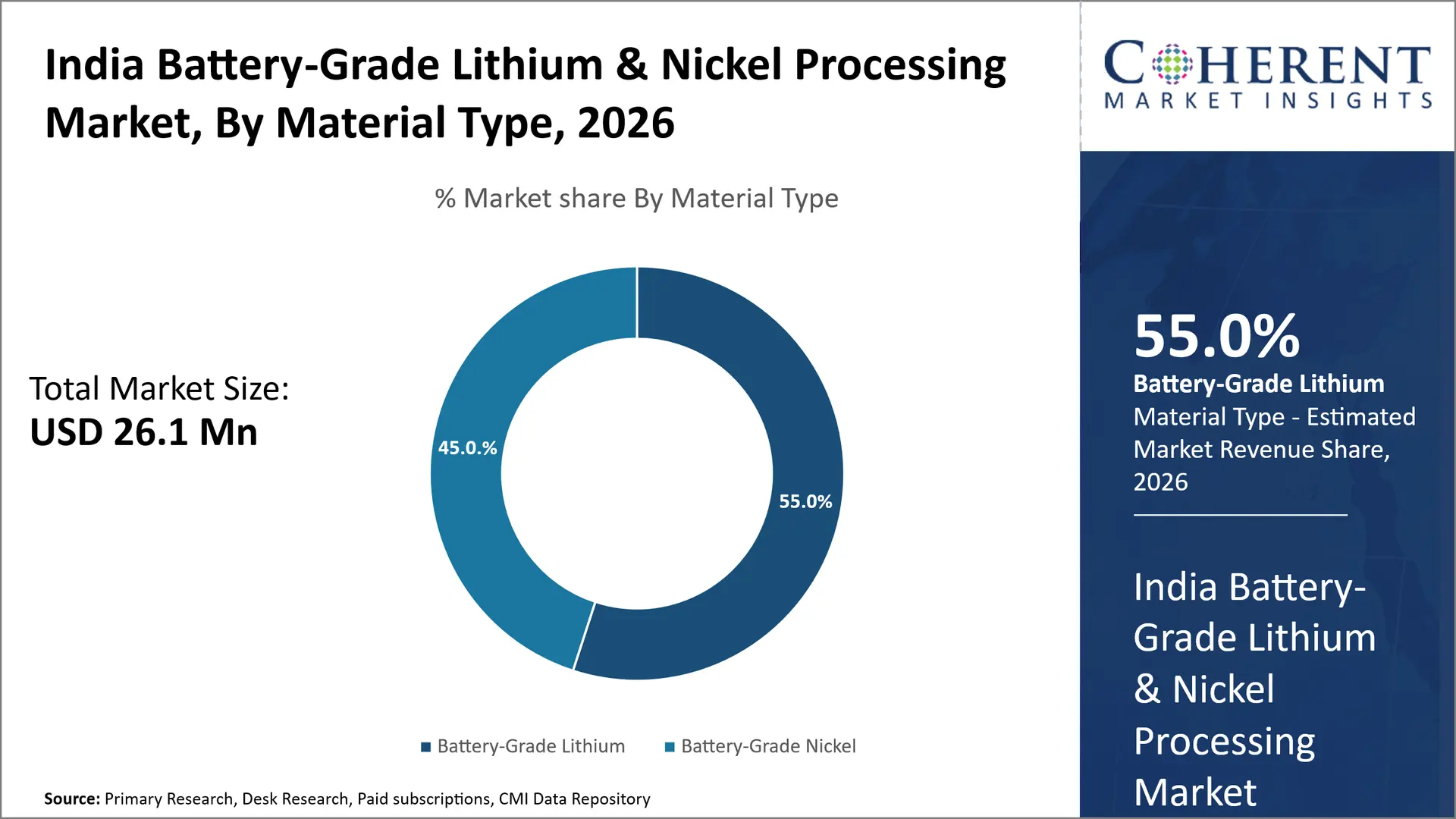
Why does Battery-Grade Lithium Dominate the India Battery-Grade Lithium & Nickel Processing Market?
The battery grade lithium segment is projected to account for 55.0% market share of the India battery-grade lithium & nickel processing market in 2026. Battery-grade lithium has become the dominant category as it is critical to power the burgeoning energy storage and electric vehicle (EV) industries. With the world moving to cleaner sources of energy, lithium-ion batteries have become the battery of choice for EV producers and renewable energy storage suppliers. India’s push for EV adoption through government incentives and infrastructure development is creating direct demand for battery-grade lithium making it a must-have raw element. For instance, the PM E-DRIVE plan is India’s flagship program to promote the use of electric vehicles, create charging infrastructure and enhance local EV manufacturing. The program begun in September 2024 and effective from October 2024 has been extended up to March 31, 2028 with a total budget outlay of Rs 11,900 crore. The plan is applicable for several categories of EVs and associated infrastructure. The Government of India has reported in October 2026 that the initiative had helped in supporting around 26.59 lakh electric car sales as of June 2026.
- Current Industry Events of 2026
- Market Size Estimation
- Regional Breakdown
- Competitive Landscape
- Customer Intelligence
- Segmental Analysis
- Pricing Analysis
- Key Market Drivers, Challenges & Future Trends
- Customized Insights Section
Why is Lithium Carbonate the Most Important Product Type?
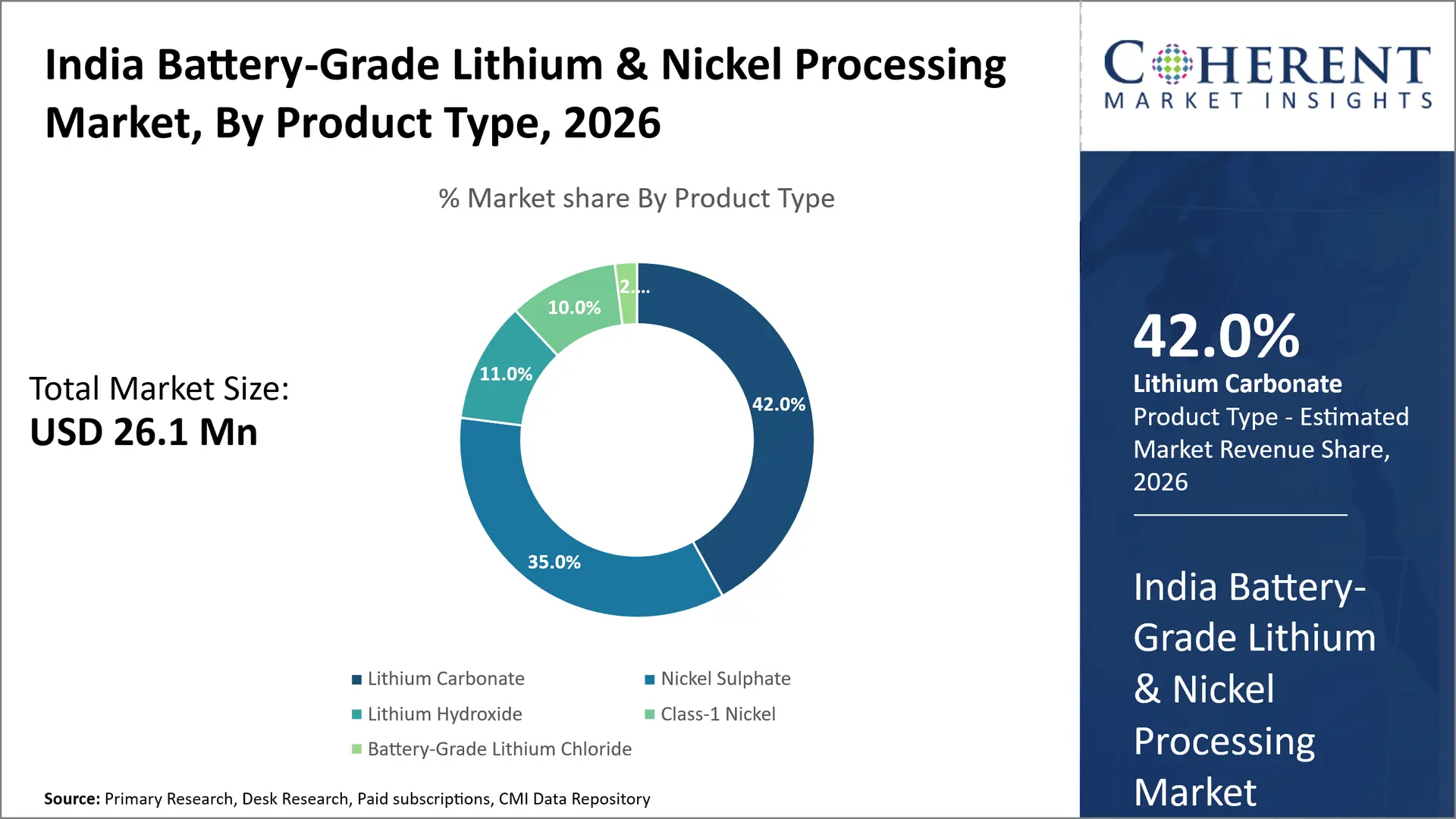
Lithium carbonate is predicted to account for 42.0% of the India battery-grade lithium & nickel processing market in 2026. The diverse applicability and cost-efficiency in battery manufacture has led to a great demand for this product. India's shift toward cost-effective LFP batteries for electric mobility and energy storage supports demand for lithium carbonate. Increasing recycling activity also creates opportunities to recover lithium carbonate from end-of-life batteries and manufacturing scrap. For example, India’s Epsilon CAM in September 2026 inked a memorandum of understanding (MoU) with Canada’s E3 Lithium for the possible delivery of up to 5,000 metric tons of battery-grade lithium carbonate a year over five years. Epsilon CAM is building a 30,000-tonne-per-year LFP cathode material facility in India aiming for early 2028 for the first phase. The study also points out the importance of lithium carbonate as a low-cost precursor for the production of LFP batteries and is also driving the increasing demand for this material in India.
Hydrometallurgical Processing Dominates India’s Battery-Grade Lithium & Nickel Processing Market
The hydrometallurgical processing category is projected to account for 62.0% of the India battery-grade lithium and nickel processing market share in 2026, owing to its higher efficiency and environmental benefits in lithium and nickel extraction. Hydrometallurgical processing dominates the largest segment of India’s battery grade lithium and nickel processing market due to its operational efficiency, cost-effectiveness and environmental sustainability. In addition, hydrometallurgical processes often require lower temperatures than pyrometallurgical procedures, leading to reduced energy use and carbon emissions. This is in line with India’s legislative push for cleaner industrial operations and mirrors global trends favoring sustainable metal recovery technologies. The decreased environmental impact also encourages investment and cooperation for the development of clean technology. The potential for hydrometallurgical processing to reduce the environmental footprint of battery recycling is supported by a report by NITI Aayog, Advancing Circular Economy of Waste Electronic and Electrical Equipment and Lithium-Ion Batteries in India.
Current Events and their Impact
Current Events | Description and its Impact |
Export Prohibition on Lithium-Ion Battery Black Mass, 2026 |
|
Central Pollution Control Board (CPCB) Guidelines for Recycling of Waste Batteries (Lead-Acid and Lithium-Ion), 2026 |
|
India Battery-Grade Lithium & Nickel Processing Market Dynamics
Market Drivers
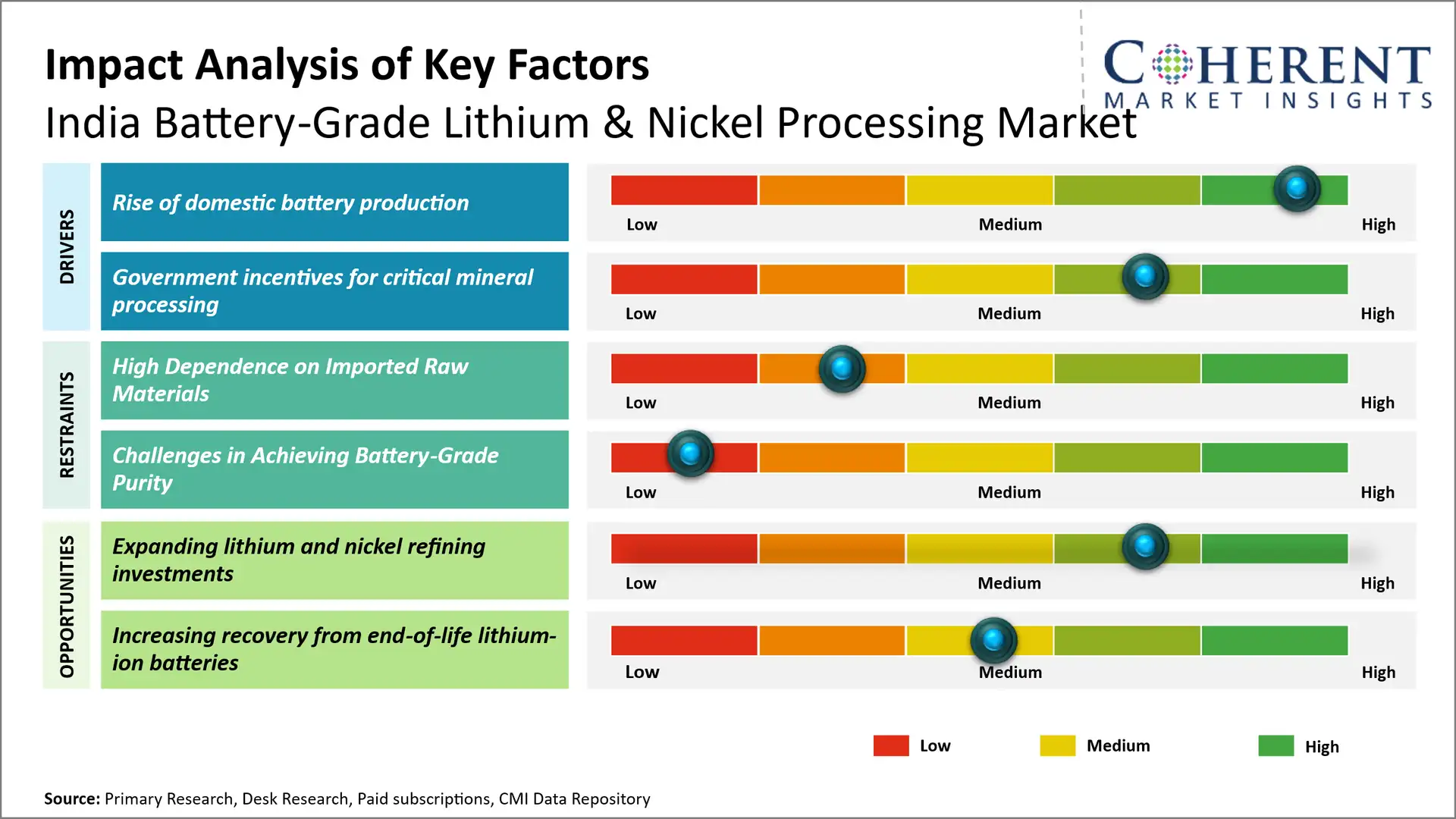
- Rise of domestic battery production: The rise of domestic battery production is a crucial growth driver for India's battery-grade lithium and nickel processing industry. Increased investment in lithium-ion cell manufacturing plants, electric car battery systems and battery energy storage infrastructure is boosting demand for high purity lithium and nickel compounds. India’s Production Linked Incentive plan for Advanced Chemistry Cell battery storage with an outlay of Rs 18,100 crore and a target of setting up 50 GWh of domestic cell manufacturing capacity is motivating battery producers to create localized production ecosystems. As these facilities grow, domestic refiners could benefit from increased feedstock needs for cathode production and battery materials manufacturing.
- Government incentives for critical mineral processing: Government incentives play a key role in alleviating India’s lack of local lithium and nickel refining capacity. Establishing battery-grade refining facilities requires significant capital investment in processing equipment, chemical conversion systems, purification technologies, and environmental management infrastructure. Government support under the National Critical Mineral Mission is intended to reduce project development costs, encourage private investment, and strengthen domestic mineral processing capabilities. On 5 November, 2026, the Union Cabinet approved the five-year CAPEX Support Scheme with an outlay of INR 2,814 crore to Promote Critical Mineral Processing. The Union Cabinet approved capital support for two lithium processing plants of at least 30,000 tonnes each and two nickel processing plants of at least 50,000 tonnes each. The scheme provides a subsidy of 30% of eligible investment and is expected to support approximately INR 10,000 crore in investments. These are especially crucial for Indian producers that are looking to lessen their dependence on foreign battery-grade chemicals.
Emerging trends
- Setting up of Dedicated Critical Mineral Processing Hubs: India is increasingly looking at setting up dedicated mineral processing hubs to boost local lithium and nickel refining. These hubs are designed to co-locate mineral processing, purification, supporting infrastructure and downstream battery material manufacturing, which might reduce operational costs and increase supply-chain efficiency.
- Impact: Such processing hubs could attract investment in refining, reduce the cost of shared infrastructure and speed the domestic production of battery-grade lithium and nickel.
- Relevance: Ministry of Mines has selected four major mineral processing parks in Maharashtra, Odisha, Gujarat and Andhra Pradesh with Maharashtra focusing on lithium related businesses and Odisha on nickel processing. The government has given INR 500 crore to facilitate the establishment of these parks, underscoring its commitment to developing indigenous mineral processing infrastructure.
- Growing Industry and Academia Collaboration for Advanced Mineral Recovery Technologies: Indian battery recycling and mineral processing companies are collaborating with research institutions to develop advanced metal extraction, separation, and purification technologies. These partnerships aim to improve recovery efficiency, reduce dependence on imported technologies, and accelerate the commercialization of sustainable lithium and nickel processing solutions.
- Impact: Such collaborations could improve domestic refining expertise, support the development of cost-efficient metal recovery technologies, and strengthen India's ability to produce high-purity battery materials.
- Relevance: In 2026, NavPrakriti signed a Memorandum of Understanding with IIT Kharagpur to advance battery recycling, critical mineral recovery, and technology development. The collaboration focuses on joint research, technology innovation, and skill development, demonstrating growing cooperation between industry and academic institutions in India's critical minerals ecosystem.
India Battery-Grade Lithium & Nickel Processing Market: Key Manufacturers, Production Capabilities and Announced Capacity Expansions (2025–2026).
Company | Project / Facility | Manufacturing & Processing Capabilities | Reported Annual Capacity | Location | Development Status |
Altmin Pvt. Ltd. | Kakinada Lithium Refinery | Planned conversion of spodumene mineral feedstock into lithium carbonate | 300,000 MT spodumene input; 30,000 MT lithium carbonate output | Kakinada, Andhra Pradesh | Planned expenditure of over USD200 million; refinery development announced in September 2026 |
LOHUM Cleantech Pvt. Ltd. | Lithium Refinery and Critical Mineral Recovery | Lithium refining; recovery of lithium carbonate and nickel-containing compounds from battery materials | 1,000 MT/year reported lithium refinery capacity | Greater Noida, Uttar Pradesh | Existing plant reported functioning; larger refinery planned |
RecycleKaro | Lithium-Ion Battery Recycling and Metal Recovery | Processing of NMC, NCA, LFP and other lithium-ion battery chemistries; hydrometallurgical recovery of lithium, nickel and cobalt | 10,000 MT/year lithium-ion battery processing | Maharashtra | Operational processing facility; reported capacity in Nov 2026 |
Bridge Green Upcycle | Circularity Center | Processing of used battery and manufacturing scrap; recovery of lithium, nickel, cobalt, manganese, copper and graphite | 7,200 MT/year battery recycling input | Gummidipoondi, Tamil Nadu | Facility inaugurated May 2026 |
NAN Silox GreenMet Pvt. Ltd. | Battery Recycling and Critical Metal Recovery Complex | Planned battery shredding, black-mass treatment, and hydrometallurgical recovery of lithium, nickel, and other critical metals | 20,000 MT/year planned hydrometallurgical processing | Naidupeta, Andhra Pradesh | Consent to Establish granted in October 2026 for INR 1,400 crore project |
How is investment in lithium & nickel refining expansion creating new growth prospects for the India battery grade lithium & nickel processing market?
Increasing investments in the refining process of lithium and nickel are providing new growth prospects by enhancing the local production of high-purity battery chemicals, enhancing mineral recovery capabilities, and lowering the reliance on imported refined materials. Processors can extract valuable minerals from battery waste and mineral feedstocks by investment in modern hydrometallurgical extraction, purification and chemical conversion technology. These improvements could lead to better integration of domestic supply chains, attract technology alliances and provide chances to supply lithium carbonate, lithium hydroxide and nickel sulfate to India’s expanding battery manufacturing industry.
NAN Silox GreenMet Pvt. Ltd, a joint venture between NAN GreenMet and Belgium’s Silox Group was granted approval in October 2026 to set up its projected INR 1,400 crore lithium-ion battery recycling and essential metals recovery plant at Naidupeta, Andhra Pradesh. The investment is a reflection of increased interest in sophisticated processing facilities to recover important battery minerals, such as lithium and nickel. Once operating the project will add to domestic mineral recovery capacity and will help build India's supply chain for battery quality materials.
Market Players, Key Development, and Competitive Landscape
Key Developments
- On July 16, 2026, Amara Raja Advanced Cell Technologies commissioned a Customer Qualification Plant in Telangana at a cost of USD 53.7 million. The plant forms part of Amara Raja’s larger USD 1.02 billion investment program to set up a 16 GWh lithium-ion battery gigafactory.
- On April 14, 2026, Namo eWaste Management Limited opened a new hydrometallurgical processing facility at Faridabad, Haryana on April 14, 2026 for the recovery of lithium, nickel, cobalt and manganese from lithium ion battery black matter. The company’s existing Nashik factory converts batteries into black matter, recovering copper, ferrous minerals and aluminum. The new facility is planned to come on line in December 2026, improving the company’s ability to move toward integrated key mineral recovery and supporting local battery recycling infrastructure.
- On January 23, 2026, Gravita India Limited announced its start of lithium-ion battery recycling factory at Mundra, Gujarat with an annual processing capacity of 6,000 metric tons. The company has committed around USD 1.5 million to set up and acquire the factory, which uses modern recycling technology to recover precious battery materials, besides reducing harmful chemicals and waste.
Competitive Landscape
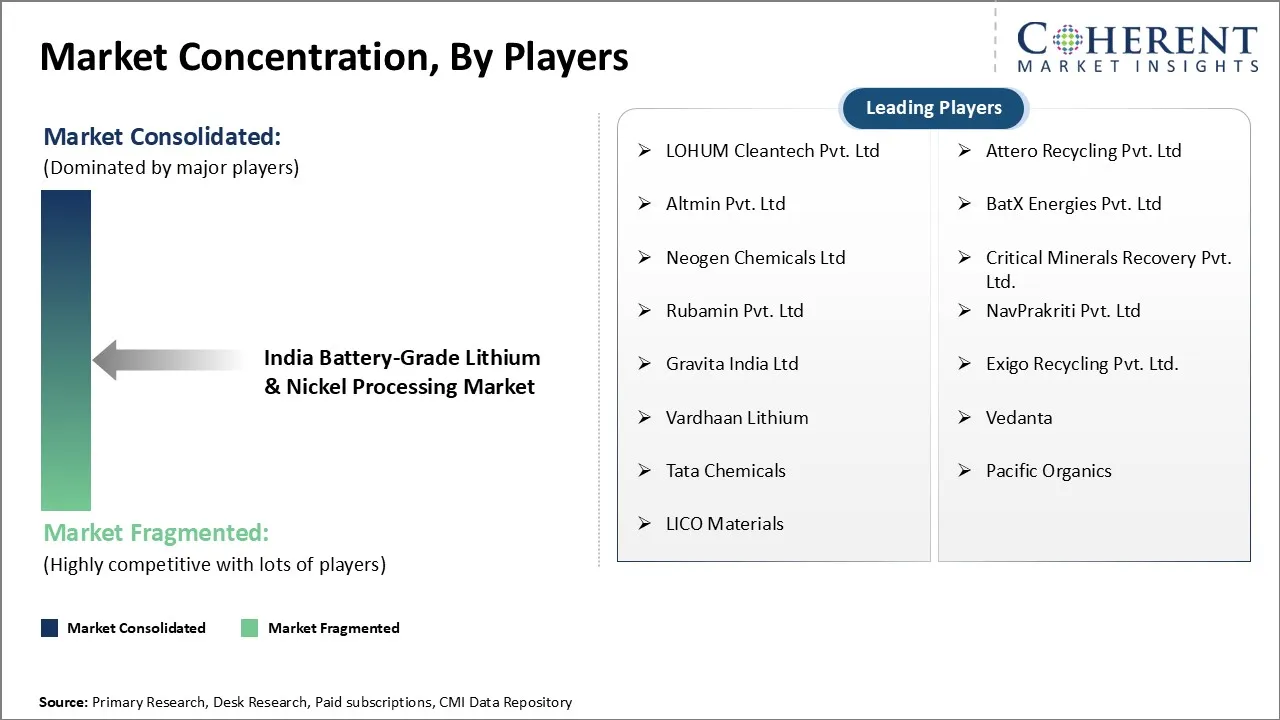
The India Battery-Grade Lithium & Nickel Processing Market is marked by an evolving competitive landscape involving battery recyclers, essential mineral recovery firms, and main lithium refining producers. LOHUM Cleantech, Attero Recycling, Altmin, Rubamin, BatX Energies, Gravita India and Recycle Karo are the major entities involved in lithium refining, hydrometallurgical recovery, battery-grade chemical manufacturing and recycling-based mineral processing. The competition is increasingly driven by refining capacities, recovery efficiency, product purity, feedstock availability, and technological competence. New entrants, strategic alliances, and capacity expansions are likely to arise from government incentives for critical mineral processing and increasing investments in domestic battery material manufacturing, which will gradually strengthen competition across India’s lithium and nickel processing value chain.
Top Manufacturers and Notable Products in the India Battery-Grade Lithium & Nickel Processing Market
Manufacturer | Notable Product | Key features |
LOHUM Cleantech Pvt. Ltd | Battery-Grade Lithium Carbonate, Battery-Grade Nickel Sulphate, Recovered Critical Minerals | Proprietary NEETM hydrometallurgical and material recovery technologies; recovery of lithium, nickel, cobalt and other critical minerals from primary and secondary feedstocks; high-purity battery materials and integrated recycling. |
Altmin Pvt. Ltd | Lithium Iron Phosphate (LFP) Cathode Active Materials, Lithium-Based Battery Materials | Focus on domestic production of LFP cathodes, lithium supply chain integration, and spodumene refining capabilities; aims large scale supply to lithium-ion cell manufacturers |
Vedanta Nico | Battery-Grade Nickel Sulphate, High-Purity Nickel Metal, Technical-Grade Nickel Compounds | Processes imported nickel mixed hydroxide precipitate (MHP) to high-purity nickel products; produces nickel metal with ~ 99.8% purity and battery-grade nickel sulfate for lithium-ion battery applications |
BatX Energies Pvt. Ltd. | Battery-Grade Lithium Carbonate, Nickel Sulphate, Cobalt Sulphate, Manganese Carbonate | Employs proprietary low-temperature, low-pressure hydrometallurgical processing; recovers critical minerals from spent lithium-ion batteries (LFP and NMC chemistries); targets closed-loop battery material recovery |
Attero Recycling Pvt. Ltd. | Recovered Lithium Carbonate, Nickel, Cobalt, Graphite | Operates lithium-ion battery recycling and essential mineral recovery operations; employs modern extraction and refining technologies to recover various high value materials from end-of-life batteries and electronic trash |
Market Report Scope
India Battery-Grade Lithium & Nickel Processing Market | |||
Report Coverage | Details | ||
Base Year | 2025 | Market Size in 2026: | USD 26.1 Mn |
Historical Data For: | 2020 To 2024 | Forecast Period: | 2026 To 2033 |
Forecast Period 2026 To 2033 CAGR: | 59.3% | 2033 Value Projection: | USD 648.2 Mn |
Segments covered: |
| ||
Companies covered: | LOHUM Cleantech Pvt. Ltd, Attero Recycling Pvt. Ltd, Altmin Pvt. Ltd, BatX Energies Pvt. Ltd, Neogen Chemicals Ltd, Critical Minerals Recovery Pvt. Ltd, Rubamin Pvt. Ltd, NavPrakriti Pvt. Ltd, LICO Chemicals, GRAVITA India Ltd. | ||
Growth Drivers: |
| ||
Restraints & Challenges: |
| ||
Expert Opinion (Analyst’s View)
- India Battery-Grade Lithium & Nickel Processing Market is predicted to develop at a considerable rate during the forecast period. Increasing production of lithium-ion batteries, demand for electric vehicles, and storage needs for renewable energy are contributing to the growth of the market. Government-backed investments in domestic refining infrastructure, including incentives for processing essential minerals, will boost local production of lithium carbonate, lithium hydroxide and nickel sulfate, reducing reliance on imports of battery-grade materials.
- Rising expenditures in hydrometallurgical processing, improved mineral purification, and battery recycling are opening up prospects for domestic manufacturers to extract lithium and nickel from imported intermediates, spent batteries and black mass. Demand for LFP and nickel-containing cathode materials and integrated battery manufacturing facilities will generate opportunities for specialist chemical producers, technology providers and recycling companies.
- Companies like LOHUM Cleantech, Attero Recycling, Altmin, BatX Energies and Gravita India are participating with investments in lithium refining, essential mineral recovery, battery recycling and downstream material development. Their focus on processing efficiency, high-purity chemical manufacturing, strategic sourcing alliances and capacity development will be key in building a competitive domestic battery-grade lithium and nickel supply chain.
Market Segmentation
- Material Type Insights (Revenue, USD Million, 2021–2033)
- Battery-Grade Lithium
- Battery-Grade Nickel
- Product Type Insights (Revenue, USD Million, 2021–2033)
- Lithium Carbonate
- Lithium Hydroxide
- Battery-Grade Lithium Chloride
- Nickel Sulphate
- Class-1 Nickel
- Feedstock Source Insights (Revenue, USD Million, 2021–2033)
- Imported Mineral Ores & Concentrates
- Imported Intermediate Materials
- Recycled Batteries & Black Mass
- Domestic Mineral Resources
- Processing Technology Insights (Revenue, USD Million, 2021–2033)
- Hydrometallurgical Processing
- Pyrometallurgical Processing
- Chemical Conversion & Refining
- Recycling-Based Metal Recovery
- Application Insights (Revenue, USD Million, 2021–2033)
- Cathode Active Material Manufacturing
- Cathode Precursor Manufacturing
- Battery Material & Chemical Manufacturing
- End User Insights (Revenue, USD Million, 2021–2033)
- Battery Material Manufacturers
- Lithium-Ion Battery Manufacturers
- Automotive Battery Suppliers
- Energy Storage Battery Manufacturers
- Key Players Insights
- LOHUM Cleantech Pvt. Ltd.
- Attero Recycling Pvt. Ltd.
- Altmin Pvt. Ltd.
- BatX Energies Pvt. Ltd.
- Rubamin Pvt. Ltd.
- Gravita India Ltd.
- RecycleKaro
- LICO Materials Pvt. Ltd.
- Neogen Chemicals Ltd.
- Exigo Recycling Pvt. Ltd.
- MiniMines Cleantech Solutions Pvt. Ltd.
- Metastable Materials Pvt. Ltd.
- Namo eWaste Management Ltd.
- Maxvolt Energy Industries Ltd.
- Vedanta Limited
Sources
Primary Research Interviews
- Battery-Grade Lithium & Nickel Refining Companies
- Lithium-Ion Battery Recycling & Critical Mineral Recovery Companies
- Cathode Active Material & Battery Chemical Manufacturers
- Hydrometallurgical Processing Technology Providers
- Lithium-Ion Battery Manufacturers & Raw Material Procurement Managers
- Critical Mineral Mining, Trading & Supply Chain Experts
Magazines
- Chemical Industry Digest
- Battery Technology Magazine
- Recycling Today
- Mining Technology
- Chemical Engineering Magazine
- Asian Metal
Journals
- Journal of Power Sources (Elsevier)
- Hydrometallurgy (Elsevier)
- Resources, Conservation and Recycling (Elsevier)
- Journal of Energy Storage (Elsevier)
- Minerals Engineering (Elsevier)
- Journal of Sustainable Metallurgy (Springer)
Associations
- India Energy Storage Alliance (IESA)
- India Cellular & Electronics Association (ICEA)
- Federation of Indian Mineral Industries (FIMI)
- International Lithium Association (ILiA)
- Nickel Institute
- Material Recycling Association of India (MRAI)
- Indian Battery Manufacturers Association (IBMA)
Public Domain Sources
- Ministry of Mines, Government of India (mines.gov.in)
- Ministry of Heavy Industries, Government of India (heavyindustries.gov.in)
- Ministry of Environment, Forest and Climate Change (moef.gov.in)
- Central Pollution Control Board (cpcb.nic.in)
- Geological Survey of India (gsi.gov.in)
- NITI Aayog Reports (niti.gov.in)
- Department of Science & Technology (dst.gov.in)
- Press Information Bureau (pib.gov.in)
- Indian Bureau of Mines (ibm.gov.in)
- Directorate General of Foreign Trade (dgft.gov.in)
- International Energy Agency (iea.org)
- United States Geological Survey (usgs.gov)
Proprietary Elements
- CMI Data Analytics Tool
- Proprietary CMI Existing Repository of Information for Last 10 Years
Get access to 250+ pages report
Every segment, forecast, competitor profile and data table behind the analysis above — available for instant download.
- ESOMAR Member
- ISO 9001:2015 Certified
- D-U-N-S Registered
- GDPR & CCPA Compliant
Frequently Asked Questions
The India battery-grade lithium & nickel processing market is estimated to stand at USD 26.1 million in 2026 and is projected to reach USD 648.2 million by 2033.
The CAGR of the India battery-grade lithium & nickel processing market is projected to be approximately 59.3% from 2026 to 2033.
The expansion of domestic lithium-ion battery manufacturing and government incentives for critical mineral processing are the major factors driving the growth of the India battery-grade lithium & nickel processing market.
High dependence on imported mineral feedstocks and limited domestic commercial-scale refining infrastructure are the major factors hampering the growth of the India battery-grade lithium & nickel processing market.
In terms of material type, the battery-grade lithium segment is estimated to dominate the market revenue share in 2026.
The market covers the domestic processing, chemical conversion, purification and refining of lithium and nickel feedstocks into high-purity battery-grade materials used in the fabrication of lithium-ion batteries.
Lithium carbonate is an important precursor in the synthesis of lithium iron phosphate (LFP) cathodes due to its chemical compatibility, commercial availability, and cost advantage in some battery fabrication methods.