

India Lithium-Ion Battery Recycling Market Size and Forecast – 2026 To 2033
The India Lithium-Ion Battery Recycling Market is estimated to be valued at USD 145.2 Mn in 2026 and is projected to reach USD 1,051.6 Mn by 2033, registering a CAGR of 32.69% during 2026–2033. The increasing replacement of portable electronic devices, the rising adoption of electric vehicles, and investments in domestic battery manufacturing are anticipated to generate additional recycling feedstock, propelling the market growth. The expanding recycling infrastructure and domestic critical minerals recovery are buoying the industry’s long-term view.
In May 2026, the Government of India and the European Union launched a joint initiative worth approximately USD 17.8 million (€15.2 million) to support electric vehicle battery recycling under the India-EU Trade and Technology Council. The initiative is aimed at improving material recovery, setting up pilot-scale recycling facilities in India and developing safer battery collection systems. These initiatives are expected to improve the recycling capabilities of the domestic economy and help develop a sustainable battery supply chain.
Key Takeaways of the India Lithium-Ion Battery Recycling Market
- Consumer Electronics is estimated to register a CAGR of 28.8% during 2026-2033 and hold a share of 46.3% in India’s lithium-ion battery recycling market in 2026. Battery feedstock is readily available due to frequent device replacement and established collection channels. In June 2026, Samsung India held authorized e-waste collection drives in eight cities, boosting formal recovery channels.
- Lithium Cobalt Oxide (LCO) is estimated to account for a 35.6% share of the lithium-ion battery recycling market revenue in 2026, registering a compound annual growth rate (CAGR) of 28.5% during 2026-2033. The recovered material is commercially attractive, especially when obtained from retired portable electronics, because of its cobalt-rich cathode chemistry. Maxvolt Energy established Maxvolt ReEarth in April 2026 to support its planned recycling operations for LCO and other chemistries.
- Hydrometallurgical Recycling is projected to account for 49.5% of the lithium-ion battery recycling market revenue in 2026, with a compound annual growth rate (CAGR) of 35.8% from 2026 to 2033. Processors can also selectively recover metals and monetize battery-grade lithium, cobalt and nickel rather than selling only intermediate black mass. Technology Development Board of India gave its approval to BatX Energies’ indigenous low temperature hydrometallurgical recycling process for commercial scale-up in June 2025.
Segmental Insights
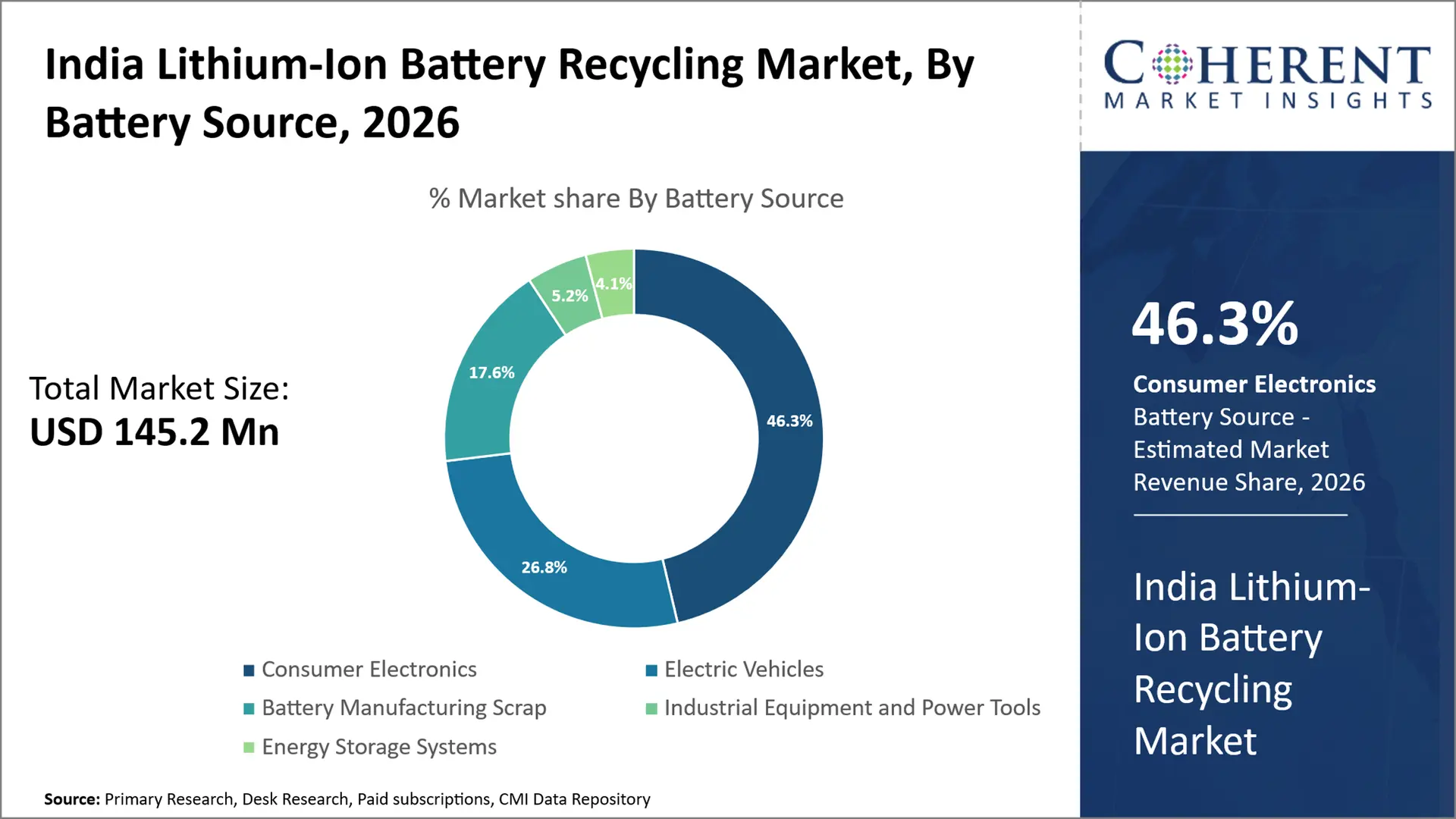
Why Does Consumer Electronics Dominate the India Lithium-Ion Battery Recycling Market?
Consumer Electronics is expected to account for 46.3% of the India lithium-ion battery recycling market in 2026, leading the battery-source category. Many of the recoverable cells are found in unused phones, laptops, wearables, and power banks instead of being directly thrown into recycling facilities. Retail exchanges can turn these scattered devices into identifiable collections, and inspections can separate reusable products from material that needs treatment. This provides a practical way for electronics retailers to manage end-of-life obligations, and provides recyclers with more consistent inflows. In January 2026, Aptronix partnered with Servify and Karo Sambhav to introduce its Limitless Exchange program, a system that takes in a variety of devices, including defunct electronics, for evaluation, refurbishment, or proper recycling. The initiative demonstrates that customer-facing incentives can improve battery-waste capture without independent scrap dealers.
- Current Industry Events of 2026
- Market Size Estimation
- Regional Breakdown
- Competitive Landscape
- Customer Intelligence
- Segmental Analysis
- Pricing Analysis
- Key Market Drivers, Challenges & Future Trends
- Customized Insights Section
Why Does Lithium Cobalt Oxide (LCO) Represent the Largest Battery Chemistry Segment in the India Lithium-Ion Battery Recycling Market?
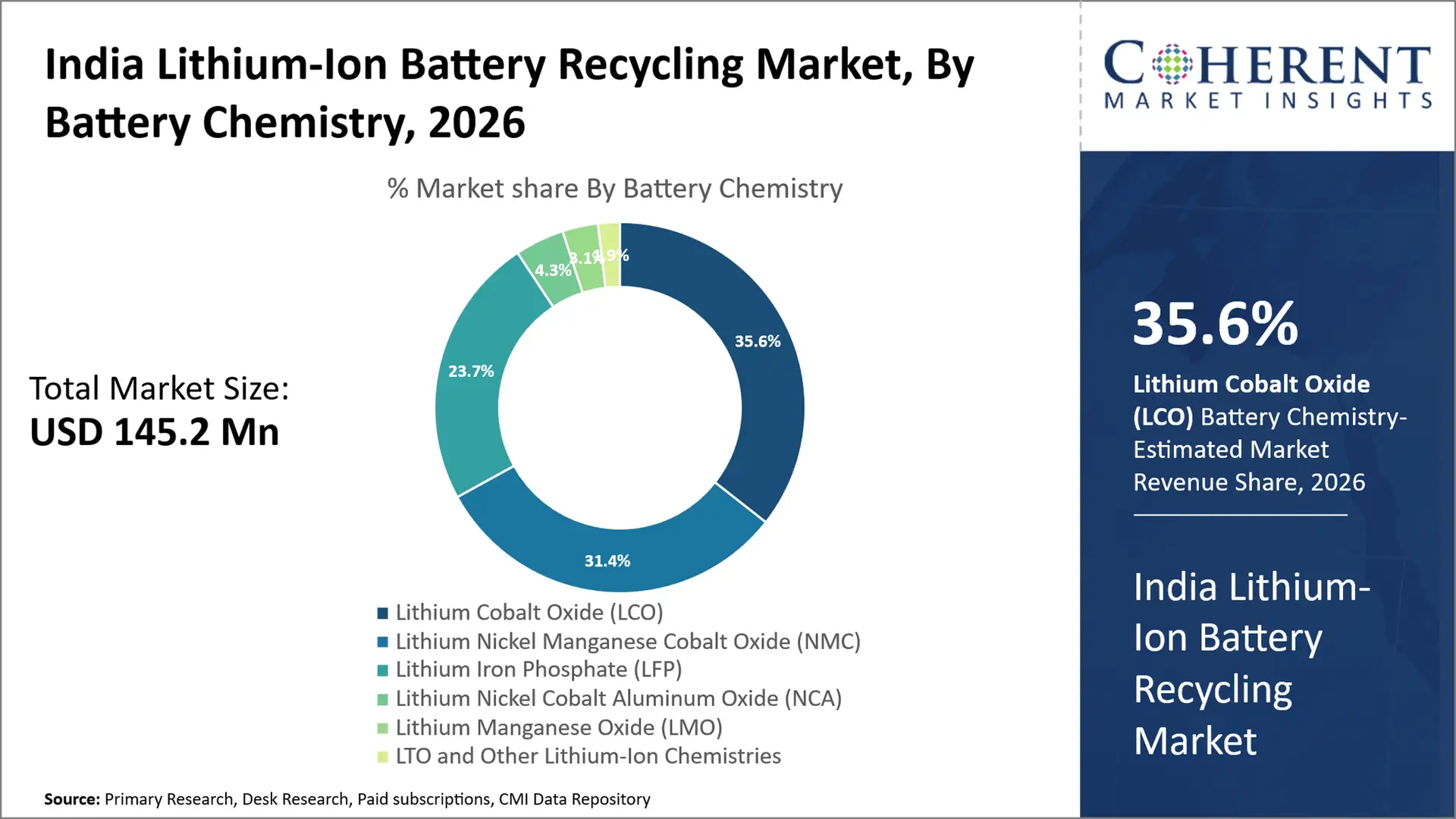
Lithium Cobalt Oxide (LCO) is expected to lead the battery-chemistry segment, accounting for a 35.6% share of the India lithium-ion battery recycling market in 2026. The composition of the LCO cell cathode is relatively identifiable, which enables recyclers to sort incoming batteries into processing lots specific to the chemistry. Improved segregation allows for better validation of input composition in the laboratory, reduces cross-contamination and provides clear purchasing specifications for recovered materials. This is relevant for refiners currently negotiating long-term contracts with industrial cobalt consumers and cathode-material makers. The India's Ministry of Mines announced its Incentive Scheme for the Promotion of Critical Minerals Recycling in September 2025, which specifically recognizes spent LCO batteries as eligible feedstocks. This makes facilities with a history of mineral extraction more attractive for investment, although individual projects must still satisfy the scheme's technical and financial criteria.
Why Does Hydrometallurgical Recycling Dominate the Recycling Process Segment of the India Lithium-Ion Battery Recycling Market?
Hydrometallurgical Recycling is expected to secure 49.5% of the India lithium-ion battery recycling market in 2026, leading the recycling-process category. Aqueous refining provides operators with greater control over final chemical specifications, process quality and metal separation than solely disassembly focused routes. Commercial attractiveness is founded on the combination of black-mass treatment with industrial chemical operations. Reagent management, effluent treatment and automated monitoring all contribute to the reliability of the operation. Audited processing records and more predictable recovery specifications can be a godsend for battery manufacturers and materials buyers. Rubamin announced in February 2025, the processing of its first batch of battery black mass for the recovery of metals at its facility in Halol, Gujarat. The company’s facility also includes automated hydrometallurgical controls, reflecting the growing importance of industrial-scale process control to the competitiveness of domestic recycling.
Current Events and their Impact
Current Event | Description and Its Impact |
February 2025 – Battery Waste Management Amendment Rules, 2025 |
|
Exemption from Customs Duty for Lithium-Ion Battery Scrap in February 2025 |
|
Maharashtra Electric Vehicle Policy 2025 May 2025 |
|
India Lithium-Ion Battery Recycling Market Dynamics
Key Market Drivers
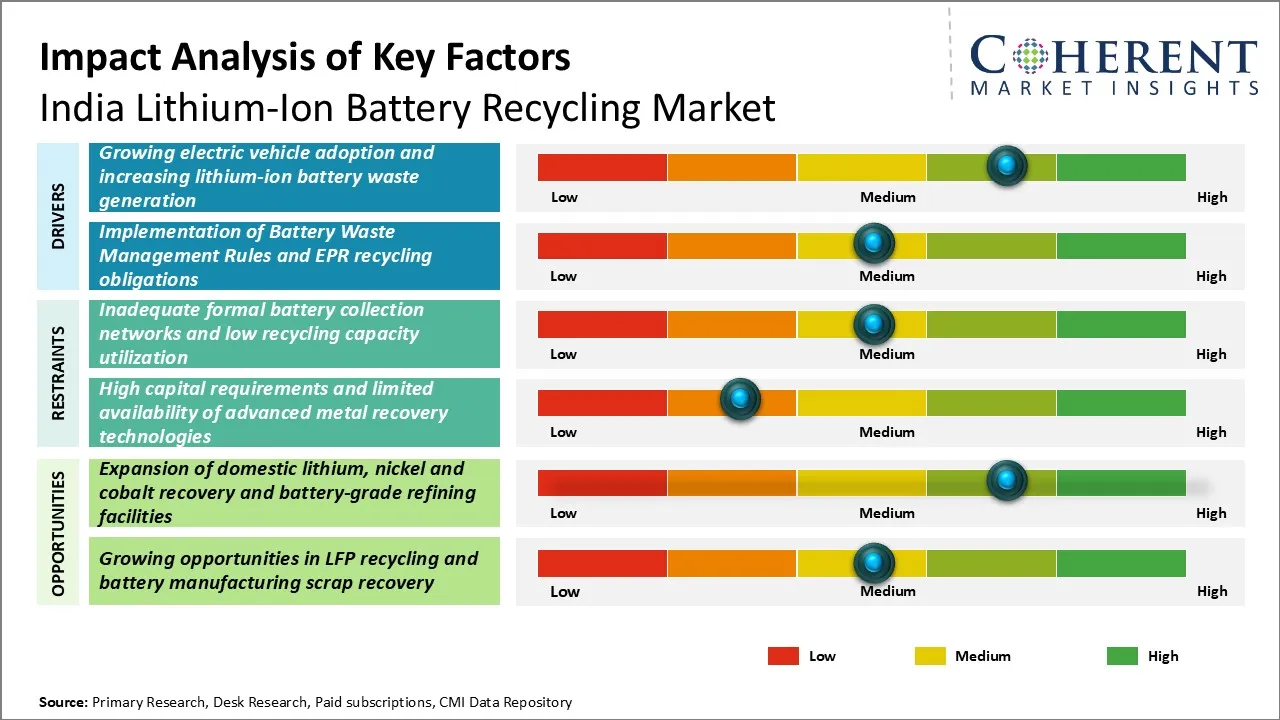
- Growing Electric Vehicle Adoption and Increasing Lithium-Ion Battery Waste Generation: Recycling opportunities from warranty claims, accidental damage and fleet maintenance will occur sooner than those from typical vehicle retirement because of battery replacements. This will promote the creation of dedicated battery collection and processing infrastructure, especially for commercial fleets, electric two-wheelers and three-wheelers. The PM E-DRIVE Scheme has sold 26.59 lakh electric vehicles till June 2026, as per the report released by the Ministry of Heavy Industries in October 2026, thus reflecting the increasing battery population that the recyclers will have to eventually accommodate.
- Implementation of Battery Waste Management Rules and EPR Recycling Obligations: India’s Battery Waste Management Rules are pushing recycling procurement toward licensed operators who can meet Extended Producer Responsibility (EPR) obligations. The battery manufacturers and importers are obliged to implement compliant waste management, which creates commercial opportunities for recyclers providing collection, processing and certificate issuance. These requirements encourage formal service contracts and strengthen the value of documented recycling operations. In March 2026, the Ministry of Environment, Forest and Climate Change reported 520 registered battery-waste recyclers and 0.17 USD tonnes of EPR certificates generated across battery categories as of March 5, demonstrating the scale of the formal compliance framework.
Emerging Market Trends
- Transition Toward Chemistry-Linked Recycling Contracts: Recycling contracts are shifting from flat fees for mixed battery waste to a price based on the amount of material that can be recovered, the complexity of processing and the chemistry of the battery. Lithium iron phosphate batteries have a different recovery economics than cobalt and nickel rich batteries, making standardized processing fees less appropriate for all feedstocks. This change could encourage recyclers to adopt material recovery arrangements and chemistry-specific quotations. Better visibility into treatment costs would benefit battery manufacturers and operators with accurate material characterization and flexible production systems should be better placed to protect margins when commodity prices swing.
- Greater Focus on Lithium Recovery from LFP Battery Waste: Recycling lithium iron phosphate is forcing a rethinking of the economics of recovery in terms of lithium extraction, rather than just relying on the value of nickel and cobalt. Selective leaching, reagent recovery and improved lithium purification could be increasingly adopted by LFP waste processors to increase revenues per ton. This shift could possibly change the procurement of recycling technology, especially for plants serving stationary energy storage applications and electric mobility. During the forecast period, operators commercializing economically viable LFP recovery processes might gain an advantage over businesses that depend on mixed black-mass sales.
Market Restraints
- High Capital Requirements and Uncertain Plant Utilization: Recycling facilities for lithium-ion batteries require specialized systems for dismantling, fire protection, pollution control and chemical treatment. Suitable battery waste is not evenly distributed across locations and chemistries, and these investments involve large fixed costs. If recyclers expand faster than their contracted feedstock supply, underutilized assets, higher processing costs, and longer investment recovery periods can result. This is especially important for smaller operators moving from mechanical pre-processing to more sophisticated metal refining.
- Hazardous Battery Handling and Reverse Logistics Costs: The remaining electrical charge and thermal instability of damaged lithium-ion batteries can increase the risk of fire, exacerbating the challenges associated with transportation, storage and operational safety. Costs for collection from scattered locations include packaging, segregation, discharge, insurance and special transport costs. A lack of adequate collection infrastructure, especially for smaller waste generators, can discourage formal collection. These conditions increase the importance of regional aggregation infrastructure and constrain margins for recyclers that do not operate within established industrial clusters.
Battery Recycling Supply Chain and Commercial Landscape – India
Market Area | Primary Focus | Key Stakeholders | Commercial Implication |
Battery Manufacturing Scrap Procurement | Collection of rejected cells, electrode offcuts, and defective battery packs from manufacturing facilities | Cell manufacturers, battery assemblers, authorized recyclers | Creates contracted feedstock opportunities and reduces dependence on irregular end-of-life battery collections |
EV Battery Collection Networks | Recovery of damaged, warranty-replaced, and retired traction batteries through authorized service channels | EV manufacturers, dealerships, fleet operators, recycling companies | Improves battery return efficiency and supports long-term recycling agreements with vehicle manufacturers |
Consumer Electronics Take-Back | Collection of discarded smartphone, laptop, power bank, and other portable-device batteries | Electronics brands, retailers, collection agencies, recyclers | Expands access to dispersed battery waste and creates opportunities for organized collection partnerships |
Battery Waste Aggregation and Logistics | Consolidation, segregation, packaging, storage, and transportation of spent lithium-ion batteries | Waste aggregators, logistics providers, industrial collection partners | Reduces fragmented collection costs and improves the reliability of battery waste supplied to recycling facilities |
EPR Compliance and Recycling Certificates | Registered battery waste processing, regulatory documentation, and EPR certificate generation | Battery producers, importers, registered recyclers | Creates compliance-related service opportunities and strengthens traceability across the formal recycling chain |
Recovered Material Supply Agreements | Commercial sale of recovered lithium, cobalt, nickel, manganese, and other recyclable materials | Recycling companies, chemical refiners, battery material manufacturers | Supports downstream revenue generation and encourages long-term purchasing agreements for qualified secondary materials |
How Can Battery-Grade Graphite Recovery Create New Growth Opportunities in the India Lithium-Ion Battery Recycling Market?
India's lithium-ion battery recycling industry offers a virgin opportunity for the recovery and upgrading of spent anode graphite. Despite the importance of graphite in lithium-ion cell manufacturing, commercial use is limited due to traditional recycling economics favoring cathode metals.
To be able to have a profitable graphite recovery business, it is necessary to separate anode material from mixed black mass, remove binder residues and metallic contamination and restore properties suitable for downstream applications.
Recyclers might want to start off by using conductive additives, industrial carbon products and other technically qualified applications before taking on challenging battery-anode specifications. This phased approach would enable processors to build up customers without the immediate need for cell grade certification.
Commercial participation means the need for long term validation agreements with anode material manufacturers, segregation of reliable feedstock, particle characterization laboratories and purification technology.
The most likely winners are vertically integrated recyclers and specialist technology developers. The sustainability of graphite recovery as a revenue stream, however, will depend on consistent product quality, competitive processing costs and buyer qualification.
Market Players, Key Development, and Competitive Landscape
Key Developments
- In April 2026, Rocklink India commissioned its integrated recycling facility at Sikandrabad, Uttar Pradesh, with a stated lithium-ion battery input capacity of 10,000 tonnes annually. The facility processes battery materials into black mass for downstream recovery, adding industrial preprocessing capacity across multiple lithium-ion battery chemistries.
- In January 2025, ACE Green Recycling announced that it had finalized a lease agreement for a planned battery recycling facility in India, targeting annual LFP processing capacity of 10,000 tonnes by 2026. The investment proposal highlighted growing commercial interest in dedicated LFP recycling infrastructure rather than cobalt-dependent recovery economics.
Competitive Landscape
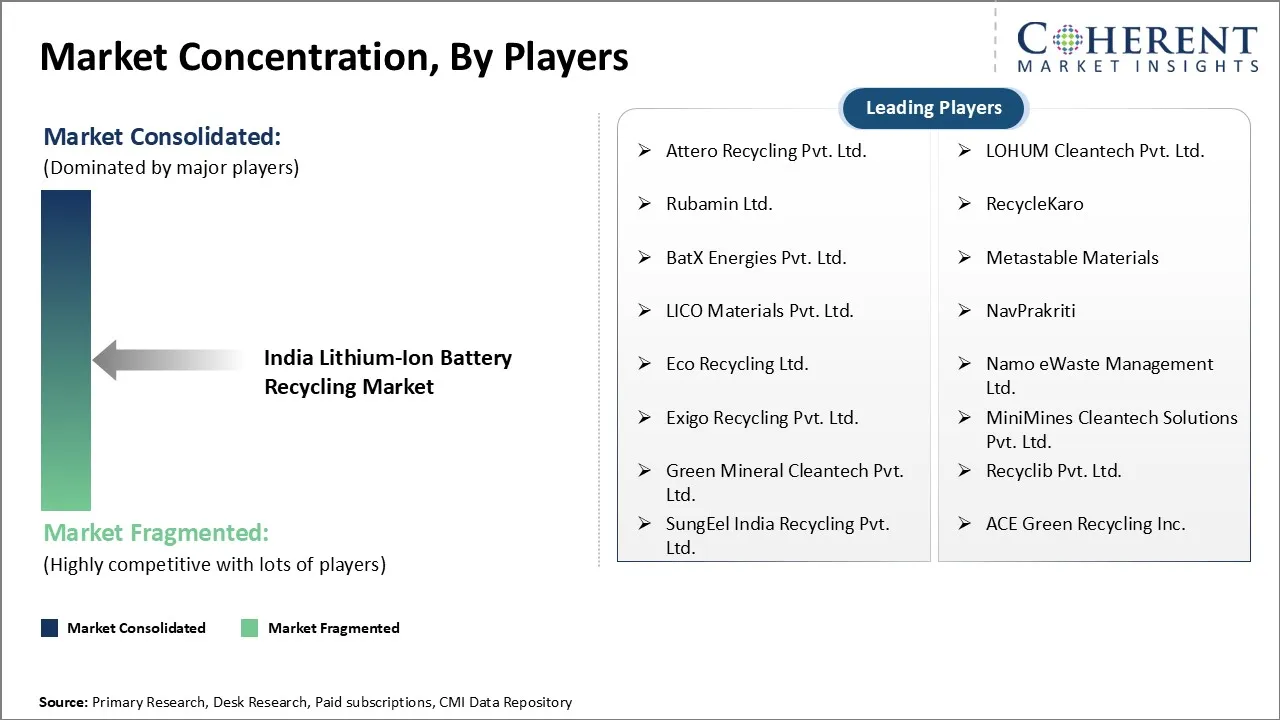
The India lithium-ion battery recycling market remains fragmented with specialized recycling technology providers, critical minerals refiners, mechanical processors and integrated recyclers. Competition is making it increasingly important to be able to operate economically across a range of battery chemistries and still meet industrial quality and environmental standards. They are more advantageous than the operators focused on the sales of intermediate materials, since these companies have built processing capabilities and have downstream customers of materials.
Key focus areas include
- Recovery Economics: reduced cost to process per kilo of salable lithium, cobalt, nickel and manganese compounds.
- Process Flexibility: Ability to treat battery materials of varying formats, chemistries and contamination levels.
- Industrial Scale. Continuous throughput without the need for excessive chemical consumption or maintenance costs.
- Material Quality: Consistent chemical purity, control of impurities and suitability for downstream industrial applications.
- Environmental Performance: Adequate handling of hazardous residues, Adequate treatment of wastewater and emissions.
- Commercial agreements: Stable contractual relations with battery material buyers, stable procurement arrangements
- Financial Resilience: Capacity to manage working capital requirements, commodity price volatility, and delayed customer qualification.
Market Report Scope
India Lithium-Ion Battery Recycling Market Report Coverage | |||
Report Coverage | Details | ||
Base Year | 2025 | Market Size in 2026: | USD 145.2 Mn |
Historical Data For: | 2020 To 2024 | Forecast Period: | 2026 To 2033 |
Forecast Period 2026 To 2033 CAGR: | 32.69% | 2033 Value Projection: | USD 1,051.6 Mn |
Segments covered: |
| ||
Companies covered: | Attero Recycling Pvt. Ltd., LOHUM Cleantech Pvt. Ltd., Rubamin Ltd., RecycleKaro, BatX Energies Pvt. Ltd., Metastable Materials, LICO Materials Pvt. Ltd., NavPrakriti, Eco Recycling Ltd., Namo eWaste Management Ltd., Exigo Recycling Pvt. Ltd., MiniMines Cleantech Solutions Pvt. Ltd., Green Mineral Cleantech Pvt. Ltd., Recyclib Pvt. Ltd., SungEel India Recycling Pvt. Ltd., ACE Green Recycling Inc. | ||
Growth Drivers: |
| ||
Restraints & Challenges: |
| ||
Analyst Opinion (Expert Opinion)
- India’s lithium-ion battery recycling market is set to migrate from a waste processing business to a technically qualified secondary raw material business. The ability to consistently deliver product specifications will be more important than the mere operation of large processing facilities if one wants to remain a market leader. Finally, recyclers developing long-term customer relationships and demonstrating consistent industrial production should achieve deeper differentiation than firms selling undifferentiated intermediate materials.
- The emergence of low-value, high-volume battery chemistry could have a significant impact on the economics of recycling plants. Facilities constructed around high-value recoverable metals may find it difficult to maintain profitability as feedstock composition changes. Modular processing configurations, selective recovery technologies and adaptable operating models may be needed to remain competitive in the future. Existing recycling companies could develop useful partnerships with tech providers that can change up recovery processes without having to rebuild entire plants.
- Recycling companies should not commit to major capacity expansions without having downstream product qualification, chemistry-specific processing economics and reliable feedstock agreements in place. Investment factors include commodity price exposures, process yields, utility consumption and regulatory obligations. Working with industrial customers, chemical refiners and battery manufacturers can help to improve operational stability. Companies should not be expanding low margin processing capacity without sufficient feedstock and commercially viable recovery outlets.
Speak to the analyst
Want personalized insights?
Take the findings above to one of our principal consultants, or have the report rebuilt around the segments, geographies and competitors you actually track.
Market Segmentation
- Battery Source Insights (Revenue, USD Mn, 2021 - 2033)
- Consumer Electronics
- Electric Vehicles
- Battery Manufacturing Scrap
- Industrial Equipment and Power Tools
- Energy Storage Systems
- Battery Chemistry Insights (Revenue, USD Mn, 2021 - 2033)
- Lithium Cobalt Oxide (LCO)
- Lithium Nickel Manganese Cobalt Oxide (NMC)
- Lithium Iron Phosphate (LFP)
- Lithium Nickel Cobalt Aluminum Oxide (NCA)
- Lithium Manganese Oxide (LMO)
- LTO and Other Lithium-Ion Chemistries
- Recycling Process Insights (Revenue, USD Mn, 2021 - 2033)
- Hydrometallurgical Recycling
- Mechanical Recycling Only
- Pyrometallurgical Recycling
- Direct Recycling and Cathode Regeneration
- Key Players Insights
- Attero Recycling Pvt. Ltd.
- LOHUM Cleantech Pvt. Ltd.
- Rubamin Ltd.
- RecycleKaro
- BatX Energies Pvt. Ltd.
- Metastable Materials
- LICO Materials Pvt. Ltd.
- NavPrakriti
- Eco Recycling Ltd.
- Namo eWaste Management Ltd.
- Exigo Recycling Pvt. Ltd.
- MiniMines Cleantech Solutions Pvt. Ltd.
- Green Mineral Cleantech Pvt. Ltd.
- Recyclib Pvt. Ltd.
- SungEel India Recycling Pvt. Ltd.
- ACE Green Recycling Inc.
Sources
Primary Research Interviews
- Lithium-ion battery recyclers, EV battery manufacturers, and metal recovery specialists
- Battery waste aggregators, recycling plant operators, and industry consultants
Stakeholders
- Battery manufacturers, recycling companies, and EV OEMs
- Waste collection agencies, metal refiners, and battery material suppliers
End-use Sectors
- Electric vehicles, consumer electronics, and energy storage systems
- Industrial equipment, power tools, and battery manufacturing
Regulatory and Industry Bodies
- Ministry of Environment, Forest and Climate Change (MoEFCC)
- Central Pollution Control Board (CPCB)
- Ministry of Heavy Industries (MHI)
- Ministry of Mines, Government of India
Databases
- CPCB Battery Waste Management EPR Portal
- VAHAN Electric Vehicle Registration Database
- UN Comtrade and DGCI&S Import–Export Statistics
- Ministry of Statistics and Programme Implementation (MoSPI)
Magazines and Journals
- Resources, Conservation & Recycling
- Journal of Power Sources
- Waste Management
- Journal of Energy Storage
Associations
- India Energy Storage Alliance (IESA)
- Material Recycling Association of India (MRAI)
- Society of Manufacturers of Electric Vehicles (SMEV)
- Society of Indian Automobile Manufacturers (SIAM)
Public Domain Sources
- Lithium-ion battery waste generation, recycling capacity, and material recovery data
- EV registrations, battery production, recycling investments, and critical mineral trade statistics
Key Standards and Regulations
- Battery Waste Management Rules, 2022, and subsequent amendments
- Extended Producer Responsibility (EPR) requirements for waste batteries
- CPCB guidelines for battery collection, storage, transportation, and recycling
- Hazardous and Other Wastes (Management and Transboundary Movement) Rules, 2016, where applicable.
Proprietary Elements
- CMI Data Analytics Tool and proprietary research repository, supplemented by battery waste generation estimates, primary interviews, recycling capacity analysis, material recovery assessment, and competitive intelligence.
Get access to 250+ pages report
Every segment, forecast, competitor profile and data table behind the analysis above — available for instant download.
- ESOMAR Member
- ISO 9001:2015 Certified
- D-U-N-S Registered
- GDPR & CCPA Compliant
Frequently Asked Questions
The CAGR of India lithium-ion battery recycling market is projected to be 32.69% from 2026 to 2033.
The lithium-ion battery recycling market in India is expected to grow from USD 145.2 million in 2026 to USD 1,051.6 million in 2033.
The main ways to treat spent lithium-ion batteries and recover their valuable materials are pyrometallurgical recycling, hydrometallurgical recycling and mechanical recycling.
Recoverable amounts of valuable elements such as lithium, cobalt, nickel, manganese, copper, aluminum, and graphite can be obtained from spent lithium-ion batteries.
Battery material manufacturers, metal refiners, chemical producers, and other industrial manufacturers are the major potential customers of recovered battery materials.
The report covers market dynamics, recycling technologies, regulatory requirements, competitive analysis, battery waste management practices, supply chain developments, and strategic business opportunities.
Growing electric vehicle adoption, increasing lithium-ion battery waste generation, and the implementation of Battery Waste Management Rules and Extended Producer Responsibility (EPR) obligations are the major factors driving the growth of the India lithium-ion battery recycling market.