

Global Industrial Robot Tactile Sensor Retrofit Market Size and Forecast – 2026 To 2033
The global Industrial robot tactile sensor retrofit market is expected to grow from USD 85.0 Mn in 2026 to USD 380.0 Mn by 2033, registering a compound annual growth rate (CAGR) of 23.9% from 2026 to 2033. The global Industrial robot tactile sensor retrofit market is driven by rising requirements for precise robotic gripping and object manipulation. On August 6, 2026, Festo introduced GripperAI, an AI-powered software solution that enables robots to handle mixed, unfamiliar and randomly positioned products without the need for extensive programming, template loading or specialist vision integration.
Key Takeaways of the Global Industrial Robot Tactile Sensor Retrofit Market
- The Tactile Pressure Sensors segment is expected to account for 38.0% of the global Industrial robot tactile sensor retrofit market share in 2026. Increasing investments in automation upgrades across established factories is driving the growth of the segment. On June 26, 2025, Schneider Electric opened a dedicated robotics and motion innovation facility in Raleigh, North Carolina. The center focuses on artificial intelligence, digitalization, and industrial automation technologies.
- The Capacitive segment is estimated to capture 41.0% of the market share in 2026. Growing demand for sensor-enabled robotic inspection and quality control is majorly driving the growth of the segment. On May 8, 2025, Hexagon Manufacturing Intelligence introduced two automated inspection solutions under its PRESTO Quality Stations portfolio. The systems support high-resolution scanning and automated measurement of large industrial components.
- The Collaborative Robots segment is estimated to capture 36.0% of the market share in 2026. Expansion of retrofit solutions that improve existing robot capabilities is majorly driving the growth of the segment. On August 5, 2026, Bosch Rexroth collaborated with Tillmann Group to modernize an existing metal profiling machine using ctrlX AUTOMATION. The project retained the existing third-party control system while upgrading drives, controls, and safety functions.
- Asia Pacific is expected to dominate the Industrial robot tactile sensor retrofit market in 2026 with a market share of 40.0%. Expansion of retrofit applications in automotive manufacturing in Asia Pacific is driving the growth of the regional market. On June 18, 2026, ForwardX Robotics expanded its autonomous mobile robot deployment at Chery Automobile's Dalian manufacturing facility in China. The installation reached 484 autonomous mobile robots across welding and final assembly workshops.
- North America is expected to account for 31.0% share in 2026 and is projected to record the fastest growth over the forecast period. Development of flexible tactile sensor arrays for robotic grippers in North America is driving the growth of the regional market. On July 14, 2025, TouchTronix Robotics, secured USD 300,000 in pre-seed funding. The Buffalo-based company develops sensing technologies for robotic hands addressing industrial automation requirements.
Segmental Insights
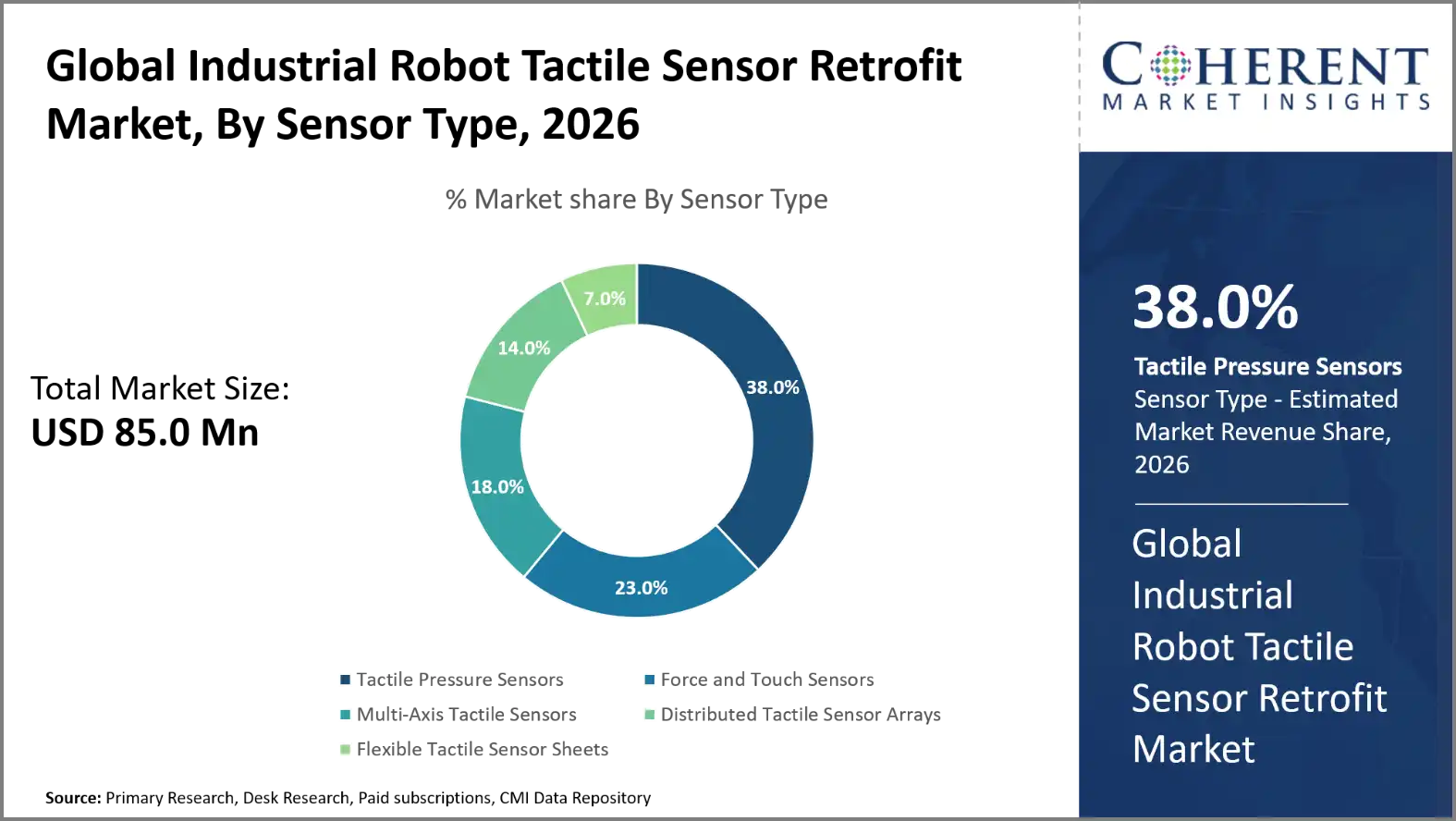
Why Does Tactile Pressure Sensors Dominate the Global Industrial Robot Tactile Sensor Retrofit Market?
The tactile pressure sensors segment is expected to account for 38.0% of the global Industrial robot tactile sensor retrofit market share in 2026. Tactile pressure sensors dominate because industrial robots require accurate contact detection and force measurement. These sensors sense pressure differences during gripping, assembling and material handling. Pressure sensors retrofitted to current robots increase object handling and decrease product damage. Integrating them allows safe interaction with fragile parts and oddly shaped items. Increasing adoption of precise manufacturing fuels demand for tactile pressure sensing technologies.
On July 27, 2026, Tacta Systems, the leading company in Dexterous Intelligence for robotics, revealed its technology for the first time. The company’s first product, the TactaBot, is made up of three groundbreaking components; the Tacta Hand, Skill Capture, and a Dexterous Intelligence AI model, that work together seamlessly to create the world's most capable, scalable, and adaptable robotic hands for high-value work.
- Current Industry Events of 2026
- Market Size Estimation
- Regional Breakdown
- Competitive Landscape
- Customer Intelligence
- Segmental Analysis
- Pricing Analysis
- Key Market Drivers, Challenges & Future Trends
- Customized Insights Section
Why is Capacitive the Most Crucial Technology Type?
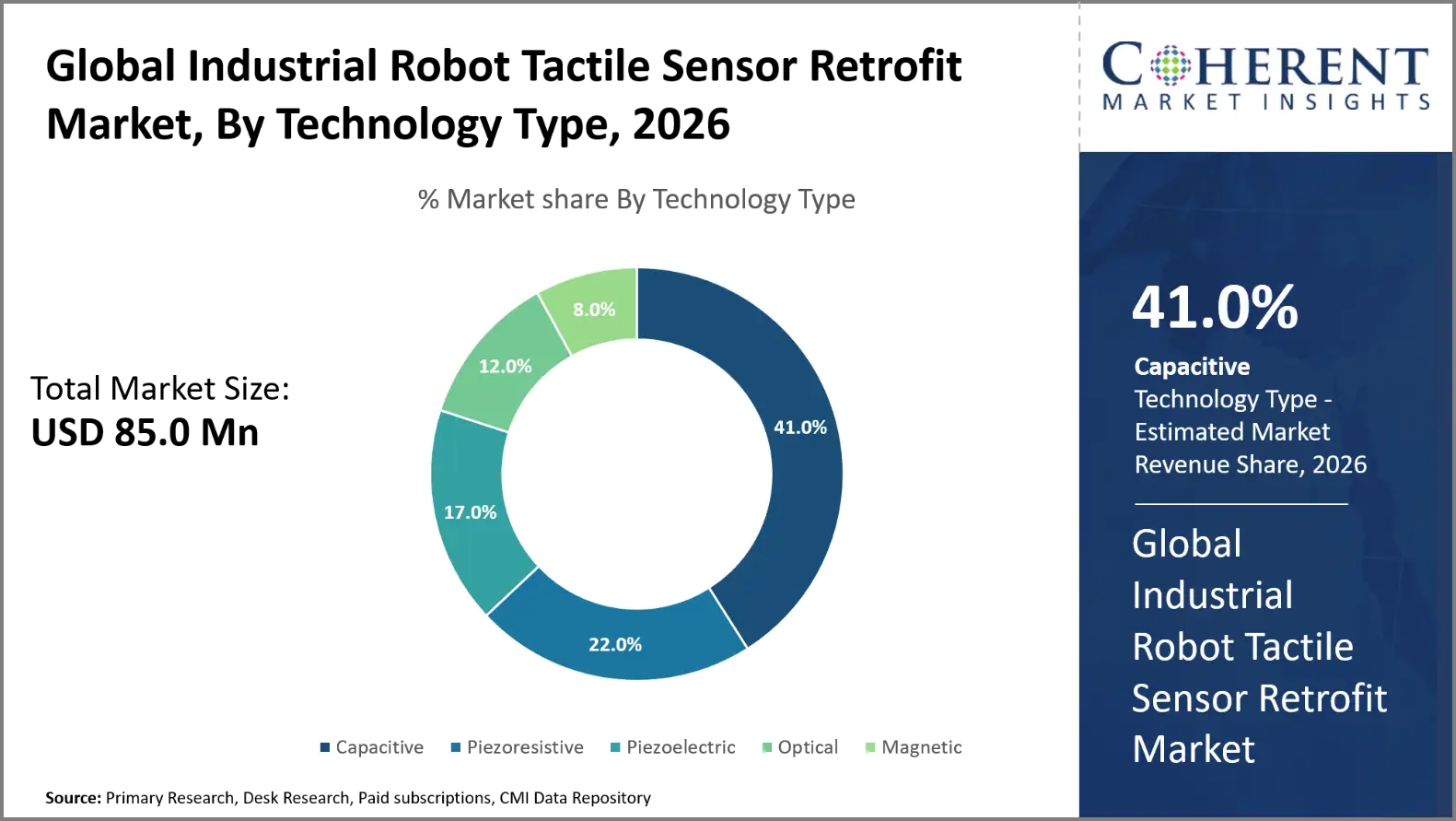
The capacitive segment is expected to account for 41.0% of the global Industrial robot tactile sensor retrofit market share in 2026. Capacitive technology is necessary due to its sensitive touch sensing and reliable pressure monitoring. The sensors measure changes in electrical capacitance due to the physical contact and the force applied. Their flexible sensor structures can be integrated into robotic grippers, fingertips, and end effectors. Capacitive sensors may also identify several contact points on complicated surfaces. Such capabilities enhance robotic manipulation, item detection and accurate handling. They are retro-fit compatible, allowing improvements on a variety of industrial robot designs.
On September 15, 2026, Synaptics announced compatibility for its Capacitive Tactile Sensing module in NVIDIA Isaac Sim and NVIDIA Holoscan. The module uses the SN6012T touch controller to capture contact information and pressure distribution. It targets dexterous robotic hands, grippers, and Physical AI systems.
Collaborative Robots Dominate the Global Industrial Robot Tactile Sensor Retrofit Market
The collaborative robots segment is expected to account for 36.0% of the global Industrial robot tactile sensor retrofit market share in 2026. Collaborative robots dominate because they require advanced contact sensing for safe human-robot interaction. By retrofitting with tactile sensors, collision detection, gripping accuracy and force control are improved. These enhancements enhance collaborative robots' ability to handle fragile parts and execute precision assembly operations. Collaborative robots are rapidly being used in electronics, automotive and packaging plants. Tactile sensing also promotes the adaptation to handling things of different shapes and textures. Growing desire for flexible automation also fuels retrofitting prospects among collaborative robotic setups.
On July 10, 2025, Kassow Robots debuted their Sensitive Arm technology. Its line of collaborative robots has high-resolution torque sensors built into each of its seven joints. The technology gives real-time force feedback with a control rate of 30 kHz.
Current Events and their Impact
Current Events | Description and its Impact |
European Union Machinery Regulation (EU) 2023/1230 |
|
European Union Artificial Intelligence Act (Regulation (EU) 2024/1689) |
|
Industrial Robot Tactile Sensor Retrofit Market Dynamics
Market Drivers
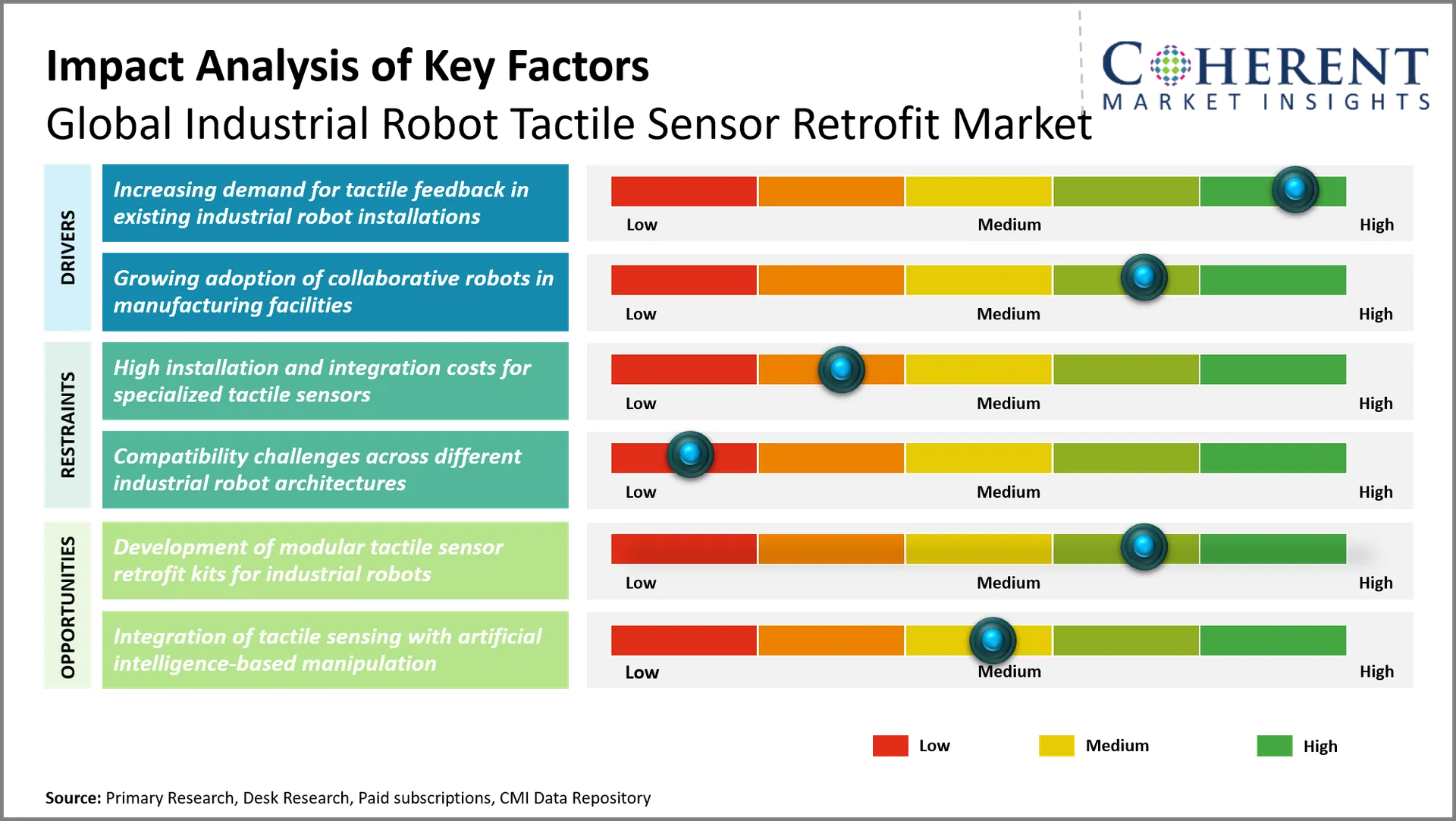
Increasing demand for tactile feedback in existing industrial robot installations
Manufacturers are increasingly demanding tactile feedback to improve precision for existing industrial robot installations. The ability to sense contact is a key capability for precise manipulation that is often lacking in traditional robots. Instead of replacing entire robotic systems, retrofitting tactile sensors enables real-time force measurement and pressure detection. The improvements raise gripping precision, reduce component damage, and allow complex assembly tasks. Sensitive robotic handling is increasingly demanded by makers of electronics, automotive and precise engineering. Rising investments in smart manufacturing further bolster demand for tactile sensor retrofits.
On February 19, 2025, Bota Systems, a leader in force-torque sensing technology, and Kassow Robots, a pioneer in agile and powerful collaborative robotics, announced a collaboration to enable advanced industrial automation. As part of this partnership, Bota Systems is now a member of the Kassow Robots KR Pulse ecosystem, allowing for smooth integration of a wide range of end-of-arm tools and software.
Growing adoption of collaborative robots in manufacturing facilities
Manufacturing facilities are rapidly embracing collaborative robots to enhance production flexibility and productivity at the workplace. They are used in conjunction with human workers in applications such as assembly, inspection, packing and material handling. Retrofits of tactile sensors enhance touch detection and pressure monitoring in collaborative activities. Advanced tactile feedback enables robots to detect physical contact and adapt gripping forces. These skills enable safer handling of sensitive components and irregular shaped objects. The growth of collaborative automation in small and medium-sized enterprises presents new prospects for tactile sensor retrofit solutions.
On February 23, 2025, Delta Electronics introduced it D-Bot series of collaborative robots in India. The six-axis robots have payload capabilities from six to 30 kilos. Their applications are packaging, electronics assembly, material handling, welding and machine tending.
Emerging Trends
- Integration of Artificial Intelligence-Powered Tactile Sensing: Industrial robot makers are merging AI with tactile sensors to enhance touch detection, grip adjustment, and item manipulation in sophisticated manufacturing processes.
- Impact: Intelligent tactile feedback enhances robot adaptability, decreases handling mistakes and allows fine tuning of forces in the processing of fragile components and irregularly shaped products.
- Relevance to the market: This trend promotes retrofits that combine tactile sensor arrays with intelligent controls. Upgrades like this allow current robots to do more sophisticated manipulation without replacing all of the hardware.
- Development of Flexible and Distributed Tactile Sensor Arrays: Sensor developers are working on flexible tactile arrays that measure pressure distribution on robotic fingertips, grippers and end-effectors during industrial handling tasks.
- Impact: Distributed sensing enhances contact localization, grip stability and force measurement. These characteristics enable accurate handling of sensitive components throughout automated production settings.
- Relevance to the market: Flexible sensor arrays allow retrofitting vendors to improve standard grippers. ATI Industrial Automation offers complementing force and torque sensing technology for robotic applications.
Regional Insights
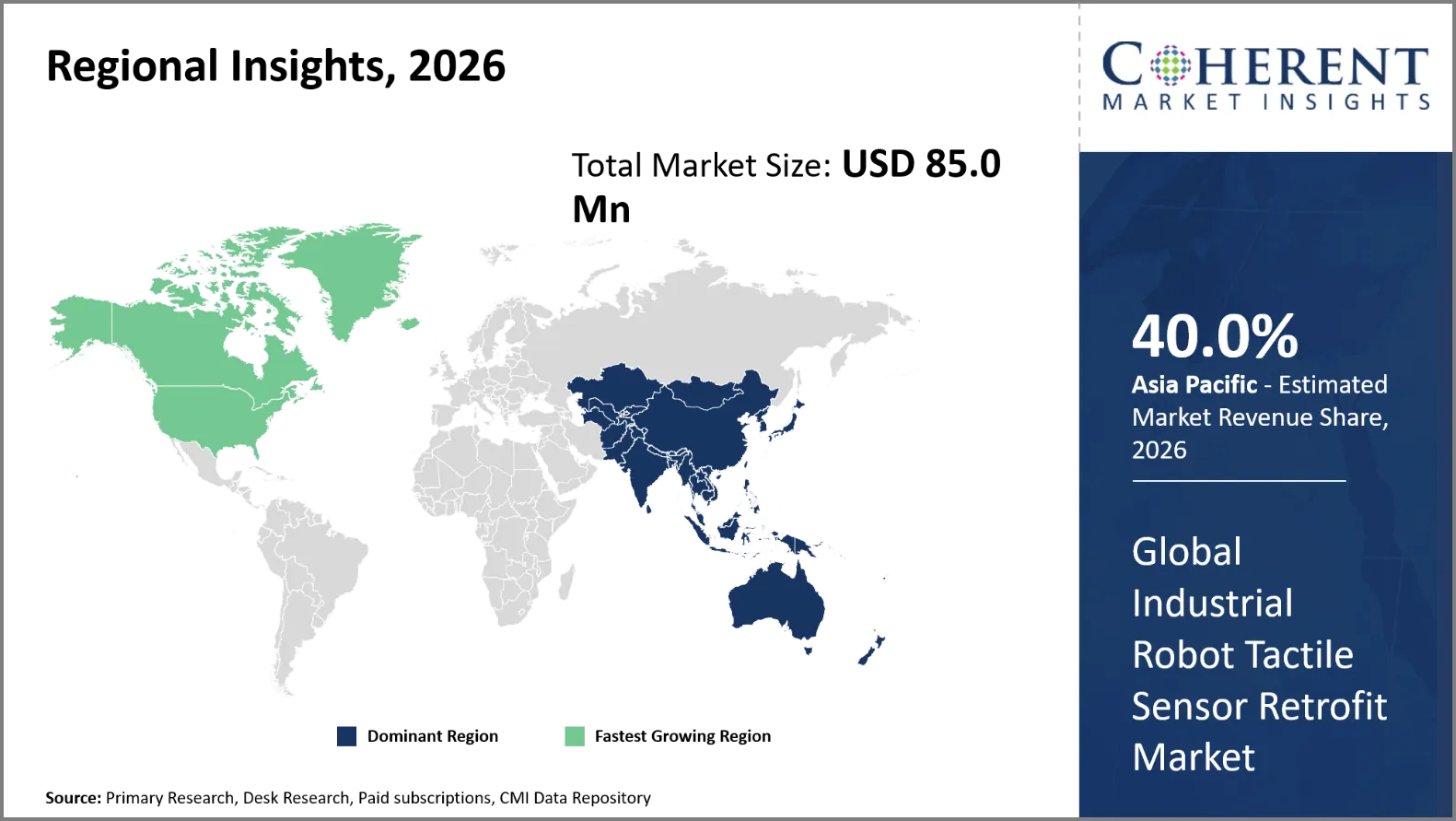
Why is Asia Pacific a Strong Market for Industrial Robot Tactile Sensor Retrofit?
Asia Pacific is expected to account for a market share of 40.0% in 2026. The Asia Pacific is also experiencing a rise in electronics manufacturing and a growing demand for precise robotic manipulation. Semiconductor packaging plants must handle delicate wafers and small electrical devices with high precision. Taiwan’s semiconductor manufacturing ecosystem offers chances for enhancements to tactile sensing in robotic handling equipment. The sophisticated production facilities in Singapore also enable accurate robotic inspection and placement of components. The International Federation of Robotics says Asian robot density increased 47% between 2020 and 2025. This automation expansion supports demand for sensor retrofits addressing delicate material handling, contact detection, and precision assembly requirements.
Why Does North America Industrial Robot Tactile Sensor Retrofit Market Exhibit High Growth?
North America is expected to register the fastest growth with a CAGR of 26.0% over the forecast period. It is projected to account for 31.0% of the global industrial robot tactile sensor retrofit market in 2026. North America benefits from reshoring investments and increasing automation across food processing and industrial manufacturing. Manufacturers need robotic systems to handle diverse product forms and fragile packaging. Food processing applications provide potential for tactile retrofits where diverse product textures require different gripping pressure. The International Federation of Robotics forecasts a 24% increase in North America’s robot density between 2020 and 2025. Its 2025 assessment also identified expanding food industry automation in the U.S. and automotive manufacturing investment in Mexico. These developments strengthen demand for adaptable robotic gripping technologies.
Global Industrial Robot Tactile Sensor Retrofit Market Outlook for Key Countries
Why is China Emerging as a Major Hub in the Industrial Robot Tactile Sensor Retrofit Market?
China benefits from domestic tactile sensor manufacturing and rapid development of dexterous robotic manipulation technologies. Wuhan Huaweike Intelligent Technology introduced multidimensional fingertip tactile sensors for robotic applications. Its electronic skin has been integrated into more than 10,000 dexterous robotic hands. The company also reported over one million compression trials for its fingertip sensing technology. Its professional-grade sensor achieves reported measurement accuracy of 0.5%. These advancements bolster China’s local tactile technology ecosystem. Retrofit suppliers looking for small sensing components and unique robotic integration solutions can benefit from local sensor availability.
Is U.S. the Next Growth Engine for the Industrial Robot Tactile Sensor Retrofit Market?
The U.S. gains from the modernization of aircraft industry and increased demand for automated precision inspection. Aircraft makers need robotic systems equipped to deal with composite constructions, curved surfaces and sensitive components. Robotic sanding, polishing and assembling can be improved by retrofitting with tactile sensors to measure contact-force. According to the International Federation of Robotics, robot density in manufacturing reached 323 units per 10,000 employees in 2025. Opportunities for modernizing outdated robotic equipment also exist with domestic automation integrators. These improvements underpin the demand for force-sensitive robotic tooling in aerospace, defense manufacturing and precision engineering applications.
Germany Industrial Robot Tactile Sensor Retrofit Market Analysis and Trends
Germany has a competitive advantage in the production of automobile parts and the automation of complex metal processing. Manufacturers need accurate robot handling for machining, welding, surface finishing, and positioning of parts. The International Federation of Robotics stated that the demand for industrial robots in Germany in 2025 was 23% for automotive. Metal manufacturing was another 21%. There were 469 robots for every 10,000 manufacturing workers. Industrial applications provide potential for tactile retrofits that allow for controlled gripping and surface contact monitoring. German automation suppliers, such as SCHUNK, supply robotic gripping technologies that complement sophisticated force-sensitive handling systems.
Japan Industrial Robot Tactile Sensor Retrofit Market Analysis and Trends
Japan is strong in precision machinery manufacture and in developing advanced robotic end-effectors. Industrial equipment manufacturers demand accurate force measurement while inserting components, cleaning and precision assembly. Existing robots can be made to recognize contact circumstances when handling microscopic mechanical parts by retrofitting tactile sensors. By 2025, the density of robots in Japan reached 452 units per 10,000 workers in the manufacturing industry. Also, its mature robotics engineering environment enables integration of sensing devices with customized robot controllers. Advanced tactile sensing technologies might be integrated onto proven platforms like industrial robot platforms from companies such as FANUC and Yaskawa Electric.
South Korea Industrial Robot Tactile Sensor Retrofit Market Analysis and Trends
South Korea enjoys the advantages of automation in semiconductor manufacturing and ever more advanced electronics production methods. Semiconductors involve delicate handling of fragile substrates, precision parts and sensitive manufacturing materials. Retrofitting tactile sensors can improve the monitoring of touch during wafer transfer and maintenance of precision equipment. In 2025, the International Federation of Robotics reported a density of 1,066 manufacturing robots per 10,000 people. This is the highest national robot density in the world. The existing electronics manufacturing environment of the country provides avenues for tiny tactile arrays, sensitive grippers, and specialized robotic manipulation enhancements.
Global Industrial Robot Tactile Sensor Retrofit Market – Growth of Industrial Robot Installations by Customer Industry
Industry | 2023 | 2024 | 2025 |
Electrical and electronics | 126,000 | 129,000 | 142,000 |
Automotive | 135,000 | 126,000 | 138,000 |
Metal and machinery | 77,000 | 89,000 | 109,000 |
Plastic and chemical products | 22,000 | 27,000 | 26,000 |
Food | 15,000 | 21,000 | 23,000 |
How is Development of Modular Tactile Sensor Retrofit Kits for Industrial Robots Creating New Growth Opportunities in the Industrial Robot Tactile Sensor Retrofit Market?
The introduction of modular tactile sensor retrofit kits offers expansion potential as it enables manufacturers to modify existing robotic grippers without replacing entire robotic systems. In August 2026, Fogale Sensors launched SENSKIN Modular, which provides expandable sensing modules for existing robotic platforms. Its architecture allows it to be installed with little mechanical modifications while maintaining the robot’s mobility and payload. A 2025 research project also showed a modular force sensitive gripper employing the Touchdetect capacitive sensor from PowerOn GmbH. The system was combined with Universal Robots UR5e and igus DP5 robots using MODBUS communication. These improvements enable application-specific retrofit packages, minimize integration complexity and increase prospects for manufacturers operating heterogeneous robot fleets.
On March 28, 2025, MinebeaMitsumi signed a memorandum of understanding with Kailas Robotics to build force sensitive robotic arms. The partnership leverages MinebeaMitsumi’s small MMS101 six-axis force-torque sensor. The sensor is able to measure three-dimensional forces and moments in a small form.
Market Players, Key Development, and Competitive Landscape
Key Developments
- On July 14, 2026, Xense Robotics Technology Co., Ltd. announced it has completed a financing round exceeding USD 15.0 million. This round was strategically invested by a top embodied intelligence industry player and Jide Electric, with co-investment from Tianji Capital.
- On April 21, 2026, Melexis announced a collaboration with bionic pioneer OYMotion to integrate its Tactaxis into next-gen robotic hands, delivering the human-like dexterity and neural-grade feedback needed to bridge the gap between physical-AI hardware and intelligent touch.
- On April 15, 2026, FLEXOO announced it is showcasing its flexible, multimodal printed sensor technology at Hannover Messe as part of an applied AI robotics demonstrator in an industrial production environment. The Heidelberg-based deeptech company contributes ultrathin tactile sensors that enable robots to perceive physical contact, detect incorrect interactions, and generate training data for AI-based decision making.
- On October 31, 2024, Pudu Robotics, a global leader in service robotics sector, announced the launch of the PUDU DH11, an 11-degree-of-freedom dexterous hand to elevate the object manipulation capabilities of specialized, semi-humanoid, and humanoid robots.
Competitive Landscape
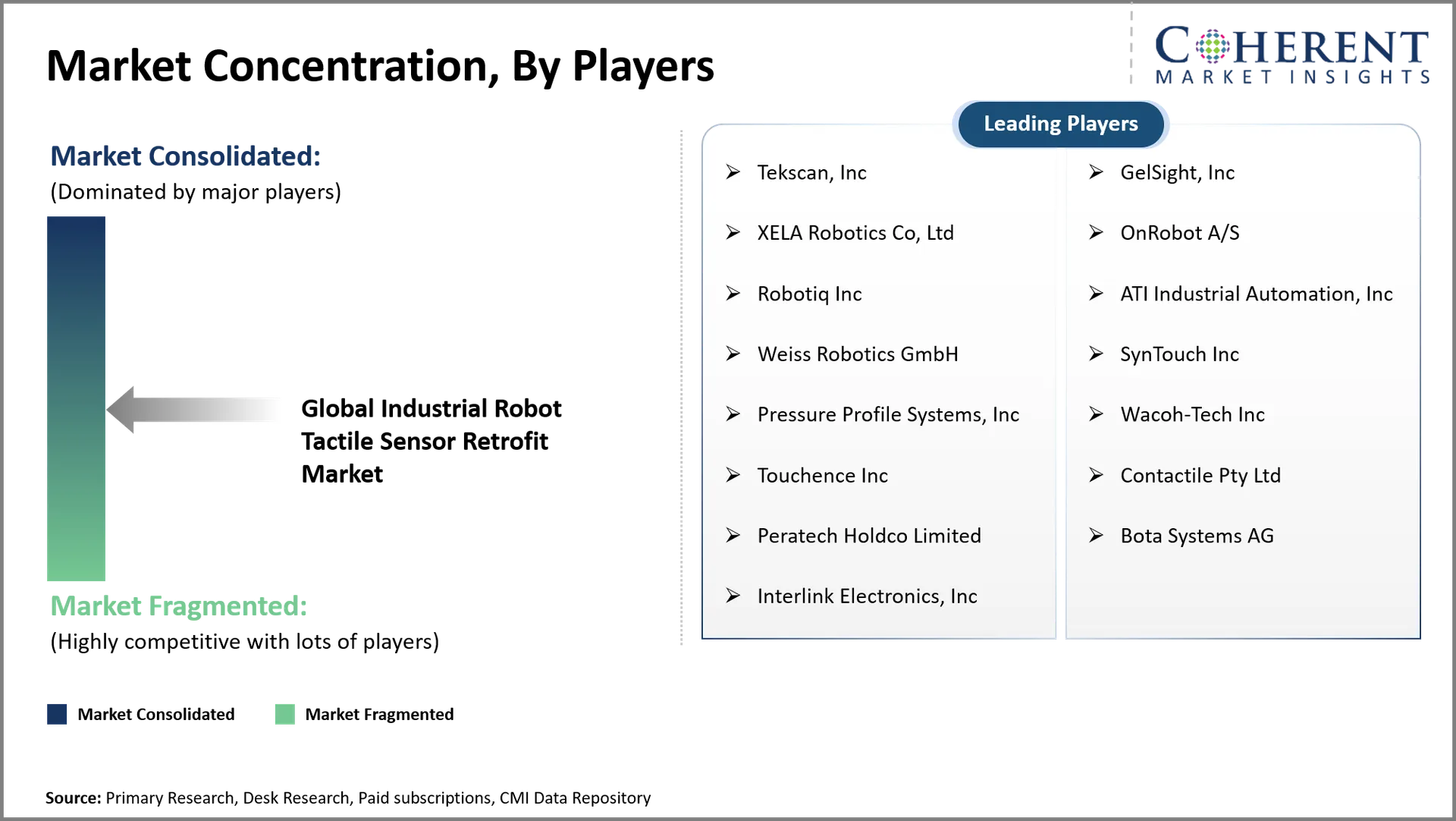
The global industrial robot tactile sensor retrofit market features specialized sensor developers and established robotic automation suppliers. XELA Robotics is developing distributed three-dimensional tactile sensing based on its uSkin technology. Its sensors measure pressure and shearing forces at each point of contact. Robotiq also supplies Tactile Sensors Fingertips for its Adaptive Grippers that provide pressure distribution, vibration detection and fingertip orientation feedback. OnRobot’s RG2-FT sensing gripper focuses on collaborative automation with a combination of fingertip force, torque and proximity data. ATI Industrial Automation is the leader in six-axis force and torque sensing for robotic assembly, testing and material removal. The competitive strategies focus on retrofit adaptability, modular integration, sensing precision and application-specific software.
Top Manufacturers and Notable Products in the Industrial Robot Tactile Sensor Retrofit Market
Manufacturer | Notable Product | Key features |
XELA Robotics Co., Ltd. | uSkin Protect (uSPr) | Digital tactile output, multidirectional force sensing, flexible gripper integration, high sensitivity, overload resistance |
Robotiq Inc. | TSF-85 Tactile Sensor Fingertips | 28 capacitive taxels, 4 × 7 sensing grid, 1000 Hz vibration sensing, integrated IMU, slip detection |
Pressure Profile Systems, Inc. | RoboTact Tactile Sensor | 12-element tactile array, pressure distribution measurement, vibration detection, incipient slip detection, USB and Bluetooth connectivity |
Contactile Pty Ltd | PapillArray Tactile Sensor Array | 3D force measurement, vibration sensing, torque detection, friction measurement, slip detection, modular configurations |
Tekscan, Inc. | FlexiForce Sensor | Thin flexible construction, customizable sensing configurations, lightweight design, low power consumption, force measurement |
Industrial Robot Tactile Sensor Retrofit Market | |||
Report Coverage | Details | ||
Base Year | 2025 | Market Size in 2026: | USD 85.0 Mn |
Historical Data For: | 2020 To 2024 | Forecast Period: | 2026 To 2033 |
Forecast Period 2026 To 2033 CAGR: | 23.9% | 2033 Value Projection: | USD 380.0 Mn |
Geographies covered: |
| ||
Segments covered: |
| ||
Companies covered: | Tekscan, Inc, GelSight, Inc, XELA Robotics Co, Ltd, OnRobot A/S, Robotiq Inc, ATI Industrial Automation, Inc, Weiss Robotics GmbH, SynTouch Inc, Pressure Profile Systems, Inc, Wacoh-Tech Inc, Touchence Inc, Contactile Pty Ltd, Peratech Holdco Limited, Bota Systems AG, Interlink Electronics, Inc | ||
Growth Drivers: |
| ||
Restraints & Challenges: |
| ||
Analyst Opinion (Expert Opinion)
- The future of this industry will increasingly depend on converting conventional industrial robots into contact-aware automation systems. Demand will shift toward tactile solutions combining pressure distribution, shear detection, and real-time force interpretation. Sensor manufacturers should prioritize compact modules that fit existing grippers and robotic fingertips. Software compatibility will become equally important because tactile information must translate into immediate gripping adjustments. Suppliers offering complete hardware, calibration, and controller integration packages will gain stronger commercial positioning.
- The maximum opportunity will emerge in capacitive tactile sensor retrofits and distributed sensing arrays. Such technologies are very promising for electronics assembly, precision component insertion, pharmaceutical packaging and handling of delicate materials. There is considerable opportunity in China because the local electronics firms have huge automated production lines. Germany provides significant chances for the assembly of precision automotive components and the production of specialist machinery. South Korea is offering chances to handle semiconductor equipment and manipulate fragile substrate. Another appealing use is collaborative robot grippers, as manufacturers need precise contact information in close proximity tasks.
- Market participants should develop retrofit kits for specific applications that are compatible with Universal Robots, FANUC, ABB and Yaskawa platforms. Companies should concentrate on interchangeable sensor fingers, standard communication interfaces and simple calibration methods. Collaborations with makers of robotic grippers and industrial automation integrators can speed commercial adoption. Suppliers should also build application-specific software for slip detection, pressure mapping and adaptive gripping. Quantifiable reduction in component damage and rejected assemblies will also assist the customer in making a purchase decision. Long-term competitive advantage will depend on reliable sensor performance, installation simplicity, and consistent technical support.
Speak to the analyst
Want personalized insights?
Take the findings above to one of our principal consultants, or have the report rebuilt around the segments, geographies and competitors you actually track.
Market Segmentation
- Sensor Type Insights (Revenue, USD Million, 2021 - 2033)
- Tactile Pressure Sensors
- Force and Touch Sensors
- Multi-Axis Tactile Sensors
- Distributed Tactile Sensor Arrays
- Flexible Tactile Sensor Sheets
- Technology Type Insights (Revenue, USD Million, 2021 - 2033)
- Capacitive
- Piezoresistive
- Piezoelectric
- Optical
- Magnetic
- Robot Type Insights (Revenue, USD Million, 2021 - 2033)
- Collaborative Robots
- Articulated Robots
- SCARA Robots
- Cartesian Robots
- Delta Robots
- Configuration Type Insights (Revenue, USD Million, 2021 - 2033)
- Gripper-Mounted Sensors
- Fingertip-Mounted Sensors
- Robot Arm-Mounted Sensors
- End-Effector Integrated Sensors
- Robot Skin and Surface Sensors
- Application Insights (Revenue, USD Million, 2021 - 2033)
- Material Handling
- Assembly and Component Insertion
- Pick-and-Place Operations
- Quality Inspection
- Machine Tending
- Precision Gripping
- End User Insights (Revenue, USD Million, 2021 - 2033)
- Automotive
- Electronics and Semiconductors
- Metal and Machinery
- Food and Beverage
- Pharmaceuticals
- Logistics and Warehousing
- Regional Insights (Revenue, USD Million, 2021 - 2033)
- North America
- U.S.
- Canada
- Latin America
- Brazil
- Argentina
- Mexico
- Rest of Latin America
- Europe
- Germany
- U.K.
- Spain
- France
- Italy
- Russia
- Rest of Europe
- Asia Pacific
- China
- India
- Japan
- Australia
- South Korea
- ASEAN
- Rest of Asia Pacific
- Middle East
- GCC Countries
- Israel
- Rest of Middle East
- Africa
- South Africa
- North Africa
- Central Africa
- North America
- Key Players Insights
- Tekscan, Inc
- GelSight, Inc
- XELA Robotics Co, Ltd
- OnRobot A/S
- Robotiq Inc
- ATI Industrial Automation, Inc
- Weiss Robotics GmbH
- SynTouch Inc
- Pressure Profile Systems, Inc
- Wacoh-Tech Inc
- Touchence Inc
- Contactile Pty Ltd
- Peratech Holdco Limited
- Bota Systems AG
- Interlink Electronics, Inc
Sources
Primary Research Interviews
- Robotics Systems Integration Specialists
- Tactile Sensor Manufacturers & OEM Representatives
- Industrial Automation Engineers & End-Users
- Supply Chain & Procurement Managers in Manufacturing Sector
Magazines
- Robotics Business Review
- Automation World
- Manufacturing Engineering Magazine
- IEEE Spectrum (Robotics & Sensors Edition)
Journals
- Journal of Field Robotics (Wiley)
- IEEE Transactions on Industrial Electronics
- Sensors and Actuators A: Physical (Elsevier)
Associations
- International Federation of Robotics (IFR)
- Robotic Industries Association (RIA) / A3 Automate
- International Society of Automation (ISA)
- European Robotics Association (euRobotics)
Public Domain Sources
- U.S. International Trade Commission (USITC) – Trade Data on Robotics Components
- European Commission – Digital Industry & Robotics Policy Reports
- World Trade Organization (WTO) – Industrial Goods Trade Statistics
- Japan Robot Association (JARA) – Robot Market Statistics
Proprietary Elements
- CMI Data Analytics Tool
- Proprietary CMI Existing Repository of Information for Last 10 Years
Get access to 250+ pages report
Every segment, forecast, competitor profile and data table behind the analysis above — available for instant download.
- ESOMAR Member
- ISO 9001:2015 Certified
- D-U-N-S Registered
- GDPR & CCPA Compliant
Frequently Asked Questions
The global Industrial robot tactile sensor retrofit market is expected to stand at USD 85.0 Mn in 2026 and is expected to reach USD 380.0 Mn by 2033.
The CAGR of the global industrial robot tactile sensor retrofit market is projected to be 23.9% from 2026 to 2033.
Increasing demand for tactile feedback in existing industrial robot installations and Growing adoption of collaborative robots in manufacturing facilities are the major factors driving the growth of the global Industrial Robot Tactile Sensor Retrofit market.
High installation and integration costs for specialized tactile sensors and Compatibility challenges across different industrial robot architectures are the major factors hampering the growth of the global Industrial Robot Tactile Sensor Retrofit market.
In terms of sensor type, tactile pressure sensors segment is estimated to dominate the market revenue share in 2026.
It covers technologies and services that add tactile sensing capabilities to existing industrial robots.
They measure contact pressure and help robotic controllers maintain appropriate gripping forces.