

Global Isolation Devices Market Size and Forecast – 2026 To 2033
The global isolation devices market is expected to grow from USD 4.80 Bn in 2026 to USD 7.65 Bn by 2033, registering a compound annual growth rate (CAGR) of 7.1% from 2026 to 2033. The global isolation devices market is driven by growing renewable energy installations. On August 26, 2026, Adani Energy Solutions Ltd. (AESL) secured a key transmission project for evacuation of renewable energy generated in Karnataka to major load centers in Maharashtra.
Key Takeaways of the Global Isolation Devices Market
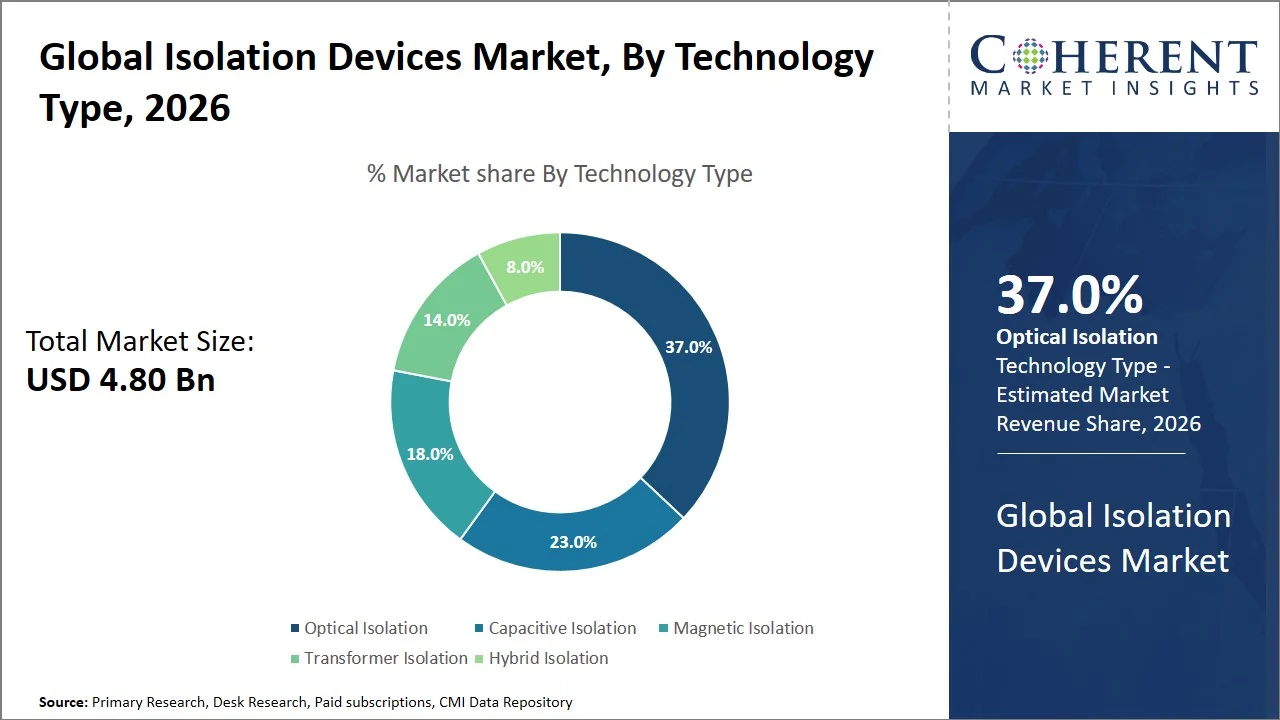
- The Optical Isolation segment is expected to account for 37.0% of the global isolation devices market share in 2026. Expansion of battery energy storage systems is driving the growth of the segment. On August 25, 2026, The Renewables business vertical of Larsen & Toubro on a major order to develop three Battery Energy Storage System (BESS) projects for a notable client in the Middle East.
- The Isolation Amplifiers segment is estimated to capture 41.0% of the market share in 2026. Increasing demand for isolated current sensing is majorly driving the growth of the segment. On March 16, 2026, Infineon Technologies introduced the XENSIV TLE4978 family of coreless, isolated magnetic current sensors.
- The Industrial Automation segment is estimated to capture 32.0% of the market share in 2026. Increasing adoption of factory automation is majorly driving the growth of the segment. On March 24, 2026, FANUC announced a USD 90 million investment to expand its U.S. robotics manufacturing capacity. The expansion supports increasing demand for industrial robots and automation systems.
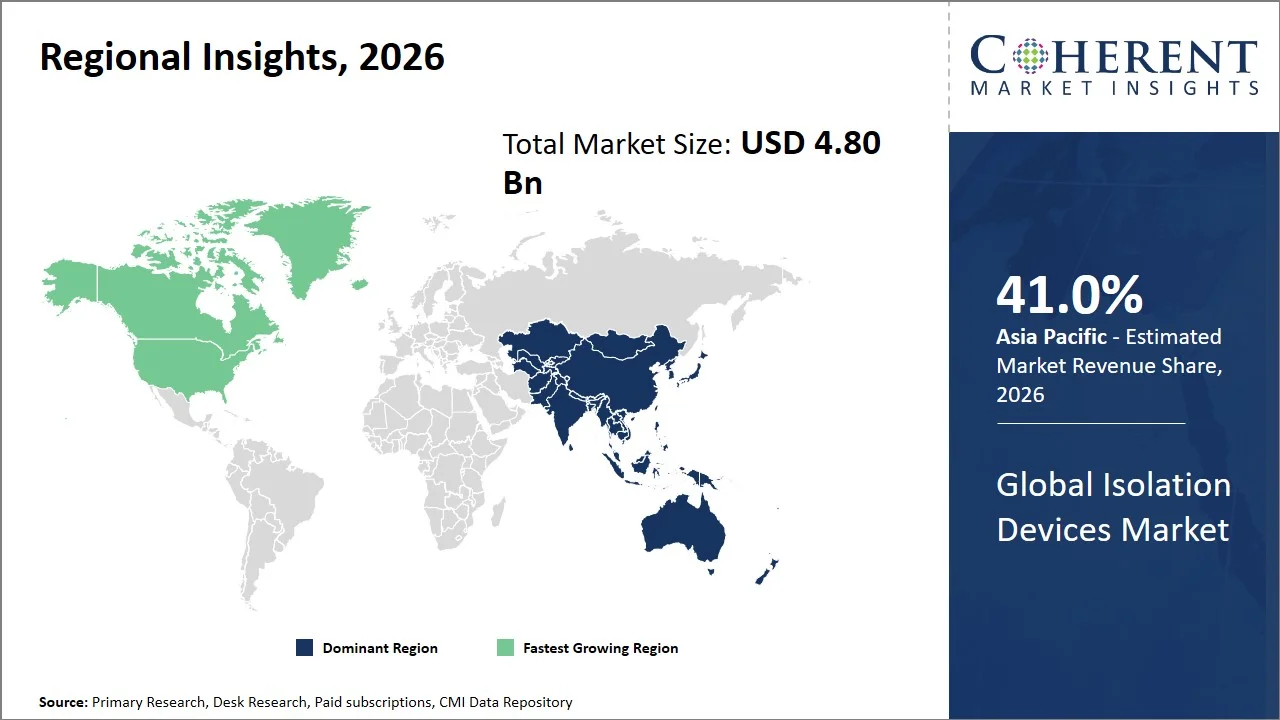
- Asia Pacific is expected to dominate the isolation devices market in 2026 with a market share of 41.0%. Growth of renewable energy inverters in Asia Pacific is driving the growth of the regional market. On April 11, 2025, Sungrow supplied inverters for Australia's largest operational direct-current coupled solar-storage project.
- North America is expected to account for 24.0% share in 2026 and is projected to record the fastest growth over the forecast period. Expansion of isolated gate driver applications in North America is driving the growth of the regional market. On June 2, 2026, Infineon Technologies AG introduced the EiceDRIVER 2EDL90xG3, a 120 V common footprint gate driver designed to enable silicon (Si) and gallium nitride (GaN) power designs on the same PCB.
Segmental Insights
Why Does Optical Isolation Dominate the Global Isolation Devices Market?
The optical isolation segment is expected to account for 37.0% of the global isolation devices market share in 2026. Optical isolation is often used as it provides good electrical separation between high voltage and low voltage circuits. It transmits signals without a direct electrical connection using light transmission. This layout minimizes the risk of ground-loops and protects sensitive control electronics from voltage transients. Optocouplers also meet proven safety criteria for industrial, automotive, medical and power electronics applications. These features enable the use of optical isolation in applications that require dependable galvanic separation and additional circuit safety. On June 25, 2026, Vishay Intertechnology, Inc. introduced a new Automotive Grade phototransistor optocoupler designed to deliver signal transmission with high galvanic isolation for electric vehicles and industrial automation systems. The Vishay Semiconductors VOLA617A combines an isolation voltage of 5000 VRMS with a VIORM of 1414 Vpeak and VIOTM of 8000 Vpeak in a 4-pin LSOP low profile package.
- Current Industry Events of 2026
- Market Size Estimation
- Regional Breakdown
- Competitive Landscape
- Customer Intelligence
- Segmental Analysis
- Pricing Analysis
- Key Market Drivers, Challenges & Future Trends
- Customized Insights Section
Why is Isolation Amplifiers the Most Crucial Device Type?
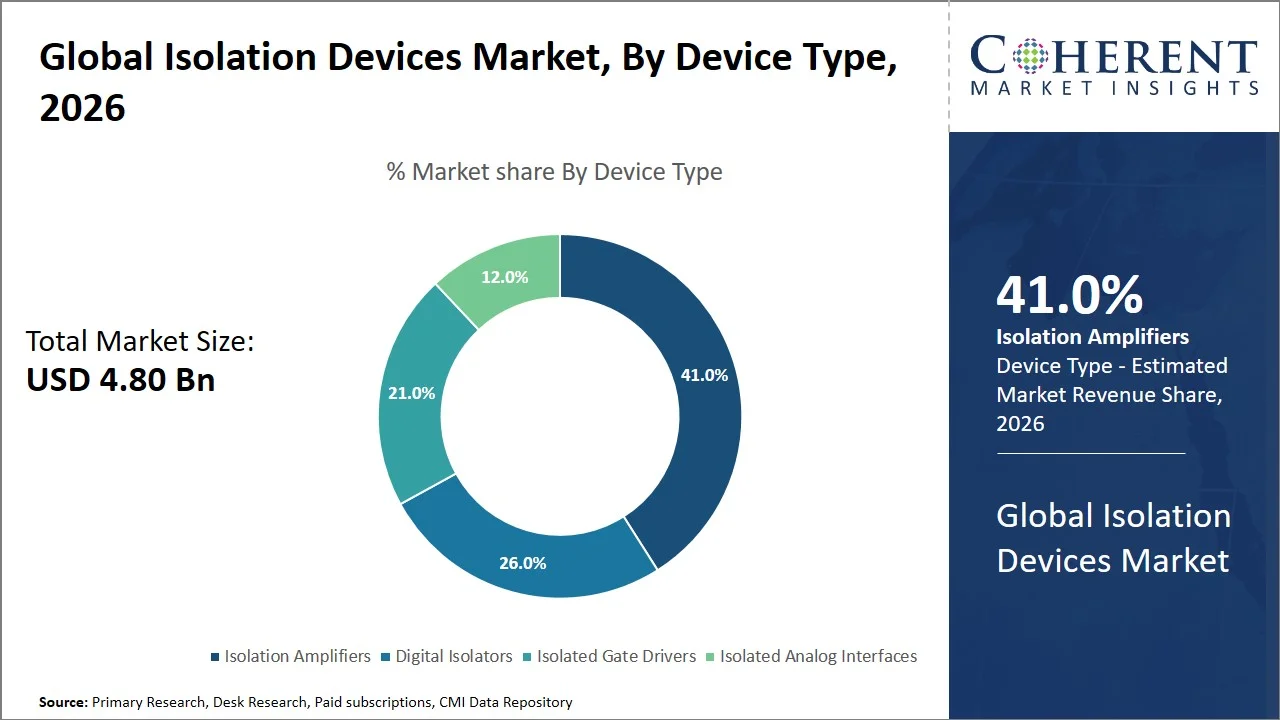
The isolation amplifiers segment is expected to account for 41.0% of the global isolation devices market share in 2026. Isolation amplifiers provide accurate measurement of high voltage signals while safeguarding low voltage control circuitry. They are galvanically isolated so that no harmful voltages can be transferred between sensor and processing stages. This capacity is useful in motor drives, battery systems, renewable energy equipment and industrial automation. High common-mode transient immunity also supports stable signal measurement in electrically noisy environments. These capabilities make isolation amplifiers particularly important for reliable monitoring and control in high voltage electronic systems. On March 27, 2025, Texas Instruments (TI) introduced the industry’s first functionally isolated modulators, helping designers achieve more precise motor control in compact robot designs. The new AMC0106M05, AMC0136 and AMC0106M25 isolated modulators enable increased precision and higher resolution of 12 to 14 effective number of bits.
Industrial Automation Dominates the Global Isolation Devices Market
The industrial automation segment is expected to account for 32.0% of the global isolation devices market share in 2026. Industrial automation requires reliable signal separation between controllers, sensors, drives, and high voltage equipment. Isolation devices protect control electronics from electrical noise, voltage spikes, and ground potential differences. Their use supports safer operation of programmable logic controllers and variable frequency drives. Increasing deployment of automated production systems is also expanding requirements for isolated communication and sensing circuits. These are the drivers of demand for isolation devices in modern manufacturing environments. On October 7, 2025, Rockwell Automation, Inc. announced the debut of their newest controller, ControlLogix 5590, the powerhouse at the center of the Logix platform. This all-in-one controller is designed to satisfy the ever-changing demands of modern manufacturing, offering seamless software integration and multidiscipline control.
Current Events and their Impact
Current Events | Description and its Impact |
European Chips Act - European Union |
|
United States Semiconductor Export Controls -United States |
|
Isolation Devices Market Dynamics
Market Drivers
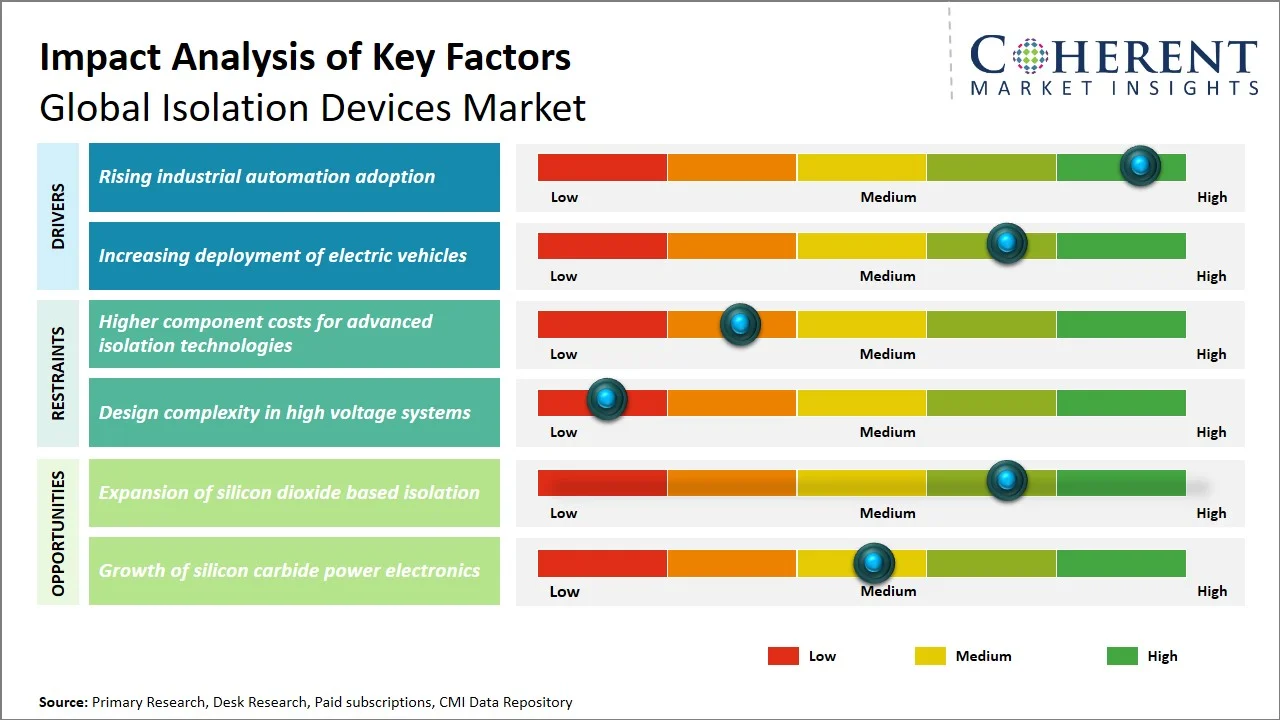
Rising industrial automation adoption
Increasing adoption of industrial automation results in higher usage of isolation devices in contemporary manufacturing systems. Electrical separation is needed between controllers, sensors, actuators and high voltage power circuits in automatic machinery. Isolation devices guard sensitive control electronics from voltage surges and electrical interference. Increasing adoption of variable frequency drives and programmable logic controllers are also a demand driver. This trend offers long-term potential for suppliers of isolation devices to automated facilities. On June 9, 2026, OMRON Robotics announced it will showcase the next generation of its flagship LD Series autonomous mobile robots (AMRs), the LD-150 and LD-300. The new models are expected to begin launching in Q4 2026 and move more in less space, delivering better payload capacity, advanced safety features and performance advancements.
Increasing deployment of electric vehicles
Growing electric vehicle deployment is boosting demand for isolation devices across battery and powertrain electronics. Isolation components isolate the high voltage battery circuits from the low voltage control systems. They also enable monitoring tasks in battery management systems and on-board charging devices. The growing electric vehicle charging infrastructure generates more possibilities for isolated sensing and gate driving. The growth of requirements for dependable isolation in car power electronics. On June 30, 2026, BMW completed a USD 1.7 billion investment in its South Carolina, U.S., facilities for electric vehicle production. The Spartanburg expansion will produce the fully electric iX5 from late 2026. At least five additional electric models are planned by 2030.
Emerging Trends
Integration of Digital Isolation
Digital isolators are slowly replacing optocouplers in high speed. Industrial automation, electric vehicles, renewable energy systems and innovative power conversion equipment benefit from faster signal transmission, fewer propagation delays and greater reliability.
Adoption of Capacitive Isolation
Capacitive isolation is gaining traction for tiny electronic systems with high-speed connectivity and signal integrity. State-of-the-art semiconductor fabrication for the electric vehicle and industrial markets means smaller isolation components with better common mode transient immunity.
Higher Voltage Isolation Requirements
Electrification is raising requirements for isolation devices that can handle higher operating voltages. Insulation performance needs to be improved and protection against transient electrical stresses needs to be enhanced for battery systems, charging infrastructure, renewable energy converters, and industrial power systems.
Integration With Intelligent Power Systems
Isolation devices are increasingly integrated with intelligent monitoring and control systems. This combination provides real time current sensing, fault detection and communication between high voltage power stages and low voltage controllers in automated equipment.
Regional Insights
Why is Asia Pacific a Strong Market for Isolation Devices?
Asia Pacific is expected to account for a market share of 41.0% in 2026. Semiconductor, electronics, automotive and battery manufacturing capacity is concentrated in the Asia Pacific region. Japan, South Korea, Taiwan and China have high requirements for isolated interfaces and power components. China increased its renewable capacity by 4.52 GW in 2025, increasing demand for isolated power conversion. South Korea’s battery manufacturing ecosystem is generating new needs for isolated monitoring and battery management electronics. Japan’s semiconductor factories are demanding more specialized operational technology security architectures. The region's electric vehicle production further increases demand for isolated gate drivers and current sensing. This combination creates several distinct application channels for isolation devices across the regional electronics ecosystem.
Why Does North America Isolation Devices Market Exhibit High Growth?
North America is expected to register the fastest growth with a CAGR of 7.8% over the forecast period. North America is projected to account for 24.0% of the global isolation devices market in 2026. North America benefits from expanding semiconductor manufacturing investments and increasingly electrified power infrastructure. The U.S. semiconductor ecosystem is supporting domestic production of advanced chips and manufacturing equipment. Automotive electrification is creating additional requirements for isolated battery monitoring and charging systems. Data centers are also boosting need for isolated power conversion and protection components. Industrial manufacturers increasingly deploy connected motor drives, programmable controllers, and high voltage equipment. Aerospace applications create additional requirements for highly reliable signal isolation and electrical protection. These applications strengthen demand across specialized electronics rather than relying primarily on consumer device production.
Global Isolation Devices Market Outlook for Key Countries
Why is China Emerging as a Major Hub in the Isolation Devices Market?
China benefits from exceptionally large electric vehicle, renewable energy, and charging infrastructure ecosystems. New energy cars reached 31.4 million units in 2024, according to Chinese official information. China also operated 18.063 million charging guns by September 2025. Renewable energy capacity reached around 2.337 billion kilowatts during 2025. These installations require separated gate driving, voltage sensing, current measuring, and communication interfaces. China's green electricity direct-connection policy also encourages industrial users to connect directly with renewable generation. This creates additional demand for isolation within industrial power conversion equipment.
Is U.S. the Next Growth Engine for the Isolation Devices Market?
The U.S. gains from semiconductor manufacturing expansion, electric vehicle infrastructure, data centers, and innovative industrial equipment. Semiconductor manufacturing investments are growing demand for sophisticated fabrication equipment and electrically separated control systems. Electric vehicle charging networks require isolated sensing and power conversion across high voltage architectures. The boom in data centers is creating a need for stand-alone power supplies and monitoring equipment. Aerospace and defense programs additionally require robust electrical separation for sensitive avionics and control systems. Industrial facilities are adopting connected motor drives and automated production equipment. These applications support demand for digital isolators, isolation amplifiers, and isolated gate drivers across high reliability electronics.
Germany Isolation Devices Market Analysis and Trends
Germany benefits from its concentration of automotive manufacturing, machinery production, and industrial automation equipment. March 2026 manufacturing orders for electrical equipment increased 21.5% month over month. Orders for data processing, electronic, and optical products increased 14.4% during the same period. Germany's automotive supply chain also increasingly incorporates electric drivetrains and battery systems. Industrial machinery manufacturers require isolated communication and sensing between controllers and power stages. Renewable energy equipment creates additional applications for isolated voltage and current measurement. These distinct manufacturing activities support isolation requirements across machinery, automotive, energy, and electronics applications.
Japan Isolation Devices Market Analysis and Trends
Japan benefits from advanced robotics, factory automation, automotive electronics, and semiconductor equipment manufacturing. The Ministry of Economy, Trade and Industry identifies robots as increasingly important across automotive and semiconductor manufacturing. Japanese manufacturers increasingly use robots for wiring, assembly, and other difficult automation tasks. Semiconductor factories are also receiving dedicated operational technology security guidance. These automated environments require reliable isolation between controllers, sensors, drives, and power circuits. Japanese automotive suppliers additionally deploy isolated sensing within electric powertrain systems. This combination supports demand across robotics, semiconductor equipment, automotive electronics, and precision manufacturing.
South Korea Isolation Devices Market Analysis and Trends
South Korea benefits from its advanced semiconductor, battery, display, and automotive manufacturing ecosystem. Samsung Electronics and SK hynix support extensive semiconductor manufacturing activity requiring sophisticated automated fabrication equipment. Battery manufacturers including LG Energy Solution, Samsung SDI, and SK On create demand for isolated battery monitoring electronics. Electric vehicle production further raises requirements for isolated gate drivers and high voltage sensing. Semiconductor production equipment demands accurate communication between high voltage actuators and sensitive control circuitry. Display manufacturing likewise relies significantly on automated equipment and precision power electronics. These manufacturing clusters create specialized demand for isolation devices across semiconductor, battery, automotive, and display production.
Global Isolation Devices Market - Domestic Manufacturing Capacity for Isolation Semiconductors Across Major Countries (2025)
Country | Semiconductor Manufacturing Capacity | Major Domestic Manufacturing Examples |
China | 10.1 million wafers per month | Semiconductor Manufacturing International Corporation |
South Korea | 5.4 million wafers per month | Samsung Electronics |
Japan | 4.7 million wafers per month | Renesas Electronics |
U.S. | 3.2 million wafers per month | Texas Instruments |
Germany | 2.7 million wafers per month | Infineon Technologies |
Taiwan | 5.8 million wafers per month | Taiwan Semiconductor Manufacturing Company |
How is Expansion of Silicon Di-oxide Based Isolation Creating New Growth Opportunities in the Isolation Devices Market?
Expansion of silicon di-oxide based isolation is offering prospects for smaller, higher-performance digital isolators used in automotive and industrial electronics. Texas Instruments employs double capacitive SiO₂ barriers in devices such as ISO774xT-Q1, offering 5,000 VRMS isolation and automotive certification. SiO₂ provides much better dielectric strength than several polymer insulation materials and remains stable under moisture and temperature exposure. This allows for compact packages with good electromagnetic immunity, minimal emissions and faster signal transfer. The technology thus opens up prospects for integrated isolation in powertrains for electric vehicles, industrial drives, battery systems and high-voltage power supply. For example, Infineon Technologies AG showcased their SOI gate driver technology for silicon carbide and gallium nitride power devices. The technology uses monolithic designs that include high- and low-voltage circuits. It also enables integrated bootstrap diodes and decreased level-shift loss.
Market Players, Key Development, and Competitive Intelligence
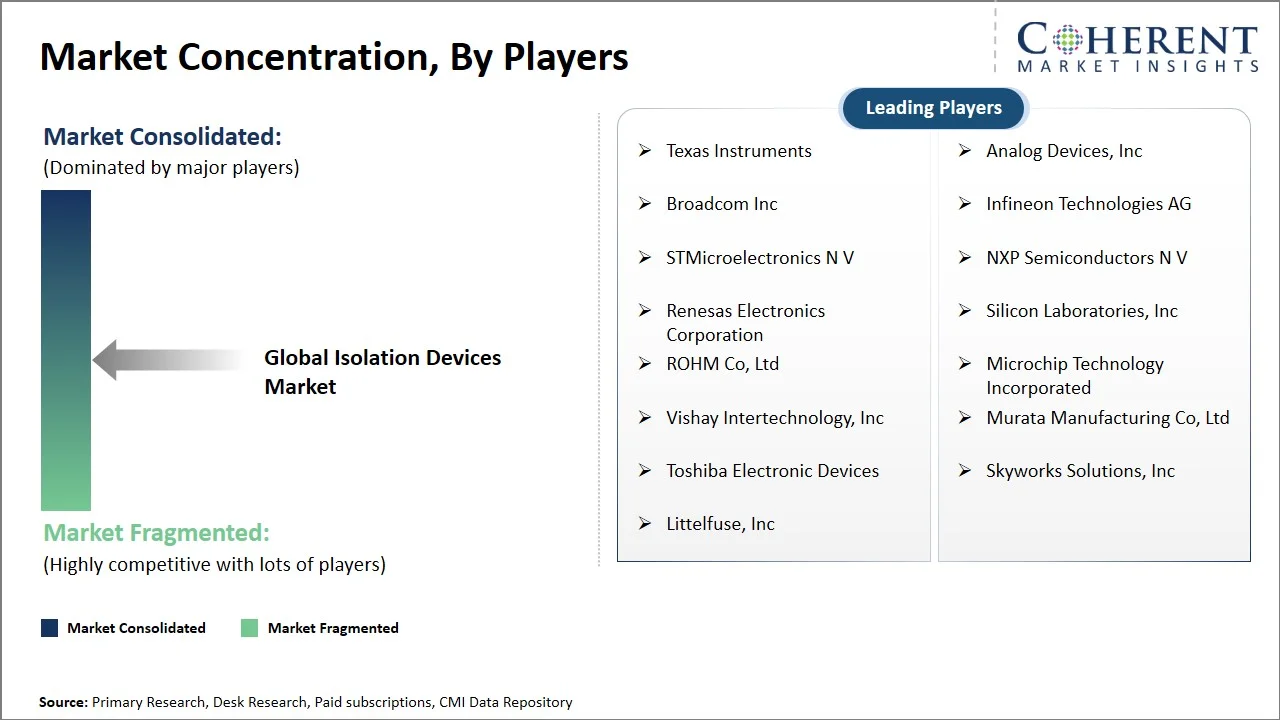
Key Developments
- On March 23, 2026, Texas Instruments (TI) unveiled new isolated power modules, helping enable increased power density, efficiency and safety in applications ranging from data centers to electric vehicles. The UCC34141-Q1 and UCC33420 isolated power modules leverage TI's IsoShield technology, a proprietary multichip packaging solution that achieves up to three times higher power density than discrete solutions in isolated power designs.
- On February 20, 2025, The European Commission approved funding under the European Chips Act for the Infineon Technologies AG Smart Power Fab in Dresden, Germany. The Smart Power Fab is receiving support under the European Commission’s Important Project of Common European Interest on Microelectronics and Communication Technologies innovation program.
Competitive Landscape
The competitive landscape is led by companies pursuing distinct isolation architectures and application-specific integration. Texas Instruments focuses on highly integrated digital isolators, isolation amplifiers, and isolated gate drivers for industrial and automotive power systems. Analog Devices emphasizes its iCoupler platform for automotive battery monitoring, motor control, and precision signal isolation. Infineon Technologies aims at high density power designs with ISOFACE digital isolators based on coreless transformer technology. Its products cover isolated communications, solar systems, energy storage, electric car charging and motor control. In the optical isolation space, Broadcom’s R²Coupler portfolio remains robust with offerings comprising automotive gate drivers, isolation amplifiers and battery monitoring devices. Its ACPL-E85BT specifically targets traction inverters, onboard chargers, and battery monitoring systems.
Market Report Scope
Isolation Devices Market Report Coverage
| Report Coverage | Details | ||
|---|---|---|---|
| Base Year: | 2025 | Market Size in 2026: | USD 4.80 Bn |
| Historical Data for: | 2020 To 2024 | Forecast Period: | 2026 To 2033 |
| Forecast Period 2026 to 2033 CAGR: | 7.10% | 2033 Value Projection: | USD 7.65 Bn |
| Geographies covered: |
| ||
| Segments covered: |
| ||
| Companies covered: | Texas Instruments, Analog Devices, Inc, Broadcom Inc, Infineon Technologies AG, STMicroelectronics N V, NXP Semiconductors N V, Renesas Electronics Corporation, Silicon Laboratories, Inc, ROHM Co, Ltd, Microchip Technology Incorporated, Vishay Intertechnology, Inc, Murata Manufacturing Co, Ltd, Toshiba Electronic Devices, Skyworks Solutions, Inc, Littelfuse, Inc | ||
| Growth Drivers: |
| ||
| Restraints & Challenges: |
| ||
Analyst Opinion (Expert Opinion)
- The future of the industry is expected to shift toward integrated digital isolation for high-voltage power electronics. Electric vehicle traction inverters, onboard chargers, and battery management systems offer particularly strong application opportunities. Industrial motor drives and energy storage systems should also remain important because they require isolated communication and sensing. Infineon Technologies already targets these applications with isolated CAN, SPI, and UART interfaces.
- The strongest opportunities are expected in Asia Pacific, particularly China, Japan, and South Korea. China has a lot of potential in electric car manufacturing, charging infrastructure and renewable energy equipment. Japan has opportunities in factory automation, robotics and automotive electronics. In South Korea, promising applications can be found in battery manufacturing and semiconductor production. Therefore, companies should develop region-specific products supporting high-voltage battery and power conversion architectures.
- Automotive qualification and improved transient immunity should be priorities for players looking for an edge with more integration. Compact devices can reduce board space while supporting increasingly dense power electronics architectures. Broadcom demonstrates this approach with automotive isolation amplifiers supporting 5,000 volts root mean square isolation. Companies should also strengthen application-specific reference designs for traction inverters, energy storage, charging systems, and industrial drives. Differentiation through reliability, diagnostics, functional safety support, and low-power operation should become increasingly important.
Speak to the analyst
Want personalized insights?
Take the findings above to one of our principal consultants, or have the report rebuilt around the segments, geographies and competitors you actually track.
Market Segmentation
- Technology Type Insights (Revenue, USD Billion, 2021 - 2033)
- Optical Isolation
- Capacitive Isolation
- Magnetic Isolation
- Transformer Isolation
- Hybrid Isolation
- Device Type Insights (Revenue, USD Billion, 2021 - 2033)
- Isolation Amplifiers
- Digital Isolators
- Isolated Gate Drivers
- Isolated Analog Interfaces
- Application Insights (Revenue, USD Billion, 2021 - 2033)
- Industrial Automation
- Automotive Electronics
- Renewable Energy
- Medical Electronics
- Telecommunications
- Consumer Electronics
- Aerospace And Defense
- Energy Storage
- Regional Insights (Revenue, USD Billion, 2021 - 2033)
- North America
- U.S.
- Canada
- Latin America
- Brazil
- Argentina
- Mexico
- Rest of Latin America
- Europe
- Germany
- U.K.
- Spain
- France
- Italy
- Russia
- Rest of Europe
- Asia Pacific
- China
- India
- Japan
- Australia
- South Korea
- ASEAN
- Rest of Asia Pacific
- Middle East
- GCC Countries
- Israel
- Rest of Middle East
- Africa
- South Africa
- North Africa
- Central Africa
- North America
Sources
Primary Research Interviews
- Isolation Device Manufacturers & Product Engineers
- Medical Device & Healthcare Equipment Specialists
- Industrial Automation & Process Control Experts
- Electrical Safety & Compliance Consultants
Magazines
- IEEE Spectrum
- Electronic Design Magazine
- Power Electronics Technology Magazine
- Control Engineering Magazine
Journals
- IEEE Transactions on Industrial Electronics
- Journal of Electrical Engineering & Technology
Associations
- International Electrotechnical Commission (IEC)
- Institute of Electrical and Electronics Engineers (IEEE)
- National Electrical Manufacturers Association (NEMA)
- Semiconductor Industry Association (SIA)
Public Domain Sources
- U.S. Department of Energy (DOE) – Energy Efficiency & Renewable Energy Reports
- European Commission – Industrial Safety & Electrical Standards Publications
- U.S. Occupational Safety and Health Administration (OSHA) – Electrical Safety Standards
Proprietary Elements
- CMI Data Analytics Tool
- Proprietary CMI Existing Repository of information for last 10 years
Get access to 250+ pages report
Every segment, forecast, competitor profile and data table behind the analysis above — available for instant download.
- ESOMAR Member
- ISO 9001:2015 Certified
- D-U-N-S Registered
- GDPR & CCPA Compliant
Missing comfort of reading report in your local language? Find your preferred language:
Frequently Asked Questions
The global isolation devices market is expected to stand at USD 4.80 Bn in 2026 and is expected to reach USD 7.65 Bn by 2033.
The CAGR of the global isolation devices market is projected to be 7.1% from 2026 to 2033.
Rising industrial automation adoption and increasing deployment of electric vehicles are the major factors driving the growth of the global isolation devices market.
Higher component costs for advanced isolation technologies and Design complexity in high voltage systems are the major factors hampering the growth of the global isolation devices market.
In terms of technology type, optical isolation segment is estimated to dominate the market revenue share in 2026.
Isolation devices electrically separate circuits while allowing signals or power to transfer safely between them.
A digital isolator transfers digital signals across an isolation barrier without creating direct electrical continuity.