

Global Last Mile Delivery Software Market Size and Forecast – 2026 To 2033
The global last mile delivery software market is expected to grow from USD 13.60 Bn in 2026 to USD 33.40 Bn by 2033, registering a compound annual growth rate (CAGR) of 10.0% from 2026 to 2033. The global last mile delivery software market is driven by growing adoption of AI-based route optimization. On February 3, 2026, Aptean announced the launch of Paragon Route 360 on AppCentral, marking a major advancement in AI‑driven transportation planning and logistics optimization. Paragon Route 360 delivers a unified, intelligent planning environment that transforms how transportation operations are scheduled, routed, and managed.
Key Takeaways of the Global Last Mile Delivery Software Market
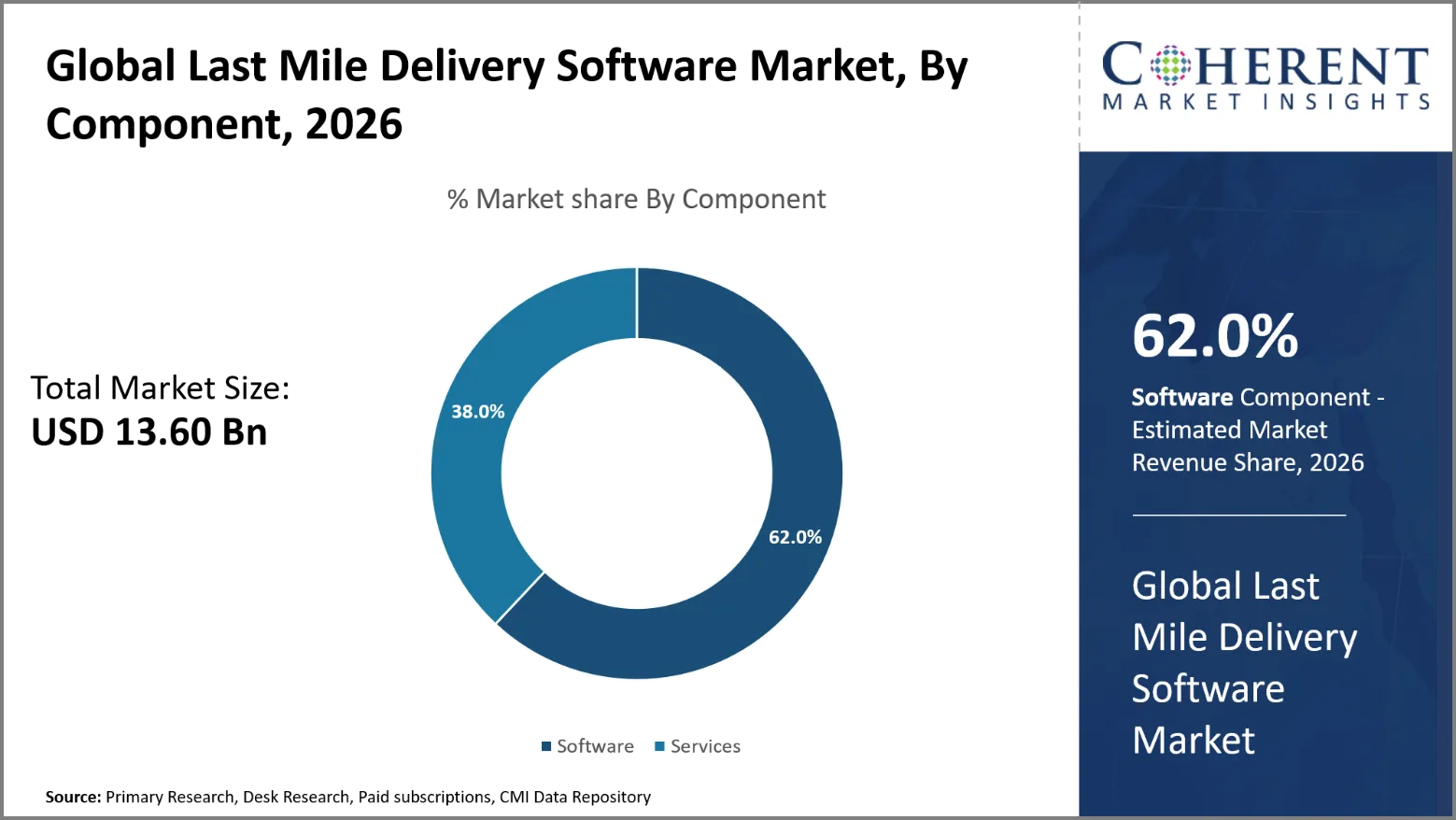
- The Software segment is expected to account for 62.0% of the global last mile delivery software market share in 2026. Expansion of quick-commerce and on-demand delivery platforms is driving the growth of the segment. On June 17, 2026, Amazon announced plans to roll out more than 100 specialized Urban Fulfillment Centers in India. These facilities will expand product selection while maintaining delivery in minutes.
- The Cloud-Based segment is estimated to capture 54.0% of the market share in 2026. Increasing demand for real-time shipment visibility and tracking is majorly driving the growth of the segment. On June 24, 2026, Samsara released its single-use Bluetooth Tracking Label, together with the Shipment Center and Shipment App. The system provides near-real-time visibility across carriers and links shipment information with existing identifiers.
- The Route Optimization Software segment is estimated to capture 28.0% of the market share in 2026. Increasing demand for real-time delivery visibility is driving the growth of the segment. On September 15, 2025, TVS Supply Chain Solutions launched ieX to enhance delivery visibility, geolocation accuracy, and customer assistance. The platform integrates with its TRACE logistics and order-tracking system.
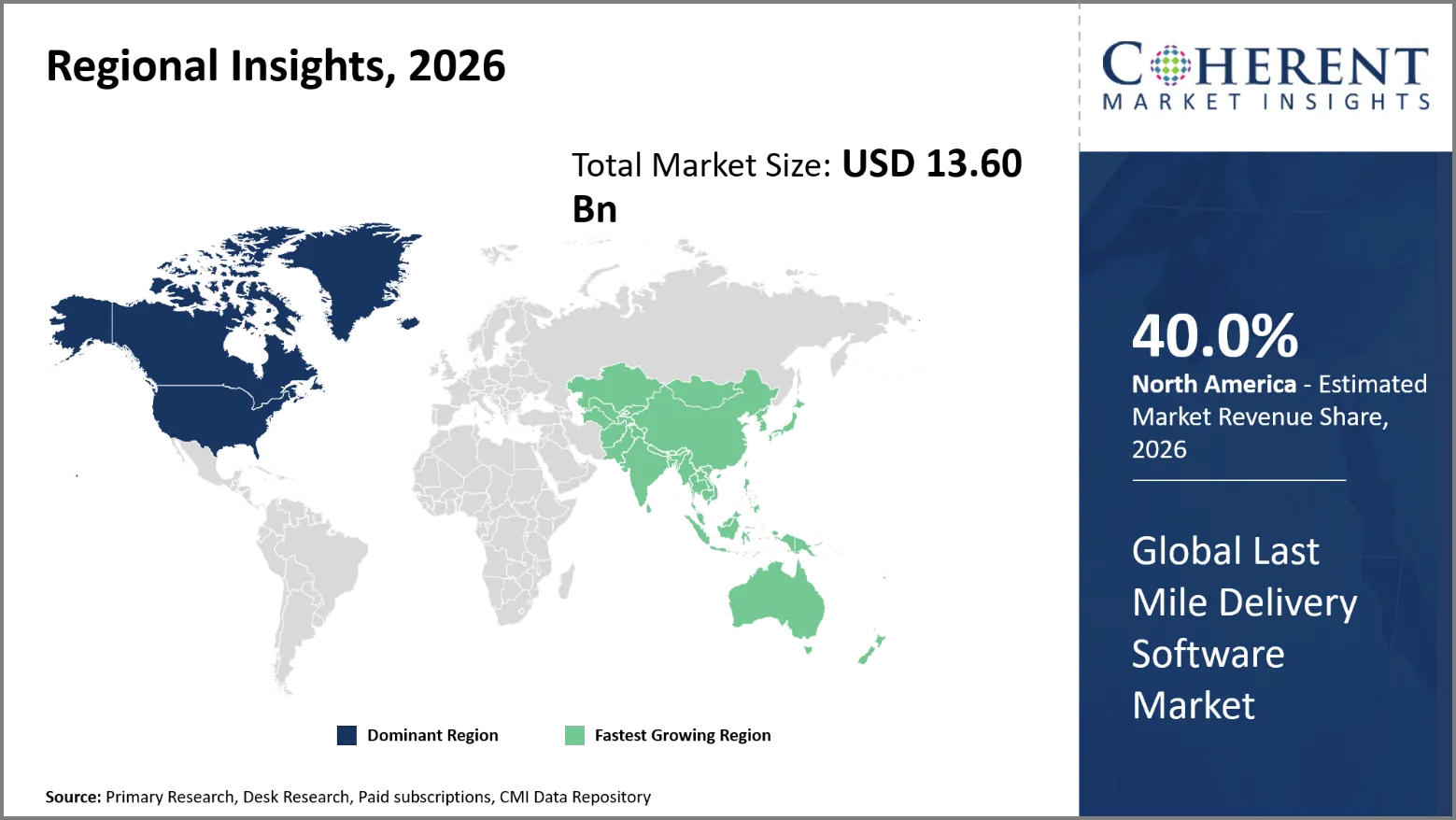
- North America is expected to dominate the last mile delivery software market in 2026 with a market share of 40.0%. Growing adoption of cloud-based logistics platforms in North America is driving the growth of the regional market. On June 26, 2025, GXO Logistics introduced GXO IQ, a cloud-native operating platform to orchestrate warehouse, transportation, inventory and workforce operations. The platform uses AI technologies from Google Cloud and Snowflake to support operational decisions.
- Asia Pacific is expected to account for 23.0% share in 2026. Expansion of software solutions for electric delivery fleets in Asia Pacific is driving the growth of the regional market. On June 5, 2026, Flipkart introduced EV Assist, a digital marketplace to facilitate access to electric vehicle rental choices for delivery partners. The platform operates across more than 20 Indian cities, including Delhi National Capital Region, Patna, and Bengaluru.
Segmental Insights
Why Does Software Dominate the Global Last Mile Delivery Software Market?
The software segment is expected to account for 62.0% of the global last mile delivery software market share in 2026. Software is dominating because corporations need centralized capabilities to coordinate deliveries, manage fleets and improve operational efficiency. These capabilities are used by retailers, logistics providers and e-commerce enterprises to manage increasing package volumes and evolving customer expectations. Automated workflows lower the risk of human mistake and help drivers be more productive and make faster choices on deliveries.
On February 19, 2025, Onfleet launched its Courier Suite, a set of tools for delivery service providers and courier companies. The upgrade has customer portals, variable delivery rates, service administration, invoicing and enhanced dispatch capabilities. Clients can place orders, follow the progress of delivery and view proof-of-delivery records through branded portals.
- Current Industry Events of 2026
- Market Size Estimation
- Regional Breakdown
- Competitive Landscape
- Customer Intelligence
- Segmental Analysis
- Pricing Analysis
- Key Market Drivers, Challenges & Future Trends
- Customized Insights Section
Why is Cloud-Based the Most Preferred Deployment Type?
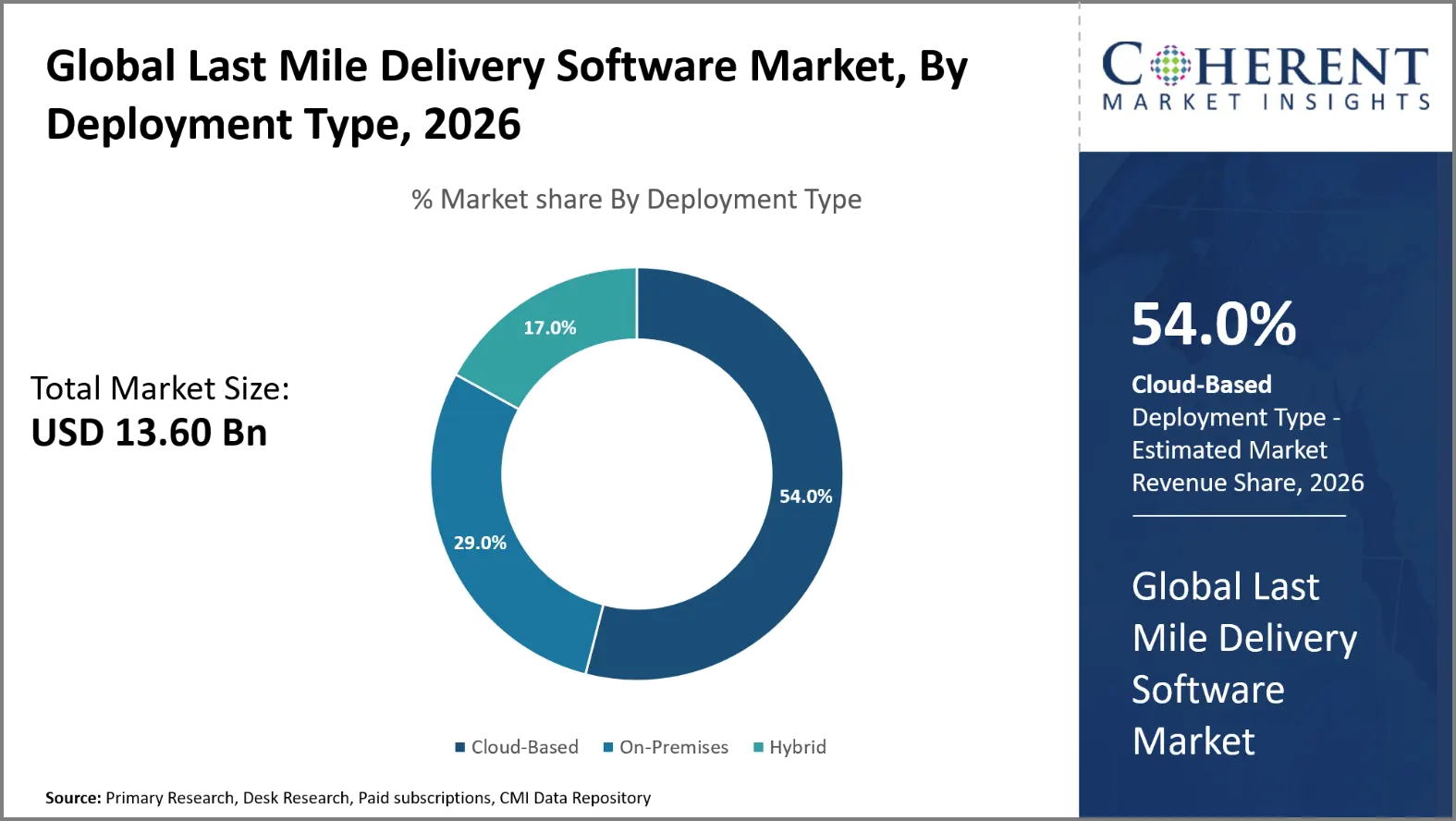
The cloud-based segment is expected to account for 54.0% of the global last mile delivery software market share in 2026. Cloud based deployment is preferred as it is more scalable, accessible and requires less infrastructure upfront. Centralized systems enable logistics organizations to handle delivery operations across multiple sites without having to install enormous servers at each site. Cloud based technologies allow dispatchers, truckers, warehouses and clients to synchronize data in real-time. Subscription pricing also allows small and medium-sized enterprises to use advanced delivery management tools. Cloud environments are managed, which makes it easier to roll out software upgrades, security improvements and new integrations.
On August 19, 2025, project44 debuted its Intelligent Transportation Management System (TMS), a next-generation, AI-powered, multi-modal system that turns fragmented logistics into integrated decisions. The Intelligent TMS represents a major step forward in how global companies improve their supply chains with smarter, faster and more data-driven transportation management.
Route Optimization Software Dominates the Global Last Mile Delivery Software Market
The route optimization software segment is expected to account for 28.0% of the global last mile delivery software market share in 2026. Delivery routes highly affect transportation costs, fuel consumption and customer satisfaction. Thus, route optimization software is a must in the modern landscape. These systems look at delivery addresses, traffic conditions, vehicle capacity, time frames, and driver availability to provide appropriate routes. Dispatchers can react to congestion, cancelations, urgent orders and changing delivery priorities owing to dynamic routing capabilities. Businesses can cut waste miles, get more out of cars and provide more every shift. Global positioning systems and real time tracking technologies are significantly improving projected arrival times and operational visibility.
On January 19, 2026, PTV Logistics launched PTV Mira, the interactive AI agent for logistics planning. The system allows consumers to ask questions and get replies from the company's routing and optimization platform with the data behind it. Conversational interactions enable logistics teams to examine planning scenarios and assist transportation decisions.
Current Events and their Impact
Current Events | Description and its Impact |
European Union General Data Protection Regulation |
|
European Union Data Act Regulation (EU) 2023/2854 |
|
Last Mile Delivery Software Market Dynamics
Market Drivers
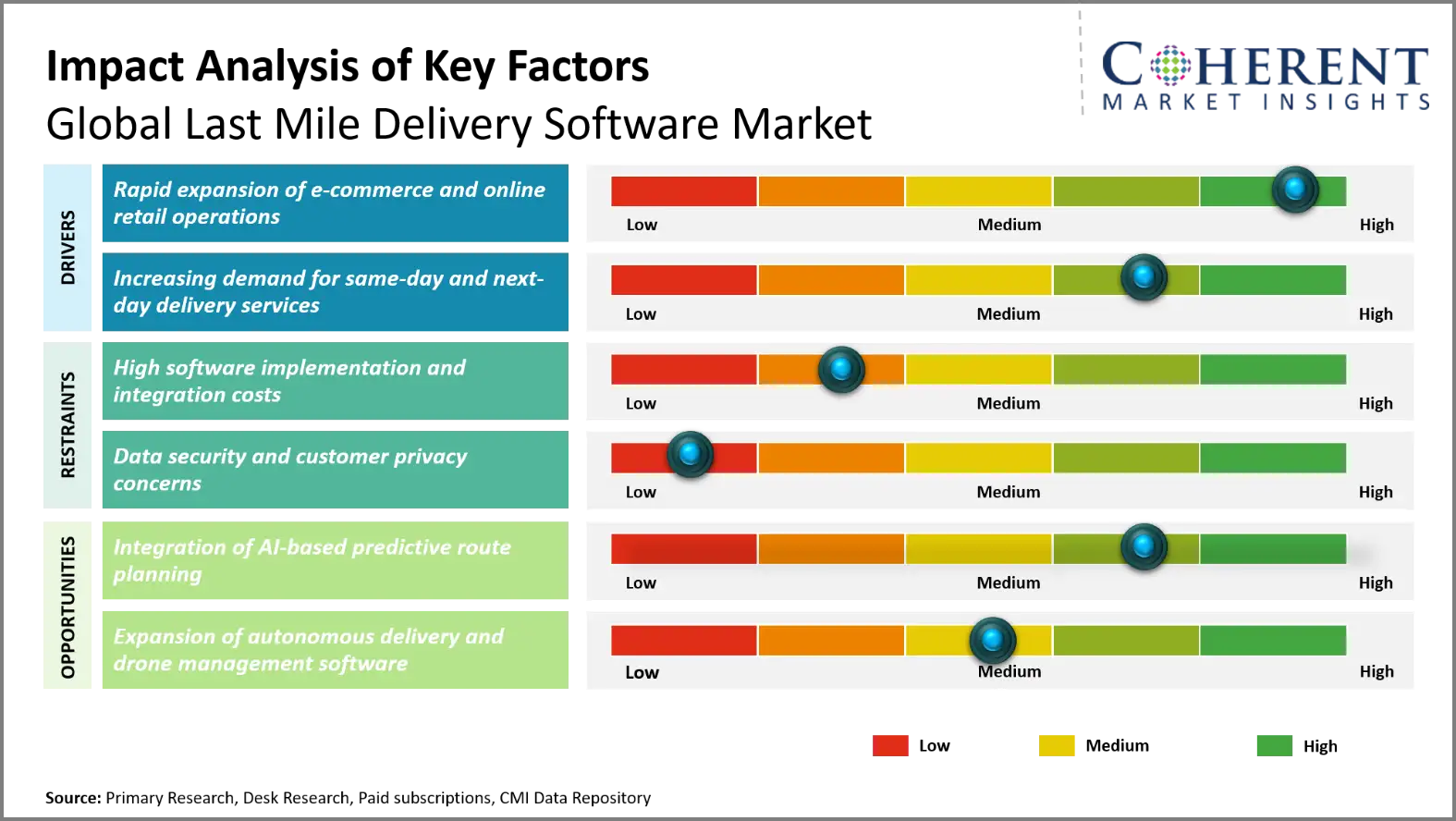
- Rapid expansion of e-commerce and online retail operations: Fast-paced growth of e-commerce and online retail operations is driving demand for last mile delivery software by increasing package volumes and complexity of delivery. Retailers need automated systems to manage orders, drivers, shipment tracking and delivery exceptions efficiently. Linking to e-commerce sites, warehouse management systems and inventory software helps increase order visibility and fulfillment accuracy. Real-time alerts and e-proof of delivery can help companies improve customer communication and avoid disputes. Last mile delivery software also allows firms to manage several carriers and distribution locations from linked dashboards. Online shopping continues to blossom and companies are investing in delivery systems that grow with their business and improve their operations.
- On June 24, 2026, Flipkart Minutes, the quick commerce offering from the Indian e-commerce platform Flipkart, which was launched in August 2024, scaled to 1,000 mini fulfillment centers across 130+ locations and 8,000+ pin codes, within two years of its launch. The platform has seen its orders climb 5x with the network expansion.
- Increasing demand for same-day and next-day delivery services: Enterprises are bound to invest in better last mile delivery software because of the growing demand for same-day & next-day delivery services. Customers desire ever shorter delivery windows, accurate arrival estimates and simple tracking of items. That means good route planning, automatic dispatch, real-time traffic monitoring and dynamic scheduling of deliveries to meet those expectations. Logistics software platforms enable operators to pick high-priority orders, balance driver workloads and respond to unexpected issues rapidly. Retailers can also employ predictive analysis to place products closer to customers and speed up order fulfillment. These features help to decrease needless travel, boost delivery reliability and support speedier service commitments in competitive e-commerce and urban logistics sectors.
- On May 28, 2026, Walmart announced that qualified orders would be delivered in 30 minutes to customers in 33 U.S. markets. The service includes groceries, pharmacy items, household basics, electronics and other everyday stuff. Walmart has a huge retail network and an algorithm that takes into account basket size, driver availability and distance to the shop.
Emerging Trends
- Artificial Intelligence-Powered Route Optimization: AI-Powered Route Optimization is increasingly being adopted for creating ideal routes for deliveries taking into account real-time traffic, delivery density, truck capacity, and historical data. Such systems can be dynamically dispatched and respond faster to unforeseen disruptions of delivery.
- Impact: Intelligent routing reduces unnecessary travel, fuel consumption and delivery delays, while increasing driver productivity. Automated judgment can help logistics organizations deal with unpredictable order volumes and changing consumer delivery preferences.
- Relevance to the market: The trend fuels the demand for advanced delivery software that utilizes predictive analytics and real-time optimization. Providers with flexible routing capabilities will attract retailers, courier companies and third-party logistics operators.
- Real-Time Delivery Visibility and Customer Communication: More and more delivery platforms are incorporating live cargo tracking, estimated arrival notifications, electronic proof of delivery, and automatic customer alerts. These capabilities improve collaboration between dispatchers, drivers, stores and beneficiaries.
- Impact: Improved delivery visibility decreases customer uncertainty, missed deliveries and service concerns related to communication. Automation notifications also minimize customer support duties, and assist firms to handle delivery exceptions more effectively.
- Relevance to the market: Demand for transparent delivery experiences has driven investment in tracking-enabled software solutions. Vendors who can accurately anticipate delivery and integrate communication can increase customer satisfaction and service differentiation.
Regional Insights
Why is North America a Strong Market for Last Mile Delivery Software?
North America is expected to account for a market share of 40.0% in 2026. North America has sophisticated carrier networks, intricate home delivery requirements, and an increasing demand for flexible parcel fulfillment. UPS handled an average of 20.8 million parcels a day around the world in 2025, or 5.2 billion packages for the year. Canada Post’s strategic initiatives include e-commerce returns, local next-day delivery and small business services. Parcel lockers also allow secure delivery to apartment buildings without requiring the recipient to be home. These operating conditions encourage software adoption for delivery-window management, failed-delivery prevention, carrier selection, and returns coordination.
Why Does Asia Pacific Last Mile Delivery Software Market Exhibit High Growth?
Asia Pacific is expected to register the fastest growth with a CAGR of 10.2% over the forecast period and is projected to account for 23.0% of the global last mile delivery software market in 2026. Fast logistics automation and high-density e-commerce networks and cross-border fulfillment are shaping the Asia Pacific market. Cainiao offers digital logistics and worldwide shipping services in more than 200 countries and regions. It boasts a network of more than 170,000 sites for flexible package collection; pick-up and drop-off. Singapore Post announced it will spend USD 23.4 million upgrading its e-commerce logistics hub in March 2025. The planned addition to the equipment will increase processing capacity from 100,000 to 300,000 small parcels a day. These developments support demand for software coordinating automated sorting, cross-border shipment visibility, pickup networks, and complex fulfillment operations.
Global Last Mile Delivery Software Market Outlook for Key Countries
Why is U.S. Emerging as a Major Hub in the Last Mile Delivery Software Market?
The U.S. market has the large parcel networks, advanced fulfillment operations and appetite for digitally managed customer delivery experiences. During FY2025, the U.S. Postal Service sent more than 14.7 billion Informed Delivery emails. Its notifications covered about 33.4 billion mail pieces and 3 billion shipments. These services highlight the value of digital cargo communication and delivery visibility. Last mile software helps with address validation, alerting about deliveries, arranging dispatches and coordinating national carriers with regional suppliers. Competition from the incumbent carriers and alternative delivery businesses also drives flexible software integration and diverse consumer experiences.
Is China the Next Growth Engine for the Last Mile Delivery Software Market?
China’s market is underpinned by huge parcel throughput, automated distribution infrastructure and digitally integrated commerce ecosystems. In 2025, China's courier industry delivered 199 billion parcels, up 13.7% from the same period last year. In the same year the country’s postal industry processed 216.5 billion delivery items. Cainiao offers digital waybills, automated facilities, pickup networks, cross-border fulfillment services, and e-commerce logistics. That level of activity drives need for software to handle things like parcel sorting, delivery allocation, exception management and distributed carrier networks. The integration of logistics systems and commerce platforms is of particular importance for the coordination of high-frequency deliveries across urban and rural regions.
Germany Last Mile Delivery Software Market Analysis and Trends
The German last mile delivery software market is defined by parcel locker networks, flexible pick-up places and a well-developed carrier infrastructure. DHL Group said its German post and parcel segment processed almost 7.5 million items a day in 2025. It has a network of 38 parcel centers and more than 41,000 fixed-location acceptance and sales locations. Customers can choose to have shipments redirected to retail shops, Pack stations or Post stations, which reduces the need for home delivery attempts. These services generate need for software that supports the selection of pickup points, control of locker capacity, diversion of deliveries, and returns processing. Connecting with parcel networks, carriers can better monitor customer delivery preferences and improve operational coordination across Germany’s tightly integrated logistics system.
Japan Last Mile Delivery Software Market Analysis and Trends
Japan’s market is characterized by driver shortages, missed-delivery reduction measures and large-scale nationwide postal networks. Yamato Transport said it has delivered almost 2.3 billion TA-Q-BIN packages in the fiscal year ended March 2025. Its network spanned all of Japan, supported by some 2,800 last-mile pickup and delivery sites. In October 2025, Japan’s Ministry of Land, Infrastructure, Transport and Tourism said 8.3% of parcels were delivered again. These conditions stimulate the use of software for delivery scheduling, recipient preference management, route optimization, and automatic delivery alerts. These capabilities allow carriers to eliminate repeat visits while still delivering reliable service to residential and commercial destinations.
India Last Mile Delivery Software Market Analysis and Trends
Postal digitization, growing e-commerce alliances and logistical modernization in smaller cities help India’s market. India Post has launched Advanced postal technology 2.0 with features including real-time delivery updates, one-time password authentication and application programming interface connectivity. Nodal Delivery Centers provide mechanized and dedicated parcel delivery operations. India Post has also tied-up with Amazon, Shiprocket, Decathlon and the Open Network for Digital Commerce. This gives rise to the need for software that supports shipment tracking, delivery confirmation, partner integration and rural distribution. In the numerous geographic and commercial settings of India, solutions that help logistics operators enhance their delivery accuracy can help solve problems such as diverse addresses and multilingual communication.
Global Last Mile Delivery Software Market - Delivery Performance Benchmarks
Metric | Definition | Relevant Data |
On-Time Delivery Rate | Deliveries completed within the promised window | 95% or higher |
First-Attempt Delivery Success Rate | Deliveries completed successfully on the first attempt | 90% or higher; 95% for mature operations |
Failed Delivery Rate | Deliveries that fail because of access, address, customer availability, or operational issues | Minimize; establish a baseline by delivery type |
Average Delivery Time | Average elapsed time from dispatch to customer delivery | Set by service level and delivery category |
Estimated Arrival Time Accuracy | Deliveries arriving within the communicated estimated arrival window | Set a target based on the promised window |
How is Integration of AI-Based Predictive Route Planning Creating New Growth Opportunities in the Last Mile Delivery Software Market?
New growth prospects in global last mile delivery software market are opening up due to artificial intelligence enabled predictive route planning that helps logistics operators to forecast delivery disruptions before routes become inefficient. They predict delays on the route-level using past delivery data, traffic patterns, weather forecasts, package density and recipient availability. Amazon, for example, implements machine learning in its delivery network to optimize delivery sequencing and anticipated times of arrival, and United Parcel Service used its ORION route optimization technology to enhance driver routing. Software suppliers can distinguish their systems by providing predicted delivery windows, proactive re-routing and demand forecasting to schedule dispatches at the neighborhood level. These capabilities are particularly beneficial for food deliveries, pharmaceutical deliveries and time sensitive e-commerce shipments.
On December 15, 2025, CEVA Logistics launched an AI-powered dynamic last mile route dispatching solution. This state-of-the-art, AI-enabled software is designed to optimize and standardize CEVA’s dispatching processes, allowing the company to provide exceptional service and meet its and its customers’ sustainability goals.
Market Players, Key Development, and Competitive Intelligence
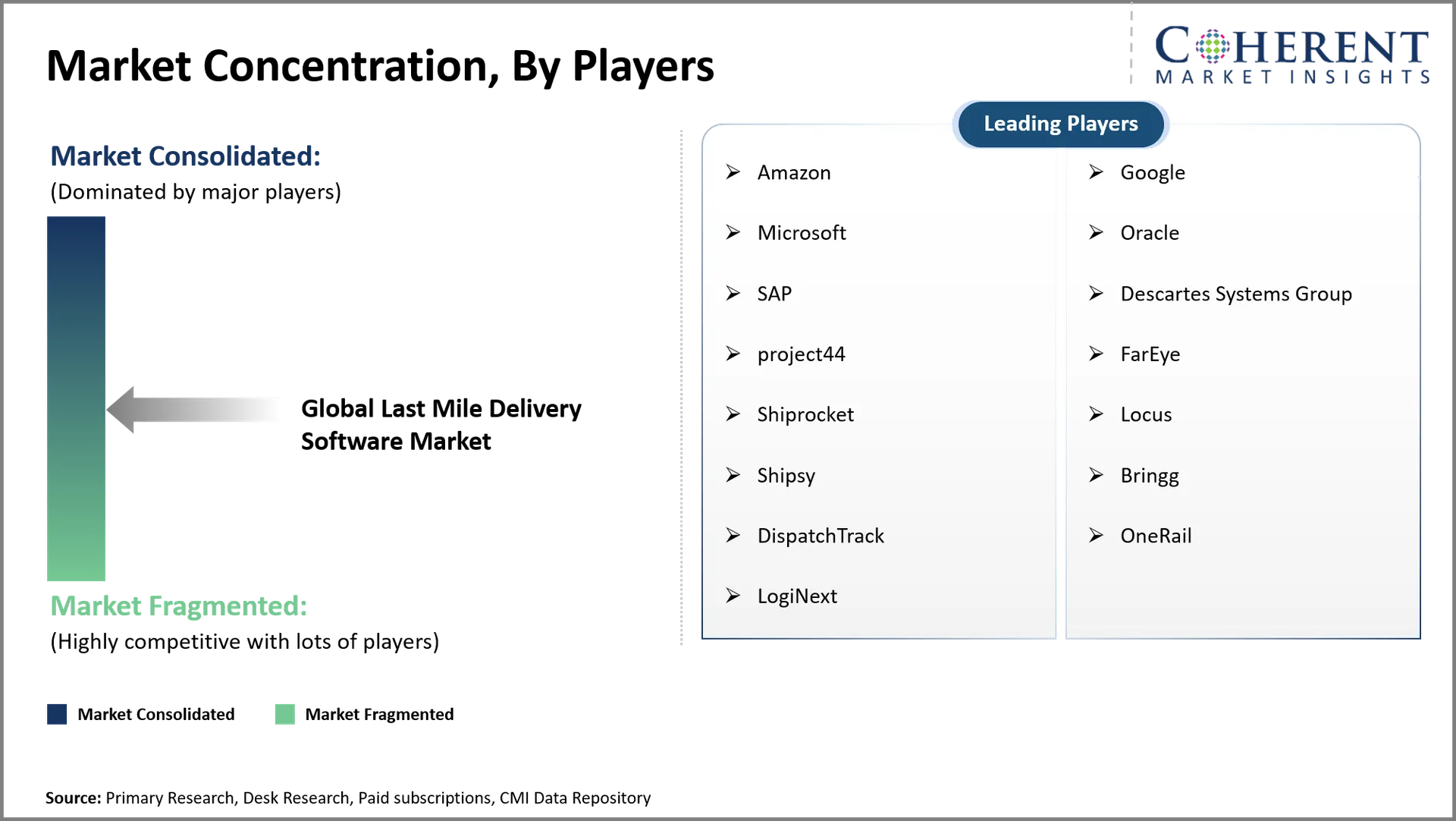
Key Developments
- On April 23, 2026, FarEye announced the launch of PILOT, an AI Agent that autonomously manages the end-to-end logistics dispatcher workflow with Human-In-The-Loop governance. PILOT autonomously orchestrates 11 specialized AI agents, planning routes, managing drivers, recovering failed deliveries, and reconciling invoices, thereby reducing a dispatcher's 10-hour day to 60 minutes.
- On March 31, 2026, Bluerock TMS introduced its Last Mile Distribution solution to the market, a cloud-native platform that manages the complete delivery lifecycle from order intake through proof of delivery in a single environment. The product is the company's first publicly available offering in last mile distribution.
- On February 11, 2026, Tenet, an Operating System built for cartage, courier, and expedited carriers, announced its official launch after its acquisition of Pallet’s Transportation Management System (TMS). Tenet’s Operating System is used by leading carriers across the U.S. for dispatching, warehouse operations, driver application, invoicing, line haul management, and reporting.
Competitive Landscape
The global last mile delivery software market features specialists competing through artificial intelligence, route optimization, fleet orchestration, and customer visibility. Onfleet focuses on predictive arrival estimates, automated dispatching, courier coordination, and driver applications. It has the product features including courier management tools and routing controls customized to the vehicle. Bringg aims for enterprise retailers, with its modular planning, carrier selection, dynamic delivery windows and fleet management. Its Predictive Time on Site feature uses merchant-specific operational data to forecast particular stop times. DispatchTrack deals with difficult deliveries, AI-powered customer service, and damage identification. Its portfolio also addresses multi-week route planning and specialized warehouse workflows. Competitive differentiation increasingly depends on measurable operational improvements, integration flexibility, and support for mixed delivery networks.
Top Manufacturers and Notable Products/Solutions in the Last Mile Delivery Software Market
Company/Manufacturer | Notable Product/Solution | Key features |
Onfleet | Onfleet Delivery Management Platform | Artificial intelligence-powered route optimization, automated dispatch, live GPS tracking, predictive estimated arrival times, customer notifications, electronic proof of delivery |
Bringg | Bringg Last-Mile Solutions | Centralized planning, route optimization, dispatch automation, driver management, third-party carrier integration, hybrid fleet management, delivery performance analytics |
FarEye | FarEye Last-Mile Delivery Management Platform | Artificial intelligence-powered dispatch, predictive delivery visibility, route optimization, delivery exception management, customer communications, carrier coordination |
DispatchTrack | DispatchTrack Last-Mile Delivery Platform | Dynamic route optimization, appointment scheduling, real-time tracking, customer notifications, electronic proof of delivery, delivery experience management |
Locus | Locus Last Mile Delivery Solution | Automated dispatch, constraint-based route optimization, dynamic scheduling, fleet allocation, delivery visibility, logistics analytics |
Market Report Scope
Global Last Mile Delivery Software Market Report Coverage | |||
Report Coverage | Details | ||
Base Year | 2025 | Market Size in 2026: | USD 13.60 Bn |
Historical Data For: | 2020 To 2024 | Forecast Period: | 2026 To 2033 |
Forecast Period 2026 To 2033 CAGR: | 10.00% | 2033 Value Projection: | USD 33.40 Bn |
Geographies covered: |
| ||
Segments covered: |
| ||
Companies covered: | Amazon, Google, Microsoft, Oracle, SAP, Descartes Systems Group, project44, FarEye, Shiprocket, Locus, Shipsy, Bringg, DispatchTrack, OneRail, LogiNext | ||
Growth Drivers: |
| ||
Restraints & Challenges: |
| ||
Analyst Opinion (Expert Opinion)
- The future of the global last mile delivery software market will center on predictive automation rather than basic route mapping. Artificial intelligence will increasingly coordinate dispatch decisions, delivery promises, driver workloads, and exception management within unified platforms. Providers should prioritize systems that continuously adjust routes when new orders, traffic disruptions, or service delays occur. Solutions must also explain operational recommendations clearly to dispatchers. This capability will distinguish intelligent delivery orchestration from conventional scheduling software.
- The strongest opportunities are likely to emerge in cloud-based software serving grocery delivery, pharmaceutical distribution, and high-volume e-commerce fulfillment. The U.S. offers opportunities for enterprise platforms coordinating internal fleets and external courier partners. India presents opportunity for mobile-first delivery applications that support complex addresses, local courier networks and smaller city expansion. Germany has possibilities for software that brings together parcel lockers, collecting stations and automated returns. Vendors should sell different configurations in different markets to satisfy the operational needs of each market.
- Market actors should build interoperable platforms to link order management, warehouse systems, customer apps and third-party carriers. Core product capabilities should include predictive arrival estimations, automatic delivery exception management and driver-specific mobile procedures. Vendors should also have a clear pricing structure depending on the volume of deliveries, active drivers, or accomplished jobs. Showing reductions in unnecessary mileage and missed deliveries can help reinforce company purchasing decisions. As such, companies who offer a combination of dependable integrations, measurable operational outcomes and fast implementation will be best positioned to retain customers.
Speak to the analyst
Want personalized insights?
Take the findings above to one of our principal consultants, or have the report rebuilt around the segments, geographies and competitors you actually track.
Market Segmentation
- Component Insights (Revenue, USD Billion, 2021 - 2033)
- Software
- Services
- Deployment Type Insights (Revenue, USD Billion, 2021 - 2033)
- Cloud-Based
- On-Premises
- Hybrid
- Software Type Insights (Revenue, USD Billion, 2021 - 2033)
- Route Optimization Software
- Fleet Management Software
- Delivery Tracking Software
- Order Management Software
- Dispatch Management Software
- Proof of Delivery Software
- Customer Communication Software
- Returns Management Software
- Application Insights (Revenue, USD Billion, 2021 - 2033)
- Route Planning and Optimization
- Fleet Tracking and Management
- Order Dispatch and Allocation
- Real-Time Shipment Visibility
- Delivery Scheduling
- Proof of Delivery
- Returns and Reverse Logistics
- End User Insights (Revenue, USD Billion, 2021 - 2033)
- Retail and E-Commerce
- Food and Beverage
- Healthcare and Pharmaceuticals
- Logistics and Transportation
- Manufacturing
- Postal and Courier Services
- Regional Insights (Revenue, USD Billion, 2021 - 2033)
- North America
- U.S.
- Canada
- Latin America
- Brazil
- Argentina
- Mexico
- Rest of Latin America
- Europe
- Germany
- U.K.
- Spain
- France
- Italy
- Russia
- Rest of Europe
- Asia Pacific
- China
- India
- Japan
- Australia
- South Korea
- ASEAN
- Rest of Asia Pacific
- Middle East
- GCC Countries
- Israel
- Rest of Middle East
- Africa
- South Africa
- North Africa
- Central Africa
- North America
Sources
Primary Research Interviews
- Last Mile Delivery Software Providers & Developers
- Logistics & Supply Chain Managers
- E-commerce Retailers & Fulfillment Center Operators
- Courier, Express & Parcel (CEP) Service Providers
Magazines
- Logistics Management Magazine
- Supply Chain Brain
- Modern Materials Handling
- DC Velocity
Journals
- International Journal of Logistics Management
- Journal of Supply Chain Management
- Transportation Research Part E: Logistics and Transportation Review
Associations
- International Air Transport Association (IATA)
- Council of Supply Chain Management Professionals (CSCMP)
- National Retail Federation (NRF)
- Warehousing Education and Research Council (WERC)
Public Domain Sources
- U.S. Department of Transportation (DOT)
- European Commission - Transport & Mobility Reports
- World Bank Logistics Performance Index (LPI)
- Federal Motor Carrier Safety Administration (FMCSA)
Proprietary Elements
- CMI Data Analytics Tool
- Proprietary CMI Existing Repository of Information for the Last 10 Years
Get access to 250+ pages report
Every segment, forecast, competitor profile and data table behind the analysis above — available for instant download.
- ESOMAR Member
- ISO 9001:2015 Certified
- D-U-N-S Registered
- GDPR & CCPA Compliant
Frequently Asked Questions
The global last mile delivery software market is expected to stand at USD 13.60 Bn in 2026 and is expected to reach USD 33.40 Bn by 2033.
The CAGR of the global last mile delivery software market is projected to be 10.0% from 2026 to 2033.
Rapid expansion of e-commerce and online retail operations and Increasing demand for same-day and next-day delivery services are the major factors driving the growth of the global last mile delivery software market.
High software implementation and integration costs and Data security and customer privacy concerns are the major factors hampering the growth of the global last mile delivery software market.
In terms of component, software segment is estimated to dominate the market revenue share in 2026.
Last mile delivery software manages the final transportation of shipments from distribution facilities to customers.
Route optimization reduces unnecessary mileage, fuel consumption, idle time, and inefficient vehicle movements.