

Global Lime based Paints Market Size and Forecast – 2026 To 2033
The global lime based paints market is projected to grow from USD 415.8 Mn in 2026 to USD 621.1 Mn by 2033, at a CAGR of 5.9% during 2026-2033. The growth is credited to the increasing preference for sustainable construction materials, low-VOC decorative coatings, and breathable mineral finishes of residential and commercial buildings. Architects and contractors are increasingly turning to lime-based alternatives to traditional paints due to the increased focus on indoor air quality, environmentally responsible renovation and transparent product certification.
In September 2024, Bauwerk Colour published technical and certification documentation for its limewash paints including VOC compliance and indoor emission testing, relevant to green building assessments. This makes the independently tested environmental performance of mineral coatings increasingly important in selection and architectural specifications.
Key Takeaways of the Global Lime Based Paints Market
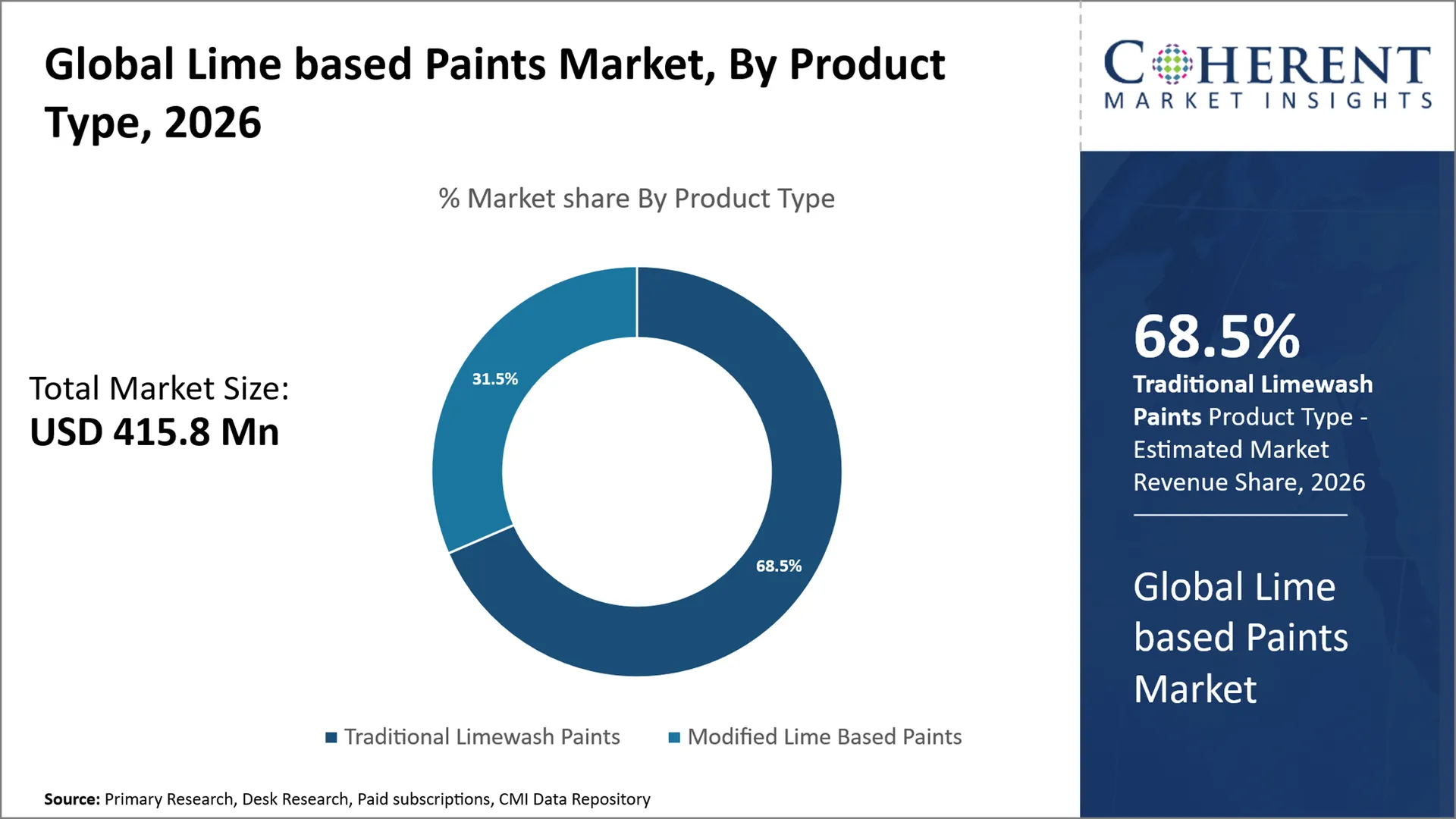
- Traditional Limewash Paints are expected to register a CAGR of 5.3% by 2033 and will hold 68.5% of the global lime based paints market share in 2026. Specialist conservation is still in demand because they are suitable for historic masonry and can be renewed periodically. May 2025: The Landmark Trust continued the care of Scotland’s Saddell Castle with further protective coats of limewash, demonstrating ongoing specification in heritage care.
- Ready-to-Use Liquid formulations will contribute 64.2% to the market revenue in 2026 and are forecast to register a CAGR of 6.2% during the period 2023-2033. Factory-mixed consistency eliminates on-site mixing errors and makes color selection easier for decorators and homeowners. French maker Ocres de France introduced 39 new colors for its ready-to-use Badisof limewash in September 2024, demonstrating the increased design choice available from premixed ranges.
- Exterior applications are projected to grow at an estimated 5.7% CAGR through 2033, representing 54.8% of the global lime based paints market in 2026. Vapour-permeable lime finishes are particularly valuable where traditional walls must release retained moisture without impermeable coatings. In May 2025, Historic England reported the restoration of Gloucester’s historic Westgate Street townhouse, whose façade was redecorated using pigmented limewash.
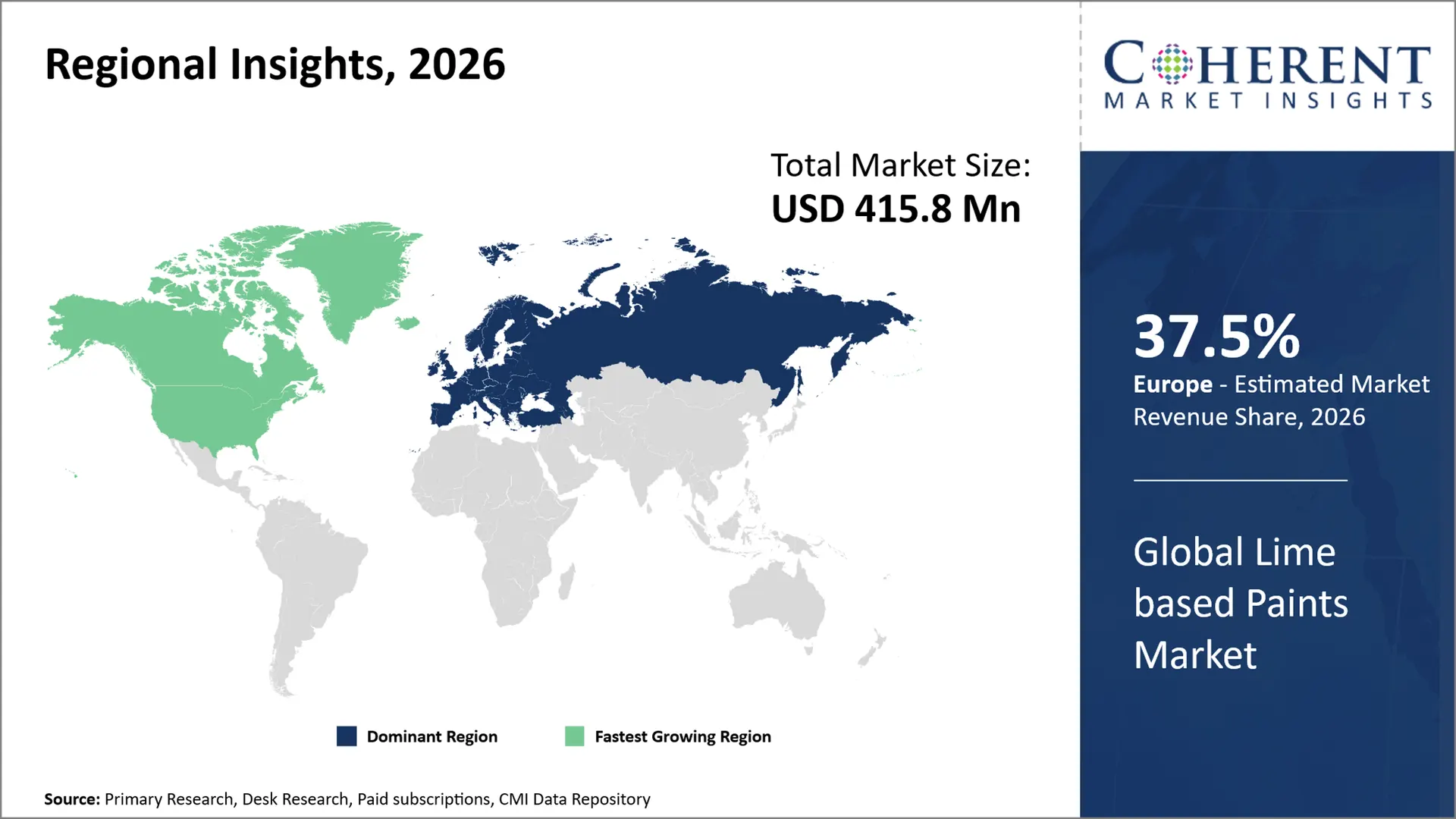
- Europe is forecast to register an estimated 5.2% CAGR through 2033, while leading global lime based paints market revenue with a 37.5% share in 2026. Lime-based coatings have a firm commercial presence in established architectural conservation practice and in specification-led sales. In September 2024 UK manufacturer Armourcoat added its limewash finish to the product’s environmental and health product declarations, further boosting the material’s appeal to architects focused on sustainability.
- North America could post an estimated 7.3% CAGR through 2033, the fastest regional pace, alongside a 28.5% global lime based paints market share in 2026. The demand for textured brick exteriors among homeowners opens up opportunities outside of specialist restoration work. U.S. paint maker Romabio completed an exterior-makeover campaign with Classico Limewash in September 2024, connecting mineral coatings with residential-renovation customers across the United States.
Segmental Insights
Why Do Traditional Limewash Paints Dominate the Global Lime Based Paints Market?
Traditional Limewash Paints are expected to account for 68.5% of the product type segment in the global lime based paints market in 2026. Their lead is a reflection of the purchasing needs of conservation projects, where the buyer has to match original building materials, not just pick a modern decorative coating. The technical specifications for porous cob and lime render are affected by binder composition, pigment compatibility and color matching. Suppliers who can prove these properties may find themselves in business with conservation architects and specialist contractors, even if skilled labor is required for application. In March 2026, the New Forest National Park Authority recognized the restoration of Rose Cottage at Frogham, where the Rose of Jerico tallow limewash was color matched to the original color of the building. This project illustrates the commercial benefits of material authenticity and accurate specifications for traditional mineral formulations.
- Current Industry Events of 2026
- Market Size Estimation
- Regional Breakdown
- Competitive Landscape
- Customer Intelligence
- Segmental Analysis
- Pricing Analysis
- Key Market Drivers, Challenges & Future Trends
- Customized Insights Section
Why Does Ready to Use Liquid Represent the Largest Product Form in the Global Lime Based Paints Market?
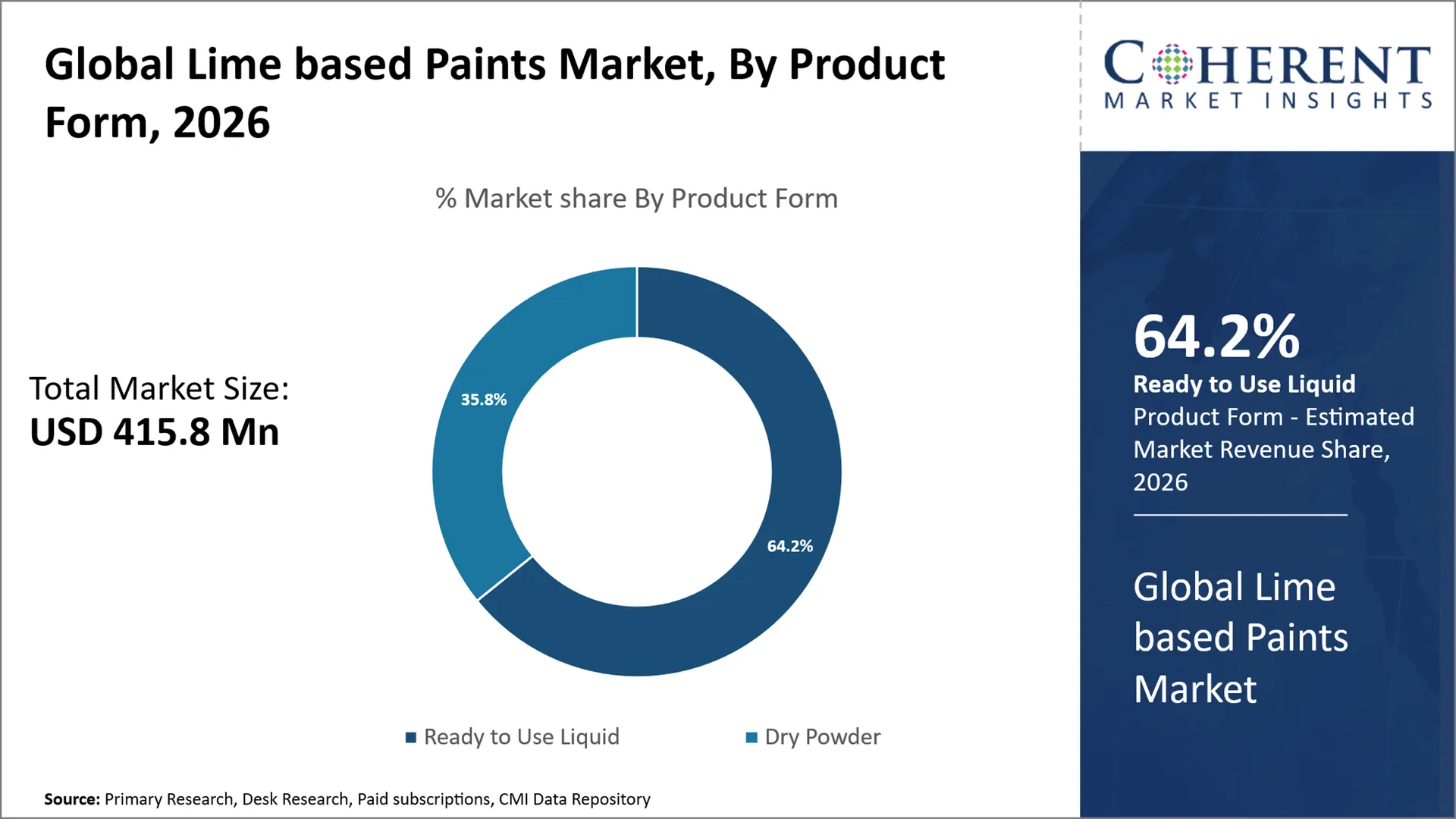
The product form segment of the global lime based paints market is expected to have 64.2% share held by Ready to Use Liquid in 2026. The appeal is that formulation control is moved from the job site to the manufacturer, so that decorators can buy a consistent product rather than having to measure lime, water and pigments separately. This is important in occupied homes and tight renovation jobs where prep space and clean up time can limit productivity. Manufacturers have improved control of viscosity, and packaging and color reproducibility, but shelf stability and freight costs need to be carefully managed. In June 2024, Latvian producer KULTA detailed its premixed limewash offering, which can be applied after opening and stirring the container. Such solutions help specialty retailers serve professional applicators and less experienced homeowners, improving product accessibility.
Why Does Exterior Dominate the Application Segment of the Global Lime Based Paints Market?
Exterior applications are expected to capture 54.8% of the global lime based paints market by application in 2026. Their commercial value includes coordinated façade redesign, where property owners want stone and brickwork to match replacement roofing, doors, trim and adjacent finishes. The choice of products is therefore conditioned by the porosity of the surfaces, the exposure to rain, the drying conditions and the visual harmony between the various materials of masonry. Qualified applicators sampling panels, site assessments, and supplier substrate-specific instructions can influence purchasing decisions, as well as reduce remedial work. In April 2026, Kirkendall Design documented its Southern Oaks residential renovation in Tulsa, where stone limewashing accompanied changes to roof colour, garage doors, and exterior trim. It demonstrates how lime-based finishes can be included in renovation budgets for whole buildings, not just for a one-off repainting purchase .
Current Events and their Impact
Current Event | Description and Its Impact |
December 2025 – European Commission Introduces Revised EU Ecolabel Criteria for Paints |
|
September 2026 – EU Consumer Protection Rules Against Greenwashing Become Applicable |
|
January 2026 – UK Competition and Markets Authority Clarifies Environmental Claims Responsibilities |
|
Global Lime Based Paints Market Dynamics
Key Market Drivers
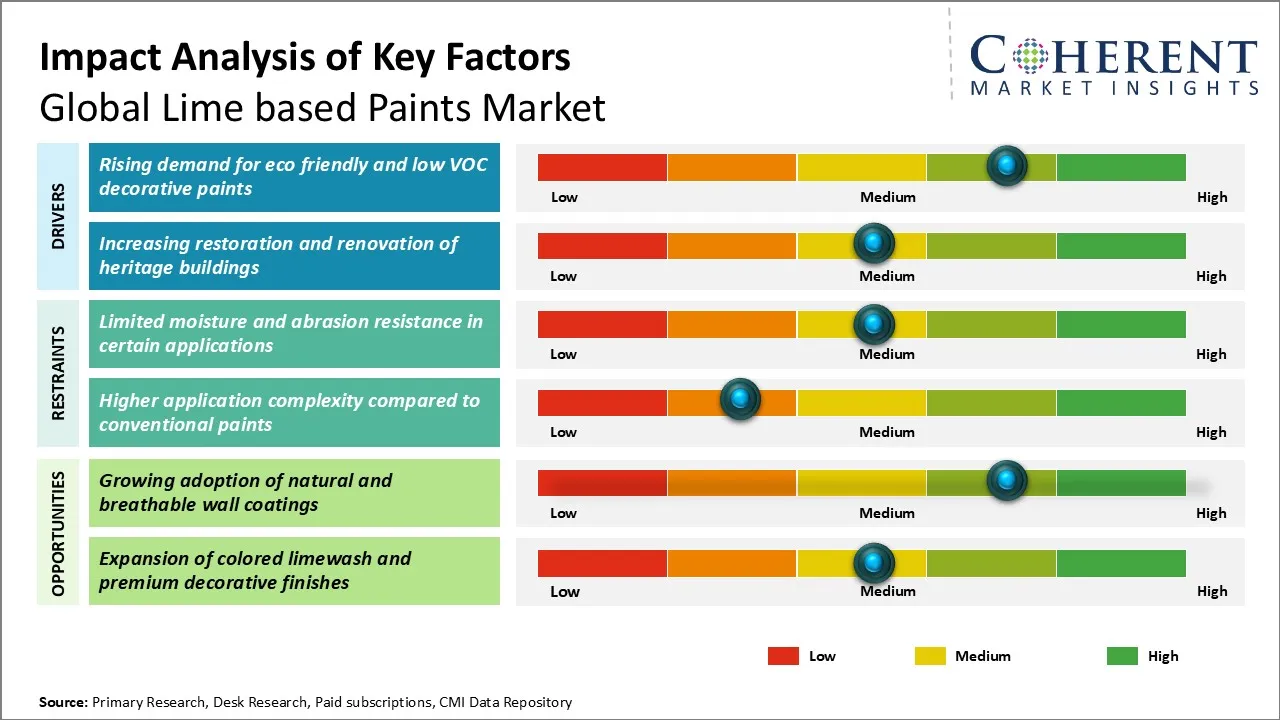
- Rising demand for eco-friendly and low VOC decorative paints: Architects, homeowners and interior designers are looking for decorative coatings that have esthetic value and less chemical emissions. Lime paints present a mineral-based option to conventional solvent-based coatings, providing manufacturers looking to produce low-VOC formulations with new avenues. They may also use verified emission performance and product transparency to further differentiate premium residential and commercial projects. In December 2024, Indonesia-based Gamma Paint introduced its Lime Wash decorative coating, featuring a breathable, low-VOC mineral formulation suitable for interior and exterior applications. This is a demonstration of the manufacturers’ attempts to bring to market environmentally sensitive architectural finishes.
- Increasing restoration and renovation of heritage buildings: One niche demand for lime based paints is the restoration of historic buildings, which often require breathable finishes compatible with the original building materials. Good limewash specification allows movement of moisture and retains the historic surface qualities, unlike impermeable coatings. This represents a continuing opening for mineral paint manufacturers, conservation specialists and restoration contractors. In April 2024, the U.S. National Park Service announced restoration activities at Fort Christiansvaern in the U.S. Virgin Islands that include interior limewashing and exterior mineral-silicate coatings. This initiative shows that traditional building finishes are still a draw for public sector investment.
Emerging Market Trends
- Greater Emphasis on Customized Colors and Textured Architectural Finishes: Interior designers increasingly specify lime finishes as controlled combinations of color, tonal movement, and surface texture rather than as interchangeable wall paints. Suppliers therefore need repeatable mineral pigment dispersion, credible sample panels, and clear instructions for brush direction and layering. This shift changes purchasing from simple shade matching to approval of an installed visual effect, allowing specialist finish manufacturers to command design-led premiums. Over the forecast period, businesses that standardize sample presentation and installer workmanship are likely to gain specification influence, while those offering only undifferentiated whitewash may struggle to serve complex projects.
- Growing Preference for Concentrated and Transport-Efficient Lime Paint Formulations: As logistics costs, shelf stability and packaging efficiency become more apparent in purchasing decisions, manufacturers are rediscovering the balance between ready-mixed paint and concentrated, dry mineral products. Powder formats have the advantage of transportability and on-site preparation, but present challenges in mixing accuracy and dust-handling that may deter the inexperienced user. The change is encouraging suppliers to develop measured dosing, sealed packaging and application instructions to reduce waste. Importers, specialist distributors and professional contractors could benefit, but brands relying on bulky, short shelf-life formats could be under pressure in distant export markets.
Regional Insights
Why Does Europe Dominate the Global Lime Based Paints Market?
Europe is projected to maintain its dominance in the global lime-based paints market in 2026 with a 37.5% share procurement of public architecture and weathered masonry, assisted by a well-established network of conservation contractors, mineral-finish suppliers and specialist construction trades. These contracts may need coatings that are color-matched, protecting exposed decorative stone without hiding the surface, unlike traditional repainting projects. This allows formulators to provide project specific application advice, controlled pigments and suitable lime binders. The North East Lincolnshire Council announced in April 2025 that restorers have conserved the clock tower at Holme Hill School in Grimsby, applying a protective shelter coat of limewash and stone dust. The project shows the need to specify performance-led limewash for the maintenance of municipal buildings. Regional leadership also draws on local knowledge of conventional substrates and existing conservation procurement practices
Why Is North America Emerging as the Fastest-Growing Region in the Global Lime Based Paints Market?
North America is anticipated to hold the largest revenue share of 28.5% in 2026 and is expected to be the fastest-growing region in the global lime-based paints market. Expansion is becoming more and more interwoven with how specialty mineral finishes are brought into design-conscious homes, through coordinated home-furnishing collections, digital color sampling and decorator recommendations. Such channels increase the relevance of limewash to room makeovers that have previously relied on conventional flat wall paint. Producers that can simplify the complexity of surface preparation, while showing the end result, can grow their client base., while premium positioning helps offset specialist application costs. In February 2026, U.S. companies Portola Paints and Lulu and Georgia introduced a collaborative palette available in limewash alongside clay and acrylic finishes. The initiative highlights how partnerships between decorative-coating specialists and home-furnishing retailers can create new purchasing opportunities without depending exclusively on traditional painting contractors.
Global Lime Based Paints Market Outlook for Key Countries
Why Is the U.S. a Key Market for the Global Lime Based Paints Market?
The United States is a major contributor to the global lime-based paints market, due to the growing remodeling ecosystem, which supports whole-home repainting as well as smaller projects with high value. Homeowners can try out mineral coatings on fireplace surrounds, exposed interior brick, or accent walls—a relatively contained way to test the coatings before tackling larger projects. Consumer purchase is dependent on availability of surface preparation instructions, compatible primers and reasonable expectations of washability and durability. Domestic niche producers can compete on technical expertise and special product formats, not on mass-market paint prices. In October 2025, application guidance for limewashed stone fireplaces was published by the U.S. manufacturer Meoded. The guidance explains how the mineral paint refreshes masonry without losing the natural surface variation. This illustration represents a unique residential niche where the choice of products and contractor inquiries may be greatly influenced by advice and instructional content that is specific to the substrate .
Why Does China Support Growth in the Global Lime Based Paints Market?
China’s role in the global lime based paints market is in its mineral-material processing capabilities and the technical requirements of the traditional building conservation. Moreover, local suppliers may have an advantage over imported binders in sourcing limestone-based binders, controlling production costs, and offering finishes compatible with regional brick and earthen construction systems. But availability of the materials does not assure growth. Restoration buyers want expert application, controlled coating composition, and consistent slaking to protect historic surfaces from damage. In November 2025, researchers published a peer-reviewed paper describing the traditional Chinese lime craft in terms of material selection, calcination, slaking, formulation, application and curing. Such results demonstrate the importance of technically validated materials for the purpose of architectural conservation. By converting this know-how into reproducible product specifications, coating producers would create a specialized sales channel separate from the mainstream decorative paint competition.
Why Is India Important in the Global Lime Based Paints Market?
India’s lime-based paints market presents a double opportunity – low-cost mineral wall finishes for budget-conscious projects and higher-spec coatings for architects seeking to create distinctive tactile interiors. Climatic variability, substrate moisture, compatibility with cement plaster and use of reliable preparation guidance are critical factors in purchasing decisions. Specialized distributors can help specifiers to identify authentic lime-putty paints from limewash imitations, adding value to the product. The imported formulations also provide local tinting, sample prep and technical services. But high land costs restrict their use to premium projects. Lime Paint 665 (made in Germany) is a lime-putty coating. Specification assistance, color support and revised technical information were provided in India by LEINOS India in June 2026. This suggests the possible role of product documentation and local advisory capacity for commercialization in the absence of local manufacturing.
Why Is Germany a Strategic Country in the Global Lime Based Paints Market?
Germany is of strategic importance in the global lime-based paints market, as it is expected to be home to technically demanding buyers who want detailed formulation disclosure, substrate guidance, and predictable coating performance. Mineral finishes are in competition not only in terms of their appearance but also regarding compatibility with lime plaster, ease of recoating and documented conditions of application. This is especially helpful for suppliers with a robust trade support network and established testing processes, as it can result in costly remedial work on refurbishment projects where inappropriate coatings are applied. In January 2025 KREIDEZEIT, a German manufacturer of natural paints, revised the technical sheet of its interior Kalkfarbe powder coating with information on surface preparation, temperature limits and brush application.
Why Is Italy an Important Growth Market for the Global Lime Based Paints Market?
Italy's decorative finishing sector is a crucial part of the global lime based paints market, connecting the production of mineral coatings with the design of architecture, craftsmanship and luxury interiors. Lime-based paints are of particular interest to designers interested in subtle tonal movement as opposed to a flat opaque field of color. Italian manufacturers may capitalize on that distinction through curated palettes, physical showroom displays and trained applicator networks, creating opportunities in high-end residential and commercial interiors. Milan Design Week in April 2025 saw Novacolor introduce Era, Pennello lime-based paint and CalceCruda decorative finish, as a part of redesigning its showroom experience.
Lime-Based Paint Formulation, Application and Performance Technology Landscape
Technology | Technical Role | Commercial Application | Adoption Considerations |
Controlled Lime Slaking and Putty Maturation | Produces consistent calcium hydroxide binders and helps control particle characteristics. | Traditional limewash production and specialist mineral finishes. | Requires controlled processing, raw-material quality checks, and appropriate storage. |
High-Shear Mixing and Mineral Dispersion | Improves the distribution of lime particles, pigments, and compatible additives. | Ready-to-use liquid paints requiring consistent texture and application properties. | Mixing conditions must limit sedimentation while maintaining suitable rheology. |
Hybrid Mineral Binder Modification | Incorporates compatible performance modifiers to improve adhesion, cohesion, or abrasion resistance. | Modified lime-based paints for selected contemporary interior applications. | Formulation changes must be assessed for vapour permeability and substrate compatibility. |
Rheology and Anti-Settling Formulation Technology | Controls viscosity, pigment suspension, storage stability, and application behaviour. | Packaged liquid lime paints for residential and professional decorators. | Additive selection must account for shelf life, coating properties, and environmental claims. |
Vapour-Permeable Primers and Substrate Conditioning | Improves adhesion and manages surface absorbency before mineral coating application. | Lime-based paint systems used on suitable existing coatings, plasterboard, and mineral substrates. | Requires substrate assessment, adhesion testing, and confirmation of system compatibility. |
How Are Standardized Mineral Finish Systems Creating New Growth Opportunities in Multi-Site Hospitality and Wellness Projects?
Multi-site hospitality and wellness operators represent a relatively underdeveloped route to scale for lime-based paints. Boutique hotels, spas, serviced apartments, and premium restaurants increasingly seek finishes that create a recognizable atmosphere across properties, yet variable workmanship and maintenance requirements can discourage procurement teams from specifying limewash.
Manufacturers could address this gap with contract-ready finish systems: approved substrate primers, consistent pigment batches, mock-up panels, room-by-room maintenance protocols, and installer accreditation.
The commercial opportunity is particularly relevant to refurbishments in tourism-oriented cities where operators need visual differentiation without lengthy shutdowns. Suppliers could sell through design-and-build contractors and facilities-management partners rather than relying entirely on retail demand.
Market Players, Key Development, and Competitive Landscape
Key Developments
- In March 2026, Urban Walls announced a distribution partnership with Australian brand DALRAY for powdered limewash in Singapore, Malaysia and UAE, and a new e-commerce storefront. The move connects specialist application expertise with product supply, providing more direct purchase routes for designers, contractors and homeowners.
- In July 2025, Asian Paints discussed its new Nilaya Arc lime-based premium coating on its earnings call, putting artisanal matt finishes on par with broad color selection and warranty coverage. This adds to competition for design-led interiors by introducing mineral finishes to the luxury portfolio of an established coatings company.
Competitive Landscape
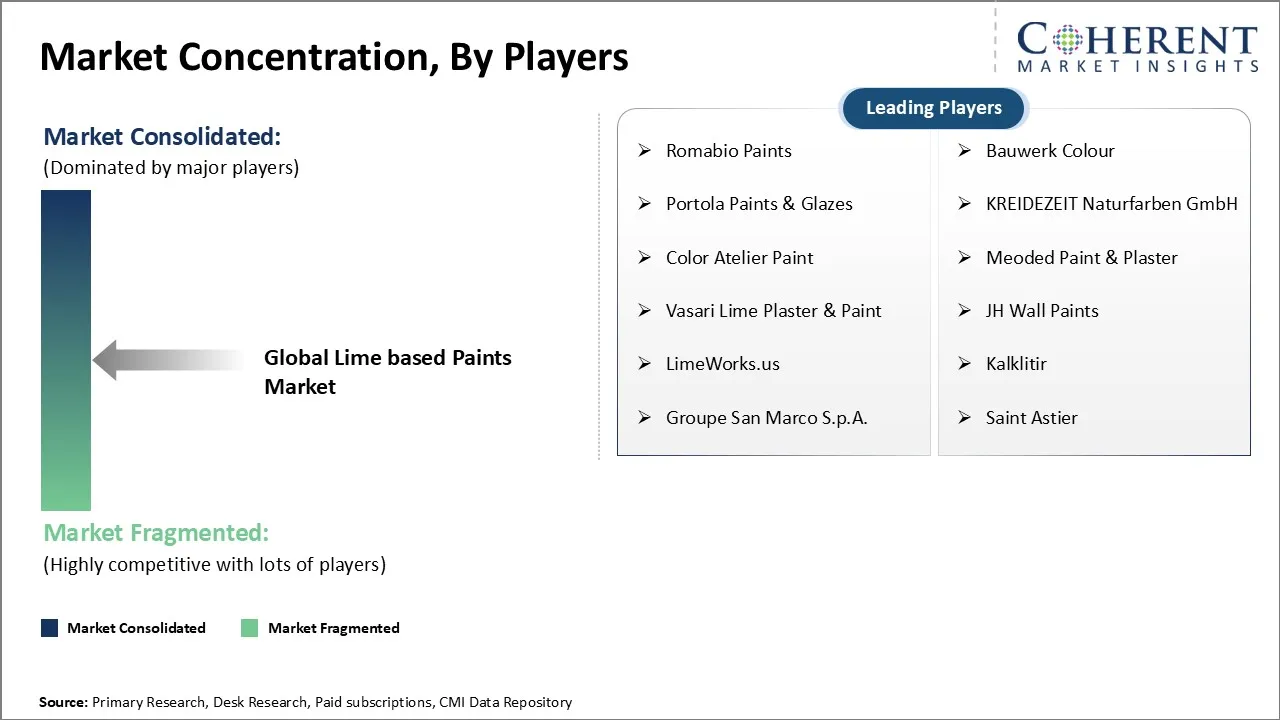
The global lime based paints market seems fragmented, made up of specialist limewash producers, regional mineral-coating makers, decorative-finish brands and diversified paint companies. Price is not the only factor but formulation consistency, authenticity of finish, installer access, substrate compatibility and reliable distribution are also the focus. Regional specialists still have the edge in local masonry know-how, while larger producers can apply manufacturing controls, retail coverage, compliance systems and technical-service networks.
Key competitive factors include
- Product Performance: Color consistency, adhesion to surface, moisture permeability.
- Efficient manufacturing Consistent lime quality Controlled processing Reduced batch variability
- Pricing Strategy: Differentiation via finish quality and total installed cost, not aggressive discounting.
- Reliability of supply: reliable sources of minerals, availability of pigments and regional stock management.
- Regulatory compliance: correct classification of chemicals, environmental documentation and product testing.
- Distribution capabilities: Contractors and specialist dealers, architectural specification channels.
- Technical differentiation Proprietary formulas Custom finishes Application specific product specs.
Market Report Scope
Lime based Paints Market Report Coverage | |||
Report Coverage | Details | ||
Base Year | 2025 | Market Size in 2026: | USD 415.8 Mn |
Historical Data For: | 2020 To 2024 | Forecast Period: | 2026 To 2033 |
Forecast Period 2026 To 2033 CAGR: | 5.9% | 2033 Value Projection: | USD 621.1 Mn |
Geographies covered: |
| ||
Segments covered: |
| ||
Companies covered: | Romabio Paints, Bauwerk Colour, Portola Paints & Glazes, KREIDEZEIT Naturfarben GmbH, Color Atelier Paint, Meoded Paint & Plaster, Vasari Lime Plaster & Paint, JH Wall Paints, LimeWorks.us, Kalklitir, Groupe San Marco S.p.A., Saint Astier | ||
Growth Drivers: |
| ||
Restraints & Challenges: |
| ||
Analyst Opinion (Expert Opinion)
- The lime based paints market is expected to shift toward integrated coating and maintenance solutions rather than individual product sales globally. Long-term relationships with customers and recurring revenue can be earned by manufacturers that can provide installation support, regular checks and repair services. This approach can help improve customer retention, reduce dependence on one-off purchases and develop competitive advantages for suppliers who can deliver consistent application quality.
- Prefabricated interior panels with mineral coatings applied in the factory could change traditional methods of paint application. By addressing curing, adhesion and transportation and surface repair challenges, manufacturers can improve installation efficiency and project delivery timelines. There could be opportunities in construction for companies investing in compatible prefabrication technologies. Traditional suppliers relying on manual application could be under greater competitive pressure.
- Producers need to concentrate on product durability, consistent raw material sourcing, substrate compatibility and efficient inventory management. Investment in performance testing, technical support and application specific product development could improve market position. Companies should also target customers who appreciate the functional benefits of lime-based coatings, while avoiding excessive product proliferation, unsubstantiated sustainability claims and aggressive pricing tactics that could erode profitability.
Speak to the analyst
Want personalized insights?
Take the findings above to one of our principal consultants, or have the report rebuilt around the segments, geographies and competitors you actually track.
Market Segmentation
- Product Type Insights (Revenue, USD Mn, 2021 - 2033)
- Traditional Limewash Paints
- Modified Lime Based Paints
- Product Form Insights (Revenue, USD Mn, 2021 - 2033)
- Ready to Use Liquid
- Dry Powder
- Application Insights (Revenue, USD Mn, 2021 - 2033)
- Exterior
- Interior
- End User Insights (Revenue, USD Mn, 2021 - 2033)
- Residential
- Commercial
- Institutional and Public Buildings
- Distribution Channel Insights (Revenue, USD Mn, 2021 - 2033)
- Specialty Paint Stores
- Home Improvement Retailers
- Direct Manufacturer Sales
- Online Marketplaces
- Regional Insights (Revenue, USD Mn, 2021 - 2033)
- North America
- U.S.
- Canada
- Latin America
- Brazil
- Argentina
- Mexico
- Rest of Latin America
- Europe
- Germany
- U.K.
- Spain
- France
- Italy
- Russia
- Rest of Europe
- Asia Pacific
- China
- India
- Japan
- Australia
- South Korea
- ASEAN
- Rest of Asia Pacific
- Middle East
- GCC Countries
- Israel
- Rest of Middle East
- Africa
- South Africa
- North Africa
- Central Africa
- North America
- Key Players Insights
- Romabio Paints
- Bauwerk Colour
- Portola Paints & Glazes
- KREIDEZEIT Naturfarben GmbH
- Color Atelier Paint
- Meoded Paint & Plaster
- Vasari Lime Plaster & Paint
- JH Wall Paints
- LimeWorks.us
- Kalklitir
- Groupe San Marco S.p.A.
- Saint Astier
Sources
Primary Research Interviews
- Limewash paint manufacturers, mineral coating producers, and specialty chemical suppliers
- Architects, heritage restoration specialists, painting contractors, distributors, and industry experts
Stakeholders
- Lime, limestone, mineral pigment, binder, and additive suppliers
- Decorative paint manufacturers, contractors, retailers, architects, and property developers
End-use Sectors
- Residential interior and exterior painting
- Commercial buildings, hospitality, and institutional facilities
- Heritage conservation, restoration, and renovation projects
Regulatory and Industry Bodies
- U.S. Environmental Protection Agency (EPA)
- European Commission and European Chemicals Agency (ECHA)
- International Organization for Standardization (ISO)
- ASTM International and Bureau of Indian Standards (BIS)
Databases
- Company annual reports and investor presentations
- UN Comtrade and Eurostat PRODCOM datasets
- National construction, renovation, and building permit databases
- Coating material pricing, production, trade, and patent databases
Magazines and Journals
- Progress in Organic Coatings
- Journal of Coatings Technology and Research
- Construction and Building Materials
- Journal of Cultural Heritage
- European Coatings Journal and Coatings World
Associations
- American Coatings Association (ACA)
- World Coatings Council (WCC)
- European Council of the Paint, Printing Ink and Artists' Colours Industry (CEPE)
- British Coatings Federation (BCF)
- Indian Paint Association (IPA)
Public Domain Sources
- Lime-based paint production, consumption, and trade information
- Green building initiatives and heritage restoration projects
- Low-VOC coating developments and mineral paint innovations
- Product launches, construction investments, and sustainability initiatives
Key Standards and Regulations
- Directive 2004/42/EC – VOC limits for certain decorative paints
- Regulation (EC) No. 1907/2006 – REACH chemical compliance
- Regulation (EC) No. 1272/2008 – CLP classification and labelling
- ISO 7783 – Water-vapour transmission properties of coatings
- ISO 11998 – Wet-scrub resistance and cleanability
- ASTM D1653 – Water-vapour transmission testing of organic coating films
Proprietary Elements
- CMI Data Analytics Tool and proprietary CMI research repository covering coatings and construction materials, including lime-based paint demand, product pricing, production trends, application technologies, heritage restoration, environmental regulations, and competitive intelligence.
Get access to 250+ pages report
Every segment, forecast, competitor profile and data table behind the analysis above — available for instant download.
- ESOMAR Member
- ISO 9001:2015 Certified
- D-U-N-S Registered
- GDPR & CCPA Compliant
Frequently Asked Questions
The CAGR of global lime based paints market is projected to be 5.9% from 2026 to 2033.
The global lime based paints market is estimated to be valued at USD 415.8 million in 2026 and is expected to reach USD 621.1 million by 2033.
Ready to use liquid is the leading product form due to its ease of application, consistent finish quality, and reduced preparation requirements.
Exterior applications dominate the market due to the suitability of lime-based paints for breathable masonry surfaces, façade renovation, and traditional building finishes.
Expanding green building projects, sustainable home renovation, and growing interest in natural decorative finishes create opportunities for lime-based paint manufacturers.
Competition from conventional acrylic paints, limited availability of skilled applicators, and performance limitations in high-moisture or high-wear environments pose challenges to market growth.
The growing demand for eco-friendly, low-VOC decorative paints and increasing restoration and renovation of heritage buildings are the major factors driving the global lime based paints market.