

Global Lithium-Titanate (LTO) Batteries Market Size and Forecast – 2026 To 2033
The global lithium-titanate (LTO) batteries market is expected to reach USD 8.68 Bn by 2033 from USD 2.51 Bn in 2026, growing at a CAGR of 19.4% during the forecast period 2026-2033. The market is expected to grow due to the increasing deployment of LTO batteries in electric transportation, industrial equipment, and energy storage systems due to operational benefits such as rapid charge, long cycle life, and thermal stability.
In June 2025, Australian battery manufacturer Zenaji released updated specs for its Eon A48-40 LTO battery in June 2025, listing a cycle life of 22,000 cycles, a 20-year warranty, and an operating temperature range of −40°C to +60°C. The move underscores LTO technology’s commercial viability for long-life energy storage solutions, notably in applications where long-term reliability and reduced battery replacement needs can sway purchasing decisions.
Key Takeaways of the Global Lithium-Titanate (LTO) Batteries Market
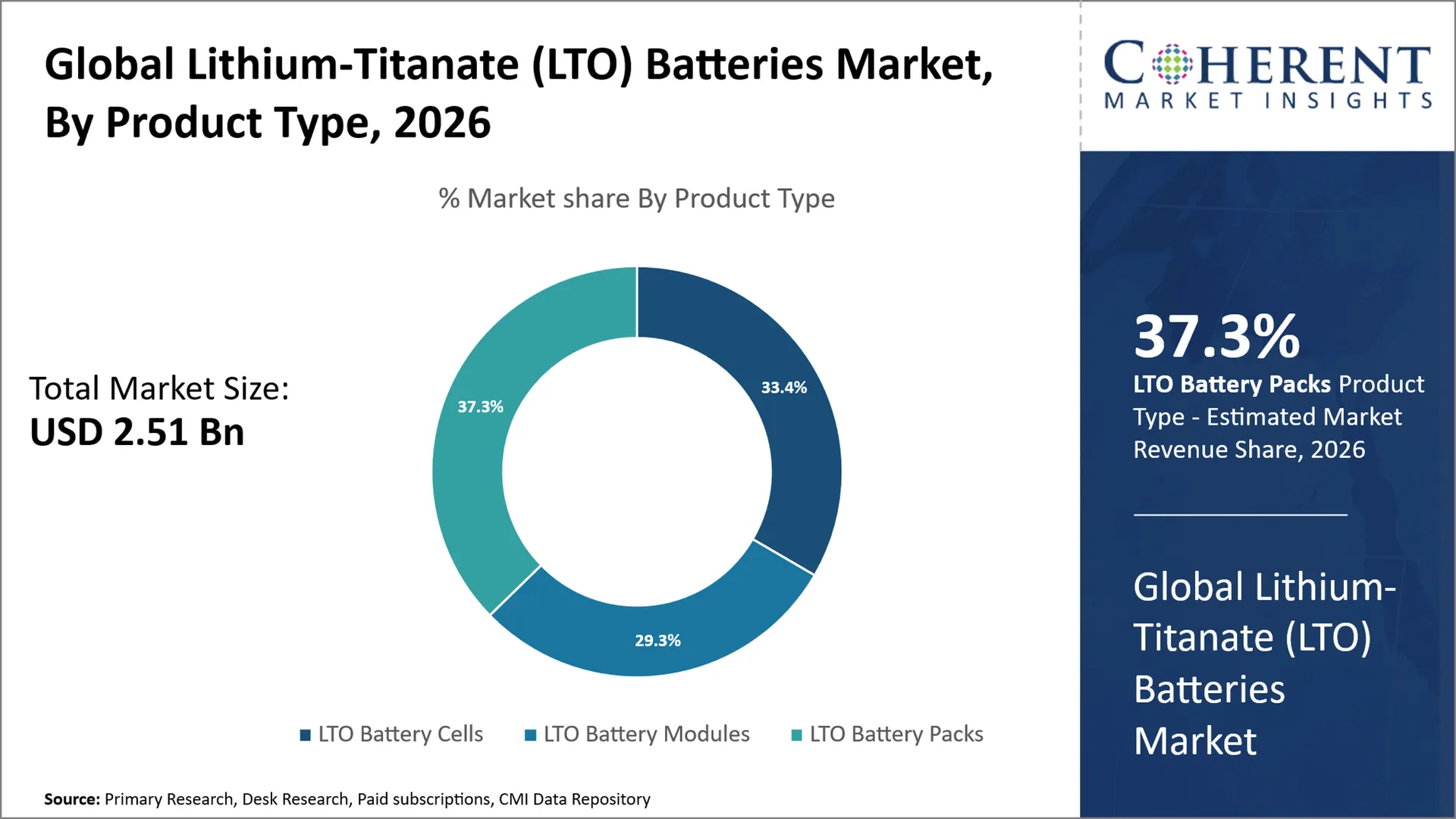
- LTO battery packs are projected to grow at a 20.0% CAGR during 2026–2033 and are forecast to account for a 37.3% global lithium-titanate (LTO) batteries market share in 2026. Integrated packs provide commercial value through system-level protection, charging controls and vehicle-specific engineering. In April 2025, Taiwan’s Master Bus adopted its own LTO battery packs into its electric bus supply chain, integrating them at the OEM level.
- Prismatic is projected to grow at an indicative CAGR of 19.9% during 2026-2033. Prismatic is projected to hold a global lithium-titanate (LTO) batteries market share of 42.8% in 2026. The rectangular housings provide structural control of the battery assemblies and efficient use of the installation space. In October 2024, researchers at RWTH Aachen published results showing a reduction in capacity loss with sustained mechanical compression in tested prismatic LTO cells, which could inform pack engineering focused on durability.
- Above 30–60 Ah are forecast to record an indicative 19.2% CAGR during 2026–2033, with an estimated 30.5% market share in 2026. This capacity band has a significant amount of energy per cell without the complications of having to integrate many smaller units. A commercialization tender was issued in January 2026 for 40 Ah lithium-titanate cells for electric vehicle applications by the TrEST Research Park in Kerala, demonstrating real manufacturing interest.
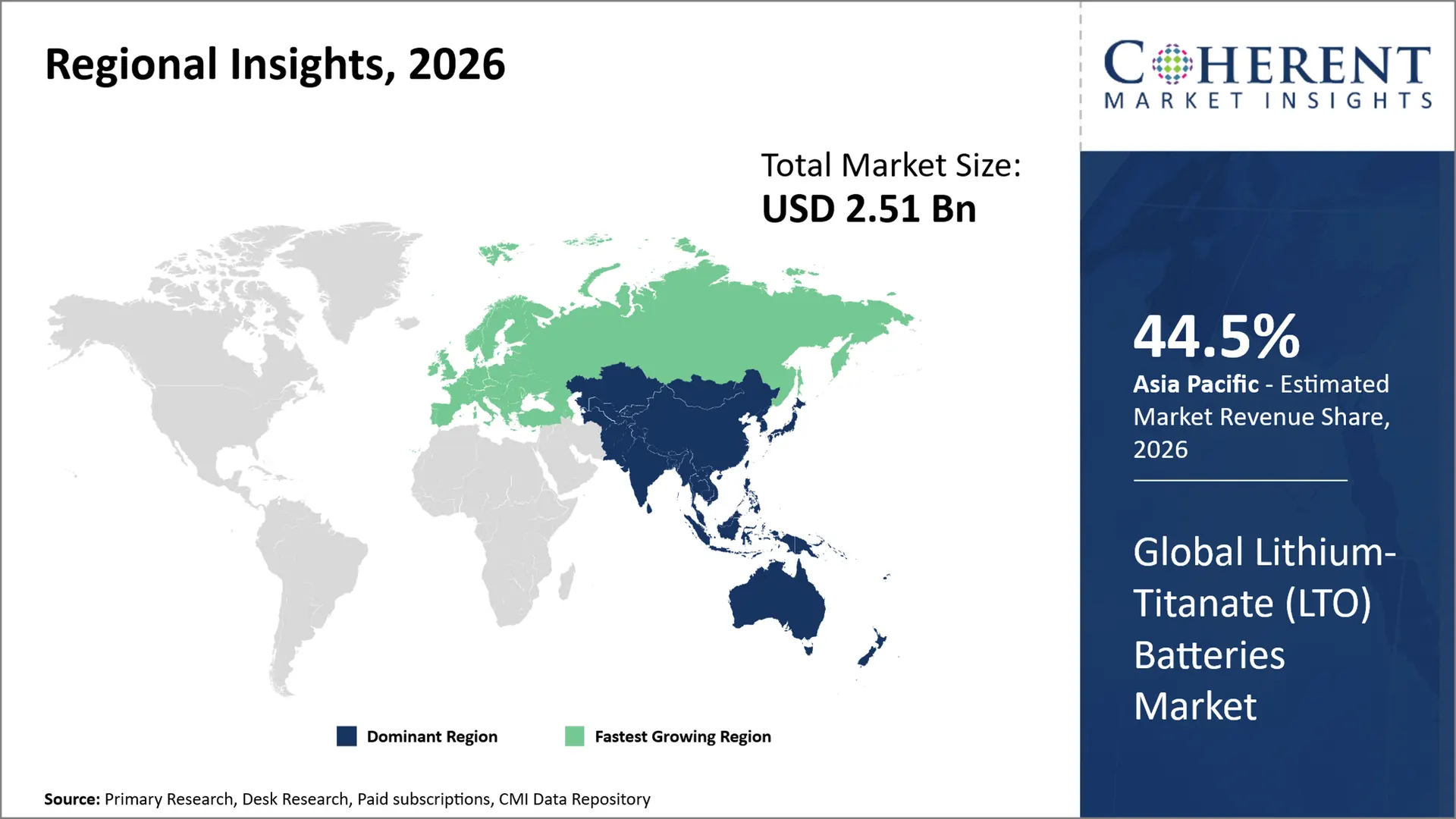
- Asia Pacific is anticipated to grow at a CAGR of 18.7% (indicative) during 2026–2033 and is projected to hold 44.5% share of the global lithium-titanate (LTO) batteries market revenue in 2026. Regional strength comes from specialized battery engineering, local OEM partnerships and existing industrial electrification channels. In April 2025, Japan’s Toshiba introduced a lithium-titanate SCiB module with enhanced heat dissipation for electric busses, ships and stationary systems.
- Europe is projected to record an indicative 22.5% CAGR over 2026-2033, following an expected 25.0% global lithium-titanate (LTO) batteries market share in 2026. The comparatively fast growth is a sign of commercial interest in batteries that can withstand repeated charging and heavy transport duty cycles. In November 2025, Sweden’s Echandia landed an LTO battery system deal for Denmark’s electric ferry Ellen that opens fleet replacement opportunities.
Segmental Insights
Why Are LTO Battery Packs Expected to Dominate the Global Lithium-Titanate (LTO) Batteries Market?
LTO Battery Packs is expected to hold 37.3% share of the global lithium-titanate (LTO) battery market in 2026. Instead of having to design a battery enclosure for itself, each equipment OEM can supply mechanically protected power units ready for installation to the machinery builder. Standardized modular configurations also make it easier to match voltage and peak-power requirements for excavators, lifting equipment and hybrid machines without redesigning each subsystem. Pack suppliers' qualification expertise and repeatable module assembly provides the potential for differentiated contracts and reduced engineering costs across equipment platforms. In December, 2025, Proventia Power LTO packs, a Finnish company, has updated the story to emphasize its modular customization, integrated cooling, stainless-steel construction and rugged off-road use. This demonstrates that ruggedized pack engineering can meet the procurement requirements of machinery.
- Current Industry Events of 2026
- Market Size Estimation
- Regional Breakdown
- Competitive Landscape
- Customer Intelligence
- Segmental Analysis
- Pricing Analysis
- Key Market Drivers, Challenges & Future Trends
- Customized Insights Section
Why Are Prismatic Cells Expected to Lead the Cell Format Segment of the Global Lithium-Titanate (LTO) Batteries Market?
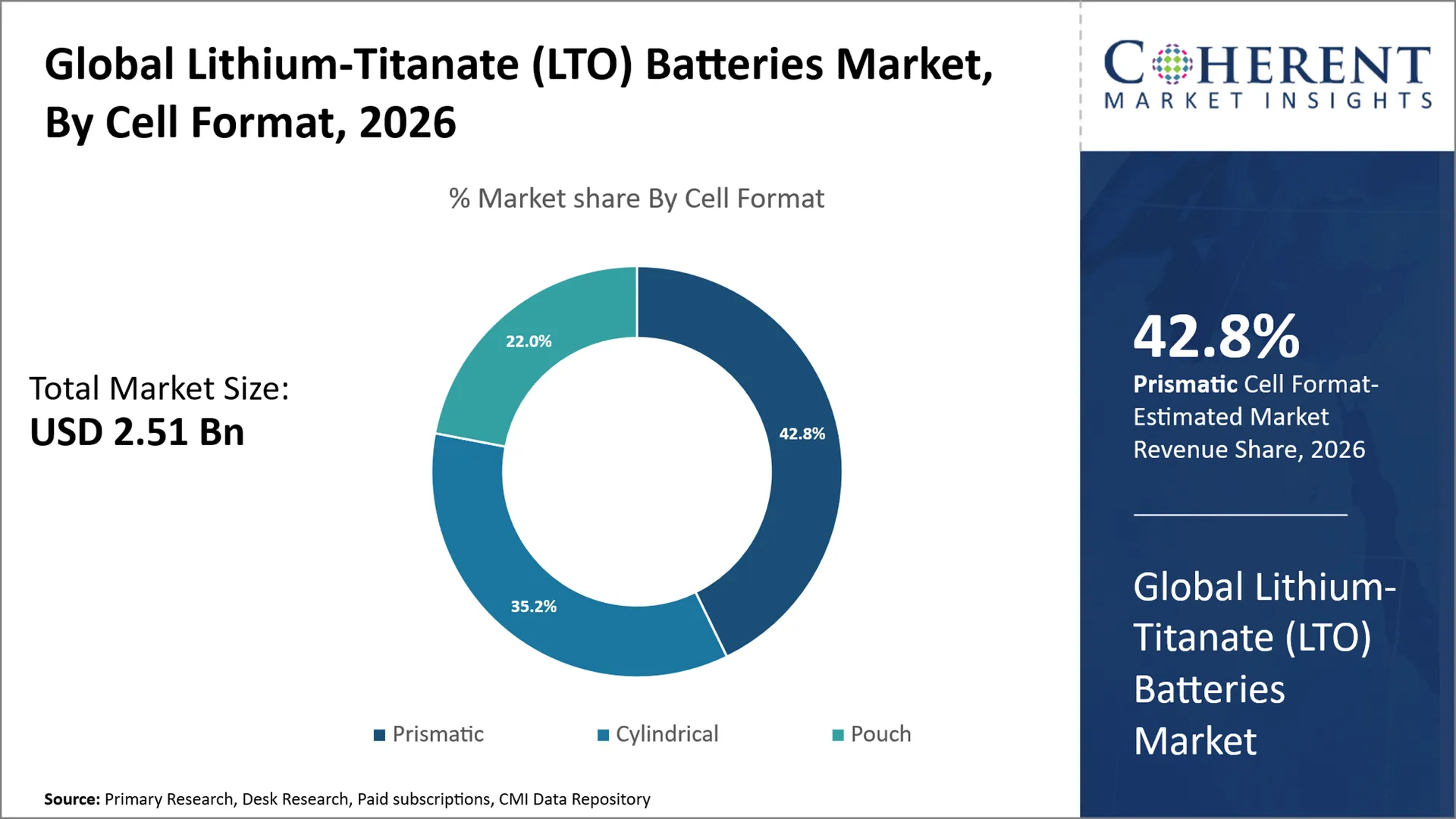
In cell format, Prismatic is expected to comprise 42.8% of the global lithium-titanate (LTO) battery market by 2026. Due to the ease with which they can be integrated into conventional low-voltage automotive battery packs and due to their production in industrial volumes, they are commercially attractive. Suppliers in established markets use flat-sided cells which permit automated inspection, controlled fixture positioning and electrical connections necessary for uniform specifications on high production runs. Confirmed cell production and local pack assembly may reduce uncertainty around assembly sourcing and qualification for vehicle manufacturers through streamlining supplier qualification and cross-border logistics. In February 2025, Clarios announced production of six million 10 Ah LTO prismatic power cells at its Michigan operation and a significant milestone in battery-system production at its German assembly plant. The announcement demonstrates a successful manufacturing pathway for prismatic LTO technology in automotive electrical systems.
Why Are Above 30–60 Ah Cells Expected to Dominate the Cell Capacity Segment of the Global Lithium-Titanate (LTO) Batteries Market?
Above 30–60 Ah are expected to hold a 30.5% share of the global lithium-titanate (LTO) batteries market by cell capacity in 2026. This capacity band is ideal for stationary storage projects requiring a manageable unit size for testing, cabinet layout and maintenance access. Procurement decisions would therefore need to be based on evidence for safe integration of individual cells into densely assembled storage equipment and nominal capacity. In May 2025, researchers from China Southern Power Grid and the University of Science and Technology of China and China Southern Power Grid researchers published a thermal-runaway hazard assessment for storage applications with 50 Ah LTO cells. Their findings highlight the need for engineering safeguards and safety characterization at the cell level, providing a better basis for technical qualification to suppliers.
Current Events and their Impact
Current Event | Description and Its Impact |
July 2025 – European Union Battery Due Diligence Amendment |
|
February 2025 – India's Battery Waste Management Amendment Rules |
|
Global Lithium-Titanate (LTO) Batteries Market Dynamics
Key Market Drivers
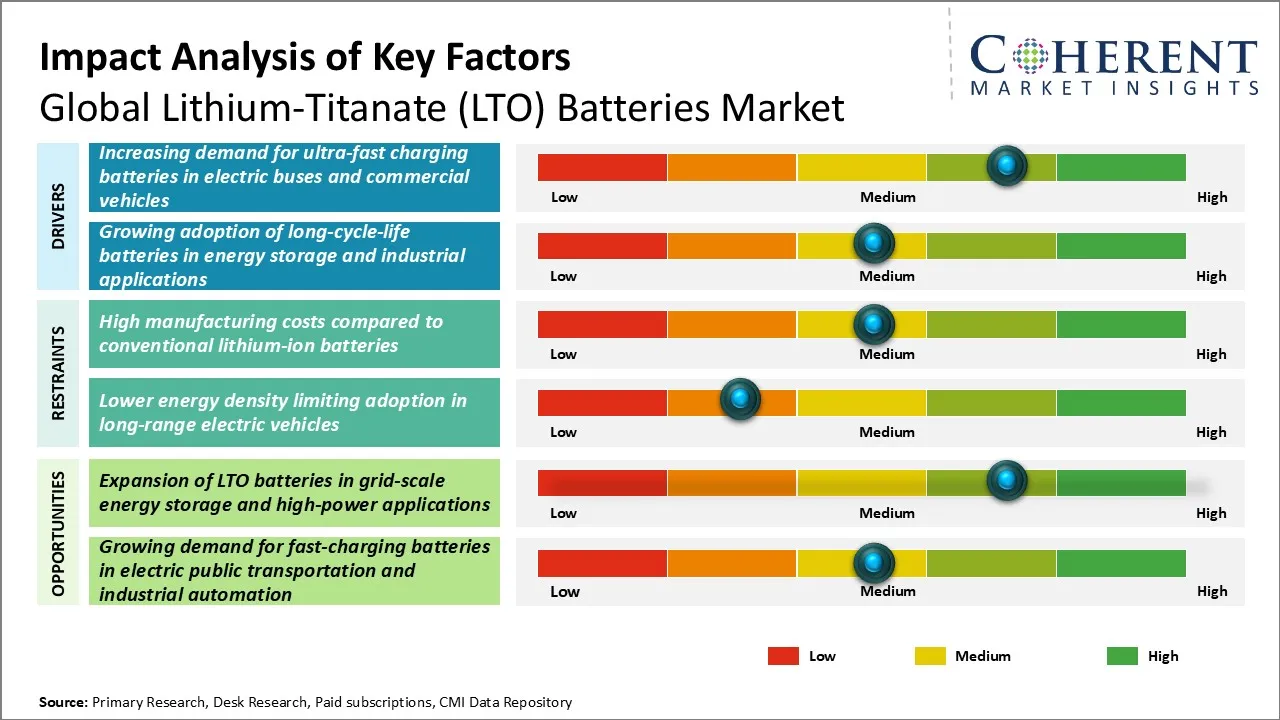
- Increasing demand for ultra-fast charging batteries in electric buses and commercial vehicles: Electric bus operators are increasingly requesting battery systems that enable short charging times without breaking a planned service. The LTO technology allows for high charging currents, but also limits degradation associated with repeated rapid charging. This improves vehicle availability, reduces charging-related downtime, and enables the deployment of highly intensive fleet operations. These are beneficial for battery manufacturers, commercial vehicle OEMs and charging infrastructure providers. The commercial viability of rapid-charging traction batteries was boosted by the launch of PULSE PLUS by Forsee Power in January 2025. PULSE PLUS is a high-power battery system based on LTO and specifically designed for demanding hybrid and fully electric heavy vehicles.
- Growing adoption of long-cycle-life batteries in energy storage and industrial applications: Industrial energy storage operators are increasingly considering batteries for their lifetime energy throughput, maintenance needs and how often they need to be replaced. LTO batteries can be used for short-term storage, buffering power for industrial applications, and frequency regulation due to the ability of the batteries to withstand many cycles of charge and discharge. These characteristics enable utilities and industrial operators to manage the lifecycle expenditures while providing assured performance. In May 2024, Yuanhe Energy supplied a lithium-titanate (LTO) energy storage system for a national research demonstration project in China’s Chuanshan Port Area, to prove its capability for high-frequency cycling applications and industrial energy management.
Emerging Market Trends
- Greater Emphasis on Battery Diagnostics and Performance Transparency: Battery purchase is moving from the manufacturer’s specifications alone to measurable operating performance. ‘Industrial customers are increasingly looking for transparency around remaining service life, thermal behavior, battery health and charging efficiency. This means suppliers have to build sophisticated monitoring systems, predictive diagnostics and performance reporting into their LTO battery solutions. Reliable battery data and integration support help manufacturers forge even stronger customer relationships. The forecast period is expected to see a substantial impact on equipment qualification, warranty negotiations and long-term maintenance agreements due to performance transparency.
- Increasing Integration of LTO Batteries into Hybrid Energy Storage Architectures: Hybrid architectures that integrate several storage technologies in a single installation are increasingly considered by energy storage system designers. LTO batteries can tolerate extreme power variations and complementary technologies guaranty a constant energy supply. This configuration offers an opportunity for operators to optimize battery sizing, system efficiency and capital allocation to meet their operational needs. The transition creates opportunities for energy management software vendors, battery integration specialists and power electronics manufacturers. Hybrid configurations may be more relevant in the forecast period, especially when customers need both an immediate response of power and a storage capability over a longer period of time.
Regional Insights
Why Does Asia Pacific Dominate the Global Lithium-Titanate (LTO) Batteries Market?
Asia Pacific is expected to account for 44.5% of the global lithium-titanate (LTO) batteries market in 2026, supported by its established battery manufacturing ecosystem and diverse industrial customer base. Japan has advanced battery engineering and component skills; China has specialized cell manufacturing skills. Regional opportunities have further expanded with the commercial electric mobility sector in India and battery technology developers in South Korea. This makes it possible for suppliers to serve domestic equipment manufacturers and export customers.
In April 2024, the Hubei Provincial Department of Economy and Information Technology reported that China's Hualin Titanium New Energy was fulfilling orders for composite titanium batteries using lithium titanate anodes. The ability of the region’s products to enter automotive supply chains demonstrated its capacity to convert specialized electrochemical manufacturing into a commercial battery supply.
Why Is Europe Emerging as the Fastest-Growing Region in the Global Lithium-Titanate (LTO) Batteries Market?
Europe is projected to constitute 25.0% of the global lithium-titanate (LTO) battery market by 2026, with growth prospects in railroad modernization and the electrification of specialty transport. The use of battery powered regional trains is especially relevant in cases when extension of overhead railroad lines requires significant capital investment. The LTO technology allows rolling stock manufacturers to develop the battery propulsion of vehicles that operate on partially electrified lines. That creates procurement opportunities outside the normal uses of electric vehicles.
In June 2026, Czech Republic-based Škoda Group unveiled its next-generation RegioPanter battery train featuring LTO batteries and silicon carbide traction converters. The organization also presented manufacturing units for Czech Railroads, along with international orders. This development demonstrates the integration of LTO technology in transport platforms of commercial interest by European rolling-stock manufacturers allowing the procurement of future batteries.
Global Lithium-Titanate (LTO) Batteries Market Outlook for Key Countries
Why Is the U.S. a Key Market for the Global Lithium-Titanate (LTO) Batteries Market?
The U.S. is a large market for lithium-titanate batteries because many users of specialty commercial transportation and industrial equipment often prefer power delivery to maximum energy capacity. For electric fleet duty cycles with challenging operating conditions and frequent acceleration that place heavy loads on the energy system, domestic battery engineering companies can tailor LTO cell designs. However, LTO’s lower energy density limits its advantage in the long-range passenger vehicle market, and results in selective purchasing decisions.
Texas-based Microvast showcased its lithium-titanate oxide cells at IAA Transportation in Germany in September 2024, emphasizing their high-power usage and the asserted ability to withstand up to 20,000 cycles. The announcement emphasizes the need for U.S. battery developers to supply specialized technologies to global commercial-vehicle manufacturers. Successful OEM qualification and competitive lifecycle economics and application level performance testing will be key to long term adoption.
Why Is China Important in the Global Lithium-Titanate (LTO) Batteries Market?
China’s position in the global lithium-titanate battery market extends beyond the assembly of vehicles, with the domestic sourcing of specialized anode materials and cell ingredients. Its integrated chemical, electrode making and battery equipment businesses can assist suppliers in reducing their product development cycle as they explore LTO chemistry. This is especially true of custom industrial batteries, where the manufacturers require local technical support and reliable supply lines.
This direction is shown in one policy signal. The Longnan municipal government issued its lithium battery industry development plan in January 2025, which prioritizes high-safety lithium titanate as an anode material until 2026. The plan promotes future development of the supply chain. However, it does not demonstrate that the LTO facilities that are planned are currently in operation. The commercial challenge for manufacturers is to turn the ambition of material development into stable customer orders and qualified production capacity.
Why Is Japan a Strategic Country in the Global Lithium-Titanate (LTO) Batteries Market?
India’s last-mile freight vehicles represent a concentrated opportunity for lithium-titanate batteries, where the quick turnaround between delivery runs might be more valuable than the maximum driving range. Small commercial operators require batteries capable of repeated charging during work hours and extreme ambient temperatures. However, the additional cost of LTO systems must be justified by improvements in fleet utilization, not laboratory specifications alone.
Log9 Materials’ LTO rapid-charging technology for light commercial vehicles had its field validation featured in the Bureau of Energy Efficiency’s low-carbon technology compendium. The Central Power Research Institute conducted testing that showed good retention of capacity under intensive cycling, and hence provided application-specific evidence for procurement evaluation. Assuming the cost of infrastructure availability and ownership is competitive, this enables battery suppliers, vehicle retrofitter and charging partners to create route specific packages for route based operations.
Why Is South Korea an Important Growth Market for the Global Lithium-Titanate (LTO) Batteries Market?
South Korea’s place in the global lithium-titanate (LTO) battery market depends on specialized power-storage engineering, not on the assumption that all domestic battery capacity is LTO chemistry. The country’s ecosystem for electrical equipment provides opportunities to develop compact, high-output systems for emergency charging, automation and infrastructure applications. These projects can help smaller chemistry players differentiate themselves from the mainstream cell makers that are competing on energy density and cost.
South Korean battery developer Grinergy said in January 2026 it has developed an LTO-based rapid-charging system as part of a Korea Electric Power Corporation project. The company announced that the system received a positive evaluation and it delivered 5 kWh in ten minutes at a 5C output rate. The result demonstrates technical feasibility, but broad acceptance will depend on repeatable economics, validation at commercial scale and product certification.
LTO Technology Deployment and Infrastructure Landscape
Technology | Adoption Status | Key Applications | Commercial Impact |
Advanced Lithium Titanate Anode Engineering | Commercial, with ongoing material optimization | High-power battery cells, industrial equipment, specialized energy storage | Improvements in particle structure and electrode conductivity can support charging performance, manufacturing consistency, and cell durability. |
High-Power Thermal Management Systems | Commercial adoption in demanding battery systems | Heavy commercial vehicles, rail traction, industrial battery packs | Liquid cooling, thermal sensors, and heat-dissipation structures help maintain cell temperatures during intensive operation and reduce performance limitations. |
Intelligent Battery Management Systems (BMS) | Established technology with evolving diagnostic capabilities | Automotive battery packs, industrial machinery, stationary systems | Cell balancing, temperature monitoring, fault detection, and state-of-health estimation support safe operation and more informed maintenance decisions. |
Bidirectional Power Conversion Systems | Commercial deployment with application-specific engineering | Microgrids, renewable integration, power quality management | Bidirectional converters enable controlled charging and discharging, improving integration with power networks and supporting short-duration power services. |
Hybrid LTO–LFP Battery Architectures | Emerging and application-specific adoption | Industrial storage, critical power systems, power buffering | Combining LTO with energy-oriented battery chemistries allows designers to allocate high-power events and sustained discharge requirements to suitable storage components. |
High-Rate Modular Battery Architectures | Commercial adoption in specialized transport and industrial systems | Electric traction, automated industrial equipment, modular storage | Configurable cell and module arrangements simplify voltage matching, electrical integration, installation, and system scalability across different equipment platforms. |
How Are Extreme-Climate Critical-Power Retrofits Creating New Growth Opportunities in the Global Lithium-Titanate (LTO) Batteries Market?
Cold, remote or temperature-variable locations are an underserved entry point for LTO battery suppliers in critical-power infrastructure. Replacement batteries used in telecommunications shelters, pipeline monitoring sites, isolated substations and emergency control systems often require heating, frequent inspection or complex maintenance logistics.
LTO technology may be useful where resilience and temperature tolerance are more important than compactness or lowest initial price. Suppliers can seize this opportunity by designing certified, retrofit-ready battery cabinets with compatible voltage interfaces, documented operating limits, and remote fault reporting.
Installation partners will include local electrical contractors and infrastructure maintenance companies, and owners can evaluate purchases based on avoided service calls and equipment downtime.
To enter the market, application-specific testing, cold-start validation, transport compliance and guarantyd replacement-part availability would be needed. Specialist manufacturers with flexible engineering capabilities may have an edge over volume-focused suppliers, especially when contracts combine hardware, commissioning and long-term service responsibilities rather than standard cataloged battery modules alone.
Market Players, Key Development, and Competitive Landscape
Key Developments
- In May 2026, Titanvolt announced a strategic partnership with Argyll Energy Developments for an LTO-based battery system for a planned megawatt-scale artificial intelligence data center pilot in the U.K. This initiative implies opportunities for LTO technology in high-reliability computing infrastructure, pending successful pilot validation.
- In September 2024, Saft announced the supply of LTO traction batteries for Siemens Mobility's Mireo Plus H hydrogen trains in Germany. The batteries support acceleration, regenerative braking, and power management, demonstrating the commercial relevance of LTO technology in hybrid rail propulsion systems.
- In October 2024, Nichicon Corporation launched the second generation SLBEVAPAS01 evaluation board for small lithium-titanate rechargeable batteries. The technology allows developers to test together energy-harvesting circuits with LTO cells, which will help to make it easier to design products for small connected devices and to increase the use of special rechargeable battery solutions.
Competitive Landscape
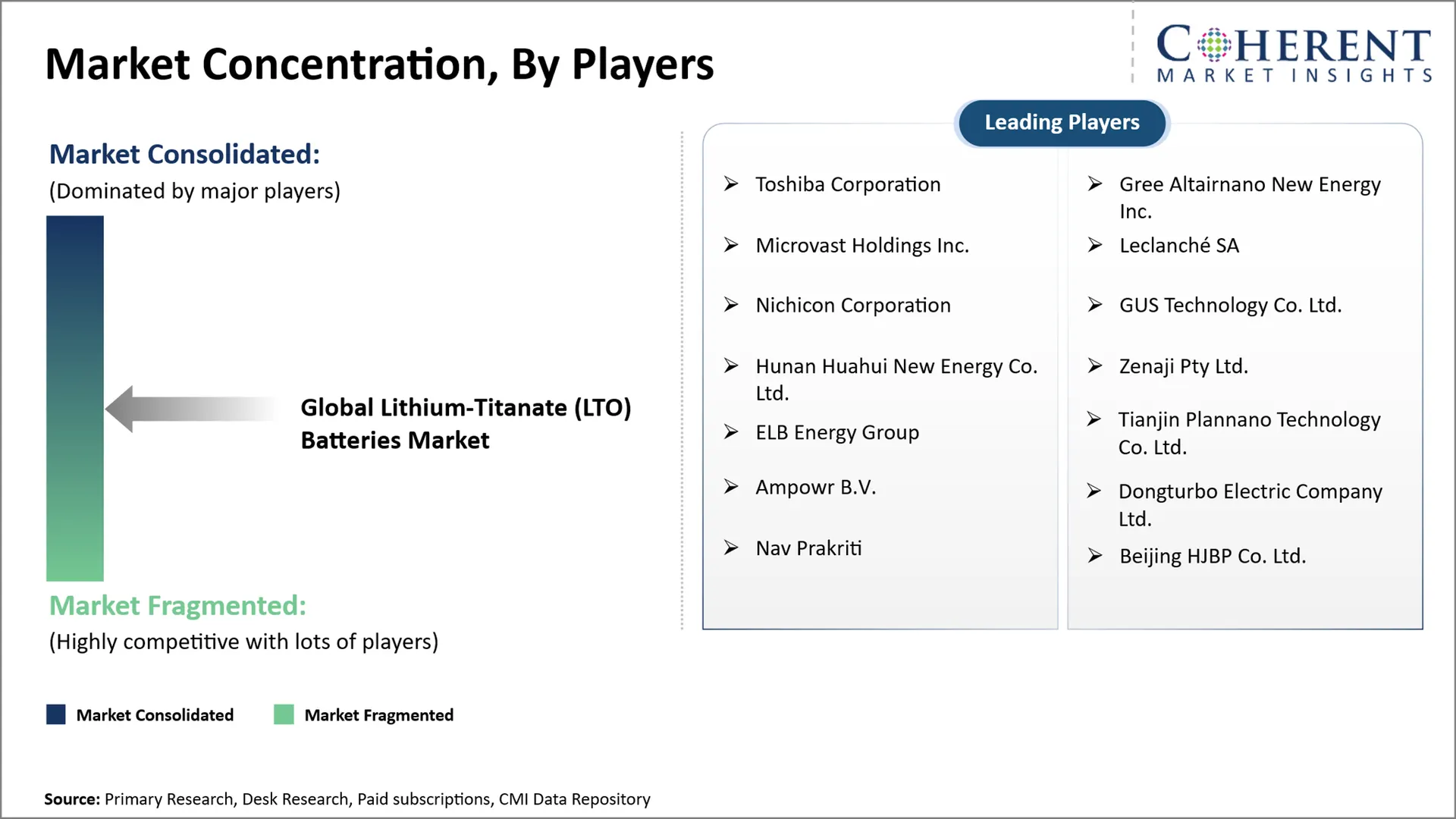
The global lithium-titanate (LTO) batteries market is rather consolidated among well established cell technology providers, but battery pack assembly and system integration has a wider range of specialist competitors. Manufacturers compete on electrochemical performance, reliability of their products, their engineering capabilities and the continuity of supply. Regional suppliers are an aid with bespoke battery builds, technical advice and local customer support. To win industrial deals, it is vital to have specialized knowledge for specific applications.
Key competitive factors include
- Product Performance Differentiation: Manufacturers want to differentiate on cell consistency, power delivery, operational stability and suitability for challenging electrical environments.
- Manufacturing Process Efficiency: Improvements in electrode coating, cell assembly and quality inspection processes can reduce manufacturing defects, and improve economics of production.
- Pricing and Lifecycle Economics: Suppliers need to balance premium battery positioning against competing chemistries while demonstrating commercially measurable operating benefits.
- Manufacturing Capacity and Supply Reliability: Availability of reliable, qualified raw materials, components, and production capacity enables meeting long-term customer commitments.
- Certification & Quality Assurance: Demonstrated compliance with relevant transport, electrical and application-specific safety standards underpin industrial procurement and facilitates international market access.
- Product Customization and Integration: Suppliers can meet specialized equipment specifications by offering tailored voltage configurations, enclosure designs, communication interfaces, and installation requirements.
- After-Sales Support and Regional Partnerships: Customer service and supplier retention are enhanced by the availability of technical assistance and replacement parts, and by relationships with regional engineering contractors.
Market Report Scope
Lithium-Titanate (LTO) Batteries Market Report Coverage | |||
Report Coverage | Details | ||
Base Year | 2025 | Market Size in 2026: | USD 2.51 Bn |
Historical Data For: | 2020 To 2024 | Forecast Period: | 2026 To 2033 |
Forecast Period 2026 To 2033 CAGR: | 19.4% | 2033 Value Projection: | USD 8.68 Bn |
Geographies covered: |
| ||
Segments covered: |
| ||
Companies covered: | Toshiba Corporation, Gree Altairnano New Energy Inc., Microvast Holdings Inc., Leclanché SA, Nichicon Corporation, GUS Technology Co. Ltd., Hunan Huahui New Energy Co. Ltd., Zenaji Pty Ltd., ELB Energy Group, Tianjin Plannano Technology Co. Ltd., Ampowr B.V., Dongturbo Electric Company Ltd., Nav Prakriti, Beijing HJBP Co. Ltd. | ||
Growth Drivers: |
| ||
Restraints & Challenges: |
| ||
Analyst Opinion (Expert Opinion)
- The global lithium-titanate (LTO) battery market’s competitive landscape is projected to move toward performance-based commercial contracts. Infrastructure owners may prefer battery suppliers that offer financially credible service guaranties, operational accountability and replacement commitments. The change may be more of a benefit to manufacturers with greater financial resources and service capabilities than those who depend upon sales of individual components.
- A chemistry-agnostic battery interface could alter the competitive dynamics by allowing equipment manufacturers to adopt different battery technologies without the need for extensive equipment redesigns. Standardized electrical connections and interoperable control systems could undermine proprietary battery integration models. Conversely, suppliers reliant on closed architectures could be subject to more pricing pressure and customer substitution risk, while manufacturers that develop compatible and independently qualified systems might be able to expand their market access.
- Before making significant capacity expansions, market participants should focus on qualified material sourcing, rigorous thermal and electrical testing and reliable component supply. "Investments should be made in applications with reasonable qualification requirements and demonstrable advantages in operating cost. Alliances with local engineering firms can help with market entry, and disciplined pricing and warranty terms can protect margins from competing battery chemistries.
Speak to the analyst
Want personalized insights?
Take the findings above to one of our principal consultants, or have the report rebuilt around the segments, geographies and competitors you actually track.
Market Segmentation
- Product Type Insights (Revenue, USD Bn, 2021 - 2033)
- LTO Battery Cells
- LTO Battery Modules
- LTO Battery Packs
- Cell Format Insights (Revenue, USD Bn, 2021 - 2033)
- Prismatic
- Cylindrical
- Pouch
- Cell Capacity Insights (Revenue, USD Bn, 2021 - 2033)
- Below 10 Ah
- 10–30 Ah
- Above 30–60 Ah
- Above 60 Ah
- Application Insights (Revenue, USD Bn, 2021 - 2033)
- Automotive (EVs and Electric Buses)
- Energy Storage Systems
- Industrial Equipment
- Rail and Marine Transportation
- Other Applications
- Sales Channel Insights (Revenue, USD Bn, 2021 - 2033)
- Direct OEM and Manufacturer Sales
- Distributors and Battery Suppliers
- Regional Insights (Revenue, USD Bn, 2021 - 2033)
- North America
- U.S.
- Canada
- Latin America
- Brazil
- Argentina
- Mexico
- Rest of Latin America
- Europe
- Germany
- U.K.
- Spain
- France
- Italy
- Russia
- Rest of Europe
- Asia Pacific
- China
- India
- Japan
- Australia
- South Korea
- ASEAN
- Rest of Asia Pacific
- Middle East
- GCC Countries
- Israel
- Rest of Middle East
- Africa
- South Africa
- North Africa
- Central Africa
- North America
- Key Players Insights
- Toshiba Corporation
- Gree Altairnano New Energy Inc.
- Microvast Holdings Inc.
- Leclanché SA
- Nichicon Corporation
- GUS Technology Co. Ltd.
- Hunan Huahui New Energy Co. Ltd.
- Zenaji Pty Ltd.
- ELB Energy Group
- Tianjin Plannano Technology Co. Ltd.
- Ampowr B.V.
- Dongturbo Electric Company Ltd.
- Nav Prakriti
- Beijing HJBP Co. Ltd.
Sources
Primary Research Interviews
- LTO battery cell, module, and pack manufacturers
- Battery technology developers, OEMs, and system integrators
- Electric vehicle manufacturers, energy storage providers, and industry experts
Stakeholders
- LTO battery manufacturers and raw material suppliers
- Anode, electrolyte, separator, and battery component manufacturers
- Automotive OEMs, energy storage developers, and industrial equipment manufacturers
- Battery distributors, system integrators, and end users
End-use Sectors
- Electric vehicles and electric buses
- Energy storage systems and grid applications
- Industrial equipment and material handling
- Rail and marine transportation
Regulatory and Industry Bodies
- International Electrotechnical Commission (IEC)
- United Nations Economic Commission for Europe (UNECE)
- European Commission
- U.S. Department of Energy (DOE)
- Bureau of Indian Standards (BIS)
- UL Standards & Engagement
Databases
- Company annual reports and investor presentations
- UN Comtrade and international battery trade databases
- Eurostat and national battery manufacturing statistics
- Battery production, pricing, capacity, and technology databases
- WIPO and EPO battery patent databases
Magazines and Journals
- Journal of Power Sources
- Journal of Energy Storage
- Energy Storage Materials
- Batteries
- Electrochimica Acta
- Battery Technology
Associations
- Global Battery Alliance (GBA)
- Battery European Partnership Association (BEPA)
- India Energy Storage Alliance (IESA)
- Battery Association of Japan (BAJ)
- China Industrial Association of Power Sources (CIAPS)
Public Domain Sources
- LTO battery production, consumption, and international trade data
- Electric mobility and stationary energy storage deployment statistics
- Battery charging performance, cycle life, and safety studies
- LTO cell chemistry, manufacturing, and recycling developments
- Product launches, manufacturing investments, and regulatory updates
Key Standards and Regulations
- Regulation (EU) 2023/1542 – Batteries and waste batteries
- UN 38.3 – Lithium battery transportation testing
- IEC 62619 – Industrial lithium battery safety
- IEC 62660-1 – Electric vehicle battery cell performance testing
- UL 2580 – Electric vehicle battery safety
- UL 1973 – Stationary and motive auxiliary power battery safety
Proprietary Elements
- CMI Data Analytics Tool and proprietary CMI research repository covering battery technology, LTO market demand, manufacturing capacity, material pricing, supply chains, end-use applications, regulatory developments, and competitive intelligence.
Get access to 250+ pages report
Every segment, forecast, competitor profile and data table behind the analysis above — available for instant download.
- ESOMAR Member
- ISO 9001:2015 Certified
- D-U-N-S Registered
- GDPR & CCPA Compliant
Frequently Asked Questions
The CAGR of global lithium-titanate (LTO) batteries market is projected to be 19.4% from 2026 to 2033.
The global lithium-titanate (LTO) batteries market is estimated to be valued at USD 2.51 billion in 2026 and is expected to reach USD 8.68 billion by 2033.
LTO batteries use lithium titanate anodes, offering faster charging, longer cycle life, and improved thermal stability, but generally lower energy density.
Battery pricing depends on raw material costs, manufacturing processes, battery specifications, production scale, and system integration requirements.
The growing demand for ultra-fast charging batteries in electric buses and commercial vehicles is a key market driver. Increasing adoption of long-cycle-life batteries in energy storage systems and industrial applications also supports the growth of the global lithium-titanate (LTO) batteries market.
High manufacturing costs compared to conventional lithium-ion batteries and Lower energy density limiting adoption in long-range electric vehicles are the major factors hampering the growth of global lithium-titanate (LTO) batteries market.
In terms of product type, LTO battery packs are estimated to dominate the market revenue share in 2026.