

Global Low Earth Orbit Satellite Market Size and Forecast – 2026 To 2033
The global low earth orbit satellite market is expected to grow from USD 15.00 Bn in 2026 to USD 41.30 Bn by 2033, registering a compound annual growth rate (CAGR) of 13% from 2026 to 2033. The global low earth orbit satellite market is driven by rising demand for internet access in remote and underserved regions. On August 11, 2025, Eutelsat and Nelco Limited signed an agreement to deliver OneWeb low Earth orbit (LEO) satellite connectivity services across India. Under the agreement, OneWeb India Communications, Eutelsat’s local operating entity, will partner with Nelco to deliver secure, low-latency LEO connectivity for customers on land, at sea, and in the air.
Key Takeaways of the Global Low Earth Orbit Satellite Market
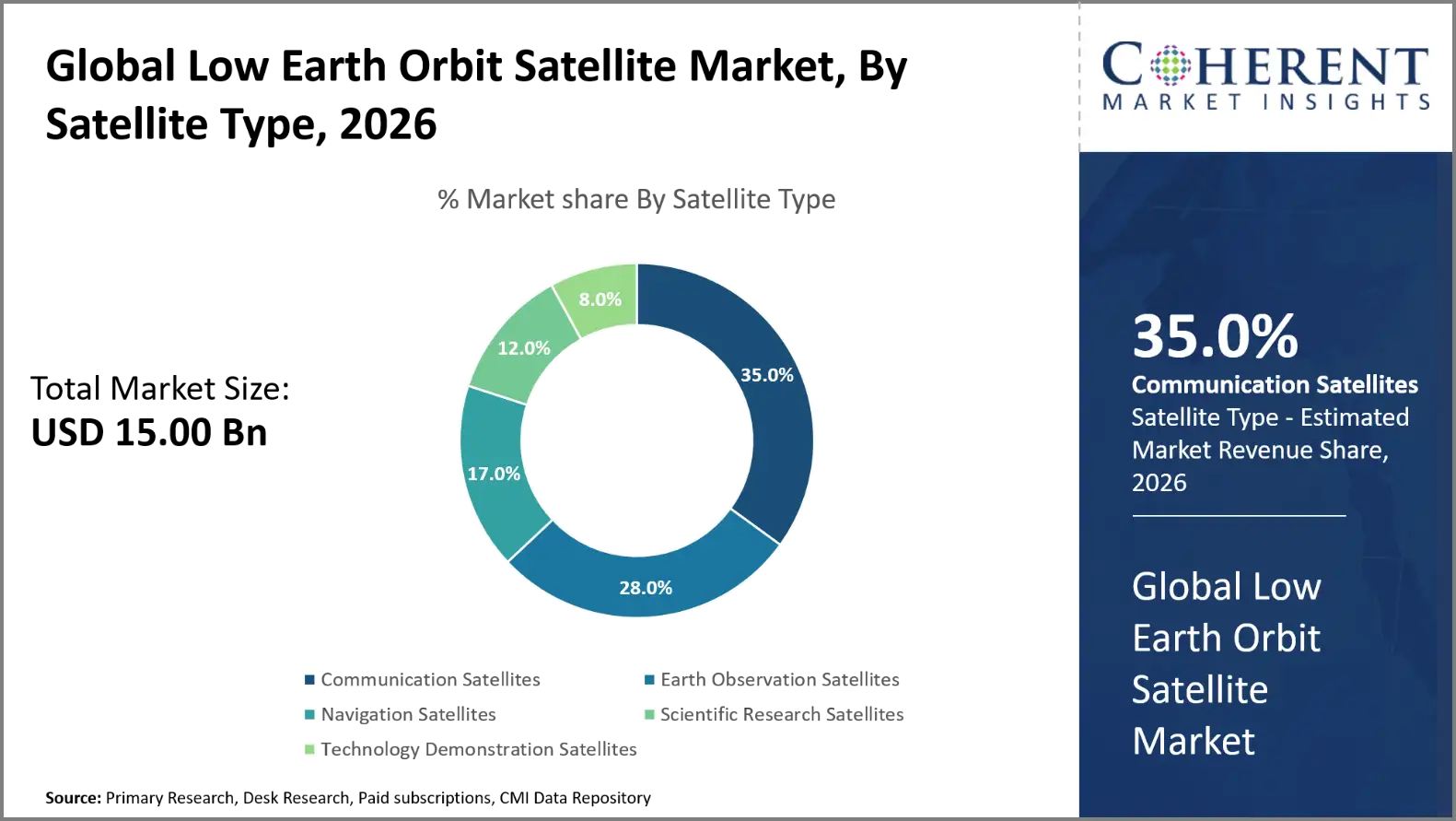
- The Communication Satellites segment is expected to account for 35.0% of the global low earth orbit satellite market share in 2026. Expanding government investment in space-based defense and surveillance is driving the growth of the segment. On December 19, 2025, the U.S. Space Development Agency awarded contracts for 72 Tracking Layer satellites. The approximately USD 3.5 billion awards went to teams led by Lockheed Martin, Rocket Lab, Northrop Grumman, and L3Harris Technologies.
- The Small Satellites segment is estimated to capture 41.0% of the market share in 2026. Increasing use of satellites for Earth observation and environmental monitoring is majorly driving the growth of the segment. On January 14, 2025, ICEYE launched four synthetic aperture radar satellites, aboard SpaceX's Transporter-12 mission.
- The Chemical Propulsion segment is estimated to capture 52.0% of the market share in 2026. Growing demand for direct-to-device satellite communication is driving the growth of the segment. On October 29, 2025, AST SpaceMobile and Saudi telecommunications company stc Group announced a ten-year commercial agreement. The agreement supports direct-to-device satellite connectivity across Saudi Arabia and selected Middle Eastern and African markets.
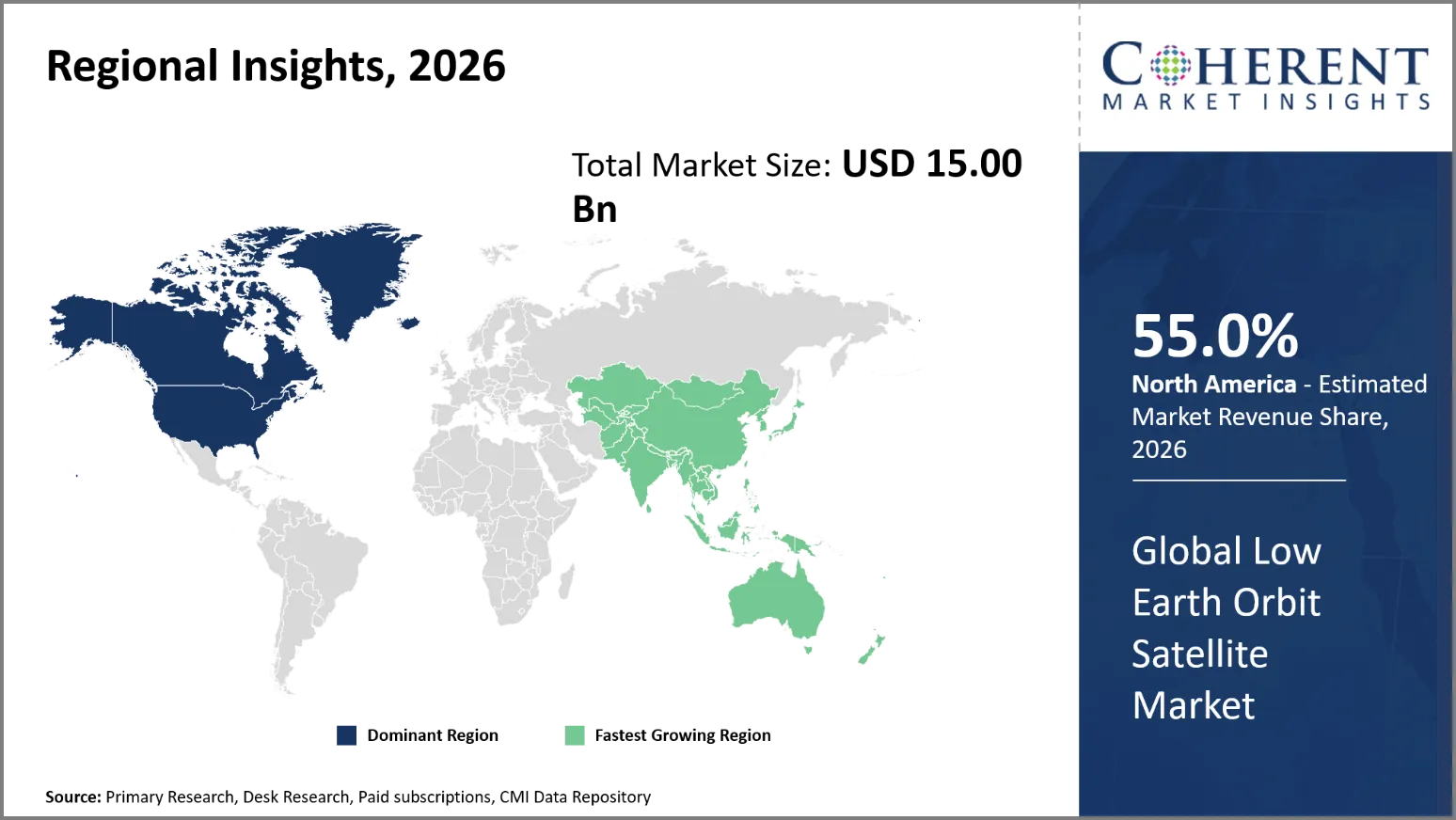
- North America is expected to dominate the low earth orbit satellite market in 2026 with a market share of 55.0%. Rising adoption of satellite Internet of Things connectivity in North America is driving the growth of the regional market. On February 24, 2026, Rogers Communications announced a satellite-powered asset tracking service with Geotab. Its GO Anywhere Plus solution combines Rogers' terrestrial network with satellite-to-mobile connectivity for tracking trailers, containers, equipment, and vehicles.
- Asia Pacific is expected to account for 24.0% share in 2026. Increasing demand for real-time disaster monitoring and emergency communication in Asia Pacific is driving the growth of the regional market. On June 10, 2026, Globe Telecom activated Starlink satellite-to-mobile connectivity in Mindanao, Philippines, following a magnitude 7.8 earthquake. The program included emergency message and catastrophe response for South Cotabato, Sultan Kudarat and Sarangani.
Segmental Insights
Why Does Communication Satellites Dominate the Global Low Earth Orbit Satellite Market?
The communication satellites segment is expected to account for 35.0% of the global low earth orbit satellite market share in 2026. Communication satellites are dominant because they provide the backbone of broadband connection, mobile communications and low latency data transfer. They are closer to the Earth than satellites in higher orbits, which cuts the travel time for signals. Telecom carriers utilize them to provide internet access to remote towns, oceans, aircraft and underserved locations. Constellation expansion driven by increasing need for reliable connection, enterprise networking and emergency communications. Satellite operators also use constellations of interconnected spacecraft to increase coverage and network resilience. These capabilities reinforce the position of communication satellites as a main section of application.
On March 2, 2026, Vodafone and Amazon Leo, Amazon’s low Earth orbit satellite broadband network, signed an agreement to connect many more 4G and 5G mobile sites in remote areas to improve coverage for customers with limited connectivity across Europe and Africa.
- Current Industry Events of 2026
- Market Size Estimation
- Regional Breakdown
- Competitive Landscape
- Customer Intelligence
- Segmental Analysis
- Pricing Analysis
- Key Market Drivers, Challenges & Future Trends
- Customized Insights Section
Why is Small Satellites the Most Preferred Satellite Mass?
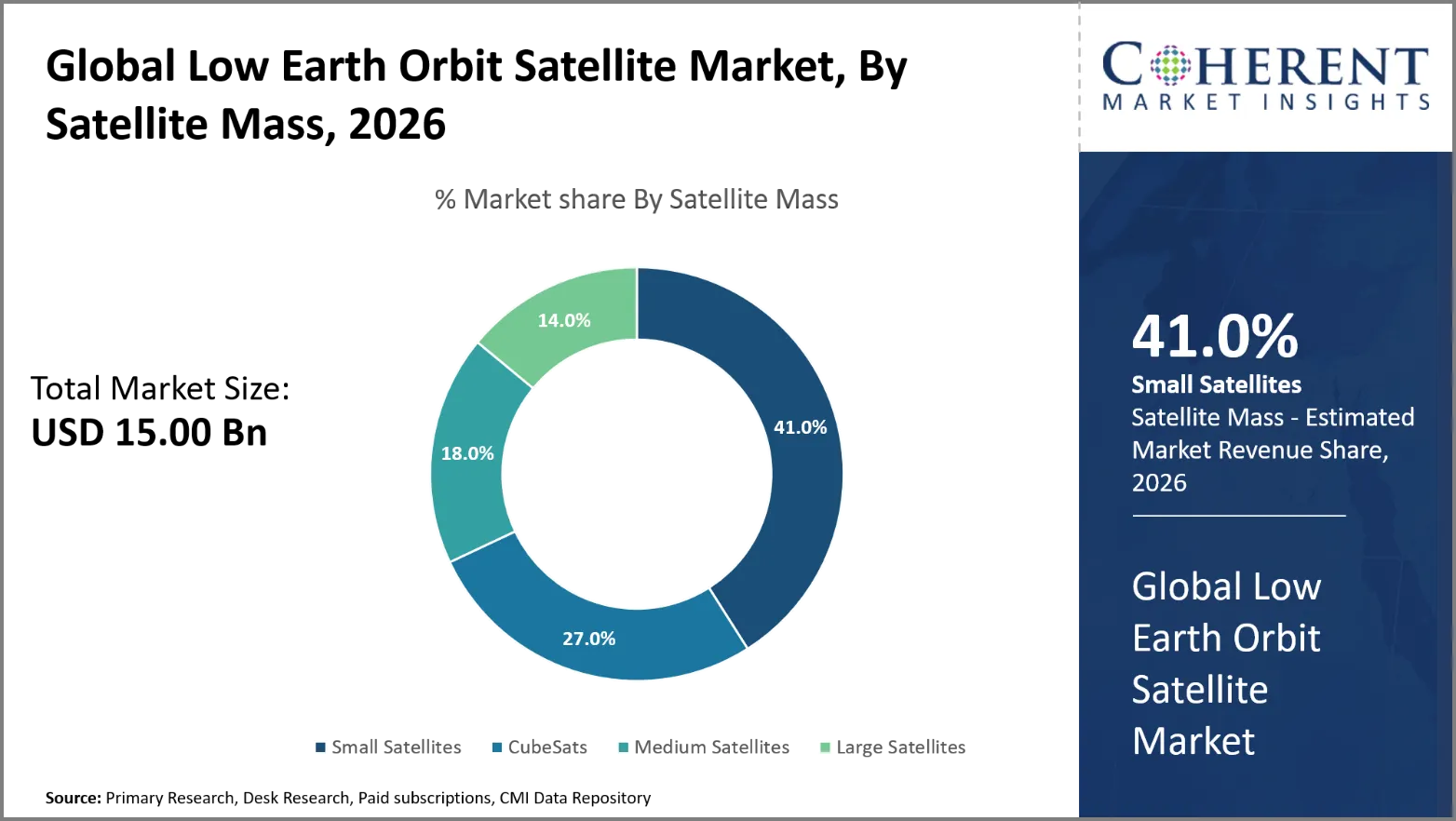
The small satellites segment is expected to account for 41.0% of the global low earth orbit satellite market share in 2026. Small satellites are becoming popular because of their lower manufacturing costs, launch costs and deployment timelines. They are small enough to allow several to share the available launch space, thereby making deployment more efficient. Standardized satellite platforms also enable speedier production and more frequent technical upgrades. Operators can also add to their constellations over time, retiring old spacecraft without the need to re-engineer complete systems. Small satellites are used for communications, earth observation, scientific research and IoT connectivity. Their scalability attracts commercial firms, government entities and research institutions.
On February 27, 2025, Rocket Lab USA, Inc. announced the launch of Flatellite, a high-volume, customizable satellite optimized for big constellations, high value applications, and national security missions. Flatellite is the culmination of a very deliberate and strategic approach, through both acquisitions and organic product development, to become a uniquely vertically integrated satellite manufacturer.
Chemical Propulsion Dominates the Global Low Earth Orbit Satellite Market
The chemical propulsion segment is expected to account for 52.0% of the global low earth orbit satellite market share in 2026. Chemical propulsion remains important because it provides high thrust for rapid orbital manoeuvres. Chemical thrusters are used by satellites for orbit insertion corrections, collision avoidance and constellation placement. This technology provides consistent performance and facilitates time critical maneuvers, which require high acceleration. Confidence in the functioning is also enhanced by established engineering methods and considerable flight heritage. Chemical propulsion systems are very responsive to changing mission requirements and orbital perturbations.
On March 28, 2026, Bellatrix Aerospace, India’s leading In-Space Mobility company with a presence in the USA, announced the closing of a USD 20 million Pre-Series B growth round led by Cactus Partners. The round marks a significant milestone as the company accelerates the commercialization and delivery of its propulsion systems.
Current Events and their Impact
Current Events | Description and its Impact |
U.S. - Federal Communications Commission Orbital Debris Mitigation Rules |
|
European Union - Proposed European Union Space Act COM(2025) 335 Final Procedure 2025/0335(COD) |
|
Low Earth Orbit Satellite Market Dynamics
Market Drivers
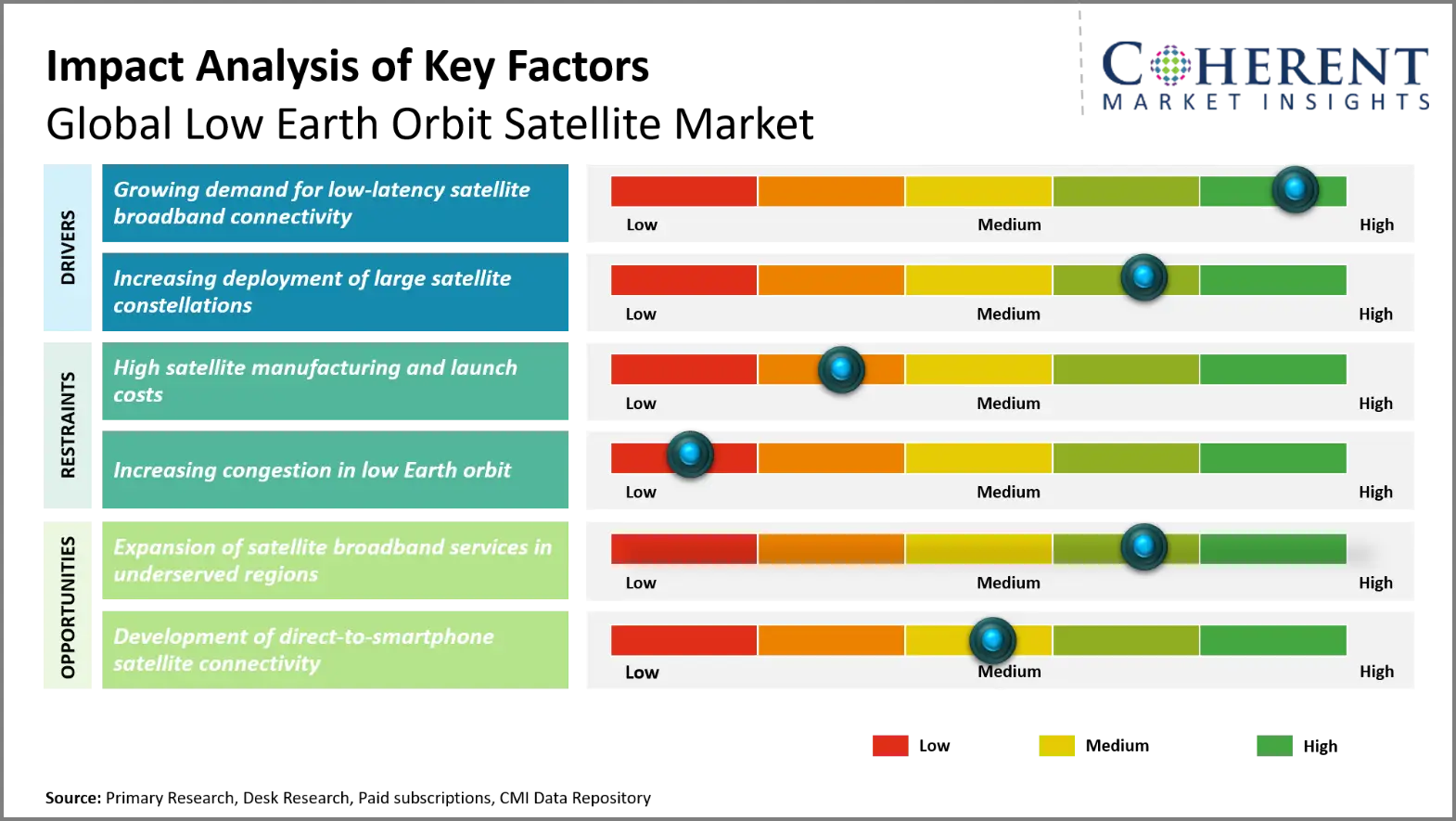
Growing demand for low-latency satellite broadband connectivity
Increasing demand for low-latency satellite broadband connectivity is driving investments in Low Earth Orbit satellite networks. These satellites are closer to the Earth, which reduces the time it takes to transmit a signal compared to geostationary satellites. These networks are used by telecommunications companies to provide broadband services to rural areas, maritime operators, aircraft and remote industrial installations. Increased demand for cloud applications, internet gaming, video conferencing and real-time enterprise communications further drives adoption. Satellite broadband also offers emergency connectivity during terrestrial network outages. These applications inspire operators to extend coverage, increase network capacity and create more inexpensive connectivity offerings.
On January 30, 2026, SES and Lynk announced that they are creating a multi-orbit direct-to-device solution that extends beyond cellular networks. The partnership offers scalable, resilient services to government and commercial users.
Increasing deployment of large satellite constellations
Increased deployment of large satellite constellations boost the demand in the global low earth orbit satellite market. Operators deploy interconnected spacecraft to enhance geographical coverage, network availability and communication capacity. Satellite broadband systems are being developed or operated by companies like SpaceX, Eutelsat OneWeb and Amazon. Large constellations require constant production of spacecraft, launch services, ground stations and network management equipment. Frequent satellite replacement also generates a regular demand for spacecraft manufacture and launch capacity. But operators will have to contend with spectrum cooperation, orbital congestion, collision avoidance and satellite disposal regulations. These investments are transforming commercial satellite communications and boosting global broadband access.
On August 4, 2026, Telesat LEO ULC announced that it has signed a USD 2.3 billion Telesat Lightspeed services contract with Canada’s Defense Investment Agency (DIA) to deliver secure Military Ka-band (Mil-Ka) Arctic connectivity to the Canadian Armed Forces (CAF) under the Enhanced Satellite Communications Project - Polar (ESCP-P) program.
Emerging Trends
- Direct-to-Device Satellite Connectivity: Satellite operators are developing systems that connect ordinary smartphones directly to satellites. This technology goes beyond terrestrial coverage for message, voice and data services. Commercial adoption is being accelerated by partnerships between satellite companies and mobile network carriers.
- Optical Inter-Satellite Communication: For links between spacecraft of high capacity, satellite manufacturers resort more and more often to laser communication systems. Optical links can decrease the need on ground stations and boost data transfer rates. These technologies will enable distributed satellite networks and create resilient broadband infrastructure worldwide.
- Satellite Manufacturing Automation: Transitioning to modular spacecraft platforms, automated assembly and standardized components. These technologies cut production cycle times and increase uniformity across large satellite fleets. The increased production rate will help constellation extension, replacement programs and more frequent upgrades of onboard technologies.
- Space Sustainability and Autonomous Collision Avoidance: Investment by satellite operators in collision monitoring, automatic maneuvering and controlled disposal technologies. Such capabilities help to mitigate orbital congestion and debris threats. Regulatory restrictions are pushing spacecraft designs to have better tracking, maneuverability and end-of-life management systems.
Regional Insights
Why is North America a Strong Market for Low Earth Orbit Satellite?
North America is expected to account for a market share of 55.0% in 2026. Commercial satellite broadband roll-out, defense procurement and integrated aerospace production are a boon for North America. Starlink is operated by SpaceX for residential, maritime, aviation, and enterprise users. Amazon is developing Amazon Leo with specialized satellite processing infrastructure at Kennedy Space Center, Florida. Canadian need includes access to rural settlements, northern territories, mining enterprises and maritime routes. Government agencies also need durable communications for disaster response and national security. Satellite deployment is bolstered by regional launch infrastructure, established telecommunications alliances, and major private investment. Competition increasingly focuses on network capacity, service reliability, and integration with terrestrial mobile networks.
Why Does Asia Pacific Low Earth Orbit Satellite Market Exhibit High Growth?
Asia Pacific is expected to register the fastest growth with a CAGR of 13.9% over the forecast period and projected to account for 24.0% of the global low earth orbit satellite market in 2026. Asia Pacific is benefiting from the growing digital infrastructure and government-backed constellation plans and need for connectivity among geographically distributed populations. China is building massive domestic satellite constellations and India is opening up its space business to commercial players. Japan has high technology in spacecraft engineering and satellite communications. Remote communities and maritime territories of Australia and Pacific-island countries need connectivity. Demand from catastrophe monitoring, precision agriculture, offshore energy and shipping is also regional. Domestic manufacturing programs support investment in satellite components, ground terminals and launch infrastructure. Strategic autonomy and secure communications further influence government procurement and constellation development across the region.
Global Low Earth Orbit Satellite Market Outlook for Key Countries
Why is U.S. Emerging as a Major Hub in the Low Earth Orbit Satellite Market?
The U.S. market benefits from private investment in constellations, sophisticated launch infrastructure, and defense requirements for satellite communications. SpaceX is expanding Starlink services to homes, airlines, maritime operators and companies who need reliable connectivity. Amazon's Leo is building a rival broadband network with more than 80 agreements signed to support its plans. The constellation can grow and satellites can link to phones based on spectrum authorizations from the Federal Communications Commission. Regular spacecraft launches enabled by Florida launch infrastructure and existing aerospace supply chains. Competition between satellite operators makes terminals affordable, improves network performance and integrates services.
Is China the Next Growth Engine for the Low Earth Orbit Satellite Market?
Strategic investments in domestic satellite infrastructure and initiatives to bolster independent communications capabilities are supporting market expansion in China. The Guowang constellation program is part of China’s bigger push to develop large-scale satellite broadband services. State-owned aerospace organizations supply satellites, launch vehicles and ground systems. Commercial companies also create space platforms and support technology. Demand includes rural connectivity, maritime communications, emergency response and secure government networking. Local component production enhances the growth of the supply chain and domestic launch capacity enables the deployment of constellations. These efforts position satellite communications as a key player in the growth of China’s digital infrastructure and space economy.
U.K. Low Earth Orbit Satellite Market Analysis and Trends
U.K. benefits from its strategic stake in Eutelsat OneWeb and government backing for home-grown satellite communications technologies. The government maintained a 10.89% share in Eutelsat Group following its December 2025 capital raising. The Connectivity in Low Earth Orbit program has up to £160 million available for British enterprises and researchers. That investment will go toward smarter spacecraft, better satellite networking and more modern communications hardware. Adoption is also aided by government requirements for secure diplomatic communications. Working with British technology businesses helps to develop British engineering skills and make national communications more resilient.
Japan Low Earth Orbit Satellite Market Analysis and Trends
Japan’s strength in electronics manufacturing, catastrophe preparedness and the need for reliable communications across the maritime region are the drivers of its market expansion. The Japan Aerospace Exploration Agency is capable of spacecraft engineering and research. National aerospace companies build satellite platforms, communication payloads and precision components. Satellite connectivity can help ships working far offshore, rescue teams responding to earthquakes, and remote industrial installations. Japan is also putting money into optical communication technologies and trusted space infrastructures. Government-funded research is leading to advances in satellite networking and data transmission. Partnerships between technology businesses, telecommunications providers and public institutions help to build specialized satellite services and domestic supply-chain development.
India Low Earth Orbit Satellite Market Analysis and Trends
India’s market growth is led by digital inclusion initiatives, private sector participation and demand for connectivity outside of terrestrial broadband networks. The Government of India announced over 1,002 million Internet subscribers for April-June 2025. Rural connectivity is vital because distant communities confront infrastructure limitations. Starlink, OneWeb India Communications, Jio Satellite Communications have achieved important milestones in service licensing. Facilities of Indian Space Research Organization also support testing and development of space companies. Other commercial potential exist in local manufacturing, telecoms partnerships and satellite-based services for remote industries.
Global Low Earth Orbit Satellite Market - Satellite Broadband Adoption In Rural And Remote Communities
Country / Region | Key Point | Year | Data |
Global | Starlink Active Customer Additions | 2025 | More Than 4.6 million New Active Customers |
New Zealand | Starlink Share of Rural Broadband Connections | 2026 | 27% |
India | Rural Internet Penetration | 2025 | Approximately 46 Internet Subscribers Per 100 People |
India | Villages Covered by Mobile Connectivity | 2025 | 629027 Of 644131 Villages, Or 97.65% |
Canada | Communities Receiving Funded Broadband Projects | 2026 | 318 Communities, Including 131 Indigenous Communities |
How is Expansion of Satellite Broadband Services in Underserved Regions Creating New Growth Opportunities in the Low Earth Orbit Satellite Market?
Satellite internet services in underdeveloped areas could unlock growth prospects by linking communities where fiber rollout and building mobile towers continue to be commercially tough. Starlink is intended for rural homes, schools, health clinics, maritime users and enterprises that need reliable internet connectivity. Eutelsat OneWeb enables connection agreements for remote community, enterprise networks and government customers. Satellite broadband can be used to provide service to Himalayan settlements, island territories, offshore operations and remote industrial sites in India. These deployments generate demand for user terminals, gateway infrastructure, network management software and satellite capacity agreements. Satellite connectivity can be added to the existing service portfolio of telecommunications carriers and generate extra revenues from clients who previously were hard to reach.
On March 4, 2025, Orange Africa and Middle East and Eutelsat announced a strategic agreement to connect Africa and the Middle East by satellite to bridge the digital gap in the region. It aims to connect isolated areas with broadband access, thereby strengthening digital inclusion in the region.
Market Players, Key Development, and Competitive Landscape
Key Developments
- On October 1, 2026, Orbitworks launched the Altair-1, UAE’s first commercial satellite. Altair-1, the first commercial satellite built in the UAE and integrated by Loft Orbital, launched aboard the Transporter-18 rideshare mission with SpaceX from Vandenberg Space Force Base, California, U.S.
- On September 21, 2026, Planet Labs announced it is scheduled to open the doors on its satellite manufacturing facility in Berlin, Germany, adding a major new capability to the engineering, mission operations, data, and business functions already based in the country.
- On June 29, 2026, Rocket Lab Corporation announced they have entered into a definitive agreement under which Rocket Lab will acquire Iridium. The acquisition will be one of the most transformative deals in the space industry, joining together two innovative American companies to play a leading role in the U.S. space economy.
Competitive Landscape
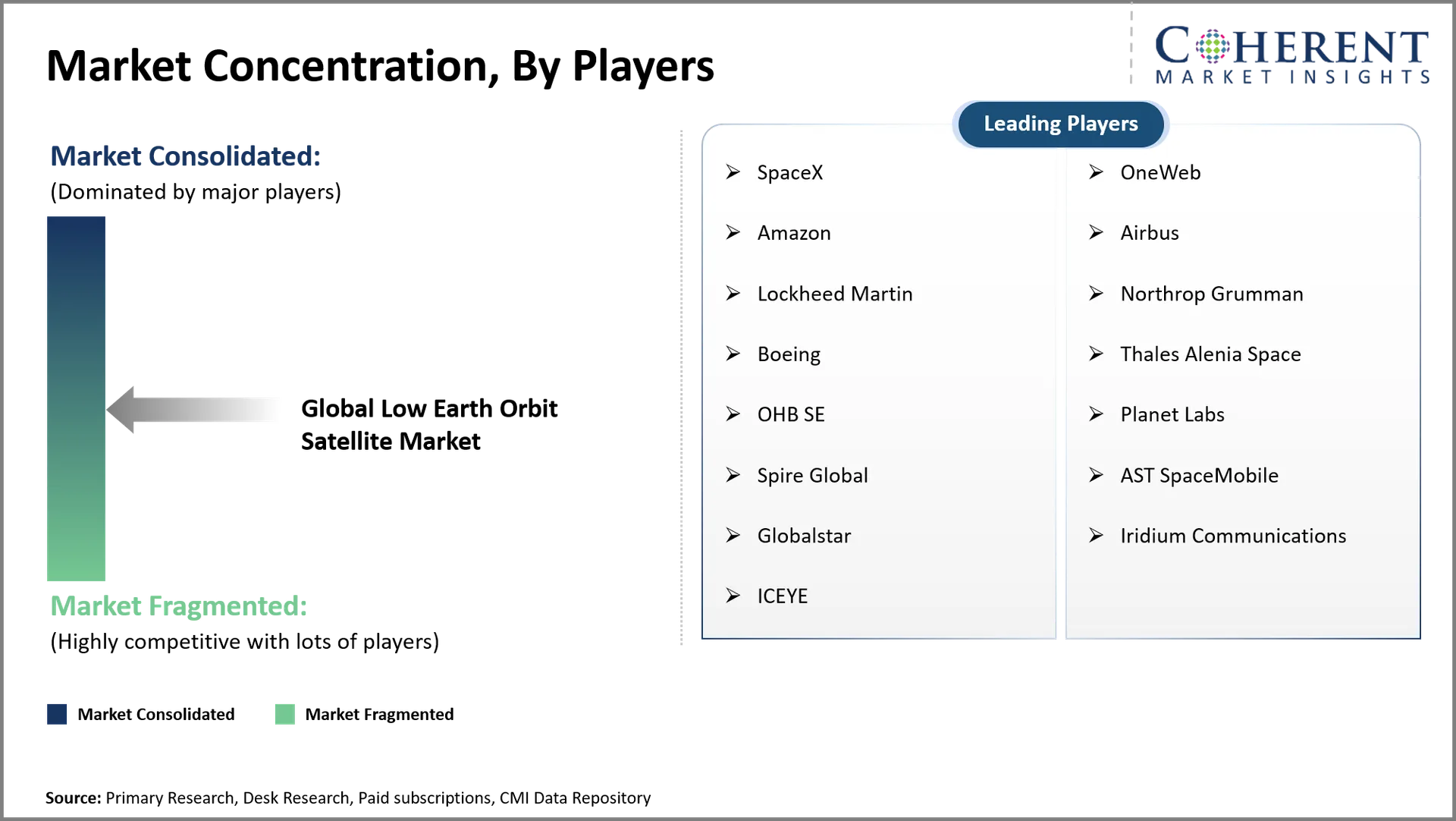
The global low earth orbit satellite industry is highly competitive in satellite communications infrastructure, broadband constellations, spacecraft manufacture, and launch services. Starlink is a vertically integrated operation – SpaceX makes the satellites, puts them into orbit using its reusable Falcon 9 vehicles and sells the customer terminals. Eutelsat OneWeb partners with telecoms to provide enterprise connectivity, government networks, aviation and maritime services. Amazon is developing Amazon Leo, a home broadband product, enterprise connectivity, and interaction with its cloud ecosystem. Telesat is building Lightspeed, a low Earth orbit constellation for government and commercial customers. Players increasingly prioritize direct-to-device connectivity, optical inter-satellite links, automated spacecraft production, and lower-cost terminals.
Top Manufacturers and Notable Products in the Low Earth Orbit Satellite Market
Manufacturer | Notable Product | Key features |
SpaceX | Starlink | Low-latency broadband, reusable launch integration, optical inter-satellite links, phased-array antennas |
Eutelsat Group | OneWeb | Global low Earth orbit connectivity, enterprise broadband, maritime and aviation connectivity, polar coverage |
Amazon | Amazon Leo | High-speed broadband, optical satellite links, compact user terminals, multiple terminal configurations |
Telesat | Telesat Lightspeed | Low-latency enterprise broadband, interconnected satellites, global mobility coverage, secure government connectivity |
SES | O3b mPOWER | High-throughput connectivity, software-defined capacity, managed network services, mobility and government communications |
Market Report Scope
Report Coverage | Details | ||
Base Year | 2025 | Market Size in 2026: | USD 15.00 Bn |
Historical Data For: | 2020 To 2024 | Forecast Period: | 2026 To 2033 |
Forecast Period 2026 To 2033 CAGR: | 13% | 2033 Value Projection: | USD 41.30 Bn |
Geographies covered: |
| ||
Segments covered: |
| ||
Companies covered: | SpaceX, OneWeb, Amazon, Airbus, Lockheed Martin, Northrop Grumman, Boeing, Thales Alenia Space, OHB SE, Planet Labs, Spire Global, AST SpaceMobile, Globalstar, Iridium Communications, ICEYE | ||
Growth Drivers: |
| ||
Restraints & Challenges: |
| ||
Analyst Opinion (Expert Opinion)
- The industry's future will depend on higher-capacity constellations, direct-to-device services, and specialized enterprise connectivity. Starlink's mobile expansion and Amazon Leo's planned direct-to-device network illustrate this transition. Operators will increasingly compete through service quality, spectrum access, and reliable coverage. Satellite-to-handset links might bring mobile services to far-flung towns and transport lines. Inter-satellite optical communications will also allow for speedier data routing and eliminate dependence on ground gateways.
- The biggest prospects are direct-to-device satellite, maritime connection, aviation broadband and secure government communications. In the U.S., there is potential for mobile integration and commercial broadband services. India has opportunity in the area of remote connection and maritime application. Japan has potential in advanced satellite components and disaster-response communications. European markets have prospects in enterprise networks and sovereign connectivity. Eutelsat’s OneWeb collaborations highlight the business opportunities for maritime and aviation services.
- Market players need to focus on economical terminals, efficient spacecraft production and adaptable network topologies. Satellite operators should work with telecommunications corporations, cloud providers and transit industries. Manufacturers should build modular platforms to facilitate upgrade and replacement cycles. All companies entering India will be required to get applicable authorizations and permissions of spectrum prior to commercial deployment. Operators should also enhance their capabilities on cybersecurity, end of life disposal and collision avoidance. Differentiated services and sustainable operations will allow companies to compete on more than just satellite coverage.
Speak to the analyst
Want personalized insights?
Take the findings above to one of our principal consultants, or have the report rebuilt around the segments, geographies and competitors you actually track.
Market Segmentation
- Satellite Type Insights (Revenue, USD Billion, 2021 - 2033)
- Communication Satellites
- Earth Observation Satellites
- Navigation Satellites
- Scientific Research Satellites
- Technology Demonstration Satellites
- Satellite Mass Insights (Revenue, USD Billion, 2021 - 2033)
- Small Satellites
- CubeSats
- Medium Satellites
- Large Satellites
- Propulsion Type Insights (Revenue, USD Billion, 2021 - 2033)
- Chemical Propulsion
- Electric Propulsion
- Hybrid Propulsion
- Frequency Band Insights (Revenue, USD Billion, 2021 - 2033)
- L Band
- S Band
- C Band
- X Band
- Ku Band
- Ka Band
- Orbit Type Insights (Revenue, USD Billion, 2021 - 2033)
- Sun-Synchronous Orbit
- Polar Orbit
- Equatorial Orbit
- Inclined Orbit
- Service Type Insights (Revenue, USD Billion, 2021 - 2033)
- Satellite Manufacturing
- Satellite Launch Services
- Ground Station Services
- Satellite Data Services
- Mission Planning and Control
- Application Insights (Revenue, USD Billion, 2021 - 2033)
- Telecommunications
- Broadband Internet
- Earth Observation and Remote Sensing
- Navigation and Positioning
- Scientific Research
- Military and Defense
- Internet of Things Connectivity
- End User Insights (Revenue, USD Billion, 2021 - 2033)
- Commercial
- Government and Defense
- Academic and Research Institutions
- Regional Insights (Revenue, USD Billion, 2021 - 2033)
- North America
- U.S.
- Canada
- Latin America
- Brazil
- Argentina
- Mexico
- Rest of Latin America
- Europe
- Germany
- U.K.
- Spain
- France
- Italy
- Russia
- Rest of Europe
- Asia Pacific
- China
- India
- Japan
- Australia
- South Korea
- ASEAN
- Rest of Asia Pacific
- Middle East
- GCC Countries
- Israel
- Rest of Middle East
- Africa
- South Africa
- North Africa
- Central Africa
- North America
- Key Players Insights
- SpaceX
- OneWeb
- Amazon
- Airbus
- Lockheed Martin
- Northrop Grumman
- Boeing
- Thales Alenia Space
- OHB SE
- Planet Labs
- Spire Global
- AST SpaceMobile
- Globalstar
- Iridium Communications
- ICEYE
Sources
Primary Research Interviews
- LEO Satellite Manufacturers & Operators
- Space Launch Service Providers
- Ground Station Equipment Suppliers
- Satellite Communication Service Providers
Magazines
- Via Satellite Magazine
- Space News Magazine
- Aviation Week & Space Technology
Journals
- Journal of Spacecraft and Rockets
- Acta Astronautica
- IEEE Transactions on Aerospace and Electronic Systems
Associations
- Satellite Industry Association (SIA)
- Global VSAT Forum (GVF)
- Space Foundation
- European Space Agency (ESA) Industry Liaison Office
Public Domain Sources
- NASA Technical Reports Server (NTRS)
- Federal Communications Commission (FCC) Filings
- United Nations Office for Outer Space Affairs (UNOOSA)
- European Space Agency (ESA) Open Data Portal
Proprietary Elements
- CMI Data Analytics Tool
- Proprietary CMI Existing Repository of Information for the Last 10 Years
Get access to 250+ pages report
Every segment, forecast, competitor profile and data table behind the analysis above — available for instant download.
- ESOMAR Member
- ISO 9001:2015 Certified
- D-U-N-S Registered
- GDPR & CCPA Compliant
Frequently Asked Questions
The global low earth orbit satellite market is expected to stand at USD 15.00 Bn in 2026 and is expected to reach USD 41.30 Bn by 2033.
The CAGR of the global low earth orbit satellite market is projected to be 13% from 2026 to 2033.
Growing demand for low-latency satellite broadband connectivity and Increasing deployment of large satellite constellations are the major factors driving the growth of the global low earth orbit satellite market.
High satellite manufacturing and launch costs and Increasing congestion in low Earth orbit are the major factors hampering the growth of the global low earth orbit satellite market.
In terms of satellite type, communication satellites segment is estimated to dominate the market revenue share in 2026.
Low earth orbit generally extends from approximately 160 kilometres to 2,000 kilometres above Earth's surface.
Their proximity to earth reduces signal travel distances, enabling faster communications than satellites operating in geostationary orbit.