

Global Marine Battery Market Size and Forecast - 2026 To 2033
The global marine battery market is expected to grow from USD 893.1 Mn in 2026 to USD 2,820.0 Mn by 2033, registering a compound annual growth rate (CAGR) of 13.2% from 2026 to 2033. The global marine battery market is driven by stricter maritime emission requirements. On April 11, 2025, the International Maritime Organization achieved another important step towards establishing a legally binding framework to reduce greenhouse gas emissions from ships globally, aiming for net-zero emissions by 2050.
Key Takeaways of the Global Marine Battery Market
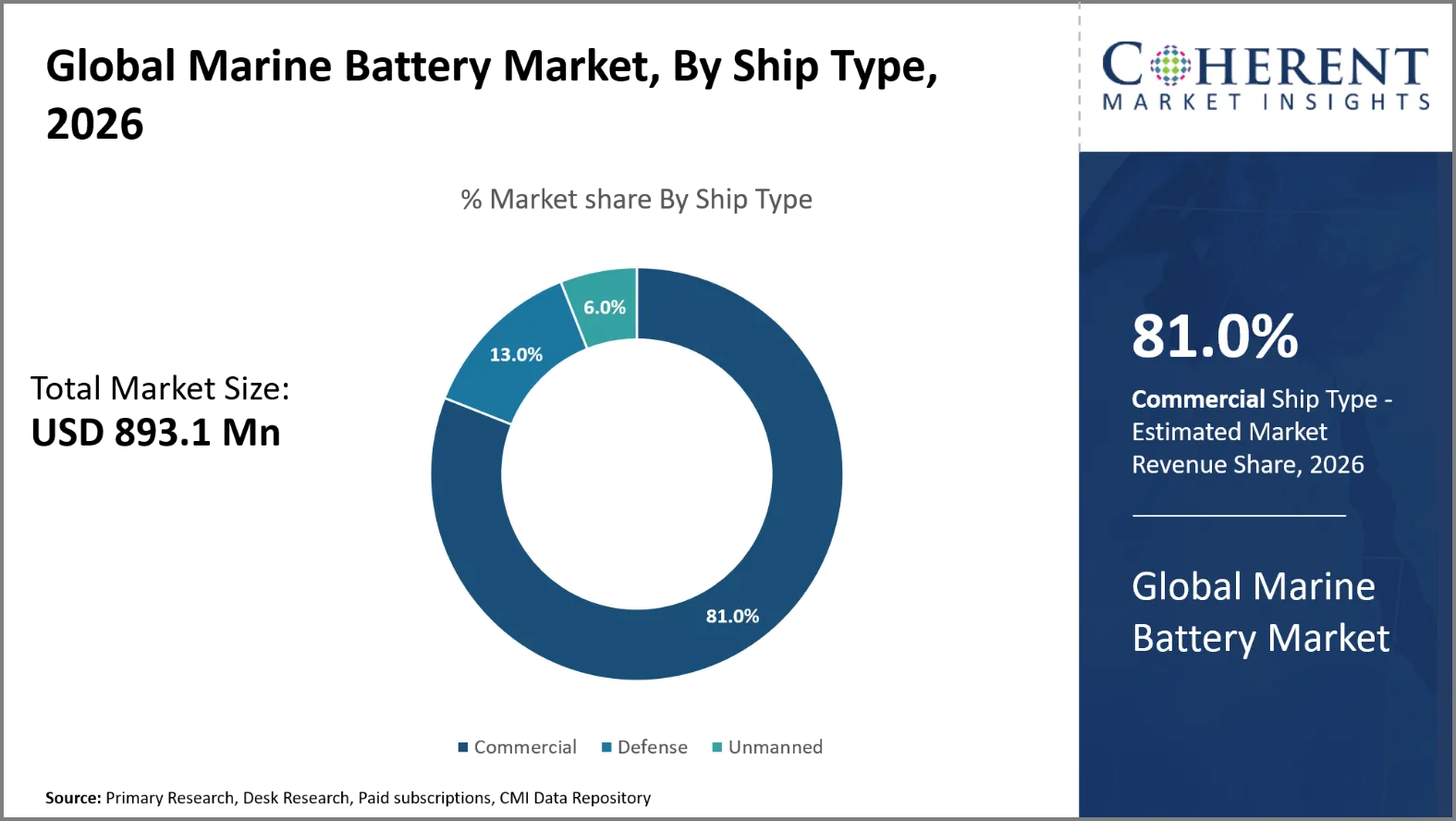
- The Commercial segment is expected to account for 81.0% of the global marine battery market share in 2026. Rising marine fuel costs is driving the growth of the segment. On May 12, 2026, Maersk introduced a temporary emergency fuel surcharge for U.S. and Canadian inland movements. The company cited refinery disruptions and higher fuel distribution costs.
- The Deep-Cycle Batteries segment is estimated to capture 48.0% of the market share in 2026. Growing port electrification initiatives is majorly driving the growth of the segment. On March 23, 2026, The Port of Rotterdam Authority secured approximately USD 100 million European Investment Bank loan for shore-power infrastructure. The project covers three deep-sea container terminals and eight kilometers of quay.
- The More Than 250 AH segment is estimated to capture 46.0% of the market share in 2026. Advancements in lithium battery technology is driving the growth of the segment. In May 2026, Corvus Energy and BYD Energy Storage signed a strategic cooperation agreement. The companies are developing high-rate lithium iron phosphate marine battery systems.
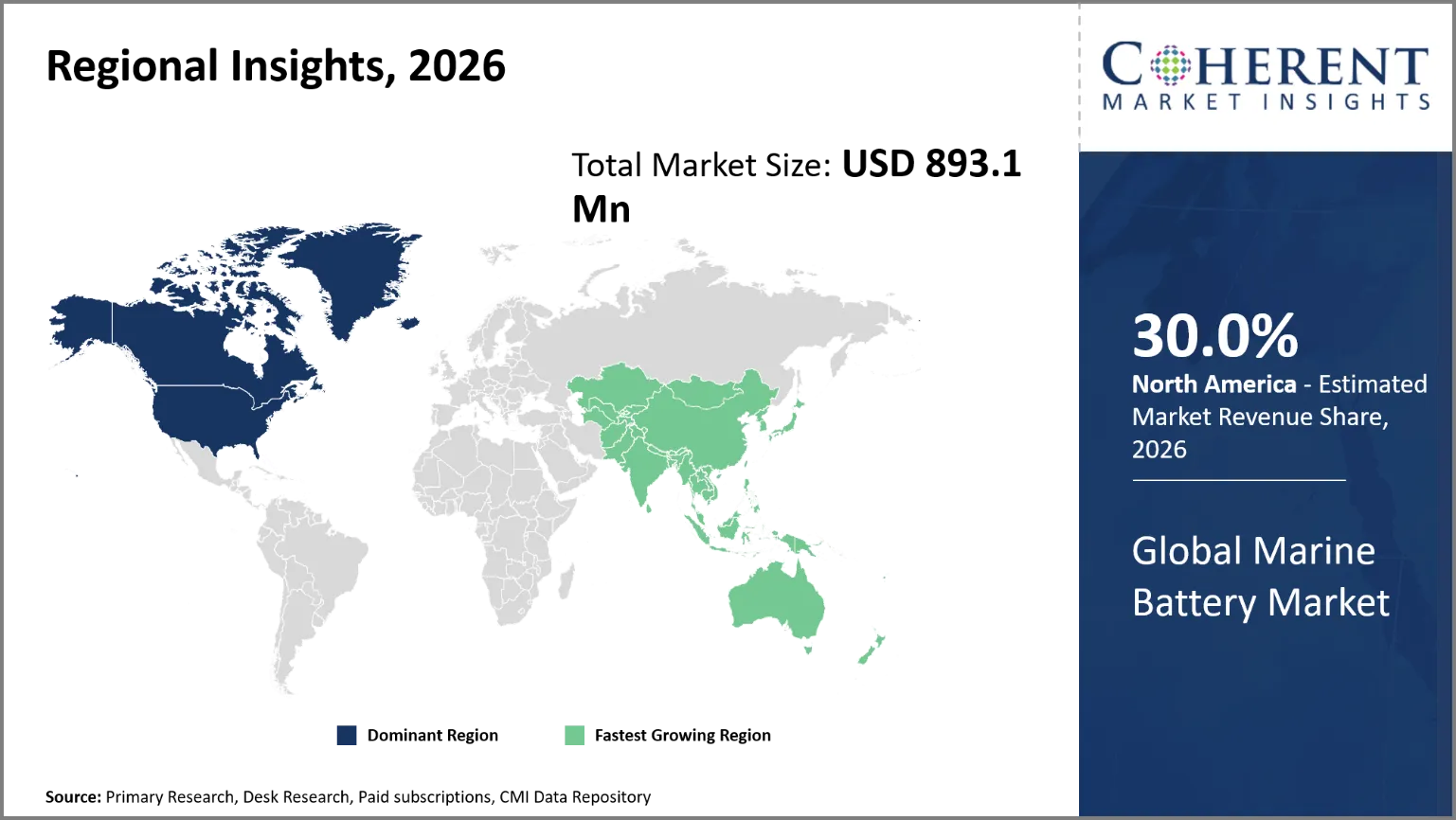
- North America is expected to dominate the marine battery market in 2026 with a market share of 30.0%. Development of high-capacity batteries for larger vessels in North America is driving the growth of the regional market. On August 11, 2026, Fleetzero received Product Design Assessment approval from the American Bureau of Shipping for its Leviathan battery system.
- Asia Pacific is expected to account for 21.0% share in 2026. Growing demand for battery systems in offshore support vessels in Asia Pacific is driving the growth of the regional market. On August 18, 2025, Marco Polo Marine introduced the battery-hybrid CSOV Wind Archer. The vessel was built at Batam Shipyard in Indonesia for Asian offshore wind operations.
Segmental Insights
Why Does Commercial Dominate the Global Marine Battery Market?
The commercial segment is expected to account for 81.0% of the global marine battery market share in 2026. Battery systems are a crucial need for commercial vessels to power propulsion and electrical loads on board. More and more ferries, workboats, offshore vessels and service vessels are moving to battery-powered systems. Commercial operators are also facing increased pressure to minimize fuel use and maritime emissions. Battery systems provide electric propulsion, hybrid propulsion, peak-load shaving and supplementary power. Commercial vessels operate more frequently than recreational boats, which increases the necessity for reliable energy storage. Longer operating schedules also support demand for higher-capacity battery systems.
On May 28, 2025, Wärtsilä announced it will supply the electric propulsion system for three fully battery-electric, high-speed ferries that will operate in the San Francisco Bay area. The zero-emission vessels will be the first full electric high-speed ferries to operate and be built in the USA. The order with Wärtsilä was placed by the shipyard All American Marine (AAM), on behalf of San Francisco Bay Ferry, California’s largest public ferry operator.
- Current Industry Events of 2026
- Market Size Estimation
- Regional Breakdown
- Competitive Landscape
- Customer Intelligence
- Segmental Analysis
- Pricing Analysis
- Key Market Drivers, Challenges & Future Trends
- Customized Insights Section
Why is Deep-Cycle Batteries the Most Preferred Battery Function?
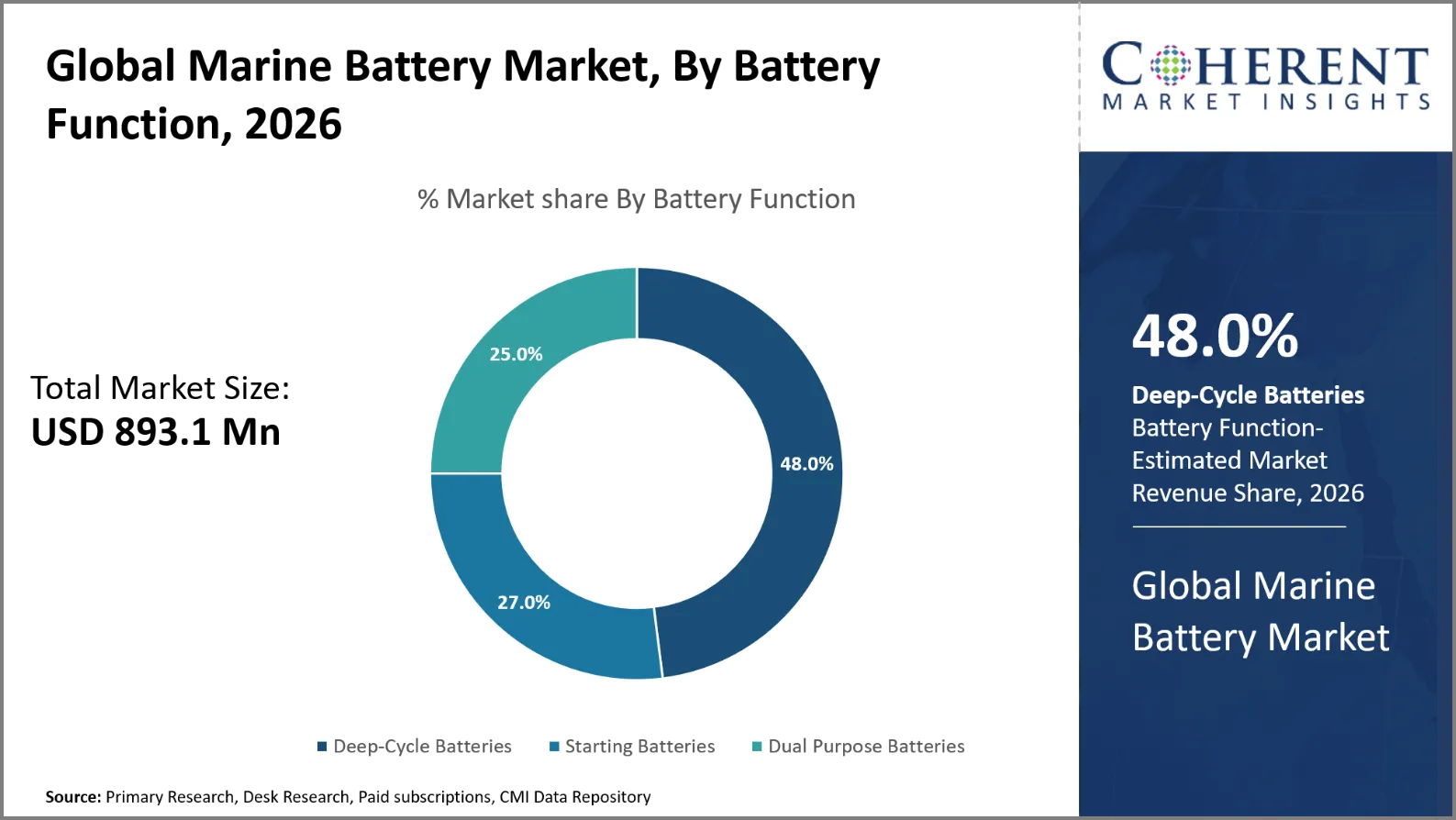
The deep-cycle batteries segment is expected to account for 48.0% of the global marine battery market share in 2026. Deep cycle batteries are designed to deliver long-lasting power across many cycles of depletion and recharging. Marine applications often demand extended periods of electrical operation, not rapid bursts of starting power. Propulsion, trolling motors, navigation systems, illumination and onboard electronics are powered by deep-cycle batteries. They are built to cycle many times, with a regulated discharge profile. Marine vessels also benefit from batteries that can withstand vibration, dampness and extreme working conditions. The lithium-ion deep-cycle batteries also have high energy density and long cycle performance. Deep-cycle batteries are advantageous for both recreational and commercial marine applications. In March 2026, Exide Technologies expanded its Marine and Leisure portfolio with the EV1920S lithium-ion battery. The battery provides 12.8 volts and 150 ampere-hours of capacity. It uses integrated Bluetooth connectivity, a dedicated application, sleep mode, and a built-in heater.
More Than 250 AH Dominates the Global Marine Battery Market
The more than 250 AH segment is expected to account for 46.0% of the global marine battery market share in 2026. Larger batteries are increasingly needed for longer run times in marine vessels. Batteries of more than 250 ampere hour for more stored energy for demanding onboard applications. The higher capacity accommodates electric propulsion, hybrid propulsion, auxiliary systems and on-board electronics. Commercial ships, in contrast, tend to remain away longer and usually require greater energy reserves. Electric boats also require a lot of battery to obtain reasonable cruising ranges. A higher capacity system can lower the frequency of charging during vessel operations. Thus, battery packs beyond 250 Ah are becoming increasingly important for demanding marine applications.
On May 29, 2025, Damen selected Corvus Energy to supply battery systems for four new BC Ferries vessels. The four systems provide more than 8 MWh of combined battery capacity. The ferries are designed for fully electric operation and scheduled for delivery by 2027.
Current Events and their Impact
Current Events | Description and its Impact |
European Union FuelEU Maritime Regulation, Regulation (EU) 2023/1805 |
|
European Union Battery Regulation, Regulation (EU) 2023/1542 |
|
Marine Battery Market Dynamics
Market Drivers
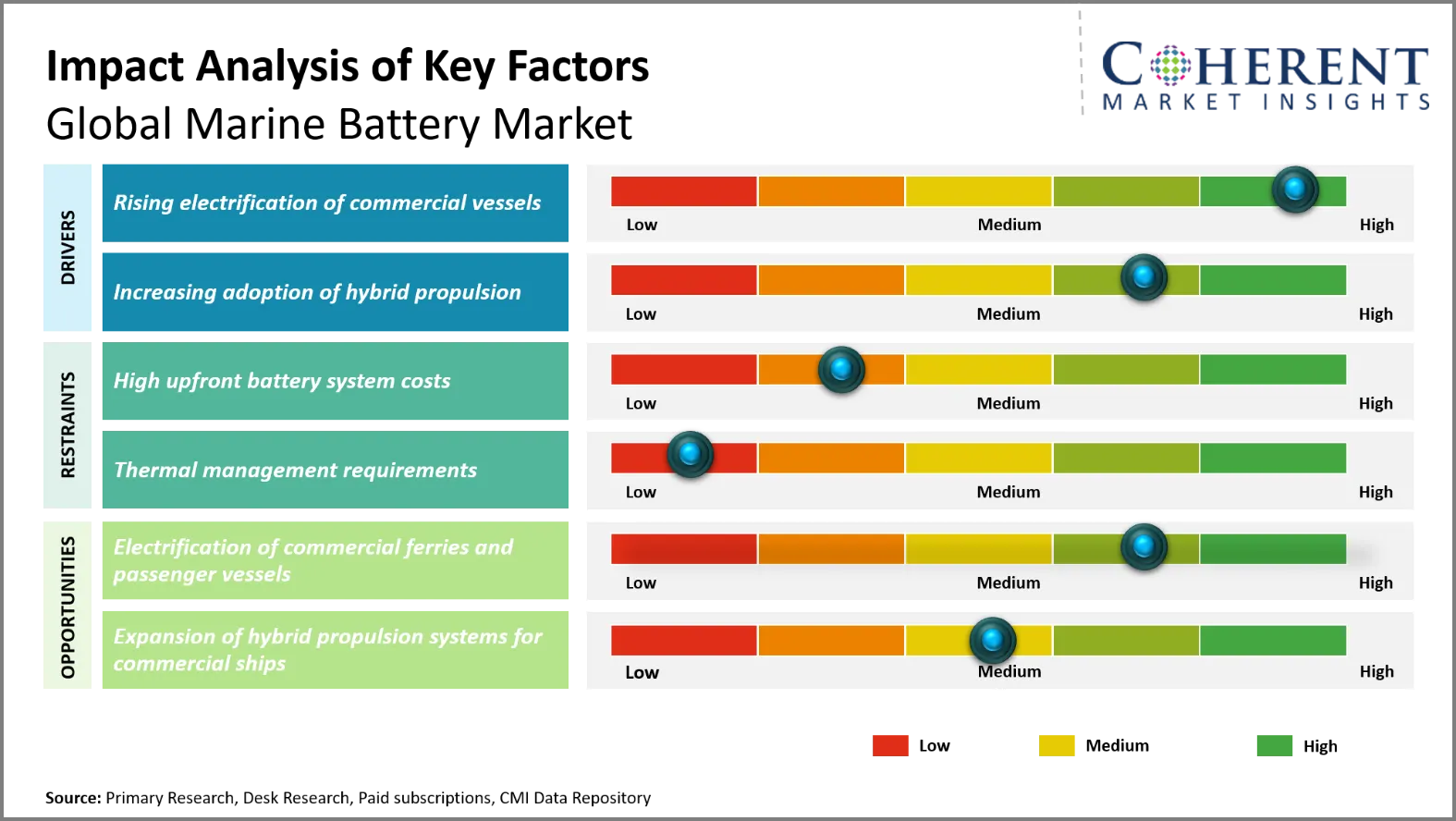
- Rising electrification of commercial vessels: The increased electrification of commercial vessels is driving demand for marine battery systems. Electric propulsion is being deployed by commercial operators to reduce fuel consumption and operational pollutants. Battery systems are used to power the propulsion, auxiliary power and on-board electrical equipment. Ferries and short-distance vessels are especially ideal, because their routes allow for predictable charge schedules. Governmental decarbonization measures are also driving shipowners to look at electric vessel solutions. Such advancements are pushing the use of marine batteries in commercial maritime activities.
- On January 12, 2026, ABB announced it will supply a complete package of power, propulsion and control technology for four new double-ended passenger and car ferries operated by British Columbia Ferry Services (BC Ferries). One of the largest ferry operators in the world, BC Ferries provides year-round vehicle and passenger service on 25 routes to 47 terminals, carrying approximately 9.7 million vehicles and 22.7 million passengers annually.
- Increasing adoption of hybrid propulsion: The increasing deployment of hybrid propulsion is driving further demand in marine battery systems. Hybrid vessels maximize their energy consumption by employing conventional engines and batteries. Batteries can provide extra power for maneuvering, acceleration and low load applications. Hybrid systems also provide peak-load management and can cut engine operating time. The hybrid systems can be used by commercial operators without having to depend solely on battery propulsion. This versatility is allowing hybrid propulsion to be implemented across ferries, workboats, offshore vessels and service vessels.
- On August 5, 2025, VARD announced a new contract with North Star, the UK’s largest shipowner-operator, a major milestone in the companies’ combined commitment to sustainable maritime innovation. The contract includes the design and construction of two hybrid Service Operation Vessels (SOVs).
Emerging Trends
- Advanced Lithium-Ion Battery Chemistries: Marine lithium-ion battery manufacturers are creating safer chemistries with increased energy density, longer cycle life, and higher thermal stability. These advances allow bigger propulsion systems while overcoming the vessel weight, range and onboard safety criteria.
- Modular Battery Energy Storage Systems: Modular battery architectures are gaining attention as they simplify vessel integration, maintenance, capacity expansion, and system replacement. Operators can configure battery capacity according to propulsion requirements, vessel size, operating profiles, and available onboard installation space.
- Smart Battery Management Systems: Sensors, predictive analytics, and automated monitoring are progressively being incorporated into sophisticated battery management systems. These technologies continuously monitor battery temperature, state of charge, and battery health. Better monitoring allows for preventative maintenance, operating efficiency and increased safety in marine applications.
- Integration With Renewable Energy Systems: Marine operators are increasingly integrating batteries with on-board renewable energy systems and shore-based renewable electricity. Vessel energy requirements can be supplemented by solar power and renewable charging. This incorporation enables lower-emission operations and more flexibility in managing energy across marine applications for which it is suitable.
Regional Insights
Why is North America a Strong Market for Marine Battery?
North America is expected to account for a market share of 30.0% in 2026. Electrification of ferries, decarbonization of ports, and commercial vessel demonstrations are helping to drive marine battery use in North America. Canada is expanding battery systems for coastal ferry operations and marine transportation. Corvus Energy is delivering 40 megawatt-hours across four new British Columbia Ferry Services vessels. Each vessel receives 10 megawatt-hours of installed battery capacity. The systems can support nearly emission-free operation for approximately two hours. In the U.S., Lawrence Berkeley National Laboratory assessed battery electrification for domestic vessels below 1,000 gross tons. Another study identified 20 major ports where charging demand could concentrate.
Why Does Asia Pacific Marine Battery Market Exhibit High Growth?
Asia Pacific is expected to register the fastest growth with a CAGR of 13.8% over the forecast period and projected to account for 21.0% of the global marine battery market in 2026. Asia Pacific is witnessing the expansion of marine batteries due to the large-scale shipbuilding, electrification of inland waterways, and green-port efforts. All new harbor boats in Singapore to be entirely electric by 2030 Its marine policy also seeks lower-carbon energy for port operations. Its maritime strategy also targets lower-carbon energy across harbor operations. South Korea is deploying battery-hybrid propulsion for harbor tugs at major ports. Kongsberg Maritime supplied the hybrid-electric system for Meta 7 at Busan Port. Regional operators are also developing electric ferries, workboats, cargo vessels, and port-service craft. These projects are strengthening demand for high-capacity batteries, charging infrastructure, and marine energy-management systems.
Global Marine Battery Market Outlook for Key Countries
Why is U.S. Emerging as a Major Hub in the Marine Battery Market?
The U.S. marine battery market is expanding on domestic maritime electrification, harbor craft and port demonstrations. Lawrence Berkeley National Laboratory studied battery electrification for home vessels under 1,000 gross tonnage. The study evaluated the technological feasibility and the theoretical expenses for the domestic fleet. Studies indicate that 6,323 smaller domestic vessels could potentially be retrofitted with battery-electric systems. Electrification could reduce domestic shipping greenhouse gas emissions substantially under favorable operating conditions. Charging demand could concentrate at 20 major ports. The U.S. Department of Energy is also considering battery propulsion efficiency and maritime energy innovation.
Is China the Next Growth Engine for the Marine Battery Market?
China is increasing the use of marine batteries through inland cargo and passenger vessel electrification and domestic battery production capacity. The Zhe Xiaoshan Cargo 03306 became the first battery-electric conversion operating on the Hangzhou section of the Grand Canal. Its 1,048-kilowatt-hour battery enables approximately 100 kilometers per charge. The vessel can complete 50 annual trips covering 360 kilometers each. Its operation replaces approximately 18 metric tons of diesel annually. The project also reduces carbon dioxide emissions by approximately 56 tons annually. CATL also supplied the marine battery system for the 58-passenger Star of East Lake sightseeing vessel.
Norway Marine Battery Market Analysis and Trends
Norway remains a major marine battery deployment center because of extensive ferry electrification and established charging infrastructure. The country had almost 90 electric ferries in operation in 2025. At that time there were about 1,000 battery-powered boats of all varieties sailing the globe. The MF Ampere became the world's first fully electric ferry in 2015. It uses a 1,090-kilowatt-hour battery system and carries 120 cars and 350 passengers. Its operation saves nearly one million liters of fuel annually. It also avoids approximately 570 tons of carbon dioxide annually.
Japan Marine Battery Market Analysis and Trends
Japan is developing marine battery demand through fully electric workboats, shipyard applications, and maritime decarbonization initiatives. Nippon Yusen Kabushiki Kaisha unveiled e-Crea in May 2025. The vessel became Japan's first fully battery-driven work vessel according to the company. Keihin Dock built the approximately nine-meter vessel at its Koyasu Shipyard. e-Crea operates without an onboard diesel generator and charges from shore facilities. Its primary role involves supporting tugboat docking and undocking operations. The experiment shows how batteries can be used to power vehicles within shipyards. It also gives operational expertise to Japanese shipbuilders researching low-carbon maritime technologies.
The Netherlands Marine Battery Market Analysis and Trends
The Netherlands is leading the way on marine batteries for inland container shipping and the use of interchangeable battery systems. In 2025, Zero Emission Services, Nedcargo and the Inland Terminals Group started with container shipping on battery-electric vehicles. The Den Bosch Max Groen operates using exchangeable battery containers called ZESpacks. The standardized containers are charged using renewable electricity at dedicated charging stations. Inland Terminals Group operates 17 terminals across the Netherlands and Belgium. The network provides locations for expanding battery charging infrastructure. Zero Emission Services plans dozens of emission-free shipping routes by 2030. The European Commission also supports a 110-meter fully electric inland container vessel under RIVERBOOST.
Global Marine Battery Market - Marine Battery Installations by Vessel Type (2025)
Vessel Type | Estimated Installations | Share of Installations | Typical Battery Capacity |
Ferries | 420 | 42.0% | 2-45 MWh |
Workboats | 180 | 18.0% | 0.5-10 MWh |
Tugboats | 140 | 14.0% | 1-6 MWh |
Passenger Vessels | 95 | 9.5% | 0.5-8 MWh |
Offshore Support Vessels | 70 | 7.0% | 2-25 MWh |
Fishing Vessels | 35 | 3.5% | 0.2-3 MWh |
Recreational Boats | 30 | 3.0% | 0.1-1 MWh |
Cargo and Inland Vessels | 30 | 3.0% | 1-8 MWh |
How is Electrification of Commercial Ferries and Passenger Vessels Creating New Growth Opportunities in the Marine Battery Market?
Route-specific battery deployment and port charging infrastructure are opening new potential for marine batteries through the electrification of commercial ferries and passenger vessels. The International Maritime Organization has evaluated 67 Ro-Ro and Ro-Pax ferries at 26 ports of the Sea of Marmara, carrying 25 million passengers per year. The results indicated that all the operations analyzed are theoretically viable with battery electric and hybrid propulsion. Its full electric scenario could cut greenhouse gas emissions from its fleet by 84% by 2050. The International Maritime Organization has cited charging facilities and high-voltage port connections as top objectives for deployment. These projects drive demand for high-capacity battery packs, marine energy-storage systems, fast-charging equipment, battery-management systems and specific retrofit solutions.
On May 27, 2025, Damen Shipyards launched the latest Island Class Ferry for BC Ferries. The vessel, a Damen RoRo 8117 E3, will become the seventh Damen vessel to sail in the Canadian organization’s fleet. The ferry is the first in an order of four battery-equipped diesel-hybrid vessels that will bring the total number of Damen vessels in the BC Ferries fleet to ten. The ferries will be capable of operating exclusively on electric power once charging infrastructure is in place at the terminals.
Market Players, Key Development, and Competitive Intelligence
Key Developments
- On June 2, 2026, Echandia announced the launch of Echandia Core, a new marine battery system built on lithium-titanium-oxide (LTO) technology. Developed for demanding fully electric and hybrid vessel applications, Echandia Core delivers the safety, lifetime and predictable performance of LTO with a significantly lower upfront investment and smaller installation footprint.
- On July 21, 2025, Octillion Power Systems announced that it has expanded its existing partnership with Vision Marine Technologies Inc. to produce high-voltage lithium-ion battery packs for their marine propulsion systems from Octillion's Reno, Nevada manufacturing facility in U.S.
- On February 26, 2025, Kraken Robotics Inc. announced that it has received orders totaling USD 34 million for SeaPower pressure tolerant batteries from three clients. In addition, Kraken signed a lease to open a new battery production facility in Nova Scotia, Canada to meet rising defense market demand for uncrewed underwater vehicles.
Competitive Landscape
Leading players are competing through high-capacity systems, integrated propulsion, safety certification, and application-specific battery architectures. Corvus Energy has supplied systems to more than 150 ferries and serves over 1,000 maritime projects. Corvus added to its lithium iron phosphate portfolio in 2026 with Blue Whale NxtGen Power. It also got a contract for new British Columbia Ferries vessels of 40 megawatt hours. Wärtsilä is concentrating on integrated electric propulsion, energy management and hybridization. Its 2025 Aurora Botnia project adds 10.4 megawatt-hours to the ferry's battery system. Its 2026 Molslinjen contract covers integrated electric propulsion for three high-speed battery-electric ferries.
Global Marine Battery Market Report Coverage | |||
Report Coverage | Details | ||
Base Year | 2025 | Market Size in 2026: | USD 893.1 Mn |
Historical Data For: | 2020 To 2024 | Forecast Period: | 2026 To 2033 |
Forecast Period 2026 To 2033 CAGR: | 13.20% | 2033 Value Projection: | USD 2,820.0 Mn |
Geographies covered: |
| ||
Segments covered: |
| ||
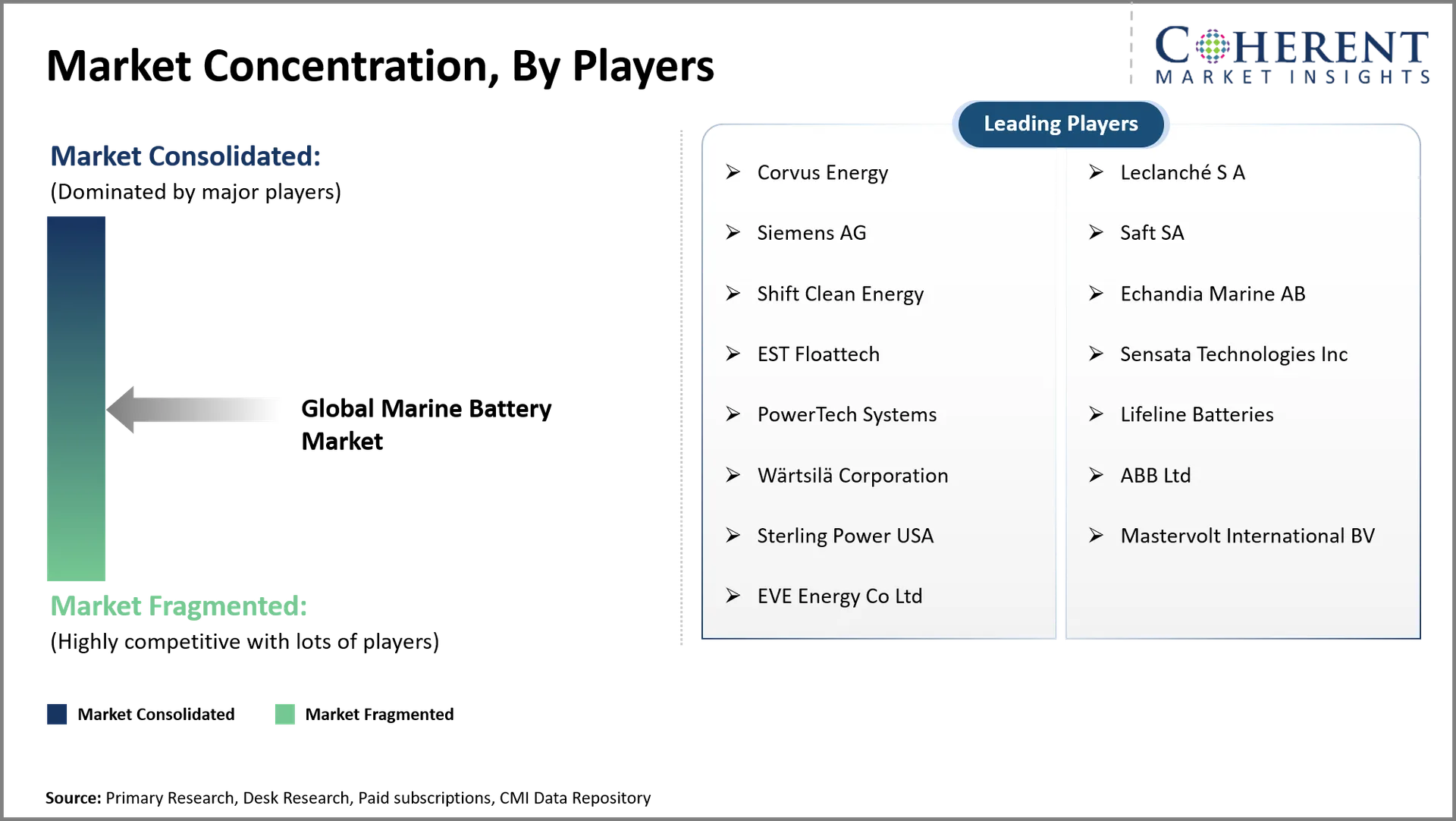
Companies covered: | Corvus Energy, Leclanché S A, Siemens AG, Saft SA, Shift Clean Energy, Echandia Marine AB, EST Floattech, Sensata Technologies Inc, PowerTech Systems, Lifeline Batteries, Wärtsilä Corporation, ABB Ltd, Sterling Power USA, Mastervolt International BV, EVE Energy Co Ltd | ||
Growth Drivers: |
| ||
Restraints & Challenges: |
| ||
Analyst Opinion (Expert Opinion)
- The marine battery industry is moving toward application-specific electrification rather than one standardized battery configuration. Short-route ferries, harbor tugs, inland vessels, and passenger craft offer strong technical compatibility with battery propulsion. Battery suppliers should therefore develop modular systems supporting different power, capacity, charging, and vessel-space requirements. High-energy lithium iron phosphate systems should gain importance where safety, cycle life, and operating economics are critical.
- The strongest opportunities should emerge in commercial ferries, passenger vessels, harbor tugs, and inland cargo vessels. These applications provide recurring routes, defined charging locations, and predictable energy requirements. China, Norway, the Netherlands, Japan, and coastal regions of North America offer particularly relevant deployment environments. Suppliers should prioritize high-capacity systems, rapid charging, shore-power integration, and retrofit-compatible architectures for these vessel categories.
- Players seeking an edge should combine battery hardware with propulsion controls, energy management, diagnostics, and lifecycle services. Corvus Energy's expanding LFP portfolio illustrates the value of chemistry diversification. Wärtsilä's integrated propulsion approach demonstrates another route through coordinated motors, power conversion, automation, and energy management. Manufacturers should also strengthen cybersecurity, thermal management, certification capabilities, and regional service networks as installations become larger and more complex.
Speak to the analyst
Want personalized insights?
Take the findings above to one of our principal consultants, or have the report rebuilt around the segments, geographies and competitors you actually track.
Market Segmentation
- Ship Type Insights (Revenue, USD Million, 2021 - 2033)
- Commercial
- Defense
- Unmanned
- Battery Function Insights (Revenue, USD Million, 2021 - 2033)
- Deep-Cycle Batteries
- Starting Batteries
- Dual Purpose Batteries
- Nominal Capacity Insights (Revenue, USD Million, 2021 - 2033)
- More Than 250 AH
- 100-250 AH
- Less Than 100 AH
- Propulsion Type Insights (Revenue, USD Million, 2021 - 2033)
- Conventional
- Hybrid
- Fully Electric
- Battery Design Insights (Revenue, USD Million, 2021 - 2033)
- Solid State
- Liquid or Gel Based
- Ship Power Insights (Revenue, USD Million, 2021 - 2033)
- Less Than 75 KW
- 75-150 KW
- 150-745 KW
- 745 KW and Above
- Battery Type Insights (Revenue, USD Million, 2021 - 2033)
- Lithium
- Lead Acid
- Nickel Cadmium
- Sodium-Ion
- Fuel Cells
- Energy Density Insights (Revenue, USD Million, 2021 - 2033)
- Less Than 100 WH/Kg
- 100-500 WH/Kg
- More Than 500 WH/Kg
- Regional Insights (Revenue, USD Million, 2021 - 2033)
- North America
- U.S.
- Canada
- Latin America
- Brazil
- Argentina
- Mexico
- Rest of Latin America
- Europe
- Germany
- U.K.
- Spain
- France
- Italy
- Russia
- Rest of Europe
- Asia Pacific
- China
- India
- Japan
- Australia
- South Korea
- ASEAN
- Rest of Asia Pacific
- Middle East
- GCC Countries
- Israel
- Rest of Middle East
- Africa
- South Africa
- North Africa
- Central Africa
- North America
Sources
Primary Research Interviews
- Marine Battery Manufacturers & Suppliers
- Shipbuilding & Naval Architecture Companies
- Marine Vessel Operators & Fleet Owners
- Regulatory & Certification Bodies (Maritime Authorities)
Magazines
- Marine Technology News
- Maritime Executive Magazine
- Naval Architect Magazine
- Ship & Boat International
Journals
- Journal of Power Sources
- Journal of Marine Science and Engineering
Associations
- International Maritime Organization (IMO
- Society of Naval Architects and Marine Engineers (SNAME)
- World Maritime University (WMU)
- European Boating Industry (EBI)
Public Domain Sources
- U.S. Department of Energy (DOE) - Marine Energy Reports
- European Maritime Safety Agency (EMSA) Publications
- International Energy Agency (IEA) - Energy Storage Reports
- Norwegian Maritime Authority (NMA) Publications
Proprietary Elements
- CMI Data Analytics Tool
- Proprietary CMI Existing Repository of Information for Last 10 Years
Get access to 250+ pages report
Every segment, forecast, competitor profile and data table behind the analysis above — available for instant download.
- ESOMAR Member
- ISO 9001:2015 Certified
- D-U-N-S Registered
- GDPR & CCPA Compliant
Frequently Asked Questions
The global Marine Battery market is expected to stand at USD 893.1 Mn in 2026 and is expected to reach USD 2,820.0 Mn by 2033.
The CAGR of the global marine battery market is projected to be 13.2% from 2026 to 2033.
Rising electrification of commercial vessels and Increasing adoption of hybrid propulsion are the major factors driving the growth of the global marine battery market.
High upfront battery system costs and Thermal management requirements are the major factors hampering the growth of the global marine battery market.
In terms of ship type, commercial segment is estimated to dominate the market revenue share in 2026.
A marine battery stores electrical energy for propulsion, starting, auxiliary power, navigation, and onboard equipment.
It monitors battery temperature, voltage, current, state of charge, and battery health.