

Global Megawatt Charging System Market Size and Forecast – 2026 To 2033
The global megawatt charging system market is expected to grow from USD 164.1 Mn in 2026 to USD 2,102.8 Mn by 2033, at a compound annual growth rate (CAGR) of 44.0% over 2026–2033. The main reason is the shift of long-haul freight to battery-electric heavy trucks. A conventional fast charger cannot refill a large truck battery during a driver’s rest break, but a megawatt charger can. Fleet operators adding electric truck models therefore need charging sites that work at megawatt power. Governments are also paying to build these sites as part of wider electric vehicle programmes. On October 28, 2025, CALSTART opened a USD 10 million funding lane under the California Energy Commission’s EnergIIZE project. It pays up to USD 450,000 per megawatt charging port at ports and rail terminals, with a maximum of USD 2.5 million per project.
Key Takeaways of the Global Megawatt Charging System Market
- The charging hardware segment is anticipated to account for 71.93% of the global megawatt charging system market share in 2026. Power cabinets, liquid-cooled cables and connectors make up most of the cost of a megawatt site, so hardware takes the largest share of spending. On April 24, 2025, ABB E-mobility launched its MCS1200 charger, which delivers up to 1,200 kW of continuous power to a truck.
- The heavy-duty trucks segment is estimated to hold 62.21% of the market share in 2026. Long-haul trucks cover the longest daily distances and carry the largest batteries, so they gain the most from charging in under an hour. On June 16, 2025, Milence and Volvo Trucks demonstrated megawatt charging at Milence’s truck charging hub in Landvetter, Sweden.
- The 1.0–1.5 MW segment is projected 38.6% of the global megawatt charging system market share in 2026. Most megawatt chargers now on sale are rated at about 1.2 MW, which matches the batteries and charging limits of current electric trucks. In May 2026, Kempower launched its Mega Satellite Flex, a single dispenser offering megawatt charging of up to 1.2 MW alongside a standard truck charging connector.
- Europe will dominate the megawatt charging system market in 2026, with a share of 37.0%. EU rules require heavy-duty charging pools along major freight corridors, and truck makers have set up their own charging networks across the region. On October 22, 2026, Milence opened a truck charging hub in Temse, Belgium, with four megawatt charging bays, bringing its network to 39 operational hubs.
- Asia Pacific is expected to account for 31.0% share in 2026 and register the fastest-growth among all regions. China is building large charging parks for electric heavy trucks, backed by strong local manufacturing and freight demand. On August 22, 2025, a 100 MW-class heavy-truck charging station built on Huawei’s megawatt charging technology began operating in Beichuan, Sichuan Province.
Segmental Insights
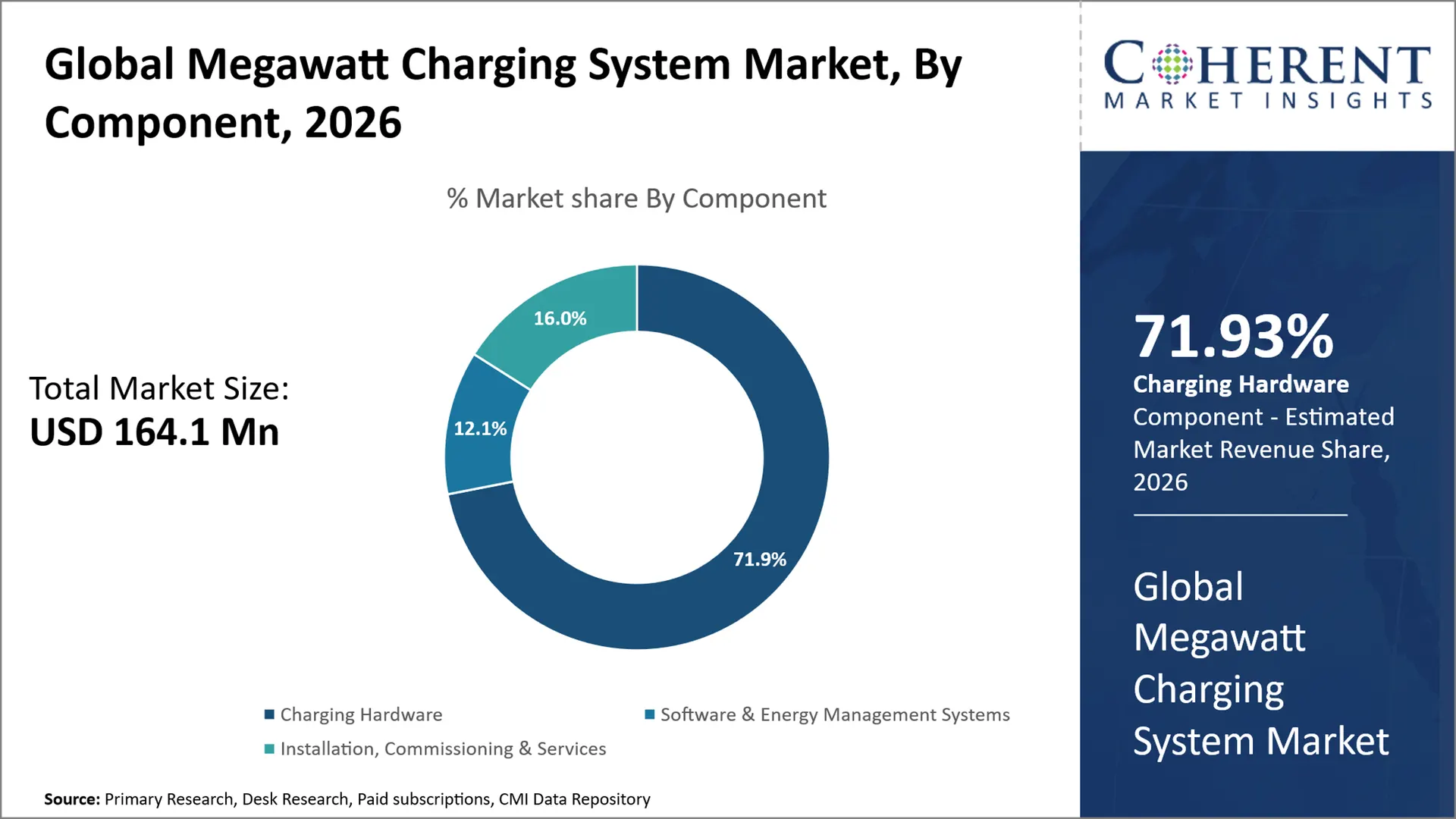
Why Does Charging Hardware Dominate the Global Megawatt Charging System Market?
In terms of component, charging hardware is estimated to account for 71.93% of the global megawatt charging system market share in 2026. Most of the money in a megawatt charging site goes into physical equipment. A single site needs power cabinets to convert grid electricity, dispensers, connectors, and liquid-cooled cables thick enough to carry very high currents safely. Software and services matter, but they are added once the hardware is in place.
The cost of this equipment is high because megawatt charging works at power levels far beyond a normal fast charger. Ordinary fast chargers for cars usually deliver a few hundred kilowatts. A megawatt charger delivers 1,000 kW or more to a single truck, which needs heavier power electronics, active cooling and, in many cases, a new medium-voltage grid connection with its own transformer. Every new site therefore starts with a large hardware order, and early networks are still at the stage of building sites rather than running them.
In May 2025, Brennerautobahn and Alpitronic put Italy’s first megawatt charging system into operation at Bolzano on the Brenner motorway, with a charging capacity of up to 1,000 kW.
- Current Industry Events of 2026
- Market Size Estimation
- Regional Breakdown
- Competitive Landscape
- Customer Intelligence
- Segmental Analysis
- Pricing Analysis
- Key Market Drivers, Challenges & Future Trends
- Customized Insights Section
Why Are Heavy-Duty Trucks the Largest Users of Megawatt Charging?
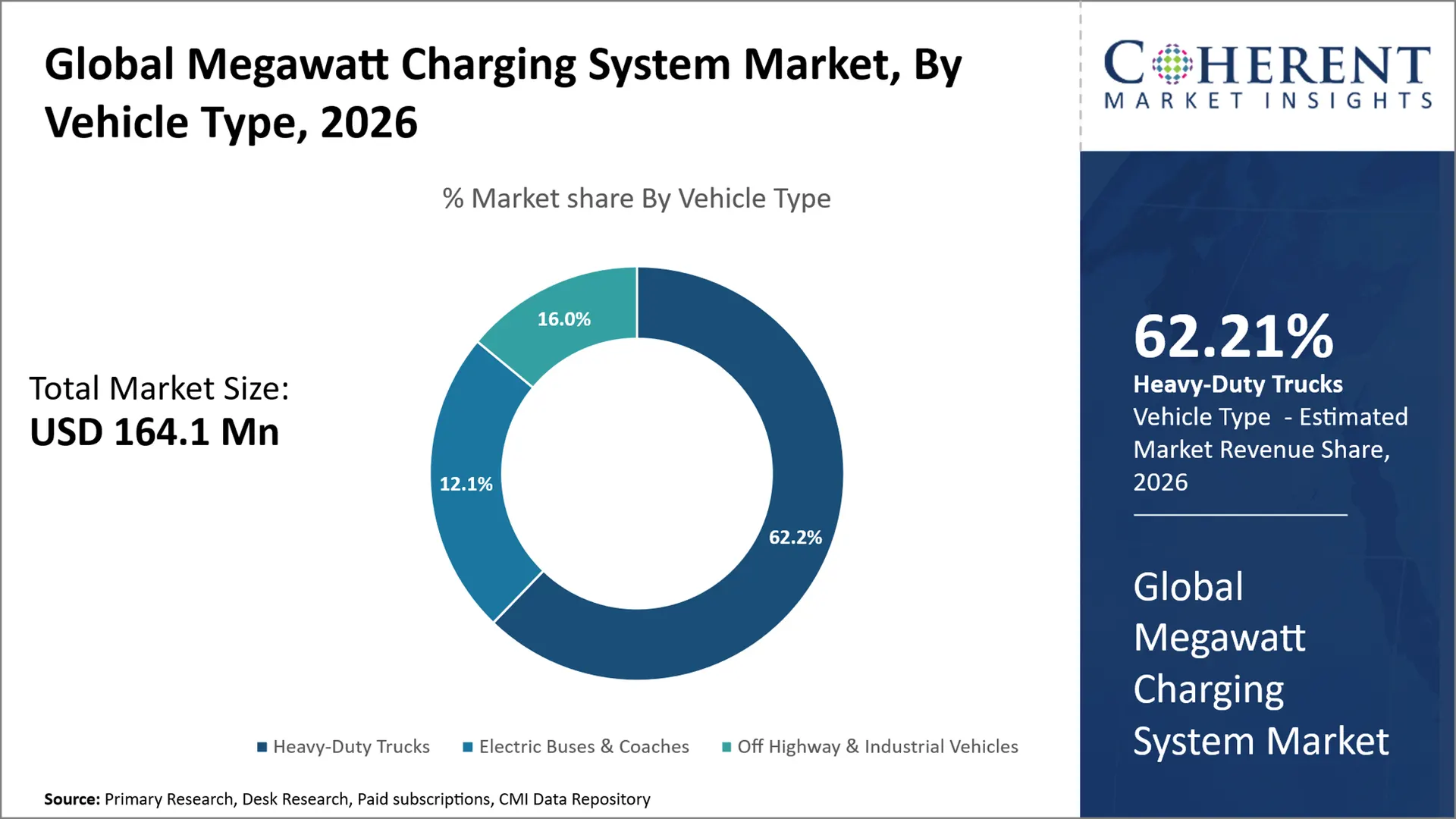
In terms of vehicle type, heavy-duty trucks is estimated to account for 62.21% of the global megawatt charging system market share in 2026. Megawatt charging was designed for them. A long-haul electric truck carries a battery several times larger than a car, and with a standard fast charger, refilling it could take a large part of a working day.
The business case comes down to time. In Europe, truck drivers must take a 45-minute break after four and a half hours of driving. A megawatt charger can add enough energy during that break for the next leg of the trip, so the truck does not lose working hours to charging. That makes electric trucks practical for long-distance freight, the largest and most diesel-dependent part of road transport. As truck makers start fitting megawatt charging ports at the factory, every new long-haul electric truck becomes a regular user of megawatt chargers.
On June 16, 2025, Scania unveiled its megawatt charging system for electric trucks at EVS38 in Gothenburg, Sweden, with the R 450e as its first model to carry a factory-fitted megawatt charging port, from early 2026.
Why Does the 1 MW–2 MW Range Lead Charger Power Output?
In terms of charger power output, the 1 MW–2 MW segment is projected to hold 45.0% of the global megawatt charging system market share in 2026. This range matches what today’s electric trucks can accept. Trucks now reaching the market charge at roughly 750 kW to 1.2 MW, so chargers in this band can serve them with room to spare.
The range also suits the grid. Higher power output needs larger grid connections, which take longer to approve and cost more to build. Chargers between 1 MW and 2 MW offer a practical balance: fast enough to recharge a truck during a driver’s break, yet small enough to fit sites where grid capacity is limited. Operators can also share power between several dispensers at one site, getting more value from the same grid connection.
In March 2026, Kempower, Windrose Technology and EV Realty completed the first megawatt charging session in North America using a Kempower charger, at EV Realty’s charging hub in San Bernardino, California.
Current Events and their Impact
Current Events | Description and its Impact |
EU Alternative Fuels Infrastructure Regulation (AFIR) Truck Charging Targets |
|
Publication of the International Megawatt Charging Standard (IEC TS 63379, February 2026) |
|
Megawatt Charging System Market Dynamics
Market Drivers
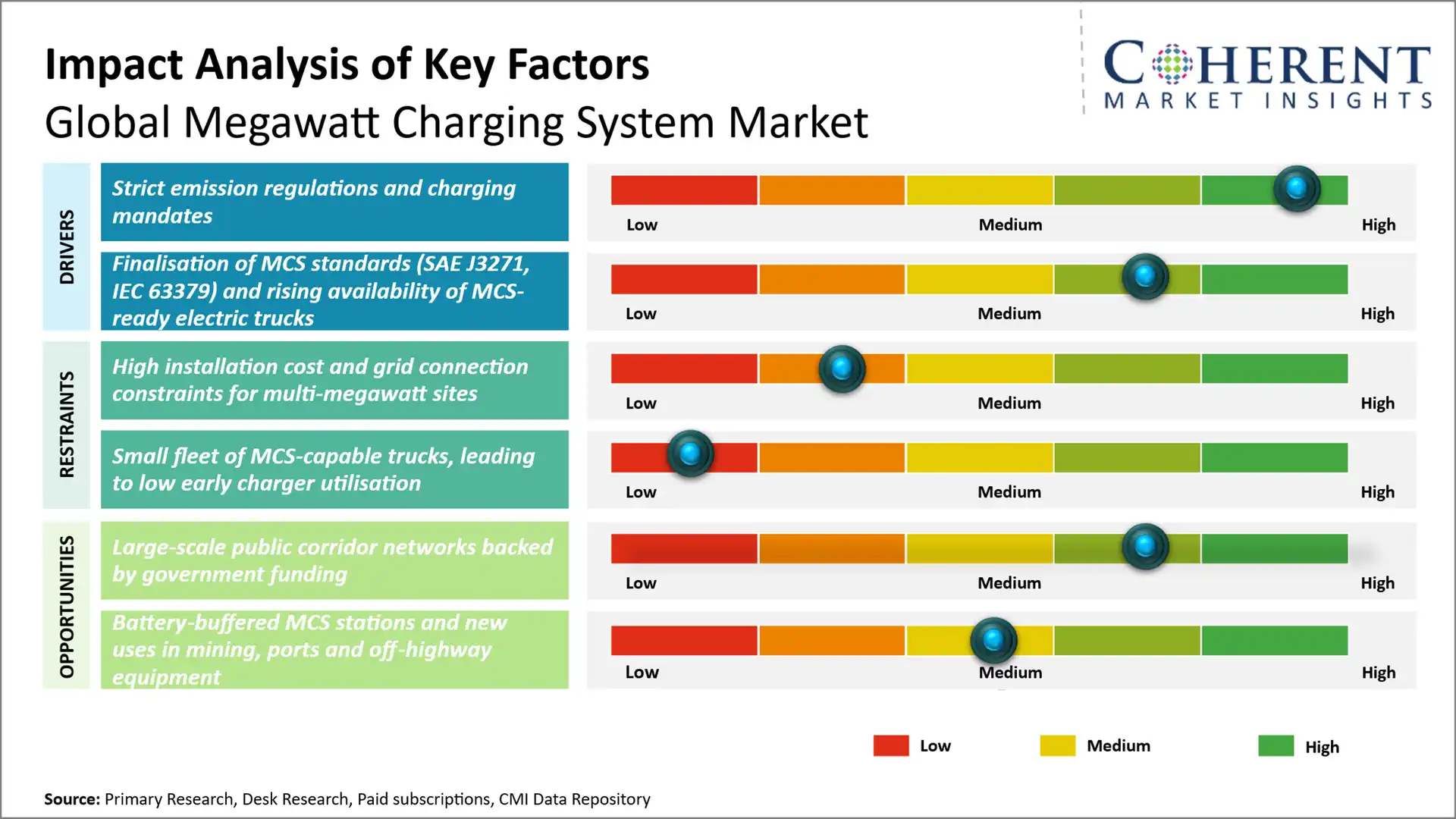
- Strict emission regulations and charging mandates: Governments are tightening the rules on truck emissions and, at the same time, setting charging targets that operators have to meet. Heavy trucks are one of the hardest parts of road transport to clean up, so regulators in Europe now cap the CO2 that new trucks may emit, with the limits getting steeper over time. Fleets that must cut emissions need battery-electric trucks, and long-haul trucks only work if they can recharge during a driver’s break. That is what megawatt charging does. Charging mandates cover the other half of the problem. They require public sites along the main freight routes, so operators don’t have to guess whether demand will arrive. The scale is large: the International Council on Clean Transportation (ICCT) estimates that the EU will need between 4,000 and 5,300 public megawatt chargers by 2030. Together, the two sets of rules push truck makers to sell electric trucks and push network operators to build the sites those trucks need.
- On September 29, 2025, Germany’s first official public megawatt charging point went into operation at the Lipperland Süd service area on the A2 motorway.
- Finalisation of MCS standards (SAE J3271, IEC 63379) and rising availability of MCS-ready electric trucks: For years, megawatt charging was a prototype technology that few vehicles could use. Two things are changing that. The standards are now settled. SAE J3271 sets out the system as a whole, from the coupler to communication and cooling, and IEC TS 63379 covers connectors, vehicle inlets and cable assemblies. Charger makers and truck makers can therefore design to the same interface instead of waiting to see which design wins. At the same time, truck makers are moving from test fleets to series production. Once a truck leaves the factory with a megawatt charging port, the fleet that buys it needs megawatt chargers for as long as the truck is in service. Each new long-haul electric truck on the road therefore adds steady, long-term demand for charging hardware, software and site services.
- In March 2026, Daimler Truck announced that it would soon deliver the first units of its eActros 600 long-haul electric truck equipped for megawatt charging.
Emerging Trends
- Modular chargers that share power across many vehicles: Instead of installing one fixed charger per bay, operators are choosing central power units that split their output across several charge points as demand changes. One cabinet can serve a single truck at full megawatt power, or several cars and trucks at lower power at the same time. In July 2026, SOLUM and i-charging began commercial deliveries of the MAX charging platform. MAX scales from 50 kW to 1.6 MW in a single cabinet and shares its power in real time across up to eight connected vehicles.
- Impact: Operators can make better use of a limited grid connection and add capacity in steps as more megawatt-capable trucks arrive, rather than paying for full capacity on day one.
- Relevance to the market: This supports growth in software and energy management, the fastest-growing component, because power-sharing depends on control software. It also favours hardware makers with modular product lines over those selling single fixed units.
- Megawatt charging is being tested for two-way power flow: Truck makers and grid companies are testing systems in which a parked electric truck can send electricity back to the grid through the same megawatt charging connection. A large truck battery is a sizeable energy store, and fleets that spend nights or weekends parked at depots could earn money by supporting the grid at peak times. In June 2026, Scania demonstrated vehicle-to-grid power transfer from a heavy-duty electric truck through a megawatt charging connection, one of the first such demonstrations in heavy transport.
- Impact: If two-way charging becomes commercial, fleets could offset part of their charging costs, and grid operators could treat truck depots as flexible energy resources rather than only as large loads.
- Relevance to the market: Chargers with two-way power electronics and grid-aware software would command higher prices. Depot charging sites, rather than public corridor sites, are likely to adopt the feature first.
Regional Insights
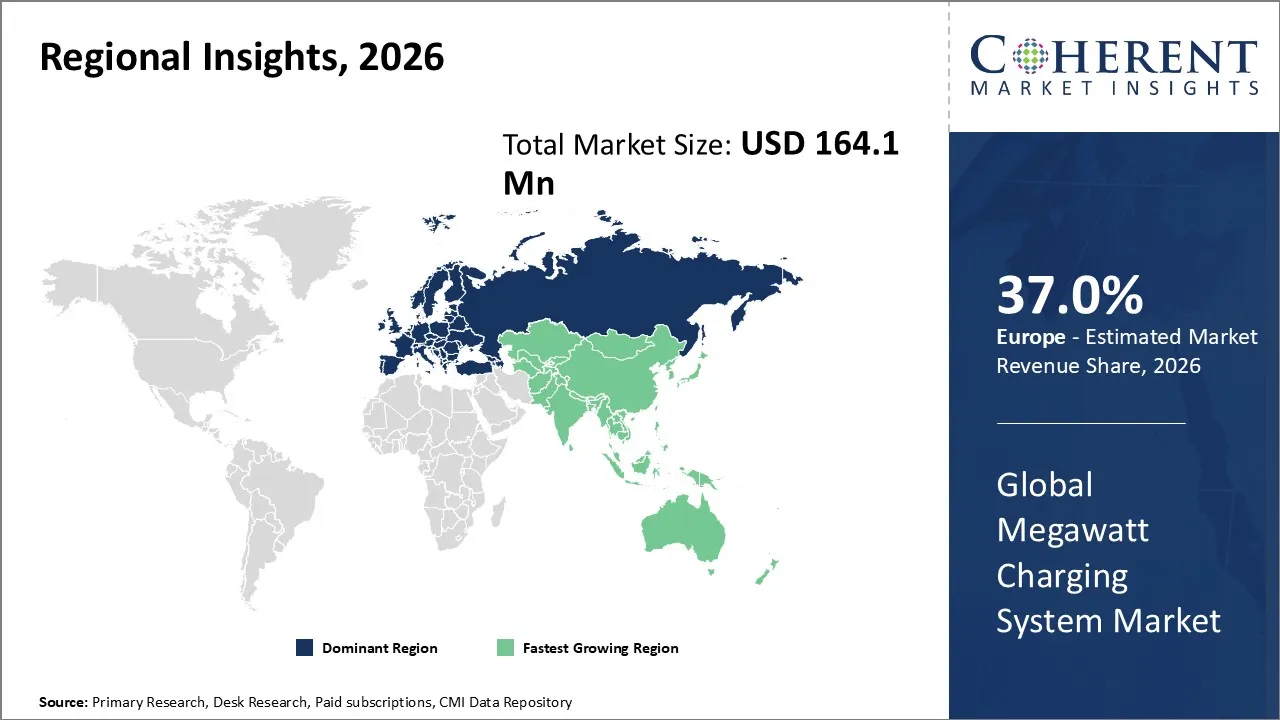
Why Does Europe Lead the Global Megawatt Charging System Market?
Europe is projected to capture a market share of 37.0% in 2026. The region was first to set binding rules for heavy-duty charging, and most of the world’s leading truck makers are based here, including Daimler Truck, the Volvo Group, MAN and Scania. Truck makers have gone further than building vehicles: Daimler Truck, the TRATON Group and the Volvo Group set up Milence as a joint venture to build a public charging network for heavy trucks. Milence plans 284 megawatt charging points across 71 sites by the end of 2027, with support from the EU’s Alternative Fuels Infrastructure Facility. Europe is also home to most of the leading megawatt charger makers, such as ABB E-mobility, Kempower, Alpitronic and Siemens. With regulation, truck makers, charger suppliers and network operators all in one region, Europe is likely to stay in front.
Why Is Asia Pacific the Fastest-Growing Region in the Megawatt Charging System Market?
Asia Pacific is expected to account for 31.0% of the global market in 2026 and register the fastest growth over the forecast period. China drives most of this growth. It is the world’s largest market for electric heavy trucks, and Chinese companies are building large charging hubs along freight routes and around mines, ports and industrial parks. The region also has a strong manufacturing base for power electronics, batteries and charging equipment, which keeps hardware costs lower than in other regions. As more countries in the region electrify their truck and bus fleets, demand for megawatt charging is expected to rise faster than in more mature markets.
Global Megawatt Charging System Market Outlook for Key Countries
Is the U.S. Leading Megawatt Charging in North America?
The U.S. megawatt charging system market is projected to reach USD 43.41 Mn in 2026, the largest in North America. Demand comes mainly from private depots rather than public corridors. Drayage trucks that move containers from ports, and fleets running fixed regional routes, can charge at their own sites, so fleet operators and charging-as-a-service providers are building depot hubs first. The U.S. is also by far the region’s largest heavy-truck market: about 212,707 new Class 8 trucks were sold there in 2025. Tesla operates its own Megacharger network for the Tesla Semi, and European charger makers are entering the market: Alpitronic has opened its U.S. headquarters in Charlotte, North Carolina. Federal policy direction is less certain, so the U.S. market depends more on state programmes and private investment.
Is China the Main Growth Engine in Asia Pacific?
China’s megawatt charging system market is projected to reach USD 47.60 Mn in 2026, the largest of any country. China’s megawatt charging system market is projected to reach USD 47.60 Mn in 2026, the largest of any country. China accounted for more than 90% of global electric truck sales in 2025, according to the International Energy Agency (IEA). Electric trucks made up 28% of its heavy truck sales that year, up from 13% in 2024. The trend has continued in 2026. In September 2026, electric trucks reached 50.3% of China’s heavy truck sales, or 33,100 trucks in a single month. Most of these trucks work on short, high-intensity routes such as mining, steel plants, ports and city logistics, where quick turnaround matters. China mostly uses its own domestic charging standards rather than the CharIN MCS standard used in Europe and North America, and Chinese suppliers such as Huawei Digital Power are building megawatt-class charging hubs for heavy trucks. Rapid truck adoption and low-cost local equipment are the main reasons Asia Pacific is the fastest-growing region.
Why Is Germany at the Center of Europe’s Megawatt Charging Rollout?
Germany’s megawatt charging system market is projected to reach USD 8.93 Mn in 2026. German-registered trucks carried 277.4 billion tonne-kilometres of road freight in 2025, second only to Poland in the EU, and it sits at the centre of Europe’s busiest truck corridors. The federal government is building a national truck charging network along its motorways, planned at around 350 sites and 4,200 charging points, of which about 1,800 will be megawatt chargers. Germany is also home to Daimler Truck and MAN, and to key suppliers such as Siemens and Phoenix Contact. Strong public planning, major truck makers and an established supplier base make Germany Europe’s most active megawatt charging market.
France Megawatt Charging System Market Analysis and Trends
France’s megawatt charging system market is projected to reach USD 5.59 Mn in 2026. French hauliers moved 172.9 billion tonne-kilometres of road freight in 2025, the fourth-highest in the EU. France is also a key transit country: the Belgium–France corridor carried 55.9 million tonnes of goods in 2025, the third-largest road freight flow between EU countries. Under EU rules, France must provide truck charging pools along its main motorway corridors by 2030, which will create steady demand for megawatt chargers on long-distance routes to Spain, Italy and the Benelux countries.
Italy Megawatt Charging System Market Analysis and Trends
Italy’s megawatt charging system market is projected to reach USD 5.22 Mn in 2026. Italian hauliers moved 161.7 billion tonne-kilometres of road freight in 2025. That was the fifth-highest in the EU and 8.6% of the EU total. The country also sits at the southern end of Europe’s main north–south freight routes, and its Alpine motorway links to Austria and Germany are among the most important of them. Italy is home to Alpitronic, a megawatt charger maker based in Bolzano, so local operators have a domestic supplier close by. Public megawatt charging is still at an early stage, so growth will depend on how quickly operators extend charging along the main motorway corridors. With heavy freight volumes and a home-grown charger maker, Italy is one of Europe’s more promising mid-sized markets.
Global Megawatt Charging System Market – Key Megawatt Chargers Used for Heavy-Duty Vehicle Charging
Charger | Producer | Power Output | Main Uses |
MCS1200 | ABB E-mobility | Up to 1,200 kW continuous | Public corridor hubs and fleet depots for long-haul electric trucks and coaches |
Mega Satellite | Kempower | Up to 1.2 MW peak | Fleet depots and public truck charging hubs; part of a distributed system in which one power unit feeds several dispensers |
HYC1000 | Alpitronic | Up to 1,000 kW, shared across multiple charging points | Motorway truck charging hubs; can serve one truck at megawatt power or several vehicles at once |
How Is Mining Electrification Creating New Growth Opportunities in the Megawatt Charging System Market?
Mining companies are under pressure to cut emissions, and diesel haul trucks are their biggest source. According to CharIN, haul trucks account for up to 80% of mine-site emissions. Replacing them with battery-electric trucks only works if the batteries can be recharged quickly between shifts, and a large haul truck carries a battery many times bigger than road trucks. That calls for charging at several megawatts, far above what road trucks need today. This opens a new area of demand beyond highways and depots: ruggedised chargers, heavy-duty cables and connectors, site energy storage and grid connections at remote mine sites. CharIN has already developed Ruggedized MCS and Extreme MCS versions of the standard for the heaviest mining equipment, so suppliers can design products for this segment with confidence. Mines also run fleets of 40 or more trucks around the clock, so each electrified site needs many high-power chargers at once.
On May 25, 2026, Fortescue announced that commissioning had started on its first in-house 6 MW fast charger in Western Australia’s Pilbara region, built to fully charge a 240-tonne battery-electric haul truck in about 30 minutes.
Market Players, Key Development, and Competitive Intelligence
Key Developments
- On July 30, 2026, MAN Truck & Bus started series production of its battery-electric eTGX and eTGS trucks with the megawatt charging option at its Munich plant. MAN says it is the first European commercial vehicle maker to build such trucks in series. They charge at up to 750 kW, double the 375 kW limit of the CCS connector on MAN’s eTrucks.
- On June 25, 2026, Fraunhofer ISE reported that MAN and its partners in the NEFTON project had run a complete truck charging path stably at 3,000 amperes on a test bench, at voltages up to 1,250 V. That is the current level the MCS standard is designed for. MAN says this could one day add more than 400 km of range in about 10 to 15 minutes, once batteries that can accept such power exist.
- On May 4, 2026, Germany’s Federal Ministry for Transport announced USD 1.17 billion over four years for charging infrastructure for heavy battery-electric vehicles (EUR 1 billion × 1.17, the European Central Bank reference rate on May 4, 2026). USD 234 million is available in 2026 (EUR 200 million × 1.17), with applications open from May 26 to July 7, 2026. The programme covers private depots as well as public sites such as motorway rest areas and charging hubs.
- On January 21, 2026, Keysight Technologies launched the SL2600A Megawatt Charging Discovery System. The test platform supports up to 1,500 V and 1,500 A and can test both vehicles and charging stations.
Competitive Landscape
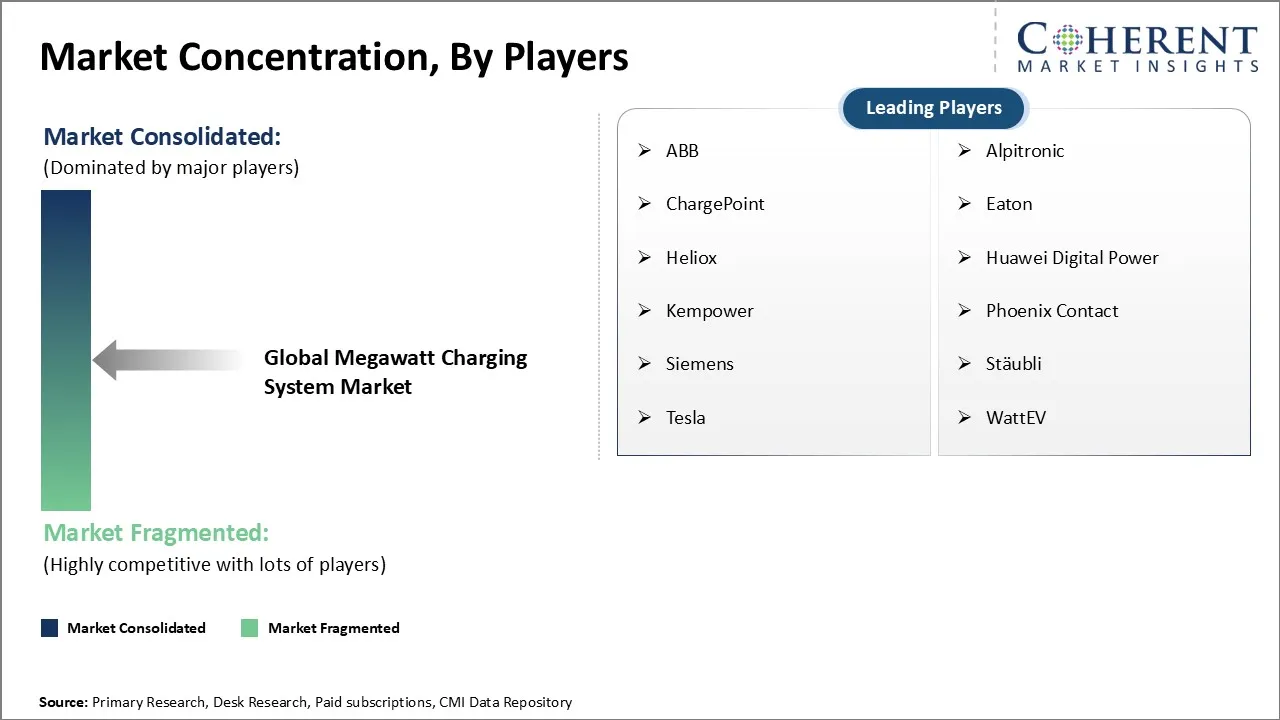
The market is split between hardware makers, network operators and truck makers, and the lines between them are getting blurry. ABB, Kempower, Alpitronic and Siemens (which owns Heliox) are the main charger suppliers in Europe. ChargePoint and Tesla are the best-known names in North America. Tesla builds its own chargers for its Semi trucks, so it acts as both supplier and operator. Huawei Digital Power is a major supplier in China, where charging hubs are built to domestic standards. Stäubli and Phoenix Contact supply connectors and related parts that every charger needs. Operators such as Milence in Europe and WattEV in California run the sites themselves, and truck makers back several of these networks so their vehicles have somewhere to charge. Competition centres on continuous power rating, uptime, the ability to share power between dispensers, and compatibility with trucks from every brand. Total site cost, including the grid connection, matters as much as the price of the charger.
Top Companies and Notable Products in the Megawatt Charging System Market
Company | Notable Product | Key Features |
ABB | MCS1200 | Delivers up to 1,200 kW of continuous power to a single truck; built for long-haul trucks and coaches |
Kempower | Mega Satellite | Dispenser fed by a central power unit, with up to 1.2 MW peak output; the Flex version has both an MCS and a CCS connector in one unit |
Alpitronic | HYC1000 | Up to 1,000 kW shared across several charging points, so one truck can take full power or several vehicles can charge at once |
Siemens | SICHARGE megawatt charging system | Prototype that delivered a 1 MW charge to a battery-electric heavy-duty truck during testing with Daimler Truck |
ChargePoint | Megawatt Charging System | Up to 1.2 MW at launch, with a design path to 3 MW; supports two-way charging; cable and connector fit its Power Link 2000 stations |
Market Report Scope
Global Megawatt Charging System Market Report Coverage | |||
Report Coverage | Details | ||
Base Year | 2025 | Market Size in 2026: | USD 164.1 Mn |
Historical Data For: | 2020 To 2024 | Forecast Period: | 2026 To 2033 |
Forecast Period 2026 To 2033 CAGR: | 44.00% | 2033 Value Projection: | USD 2,102.8 Mn |
Geographies covered: |
| ||
Segments covered: |
| ||
Companies covered: | ABB, Alpitronic, ChargePoint, Eaton, Heliox, Huawei Digital Power, Kempower, Milence, Phoenix Contact, Siemens, Stäubli, Tesla, WattEV | ||
Growth Drivers: |
| ||
Restraints & Challenges: |
| ||
Analyst Opinion (Expert Opinion)
- Hardware still takes most of the money, but value is starting to move towards software and site design. Charging hardware made up 71.93% of spending in 2026, against 12.05% for software and energy management and 16.01% for installation and services. That split suits a market still building its first sites, but it probably won’t last. Few trucks on the road can take a full megawatt today, so many sites will spend much of their time splitting power across several vehicles. Software that shares power between dispensers, books charging slots and keeps a site inside its grid limit often matters more than a higher power rating. That is why software and energy management is the fastest-growing component. Suppliers that sell the cabinet, the software and the service contract together are likely to win the larger orders. Those that sell only cabinets or cables may find margins harder to hold as more makers enter.
- Growth is likely to stay policy-led and strongest in Europe, with two timing risks. Europe estimated to hold 37.0% of the market in 2026 because its charging rules and truck-maker networks came first, and Asia Pacific, at 31.0%, is catching up on the back of China’s large electric truck fleet. The first risk is truck supply. About 298,000 heavy trucks above 16 tonnes were registered in Europe in 2025, and about 233,000 Class 8 trucks were sold in the U.S. and Canada. These fleets are still mostly diesel, and only a small share of the electric trucks can accept megawatt charging. Chargers installed ahead of the trucks will sit underused for a while. The second risk is the grid. Multi-megawatt sites need high-voltage connections and transformers, and permits and upgrades can take longer than building the chargers. Suppliers with a mix of customers (corridor operators, depot fleets and mines) and a presence in more than one region are best placed, because a delay in one segment won’t stall their growth.
Speak to the analyst
Want personalized insights?
Take the findings above to one of our principal consultants, or have the report rebuilt around the segments, geographies and competitors you actually track.
Market Segmentation
- Component Insights (Revenue, USD Million, 2021 - 2033)
- Charging Hardware
- Software & Energy Management Systems
- Installation, Commissioning & Services
- Vehicle Type Insights (Revenue, USD Million, 2021 - 2033)
- Heavy-Duty Trucks
- Electric Buses & Coaches
- Off-Highway & Industrial Vehicles
- End User Insights (Revenue, USD Million, 2021 - 2033)
- Fleet Operators & Logistics Companies
- Public Transport Authorities
- Others (Commercial Charging Network Operators, etc.,)
- Charging Configuration Insights (Revenue, USD Million, 2021 - 2033)
- Single-Output MCS Chargers
- Multi-Output/Dispenser-Based MCS Systems
- Charger Power Output Insights (Revenue, USD Million, 2021 - 2033)
- 1.0–1.5 MW
- 1.5 - 2.0 MW
- Above 2.0 MW
- Regional Insights (Revenue, USD Million, 2021 - 2033)
- North America
- U.S.
- Canada
- Latin America
- Brazil
- Argentina
- Mexico
- Rest of Latin America
- Europe
- Germany
- U.K.
- Spain
- France
- Italy
- Russia
- Rest of Europe
- Asia Pacific
- China
- India
- Japan
- Australia
- South Korea
- ASEAN
- Rest of Asia Pacific
- Middle East
- GCC Countries
- Israel
- Rest of Middle East
- Africa
- South Africa
- North Africa
- Central Africa
- North America
- Key Players Insights
- ABB
- Alpitronic
- ChargePoint
- Eaton
- Heliox
- Huawei Digital Power
- Kempower
- Milence
- Phoenix Contact
- Siemens
- Staubli
- Tesla
- WattEV
Sources
Primary Research Interviews
- Charging Hardware Manufacturers and Component Suppliers
- Charge Point Operators and Network Developers
- Truck and Bus Manufacturers
- Fleet Operators and Logistics Companies
- Utilities and Grid Operators
Magazines
- electrive
- Charged EVs
- Heavy Duty Trucking
- Transport Topics
- International Mining
- Engineering & Mining Journal (E&MJ)
Journals
- IEEE Transactions on Transportation Electrification
- World Electric Vehicle Journal
- Energies
- Journal of Power Sources
Associations
- CharIN e.V.
- CALSTART
- International Council on Clean Transportation (ICCT)
Public Domain Sources
- SAE International: SAE J3271, Megawatt Charging System
- International Electrotechnical Commission (IEC): IEC TS 63379
- European Union: Regulation (EU) 2023/1804 (AFIR) and Regulation (EU) 2024/1610
- Eurostat: Road freight transport statistics, 2024 and 2025
- European Central Bank: Euro foreign exchange reference rates
- German Federal Ministry for Transport (BMV): Press release on charging infrastructure funding, May 4, 2026
- California Energy Commission and CALSTART: EnergIIZE Project, MCS Infrastructure Funding Lane
- U.S. Securities and Exchange Commission (SEC): Company annual filings
- Company press releases
- U.S. Securities and Exchange Commission (SEC): company annual filings
- Company press releases
Proprietary Elements
- CMI Data Analytics Tool
- Proprietary CMI Existing Repository of information for last 10 years
Get access to 250+ pages report
Every segment, forecast, competitor profile and data table behind the analysis above — available for instant download.
- ESOMAR Member
- ISO 9001:2015 Certified
- D-U-N-S Registered
- GDPR & CCPA Compliant
Frequently Asked Questions
The global megawatt charging system market is estimated to be valued at USD 164.1 Mn in 2026 and is expected to reach USD 2,102.8 Mn by 2033.
The CAGR of the global megawatt charging system market is projected to be 44.0% from 2026 to 2033.
Public funding and charging mandates for heavy-duty freight corridors, and truck makers fitting megawatt charging to their long-haul electric trucks, are the major factors driving market growth.
The high cost of chargers and grid upgrades, and the small number of trucks that can accept megawatt charging today, are the major factors hampering market growth. The second one keeps early charger use low.
In terms of component, charging hardware is estimated to dominate the market, with a revenue share of 71.93% in 2026.
A megawatt charging system (MCS) is a direct-current charging standard for heavy-duty electric vehicles, such as long-haul trucks, buses and coaches, and for off-highway machines used in mines and ports. It can deliver well over 1 MW to a single vehicle, with a design limit of 3.75 MW (1,250 V at 3,000 A). The CharIN industry association developed it, and it is now set out in SAE J3271 and IEC TS 63379.
A site needs power cabinets that convert grid electricity into direct current, a dispenser, a liquid-cooled cable and connector, and a matching inlet on the vehicle. Control software manages the session. The vehicle and charger exchange data using the ISO 15118-20 communication protocol.