

Global Megawatt EV Charging Test Equipment Market Size and Forecast – 2026 To 2033
The Global Megawatt EV Charging Test Equipment Market is estimated to be valued at USD 45.2 Mn in 2026 and is expected to reach USD 341.6 Mn by 2033, growing at a CAGR of 33.50% during the forecast period. The market is driven by the growth of megawatt charging infrastructure for heavy duty electric trucks and busses, the increasing demand for high-power charging validation and the increasing importance of electrical safety and interoperability testing.
In October 2025, Siemens announced its SICHARGE FLEX charging system, which can deliver up to 1.68 MW of DC power and 1,500 A of charging current. The progress highlights the increasing technical sophistication of high-capacity charging infrastructure and the need for advanced power measurement, thermal safety testing, and charging-system validation equipment.
Key Takeaways of the Global Megawatt EV Charging Test Equipment Market
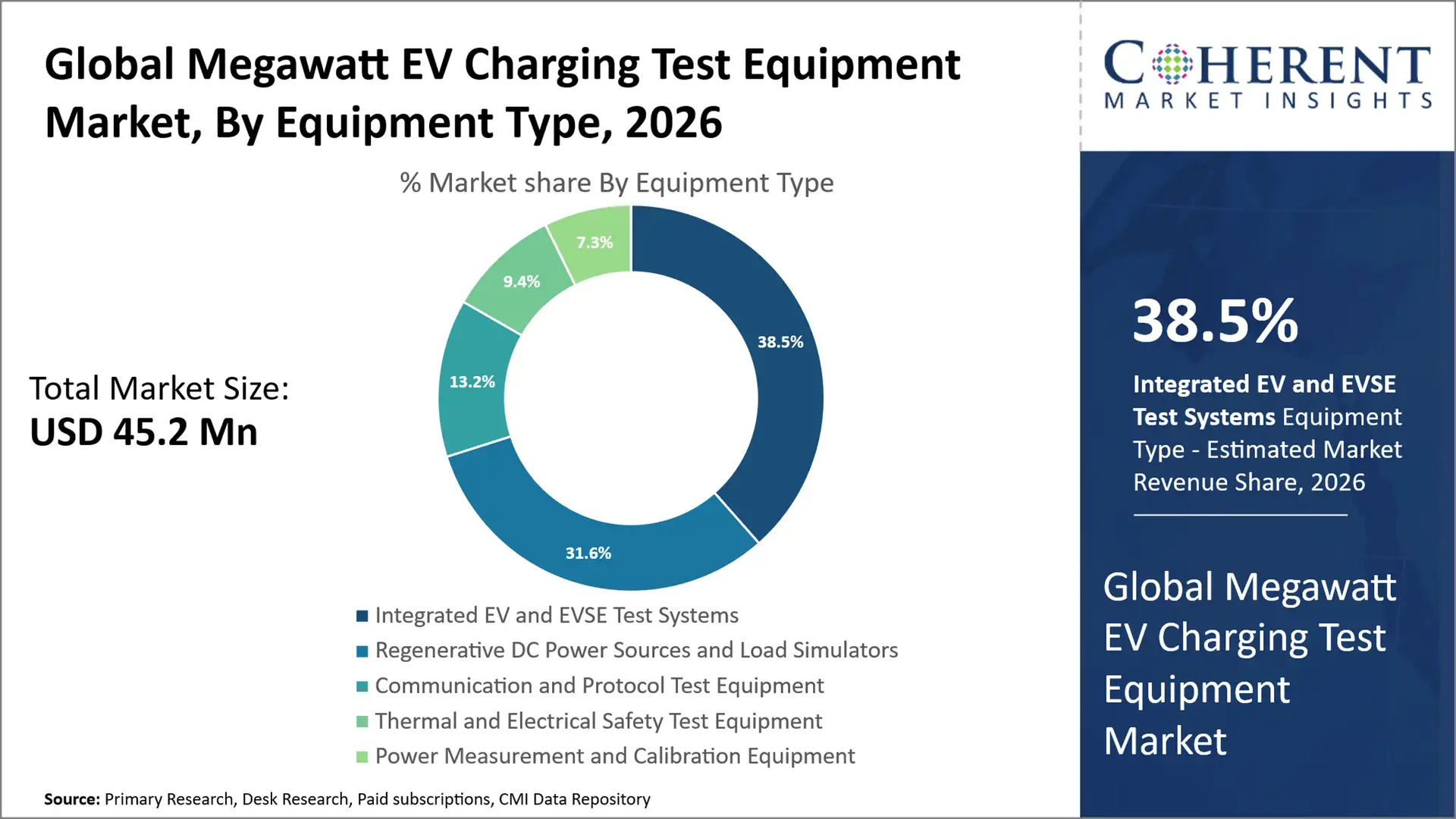
- Integrated EV and EVSE Test Systems are projected to grow at a CAGR of 34.5% through 2033 and will account for 38.5% of the global megawatt EV charging test equipment market in 2026. A combined vehicle and charger emulation reduces duplicated investment in the lab and detects protocol and power-transfer failures before deployment. In November 2025, Vector launched vCTS. performance merging scalable regenerative DC load testing with automated interoperability testing.
- Test power capacities above 1.5–2.5 MW are projected to represent 31.4% share of the global megawatt EV charging test equipment market in 2026 and grow at a CAGR of 35.9% through 2033. The power range allows for high current validation without the need for maximum rated laboratory infrastructure. Keysight announced its SL2600A Megawatt Charging Discovery System in January 2026, providing charging interface testing support up to 2.25 MW.
- Megawatt Charging Station Testing is estimated to grow at a CAGR of 35.8% between 2026 and 2033 with a global megawatt EV charging test equipment market share of 47.8% in 2026. Manufacturers of charging infrastructure will test power delivery, vehicle interoperability and charging-session security under real world conditions. CharIN successfully performed an integrated MCS test in June 2025 in France, with power transfer between heavy-duty vehicles and charging systems.
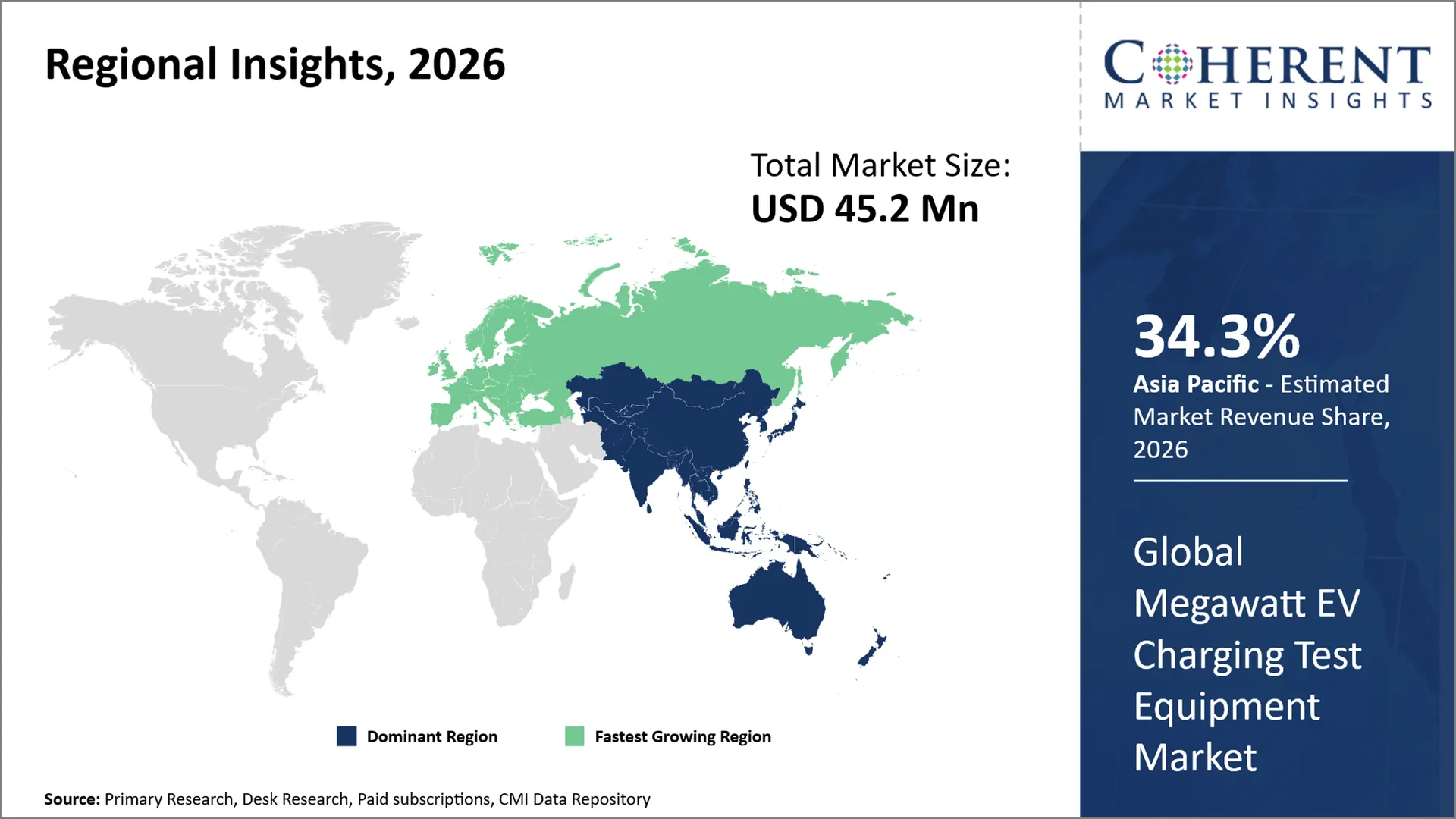
- Asia Pacific is projected to maintain its 34.3% market share in 2026 and post a compound annual growth rate (CAGR) of 32.0% through 2033 for global megawatt EV charging test equipment market. High power testing and repeatable performance assessment are a must for focused manufacturing of charging equipment and electrification of commercial vehicles. In August 2026, a technical guidance project on performance requirements and testing methods of MW DC charging for heavy-duty electric trucks was registered by China’s national standards platform.
- Europe is projected to see the fastest estimated CAGR of 37.8% till 2033 with 31.1% market share in global megawatt EV charging test equipment market. The electrification of cross-border freight raises the demand for traceable charger measurements and harmonized testing procedures. The European LEG4EVSE project was launched in July 2026 to develop dedicated test equipment and metrology methods for megawatt DC charging systems.
Segmental Insights
Why Do Integrated EV and EVSE Test Systems Dominate the Global Megawatt EV Charging Test Equipment Market?
Integrated EV and EVSE test systems are expected to capture 38.5% of the global megawatt EV charging test equipment market by 2026. Their leadership illustrates the need to conduct a coordinated testing environment that includes investigating charging failures in vehicle controllers, charging stations and electrical interfaces. With these platforms, engineers can simulate communication failures, study charge sequences and evaluate software changes — without having to configure each instrument over and over. Protocol libraries, interface modules and special engineering services can be a new revenue stream for equipment suppliers. Commercial vehicle OEMs and EVSE developers gain greater uniformity in validation processes. In November 2025, dSPACE promoted its Smart Charging Solution for MCS communication-controller testing, which enables developers to simulate charging infrastructure without the need for physical access to a charging station. This approach enables an earlier detection of control related failures in the development of heavy-duty charging systems.
- Current Industry Events of 2026
- Market Size Estimation
- Regional Breakdown
- Competitive Landscape
- Customer Intelligence
- Segmental Analysis
- Pricing Analysis
- Key Market Drivers, Challenges & Future Trends
- Customized Insights Section
Why Does Above 1.5–2.5 MW Represent the Largest Test Power Capacity Segment in the Global Megawatt EV Charging Test Equipment Market?
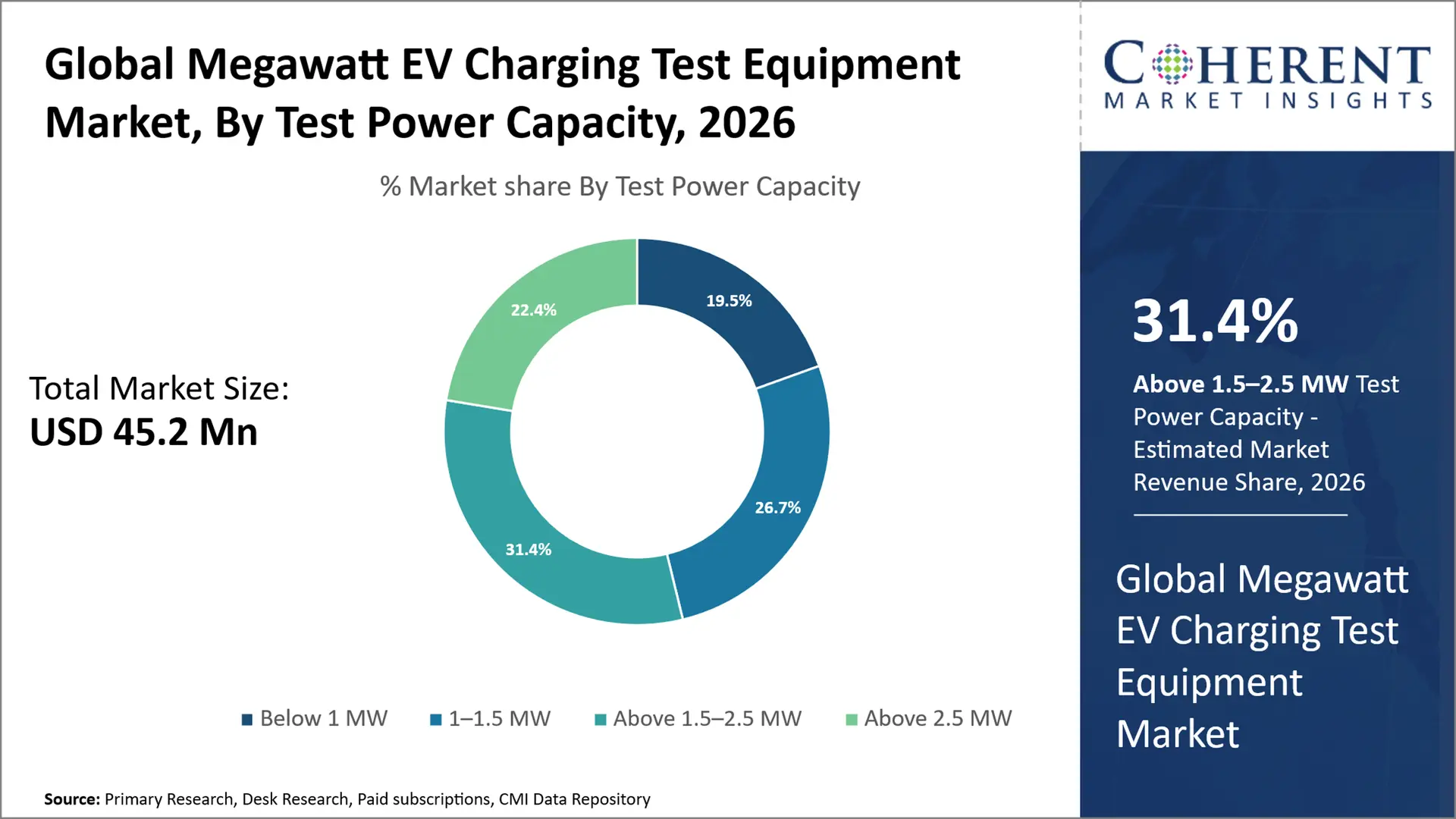
Above 1.5–2.5 MW test power capacity is expected to represent 31.4% of the global megawatt EV charging test equipment market in 2026, leading the test power capacity category. This range is designed to meet the challenge of maintaining a high level of electrical output and simultaneously monitor voltage stability, thermal behavior and protective responses during rigorous charging cycles. When selecting laboratory equipment, laboratory operators should take into account the current grid capacity, the cooling requirements and the continuous power ratings. This opens up opportunities for suppliers of specialized lab infrastructure, measurement instruments and high power DC loads. In February 2026, the European HYPOBATT project successfully demonstrated an MCS-aligned charging infrastructure with validated power delivery of up to 2 MW for an electric ferry. While this is a maritime application, it is a demonstration of the engineering requirements with this power class: sustained energy transfer and system validation in an integrated manner.
Why Does Megawatt Charging Station Testing Dominate the Test Application Segment of the Global Megawatt EV Charging Test Equipment Market?
Megawatt Charging Station Testing is expected to dominate the global megawatt EV charging test equipment market with a 47.8% share in the test application segment in 2026. Charging infrastructure developers need to verify the complete performance of the station in the case of emergency shutdowns, prolonged electrical loading and real vehicle charging sessions. These prerequisites go beyond prototype validation, as charging network operators need reliable evidence of thermal stability and protection-system performance in commercial operating environments. Equipment suppliers can benefit from the supply of commissioning instruments, diagnostic systems and specialized field testing services. ABB E-mobility and MAN Truck & Bus have successfully completed an MCS testing campaign in September 2025 including communication behavior, current ripple, emergency shutdown and sustained charging performance. The companies' report of a continuous charging session exceeding 3.5 hours demonstrated the importance of endurance testing for a dependable heavy-duty charging infrastructure.
Current Events and their Impact
Current Event | Description and Its Impact |
June 2025: European Commission revises charging interoperability requirements |
|
In August 2026, China introduced a compulsory CCC certification for electric vehicle charging equipment. |
|
NIST Releases Revised Commercial Measurement Standards January 2026 |
|
Global Megawatt EV Charging Test Equipment Market Dynamics
Key Market Drivers
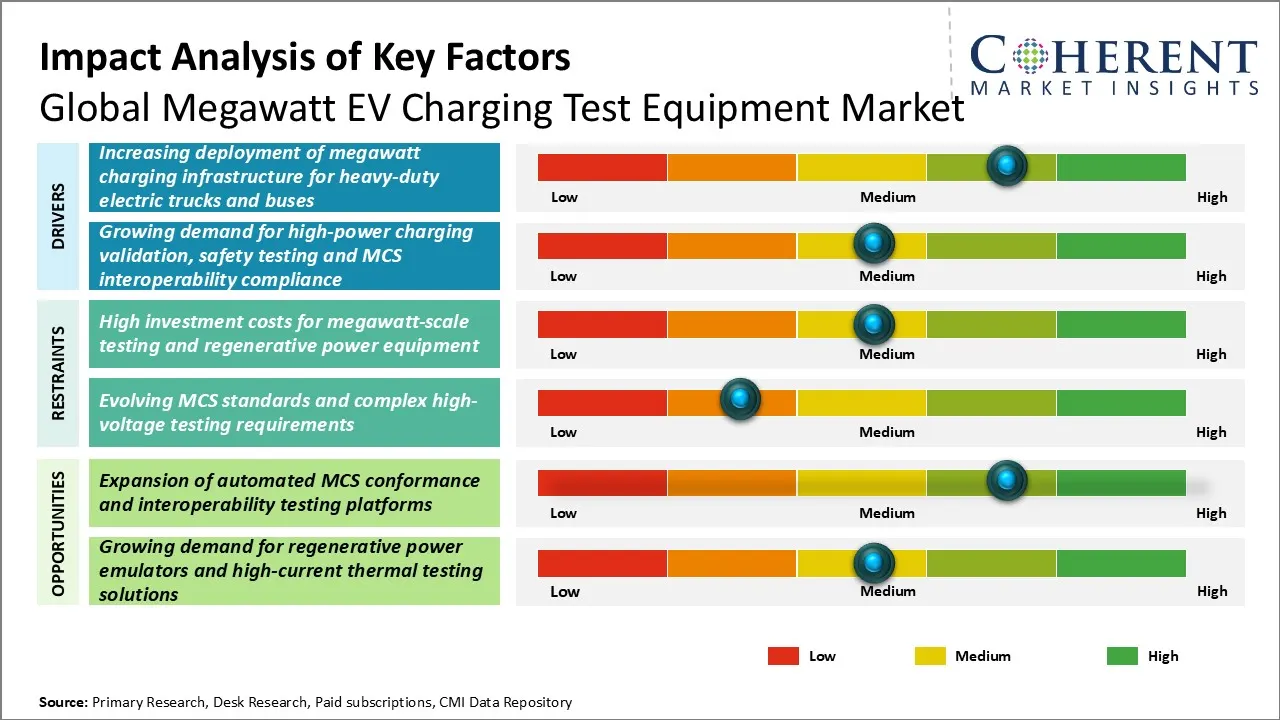
- Increasing Deployment of Megawatt Charging Infrastructure for Heavy-Duty Electric Trucks and Buses: With the development of high-capacity charging networks for electric freight vehicles, new demands are arising for megawatt charging test equipment. Before commissioning, charging infrastructure developers must ensure operational reliability, sustained current delivery, power conversion efficiency and connector performance. This provides procurement opportunities for integrated charging test platforms, high voltage measurement equipment and regenerative load simulators. In January 2025, the U.S. Department of Energy announced it will award US$ 68 million for projects to develop and demonstrate large-scale charging sites at ports, distribution hubs and major freight corridors. The funding will support the validation requirements of future high-power infrastructure.
- Growing Demand for High-Power Charging Validation, Safety Testing and MCS Interoperability Compliance: Engineering challenges with high current connections, thermal protection, safe communication, and coordinated charging control make megawatt charging complicated. Vehicle manufacturers, EVSE suppliers and certification laboratories require special equipment to reproduce operating conditions and to detect communication failures prior to commercialization. The standardized MCS communication specifications also increase the importance of protocol-specific test capabilities. In July 2026, the International Organization for Standardization published Amendment 1 to ISO 15118-20, containing MCS charging services and an improved security concept. This update is a technical reference for validation of communication and interoperability testing.
Emerging Market Trends
- Shift Toward Energy-Efficient, Reconfigurable Megawatt Test Laboratories: Modular equipment configurations are becoming more common in megawatt charging test laboratories to support various charging architectures. The use of regenerative power systems and sharing electrical infrastructure help make labs more efficient and reduce operating costs.
Impact: This change reduces the need for specialized high power testing equipment and reduces energy consumption. It also provides flexible configurations to accommodate a wide variety of testing programs in laboratories.
Relevance to Market: The trend creates opportunities for suppliers of modular load simulators, configurable testing platforms and regenerative DC power sources. Equipment manufacturers can boost their credibility with independent testing laboratories and EV charging developers by providing energy-efficient solutions.
- Commercialization of Software-Based Test Libraries and Digital Validation Records: Megawatt charging equipment manufacturers are increasingly leverage automated testing software and digital validation systems in their lab operations. Automated fault detection, centralized records and reusable test sequences all lead to simplified engineering documentation and improved testing consistency.
Impact: Software-based testing reduces manual intervention and accelerates validation across different charging system designs. It also improves traceability, reporting accuracy, and management of testing results.
Relevance to Market: This trend supports opportunities for the development of automated testing software, protocol validation tools, and advanced diagnostic platforms. By combining digital offerings with test equipment, suppliers can build stronger customer relationships and generate recurring software revenue.
Regional Insights
Why Does Asia Pacific Dominate the Global Megawatt EV Charging Test Equipment Market?
The Asia Pacific region is expected to hold 34.3% of the global megawatt EV charging test equipment market share in 2026 on the back of the region’s strong base in power electronics manufacturing, production of charging equipment, and growing high-power testing capabilities. Manufacturers across the region need specialized equipment to test the performance of connectors, electrical safety and charging controllers, before they supply domestic and export markets. Regional certification laboratories also assist equipment makers to meet international standards for interoperability. In August 2024, Korea Testing Certification (KTC) set up a separate electric vehicle charging division and said it will focus on testing the Megawatt Charging System (MCS) from now on. This development highlights the region’s investment in specialized charging validation infrastructure, which opens commercial opportunities for suppliers of integrated testing equipment, communication analyzers and programmable power sources.
Why Is Europe Emerging as the Fastest-Growing Region in the Global Megawatt EV Charging Test Equipment Market?
Europe is expected to be the fastest-growing regional global megawatt EV charging test equipment market with a share of 31.1% in 2026. The transition to electrified long-distance freight transportation in the region is raising the technical requirements for charging equipment development and validation. European engineering suppliers and research institutions are investing in thermal performance testing, grid-connected charging systems and high-voltage power conversion. In March 2026, the German organization Fraunhofer ISE presented the results of its HV-MELA-BAT project. Within the project, modular power converters for megawatt charging were developed and the system was demonstrated in a multi-megawatt laboratory setup. The project highlights Europe’s determination to overcome challenges in power conversion and infrastructure integration, enabling future procurement of specialized electrical testing equipment and laboratory services.
Global Megawatt EV Charging Test Equipment Market Outlook for Key Countries
Why Is the U.S. a Key Market for the Global Megawatt EV Charging Test Equipment Market?
The US is an important global megawatt EV charging test equipment market, due to its emphasis on high-power charging infrastructure research and electrification of commercial trucks. Testing requirements are expanding in scope to include grid performance at the station level, variability in electrical loads, and concurrent truck charging, as well as individual chargers. This enables opportunities for advanced data acquisition systems, grid simulators and high power emulators. In January 2025, the National Renewable Energy Laboratory (NREL) explained its Megawatt Charging Emulator, a device that can simulate the charging profiles of many heavy-duty electric vehicles at one location. The research infrastructure allows equipment manufacturers to adjust testing methods for commercial charging stations and large-scale fleet electrification projects.
Why Does China Support Growth in the Global Megawatt EV Charging Test Equipment Market?
China further consolidates its position in the global megawatt EV charging test equipment market. Domestic manufacturers need specific test equipment to evaluate the reliability of power converters, performance of liquid-cooling systems, voltage stability and continuous electrical output. These technical requirements open up opportunities for precision power measurement systems and regenerative DC loads. Huawei Digital Power launched its megawatt charging solution for heavy goods vehicles at a product launch in Shanghai in April 2025 and announced a charging network initiative with industry partners. This development exemplifies China’s shift to a higher-capacity charging infrastructure that could drive demand for specialized electrical validation, thermal testing and charging-system performance evaluations.
Why Is India Important in the Global Megawatt EV Charging Test Equipment Market?
India’s burgeoning electric truck ecosystem and increasing research capabilities in charging technology, it is becoming a potential market for megawatt charging test equipment. Domestic engineering institutions and charger developers must consider electrical performance under fluctuating grid conditions, high ambient temperatures and varying charging protocols. These requirements provide opportunities for specialized communication testing systems and configurable laboratory equipment. The Office of the Principal Scientific Adviser of India co-organised an India-EU workshop on advanced charging technologies, interoperability standards and megawatt charging systems in March 2026. The initiative, involving technical experts, automotive organizations and testing institutions, helped India prepare for future MCS adoption and develop more sophisticated charging validation capabilities.
Why Is Japan a Strategic Country in the Global Megawatt EV Charging Test Equipment Market?
Japan is important for its specialized high voltage charging evaluation services but also for its mature automotive engineering ecosystem and its precision measurement capabilities. Locally-based testing companies can apply their knowledge of automated testing, insulation testing and electrical calibration to the emerging megawatt-class applications. The validation features of CHAdeMO as they exist today, however, are different from those specific to MCS. TOYO Corporation also announced in April 2025 that it will expand its EV charging evaluation service to support CHAdeMO charging at voltages up to 1,000 V, starting in May 2025. This development reflects the investment in testing infrastructure at higher voltages and the technical basis that could enable the future development of more advanced charging verification solutions.
Why Is Brazil an Important Growth Market for the Global Megawatt EV Charging Test Equipment Market?
Brazil represents an emerging opportunity for global megawatt EV charging test equipment market as commercial fleet electrification develops alongside charging infrastructure regulations. The initial equipment requirements will likely emphasize electrical measurement, safety verification and field calibration rather than dedicated multi-megawatt laboratories. Local industrial operators and suppliers of charging equipment will need reliable measurements to assess the performance of charging systems and to prepare for future compliance obligations. In April 2026, Brazil’s National Institute of Metrology, Quality and Technology (Inmetro) initiated discussions on potential technical metrology requirements for electric vehicle charging systems. The initiative can enable future investment in traceable DC energy measurements, specialized calibration equipment, and charging-system testing services, even though the regulatory framework is still under development.
Megawatt EV Charging Test Equipment Commercial Demand and Procurement Landscape
Market Focus Area | Key Market Requirements | Primary End Users | Commercial Significance |
Research and Development Investment | Dedicated lab capacity for evaluation of charging system prototypes, design changes and performance in a range of operating conditions. | OEMs for automotive and manufacturers of electric vehicle charging equipment | It results in the need for dedicated laboratory facilities and sophisticated testing equipment in the product development process. |
Production & End-of-Line Test | Product Acceptance Test, Charge Performance Check and Consistent Quality Check Prior to Commercial Shipment. | EVSE manufacturers and power electronics | Promotes purchase of automated testing systems to improve the consistency of manufacture and lower production defects. |
Conformance Testing and Certification | Independent verification confirms electrical safety, charging interoperability and compliance with applicable technical standards. | Testing and certification laboratories independent | It helps to expand laboratory capacity, provide specialized testing services and acquire conformity assessment equipment. |
Charging Infrastructure Commissioning | Verification on site of the operational performance, safety functions and acceptance requirements of the installed charging points. | Charging service providers and infrastructure developers | Supports the need for project specific acceptance testing solutions, commissioning services and portable testing equipment. |
Maintenance and Calibration Services | Periodic calibration, accuracy checks of measurements, troubleshooting, and performance verification are carried out during operation. | Charging equipment manufacturers and calibration service providers | Opens doors for equipment replacement, maintenance contracts and recurring calibration services. |
Direct Procurement & System Integration | Operator training, technical consultation, installation support, customized equipment specifications and integration with existing laboratory infrastructure. | Research institutions, automotive OEMs and EVSE manufacturers | Boosts direct manufacturer sales, and provides opportunities for long-term engineering support and customer-specific equipment supply. |
How Are Shared High-Power Validation Facilities Creating New Growth Opportunities in the Global Megawatt EV Charging Test Equipment Market?
An underdeveloped commercial opportunity lies in shared MCS validation facilities serving smaller charging equipment manufacturers, commercial vehicle component suppliers, and depot engineering contractors that cannot justify dedicated high-power laboratories. Such facilities could provide scheduled testing services covering controlled power transfer, abnormal operating conditions, connector durability, and charging-system acceptance.
This model would allow customers to access specialized testing infrastructure without a large capital investment upfront, unlike traditional equipment sales. Equipment suppliers may also earn money through technical maintenance, software licensing, lab partnerships and periodic system upgrades.
Successful implementation requires secure handling of customer engineering information, qualified testing personnel, calibrated measurement systems and adequate grid capacity of electrical safety infrastructure.
Specialist engineering companies could differentiate themselves by their knowledge of specific applications, while established testing bodies could build on their existing quality management capabilities. If we are able to show consistent, independently documented test results, competitive service pricing and laboratory utilization, then there is commercial viability.
Market Players, Key Development, and Competitive Intelligence
Key Developments
- In September 2026, comemso electronics GmbH documented the released capabilities of its EVCA MCS platform, including EV and EVSE simulation, communication analysis, temperature monitoring, and external DC source integration. The system provides configurable testing capabilities for commercial vehicle manufacturers and charging equipment developers working on MCS charging interfaces.
- In March 2026, EMH Energie-Messtechnik GmbH delivered its PTS 3.1 genX DC MCS testing system to Alpitronic. The phantom-load system supports testing applications up to 3 MW without requiring a large integrated battery load, offering a more compact solution for factory acceptance and legal-metrology verification of megawatt chargers.
Competitive Landscape
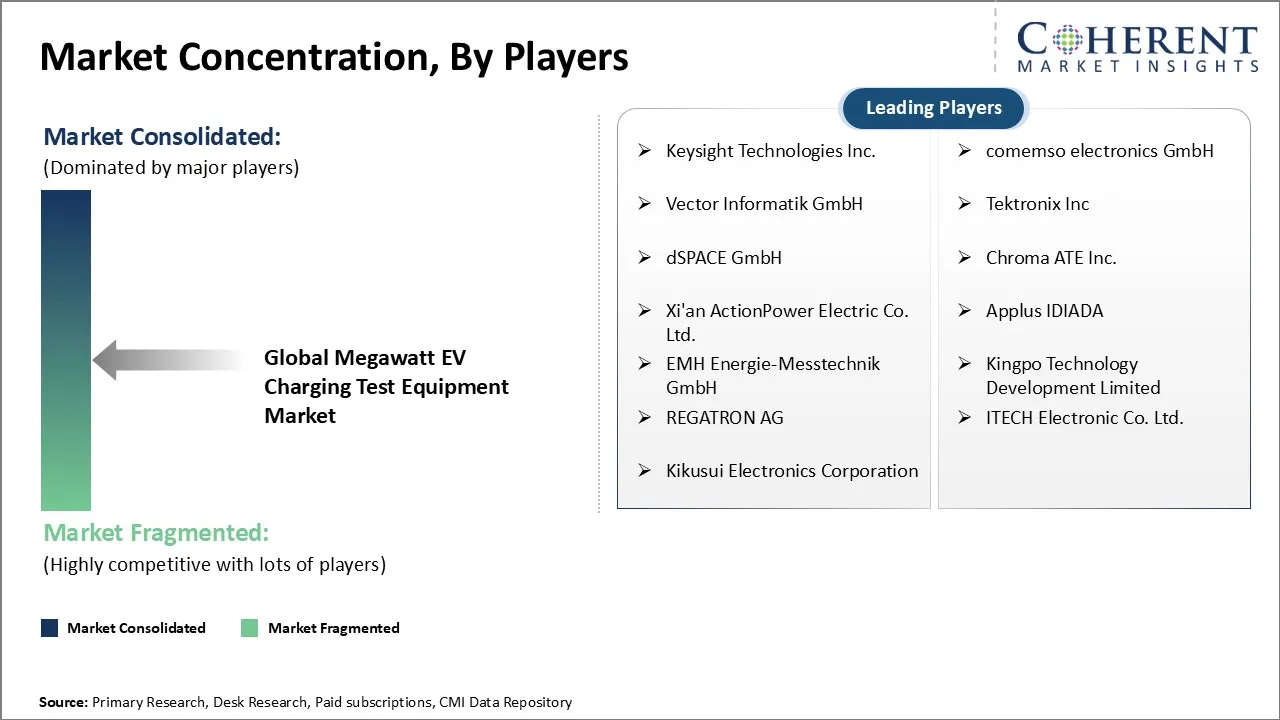
The global megawatt EV charging test equipment market is moderately consolidated amongst suppliers that can provide complete high-power testing platforms while the market for specialized instrumentation and communication testing is more fragmented. The competition is on technical customization, automation capability, measurement accuracy and continuous power ratings. Regional engineering companies are responsible for lab integration, commissioning and after-sales support. Established manufacturers enjoy the advantages of large product portfolios and longstanding industrial customer relationships.
Key focus areas include
- Performance Differentiation Suppliers differentiate on the reliability of their products, the accuracy of voltage and current measurements and the ability to operate continuously under demanding electrical test conditions.
- Measurement Traceability: Calibration procedures and measurement uncertainty documentation assist in acceptance of equipment by industrial customers and regulated laboratories.
- Lifecycle Economics: Buyers look at equipment acquisition cost, electricity consumption, maintenance cost, and utilization rates.
- Delivery & Commissioning: Procurement timeframes are influenced by the complexity of the installation, requirements for grid connection and availability of specialist engineering.
- Technical Support: The choice of supplier is influenced by availability of spare parts, operator training, repair response times and local calibration facilities.
- Customer-Specific Engineering: Suppliers capable of meeting specialized laboratory specifications can defend premium pricing against standardized equipment manufacturers.
Market Report Scope
Global Megawatt EV Charging Test Equipment Market Report Coverage | |||
Report Coverage | Details | ||
Base Year | 2025 | Market Size in 2026: | USD 45.2 Mn |
Historical Data For: | 2020 To 2024 | Forecast Period: | 2026 To 2033 |
Forecast Period 2026 To 2033 CAGR: | 33.50% | 2033 Value Projection: | USD 341.6 Mn |
Geographies covered: |
| ||
Segments covered: |
| ||
Companies covered: | Keysight Technologies Inc., comemso electronics GmbH, Vector Informatik GmbH, Tektronix Inc, dSPACE GmbH, Chroma ATE Inc., Xi'an ActionPower Electric Co. Ltd., Applus IDIADA, EMH Energie-Messtechnik GmbH, Kingpo Technology Development Limited, REGATRON AG, ITECH Electronic Co. Ltd., Kikusui Electronics Corporation | ||
Growth Drivers: |
| ||
Restraints & Challenges: |
| ||
Analyst Opinion (Expert Opinion)
- The global megawatt EV charging test equipment market positioning will become increasingly dependent on the ability to demonstrate tangible engineering results, not just offering the most advanced equipment specifications.” Suppliers who can demonstrate test repeatability, support complex customer acceptance procedures and reduce engineering validation delays would enhance their commercial standing. Procurement decisions will probably lean toward application-specific engineering expertise and proven test reliability.
- Incorporating validated simulation models with low-power testing can fundamentally change the decision on investing in a laboratory. If simulated operating conditions can be reliably correlated with full power results, then some development activities might not require dedicated megawatt-rated infrastructure. This could put pressure on traditional high-capacity equipment suppliers, while providing opportunities for specialists in the development of simulation accuracy, model verification and test correlation methodologies.
- Manufacturers should concentrate on safety of high current electrical systems, correct measuring ability and compatibility with emerging charging interfaces. Investment decisions have to consider the availability of the grid, the sourcing of specialized components and the long equipment qualification cycles. Build partnerships with engineering laboratories and enhance the capacity of localized technical services to raise customer retention. Suppliers should be wary of investing heavily in top-end configurations without clear evidence of commercial payback and demand by customers.
Speak to the analyst
Want personalized insights?
Take the findings above to one of our principal consultants, or have the report rebuilt around the segments, geographies and competitors you actually track.
Market Segmentation
- Equipment Type Insights (Revenue, USD Mn, 2021 - 2033)
- Integrated EV and EVSE Test Systems
- Regenerative DC Power Sources and Load Simulators
- Communication and Protocol Test Equipment
- Thermal and Electrical Safety Test Equipment
- Power Measurement and Calibration Equipment
- Test Power Capacity Insights (Revenue, USD Mn, 2021 - 2033)
- Below 1 MW
- 1–1.5 MW
- Above 1.5–2.5 MW
- Above 2.5 MW
- Test Application Insights (Revenue, USD Mn, 2021 - 2033)
- Megawatt Charging Station Testing
- Electric Vehicle Charging Interface Testing
- Charging Cable and Connector Testing
- Charging Communication Controller Testing
- Testing Stage Insights (Revenue, USD Mn, 2021 - 2033)
- Research and Development Testing
- Production and End-of-Line Testing
- Conformance and Certification Testing
- Field Testing and Calibration
- End User Insights (Revenue, USD Mn, 2021 - 2033)
- EV Charging Equipment Manufacturers
- Automotive and Commercial Vehicle OEMs
- Independent Testing and Certification Laboratories
- Power Electronics Manufacturers
- Research and Development Institutions
- Sales Channel Insights (Revenue, USD Mn, 2021 - 2033)
- Direct Manufacturer Sales
- System Integrators and Engineering Partners
- Equipment Distributors
- Regional Insights (Revenue, USD Mn, 2021 - 2033)
- North America
- U.S.
- Canada
- Latin America
- Brazil
- Argentina
- Mexico
- Rest of Latin America
- Europe
- Germany
- U.K.
- Spain
- France
- Italy
- Russia
- Rest of Europe
- Asia Pacific
- China
- India
- Japan
- Australia
- South Korea
- ASEAN
- Rest of Asia Pacific
- Middle East
- GCC Countries
- Israel
- Rest of Middle East
- Africa
- South Africa
- North Africa
- Central Africa
- North America
Sources
Primary Research Interviews
- Megawatt charging test equipment manufacturers, EVSE testing specialists, and power electronics experts
- Automotive OEM engineers, certification professionals, and laboratory testing specialists
Stakeholders
- EV charging equipment manufacturers, commercial vehicle OEMs, and testing laboratories
- Charging infrastructure developers, system integrators, and engineering service providers
End-use Sectors
- Heavy-duty electric trucks, electric buses, and commercial EV charging infrastructure
- Automotive manufacturing, power electronics, and independent certification services
Regulatory and Industry Bodies
- International Electrotechnical Commission (IEC) and International Organization for Standardization (ISO)
- SAE International, European Commission, and U.S. Department of Energy
Databases
- International Energy Agency (IEA) Global EV Outlook and Global EV Data Explorer
- U.S. Alternative Fuels Data Center (AFDC), European Alternative Fuels Observatory (EAFO), and UN Comtrade
Magazines and Journals
- IEEE Transactions on Transportation Electrification
- SAE International Journal of Electrified Vehicles
- IEEE Transactions on Industrial Electronics
Associations
- Charging Interface Initiative (CharIN)
- SAE International and IEEE Power & Energy Society
Public Domain Sources
- Megawatt charging deployments, heavy-duty EV adoption, and infrastructure investment data
- Equipment specifications, interoperability testing results, laboratory capabilities, and government charging initiatives
Key Standards and Regulations
- IEC 61851-23-3:2026 – DC EV Supply Equipment for Megawatt Charging Systems
- IEC TS 63379:2026 – Megawatt DC Charging Connectors and Cable Assemblies
- ISO 15118-20:2022/Amd 1:2026 – MCS Communication Requirements
- SAE J3271:2025 – Megawatt Charging System Technical Information Report
Proprietary Elements
- CMI Data Analytics Tool
- Proprietary research repository, supplemented by primary interviews, equipment pricing analysis, charging infrastructure assessments, testing technology evaluation, and competitive intelligence.
Get access to 250+ pages report
Every segment, forecast, competitor profile and data table behind the analysis above — available for instant download.
- ESOMAR Member
- ISO 9001:2015 Certified
- D-U-N-S Registered
- GDPR & CCPA Compliant
Frequently Asked Questions
The CAGR of global megawatt EV charging test equipment market is projected to be 33.50% from 2026 to 2033.
The global megawatt EV charging test equipment market is estimated to be valued at USD 45.2 Mn in 2026 and is expected to reach USD 341.6 Mn by 2033.
The report helps businesses evaluate market opportunities, customer requirements, competitive positioning, and investment priorities for high-power EV charging testing solutions.
Key considerations include testing accuracy, power handling capacity, MCS interoperability, electrical safety, equipment scalability, automation capabilities, and total cost of ownership.
Key opportunities include automated charging validation, independent certification services, regenerative testing systems, laboratory modernization, and specialized calibration services.
The report examines key manufacturers, product capabilities, competitive strategies, technology differentiation, and supplier positioning to support procurement, partnerships, and market entry decisions.
The major factors driving the growth of the Global Megawatt EV Charging Test Equipment Market are the increasing deployment of megawatt charging infrastructure for heavy-duty electric trucks and buses, along with the growing need for high-power charging validation, electrical safety testing, and MCS interoperability compliance.