

Global Mini Solar Cell Market Size and Forecast – 2026 To 2033
The Global Mini Solar Cell Market is estimated to be valued at USD 23.97 Bn in 2026 and is expected to reach USD 56.74 Bn by 2033, growing at a compound annual growth rate (CAGR) of 13.1% from 2026 to 2033. The market is gaining momentum as industries increasingly require compact photovoltaic solutions that can deliver reliable power in space-constrained applications, including IoT devices, portable electronics, smart sensors, and wearable technologies. Beyond conventional solar deployment, mini solar cells are enabling new product designs by reducing battery dependency and supporting energy-autonomous electronic systems.
Advancements in high-efficiency silicon architectures, flexible photovoltaic materials, and next-generation solar technologies are further improving commercial feasibility. In June 2026, Fraunhofer Institute for Solar Energy Systems ISE and Oxford PV demonstrated a perovskite-silicon solar module combining tandem cell technology with matrix shingled interconnection, highlighting continued progress toward higher-efficiency photovoltaic designs that can support future compact solar applications.
Key takeaways of the Global Mini Solar Cell Market
- Monocrystalline Silicon Mini Solar Cells are projected to register a CAGR of 13.8% and capture 46.8% of the global mini solar cell market in 2026, maintaining leadership due to their superior conversion efficiency, compact structure, and suitability for small electronic devices where space and power output are critical factors. In April 2025, LONGi highlighted continued progress in high-efficiency crystalline silicon technologies, strengthening the role of silicon-based cells in next-generation photovoltaic applications.
- Consumer Electronics are estimated to expand at a CAGR of 14.2% and represent 28.6% of the global mini solar cell market in 2026, supported by growing integration of solar power solutions into portable electronics, smart devices, and low-energy consumer products. The segment benefits from demand for self-charging capabilities that can reduce dependence on conventional batteries. In January 2025, Toyoda Gosei announced development activities involving solar-powered smart wearable technologies for future electronic applications.
- Below 5 Watt segment is expected to grow at a CAGR of 12.9%, accounting for 38.6% of global mini solar cell market demand in 2026, as low-power photovoltaic solutions become increasingly relevant for IoT sensors, tracking systems, and remote monitoring devices. Their ability to provide continuous energy supply in isolated locations creates strong commercial value for connected applications. In February 2025, Globalstar expanded attention toward solar-powered asset tracking solutions through its SmartOne Solar device platform.
- Asia Pacific is forecast to achieve a CAGR of 14.5% and contribute 36.8% of the global mini solar cell market in 2026, supported by its strong photovoltaic manufacturing ecosystem, extensive electronics production base, and large-scale renewable energy investments. Countries such as China, India, Japan, and South Korea continue strengthening domestic solar supply chains. In August 2025, India’s Ministry of New and Renewable Energy reported significant progress in domestic solar module manufacturing capacity development.
- North America is anticipated to record a CAGR of 15.1% and hold 28.6% market share in global mini solar cell market, driven by investments in localized photovoltaic production, clean energy infrastructure, and demand for distributed power solutions. The region is also witnessing greater interest in compact solar technologies for specialized electronics and autonomous systems. In December 2025, Canadian Solar announced further expansion initiatives related to its U.S. manufacturing capabilities.
Segmental Insights
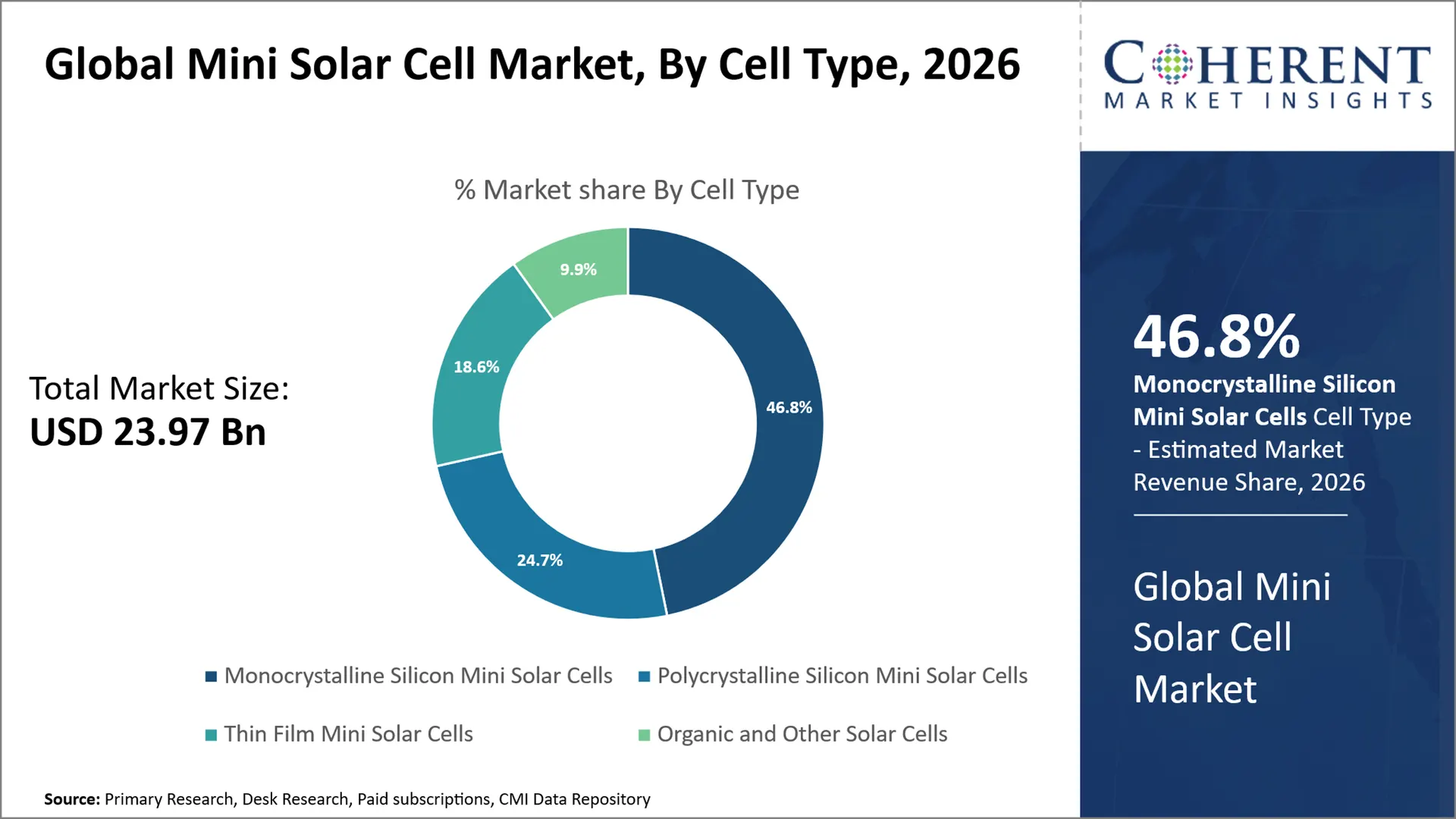
Why Do Monocrystalline Silicon Mini Solar Cells Dominate the Global Mini Solar Cell Market?
Monocrystalline Silicon Mini Solar Cells are expected to account for 46.8% of the global mini solar cell market in 2026, supported by their balance of efficiency, manufacturing maturity, and compact power generation capability. Unlike alternative photovoltaic materials that are still progressing toward large-scale commercialization, monocrystalline silicon benefits from established wafer production, optimized processing techniques, and a reliable supply ecosystem. Miniaturized versions of these cells are preferred for applications where manufacturers require higher energy output from limited surface areas, including portable electronics, sensors, and specialized power systems. Suppliers benefit from existing silicon manufacturing infrastructure, while buyers gain improved reliability and predictable performance over longer operating periods. In April 2025, LONGi announced that its crystalline silicon HIBC solar cell achieved a 27.81% conversion efficiency milestone certified by ISFH, demonstrating continued performance improvements within silicon-based photovoltaic technologies.
- Current Industry Events of 2026
- Market Size Estimation
- Regional Breakdown
- Competitive Landscape
- Customer Intelligence
- Segmental Analysis
- Pricing Analysis
- Key Market Drivers, Challenges & Future Trends
- Customized Insights Section
Why Does Consumer Electronics Represent the Largest Application Segment in the Global Mini Solar Cell Market?
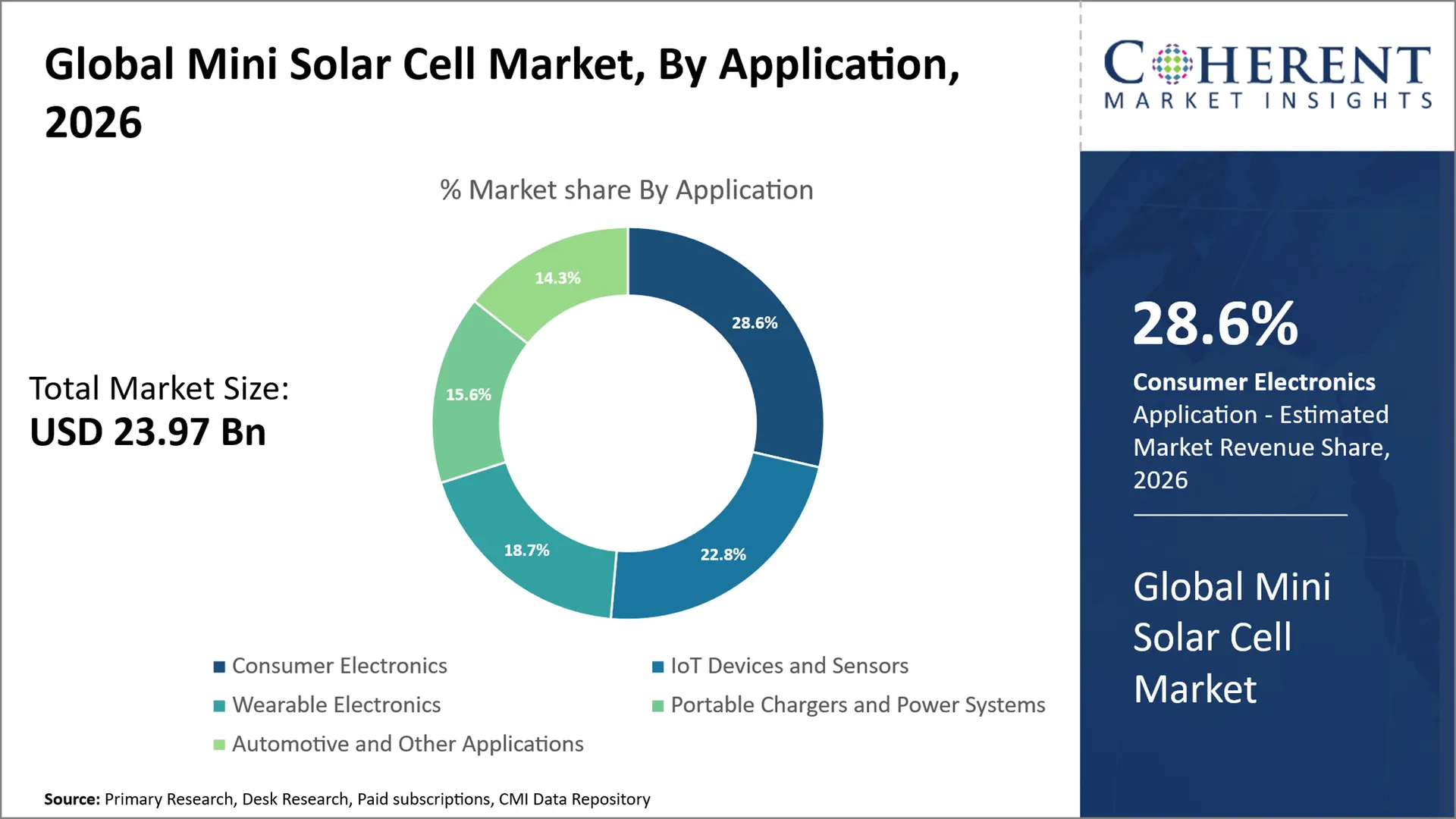
Consumer Electronics is projected to represent 28.6% of the global mini solar cell market in 2026, as device manufacturers increasingly explore compact renewable power solutions for products requiring extended operating time and reduced charging dependency. The segment benefits from the growing need for lightweight energy sources in portable electronics, smart accessories, and low-power consumer devices where traditional battery replacement creates inconvenience. Mini solar cells provide manufacturers with opportunities to differentiate products through energy autonomy, improved user experience, and reduced maintenance requirements. From the supply perspective, advancements in flexible photovoltaic designs and smaller cell formats are allowing solar technology integration into products with limited installation space. In June 2025, Samsung Electronics introduced its AI-powered smart home ecosystem updates incorporating greater device connectivity and energy efficiency considerations, highlighting the broader industry movement toward smarter low-power consumer devices.
Why Do Below 5 Watt Mini Solar Cells Lead the Power Output Category in the Global Mini Solar Cell Market?
Below 5 Watt are estimated to hold 38.6% of the global mini solar cell market in 2026, mainly because they match the energy requirements of rapidly expanding low-power electronic applications. This category is particularly relevant for IoT sensors, smart labels, wearable devices, and remote monitoring equipment where continuous operation is more important than high electricity generation. Manufacturers prefer these solutions because they can be integrated into compact products without adding significant weight or complexity. The availability of low-power semiconductor components and efficient energy management systems further improves the commercial feasibility of these cells. In July 2025, the U.S. Department of Energy highlighted ongoing photovoltaic research focused on improving efficiency, reducing costs, and enabling diversified solar applications beyond conventional installations, supporting broader development of compact photovoltaic technologies.
Current Events and their Impact
Current Event | Description and Its Impact |
January 2025 – U.S. Department of Energy Support for Advanced Photovoltaic Research |
|
April 2025 – European Union Solar Manufacturing and Supply Chain Initiatives |
|
2025 – Japan Government Support for Next-Generation Perovskite Solar Development |
|
Global Mini Solar Cell Market Dynamics
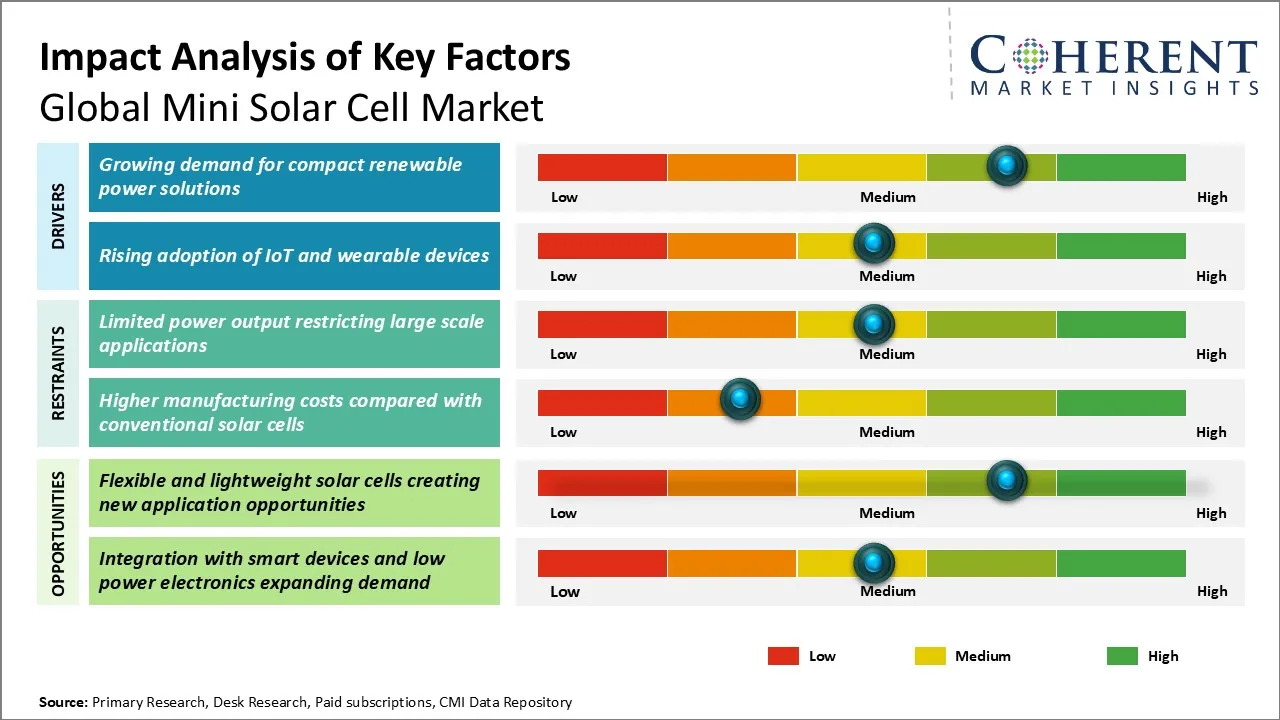
Key Market Drivers
- Growing Demand for Compact Renewable Power Solutions: The growing preference for smaller and energy-efficient power sources is strengthening the role of mini solar cells in applications where conventional solar modules cannot be integrated. Manufacturers of portable electronics, smart sensors, and remote monitoring devices benefit from compact photovoltaic solutions that provide continuous power without frequent battery replacement. Mini solar cells create value by improving device autonomy, reducing maintenance requirements, and enabling new product designs. In January 2025, JinkoSolar announced progress in perovskite tandem solar cell efficiency, highlighting continued industry efforts toward higher-performance photovoltaic technologies that can influence future compact solar applications.
- Rising Adoption of IoT and Wearable Devices: The expansion of connected devices is creating demand for miniature energy sources capable of supporting low-power electronics in locations where wired electricity access is limited. IoT companies, wearable manufacturers, and industrial monitoring providers are increasingly evaluating solar-powered designs to improve device lifetime and reduce operational interruptions. Mini solar cells are particularly valuable for sensors deployed in agriculture, logistics, smart buildings, and healthcare monitoring systems. In January 2025, imec and partners demonstrated improved outdoor stability of perovskite solar modules, supporting the development of future lightweight photovoltaic solutions for emerging applications.
Emerging Market Trends
- Movement Toward Self-Powered Electronic Ecosystems: Mini solar cell adoption is gradually shifting from being a supplementary power option to becoming an integrated component of autonomous electronic systems. Device manufacturers are redesigning products around continuous energy harvesting rather than relying entirely on replaceable batteries. This transition is creating opportunities for suppliers offering ultra-small photovoltaic formats, energy management circuits, and integrated power solutions. Over the forecast period, companies that can combine solar harvesting with efficient storage and low-power electronics are likely to gain stronger positioning as buyers prioritize reliability, lower maintenance, and longer device operating cycles.
- Advancement of Flexible and Next-Generation Photovoltaic Materials: The competitive direction of mini solar cells is moving beyond conventional silicon designs toward flexible and lightweight materials that can support unconventional applications. Thin film, organic photovoltaic, and perovskite-based technologies are attracting attention because they can be adapted to curved surfaces, wearable products, and indoor environments. This evolution may reshape supplier strategies as manufacturers focus not only on conversion efficiency but also on flexibility, durability, manufacturing scalability, and integration capability. Companies capable of commercializing application-specific photovoltaic solutions may create differentiation beyond traditional cell performance parameters.
Regional Insights
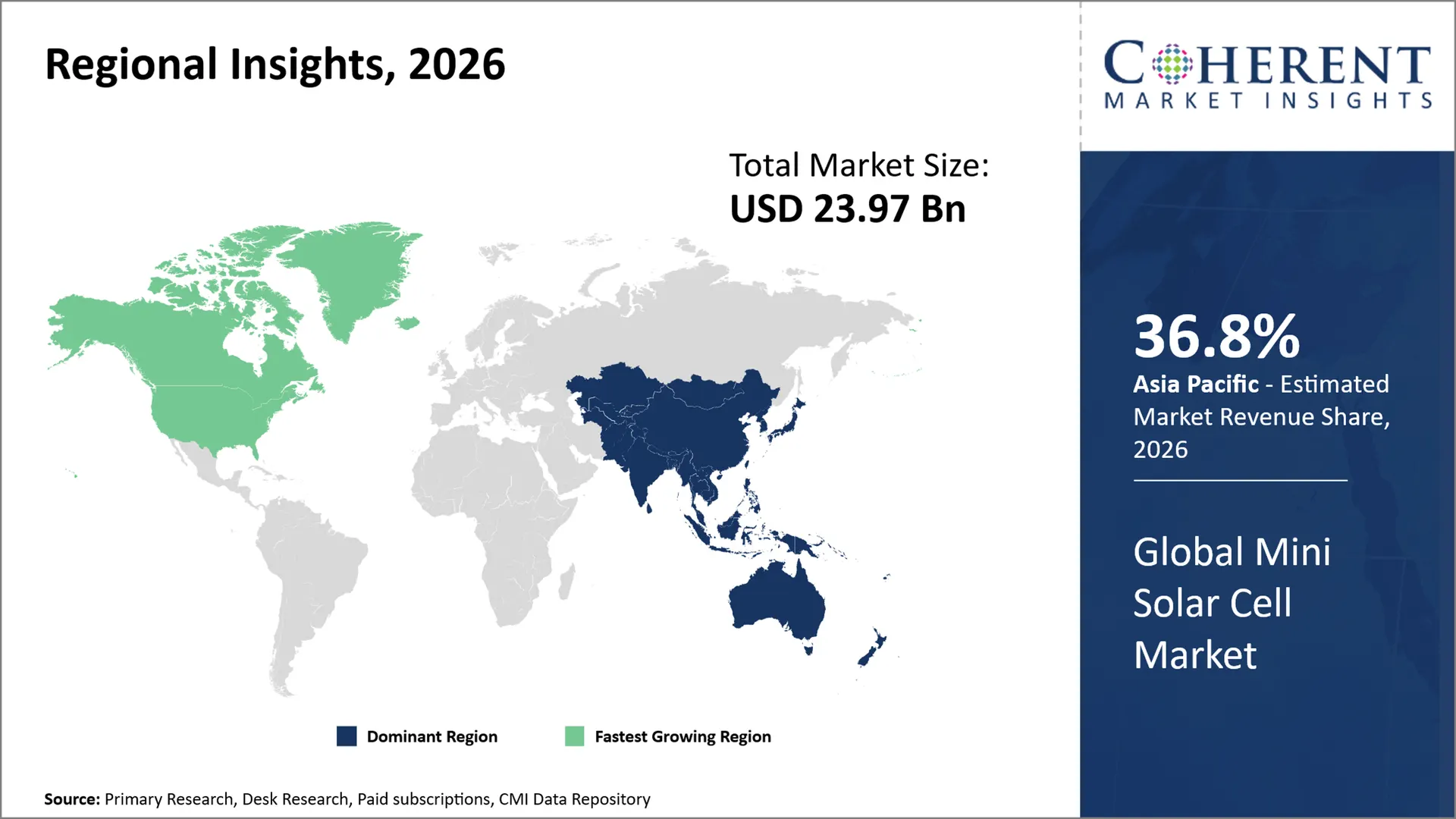
Why Does Asia Pacific Dominate the Global Mini Solar Cell Market?
Asia Pacific is expected to account for 36.8% of the global mini solar cell market in 2026, supported by its strong electronics manufacturing ecosystem, extensive photovoltaic supply chain, and concentration of companies producing consumer devices, sensors, and smart components. The region benefits from close integration between solar cell manufacturers, semiconductor suppliers, and downstream electronics producers, allowing faster commercialization of compact photovoltaic solutions. China, Japan, South Korea, and India provide a strong industrial base for mini solar cell applications across IoT devices, portable electronics, and energy-efficient systems. In addition, regional governments are strengthening domestic renewable technology capabilities and advanced manufacturing infrastructure. In May 2025, China’s Ministry of Industry and Information Technology released guidance emphasizing the development of advanced photovoltaic manufacturing technologies and industrial upgrading, supporting continued innovation across the solar value chain.
Why Is North America Emerging as the Fastest-Growing Region in the Global Mini Solar Cell Market?
North America is projected to represent 28.6% of the global mini solar cell market in 2026, with growth supported by expanding demand for autonomous electronic systems, smart infrastructure, and advanced energy harvesting solutions. The region has a strong ecosystem of technology companies, IoT developers, research institutions, and specialty photovoltaic manufacturers focusing on applications beyond conventional solar installations. Demand is increasing from sectors such as industrial monitoring, wearable electronics, defense systems, and connected devices where compact and reliable power sources are valuable. Local innovation programs and clean energy manufacturing initiatives are also improving the commercial environment for advanced photovoltaic technologies. In February 2025, the U.S. Department of Energy announced continued support for photovoltaic research programs aimed at improving next-generation solar technologies and manufacturing capabilities.
Global Mini Solar Cell Market Outlook for Key Countries
Why Is China a Key Market for the Global Mini Solar Cell Market?
China remains a critical market for mini solar cells due to its unmatched photovoltaic manufacturing capacity, mature electronics supply chain, and large-scale production capabilities across silicon materials, semiconductor components, and consumer devices. The country provides advantages through integrated industrial clusters where solar manufacturers, component suppliers, and electronics producers operate within connected ecosystems. This enables faster product development and cost optimization for compact photovoltaic applications used in sensors, portable devices, and smart electronics. China’s strong export position also allows domestic manufacturers to supply mini solar cell solutions to global technology companies. In June 2025, China’s National Energy Administration highlighted continued expansion of renewable energy manufacturing and photovoltaic industry development, reinforcing the country’s strategic importance in global solar technology production.
Why Is India Important in the Global Mini Solar Cell Market?
India is becoming increasingly relevant in the mini solar cell market as domestic electronics manufacturing, renewable energy investment, and distributed energy applications continue expanding. The country offers significant potential for compact photovoltaic solutions through applications such as agricultural sensors, rural monitoring systems, telecommunications equipment, and low-power electronic devices. Government initiatives supporting domestic solar manufacturing are encouraging development of local photovoltaic capabilities while reducing dependence on imported components. India’s growing electronics production base also creates opportunities for integrating mini solar cells into connected consumer and industrial products. In August 2025, India’s Ministry of New and Renewable Energy highlighted progress in domestic solar manufacturing capacity under the Approved List of Models and Manufacturers framework, strengthening the country’s photovoltaic ecosystem.
Why Does Japan Support Growth in the Global Mini Solar Cell Market?
Japan supports mini solar cell market development through its advanced electronics industry, precision manufacturing capabilities, and focus on compact renewable energy technologies. Japanese companies have strong expertise in sensors, robotics, wearable devices, and smart infrastructure, creating demand for lightweight and efficient power solutions. The country is particularly positioned for applications where mini solar cells must deliver reliable performance in limited spaces, including indoor environments and specialized electronic systems. Japan’s research ecosystem is also contributing to the commercialization of emerging photovoltaic materials such as perovskite solar cells. In March 2025, Japan’s Ministry of Economy Trade and Industry continued promoting next-generation solar technology development through initiatives supporting domestic photovoltaic innovation and manufacturing competitiveness.
Why Is the U.S. a Strategic Country in the Global Mini Solar Cell Market?
The U.S. represents an important market for mini solar cells due to its strong innovation ecosystem, advanced research infrastructure, and demand from specialized applications requiring autonomous power solutions. The country has significant opportunities in IoT networks, defense electronics, aerospace systems, smart buildings, and industrial monitoring where compact photovoltaic technologies can reduce maintenance requirements and improve operational reliability. The presence of technology developers, research institutions, and advanced manufacturing companies supports commercialization of emerging solar formats beyond traditional modules. In April 2025, the National Renewable Energy Laboratory published research progress related to advanced photovoltaic materials and device architectures, supporting continued innovation in next-generation solar technologies.
Why Is Germany a Strategic Country in the Global Mini Solar Cell Market?
Germany holds strategic importance in the mini solar cell market through its advanced engineering capabilities, strong industrial automation sector, and emphasis on sustainable technology adoption. The country’s demand is supported by applications requiring reliable and efficient energy solutions, including industrial sensors, smart manufacturing systems, and specialized electronics. German companies and research institutions have long-standing expertise in photovoltaic research, materials engineering, and high-quality manufacturing processes, creating opportunities for premium mini solar cell solutions. The country’s sustainability-focused industrial policies also encourage adoption of renewable technologies across commercial and industrial environments. In January 2025, Germany’s Fraunhofer Institute for Solar Energy Systems reported continued research advancement in photovoltaic technologies, supporting innovation across the solar value chain.
Innovation, Production & Manufacturing Landscape
Technology | Adoption Status | Commercial Impact | Key Applications |
Monocrystalline Silicon Mini Solar Cells | Most commercially established technology with high efficiency and mature manufacturing ecosystem | Enables reliable power output in compact designs while benefiting from existing silicon supply chains | Consumer electronics IoT devices portable power systems |
Thin Film Mini Solar Cells | Expanding adoption where flexibility and lightweight designs are required | Supports applications where rigid silicon cells cannot meet form-factor requirements | Wearables smart cards sensors flexible electronics |
Organic Photovoltaic Cells | Early commercial adoption with focus on lightweight and indoor applications | Provides design flexibility and low-weight energy harvesting options | Indoor IoT devices smart labels low-power electronics |
Perovskite Solar Cells | Moving from research toward pilot-scale commercialization | Offers potential for higher efficiency flexible formats and new manufacturing approaches | Wearables building-integrated electronics next-generation mini devices |
Indoor Photovoltaic Technology | Emerging solution designed for artificial lighting environments | Creates opportunities for battery-free sensors and connected devices operating indoors | Smart buildings retail sensors healthcare devices |
Hybrid Tandem Solar Cells | Development-stage technology combining multiple photovoltaic materials | May improve energy conversion performance and expand premium application opportunities | High-performance compact solar systems specialized electronics |
How Are Self-Powered IoT Systems and Flexible Photovoltaic Designs Creating New Growth Opportunities in the Global Mini Solar Cell Market?
Self-powered electronic systems represent one of the most promising commercial opportunities for mini solar cell manufacturers because many connected devices require long operating periods with minimal maintenance. Industrial sensors, smart infrastructure equipment, wearable devices, and remote monitoring platforms are increasingly designed around autonomous energy solutions. Companies participating in this space can differentiate through integrated offerings that combine photovoltaic cells, energy storage components, and power management systems rather than supplying standalone cells. Flexible photovoltaic technologies also create opportunities in applications where traditional solar modules cannot be installed due to size, weight, or design limitations. Suppliers with capabilities in material innovation, miniaturized manufacturing, and customized product development are better positioned to capture emerging demand from specialized electronics manufacturers and industrial users.
Market Players, Key Development, and Competitive Landscape
Key Developments
- In January 2025, JinkoSolar announced that its perovskite tandem solar cell achieved a conversion efficiency improvement milestone using N-type TOPCon technology. This development highlights the company’s focus on combining established silicon platforms with emerging photovoltaic materials to improve future solar performance.
- In April 2025, Oxford PV and Trinasolar announced a perovskite photovoltaic patent licensing agreement covering manufacturing and sales opportunities in China. This collaboration supports faster commercialization of advanced tandem photovoltaic technologies by combining technology ownership with large-scale manufacturing capabilities.
- In May 2025, Hanwha Group achieved validation progress for perovskite-silicon tandem solar modules through IEC and UL certification-related testing. This milestone strengthens the pathway toward commercial deployment of higher-efficiency photovoltaic technologies and demonstrates industry movement toward next-generation solar architectures.
Competitive Landscape
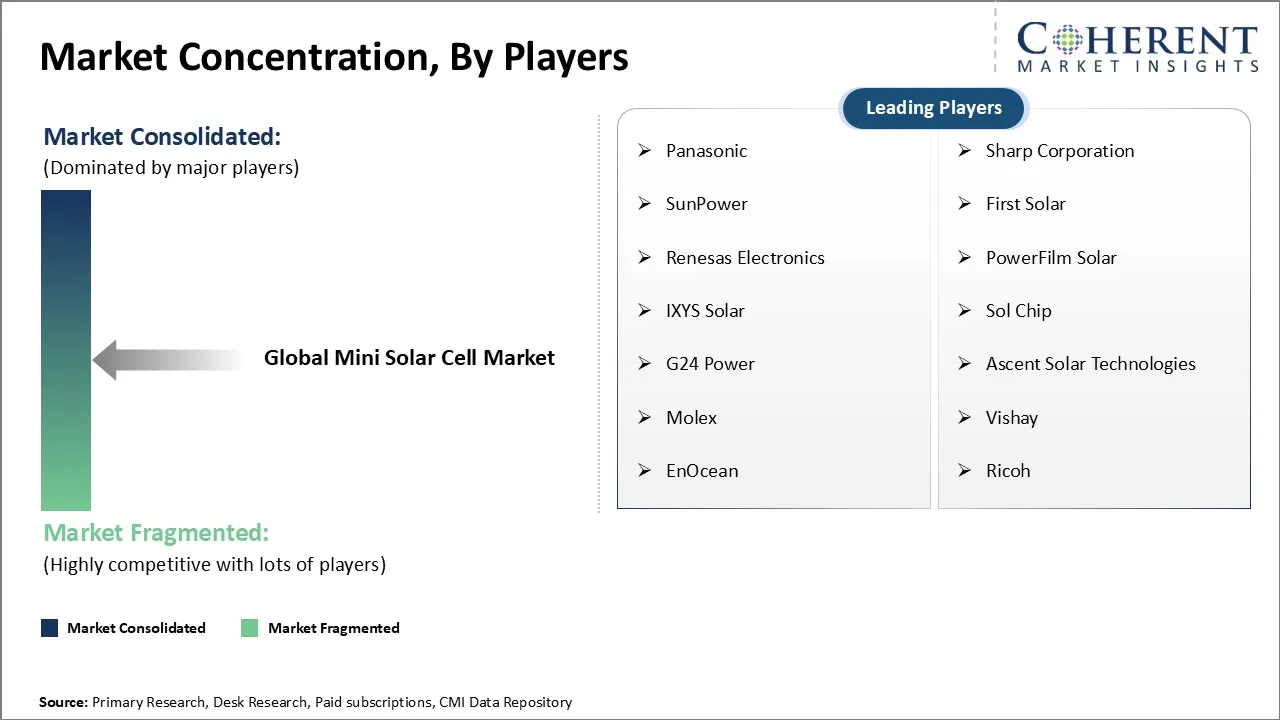
The global mini solar cell market is moderately fragmented, with competition spanning established photovoltaic manufacturers, specialized solar technology developers, and emerging material innovators. Companies compete through efficiency improvements, miniaturization capability, manufacturing reliability, customization, and integration support. While large photovoltaic companies benefit from scale and technology expertise, niche players are gaining attention through flexible materials, indoor energy harvesting, and application-specific designs.
Key focus areas include
- Conversion efficiency and power output optimization for compact applications
- Ability to manufacture customized cell sizes and form factors
- Reliability under indoor lighting and low-intensity environments
- Material innovation including thin film and perovskite technologies
- Manufacturing scalability and cost control
- Product certification and quality consistency
- Integration partnerships with electronics and IoT manufacturers
- Technical support and application engineering capabilities
Market Report Scope
Mini Solar Cell Market Report Coverage | |||
Report Coverage | Details | ||
Base Year | 2025 | Market Size in 2026: | USD 23.97 Bn |
Historical Data For: | 2020 To 2024 | Forecast Period: | 2026 To 2033 |
Forecast Period 2026 To 2033 CAGR: | 13.1% | 2033 Value Projection: | USD 56.74 Bn |
Geographies covered: |
| ||
Segments covered: |
| ||
Companies covered: | Panasonic, Sharp Corporation, SunPower, First Solar, Renesas Electronics, PowerFilm Solar, IXYS Solar, Sol Chip, G24 Power, Ascent Solar Technologies, Molex, Vishay, EnOcean, Ricoh | ||
Growth Drivers: |
| ||
Restraints & Challenges: |
| ||
Analyst Opinion (Expert Opinion)
- The mini solar cell market is likely to evolve from a component-driven industry into a solution-oriented ecosystem. Future competition will depend less on basic cell availability and more on how effectively suppliers combine photovoltaic technology with storage, electronics integration, and application engineering.
- The largest disruption may come from flexible and indoor photovoltaic technologies that redefine where solar energy can be used. Companies focused only on outdoor power generation may face pressure as new competitors target previously inaccessible applications such as wearable devices, smart packaging, and autonomous sensors.
- Market participants should prioritize scalable manufacturing, material innovation, and partnerships with electronics companies. However, companies should carefully evaluate commercialization timelines for emerging technologies, as durability, production consistency, and cost competitiveness will determine whether new photovoltaic formats achieve widespread adoption.
Speak to the analyst
Want personalized insights?
Take the findings above to one of our principal consultants, or have the report rebuilt around the segments, geographies and competitors you actually track.
Market Segmentation
- Cell Type Insights (Revenue, USD Bn, 2021 - 2033)
- Monocrystalline Silicon Mini Solar Cells
- Polycrystalline Silicon Mini Solar Cells
- Thin Film Mini Solar Cells
- Organic and Other Solar Cells
- Application Insights (Revenue, USD Bn, 2021 - 2033)
- Consumer Electronics
- IoT Devices and Sensors
- Wearable Electronics
- Portable Chargers and Power Systems
- Automotive and Other Applications
- Power Output Insights (Revenue, USD Bn, 2021 - 2033)
- Below 5 Watt
- 5 Watt to 20 Watt
- Above 20 Watt
- End User Insights (Revenue, USD Bn, 2021 - 2033)
- Consumer Electronics Manufacturers
- Industrial and IoT Companies
- Automotive Companies
- Research and Defense Organizations
- Others
- Distribution Channel Insights (Revenue, USD Bn, 2021 - 2033)
- Direct Sales
- Indirect Sales
- Regional Insights (Revenue, USD Bn, 2021 - 2033)
- North America
- U.S.
- Canada
- Latin America
- Brazil
- Argentina
- Mexico
- Rest of Latin America
- Europe
- Germany
- U.K.
- Spain
- France
- Italy
- Russia
- Rest of Europe
- Asia Pacific
- China
- India
- Japan
- Australia
- South Korea
- ASEAN
- Rest of Asia Pacific
- Middle East
- GCC Countries
- Israel
- Rest of Middle East
- Africa
- South Africa
- North Africa
- Central Africa
- North America
- Key Players Insights
- Panasonic
- Sharp Corporation
- SunPower
- First Solar
- Renesas Electronics
- PowerFilm Solar
- IXYS Solar
- Sol Chip
- G24 Power
- Ascent Solar Technologies
- Molex
- Vishay
- EnOcean
- Ricoh
Sources
Primary Research Interviews
- Mini solar cell manufacturers, photovoltaic cell producers, thin film solar technology companies, and specialty solar solution providers
- IoT device manufacturers, wearable electronics companies, consumer electronics brands, sensor manufacturers, and smart device developers
- Solar technology researchers, photovoltaic engineers, material scientists, semiconductor specialists, and energy storage professionals
- Distributors, system integrators, component suppliers, and application solution providers involved in compact photovoltaic products
Stakeholders
- Solar cell manufacturers, photovoltaic technology developers, semiconductor companies, and renewable energy solution providers
- Raw material suppliers including silicon wafer manufacturers, photovoltaic material suppliers, conductive material providers, and component manufacturers
- Electronics manufacturers, IoT solution providers, wearable technology companies, automotive electronics suppliers, and industrial automation companies
- Distributors, technology integrators, energy solution providers, and aftermarket service companies
End-use Sectors
- Consumer electronics applications including portable devices, smart accessories, and battery-assisted electronics
- IoT and sensor applications including smart monitoring systems, connected devices, and remote sensing solutions
- Wearable electronics including smart watches, health monitoring devices, and flexible electronic products
- Industrial applications including automation systems, asset tracking, and remote monitoring equipment
- Automotive electronics, aerospace systems, and specialized low-power electronic applications
Regulatory and Industry Bodies
- Renewable energy ministries and government energy departments
- Solar photovoltaic industry associations and clean energy organizations
- Semiconductor and electronics industry associations
- Energy efficiency and renewable technology regulatory authorities
- Environmental and sustainability organizations supporting clean technology development
Databases
- Company annual reports, investor presentations, regulatory filings, and corporate disclosures
- Photovoltaic manufacturing databases and renewable energy industry datasets
- Semiconductor industry databases and electronics supply chain intelligence platforms
- Import-export trade databases for solar cells, photovoltaic components, and electronic devices
- Patent databases covering photovoltaic materials, solar cell technologies, and energy harvesting solutions
- Product portfolio databases and competitive intelligence repositories
Magazines and Journals
- Solar photovoltaic technology publications
- Renewable energy and clean technology journals
- Semiconductor and electronics industry publications
- Materials science and advanced photovoltaic research journals
- Energy technology and sustainability-focused publications
- IoT, wearable technology, and electronics innovation journals
Associations
- International Renewable Energy Agency (IRENA)
- International Energy Agency (IEA)
- Solar Energy Industries Association (SEIA)
- European Photovoltaic Industry Association (SolarPower Europe)
- Semiconductor industry associations
- Regional renewable energy and photovoltaic industry organizations
Public Domain Sources
- Solar manufacturing capacity developments and photovoltaic technology advancements
- Renewable energy policy updates and government clean energy initiatives
- Miniaturized photovoltaic product innovations and energy harvesting developments
- IoT, wearable electronics, and smart device adoption trends
- Semiconductor supply chain developments and advanced material innovations
- Solar technology research publications and commercialization updates
Key Standards and Regulations
- Photovoltaic module and solar cell performance standards
- Electrical safety and reliability requirements for photovoltaic components
- Semiconductor and electronic component quality standards
- Environmental compliance requirements for solar material manufacturing
- Restriction of hazardous substances (RoHS) compliance for electronic components
- International trade regulations and certification requirements for photovoltaic products
Proprietary Elements
- CMI Data Analytics Tool, Proprietary CMI repository containing 10+ years of renewable energy, photovoltaic technology, semiconductor, electronics, and clean technology market intelligence
Get access to 250+ pages report
Every segment, forecast, competitor profile and data table behind the analysis above — available for instant download.
- ESOMAR Member
- ISO 9001:2015 Certified
- D-U-N-S Registered
- GDPR & CCPA Compliant
Missing comfort of reading report in your local language? Find your preferred language:
Frequently Asked Questions
The CAGR of global mini solar cell market is projected to be 13.1% from 2026 to 2033.
The global mini solar cell market is estimated to be valued at USD 23.97 billion in 2026 and is expected to reach USD 56.74 billion by 2033.
Mini solar cells are primarily used in portable electronics, IoT devices, wearable electronics, smart sensors, and compact power systems where lightweight and continuous power generation is required.
Advanced photovoltaic technologies such as flexible solar cells, thin film solutions, and next-generation solar materials are influencing product innovation and expanding application possibilities.
Major end users include consumer electronics manufacturers, IoT solution providers, industrial technology companies, automotive companies, and organizations developing autonomous electronic systems.
Companies should evaluate technology maturity, manufacturing capabilities, supply chain reliability, application suitability, product performance, and integration requirements before entering the mini solar cell market.
The global mini solar cell market growth is primarily supported by the increasing need for compact renewable power solutions and the growing integration of solar technologies into IoT devices and wearable electronics. These applications require lightweight and reliable energy sources that can improve device autonomy and reduce dependence on conventional batteries.