

Global Motor Insurance Market Size and Forecast – 2026 To 2033
The Global Motor Insurance Market is estimated to be valued at USD 1,170.1 Bn in 2026 and is expected to reach USD 2,084.64 Bn by 2033, growing at a compound annual growth rate (CAGR) of 8.60% from 2026 to 2033. This expansion reflects increasing vehicle ownership, evolving regulatory frameworks, and greater emphasis on financial protection against road accidents and third-party liabilities across developed and emerging economies.
Insurers are also adapting their pricing and coverage strategies to address vehicle theft, changing repair costs, and affordability concerns. In December 2025, the UK Department for Transport and HM Treasury published the Motor Insurance Taskforce's final report, outlining government and regulatory actions to address vehicle theft, improve road safety, and reduce insurance-related costs. These measures highlight the growing importance of regulatory intervention and cost management in supporting sustainable motor insurance coverage.
Key Takeaways of the Global Motor Insurance Market
- Comprehensive Insurance is expected to record an estimated CAGR of 9.0% during 2026–2033 and secure 59.2% of the global motor insurance market in 2026. Its broader protection against collision damage, theft, and weather-related losses makes it attractive to vehicle owners seeking financial protection. In March 2026, AXA Mansard introduced smartphone-based vehicle inspections in Nigeria for comprehensive policy issuance, renewals, and claims assessment.
- Third Party Liability is projected to grow at an estimated CAGR of 8.1% during 2026–2033, while representing 63.2% of the global motor insurance market in 2026. Mandatory insurance requirements establish a recurring premium base because vehicle owners must cover injuries and property damage caused to others. In January 2025, California increased standard automobile liability minimums, including bodily injury coverage of USD 30,000 per person.
- Passenger Cars are anticipated to expand at an estimated CAGR of 8.3% during 2026–2033 and contribute 68.7% of global motor insurance market in 2026. Extensive privately owned vehicle fleets and recurring policy renewals sustain underwriting volumes across mature and developing economies. In April 2026, the European Automobile Manufacturers' Association reported that worldwide car registrations reached 77.6 million units in 2025.
- North America, with an estimated CAGR of 7.4% during 2026–2033, is expected to command 34.8% of global motor insurance market in 2026. Its leadership reflects substantial insured vehicle exposure and premium pricing influenced by repair complexity, medical expenses, and claims severity. In October 2026, the National Association of Insurance Commissioners reported that combined average U.S. automobile insurance premiums increased by 12.12% in 2024.
- Asia Pacific combines an estimated CAGR of 10.5% during 2026–2033 with an expected 30.0% share of the global motor insurance market in 2026. Growing vehicle ownership creates opportunities to expand insured vehicle coverage, particularly in markets where insurance penetration remains relatively low. In April 2026, the Society of Indian Automobile Manufacturers reported that Indian two-wheeler sales reached 21.7 million units during fiscal 2025–26
Segmental Insights
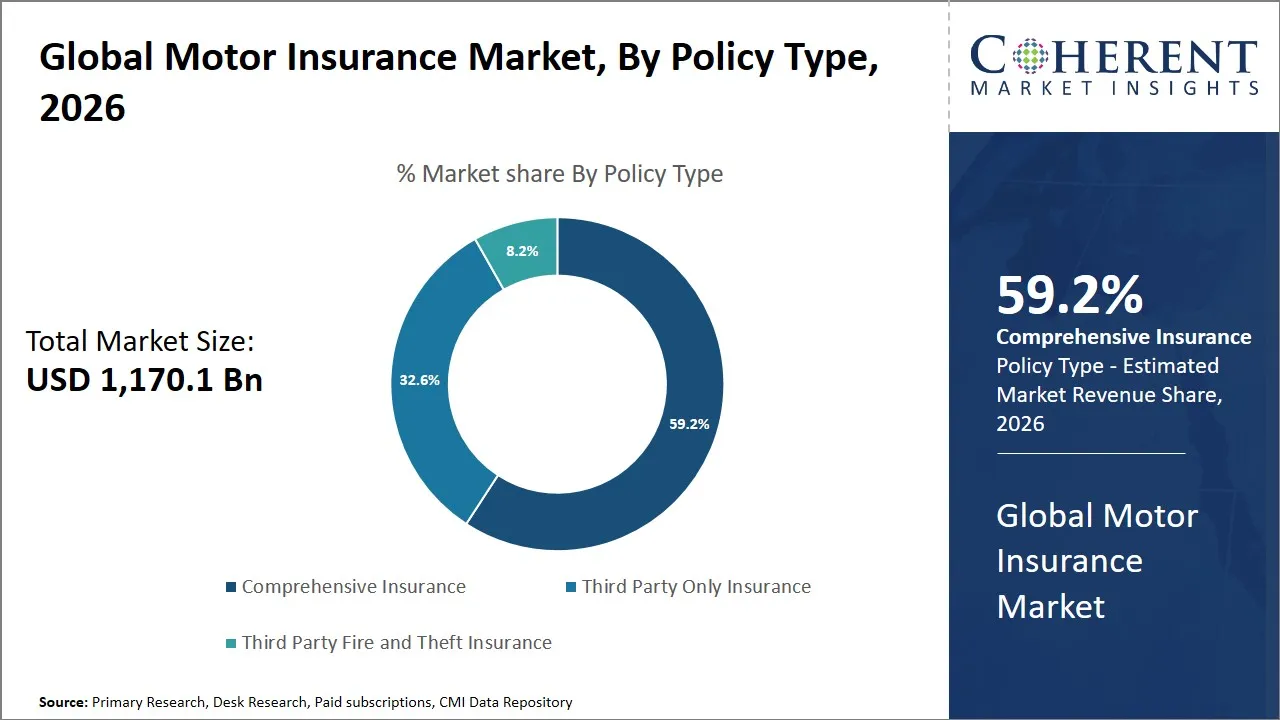
Why Does Comprehensive Insurance Dominate the Global Motor Insurance Market?
Comprehensive Insurance is expected to account for 59.2% of the global motor insurance market by policy type in 2026. Its appeal extends beyond the scope of insured risks to how easily households and smaller fleet operators can finance broader protection. Spreading premiums across scheduled instalments can reduce the initial financial commitment without requiring motorists to settle for liability-only protection. For insurers, payment flexibility creates opportunities among customers who value extensive coverage but cannot comfortably fund annual premiums upfront. In July 2026, Britam Uganda introduced Car-Tono Katono, allowing comprehensive motor insurance premiums to be paid monthly, quarterly, or semi-annually through financing arrangements. This approach illustrates how flexible payment structures can improve access to comprehensive policies, although insurers must carefully manage payment continuity and financing conditions.
- Current Industry Events of 2026
- Market Size Estimation
- Regional Breakdown
- Competitive Landscape
- Customer Intelligence
- Segmental Analysis
- Pricing Analysis
- Key Market Drivers, Challenges & Future Trends
- Customized Insights Section
Why Does Third Party Liability Represent the Largest Motor Insurance Component in the Global Motor Insurance Market?
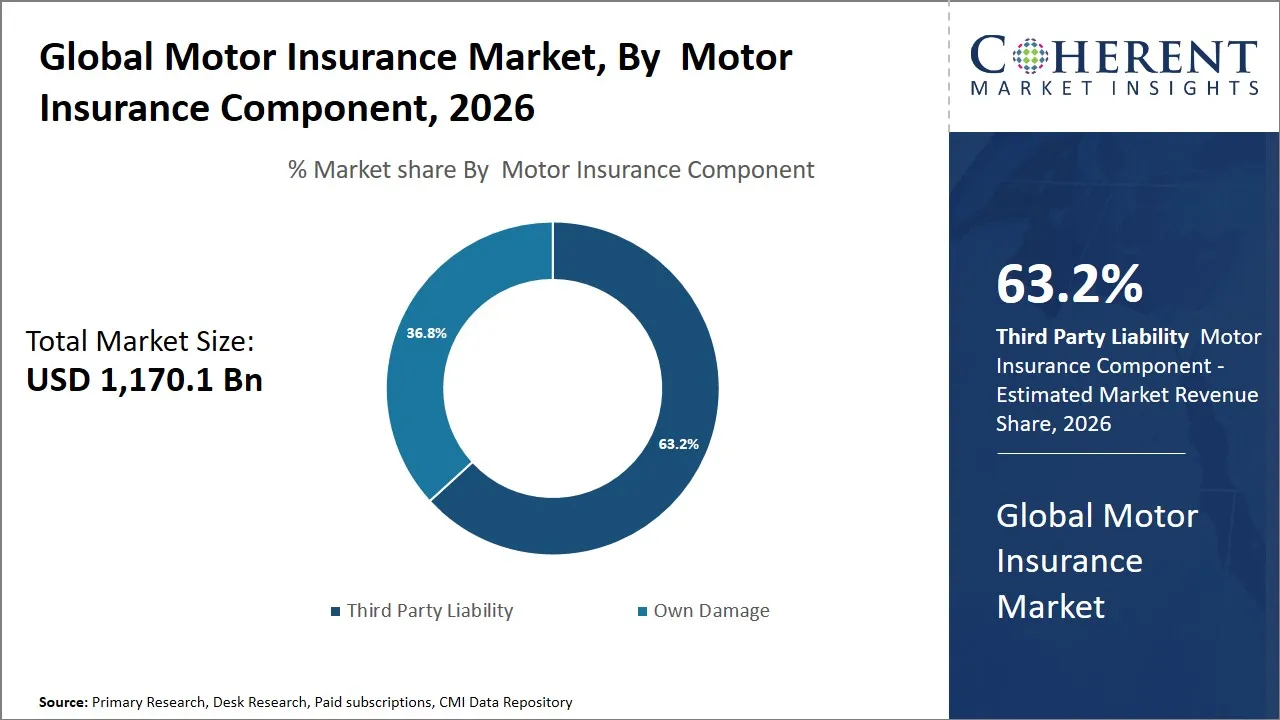
Third Party Liability is expected to represent 63.2% of the global motor insurance market by component in 2026. Unlike protection for the insured vehicle, liability insurance addresses compensation owed to other road users, including pedestrians and owners of damaged property. This creates an underwriting requirement across private cars, delivery vehicles, and transport fleets, with policy structures shaped by potential injury settlements and local liability limits. Insurers can differentiate through clearly defined benefit tiers and affordable pricing rather than relying exclusively on own-damage upgrades. In October 2026, Anchor Insurance Company Limited launched an enhanced third-party motor policy in Nigeria with several coverage tiers aimed at individuals, small businesses, and transport operators. The development demonstrates how insurers can adapt core liability products to different customer budgets and protection requirements.
Why Do Passenger Cars Dominate the Vehicle Type Segment of the Global Motor Insurance Market?
Passenger Cars are expected to contribute 68.7% of the global motor insurance market by vehicle type in 2026. Insurance for this category benefits from established purchasing channels, including dealerships, automotive finance providers, and authorized service facilities. These channels enable insurers to introduce coverage during vehicle purchase, while vehicle-specific records can streamline policy quotations and identify suitable repair options. Insurers gain access to clearly defined customer groups, whereas automakers can strengthen ownership support through coordinated insurance services. In September 2025, Citroën India partnered with Oriental Insurance Company to expand motor insurance choices, simplify policy issuance, and improve claims access for customers, including those in smaller towns. Such arrangements strengthen passenger-car insurance distribution beyond major metropolitan dealerships and create additional opportunities for customer acquisition and policy renewals.
Global Motor Insurance Market Dynamics
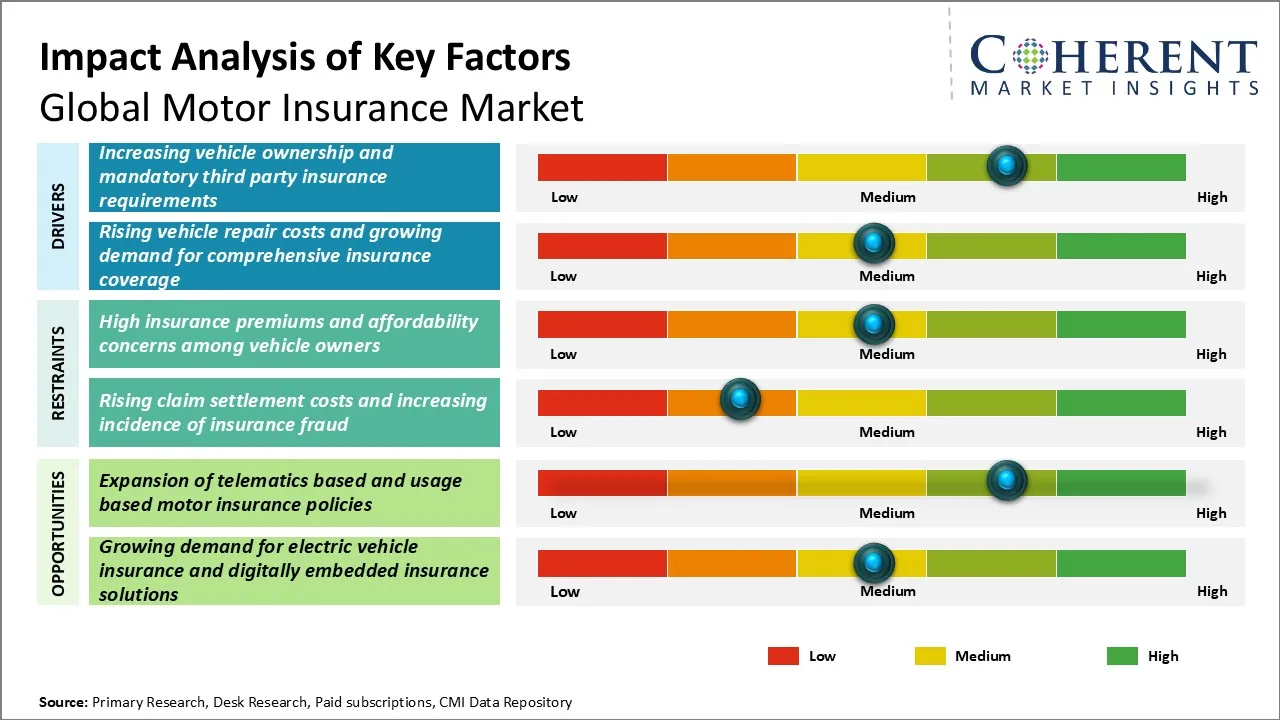
Key Market Drivers
- Increasing vehicle ownership and mandatory third party insurance requirements: Expanding vehicle fleets increase insurable exposure, while compulsory third-party liability rules turn many vehicle owners into recurring policyholders. Registration checks and roadside enforcement help reduce uninsured driving and widen premium collection, especially in markets with inconsistent renewal compliance. Insurers and licensed distributors benefit from a broader customer base, but affordability and accurate verification remain important to sustained retention. In January 2025, California increased mandatory minimum automobile liability coverage to USD 30,000 per injured person, USD 60,000 per accident, and USD 15,000 for property damage, strengthening financial protection for road users.
- Rising vehicle repair costs and growing demand for comprehensive insurance coverage: Modern vehicle design increases the expense of otherwise routine collision repairs because sensors, cameras, and safety systems often require specialized parts and recalibration. Greater potential loss severity strengthens the economic case for comprehensive cover and places more importance on adequate premiums, repair agreements, and claims reserves. Insurers with efficient repair networks can defend margins, while specialist repair providers gain more complex work. In February 2026, the Association of British Insurers reported that insurers paid USD 15.77 billion in motor claims during 2025, including nearly USD 9.94 billion for vehicle damage.
Emerging Market Trends
- Shift Toward Driving Behavior-Based Insurance Pricing: Motor insurers are moving beyond broad demographic proxies toward risk measures based on how, when, and where vehicles are operated. Consent-based telematics and connected vehicle feeds can support usage-sensitive premiums, safer-driving incentives, and policy adjustments that reflect actual exposure. This approach may appeal to low-mileage motorists while putting pressure on insurers reliant on static annual classifications. Customers will nevertheless expect straightforward explanations of data collection, scoring, and premium decisions. Over the forecast period, trustworthy data governance may become as commercially important as sophisticated risk modelling.
- Integration of Digital Claims Management with Vehicle Repair Networks: Repair authorizations, parts sourcing, calibration records, and settlement updates are increasingly being connected through shared claims workflows. Instead of managing each collision as a separate administrative task, motor insurers can establish service networks that measure workmanship, repair duration, and communication quality. Independent workshops may gain recurring referrals when they can exchange reliable digital records, while disconnected providers risk losing preferred status. During the forecast period, consistent repair documentation and visible service performance should strengthen insurers' control over claims execution and shape how customers evaluate an insurance policy.
Current Events and their Impact
Current Event | Description and Its Impact |
July 2025 – European Union Standardized Motor Insurance Claims-History Requirements |
|
June 2025 – United Kingdom Moves to Restrict Property Damage Compensation for Uninsured Drivers |
|
March 2024 – Philippines Doubles Compulsory Third-Party Motor Insurance Benefits |
|
Regional Insights
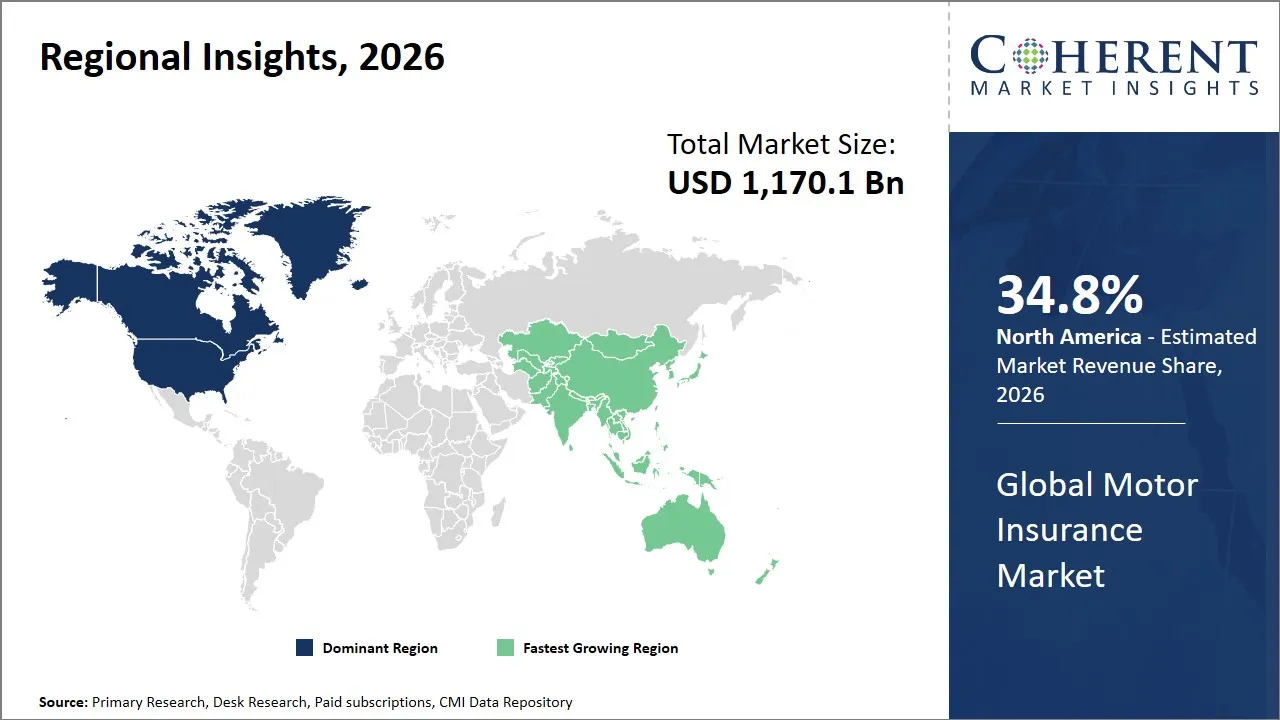
Why Does North America Dominate the Global Motor Insurance Market?
North America is expected to account for 34.8% of the global motor insurance market in 2026, supported by extensive insured vehicle exposure and mature risk-transfer arrangements. The United States anchors regional premium volume, while Canadian insurers add a substantial market for private automobile protection. Beyond routine accident cover, theft exposure influences vehicle eligibility, underwriting restrictions, deductibles, and investments in preventive technology. The region therefore generates business not only through policy issuance but also through specialized risk assessment and recovery services. In April 2026, the Insurance Bureau of Canada reported that Canadian auto theft claims declined by 24% in 2025, although their total value remained historically elevated at CAD 724 million. This highlights how insurers must continually reprice and manage vehicle-specific risks even when reported incident volumes improve. North America's established claims infrastructure helps carriers respond to these changing exposures.
Why Is Asia Pacific Emerging as the Fastest-Growing Region in the Global Motor Insurance Market?
Asia Pacific is expected to represent 30.0% of the global motor insurance market in 2026 and is identified in the supplied forecast as the fastest-growing region. Its expansion potential is geographically diverse: large domestic insurance portfolios in China and India coexist with smaller Southeast Asian markets where distribution and policy access are still developing. Regional freight movements also create demand for insurance that remains valid across national borders, an issue distinct from ordinary domestic renewals. In July 2024, Thailand's national insurance bureau, Road Accident Victims Protection Company Limited, partnered with Dhipaya Insurance to enable electronic compulsory motor cover for cross-border travelers through the ASEAN Compulsory Motor Insurance system. Such infrastructure reduces purchasing friction for transport operators and provides a practical route to formalizing additional insured journeys. Growth will depend on affordability and effective local implementation.
Global Motor Insurance Market Outlook for Key Countries
Why Is the U.S. a Key Market for the Global Motor Insurance Market?
The United States remains a cornerstone of the global motor insurance market because personal vehicles are central to commuting and state-based insurance oversight produces a large, differentiated underwriting environment. Consumer purchasing decisions increasingly balance premium affordability against deductible size, service standards, and confidence in claim settlement. For carriers, state-level approval requirements create distinct pricing and compliance challenges, while established digital and agency channels support broad policy access. In January 2025, the U.S. Department of the Treasury released a Federal Insurance Office report examining personal automobile insurance affordability, underwriting practices, and the effects of technological change on consumers. The report identified concerns around pricing proxies and the transparency of artificial intelligence applications. These issues make defensible risk selection and explainable pricing commercially important for insurers seeking sustainable customer retention in the United States.
Why Is India Important in the Global Motor Insurance Market?
India is important to the global motor insurance market because coverage must serve highly varied vehicle owners, from household motorists to small transport businesses operating on tight budgets. Insurers face a practical challenge beyond selling policies: they must settle modest-value accident claims efficiently and explain adjustments clearly to customers unfamiliar with insurance procedures. Regional language support, accessible workshops, and straightforward documentation can therefore affect renewal decisions. In December 2025, India's Ministry of Finance outlined Insurance Regulatory and Development Authority of India requirements for transparent motor claim decisions and reported that claims below INR 50,000 need not undergo mandatory assessment by a registered surveyor. The ministry also noted the use of application-based assessments for these cases. This framework can lower servicing friction, giving insurers an opportunity to improve turnaround times without weakening review controls.
Why Does China Support Growth in the Global Motor Insurance Market?
China plays a distinctive role in the global motor insurance market because the increasing diversity of new-energy vehicles complicates conventional vehicle classification and underwriting. Battery characteristics, vehicle-specific components, and differences in repairability affect potential claim costs, while insurers must maintain access for customers whose vehicles appear expensive to insure. Standardized risk information and closer coordination with automotive producers could improve policy availability and risk selection. In January 2025, China's National Financial Regulatory Administration and three other ministries introduced guidelines for new-energy vehicle insurance, including work on model-level risk classifications, repair standards, and more appropriate pricing mechanisms. The measures could help insurers align premiums with actual exposure and support products suited to electric vehicle ownership. Their effectiveness will depend on data quality and consistent implementation.
Why Is Germany a Strategic Country in the Global Motor Insurance Market?
Germany is a strategic motor insurance market because detailed vehicle-model statistics provide insurers with an established basis for differentiating liability and own-damage risks. Its varied automobile fleet, including premium vehicles, creates meaningful differences in replacement values and claim profiles. Insurers can use standardized model classifications alongside location and mileage information when assessing premiums, while consumers can compare how insurance costs vary between vehicle choices. In September 2026, the German Insurance Association, GDV, updated its motor liability type classifications and reported that more than twelve million motorists would receive a changed category. The association emphasized that these classifications are not binding on insurers and do not determine premiums on their own. This framework illustrates the commercial value of granular vehicle-risk evidence in Germany's insurance market.
Why Is Brazil an Important Growth Market for the Global Motor Insurance Market?
Brazil is an important growth market for global motor insurance because insurers must balance affordability with diverse local exposure profiles and a distribution network serving motorists beyond major cities. Product design has to account for differences in vehicle usage, theft risk, and customers' willingness to pay for optional protection. This creates room for insurers that can offer clear cover options without weakening claims economics. In February 2026, Brazil's insurance supervisor, SUSEP, reported that automobile insurance premiums grew 6.79% in nominal terms and 1.66% in real terms during 2025. It also highlighted a regulatory framework intended to expand participation by insurance cooperatives and mutual protection groups. These developments suggest opportunities for broader access, although new competition will require established insurers to defend service quality and technical pricing discipline.
Digital Underwriting and Claims Technology Landscape in the Global Motor Insurance Market
Technology | Application in Motor Insurance | Commercial Significance | Key Adoption Considerations |
Telematics and Usage-Based Insurance | Collects driving information, including mileage, acceleration, braking, and vehicle usage patterns, to support individualized insurance pricing. | Enables more precise risk segmentation and creates opportunities for pay-as-you-drive and driving behavior-based policies. | Customer consent, data privacy, device compatibility, and pricing transparency. |
AI-Powered Vehicle Damage Assessment | Uses computer vision and image recognition to evaluate vehicle damage from accident photographs and digital inspection records. | Supports faster damage estimation, reduces routine assessment workloads, and helps claims teams prioritize complex cases. | Image quality, estimation accuracy, fraud controls, and human review requirements. |
Automated First Notification of Loss (FNOL) | Uses mobile applications, accident detection systems, and connected vehicle information to initiate claims notifications. | Improves accident reporting, facilitates early assistance, and reduces delays in gathering initial incident information. | System integration, false accident alerts, customer authorization, and data security. |
Advanced Insurance Fraud Analytics | Applies machine learning and relationship analysis to identify suspicious claims, inconsistent documentation, and potentially coordinated fraud. | Supports more targeted investigations, strengthens claims controls, and helps insurers reduce unnecessary settlement expenditure. | Model explainability, false-positive management, and regulatory compliance. |
Embedded Insurance and API Integration | Integrates policy quotations, issuance, and renewals into automotive dealerships, financing platforms, and digital mobility services. | Creates additional customer acquisition opportunities and simplifies insurance purchasing within vehicle-related transactions. | Partner integration, distribution regulations, cybersecurity, and commission structures. |
Geospatial Risk Analytics | Combines location information with flood, hail, theft, and other relevant exposure indicators for motor underwriting. | Supports location-sensitive risk assessment, catastrophe exposure monitoring, and more informed portfolio management. | Geographic data accuracy, privacy restrictions, and regulatory requirements for fair pricing. |
How Are Flexible Mixed-Use Motor Insurance Policies Creating New Growth Opportunities in the Global Motor Insurance Market?
An underserved opportunity is emerging among drivers whose vehicles alternate between private journeys and income-generating trips. Standard personal motor policies may exclude ridesharing or parcel delivery, while annual commercial policies can be uneconomical for occasional platform work. Insurers could bridge this gap with policies that activate additional protection during verified commercial trips and revert to personal cover afterward.
Potential buyers include part-time drivers, small delivery operators, vehicle-leasing businesses, and mobility platforms, particularly where app-based work is expanding faster than specialist insurance distribution. Successful offerings would require reliable trip-status information, clear liability allocation, mobile premium collection, and agreements with platform operators.
Insurers must also establish fraud controls, consent-based data handling, and claims procedures that can distinguish personal from paid use. Technology specialists may enter through distribution partnerships, but established carriers could retain an advantage where local licensing, underwriting capital, and claims networks are essential to operating profitably across fragmented regulatory markets.
Market Players, Key Development, and Competitive Intelligence
Key Developments
- In June 2026, State Farm Mutual Automobile Insurance Company announced an optional claims feature allowing eligible Toyota and Lexus owners to share vehicle accident data through its mobile app. The collaboration could reduce dependence on customers' recollections and speed up initial claim assessment while preserving consent and excluding these data from underwriting.
- In July 2026, Allianz UK, part of Allianz SE, launched Slick Cover, a digital-first motor insurance proposition developed through a managing general agent model. Its digital wallet and streamlined claims notification tools illustrate how established insurers can test leaner retail distribution structures while preserving access to telephone-based claims support.
- In January 2026, Lemonade, Inc. launched Autonomous Car insurance for eligible Tesla vehicles using Full Self-Driving, with pricing that distinguishes software-assisted miles from human-driven miles. This development introduces vehicle operating-mode information into insurance premiums, allowing risks associated with different driving states to be assessed separately.
Competitive Landscape
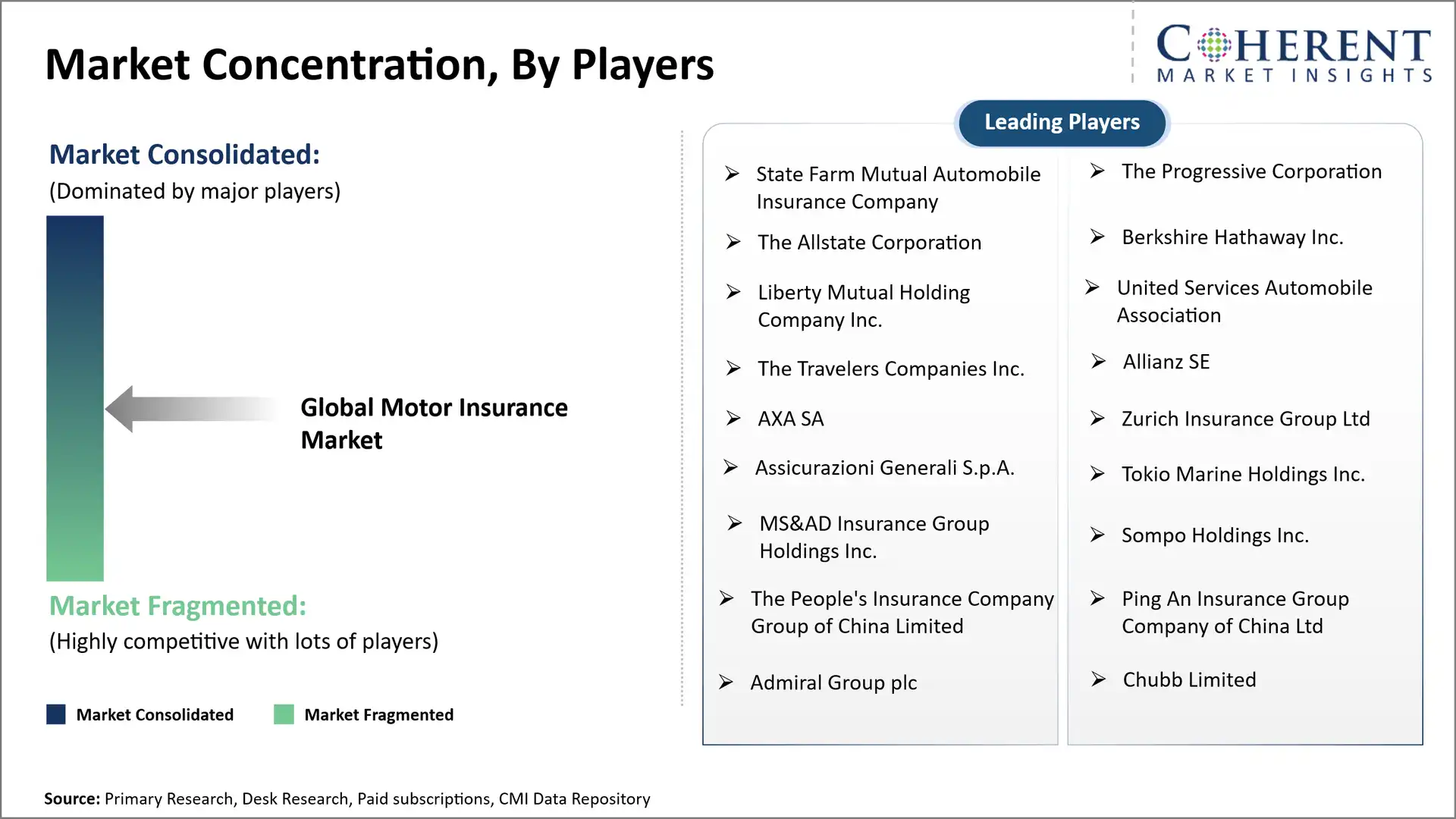
The global motor insurance market is fragmented across jurisdictions, although established multiline insurers command strong positions within individual countries. Competition depends on technical pricing, capital strength, claims responsiveness, and relationships with agents, brokers, dealerships, and repair networks. Regional carriers compete through local risk knowledge, while digital specialists target narrower customer groups. Regulatory compliance and disciplined acquisition costs remain crucial to sustainable underwriting.
Key focus areas include
- Underwriting Profitability: Accurate assessment of accident frequency, claims severity, and vehicle-specific exposure supports sustainable premium pricing.
- Distribution Economics: Efficient acquisition and renewal processes help insurers reduce dependence on expensive intermediary arrangements.
- Customer Retention: Transparent policy conditions, dependable claims communication, and convenient servicing influence renewal decisions.
- Portfolio Diversification: Balanced exposure across private and commercial vehicle categories helps manage concentration and underwriting volatility.
- Capital and Reinsurance Management: Appropriate risk transfer and reserve adequacy improve insurers' ability to absorb large or unexpected claims.
- Fraud Prevention Capabilities: Reliable identity verification and coordinated investigation procedures protect claim settlements from manipulation.
- Local Market Expertise: Understanding jurisdiction-specific liability rules, claims practices, and consumer preferences supports regional competitiveness.
Market Report Scope
Global Motor Insurance Market Report Coverage | |||
Report Coverage | Details | ||
Base Year | 2025 | Market Size in 2026: | USD 1,170.1 Bn |
Historical Data For: | 2021 To 2024 | Forecast Period: | 2026 To 2033 |
Forecast Period 2026 To 2033 CAGR: | 8.60% | 2033 Value Projection: | USD 2084.64 Bn |
Geographies covered: |
| ||
Segments covered: |
| ||
Companies covered: | State Farm Mutual Automobile Insurance Company, The Progressive Corporation, The Allstate Corporation, Berkshire Hathaway Inc., Liberty Mutual Holding Company Inc., United Services Automobile Association, The Travelers Companies Inc., Allianz SE, AXA SA, Zurich Insurance Group Ltd, Assicurazioni Generali S.p.A., Tokio Marine Holdings Inc., MS&AD Insurance Group Holdings Inc., Sompo Holdings Inc., The People's Insurance Company Group of China Limited, Ping An Insurance Group Company of China Ltd, Admiral Group plc, Chubb Limited | ||
Growth Drivers: |
| ||
Restraints & Challenges: |
| ||
Analyst Opinion (Expert Opinion)
- The global motor insurance market is likely to move toward longer-term customer relationships built around mobility protection rather than individual annual policy transactions. Insurers that can coordinate protection across vehicle ownership, financing, and changing transport needs may achieve stronger retention. Competitive leadership could increasingly depend on customer lifetime value and service integration instead of premium discounting alone.
- Software-defined vehicles could fundamentally change how accident responsibility is allocated among drivers, vehicle manufacturers, and automated driving technology providers. As driving decisions become increasingly influenced by software, conventional fault-based underwriting assumptions may require reconsideration. Insurers capable of evaluating software-related exposure, establishing liability arrangements, and developing suitable policy language could gain an advantage as regulatory frameworks evolve.
- Motor insurers would benefit from prioritizing geographically detailed risk assessment, disciplined underwriting, and resilient claims operations. Particular attention to weather-exposed vehicle portfolios and smaller commercial customers could improve risk selection. Investment in localized service capabilities and reliable risk information may offer greater long-term value than aggressive discounting. Companies should also consider regulatory pricing restrictions, reinsurance costs, and concentration risks before entering unfamiliar markets.
Speak to the analyst
Want personalized insights?
Take the findings above to one of our principal consultants, or have the report rebuilt around the segments, geographies and competitors you actually track.
Market Segmentation
- Policy Type Insights (Revenue, USD Bn, 2021 - 2033)
- Comprehensive Insurance
- Third Party Only Insurance
- Third Party Fire and Theft Insurance
- Motor Insurance Component Insights (Revenue, USD Bn, 2021 - 2033)
- Third Party Liability
- Own Damage
- Vehicle Type Insights (Revenue, USD Bn, 2021 - 2033)
- Passenger Cars
- Light Commercial Vehicles
- Heavy Commercial Vehicles
- Two Wheelers
- Other Vehicles
- Vehicle Age Insights (Revenue, USD Bn, 2021 - 2033)
- New Vehicles
- Used Vehicles
- By Application (Revenue, USD Bn, 2021 - 2033)
- Personal Vehicles
- Commercial Vehicles
- Distribution Channel Insights (Revenue, USD Bn, 2021 - 2033)
- Insurance Agents and Brokers
- Direct Insurer Sales
- Banks and Financial Institutions
- Online Insurance Aggregators
- Automotive Dealerships and OEM Partners
- Regional Insights (Revenue, USD Bn, 2021 - 2033)
- North America
- U.S.
- Canada
- Latin America
- Brazil
- Argentina
- Mexico
- Rest of Latin America
- Europe
- Germany
- U.K.
- Spain
- France
- Italy
- Russia
- Rest of Europe
- Asia Pacific
- China
- India
- Japan
- Australia
- South Korea
- ASEAN
- Rest of Asia Pacific
- Middle East
- GCC Countries
- Israel
- Rest of Middle East
- Africa
- South Africa
- North Africa
- Central Africa
- North America
Sources
Primary Research Interviews
- Motor insurance providers, underwriters, and actuarial experts
- Insurance agents, brokers, and digital insurance aggregators
- Automotive OEMs, fleet operators, and claims management professionals
Stakeholders
- General insurers, reinsurers, and insurance intermediaries
- Automotive manufacturers, dealerships, and vehicle financing institutions
- Fleet operators, repair networks, and insurance technology providers
End-use Sectors
- Private passenger vehicles and two-wheelers
- Commercial vehicles, logistics, and transportation fleets
- Ride-hailing, vehicle leasing, and mobility services
Regulatory and Industry Bodies
- National Association of Insurance Commissioners (NAIC)
- European Insurance and Occupational Pensions Authority (EIOPA)
- Insurance Regulatory and Development Authority of India (IRDAI)
- International Association of Insurance Supervisors (IAIS)
- Financial Conduct Authority (FCA), U.K.
Databases
- Company annual reports and investor presentations
- NAIC Auto Insurance Database and OECD Insurance Statistics
- EIOPA insurance statistics and IRDAI annual reports
- World Bank and OICA automotive industry statistics
Magazines and Journals
- Insurance Journal
- Insurance Business
- The Geneva Papers on Risk and Insurance
- Journal of Risk and Insurance
- Asia Insurance Review
Associations
- Insurance Information Institute (Triple-I)
- Association of British Insurers (ABI)
- Insurance Bureau of Canada (IBC)
- General Insurance Council (India)
- German Insurance Association (GDV)
Public Domain Sources
- Motor insurance premiums, policy issuance, and claims statistics
- Vehicle registrations, ownership, and insurance penetration data
- Motor insurance pricing, underwriting, and distribution trends
- Accident frequency, vehicle theft, and repair cost statistics
- Digital insurance, telematics, and regulatory developments
Key Standards and Regulations
- EU Motor Insurance Directive (2009/103/EC, as amended)
- U.K. Road Traffic Act 1988
- India Motor Vehicles Act 1988, as amended
- U.S. state-level compulsory motor liability insurance requirements
- IFRS 17 – Insurance Contracts
- IAIS Insurance Core Principles (ICPs)
Proprietary Elements
- CMI Data Analytics Tool
- Proprietary CMI repository containing 10+ years of industry intelligence covering motor insurance premiums, claims trends, underwriting practices, policy pricing, distribution channels, vehicle risk assessment, regulatory developments, and competitive intelligence.
Get access to 250+ pages report
Every segment, forecast, competitor profile and data table behind the analysis above — available for instant download.
- ESOMAR Member
- ISO 9001:2015 Certified
- D-U-N-S Registered
- GDPR & CCPA Compliant
Frequently Asked Questions
The CAGR of global motor insurance market is projected to be 8.60% from 2026 to 2033.
The global motor insurance market is estimated to be valued at USD 1,170.1 Bn in 2026 and is expected to reach USD 2,084.64 Bn by 2033.
Digital platforms are simplifying policy purchases, renewals, premium comparisons, and claims processing, helping insurers improve operational efficiency and customer convenience.
Vehicle theft increases insurance claim exposure and influences premium pricing, underwriting decisions, and demand for theft protection coverage.
Electric vehicles create new insurance requirements related to battery damage, specialized repairs, replacement costs, and vehicle-specific risk assessment.
Government regulations establish mandatory insurance requirements, minimum liability coverage, consumer protection standards, and claims settlement guidelines, influencing insurance adoption and insurer compliance.
The major factors driving the growth of the global motor insurance market are increasing vehicle ownership, mandatory third-party insurance requirements, rising vehicle repair costs, and growing demand for comprehensive insurance coverage.