

Global Motorized Zoom Lens Market Size and Forecast – 2026 To 2033
The global motorized zoom lens market is expected to grow from USD 1.25 Bn in 2026 to USD 2.95 Bn by 2033, registering a compound annual growth rate (CAGR) of 5.1% from 2026 to 2033. The global motorized zoom lens market is driven by rising expansion of industrial automation and machine vision. On June 9, 2025, Cognex Corporation announced the upcoming full launch of OneVision, a cloud-based platform that will transform how manufacturers build, train, and scale AI-powered vision applications. (Source: Cognex Corporation)
Key Takeaways of the Global Motorized Zoom Lens Market
- The optical zoom segment is expected to account for 42.0% of the global motorized zoom lens market share in 2026. Growing demand for remote-controlled high-precision imaging is a major growth factor for the segment. On November 4, 2025, Canon U.S.A., Inc. announced the launch of the CR-N400 and CR-N350, two new Pan-Tilt-Zoom (PTZ) cameras designed to deliver outstanding image quality, versatile connectivity, and advanced control for professional video applications. (Source: Canon)
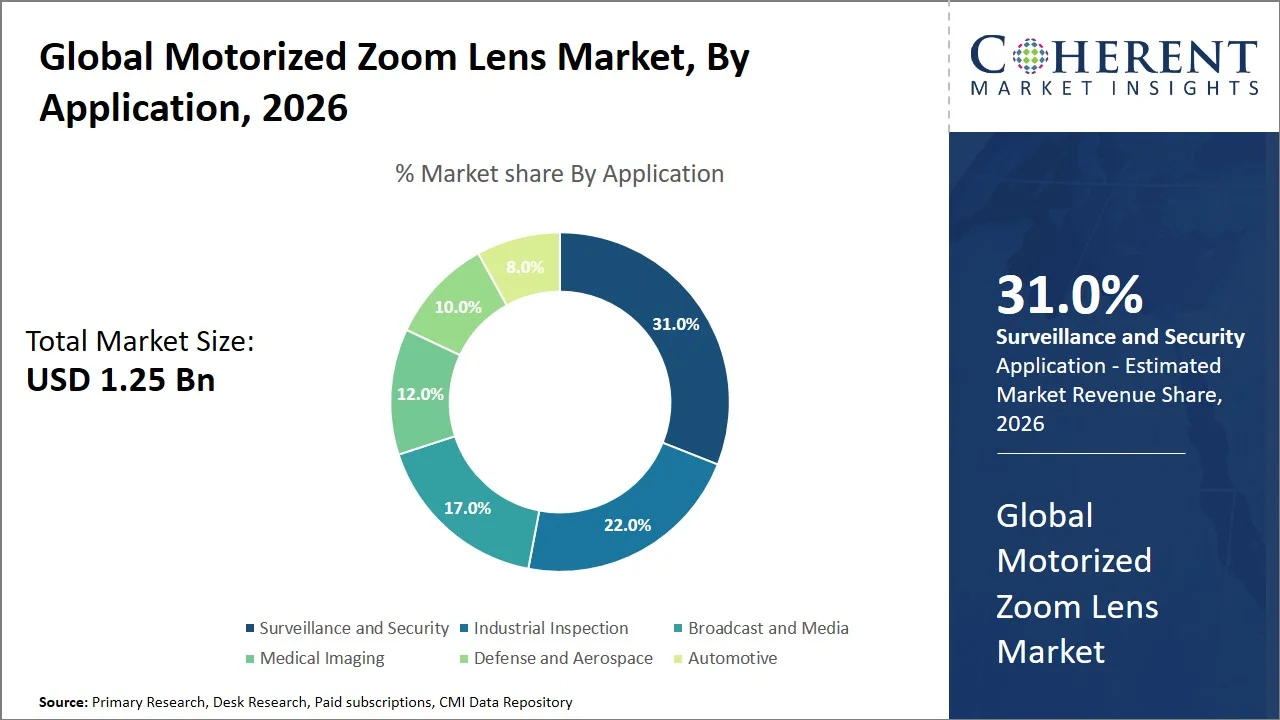
- The surveillance and security segment is estimated to capture 31.0% of the market share in 2026. Integration of surveillance systems with IoT and cloud-based monitoring systems is majorly driving the growth of the segment. On September 25, 2025, Motorola Solutions showcased new AI-assisted incident response solutions across on-premise, cloud-based and other third-party security deployments that ease the burden on security operators managing hundreds of cameras, doors, sensors and more. (Source: Motorola Solutions)
- Asia Pacific is expected to dominate the motorized zoom lens market in 2026 with a market share of 42.0%. Expansion in autonomous vehicles & robotic vision systems in Asia Pacific is guiding the growth of the regional market. On June 7, 2026, NVIDIA and LG Group announced the commencement of an AI factory to accelerate LG Group’s next wave of AI-driven businesses, spanning robotics, autonomous driving, data center technologies and GPU cloud services. (Source: NVIDIA)
- North America is expected to account for 26.0% share in 2026 and is projected to record the fastest growth over the forecast period. Growing miniaturization of lenses for compact devices and introduction of meta-lenses in North America is driving the growth of the regional market. On December 22, 2025, Kyocera Corporation announced that it has developed a new meta-lens that uses metasurface-based optical control technology to precisely manipulate focal positions depending on the wavelength of light. (Source: Kyocera)
- AI-Integrated Intelligent Zoom and Auto-Tracking Systems: Motorized zoom lenses are increasingly being fitted with artificial intelligence algorithms that automatically identify, track and zoom in on moving objects. This is especially seen in surveillance, traffic monitoring and smart city applications where cameras may automatically change focal length and focus settings such that images are kept in focus without human involvement.
- Growing Adoption of High-Resolution Imaging (4K, 8K, and Beyond): The push for ultra-high-definition imaging is creating the need for improved motorized zoom lenses that can retain optical performance over broader zoom ranges. Security operators, broadcasters, industrial inspectors and defense organizations requiring precision optics with excellent light transmission, focusing capabilities and little distortion are investing in 4K and 8K display and imaging systems.
Segmental Insights
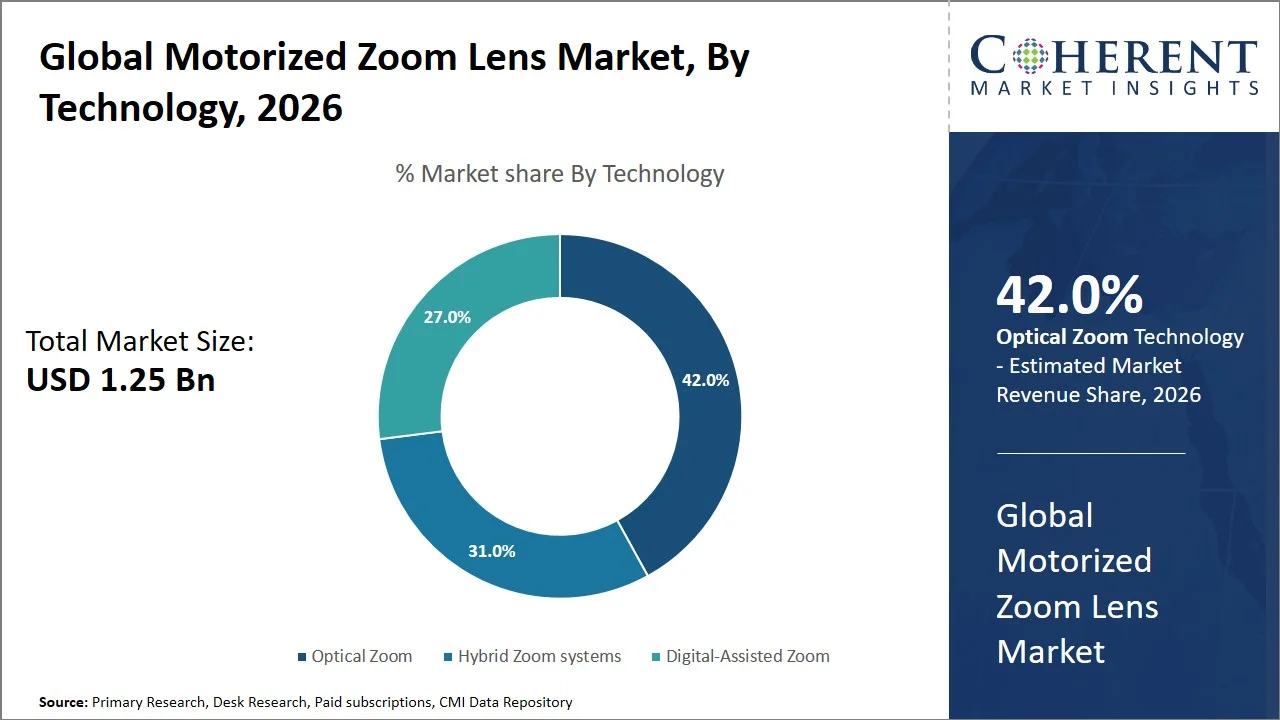
Why Does Optical Zoom Dominate the Global Motorized Zoom Lens Market?
The optical zoom segment is expected to account for 42.0% of the global motorized zoom lens market share in 2026. The world’s motorized zoom lens industry is dominated by optical zoom, which enlarges the subject by physically moving lens elements rather than enlarging the image digitally. This means the full sensor resolution and image quality are preserved. This capacity is important in surveillance, defense, industrial inspection, and broadcasting applications where small details need to be captured at vast distances. Unlike digital zooms that create pixelation, image distortion and loss of clarity, optical zoom minimizes these effects and is the preferred choice for professional and mission-critical imaging systems.
On March 17, 2025, Sony announced the FE 400-800mm F6.3-8 G OSS (SEL400800G), Sony’s first 800 mm super-telephoto zoom G Lens. This brand-new Alpha lens flaunts high resolution performance across the entire zoom range, beautiful bokeh, as well as fast, precise, and accurate autofocus. In addition, the inner-zoom design, which minimizes change in the center of gravity, allows for stable framing. It is also compatible with the separately sold 1.4x and 2x teleconverter that can extend the maximum focal length to 1,600 mm, making this lens ideal for shooting birds, wildlife, sports, aircraft and landscapes. (Source: Sony)
- Current Industry Events of 2026
- Market Size Estimation
- Regional Breakdown
- Competitive Landscape
- Customer Intelligence
- Segmental Analysis
- Pricing Analysis
- Key Market Drivers, Challenges & Future Trends
- Customized Insights Section
Why is Surveillance and Security the Most Widespread Application?
The surveillance and security segment is expected to account for 31.0% of the global motorized zoom lens market share in 2026. Motorized zoom lenses are most commonly used in surveillance and security applications because they enable the remote monitoring of huge regions with high precision, while still offering clear images at different distances. Security personnel may dynamically alter magnification and focus to spot persons, vehicles and incidents in real-time without physically moving the cameras. This feature is of particular importance in smart cities, transport hubs, critical infrastructure, industrial facilities and public safety networks where constant situational awareness is vital. On April 1, 2025, Axis
Why is Surveillance and Security the Most Widespread Application?
The surveillance and security segment is expected to account for 31.0% of the global motorized zoom lens market share in 2026. Motorized zoom lenses are most commonly used in surveillance and security applications because they enable the remote monitoring of huge regions with high precision, while still offering clear images at different distances. Security personnel may dynamically alter magnification and focus to spot persons, vehicles and incidents in real-time without physically moving the cameras. This feature is of particular importance in smart cities, transport hubs, critical infrastructure, industrial facilities and public safety networks where constant situational awareness is vital. On April 1, 2025, Axis Communications announced two AI-powered PTZ cameras that deliver unmatched image quality with great detail and high performance in all light conditions. Built on ARTPEC-9, they offer accelerated performance and make it possible to run impressive analytics applications on the edge. (Source: Axis Communicationsannounced two AI-powered PTZ cameras that deliver unmatched image quality with great detail and high performance in all light conditions. Built on ARTPEC-9, they offer accelerated performance and make it possible to run impressive analytics applications on the edge. (Source: Axis Communications
Currents Events and their Impact
Current Events | Description and its Impact |
European Union AI Act (European Union) |
|
Cyber Resilience Act (European Union) |
|
(Source: EU AI Act, European Commission)
Motorized Zoom Lens Market Dynamics
Market Drivers
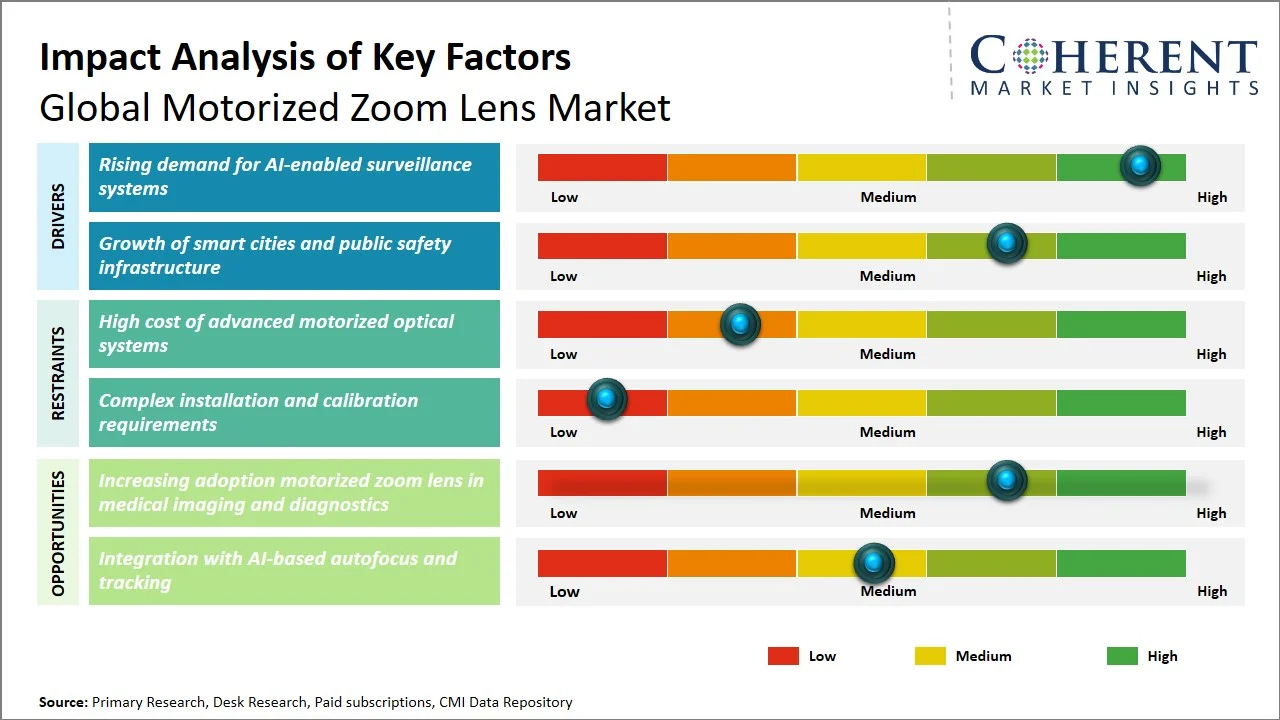
- Rising demand for AI-enabled surveillance systems: The rising demand for AI-enabled surveillance systems is a significant growth driver for the global motorized zoom lens market, as organizations are increasingly looking for intelligent monitoring solutions capable of real-time object detection, facial recognition, behavior analysis, and automated threat identification. At the core of these systems are motorized zoom lenses that allow cameras to zoom and focus automatically, tracking targets over vast areas while keeping the image in focus. As governments, transit authorities, smart-city operators and commercial organizations engage in AI-powered security infrastructure, there is a growing need for high-performance motorized zoom lenses that enable accurate picture capture and advanced analytics.
- On November, 20, 2024, Axis Communications announced the release of its ninth-generation system-on-chip (SoC), ARTPEC-9, designed to address key challenges in today’s security surveillance systems. With ARTPEC-9, security managers and integrators can benefit from enhanced AI-powered analytics, superior image quality, and advanced cybersecurity, all while reducing storage costs owing to the AV1 video encoding standard. (Source: Axis Communications)
- Growth of smart cities and public safety infrastructure: The increasing development of smart cities and public safety infrastructure is a major factor boosting the demand for motorized zoom lenses as governments across the globe are investing in intelligent traffic management, urban surveillance, emergency response systems, and critical infrastructure protection. These applications call for cameras that can monitor broad public spaces, transportation networks and civic assets and produce crisp, high-resolution images at different distances. Motorized zoom lenses allow for zoom and focus adjustments from a distance, and are key components of modern surveillance systems that enable real-time monitoring, incident detection and improved public safety in more and more connected cities.
- On April 21, 2025, Motorola Solutions launched SVX, a first-of-its-kind video remote speaker microphone that converges secure voice, video and AI, designed for the company’s flagship radio, APX NEXT. (Source: Motorola Solutions)
Emerging Trends
- Expansion of Machine Vision and Industrial Automation Applications: Motorized zoom lenses are becoming essential for machine vision applications in automated inspection, robotics, semiconductor production, and logistics. More and more, manufacturers are turning to lenses that allow remote adjustment of zoom and focus characteristics to suit diverse product sizes and inspection needs.
- Development of Compact and Long-Range Zoom Solutions: Lens manufacturers are working on producing lighter, smaller and more energy-efficient motorized zoom lenses while at the same time enhancing long-range imaging capabilities. Advancements in optical engineering, small motors, and precision control systems are enabling compact cameras to attain impressive zoom capabilities.
Regional Insights
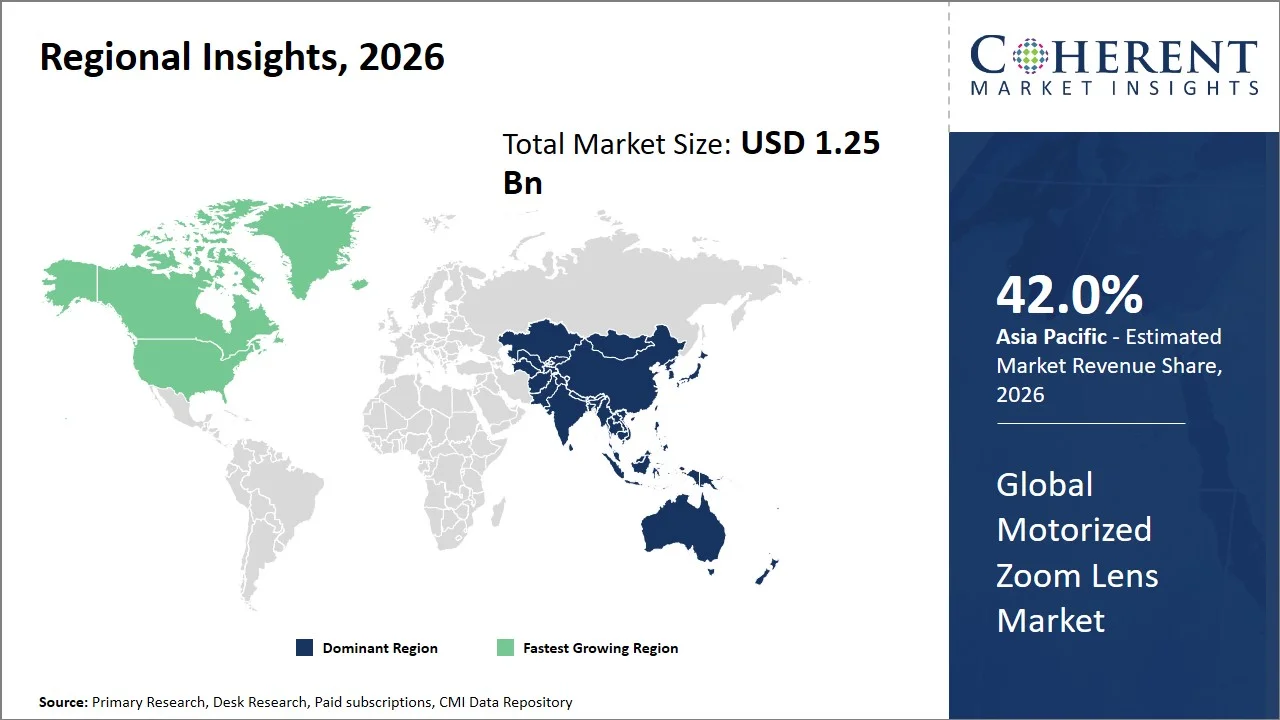
Why is Asia Pacific a Strong Market for Motorized Zoom Lens?
Asia Pacific is expected to account for a market share of 42.0% in 2026. The Asia Pacific region is the global hub for motorized zoom lens use, driven by widespread surveillance deployments, electronics manufacturing and industrial automation projects. In the meantime, China’s government-backed smart-city initiatives under the 14th Five-Year Plan are spurring the massive deployment of PTZ (pan-tilt-zoom) surveillance systems that need motorized optics. India’s Safe City projects are increasing the demand for remotely controlled zoom cameras in city monitoring networks. The proximity of major optical producers in Japan and South Korea also facilitates growth in the region, with a highly integrated supply chain for superior zoom lens technologies. On October 27, 2025, Hikvision introduced a suite of products, solutions, and services designed to help small and medium-sized businesses (SMB) and their security installers work smarter and grow faster. The launch event, called Unlock AI, Unlock SMB Growth and part of the HikTech Star Tour 2025, brought together Hikvision's SMB business partners from around the world at its campus in Hangzhou, China. (Source: Hikvision)
Why Does the North America Motorized Zoom Lens Market Exhibit High Growth?
North America is projected to account for 26.0% of the global motorized zoom lens market and is expected to register the fastest growth. The North America market is being driven by critical infrastructure protection, transportation monitoring and AI-powered security solutions. U.S. airports, transit authorities, utilities and defense sites are installing high-resolution pan, tilt and zoom cameras that automatically track objects and monitor great distances. Demand is also increasing from industrial automation and machine vision applications, where manufacturers are replacing fixed focus optics with motorized zoom options that can inspect many stages of production with a single imaging system. On May 7, 2026, Vadzo Imaging announced the launch of the Falcon‑900MGS 3MP Global Shutter USB Camera. Built on the Sony IMX900 sensor and part of Vadzo's USB camera portfolio, the Falcon‑900MGS delivers true 3MP monochrome global shutter imaging with fixed focus, auto exposure, and a native 9‑axis IMU at full resolution.
Why is China Emerging as a Major Hub in the Motorized Zoom Lens Market?
China, the leading market, has massive smart-city and public-security infrastructure programs. Hikvision and other companies are continuing to release AI-enabled surveillance technologies, such as its DeepinViewX series, which combines enhanced analytics with improved long-range monitoring. Motorized zoom cameras are being used more and more by urban security networks in large cities for traffic management, perimeter security, and public safety applications, while local manufacturers maintain strong production capabilities across the optical value chain.
Is the U.S. the Next Growth Engine for the Motorized Zoom Lens Market?
The drivers of the U.S. motorized zoom lens market demand are homeland security, border surveillance, transportation infrastructure and industrial automation. Federal and state authorities continue to expand their camera networks with AI-enabled monitoring capabilities that demand precise zoom and autofocus accuracy. Manufacturers and logistics operators like GXO and Amazon are also increasingly employing machine vision systems with motorized zoom lenses to boost quality inspection, warehouse automation, and operational efficiency.
Japan Motorized Zoom Lens Market Analysis and Trends
Japan continues to be an important innovation hub with globally recognized optical and imaging producers including Fujifilm Corporation, Canon Inc., and Ricoh Company Ltd. situated within the country. Demand is driven by high accuracy imaging and measurement using motorized zoom lenses for factory automation, semiconductor inspection, robotics and intelligent transportation systems. Japanese businesses are also making progress in compact, high-resolution zoom technologies for industrial and surveillance applications that need remarkable optical precision.
South Korea is using its expertise in electronics, semiconductors and surveillance technology to fuel the demand for high-end motorized zoom lenses. A good example is Hanwha Vision, which presented AI-enabled PTZ camera solutions with high-magnification zoom, object auto-tracking and edge-AI analytics for large-area surveillance. The demand for high-performance motorized optical systems continues to be driven by the country’s smart-city efforts, traffic monitoring projects and manufacturing automation programs.
The Germany motorized zoom lens market is heavily reliant on Industry 4.0 and modern manufacturing. Automotive industries, robotics facilities and precision engineering organizations are increasingly using machine vision systems that require adjustable zoom optics for inspection and quality-control operations. Germany’s long-established optics competence is further augmented by investments from firms such as Carl Zeiss AG, which is investing in increasing its lens production and optical research activities to serve industrial and imaging applications globally.
Global Motorized Zoom Lens Market - Smart City Surveillance Infrastructure Deployments
Region | Smart City Surveillance Infrastructure Deployments (Million Camera Endpoints) |
Asia Pacific | 118.0 |
North America | 41.5 |
Europe | 36.8 |
Middle East & Africa | 31.2 |
Latin America | 25.7 |
Global Motorized Zoom Lens Market - Installed Base of PTZ Cameras
Country | Estimated Installed Base of PTZ Cameras (Million Units) |
China | 18.5 |
U.S. | 11.2 |
India | 5.8 |
Japan | 3.4 |
Germany | 2.7 |
U.K. | 2.3 |
South Korea | 2.1 |
Saudi Arabia | 1.8 |
U.A.E | 1.5 |
France | 1.4 |
How is the Increasing Adoption of Motorized Zoom Lens in Medical Imaging and Diagnostics Creating New Growth Opportunities in the Motorized Zoom Lens Market?
The growth of the motorized zoom lens market is being driven by the rising use of medical imaging and diagnostics as healthcare providers invest in sophisticated imaging systems that need precise, remote-controlled magnification and focus adjustment for accurate diagnosis and clinical procedures. Motorized zoom lenses are finding growing use in digital pathology scanners, surgical microscopes, endoscopic systems, ophthalmic imaging devices and telemedicine platforms where physicians need to view minute anatomical features without sacrificing image quality. The growing use of minimally invasive techniques, AI-powered diagnostics, and advanced imaging technologies with high resolution by hospitals and diagnostic centers is increasing the demand for motorized zoom lenses with greater precision, automation, and real-time imaging capabilities. On February 2, 2026, Wipro GE Healthcare announced the launch of SIGNA Prime Elite, its latest MR imaging system, at the Indian Radiological and Imaging Association (IRIA) 2026 Annual Conference in Hyderabad, India. (Source: GE Healthcare)
Market Players, Key Development, and Competitive Intelligence
Key Developments
- On February 24, 2026, Sigma announced the launch of the Sigma AF Cine 28–105mm T3 FF, the second addition to its AF Cine Line, designed to meet the evolving demands of professional cinema production. Built on the optical performance of Sigma’s acclaimed Art lenses and combined with cinema-style mechanics and advanced autofocus technology, the new lens offers filmmakers a versatile solution for full-frame filmmaking across a wide range of shooting scenarios.
- On September 10, 2025, FUJIFILM announced the release of its FUJINON GF32-90mmT3.5 PZ OIS WR filmmaking lens (GF32-90mmT3.5 PZ OIS WR). The first FUJINON motorized power zoom lens for the GFX System, GF32-90mmT3.5 PZ OIS WR offers serious filmmakers cinematic versatility and exceptional optical performance in a compact, lightweight design.
Competitive Landscape
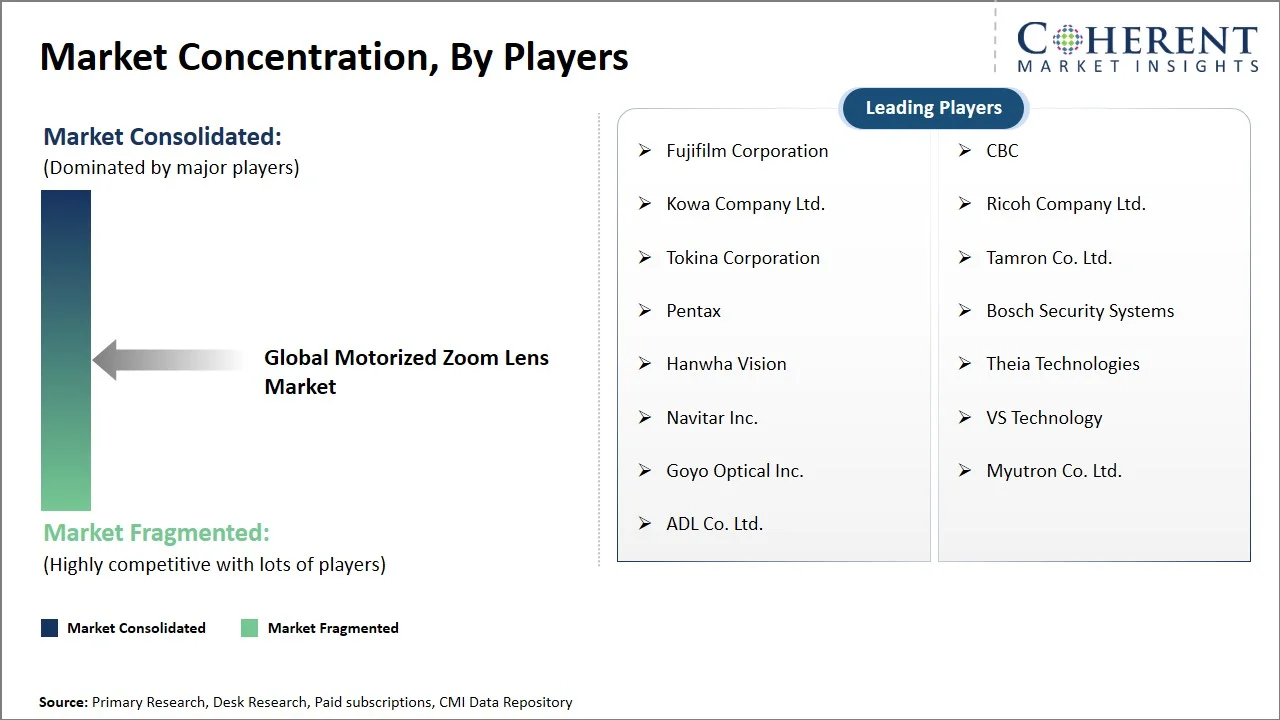
The global market for motorized zoom lenses includes the world’s leading optical manufacturers, security technology providers and specialized machine-vision lens firms competing on product innovation, optical performance and integration capabilities. Manufacturers such as Fujifilm, CBC, Kowa, Ricoh, Tamron, Tokina, Hanwha Vision, Bosch Security Systems and Theia Technologies are developing high-resolution zoom lenses, image solutions compatible with AI and small long-range optical systems. The market is witnessing strategic investments on improved optics, automation technologies and surveillance applications to enhance the position in the industry. Partnerships with camera makers and system integrators are increasingly leveraged to broaden the client base.
Market Report Scope
Motorized Zoom Lens Market Report Coverage
| Report Coverage | Details | ||
|---|---|---|---|
| Base Year: | 2025 | Market Size in 2026: | USD 1.25 Bn |
| Historical Data for: | 2020 To 2024 | Forecast Period: | 2026 To 2033 |
| Forecast Period 2026 to 2033 CAGR: | 5.10% | 2033 Value Projection: | USD 2.95 Bn |
| Geographies covered: |
| ||
| Segments covered: |
| ||
| Companies covered: | Fujifilm Corporation, CBC, Kowa Company Ltd., Ricoh Company Ltd., Tokina Corporation, Tamron Co. Ltd., Pentax, Bosch Security Systems, Hanwha Vision, Theia Technologies, Navitar Inc., VS Technology, Goyo Optical Inc., Myutron Co. Ltd., and ADL Co. Ltd. | ||
| Growth Drivers: |
| ||
| Restraints & Challenges: |
| ||
Analyst Opinion (Expert Opinion)
- The market will be positively affected by the increasing use of intelligent surveillance systems, smart-city infrastructure, industrial automation, and sophisticated imaging technologies. Demand for applications that require remote zoom control, high resolution picture capture and AI-enabled analytics are expected to be strong while optical technical developments are likely to increase product capabilities. While pricing challenges and cybersecurity compliance requirements may be seen in some industries, continued expenditures in security, transportation, healthcare and industrial modernization are anticipated to drive continuous growth prospects.
- The combination of artificial intelligence, edge computing and improved optical imaging systems will likely present substantial opportunities over the next few years. The use of motorized zoom lenses is expected to increase in autonomous systems, smart transportation networks, medical diagnostics, robotics, and next-generation surveillance platforms. The growth of the market is likely to be driven by the emergence of compact high-magnification lenses, AI-assisted autofocus technologies, and ultra-high-resolution imaging solutions. Additionally, the increasing investments in digital infrastructure and public safety projects across Asia Pacific and North America are expected to support long-term demand.
Speak to the analyst
Want personalized insights?
Take the findings above to one of our principal consultants, or have the report rebuilt around the segments, geographies and competitors you actually track.
Market Segmentation
- Technology Insights (Revenue, USD Billion, 2021 - 2033)
- Optical Zoom
- Hybrid Zoom systems
- Digital-Assisted Zoom
- Application Insights (Revenue, USD Billion, 2021 - 2033)
- Surveillance and Security
- Industrial Inspection
- Broadcast and Media
- Medical Imaging
- Defense and Aerospace
- Automotive
- Regional Insights (Revenue, USD Billion, 2021 - 2033)
- North America
- U.S.
- Canada
- Latin America
- Brazil
- Argentina
- Mexico
- Rest of Latin America
- Europe
- Germany
- U.K.
- Spain
- France
- Italy
- Russia
- Rest of Europe
- Asia Pacific
- China
- India
- Japan
- Australia
- South Korea
- ASEAN
- Rest of Asia Pacific
- Middle East
- GCC Countries
- Israel
- Rest of Middle East
- Africa
- South Africa
- North Africa
- Central Africa
- North America
Sources
Primary Research Interviews
- Motorized zoom lens manufacturers and suppliers
- Camera and imaging system integrators
- Security and surveillance equipment vendors
- Industrial automation companies
Magazines
- Imaging & Machine Vision Europe
- Vision Systems Design Magazine
- Security Magazine
- Industrial Photography Magazine
Journals
- Journal of Optical Engineering
- Applied Optics Journal
- IEEE Transactions on Industrial Electronics
Associations
- Society of Photo-Optical Instrumentation Engineers (SPIE)
- International Association of Machine Vision (IAMV)
- Security Industry Association (SIA)
- Camera & Imaging Products Association (CIPA)
Public Domain Sources
- World Trade Organization (WTO) Trade Statistics
- International Trade Centre (ITC) Market Analysis
- Government procurement databases
- Patent and trademark offices databases
Proprietary Elements
- CMI Data Analytics Tool
- Proprietary CMI Existing Repository of information for last 10 years
Get access to 250+ pages report
Every segment, forecast, competitor profile and data table behind the analysis above — available for instant download.
- ESOMAR Member
- ISO 9001:2015 Certified
- D-U-N-S Registered
- GDPR & CCPA Compliant
Missing comfort of reading report in your local language? Find your preferred language:
Transform your Strategy with Exclusive Trending Reports
Frequently Asked Questions
The global motorized zoom lens market is expected to stand at USD 1.25 Bn in 2026 and is expected to reach USD 2.95 Bn by 2033.
The CAGR of the global motorized zoom lens market is projected to be 5.1% from 2026 to 2033.
Rising demand for AI-enabled surveillance systems and growth of smart cities and public safety infrastructure are the major factors driving the growth of the global motorized zoom lens market.
High cost of advanced motorized optical systems and complex installation and calibration requirements are the major factors hampering the growth of the global motorized zoom lens market.
In terms of technology, the optical zoom segment is estimated to dominate the market revenue share in 2026.
AI enables automatic object tracking, autofocus optimization, and intelligent zoom adjustments.
Yes, they are widely used in machine vision systems for inspection, measurement, and quality control.