

Global Ocean Freight Forwarder Market Size and Forecast – 2026 To 2033
The global ocean freight forwarder market is expected to grow from USD 154 Bn in 2026 to USD 268 Bn by 2033, registering a compound annual growth rate (CAGR) of 7.6% from 2026 to 2033. The market is driven by rising outsourcing of logistics activities. On May 4, 2026, DHL Supply Chain and Pepco announced an expansion of their long-standing collaboration to further strengthen Pepco's distribution operations across Europe.
Key Takeaways of the Global Ocean Freight Forwarder Market
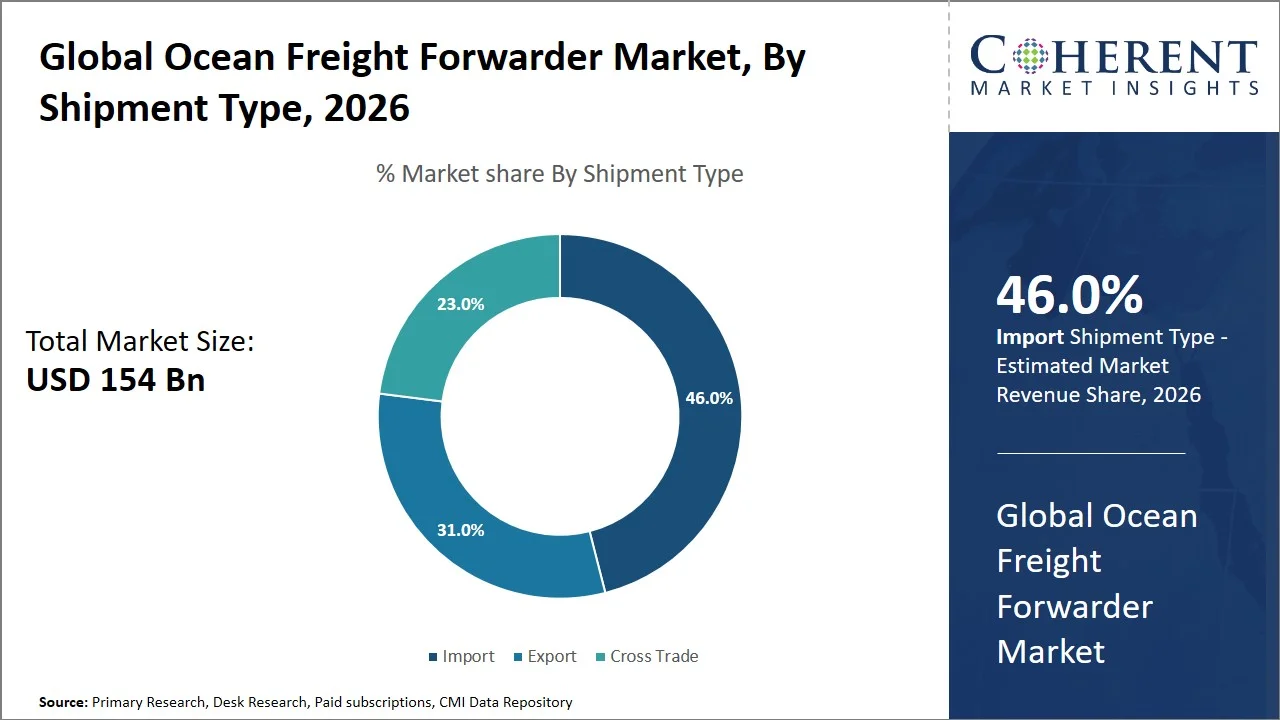
- The Import segment is expected to account for 46.0 % of the global ocean freight forwarder market share in 2026. Greater demand for supply chain visibility is driving the growth of the segment. In September 2025, Maersk launched enhanced supply chain visibility capabilities with predictive alerts and artificial intelligence insights.
- The Dry Containers segment is estimated to capture 41.0 % of the market share in 2026. Expansion of multimodal logistics services is majorly driving the growth of the segment. On June 24, 2026, CEVA launched a Hanoi-to-Chicago air charter service.
- The Full Container Load segment is estimated to capture 27.0 % of the market share in 2026. Increasing containerized cargo movements is majorly driving the growth of the segment. In 2025, DP World reported 93.4 million TEUs handled across its ports and terminals.
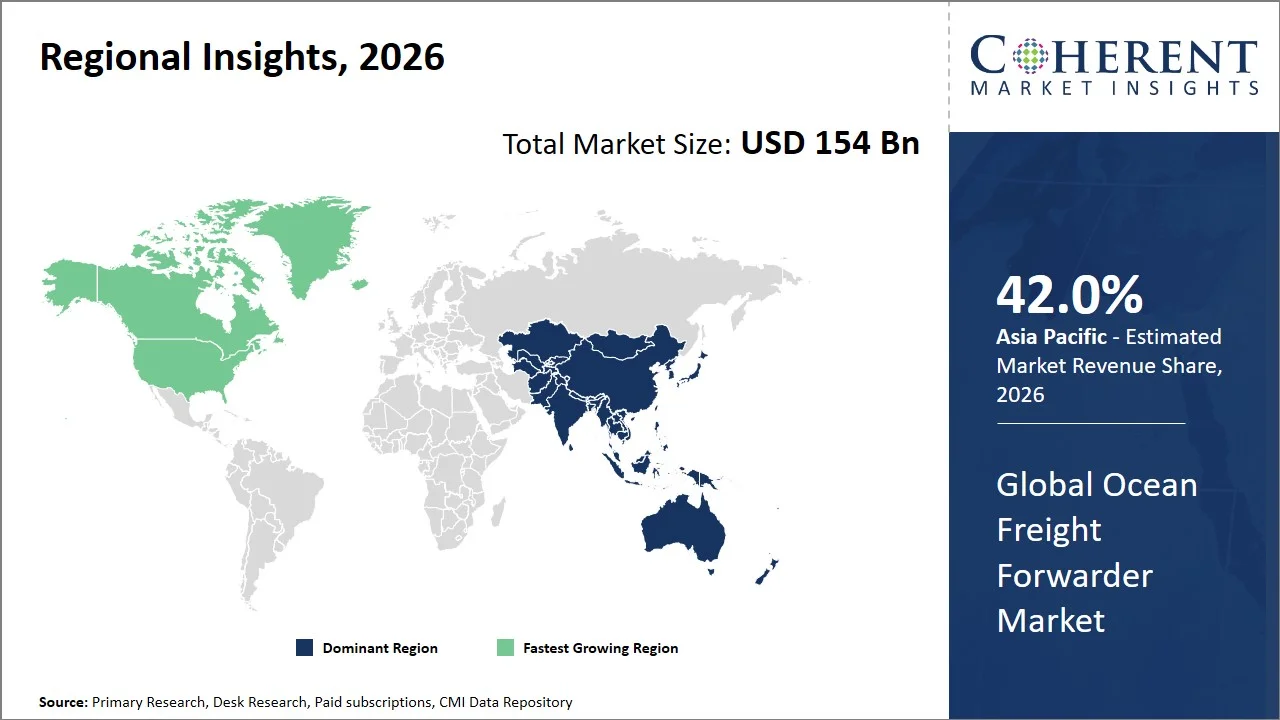
- Asia Pacific is expected to dominate the ocean freight forwarder market in 2026 with a market share of 42.0 %. Supply chain diversification across multiple countries in Asia Pacific is driving the growth of the regional market. On December 2, 2025, Foxconn pursued additional investments across India while expanding Vietnam production. Its Vietnamese subsidiary sought approval to produce Xbox devices and related components.
- North America is expected to account for 28.0% share in 2026 and is projected to record the fastest growth over the forecast period. Growing adoption of digital freight platforms in North America is driving the growth of the regional market. On August 27, 2025, Trimble launched Freight Marketplace with Procter & Gamble as its first shipper customer.
Segmental Insights
Why Does Import Dominate the Global Ocean Freight Forwarder Market?
The import segment is expected to account for 46.0% of the global ocean freight forwarder market share in 2026. Import shipments are benefiting from steady consumer demand across key importing economies. Big merchants and manufacturers rely on offshore procurement for components and completed items. Asia remains a top manufacturing center for electronics, equipment, textiles and other goods worldwide. This results in large incoming container movements to North America and Europe. Forwarders thus manage substantial import documentation, customs coordination, inland delivery and container handling needs.
On March 11, 2025, Kuehne+Nagel established a new 2,800 sqm Container Freight Station (CFS) in Bangkok, Thailand, conveniently placed near Laem Chabang Port. Laem Chabang, Thailand’s largest deep-water port, is a crucial gateway for international trade, particularly on the Asia-North America and Asia-Europe routes. With the expansion of its Less-than-Container Load (LCL) and integrated logistics capabilities at this facility, Kuehne+Nagel is working to improve the efficiency and reduce the environmental footprint of logistics operations.
- Current Industry Events of 2026
- Market Size Estimation
- Regional Breakdown
- Competitive Landscape
- Customer Intelligence
- Segmental Analysis
- Pricing Analysis
- Key Market Drivers, Challenges & Future Trends
- Customized Insights Section
Why is Dry Containers the Most Crucial Container Type?
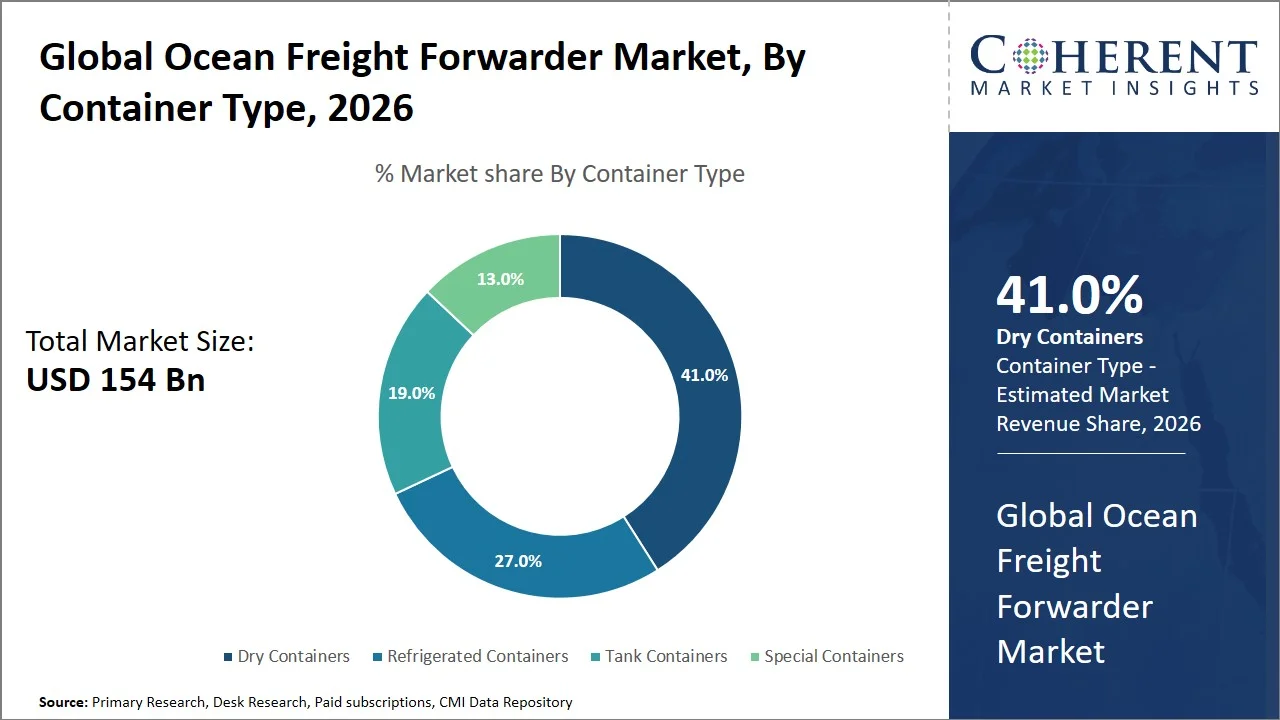
The dry containers segment is expected to account for 41.0% of the global ocean freight forwarder market share in 2026. Dry containers are often utilized because they can carry a large variety of cargo types that are not temperature sensitive. They carry machinery, electronics, fabrics, furniture, packaged items and industrial components. They are all the same size, which makes them easy to handle by ships, ports, rail networks and vehicles. Their universal interoperability lets forwarders combine shipments from a wide range of businesses. Their adaptability makes them a crucial part of the normal international transit of cargo. On 14 July 2026, Hapag-Lloyd announced a General Rate Increase for 20ft and 40ft dry containers. On July 14, 2026, Hapag-Lloyd announced a General Rate Increase covering 20-foot and 40-foot dry containers. The announcement specifically included High Cube dry equipment.
Full Container Load Dominates the Global Ocean Freight Forwarder Market
The full container load segment is expected to account for 27.0% of the global ocean freight forwarder market share in 2026. Full Container Load shipments offer dedicated container capacity for big and predictable cargo volumes. Dedicated containers also cut down on the mingling of cargo and make loading and unloading easier. Major manufacturers and merchants regularly move large volumes between established worldwide supply chains. These features help maritime freight forwarders and their customers plan more efficiently. On May 26, 2026, Maersk launched FI2 following demand for increased capacity between China and India from clients. The service connects manufacturing hubs directly with north Indian markets. It handles frequent full container moves for industrial and commercial shipments.
Current Events and their Impact
Current Events | Description and its Impact |
European Union Import Control System 2 Expansion |
|
U.S. Ocean Shipping Reform Act |
|
Ocean Freight Forwarder Market Dynamics
Market Drivers
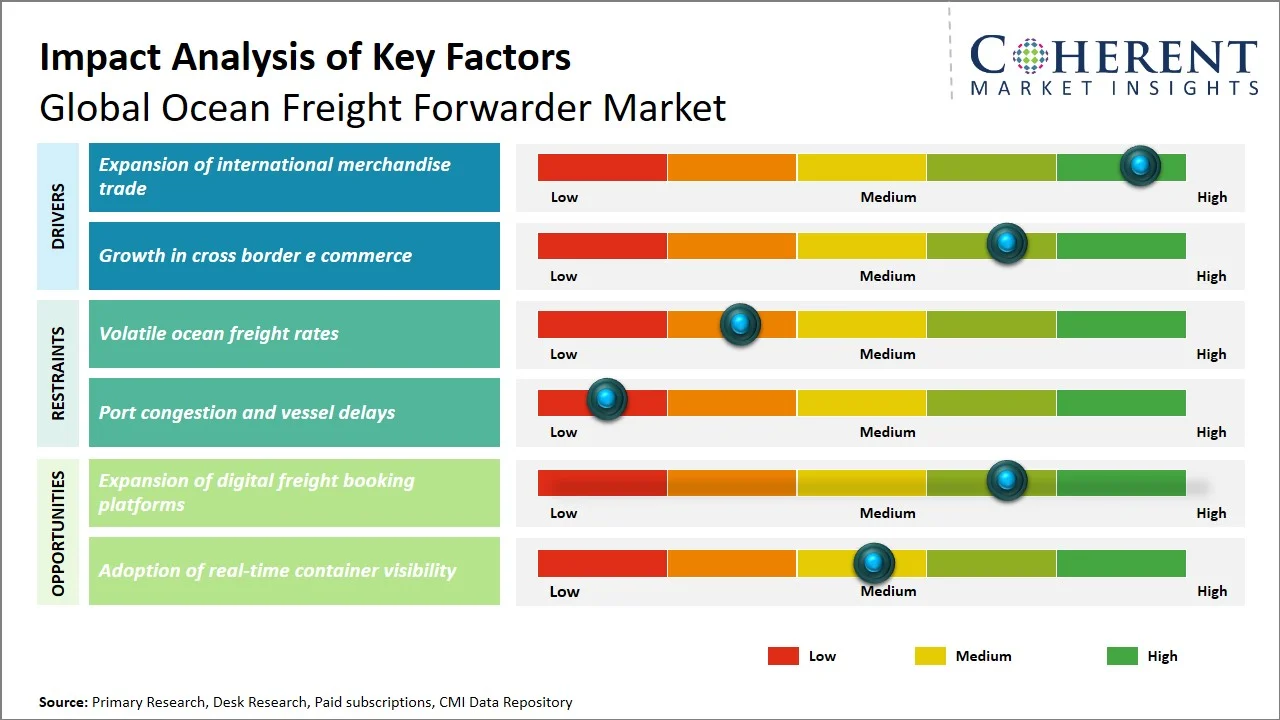
- Expansion of international merchandise trade: The expansion in international merchandise trade increases the volume of items that need to be transported and coordinated across borders. More and more manufacturers are getting parts from several countries to make manufacturing and purchasing better. Retailers are also supplied with finished goods, machinery, electronics and consumer products by other overseas sources. These movements create demand for container booking, documentation, customs coordination, cargo consolidation and inland transportation services. This gives ocean freight forwarders more chances to control increasingly complex multinational supply chains. On March 6, 2025, CMA CGM Group, a global leader in sea, land, air, and logistics solutions, and owner of the U.S. flag carrier American President Lines (APL), announced a USD 20 billion investment to contribute to U.S. maritime economy and support the transformation of America’s domestic supply chain over the next four years.
- Growth in cross border e commerce: Growth in cross-border e-commerce increases international shipments of consumer products from overseas sellers to individual buyers. Online marketplaces allow smaller businesses to reach customers across multiple countries. This means there are new requirements for consolidating shipments, customs documentation, tracking and last-mile cooperation. Ocean freight forwarders can assist merchants by integrating international transportation with warehousing and distribution services. Thus, the growth of e-commerce creates more freight volumes and increases the need for forwarding in the worldwide supply chains. In March 2026, DHL began offering advice for cross-border e-commerce and international logistics help to companies. Customs clearance, shipment visibility and flexible delivery are important capabilities as per DHL.
Emerging Trends
- Artificial Intelligence driven freight optimization: Forwarders are increasingly using artificial intelligence for demand forecasts, route planning, shipment visibility, documentation and exception management, enhancing operational responsiveness across complicated multinational supply chains.
- Digital freight forwarding platforms: Digital platforms are adding automated quotation, booking, tracking, document management and customer communication capabilities, allowing forwarders to offer faster services while increasing shipment transparency and reducing manual administrative processes.
- Green ocean logistics solutions: Forwarders are progressively adding emissions tracking, sustainable fuel options, optimized routing, and environmental reporting to logistics offerings to assist shippers in lowering their supply chain emissions and boosting their environmental compliance.
- Supply chain diversification: As manufacturers expand sourcing networks to multiple countries to reduce concentration risks, they are creating more forwarding opportunities through alternative trade routes, regional distribution networks, multimodal transportation needs, and the increasingly complex coordination of international logistics.
Regional Insights
Why is Asia Pacific a Strong Market for Ocean Freight Forwarder?
Asia Pacific is expected to account for a market share of 42.0% in 2026. Asia Pacific benefits from its concentration of manufacturing, export output and containerized commercial activity. In 2024, Asian developing economies accounted for 60% of the world’s port container traffic. In June 2025, the top four most linked shipping economies were China, the Republic of Korea, Singapore and Malaysia. Regional forwarding demand is being supported by shipments of electronics, machinery, automotive components, textiles and consumer goods. Diversification of supply chains is also driving intra-Asian forwarding requirements. Increasing access to foreign markets through the expansion of direct maritime links and the deployment of larger vessels. These factors strengthen demand for booking, consolidation, customs coordination, documentation, and inland logistics services across the region.
Why Does North America Ocean Freight Forwarder Market Exhibit High Growth?
North America is expected to register the fastest growth with a CAGR of 8.8% over the forecast period. The region is projected to account for 28.0% of the global ocean freight forwarder market in 2026. North America benefits from substantial containerized imports supporting retail, manufacturing, automotive, and industrial supply chains. The U.S. government trade statistics separately track imports of vessels and containerized vessels by port and commodity. Extensive forwarding requirements result from the wide variety of cargo handled by major gateways from Asian manufacturing areas. Supply chain modifications are also underway in the region, due to tariff increases and geopolitical disturbances. U.S. policy actions have added to shipping costs and uncertainties, according to UN Trade and Development. Freight forwarders are so increasingly coordinating alternate routes, customs regulations, inland transportation and inventory planning. Such operations increase demand for integrated forwarding solutions in North American supply chains.
Global Ocean Freight Forwarder Market Outlook for Key Countries
Why is China Emerging as a Major Hub in the Ocean Freight Forwarder Market?
China has the advantage of their massive industry concentration and their wide sea links. In 2024, China was ranked as the world’s leading maritime freight economy by UN Trade and Development. It loaded over 670 million metric tons and discharged roughly 3 billion metric tons. China also remained the most-connected container shipping economy in June 2026. Its liner shipping connectivity index was 1,330.7 in that month. Shenzhen, Shanghai, Ningbo-Zhoushan and Qingdao back big export flows. Diverse forwarding requirements are generated by electronics, machines, cars, batteries, textiles and industrial equipment. China’s growing deployed vessel capacity further increases linkages to foreign markets.
Is U.S. the Next Growth Engine for the Ocean Freight Forwarder Market?
The U.S. continues to be one of the world’s largest maritime freight economies. Government trade data gives specific records of containerized vessel imports by ports and commodities. Los Angeles and Long Beach are the largest hubs for trans-Pacific supply chains that support stores and manufacturers. Savanna encourages the growth of distribution networks that serve eastern and southeastern markets. Customs preparation and alternate sourcing arrangements are also being demanded as a consequence of changes in trade policy. New tariffs and port regulations have created uncertainty for shipping companies.
Singapore Ocean Freight Forwarder Market Analysis and Trends
Singapore’s advantage is mainly its global maritime services and transshipment hub status. Transshipment activities accounted for around 90% of Singapore’s container traffic in 2024. By 2025, the port is connected to more than 600 ports throughout the world. Singapore is home to more than 200 international maritime groups. In 2025, Singapore’s container throughput was at 44.66 million twenty-foot equivalent units. Tuas Port development to increase handling capacity, operational flexibility. Singapore also recorded record sales of alternative marine fuels, boosting greener logistical services.
South Korea Ocean Freight Forwarder Market Analysis and Trends
The advantages include South Korea’s robust export industry base and well-connected container transportation network. In June 2025, the UN Trade and Development rated the Republic of Korea among the four most linked shipping economies in the world. Busan is a hub for shipping in the automobile, electronics, machinery, chemicals and semiconductor industries. Korean manufacturers have large supplier networks in China, Southeast Asia, Europe and North America. Hyundai Motor Group and Samsung Electronics together represent a large portion of foreign cargo needs. Korean marine link also facilitates transshipment and regional distribution within Northeast Asia. Such export-oriented manufacturing clusters create recurring demands for container booking, documentation, consolidation, customs cooperation and inland distribution.
Malaysia Ocean Freight Forwarder Market Analysis and Trends
Malaysia benefits from its strategic location along major Asian sea routes and its importance in regional manufacturing supply chains. The UN Trade and Development listed Malaysia as one of four most linked shipping economies in June 2025. Port Klang and Port of Tanjung Pelepas are the twin pillars of Malaysia’s containerized international trade and regional transshipment activity. Electronics and electrical products are significant export businesses that require reliable international logistics coordination. Other maritime cargo flows include automotive components, chemicals, machinery and palm oil. The investments made in building semiconductor and electronics-manufacturing plants are raising demands for specialized logistics coordination. Malaysia’s location further favors distribution across Northeast Asia, Southeast Asia, Europe and Middle Eastern markets.
Global Ocean Freight Forwarder Market - Global Containerized Trade Flows (2025)
Trade Flow Region | Containerized Trade Volume | Share Of Global Containerized Trade |
Main East-West | 64.83 million TEU | 36.7% |
Intraregional | 49.04 million TEU | 27.8% |
Non-Mainland East-West | 24.85 million TEU | 14.1% |
South-South | 24.09 million TEU | 13.6% |
North-South | 15.30 million TEU | 8.7% |
How is Expansion of Digital Freight Booking Platforms Creating New Growth Opportunities in the Ocean Freight Forwarder Market?
Growing digital freight booking systems are providing growth prospects by decreasing manual booking work and enhancing access to carrier capacity. On its digital platforms, Maersk offers real time price, route availability, booking confirmation and cargo tracking. Maersk has also announced that some booking adjustments and cancelations will need to be submitted digitally from September 2025. Flexport bundles booking management with carrier allocation analytics, forecasts, supplier communication, and shipment milestones. These features enable forwarders to manage more bookings, reduce booking inconsistencies and make better allocation decisions. Maersk also enables API and EDI connectors for automated booking operations. On April 23, 2025, Freightos released Freightos Enterprise, a complete logistics procurement suite for large importers and exporters. Freightos Enterprise combines the increasingly digitalized world of global freight procurement, rate benchmarking and shipment execution.
Market Players, Key Development, and Competitive Landscape
Key Developments
- On July 1, 2026, The CMA CGM Group, a leading global player in sea, land, air and logistics solutions, announced an agreement to acquire FedEx Supply Chain, at an enterprise value of USD 1.4 billion. The acquisition would nearly triple the size of the North American contract logistics operations of CEVA Logistics, a subsidiary of the CMA CGM Group.
- On May 18, 2026, CEVA Logistics, a global leader in 3PL logistics, continued its growth in Africa with the opening of three new agencies in Guinea, Gabon and the Republic of the Congo. With the addition of offices in the major port cities of Conakry (Guinea), Libreville (Gabon) and Pointe-Noire (the Republic of the Congo), CEVA strengthened customer proximity and expanded its execution capabilities in transport and logistics across West Africa.
Competitive Landscape
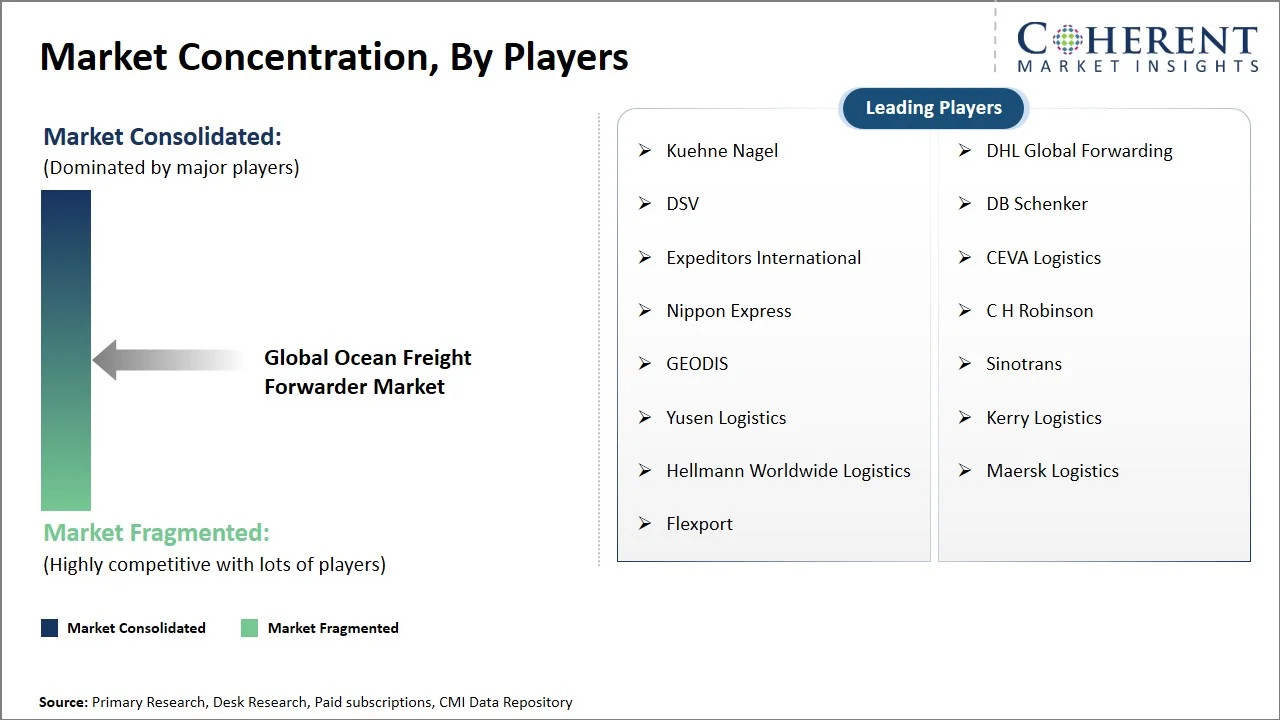
The ocean freight forwarder business is highly fragmented and key competitors are looking for scale, integration and technology led differentiation. AP. Moller-Maersk is enhancing its integrated logistics offering by combining ocean, terminals, forwarding and inland services. Its Gemini Cooperation with Hapag-Lloyd is intended to provide greater schedule reliability across the ocean network. Kuehne+Nagel is targeting leadership in ocean logistics, digital platforms, artificial intelligence and specialized cargo. myKN platform offers immediate quotations, bookings, shipment tracking and data integration. DSV has expanded substantially after completing its Schenker acquisition in April 2025. The combined network emphasizes global forwarding, industry expertise, digitalization, and integrated logistics solutions.
Market Report Scope
Ocean Freight Forwarder Market Report Coverage
| Report Coverage | Details | ||
|---|---|---|---|
| Base Year: | 2025 | Market Size in 2026: | USD 154 Bn |
| Historical Data for: | 2020 To 2024 | Forecast Period: | 2026 To 2033 |
| Forecast Period 2026 to 2033 CAGR: | 7.6% | 2033 Value Projection: | USD 268 Bn |
| Geographies covered: |
| ||
| Segments covered: |
| ||
| Companies covered: | Kuehne Nagel, DHL Global Forwarding, DSV, DB Schenker, Expeditors International, CEVA Logistics, Nippon Express, C H Robinson, GEODIS, Sinotrans, Yusen Logistics, Kerry Logistics, Hellmann Worldwide Logistics, Maersk Logistics, Flexport | ||
| Growth Drivers: |
| ||
| Restraints & Challenges: |
| ||
Analyst Opinion (Expert Opinion)
- The future of ocean freight forwarding will increasingly favor integrated, technology-enabled logistics providers. Digital booking, predictive shipment management, automated documentation, and artificial intelligence should become core operating capabilities. Maersk's digital platform already combines ocean and inland booking, pricing, customs, and shipment milestones. Forwarders should therefore evolve beyond basic freight arrangement toward integrated supply-chain management. This shift should create stronger opportunities for providers controlling multiple logistics stages.
- The maximum opportunity should emerge around full-container-load services, specialized cargo, and Asia-focused trade corridors. China, India, Southeast Asia, and the Republic of Korea should remain important expansion markets. Electronics, semiconductors, automotive components, machinery, batteries, and consumer products offer attractive cargo opportunities. Transshipment and regional distribution activity should also benefit Singapore and Malaysia. Forwarders should create focused vertical knowledge around certain cargo types rather than providing undifferentiated forwarding services.
- Players focus on proprietary digital platforms, carrier connection and real-time exception handling as competitive advantage. They also use AI to assign bookings, forecast estimated arrivals, verify documentation and react to disruptions. Kuehne+Nagel already integrates private data with artificial intelligence across its IT platform. Maersk is also investing in automation, data-driven solutions, and integrated customer platforms. Competitive advantage should increasingly depend on combining network scale with faster digital decision-making and specialized customer solutions.
Speak to the analyst
Want personalized insights?
Take the findings above to one of our principal consultants, or have the report rebuilt around the segments, geographies and competitors you actually track.
Market Segmentation
- Shipment Type Insights (Revenue, USD Billion, 2021 - 2033)
- Import
- Export
- Cross Trade
- Container Type Insights (Revenue, USD Billion, 2021 - 2033)
- Dry Containers
- Refrigerated Containers
- Tank Containers
- Special Containers
- Service Type Insights (Revenue, USD Billion, 2021 - 2033)
- Full Container Load
- Less than Container Load
- Breakbulk and Project Cargo
- Customs Clearance
- Documentation Services
- Warehousing and Distribution
- Value Added Logistics Services
- End User Insights (Revenue, USD Billion, 2021 - 2033)
- Manufacturing
- Automotive
- Electronics
- Retail and E Commerce
- Food and Beverage
- Pharmaceuticals
- Chemicals
- Consumer Goods
- Energy and Industrial Equipment
- Regional Insights (Revenue, USD Billion, 2021 - 2033)
- North America
- U.S.
- Canada
- Latin America
- Brazil
- Argentina
- Mexico
- Rest of Latin America
- Europe
- Germany
- U.K.
- Spain
- France
- Italy
- Russia
- Rest of Europe
- Asia Pacific
- China
- India
- Japan
- Australia
- South Korea
- ASEAN
- Rest of Asia Pacific
- Middle East
- GCC Countries
- Israel
- Rest of Middle East
- Africa
- South Africa
- North Africa
- Central Africa
- North America
- Key Players Insights
- Kuehne Nagel
- DHL Global Forwarding
- DSV
- DB Schenker
- Expeditors International
- CEVA Logistics
- Nippon Express
- C H Robinson
- GEODIS
- Sinotrans
- Yusen Logistics
- Kerry Logistics
- Hellmann Worldwide Logistics
- Maersk Logistics
- Flexport
Sources
Primary Research Interviews
- Freight Forwarding Companies & Logistics Service Providers
- Shipping Lines & Ocean Carriers
- Port Authorities & Terminal Operators
- Supply Chain & Trade Compliance Consultants
Magazines
- Journal of Commerce (JOC)
- Logistics Management Magazine
- Freight Waves Magazine
- Air Cargo World
Journals
- International Journal of Shipping and Transport Logistics
- Journal of Transport Geography
- Maritime Policy & Management
Associations
- International Federation of Freight Forwarders Associations (FIATA)
- World Shipping Council (WSC)
- Baltic and International Maritime Council (BIMCO)
- Global Shippers Forum (GSF)
Public Domain Sources
- World Trade Organization (WTO) Trade Statistics
- United Nations Conference on Trade and Development (UNCTAD)
- International Maritime Organization (IMO) Reports
- World Bank Logistics Performance Index (LPI)
Proprietary Elements
- CMI Data Analytics Tool
- Proprietary CMI Existing Repository of Information for the Last 10 Years
Get access to 250+ pages report
Every segment, forecast, competitor profile and data table behind the analysis above — available for instant download.
- ESOMAR Member
- ISO 9001:2015 Certified
- D-U-N-S Registered
- GDPR & CCPA Compliant
Missing comfort of reading report in your local language? Find your preferred language:
Frequently Asked Questions
The global ocean freight forwarder market is expected to stand at USD 154 Bn in 2026 and is expected to reach USD 268 Bn by 2033.
The CAGR of the global ocean freight forwarder market is projected to be 7.6% from 2026 to 2033.
An ocean freight forwarder arranges sea transportation, documentation, customs coordination, and related logistics services.
Artificial intelligence can automate document processing, booking allocation, forecasting, and shipment exception management.
Real-time tracking allows forwarders to identify shipment delays and communicate exceptions earlier.
Supplier diversification creates additional origin countries, routes, documentation requirements, and logistics relationships.
Disruptions can require alternative routes, revised schedules, additional planning, and faster customer communication.