

Global Organic Electronics Market Size and Forecast – 2026 To 2033
The global organic electronics market is expected to grow from USD 88.00 Bn in 2026 to USD 295.00 Bn by 2033, registering a compound annual growth rate (CAGR) of 13.5% from 2026 to 2033. The global organic electronics market is driven by increasing use of lightweight electronic components. On December 10, 2025, Nikon Corporation announced it will open and commence operation of S3S LAB, a co-creation platform outfitted with a full suite of equipment necessary for developing flexible electronics within its Sagamihara Plant in Kanagawa, Japan.
Key Takeaways of the Global Organic Electronics Market
- The Organic Semiconductor segment is expected to account for 41.0% of the global organic electronics market share in 2026. Increasing deployment of organic semiconductor materials is driving the growth of the segment. On September 4, 2026, CREDOXYS GmbH successfully closed its Series A financing round. The fund will help CREDOXYS expand its market presence in Asia and tap into additional application fields in organic electronics.
- The Display segment is estimated to capture 39.0% of the market share in 2026. Growing demand for energy-efficient displays is majorly driving the growth of the segment. On august 19, 2026, LG Display unveiled FLiPP, an OLED pixel-patterning method that eliminates the conventional fine metal mask process.
- The Consumer Electronics segment is estimated to capture 34.0% of the market share in 2026. Expansion of wearable electronic devices is majorly driving the growth of the segment. On May 19, 2026, Samsung and Google previewed intelligent eyewear developed with Gentle Monster and Warby Parker.
- Asia Pacific is expected to dominate the organic electronics market in 2026 with a market share of 54.0%. Expansion of smart packaging applications in Asia Pacific is driving the growth of the regional market. On April 24, 2025, Avery Dennison opened its first RFID inlay and label production facility in Pune, India. The facility is ARC-certified and manufactures RFID inlays and labels locally for applications including pharmaceuticals, fast-moving consumer goods, logistics, and retail.
- North America is expected to account for 22.0% share in 2026 and is projected to record the fastest growth over the forecast period. Growing demand for transparent and lightweight electronic devices in North America is driving the growth of the regional market. On September 29, 2025, Vuzix Corporation announced that it has received a development order for customized waveguides from one of U.S.’ leading defense contractors. These waveguides will be designed to be used within a new lightweight heads-up display (HUD) for military personnel.
Segmental Insights
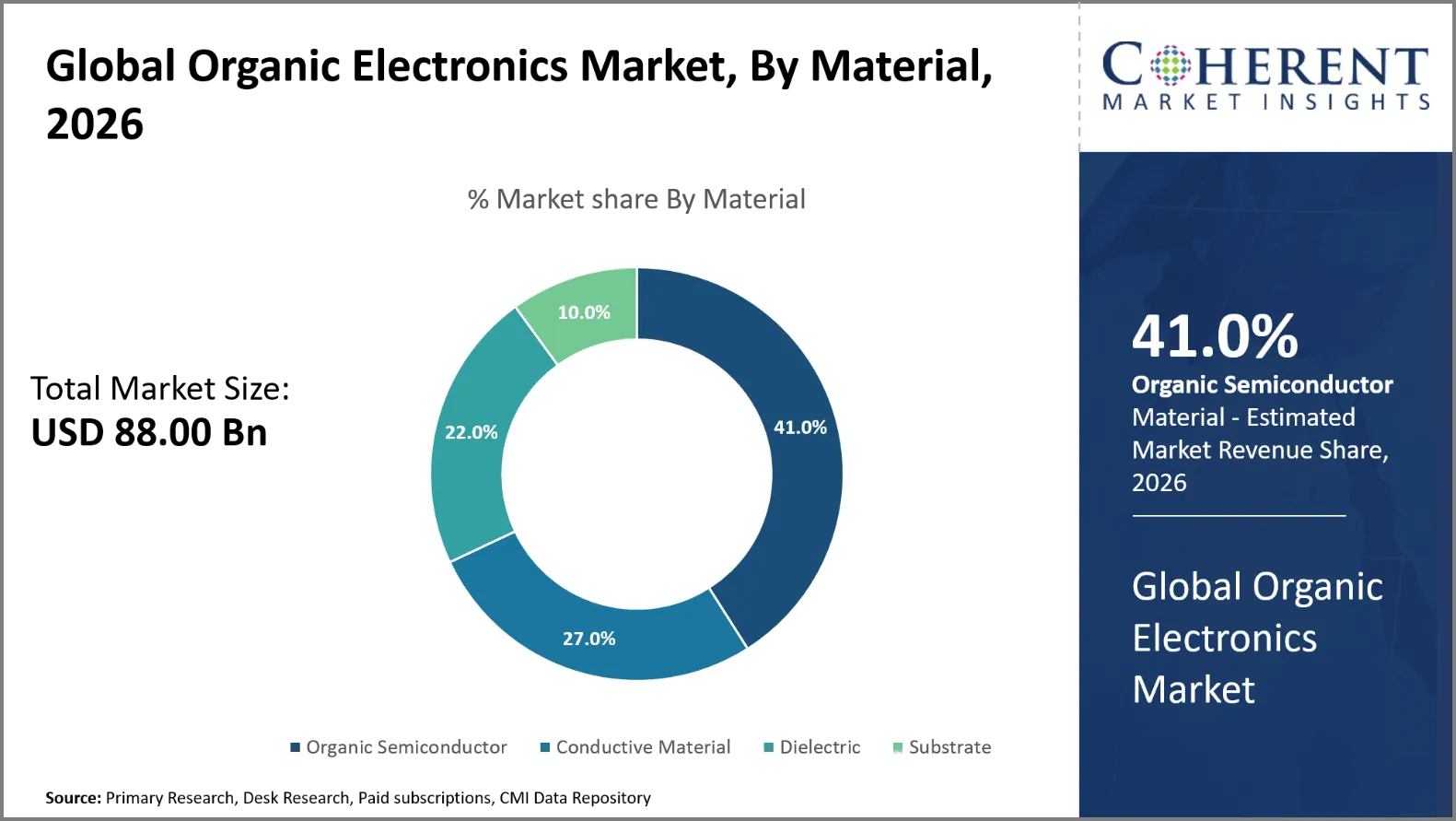
Why Does Organic Semiconductor Dominate the Global Organic Electronics Market?
The organic semiconductor segment is expected to account for 41.0% of the global organic electronics market share in 2026. Organic semiconductors enable lightweight, flexible, and thin electronic devices. Their solution processable features enable fabrication on flexible substrates. This kind of versatility is attractive for displays, sensors, wearable electronics and other new applications. Manufacturers can integrate these materials into large-area electronic components with relatively adaptable production methods. Increasing demand for flexible and lightweight devices therefore supports their strong market position. On May 7, 2025, FlexEnable won the 2025 Display Component of the Year Award by the Society of Information Display (SID) for its FlexiOM organic thin-film transistor (OTFT) materials. The FlexiOM materials set comprises organic polymer semiconductor and dielectric materials that together form high-performance, highly rugged and flexible OTFTs.
- Current Industry Events of 2026
- Market Size Estimation
- Regional Breakdown
- Competitive Landscape
- Customer Intelligence
- Segmental Analysis
- Pricing Analysis
- Key Market Drivers, Challenges & Future Trends
- Customized Insights Section
Why is Display the Most Widespread Application?
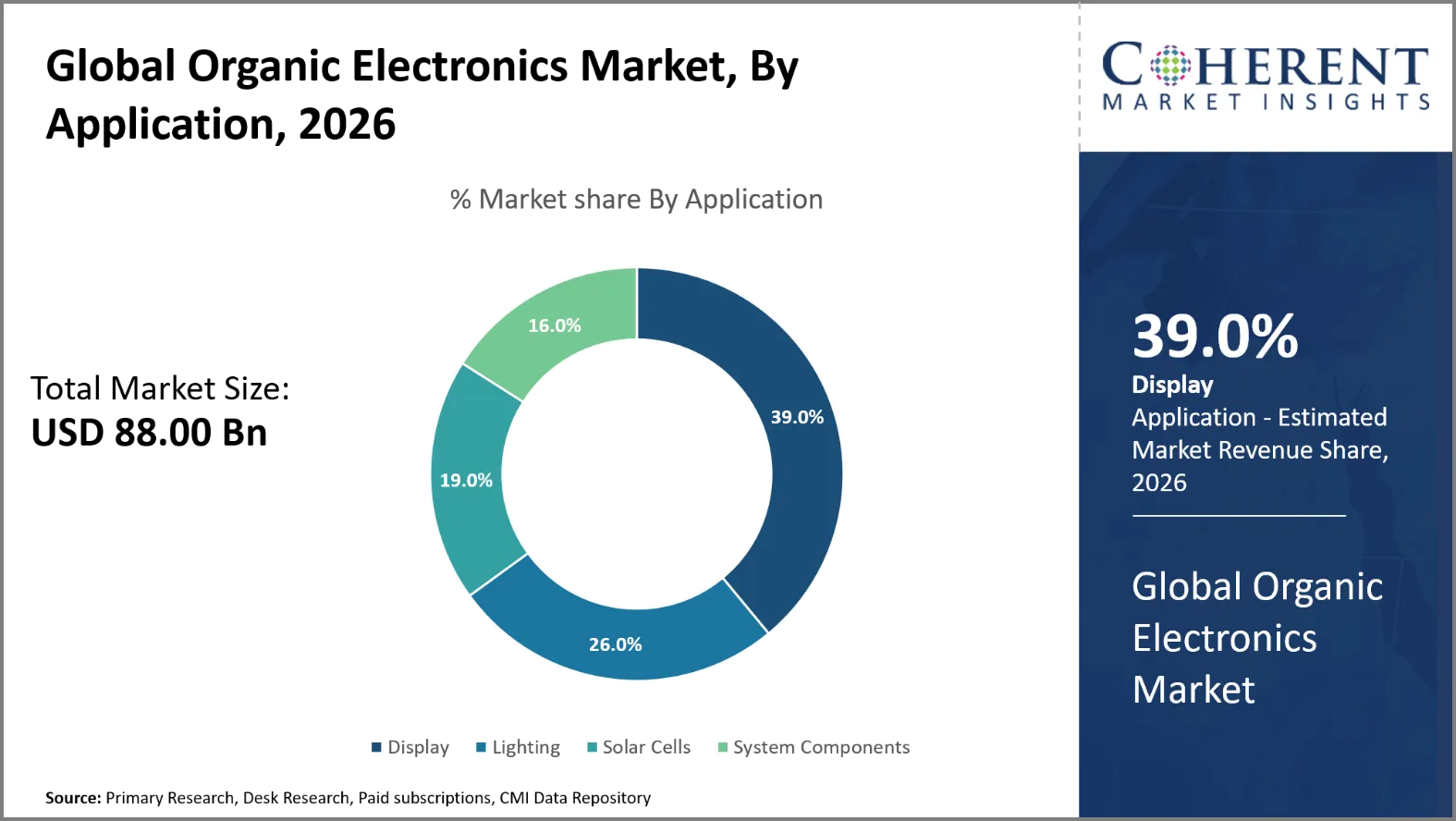
The display segment is expected to account for 39.0% of the global organic electronics market share in 2026. An important driver is the increasing incorporation of organic electronic materials in lightweight and flexible display technologies. Organic light-emitting diodes provide for tiny designs, great contrast and low power consumption. These features are found in smartphones, televisions, wearable devices and car displays. Flexible substrates enable curved, foldable and rollable screen designs that are also a boon to manufacturers. Increasing consumer demand for enhanced visual interfaces continues to drive the adoption of organic electronics in display applications. In January 2025, Samsung Display showcased an 18.1-inch foldable OLED panel at CES 2025. The panel folds into a 13.1-inch laptop-sized display and can also function as a monitor. The company also demonstrated slidable OLED displays and multi-foldable concepts. Its automotive OLED demonstrations included bendable center information displays and head-up displays.
Consumer Electronics Dominates the Global Organic Electronics Market
The consumer electronics segment is expected to account for 34.0% of the global organic electronics market share in 2026. A primary factor is the rapid adoption of flexible and energy-efficient electronic components in consumer devices. Organic electrical materials make possible slimmer smartphones, wearables, tablets and televisions. This flexibility leads to bent, foldable and lightweight product designs. Manufacturers may also incorporate organic components into small gadget architectures. Product innovation continues and the update cycle for consumer devices is shortening, driving wider usage. In January 2025, Lenovo unveiled the ThinkBook Plus Gen 6 Rollable at CES 2025. The laptop uses a 14-inch to 16.7-inch rollable OLED display and weighs approximately 1.69 kilograms. The device maintains a 19.9-millimeter profile despite its expandable screen. Lenovo planned commercial availability from June 2025.
Current Events and their Impact
Current Events | Description and its Impact |
European Union - Ecodesign Regulation for Smartphones and Tablets |
|
European Union - Restriction of Hazardous Substances Directive |
|
Organic Electronics Market Dynamics
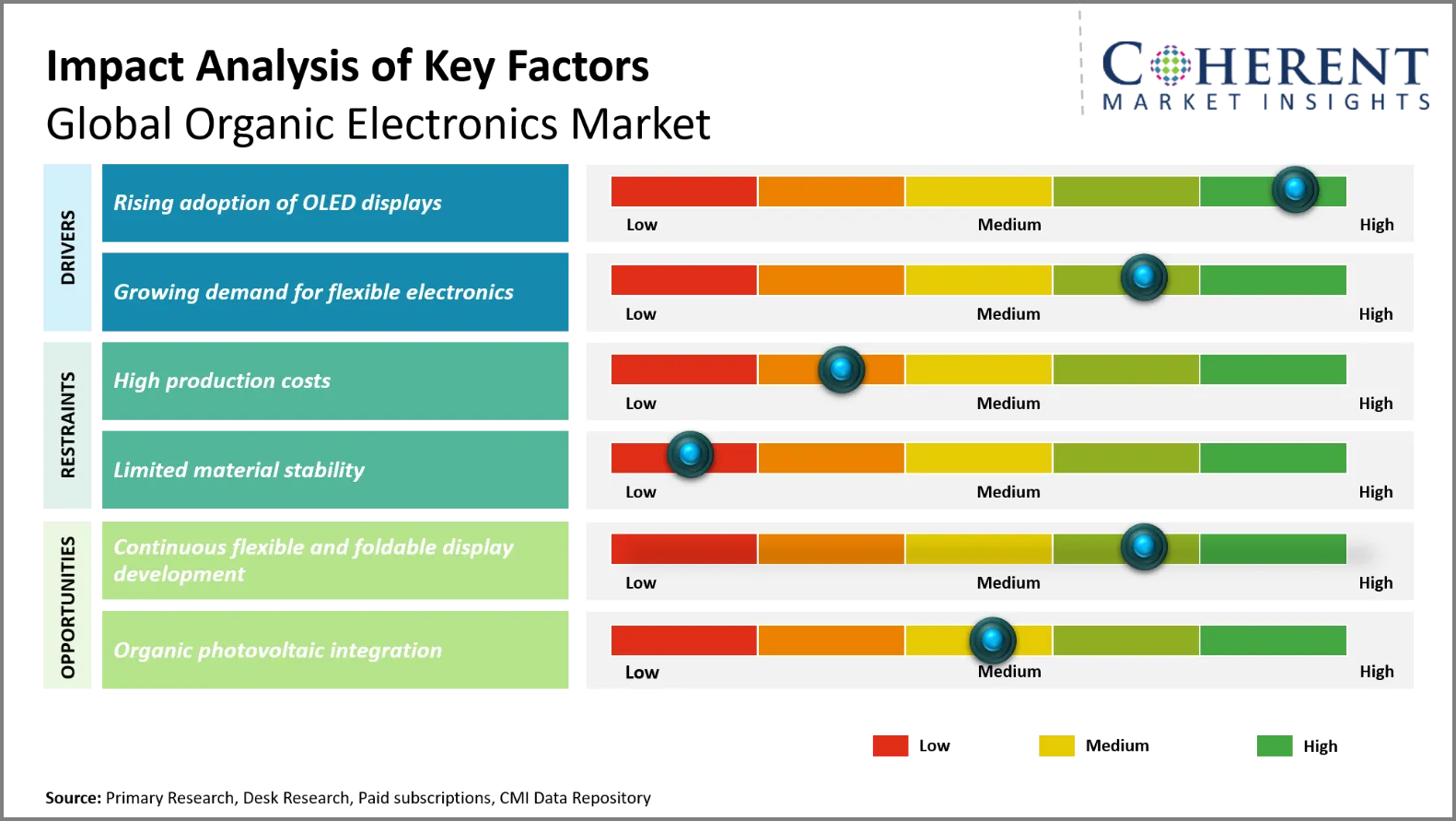
Market Drivers
Rising adoption of OLED displays
Rising demand for slimmer and energy-efficient screens is supporting surge in use of OLED displays. OLED screens feature excellent contrast, fast reaction times and great color performance. OLED is finding its way into more and more smartphones, TVs, computers, car displays and wearables. Flexible OLED panels also allow curved and foldable product designs. Increasing manufacture of premium consumer electronics continues to drive potential for organic electronic materials and components.
On February 12, 2026, Samsung Display announced the launch of QD-OLED Penta Tandem, a new premium technology brand based on its patented five-layer organic light-emitting structure, a fundamental innovation exclusive to its QD-OLED panels. Samsung Display said that it has completed the trademark registration of the new brand established to express the unique value of the five-layer organic light-emitting structure applied to QD-OLED panels for premium monitors and TVs.
Growing demand for flexible electronics
Foldable, wearable and lightweight devices are being developed and this is increasing the demand for flexible electronics. Flexible substrates allow electronic components to bend and conform to curved surfaces and irregular shapes. Flexible technologies are being incorporated into displays, sensors, medical gadgets and smart packaging by manufacturers. Advances in printed electronics are boosting production flexibility and enabling larger-area applications. This is therefore growing potential for organic semiconductor and conductive material technologies owing to increasing product innovation.
On July 15, 2026, Samsung Electronics introduced new Flex Titanium technology for the next generation of Galaxy foldable handsets. The new display architecture is the culmination of seven generations of innovation and engineering knowledge in foldable technology, leveraging enhancements in structure and materials to provide a more polished viewing experience with increased durability and decreased visible creases.
Emerging Trends
- Flexible and stretchable organic electronics: Organic electronic components that can be bent, folded and stretched without significant loss of performance are being developed by manufacturers. These technologies are enabling foldable screens, wearable sensors, smart textiles and curved interfaces leading to new uses beyond typical rigid electronic equipment.
- Printed organic electronic manufacturing: Printing methods are increasingly considered for organic transistors, sensors, conductive layers and display components fabrication. Roll-to-roll processing can provide high-throughput manufacturing with reduced material waste for cost-efficient manufacture of lightweight and large-area electronic goods.
- Bio-integrated organic electronics: Organic electronic materials for devices that have close contact with biological tissues are being developed by researchers. Applications include wearable health monitoring, implanted sensors, and electronic skin where mechanical flexibility and low operating voltages are advantageous for continuous physiological monitoring.
- Organic electronics for smart packaging: Organic electronic components are being investigated for use in smart packaging. Food, pharmaceutical and logistics packaging can use printed sensors, indications and communications features to authenticate goods, monitor freshness, track temperature and provide interactive customer information.
Regional Insights
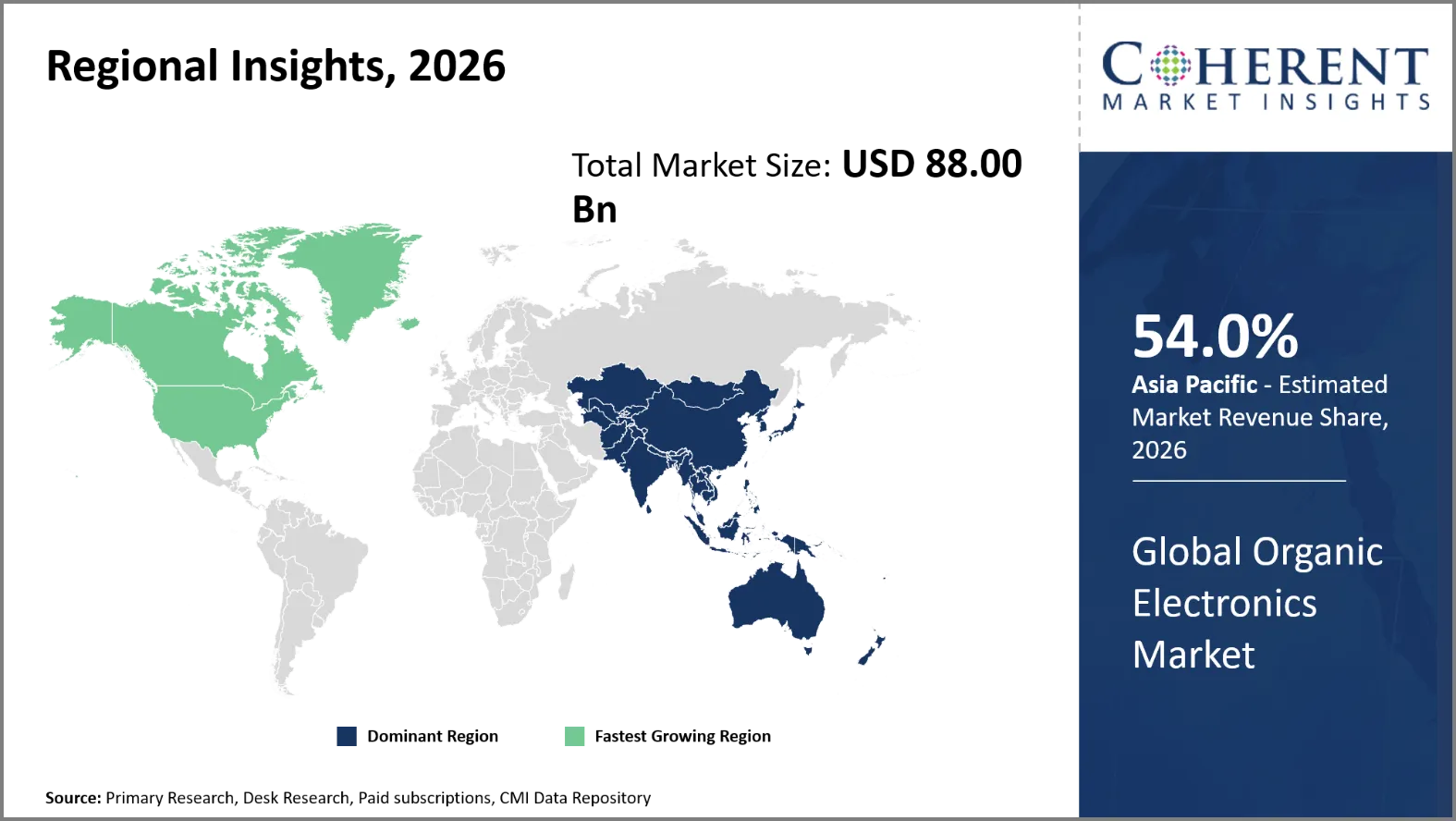
Why is Asia Pacific a Strong Market for Organic Electronics?
Asia Pacific is expected to account for a market share of 54.0% in 2026. Asia Pacific has a concentrated OLED production base in China, South Korea and Japan. China is building out flexible AMOLED capacity, including BOE’s Gen-8.6 plant in Chengdu for tablets and automotive displays. South Korean firms continue to produce OLED panels for smartphones, TVs, and cars. Japan contributes deposition equipment, organic materials, and flexible-display research. Japan’s government-backed development has demonstrated flexible OLED displays using solution-processed organic transistors below 150°C. The regional ecosystem also includes printed electronics research, wearable sensors, and organic photovoltaics. These interconnected manufacturing and research capabilities support faster commercialization of organic electronic technologies across consumer electronics, automotive systems, and emerging flexible devices.
Why Does North America Organic Electronics Market Exhibit High Growth?
North America is expected to register the fastest growth with a CAGR of 15% over the forecast period and projected to account for 22.0% of the global organic electronics market in 2026. Instead of mass-producing displays, North America is focusing on organic electronics that use advanced materials, healthcare devices, defense systems and flexible computing. U.S. companies such as Universal Display Corporation develop phosphorescent OLED materials and license technologies to global display manufacturers. Flexible electronics research also targets healthcare biosensors and defense applications. Recent research has demonstrated organic semiconductor and two-dimensional material devices achieving more than one million bending cycles. Flexible integrated circuits are also being developed for disposable diagnostics and connected healthcare products. This combination of material innovation, biomedical applications, and specialized electronics supports regional expansion beyond conventional OLED display manufacturing.
Global Organic Electronics Market Outlook for Key Countries
Why is China Emerging as a Major Hub in the Organic Electronics Market?
China is boosting organic electronics through large scale AMOLED manufacturing and local display supply chains. BOE is constructing an AMOLED Gen-8.6 fab in Chengdu for tablets and automotive cockpit displays. Chinese display makers are also boosting flexible OLED production for smartphones and automotive applications. Domestic electronics manufacturing provides nearby customers for OLED panels, touch components, organic materials, and flexible substrates. China’s scale also supports faster commercialization of new display architectures. Automotive cockpit applications are becoming particularly important as manufacturers introduce larger curved and integrated displays. This combination of fabrication investment and downstream electronics production creates distinct opportunities for organic electronic components and materials.
Is U.S. the Next Growth Engine for the Organic Electronics Market?
The U.S. organic electronics market is strongly connected to organic semiconductor materials, intellectual property, and specialized flexible electronics development. Universal Display Corporation remains an important domestic OLED technology developer, with phosphorescent materials and licensing agreements supporting global display production. Flexible electronics research is also moving toward healthcare and defense applications. Recent work combining organic semiconductors with graphene, molybdenum disulfide, and MXenes achieved more than 40% higher charge mobility and over one million bending cycles. These developments expand organic electronics beyond displays. Pharmaceutical packaging, wearable monitoring, flexible antennas, and disposable diagnostics provide additional application pathways for domestic technology developers.
Germany Organic Electronics Market Analysis and Trends
Germany’s growth is strongly linked to printed electronics, automotive applications, and industrial automation. LOPEC 2025 in Munich attracted around 170 exhibitors from 29 countries and approximately 2,400 visitors. The event highlighted applications across automotive, healthcare, and consumer electronics. German printed-electronics activity increasingly emphasizes sustainable production and smart industrial components. Automotive makers are also introducing innovative display technologies into car interiors. Germany’s established chemical, materials, and precision-engineering industries support development of conductive inks, organic materials, printed sensors, and flexible components. The integration of industrial automation and automobile electronics creates application-specific need for organic electronic technologies rather than depending largely on consumer displays.
Japan Organic Electronics Market Analysis and Trends
Japan is advancing organic electronics through materials research, printed manufacturing, and specialized OLED applications. The Ministry of Economy, Trade and Industry highlights flexible OLED research employing solution-processed organic transistors created below 150°C. Japanese researchers have also produced transparent flexible OLED panels through cooperation involving materials, printing, equipment, and automotive companies. Another project achieved organic TFT arrays containing 100,000 transistors across a 30-centimeter square film, with 95% yield. Research at Yamagata University covers organic transistors, flexible displays, organic photovoltaics, inkjet fabrication, and barrier technologies. These capabilities support specialized industrial panels, automotive interfaces, sensors, and lightweight flexible electronics.
South Korea Organic Electronics Market Analysis and Trends
South Korea’s organic electronics growth is centered on advanced OLED manufacturing and foldable display innovation. Samsung Display and LG Display maintain major OLED production capabilities serving smartphones, televisions, monitors, and automotive applications. Domestic research institutions are also developing organic photovoltaics for applications involving windows and electric vehicles. Government support has provided major financing for next-generation display and sensor technologies since 2020. Korean firms continue increasing flexible OLED performance, production yields, and form factors. The country’s strong integration between display manufacturers, materials suppliers, equipment companies, and electronics brands enables rapid commercialization of foldable displays and other organic electronic technologies for premium consumer and mobility applications.
Global Organic Electronics Market - Organic Semiconductor Material Innovations for Low-Temperature Processing
Innovation / Material | Low-Temperature Processing | Key Technical Point | Target Application |
FlexEnable FlexiOM S500 organic semiconductor | Below 100°C | Mobility above 1.5 cm²/Vs | Flexible displays and liquid-crystal optics |
Smartkem TRUFLEX organic semiconductor inks | 80°C | Device mobility approximately 4 cm²/Vs | Flexible displays, MicroLED backplanes and sensors |
Fluorinated block copolymer organic synaptic transistor material | 80°C for 10 minutes | Sub-6 nm domains and on/off ratio around 10⁵ | Organic memory and neuromorphic electronics |
Green-solvent TIPS-pentacene processing | Low-temperature solution processing | Mobility increased up to threefold | Organic thin-film transistors |
Low-temperature melt-processable polymer semiconductor | Low-temperature melt processing | Crown-ether side-chain polymer architecture | Flexible organic electronics |
Pyridine-flanked DPP copolymers | Solution processing with thermal treatment | Selenophene variant provides higher electron mobility | N-type organic field-effect transistors |
Primer-template organic semiconductor coating | Solution coating | Average mobility of 1.62 cm²/Vs and 100% device yield | Large-area organic thin-film transistors |
How is Continuous Flexible and Foldable Display Development Creating New Growth Opportunities in the Organic Electronics Market?
Continuous development of flexible and foldable screens is creating opportunities for organic electronics vendors through increasingly complicated device architectures. Samsung Display’s Flex G foldable OLED idea showcases multi-fold designs that expand usable panel areas while keeping small folded dimensions. LG Display has also developed stretchy displays capable of expanding by around 20% while keeping image quality. These improvements enhance demand for flexible organic semiconductor layers, transparent electrodes, thin-film encapsulation, and bend-resistant substrates. Automotive manufacturers are exploring rollable and bendable OLED instrument panel interfaces as well. These applications expand the demand for organic electronic materials beyond today's flat-panel smartphone and television displays.
On January 6, 2026, Lenovo announced the newest additions to its gaming device range to assist esports players, college gamers and mobile gamers. The additions include a new Legion laptop proof of concept with a rollable screen, which is intended to give discriminating gamers powerful, portable gaming equipment.
Market Players, Key Development, and Competitive Landscape
Key Developments
- On August 19, 2026, Universal Display Corporation unveiled OLEDX, a proprietary device architecture designed to improve how light is extracted and utilized within an OLED, while giving display makers greater control over how that light is delivered to the viewer.
- On June 8, 2026, Dracula Technologies brought innovative energy-harvesting solutions to the IoT industry through its LAYER OPV technology, which efficiently harvests ambient light to eliminate the need for batteries. With a proven track record in organic photovoltaic (OPV) technology, the company is now turning its attention to the vast potential of organic light-emitting diode (OLED) displays as well as flexible and organic electronics.
- On January 6, 2026, Smartkem, Inc. announced that it has entered into a 12-month paid proof-of-concept agreement with a global consumer electronics leader to develop next-generation smart wearables that incorporate a conformable MicroLED display utilizing Smartkem’s proprietary organic thin-film transistor (OTFT) technology.
Competitive Landscape
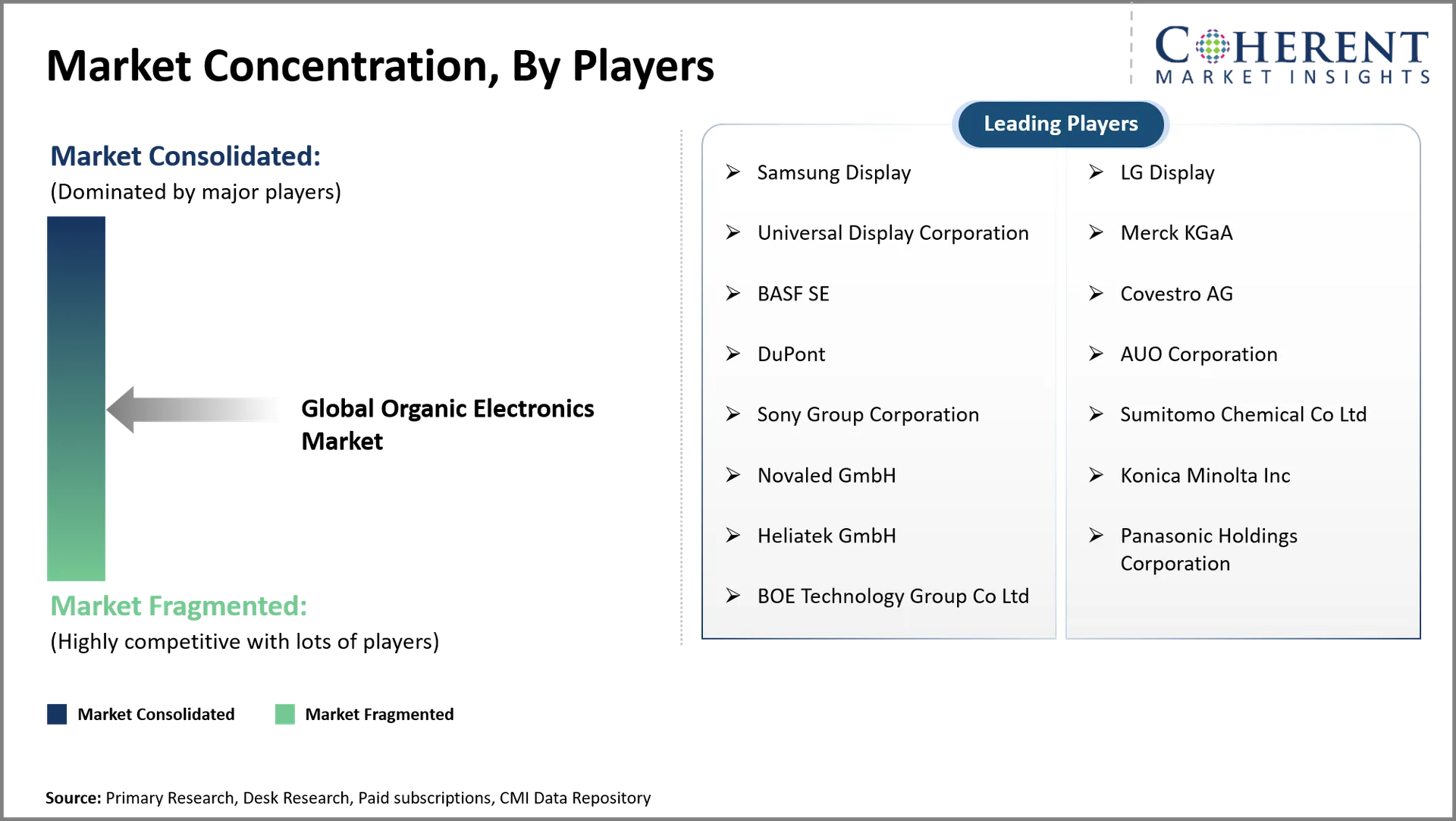
Leading players are shifting from conventional OLED panels toward higher-value architectures and new applications. Samsung Display is expanding beyond smartphones through foldable IT panels, slidable displays, QD-OLED, and automotive OLED solutions. Its 2025 portfolio included an 18.1-inch foldable IT panel and automotive displays incorporating under-panel cameras and bendable center information displays. Samsung Display also worked with Qualcomm to showcase vehicle OLED cockpit demos. LG Display is focusing on tandem OLED, automotive P-OLED, slidable displays and software-defined vehicle interfaces, including a 57-inch pillar-to-pillar display. Universal Display Corporation is focusing on phosphorescent materials, OLED manufacturing technologies, and its OLEDX architecture, while expanding intellectual property around emerging OLED structures.
Market Report Scope
Report Coverage | Details | ||
Base Year | 2025 | Market Size in 2026: | USD 88.00 Bn |
Historical Data For: | 2020 To 2024 | Forecast Period: | 2026 To 2033 |
Forecast Period 2026 To 2033 CAGR: | 13.5% | 2033 Value Projection: | USD 295.00 Bn |
Geographies covered: |
| ||
Segments covered: |
| ||
Companies covered: | Samsung Display, LG Display, Universal Display Corporation, Merck KGaA, BASF SE, Covestro AG, DuPont, AUO Corporation, Sony Group Corporation, Sumitomo Chemical Co Ltd, Novaled GmbH, Konica Minolta Inc, Heliatek GmbH, Panasonic Holdings Corporation, BOE Technology Group Co Ltd | ||
Growth Drivers: |
| ||
Restraints & Challenges: |
| ||
Analyst Opinion (Expert Opinion)
- The future of organic electronics is likely to center on higher-performance OLED architectures rather than conventional flat displays alone. Tandem OLED can address brightness, lifetime, and efficiency requirements in demanding automotive and IT applications. Foldable, slidable, and stretchable architectures can create additional product formats. Automotive interiors offer a particularly distinct opportunity because manufacturers are integrating larger displays, hidden cameras, curved interfaces, and software-defined vehicle systems.
- The strongest opportunities should emerge across tandem OLED, flexible OLED, and advanced organic semiconductor materials. Foldable laptops, tablets and OLED monitors require more flexible panels. Automotive applications also enable the provision of quality organic electronics with displays from pillar to pillar, slidable screens, and interfaces for driver monitoring. Geographically, South Korea, China and Japan are significant manufacturing and materials ecosystems, while the U.S. is crucial for OLED intellectual property and material innovation.
- For players looking for an edge, focus on material efficiency, flexible-device durability, and application-specific OLED structures. Phosphorescent emitters, tandem structures, thin encapsulation and bend-resistant components are examples of areas in which suppliers might create significant positions. Partnerships with automotive technology providers can accelerate qualification for cockpit applications. Companies should also build intellectual-property portfolios around emerging architectures, since Universal Display already holds more than 7,000 issued and pending patents.
Speak to the analyst
Want personalized insights?
Take the findings above to one of our principal consultants, or have the report rebuilt around the segments, geographies and competitors you actually track.
Market Segmentation
- Material Insights (Revenue, USD Billion, 2021 - 2033)
- Organic Semiconductor
- Conductive Material
- Dielectric
- Substrate
- Application Insights (Revenue, USD Billion, 2021 - 2033)
- Display
- Lighting
- Solar Cells
- System Components
- End User Insights (Revenue, USD Billion, 2021 - 2033)
- Consumer Electronics
- Healthcare
- Automotive
- Energy
- Aerospace and Defense
- Others
- Regional Insights (Revenue, USD Billion, 2021 - 2033)
- North America
- U.S.
- Canada
- Latin America
- Brazil
- Argentina
- Mexico
- Rest of Latin America
- Europe
- Germany
- U.K.
- Spain
- France
- Italy
- Russia
- Rest of Europe
- Asia Pacific
- China
- India
- Japan
- Australia
- South Korea
- ASEAN
- Rest of Asia Pacific
- Middle East
- GCC Countries
- Israel
- Rest of Middle East
- Africa
- South Africa
- North Africa
- Central Africa
- North America
- Key Players Insights
- Samsung Display
- LG Display
- Universal Display Corporation
- Merck KGaA
- BASF SE
- Covestro AG
- DuPont
- AUO Corporation
- Sony Group Corporation
- Sumitomo Chemical Co Ltd
- Novaled GmbH
- Konica Minolta Inc
- Heliatek GmbH
- Panasonic Holdings Corporation
- BOE Technology Group Co Ltd
Sources
Primary Research Interviews
- Organic Electronics Manufacturers & Producers
- Raw Material Suppliers (Organic Semiconductors & Conductive Polymers)
- End-Use Industry Representatives (Consumer Electronics, Healthcare, Energy)
- Research & Development Scientists and Technology Innovators
Magazines
- Organic Electronics Magazine
- IEEE Spectrum
- Materials Today
- Advanced Materials & Processes
Journals
- Nature Electronics
- Journal of Organic Electronics and Optoelectronics
- Advanced Functional Materials
- Organic Electronics (Elsevier Journal)
Associations
- Organic Electronics Association (OE-A)
- International Electronics Manufacturing Initiative (iNEMI)
- Semiconductor Industry Association (SIA)
- European Electronics Component Manufacturers Association (EECA)
Public Domain Sources
- U.S. Department of Energy (DOE) – Office of Scientific and Technical Information
- European Commission – Innovation and Research Reports
- World Intellectual Property Organization (WIPO) – Patent Database
- National Renewable Energy Laboratory (NREL) Publications
Proprietary Elements
- CMI Data Analytics Tool
- Proprietary CMI Existing Repository of Information for Last 10 Years
Get access to 250+ pages report
Every segment, forecast, competitor profile and data table behind the analysis above — available for instant download.
- ESOMAR Member
- ISO 9001:2015 Certified
- D-U-N-S Registered
- GDPR & CCPA Compliant
Frequently Asked Questions
The global organic electronics market is expected to stand at USD 88.00 Bn in 2026 and is expected to reach USD 295.00 Bn by 2033.
The CAGR of the global organic electronics market is projected to be 13.5% from 2026 to 2033.
Rising adoption of OLED displays and growing demand for flexible electronics are the major factors driving the growth of the global organic electronics market.
High production costs and limited material stability are the major factors hampering the growth of the global organic electronics market.
In terms of material, organic semiconductor segment is estimated to dominate the market revenue share in 2026.
Organic electronics use carbon-based semiconductor materials to create electronic components such as displays, sensors, transistors, and photovoltaic devices.
Flexible electronics enable curved, foldable, stretchable, and lightweight products across displays, sensors, healthcare devices, and smart packaging.