

Global Packaging Gas Market Size and Forecast – 2026 To 2033
The global packaging gas market is estimated to be valued at USD 7.89 Bn in 2026 and is expected to reach USD 12.91 Bn by 2033, growing at a CAGR of 7.3% during 2026–2033. Growing adoption of modified atmosphere packaging (MAP) for meat, poultry, seafood, dairy and convenience foods to maintain freshness, prevent oxidation and prolong product life is driving market growth.
Food manufacturers are also looking at making nitrogen on site as a way of improving operational efficiency and reliability of supply. GENERON announced in February 2026 that it was awarded a U.S. patent for its NG Modular Bank PSA nitrogen generation system that offers scalable gas purity and flow capacity. The technology is relevant to food and beverage processing and shows how a flexible gas generation infrastructure can adapt to evolving packaging requirements.
Key Takeaways of the Global Packaging Gas Market
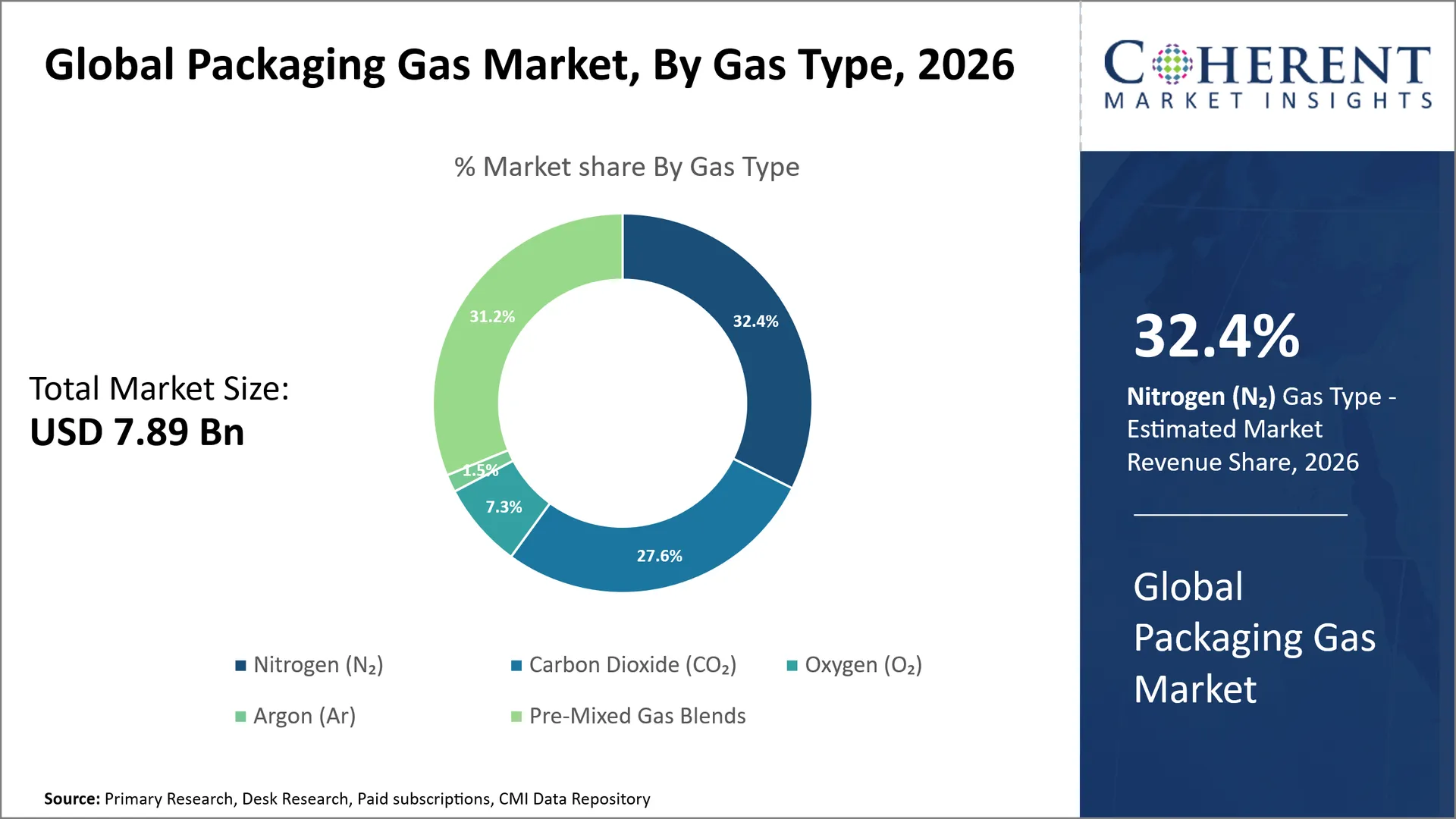
- Nitrogen (N₂) is projected to account for 32.4% of the global packaging gas market by 2026 and will increase at a compound annual growth rate (CAGR) of 7.6% from 2026 to 2033. The inert atmosphere keeps snacks, coffee and other fat-sensitive foods from oxidizing without having to change the recipes. Atlas Copco introduced an integrated nitrogen-generation skid for modified atmosphere packaging at the UK’s PPMA Show in September 2026.
- Meat and Poultry Packaging is expected to record a CAGR of 7.8% between 2026 and 2033. The segment will hold 21.5% of the market share in terms of revenue in the global packaging gas market in 2026. Gas-controlled packs help processors to control microbial deterioration and maintain retail presentation during chilled distribution. In April 2025, Faerch announced it had received independent certification that its MAPET II trays for storing fresh meat under modified atmospheres are recyclable.
- Bulk Gas Supply is projected to grow at a CAGR of 6.9% during the forecast period 2026-2033 and account for 45.6% of the global packaging gas market in 2026. For high-throughput food plants where cylinder changes happen frequently and may interfere with packaging lines, central storage and scheduled deliveries are a godsend. In December 2024, Messer started up its Vrdy carbon dioxide production plant in the Czech Republic, further strengthening the direct gas supply for local food and beverage customers.
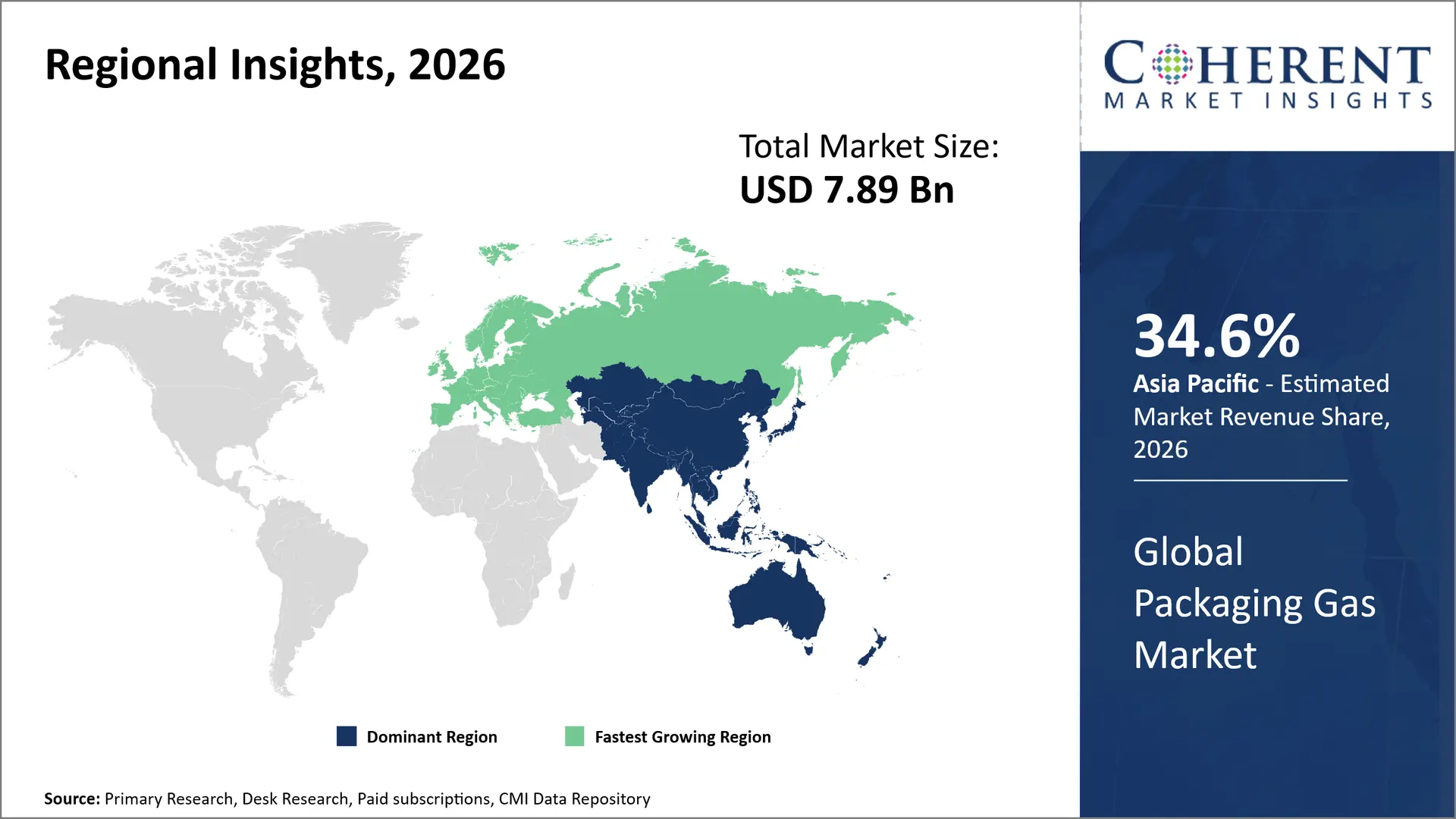
- Asia Pacific is anticipated to hold a significant share of 34.6% in the global packaging gas market in 2026, and a projected CAGR of 7.9% in the forecast period 2026-2033. In a commercial context, reliability of food-grade gas infrastructure is important with the growth of processed food capacity and the growth of chilled food distribution. Air Liquide and Manildra Group have entered into a contract to build a carbon dioxide plant in New South Wales, Australia, for food and beverage applications, with a target completion date of May 2025.
- Europe expected to hold 31.7% share of the global packaging gas market by 2026 and register an estimated CAGR of 8.6% for 2026-2033, the highest among all regions. Producers are working to redesign packs to meet recyclability requirements while still ensuring their shelf life. MULTIVAC has announced a German exhibition demonstration of its TX 620 line, used for packaging ready meals in cardboard trays sealed with recyclable film under modified atmosphere, in July 2025.
Segmental Insights
Why Does Nitrogen (N₂) Dominate the Gas Type Category of the Global Packaging Gas Market?
Nitrogen (N₂) is expected to hold 32.4% of the global packaging gas market by gas type in 2026. Its use in food packaging, especially because of its low solubility in food products, ensures the package headspace and prevents the package from getting deformed. This is reflected in its leadership. This makes nitrogen ideal for flexible packaging of crackers, roasted nuts, powdered ingredients and other moisture sensitive products. In addition, food producers are happy that it can be easily integrated into existing industrial gas distribution networks and automated gas-flushing systems. On-site nitrogen generation offers processors additional flexibility where consistent gas quality and uninterrupted packaging operations are required. In June 2025, Absstem introduced its nGENX compact pressure swing adsorption nitrogen generator, designed for food-packaging applications with controlled nitrogen purity and remote monitoring capabilities. This development paves the way for manufacturers to increase the reliability of their supply chain and decrease their dependence from external gas deliveries.
- Current Industry Events of 2026
- Market Size Estimation
- Regional Breakdown
- Competitive Landscape
- Customer Intelligence
- Segmental Analysis
- Pricing Analysis
- Key Market Drivers, Challenges & Future Trends
- Customized Insights Section
Why Do Meat and Poultry Packaging Dominate the Global Packaging Gas Market?
The application segment of Meat and Poultry Packaging is expected to hold the largest share of the global packaging gas market by 2026, accounting for an estimated 21.5% share. Food-grade carbon dioxide and nitrogen are used across a variety of product lines to calibrate gas mixtures to product moisture, cut type and microbial sensitivity for fresh proteins. The centralization of supermarket packing increases the need for a repeatable composition of gasses, validated seals and a shelf life that is consistent with refrigerated distribution schedules. Unlike shelf-stable foods, the losses of fresh proteins can quickly erode processor margins – and that makes atmosphere validation a purchase priority. In May 2026 Amcor announced its Fresh Tray modified atmosphere package, developed in conjunction with Beijing Zhongrun Changjiang Food Company for fresh meat in China, had been awarded a WorldStar packaging award. The development shows how processors can use alternative materials and still maintain gas-protected packaging.
Why Does Bulk Gas Supply Represent the Largest Supply Mode in the Global Packaging Gas Market?
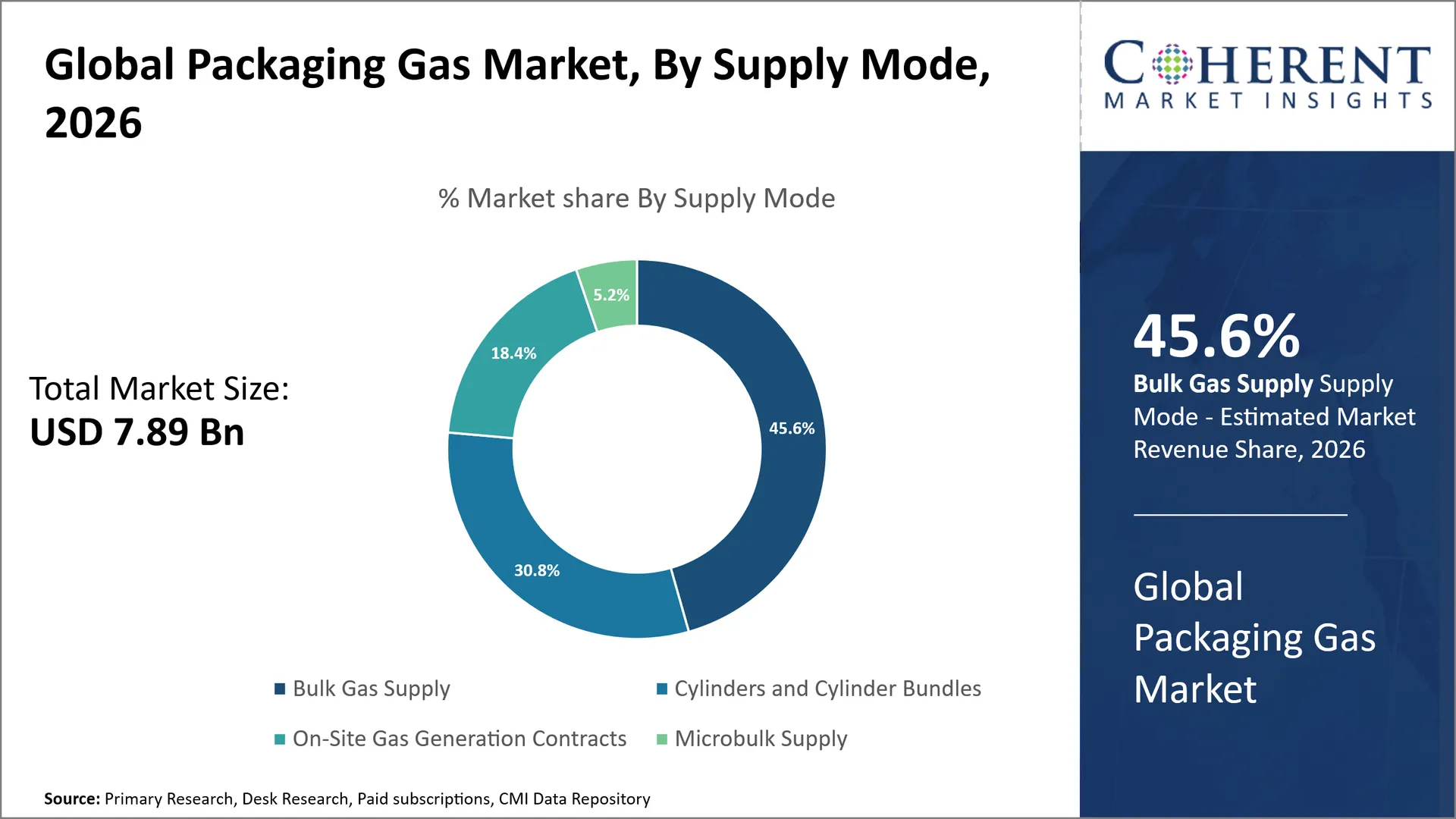
Bulk Gas Supply is expected to lead the Supply Mode Category in 2026, accounting for 45.6% of the global packaging gas market. Food-packaging plants operating multiple shifts prefer to deliver to stationary storage vessels where the replenishment can be matched to production volume versus the cylinder replacement cycles. Sufficient tank capacity, vaporizers and controlled pipeline pressure ensure a constant gas supply to several packaging lines. The reduction of handling operations guaranties simplicity for plant operations. This model of supply is appropriate for large processors, but the ability to get tankers, inventory visibility and emergency replenishment are critical purchasing considerations. In September 2026, Gulf Cryo announced an expansion of its regional liquid carbon dioxide production capacity across the UAE, Saudi Arabia, and Kuwait, supported by its cryogenic transport and bulk-storage network. The project shows how integrated infrastructure can guaranty the continuity of supply to industrial gas customers.
Current Events and their Impact
Current Event | Description and Its Impact |
In October 2025, the European Commission changed the food additive permissions for specialized nutritional products. |
|
The European Union Packaging and Packaging Waste Regulation is scheduled to come into force in August 2026. |
|
October 2025 – FSSAI Proposes Restrictions on PFAS and BPA in Food-Contact Materials |
|
Global Packaging Gas Market Dynamics
Key Market Drivers
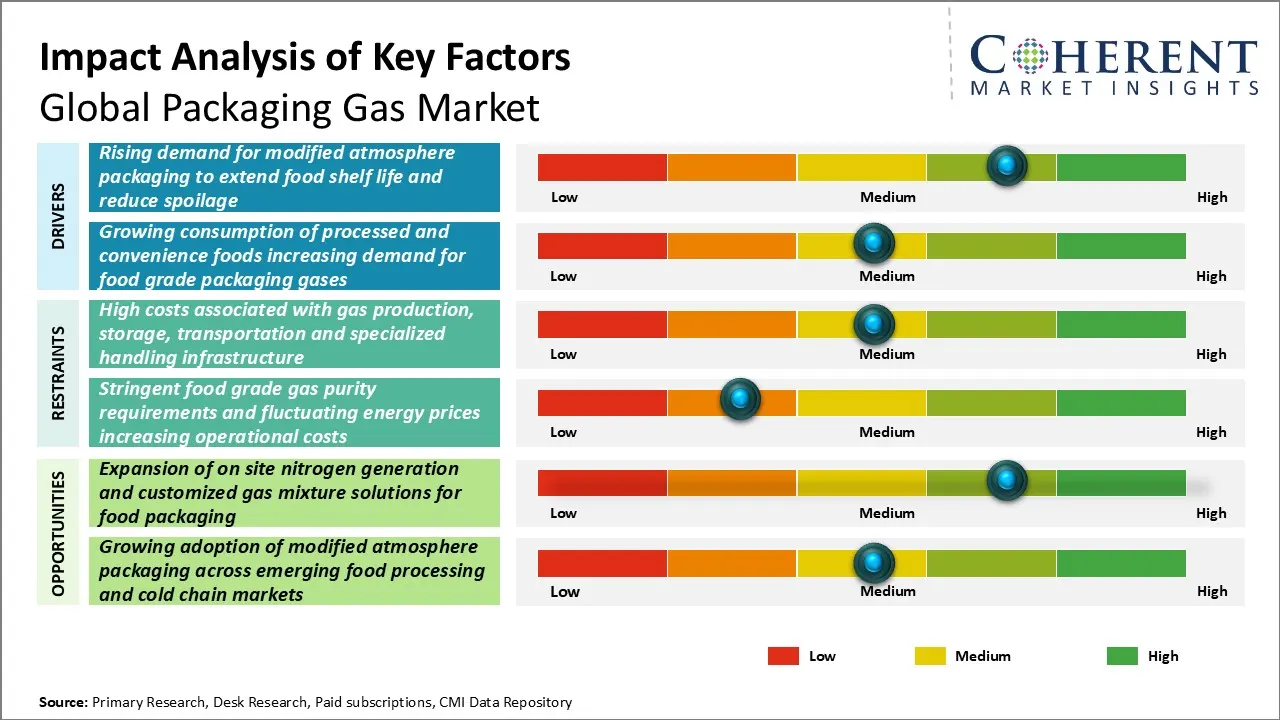
- Rising Demand for Modified Atmosphere Packaging to Extend Food Shelf Life and Reduce Spoilage: Modified atmosphere packaging helps food processors to control the factors that affect the salability of chilled products during distribution. Processors can rely on oxygen reduction, carbon dioxide management and reliable hermetic seals to deliver consistent shelf-life performance with low levels of product rejection. Packaging gas procurement is a critical component of waste prevention, retailer service levels and operational efficiency, all of which benefit gas suppliers and packaging equipment manufacturers. In April 2025, ULMA Packaging introduced the FM 400 flow wrapper, a high-speed modified atmosphere packaging machine. The product features a hygienic design and sealing capabilities for perishables.
- Growing Consumption of Processed and Convenience Foods Increasing Demand for Food-Grade Packaging Gases: The increased consumption of processed and convenience foods. These include ready-to-eat meals, refrigerated snacks and portioned convenience products, which create a greater number of packaging formats and shorter production runs. Processors require protective atmospheres that will work for a variety of ingredients, but not require long changeovers that add to packaging costs. This supports the need for food grade gas mixtures, multi-purpose sealing equipment and technical services among contract packers and meal manufacturers. At IFFA in May 2025, Ishida launched the QX-800 tray sealer, capable of gas-flush packaging and quick format changes for a range of food-processing applications.
Emerging Market Trends
- Packaging Gas Consumption Transparency Becoming an Important Procurement Criterion: Food processors are now evaluating packaging gasses based on usable output per salable pack, not just delivered price. The method is intended to clear losses, start-up consumption of production and mismatch between actual requirements and scheduled gas deliveries. Suppliers may be required to provide additional support for consumption measurement, operator training, and contract reviews based on verified usage patterns. Providers with transparent gas-utilization records have an opportunity to deepen customer relationships over the forecast period, while suppliers competing on commodity pricing alone may experience increasing margin pressure.
- Greater Emphasis on Traceable and Lower-Emission Packaging Gas Sourcing: As manufacturers look at emissions across their supply chain, the sourcing of food-grade carbon dioxide is becoming an increasingly important consideration in purchasing decisions. Buyers may increasingly differentiate between conventional CO2 supply and properly purified gas recovered from appropriate industrial or biological processes. Such a shift can drive investment in supplier qualification, quality documentation and source verification. Food manufacturers with a focus on sustainability are likely to favor producers able to provide credible environmental credentials and reliable purity throughout the forecast period. Suppliers with non-transparent sourcing practices may be subject to additional qualification requirements.
Regional Insights
Why Does Asia Pacific Dominate the Global Packaging Gas Market?
The global packaging gas market is projected to be 34.6% of the Asia Pacific region in 2026 due to the depth of its food processing supply chain and not any one application. They make seafood exporters, snack makers and refrigerated-food producers all of them of different sizes and they all need packaged gas mixtures and dependable deliveries of liquid gas. Suppliers also face the challenge of scattered production clusters, a patchwork of food-safety regulations and the cost of transporting cryogenic gasses. Also, the region offers opportunities for the recovery of food grade carbon dioxide from existing industrial streams, provided the purification process meets the customer’s requirements. Vietnam’s Petrovietnam Ca Mau Fertilizer Corporation began production of food-grade CO₂ in February 2026 and shipped its first commercial batch. The project shows the potential for local feedstock recovery to expand the range of qualified supply options for food processors and packaging applications.
Why Is Europe Emerging as the Fastest-Growing Region in the Global Packaging Gas Market?
Europe is expected to represent 31.7% of the global packaging gas market in 2026 and is known as the fastest-growing region in the packaging gas market. Its growth prospects point to manufacturers re-evaluating the sourcing of gas, as well as changes in the packaging materials. Food processors need proven atmosphere performance when using alternative barrier films and gas suppliers need to provide clear documentation to validate purity, origin and continuity of supply. Localized investments in purification are also driven by the need for alternatives to traditional carbon dioxide sources, particularly where suitable fermentation streams are available. In September 2025, SIAD inaugurated a carbon dioxide recovery and liquefaction plant at Leopoldov, Slovakia, producing food-grade CO₂ from bioethanol fermentation. The facility illustrates how closer connections between industrial feedstocks and gas distribution could improve sourcing resilience and support future packaging gas requirements across European food-processing networks.
Global Packaging Gas Market Outlook for Key Countries
Why Is the U.S. a Key Market for the Global Packaging Gas Market?
The United States remains an important packaging gas market because of the need for chilled products in formats suitable for quick replenishment by convenience retailers, supermarkets and institutional food suppliers. Gas suppliers are encouraged to work with food manufacturers and packaging converters to meet the specific protective-atmosphere requirements of prepared sandwiches, fresh meal components and packaged protein cuts. And then there’s the commercial challenge of managing labor costs at distribution centers and stores, and keeping products on the shelves. Cincinnati-based ProAmpac showcased fiber-based modified atmosphere packaging for sandwiches, sides and meals at the NACS Show in Chicago in October 2025. Its product range reflects the need for packaging formats that allow for easy handling and extended merchandising times. This is an opportunity for the gas suppliers to validate mixtures for newer material structures rather than relying solely on conventional plastic packaging.
Why Is India Important in the Global Packaging Gas Market?
India’s packaging gas market offers opportunities due to a unique blend of traditional foods and the growth of organized processing. Protective atmospheres suitable for moisture sensitivity, oxidation and a variety of distribution conditions are required by regional producers of dairy products, chilled prepared foods, savory snacks and sweets. Many companies are moving from manual packaging to semi-automatic sealing and cost-effective gas control and easily accessible technical service are important purchasing considerations. These customers can be targeted by gas suppliers who provide food grade specification advice and small batch supply. In September 2025, Duravant expanded its Indian operations by adding technical support hubs in Thane and Vadodara to support customers in the food-processing and packaging automation sectors. While the announcement did not create new packaging gas capacity, it does illustrate the growth of local equipment-support infrastructure that could help processors implement more sophisticated gas-flushed packaging operations.
Why Does China Support Growth in the Global Packaging Gas Market?
China's food supply chains are influencing the global packaging gas market, which includes high volume protein processing, along with large-scale production of chilled retail products and ready meals. U.S. manufacturers of packaging equipment can help processors by providing domestically developed gas-flushing and sealing machines, allowing facilities to match equipment specifications to nitrogen, oxygen and carbon dioxide purchases. The decisions of procurement are motivated by the production throughput, product presentation and compatibility of equipment for different sizes of packages. RODBOL, based in Chengdu, announced in September 2025 that it will display automatic modified atmosphere packaging equipment at the China International Meat Industry Expo in Xiamen. Its display included systems for industrial and smaller processing operations. This indicates a differentiated market, where the packaging gas suppliers have to adapt to the variety of equipment capabilities, gas consumption patterns and production volumes.
Why Is Germany a Strategic Country in the Global Packaging Gas Market?
Germany is a strategic packaging gas market as the food manufacturers attach high importance to the provenance of industrial carbon dioxide, regulatory compliance and food-grade verification. Processors using protective atmospheres for chilled convenience foods, cheeses and sliced meats must ensure that the gasses they supply meet the quality and documentation standards of the application. Therefore, suppliers compete on the basis of differentiated sourcing options, reliability of specifications and analytical assurance. In May 2026, German industrial gas company Westfalen said it was adding gas recovered from biomethane plants to its mix of carbon dioxide sources, but maintaining separate logistics for different sources. The company also pointed out the importance of application-specific aspects when picking CO₂ from alternative sources. This development shows that for German food-packaging gas buyers, supplier qualification, product traceability and customer acceptance are gaining in commercial importance.
Why Is Brazil an Important Growth Market for the Global Packaging Gas Market?
Brazil has a highly developed poultry and meat-processing ecosystem, which is good for the packaging gas market, but domestic retail requirements differ from those of export operations. There is a scope for tailor-made protective gas atmospheres as supermarkets are increasingly valuing chilled, portion-controlled packs that can be displayed without any further handling. Producers need to ensure that the gas composition is suitable for refrigerated distribution, product appearance and moisture management, while keeping packaging costs commercially acceptable. In Brazil, JBS’s Seara brand launched premium trays for chilled chicken in May 2026. These trays feature a dual-absorption system and modified atmosphere packaging. The company said the new format would be easier for retailers to handle, keep fresh and improve product presentation. This presents an opportunity for packaging gas suppliers to broaden their role in shelf-ready chilled products away from just export-oriented meat processing applications.
Packaging Gas Production and Quality-Control Technology Landscape
Technology | Principal Application | Adoption Landscape | Commercial Significance |
Pressure Swing Adsorption (PSA) Nitrogen Generation | Onsite nitrogen generation for food packing lines | Good for plants that need a constant supply of nitrogen and a steady power source | It is less dependent on nitrogen supply, but it requires investment in air treatment, maintenance and purity monitoring. |
Food-grade CO2 recovery and purification | Captured CO₂ used in food and beverage applications | Requires proven purification, contaminant testing and reliable feedstock. | It diversifies the sourcing of qualified CO2 and offers the potential for supply agreements close to suitable production sites |
Flow Control & Gas Mixture Automation | Preparing controlled nitrogen, carbon dioxide, and oxygen mixtures | Relevant to processors packaging products with different atmosphere requirements | Improves formulation consistency and supports product changes without relying exclusively on fixed premixed-gas deliveries |
Automated Vacuum-Gas Flushing and Sealing | Replacing package air with protective gases before sealing trays and flexible packages | Established in industrial modified atmosphere packaging operations | Creates repeatable gas consumption and links gas performance to equipment settings, seal integrity, and line efficiency |
Headspace Gas Analysis | Measuring residual oxygen and carbon dioxide inside sealed food packages | Used for quality assurance, process validation, and troubleshooting | Helps processors verify packaging specifications and identify deviations before affected products enter distribution |
Non-destructive detection of failures in package integrity | Increasingly relevant in situations where product retention and inspection costs are important | Food manufacturers can enhance packaging validation and minimize waste due to destructive testing. | Allows food manufacturers to strengthen packaging validation while limiting waste associated with destructive testing |
How Are Shared Microbulk Delivery and Application Support Creating New Growth Opportunities in the Global Packaging Gas Market?
Small food manufacturers occupy the accessible white space, where the gas consumption is too variable to justify the installation of dedicated generation equipment, but too predictable to maintain the efficiency of repeated cylinder handling. Shared microbulk delivery is possible through scheduled replenishment and compact storage, which could offer an intermediate solution for chilled meal co-packers, regional bakeries and specialty seafood processors. Product-specific atmosphere guidance, gas-quality certificates, operator training and emergency switching arrangements may be included in the delivery package by suppliers. The size of the individual account would be less important for commercial returns than the routing of multiple customers within a manageable service radius. Winning providers will need cryogenic handling expertise, calibrated filling systems, reliable storage monitoring, trained technicians and documented food safety procedures. Big gas producers can provide a steady upstream volume, but local distributors with existing ties may have an edge in winning customers. The main risk is that you spread your infrastructure out across sites and you don’t have enough repeat consumption. Pilot clusters and minimum-volume service agreements provide a disciplined entry path.
Market Players, Key Development, and Competitive Landscape
Key Developments
- In June 2026, WITT Gasetechnik announced the acquisition of INFICON's Contura packaging leak-testing product range and related patents, effective July 2026. The transaction expands WITT's nondestructive package inspection portfolio, giving modified atmosphere packaging operators access to an additional leak-detection method without using test gases.
- In September 2025, Nippon Gases inaugurated a processing plant in Zörbig, Germany, producing food-grade liquid carbon dioxide recovered from nearby bioethanol manufacturing. For the global packaging gas market, this illustrates an alternative upstream supply route and the importance of purification capacity close to suitable industrial feedstocks.
- In September 2025, AMETEK MOCON introduced Small Volume modules for its Dansensor CheckMate 4 analyzer, enabling nondestructive oxygen measurement in packaging with minimal headspace, including coffee capsules. This development strengthens verification options for specialized packages where conventional gas sampling may be impractical or disruptive.
Competitive Landscape
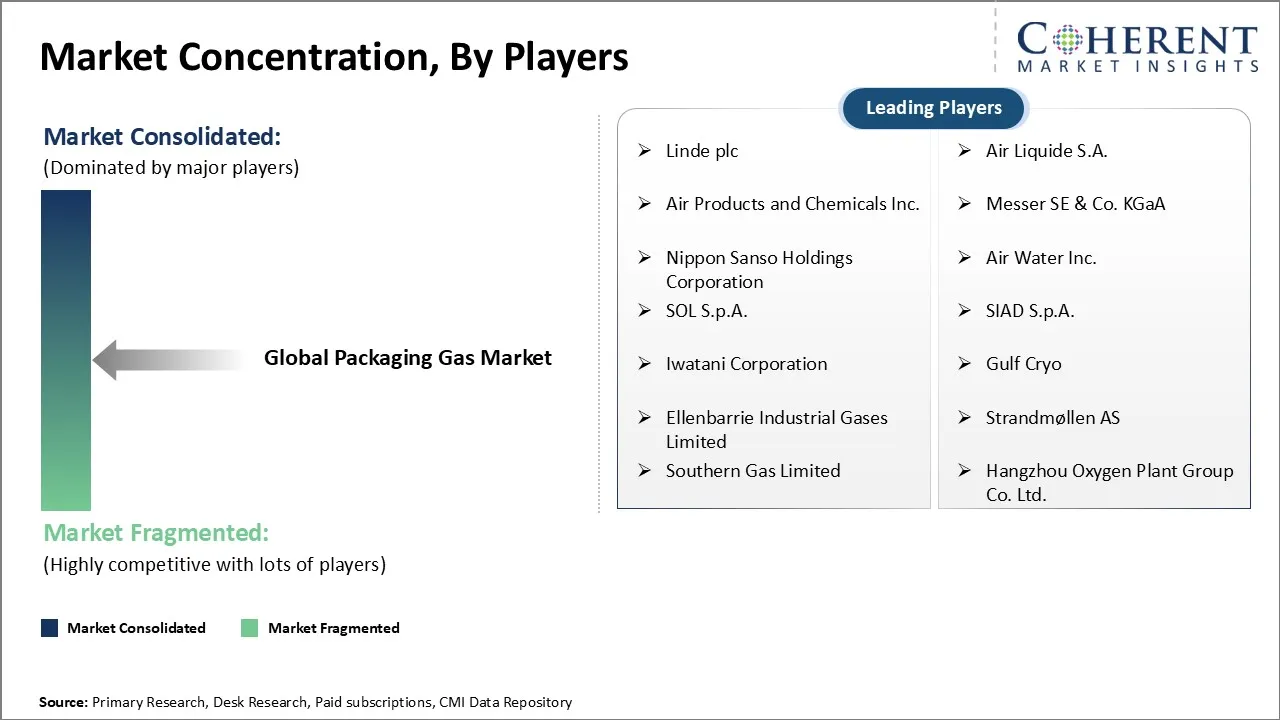
The global packaging gas market is moderately consolidated at the gas-production level, where major industrial gas suppliers operate purification assets and extensive delivery infrastructure. Competition becomes more dispersed in cylinder filling, specialist mixtures, and regional distribution. Food processors evaluate suppliers through food-grade specifications, delivered cost, continuity safeguards, technical responsiveness, and contractual flexibility. Regional specialists can compete effectively where local service requirements outweigh production scale.
Key competitive factors include
- Food-grade quality assurance: Verified purity, contaminant control, traceability, and documented compliance.
- Supply continuity: Backup sources, storage availability, and contingency planning for production interruptions.
- Gas specification flexibility: Ability to supply application-specific mixtures and consistent gas compositions.
- Regional distribution capability: Efficient cylinder, microbulk, and bulk delivery across different customer locations.
- Technical service: Support for gas-flow settings, equipment compatibility, and packaging process validation.
- Cost competitiveness: Transparent pricing structures that reflect transport, storage, handling, and service requirements.
- Customer relationship management: Responsive account support, reliable fulfillment, and contracts suited to production schedules.
Market Report Scope
Packaging Gas Market Report Coverage | |||
Report Coverage | Details | ||
Base Year | 2025 | Market Size in 2026: | USD 7.89 Bn |
Historical Data For: | 2020 To 2024 | Forecast Period: | 2026 To 2033 |
Forecast Period 2026 To 2033 CAGR: | 7.3% | 2033 Value Projection: | USD 12.91 Bn |
Geographies covered: |
| ||
Segments covered: |
| ||
Companies covered: | Linde plc, Air Liquide S.A., Air Products and Chemicals Inc., Messer SE & Co. KGaA, Nippon Sanso Holdings Corporation, Air Water Inc., SOL S.p.A., SIAD S.p.A., Iwatani Corporation, Gulf Cryo, Ellenbarrie Industrial Gases Limited, Strandmøllen AS, Southern Gas Limited, Hangzhou Oxygen Plant Group Co. Ltd. | ||
Growth Drivers: |
| ||
Restraints & Challenges: |
| ||
Analyst Opinion (Expert Opinion)
- The global packaging gas market is likely to shift toward contractual arrangements that place greater responsibility for packaging performance on suppliers. Industrial gas companies could move beyond supplying molecules toward jointly managed operating commitments with food processors. Providers capable of aligning supply guarantees, technical accountability, and customer production requirements may achieve stronger commercial differentiation than businesses relying on conventional volume-based agreements.
- Alternative preservation and packaging methods could reshape the addressable market for protective gases. Vacuum-skin packaging and other preservation approaches may replace gas-flushed formats in selected food categories where product characteristics and shelf-life requirements permit. This creates a potential challenge for suppliers assuming packaging volume will translate directly into gas consumption. Commercially adaptable participants should evaluate application-level substitution risks before making long-term capacity commitments.
- Packaging gas suppliers should prioritize validated food-grade CO₂ purity, contaminant detection, flexible mixing capabilities, and dependable backup arrangements. Particular attention should be given to processors handling sensitive chilled products, where supply failures or unsuitable atmosphere compositions can create substantial losses. Investment decisions should account for energy-price exposure, variable feedstock quality, and customer qualification requirements. Suppliers should avoid oversized generation assets without firm consumption commitments and strengthen technical cooperation with packaging material and equipment specialists.
Speak to the analyst
Want personalized insights?
Take the findings above to one of our principal consultants, or have the report rebuilt around the segments, geographies and competitors you actually track.
Market Segmentation
- Gas Type Insights (Revenue, USD Bn, 2021 - 2033)
- Nitrogen (N₂)
- Carbon Dioxide (CO₂)
- Oxygen (O₂)
- Argon (Ar)
- Pre-Mixed Gas Blends
- Application Insights (Revenue, USD Bn, 2021 - 2033)
- Meat and Poultry Packaging
- Seafood Packaging
- Bakery and Snack Packaging
- Dairy Product Packaging
- Ready to Eat Meal Packaging
- Fresh Fruit and Vegetable Packaging
- Coffee, Nuts and Dried Food Packaging
- Other Food Packaging
- Supply Mode Insights (Revenue, USD Bn, 2021 - 2033)
- Bulk Gas Supply
- Cylinders and Cylinder Bundles
- On Site Gas Generation Contracts
- Microbulk Supply
- Packaging Format Insights (Revenue, USD Bn, 2021 - 2033)
- Rigid Trays
- Flexible Pouches and Bags
- Thermoformed Vacuum Gas Packages
- Other Rigid Containers
- Distribution Channel Insights (Revenue, USD Bn, 2021 - 2033)
- Direct Manufacturer Sales
- Industrial Gas Distributors
- Regional Insights (Revenue, USD Bn, 2021 - 2033)
- North America
- U.S.
- Canada
- Latin America
- Brazil
- Argentina
- Mexico
- Rest of Latin America
- Europe
- Germany
- U.K.
- Spain
- France
- Italy
- Russia
- Rest of Europe
- Asia Pacific
- China
- India
- Japan
- Australia
- South Korea
- ASEAN
- Rest of Asia Pacific
- Middle East
- GCC Countries
- Israel
- Rest of Middle East
- Africa
- South Africa
- North Africa
- Central Africa
- North America
- Key Players Insights
- Linde plc
- Air Liquide S.A.
- Air Products and Chemicals Inc.
- Messer SE & Co. KGaA
- Nippon Sanso Holdings Corporation
- Air Water Inc.
- SOL S.p.A.
- SIAD S.p.A.
- Iwatani Corporation
- Gulf Cryo
- Ellenbarrie Industrial Gases Limited
- Strandmøllen AS
- Southern Gas Limited
- Hangzhou Oxygen Plant Group Co. Ltd.
Sources
Primary Research Interviews
- Industrial gas manufacturers and food-grade gas suppliers
- Nitrogen, carbon dioxide, oxygen, and gas-blend producers
- Food processors, packaging manufacturers, distributors, and industry experts
Stakeholders
- Industrial gas producers and specialty gas suppliers
- Gas purification, blending, and on-site generation equipment manufacturers
- Food and beverage manufacturers and packaging converters
- Bulk gas distributors, cylinder suppliers, and end users
End-use Sectors
- Meat, poultry, and seafood packaging
- Bakery, snacks, and dairy packaging
- Ready-to-eat meals and convenience foods
- Fresh produce, coffee, nuts, and dried foods
Regulatory and Industry Bodies
- U.S. Food and Drug Administration (FDA)
- European Commission
- European Food Safety Authority (EFSA)
- Food Safety and Standards Authority of India (FSSAI)
- International Organization for Standardization (ISO)
- European Industrial Gases Association (EIGA)
Databases
- Company annual reports and investor presentations
- UN Comtrade and international gas trade databases
- Eurostat and national industrial production databases
- Industrial gas production, capacity, pricing, and patent databases
- Food-grade gas quality and regulatory compliance databases
Magazines and Journals
- Food Packaging and Shelf Life
- Packaging Technology and Science
- Journal of Food Engineering
- Food Control
- Gasworld
- Packaging Europe
Associations
- European Industrial Gases Association (EIGA)
- Compressed Gas Association (CGA)
- Asia Industrial Gases Association (AIGA)
- International Society of Beverage Technologists (ISBT)
- World Packaging Organisation (WPO)
Public Domain Sources
- Industrial gas production, consumption, and trade statistics
- Modified atmosphere packaging adoption and shelf-life data
- Food-grade gas purity, pricing, and supply infrastructure information
- Nitrogen generation, CO₂ recovery, and gas-blending developments
- Manufacturing investments, product launches, and regulatory updates
Key Standards and Regulations
- Regulation (EC) No. 1333/2008 – Food additives, including packaging gases
- Regulation (EU) No. 231/2012 – Food additive purity specifications
- FDA 21 CFR §184.1240 – Carbon dioxide
- ISO 22000 – Food safety management systems
- EIGA Doc 126/20 – Minimum specifications for food gas applications
- EIGA Doc 125/20 – Guide to the supply of gases for use in foods
- EIGA Doc 194/24 – Design and operation of on-site nitrogen generators for food use
Proprietary Elements
- CMI Data Analytics Tool and proprietary CMI repository containing 10+ years of packaging industry intelligence, covering food-grade gases, modified atmosphere packaging, gas pricing, production capacity, supply infrastructure, regulatory compliance, technological developments, and competitive intelligence.
Get access to 250+ pages report
Every segment, forecast, competitor profile and data table behind the analysis above — available for instant download.
- ESOMAR Member
- ISO 9001:2015 Certified
- D-U-N-S Registered
- GDPR & CCPA Compliant
Missing comfort of reading report in your local language? Find your preferred language:
Frequently Asked Questions
The CAGR of global packaging gas market is projected to be 7.3% from 2026 to 2033.
The global packaging gas market is estimated to be valued at USD 7.89 billion in 2026 and is expected to reach USD 12.91 billion by 2033.
Packaging gases help preserve food freshness, maintain product quality, control oxidation, and extend shelf life during storage and distribution.
Modified atmosphere packaging replaces or adjusts the air inside food packages with controlled gas mixtures to maintain suitable preservation conditions.
Food manufacturers prioritize gas purity, supply reliability, regulatory compliance, technical support, and consistency in product quality.
Packaging gases must comply with applicable food-grade purity specifications, food additive regulations, and quality assurance requirements in their respective markets.
The major factors driving the growth of the global packaging gas market are the increasing use of modified atmosphere packaging to extend food shelf life and reduce spoilage, along with growing consumption of processed and convenience foods that require food-grade packaging gases.