

Global Permanent Magnets Market Size and Forecast – 2026 To 2033
The Global Permanent Magnets Market is estimated to be valued at USD 28.4 Bn in 2026 and is expected to reach USD 48.05 Bn by 2033, growing at a compound annual growth rate (CAGR) of 7.8% from 2026 to 2033. Market expansion is supported by wider use of high-efficiency permanent-magnet motors and components in electric vehicles, industrial automation, consumer electronics, energy-efficient appliances, and renewable-energy systems.
Manufacturers are also developing magnets with improved corrosion resistance, resource efficiency, and complex-form capabilities to meet increasingly demanding operating requirements. In October 2024, Aichi Steel announced sample sales of an upgraded MAGFINE anisotropic bonded magnet featuring improved corrosion resistance, with the company targeting broader motor applications including electric water pumps and other electrified systems. This development highlights continuing material innovation aimed at expanding permanent-magnet applications while improving durability and manufacturing flexibility.
Key Takeaways of the Global Permanent Magnets Market
- Neodymium Iron Boron (NdFeB) Magnets are expected to record an estimated CAGR of 8.9 % during 2026–2033 and hold 48.6% of the global permanent magnets market in 2026. Their superior magnetic strength, compact size, and efficiency support broad use in high-performance motors, electronics, and automation. In January 2025, MP Materials began trial production of automotive-grade sintered NdFeB magnets at its Texas facility, reinforcing commercial supply expansion.
- Sintered Magnets are projected to expand at an estimated CAGR of 8.4 % during 2026–2033 while accounting for 64.8% of the global permanent magnets market in 2026. Their high energy density, thermal performance, dimensional precision, and suitability for demanding motor designs preserve their manufacturing advantage. In December 2024, the U.S. Department of Energy selected projects to scale tougher NdFeB technology and pre-pilot high-performance sintered magnet production.
- Automotive and Electric Vehicles are anticipated to grow at an estimated CAGR of 9.3 % during 2026–2033 and represent 34.6% of the market in 2026. Permanent magnets enable compact, efficient traction motors and multiple vehicle actuators, making automotive electrification a high-value demand base. In April 2024, eVAC Magnetics received a major U.S. tax credit to advance an NdFeB magnet facility serving automotive and other strategic applications.
- Asia Pacific is forecast to advance at an estimated CAGR of 8.1 % during 2026–2033 and command 64.8% of the global permanent magnets market in 2026. The region combines large-scale rare-earth processing, magnet manufacturing, electronics production, and electric-mobility supply chains, creating unmatched upstream-to-downstream integration. In April 2025, China introduced export controls covering selected samarium-cobalt and terbium- or dysprosium-containing NdFeB permanent magnet materials, underscoring the region’s supply-chain influence.
- Europe is expected to post an estimated CAGR of 9.6 % during 2026–2033 and account for 14.7% of the global permanent magnets market in 2026, making it the fastest-growing region. Localization policies, vehicle electrification, wind-energy investment, and supply-security priorities are accelerating regional capacity creation. In September 2025, Neo Performance Materials opened its permanent magnet manufacturing facility in Narva, Estonia, supplying EV, wind-energy, robotics, and other applications.
Segmental Insights
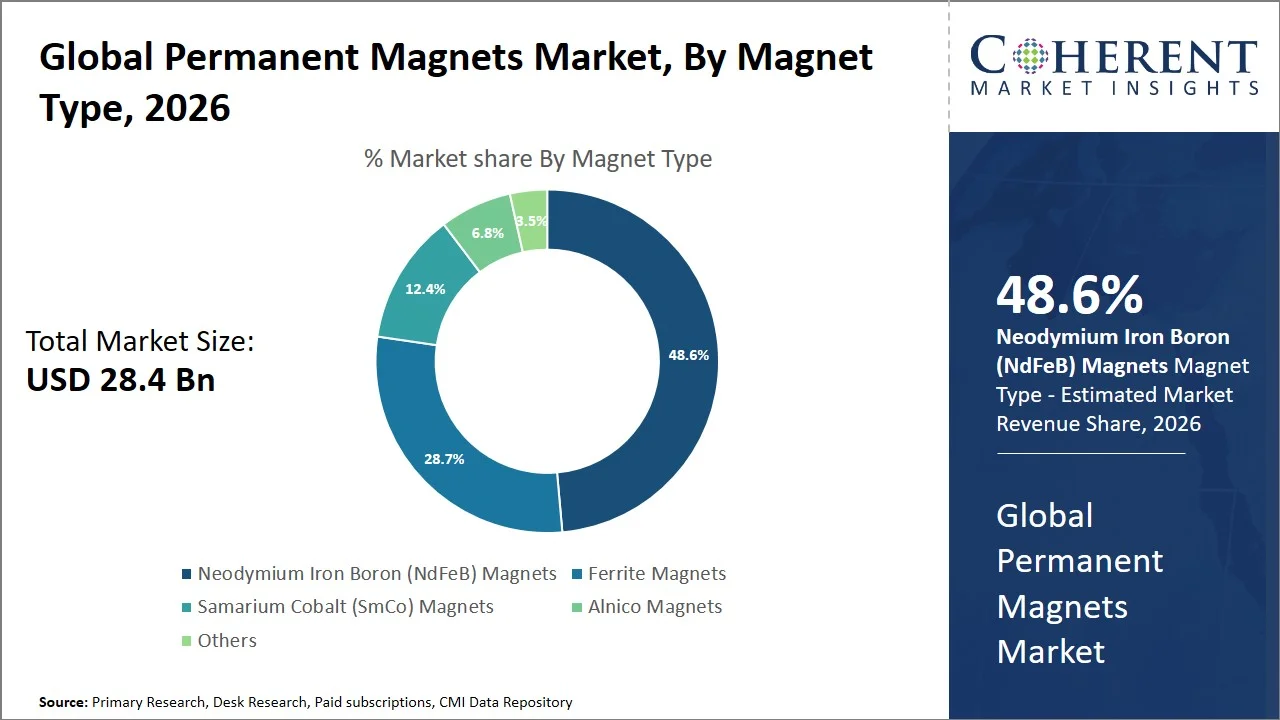
Why Do Neodymium Iron Boron (NdFeB) Magnets Dominate the Global Permanent Magnets Market?
Neodymium Iron Boron (NdFeB) Magnets are expected to account for 48.6% of the global permanent magnets market in 2026 because they deliver exceptionally high magnetic energy density in a compact footprint. This enables smaller, lighter and higher-torque motors across electric mobility, industrial automation, robotics, electronics and renewable-energy systems. Their commercial advantage is increasingly reinforced by material engineering that reduces exposure to dysprosium and terbium while preserving heat resistance and coercivity. Suppliers able to combine advanced composition control, reliable machining and application-specific grades can secure higher-value OEM programs rather than compete only on volume. In July 2025, Proterial developed heavy-rare-earth-free neodymium sintered magnets for EV driving motors, with pre-production sampling already underway for one grade, demonstrating how material innovation is widening NdFeB use while addressing resource-risk constraints.
- Current Industry Events of 2026
- Market Size Estimation
- Regional Breakdown
- Competitive Landscape
- Customer Intelligence
- Segmental Analysis
- Pricing Analysis
- Key Market Drivers, Challenges & Future Trends
- Customized Insights Section
Why Do Sintered Magnets Represent the Largest Manufacturing Process Segment in the Global Permanent Magnets Market?
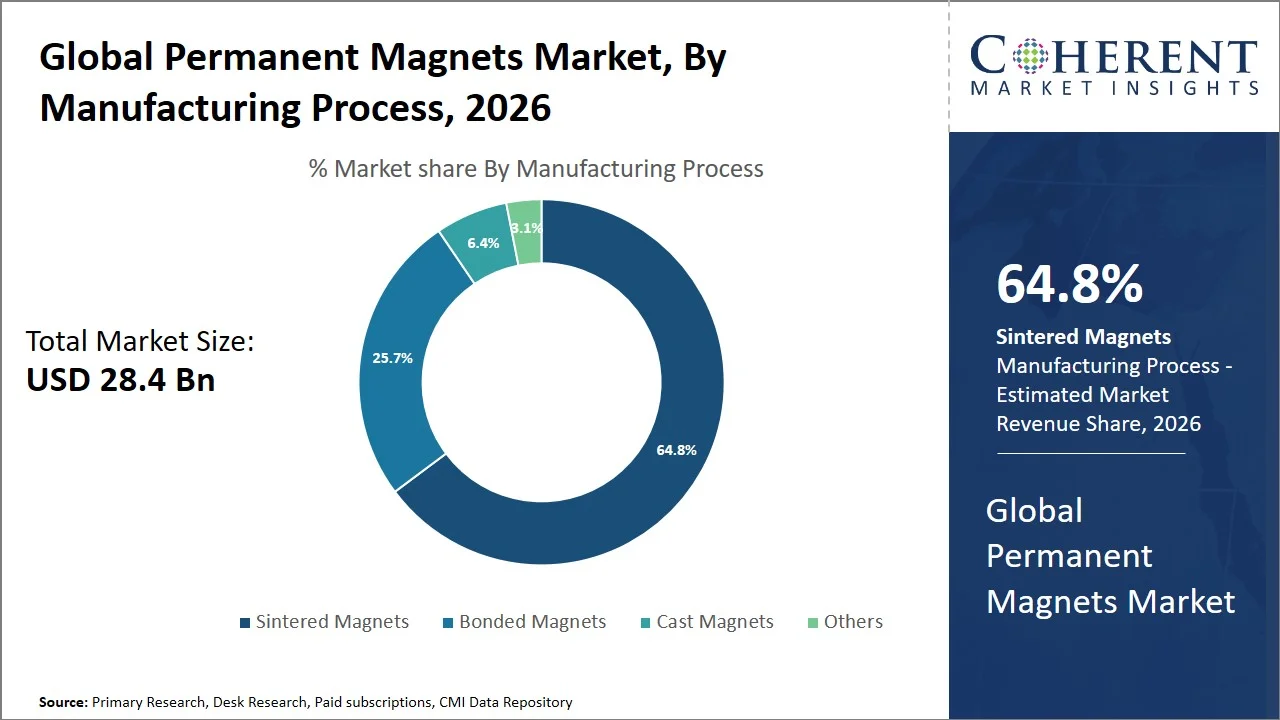
Sintered Magnets are projected to represent 64.8% of the global permanent magnets market in 2026 because the sintering route provides the density, grain alignment and magnetic performance required in demanding motor and generator applications. Compared with bonded alternatives, sintered products can achieve stronger magnetic output and better suitability for high-torque, space-constrained systems, making them important in automotive traction motors, wind generators, industrial drives and precision equipment. Mature powder-processing, pressing, heat-treatment and machining capabilities also support repeatable large-volume production across multiple grades and shapes. In June 2025, HyProMag reported that its HPMS recycling route could remanufacture recovered NdFeB material directly into new sintered magnets containing more than 95% recycled content, with recycled magnets tested in automotive applications for ZF Automotive and GKN Automotive, showing how sintering is adapting to circular supply models.
Why Do Automotive and Electric Vehicles Dominate the Application Segment of the Global Permanent Magnets Market?
Automotive and Electric Vehicles are expected to capture 34.6% of the global permanent magnets market in 2026 as vehicle electrification increases magnet content across propulsion and auxiliary systems. Permanent magnets support traction motors, electric power steering, pumps, compressors, actuators, sensors and other compact electromechanical functions where efficiency, torque density and packaging flexibility matter. EV platforms are particularly important because high-volume vehicle programs create recurring, specification-driven demand and require magnets that can maintain performance under thermal and mechanical stress. This favors suppliers capable of automotive-grade quality control, traceability and long-term volume commitments. In May 2024, General Motors confirmed that the Chevrolet Equinox EV uses a permanent-magnet, bar-wound front motor in both front-wheel-drive and all-wheel-drive configurations, directly illustrating how mass-market EV platforms translate vehicle production into sustained permanent-magnet demand.
Current Events and their Impact
Current Event | Description and Its Impact |
European Critical Raw Materials Act enters into force – May 2024 |
|
U.S. finalizes higher Section 301 tariff on permanent magnets from China – September 2024 |
|
India approves Sintered Rare Earth Permanent Magnet Manufacturing Scheme – November 2025 |
|
Global Permanent Magnets Market Dynamics
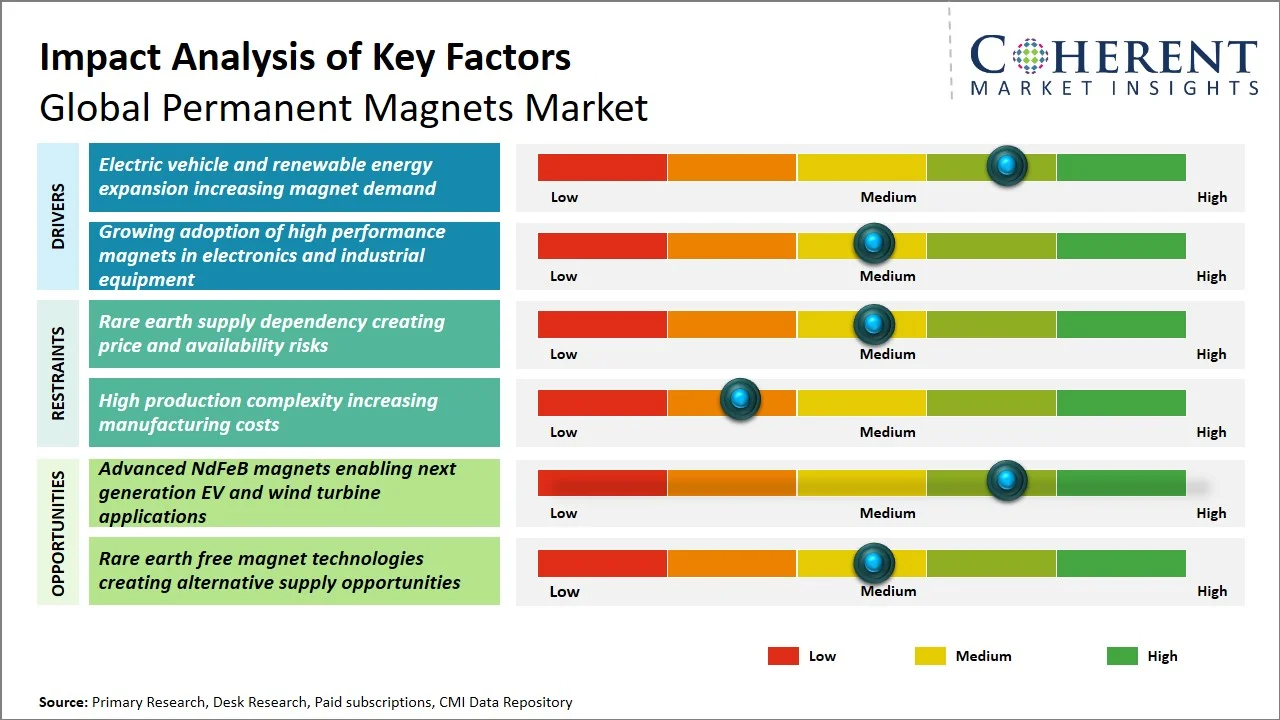
Key Market Drivers
- Electric vehicle and renewable energy expansion increasing magnet demand: Electrification is increasing the number of high-efficiency traction motors and direct-drive wind generators that require compact, high-flux permanent magnets, particularly are power density and operating efficiency influence system economics. Magnet producers, alloy suppliers, motor manufacturers, and precision component suppliers benefit as OEM programs move from prototype volumes into recurring production schedules. In May 2024, BorgWarner secured additional eMotor business with XPeng for two future SUV models; its HVH220 motor uses a permanent-magnet rotor, illustrating how new EV platforms translate directly into magnet-bearing drivetrain demand.
- Growing adoption of high performance magnets in electronics and industrial equipment: Industrial users are placing greater value on motors that deliver higher torque density, lower energy losses, compact footprints, and precise speed control across pumps, compressors, conveyors, robotics, and other automated equipment. This expands demand for permanent-magnet grades that can meet tighter thermal, dimensional, and reliability specifications, benefiting magnet manufacturers, motor OEMs, drive suppliers, and application integrators. In April 2024, Rockwell Automation expanded its PowerFlex 6000T medium-voltage drive coverage to permanent-magnet motor applications, widening the industrial operating envelope for PM-based motor systems.
Emerging Market Trends
- Integrated magnetic assemblies are moving value beyond standalone magnets: Buyers are increasingly evaluating magnets as part of a complete electromagnetic subsystem rather than as isolated components. This is shifting supplier selection toward companies that can combine magnetic design, machining, coating, magnetization, rotor integration, tolerance control, and application engineering. The change favors suppliers capable of reducing assembly complexity and qualification time for OEM customers, while commodity-only producers face greater pricing pressure. Over the forecast period, engineering depth and integration capability are likely to become more important differentiators than basic material availability alone.
- Multi-material magnet strategies are replacing one-material design assumptions: OEM engineering teams are becoming more selective about where high-strength rare-earth magnets are truly necessary and where ferrite, samarium cobalt, alnico, or bonded solutions can provide a better balance of temperature resistance, cost, geometry, and magnetic performance. This encourages portfolio diversification and application-specific material selection rather than uniform specification across product families. Suppliers with broad materials expertise should gain more design-in opportunities, while narrow portfolios may face substitution risk. The trend is expected to increase technical selling and customization throughout the forecast period.
Regional Insights
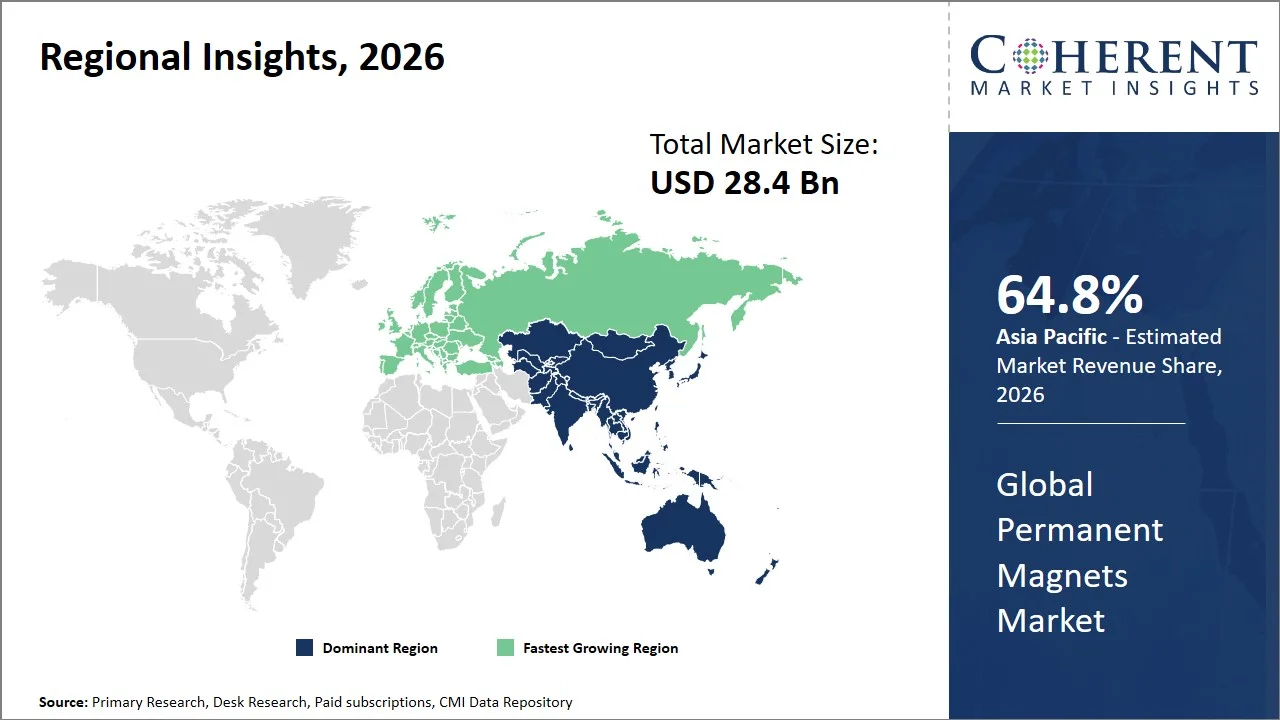
Why Does Asia Pacific Dominate the Global Permanent Magnets Market?
Asia Pacific is expected to account for 64.8% of the global permanent magnets market in 2026, supported by an unusually integrated value chain spanning rare-earth mining, separation, alloy production, magnet manufacturing, electric motors, consumer electronics, and electric vehicles. China provides large-scale NdFeB manufacturing and downstream consumption, while Japan and South Korea add advanced materials engineering, precision motor production, and high-specification electronics demand. Australia strengthens the region’s upstream position through new rare-earth projects, improving access to magnet-critical feedstock across the Asian supply network. This combination gives producers shorter customer linkages, deeper technical ecosystems, and stronger scale economics. In May 2026, the Australian Government confirmed support for Arafura Rare Earths’ Nolans project, enabling construction of a domestic rare-earth mining and processing operation and expanding non- Chinese regional material availability.
Why Is Europe Emerging as the Fastest-Growing Region in the Global Permanent Magnets Market?
Europe is projected to hold 14.7% of the global permanent magnets market in 2026 and emerge as the fastest-growing region as industrial policy, electrification, recycling, and supply-security priorities reshape magnet procurement. Demand is increasingly linked to electric drivetrains, wind generators, factory automation, robotics, and high-efficiency industrial motors, while European buyers are placing greater value on traceable and regionally sourced magnetic materials. Growth therefore extends beyond conventional consumption toward development of resilient, lower-carbon and technologically differentiated magnet value chains. Recycling and remanufacturing are also becoming commercial routes for reducing exposure to imported rare-earth feedstocks. In November 2025, EIT RawMaterials reported that MagREEsource had raised USD 26.71 million to scale fully recycled rare-earth magnet production and prepare a second large-scale European manufacturing site, illustrating the transition from pilot-scale circularity toward industrialized magnet supply.
Global Permanent Magnets Market Outlook for Key Countries
Why Is the U.S. a Key Market for the Global Permanent Magnets Market?
The U.S. is estimated to represent 10.8% of the global permanent magnets market in 2026, supported by demand from electric mobility, aerospace and defense, industrial automation, data-center equipment, medical technology, and advanced electronics. Its strategic importance is increasingly linked to rebuilding domestic magnet manufacturing rather than relying heavily on imported finished magnets and magnetic materials. U.S. buyers also emphasize qualification, supply assurance, intellectual-property protection, and domestic sourcing for sensitive applications, creating opportunities for premium and alternative magnetic technologies. The country’s research, venture-capital, and OEM ecosystem further supports commercialization of new magnet chemistries. In September 2025, Niron Magnetics broke ground on a 1,500-ton-per-year Iron Nitride permanent magnet manufacturing facility in Minnesota, establishing a rare-earth-free production route for automotive, robotics, electronics, industrial, defense, and data-center applications.
Why Does China Support Growth in the Global Permanent Magnets Market?
China is estimated to account for 45.2% of the global permanent magnets market in 2026, reflecting its concentration of rare-earth processing, NdFeB production, component manufacturing, and major downstream industries. Domestic magnet consumption is supported by electric vehicles, variable-frequency air conditioners, wind power, industrial servo motors, robotics, rail equipment, and consumer electronics, allowing suppliers to operate close to high-volume customers. Manufacturing clusters connect alloy preparation, sintering, machining, surface treatment, magnetization, and motor assembly, supporting rapid capacity deployment and production-cost control. China’s importance therefore extends beyond exports to substantial internal consumption and product engineering. In January 2025, JL MAG announced a USD 0.16 billion project in Baotou to add 20,000 tons of annual high-performance rare-earth permanent magnet material capacity for new-energy vehicles, energy-efficient appliances, and emerging robotics applications.
Why Is Japan Important in the Global Permanent Magnets Market?
Japan is estimated to hold 7.9% of the global permanent magnets market in 2026, with its importance rooted in high-performance materials science, precision manufacturing, and demanding end-use specifications rather than volume alone. Japanese automotive, electronics, robotics, factory-automation, and appliance manufacturers require magnets with tightly controlled coercivity, thermal stability, dimensional accuracy, and operating durability. This supports premium NdFeB, samarium cobalt, bonded magnet, and specialized motor applications. Japan is also addressing supply vulnerability through domestic manufacturing capability, material efficiency, recycling, and reduced dependence on constrained heavy rare-earth inputs. In February 2026, Japan’s Ministry of Economy, Trade and Industry approved a permanent-magnet supply-assurance plan involving Honda Motor, Astemo, and Daido Special Steel, linking automotive demand, component engineering, and magnetic-material production within a more resilient domestic industrial chain.
Why Is Germany a Strategic Country in the Global Permanent Magnets Market?
Germany is estimated to account for 4.6% of the global permanent magnets market in 2026, supported by its concentration of automotive engineering, industrial machinery, automation, wind-energy equipment, medical technology, and premium electrical systems. German buyers typically prioritize magnet consistency, temperature resistance, durability, process traceability, and integration into efficient motor and actuator designs, favoring technically qualified suppliers over purely price-led sourcing. The country also maintains a strong research base in magnet recycling, material substitution, disassembly, and advanced manufacturing, creating pathways to lower raw-material exposure while retaining high product performance. In July 2025, the MagCycleAM project officially began under the leadership of Technical University of Darmstadt with Fraunhofer IWKS participation, targeting resource-efficient recycling and additive manufacturing of NdFeB magnets using recovered materials and manufacturing routes suited to complex future magnet geometries.
Why Is South Korea an Important Growth Market for the Global Permanent Magnets Market?
South Korea is estimated to represent 4.3% of the global permanent magnets market in 2026, supported by globally competitive electronics, home appliances, automotive manufacturing, robotics, and precision-component industries. These sectors create recurring requirements for compact and efficient permanent-magnet motors, compressors, actuators, speakers, sensors, and motion-control systems. The country’s next growth layer is increasingly connected to securing rare-earth inputs and recovering magnets from end-of-life equipment, complementing its established high-volume manufacturing capabilities. Domestic circularity can reduce exposure to external supply disruption while creating secondary feedstock for future magnets. In August 2026, South Korea’s climate and environment ministry announced a pilot with LG Electronics and a national electronics-recycling organization to recover rare-earth permanent magnets from discarded air conditioners and refrigerators, targeting about 1,600 kg annually from 40,000 appliances.
Innovation, Production & Manufacturing Landscape
Technology / Manufacturing Approach | Adoption Status | Commercial Relevance | Strategic Implication |
Hot-Deformed Anisotropic NdFeB Processing | Scaling in specialized applications | Produces dense, directionally aligned magnetic structures while enabling shapes and performance profiles different from conventional sintering routes. | Creates opportunities in compact high-performance motors where geometry, thermal behavior, and mechanical integrity justify specialized processing. |
Injection-Molded Bonded Magnet Manufacturing | Commercial and expanding | Combines magnetic powder with polymer binders to manufacture complex, lightweight, near-net-shape components with integrated features. | Reduces machining and assembly steps and supports high-volume production of precision components for sensors, actuators, electronics, and compact motors. |
Additive Manufacturing of Permanent Magnets | Emerging to early commercialization | Enables customized geometries, internal structures, rapid prototyping, and material placement that conventional tooling may not economically reproduce. | Particularly relevant to low-volume, high-complexity aerospace, research, robotics, and specialized industrial applications before broader scale economics improve. |
Advanced Corrosion-Resistant Surface Treatments | Highly commercial | Protective coatings and surface engineering improve resistance to humidity, chemicals, temperature cycling, and aggressive operating environments. | Coating capability increasingly influences product qualification, warranty exposure, service life, and supplier acceptance in automotive, medical, marine, and industrial applications. |
Precision Multipole Magnetization | Commercial with growing sophistication | Enables multiple magnetic poles and tightly controlled field patterns within compact magnet geometries for high-resolution motion and position systems. | Supports miniaturized motors, encoders, actuators, sensors, and robotic systems where magnetic-field accuracy is as important as base material strength. |
Automated Magnetic Metrology and Machine-Vision Inspection | Expanding in advanced production | Integrates field-strength testing, dimensional inspection, defect detection, and process data into production-line quality assurance. | Improves batch consistency and traceability while helping suppliers meet tighter OEM qualification requirements and reduce rejection costs in high-volume programs. |
How Are Bonded Magnet Architectures for Robotics and Smart Actuators Creating New Growth Opportunities in the Global Permanent Magnets Market?
Bonded magnet solutions represent an attractive opportunity where designers need complex geometry, low component weight, integrated features, and repeatable magnetic performance rather than the maximum energy density available from conventional sintered magnets. Robotics, compact actuators, drones, smart appliances, precision automation, and small electric drives can benefit from injection-molded or compression-bonded designs that reduce secondary machining and enable multipole or near-net-shape components. Suppliers can capture this opportunity by combining magnetic compound formulation, mold design, precision tooling, magnetization engineering, and co-development support for OEM customers. Commercial success will depend on consistent material dispersion, dimensional control, thermal validation, and scalable molding capacity. Specialists and vertically integrated suppliers are particularly well positioned because buyers often require rapid prototyping followed by repeatable high-volume production. The strongest differentiation will come from converting magnet functionality into fewer parts, simpler assembly, and lower total system complexity rather than competing only on magnet price. This model can also support premium margins in specialized programs.
Market Players, Key Development, and Competitive Landscape
Key Developments
- In April 2026, Arnold Magnetic Technologies announced a multi-million-dollar expansion of its Thailand operations, adding samarium cobalt magnet production, shaping, and finishing capabilities. The project broadens regional high-performance magnet availability, supports Asia Pacific and European customers, and reduces lead-time pressure on Arnold’s existing Swiss SmCo production base.
- In April 2026, Daikin Industries joined Shin-Etsu Chemical, Hitachi, and Tokyo Eco Recycle to develop a circular system recovering rare-earth magnets from commercial air-conditioner compressors. The initiative creates a structured end-of-life magnet feedstock route and demonstrates how equipment manufacturers can integrate recovered magnetic materials into future production cycles.
- In January 2026, Noveon Magnetics completed a USD 215 million Series C financing to expand U.S. sintered rare-earth permanent magnet manufacturing capacity. The investment strengthens non-Chinese supply availability for automotive, defense, energy, AI, and advanced-manufacturing customers while supporting larger-volume domestic qualification and production programs.
Competitive Landscape
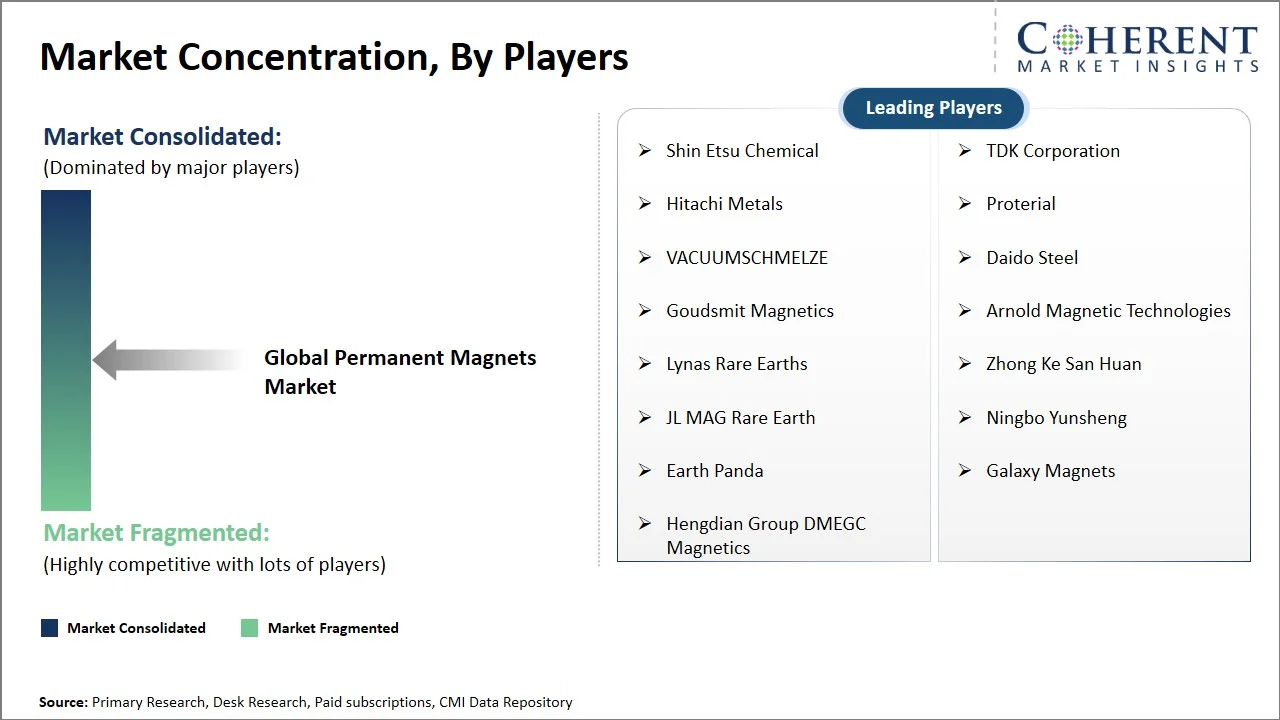
The global permanent magnets market is moderately consolidated at the high-performance end but remains fragmented across ferrite, bonded, specialty, and regional supply categories. Competition centers on magnetic performance, consistency, qualification capability, manufacturing scale, intellectual property, and delivery reliability. Large integrated producers compete for global OEM programs, while regional and specialist suppliers retain strong positions through customization, rapid engineering support, niche grades, and close customer relationships.
Key focus areas include
- Magnetic performance and consistency: Suppliers compete on coercivity, remanence, thermal stability, demagnetization resistance, dimensional tolerance, and batch-to-batch repeatability.
- Application qualification capability: Automotive, aerospace, medical, and industrial customers favor suppliers capable of supporting validation, failure analysis, documentation, and long product qualification cycles.
- Manufacturing capacity and delivery reliability: Available capacity, lead-time predictability, raw-material access, and production redundancy increasingly influence sourcing awards alongside unit pricing.
- Intellectual property and processing know-how: Proprietary compositions, shaping methods, magnetization techniques, coatings, and manufacturing controls provide defensible differentiation in higher-value applications.
- Customization and engineered assemblies: Specialist suppliers can compete effectively by supplying machined magnets, rotor components, magnetic circuits, assemblies, and application-specific configurations rather than standard catalog products.
- Total cost of ownership: Buyers increasingly assess machining yield, assembly complexity, durability, operating efficiency, failure risk, and replacement cost instead of evaluating only magnet purchase price.
- Technical support and customer proximity: Early design involvement, rapid prototyping, local engineering support, and responsive problem-solving improve supplier retention in programs where changing an approved magnet creates requalification costs.
Market Report Scope
Permanent Magnets Market Report Coverage
| Report Coverage | Details | ||
|---|---|---|---|
| Base Year: | 2025 | Market Size in 2026: | USD 28.4 Bn |
| Historical Data for: | 2020 To 2024 | Forecast Period: | 2026 To 2033 |
| Forecast Period 2026 to 2033 CAGR: | 7.8% | 2033 Value Projection: | USD 48.05 Bn |
| Geographies covered: |
| ||
| Segments covered: |
| ||
| Companies covered: | Shin Etsu Chemical, TDK Corporation, Hitachi Metals, Proterial, VACUUMSCHMELZE, Daido Steel, Goudsmit Magnetics, Arnold Magnetic Technologies, Lynas Rare Earths, Zhong Ke San Huan, JL MAG Rare Earth, Ningbo Yunsheng, Earth Panda, Galaxy Magnets, Hengdian Group DMEGC Magnetics | ||
| Growth Drivers: |
| ||
| Restraints & Challenges: |
| ||
Analyst Opinion (Expert Opinion)
- The global permanent magnets market leadership is expected to shift toward suppliers with specification-critical capabilities rather than those competing only on volume. Customers will increasingly prioritize consistent magnetic performance, precision manufacturing, qualification support, engineering collaboration, and reliable supply execution, strengthening the position of suppliers integrated into OEM development programs.
- Diversification in motor architectures could reshape magnet consumption patterns despite continued electrification growth. Alternatives such as ferrite-based designs, reluctance motors, and hybrid systems allow OEMs to balance cost, efficiency, material availability, and performance, making application engineering and design-in capabilities increasingly important for magnet suppliers.
- Market participants should focus on high-temperature magnets, advanced manufacturing, qualification expertise, secure raw-material sourcing, and multi-region supply chains. Companies should prioritize automotive, robotics, aerospace, and industrial automation applications where technical differentiation protects margins while avoiding excessive investment in undifferentiated capacity exposed to pricing pressure and technology substitutions.
Speak to the analyst
Want personalized insights?
Take the findings above to one of our principal consultants, or have the report rebuilt around the segments, geographies and competitors you actually track.
Market Segmentation
- Magnet Type Insights (Revenue, USD Bn, 2021 - 2033)
- Neodymium Iron Boron (NdFeB) Magnets
- Ferrite Magnets
- Samarium Cobalt (SmCo) Magnets
- Alnico Magnets
- Others
- Manufacturing Process Insights (Revenue, USD Bn, 2021 - 2033)
- Sintered Magnets
- Bonded Magnets
- Cast Magnets
- Others
- Application Insights (Revenue, USD Bn, 2021 - 2033)
- Automotive and Electric Vehicles
- Consumer Electronics
- Industrial Machinery
- Renewable Energy
- Medical Devices
- Others
- End Use Industry Insights (Revenue, USD Bn, 2021 - 2033)
- Automotive
- Electronics and Electrical
- Industrial Equipment
- Energy and Power
- Others
- Distribution Channel Insights (Revenue, USD Bn, 2021 - 2033)
- Direct Sales
- Indirect Sales
- Regional Insights (Revenue, USD Bn, 2021 - 2033)
- North America
- U.S.
- Canada
- Latin America
- Brazil
- Argentina
- Mexico
- Rest of Latin America
- Europe
- Germany
- U.K.
- Spain
- France
- Italy
- Russia
- Rest of Europe
- Asia Pacific
- China
- India
- Japan
- Australia
- South Korea
- ASEAN
- Rest of Asia Pacific
- Middle East
- GCC Countries
- Israel
- Rest of Middle East
- Africa
- South Africa
- North Africa
- Central Africa
- North America
- Key Players Insights
- Shin Etsu Chemical
- TDK Corporation
- Hitachi Metals
- Proterial
- VACUUMSCHMELZE
- Daido Steel
- Goudsmit Magnetics
- Arnold Magnetic Technologies
- Lynas Rare Earths
- Zhong Ke San Huan
- JL MAG Rare Earth
- Ningbo Yunsheng
- Earth Panda
- Galaxy Magnets
- Hengdian Group DMEGC Magnetics
Sources
Primary Research Interviews
- Permanent magnet manufacturers, rare-earth magnet producers, ferrite magnet manufacturers, bonded magnet producers, magnetic assembly suppliers, distributors, and component manufacturers
- Materials scientists, magnetic engineers, procurement professionals, motor designers, production managers, sourcing executives, OEM representatives, and industry consultants
Stakeholders
- NdFeB, ferrite, samarium cobalt, alnico, bonded magnet, and specialty permanent magnet manufacturers
- Rare-earth miners, oxide processors, alloy producers, magnetic powder suppliers, coating suppliers, equipment manufacturers, distributors, and magnetic assembly companies
- Electric motor manufacturers, automotive OEMs, electronics companies, wind turbine manufacturers, industrial equipment producers, medical device manufacturers, and automation companies
End-use Sectors
- Automotive and electric vehicle traction motors, auxiliary motors, sensors, actuators, and electronic systems
- Consumer electronics, home appliances, speakers, data-storage equipment, and compact electronic devices
- Industrial machinery, robotics, servo motors, factory automation, pumps, compressors, and motion-control equipment
- Renewable energy applications including wind turbine generators and other high-efficiency electrical systems
- Medical devices, aerospace, defense, instrumentation, and specialized magnetic assemblies
Regulatory and Industry Bodies
- U.S. Department of Energy (DOE)
- U.S. Geological Survey (USGS)
- European Commission and European Raw Materials Alliance (ERMA)
- International Energy Agency (IEA)
- Ministry of Economy, Trade and Industry (METI), Japan
- Ministry of Industry and Information Technology (MIIT), China
- National and regional authorities governing critical minerals, rare-earth materials, trade, recycling, and environmental compliance
Databases
- Company annual reports, investor presentations, sustainability reports, and corporate filings
- Rare-earth mining, processing, alloy production, and permanent magnet manufacturing databases
- Global trade databases covering rare-earth materials, magnetic alloys, permanent magnets, and related components
- Automotive production, electric vehicle, wind-energy, electronics, and industrial motor databases
- Patent databases covering magnetic materials, manufacturing processes, coatings, recycling, and magnet technologies
- Product specification, pricing, production capacity, supplier, and competitive intelligence databases
Magazines and Journals
- Journal of Magnetism and Magnetic Materials
- IEEE Transactions on Magnetics
- Rare Metals
- Journal of Alloys and Compounds
- Resources, Conservation & Recycling
- Automotive, electric motor, renewable energy, electronics, advanced materials, and industrial manufacturing publications
Associations
- Rare Earth Industry Association (REIA)
- European Raw Materials Alliance (ERMA)
- International Magnetics Association and magnetic materials industry organizations
- Motor and Motion Association
- National mining and critical-mineral associations
- Automotive, electronics, renewable-energy, electrical equipment, and advanced materials industry associations
Public Domain Sources
- Rare-earth mining, reserves, production, processing, and supply-chain developments
- Permanent magnet manufacturing capacity and localization initiatives
- Electric vehicle production and permanent-magnet motor adoption trends
- Wind turbine installations and permanent-magnet generator developments
- Robotics, industrial automation, electronics, and high-efficiency motor adoption
- Rare-earth recycling, magnet recovery, material substitution, and circular-economy developments
- Trade restrictions, tariffs, export controls, and critical-mineral security initiatives
Key Standards and Regulations
- EU Critical Raw Materials Act requirements affecting strategic raw materials and permanent magnets
- REACH requirements governing chemicals and materials used in magnet manufacturing and coatings
- RoHS requirements applicable to electrical and electronic equipment containing magnetic components
- ISO and IEC standards applicable to permanent magnet materials, electrical machines, motors, and magnetic measurement
- ASTM standards covering magnetic material characterization and testing where applicable
- Environmental, occupational safety, waste-management, and recycling requirements for rare-earth processing and magnet manufacturing
- International customs, export-control, tariff, and import requirements covering rare-earth materials and permanent magnets
Proprietary Elements
- CMI Data Analytics Tool, proprietary CMI repository containing 10+ years of permanent magnets, rare-earth materials, automotive, electric vehicles, electronics, renewable energy, industrial machinery, advanced materials, and critical-mineral market intelligence
Get access to 250+ pages report
Every segment, forecast, competitor profile and data table behind the analysis above — available for instant download.
- ESOMAR Member
- ISO 9001:2015 Certified
- D-U-N-S Registered
- GDPR & CCPA Compliant
Missing comfort of reading report in your local language? Find your preferred language:
Frequently Asked Questions
The global permanent magnets market is estimated to be valued at USD 28.4 billion in 2026 and is expected to reach USD 48.05 billion by 2033.
The supply chain is shifting toward localized production, diversified rare-earth sourcing, recycling, and long-term supplier agreements to improve material security and supply reliability.
Advanced sintering, bonded magnet manufacturing, improved coating technologies, precision magnetization, rare-earth reduction techniques, and magnet recycling are influencing product performance and manufacturing efficiency.
Major opportunities include domestic magnet manufacturing, rare-earth recycling, high-performance motor applications, robotics, industrial automation, energy-efficient equipment, and development of alternative magnetic materials.
Companies should evaluate raw-material access, manufacturing capabilities, customer qualification requirements, technology expertise, supply-chain localization, product performance standards, and long-term relationships with automotive, electronics, energy, and industrial customers.
The CAGR of global permanent magnets market is projected to be 7.8% from 2026 to 2033.
In terms of magnet type, neodymium iron Boron (NdFeB) magnets are estimated to dominate the market revenue share in 2026.