

Global Pool Alarms Market Size and Forecast – 2026 To 2033
The global pool alarms market is expected to grow from USD 76.5 Mn in 2026 to USD 92.3 Mn by 2033, registering a compound annual growth rate (CAGR) of 2.4% from 2026 to 2033. The global pool alarms market is driven by increasing introduction of stronger pool safety requirements. On March 19, 2025, SwamCam launched its Dual Camera System with expanded OverWatchAI drowning-prevention coverage.
Key Takeaways of the Global Pool Alarms Market
- The Wall Mounted Pool Alarms segment is expected to account for 39.0 % of the global pool alarms market share in 2026. Rising adoption of electronic safety equipment is driving the growth of the segment. On August 28, 2025, SwimEye introduced Version 5, representing a major upgrade to its underwater monitoring platform.
- The Residential segment is estimated to capture 41.0 % of the market share in 2026. Increasing smart home adoption is majorly driving the growth of the segment. In May 2025, PoolAlarm system from Poolguard joined the Z-Wave Alliance smart-home ecosystem.
- The Specialty Pool Stores segment is estimated to capture 33.0 % of the market share in 2026. Growing demand for remote safety monitoring is driving the growth of the segment. On march 31, 2026, Active Monash reported real-time alerts delivered directly to lifeguards through smartwatches and workstation screens.
- North America is expected to dominate the pool alarms market in 2026 with a market share of 57.0 %. Growing adoption of AI assisted detection in North America is driving the growth of the regional market. On July 7, 2026, the YMCA introduced AngelEye at its Green Hills facility in Tennessee. The system uses cameras and underwater sensors to identify distressed swimmers.
- Asia Pacific is expected to account for 18.0 % share in 2026. Growing deployment of wireless pool monitoring systems in Asia Pacific is driving the growth of the regional market. On May 26, 2026, Poolwerx and Intellihub launched the Pooled Gen 2 Controller national pilot. The retrofit system continuously monitors pool health and equipment performance.
Segmental Insights
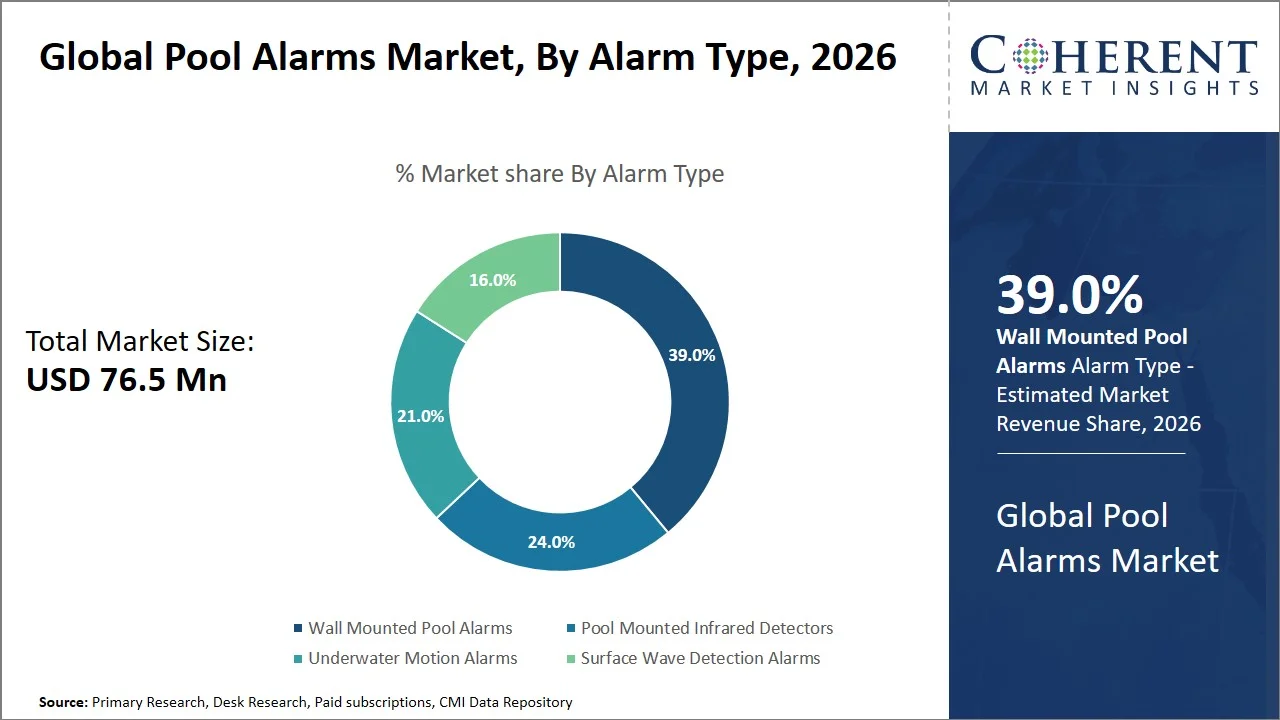
Why Does Wall Mounted Pool Alarms Dominate the Global Pool Alarms Market?
The wall mounted pool alarms segment is expected to account for 39.0% of the global pool alarms market share in 2026. Wall mounted pool alarms are a practical safety option since they can monitor pool access points all the time. High placement allows them to monitor activity around pool boundaries without directly underwater placement of sensors. The design can simplify installation and limit susceptibility to water related equipment damage. The approach also supports perimeter detection, which is recognized within ASTM International pool alarm classifications. For instance, Quimipool’s current swimming pool alarm portfolio includes immersion alarms designed for direct water disturbance detection. The company explains that these alarms can either float on the pool surface or be installed on the pool wall. They detect sudden water movements, including splashes or waves caused by accidental falls.
- Current Industry Events of 2026
- Market Size Estimation
- Regional Breakdown
- Competitive Landscape
- Customer Intelligence
- Segmental Analysis
- Pricing Analysis
- Key Market Drivers, Challenges & Future Trends
- Customized Insights Section
Why is Residential the Most Widespread Application?
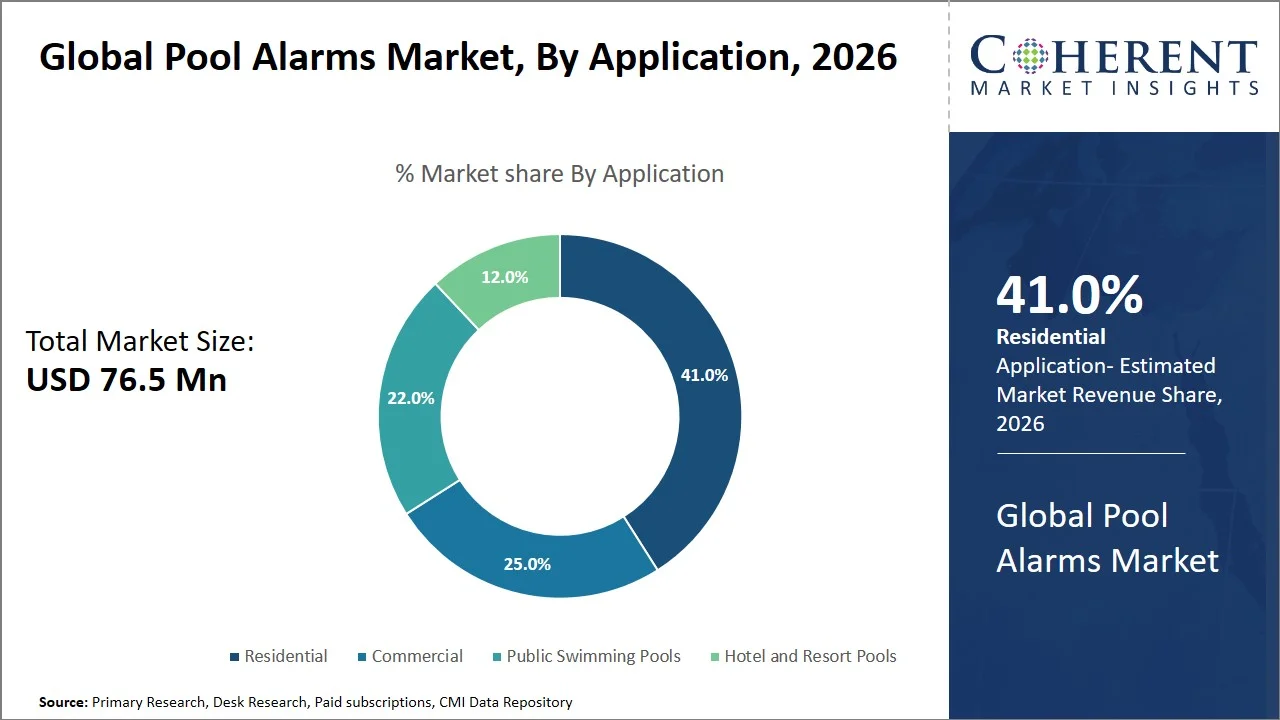
The residential segment is expected to account for 41.0% of the global pool alarms market share in 2026. Residential pools demand a greater safety monitoring because they are accessible without supervision in the household. More than 70% of kid pool drowning deaths from 2021-2023 happened in household pools, according to the U S Consumer Product Safety Commission. Supervision gaps can lead to young children being unexpectedly at residential pools. Pool alarms consequently give an additional level of protection together with fencing, covers and supervision. This safety regulation promotes the widespread use of alarms by home pool owners. On May 5, 2025, SwamCam, a leader in the AI-powered pool alarm industry, announced it has teamed with Olympic gold medalist Lilly King on a water safety and drowning prevention awareness campaign.
Specialty Pool Stores Dominates the Global Pool Alarms Market
The specialty pool stores segment is expected to account for 33.0% of the global pool alarms market share in 2026. Specialty pool retailers sell pool safety goods to customers and provide installation and equipment support advice. Generally, pool alarms must be installed in the right area and be suitable for the type of pool. Specialty vendors can thus help consumers select the right types of alarms for unique pool needs. Manufacturers like Poolguard have special dealer networks of pool supply dealers and builders. It is a distinctive atmosphere of purchase that helps to create more visibility of the product and customers' confidence among pool owners. In April 2025, Poolwerx either extended its specialty pool retail network in the U.S. or strengthened its franchise model. Its storefronts and mobile service trucks were located throughout the United States, Australia and New Zealand. Its model is a mix of retail sales and professional pool servicing. The framework will allow customers access to equipment selection, maintenance advice and installation help.
Current Events and their Impact
Current Events | Description and its Impact |
U.S. - Virginia Graeme Baker Pool And Spa Safety Act |
|
U.S. - Pool Safely Grant Program |
|
Pool Alarms Market Dynamics
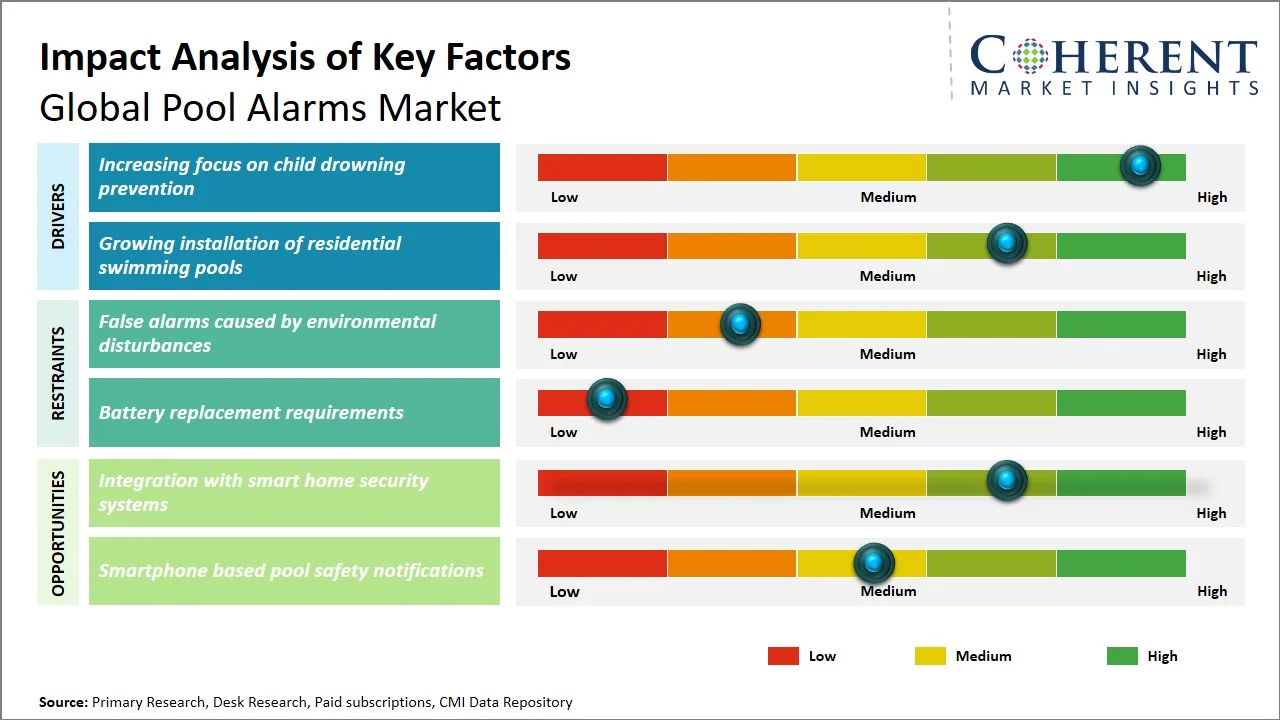
Market Drivers
- Increasing focus on child drowning prevention: Child drowning prevention has become an important goal for governments, safety organizations and home pool owners. Child drowning deaths in pools and spas averaged 309 yearly from 2021-2023, according to the U.S. Consumer Product Safety Commission. The more alert people are, the more likely they are to utilize supervision along with barriers, covers and pool alarms in homes. Another alert comes from pool sirens when youngsters unexpectedly reach restricted pool sections. Increased emphasis on safety will help encourage continuing use of pool alarm systems by homeowners. On January 30, 2026, Pentair Pool donated USD 100,000 to the Step into Swim drowning prevention campaign. The fund will assist swim classes and water safety education for children. The donation is part of Pentair’s corporate-wide commitment to drowning prevention.
- Growing installation of residential swimming pools: The growing desire for private outdoor enjoyment and home improvement is resulting in an increase in residential swimming pool installations. Building new pools adds to the pool of properties that need to be made safe. Safety regulations are especially crucial where pools are accessible to children and guests. Pool owners are turning to alarms in addition to fences, coverings, gates and other safeguards. This growing installed pool base generates more potential for makers of residential pool alarms. On August 8, 2025, Premier Franchise Management announced 17 new franchise signings. Several franchises focused specifically on swimming pool construction. The expansion increased local capacity for residential pool design and installation across U.S. markets.
Emerging Trends
- Smartphone Connected Pool Alarms: Pool alarms are increasingly being connected to wireless networks, allowing homeowners to receive immediate intrusion alerts on smartphones and monitor safety conditions remotely.
- Integration With Smart Home Systems: Pool alarm manufacturers are working on alarms that can be integrated into smart home systems. This enables automated notifications, security routines, and central monitoring with connected cameras and door sensors.
- Artificial Intelligence Enabled Detection: Artificial Intelligence is emerging in pool safety monitoring for better detection of human activity and reduced false alarms due to pets, weather, and surface disturbances.
- Multilayered Pool Safety Solutions: More pool owners are combining alarms with fencing, safety covers, surveillance camera systems and automatic gates for layered protection from accidental pool access and drowning incidents involving children.
Regional Insights
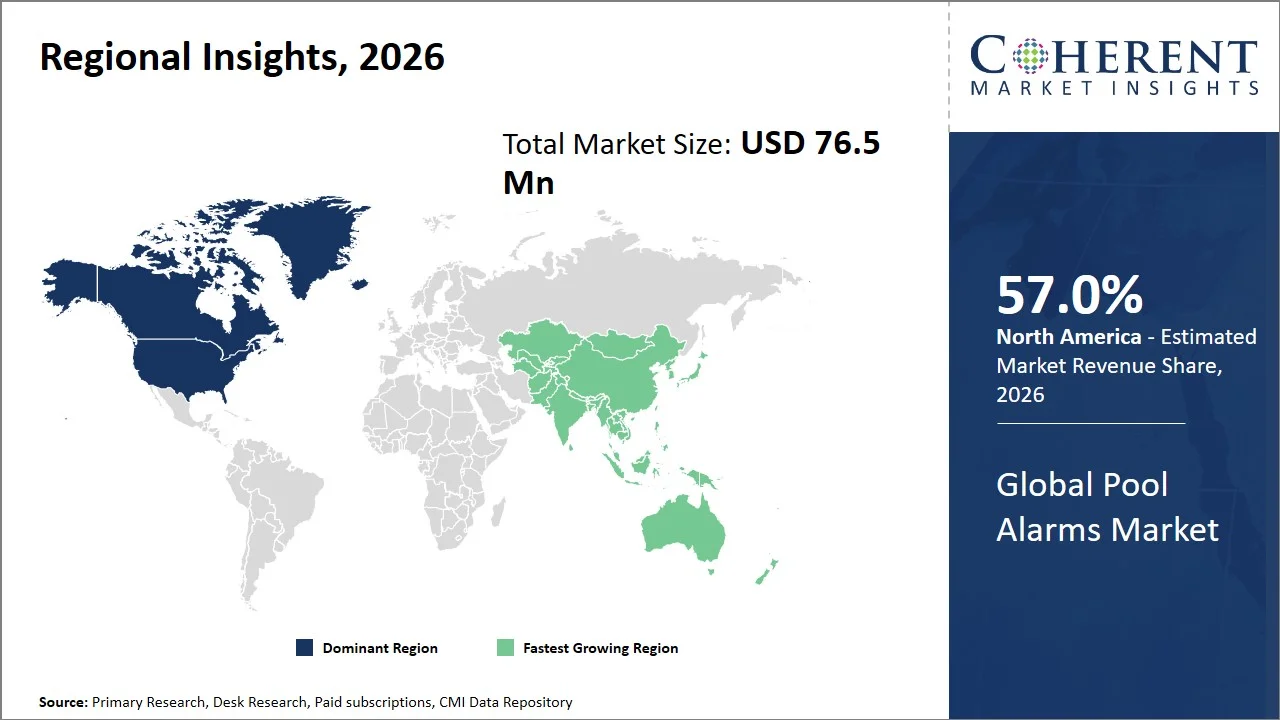
Why is North America a Strong Market for Pool Alarms?
North America is expected to account for a market share of 57.0% in 2026. North American demand is heavily influenced by household drowning prevention standards and existing pool safety infrastructure. The U.S. Consumer Product Safety Commission reported 376 child pool-related fatalities annually in 2021-2023. Almost 80% were in youngsters under 5 years of age and more than 70% occurred in residential settings. Canada also identifies children aged one to four as particularly vulnerable around backyard pools. Canadian recommendations are fence, self-closing gates, lockable access and safety coverings. These stacked requirements have created a strong climate for the development of supplemental alarms. The regional opportunity is further supported by established consumer safety enforcement and extensive residential pool usage.
Why Does Asia Pacific Pool Alarms Market Exhibit High Growth?
Asia Pacific is expected to register the fastest growth with a CAGR of 2.8% over the forecast period. The region is projected to account for 18.0% of the global pool alarms market in 2026. Asia Pacific offers strong potential because drowning prevention increasingly combines supervision with technology-based monitoring. The World Health Organization reports that more than half of global drowning deaths occur across Southeast Asia and the Western Pacific regions. China is working on technology solutions for public swimming facilities. A nationwide standard is proposed for computer-vision systems that detect drowning. It defines the alarm triggering time within 15 seconds and detection rates above 80% under certain illumination conditions. Meanwhile, the Chinese authorities are also raising the standards for the safety of swimming facilities in terms of equipment, people and safety management. These developments encourage sophisticated detection systems beyond conventional supervision practices.
Global Pool Alarms Market Outlook for Key Countries
Why is U.S. Emerging as a Major Hub in the Pool Alarms Market?
U.S. pool alarms market is driven by domestic kid drowning prevention and federal safety awareness. In 2023, the U.S. Consumer Product Safety Commission reported 379 drowning deaths of children due to pools. Deaths were up 6% from the year before. More than 70% of deaths in 2021-2023 were in domestic settings. Almost 80% of annual deaths were children younger than five years of age. The U.S. Consumer Product Safety Commission also lists door alarms, pool alarms, obstacles and safety coverings as levels of protection. These guidelines support demand for alarms that detect unanticipated pool entry. Summer concentration of accidents bolsters seasonal buying and replacement activities.
Is China the Next Growth Engine for the Pool Alarms Market?
China is developing a distinct opportunity around technology-enabled drowning detection in public swimming facilities. The national standards system is developing requirements for computer-vision drowning detection systems. Proposed requirements include alarm triggering within 15 seconds and detection rates above 80%. The system framework also addresses camera positioning, lighting, alarm transmission, and performance testing. Separately, China's public swimming-place standards address qualified lifeguards, facility conditions, equipment, and safety management. Government-backed projects are also blending human supervision with intelligent monitoring systems. Such advancements promote integration of visual detection, automatic alerts and centralized monitoring of the facility. Such technology-focused safety policies create opportunities for advanced pool alarm suppliers.
Australia Pool Alarms Market Analysis and Trends
Australia presents strong demand because backyard pools remain a significant child drowning risk. Royal Life Saving Australia reported 357 drowning deaths during 2024–2025. Swimming pools accounted for 35 deaths, with 68% occurring in backyard pools. Over the previous decade, 183 children aged zero to four drowned nationally. Swimming pools accounted for 65% of those child deaths. Royal Life Saving Australia also reported that most toddler incidents involved unsupervised access through improperly closed or propped-open gates. The findings support a need for additional access alerts in addition to compliant fence. Pool alarms consequently add to Australia’s strong emphasis on monitoring, limited access and working pool barriers.
France Pool Alarms Market Analysis and Trends
France is experiencing stronger safety pressure because swimming activity rises sharply during heatwaves. Santé publique France recorded 1,418 drowning incidents during June–September 2025. Fatal outcomes reached 409 cases during that period. Drowning incidents increased 14% compared with summer 2024. During an orange or red heatwave alert, incidences rose 135% over June 19 - July 8. Children under age 6 made up 27% of summer 2025 drowning cases. Private pools were of special relevance for minors in the monitoring results. Such factors increase demand for residential pool protection especially during the hotter times. Pool alarms can provide additional alerts when supervision is interrupted around private swimming facilities.
Canada Pool Alarms Market Analysis and Trends
Canada's opportunity is strongly connected with backyard pool access risks among young children. Health Canada identifies children aged one to four as particularly vulnerable to drowning. Government guidance recommends fencing at least 1.2 meters high around pools. It also suggests self-closing gates and self-latching gates with latches that children cannot reach. Canadian surveillance from participating emergency centers identified 1,109 drowning-related cases between 2011 and 2023. Swimming pools were the source of 62.5% of incidents in warmer months. Residential and public pools were the sites of 56.3% of reported drownings. In 2025, around 266,000 above-ground pools were recalled, revealing unforeseen risks of child access.
Global Pool Alarms Market - Bluetooth, Wi-Fi, Radio-Frequency, and Cellular Connectivity Adoption (2025)
Connectivity type | Estimated adoption share | Primary use case |
Wi-Fi | 42% | Smartphone alerts and smart-home integration |
Radio-Frequency | 31% | Pool-to-home receiver communication |
Bluetooth | 18% | Local setup and smartphone connectivity |
Cellular | 9% | Remote monitoring without local Wi-Fi |
How is Integration with Smart Home Security Systems Creating New Growth Opportunities in the Pool Alarms Market?
Smart home security system integration is generating new prospects for pool alarms to become connected household safety devices vs independent equipment. Pool Guardian already integrates with Home Assistant and Samsung SmartThings, so pool conditions and warnings may be included into other connected-home operations. BCone, from Lifebuoy, combines pool detection, an indoor alarm and smartphone notification for simultaneous alerting at multiple locations. This connection allows manufacturers to access homes already using connected security products without needing separate monitoring interfaces. It also allows future connection with cameras, door sensors, gate alarms and automatic emergency notification protocols. For example, Aridea Solutions continued to develop its Wi-Fi connected pool monitoring system for smart-home applications during 2025. The system identifies probable falls and delivers related alerts to homes. The fact that it’s in the smart home category points to a convergence of pool monitoring with home automation.
Market Players, Key Development, and Competitive Landscape
Key Developments
- On August 12, 2026, Brisbane City Council announced a 12-month Lynxight trial at Runcorn Aquatic Centre and Yeronga Memorial Pool in Brisbane, Australia. Artificial intelligence cameras will identify swimmer distress and alert lifeguards through dedicated smartwatches.
- On March 19, 2025, Fluidra invested in Lynxight, the market leader in AI-powered safety solutions for commercial pools. The company believes that pools should be a sanctuary of well-being, joy, and safety and therefore investing in the next-generation of safety systems is a fundamental part of that vision.
Competitive Landscape
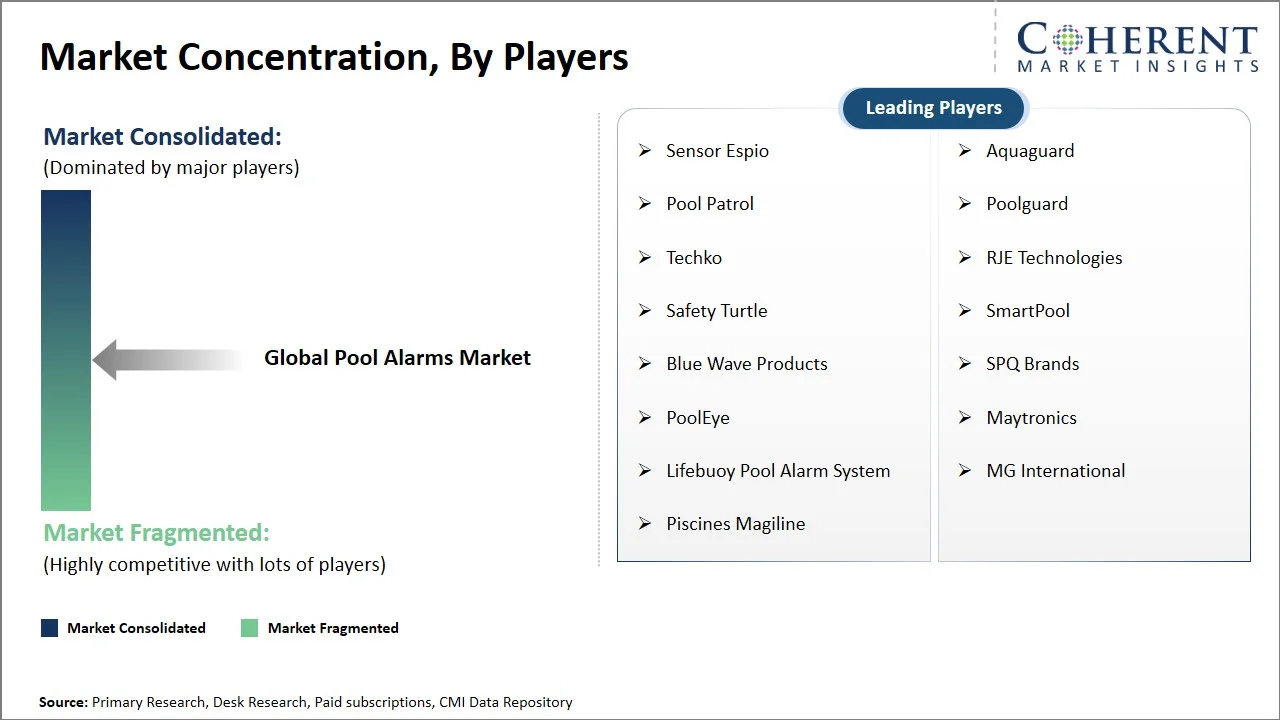
The competitive landscape is led by specialized manufacturers and diversified pool technology companies with distinct product strategies. Poolguard focuses on dedicated residential safety products, offering pool, floating, door, and gate alarms. Its PGRM-2 uses sensing technology designed to reduce false alarms from wind, rain, and floating objects. Its products meet specified state alarm codes, including New York, California, Connecticut, Florida, and Tennessee. Maytronics has expanded beyond conventional alarms into integrated pool safety, offering Sensor Espio, Precisio, and Aqualarm. The company also markets Poseidon, which combines above-water and underwater cameras with artificial intelligence for public-pool drowning detection. Lifebuoy is emphasizing connected residential protection through BCone, combining pool and indoor sirens with smartphone alerts and Amazon Alexa control.
Market Report Scope
Report Coverage
| Report Coverage | Details | ||
|---|---|---|---|
| Base Year: | 2025 | Market Size in 2026: | USD 76.5 Mn |
| Historical Data for: | 2020 To 2024 | Forecast Period: | 2026 To 2033 |
| Forecast Period 2026 to 2033 CAGR: | 2.4% | 2033 Value Projection: | USD 92.3 Mn |
| Geographies covered: |
| ||
| Segments covered: |
| ||
| Companies covered: | Sensor Espio, Aquaguard, Pool Patrol, Poolguard, Techko, RJE Technologies, Safety Turtle, SmartPool, Blue Wave Products, SPQ Brands, PoolEye, Maytronics, Lifebuoy Pool Alarm System, MG International, Piscines Magiline | ||
| Growth Drivers: |
| ||
| Restraints & Challenges: |
| ||
Analyst Opinion (Expert Opinion)
- The industry's future is expected to shift toward connected and layered pool protection. Standalone alarms will remain important for affordability and simple installation. However, connected systems can combine pool entry detection, indoor alerts, smartphones, and home automation. This is the trend that Lifebuoy’s BCone is already showing, with dual sirens, smartphone alerts and Alexa management.
- The main opportunity is projected to be in connected residential alarms, especially in the U.S., Australia and France. These markets have high rates of home pool ownership and are also very conscious of child safety. Public facilities also offer an attractive opportunity for artificial intelligence-based drowning detection. Maytronics’ Poseidon shows the power of merging underwater cameras, overhead cameras and artificial intelligence.
- Players seeking an edge should prioritize false-alarm reduction, rapid alerts, simple installation, and interoperability. Product portfolios should cover pool, gate, and door protection rather than relying on one detection point. Manufacturers should also strengthen dealer networks because Poolguard demonstrates the value of specialized distribution across pool retailers and distributors.
Speak to the analyst
Want personalized insights?
Take the findings above to one of our principal consultants, or have the report rebuilt around the segments, geographies and competitors you actually track.
Sources
Primary Research Interviews
- Pool Safety Equipment Manufacturers
- Swimming Pool Contractors & Installers
- Residential & Commercial Pool Owners
- Safety Regulatory Compliance Officers
Magazines
- Pool & Spa News
- Aquatics International
- Swimming Pool & Spa International
- Service Industry News
Journals
- Journal of Safety Research
- International Journal of Injury Control and Safety Promotion
- Journal of Environmental Health
Associations
- Association of Pool & Spa Professionals (APSP)
- Pool & Hot Tub Alliance (PHTA)
- National Swimming Pool Foundation (NSPF)
- World Aquatic Health Conference (WAHC)
Public Domain Sources
- U.S. Consumer Product Safety Commission (CPSC)
- World Health Organization (WHO) – Drowning Prevention Reports
- U.S. Centers for Disease Control and Prevention (CDC)
- European Pool & Spa Association (EPSA) Public Reports
Proprietary Elements
- CMI Data Analytics Tool
- Proprietary CMI Existing Repository of Information for the Last 10 Years
Get access to 250+ pages report
Every segment, forecast, competitor profile and data table behind the analysis above — available for instant download.
- ESOMAR Member
- ISO 9001:2015 Certified
- D-U-N-S Registered
- GDPR & CCPA Compliant
Missing comfort of reading report in your local language? Find your preferred language:
Frequently Asked Questions
A pool alarm detects unexpected pool entry and activates an audible or connected warning.
They can provide an additional safety layer but cannot replace supervision, fencing, or secure gates.
Yes, several alarm designs are specifically developed for above ground pool configurations.
Certain systems can detect smaller disturbances, although performance varies between products.
Strong wind, rain, waves, pets, and floating objects can trigger some detection technologies.
Manufacturers use filtering algorithms, adjustable sensitivity, and detection thresholds to distinguish relevant disturbances.
The global pool alarms market is expected to stand at USD 76.5 Mn in 2026 and is expected to reach USD 92.3 Mn by 2033.