

Global PPS Busbar Insulation Market Size and Forecast – 2026 To 2033
The global PPS busbar insulation market is estimated to be valued at USD 59.8 Mn in 2026 and is expected to reach USD 177.3 Mn by 2033, growing at a compound annual growth rate (CAGR) of 16.80% from 2026 to 2033. The market is growing due to the demand for heat resistant, flame retardant and electrically insulating materials used in high voltage busbar assemblies for electric vehicles, industrial automation and power distribution systems. Manufacturers are concentrating on PPS formulations that offer dielectric reliability, dimensional stability and resistance to repeated thermal cycling for compact electrical architectures.
In October 2026, Würth Elektronik ICS introduced its PowerBusbar PF technology which is designed to simplify the distribution of higher currents in compact electronic assemblies for industrial automation, electric mobility, energy storage and AI data centers. While this development doesn't explicitly confirm the adoption of PPS, it points to a growing demand for advanced busbar designs, which could create potential opportunities for specialized PPS insulation components.
Key Takeaways of the Global PPS Busbar Insulation Market
- Injection and Overmolded PPS Insulation is expected to hold 52.6% share of the global PPS busbar insulation market in 2026 and witness a CAGR of 17.5% from 2026 to 2033. Integrated encapsulation protects complex copper conductors and eliminates the need for a separate insulation assembly step. In August 2023, Celanese introduced Fortron PPS grades for metal overmolding, highlighting electric vehicle busbars as one of the applications.
- The Standard Glass-Fiber Reinforced PPS is expected to gain 41.7% share in global PPS busbar insulation market and is expected to register around 17.2% CAGR from 2026 to 2033. Its thermal stability and stiffness provide for precise molding around conductive inserts without loss of structural integrity. Polyplastics launched its glass-filled DURAFIDE PPS 1140HS6 in May 2024 for electric vehicle busbars, saying it offers thermal shock resistance without the need for impact modifiers.
- EV Battery Packs and Powertrains are expected to witness CAGR of around during 2026-2033 and are expected to hold 62.5% share of the global PPS busbar insulation market in 2026. Insulation is required for high voltage electrical routing to survive continu18.4% ous heat in tightly packed battery assemblies. October 2025: Syensqo introduces Ryton PPS XE3500 Orange for extruded battery busbars with high voltage reliability and heat stability.
- Asia Pacific is anticipated to record a CAGR of 15.8% during 2026-2033, which is equivalent to a 55.3% share of the global PPS busbar insulation market in 2026. The localized electric vehicle and battery manufacturing network allows the local procurement of qualified high-voltage insulation components. In May 2026, the International Energy Agency reported that China produced nearly seventy-five percent of the world’s electric cars in 2025.
- Europe is expected to exhibit a CAGR of 20.5% during the period 2026-2033 and reach a market share of 21.1% in global PPS busbar insulation market. Material qualification support and reduced lead times for procurement of specialized electrical insulation are becoming more important to regional automakers. Envalior announced in January 2025 that it would invest in a PPS compounding facility in Uerdingen, Germany, to strengthen its local supply capabilities.
Segmental Insights
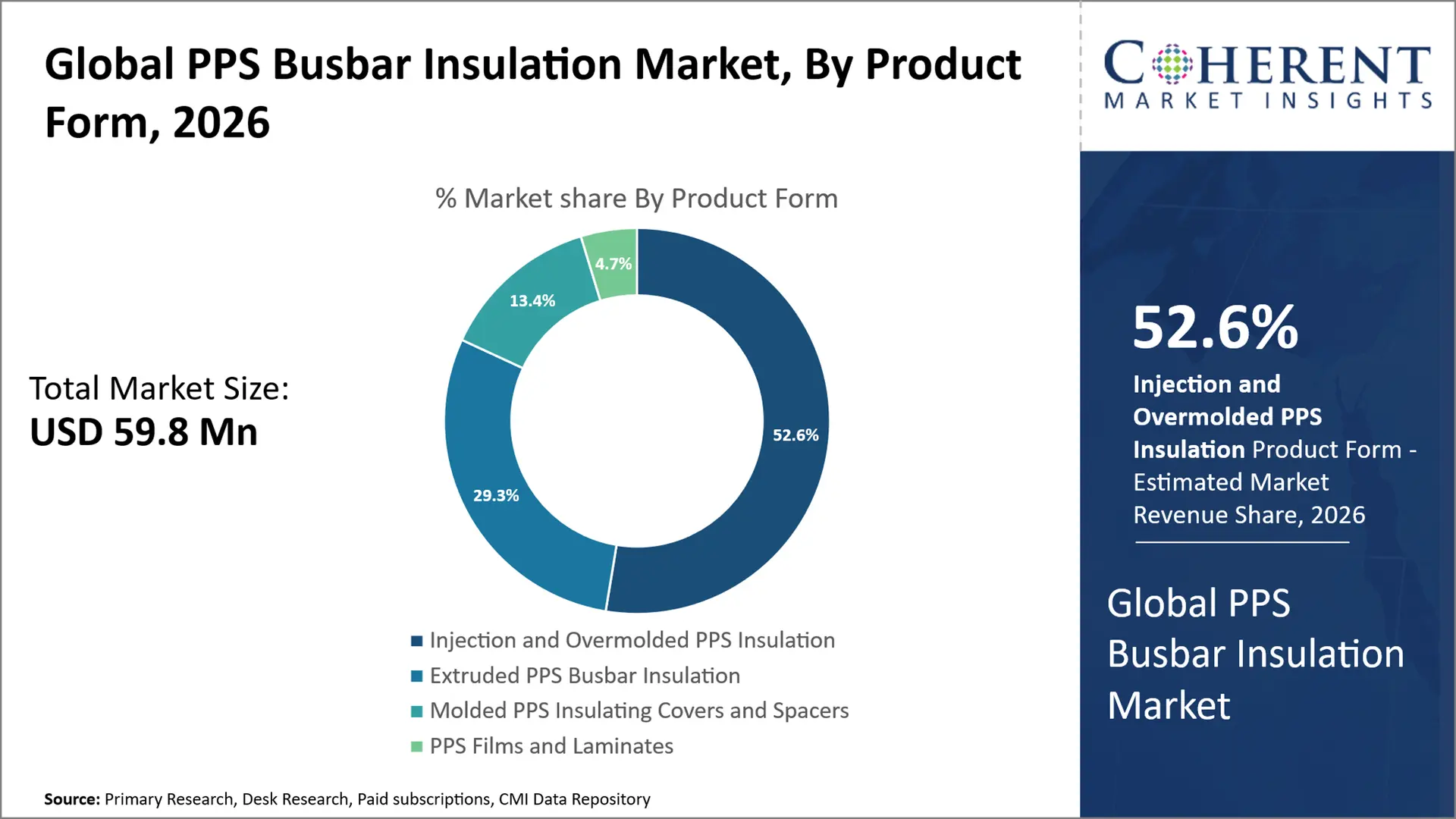
Why Do Injection and Overmolded PPS Insulation Dominate the Global PPS Busbar Insulation Market?
In terms of product form, Injection and Overmolded PPS Insulation is expected to hold 52.6% of the global PPS busbar insulation market in 2026. The commercial advantage is the shaping of dielectric barriers, complex conductor interfaces and locating features, instead of the assembly of several protective parts. Battery junction assemblies and power-control units are useful when the manufacturer can design mounting points and electrical connections into specific component geometries. Repeatable tooling also enables suppliers to provide fully assembled insulative subassemblies. LNP THERMOCOMP OFM compounds based on PPS for high-voltage power modules were introduced by SABIC in July 2026 and integrated busbar brackets were mentioned as a potential application. The development demonstrates the potential of precision-molded PPS components, but commercial use in busbars depends on the application. Production yields, tooling capabilities and design integration will remain key profitability drivers for converters.
- Current Industry Events of 2026
- Market Size Estimation
- Regional Breakdown
- Competitive Landscape
- Customer Intelligence
- Segmental Analysis
- Pricing Analysis
- Key Market Drivers, Challenges & Future Trends
- Customized Insights Section
Why Does Standard Glass-Fiber Reinforced PPS Represent the Largest Resin Formulation Segment in the Global PPS Busbar Insulation Market?
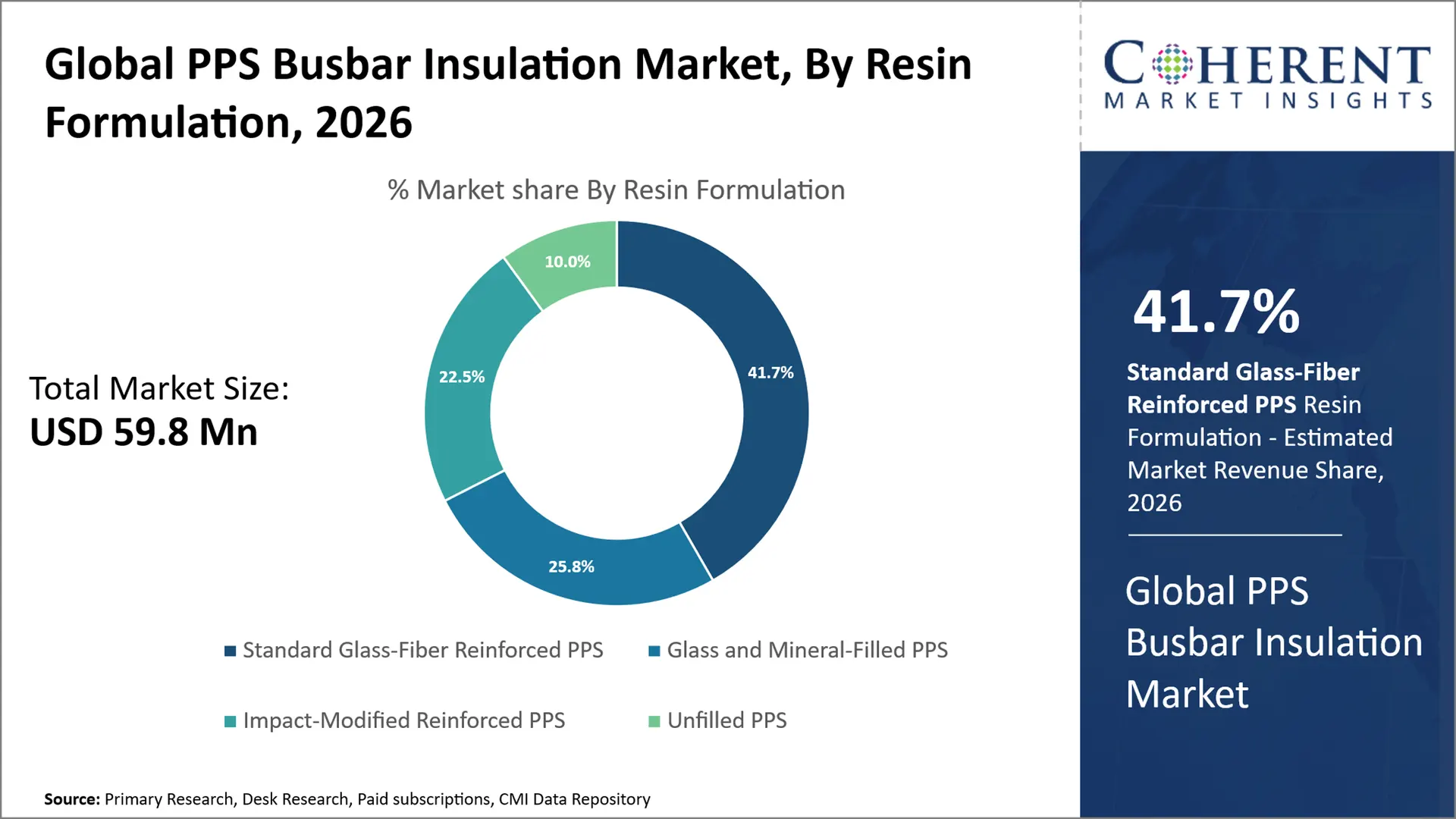
Standard Glass-Fiber Reinforced PPS is projected to capture 41.7% of the global PPS busbar insulation market by resin formulation in 2026. Its position is indicative of the balance between established injection molding processes, thermal stability and mechanical rigidity. Such properties are important for insulating supports and spacers which must maintain dimensional accuracy around electrical conductors. Also, standard formulations provide vendors with a useful basis for qualifying components before specialized modifications are considered. In November 2024 Bond-Laminates GmbH's international published an international patent application, in which PPS was disclosed as a possible thermoplastic matrix material and fiber-reinforced busbar insulation. The patent is related to a proposed composite architecture, and not a commercial standard glass-filled PPS product, but is indicative of the continuing engineering interest in reinforced insulation structures. Suppliers can differentiate themselves through consistent molding performance, reproducible material properties and validated electrical insulation characteristics.
Why Do EV Battery Packs and Powertrains Dominate the Application Segment of the Global PPS Busbar Insulation Market?
By application, EV battery packs and powertrains are anticipated to account for 62.5% of the global PPS busbar insulation market in 2026. Their leadership position demonstrates the range of electrical interconnections required by battery modules, disconnect units, inverters and traction motors. Assemblies require insulation that is compatible with automotive manufacturing, conductors that are accurately routed, and accessible connection points. Consequently, component qualification and manufacturing consistency become important criteria in supplier selection. In September 2025, Aptiv released a detailed description of an automated spot-coating process for electric vehicle busbar contact surfaces, demonstrating how manufacturers are streamlining the production of high-voltage conductors. The development does not specifically identify PPS insulation but it shows the continued investment in automotive busbar engineering. PPS suppliers can benefit by matching material specifications, component designs and manufacturing capabilities with the qualification requirements of Tier-1 suppliers and vehicle manufacturers.
Current Events and their Impact
Current Event | Description and Its Impact |
April 2025 – China’s revised EV battery safety standard |
|
April 2024 – EU Regulation on Alternative Fuels Infrastructure. |
|
E-DRIVE Charging Infrastructure Guidelines Prime Minister of India September 2025 |
|
Global PPS Busbar Insulation Market Dynamics
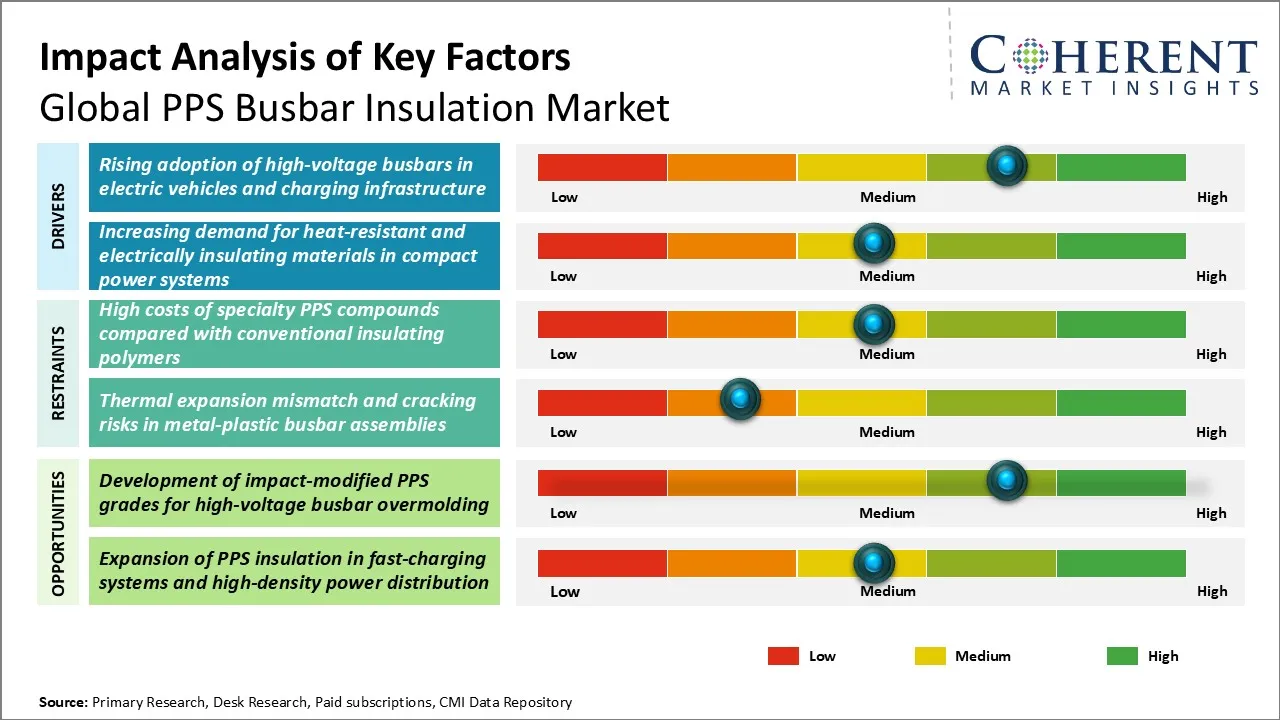
Key Market Drivers
- Rising Adoption of High-Voltage Busbars in Electric Vehicles and Charging Infrastructure: Electric vehicle platforms and high-power charging equipment increasingly require carefully engineered DC power-distribution systems. As current loads increase, there is an increasing need to avoid failure at connection points, to maintain electrical clearances and to insulate conductor joints. This is a chance for PPS insulation manufacturers and busbar converters to offer application-specific components that meet stringent electrical and mechanical specifications. Siemens introduced the SICHARGE FLEX distributed charging system in October 2025, capable of delivering up to 1.68 MW of power. This evolution shows the growing needs of engineering for reliable high current distribution and for the related insulation solutions.
- Increasing Demand for Heat-Resistant and Electrically Insulating Materials in Compact Power Systems: The miniaturization of power-conversion equipment makes it more difficult to maintain insulation integrity, mechanical alignment, and dielectric separation within limited installation spaces. Component manufacturers requiring dimensional precision and dependable electrical properties in demanding operating environments utilize PPS compounds. Power-electronics manufacturers will prefer suppliers that can prove optimized molding characteristics and validated insulation performance. In June 2026, Infineon Technologies announced its EasyPACK S, a compact power-module packaging concept, designed especially for applications such as onboard chargers and AI data center power supplies. This development reflects the current trend toward space-efficient electrical architectures.
Emerging Market Trends
- Shift Toward Hybrid and Application-Specific Busbar Insulation Designs: Busbar manufacturers are combining extruded PPS coverings, molded spacers, and insulating covers to satisfy the electrical protection needs of a range of conductor geometries. This approach enables the design of tailor-made insulation solutions and improves the efficiency in material use and assembly.
Impact: Offering a variety of PPS insulation formats as integrated product solutions helps manufacturers build stronger customer relationships. Suppliers with limited processing capabilities may also have an incentive to diversify their portfolios.
Relevance to Market: product differentiation in industrial power electronics, charging infrastructure and EV battery packs. This allows for the creation of customized PPS components, specifically designed to meet the required electrical and mechanical specifications.
- Greater Emphasis on Traceable Material Performance and Qualification Data: Automotive OEMs and electrical equipment manufacturers are concentrating on traceability of materials, dielectric testing and documented thermal performance. PPS insulation manufacturers will be required to improve quality assurance efforts and maintain proper production documentation.
Impact: Companies with their own testing facilities are better able to vet suppliers and enter into long-term agreements. Smaller converters may have to carry higher compliance costs because of the need for additional documentation and testing.
Relevance to Market: Improve relevance of validated PPS formulations in safety-critical electrical assemblies. It provides an incentive for investment in quality certification, production traceability and application-specific material testing.
Regional Insights
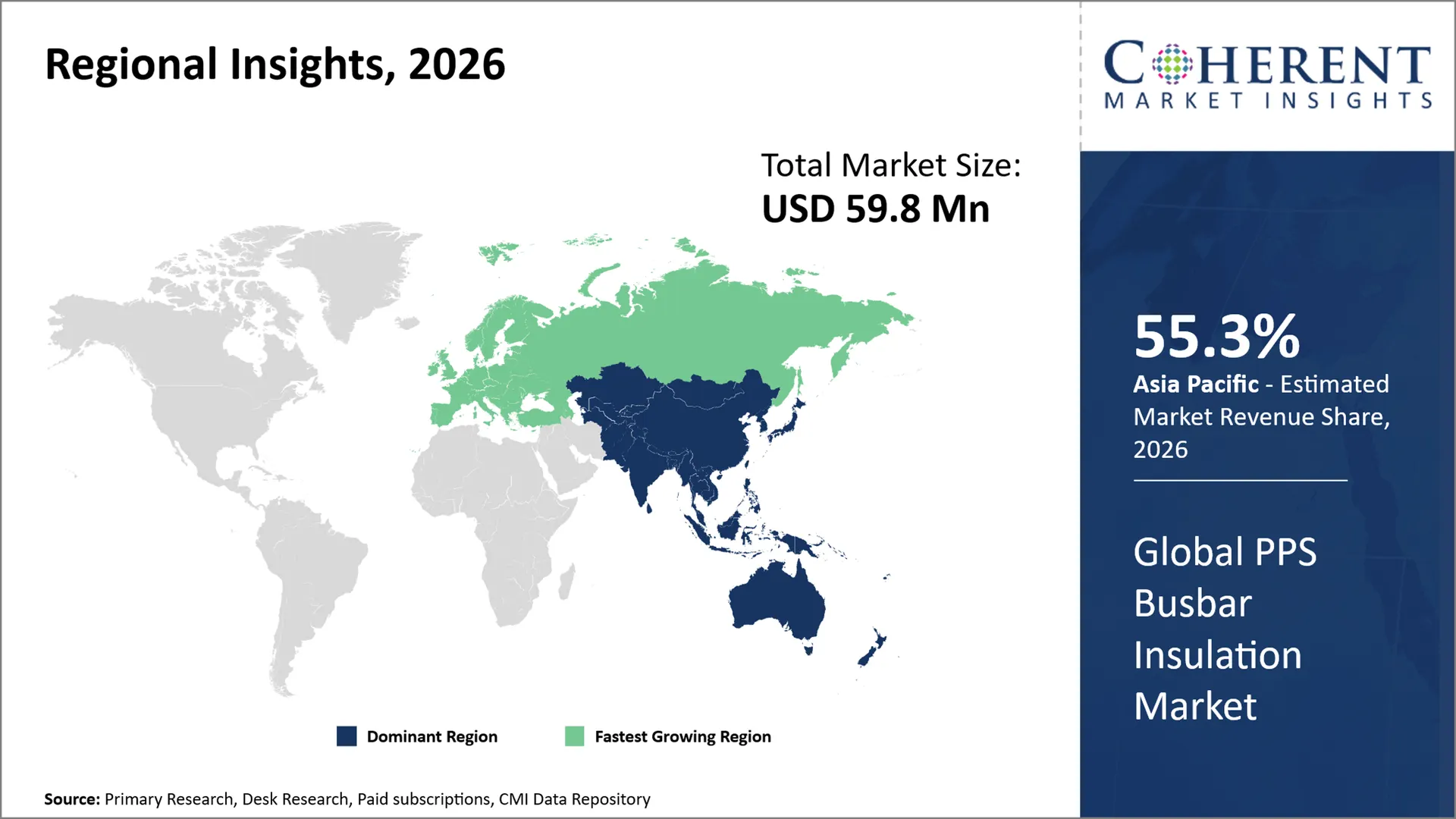
Why Does Asia Pacific Dominate the Global PPS Busbar Insulation Market?
Asia Pacific is expected to dominate the global PPS busbar insulation market, accounting for 55.3% of global revenue in 2026. The region leverages existing automotive component supply chains in China, South Korea and India and concentrated electric vehicle manufacturing and engineering polymer processing capabilities. Proximity to the electrical component manufacturers allows the resin compounders to customize materials, shorten development cycles and maintain competitive production costs. In January 2026, Shenzhen WOTE Advanced Materials announced that its PPS materials were used for electronic components in new-energy vehicles, and shipments continued to grow. This is an example of the increasing commercialization of specialized PPS formulations in the regional automotive supply chains. Therefore, Asia Pacific manufacturers are well positioned to support high volume electrical insulation programs, particularly where procurement decisions are influenced by local technical expertise and reliable material availability.
Why Is Europe Emerging as the Fastest-Growing Region in the Global PPS Busbar Insulation Market?
Europe is expected to be the fastest growing region during the forecast period, holding 21.1% of the global PPS busbar insulation market in 2026. It is growing, which is a sign of the development of regional battery supply chains, specialized electrical component manufacturing and a stronger integration between automotive engineering and material suppliers. More and more European manufacturers are searching for insulation solutions that can satisfy customized conductor configuration and stringent product qualification requirements. In June 2026, Mersen showcased its engineered busbar solutions for electric vehicle batteries and power-electronics applications, made in Europe, at PCIM Europe. The development demonstrates regional capabilities in advanced conductor assemblies which could offer potential opportunities for qualified PPS insulation materials. Those suppliers with application-specific testing capabilities and local engineering support may be able to develop more advantageous positions in European automotive procurement programs.
Global PPS Busbar Insulation Market Outlook for Key Countries
Why Does China Support Growth in the Global PPS Busbar Insulation Market?
China represents an important global PPS busbar insulation market due to its extensive electric vehicle production network, domestic engineering polymer industry, and rapid commercialization of high-voltage powertrain architectures. As Chinese vehicle manufacturers focus more on high current charging capability, technical requirements for electrical insulation around compact conductors and connection assemblies are being added. In March 2025, BYD unveiled its Super e-Platform with 1,000-volt electrical architecture and megawatt-level charging capability. These developments result in an increased importance of the evaluation of insulation materials in terms of dimensional stability, heat exposure and electrical tracking resistance. The development of cost-effective formulations tailored to these operating conditions could be beneficial for domestic PPS compounders and busbar converters. However, the commercial application of this technology will depend on the qualification for specific applications and the competition with other insulating material.
Why Is the U.S. a Key Market for the Global PPS Busbar Insulation Market?
The United States has invested in domestic battery manufacturing, automotive engineering, and is increasingly focusing on localized component sourcing, which has put the country in a strategic position in the global PPS busbar insulation market. Battery module manufacturers require reliable electrical connections. To ensure reliability, consistent component specifications and validated insulation performance are necessary. Toyota said in November it will begin production in 2025 at its USD 13.9 billion battery manufacturing facility in North Carolina, which will support hybrid, plug-in hybrid and battery electric vehicles. This manufacturing expansion has the potential to provide opportunities for domestic suppliers of electrical components, such as qualified insulation manufacturers that serve battery assemblies. U.S. PPS suppliers can improve their competitiveness by offering localized technical support, maintaining automotive grade quality, and partnering more closely with battery system integrators. The choice of materials will continue to be dictated by the particular needs of each vehicle platform.
Why Is South Korea Important in the Global PPS Busbar Insulation Market?
South Korea's polymer compounding engineering capabilities and its existing automotive electrical component manufacturing ecosystem have allowed it to carve out a niche in PPS busbar insulation. Domestic suppliers provide reinforced formulations that meet the thermal and mechanical properties required for insulated busbar assemblies. Hyundai Advanced Materials’ TEKASTEN L4GL50TS PPS grade is identified as being for electric vehicle busbar applications only. The grade has 50% combined glass-fiber and mineral reinforcement. This is a direct indication of PPS formulations which are marketed commercially within the country’s material supply chain. This specialization allows resin compounders to work with manufacturers of automotive components on the reliability of electrical insulation, thermal expansion behavior and dimensional accuracy. South Korean suppliers can increase their international footprint by combining formulation development with standardized testing and customer-specific material qualification.
Why Is India an Important Growth Market for the Global PPS Busbar Insulation Market?
As the production of charging equipment and integration of electric power systems becomes more sophisticated, India becomes an emerging market for PPS busbar insulation manufacturers. Local equipment suppliers are demanding power distribution assemblies that are increasingly smaller in size, yet able to handle higher electrical loads and meet demanding reliability specifications. Harmony Boost solution was launched by Exicom at the Bharat Mobility Global Expo in January 2025. The solution combines battery energy storage with high power electric vehicle charging infrastructure that can accommodate multiple dispensers. The development points to the growing demand for integrated DC power systems in India with the use of appropriate insulating components. For domestic PPS processors, it would be beneficial to develop customized insulating covers, spacers and conductor supports for charging equipment manufacturers. Access to electrical testing facilities, competitive pricing and reliable material sourcing will continue to be critical to the expansion of commercialization.
Why Is Germany a Strategic Country in the Global PPS Busbar Insulation Market?
Germany represents a strategically important global PPS busbar insulation market because of its advanced automotive engineering capabilities, precision component manufacturing, and established high-voltage electrical system development. Germany is a strategically important market for PPS busbar insulation. German manufacturers are concentrating on the integration of insulation into complex battery architectures, tracing the performance of components and strictly controlling production tolerances. BMW Group has started series production of high-voltage batteries of the sixth generation for its Neue Klasse vehicles at its plant in Irlbach-Straßkirchen in Bavaria in October 2026. The factory has automated production processes and strict checks on the assembly of batteries. Potential opportunities exist for PPS suppliers that provide precision-molded insulating components and documented quality performance in their manufacturing practices. German component manufacturers can improve their competitive position through the use of materials that fulfill strict automotive qualification standards, reliable production processes and engineering collaboration.
PPS Busbar Insulation Market – Application Demand and Commercial Landscape
Application Area | Key Market Requirements | Demand Factors | Commercial Opportunities |
EV Battery Packs and Powertrains | High-voltage electrical insulation, resistance to thermal cycling, and reliable protection around battery interconnections. | Integration of compact battery systems, high-voltage traction architectures, and increasingly complex electrical connections. | Customized PPS insulating components for battery manufacturers, automotive OEMs, and Tier-1 suppliers. |
EV Charging Infrastructure | Dielectric reliability, thermal endurance, and protection of conductors operating under repeated high-power charging cycles. | Deployment of DC fast-charging equipment and increased power ratings of charging stations. | Supply of specialized insulation covers, conductor supports, and insulated busbar assemblies to charging equipment manufacturers. |
Industrial Power Electronics | Dimensional stability, electrical isolation, and resistance to demanding operating temperatures. | Modernization of industrial drives, inverters, converters, and power-control equipment. | Application-specific PPS insulation components for industrial equipment manufacturers and electrical system integrators. |
Battery Energy Storage Systems | Reliable DC conductor insulation, resistance to environmental exposure, and long-term operational durability. | Installation of modular battery storage systems and expansion of grid-connected energy storage infrastructure. | Standardized insulating spacers, protective covers, and customized busbar components for battery storage integrators. |
Data Center Power Distribution | Compact insulation geometries, reliable electrical separation, and consistent performance under continuous operating loads. | Increasing rack power density and development of advanced DC power-distribution architectures. | Precision PPS insulation components for server power systems, busbar manufacturers, and data-center electrical infrastructure suppliers. |
Other Applications | Application-specific dielectric properties, material compatibility, mechanical strength, and controlled manufacturing costs. | Specialized requirements across electrical equipment where conventional insulation materials may face performance limitations. | Low-volume customized insulation products, specialty PPS formulations, and engineering support for niche industrial customers. |
How Are Emerging High-Voltage Data-Center Power Architectures Creating New Growth Opportunities in the Global PPS Busbar Insulation Market?
AI data centers are migrating to higher-voltage DC power distribution a sweet spot for PPS busbar insulation suppliers diversifying away from automotive. Molded PPS insulating covers, spacers and customized conductor supports are potential applications for high-density computing equipment that requires reliable electrical distribution in ever-constrained rack and power-conversion configurations.
Material suppliers can benefit by developing compact insulation parts that offer reliable performance at higher operating temperatures, electrical resistance and dimensional accuracy. Among the key customer groups are suppliers of power distribution equipment, manufacturers of data center infrastructure and specialized busbar converters.
Commercial participation will require investment in application specific engineering, dielectric qualification, custom tooling and collaborative prototype development. Suppliers must also demonstrate that they can meet the equipment safety requirements and maintenance practices.
The opportunity is likely to be a boon for established suppliers of engineering polymers and specialist converters who can offer small-batch customization before moving to standard production programs.
Market Players, Key Development, and Competitive Intelligence
Key Developments
- In October 2026, DIC Corporation announced the development of new PPS compounds, including DIC.PPS Z-650-MV BLACK, designed to combine electrical tracking resistance with thermal-cycle durability. This development supports advanced busbar insulation applications where long-term performance around metal inserts is an important material-selection criterion.
- In February 2026, Toray Industries announced the development of a PFAS-free flexible PPS resin with enhanced flame retardancy and heat resistance, targeting electrical and battery-related components. Although not specifically launched for busbar insulation, the development could broaden future material options for flexible protective components in electrified power systems.
- In August 2025, Wacker Chemie announced ELASTOSIL R 531/60, an extrudable silicone rubber designed for insulation of high-voltage battery busbars. Its ability to form an insulating ceramic layer during fire exposure represents a competitive material alternative, encouraging PPS suppliers to strengthen their application-specific performance differentiation.
Competitive Landscape
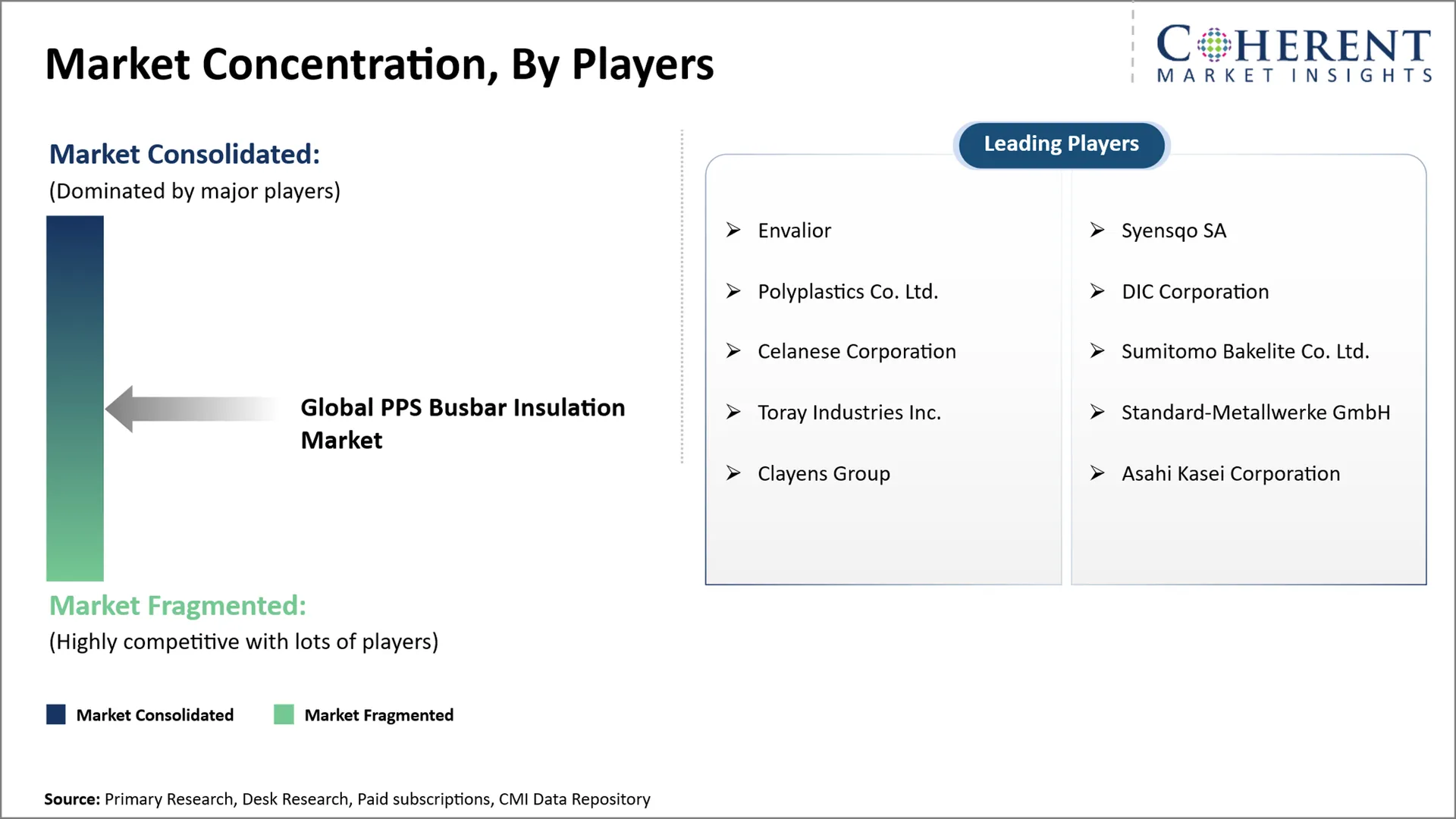
The global PPS busbar insulation market is best described as moderately consolidated at the specialist resin-supplier level, with a more fragmented downstream conversion ecosystem. They include insulation processors, PPS producers, compounders and integrated busbar manufacturers. Regional specialists compete on customization, delivery responsiveness and technical support while established suppliers rely on their manufacturing scale and formulation know-how. Supply consistency and product qualification remain key considerations in the buying process.
Key focus areas include
- Material Performance: Dielectric strength, tracking resistance, heat-cycle durability and flame resistance are all differentiators.
- Processing Efficiency Efficient material usage, consistent molding quality and lower scrap rates result in competitive production costs.
- Their compounds are custom glass filled, mineral filled or impact modified and can be formulated to meet specific engineering requirements.
- Reliability Manufacturing. Confidence in the customer comes from being able to reproduce production specifications and knowing that you have a stable resin to work with.
- Technical Qualification: Long term supply relationships rely on customer specific validation and documented testing.
- Cost Competitiveness: Material consumption and manufacturing yields are optimized to protect margins against alternative insulation materials.
- Commercial Partnerships: Resin suppliers, busbar converters and equipment manufacturers collaborate on the development of customized products.
Market Report Scope
Global PPS Busbar Insulation Market Report Coverage | |||
Report Coverage | Details | ||
Base Year | 2025 | Market Size in 2026: | USD 59.8 Mn |
Historical Data For: | 2020 To 2024 | Forecast Period: | 2026 To 2033 |
Forecast Period 2026 To 2033 CAGR: | 16.80% | 2033 Value Projection: | USD 177.3 Mn |
Geographies covered: |
| ||
Segments covered: |
| ||
Companies covered: | Envalior, Syensqo SA, Polyplastics Co. Ltd., DIC Corporation, Celanese Corporation, Sumitomo Bakelite Co. Ltd., Toray Industries Inc., Standard-Metallwerke GmbH, Clayens Group, Asahi Kasei Corporation | ||
Growth Drivers: |
| ||
Restraints & Challenges: |
| ||
Analyst Opinion (Expert Opinion)
- Leadership in the global PPS Busbar Insulation market is expected to move to suppliers that can take on more responsibility for component-level engineering and production readiness. Manufacturers should look beyond resin grades and develop integrated offerings that include component specifications, tool development, quality assurance and manufacturing support. This would improve customer relationships and provide opportunities for differentiated pricing.
- A greater emphasis on fault tolerant electrical architecture could significantly change the way that insulation material is chosen. Future purchasing decisions may be based on performance during electrical faults and severe thermal incidents as well as during normal operating conditions. This transition may challenge traditional PPS solutions and favor suppliers able to develop hybrid protective structures or to demonstrate superior performance in demanding safety scenarios.
- As manufacturers develop partnerships with suppliers of energy-storage and power-distribution equipment, they should emphasize electrical tracking resistance, thermal-cycle durability, and application-specific product qualification. Investment decisions should take into account competition from alternative polymers, supply limitations of resins and customer validation costs. Capacity expansion without secured customer programs should be approached cautiously to limit underutilization and margin pressure.
Speak to the analyst
Want personalized insights?
Take the findings above to one of our principal consultants, or have the report rebuilt around the segments, geographies and competitors you actually track.
Market Segmentation
- Product Form Insights (Revenue, USD Mn, 2021 - 2033)
- Injection and Overmolded PPS Insulation
- Extruded PPS Busbar Insulation
- Molded PPS Insulating Covers and Spacers
- PPS Films and Laminates
- Resin Formulation Insights (Revenue, USD Mn, 2021 - 2033)
- Standard Glass-Fiber Reinforced PPS
- Glass and Mineral-Filled PPS
- Impact-Modified Reinforced PPS
- Unfilled PPS
- Application Insights (Revenue, USD Mn, 2021 - 2033)
- EV Battery Packs and Powertrains
- EV Charging Infrastructure
- Industrial Power Electronics
- Battery Energy Storage Systems
- Data Center Power Distribution
- Other Applications
- Sales Channel Insights (Revenue, USD Mn, 2021 - 2033)
- Direct Manufacturer Sales
- Busbar Converters and Tier-1 Suppliers
- Specialty Material Distributors
- Regional Insights (Revenue, USD Mn, 2021 - 2033)
- North America
- U.S.
- Canada
- Latin America
- Brazil
- Argentina
- Mexico
- Rest of Latin America
- Europe
- Germany
- U.K.
- Spain
- France
- Italy
- Russia
- Rest of Europe
- Asia Pacific
- China
- India
- Japan
- Australia
- South Korea
- ASEAN
- Rest of Asia Pacific
- Middle East
- GCC Countries
- Israel
- Rest of Middle East
- Africa
- South Africa
- North Africa
- Central Africa
- North America
- Key Players Insights
- Envalior
- Syensqo SA
- Polyplastics Co. Ltd.
- DIC Corporation
- Celanese Corporation
- Sumitomo Bakelite Co. Ltd.
- Toray Industries Inc.
- Standard-Metallwerke GmbH
- Clayens Group
- Asahi Kasei Corporation
Sources
Primary Research Interviews
- PPS resin manufacturers, specialty compounders, and busbar insulation converters
- EV battery manufacturers, automotive OEMs, Tier-1 suppliers, and electrical equipment manufacturers
Stakeholders
- Engineering polymer suppliers, busbar manufacturers, and insulation processors
- EV charging equipment suppliers, battery storage integrators, and industrial power electronics manufacturers
End-use Sectors
- Electric vehicles, EV charging infrastructure, and battery energy storage systems
- Industrial power electronics, data centers, and electrical power distribution
Regulatory and Industry Bodies
- International Electrotechnical Commission (IEC)
- International Organization for Standardization (ISO)
- European Chemicals Agency (ECHA)
- United Nations Economic Commission for Europe (UNECE)
Databases
- UN Comtrade and International Trade Centre (ITC) Trade Map
- Eurostat, International Energy Agency (IEA), and OICA automotive production statistics
Magazines and Journals
- IEEE Transactions on Dielectrics and Electrical Insulation
- Polymer Engineering & Science
- IEEE Transactions on Industry Applications
- Journal of Applied Polymer Science
Associations
- SAE International
- National Electrical Manufacturers Association (NEMA)
- IPC – Association Connecting Electronics Industries
- Society of Plastics Engineers (SPE)
Public Domain Sources
- PPS resin technical data sheets, dielectric testing specifications, and product documentation
- EV battery production, charging infrastructure investments, and PPS manufacturing capacity announcements
Key Standards and Regulations
- ISO 6469-3:2021 – Electric vehicle electrical safety
- IEC 60664-1 – Electrical insulation coordination
- IEC 60112:2025 – Comparative tracking index testing
- UNECE Regulation No. 100 – Electric powertrain safety
Proprietary Elements
- CMI Data Analytics Tool
- Proprietary research repository, supplemented by primary interviews, PPS application-level demand modeling, resin pricing analysis, manufacturing assessments, and competitive intelligence.
Get access to 250+ pages report
Every segment, forecast, competitor profile and data table behind the analysis above — available for instant download.
- ESOMAR Member
- ISO 9001:2015 Certified
- D-U-N-S Registered
- GDPR & CCPA Compliant
Frequently Asked Questions
The CAGR of global PPS busbar insulation market is projected to be 16.80% from 2026 to 2033.
The global PPS busbar insulation market is estimated to be valued at USD 59.8 Mn in 2026 and is expected to reach USD 177.3 Mn by 2033.
When choosing PPS busbar insulation materials, buyers look at dielectric strength, thermal stability, dimensional accuracy, material certifications, pricing and long-term supplier reliability.
The market includes established engineering polymer manufacturers, specialized PPS compounders and busbar insulation converters that compete on material performance, customization capabilities, product quality and technical support.
The price depends on the grades of PPS resin, the reinforcement materials, the complexity of the component, the manufacturing processes, the production volumes and the testing and qualification requirements specific to the customer.
Potential investors should assess manufacturing economics, supplier capabilities, customer qualification requirements, competitive positioning, raw material availability, and opportunities for long-term OEM supply agreements.
The key factors driving the growth of the global PPS busbar insulation market are the increasing adoption of high-voltage busbars in electric vehicles and charging infrastructure, along with the growing need for heat-resistant electrical insulation materials in compact power systems.