

Global PPWR Packaging Coatings Market Size and Forecast – 2026 To 2033
The global PPWR packaging coatings market is expected to grow from USD 15.40 Bn in 2026 to USD 18.35 Bn by 2033, registering a compound annual growth rate (CAGR) of 6.2% from 2026 to 2033. The global PPWR packaging coatings market is driven by growing demand for coatings that reduce plastic packaging components. On February 28, 2025, Huhtamaki, a global leader in sustainable food packaging solutions, announced the development of the recyclable single coated paper cups ProDairy, specifically designed for yogurt and dairy products.
Key Takeaways of the Global PPWR Packaging Coatings Market
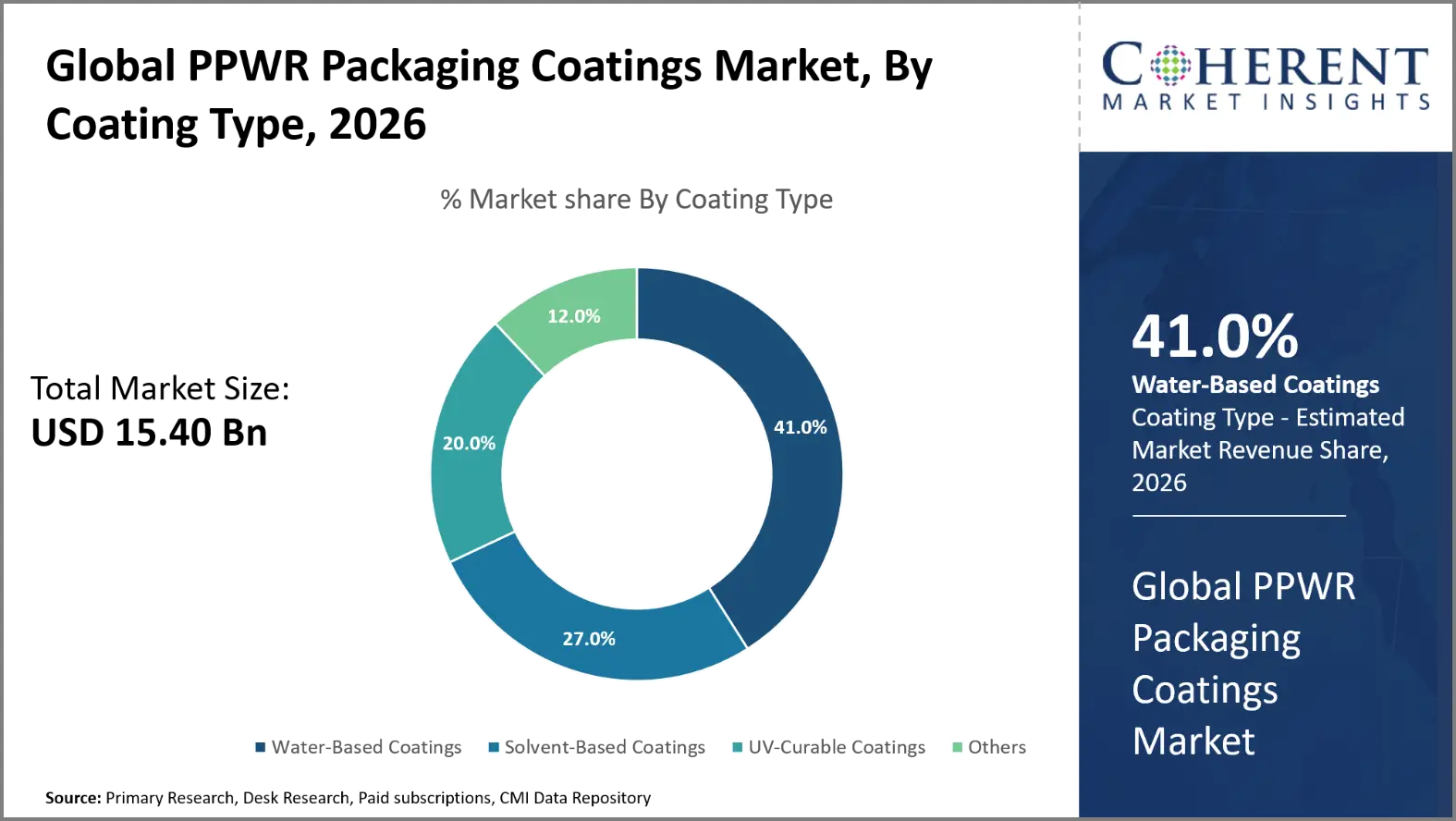
- The Water-Based Coatings segment is expected to account for 41.0% of the global PPWR packaging coatings market share in 2026. Expansion of sustainable food and beverage packaging applications is driving the growth of the segment. On May 6, 2025, Metpack and BASF demonstrated Ezycompost paper coated with ecovio 70 PS14H6. The solution provides barriers against liquids, fats, grease, and mineral oil. It also offers food-contact approval and temperature stability up to 100°C.
- The Oxygen Barrier Coatings segment is estimated to capture 51.0% of the market share in 2026. Increasing investment in packaging redesign to meet regulatory requirements is majorly driving the growth of the segment. On January 26, 2026, Tetra Pak announced a €60 million investment in a dedicated paper-based barrier pilot plant in Lund, Sweden. The facility will accelerate development of aseptic packaging materials replacing conventional aluminum foil barriers.
- The Paper and Paperboard segment is estimated to capture 36.0% of the market share in 2026. Growing demand for functional coatings with improved recyclability is driving the growth of the segment. On November 12, 2025, Cortec Corporation introduced EcoBio Barrier Paper for recyclable and repulpable industrial packaging. The product uses 100% recycled paper stock with a bio-based barrier coating.
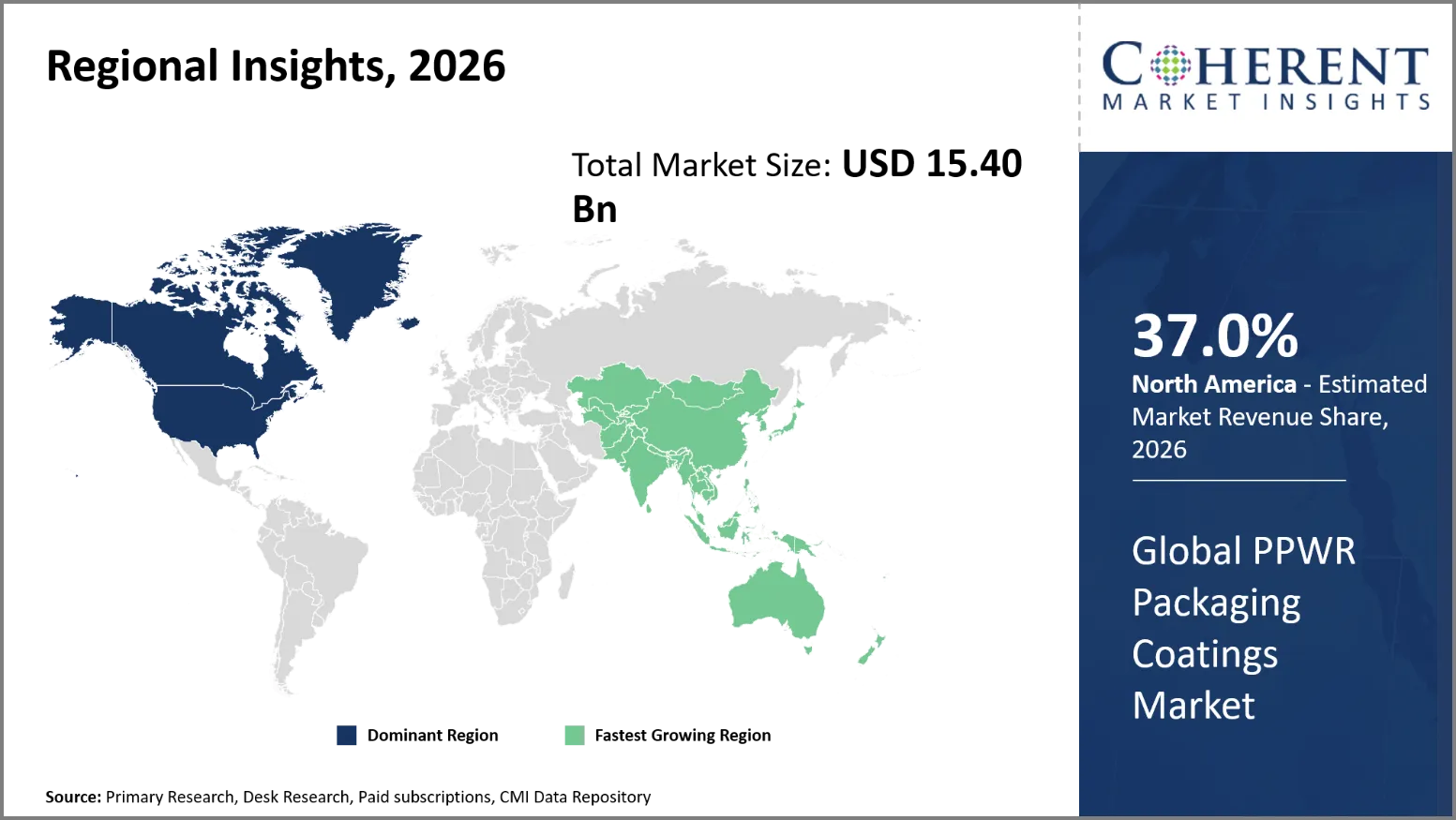
- North America is expected to dominate the PPWR packaging coatings market in 2026 with a market share of 37.0%. Rising adoption of fiber-based alternatives to conventional plastic packaging in North America is driving the growth of the regional market. On January 15, 2025, Cirkla launched molded-fiber Modified Atmosphere Packaging trays as alternatives to conventional plastic meat trays. The technology reduces plastic content by approximately 85%.
- Asia Pacific is expected to account for 25.0% share in 2026. Increasing demand for PFAS-free packaging coating formulations in Asia Pacific is driving the growth of the regional market. On December 23, 2025, Mitsubishi Chemical Corporation developed a SoarnoL-based coating technology for paper food packaging. The ethylene vinyl alcohol coating provides gas-barrier performance and strong oil resistance.
Segmental Insights
Why Does Water-Based Coatings Dominate the Global PPWR Packaging Coatings Market?
The water-based coatings segment is expected to account for 41.0% of the global PPWR packaging coatings market share in 2026. Water-based coatings dominate because they support recyclable packaging development. These formulations provide barrier protection and reduce the need on traditional solvent-based systems. Their low volatile organic compound emissions add to their environmental attractiveness with packaging producers. Water-based technologies have moisture resistance, grease resistance, heat sealability and printability. Manufacturers are increasingly using these coatings as a substitute for polyethylene layers on paperboard packaging. Joncryl technologies for water-based applications in recyclable paper & paperboard from BASF.
On October 9, 2025, Harima released water-based barrier coating agents, with high biomass content, which instill paper with outstanding resistance to water, oil, heat and moisture. Harima’s new barrier coating agents feature a high pine-based biomass content up to 85%, which enhances both their sustainability and capabilities. They are also water-borne and solvent-free, making them safer and better for the environment.
- Current Industry Events of 2026
- Market Size Estimation
- Regional Breakdown
- Competitive Landscape
- Customer Intelligence
- Segmental Analysis
- Pricing Analysis
- Key Market Drivers, Challenges & Future Trends
- Customized Insights Section
Why is Oxygen Barrier Coatings the Most Preferred Coating Functionality?
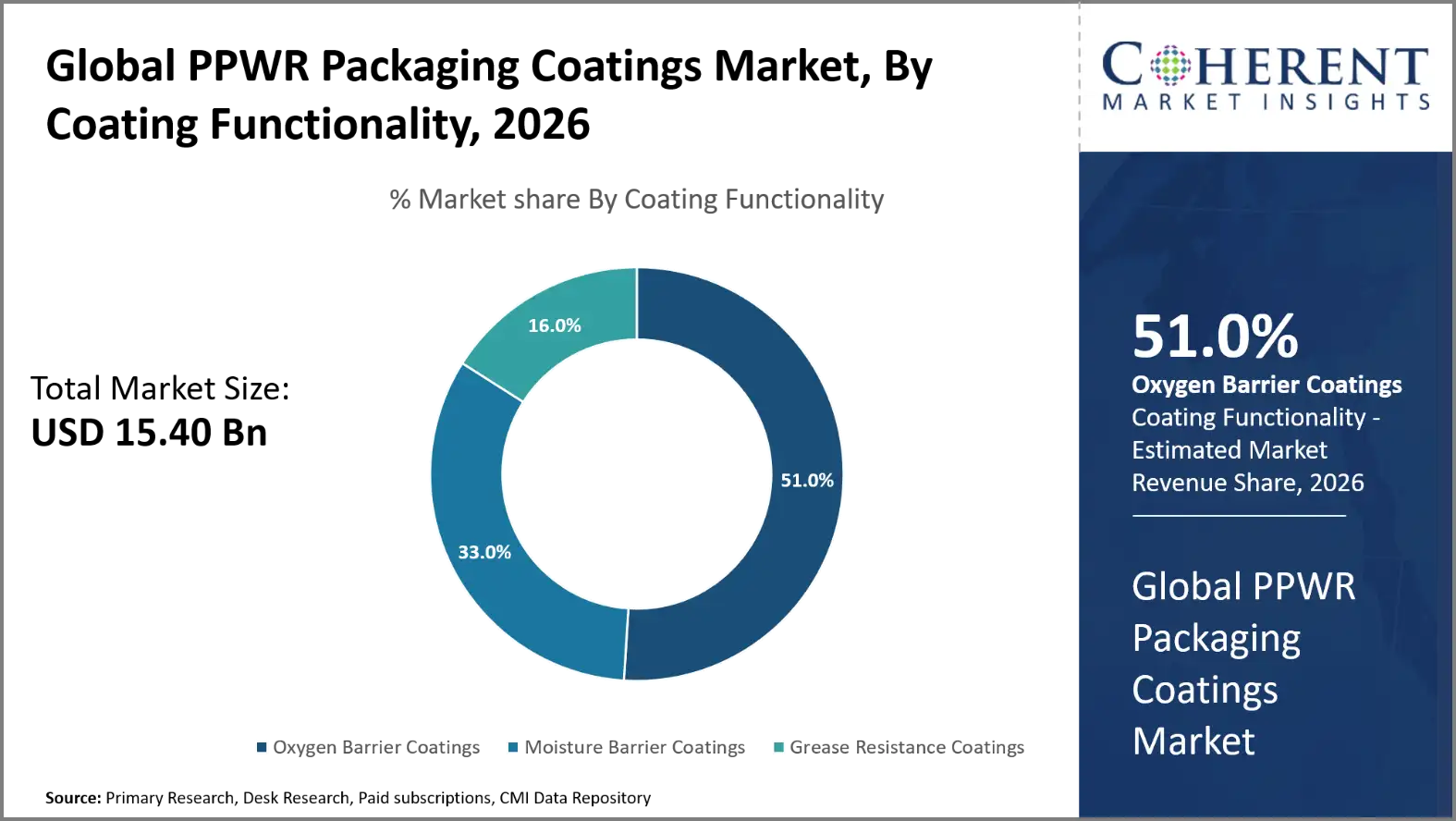
The oxygen barrier coatings segment is expected to account for 51.0% of the global PPWR packaging coatings market share in 2026. Oxygen barrier coatings are preferred to prevent packed products from oxidation and quality loss. Oxidation accelerates rancidity, discoloration, loss of nutrients and flavor deterioration in susceptible foods. These coatings help in increasing the shelf-life of the products and reducing the wastage of food. These are used in snack packaging, bread products, dairy products, coffee packaging, and processed foods. Advanced formulations for improved oxygen resistance without sacrificing packaging flexibility and conversion efficiency. Oxygen barrier technologies are particularly useful for paper-based packaging due to the poor gas barrier properties of untreated cellulose fibers. Manufacturers are developing water- and bio-based replacements that will be easier to recycle.
On July 23, 2025, Lecta commercialized Metalvac Seal Oxygen Barrier, a metalized paper for recyclable food packaging. The substance protects against oxygen, water-vapor, scent and grease. Its low aluminum content supports recyclability within standard paper and cardboard recycling streams. The material is available in 83 and 93 grams per square meter.
Paper and Paperboard Dominates the Global PPWR Packaging Coatings Market
The Paper and Paperboard segment is expected to account for 36.0% of the global PPWR packaging coatings market share in 2026. Paper and paperboard dominate because they offer established recycling infrastructure and renewable material advantages. These substrates are ideal for packaging applications in food, beverage, personal care, pharmaceuticals and e-commerce. In 2024, paper and cardboard represented 40.8% of packaging trash in the European Union. This substance is present in large quantities and causes a major need for practical packaging coatings. Manufacturers utilize barrier coatings to provide moisture resistance, grease resistance, oxygen protection and heat sealability. Water-based coatings can also assist replace conventional plastic layers while allowing paper recycling. BASF and Henkel are working on functional coating technologies for recyclable fiber-based packaging.
On August 14, 2025, Mondi boosted production of its FunctionalBarrier Paper Ultimate after investing in its Solec, Poland factory. The high barrier paper protects against oxygen, water vapor and grease. It achieves oxygen transmission below 0.5 cubic centimeters per square meter daily.
Current Events and their Impact
Current Events | Description and its Impact |
European Union - Packaging and Packaging Waste Regulation (PPWR), 2025 |
|
India - Plastic Waste Management (Amendment) Rules, 2025 |
|
PPWR Packaging Coatings Market Dynamics
Market Drivers
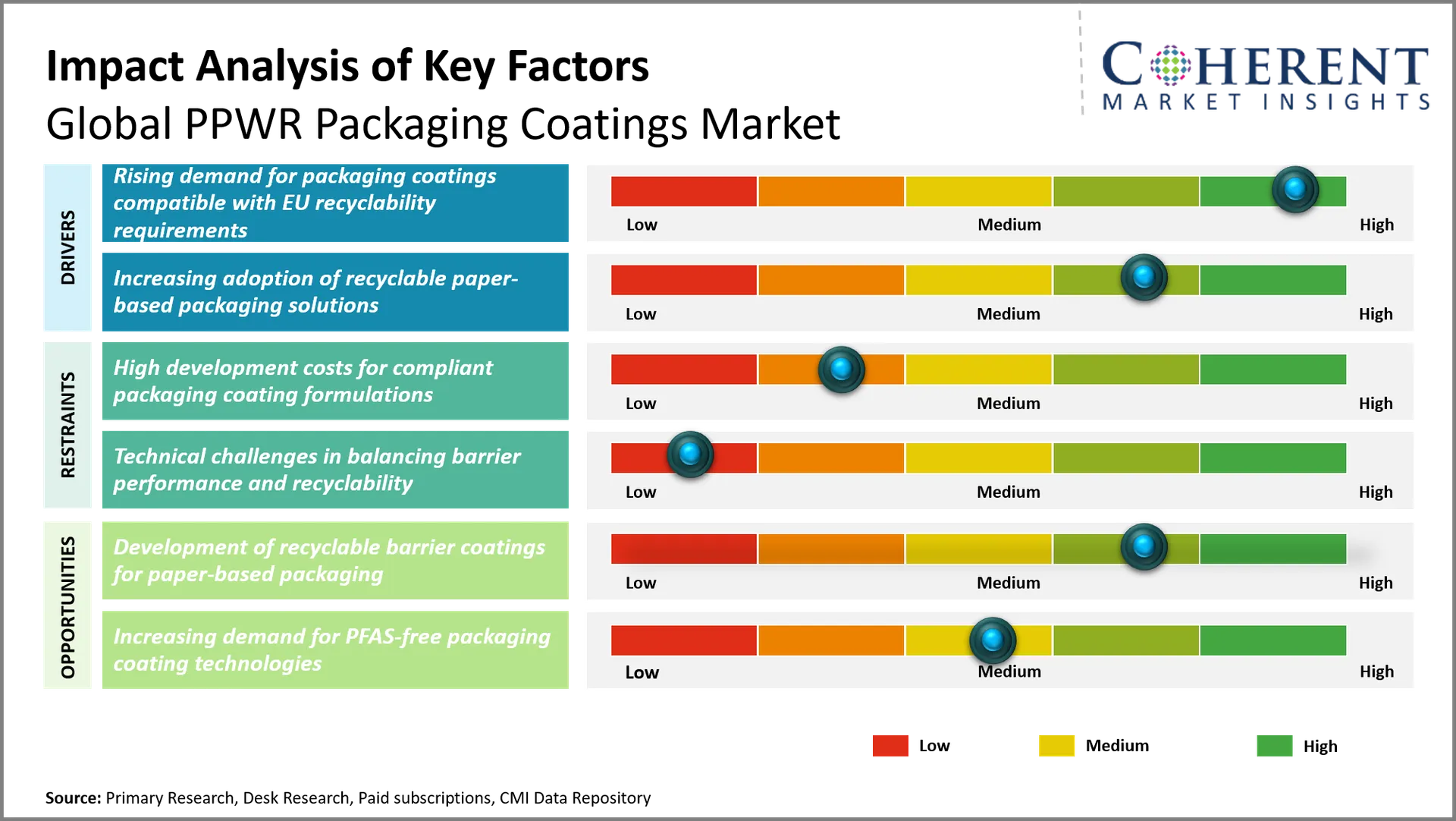
- Rising demand for packaging coatings compatible with EU recyclability requirements: The EU's Packaging and Packaging Waste Regulation is driving demand for coatings that are consistent with packaging recyclability requirements. Regulation (EU) 2025/40 entered into force on August 12, 2026. It will need to be packaged to increasingly stringent recyclability requirements starting in 2030. Packaging makers are re-evaluating coatings that interfere with sorting, repulping and material recovery. This supports the creation of water-based, PFAS-free, and recyclable barrier coating technologies. Suppliers are developing functional coatings that retain moisture, grease and oxygen protection. These technologies allow packaging makers to find the balance between product protection and environmental compliance. There is an increasing demand for coatings that enable fiber-based packaging and mono-material plastic structures.
- On February 26, 2026, Henkel launched the first cold seal solution for barrier-coated paper, Loctite Liofol CS 7106 RE. Henkel closes a technological gap with the Loctite Liofol CS 7106 RE: It is the first Cold Seal solution that was specifically developed for barrier-coated paper packaging. This shift is mainly driven by greater legal pressure for recyclable packaging, including the EU Packaging and Packaging Waste Regulation (PPWR), and growing consumer demand for sustainable packaging solutions.
- Increasing adoption of recyclable paper-based packaging solutions: Packaging producers are increasingly using recyclable paper-based solutions to lessen dependency on conventional plastic packaging. Food producers, retailers and consumer products corporations are experimenting with coated paperboard for both flexible and rigid packaging uses. Water-based barrier coatings can offer moisture resistance, grease resistance and heat sealability without the need for typical plastic laminates. Among others, BASF and Henkel are working on functional coating solutions for fiber-based packaging. Increased investment in recyclable food packaging also provides opportunity for specialized providers of coatings. But paper substrates require proper barrier treatments to safeguard sensitive products from oxygen, moisture and external contamination. The change will increase the demand for repulpable coatings that maintain packaging performance and are compatible with existing paper recycling systems.
- On March 12, 2025, Billerud launched ConFlex HeatSeal, a recyclable paper packaging material that can be heat-sealed. The product is designed for situations where secure sealing and interoperability with current paper recovery systems are required. It could replace plastic packaging in industrial and hygienic applications.
Emerging Trends
- Development of PFAS-Free and Recyclable Barrier Coatings: Packaging producers are looking for PFAS-free barrier coatings that offer better grease, moisture and oxygen barrier properties. These formulations are compliant with food contact safety regulations and compatible with recycled paperboard and developing mono-material packaging architectures.
- Impact: This transition speeds reformulation of coatings, raises research investments and incentivizes producers to develop alternative barrier chemistries. It also raises the demand for scientifically proven recyclable coating options.
- Relevance to the market: Functional paper packaging technology by BASF and Henkel. Their results show promise commercially for vendors developing PFAS-free, water-based and recycling-compatible barrier coating compositions.
- Expansion of Water-Based Coatings for Fiber-Based Packaging: Packaging converters are increasingly adopting water-based coatings as a substitute for conventional plastic laminations on paper and paperboard. These methods provide functional barriers while allowing for better recyclability and less dependence on solvent demanding coating techniques.
- Impact: Greater use drives investment in coating manufacturing capacity, formulation advancements, and application technologies. It also opens new prospects for suppliers to foodservice, e-commerce and consumer packaging producers.
- Relevance to the market: Henkel’s water-based barrier technology and BASF’s Joncryl product portfolio show commercial applications. These advancements are increasing the potential for recyclable paper packaging in the food and consumer goods sectors in Europe.
Regional Insights
Why is North America a Strong Market for PPWR Packaging Coatings?
North America is expected to account for a market share of 37.0% in 2026. Recyclable coatings are in rising demand in North America as packaging regulations move toward producer accountability. Extended producer responsibility standards have been enacted in California, Colorado, Oregon and Washington. Such programs promote brands to look at packaging recyclability and waste management cost in their material selection. The American Forest & Paper Association and Fiber Box Association modified their guideline for recycling coated corrugated in May 2025. This standard analyzes the ability of coated cardboard to be repulped using typical mill technology. Dow’s RHOBARR barrier technology provide recyclable fiber-based food packaging that is heat sealable. Such developments strengthen demand for coatings compatible with established paper recycling infrastructure.
Why Does Asia Pacific PPWR Packaging Coatings Market Exhibit High Growth?
Asia Pacific is expected to register the fastest growth with a CAGR of 6.4% over the forecast period. It is projected to account for 25.0% of the global PPWR packaging coatings market in 2026 offering substantial opportunities because manufacturers increasingly serve international brands requiring recyclable packaging specifications. China’s burgeoning paperboard manufacturing base is driving demand for functional surface treatments in e-commerce and food packaging. India’s Extended Producer Responsibility regulations are forcing packaging makers to enhance material recovery procedures. Japan is developing high-performance gas barrier solutions for paper-based food packaging. December 2025 Mitsubishi Chemical Corporation has developed a technique for coating paper with their SoarnoL ethylene vinyl alcohol resin. These technologies offer oil resistance and gas protection without the need of standard fluorochemical treatments. Regional converters increasingly require coatings balancing product protection, processing efficiency, and recyclability.
Global PPWR Packaging Coatings Market Outlook for Key Countries
Why is U.S. Emerging as a Major Hub in the PPWR Packaging Coatings Market?
Growing demand for recyclable corrugated packaging in agricultural, fisheries and industrial distribution applications is driving the U.S. industry. In May 2025, the American Forest & Paper Association and Fiber Box Association modified its optional coated-fiberboard recycling standard. The standard measures repulpability under present mill conditions. Dow’s RHOBARR 320 Barrier Dispersion delivers paper packaging performance while lowering the need for coating materials. Cortec Corporation’s EcoShield Barrier Coating delivers aqueous, recyclable and repulpable protection against moisture, oil and grease. These innovations respond to the desire for alternatives to standard polyethylene and wax treated corrugated packaging.
Is China the Next Growth Engine for the PPWR Packaging Coatings Market?
China’s large paper making industry presents prospects for functional coatings on corrugated boxes, folding cartons and food packaging. The China Paper Association announced that the output of paper and paperboard in 2024 reached 136.25 million tons. Containerboard output was 30.35 million tons while packaging paper production was 7.75 million tons. Increasing need for domestic production and export-oriented packaging requirements is driving demand for moisture-resistant and grease-resistant coatings. Manufacturers also require surface treatments that are suitable with high-speed printing and conversion. Recyclable coatings can assist Chinese package suppliers meet the material standards of their international customers. These regulations promote the domestic development of water-based barrier dispersions and specialist coating technologies.
Germany PPWR Packaging Coatings Market Analysis and Trends
Germany has a strong packaging converting industry and a well-developed infrastructure for paper recovery. In 2024, the consumption of paper, cardboard and carton packaging amounted to 7.84 million tons. The Federal Environment Ministry stated that Germany’s rate of recycling these items was 86.8%. The country also reclaimed 12.4 million tons of paper in 2024. But pollutants from printing inks, adhesives and paper additives make recycling difficult. This increases the need for coatings that retain barrier qualities without interfering with recovered-fiber processing. In April 2026, Henkel increased its water-based barrier and heat-seal coatings offering.
Italy PPWR Packaging Coatings Market Analysis and Trends
Italy offers prospects owing to its consolidated paper converting sector and its advanced recycling network for cellulose packaging. In 2024 Italy produced 8 million tons of paper and cardboard. 56.1% of the industry’s usage of raw material was paper that was recycled. The country also achieved a 92.4% recycling rate for paper and cardboard packaging. Comieco reported that 346 facilities supported collection and preliminary processing activities. These capabilities encourage demand for coatings compatible with recovered-fiber processing. Italian packaging converters also require grease-resistant treatments for bakery, confectionery, and takeaway food applications. Manufacturers increasingly need recyclable coatings that preserve packaging functionality across these applications.
Japan PPWR Packaging Coatings Market Analysis and Trends
The PPWR packaging coatings industry in Japan is driven by the demand for enhanced food preservation and the development of specific functional materials. In December 2025, Mitsubishi Chemical Corporation developed a technology covering paper with their SoarnoL ethylene vinyl alcohol resin. This technology combines gas barrier properties with oil resistance for food packaging applications. In 2024, paper and paperboard production in Japan amounted to around 21.6 million tons. The recovery of paper for recycling was 14.7 million tons, underlining the necessity of fiber recovery. This encourages coatings that both preserve food quality and facilitate paper recycling. Demand is particularly relevant for convenience foods, processed seafood, bakery products, and premium food packaging.
Global PPWR Packaging Coatings Market - Regional Regulatory Comparison
Region/Country | Major Regulation | Implementation Status | Packaging Scope | Recyclability Requirements | EPR Requirements |
European Union | Regulation (EU) 2025/40 -PPWR | Applicable from August 12, 2026 | All packaging materials including paper, cardboard, plastics, metals, glass, and composites | Design-for-recycling criteria from 2030 with grades A, B, and C and only grades A and B permitted from 2038 | Producer registration, reporting, and financial responsibility under harmonised rules |
U.S. | State packaging EPR laws, California SB 54, Washington PFAS restrictions, and FDA food-contact requirements | State-level implementation with California SB 54 regulations effective May 1, 2026 | Packaging, paper products, and foodservice materials depending on state law | Requirements differ by state with California targeting 65% recycling of single-use plastic packaging and foodservice ware by 2032 | Seven states have enacted packaging EPR laws by 2026 including California, Oregon, Colorado, Maine, Minnesota, Maryland, and Washington |
China | GB/T 44834-2024, GB/T 36392-2025, and GB 4806.10-2025 | Water-based coated paper standard effective May 1, 2025, coated paper standard effective January 1, 2026, food-contact coating standard effective September 2, 2026 | Food packaging paper, paperboard, coated paper, and food-contact coating layers | Standards establish requirements for water-based coated paper and coated paper used in food packaging | EPR and waste-management obligations operate under separate national and local frameworks |
Japan | Containers and Packaging Recycling Law | Established national recycling framework with ongoing implementation | Paper containers, plastic containers, glass containers, and PET bottles | Separate collection and recycling systems apply to designated packaging categories | Businesses bear recycling responsibilities for designated materials while municipalities organise collection |
India | Plastic Waste Management Rules, 2016, EPR Guidelines, and Food Safety and Standards (Packaging) Regulations, 2018 | Plastic packaging EPR requirements active with packaging regulation amendments issued in March 2025 and August 2026 | Plastic packaging under EPR and food-contact packaging materials under FSSAI requirements | Recycled plastic content targets apply to regulated plastic packaging with no equivalent national coating-specific recyclability grading system for paper packaging | Producers, importers, and brand owners have EPR obligations for plastic packaging |
How is Development of Recyclable Barrier Coatings for Paper-Based Packaging Creating New Growth Opportunities in the PPWR Packaging Coatings Market?
Development of recyclable barrier coatings creates prospects to substitute polyethylene laminations and conventional fluorochemical treatments in paper-based packaging. In April 2026, Henkel added to its line of water-based barrier and heat seal coatings for repulpable food and non-food packaging. Its Loctite Liofol CS 7106 RE, released in February 2026, allows cold sealing of barrier-coated paper without heat exposure. In December 2025, Mitsubishi Chemical Corporation has developed a SoarnoL ethylene vinyl alcohol resin coating technology for food packaging that offers gas barrier and PFAS-free oil resistance. Stahl launched its Repura portfolio in May 2026, providing oil, grease, moisture and oxygen protection with paper recyclability. Dow’s RHOBARR 320 Barrier Dispersion also enables 99% fiber recovery when recycling paper. These advances provide potential for specialty coating suppliers in the areas of snack packaging, bakery items, takeaway food and flexible paper packaging.
Market Players, Key Development, and Competitive Intelligence
Key Developments
- On April 30, 2026, Michelman introduced two new bio-based, plastic-free coatings, Nuvita Life 4002 & Nuvita Life 4605. The coatings are meant to give strong barrier performance while enabling recyclability and compostability for retail food packaging applications made from fiber-based materials.
- On February 10, 2026, Tetra Pak announced that it is extending its breakthrough paper‑based barrier technology to high‑speed Tetra Pak A3/Speed filling lines, with Maeil Dairies becoming the first producer in the world to use the solution for its soya beverage. The milestone comes as part of a wider trend in the food and beverage industry, with companies speeding the shift to low-carbon, renewable packaging materials.
- On September 12, 2025, Koehler Paper introduced a new packaging solution: their newly developed Koehler NexPlus Seal Coat paper, which provides superior flex-crack resistance, glossy surfaces and brilliant printing effects. This closes a significant gap in the market by allowing brands to showcase their products in paper packaging with a look and feel that leave nothing to be desired in comparison to plastic.
Competitive Landscape
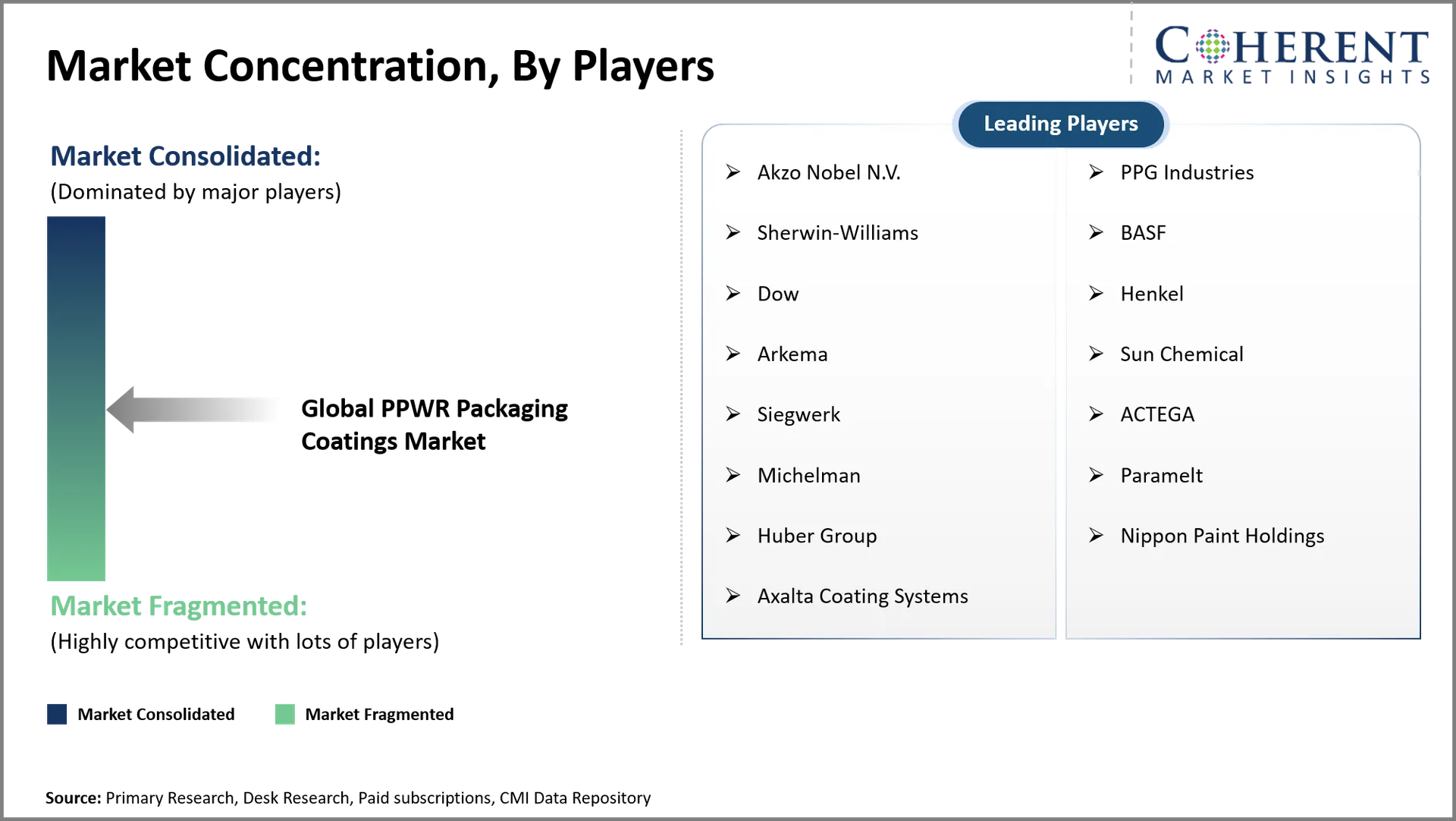
The global PPWR packaging coatings market features competition across barrier chemistry, recyclability, food-contact safety, and coating application technologies. Dow’s RHOBARR barrier coating portfolio keeps it well positioned. RHOBARR 320 is resistant to liquids, oil and grease and has over 99% fiber recovery. Henkel’s recyclable paper packaging focus is the Loctite Liofol RE product family. The CS 7106 RE is ideal for cold sealing barrier coated paper used for snacks and confectionery. BASF reinforces position with Joncryl HPB water-based barrier resins. Works with UPM to integrate barrier sheets with functional coating technologies. In May 2026, Stahl presented Repura, a range designed for the protection of oil, grease, moisture and oxygen. Mitsubishi Chemical Corporation developed paper coatings based on SoarnoL that offer both gas barrier performance and oil resistance. They set themselves apart by application specific formulas, suitability to recycling and cooperation with packaging converters.
Top Manufacturers and Notable Products in the PPWR Packaging Coatings Market
Manufacturer | Notable Product | Key features |
BASF SE | Joncryl HPB 4011, Joncryl HPB 1631/1633, Joncryl HPB 1701 | Water-Based Barrier Technology, Moisture Resistance, Grease Protection, Heat Sealability, Repulpability, Low Volatile Organic Compound Emissions |
Henkel AG & Co KGaA | Loctite Liofol CS 7106 RE, Water-Based Paper Barrier Coatings, Heat-Seal Coatings | Recycling-Compatible Formulations, Cold Sealing, Grease and Moisture Resistance, Repulpability, Food-Contact Suitability |
Dow Inc | RHOBARR 320 Barrier Dispersion | Water-Based Barrier Dispersion, Grease and Oil Resistance, Moisture Protection, Compatibility with Recyclable Paper Packaging |
Stahl Holdings BV | Repura Barrier Coatings | Oxygen, Water-Vapor, Oil and Grease Barriers, Direct Food-Contact Applications, Repulpability, Plastic Replacement |
Michelman Inc | Nuvita Life 4002, Nuvita Life 4605 | Bio-Based Coating Formulations, Heat Sealability, Grease Resistance, Moisture Protection, Recyclable Paper Packaging Compatibility |
Market Report Scope
Global PPWR Packaging Coatings Market Report Coverage | |||
Report Coverage | Details | ||
Base Year | 2025 | Market Size in 2026: | USD 15.40 Bn |
Historical Data For: | 2020 To 2024 | Forecast Period: | 2026 To 2033 |
Forecast Period 2026 To 2033 CAGR: | 6.20% | 2033 Value Projection: | USD 18.35 Bn |
Geographies covered: |
| ||
Segments covered: |
| ||
Companies covered: | Akzo Nobel N.V., PPG Industries, Sherwin-Williams, BASF, Dow, Henkel, Arkema, Sun Chemical, Siegwerk, ACTEGA, Michelman, Paramelt, Huber Group, Nippon Paint Holdings, Axalta Coating Systems | ||
Growth Drivers: |
| ||
Restraints & Challenges: |
| ||
Analyst Opinion (Expert Opinion)
- The future of the PPWR packaging coatings market will depend on replacing conventional plastic laminations with functional recyclable coatings. Water-based barrier dispersions and PFAS-free chemistries will become important development priorities. Manufacturers will increasingly combine oxygen protection, grease resistance, moisture barriers, and heat sealability within individual coating systems. Technologies supporting paper repulpability will gain commercial importance. Suppliers capable of maintaining food protection alongside recycling compatibility will secure stronger customer relationships. Specialty coating manufacturers should prioritize application-specific formulations rather than developing single-purpose barrier products.
- The strongest opportunities will emerge in water-based paperboard coatings, particularly for foodservice, confectionery, bakery, and flexible food packaging. Germany, Italy, and France offer attractive opportunities because of their packaging conversion industries and European regulatory exposure. The U.S. provides opportunities through recyclable foodservice packaging and coated corrugated applications. China and Japan offer additional potential through advanced paper manufacturing and specialty barrier development. Oxygen barrier coatings, PFAS-free grease-resistant coatings, and recyclable heat-seal systems deserve particular attention. Suppliers should prioritize coatings compatible with paper recycling while maintaining performance under commercial packaging conditions.
- Market participants should establish technical partnerships with paper mills, converters, and food packaging manufacturers. They should develop formulations compatible with existing gravure, flexographic, rod, and curtain coating equipment. Companies should independently validate repulpability, food-contact compliance, oxygen transfer and moisture resistance. Product portfolios should cover multiple paper grades and packaging uses. Regional investment in technical labs can speed up customer validation and formulation customization. Manufacturers should also give a comprehensive documentation of the coating composition and confirmation of recycling compatibility. Such skills can be a differentiator for suppliers as packaging converters consider alternatives to polyethylene laminations.
Speak to the analyst
Want personalized insights?
Take the findings above to one of our principal consultants, or have the report rebuilt around the segments, geographies and competitors you actually track.
Market Segmentation
- Coating Type Insights (Revenue, USD Billion, 2021 - 2033)
- Water-Based Coatings
- Solvent-Based Coatings
- UV-Curable Coatings
- Others
- Coating Functionality Insights (Revenue, USD Billion, 2021 - 2033)
- Oxygen Barrier Coatings
- Moisture Barrier Coatings
- Grease Resistance Coatings
- Packaging Material Insights (Revenue, USD Billion, 2021 - 2033)
- Paper And Paperboard
- Polyethylene
- Polypropylene
- Polyethylene Terephthalate
- Aluminum
- Metal Packaging
- Application Insights (Revenue, USD Billion, 2021 - 2033)
- Food Packaging
- Beverage Packaging
- Pharmaceutical Packaging
- Personal Care Packaging
- Household Product Packaging
- Industrial Packaging
- Regional Insights (Revenue, USD Billion, 2021 - 2033)
- North America
- U.S.
- Canada
- Latin America
- Brazil
- Argentina
- Mexico
- Rest of Latin America
- Europe
- Germany
- U.K.
- Spain
- France
- Italy
- Russia
- Rest of Europe
- Asia Pacific
- China
- India
- Japan
- Australia
- South Korea
- ASEAN
- Rest of Asia Pacific
- Middle East
- GCC Countries
- Israel
- Rest of Middle East
- Africa
- South Africa
- North Africa
- Central Africa
- North America
- Key Players Insights
- Akzo Nobel N.V.
- PPG Industries
- Sherwin-Williams
- BASF
- Dow
- Henkel
- Arkema
- Sun Chemical
- Siegwerk
- ACTEGA
- Michelman
- Paramelt
- Huber Group
- Nippon Paint Holdings
- Axalta Coating Systems
Sources
Primary Research Interviews
- Packaging Coatings Manufacturers
- Sustainable Packaging Solution Providers
- Raw Material Suppliers (Resins, Binders & Additives)
- Regulatory Compliance & Environmental Consultants
Magazines
- Packaging World Magazine
- European Coatings Journal
- Packaging Digest
- Coatings World Magazine
Journals
- Journal of Coatings Technology and Research
- Progress in Organic Coatings (Elsevier)
- Journal of Cleaner Production
Associations
- European Coatings Association (VdL)
- Packaging Europe Association
- American Coatings Association (ACA)
- Flexible Packaging Association (FPA)
Public Domain Sources
- European Commission - PPWR (Packaging and Packaging Waste Regulation) Official Portal
- U.S. Environmental Protection Agency (EPA) - Sustainable Packaging Guidelines
- United Nations Environment Programme (UNEP) - Packaging Waste Reports
- European Environment Agency (EEA) - Packaging & Waste Statistics
Proprietary Elements
- CMI Data Analytics Tool
- Proprietary CMI Existing Repository of Information for Last 10 Years
Get access to 250+ pages report
Every segment, forecast, competitor profile and data table behind the analysis above — available for instant download.
- ESOMAR Member
- ISO 9001:2015 Certified
- D-U-N-S Registered
- GDPR & CCPA Compliant
Frequently Asked Questions
The global PPWR packaging coatings market is expected to stand at USD 15.40 Bn in 2026 and is expected to reach USD 18.35 Bn by 2033.
The CAGR of the global PPWR packaging coatings market is projected to be 6.2% from 2026 to 2033.
Rising demand for packaging coatings compatible with EU recyclability requirements and Increasing adoption of recyclable paper-based packaging solutions are the major factors driving the growth of the global PPWR packaging coatings market.
High development costs for compliant packaging coating formulations and Technical challenges in balancing barrier performance and recyclability are the major factors hampering the growth of the global PPWR packaging coatings market.
In terms of coating type, water-based coatings segment is estimated to dominate the market revenue share in 2026.
PPWR packaging coatings are functional surface treatments designed to improve packaging performance while supporting European Union recyclability requirements.
PPWR encourages manufacturers to develop coatings that preserve packaging functionality without compromising material recyclability.